Children and Urban Space

‘Children and Urban Space’, Robert Rooney Seminar, Centre for Contemporary Photography, 24 April, 2013

Powerpoint slides:


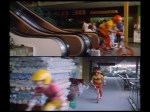
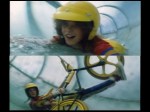
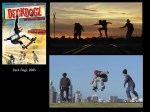
 In response to Robert Rooney’s extraordinary photographs I want to draw two very thin threads through the history of Australian photography and film.  I’m going to be looking at two separate filaments which have linked together the way children have been used to define or re-define urban space in Australia. The first is the figure of the street urchin, who has been seen as a combination of both the picturesque and the pathogenic. The second occurs in three films, Kid Stakes, 1927, BMX Bandits, 1983 and Deck Dogz, 2005, in which children or adolescents pursue trajectories at a tangent to the normative social geographies of Sydney.

Street Urchins and the Official Gaze

Children have been crucial motifs in the official photographs of urban space. They appear regularly in the photographs documenting the cleansing of The Rocks area following the outbreak of the Bubonic Plague in January 1900.

When these photographs were rediscovered in the 1970s the historian Max Kelly recognized that the photographer had also captured a new relationship between citizen and camera, in which the children had also become enmeshed.  He said:

Here people are as they were. There is no artifice. Some are caught unawares, some are apprehensive. Others are just as interested in the photographer as he is in them. Most have only rarely, if ever, had their photographs taken.

The presence of the small, kinetic children, often caught in fleeting movement or play, further activates the deep, wide-angle space of the photographs, while their social status as vulnerable innocents gives the political meaning of the slum clearance an extra symbolic validation.

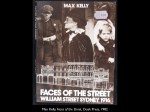
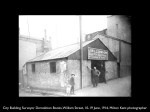
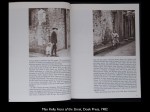
Children were deployed to a similar effect in the photographs methodically taken over a period of just one week, in 1916, to document all the buildings to be demolished for a widening of Sydney’s William Street. In his 1982 book Faces of the Street, Max Kelly entered this systematic space and enlarged sections from the evidentiary photos, performing a kind of retro street photography within the archive. Once excavated from the scene the child becomes a kind of readymade punctum in the overall scenarios of the official photographs.

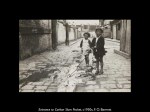
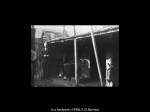
This can also be seen in the Melbourne Housing Commission photographs of F. O. Barnett from the 1930s, where the presence of children overlays the spatial structuring of the labyrinthine, enclosed, segregated slum with a temporal dimension of social poverty. Here, children are social pathogens: will they stay poor like their parents, or will they erupt from the slums and threaten the rest of Melbourne?

However, the stern boot-steps of official photographers have always been shadowed by the soft pad of art photographers.

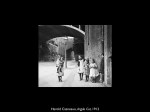
For instance in 1910 Harold Cazneaux wrote an article called In and about the City with a Hand Camera, a record of his own engagement with the streets which, he said, ‘have all the humour and pathos of life’. For Cazneaux he streets contained artistic lighting effects and picturesque subject matter waiting to be discovered by the intrepid Pictorialist. In particular they contained children who could be photographed in such a way as to hark back to the figure of the urchin when, for the nineteenth century viewer, there was an aesthetic and erotic frisson to be had in seeing innocence potentially threatened. But Cazneaux also admitted that the streets were resistant to his gaze. Without any official authority to back him up, a mute stand-off could quickly become outright hostility and demolish the Pictorialist’s personal old world fantasy. As he warned:

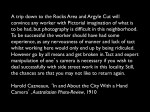
A trip down to the Rocks Area and Argyle Cut will convince any worker with Pictorial imagination of what is to be had, but photography is difficult in this neighborhood. To be successful the worker should have had some experience, as any nervousness of manner and lack of tact whilst working here would only end up by being ridiculed. However go by all means and get broken in. Tact and expert manipulation of one’s camera is necessary if you wish to deal successfully with side street work in this locality. Still, the chances are that you may not like to return again.

However Cazneaux did return again and again to the slums. In the late 1940s and 50s — because of a combination of the post war housing shortage, the rise of the Communist Party and Left politics in Australian art, and the ascendancy of the Documentary genre in photography —  ‘slum portraits’ had a popular resurgence.

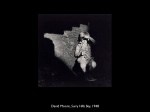
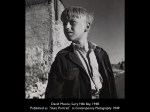
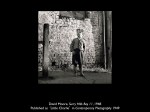
In 1948 Cazneaux turned the wee little pictorial gems which he had made back in the 1900s, into brand new bromide enlargements.. He also wrote a print criticism column for Contemporary Photography magazine to which aspiring photographer’s sent prints for critique. One of these was David Moore, an ambitious photographer working at Max Dupain’s studio who was assembling a portfolio to take to London to try to break into the picture magazine market. Moore had identified Sydney’s slums as a prime spot to get photographs that could be of interest to overseas picture editors. Like Cazneaux before him he travelled from his comfortable North Shore home to enter the slum in search of urchins. He titled one of his photographs ‘Little Charlie’, perhaps in reference to Charlie Chaplin’s character of The Tramp, and sent it in to Cazneaux, who was sympathetic to the young photographer’s editorial intentions.

Has the photographer been concerned with the sunlight and texture shown on the figure, post and old brick wall, or the slum-like surrounding the boy is growing up in … The photographer has supplied the clue to the motif. His title ‘Little Charlie’ is a definite statement. We can use our imagination and extract a reason. ‘Little Charlie’ seemingly looks forward to the future — and what of his future? Who knows? The fact that the print can thus arouse our interest and sympathy places it on a higher plane of pictorial expression. I make no comment as to how this photograph could be improved.  At the moment we are more concerned with its message.

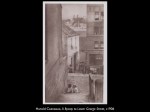
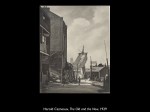
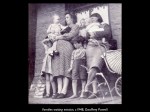
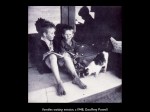
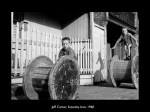
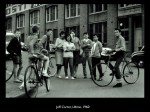
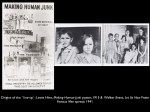
During this period many other photographers, such as Geoffrey Powell, Henry Talbot, Jeff Carter and Mark Strizic, also shot picturesque documentary urchins around the slums of Sydney. Many of these photographs — both the official ones and the artistic ones — have a very similar composition. They place the figures of the children precariously along the deep vertiginous angles of alleyways and walls, leading backwards and forwards through space. This visually amplifies the metaphorically precarious temporal status of the slum child, moving simultaneously backwards and forwards through the processes of social development and historical progress, as well as potentially across the barrier between the slum and the rest of the city. The ‘deep space’ shot dominates, but sometimes the ‘line-up against the wall ‘shot, which harks back to the graph–like display of poverty in Lewis Hine or Walker Evans, also occurs

It is probably too much of a stretch to tie this thread through to Carol Jerrems’ intensely personal engagement with the young skinheads she taught around Heidelberg in 1975. There are too many differences. She was not an outsider like the other photographers, rather she knew her subjects personally and she found them erotically compelling as individuals, rather than types. In filming the uncompleted film School’s Out she was a precarious guest in the communally enclosed spaces they had created for themselves on the banks of the Yarra. Looking at these extraordinary sequences now, not only does the intense eroticisation of the encounter come through, but also the sense that at any moment the rules that had been set to allow the encounter to happen in the first place, may suddenly be broken.

However Jerrems’ work does allow me to segue to the three films I want to finish with, which are also concerned with getting inside the spaces children create for themselves. Although basically generic kids movies, each film sets up a dominant panoramic view of the city, beneath which, or across which, a group of children move, following their own needs and desires, and evading the higher, clumsier and more inflexible demarcations of hapless adults.

Ludic Trajectories


Kid Stakes

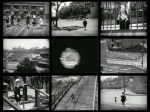
The popular children’s film Kid Stakes, made in 1927, contains an astonishing sequence that perfectly, elegantly and poetically, captures the spatial politics of Sydney in the 1920s. Based on a comic strip, the film centres on the slum kids of Woolloomooloo who play cricket and live their lives freely in front of the wharves and ships of Woolloomooloo Bay. Above them lies Potts Point, full of its posh mansions and restrictive mores. Suddenly, out of the rows of grand houses at the bottom of Victoria Street, emerges an upper class boy who yearns for the freedoms of the Woolloomooloo kids. Through the bars of his suburban prison he performs a panoramic sweep of the city across the bay. But this panorama is not a projection into the future, instead he is assaying a potential personal itinerary. He sees the kids playing, and the camera irises in. The Woolloomooloo steps dwarf him as he descends down them like a latter-day Dante, but the steps are leading him towards the salvation of the slums. Initially the slum kids taunt him, but when he proves he can fight he joins their gang and, his velvet clothes now torn, he becomes free. He is able to lead the kids back up the steps, past a sleeping policeman on guard between the two elevations, the two classes, of Sydney, and into the wilds of Potts Point for further adventures.

BMX Bandits

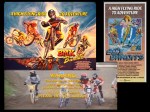
In BMX Bandits Nicole Kidman and her two friends are being chased by two bumbling baddies. The film is a ‘location film’ shot in Manly, but since it is trying to cash in on the BMX craze of the early 80s it is entirely an urban film — unusually for a beach film the kids never set foot on the sand, and never enter the surf. The baddies, who style themselves as American gangsters, drive a big American car and so are compelled to slew back and forth along the switchback roads of Manly’s hills, whilst the BMXers nimbly dart directly up and down the slopes, as well as through shopping centres and building sites. In one extraordinary sequence they transition between urban strata in a dizzying delirium as they slide down the fiberglass spirals of the Manly Waterworks, complete with their bikes.

Deck Dogz

The three nimble skateboarders in 2007’s Deck Dogz are also being chased by two lumbering and hapless baddies. But, rather than the unstructured romp of BMX Bandits, there is an attempt to embed their skateboarding thrills and spills in a Jospeh Cambellesque hero’s journey from the badlands of Sydney’s western suburbs to a beachside skate bowl where the Holy Grail of corporate sponsorship by a world famous skater awaits. But, as in Kid Stakes and BMX Bandits, panoramic horizon lines of the city also feature. These horizon lines are a spatial limit beneath which only children, equipped with either slum-bred insouciance, or BMX Bikes, or skateboards, can travel. In Deck Dogz the skateboarders travel down a stormwater drain, which morphs into the virtual space of a computer game to deposit them magically within the city of Sydney itself.

Martyn Jolly

The Australian National University’s Inkjet Research Facility

The Australian National University’s Inkjet Research Facility’, Imprint Magazine, March. Pp28-29

The ANU’s Inkjet Research Facility in the ANU School of Art was founded in 2003 with a remit to research the creative arts potential of inkjet printing on as wide a variety of different substrates as possible, and to integrate inkjet printing as closely as possible with other disciplines taught in the school such as photography, printmaking, drawing , textiles and painting.

The approach the Facility takes, of methodically and slowly applying hands on, studio based, iterative experimental processes to the technologies of inkjet printing, is very much in keeping with the ethos of the School of Art in which it is based. While the facility has nurtured many younger artists, many of the other artists who have experimented on our Océ Arizona, wide-format, flatbed, UV cured printer already had long experience in studio-based, hands-on techniques in other disciplines — particularly painting, printmaking, textiles and photography. They are already experts in working closely with the materials of their discipline in the ‘atelier’ of the studio or darkroom. To them the digitisation of image printing is just part of what has been a larger evolving and mutating environment in which they have continued to make their work.

Taking a low volume, experimental approach to equipment primarily designed for the high volume, highly standardised, requirements of an industry is not all that new, even if within traditions of art it has always the manual processes that have been valorised.  In the discourses of art photography and printmaking it is the craft and materiality of the traditional darkrooms or print studio that was usually celebrated.  The material processes of light falling on emulsion, or light projected through the finely-tuned magenta, yellow and cyan filters of colour enlargers were once the only way that photographic images were ‘bodied forth’ and their meanings created. Photographers thought in terms of cones of light causing chemical reactions across emulsion. Different emulsions and chemicals, they knew, reacted in different ways. Darkroom printers controlled those reactions directly through manually calibrating light filtrations and subtly changing chemical reactions.  Similarly prints and paintings were once chiefly made by the squeegeeing of ink through the fine mesh of a silk screen, or the pushing of paint into the weave of canvas. In these studio processes the intuitive control of the hand, twisting and pushing, inflecting and directing with micro-muscular movements, was what was valorised ‘ — by the market, the connoisseur and the historian.

However, just as art history was celebrating the individuated manual control which apparently reigned in artists’ darkrooms and studios over the centuries, the artists themselves always knew that at the same time they were dealing with automatic processes, often derived from industrially scaled reproductive technologies, such as lithography or screen printing, that had become superseded in the factory or commercial printery, but had survived in the atelier. They also knew that art history’s divided narratives of photography, printmaking and painting meant little to them when it came to the actual production of their images. Most art has always been ‘multimedia’ to some degree, combining various processes from photography, printmaking and painting, as well as, of course, collage, performance and construction.

This history continues. If you were forced to identify year one of the so-called ‘digital revolution’, you might nominate 1988. It was the year the first digital camera was invented, the Fuji DS-IP , which directly recorded images as a computer file onto a 16 MB card. It was the year the JPEG and MPEG compression standards were formulated. It was the year Thomas and John Knoll signed a licensing agreement with Adobe to distribute the software they were developing, which they had just christened ‘Photoshop’. And it was the year the Hewlett Packard Deskjet printer was released, the first consumer-priced printer to translate the bitmapped digital image into a matrix of microscopic jets of ink. Yet seen from the seen from the point of view of most of the artist who have worked in the Inkjet Research Facility, the year 1988 is not really so cataclysmic. It has simply introduced new technical procedures, and new material spaces into the artist’s working process — a process which has been going on for a long time.

For instance in 2009 the IRF hosted the ANU’s H. C. Coombs Creative Arts Fellow, the late Michael Callaghan. Well-known for his iconic screen-printed posters of the 1970s, Callaghan had a thirty-year career as a graphic designer, painter, sculptor, and printmaker. He brought all of this to bear as he worked closely with the IRF’s printer at the time T. J. Phillipson, who is now working in London at Cut Laser Cut. For a major exhibition which was first shown at the ANU School of Art Gallery, and then at the Damien Minton Gallery as The Torture Memo, Callaghan graphically collaged and layered the familiar media images and slogans of the recent Iraq War. The media images appeared in silhouette, the slogans in repeated patterns of both English and Arabic script. For one ambitious work, eventually called ‘What the US Government Did at Gitmo’, the patterns were printed onto marine ply which was then laser cut and assembled into a chair, such as a torture victim may have used. The chair was placed on a large mirror, itself printed with more script, which in turn reflected an image on the underside of the chair’s seat.

Other researchers didn’t exploit the Océ Arizona’s ability to print on a variety of substrates, as much as its ability to cover a lot of print area quickly, and at reasonably high quality. For instance, for his 2009 PhD examination David Wills produced one of his massive ‘Wunderwall’ installations. Titled ‘There Are Too Many Things in the Cupboard’, it comprised over 3000 separate images, each printed directly on 150 x 200mm fomecore, installed in a floor to ceiling grid almost twenty-seven metres wide.

So far there have been two exhibitions showcasing the Inkjet Research Facility’s work, each held in collaboration with colleagues from the University of South Australia’s School of Art, Architecture and Design. The most recent, Assisted Reproduction, curated by Dr Denise Ferris, was held at the ANU School of Art in October 2012.

It featured work by the painter Gary Smith, a graduate of the School’s painting workshop. For a series of large canvases of glowering industrial landscapes called ‘Refined’, he used a technique researched in the IRF with the aid of an ArtsACT grant.

In the catalogue Smith said:

‘My work over the past three years has explored how contemporary inkjet technologies and traditional glaze painting techniques can be layered and integrated to broaden the scope of painting. … I create multi-pass composite prints, that seek to utilize the inkjet facility as a painter would develop a picture rather than how a photographer would output a print.’

Elsewhere he explained in more detail:

‘The canvas is initially prepared with many layers of silver and pearlescent glazes. These act like a screen in a theatre and add luminosity to the final image. The image to be layered is then split into each of the colours, ie CMYK, and printed separately as a reduced percentage. Between each layer that is printed the whole canvas is glazed with acrylic. This acts to separate each color and to help break the image down. This process is repeated until the image reaches the required level of saturation. These can vary from work to work being 8 layers of printing and 8 layers of glazing to 24 layers of printing and 24 layers of glazing.’

This technique was also used in the collaborative painting Smith did with Frank Thirion. Called ‘The Faceless Men’ it was shortlisted for the 2012 Archibald Prize.

Another longstanding artist with a long association with the IRF is Annie Trevillian, who has been experimenting for several years with printing directly on textiles. For Assisted Reproduction she exhibited work from the site-specific installation ‘Remnants’, about the fugitive historical existence of the Indigenous and European men, women and children who once lived near some old house ruins left in the middle of the new Canberra suburbs of Gungahlin.  For the sixteen large format images use in the installation she wanted to print her motifs, which were derived from various aspects of the site including its artefacts, buildings, orchards, food, animals and machinery, onto a similarly fugitive, remnant material, so she chose a crisp  but lightweight polyester fabric called polyvoile.

In the catalogue Trevillian said:

‘Because of the transparency of the fabric the imagery was either hidden or obvious depending on the light and where you are standing. It definitely conveyed the idea that there was a history to the site whether hidden or known. A bit like prompting memories of people and places. I worked closely with Amy Macgregor from the IRF sampling colours. Stretching the fabric taut and securing it with masking tape pre printing was very reminiscent of stretching mesh for screen printing. I enjoy the fact that my skills from previous art making activities can be translated to different aspects of digital printing.’

Three other artists in the exhibition printed onto glass. PhD candidate Kevin Miller, for instance, often rescues old window glass or architectural glass panels complete with their patina of long use. Miller intensively works with the contrast levels in his digital image until the tones are so compressed, at either the extreme dark or light end ends of the scale, that their content is often at the very edge of perception, as though seen at the outer limits of peripheral vision.  Miller advice to his viewers, straining to interpret the images, is:

‘You could imagine someone peering at a computer screen, adjusting levels, testing contrast and examining the colour, there may even be some manipulation involved, but this is uncertain. Then you imagine the file being uploaded to the printer in a brightly lit space. In this case the smell is not of chemicals but something closer to acrylic paint and while standing there watching the image being revealed in layers on the glass you could believe that the sound of the back and forth movement of the printer head is strangely comforting to the artist.’

Two artists in the exhibition were inspired by the peculiar mystery of glass magic lantern slides. Nick Stranks, another Phd candidate at the School of Art, has been collecting used and old tools. He sees them as a form of physical biography of their original owners. Inspired by nineteenth century magic lantern slides he prints their image onto glass at one-to-one scale, so they then act as sculptural ‘shadows’ cast from the original tool.

Martyn Jolly has approached the magic lantern slide more directly. Following on from his historical research in the National Film and Sound Archive he has tried to figure out ways of reproducing the experience of experiencing a projected image in the nineteenth century. He printed a 150 year old magic lantern slide of a butterfly, from the NFSA’s collection onto plate glass 1.5 metre square, which was suspended and spot lit as though it was a slide projection.

But the most popular work in the Assisted Reproduction show was the witty series, ‘Cheese on Toast’, by current Inkjet Research Facility technician Amy Macgregor. Pursuing her fascination with ‘cheesey’ and ‘hammy’ TV shows and movie stars from the 1950s to the 1970s, she harvested some images of her favourites, including Doris Day and Rock Hudson, and printed them directly onto slices of white bread, carefully dried in a microwave. Not only does the UV cured ink, in it saturated Hollywood colours, soak into the surface of the white bread in a wonderfully delicious way, but the visual pun on ‘white bread’ heroes plays itself out as Doris, Rock, Cliff, Olivia, The Fonze and all the rest gaze out of the bread at us full of wholesome goodness.

What is fascinating about each of these artists is how adept they are at incorporating a range of technologies — their legacy from centuries of studio-based art making practices and decades of industrial image-producing technologies — within a ‘new’ digital environment. For them their research takes place in an historically unprecedented range of creative spaces which nest one into the other: the optical space of the camera, the physical space of the studio, the virtual space of the computer, and the mechanical space of the printer head as it methodically moves back and forth across a surface directly delivering colour and pigment at an impossibly microscopic level of resolution.

Martyn Jolly

Captions

Gary Smith

Tanks 2012

Acrylic and Pigment on Canvas

115 x 240 cm

Amy Macgregor

Doris on White (from the Cheese on Toast series), 2012

UV cured print on bread

10 x 10 cm

Nick Stranks

Mr Pratt (installation detail), 2012

glass, ink jet image, Steel

180 x 50 x 13 cm

Kevin Miller

Blood and Bone 1, 2 & 3, 2012

digital print on glass

(3 x) 90 x 90 cm

Michael Callaghan

What the US Government Did at Gitmo, 2009/2010

Digitally printed marne ply, stainless steel, digitally printed mirror, MDF and Timber, aluminium

Dimension variable

Courtesy Damien Minton Gallery

Michael Callaghan

What Detainee 063 Did at Gitmo, 2009/2010

Digital Print

111 x 140 cm

Courtesy Damien Minton Gallery

David Wills

‘There are too many things in the cupboard’ 2009

Installation of 3000 individual prints

ANU School of Art Gallery

Martyn Jolly

Reproduction of glass magic lantern slide of a moth C1860s

Collection, National Film and Sound Archive

Glass

150 x 150cm

Art School Anecdote

‘Art School Anecdote’, Art Monthly Australia, May pp60-61

March 22

ANU School of Art

If, like me, you once went to an art school for your training as an artist, you might have found that some of the most valuable creative experiments you undertook weren’t for your classes, but were for school balls and parties; and that some of the most memorable conversations you had, with either lecturers or fellow students, occurred at after school drinking sessions rather than tutorials. Walter Gropius, the founder of the most famous art school of them all, knew this. He wrote into the Bauhaus’s curriculum mandatory parties, for which both staff and students had to design decorations and costumes, as we’ll as attend. These parties were part of the utopian current that so fundamentally animated the Bauhaus as a social ideal, and which animated the idea of the art school in general, both before the Bauhaus and since.

Walter Burley and Marion Mahony Griffin also liked a party, and didn’t need much encouragement to design elaborate costumes for themselves to attend impromptu rituals and entertainments, designed to herald a modern future, at sites like the new suburb of Castlecrag in Sydney. And a current of urban utopianism, historically related to the educational ideals of the Bauhaus, also ran through their design for Canberra.

It is the contention of Zoe Walker and Neil Bromwich, UK artists who have had a long interest the utopian impulse in contemporary social settings and media environments, that this utopian current is still relevant to today’s art schools, although admittedly at a lower wattage compared to all the other political and financial factors affecting art schools globally. Perhaps you saw Walker and Bromwich last year during the opening of the MCA extensions, sailing around Sydney Harbour in a mirror-tile covered boat, broadcasting in pirate-radio style an FM mash up of people talking about their experience of the marine life of the Harbour. That was part of their ongoing work Celestial Radio, which they have created in various places around the world.

Oral traditions such as radio broadcasting or storytelling — what Walter Benjamin called in his 1936 article, The Storyteller, ‘experience which is passed on from mouth to mouth’ — have been one of their abiding concerns as a way of maintaining and transmitting knowledge within communities. For instance they are interested in the much-maligned oral form of the ‘anecdote’. Narratively streamlined through frequent re-telling, and fueled by a bit of exaggeration and apocrypha, anecdotes are in fact still important for giving us all a sense of our place in time — on a personal, family, and community level.

When invited to produce a collaborative work with students at the ANU School of Art for Canberra’s Centenary, Walker and Bromwich brought these threads together in a work called Art School Anecdote. They and students from across the School designed and built a wonderfully ancient looking stage, which was based on the Griffin’s unrealised design of 1936 for the student union of India’s Lucknow University. The team designed and made fantastically modernist costumes for themselves, and created kookily choreographed Futurist rituals involving the hilarious, but po-faced recitation of the idealistic design philosophy of Marion Mahony Griffin from 1912; as well as the educational philosophy of the Bauhaus’s Johannes Itten from a 1919 lecture called ‘ Our play, our party, our work’; and the inaugurating Vision Statement of the Canberra School of Art by its first director, Udo Sellbach, who in the mid 1970s still saw Canberra’s new art school as being on the outer lip of the furtherest historical ripple that had been created by the Bauhaus.

The team trained themselves to spontaneously form into instant tableau vivants of famous paintings and, most importantly, invited past and present students and staff to retell alternatively poignant and amusing anecdotes about things that had happened to them at the school, and the things that had accumulated to give the school its presence within so many individual lives, as well as the community of Canberra. Some students even revisited the archives of the School’s well-known performance group Acme, which had formed in the 1990s around the former head of Sculpture, David Watt, and re-interpreted one of their works.

But the night wasn’t just a nostalgia fest for the ANU School of Art, in fact it was about every art school anywhere, and the enduring value of the idea of the art school through time. The climax of the performances was a fabulous tableau vivant of that old revolutionary chestnut, Delacroix’s Liberty Leading the People. This dramatic pyramid was backed with ex-student Tim Dwyer’s electronic looping and layering of his own musings on not quite living up to the standard model of art world success expected of him with his degree. The crowd went crazy. A genuine wave of collective joy had been created by the vernal force of the students, and we all felt borne up, above the specificities of our own good or not-so-good experiences with art schools, to be part of a larger, collective, transnational historical project.

Every five-year-old child who has played with blocks on the lounge room floor knows that utopias are bound to fail. But what these students, through Walker and Bromwich, reminded us was that the real failure is, when given the opportunity to ride that utopian impulse, to not say: YES!

Martyn Jolly

Martyn Jolly is Head of Photography and Media Arts at the ANU School of Art

Captions:

Square darkish image:

Tableau Vivant of Liberty Leading the People, from Art School Anecdote, ANU School of Art, Picture: Sarah Nathan-Truesdale.

Longer crop

Tableau Vivant of Liberty Leading the People, from Art School Anecdote, ANU School of Art, Video Frame Grab: Lachlan Pini.

Lee Grant’s Belco Pride

‘Belco Pride’, introductory essay for Lee Grant Belco Pride, 2012, pp6-9, ISBN 978-0-98734-950-7

Let’s start with the graffiti Lee Grant photographed, now erased, which gives this book its title. When it was first established in 1966, Canberra’s new town of Belconnen took its name from an original 1837 land grant to the explorer Charles Sturt. The origins of the name are obscure, but its undulating syllables seem to contain aboriginal vowel sounds, while also ringing with hints of English-styled pastoral beauty. As the various suburbs of Belconnen were progressively surveyed and gazetted during the next forty years, the new residents (or ‘first settlers’ as local historians insist on calling them, as though they were heroically following the westward-ho migration of our colonial pioneers) fanned out and made them their own. In typically Australian fashion they began to contract the three syllables of Belconnen down to two. Their affectionate name for the place is now a wry belch that refuses all pretension. The fact that the graffitist should choose to declare their pride in the swathe of suburbs they call home by vandalizing them is also a claiming by refusal. Their act of unruly defiance re-reverses the metaphoric effect of the barbed wire that had been bolted to the top of the wall. The barbed wire had turned this part of Belconnen into a grim parody of a prison, however with the graffiti added the wall becomes part of a local suburb once more. These processes of refusal and reversal are typical of the ways that new suburban ‘settlers’ make a chthonic connection for themselves to the places in which they spend every day, within the larger civic aspirations of the governments, planners, and architects who had initially designed those places, and then moved on.


In many ways Belconnen is like so many other outer suburbs around the world: sprawling in the sun across hills and ridges till finally petering out in a farmer’s back paddock; fed by tributaries of Cul-de-sacs, Places, Closes, Circuits, and Streets, which trickle into Roads, Ways and Drives along which a bus will occasionally lumber. It has posher areas — the hilly, breezy, leafy older suburbs closer to the centre of the city and the cycle paths and dog walking tracks of Canberra’s Nature Park; and it has bogan areas — the outer suburbs which are flung a further ten minutes drive away. One of these outer suburbs, Charnwood (or Charny as it know to its residents), has even become a synonym, universally recognized across Canberra with an unspoken micro-twitch of the eyebrow, for the crime and poverty of social disadvantage.


Yet if Belconnen shares many of these social dynamics with so many other suburban areas in so many other cities in the world, it is also in many ways unique, because Canberra itself is unique: Canberra, barely one hundred years old, the planned, artificial capital of a new nation, which has only two other comparators — Brasilia and perhaps Washington; Canberra, the repository of the symbolic dreams of generations of bureaucrats and politicians; Canberra, the experimental laboratory for the utopian plans of generations of civic planners and architects, at least until it was forced to govern itself after 1988; Canberra, the seat of parliament from which all those unpopular laws emanate; Canberra, the national byword for middle class, privileged insularity, supposedly permanently out of touch with the ‘real Australia’; and Canberra, two hours from the nearest decent beach. While these caricatures have very little day-to-day reality for those of us who actually live here, they nonetheless persist as a kind of distant horizon, something we occasionally catch an unexpected glimpse of. For example when they aren’t bestowed with Aboriginal names, Belconnen’s suburbs are named after former Prime Ministers — Holt, Scullin, Page and Bruce; or former worthies — Melba and Florey.


Canberra was conceived along garden city principles, with semi-autonomous new town satellites such as Belconnen connected to the city centre by freeways. Accordingly, Belconnen has one of everything: one university, one mini-lake, one arts centre, one community centre, one remand centre, one shopping mall, and one Bunnings. Beneath this town level Canberra’s planners designed smaller neighbourhoods, with streets curled around primary schools and sets of shops. These carefully planned neighbourhoods, in this carefully planned new town, connected by long curving freeways to this carefully planned city, have now become just Belco to the people who live there. Yet the legacy of the idea of Canberra remains, in Belconnen’s planning successes, and in its failures. Benjamin Way, the main drive through the ‘town centre’, turns off the main route leading northwest from Canberra’s CBD. It may lead past a familiarly generic Westfield shopping mall, but the lake it is heading towards, Lake Ginninderra, is entirely artificial, made by damming a creek in order to continue the overall plan of making Canberra a landscape city. On the way to the lake the road has passed the remains of the Cameron Offices which, when they were built in the 1970s to provide a centre of government employment for the new town, were at the forefront of architecture. However their brutalist concrete flying buttresses and large interior voids created wind tunnels and an acute sense of isolation, and they were unloved by both the public servants who worked in them and the Belconnen residents who drove past them. They have now been demolished, with only one architecturally representative fragment, protected by the Commonwealth Heritage Register, remaining. Between the benighted Cameron Offices and the mall was once the Belconnen Bus Interchange. In 1980 it was linked to the surrounding civic infrastructure with what was at the time a futuristic innovation, an aerial network of enclosed walkways like plastic tubes running above the street. But unfortunately these, too, turned out to be windy, dangerous, unloved and unmaintained until they were finally demolished in 2009. Recently the ACT government have placed an eight-metre tall sculpture of an Owl at the beginning of Benjamin Way as a new ‘gateway marker’ for the town centre, it remains to be seen whether this bold gesture, which appeared on their streets unbidden, will be embraced by the people of Belconnen or not.


Narratives like these, of larger ambitions within bigger historic frameworks, inevitably affect in a unique way the experience of living in what is really a relatively small cluster of suburbs. Although none of these narratives are directly referred to in Grant’s photographs they nonetheless form the distant horizon to the everyday suburban activities which Grant, who herself grew up in Belconnen amongst all of those histories, has documented.


Since it became the dominant mode of living in the West in the 1950s, suburbia has been one of documentary photography’s natural homes. Bill Owens’s seminal 1972 book Suburbia set the tone for much of this genre. His wide-angle black and white photographs, with captions written underneath by their subjects, were shot in Livermore California by a photographer who was an outsider. He approached his subjects like an anthropologist might, with a point to make about the new tribe he had discovered. Many other photographers since have shared Owens’s distant fascination with suburbia, its quaint rituals and its kitsch pomposities. Others, who may have grown up in suburbia but then left it for the ‘real world’ of the big city, have returned, but they usually view it with a residual sense of estrangement. The dominant moods of this suburban photography are either Gus van Sant ennui or Stepford Wives satire. Clichés are beginning to emerge. William Eggleston’s picture of a man sitting with a gun on his quilt-covered bed in Mississippi from his 1976 book William Eggleston’s Guide set the paradigm for thousands of other lone figures sitting in enigmatic contrast to the business of the ordinary rooms around them. Thousand of other photographers have photographed suburban houses, often at dusk with glowing, glaucomal windows, barely protected in their manicured quarter-acre patches from the glowering sky above them. Hundreds more have photographed discarded toys and tricycles, shot from low angles tipped over in hallways or driveways, their young owners portentously absent.


Australians have carved out their own strong traditions of suburban photography. Some, like Grant, have immersed themselves deeply and very personally into its rituals, such as Ruth Maddison in Christmas holiday with Bob’s Family, Queensland, 1978, or Trent Parke’s more recent The Christmas Tree Bucket, 2008. Others such as Darren Sylvester, Tracey Moffatt or Glenn Sloggett have used suburbia as a way of staging a particular state of mind. Broader Australian culture has a rich tradition going back at least forty years of suburbia being a site where all of its anxieties about national identity were played out, in TV sit-coms from Kingswood Country to Kath & Kim; in films from Don’s Party to The Castle; in painting from Howard Arkley to Reg Mombassa, and in theatre from Patrick White to Dame Edna Everage..


But Grant is not a returning nostalgic, nor an anthropologist visiting for a fieldwork project, nor somebody acting out her own psychodramas within a suburban mise en scéne. She lives there, and she has always lived there. And like everybody else in Belconnen she’s more concerned with day-to-day realities Belconnen shares with every other suburb, rather than Canberra’s status as the nation’s capital. The people of Belconnen are front and centre in Grant’s photographs. She uses a square format camera, but not to swirl a vertigo of space around her subjects as, say, Diane Arbus might have, but to catalogue the home ground in which her subjects are located. Thus, the colour of Sophie at Snippets’ eye shadow chromatically rhymes with her shampoo bottles and the beaded curtain to her parlour. Still in Charnwood, the white shirts of Dennis and Lesley team with the white of the faux marble bench top and the kitchen curtains in a confection of pure suburban honesty, which sets off the raw pink of their skin and their kitchen cabinet doors. The colour white is also crucial to her portrait of Aja, Adau, Mary and Nankir, Sudanese refugees now of Dunlop. There the white of the dresses, curtains, and walls contrasts with the warm mahogany of the regal chairs they sit on, the floral patterns on their carpet, clothes and sandals, and also their skin. There is very little arrogance displayed by the people in this book, even the eyes of the Graffhead that Grant has photographed — hands thrust into his hoodie pockets, face hidden behind his protective mask — are slipping sideways. The most tattooed and bearded character in the whole book, Cons, is clearly still a kidult, although a father he still likes to scoot his low riding dragster bike around the streets of Latham before tea time. Grant also avoids condescension. The young stilt walker — standing in front of an irredeemably ugly wall at the Charny Carny, whose red circus jacket rhymes with a transportable ice-cream stall manned by a child and precariously resting on some pallets — still manages to maintain the dignity of her elevation. The most common aspect her subjects show us is a shy cock of the head, and a slightly formal hitched-up stance, from which a clear-eyed gaze at the camera eventually emerges.


Many of Grant’s interior portraits rely on an all-over mapping of edge to detail, but many of her exteriors are organised in horizontal bands from ground to sky. In keeping with Canberra’s overall plan, Belconnen is a town set in a landscape, and that landscape is over half a kilometre above sea level where the air is crisp and dry, the sky china-blue and distant edges retain a piercing acutance. The traditional suburban banding, familiar since Eggleston, of horizontal road, inclined driveway, vertical brick wall, and infinite sky, stands out in hyperreal clarity beneath the cool Canberra sun. Refugees from Sudan, the Duot Family, stand in their sandals, runners and suits in front of their new Dunlop home. With its Georgian styled aluminium windows, freshly inserted shrubs and patches of grass, it looks like it could be the hastily built display from a home show. In Pipeline, Ginninderra Creek, the creek that was dammed to form Belconnen’s artificial lake picturesquely winds off below the weir towards an overhead pipeline that cuts across the landscape below a ridge full of houses. In Ginninderra underpass a cold light arrows in, turning the creek into mirror flawlessly reflecting the graffitied walls.


Grant has documented the experiences of people in suburbia which are at once specific, belonging to a particular set of suburbs in the ‘new town’ of a planned capital with a particular history, and universal, part of a global experience shared by millions of people around the world, from China to South Africa, who are all adjusting to their new suburbs. The ‘pride’ of these people has nothing to do with the jingoistic huffing of local political demagogues, nor the confected hysteria of the ‘tribal’ allegiances of corporatised sporting competitions. But it has everything to do with confirming a sense of abiding occupation amongst the ridges and valleys, streets and drives, emptinesses and amenities, forgotten histories and unrealized futures, of Belco.

Martyn Jolly

Cardinal Points: The Significance of Visual vectors in Australian landscape Photography

‘Cardinal Points: The significance of visual vectors in Australian Landscape Photography’, Art Gallery of New South Wales photography symposium, 9 April, 2011

For Australia’s landscape photographers of the late 1970s and early 1980s, the acknowledgment of their point of view as photographers suddenly became very important. They all used very different strategies, but their intentions were strongly aligned.

For instance Wesley Stacey, shooting one-handed out of the windows of his Kombi as he freewheeled across Australia, often included his rear vision mirror or his window frame in the shot. And the shots themselves were presented as artefacts, instamatic ‘snaps’ with rounded corners like you’d get from the chemists, simply mounted onto long boards.

Douglas Holleley also travelled across Australia in a kombi, courtesy of the Australian taxpayer on an Australia Council Grant. He packed a quick-shooting Polaroid SX-70 camera as well as Polaroid film for an 8 x 10 view camera. Of course his rigorous grids are much more formalistically structured than Stacey’s deliberately spontaneous compositions, yet they also draw attention to the point of view of the photographer, incorporating what Gael Newton and Robert MacFarlane called a ‘geodesic perspective’, a subjectively imposed geometry to interpret raw nature. Yet Holleley’s geometry, combined with his rich gelatinous chemical pigments and the shifts in focus and angle of view in each segment also created an almost three-dimensional, optically induced, phenomenological environment almost as immersive as Stacey’s hyperactive hippy instamatics. As Newton and McFarlane say; ‘…forms often explod[ing] on the consciousness of the viewer’. (And I remember Douglas demanding that I squint and align my eyes to the separate vanishing points in order to get the full retinal wallop.)

Although using different photographic materials, a sense of the viewer’s direct involvement was often the same objective for every photographer. On his travels across Australia Jon Rhodes took traditional 35mm images. But in his magnificent album Australia he, like Holleley, recommends paying attention to the optical effect on the retina of the a wide-angle, deep focus, and dense assertive grain structure of his images: “I think the best viewing distance for these pictures is at least 10 to 12 inches — the closer the better. Try also looking at them with one eye (instead of two) for most wonderful 3-D effects …”

The viewer’s acting of looking became important for Marion Marrison in her underrated 1979 series Bonnet Hill Bush taken in a patch of suburban scrub near where she lived in Tasmania. Four years before, Marrison had worked on the Australian Conservation Foundation’s documentation of the union Green Bans on various acts of environmental vandalism in Sydney. For that book she photographed Kelly’s Bush, a piece of Sydney Harbour foreshore saved from development, as well as cemtennial Park and the Botanic Gardens. Rather than undertaking epic pilgrimages across Australia, Marrison found a microcosmic Australia literally in her own backyard. And rather than imposing a geometry on it, she finds a geometry within it, visually curating the fallen trunks and branches into an order which registers her own personal point of view, and her own presence as an aesthetic appreciator immersed in the environment — however modestly scaled.

But the most explicit, constructed acknowledgement of ‘point of view’ was in Lyn Silverman’s series Horizons. It was reprinted, along with two short texts written for the photographs by Meaghan Morris in 1980 as: ‘Collecting ground sample and locating them in relation to the horizon from where the were photographed’ and ‘Two types of photography criticism located in relation to Lynn Silverman’s series’ in Art & Text 6 1982. The scientistic vibe of the titles was augmented by an explorer’s map tracing the photographer’s outback journey. On the pages of the journal the bottom row of photographs, each one primly pinned into position by the photographers own hiking boots, was rhymed by an informal text by Morris about Silverman’s photographs; while the top row of photographs, of the distant horizon and sky, was rhymed by a more ‘theoretical’ text by Morris about the role of the desert in Australian culture.

The top text deals with how the urban imagination invests the desert with meaning. The desert is a site for the mythic construction of the ‘real’ Australia, while in contradiction it is also experientially constructed as elusive, self-effacing, boring and repulsive. “The wanderer, artist, tourist who goes there repeats the great itineraries of the predecessors, follows the broken lines on the map of a trap which has already been made. The generalized space of the inland solicits an act of repetition which is always, in the beginning, a rediscovery of the same.” (pp71-72)

The bottom text describes how the photographs reconstruct the viewer’s experience of inland space. They contrast the familiar scan of a generalized horizon with the lingering difference and precision of the exact details of the bushes and stones at the photographer’s/viewer’s feet. “The work then confronts us, not with objective and subjective interpretations of the same space, but with two different ways of manipulating subject-object relationships. One makes myth, the other makes personal statement; one includes us, the other addresses.” (pp67-68) The horizon addresses a universal ‘us’ with an imperial view, while the ground includes us individually into the photographer’s particular place and time. “What remains is a set of tracks. Not the single broken line of the traveler marking progress on a map; but a double line, an exploration of reversibility, the trace of a movement on a strange, still space in which everybody looks at elsewhere, and somebody looked at here.”

The photographs themselves, while shot with a 35mm camera, were developed in the high acutance developer Rodinol, which gives each tiny clump of film grain a distinctly sharp edge, so while not having the simmering granular tactility of Rhodes’ 35mm shots, or the creamy emulsive pigmentation of Holleley’s Polaroids, or the raw instamatic casualness of Stacey’s snaps, they produced their own retinal qualities — a sharp microscopic mesh anchoring the field of vision equally across the entire surface of the photograph.

So, why were these distinct formal and optical strategies used at this time? Because the landscape had long been the neglected poor cousin in Australian photography. While there had been lots happening in fashion photography, street photography, photojournalism, and magazine editorial photography from the 1960s into the 1970s, landscape photography had remained stagnant since the 1950s, cycling through the same formats of the picturesque, the picaresque, the pastoral and the aerial. At the same time however the landscape continued to serve the function it had always served in Australia culture, of being the site where issues of Australian identity were debated. And Australian identity, a perennial hot topic, became even hotter in the 1970s with the political resurgence of the Left; feminism; the resurgence of Aboriginal activism; the impacts of globalization on regional identities; the beginnings of a shift in focus from Europe  and America to Asia; and the beginnings of the modern Green movement with green bans and campaigns to save the wilderness. All of these issues were set against post modern discourses which were

References:

Gael Newton and Robert McFarlane, ‘Introduction’, Visions of Australia, Douglas Holleley, Angus and Robertson, 1980

Marion Marrison and Peter Manning, Green Bans, Australian Conservation Foundation, 1975

Lyn Silverman, ‘Collecting ground sample and locating them in relation to the horizon from where the were photographed’ and Meaghan Morris ‘Two types of photography criticism located in relation to Lynn Silverman’s series’, Art & Text 6, 1982.

Australian Photography in the 1980s: Connoisseurs of the Code

‘Martyn Jolly: Commentary’, Anne Marsh, Look: Contemporary Australian Photography since 1980, Macmillan Art Publishing, Melbourne, ISBN 978-1-92-1394-10-2, p385.

I remember the graffiti that appeared on a wall in my first year of art school, it read: ‘Postmodern Cadets’. Postmodernism was the one word that described the decade. At art school I read Roland Barthes’ semiotic deconstructions of the photographic message, first published in English in 1977. Other touchstone events were WOPOP’s Australian Photography Conference held in Melbourne in 1980, the first issue of Art & Text in 1981, and Sydney University’s Futur Fall conference in 1984, at which Jean Baudrillard spoke. I loved (and still love) the traditions of photography — the fine print, the grabbed street shot — but the 1980s was the decade that made all those traditions problematic — another favourite 1980s word. Photography was no longer the product of its own discrete history but was now in dialogue with painting, performance, video and film. It was no longer just an art form but was now an integral part of the cultural discourse around the powers of the mass media, the desires and disciplines of the body, and the telling of history. From being relegated to the sidelines, the photograph suddenly found itself at the very centre of attention as the model for what was happening to reality itself — which was said to be becoming thin, brittle and increasingly defined by the exchange of signs. For photographers, the decade was marked by a schizoid relationship to the photograph — both suspicion and seduction. This tension produced an amazing variety of work, from the grimly declamatory to the extravagantly coloured. As photographs grew in size, ambition and self-importance, we all became connoisseurs of the code, sharing amongst ourselves our knowledge of visual styles, genres, modes, subtexts and connotations with a kind of guilty delectation.

Martyn Jolly

Generating a new sense of place in the age of the metaview

‘Generating a new sense of place in the age of the metaview’, Journal of Australian Studies, Volume 35, Issue 4, 2011. With James Steele

A new sense of place in the age of the metaview

In the period since its invention, photography has become one of the main means through which we create and maintain our sense of place. For a long time photography has grounded our human evocations of a site’s cultural, historical or natural significance to its actual physical location. As Joan M Schwartz and James R Ryan put it, ‘Photographs shape our perceptions of place … photographic practices — from tourist photography to domestic photography — play a central role in constituting and sustaining both individual and collective notions of landscape and identity. Moreover, photography has long played a central role in giving such social imagery solid purchase as part of the ‘real’.’[1] For many of us it is our prior understanding of a site’s significance through seeing photographs of it that we feel to be so strongly confirmed by our own eventual experience of its actual material reality. For instance we understand the significance of the Tasmanian wilderness through all the photographs of it by Peter Dombrovskis and Olegas Truchanas. And we process our experience of the sheer physical presence of Uluru through all the thousands of photographs of it we have seen.

If photographs have been turning spaces into places for such a long time, what can be said about that process now after two revolutions, the first being the digitisation of the film-based imaging in the 1990s, and the second being the explosion of online uploading, archiving, access and distribution of photographs on the web in the 2000s. How have these revolutions affected the framing, sharing and experiencing of places?

THE FRAME

With the invention of photography the convention of the wooden frame around a painting, which had been developing in the West for a thousand years, became technologised and internalised into the camera itself, first into the glass-plate holder, and then into the viewfinder which punched a rectangular ‘picture’ out of the circular image thrown by the lens. Before photography frames were wooden artefacts that separated the art from the architecture in order to, in Immanuel Kant’s words, ‘stimulate representation by their charm, as they excite and sustain the attention directed to the object itself’.[2] After photography, however, framing became a more instrumental act that concentrated and directed the eye of the viewer. In the case of landscape photography this framing act incorporated the conventions already developed in landscape painting. The succeeding planes of mountains and hills, the compositional vectors of valley and rill, led the viewer’s eye into the virtual space of the picture. Many subsequent critiques of European imperialism have also seen this act of scopic framing and penetration as emblematic of the commandeering and domination of the land itself.[3]

In the case of stereo views the narrativization of the enframed space almost became violent as the viewer seemed to be virtually jolted out of their chair and phenomenologically drawn into the 3D illusion of the picture. As the essayist Oliver Wendell Holmes enthused to his readers in 1859: ‘The first effect of looking at a good photograph through the stereoscope is a surprise such as no painting has ever produced. The mind feels its way into the very depths of the picture. The scraggy branches of a tree in the foreground run out as if they would scratch our eyes out.’[4]

Photography brought to the forefront the frame’s capacity for not only gathering up, concentrating and organising the viewer’s attention, but also for — again almost violently — cutting what was inside the frame off from the reality that continued to extend beyond it. By the mid twentieth century to compose was also to crop. As John Szarkowski remarked in 1966 ‘The Photographer looked at the world as though it was a scroll painting, unrolled from hand to hand, exhibiting an infinite number of croppings — of compositions — as the frame moved onward’.[5] Szarkowski’s conventional art-historical analogy is certainly well chosen as a means of acknowledging photography’s close historical relationship to both Western and Oriental painting traditions, but it misses the full agility of the camera as the photographer swooped the camera up and down and zoomed in and out. The slicing edge of the photograph added a graphic intensity to the spatial drama of the view, boxing spaces up with shapes that were amputated and truncated by the frame. Frames were particularly good at giving monuments and landmarks a graphic iconicity. For instance the conventional postcard framing of Uluru sitting on the horizon has a flag-like recognisability.

METADATA

Photography had always been a medium of quantity. From the beginning photographs were packaged into albums to be circulated, or reproduced in books to be published. The digital revolution and the rise of the internet exponentially accelerated that old order. Almost five billion images have been uploaded to the photo-sharing site Flickr since it began in 2004[6]. Over two billion photos go up onto Facebook each month.[7] The central object of the medium, the photograph as artefact — be it daguerreotype, stereograph, print or book – is disappearing under the weight of the simplicity, accessibility and reach of the new, digital form. New possibilities opened up by the online digital environment have changed the way images communicate and audiences are moving to new virtual environments to experience images. New methods of finding, sorting and viewing images are being developed. Ease of access to these images is creating new technological opportunities to assemble and present transient collections of related images. Such collections can be easily shared so others can experience them, or in their turn actively reorder, expand or limit the images, how they see them, and what meaning they derive from them.

Although algorithmic recognition software, such as face recognition software, is beginning to be developed to search for images by directly matching the features in the images themselves (colour, faces, shapes and so on), the most common way of locating images on the internet is still through simple text searches. [8] To find an image through a text search the text a user seeks to match with a photograph must have somehow been previously associated with the image in a way that makes sense to a search engine. Typically, the title of the photograph, its description or text surrounding an image embedded in a web page is used to make the match with search terms. This associated text is metadata: data (text descriptions) about data (the image) that makes access to the image possible through text-based searches. There are other sorts of metadata as well, for example, librarians catalogue photographs with a range of descriptors, while whenever a picture is taken digital cameras automatically save data about such things as the shutter speed, aperture, camera type, lens type, and the date and time the exposure was made.

Search engines can use this extended metadata to aid user searches. Specialist sites like the National Library of Australia’s Trove allow users to search catalogue data to find items that interest them in the collections not only of the National Library itself, but also other institutions across Australia and even beyond: books, newspapers, journals, maps, music, oral history, paintings, photographs and more besides.[9] Items are indexed by Trove to help searchers find items on Australia and Australians. Trove is a portal or metasearch engine, providing access to items using data provided by a range of sources, many of which are external to the National Library and out of its control.

Flickr uses a similar approach in its Commons Project.[10] Flickr Commons exposes the photography collections of a number of large institutions, including the Australian War Memorial, State Library of New South Wales and Sydney’s Powerhouse Museum. In a process known as crowdsourcing, Flickr encourages its community of users to add their own tags and comments about the photographs they see in the Commons. The tags and comments become part of the public data associated with the photographs, discoverable through searches by other users.

Another type of metadata that can be attached to items like photographs is the location where the photograph was created. With digital photographs, this information can be embedded electronically in the image file itself, along with other standard metadata like the date and time the photograph was taken, any keywords associated with the image, copyright information and so on. As the digital photograph is shared across the internet, so too is the embedded metadata. Digital photographs with location data embedded in them are said to be ‘geotagged’.

When the Panoramio layer is turned on in Google Earth, small icons, or the images themselves, appear on the surface where geotagged photographs were taken. Clicking the icons or images displays the photograph. Icons also appear for other geotagged photographs that were taken nearby, and can be similarly displayed.

[INSERT PHOTO1 HERE]

Panoramio layer on Google Earth showing the presence of geotagged images along the Champs-Élysée

As more and more photographs have location metadata attached, it becomes easier to find different views of a place, or even the same view but taken at different times. Currently about eight million geotagged photographs are uploaded to Flickr every month.[11] These pictures can be searched and reconfigured to create other pictures, for instance in 2009 over 35 million geocoded photographs were harvested from Flickr to create a ‘heat map’ of the world showing where the photographs had been taken[12].

[INSERT PHOTO 2 HERE]

World Heat Map: http://www.cs.cornell.edu/~crandall/photomap/, used with permission

METAVIEWS

What is emerging is the possibility of software applications within online environments creating an enhanced sense of a place by using the increasing numbers of photographs available of a particular location. A single photograph is one moment in time, while the more photographs there are of a place, the greater the possibility of capturing the events, the structures, and the beauty of the place that provides meaning and defines it as something worth experiencing. An even richer sense of place can be further revealed through the comments added by the user community.

Before digital photography, snapshot photographs circulated in different spheres to official photographs, and historic photographs were kept in different collections to contemporary photographs, but now they are all just a hyperlink from each other. Different images of the same place taken at different times can help us build up a more complete ‘picture’ of the activities and events that happened there, giving us a new sense of the place that would be impossible to extract from any one image. Traditionally, different photos were looked at individually, on the wall of a gallery, in the pages of an album or book, within a pile of holiday prints back from the chemist, or at a slideshow on a Saturday night. Just as the Renaissance picture frame was remediated into the camera, these old forms of viewing have been remediated into the internet, with its document, page, slide-show and album metaphors. But computers are also capable of previously impossible forms of display: using software, similar images can be combined, stitched together in panoramas, used to create tone-mapped images, or laid out in three-dimensional space so that viewers can navigate through them almost at random.

Through the use of these online technologies viewers now have the opportunity to experience extended views of landscapes that grow beyond the rectangular frames of cameras. These views can be called ‘metaviews’ for several reasons. Firstly because they are not framed by a rectangular boundary cropping a composed scene out of an infinitely extensive reality, rather they are ‘enframed’ by search terms applied to the metadata attached to each picture in an online archive. This sifting of the metadata may gather together pictures that share a common locality established by proximate GPS co-ordinates for instance, or a similar compass direction, or a similar time of the year, or the same key word in the caption. The viewer’s eye composes a sense of a view by travelling through a sequence of photographs that erase the frame. Just as the eye was led through traditional landscapes, or the viewer apparently entered the very depths of the stereographic view, in the metaview the user navigates through a contiguous collection of images.

The experience of the view they get is therefore a second order view, a metaview in a second sense because it is constructed from first order components — photographs. It is not, however, a slide show or a cinematic or paginated sequence because it is not a deliberately authored enunciation, rather it is a technological enframing which in and of itself ‘excites and sustains’ the user’s attention which is directed to the metaview. These enframed views are ‘meta’ in a third sense because they become a virtual place within the space of the web, a place that, often, users can navigate themselves. They are another ‘site’ on top of the website the viewer is using. As William J Mitchell noted, increasingly ‘the places we frequent have IP addresses as well as geographic coordinates.’ [13]

Computer software currently exists where individual photographs can be stitched together to extend the frame by creating panoramas, or gigapixel images[14], where the viewer can pull back to see the whole scene or zoom in to any part for fine detail. High Dynamic Range (HDR) images are created using computer software by combining several photographs of the same scene taken with difference exposures, to bring out details in the shadows and the highlighted areas that normally would not be able to be distinguished with film or digital photography. QuickTime VR images[15] are spherical images that can be viewed in a web browser. They can show a full 360 degree view of an object or space, allowing the viewer to choose the perspective from which they want to see the scene. Google’s free SketchUp software[16] is a 3D modelling application that allows users to skin their 3D models with actual photographic images, providing the viewer with more angles to view the subject of the model than would normally be possible using individual images.[17] Microsoft’s Photosynth[18] and AutoDesk’s Photo Scene[19] place photographs taken of the same subject or scene from different perspectives in a three-dimensional space and provide the viewer with tools to navigate through the scene on the computer screen.

Currently, most metaviews are created from the collection of a single photographer, although there are some examples where online communities contribute images of a particular place or event, and the metapicture is created from the contributions of many people[20].  Unlike the traditional ‘decisive’ moment, these metaviews have the potential to span time, from microseconds to more than a century, giving viewers insights, for example, into the impact of human activity on the environment; insights that would be harder or impossible to achieve with individual photographs. Different points of view may reveal information hidden in the single framed photograph. In his article Walls of Light – Immaterial Architecture, Scott McQuire refers to ‘cumulative knowledge established by the series or set’[21]. Collections of images related by time and place add a dynamic dimension to the individual photograph, transcending the original frame and allowing us to peer outside it into space the original photographer was unable or unwilling to let us see, giving us a wider perspective and greater insights than would otherwise be possible. Multiple perspectives on the same place or event may provide viewers greater opportunities to be witnesses rather than consumers of packaged stories, allowing them the sense that they are informing themselves and making up their own minds.

A SENSE OF PLACE

If individual photographs of somewhere give us evidence of what happened or exists there, then many photographs, say of different events at that location or of the location through time, might provide more of the resonance that turns space into place. Previously, photographers have always sought to encapsulate the significance of a view in a single frame. The paradigmatic example in Australia is Peter Dombrovskis’ picture of Rock Island Bend on the Franklin River, reproduced in full-page colour in Australia’s newspapers on election eve 1983 with the slogan ‘Could you vote for a party that would destroy this?’, it was arguably responsible for  electing Bob Hawke’ Labor government.[22]  Other significant parts of Australia, such as Uluru, have become widely experienced through their amenability to iconic, graphic iconicity. The metaview is now available to be used to contribute to the material experience of more Australian places, perhaps those not so immediately amenable to spectacular encapsulation.

The first signs of this movement are beginning to appear. For example Picture Australia is the National Library of Australia’s service that allows users to search the pictorial collections of many of Australia’s collecting institutions.[23]  Individuals can also contribute photographs to the Picture Australia pool using Flickr: simply by joining a Picture Australia Flickr group, tagging their photos and contributing them to the group, those user-contributed photographs on Flickr with metadata matching a user’s search criteria will be returned to other users searching Picture Australia. The National Library also uses the Flickr groups to identify contemporary images that may be added to its own collections. With the sheer deluge of images coming available on the internet, the utilisation of Flickr contributors’ own efforts to tag and nominate photographs that fit the Picture Australia criteria gives the National Library a mechanism to cope with the flood.

A recent project with the Kosciuszko Huts Association (KHA) is an example of how the National Library has been able to harness the power of the internet to augment its limited resources for accessioning images. The National Library had previously accepted over 2 000 photographs, negatives, and slides contributed by KHA members, but the Library was not in a position to accession further photographs. Keen that all these additional images not be lost to the community, the Library suggested to the KHA that its members upload the images to Flickr and contribute them to the Picture Australia ‘Ourtown’ Flickr group. While the number of photographs actually shared by the KHA on the group remains relatively small, projects such as this nonetheless indicate the potential for groups with their own idiosyncratic histories and private collections to form larger searchable archives.

On 23 July, 2010, at Whites River Hut in the High Country a skier threw spirits into a pot-bellied stove to light it, not knowing that there were still glowing embers there. The resulting fire quickly took hold inside the hut, but a party of passing skiers extinguished it before the hut was completely destroyed[24]. The KHA sent out a call to its members to contribute photographs of the hut before the fire to its photography website so that a 3D model of the hut, outside and in, could be developed using Google’s SketchUp application, and plans drawn up to repair the damage. The metaview afforded by the 3D model allows the viewer to experience something that has been lost, to get a sense of the place as it was before a destructive event. The purpose is not only to help give viewers an appreciation of the value of the structure in its environment, but to provide the information necessary to support a reconstruction project.

In this case, despite several year of effort before the fire to collect them online, sufficient photographs of the hut were not immediately available to create the 3D model, but a call-to-action among KHA members immediately after the fire saw sufficient photographs for the 3D model to be made contributed to the KHA photo website. Had the photographs scattered across the internet in, for example, KHA members’ Flickr accounts, on Panoramio or in the online collections of cultural institutions, contained location metadata the call-to-action may not have been required.

[INSERT PHOTO3 HERE]

Whites River Hut, Kosciuszko National Park, February 2010 [ Photo: James Steele]

Finding geotagged photographs easily remains difficult. A Google Image Search for Whites River Hut returns 1.35 million results but, in fact, few of the images are relevant. If, for instance, these images were geotagged, it could be possible to search just for images within the immediate vicinity of the hut, and building the metaview would have been a much easier project.

It is clear from examples such as these that the technology to search images by location, essential to the creation of a metaview of a particular place, is still nascent. For instance a name-based search for a location on Trove returns not only photographs, but a range of other sources including books, journals, magazine and newspaper articles, oral history recordings and maps, not all of which may relate to the particular location under investigation. What does not yet exist is an effective search engine for images from across the internet that returns results based on the unique location where the image was captured. Online photo collections services Flickr, Panoramio and Picasa have map-based interfaces to their own collections that allow visitors to browse for photographs taken in particular locations, but as yet there is no over-arching search engine that would return all the photographs from a particular location across all three services and the rest of the internet at once. Limiting the results of a Google Image Search by location would be an important feature, but it requires the images to have the necessary and accurate metadata encoded along with the image; an ability for the search engine that located and interpreted the image file to understand the embedded location data; and an interface to allow the user to limit their search to a particular location, or to have the results grouped by location if the searcher was unsure of where the place they were searching for actually was.

Building new means of navigating the found set of co-located images is also a challenge. Microsoft’s Photosynth provides a better experience of a place than the scattered icons and picons of Google Earth’s Panoramio layer. However the experience is still one of moving between the flat, framed rectangles of the original photographs that have been digitally stitched together into the synthetic view. In one sense this effect is a salutary, but constant, reminder for the user of the origins of the view as disparate photographs. However a more seamless, immersive, and perhaps visually exhilarating experience of a place could also be generated through the amalgamation of games technologies like Epic Games’ Unreal Engine which could recreate real-world environments in 3D with photographs harvested from the internet. [25] [26]

In any case crowdsourced metaviews, as they become more accessible in the future, potentially offer a much richer experience of the place, drawing on different points of view of different visitors at different times. These representations may provide resonances that enrich the viewer’s experience of a place beyond the framed, well-executed, single image. Even now experiencing Uluru via Google Earth allows a far more complex and complicated interaction for the casual viewer than that available through the iconic but flat picture postcards or Australiana picture books. There is the potential through this sense of ‘virtual fly-through’ to provide the user with an exhilarating sense of access to significant places that is a more materially based experience than the iconic image can ever provide. It may even replace the commanding monocular imperial gaze with one that is more engaged and enmeshed in the place.

[INSERT PHOTO 4 HERE]

Uluru on Panoramio[27]

However, currently iconic views of iconic places still dominate Google Earth’s metaviews. Maps of the distribution and concentration of photographs on Google Earth demonstrate that the Opera House, Bondi Beach and so on are all places where the crowd still gathers to take their own photographs, just as the professionals have stood there before them to make their postcards. However metaviews which incorporate additional images taken from different perspectives, at different times of the day, showing fleeting visitors or transient events offer at least the possibility of an enriched understanding of these already famous places. Other places, for instance those shrouded by difficult terrain, property laws, prohibitive cultural taboos and so on may also become accessible through metaviews when enough sufficiently tagged images become available.

This may take some time however. There are still many factors restricting the scope and scale of geotagged images being collected and navigated. For instance Panoramio, the source for Google Earth’s picture layer, has strictly enforced rules about what can and cannot be contributed to the site, and what will or will not be selected for viewing on Google Earth. Actual people manage the selection process manually, and the rules exclude (with some exceptions, interpreted by the people making the decisions), among other things: portraits of people, or photos of people posing; cars, planes or any machine; pets or animals; flowers and details of plants; close-ups, details, inscriptions, or signs; events, such as exhibitions, concerts, and parades; interiors; anything under a roof. [28] These exclusions prevent many examples of culture from being displayed alongside other images of a place. The excluded images may contain evidence of activities and details that help viewers interpret the place. While Google (which owns Panoramio) has every right to set its rules for users of the site and to control the process by which images are displayed on it, the rules and processes limit the opportunities for the service to enrich viewers’ experiences of the place. By its restrictions on what can and cannot be displayed, Google Earth is not a service where place can be explored. Evidence of space and location are available, but not the human activity and artefacts that make a space a place.

The metaview has the potential to give us a new sense of place if we can overcome the barriers to images being contributed and made available to the community. Crowds are capturing images with digital cameras and libraries are scanning older images, but we are not yet sharing them easily. Perhaps we are afraid of being ripped-off or the images being somehow misused. Metadata is being added to images, but it needs to be more accurate, more extensive, and using generally agreed language and standards. Search engines continue to improve and provide extra dimensions to finding photographs that exist on the internet, but the display of the results largely continues to be limited to outdated and two-dimensional, using page, document and book metaphors and logics in their interfaces, rather than image based or scopic metaphors and logics.

And of course the geopolitics of wealth, religion, culture and class define the geography of World Wide Web, just as they define our real world. As is so starkly revealed by the world heat map of photographs uploaded to Flickr, the technologies that are being developed to record the images, store them, share them and display them, and the people with the resources to access the technologies and the skills required to use them, are the richer and more educated people of the world. It is they that determine the direction of the technologies and the uses to which they are put, defining the perspective we take through the metaview.

Nonetheless it is clear that we are at the threshold of the age of the metaview. In Australia, libraries and ordinary people are beginning to collaborate in an unprecedented way to allow us an enhanced scopic access to Australian places. What remains to be seen is whether or not these new modes of experience will change the nature of the places we collectively decide to value as our national heritage. Will it continue to be those places that are most amenable to being encapsulated into a single frame as a vista, or will other places, where perhaps multiple layers of experience lie embedded, also now rise to national significance?


[1] I. B. Tauris, Picturing Place: Photography and the Geographical Imagination, London, 2003, p 6.

[2] Quoted by Paul Duro ‘Introduction’, The Rhetoric of the Frame: Essays on the Boundaries of the Artwork, Cambridge University press, 1996 p2. Immannuel Kant, Critique of Judgement.

[3] See for example, James Ryan, Picturing Empire: Photography and the Visualization of the British Empire, University of Chicago Press, Chicago, 1997.

[4] Vicki Goldberg (Ed.), Photography in Print: Writings from 1816 to the Present, Simon and Schuster, New York, 1981, P107.

[5] John Szarkowski, The Photographer’s Eye, Museum of Modern Art, New York, 1966.

[6] Image number 4,882,190,327 went up on 11 August 2010.

[7] According to a blog post on the official Facebook Blog dated 6 February 2010 [http://blog.facebook.com/blog.php?post=206178097130 accessed 7 September 2010], over 2.5 billion photos are uploaded to Facebook every month.

[8] See http://www.face-rec.org/algorithms/#Image for a bibliography of image-based face recognition algorithms. Accessed 5 September 2010.

[9] http://trove.nla.gov.au/ accessed 11 August 2010.

[10] http://www.flickr.com/commons/ accessed 16 August 2010.

[11] See http://www.flickr.com/ accessed 7 September 2010. The current monthly count of geotagged things is shown on the front page of the site.

[12] Crandall, David, Lars Backstrom, Daniel Huttenlocher and Jon Kleinberg. Mapping the World’s Photos. WWW2009, April 20-24, 2009, IW3C2, Madrid, Spain. http://www.cs.cornell.edu/%7Edph/papers/photomap-www09.pdf, accessed 19 July 2009

[13] WJ Mitchell, ‘Wunderkammer to World Wide Web: Picturing Place in the Post Photographic Era’, in Picturing Place: Photography and the Geographical Imagination, I. B. Tauris, London, 2003, p299.

[14] http://www.gigapan.org/ accessed 6 September 2010.

[15] See http://www.vatican.va/various/basiliche/san_giovanni/vr_tour/index-en.html for examples of QuickTime VR. Accessed 6 September 2010.

[16] http://sketchup.google.com/intl/en/ accessed 5 September 2010.

[17] See http://sketchup.google.com/3dwarehouse/cldetails?mid=6c88a243c853e4c86dbd167550660c4&prevstart=0&start=12 for examples of 3D models of Kosciuszko huts constructed using photographs of the huts. Accessed 5 September 2010.

[18] http://photosynth.net/ accessed 6 September 2010.

[19] AutoDesk calls the results from images combined with its Photo Scene Editor application Photo Scenes. http://labs.autodesk.com/technologies/photofly/PhotoGuide_PSE_TermsandDefinitions/ accessed 15 August 2010.

[20] A well-known example of the crowdsourced metapicture is “The Moment”: http://photosynth.net/view.aspx?cid=05dc1585-dc53-4f2c-bfb1-4da8d5915256 accessed 15 August 2010.

[21] McQuire, Scott. “Walls of Light – Immaterial Architecture” In Value-Added Goods: Essays on Contemporary Photography, Art & Ideas, edited by Stuart Koop, 159-67. Melbourne: Centre for Contemporary Photography, 2002. p162

[22] See Geoffrey Batchens Terrible Prospects, in the Lie of the Land, National Centre for Australian Studies, Monash University, 1992, pp 46-47.
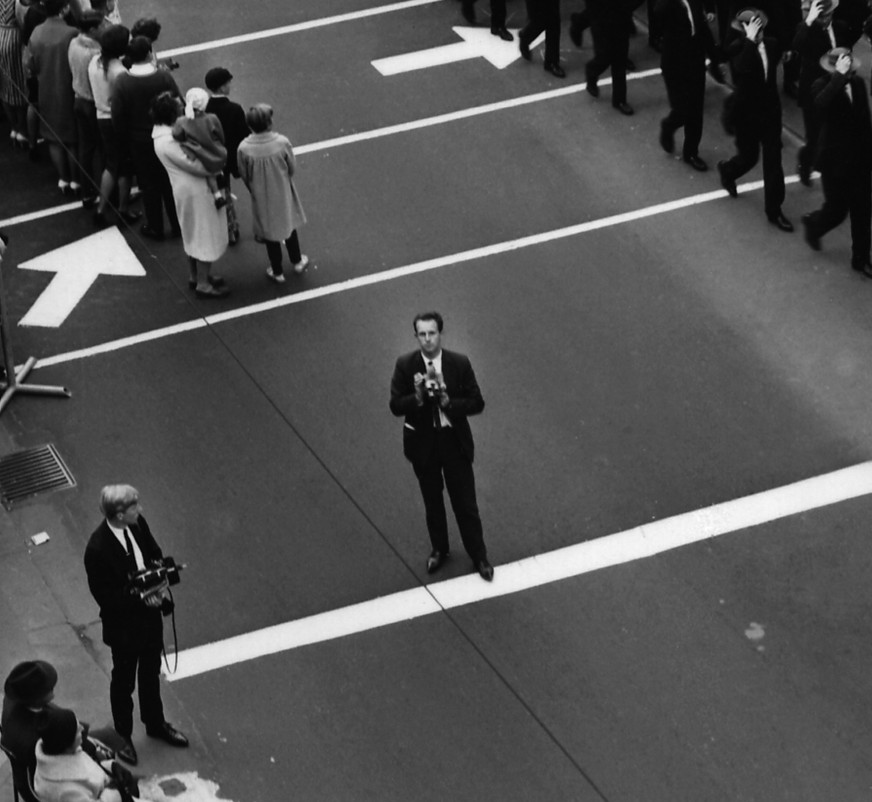
[23] http://www.pictureaustralia.org/ accessed 16 August 2010

[25] http://www.epicgames.com/ accessed 6 September 2010.
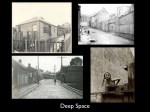
When in Venice…

‘When in Venice…’, review of Venice Biennale, Art Monthly Australia, July, pp24-26

Venice Biennale

‘I will not make any more boring art’ reads the giant banner slung across the front of one of the palaces on the Grand Canal. It’s there to greet the 300,000 visitors who are expected to visit the Venice Biennale this year. The text has been extracted and enlarged from a 1971 work by John Baldessari, who, along with Yoko Ono, won the Biennale’s Golden Lion for Lifetime Achievement this year. Originally Baldessari had written it out multiple times for a video work as though he was a school child being punished. He was wittily commenting on the serial nature of art at the time, and pre-dating Bart Simpson’s nightly exercises by eighteen years. Now turned from a conceptual art piece into a single slogan for the Biennale it announces that we are entering the globalised, corporatised world of the international art fair, where scale, impact and the grand gesture define the moment.

The Biennale consists of a large curated exhibition, this year called Making Worlds and curated by Daniel Birnbaum; 77 national contributions, either within purpose-built pavilions or elsewhere; 44 collateral events and exhibitions; and other events which although not officially part of the Biennale are timed to ride its bow waves. (For instance the billionaire art collector and owner of Christie’s, Francois Pinault, timed the opening of his private museum in the newly restored Venice Customs House, the Punta della Dogana, to coincide with the Biennale.) The Biennale proper takes place over two main areas — the Arsenale, originally Venice’s Military precinct, and the Giardini, located in nearby parkland — as well as numerous other venues throughout Venice. All up it includes about 800 artists and runs until November 22 this year.

Daniel Birnbaum’s Making Worlds exhibition was dedicated to the notion that ‘the artist makes worlds, not objects’. In the Arsenale section of Making Worlds the show led the visitor for hundreds and hundreds of metres down a long cavernous space, then outside into the Arsenale’s gardens where more works were tucked away in overgrown nooks and tumbledown buildings. The exhibition continued in a more labyrinthine form in the old Italian Pavilion in the Giardini which has been enlarged and renamed the Palazzo delle Esposizioni. The spirit of Fluxus and the post war avant-gardes reigned over the show. As Birnbaum said: ‘not every artist who is new or who is doing something interesting is 27 years old’.  Of the over 90 artists in the show many were senior, such as Yoko Ono and John Baldessari, and thirteen were, in fact, dead  — such as the Brazillian artist Lygia Pape who died in 2004 (at the ripe age of 77). She opened the Arsenale arm of show with a breathtaking installation of delicate square columns of copper thread stretched between floor and ceiling which she completed just before she died; and she was also in the Palazzo with a work from the late 1950s consisting of elegantly cut and folded cardboard sheets telling a creation story in austere abstract geometry.

The show had plenty of familiar old stagers from the circuit, such as Joan Jonas (who was at last year’s Sydney Biennale) who restaged her Reading Dante project; as well as wonderful lesser known surprises from the older generation, such as Hans-Peter Feldmann, the German collector/artist who presented Shadow Play, a frieze of flickering shadows made by shining lights across his collection of dolls and toys as they rotated on turn-tables. His complete corpus of artist’s books was also on display in the Book Pavilion. Yoko Ono’s ‘instruction pieces’ were a simple pleasure, but so too was a display from Gutai, the Japanese avant-garde group formed in 1954, most of whom have either now died or are well into their eighties. They re-presented coloured water suspended from the ceiling in plastic tubes, wooden boxes you could listen to, constellations of light bulbs embedded in sand, torn paper walls, and other avant-garde delights which were as fresh today as they were fifty years ago.

This spirit was given a contemporary spin by plenty of the younger artists, such as the Chinese artist Chu Yun. His Constellation consisted of a darkened room that, when you first entered, appeared to be an Aladdin’s cave full of flashing jewels, which you soon realized were the LED lights from scores of ordinary household appliances, passively waiting without function.

A lot of the works Birnbaum selected for Making Worlds were shot through with the elemental constituents of the act of fabrication: primary colours; cuts and collages; stackings and scatters; drawn charts and maps. However post-colonial politics, a standard theme for the global art circuit for at least the last ten years, was also strongly present. For instance Pascale Marthine Tayou, born in Cameroon but based in Belgium, constructed an African village crammed with video projectors projecting scenes of everyday labour from around the world onto every available surface; while Haloba Anawana, born in Zambia but based in Norway, built The Greater G8 Advertising Marketing Stand, where tins of third world products could be opened so they played personal stories of pain and displacement from speakers hidden in their lids.

Engineered construction, reconstruction and architecture were other themes. A steel and glass sculpture by Palermo built for the 1976 Venice Biennale was reconstructed in the same room for this Biennale; Simon Starling designed an elaborate steel film-projector where the 35mm film snaked through a spiral of rollers at the end of a twisting column of stainless steel arms, and projected the images and sounds of its own construction in a factory. At the other end of this spectrum of fabrication the Barcelona artists Bestué/Vives constructed a hilariously kooky costume out of paper, cloth and string which allowed them to transform from man, to motorbike to horse and back again whilst running through some wasteland under a flight path.

The after-effects of relational aesthetics were also still present. Att Poomtangon from Thailand, but now based in New York, used Thai engineering to construct a hanging garden which was meant to be watered by visitors treadling on pumps. However the wooden treadles were already broken and the plants were dying. The Golden Lion for Best Artist went to Tobias Rehberger who painted out the cafeteria walls, floors, ceilings and furniture in a World War One vintage ‘razzle dazzle’ camouflage pattern, to subject the weary visitor to yet more shifts in perceptual orientation as they ate their lunch.

The show took great pleasure in deliberately slipping and sliding between mediums. The American artist Tony Conrad called his pleasant drippy-black painted rectangles from the 1970s ‘movies’ because their cheap paper and paint yellowed over time; while the Silver Lion for most promising young artist went to Nathalie Djurberg who made a nightmare dungeon out of large-scale wet-looking ceramic sculptures of cacti and succulent plants which crowded round video projections of her stop-frame animations in clay, where priests and cardinals committed unspeakable acts of perversion, degradation and cannibalism on naked and pinkly-frightened young women.

The national representations in the various pavilions in the Giardini and elsewhere were a far cry from being an ‘art olympics’. The German curator selected for the German pavilion the British artist Liam Gillick (who ended up making a pretty boring work consisting of an installation of kitchen benches and an audio track), while Denmark and the Nordic countries (Finland, Norway and Sweden) collaborated on what was the highlight of the pavilions. Their project, called The Collectors, was a collaboration between 25 artists curated by Michael Elmgreen and Ingar Dragset who installed works by each artist throughout the two pavilions, which are side by side. The various works from the artists — which were wall pieces, installations, sculptures and photographs — combined to construct two huge, comprehensive and integrated domestic scenarios of contemporary excess in wealth, consumption and taste — all the way from the kitchen, to the dining room, to the bedroom. The scenario in one pavilion, ‘A. Family’, told a story of marital break-up, while the scenario in the pavilion next door, ‘Mr B.’, told a story of homosexual murder, or perhaps suicide.

The themes established in Making Worlds seemed to find echoes in the national pavilions. There were more collections, for instance Jussi Kivi’s vast and orderless collection of everything and anything to do with fire for Finland, or Jef Geys’ scientific survey of medicinal plants found in urban situations for Belgium. There were lots of gardens and cultivations. The grain of the human voice was often heard, not only throughout Making Worlds in the work of artists like Joan Jonas for instance, where ordinary people read from Dante, or in Tamara Grcic’s bright-red life rafts floating in the Arsenale dock from which the overlapping voices of ordinary conversations could be heard; but also in Krzysztof Wodiczko’s video installation for Poland where migrant workers told their stories as we appeared to see them outside of the pavilion blurrily washing its windows, or in Katarina Zdjelar’s videos about language and identity, where for instance a Korean woman struggled again and again to pronounce the artist’s name.

The viewer’s ears were also fully engaged in the British Pavilion, which had been darkened into a cinema for scheduled screenings of Steve McQueen’s two-gun video work Giardini. The work, another highlight, was filmed in the Giardini during winter, the off-season between Biennales. Snails crawled over leaves, buds dripped cold water, and confetti leaked its dye into the icy gravel, while dogs nuzzled through rubbish and occasionally the distant roar of a crowd from the soccer stadium which is behind the Giardini, on the tip of Venice itself, penetrated the microcosmic aural world of drips and rustles. Then, slowly, two male figures emerge from the darkness, silently regard each other across the two screens, and disappear together into the bushes.

The other common sounds of the Biennale were loops of music propelling the various video and film animations, and the slowed-down bassy rumbles that accompanied the more stentorian of the videos. This was the sound in the Australian Pavilion as Shaun Gladwell’s helmeted road warrior figure climbed out of a reconstruction of Mad Max’s car in slow-mo and stood atop with arms partially outstretched as it drove down an endless, red, outback track towards an infinite horizon. The car itself had been shipped out to be parked outside the pavilion, giving it a bit of a trade show feeling, while a motorbike was slammed into its side. This was the motorbike on which, in Apology to Roadkill, the same helmeted figure collected dead kangaroos from the side of the road, cradling them Pieta-like, before carrying them off camera. Downstairs, in a more interesting piece, a skull slowly rotated around a mini video camera that had been inserted inside it so it could film the cranial cupola endlessly turning.

The other Australian presence was located in a prime piece of Biennale real estate, a former convent located between the Arsenale and the Giardini. Once Removed (so called because each artist has been displaced in one way or another) didn’t come across as an integrated show so much as three separate installations. Only the installation by Claire Healy & Sean Cordeiro, Life Span, really took command of the space. It was a huge basalty block of plastic that sat directly under the ceiling fresco of the chapel, almost obscuring the altar, and pushing the viewer back against the wall. The work was built from a total of 175,218 VHS video cassettes the collective running time of which is, apparently, 60.1 years, which was also, apparently, the average life span in 1976 when the VHS system, now a redundant technology consigned to the rubbish heap of history, was first released. Vernon Ah Kee’s installation, Cant Chant, perhaps suffered from too many indignant metaphors and references to Australian racism which ended up competing with each other. It centred on a three-gun video projection where cool and confident aboriginal surfers reclaimed a beach by riding, to the pound of a rock sound track, on surfboards decorated with indigenous designs and, on the underside, the faces of their ancestors. Elsewhere in the video other surfboards were lynched and massacred. Their corpses, wrapped in barbed wire, were hung in the convent’s courtyard. Ah Kee’s familiar text paintings also crowded the walls. In the final room Ken Yonetani’s comment on environmental degradation, Sweet Barrier Reef, previously installed at the Adelaide Biennale, was a boxed-in Zen-style garden made with raked sugar which surrounded the ceramic forms of bleached coral. The whole thing was lit with a wavy blue theatre light as though under water, which for me gave it an artificial, stagy feeling at odds with its elemental materiality.

Elsewhere, the Russians had a strong presence with a spectacular series of bravura agitprop sculptural works in their own pavilion called Victory Over the Future, and a collateral event from the Moscow Museum of Modern Art called Unconditional Love which featured a massively operatic nine-gun projection from the Russian group of artists AES+F. Called The Feast of Trimalchio it featured gangs of models performing languid tableaus of leisurely excess against the CGI background of a fantasy resort island.

The Middle-East also had a strong presence, with the long walk of the Arsenale leg of the Making Worlds exhibition finally disgorging into the United Arab Emirates pavilion which, perhaps wisely, had decided to perform a 1980s style deconstruction job on the whole machinery of Biennales, as well the UAI itself with its tightly controlled displays of wealth.

Martyn Jolly

Down Turn

‘Downturn’, book foreword to Downturn, 2009. edited by Lee Grant, unpaginated one page ISBN 978-0-646-51556-4

Documentary photography’s prime responsibility is to take the abstract and make it concrete, to put a ‘human face’ to broad historical events, and create from raw actuality something understandable and legible. Documentary photography came into its own and consolidated its central precepts during another global turn down, the Great Depression of the 1930s, when photographers such as Dorothea Lange shot the key icons of the style — emotionally charged images of hapless individuals caught up in global currents they could barely comprehend that tugged at the heartstrings of sympathetic viewers.

Our own global down turn is even more abstract than the Great Depression, which is its only comparator. It has no time for the plangent majesty of the phrase ‘the great depression’, instead it goes by a brisk acronym: the GFC. It started only last year when a chain reaction was suddenly triggered in the interlocking money markets, and it may be even be over by the end of this year. I have hardly felt it effects at all, I haven’t lost my job and in fact the cost of my mortgage has gone down while I have received two refreshing splashes of cash. Yet I know that it has been historically catastrophic in some way or other, because I have seen the jagged red lines plunging downwards again and again, on my TV screen and in my newspaper. And I’m vaguely aware that perhaps it has directly affected people I might know. Perhaps some of my students have found it harder to get shifts at wherever they have to work to pay their way through uni, perhaps the relatives of some of my friends might have lost their jobs, perhaps….

So there is a task here for documentary photography. And there is particularly a task for young documentary photographers. Young people are continually being accused of being disengaged from the world, insulated from social responsibility by the upholstered solipsism of youth. Yet, as they are also being constantly reminded, it is they who will inherit and have to solve the seemingly intractable problems we have created for them.

How then, do they respond to the assignment of documenting the GFC? Each in their own individual way, of course. But some themes do emerge. For instance there is a persistent concern with stuff — the end residue of that urgent impulse to consume that drives the modern economy. Why do we need all this stuff, what are we going to do with it, what does it look like? And notice how it hangs around even after we ourselves have gone and have no use for it. Another visual trope is the threshold, the spatial barrier of the gate or the fence that either separates people or forces them together. Fences, gates and walls define spaces, and many photographers in this book are sensitive to the nuances of space — both the social space of the street and the private space of the home. Those spaces are where people are forced to live together, and with economic down-turns edges get sharper and surfaces get rawer as people rub up against each other. So we have the ‘haves’ and the ‘have nots’ studiously ignoring each other on the street an in other public spaces, while developers continue to push the suburbs out further and further by building individual houses separated from each other by darkness. Meanwhile within those houses people continue to just about manage their lives in congested and claustrophobic rooms.

Having seen these photographs I now feel I know just a little bit more about the great economic downturn of our time.

Martyn Jolly

Head, Photography and Media Arts

ANU School of Art

David Wills

Made up of over eight thousand photographs and seven hundred fragments of overheard conversations — all meshed together by nearly a thousand keywords — Turnstile is an extraordinary cultural archive. David Wills has spent the last four years trawling through our contemporary urban environment like a human drift-net. He has developed a finely attuned radar for cultural objects that are so marginal, so detrital, that they barely register as artefacts at all. He taxonomizes and cross-references this ‘cultural mulch’ using an acute historical sensibility that mixes irony with a passion for his world, as well as nostalgia with a love for the contemporary, in equal parts.  The interlacing of the threads of images and information forms an on-line network vast in scale and microscopic in detail, but unified in structure.

He has not only constructed his own world, but has also produced a thoroughly compelling document of our time, which depicts the early twenty-first century not so much pictorially as granularly.

The archive is a key motif of photography, from nineteenth century ethnographers, through twentieth century artists such as Gerhard Richter and Hans Peter-Feldman, to today’s sardonic flaneurs such as Martin Parr. And of course online archives such as Corbis or Flickr already allow us access to numbers of images at an astronomical scale. But only Turnstile combines the automatic logic of a search engine with the personal sensibility of a singular artist.