‘Sorely tried men’ : the male body in World War Two Australia

as published with illustrations in Artlink, Vol 16, No 1, Autumn, 1996.

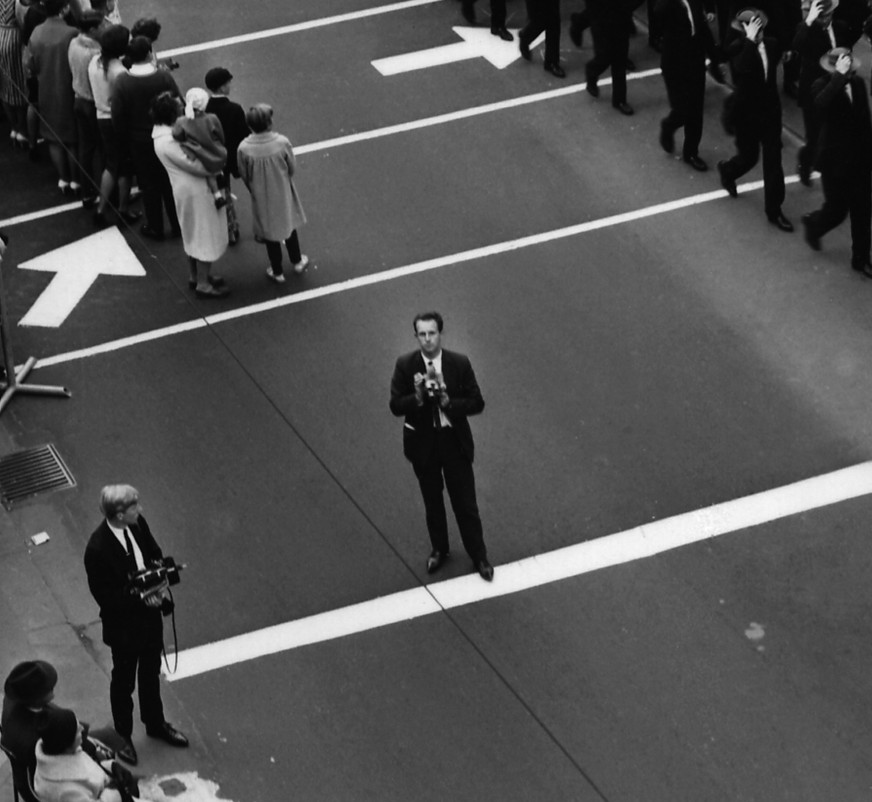
During World War Two  the Australian Government’s Department of Information represented the male body in at least two distinct ways. The photographer Edward Cranstone photographed a heroically active, phallicised body; and the cameraman Damien Parer filmed a heroically suffering, abject body.

Edward Cranstone’s main assignment for the DOI was to photograph the Civil Construction Corps of the Allied Works Council. (1) Established in 1942 the AWC conscripted men between the ages of 35 and 55, who were otherwise ineligible for military service, to work on large building projects in northern and interior Australia. However the CCC quickly began to attract adverse publicity. There was industrial unrest on many projects with workers accusing the management of inefficiency and rorting, and management accusing the workers of unpatriotic union activity. (2) Against this background the DOI sent Cranstone, accompanied by a journalist who wrote captions, on an extended assignment to all the AWC projects. His photographs were extensively published in the press, in everything from the Tribune to the Women’s Weekly, and were eventually formed into a large exhibition, which also included paintings of CCC workers by Dobell and other artists, that toured capital cities in 1944.

As a member of the Communist Party of Australia Cranstone was exposed to a rich source of propagandistic imagery. Soviet socialist photographs were regularly published in the Tribune, and the Soviet Australia Friendship League held frequent screenings of classics of revolutionary cinema. Their influence can be clearly seen in Cranstone’s Modernist visual rhetoric — his use of upward looking camera angles, strong diagonal compositions, bright sunlit forms and heroic poses. Although the Soviet photography published in the Tribune can be identified as a specific source for Cranstone, his was a global style shared by other American, British and German propaganda photographers of the period.

Cranstone’s photographs appear to have been effective in persuading the public of the value of the CCC’s contribution to the War effort. As one article reviewing the exhibition stated:

The Australian worker—bareheaded, steady-eyed, stripped to the waist—is the dusty, sweating keynote to a display of about 450 photographs [….] It would be surprising if most people did not take away a warm impression of that typical Australian, stripped to the waist, working on untouched land, levelling it, digging into it or building up from it. In a real immediate way, the show tells the story of how Australia—the country itself— has gone to war.(3)

Cranstone’s men are heroic soldier/worker/pioneer hybrids. The battle which they fight is in the familiar industrial workplace and on the equally familiar colonial frontier. There is a strong erotics to many of Cranstone’s photographs: skin is pneumatically pumped out by muscle, sheened by sweat, and ribboned by shadow; the men vigorously swing crowbars and work machinery.  His photographs turn their bodies, which were by definition not Australia’s finest, into splendid specimens indeed.

Although Cranstone’s photographs were widely exhibited and published and generally well received, some commentators reacted against their overt visual rhetoric and mechano-eroticism. In Canberra the exhibition was displayed hidden away in the basement of Parliament House rather than in the usual exhibition space of Kings Hall. The Speaker of the House, complaining about the Modernist paintings of William Dobell with their thick fleshy strings of paint, claimed that the show “was a grave reflection on the manhood of Australia generally, and particularly the fine types who have discharged essential duties during a critical period in Australia’s history.” He added, in reference to Cranstone’s brand of photographic Modernism, that a “photograph allegedly taken in a quarry made me feel that I was in Dartmoor [Gaol].”(4)

Damien Parer was also employed by the DOI, but as a war cameraman. The footage he shot in New Guinea was supplied to newsreel companies to be cut into their weekly newsreels. Parer’s two most famous newsreels, Cinesound’s Kokoda Frontline and Assault on Salamau, were essentially collaborations between himself and the head of Cinesound Ken Hall. In both cases Damien Parer appeared as the ‘star’ to introduce the newsreels. After some titles telling us that Parer has already been responsible for some of the ‘classic footage’ of the War and that he is a reliable witness, Kokoda Frontline opens on Parer, in his uniform, in an empty domestic room, leaning casually against a table. The camera slowly moves in on his handsome face as he speaks directly to the camera.

Eight days ago I was with our advanced troops in the jungle facing the Japs at Kokoda. Its an uncanny sort of warfare, you never see a Jap, even though he is only twenty yards away. They are complete masters of camouflage and deception, […] Don’t underestimate the Jap, he’s a highly trained soldier, well disciplined and brave, and although he’s had some success up until the present, he’s now got against him some of the finest and toughest troops in the world, troops with a spirit amongst them that makes you intensely proud to be an Australian. […] When I returned to Moresby I was full of beans, it was the spirit of the troops and the knowledge that General Rowell was on the job, and now that we had a really fine command. But when I came back to the mainland, what a difference, I heard girls talking about dances, and men complaining about the tobacco they didn’t get; at the front, they were smoking tea some of the time. There seems to be an air of unreality, as though the war were a million miles away. Its not, its just outside our door now. I’ve seen the war, and I know what your husbands, your sweethearts and brothers are going through. If only everybody in Australia could realise that this country is in peril, that the Japanese are a well equipped and dangerous enemy, they might forget about the trivial things and go ahead with the job of licking them.

After this introduction the film cuts to some spectacular combat footage, but most important to the film are the intimate close-ups of the soldiers in retreat down the Kokoda Trail with which the film ends. The soldiers either pass in slow procession past the camera, or compose themselves into tableaus as they have their bandages tenderly applied by their mates, or their cigarettes lit. Cut into these sequences are extended close-up shots of the faces of native bearers and Australian soldiers which act as still portraits of various emotions. The hortatory voice over commentary during these scenes contrasts with Parer’s tender pain, but it re-emphasises the theme he established:

[…] [Here are the] first vivid, starkly dramatic glimpses of the eerie jungle conflict. [Showing] almost incredible hardship. […] Where the patrols go the bearded Parer goes too, so that this strange uncanny warfare can be vividly brought to the outside world. […] This is war, the real thing. The utter weariness of sorely tried men is evident in their faces. […] These are grim pictures, brutally, terribly real, they smash a complacency as nothing written or spoken ever possibly could. […] Half the distance from Sydney to Melbourne men are sweating, suffering, dying in that jungle so that it cannot happen here. Are they getting all the support the deserve, from the mines, from the factories, from the ordinary civilian? […]

In the final seconds Parer’s soft face of concern returns, angelically superimposed over shots of the feet of the soldiers pushing down through mud. He repeats, but now in ghostly tones:

I’ve seen the war, and I know what your husbands, your sweethearts and brothers are going through. If only everybody in Australia could realise that this country is in peril, that the Japanese are a well equipped and dangerous enemy, they might forget about the trivial things and go ahead with the job of licking them.

The newsreel was immediately successful, with a queue snaking out from Sydney’s State Theatre newsreel theatrette and around into George Street. The soldiers in Parer’s films are very different to Cranstone’s workers. The frontline on which they fight is not the domesticated colonial frontier of the purifying, astringent desert, but the dark uncannily wet tunnels of a jungle beyond the borders of Australia. The men are not assertively doing, but passively suffering. Parer’s soldiers are sick, bleeding and blinded. They rely on the tenderness of comrades or natives to survive. Their feet slip through mud as they lean on sticks or each other. They are not symbolic nationalist cyphers like Cranstone’s men, they are individuals, suffering psychological, as well as physical privations on our personal behalf.

Parer was a devout Catholic and many have seen spiritual and religious connotations in his work.

Ron Williams [another DOI filmmaker] believes that Parer was portraying redemption emerging out of suffering in these sequences. While Damien’s notes give no indication of any such intention, one particular shot does have a religious undertone. It shows Salvation Army Major Albert Moore on the far right of the frame lighting a cigarette for a wounded soldier. This is carefully balanced by a group of soldiers on the other side. Parer’s composition is similar to a medieval or Renaissance painting showing as its centrepiece Christ being taken down from the cross. The religious analogy is strengthened by the fact that the soldier is naked, covered from the waist down by an army blanket.(5)

Through their suffering these men will lead us to redemption. We, the audience of Parer’s newsreels, are feminised: we are wives, mothers or sisters who weakly complain at home and don’t acknowledge the danger from overseas. Like Orpheus, Parer has been both there and here. He has suffered too, and has returned, but our indifference is making him suffer again. Unabashed emotion and direct physical contact is both the conduit and evidence of this transaction—it becomes the subject of the newsreel itself. We see with our own eyes that our delusion and triviality has personally dispirited Parer, when he arrived back he was ‘full of beans’ with ‘the spirit of the troops’ but now he has experienced our complacency, he is worried and upset. His voice drops, and his face tightens.

There is an eroticism here too. Not the auto-phallicisation of man and machine as in the CCC, but a polymorphous blending of mate into mate and man into mud. Australians would have easily recognised this eroticism as already part of the ANZAC myth, Australian men similarly suffered together on the beaches of Gallipoli or in the trenches of France. Citing Julia Kristeva and Klaus Theweleit, Leigh Astbury has explained how this eroticism was understood into gender terms.

Again and again accounts of war emphasise the stinking ooze, mud, slush, stench, slime, rotting corpses, gore, human excreta—hybrid substances and odours that could be associated in the male mind with the body, especially with its orifices and, negatively, with the erotogenic zones of the female. Given the soldier’s morbid fear of anxiety-producing, hybrid substances connected with the body, abjection could only be held in abeyance through controlling the body’s purity and integrity and expelling from it the improper and unclean. (6)

However rather than conventionally describing it as that against which the phallic ANZAC heroically struggles to define itself, to Parer the abjection of New Guinea is something to which this generation of ANZAC, mired in the grimmest days of the War, must heroically succumb.

Parer’s trinity of ‘mother, wives and sisters’ had been evoked once before in relation to Australian warrior masculinity. The sculptural centrepiece for the memorial which Sydney had built for its WW1 ANZACs was Rayner Hoff’s Sacrifice 1934. In this sculpture a symbolic Australian mother, wife and sister hold aloft a lithe, cleansed and perfect male body crucified on a sword, they successfully bear him up out of the miasma of battle and into a transcendent erotic masculinity. However in Kokoda Frontline Parer is sadly compelled to inform the women of WW11 Australia that, unlike these women, they have abandoned their soldiers to an abject eroticism.

The newsreel’s powerful message is that, in the darkest hour of the War, while their women are still enthralled by false images and trivial concerns, it is up to desperately abjected soldiers, redeemed by a spiritually defined homo eroticism, to defend Australia. In contrast to Parer’s psychologically specific homo-eroticism, Cranstone’s internationally symbolic, stylised auto-eroticism redeemed the home front labours of another potentially unstable category of Australian male—the worker.

Whilst these two types of male body were produced at a particular extraordinary juncture of Australian history and culture I cannot resist the temptation to extrapolate them into later manifestations. Cranstone’s phallic cyphers of labour have certainly found their way into corporate annual report photography. Large corporations such as BHP still, from time to time, use these ‘masculinist automatons’ as nostalgic labourist archetypes, particularly in areas which are undergoing extreme technological transformation. (7)  However this type of pneumatic body, flexing itself against machinery in self-absorbed labour, is perhaps more commonly seen today in the productivist potlaches of the gym.

The Winfield Cup statuette, The Gladiators, sculpted from a photograph of two David and Goliath sized Grand Final team captains helping each other off a muddy football field in 1963, has strong references back to WW11 imagery of the abjected soldier. Does the eroticism of male sport still rely on a mute accusation against sisters, mothers and wives?

Martyn Jolly

1 Martyn Jolly ‘Edward Cranstone: Photographer’ Photofile Vol 1 No 1 1984, pp1-3.

2 H.P. Brown,(Commissioner) Inquiry under the National Security Regulations into certain allegations concerning the administration of the Allied Works Council    5 March 1943.

3 K.K. ‘Australia Portrayed Stripped to the Waist’ Melbourne Herald 3 August 1944, p5.

4 Massey Stanley ‘Art Critic’ Sunday Telegraph 24 September 1944, p10.

5 Neil McDonald War Cameraman: The Story of Damien Parer, Lothian 1994, pp157-158.

6 Leigh Astbury ‘Death and eroticism in the ANZAC Legend’ Art and Australia  Spring 1992 Vol 30 No 1, pp68-73.

7 Charles Pickett ‘BHP & the Village People’ The Lie of the Land, Powerhouse and National Centre for Australian Studies, Monash University, pp27-28.

Captions will be supplied with illustrations


Frank Hurley’s Vision Splendid

‘Frank Hurley’s domesticated sublime’, Australian Centre for Photography forum. October 26, 1996

David Millar, Snowdrift and Shellfire, David Ell Press, 1984.

Julian Thomas, Showman, National Library of Australia, 1990.

Scot Bukatman, ‘The Artificial Infinite’, in Visual Display:   Culture Beyond Appearances, eds Lynne Cook & Peter Wollen, 1995.

Ken. G. Hall, Directed by Ken G. Hall, Lansdowne Press, 1977

Anne-Marie Condé, ‘A Marriage of Sculpture and Art: dioramas at the memorial’, Journal of the Australian War Memorial, November 1991, pp56-59

Hurley Chronology:

Postcard trade and camera club movement 1900s

Mawson Antarctica 1911-13

Shackleton Antarctica 1914-16

Flanders and Palestine AIF 1917

Papua New Guinea  early 1920s

Mawson Antarctica 1929-31

Cinesound cameraman 1930s

Middle East AIF 1940s

‘Camera Study’ books 1946-66 (even after his death)

Captain Frank Hurley was much more than just a photographer, he was also a filmmaker, a performer, an adventurer and, by the end of his career, a household name. Colleagues such as the film director Ken G Hall and the journalist Maslyn Williams referred to Hurley as a ‘showman’. By that they meant that he himself was the essential subject of all his work, and that he strove for customer satisfaction, entertainment value, and spectacular effect above all other considerations, including veracity.

For instance Hurley made many combination prints out of the material he shot in Flanders as one of Australia’s two official war photographers. He immediately ran into conflict with the Australia’s war correspondent, later to be Australia’s official war historian, Charles Bean, who needed simple factual documents of the War. Hurley, however, wanted immediate “publicity pictures and aesthetic results”.[Millar 48]

“None but those who have endeavoured can realise the insurmountable difficulties of portraying a modern battle by camera. To include the event on a single negative, I have tried and tried, but the results are hopeless. Everything is on such a vast scale. Figures are scattered—the atmosphere is dense with haze and smoke—shells will not burst where required—yet the whole elements are there could they but be brought together and condensed. The battle is in full swing, the men are just going over the top—and I snap! A fleet of bombing planes is flying low, and a barrage burst all around. On developing my plate there is disappointment! All I find is a record of a few figures advancing from the trenches—and a background of haze. Nothing could be more unlike a battle. I might be a rehearsal in a paddock.” [Millar 50] “[I] Am thoroughly convinced that it is impossible to secure effects without resorting to combination pictures”[Millar 51]

To Hurley photographed battles must be coherent, legible, and dramatic. However Bean was implacably opposed to this argument and called Hurley’s combination pictures ‘fakes’. He wanted historical documents from which a posterior account of the war could be properly constructed. For this reason Bean was very supportive of the concept of the model dioramas built for the Australian War Memorial in the 1920s which, in their dramatic logic, cinematic power, spatial compression and explanatory completeness are, in fact, very similar to the Hurley combination prints he so disapproved of in 1917. For the purposes of this sanctioned presentation of history Bean himself even urged the sculptors involved to judiciously edit and combine the facts of the battles to make for a more expository, emotionally engaging diorama. [Anne-Marie Condé]

Hurley displayed six of his combination prints in London in 1918 as giant seven by three metre enlargements accompanied by 130 or so smaller straight prints and continuous projections of full colour lantern slides. The viewer of Hurley’s combination prints in 1918 would have comprehended them not as literal truth, but as an emotional attraction. They would have seen the combination techniques not as illicit fakery, but as entirely licit ‘special effects’—where it is the production of an effect worthy of emotional and phenomenological investment by the viewer that counts. For the contemporaneous viewer, his WW1 images were verifiable by reference not to reality but to the reality of their affect—on an emotional and ideological as well as a pictorial level. So, despite Bean’s objections, Hurley’s combination prints were never fakes in the sense that a manipulated image would be called a fake later when, with the elaboration of the documentary mode in photography and film, viewers were trained to read an image from the fragmentary, contingent point of view of the participant. By the late 20s and 30s readers of picture magazines and viewers of weekly newsreels had been taught to valorise the sense of physical proximity to the actual moment the photograph conveyed, over its scenographic exposition of the unfolding event.

Hurley was prevented by Bean from bringing this phantasmagoric attraction to Australia. But in the display of smaller images which he was eventually allowed to exhibit at the Kodak Salon in Sydney in 1919 he freely admitted to using combination printing. In the catalogue he states:

“In order to convey accurate battle impressions, I have made several composite pictures, utilising a number of negatives for the purpose. The elements of these composites were all taken in action and submitted to the G.O.C. A.I.F.  who gave his approval for their production.”

However Hurley is clearly being disingenuous here, perhaps in response to his dispute with Bean. A large part of the motivation for his use of combination printing wasn’t, in fact, to create a theatrically complete, legible, battle tableau. His addition of piles of cumulus or storm clouds, through which shafts of sunlight are breaking, and the proscenium frames of church architecture, are clearly pictorial tropes of the sacred and the sublime which provide the moral benediction of God and Nature to Imperial victory.

Hurley had extensive experience with the production of popular attractions at this time, all of which used the latest film and photographic technology, and all of which featured himself as ‘showman’. As a postcard photographer in the 1900s he had specialised in pushing the envelope of the new photographic technologies, producing postcards taken at night, using flash or extended exposures, or photographs which dangerously froze high speed trains or crashing waves. The appeal of these images to contemporaneous audiences would have been as much in their status as artefacts of a new technology, as in their pictorial aesthetics.

In 1913 his film on the Mawson expedition Home of the Blizzard screened in Sydney whilst Mawson was still stranded in Antarctica. Hurley appeared at each screening as the figure of the returned Imperial explorer to give a personal recitation to accompany the film. In 1914 he shot and again appeared with Into Australia’s Unknown about Francis Birtles car expedition across Australia. In 1919-1920 he toured internationally with In the Grip of the Polar Ice about the crushing of ‘The Endurance’ on Shackleton’s expedition. And in 1919 he exhibited and narrated With the Australians in Palestine.

In 1920 he appeared with The Ross Smith Flight, about the first flight from the UK to Australia in under thirty days. He accompanied Smith on the final legs of the flight, but the film also incorporated previous footage shot in Palestine and on the Birtles expedition. It also, significantly, had metres of blank film cut into it for the projection of colour lantern slides, and trick effects to produce the illusion of the pilot’s point of view whilst approaching Australian cities, created by jiggling postcards of the cities in front of a tracking camera. Pearls and Savages, shot on two expeditions to New Guinea, ran for five months in 1922 with specially composed piano music, chemical and hand tinting, interspersed colour slides, and a personal appearance and recitation by Hurley as the returned explorer.

These films were made before the Documentary Movement. They had none of the diegetic logic developed by Documentary pioneers such as Grierson and Flaherty after Flaherty’s seminal Nanook of the North of 1922. Nor did they assume the objective invisibility of the filmmaker. Rather they revolved around Hurley’s actual physical presence as the returned hero who was not so much auteur of, as physical witness to, the disjointed sections of film projected on the screen. He was also, of course, the showman impresario of the various technological effects he created and displayed. They therefore conform to the ‘cinema of attractions’ as it has been theorised by Tom Gunning and Miriam Hansen: that is, a cinema of presentation, rather than representation, where the space and time of the film, and the space and time of the audience in the auditorium, remain continuous and are not severed by the illusion of cinematic montage and the diegetic drive of narrative.

Although Hurley’s films were made pre Documentary, they are not proto Documentary. Hurley remained essentially anti Documentary throughout his life. When he was sent to Africa with Australian troops at the beginning of WW11 as head of the Department of Information’s film unit he ran into trouble once more with both the requirements of the Department for exciting newsreel footage, and with his younger colleagues who were intoxicated by the Documentary ethos. As an exasperated Damien Parer wrote back to Max Dupain:

“Hurley hasn’t much news sense which is necessary to the job: he goes mad about bloody native boats, and mosques and clouds (cumulus variety only)…[and] worries about ‘quality’.”

For the decade before WW11 Hurley had been Cinesound’s chief cameraman. In 1924 he had made two ‘location’ fictional films on Thursday Island, Hound of the Deep and The Jungle Woman which he conceived of as extensions on Pearls and Savages, however these were not successful. But at Cinesound he was able to add his ability to shoot sweeping, operatic landscapes, plus his affinity for special affects, to Cinesound’s series of nationalistic features directed by Ken G. Hall. Thus, for instance, for The Squatter’s Daughter he devised the opening sequence of a mob of 10,000 sheep, which in Hall’s words:

“seemed to float like a long white cloud down the valley, stirred by the rising sun. The purely photographic sequence still stands vividly in my memory as a projection of Australia with which I am glad to be associated. I used it at some length in the feature and the rest went into the Cinesound library for use on innumerable occasions” [78 Hall].

He also helped devise the final climatic bushfire sequence lit by festooning the trees with thousands of feet of Australia’s film heritage in the form of flammable nitrate stock. He became something of a specialist outdoors and effects cinematographer throughout the 1930s. Charles Chauvel brought him in to shoot the horse charge sequence in Forty Thousand Horsemen, about the Australian Light Horse in Palestine, where Hurley used a similar technique to one used by Leni Riefenstahl in Olympia, and placed the camera in a deep pit over which the horses jumped.

Eventually Hurley’s outmoded deep focus style, plus with inability to empathise with filming anything other than landscapes, combined with his reluctance to work as part of a team, forced Hall to move him sideways into his own ‘Industrial Division’ to make documentaries for corporate and government clients. This work culminated in the 1938 sesqui-centenary featurette A Nation Is Built where Hurley’s imperial, industrial sublime reaches its highest pitch. The film features some more special effects, such as a scene where Governor Phillip imagines a modernist city rising out of his Sydney Cove tents. But it is most memorable for panoramic sweeps of cities, industry and pastoral landscapes.

The climax features not a floating cloud of sheep, but a field of golden grain beneath his by now trademark cumulus clouds. The narrator declares:

“The amazing transformation of a country of wild bush land into a highly developed commonwealth in the brief one hundred and fifty years has no parallel in history. Nor could we today be harvesting the benefits of a great past were it not for the fact that our nation builders were imbued with a sublime patriotism. […]  Nor are our peoples unmindful of the beneficence which has been showered down upon our land by the Creator of all things. This lovely scene inspires us to something more than mere admiration. The bounty of the earth impels us to look up to the good will which is in the heavens and to say ‘We Thank Thee’. Just as those of the past had visions of the greatness  of the future, so we the builders of today must build towards our nation’s mightiness of the morrow. In harmony and consort our voices are raised: “God who made thee mighty, make thee mightier yet’.”

The heavens above are invoked in A Nation is Built in the same way as they were in his Flanders combination prints: as a technologically produced special effect, as a sublime pictorial supplement, and as a divine cum natural benediction on the Empire. In the filmic montage we can more clearly see how, as well as being simply a pictorial trope, Hurley’s sublime clouds actually provide an additional spatial vector to the image. The camera pans around in proprietorial survey of the bounty of Empire. Wipes and dissolves move us horizontally along in a cavalcade of history not unlike the procession of floats up Macquarie Street in the Sesquicentenary Parade. But then the camera also lifts us up ecstatically to the clouds for us to receive a divine blessing on our Imperial progress.

After WW11 Hurley began to produce a series of Camera Study books on each state, major city, and eventually on Australia as a whole. These books ended up selling a total of 168,500 copies. The books are quite different to other ‘Australiana’ picture books. Unlike, say, Ernistine Hill, Ion Idriss, Bill Peach, Albie Mangles, the Leyland Brothers or the Bush Tucker Man, Hurley is not interested in collecting and stringing together anecdotal travel stories or eccentric characters as signs of nationhood. Rather he is interested in nationhood enacted by scenery itself. His landscapes are conceived of as gigantic prosceniumed stage sets complete with all the theatrical machinery of flies, flats and backdrops. His people are not characters, but extras.

In that sense, of course, his sublime is rooted in the eighteenth and nineteenth centuries. But Hurley’s sublime is much more circumscribed than the Burkian sublime of astonishment, terror and awe at a power far greater than the human, a power which paradoxically uplifts us because it threatens to annihilate us, a power whose immensity provokes a crisis in the viewer which can only be resolved by their identification with it. Hurley’s sublime is more circumscribed, even, than the manifest destiny of the nineteenth century  American Luminists, with their ideological investment in the natural inevitability of the great American nation evidenced by its sublime wildernesses. Hurley’s own vision splendid takes place within a comforting horizon of civic, industrial or pastoral scenery. His nation’s manifest destiny is domesticated and almost suburban. In all of the 220 pages of Australia: A Camera Study of 1955 there are only a few pages devoted to outback scenery, and virtually none devoted to what we would now affirmatively call wilderness, a word which had entirely negative connotations for Hurley. Aborigines do not appear at all.

His photographs are therefore empty stage sets, images of an imperial potentiality, a libidinal void waiting to be filled with flowing floods of sheep or churning turbines. All his landscape are technologised to some extent, mechanically and repetitively clunking themselves through their pictorial machinations. They encourage us to lob our gazes, almost ballistically, across them. The technique of special effects was still felt by Hurley to be necessary to his project, he still combined negatives to add in clouds, sunrays, birds and aeroplanes.

Summary of points:

Hurley’s photography is anti-documentary. And his cinema conforms to the ‘cinema of attractions’ rather than the proto documentary. It is non-diegetic, non anthropological, and uninterested in actuality. It is interested in affect and is based on the figure of Hurley as showman.

Although Hurley’s sublime aesthetic had its roots in the nineteenth century (via the postcard trade and the camera club movement’s connections to art photography) it was expressed within a twentieth century technic. His sublime is pictorially troped and technologically tamed into a special effect.

Hurley’s sublime is not a phenomenological excess—a visual plenitude which takes us to a great infinity beyond the pictorial space of the image. Rather it gives his images two distinct vectors:

[1] The horizontal pan around a horizon which is spatially consistent with a proprietorial panoptic survey, but also with a temporal cavalcade of history.

[2] A vertical pan up to a transcendent, beneficent, affirming God who is above the imperial thrust of history, but confirms it.

Anne Zahalka: Privacy, Publicity and Inhabitation

‘Anne Zahalka: spurs of the moment’, Art & Text, Number 54, April, 1996

Throughout its short history photography has had a special relationship with both privacy and publicity. It was invented during a period when the domestic sphere of social organisation was reaching new levels of importance. But it also inaugurated the era of mass media and the age of publicity. Photography redefined both the living room and the street.

On one hand photography became the ultimate medium of private communication. Under the rule of painting and its various genres portraiture had been fundamentally declarative—of wealth, status and ideology. With photography it became confessional—of desire, personal obligation and sheer bodily existence. For centuries portraits had been coolly assembled by trained experts out of a generic lexicon of social signifiers—costume, pose, accoutrements. With photography portraits became both more popular, and warmer. They were physically warmed by the cosy fires of the domestic mantelpieces on which they sat, or by the loving bodies against which they nestled; and spiritually warmed by the intimate urgencies they conveyed as mothers looked out of them at their sons who were far from home, or lovers used them to steal secret glances at each other. The inevitable accidents of amateur photography became part of portraiture’s poignancy—the random details, slight blurs and fleeting expressions becoming, in Barthes’s words, punctums to pierce the heart.

But on the other hand photography also represented the public to itself. As Benjamin pointed out, in the nineteenth century urban crowds not only came to dominate the social landscape, but also to demand that they themselves be portrayed, just “as the patrons did in the paintings of the Middle Ages.” . Benjamin recognised that in the twentieth century “mass movements, including war, constitute a form of human behaviour which particularly favours mechanical equipment”.  In the age of mass reproduction the masses best reproduced themselves through photography and film. Countless carefully orchestrated revolutions, rallies and sporting events since have confirmed his observation. Our experience of urban space has been slowly re-engineered by photography and film, and we are all now well used to imagining ourselves as civic actors, visible to ourselves every day in the crowds on the street.

Photography was therefore intractably intertwined with the social, architectural and technological changes which produced our modern conceptions of private and public relations, and domestic and civic spaces. In this context Anne Zahalka’s photographic work can be read as a response to recent changes in these fundamental categories of modernity.

Zahalka first began to work with portraiture in the 1987 series Resemblance, which were based on Dutch genre paintings. The delight audiences experienced in the elegant luxury of these large chromogenic prints, and their satisfying recognition of the art historical citations encoded into the images, perhaps masked what was most interesting about the works—the challenge they presented to our current conventions of photographic portraiture. Taking photographs which were intended to function, at least on one level, as ‘real’ portraits of contemporary people, but within a post modern quotational style referring to a painting genre which had been functionally redundant but aesthetically valorised for four centuries, stretched the assumptions underpinning our conventions of candid portraiture. But by jettisoning all of the casual punctums of the candid portrait in favour of cold generic citation Zahalka was potentially doing more than merely glibly tweaking portraiture’s re-conventionalised stylistics. Perhaps she was also engaged in a full blown documentary project, a social taxonomy of her historical period which, like August Sander’s Men of the Twentieth Century, choose its format and style to fully embody the temper of the times.

Side by side with her interest in portraiture Zahalka also pursued an examination of urban geography which she also regarded as a set of received spatial and iconic conventions to be parodied and pastiched. For instance in her Bondi: Playground of the Pacific 1989 series the famous beach was reduced to a painted backdrop for a staged re-enactment of various tableaus of multicultural nationhood. And in an earlier, charming series of straight photographs, precise points of view were chosen to deconstruct Centrepoint Tower’s iconic eminence over Sydney by, for instance, photographing it so that it appeared to be just another chimney sprouting from the roof of a suburban factory.

Both these long standing  interests have culminated in two recent series of large backlit transparencies. The Open House 1995 series are portrait tableau vivants staged by members of Sydney’s artistic beau monde within their authentic domestic environments. Fortresses and Frontiers 1993 are views taken in a recognisable Sydney, but of strangely redolent, heterotopic spaces. In some of these views various figures—everything from zoo animals to office workers—appear in a kind of purposeful but suspended pose.

The tableaus of the Open House series allow a kind of visual anthropology of some of Sydney’s domestic spaces. The meticulous art direction of the images, and the attention to the clothes, pose and gesture of the sitters, invites objective scrutiny. But on each of these carefully prepared stages a scene of slight, ambiguous domestic tension is also being enacted. These repeated domestic scenarios tell a story about the fundamental apartness of people, their ‘public’ selfconsciousness even within the bosom of the private. Zahalka’s living room inhabitants submit themselves to self display in the same way we all unconsciously ‘gather ourself’ the moment we step outside our front door. They are as aware of the other people around them, but as unresponsive, as people forced to share a seat on the bus.

In Fortresses and Frontiers Zahalka has set up a series of ironic visual relationships within each urban space. For instance in one image a lonely giraffe in the middle of a bare enclosure at Taronga Park Zoo looks out over the Harbour at the distant capitalist spires of Sydney. In another, a similarly lonely salary man carries his briefcase across a concrete walkway towards the same spires, now turned sulphurically brazen by the setting sun. In a third image a homeless man sits and waits for the evening tennis players from the brightly lit courts in the background to go home, before settling down for the night in a bizarre, cave-like, moulded concrete park shelter. (At Roslyn Oxley9 Gallery this image was hung next to another zoo image of several mountain goats resting on top of a similar concrete.)

In these deliberately ironic juxtapositions Zahalka isn’t revealing anything to us which isn’t already known and acknowledged by the city itself. Everybody has always known that the city is a ‘human zoo’, Zahalka is simply declaring what the city explicitly states on its own behalf every day. However by using these ‘concrete jungle’ cliches, Zahalka has managed to flatter the city into declaring its own implicit boundaries between the public and the private.

To be homeless in the city is to virtually cease to exist, so the two tennis players ignore the homeless man as they walk home after their game. He is a nocturnal, nomadic ‘urban caveman’, waiting in the shadows until it is late enough for the park, and his rustic shelter, to invert their designated function and become his private space. The potentially threatening indeterminacy of city space is also present in images such as the one of children playing on some bright, new, council playground equipment. But the children are playing at night, they have strayed outside their designated temporal zone in the city’s strict diurnal timetable, and a threatening shadow is phallically casting itself towards them. Fortresses and Frontiers documents the shifting physical and temporal boundaries of the city, and the dissolution into each other of the categories of public and private

For Zahalka the fluorescent light boxes on which her large transparencies are mounted refer to the preferred display technology of upmarket advertising, most commonly seen in airport concourses. Photography, film and TV have produced the airport as the key symbol of contemporary de-spatialisation—an affectless, shadowless interzone where will and autonomy are drained and subjectivity itself seems threatened. Airport light box ads for mobile phones, digital watches and other re-assuring accoutrements have a similar ambience to Zahalka’s work—they are declarative, yet inert.

Her light boxes produce quite a different effect to the grand ‘epic of the everyday’ scenes of Jeff Wall. There is no real sense of psychological or phenomenological experience in her images, and no sense of time—no sense of a moment on the verge of either explosion or implosion, as in Wall. Zahalka’s images are deliberately assembled with an art director’s imperative to leave nothing to chance, to leave no potentially disruptive visual excess or scenographic residue. All of her photographs are resolutely expository. They are lit and considered from corner to corner and edge to edge, and evenly irradiate refrigerated light. Even when atmospheric moods are employed, as in some of the Fortresses and Frontiers series, the lighting effects are so deliberately emplaced, and conform to such a corporate vision throughout the series, that they immediately declare themselves before the viewers eyes. All of this gives her images a curious inertness, despite their monumental visual exertions.

The two tennis players walking along the pathway in the background of the homeless man image from Fortresses and Frontiers are friends of the artist conscripted to play the part. But in a complete reversal of the ethic of the street photograph the camera doesn’t instantaneously capture them in mid stride, rather they are photographed standing in the attitude of walking—one foot held suspended, the tennis racket clenched at a particular angle—waiting patiently for the exposure to finish. But in their frozen movement they are not absorbed into the moment either, they are not like those figures seen in nineteenth century city views eternally poised getting their shoes shined. Time has not accreted around their stillness because Zahalka’s figures are already drained of blood and subjectivity.

This reverses the usual relationship between city and citizen. The citizen becomes the scenographic cut out against which the city acts itself out. It is the city which glows and shines, pulses and beckons. Her characters do not even serve the emblematic role of the figures conventionally found in the foreground of picturesque landscapes, they are not there to draw the viewer into the scene, but to confirm an unbridgeable abyss between the new imagistic virtual space of the city and the phenomenological space of the viewer.

Similarly, in the staged tableaus of Open House, the poses are directed to such an excruciating pitch, and held in such a deliberate way by her sitters, as to be neither ‘people posing for their portrait’, nor ‘people acting out a part’. The lighting is arranged to evenly illuminate every surface, every nook and cranny of the room, so the sitters almost become extensions of their furniture, materially continuous with their possessions. The clutter of each house is art directed to within an inch of its life, doing double duty as contemporary clutter, and second degree signifiers of social meaning á la Dutch portraiture. But in contrast to Dutch painting, in these light boxes there is no sumptuous thickness of paint for the ‘thingness’ of their possessions to grow into, no implacably ineffable expressions caught in a few enigmatic brush strokes and presented to our endless curiosity. Instead, brutally irradiated by fluorescent light, the domestic tableaus become almost forensically explicit. As in Fortresses and Frontiers the tableaus are not acted out, but instead enacted in a curiously constricted way.

Zahalka has cited TV sit coms as a point of reference for these works. And those ‘personalities’—actor/character hybrids who live out their lives in three-walled rooms, repeating the same hyperdomestic patterns under the shadowless, public glare of TV lights—could be the result of today’s dispersed, atomised publics demanding that they themselves be portrayed, just as the masses in modernity were, and the patrons of the Middle Ages before them. But Zahalka herself has largely abandoned even the sit com’s vestigial desire to represent particular ‘people’, and instead concentrates on contemporary ‘inhabitation’, where there is little to distinguish between being at home or being out on the street.

Martyn Jolly

Martyn Jolly is an artist, academic and writer and is Head of Photomedia at the ANU Canberra School of Art.

Ruby Davies Photographs 1987 – 1995 Stills Gallery

‘Cinematic Distopias’, Ruby Davies review, Art Monthly, November, 1995

The empire of the city has risen and fallen in a little over two hundred years. The great cities of the world—Paris, New York, London— are on life support systems, relying on ‘urban renewal’, ‘inner city rejuvenation’ and ‘infilling’ to keep them alive. They were once the political capitals of empires, the psychological capitals of civilizations, and the imaginary capitals of entire centuries, now they are pathogenic trouble spots. Once towering metropolises, now they have collapsed into corroding sprawls.

But as ruins never have the great cities of the world been so romantic, even if their romanticism has changed from the days of their glory. The streets of the great cities are no longer filled with insouciant sophisticates parrying the many shocks and jolts of modernity, today’s urban flaneur must go off on a dedicated, lugubrious search for entropic events, imploded spaces and sunken monuments.

Ruby Davies’ photographs capture this feeling perfectly. They were shot on small format over the last eight years or so on various trips to St Petersberg, Tokyo, Berlin and New York (and there’s a couple shot back home in Sydney). For her recent exhibition at Stills  Davies went back to her contact sheets and scanned them once more. The images she chose to enlarge and exhibit tended to be long exposures, and often taken at dusk or night with lighting coming from diverse artificial and natural light sources. The combination of Fuji negatives and Fuji paper has produced chromatically intense images, but the saturated colours produced by the bright lights of the big city appear thickened and coagulated, as though tainted and by some foreign chromogen.

Davies was interested in the massive geopolitical changes her photographs spanned, but also in the intimate association of space and personal memory they embodied. The status of Moscow and Berlin, exactly what they are capitals of, has changed dramatically during the short period of her photography. But she was also interested in the spatialisation of experience which every traveller remembers and sometimes relives through photgraphs. As Benjamin pointed out in his Moscow and Berlin diaries of the 1930s, and Francis Yates pointed out in her classic The Art of Memory, cities are a way of thinking. They are a way of ordering and storing experience, sorting and retrieving personal and political data. Cities are mnemonic machines, on everything from an individual to an epochal level.

Davies’s was a critical tourism, combining a tourist’s eagerness to see the sights, with a traveller’s willingness to drift across the city and discover her own personally meaningful precincts and monuments. Her exhibition maps what the Situationist Guy Debord would call a ‘psychogeography’ of the city. Her cities are not made up of broad clear thoroughfares providing commanding views of citizens bustling about their business. Her’s is a fragmented city, made up of oblique and occluded glimpses—stilted, vaguely threatening portraits; details of lights, shadows and advertising signs verging on the undecipherable; and fleeting views down strange alleys.

Her photographs have the curious effect of solidifying people and desubstantiating architecture. The people she photographs monumentalise themselves, they appear stilled or temporarily absent from their bodies. The Russian soldier stiffly standing guard in Berlin in 1992, the potentially aggro black American soldier on R & R in Tokyo in 1988, and even the posing rock’n’roll singer in New York in 1988, all seem as uncannilly otherworldly and distant as the spotlit and familiarly heroic Lenin statue, which nobody had bothered to topple, photographed by Davies in St Petersburg in 1993. The Japanese girl asleep on the train to Mt Fuji 1988 has left behind her body to dream, as she leans her head against the steel window frame the dark interior of the carriage seems to absorbed her into itself.

In contrast, most of the solid monuments and buildings Davies photographs appear as though they are melting into sodium-vapour lit air. For instance a statue of General Sherman on horseback with attendant angel was photographed in Central Park in 1990. Shot from below and upwards towards a crepuscular blue sky the statue seems to move above us in ghostly procession, the brassy golden burnish on angel’s wing, horse’s head and general’s cloak melding into a slow motion feathery blur. Curtains at the Hermitage Museum in St Petersberg hang in beautiful, but wet looking scallops of cyan blue and orange. We look through the flourescent green stone columns of St Petersberg’s Kazanskii Cathedral towards a tiny figure, standing alone in a square of tungsten yellow light.

The exhibition space of Stills, with its two-and-a-bit tiny terrace house rooms, actually works to Davies’ advantage in her hang. Where it has all but destroyed many an exhibition there, the hanging of work up and down stairs, over light wells, and so on, helps to create a sense of fragmentation and distopia in this case. The disjointed hang made it clear that the influence of cinema has also been important to Davies, looking through the installation the cinema of distopian filmmakers such as Wim Wenders or Martin Scorcese, with their extended point-of-view Steadicam sequences, came to mind.

One key image in the show confirms a cinematic connection. It is an enlarged frame from a Super 8 film taken in the New York Cafe, Newtown, Sydney, in 1987. The painting is of the archetypal Manhattan skyline. It is the oldest image in the show and inaugurates the artist’s drift across the great metropolises of the northern hemisphere and modernity. The lure of New York painted on a cafe wall in Newtown shattered into thousands of images on photographic contact-sheets from which memory, spatial experience and history were recombined into a personal psychogeography. An image taken two years later, and used for the invitation, was of another commercially painted image representing the desire to traverse. This time it was photographed off the rear roller door of a delivery truck in Central Tokyo’s Tskiji Markets. A samurai crouches over the mane of a wild-eyed white horse which appears to be rearing slightly as it advances. Both rider and horse stare intently into the distance, out of the Tskiji Markets, out of Tokyo altogether, and into an impossible place.

Martyn Jolly

Lee Grant’s Belco Pride

‘Belco Pride’, introductory essay for Lee Grant Belco Pride, 2012, pp6-9, ISBN 978-0-98734-950-7

Let’s start with the graffiti Lee Grant photographed, now erased, which gives this book its title. When it was first established in 1966, Canberra’s new town of Belconnen took its name from an original 1837 land grant to the explorer Charles Sturt. The origins of the name are obscure, but its undulating syllables seem to contain aboriginal vowel sounds, while also ringing with hints of English-styled pastoral beauty. As the various suburbs of Belconnen were progressively surveyed and gazetted during the next forty years, the new residents (or ‘first settlers’ as local historians insist on calling them, as though they were heroically following the westward-ho migration of our colonial pioneers) fanned out and made them their own. In typically Australian fashion they began to contract the three syllables of Belconnen down to two. Their affectionate name for the place is now a wry belch that refuses all pretension. The fact that the graffitist should choose to declare their pride in the swathe of suburbs they call home by vandalizing them is also a claiming by refusal. Their act of unruly defiance re-reverses the metaphoric effect of the barbed wire that had been bolted to the top of the wall. The barbed wire had turned this part of Belconnen into a grim parody of a prison, however with the graffiti added the wall becomes part of a local suburb once more. These processes of refusal and reversal are typical of the ways that new suburban ‘settlers’ make a chthonic connection for themselves to the places in which they spend every day, within the larger civic aspirations of the governments, planners, and architects who had initially designed those places, and then moved on.


In many ways Belconnen is like so many other outer suburbs around the world: sprawling in the sun across hills and ridges till finally petering out in a farmer’s back paddock; fed by tributaries of Cul-de-sacs, Places, Closes, Circuits, and Streets, which trickle into Roads, Ways and Drives along which a bus will occasionally lumber. It has posher areas — the hilly, breezy, leafy older suburbs closer to the centre of the city and the cycle paths and dog walking tracks of Canberra’s Nature Park; and it has bogan areas — the outer suburbs which are flung a further ten minutes drive away. One of these outer suburbs, Charnwood (or Charny as it know to its residents), has even become a synonym, universally recognized across Canberra with an unspoken micro-twitch of the eyebrow, for the crime and poverty of social disadvantage.


Yet if Belconnen shares many of these social dynamics with so many other suburban areas in so many other cities in the world, it is also in many ways unique, because Canberra itself is unique: Canberra, barely one hundred years old, the planned, artificial capital of a new nation, which has only two other comparators — Brasilia and perhaps Washington; Canberra, the repository of the symbolic dreams of generations of bureaucrats and politicians; Canberra, the experimental laboratory for the utopian plans of generations of civic planners and architects, at least until it was forced to govern itself after 1988; Canberra, the seat of parliament from which all those unpopular laws emanate; Canberra, the national byword for middle class, privileged insularity, supposedly permanently out of touch with the ‘real Australia’; and Canberra, two hours from the nearest decent beach. While these caricatures have very little day-to-day reality for those of us who actually live here, they nonetheless persist as a kind of distant horizon, something we occasionally catch an unexpected glimpse of. For example when they aren’t bestowed with Aboriginal names, Belconnen’s suburbs are named after former Prime Ministers — Holt, Scullin, Page and Bruce; or former worthies — Melba and Florey.


Canberra was conceived along garden city principles, with semi-autonomous new town satellites such as Belconnen connected to the city centre by freeways. Accordingly, Belconnen has one of everything: one university, one mini-lake, one arts centre, one community centre, one remand centre, one shopping mall, and one Bunnings. Beneath this town level Canberra’s planners designed smaller neighbourhoods, with streets curled around primary schools and sets of shops. These carefully planned neighbourhoods, in this carefully planned new town, connected by long curving freeways to this carefully planned city, have now become just Belco to the people who live there. Yet the legacy of the idea of Canberra remains, in Belconnen’s planning successes, and in its failures. Benjamin Way, the main drive through the ‘town centre’, turns off the main route leading northwest from Canberra’s CBD. It may lead past a familiarly generic Westfield shopping mall, but the lake it is heading towards, Lake Ginninderra, is entirely artificial, made by damming a creek in order to continue the overall plan of making Canberra a landscape city. On the way to the lake the road has passed the remains of the Cameron Offices which, when they were built in the 1970s to provide a centre of government employment for the new town, were at the forefront of architecture. However their brutalist concrete flying buttresses and large interior voids created wind tunnels and an acute sense of isolation, and they were unloved by both the public servants who worked in them and the Belconnen residents who drove past them. They have now been demolished, with only one architecturally representative fragment, protected by the Commonwealth Heritage Register, remaining. Between the benighted Cameron Offices and the mall was once the Belconnen Bus Interchange. In 1980 it was linked to the surrounding civic infrastructure with what was at the time a futuristic innovation, an aerial network of enclosed walkways like plastic tubes running above the street. But unfortunately these, too, turned out to be windy, dangerous, unloved and unmaintained until they were finally demolished in 2009. Recently the ACT government have placed an eight-metre tall sculpture of an Owl at the beginning of Benjamin Way as a new ‘gateway marker’ for the town centre, it remains to be seen whether this bold gesture, which appeared on their streets unbidden, will be embraced by the people of Belconnen or not.


Narratives like these, of larger ambitions within bigger historic frameworks, inevitably affect in a unique way the experience of living in what is really a relatively small cluster of suburbs. Although none of these narratives are directly referred to in Grant’s photographs they nonetheless form the distant horizon to the everyday suburban activities which Grant, who herself grew up in Belconnen amongst all of those histories, has documented.


Since it became the dominant mode of living in the West in the 1950s, suburbia has been one of documentary photography’s natural homes. Bill Owens’s seminal 1972 book Suburbia set the tone for much of this genre. His wide-angle black and white photographs, with captions written underneath by their subjects, were shot in Livermore California by a photographer who was an outsider. He approached his subjects like an anthropologist might, with a point to make about the new tribe he had discovered. Many other photographers since have shared Owens’s distant fascination with suburbia, its quaint rituals and its kitsch pomposities. Others, who may have grown up in suburbia but then left it for the ‘real world’ of the big city, have returned, but they usually view it with a residual sense of estrangement. The dominant moods of this suburban photography are either Gus van Sant ennui or Stepford Wives satire. Clichés are beginning to emerge. William Eggleston’s picture of a man sitting with a gun on his quilt-covered bed in Mississippi from his 1976 book William Eggleston’s Guide set the paradigm for thousands of other lone figures sitting in enigmatic contrast to the business of the ordinary rooms around them. Thousand of other photographers have photographed suburban houses, often at dusk with glowing, glaucomal windows, barely protected in their manicured quarter-acre patches from the glowering sky above them. Hundreds more have photographed discarded toys and tricycles, shot from low angles tipped over in hallways or driveways, their young owners portentously absent.


Australians have carved out their own strong traditions of suburban photography. Some, like Grant, have immersed themselves deeply and very personally into its rituals, such as Ruth Maddison in Christmas holiday with Bob’s Family, Queensland, 1978, or Trent Parke’s more recent The Christmas Tree Bucket, 2008. Others such as Darren Sylvester, Tracey Moffatt or Glenn Sloggett have used suburbia as a way of staging a particular state of mind. Broader Australian culture has a rich tradition going back at least forty years of suburbia being a site where all of its anxieties about national identity were played out, in TV sit-coms from Kingswood Country to Kath & Kim; in films from Don’s Party to The Castle; in painting from Howard Arkley to Reg Mombassa, and in theatre from Patrick White to Dame Edna Everage..


But Grant is not a returning nostalgic, nor an anthropologist visiting for a fieldwork project, nor somebody acting out her own psychodramas within a suburban mise en scéne. She lives there, and she has always lived there. And like everybody else in Belconnen she’s more concerned with day-to-day realities Belconnen shares with every other suburb, rather than Canberra’s status as the nation’s capital. The people of Belconnen are front and centre in Grant’s photographs. She uses a square format camera, but not to swirl a vertigo of space around her subjects as, say, Diane Arbus might have, but to catalogue the home ground in which her subjects are located. Thus, the colour of Sophie at Snippets’ eye shadow chromatically rhymes with her shampoo bottles and the beaded curtain to her parlour. Still in Charnwood, the white shirts of Dennis and Lesley team with the white of the faux marble bench top and the kitchen curtains in a confection of pure suburban honesty, which sets off the raw pink of their skin and their kitchen cabinet doors. The colour white is also crucial to her portrait of Aja, Adau, Mary and Nankir, Sudanese refugees now of Dunlop. There the white of the dresses, curtains, and walls contrasts with the warm mahogany of the regal chairs they sit on, the floral patterns on their carpet, clothes and sandals, and also their skin. There is very little arrogance displayed by the people in this book, even the eyes of the Graffhead that Grant has photographed — hands thrust into his hoodie pockets, face hidden behind his protective mask — are slipping sideways. The most tattooed and bearded character in the whole book, Cons, is clearly still a kidult, although a father he still likes to scoot his low riding dragster bike around the streets of Latham before tea time. Grant also avoids condescension. The young stilt walker — standing in front of an irredeemably ugly wall at the Charny Carny, whose red circus jacket rhymes with a transportable ice-cream stall manned by a child and precariously resting on some pallets — still manages to maintain the dignity of her elevation. The most common aspect her subjects show us is a shy cock of the head, and a slightly formal hitched-up stance, from which a clear-eyed gaze at the camera eventually emerges.


Many of Grant’s interior portraits rely on an all-over mapping of edge to detail, but many of her exteriors are organised in horizontal bands from ground to sky. In keeping with Canberra’s overall plan, Belconnen is a town set in a landscape, and that landscape is over half a kilometre above sea level where the air is crisp and dry, the sky china-blue and distant edges retain a piercing acutance. The traditional suburban banding, familiar since Eggleston, of horizontal road, inclined driveway, vertical brick wall, and infinite sky, stands out in hyperreal clarity beneath the cool Canberra sun. Refugees from Sudan, the Duot Family, stand in their sandals, runners and suits in front of their new Dunlop home. With its Georgian styled aluminium windows, freshly inserted shrubs and patches of grass, it looks like it could be the hastily built display from a home show. In Pipeline, Ginninderra Creek, the creek that was dammed to form Belconnen’s artificial lake picturesquely winds off below the weir towards an overhead pipeline that cuts across the landscape below a ridge full of houses. In Ginninderra underpass a cold light arrows in, turning the creek into mirror flawlessly reflecting the graffitied walls.


Grant has documented the experiences of people in suburbia which are at once specific, belonging to a particular set of suburbs in the ‘new town’ of a planned capital with a particular history, and universal, part of a global experience shared by millions of people around the world, from China to South Africa, who are all adjusting to their new suburbs. The ‘pride’ of these people has nothing to do with the jingoistic huffing of local political demagogues, nor the confected hysteria of the ‘tribal’ allegiances of corporatised sporting competitions. But it has everything to do with confirming a sense of abiding occupation amongst the ridges and valleys, streets and drives, emptinesses and amenities, forgotten histories and unrealized futures, of Belco.

Martyn Jolly

David Wills

Made up of over eight thousand photographs and seven hundred fragments of overheard conversations — all meshed together by nearly a thousand keywords — Turnstile is an extraordinary cultural archive. David Wills has spent the last four years trawling through our contemporary urban environment like a human drift-net. He has developed a finely attuned radar for cultural objects that are so marginal, so detrital, that they barely register as artefacts at all. He taxonomizes and cross-references this ‘cultural mulch’ using an acute historical sensibility that mixes irony with a passion for his world, as well as nostalgia with a love for the contemporary, in equal parts.  The interlacing of the threads of images and information forms an on-line network vast in scale and microscopic in detail, but unified in structure.

He has not only constructed his own world, but has also produced a thoroughly compelling document of our time, which depicts the early twenty-first century not so much pictorially as granularly.

The archive is a key motif of photography, from nineteenth century ethnographers, through twentieth century artists such as Gerhard Richter and Hans Peter-Feldman, to today’s sardonic flaneurs such as Martin Parr. And of course online archives such as Corbis or Flickr already allow us access to numbers of images at an astronomical scale. But only Turnstile combines the automatic logic of a search engine with the personal sensibility of a singular artist.

Peace After War and Memories, 1918

‘Peace after war and memories’, catalogue essay in Harold Cazneaux: Artist in Photography, 2008, edited by Natasha Bulluck, Art Gallery of New South Wales. PP136-137 ISBN 978-1-74174-022-6

Cazneaux was a photographer of taste and restraint. His reputation was built on understated images with elegant compositions and carefully modulated lighting effects. Which is not to say that he didn’t tackle big topics, his central theme was the process of historical change itself, the gentle overlapping of one epoch with the next. However, a few images stand out as intriguingly different in Cazneaux’s work. One example is Peace After War and Memories, 1918, exhibited at the London Salon of 1920. Unlike most of Cazneaux’s pictorialist work it is not a generalised view of this or that backstreet of Sydney, or this or that picturesque by-way in the countryside. Its title and date refer to a specific historical event, the end of the Great War. The main figure is presumably a soldier settler, one of the thousands who were given small blocks to farm as a form of repatriation, and in order to build up the Australian nation by forging the returning diggers into a class of agrarian yeomanry. (Although, even in 1918 as a severe drought began to bite, it was becoming clear that the utopian dream of the soldier settler schemes was destined for failure.) The horse-drawn plough of the farm is a familiar enough Cazneaux trope — an anachronistic technology teetering on the edge of nostalgia — but it is the dusty smoky paddock it ploughs that is the most arresting. It is a strange, uncanny landscape, a doubled landscape, at once an image of a precarious attempt to make the harsh Australian land productive and a visual echo of the blasted landscape of the Front returning. The bare trees in the background would have reminded contemporary viewers of the skeletal trees of the Somme, stripped of their leaves by bomb blasts; and the drifting smoke from the burn-off would have reminded them of the newspaper pictures they had seen of the bombs themselves. The dispersing clouds are also a familiar pictorialist convention, but the shafts of light beneath which the soldier/farmer bows his head now seem to directly offer divine benediction to his reverie. Cazneaux has clearly felt compelled to lard all of these extra symbols into his image in order to express his personal reaction to the historical cataclysm that was the most epoch changing event of his time. Although he was a sentimentalist, this mannered symbolism was new terrain for him. However similar images were occurring regularly in lower-brow culture, and Cazneaux drew on this visual vocabulary for his own salon image. For instance in 1915 Melbourne’s Weekly Times Annual printed a montage of a digger on guard duty in a bare battle field, leaning over his rifle and dreaming, in a photographic thought bubble, of his mother waiting for him back home. And in 1919 Frank Hurley was to exhibit The Dawn of Passchendaele at Sydney’s Kodak Salon, in which he montaged a holy-card sky above a terrible battle scene. By the 1920s Cazneaux was back to making sleek images for classy magazines like The Home. It wasn’t until World War Two, when he rechristened his 1937 photograph of an ancient gum tree tenaciously clinging to a dry creek bed The Spirit of Endurance, that he made another of his images resonate in a similar way. That nationalist allegory was more enduring and remains popular to this day.

Weekly Times Annual, Melbourne 4 November 1915, The Mothers Daydream, The Son’s Lonely Vigil, pp12-13

Alex James’s Landscape Photographs of Time and History

‘Photographs of Time and History’, book foreword in The Twilight of Mr Kemp: Landscapes 1797-1897, by Alexander James, unpaginated two pages. ISBN 0-9532458-4-5

In that period after the sun sets below the horizon, but before the landscape sinks into complete darkness, Alex James works like a demon. With a view camera he urgently exposes sheet after sheet of large-format film. As the gloaming intensifies, his exposures lengthen, from several seconds to many minutes. Eventually he is focussing only on the beam of a torch, and the chemical phenomenon of reciprocity departure has curdled the colour of the last remaining glow of sky a sour yellow.

James is photographing sites where, perhaps, tragedies once occurred. As Europeans moved across the landscape they sowed the ground with such stories. There were not only the massacres and dispersals they perpetuated on the indigenous population, but also their own random mishaps and misadventures — their drownings, their shootings, their shipwrecks, their bungled escapes and their disappearances.

Not for James the antiseptic, suprahuman wildernesses of, say, a Peter Dombrovskis. Against those anodyne microcosmic or macrocosmic spectacles James counterposes a large-format landscape photography where places are entangled with stories, light seems to grow up and out from the ground, and the landscape is not there to be consumed by the viewer, but instead sometimes threatens to engulf the viewer themself.

James is born and bred in south eastern New South Wales and has a profound affection for the place. Since he was a child he has skied, bushwalked and surfed from the Snowy Mountains to the South Coast. [M1] He also loves the process of large-format photography, the muscular physical challenge of getting his camera to the spot, the forensic accumulation of detail, and the dilation of time during the exposure. Like many locals a starting point for establishing a deeper connection to his land and its uncomfortable past began with various local histories. As a genre, these popular local histories are often not much more than patchwork compilations of picturesque anecdotes from various sources which, their authors enthusiastically presuppose, have somehow combined to form the unique character of the region and its current inhabitants. However by re-attaching them to specific landscapes, James has used these local stories to produce a sophisticated visual experience.

In one such history he found an account of a twelve-year old boy who had drowned in the Molonglo River in 1843. This story, complete even with a spooky premonition by the boy’s mother, is typical of the hundreds of such stories from the nineteenth century which testify to the disquieting sense of unbelonging which underscored colonial expansion and settlement.

James returned to the site — now, probably, just below the dam that forms Lake Burley Griffin — to photograph a shallow watercourse choked with weeds and swallowed up by scrubby trees. The receding surface of the water is crawling with worm-like tree-flowers and striated with reflections from the trees, while the vertical plane of the photograph is criss-crossed by a latticework of falling branches which further repel the eye. The threads of light which do manage to penetrate this suffocating space are stained an eerie, indistinct colour — a colour which we know has not been dialled up in Photoshop, but is the chemical and optical result of the process of photography itself at this time of day.

Another oral-history story, which almost has the metaphorical resonances of a fable, concerns a horse which, in the 1890s, escaped a cruel owner on Montagu Island by swimming back to the mainland nearly nine kilometres away — not once, not twice, but three times. In James’s photographs of a low rock platform sloping away into the sea (the only place on the island where the horse could conceivably have entered the water to begin its epic swims) the waves have dissolved under his long exposure into an etheric vapour, and the horizon-line appears like the impossibly distant edge of the world.

Various views of South Coast beaches and headlands are gathered under the title Spring 1797. The date refers to the months when a group of shipwrecked sailors attempted to walk up the coast towards Sydney from Victoria. Despite considerable help from the local indigenous tribes the group progressively died of starvation until only three remained to be found, near death, a few miles south of Botany Bay. James’s crepuscular photographs of the regions they passed through turn what could have been pretty postcard views of holiday beaches, or pleasant pastoral scenes from tourist drives, into something like the ominous and brooding landscape the sailors must have experienced as they trudged through them.

An even more scary ambience is created in a series of rainforest views James titles Spring 1830, in reference to a letter sent at that time by a Batemans Bay resident to the Governor seeking his permission to murder a group of local Aborigines who had been spearing cattle. In James’s airless photographs his wide-angle lens appears to have spreadeagled the ground itself, and the serpentine forms of roots and branches writhe and twist away, plunging into the loam beneath the dense leaf-litter. Each of these shadowless scenes is steeped in an identical sanguineous light.

From these low chthonic reaches, James also took his camera higher, up into the airy tops of the High Country and even above the snow line. For instance Spring 1862 refers to Eugene von Guerard’s expedition to Mount Kosciusko accompanying a scientific survey led by the German scientist George Neumayer, where yet again the expedition’s work was interrupted by a member of the party who got himself lost for several days. But in rephotographing von Guerard’s original famous view from Mount Townsend one hundred and forty-six years later James found himself, like his predecessors, dangerously caught out by the rapidly changing weather, and barely able to make it back to the safety of his tent after darkness unexpectedly closed in.

In these images the scale opens out to approach the majestic, but the horizon line remains high and the colours remain cloying. In the summer of 1835 a mounted policeman shot an escaping bushranger who was desperately swimming across the Snowy River, and his body was never seen again. In James’s photographs of the river the surface of the water becomes skinned with a viscous and glaucous blur.

Towards the end of the book the images approach white-out and the spatial stability offered by a horizon line all but disappears. The series Autumn 1983 is based on the story of a settler who was thrown from his horse and drowned after being caught in a freak snow storm while running cattle in the Snowy Mountains. At this elevation stories such as these seem to have created their own small seismic events as they crack the collapsing crust of snow, revealing the basalt bones beneath. Up here, where the delicate balance of the weather defines the look of the landscape, these fracturing, brittle surfaces have an almost apocalyptic beauty.

All of James’s landscapes are entangled and layered. In his vision time is folded into space, and history is folded into geography. His love for his home, the south-eastern regions of New South Wales, has been deepened by his use of local histories and the bizarre range of stories they offer up. But his photographs do not celebrate the bravery and struggle of the white ‘pioneers’ who ‘opened’ up the land for us. Nor, on the other hand, do they dismissively condemn them for the dispossession of those that, some claim, still have the only authentic relationship to the land — the Aborigines.[M2]  Rather, the loose connections he makes between story and place mobilise the imagination of the audience to narrativize the scenes in a provisional, unsettled way. The viewer virtually enters the scenes and animates them by following along the tracks and lines of tree trunks with their eye, or by spreading their gaze out to suffuse them up to the horizon.

These sites are not monuments to Australian history, like Gallipoli Cove or the Burke and Wills ‘Dig Tree’. They are not sites for prescribed acts of historical memory as a form of national allegiance. The photographs are probably not even taken precisely where the event actually took place, even if, indeed, the event actually happened in precisely the dislocated, fragmentary way in which it has eventually come down to us. Nonetheless story and place adhere to each other like a vague haunting, intermixing and catalysing in the imagination of the viewer. These photographs are experiments in producing a new relationship between ourselves and the land we have inherited — for better or for worse, and along with all of its stories.

Martyn Jolly

October 2008

Dr Martyn Jolly is Head of Photography and Media Arts at the Australian National University School of Art.


 [M1]I mainly ski these days so if you could put “skied” instead of snowboarded and “surfed” instead of swum.

[M2]Again use indigenous Australians or indigenous population, or finish sentance after ‘relationships with land’ – whatever you think.

David Wills’ B3

Absolutely everybody in Australia, and many other people around the world, would recognise the Bananas in Pyjamas instantly.  To Australian children the lovable bananas in their blue and white striped pyjamas come from a phase they all went through in pre-school. They adore B1 and B2, as the characters call each other, as they rollick across their TV screens getting themselves into, and out of, all sorts of muddles with a delightfully light sense of humour. To Australian adults they are probably the least annoying of all the children’s TV characters. With their slightly camp relationship to each, and their absolutely unique shape — not a cuddly teddy bear or a twee fairy but a two metre tall banana — the identical odd couple of B1 and B2 are ripe for affectionate parody.

The Bananas in Pyjamas are part of the stable of children’s TV characters shown by the Australian Broadcasting Corporation. A vast range of Banana merchandise, from plush toys to bed sheets, to backpacks, is available under licence for parents and grandparents to buy for their children’s presents. The ABC guards its copyright as jealously as any other corporation, but at the same time ordinary Australian people feel a sense of ownership and participation in the ABC that they don’t feel for other trans-national media organisations. Therefore, patterns from which you can knit your own Banana have been regularly published in popular magazines such as the Australian Women’s Weekly and in various home-craft magazines. Vernacular, home knitted Bananas regularly appear in children’s bedrooms, alongside the officially merchandised Banana clones which are produced in their thousands by factories in China.

You can’t just walk in and buy these lovingly knitted Bananas from toyshops or ABC franchises. You have to be attending a school fete or Saturday morning market, where you will stumble across them lying in anticipation on a lady’s trestle table, newly knitted in fresh wool and nestled amongst the piles of all of her other knitting — baby’s clothes and coat-hanger covers and beanies. Or you have to be browsing through a garage sale or Op Shop, where you might find one, with its wool smudged and fluffed after a lifetime’s use, amongst all of the other bruised and battered toys a child has grown out of, which they are now offering up for hopeful sale.

For several years David Wills has been rescuing Bananas from the lonely isolation of such places and assembling them into a collection. These ‘other’ Bananas aren’t stamped from the same factory template as the official plush toys, rather a different pair of hands has knitted each one from the same pattern. Each knitter has been more or less skillful in her stitching, each has chosen wool at a higher or lower level of virulence in the Bananas’ signature colours of yellow, blue and white, and each has stuffed the Bananas with more or less wadding, distending the stitches to different degrees in different shapes. Most importantly, each has applied in her own unique way those vital details: the stitching of the mouth and eyes and stalk — that last touch that finally animates the previously inert Banana with personality and life.

David Wills has taken each of these alternate Bananas — aberrant offshoots from an ideal root-stock — and made a series of respectful head and shoulder portraits of them. Toys and dolls have long been a favourite subject for photographers. But these images aren’t just microscopic still-lives of toys, or table-top tableaus of dolls and figurines enacting some socially parodic scenario. They are fully constituted portraits. Each Banana squarely faces the camera, and is allowed to present his own stitched-on face and his own acquired personality to the viewer. This is not a rogues gallery of mugshots. Photographed against a red background and framed in gold, the Bananas present an array of faces to be admired, like oil paintings in an ancestral hall, executive portraits in a boardroom, or graduand portraits in a yearbook. Bravely posing for their portraits in front of Wills’ camera, these knitted toys have none of the abjection of Mike Kelley’s hand knitted toys. They are not the pathetic tragic residue of an excess of cloying love, rather the individuality of that love, which is revealed by the careful repetition of Wills’s respectful portraiture, seems to have granted them an uncanny vitality, independence and autonomy.

Looking along the rows of faces the viewer can compare and contrast the ways in which the identical DNA of the original Banana knitting pattern has been nurtured into unique individuality. In general these Bananas, like their original models, exude generous bonhomie, they open their arms out to us and give us a great big goofy smile. Intelligence was never the original Bananas’ strong point. Part of B1 and B2’s charm, apart from the fact that they are only differentiated by the small ‘B1’ and ‘B2’ embroidered on their collars, is that as they are getting themselves into yet another muddle they are the are always the last to realize what their pre-school audience already, delightedly, knows. Most of the faces stitched onto the other knitted Banana have a similar naïve openness. Some even seem to open their pyjama jackets to us, showing us their generous woolly hearts like a cuddly Jesus. But not all of them. Once the core Banana DNA has bolted the stable of industrial replication it can genetically mutate into all kinds of new creatures. Some of the knitted Bananas seem to have changed gender, growing a well-padded maternal bosom between their outstretched arms. Others seemed to have even crossed over to the other side, with the blue stripes of their pyjamas darkening to black, and their wide grins being pinched into a Mephistophelian leer.

What allows these contrasts to take place, of course, is not only the unique love and care with which they were originally knitted, but the rigorous system of portraiture that allows us compare them. Evolution has trained us to interpret faces. We have to read the language of the face, no matter how crudely the eyes and mouth are delineated, just as we have to compare expressions when we see them presented in a clean grid, where the nuances of expressive inflection are amplified by their modulation of a serial pattern. In David Wills’ care these Bananas, who are mustered together after being scattered to the far corners of Australian vernacular culture, are now no longer alone, but re-united with their siblings. This family of ‘B3s’ are found to be just like each other on the one hand, but also utterly strange to each other on the other. And in that they are exactly like us.

Martyn Jolly