Charles Martin & Martyn Jolly

Reconstruction of

The Dream Tent
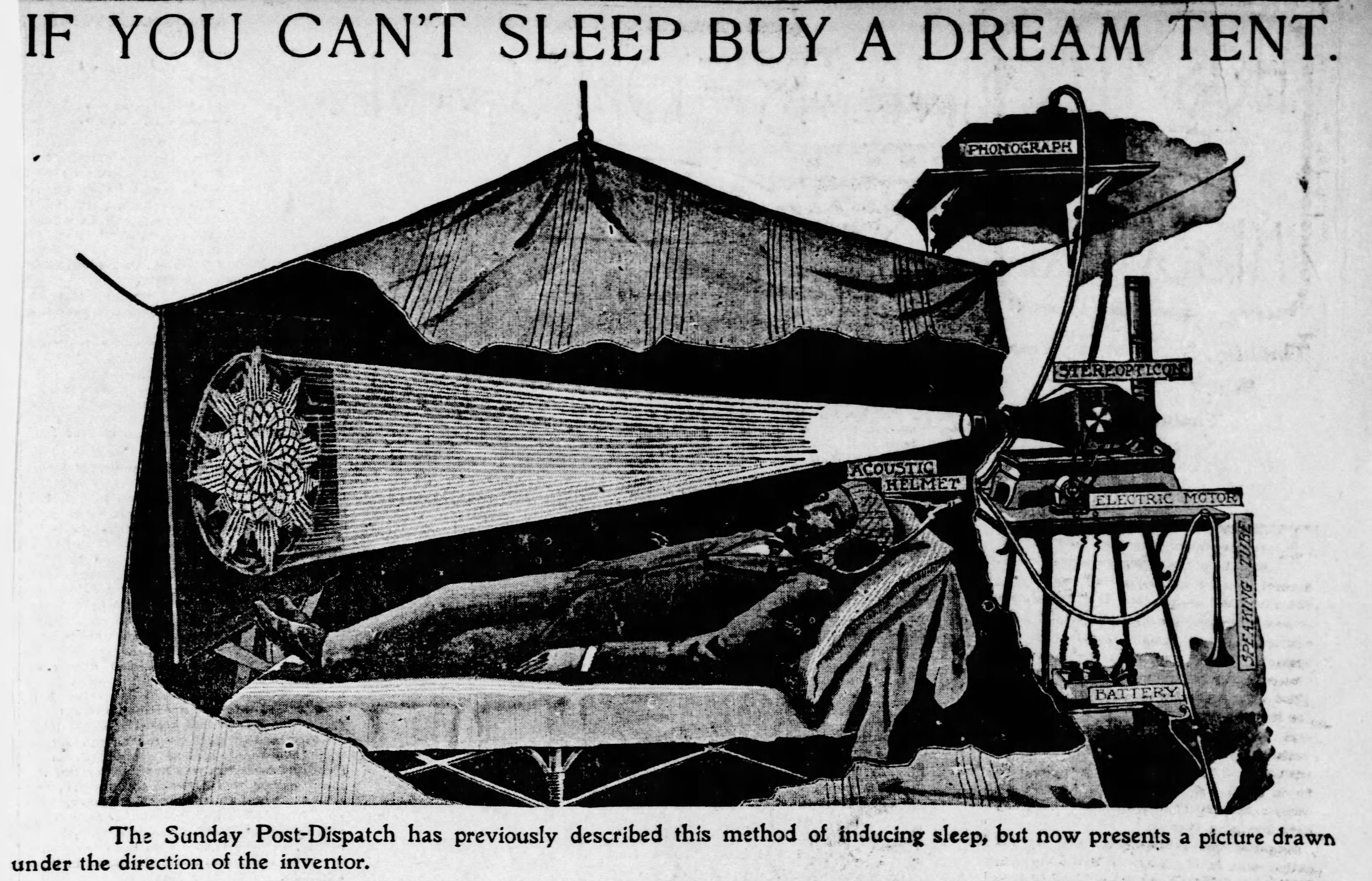
St Louis Sunday Post Dispatch, 4 June 1899
Drill Hall Gallery, 17 October 2025

Handout for Participants

You are about to experience some mind therapy from the late nineteenth century. The Dream Tent was invented by the New York neurologist James Leonard Corning in 1899, the same year Freud published his Interpretation of Dreams.

Corning’s idea was that the brain was susceptible to chromatic and sonic vibrations in the drowsy state before sleep. While in that state, doses of pleasurable colour and sound could induce pleasant dreams and thereby improve the patient’s waking life.

He reported to the International Review of Electrotherapy and Radiotherapy that with the aid of the Dream Tent he had cured Miss L of her Matutinal Depression and Inertia (not wanting to get up in the morning), Mr S of his Insomnia, Mr L of his Morbid Dreams, Mr S of his Imperative Conceptions, and H of his Nervous Irritability.

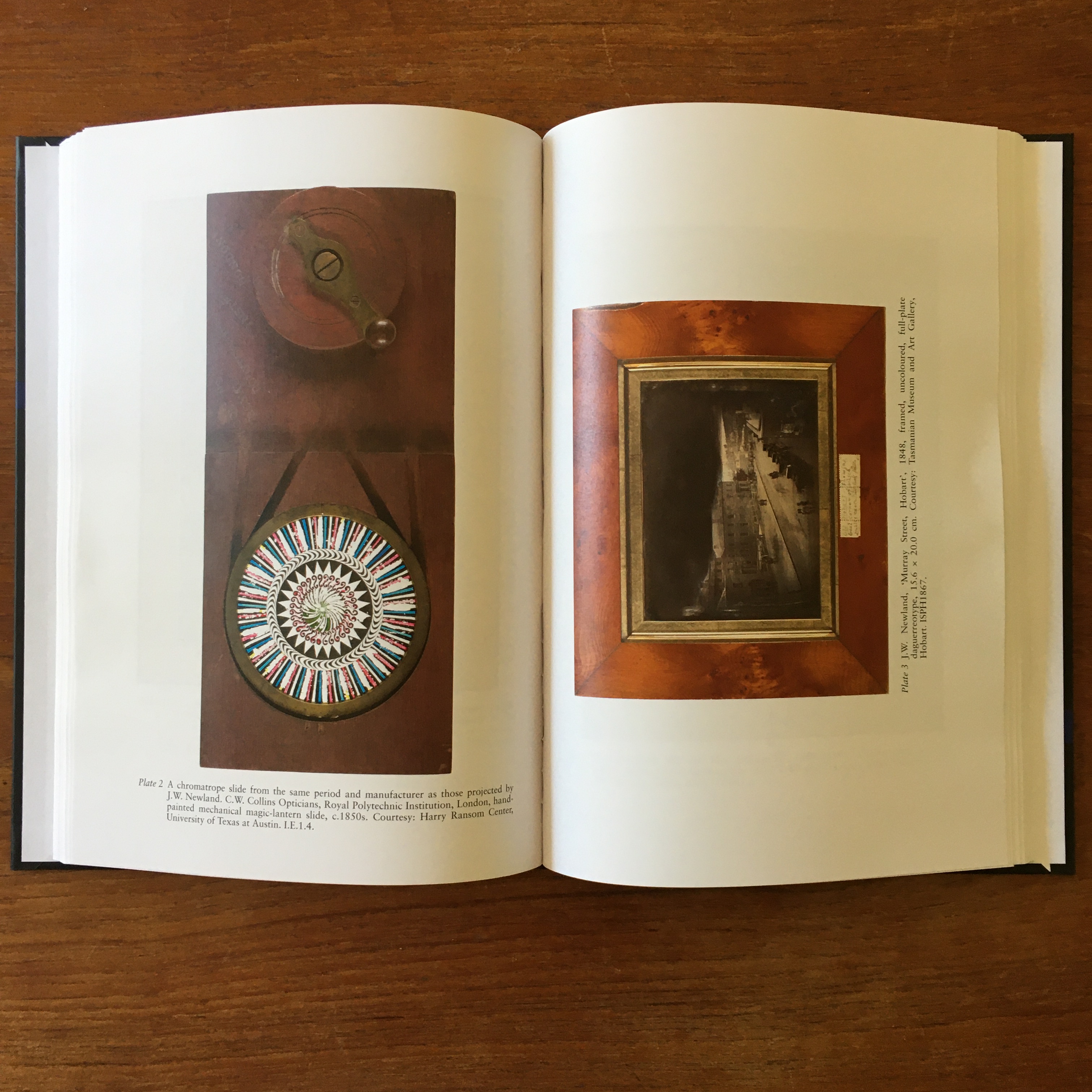
The pleasant colours were delivered to the patient’s retinas via a motor-driven chromatrope, a well-known optical device popular since the 1830s where two discs of glass painted with cycloidal patterns were rotated against each other in a magic lantern, optically mixing their colours and pulsing them off the screen. Our reconstruction uses authentic chromatropes and a magic lantern from the period.

The therapeutic musical vibrations were delivered to the cells of the patient’s brain via a canvas and leather ‘acoustic helmet’, into which Corning had stitched padded metal saucers supporting above each ear hollow metallic nipples connected by a long india-rubber tube to a wax cylinder phonograph, a machine for playing recordings popular since 1888. Our reconstruction uses a Bela Mini computer, programmed with three circular sonic layers, breathily resonating with the optical logic of the spinning chromatrope discs.

In Corning’s words, ‘pleasing scenes, fantasies, and combinations of color form and fade before [the] eyes’, while ‘the musical waves, surging into the labyrinth and onward to the sensorium, produce effects alike transcendent and indescribable’.

126 years after it was first used on sick patients, will you also experience some of the therapeutic benefits of our reconstructed Dream Tent? It’s time to find out.

Take off your shoes, lie on the divan, put on the headphones, and we’ll zip you up. Then, all you have to do is look steadily at the chromatrope.
One minute sample of the Dream Tent reconstruction experience with audio by Charles Martin

Daguerreotypes and Chromatropes

We’ve just received a few advanced copies of our book Empire, Early Photography and Spectacle: The Global Career of Showman Photographer J. W. Newland in the post. It was wonderful writing it with Elisa deCourcy. And now we’ve got it, it is so great seeing the daguerreotypes and magic lantern shows we discuss reproduced side by side as they should be.

We are going to give it a bit of a launch on 18 February next year, so for those in Canberra put it in your diaries, we are even going to put on a magic lantern show under the trees at PhotoAccess.

You can get the ebook if you forgo a few coffees. Or the hard copy if you save up a bit.

https://www.routledge.com/Empire-Early-Photography-and-Spectacle-The-Global-Career-of-Showman-Daguerreotypist/deCourcy-Jolly/p/book/9781003104780

Reviews

“Driven by some extraordinary research, this fascinating book traces the itinerant career of nineteenth-century photographer and projectionist J.W. Newland as he restlessly traverses the world in search of images and customers. Offering a new way of understanding the early history of photography, deCourcy and Jolly embed Newland’s story in an intricate global network of spectacle and exchange. The end result is a brilliant exposition of one man’s working life that also illuminates the advent of the modernity in which we all still live.”

Professor Geoffrey BatchenUniversity of Oxford  

“This fascinating book turns on its head ideas about Empire, and indeed colonial, visual culture. As it makes clear, many more people encountered images of Empire in theatres, music halls and popular lectures than through fine art. Empire, Early Photography and Spectacle helps address the common over-emphasis on paintings and prints when describing how empires illustrated themselves. The reality, as this book demonstrates, is a much more messy, less linear, often technology-based conflation of images, which are teased out through this eminently readable text. By its focus on someone apparently inconsequential, something of real substance and importance emerges.”

Richard Neville,Mitchell Librarian, State Library of New South Wales 

Original, thoughtful, and remarkably readable, this book presents a fascinating story of international and inter-imperial mobility during the mid-nineteenth century. In tracking the itinerant career of the daguerrotypist J. W. Newland across the margins of global empires, deCourcy and Jolly consider the significance of the showman as a shrewd negotiator of colonial and other networks, finding a mixed media space at work in territories from the United States, to the Pacific Islands, Australia and India. An extraordinary global research project in its own right, this book discovers a diversifying trade in cultural goods in this period, offering enlightening insights not only to media and art historians, but also to observers of contemporary global media spaces.”

Professor Joe Kember,University of Exeter

Empire, Early Photography and Spectacle takes the career of British daguerreotypist and showman J.W. Newland as a central device to explore the volatile world of image production, consumption and transnational cultural exchange in the mid nineteenth century. Exquisitely researched and written with extensive illustrations, this book draws on international archival material, images, historical and biographical data to consider the relationship of one itinerant photographer to the global explosion of image making and visual culture. Through this important and richly illustrated study deCourcy and Jolly reveal both the historical and ongoing relevance of photography as a global visual media.”  

Associate Professor Donna West BrettUniversity of Sydney

A dazzling and dynamic journey through a world on the brink of an enormous expansion in global visuality.  Empire, Early Photography and Spectacle is a major achievement, offering a new way of understanding the intertwined complex of optical technologies, visual experiences, practices, and audiences across multiple sites of empire in the 1840s and 1850s.” 

Associate Professor Jennifer TuckerWesleyan University 

Much more than an episode in the history of photography, Elisa deCourcy and Martyn Jolly’s book is an excavation into the emergence of modern media culture. The biography of photographer and performer James William Newland is turned into a chapter of the wider biography of entertainment media, providing us with a powerful testimony of how the new appetite for mediated entertainments emerged and developed across the globe in the mid nineteenth century.” 

Dr Simone Nataleeditor of Photography and Other Media in the Nineteenth Century