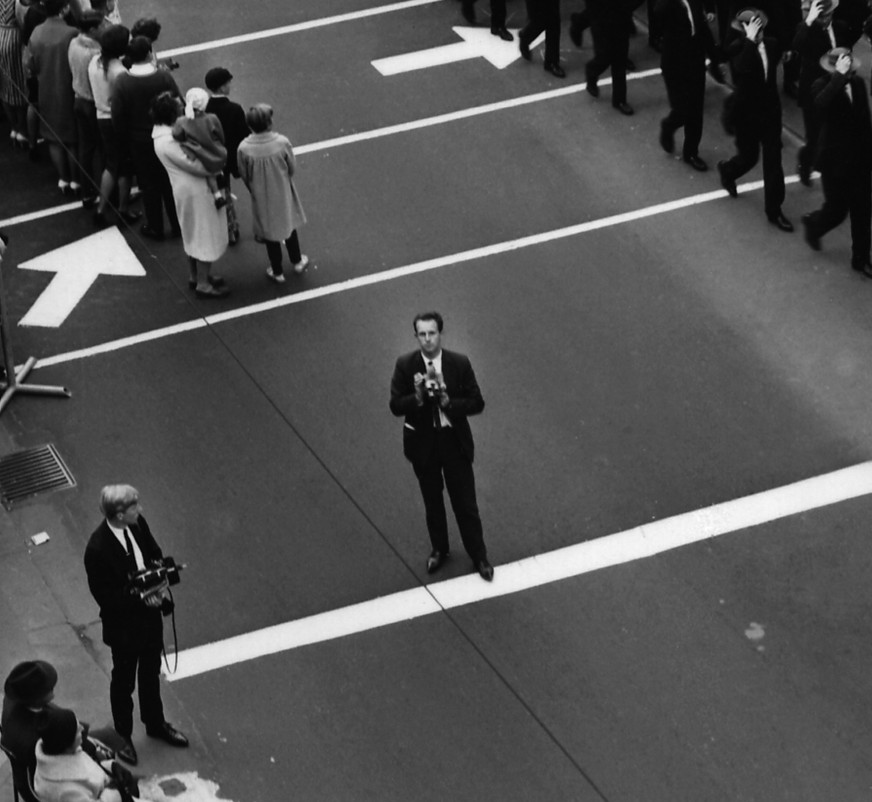
Reconfiguring of camera technologies and camera/subject relationships

The camera is being reconfigured, so we have to rethink camera/subject relations. Not only is the thing itself disappearing, with production of one of the most emblematic objects of modernity halving in one year (thanks to Jason O’Brien from the ANU for that tip-off), but there are more and more signs that the shuttling back and forth of object and image is becoming a permanent enmeshment. Clothing is being engineered to resist the paparazzi’s blast. Kate Moss, one of the most papped women of all time, models a T shirt engineered just for her. Seemingly an innocent black T shirt, it briefly broadcasts ‘FUCK YOU CUNT’ when hit with a photographer’s flash, thereby supposedly rendering the image worthless in the celebrity marketplace (although, cannily, this anti-pap campaign only adds to Kate’s celebrity value). Apple have also just patented a ‘concert camera blocker’, which undermines one of the main uses of its own smart phones by emitting infrared signals from a stage disabling smart phone cameras, technologically enforcing ‘reality’ onto concert goers who may prefer their pop culture mediated. I’m sure there are other examples. We photo theorists are still too hung up on images and image ubiquity, we need to think about other dissolving technological categories as well.

Kate Moss modelling her  anti-paparazzi T shirt

Kate Moss modelling her anti-paparazzi T shirt

Apple's patent for a 'concert camera blocker'

Apple’s patent for a ‘concert camera blocker’

Catoptrics literally and figuratively

In 212BC Archimedes supposedly used a parabolic ‘burning mirror’ to set the attacking Roman ships on fire. In 1646 Anthanasius Kircher, in his book The Great Art of Light and Shadow speculated that Archimedes would have had more success if he had used multiple mirrors each focusing the sun in a giant parabolic shape. Kircher’s groundbreaking catoptrics were borne out in today’s solar furnaces and generators. Now Spencer Tunick revises the idea at the current republican convention and with his trademark naked participants. As 100 nude women hold large mirror discs ‘to reflect the knowledge and wisdom of progressive women and the concept of “Mother Nature” into and onto the convention center’ Tunick joins the figurative metaphor of enlightenment to age old catoptric science. However the women are phalanxed to form a series of flat reflective surfaces. The work would have had a different valency if he had organised their naked bodies into a parabolic surface as Kircher suggested, focussing their rays onto Trump , who invites volatility.

Frontispiece, Anthanasius Kircher, The Great Art of Light an Shadow, 1646

Frontispiece, Anthanasius Kircher, The Great Art of Light an Shadow, 1646

 Anthanasius Kircher, The Great Art of Light an Shadow, 1646

Anthanasius Kircher, The Great Art of Light an Shadow, 1646

Anthanasius Kircher, The Great Art of Light an Shadow, 1646

Anthanasius Kircher, The Great Art of Light an Shadow, 1646

Spencer Tunick work at republican convention, 2016

Spencer Tunick work at republican convention, 2016