David Moore, 1989

David Moore, 1989

‘Photofile’, Vol. 7 Number 1, Autumn 1989

“Certain  [of his] photographs  have   become ‘classics’ —   icons   imprinted  on Australia’s visual memory.” Sandra Byron Curator of Photography Art Gallery of New South Wales


The publishers of David Moore Australian Photographer thought this such an apposite quote that they used it to open the blurb on the inside flap of the book’s dust jacket. I, also, can find no better way to open my review.

The quote comes from the introduction to the book — immediately preceding David Moore’s auto­biographical ruminations which make up the bulk of its text. The introduction also serves as a de facto statement of curatorial intent for the exhibition which was mounted at the Art Gallery of New South Wales to coincide with the publication of this major two-volume monograph. The quote therefore neatly links the ‘gallery retrospective’ and the ‘definitive mono­graph’ — tandem representations of “the achieve­ments of a life in photography spanning almost fifty years.” (Book blurb)

Any differences between two such representations of a photographer’s life are worth considering, not in the search for any ultimate historical veracity, but in order to explore some of the various ways ‘lives’ and ‘life-time achievements’ are written.

These days the art gallery and the coffee-table book seem to just naturally go together, but their alliance often feels somehow unholy. All those Treasuries of Golden Summer Greats rely on the enduring authority of the museum for their immedi­ate appeal, just as museums themselves are in­creasingly encountering the necessity of popularity in a funding environment where fickle corporate philan­thropy is replacing government obligation in the maintenance of the cultural estate.

In this case, however, the marriage was sanc­tified. The publishers, Chapter and Verse, provided the AGNSW with a luxurious accompanying mono­graph  for its  exhibition  which  it  could not have otherwise afforded. In turn, that exhibition became a launch pad for sales of the book (including a signed limited edition, copies of which came complete with your choice of one of four hand-crafted photographs.)

The life of David Moore, as described in the Art Gallery’s well researched introduction to the book, is exactly congruent to his career as an Australian artist. The multiplicity of his work — adolescent experi­ments, international photojournalism, self­consciously artistic architectural constructions — is given an oeuvral coherence by reference to larger art-historical narratives. Moore’s life is woven in and out of the procession of great Australian photo­graphers and artists, and regularly stitched into the background pattern of American and European Modernist art and photography. Thus in 1949 he is found working in the studio of his mentor Max Dupain, but also purchasing books by Brandt, Brassai and Kertesz for his library. In the mid 1970s he is instrumental in setting up the Australian Centre for Photography, whilst also being strongly influenced by international Hard-Edged Abstraction.

Each of his major photographic moments — Sydney documentarian, overseas reporter, Australian iconographer, or seventies abstractionist — is evalu­ated as either like, or not like, a global equivalent. We are shown how overseas models were customized by Moore. For instance, his work from the late 1940s may look like the Farm Security Administration Project, but it is not, its precepts have been retooled to suit the photographer. His photography is naturalis­tic, not humanistic: motivated by aesthetics, not concern. In fact the persistent geometry of his compositions, although changing angularity in ratio to international tastes, is found to be the scaffolding upon which his entire oeuvre, and his life, is built.

The AGNSWs ‘life’ adroitly lodges the artist on its storage shelves under ‘M’ for Modernist. In contrast David Moore’s self-account indulges nothing but his own copious recollections and opinions. In his ‘life’ we lose all reference points to oeuvral intention or art-historical placement. He is continually seduced by himself, writing his own career as one of intrepid determination punctuated by fortuitous moments. Its narrative spreads itself along intricate pathways. As readers we are carried along with him, observing all the things he observed, participating in his moments of revelation, experiencing the global coverage of his travels, and sharing in his vividly recalled excitement at actually being there — then. His mastery of the art of photography is assumed, we are only asked to look at his world with his eyes.

Although both were large and comprehensive, the exhibition and the book each contained a slightly different selection of images, further inflecting the twin lives of David Moore in line with the tandem texts.

Certain images specifically chosen for the AGNSW exhibition firmly locate the artist within the received history of Modernist photographv. Images like “TAA Aircraft Detail” cl948, “David Potts Sleeping On Yacht Deck” cl948, or “Pedestrians Martin Place” cl949 — none of which were deemed by the photographer to be worthy of inclusion in his monograph — become key images to the AGNSW, strongly recalling for the viewer as they do classic images by other Modernist masters such as Callahan, Bay or Moholy-Nagy. The exhibition also de-emphasises Moore’s colour work, comprising one whole volume of the two-volume monograph, while devoting more attention to his ‘experimental’ work of the seventies. His career is thus given a monochroma­tic, formalist consistency within itself. It is made continuous with the work of other major figures in the Gallery’s collection (as well, of course, as the photo­graphy collections of other art museums). For the AGNSW Moore’s life becomes canonic to the interna­tional collecting logic of art museums, which is onlv fit and proper.

In contrast the selection Moore himself made for the monograph is open and discursive — following the meandering anecdotal pathways of his auto­biography. Images of personal revelation, images of historical interest, or images to which simply an exciting story is attached — all are given equal billing, all are the bustling incident which crowd an adven­turous life. Rather than being streamlined around a central artistic thrust, the photographer’s own selec­tion extends in all directions at once in grand abandon.

The art gallery and the coffee-table book demand two lives — the canonical and the anecdotal. Here each interpenetrates the other in happy partnership. In whose life, however, were those iconic classics imprinted on Australia’s visual memory?

No other Australian photographer since Frank Hurley has been as aware of, to use one of David Moore’s own chapter titles, “The Overseas Market from Australia”. His seven years in London in the 1950s, the closing decade of the Golden Age of picture magazines, taught him the rules and regulations of the foreign photo exchange market. Working free­lance for a variety of picture editors and agencies he became one of an elite corps of photojournalistic globe-trotters. Plugged in by cable communication to the instantaneous demands of his big-city clients he was able to, by virtue of expense account and grim determination alone, penetrate the outer reaches of the globe at their command. It is this almost omnipotent ecstasy of instantaneous image produc­tion which he is most eager to share with us in his text; even to the point of devoting one whole chapter to the “Magic of Cables” in the colour volume of the monograph.

By the mid 1960s he had staked out just about the entire Asian and Pacific region as his patch. Assignments from the Time-Life Books Division World Library Series and National Geographic led to such images as “Pitjantjatjara Children” (1963), “New­castle Steelworks” (1963), and “European Migrants Arriving in Sydney” (1966). These national icons were taken with the same professional diligence as his other assignments from the same period: his coverage of indigenous Asian sport for Sports Illustrated or Polynesia for National Geographic, for instance. Those images which are now so familiarly ‘ours’ — reproduced in a thousand books, magazines, post­cards, social studies texts, and popular history exhibi­tions — were originally made to be ‘theirs’: obedient responses to the call from the centre for images of its exotic periphery.

Is it this import/export dynamic which gives the most famous of Moore’s images their unambiguous, summary clarity? Is this why the Rousseauian Pitjant­jatjara Children, the steelworker’s sons on their suburban bikes, and the apprehensive European Migrants, seem to all perform, as though on cue, for some unseen audience — initially American, now us? For instance, the emotional contradiction of “European Migrants Arriving in Sydney” is neatly presented in the latticed choreography of an extended family of faces emerging from a velvety background, behind a framing handrail, and beneath a proscenium arch of supplicant hands. This staging is given an almost epic quality by the way their anticipatory gazes knit together as each generation strains to penetrate the nether regions somewhere behind the photographer’s left shoulder. The original colour transparency is now usually printed in black and white to further abstract the particular towards the

iconic.

Moore’s icons have quickly outgrown the inten-tionality of their moments of creation. One of his anecdotes is illuminating. Wandering down a Redfern lane on an aesthetic mission from Modernism, Moore was accosted by a desperate woman who mistook him and his borrowed Speed graphic as possessing the politically useful authority of a newspaper. “Take a picture and print it,” she demanded. “Redfern Interior” (1949) was the result. Persuaded by Max Dupain not to destroy the negative the rest was safely allowed to become history: inclusion in the Family of Man at the Museum of Modern Art in New York and elevation to the heights of classical iconicity in Australia followed. The picture wasn’t really taken under false pretences as Moore feared. At the time he may not have possessed the authority of a press photographer, but his manifest destiny invested him with a greater authority. The woman’s immediate distress was dissolved in the universal image of ‘stoicism in adversity’ she became.

Similarly, many of his other images have gone on to lead complex ‘lives’ on their own account. Throughout his career Moore’s closest colleagues have been editors, designers and writers. The vintage magazines displayed at the exhibition demonstrated that the visual syntax of mass reproduction and public display has neatly interconnected with Moore’s own carefully nurtured formalism. His photographs are most commonly composed of bold horizontal and vertical blocks tautened with delicate diagonal braces. Their dynamic design irresistably hooks the browser’s roving eye; their precision engineering tightly inter­locking with the margins, headings, edges and col­umns of type on page layouts and display panels to form a single high-performance graphic unit. This, Moore’s essential skill as a photographer, is what steadily pumps his images through the capillaries of our visual culture.

His marvellous artistry lies in his ability to neatly package complex social issues into visual aphorisms. Of course this is the basic language of photojournal­ism, with a noble lineage. However, the somewhat glib summations of Moore’s ‘classics’ — the Brave New Migrants, The Stolid Redfern Matriarch, the Obsequious Prime Minister — are given a further emphatic certainty by his dourly efficient composi­tions. A photograph like “President Johnson and Prime Minister Holt at Canberra Airport” 1966 (taken for LIFE magazine but never used) has almost mutated into a political cartoon. It squeezes an entire geo-political relationship into a few deft strokes and a cheeky punchline.

The formal mechanics of Moore’s photographs perfectly mesh with the design machinery of their reproduction and the cultural industry of their dissemination. Is this the process which gradually elevates particular journalistic events to national icons, imprinting them on our collective visual mem­ory? Neither the canonic life of the gallery artist, nor the decisive revelations of the intrepid photographer, seem sufficient to explain this phenomenon by them­selves.

However, it is certain that, from keen student of the Modernist canon to eager functionary within the global circulation of signs of ‘otherness’, Moore has been a willing worker, driven bv the desire to lead an interesting life.


Martyn Jolly

I would like to thank Sandra Bvron and David Moore for their cooperation and help. Martyn Jolly


Australian First World War Photography 1999

pdf: Australian First World War Photography 1999

Australian First World War Photography

History of Photography, Vol. 23, No. 2, Summer, 1999.

On the twenty-sixth of September 1917, during the Third Ypres Campaign on the Western Front in Flanders, Frank Hurley and Charles Bean began a long argument about photographic verisimilitude. Captain Frank Hurley, one of Australia’s newly appointed war photographers, wanted to combine several different negatives into a single battle tableau, and C. E. W. Bean, Australia’s long-standing war correspondent and official war historian, prohibited it.

An amateur photographer himself, Bean valorized pho­tographic objectivity in his own reportage writing. After he was appointed official Australian ‘eyewitness’ to the war in 1915, he referred to himself in his diary as an Australian recorder’ and was angered when Australian newspapers preferred to publish the more lurid and fanciful accounts of the Reuters pool reporters over his own official dispatches, which ended up being described as ‘colourless’ by the Bulletin.” To Bean, however, ‘the private interests of papers are something which cut right across the interests of the country — scoops, competition, magnification and exaggera­tion are out of all harmony with what is best for country’. In 1916 he began a campaign to establish an Australian War Records Section which would ‘preserve and tenderly care for the sacred things which will some day constitute the greatest public possession Australia will have’. It would collect war relics (a term he preferred to trophy),3 which would act as both vivid historical expository devices, and as spiritual shipping containers in which to bring some essence of the experience of the Anzacs4 back to Australia from France, where many thousands of their bodies were to remain. It would also collect photographs as ‘sacred records — standing for future generations to see forever the plain simple truth’.5

To Bean, both photographs and relics sat on the same continuum, because both received and retained direct index-ical impressions of the fighting. For example, in July 1918, Bean had two, front-and-back, anthropological-style photo­graphs taken of two diggers6 when they came out of the fighting.7 Then he had their uniforms and all their gear taken from them and replaced by a completely new outfit. In the words of Bean’s biographer: ‘Everything that was taken from these soldiers, with all the emanations evocative of battle, fear, death, endurance and heroism, was to be sealed up, just as it came from these men, and sent back to Australia so that their countrymen might feel these emana­tions and be reminded what manner of men these had been’.8

To Bean both the war relic and the record photograph would also provide a ready-made archaeological substratum for the nascent Australian nation. For example, in 1919, after the Armistice, Bean returned to Gallipoli with the Australian Historical Mission and, in a scrupulous valedictory labour, combed the ground for relics which he referred to as ‘ “antiquities” only four years old’.9 These were then forens-ically examined to determine how far inland the Australians had penetrated on the morning of the first landing. Significant finds were photographed in situ. A seemingly insignificant photograph of a water bottle lying under a bush, Australian relics on the north-easternmost spur of Battleship Hill, is only activated into historical, and spiritually mnemonic life by its caption: ‘This was probably the point reached by Tulloch’s Company on 25th April 1915’.10

The Australian War Records Section was established in June 1917, and two Australian photographers, Hubert Wilkins and Frank Hurley, were appointed to the Section shortly thereafter. If Bean revered the photograph as an inviolable historical record and immutable spiritual artefact, to Hurley it was a manipulable, spectacular showcase. Frank Hurley was much more than just a photographer. At the time of his appointment to the Section he was a household name as a polar explorer and a showman film maker, photographer and adventurer.11 He already had extensive experience with the production of popular attractions, all of which used the latest film and photographic technology, and all of which featured himself as showman. A youthful apprenticeship in Sydney as a postcard photographer special­izing in spectacular subjects and unusual effects prepared him for the heroic work he produced on the Mawson Antarctic expedition of 1911 — 13 and the Shackleton Antarctic Expedition of 1914—16. Hurley produced and appeared with theatre presentations of the cinema film and lantern slides he shot on these expeditions. His film of the Mawson expedition, Home of the Blizzard, was screened in Sydney in 1913 whilst Mawson was still stranded in Antarctica. Hurley appeared at each screening as the figure of the returned imperial explorer to give a personal recitation to accompany the film.

After receiving the honorary rank of Captain from the AIF,1 Hurley established with Bean a clear separation between the duties of himself and Lieutenant Hubert Wilkins: ‘Wilkins will attend to the records, and I myself to the publicity pictures and aesthetic results’.13 Bean saw the division of labour between the two photographers in similar terms, but placed quite different weightings on their relative importance. Whilst admitting that both photographers were ‘utterly daring fellows’, Bean always felt more affinity for Wilkins. To him Hurley was merely a ‘keen commercial man’ devoted to publicity and propaganda, whereas Wilkins was committed to providing future historians with records accurate enough to be relied on as historical evidence.14 Bean not only saw these as ‘conflicting activities’,1= but to him the publicity photographer was necessarily excluded from the urgent historical imperatives of military, and there­fore national, destiny. Only the record photographer who risked his life out of ‘his own sense of duty’16 truly ‘played [his] part as [an] Australian soldier’.17 After the Third Ypres Campaign, Bean warmly recommended Wilkins for a Military Cross, and rather lukewarmly recommended Hurley for a Mention in Dispatches.18 Wilkins received his Military Cross but Hurley never received his Mention in Dispatches.

However, like Bean, Hurley was overwhelmed by the horror of the Front and greatly impressed by the futile bravery of the Anzac soldiers, which he immediately saw in the same nation-forming terms as Bean. His picturesque imagination was excited by the weird juxtapositions of modern warfare, where expansive scenes of pastoral beauty existed within a few kilometres of the compacted hell of the trenches, and everything was overseen by awesome new technologies. Hurley had trouble scenographically encompassing this visual sweep. During the Battle of Polygon Wood the speed and intensity of battle were his biggest problem. Both Hurley and Wilkins wanted to capture the random instantaneity of aerial bombardment: ‘In spite of heavy shelling by the Boche, we made an endeavour to secure a number of shell burst pictures. … I took two pictures by hiding in a dugout and then rushing out and snapping’.19

It was that evening that Hurley and Bean began their argument: ‘Had a great argument with Bean about combina­tion pictures. Am thoroughly convinced that it is impossible to secure effects, without resorting to combination pic­tures’.20 Composite printing was a staple technique with which Hurley was well acquainted. He had already produced composites from his Shackleton Antarctic Expedition nega­tives. The technique was widely used by amateurs to add moodily artistic cloud effects to landscapes, but postcard companies and illustrated newspapers also occasionally used it to recreate complex scenarios. 1

The dispute was important to both men because the Australian High Commission in London was planning an exhibition of war pictures at the Grafton Galleries in May 1918. Bean also sought to get a perspective on the argument by retreating to his diary: ‘ … had a long argument with Hurley who  wants  to  be  allowed  to  make  “composite” pictures for his exhibition — i.e. to put in a shell burst made by trench mortars at St Pol. I can see his point, he has been nearly killed a dozen times and has failed to get the pictures he wants — but we will not have it at any price’.22 Five days after their initial confrontation Hurley and Bean continued their argument, and both hardened their stances. Bean got General Headquarters to prohibit Hurley from making com­posites and Hurley, banking on his prestige as a famous polar explorer, tactically responded by tipping the ante:

Had a lengthy discussion with Bean re pictures for exhibition and publicity purposes. Our authorities here will not permit me to pose any pictures or indulge in any original means to secure them … . As this absolutely takes all possibilities of producing pictures from me, I have decided to tender my resignation at once. I conscientiously consider it but right to illustrate to the public the things our fellows do and how the war is conducted. They can only be got by printing a result from a number of negatives or re-enactment. This is out of reason and they prefer to let all these interesting episodes pass. This is unfair to our boys and I conscientiously could not undertake to continue to work.23

I sent in my resignation this morning and await result of igniting the fuse. It is disheartening after striving to secure the impossible and running all hazards to meet with little encour­agement. I am unwilling and will not make a display of war pictures unless the Military people see their way clear to give me a free hand.24

However, Hurley continued to photograph and film. Called to General Headquarters to photograph the 1st Anzac staff, he spoke to General Birdwood who promised to ‘fix matters up’.25 A few days later Hurley was able to report in his diary: ‘Headquarters have given me permission to make six combination enlargements in the exhibition so I withdrew my resignation … . However it will be no delusion to the public as they will be distinctly titled, setting forth the number of negatives used, etc. All of the elements will be taken in action’.26 In early November Hurley was sent to Palestine to cover the Australian Light Horse. Away from the strictures of both the Front and Bean, he flourished. He found the battalions, and battalion commanders, extremely amenable to staging re-enacted ‘stunts’ for his camera.

Hurley returned to London in May 1918 to prepare for the exhibition of Australian war pictures at the Grafton Galleries. He arranged to have 130 negatives printed, his six composites and other images enlarged to mural size at Raines & Co in Ealing, and colour lantern slides made from the Paget colour plates. He enthusiastically described the exhibition in his diary:

The exhibition was well patronised today. The colour lantern is working excellently. The colour slides depict scenes on the Western Front, Flanders and also Palestine. They are gems and elicit applause at every showing. A military band plays through­out the day. … Our largest picture ‘THE RAID’ depicting an episode at the Battle of Zonnebeke [is a combination of twelve negatives] and measures over 20ft x 15’6′ high. Two waves of infantry are leaving the trenches in the thick of a Boche Barrage of shells and shrapnel. A flight of bombing aeroplanes accompanies them. An enemy plane is burning in the foreground. The whole picture is realistic of battle, the atmospheric effects of battle smoke are particularly fine. Another sensational picture is ‘DEATH THE REAPER’. This remarkable effect is made up of two  negatives.  One, the foreground, shows the mud splashed corpse of a boche floating in a shell crater. The second is an extraordinary shell burst: the form of which resembles death. The Palestine series are magnificent … . It is some recompense to see one’s work shown to the masses and to receive favourable criticism after the risks and hardships I have taken and endured to secure the negatives.27

The composite Hurley referred to as ‘The Raid’ was sub­sequently variously known as An episode after the Battle at Zonnebeke,2 or sometimes Over the Top29 (figure 1). The foreground is constructed from the final two images of a rapid sequence of three photographs he shot of a group of soldiers going over the top (figure 2). In the composite, these sequential images of the same soldiers become spat-ialized two lines of advancing troops, and planes, shrapnel and smoke have been added into the background. The original sequence was most probably taken during a training exercise or a re-enactment since they have been accessioned out of series by the Records Section; in addition, it is extremely unusual to see any photographs, let alone a sequence of three, taken from such an exposed position during a battle; and, finally, the actual battle was fought in torrential rain and a quagmire of mud, whilst in the compos­ite the ground appears dry.30

Although oil and water colour sketches were exhibited in a separate room, the photographs received most press attention. In particular the colour lantern slides received notices that confirm Hurley’s enthusiastic diary entries.31 A day or so later Wilkins visited London sporting his Military Cross. Hurley commented darkly, ‘Strings have been pulled’.32 Bean also came to London and visited the exhibi­tion. He had already discovered that Hurley had attempted to smuggle some colour plates out of France for the exhibi­tion without going through the censor — he was angry, but not surprised, at Hurley’s unscrupulousness.33 He was further angered when he realized that Hurley now intended to abandon the task of photographing the continuing trials of the Anzacs in France in order to return to Australia to continue his showman career. And he did not like -what he saw when he visited the exhibition either:

Our exhibition is easily the best I have seen, although there is too much Hurley in it — his name is on every picture with few exceptions — including some that Wilkins took; and what should be a fine monument to the sacrifice of Australians in France is rather an advertisement for Hurley. … Hurley was married in Egypt and is determined to go back to Australia straight. I shall see that he does not have management of this exhibition there.34

As the exhibition continued to attract larger and larger numbers of visitors (on one Sunday a thousand people saw it in three hours) Bean mobilized his forces against Hurley’s plans. Hurley recorded it all in his diary, only hinting that he knew who might be pulling the strings:

I am urging that the present set of enlargements be sent to Australia for propaganda. No better medium could we possibly have. The exhibition has been pronounced by experts to be the best since the beginning of the war.33

I have omitted a week from my diary, having been so disgusted with the treatment I have received from the High Commissioner’s  office and  the A.  I.   F.  It has worried me considerably. A deadlock has been arrived at which excludes me from taking the Exhibition of my own pictures to Australia …. The only reason Australia House ascribe to their attitude is because I am soliciting publicity. They accuse me of making a Hurley show of the exhibition, which is an infernal lie. … It seems beyond conception that government officials can assume such an attitude which is nothing but the outcome of personal jealousy. … I do not intend to let the matter drop here, but will have it taken up further by the Australian press.36

The exhibition was sent on a provincial English tour. Hurley unsuccessfully tried to persuade Australia House to produce a duplicate set to take to Australia. He resigned on 11 July and received permission to make smaller versions of the AIF photographs, including the composites, for his private use, paying for the materials himself.37

Meanwhile, Bean was, in his own way, attending to the propaganda potential of photographs. His attempt to prohibit Hurley from taking his composite tableaux to Australia did not mean that he was ignoring the value of photography for propaganda altogether. Whilst Hurley was arguing with the High Commissioner, Bean was organizing for 72 small 4×6 cm photographs to be available for purchase by the troops, at a shilling each. Bean also produced several series of lantern slides for the recruiting authority in Australia. As Bean admitted, ‘the originator of this scheme was really Hurley’.38

Back in Australia, Hurley was amongst friends once more. In early 1919, after the Armistice, he got permission from the Minister for Defence to exhibit his personal collec­tion of the smaller AIF photographs at Kodak’s Sydney Salon, which paid for the framing and mounting. The proceeds of the exhibition, some £300, were donated to the Red Cross. He used the press consummately to complain about his treatment in London. A talk he gave to the Photographic Society of New South Wales was reported under the headline ‘Australian War Pictures Kept In England’,39 and two corres­pondents wrote letters of support to the Sydney Morning Herald, which conveniently allowed Hurley to reply:

Sir, After seeing Captain Frank Hurley’s wonderful war pictures … 1 cannot help wondering how it is that we have not become acquainted with them before. They are the real thing, and are of historic value. … I believe this collection is only one third of the pictures he has photographed on the battlefield, the others are in the keeping of military authorities in London. Why have they not reached Australia? Isn’t it worthwhile making some effort to obtain them for our National Art Gallery or Mitchell Library or some other place where they could have a permanent home, and serve as a memento of what our soldiers actually did in the great war, when they travelled 12 000 miles to help the Motherland. I write as an Anzac’s sister. I am etc. May Summerbelle.40

… The last I heard of the collection of pictures was that they rested in peace, or rather pieces, in the vault of Australia House, London, in a shroud of red tape and cobwebs. Surely, indeed, this is gross injustice to the people, and a poor tribute to those who had deeply at heart the immortalisation of doings great in the history of our nation. … I am etc. Frank Hurley, Captain.41

Hurley’s Kodak Salon exhibition received much publicity. The composites were reproduced in many different newspa­pers and magazines. Hurley had assured the AIF that there would be ‘no delusion to the public’,42  and in the catalogue that accompanied the exhibition he freely admitted that: ‘In order to convey accurate battle impressions, I have made several composite pictures, utilising a number of negatives for the purpose’.43 However, the catalogue does not identify the composites, and when they were reproduced sometimes their composite nature was noted, sometimes not. All the time, however, the authenticity of the composites was stressed. Considerably stretching the truth, the catalogue stated that ‘The elements of these composites were all taken in action and submitted to the G. O. C. A. I. F. who gave his approval for their production’.44 It was crucial for the reception of the images as authentic that all the component parts of the composites be assumed to be taken in action. Newspaper reviews certainly worked on that assumption.

War Pictures Realistic Collection Capt. Hurley’s work

‘The Dawn of Passchendaele’ immediately arrests attention, this is a very striking picture with all the sinister suggestions appropriate to that dreadful day. It was taken under machine gun fire at a spot where some stretcher-bearers had laid down their stricken burdens overnight to await for a relief party. The recumbent, shrouded figures — the attitude of complete exhaustion in which a guarding bearer leans against a wall — tell a mute story of suffering and endurance which gives the heart a sharp pang and stirs the imagination to a perhaps more intimate realisation of what prodigies of devotion and sacrifice those shell swept trenches of Flanders witnessed.43


The pictures … are photographs taken at great risk during battles, and not fancy pictures faked from a safe position behind the lines. I received this news from the mouth of a returned soldier who said, ‘They are the goods, in the thick of the fight was Hurley with his camera; both he and his camera must have been charmed’.46

These responses to Hurley’s composites (figures 3—5) are themselves a kind of composite: the reading of the ‘sinister suggestions’ produced by the addition of heavy clouds conforms to a conventional mode of pictorial decipherment which uses a generic lexicon derived from salon painting, whilst, at the same time, the assumption that the compo­nent parts are actual adds a ‘sharp pang’ of authenticity. The word ‘faked’, here, is used to distinguish composites sup­posedly comprising authentic components from staged re-enactments.

Hurley, explaining himself to a camera club readership, appropriated their word ‘impression’ in order to further validate his composites. Within camera clubs, ‘impression’ was normally used to describe ‘artistic’ or ‘pictorial’ photo­graphs, but Hurley used it more generally to describe an authorized auteurial mode of photographic malleability:

Special permission was granted … for the making of ‘Photographic Impression Pictures’ …. None but those who have endeavoured can realise the insurmountable difficulties of portraying a modern battle by camera. To include the event on a single negative, I have tried and tried, but the results are hopeless.   Everything  is  on  such  a  vast scale.   Figures  are

scattered — the atmosphere is dense with haze and smoke — shells will not burst where required — yet the whole elements are there could they but be brought together and condensed. The battle is in full swing, the men are just going over the top — and I snap! A fleet of bombing planes is flying low, and a barrage burst all around. On developing my plate there is disappointment! All I find is a record of a few figures advancing from the trenches — and a background of haze. Nothing could be more unlike a battle. It might be a rehearsal in a paddock. Now if negatives are taken of all the separate incidents in the action and combined, some idea may be gained of what a modern battle looks like.

Ironically, Hurley had, in fact, used photographs taken of ‘a rehearsal in a paddock’ to create his most hyper-real and convincing battle scene. Besides dexterously fudging the truth, Hurley also took the opportunity to reply, inter alia, to Bean’s interdiction by citing the ultimate authority — the digger:

During a recent exhibition held in London by the High Commissioner for Australia, one such picture, depicting a scene near Zonnebeke, was enlarged up to 300 square feet. Attired in civilian dress, I often mingled with the ‘diggers’ to hear their scathing criticism. When I find they approve and pass favourable judgement, then I feel convinced such impres­sion composites are justified.4

Immediately after his exhibition Hurley offered to sell his prints to the National Art Gallery (now the Art Gallery of New South Wales) and they were eventually acquired by the Mitchell Library. Two years later, in August 1921, the first photographic exhibition from Bean’s Australian War Museum opened at the Melbourne Aquarium, and was seen by 83 000 people in five weeks. Mural-sized enlargements and colour prints were on display, and particular photographs could be ordered to raise money for the future Memorial. Like Hurley’s show, the exhibition reproduced the horror of the war on an immediate level:

There, most truly and vividly, war in all its frightfulness is pictured …. The horror of all those things so vividly shown in these photographs makes itself most terribly felt …. Every phase of the war is presented without trimmings or politeness. It is a real record, and one which Australians will value and be proud of. The photographs have been selected from 20 000 negatives in the possession of the War Museum’s committee. They were so accurate and complete that the military censors in France insisted on their being treated as secret documents.49

But this exhibition, compiled on Bean’s terms, was able to achieve more, even, than had Hurley’s own exhibition: the archival monumentality of the 20000 negatives in the nation’s collection, plus their ontological status as ‘real records’ which at one time even had the strategic status of ‘secret documents’, gives these images an extra artefactual solidity. In addition, the exhibition was a mnemonic event that directly addressed itself to each returned digger and each grieving relative individually:

[I]t is estimated that nearly 60 percent of the personnel of the A. I. F. appear in the views, which are ‘keyed’ and indexed so that it is possible to identify nearly every man who was ‘snapped’. … By means of a unique system of indexing, hundreds of relatives have been able to see photographs of men who were killed or missing, and soldiers who have returned have identified themselves and their comrades on the battle fronts.50

Two years after that, in 1923, the twelfth volume of Bean’s Official History was devoted entirely to photographs, 753 in all, each one meticulously captioned and each one, Bean was careful to note in his introduction, ‘as far as possible, scrupulously genuine. … The pictures here printed have not been retouched in any way except to remedy scratches or other obvious flaws in the negatives’.51

In photography the division between the fake and the not-fake has always been unstable. Bean’s argument with Hurley took place before the full development of the documentary genre in the 1920s and ’30s which established the technical slice of the shutter-blade, guillotining and encapsulating a contingent moment, as the only guarantor of truth. However, in the case of Hurley’s composites, photographic authenticity is guaranteed by the manual virtu­osity of scenographic effect which is able to assemble multiple moments into a single tableau, with a second-degree pictorial expressivity to provide legibility, and an exegetic, performat­ive testimony from the impresario/witness to provide authenticity. To the contemporaneous viewer Hurley’s com­posite techniques were not illicit fakery, but licit special effects tacitly deployed to produce a legitimate scenario worthy of emotional and phenomenological investment.

Hurley’s argument with Bean also took place when the specific gravity of the photograph as artefact was still high — before photography’s atomization during the age of its mechanical reproduction — when the photograph was primarily encountered as an object to be pasted into an album or placed on a mantelpiece. Bean’s pious reverence for the purity of the photograph related as much to its status as a potent relic to be eternally exposited by his larger history, as to its putative ‘documentary’ ability to contain a self-evident historical truth. For Bean the main game was long-term national memory, and that needed artefactually stable images which interlocked into a monumental reliquary archive. In that context, Hurley’s composites were dangerous fakes because they drained the indexical charge from the relic.

Hurley’s composites are quaint historical footnotes now, and would not move audiences even if they still existed in their original salon picture size. The heroic stories they told, and their rich pictorial embroidery, now seem threadbare and slightly disreputable. On the other hand, none of Wilkins’s record photographs have become iconic either, despite being reproduced many times. Many do, indeed, look like rehearsals in a paddock, and tend to be crippled without Bean’s meticulous captions. Hurley’s sensational effects compromised the photograph’s optical and temporal specificity, but strategically produced an immediate, though evanescent emotion. Bean’s collection of indexical photo­graphic records did become integral to his highly successful Memorial, but they are only able to act as a monument to the dead within larger sustaining institutional structures and mythic mnemonic mechanisms.

Despite the subsequent historical slippage of the terms in which it was couched, their argument lined up along either side of a dialectic that has remained persistently entrenched within photography. The major theorists of photography within modernity (Benjamin, Bazin, Barthes) all   subsequently   elaborated   on   this   dialectic   when   they distinguished, in various ways, between the indexical charge of the photograph as artefact and the semiotic mutability of the photograph as image. Current postmodern developments in digital technology have added new twists to their argu­ment. Recent journalistic anxiety over the supposed threat of the digital to the autonomous authority of the news photograph would have had a familiar ring to Bean. Photography’s role within the newly digital mass media is less now as a provider of an endless series of rectangular, guillotined slices of time and space, and more as a font for a continuous stream of mutable visual data to be assembled and reassembled into various pictorial configurations. Exegetic protocols are currently being established within the media to set the various levels of agreed fakery, from factual reportage to editorial illustration. In addition, the media’s own ubiquitous presence throughout the real means that the distinction between a spontaneous and an enacted profilmic event is more and more difficult to make. And the growing archive of historical photography and film, which distingu­ishes less and less between documentary and fictional sources, means that the past is known as much through fabulated as actual historical images.5

As the twentieth century progressed, the guillotining blade of the camera shutter became the core of photography’s technical ontology. The documentary movement entrenched the snapshot image as photography’s normative style, and the indexical photograph became our culture’s key historical and mnemonic artefact. But although it might once have appeared that the issue of fakery had been settled for good, it now seems that an argument of eighty years ago is far from over yet.

Notes

  1. D. McCarthy,  Gallipoli to the Somme:  The Story of C.  E. Sydney: John Ferguson 1983, 233, 270.
  2. C.  E.  W. Bean,   C.  E.   W.  Bean Diary, Australian  War Memorial, AWM38, 3DRL606, series 1, item 88, 19 September 1917.
  3. C. E. W. Bean, Gallipoli Mission, Canberra: Australian War Memorial 1948, 6.
  4. Members of the Australian and New Zealand Army Corps.
  5. M. McKernan, Here is Their Spirit, Brisbane: University of Queensland Press 1991, 42.
  6. Australian colloquialism for an Australian soldier, particularly those that served in the First World War.
  7. AWM E2818, E2819, ‘Two diggers from the 5th Australian Division’, 30 July 1918.
  8. D. McCarthy, Gallipoli to the Somme, 34.
  9. Bean, Gallipoli Mission, 4.
  10. Ibid., 111.
  11. J. Thomas, Showman, Canberra: National Library of Australia 1990; D. Millar, Snowdrift and Shellfire, David Ell Press 1984.
  12. Australian Imperial Force.
  13. F. Hurley, My Diary, Official War Photographer, Commonwealth Military Forces, from 21 August 1917 to 31 August 1918, typewritten manuscript, National Library of Australia, MS883,Series 1, Item 5, 5 September, 1917. Bean, Gallipoli Mission, 20.
  14. x
  15. C.  E.  W.  Bean and H.  S.  Gullett,  Photographic Record of the  War:
  16. Reproductions  of Pictures  taken  hy  the Australian   Official Photographers,
  17. Sydney: Angus and Robertson 1923, vii—viii.
  18. C.  E. W. Bean,   Wilkins and Hurley recommendations, Australian War
  19. Memorial, AWM38, DRL6673, item 57, 24 October 1917.
  20. Bean and Gullett, Photographic Record of the War, vii—viii.
  21. C. E. W. Bean, Wilkins and Hurley recommendations.
  22. Hurley, My Diary, 26 September 1917.
  23. Ibid.  ‘
  24. For example, the Australian War Memorial holds a composite postcard
  25. by Underwood, ‘Battle in Skies During Zeppelin Raid on England’,
  26. AWM, H18216.
  27. C. E. W. Bean Diar)>, 71-2.
  28. Hurley, My Diary, 1 October 1917.
  29. Hurley, 2 October 1917.
  30. Hurley, 3 October 1917.
  31. Hurley, 6 October 1917.
  32. Hurley, 26, 27, 28 May 1918.
  33. C.        F. Hurley, Catalogue of an Exhihition of War Photographs, Sydney:
    1919, Cat. No. 77.
  34. F. Hurley, Press cuttings, National Library of Australia, MS883, series 2, items 29-36, Newsy Notes (August 1919), n.p.
  35. The first shot from the sequence was exhibited as ‘ “Fix Bayonets”, Australian Infantry preparing to resist a counter attack at Zonnebeke’, State Library of New South Wales Collection PXD19-PXD31. Catalogued in C. F. Hurley, Catalogue of an Exhihition of War Photographs, Sydney: 1919, cat no. 36; and D. O’Keefe, Hurley at War, Sydney: The Fairfax Library 1986, 53. The second shot from the sequence was exhibited, as a detail from the larger composite, as ‘A wave of infantry going over the top to resist a counter attack, Zonnebeke’, SLNSW Collection. Catalogued in C. F. Hurley, cat. no. 41; and D. O’Keefe, 51. The third shot from the sequence is in the Australian War Memorial at E5429 as A photograph taken in France in June 1919 [incorrect date] illustrating the commencement of an attack’. The background aircraft montage was also exhibited separately as ‘Shrapnel bursting amongst reconnoitring planes. Picture taken over the tail of a leading machine’, SLNSW Collection. Catalogued in C. F. Hurley, cat. no. 45. (However, Hurley did not take his first flight until he was sent to Palestine at the end of 1917.)
  36. ‘Colour Photographs. Capt. Hurley’s Work in Palestine’, The Times, London, (6 June 1918), 5. Hurley, My Diary, 4 June 1918.
  37. D.        McCarthy, Gallipoli to the Somme, 333.
    C. E. W. Bean Diary, 5, 6, 7 June 1918.
    Hurley, My Diary, 4 June 1918.
    Hurley, My Diary, 14-21 June 1918.
  38. Information given hy Captain Frank Hurley (Official Photographer A. I. F.)
  39. during interview with Principal Librarian on 27/6/19, State Library of New
  40. South Wales, 27 June 1919.
  41. C. E. W. Bean Diary, 26 June 1918.
  42. Hurley, Press cuttings, National Library of Australia, MS883, series 2,
  43. items 29—36, n.d., n.t., n.p.
  44. Hurley, Press cuttings, Sydney Morning Herald (19 March 1919), n.p.
  45. Hurley, Press cuttings, Sydney Morning Herald (20 March 1919), n.p.
  46. Hurley, My Diary, 6 October 1917.
  47. C. F. Hurley,  Catalogue of an Exhihition of War Photographs, Sydney:
  48. 1919, n.p.
  49. Hurley, n.p.
  50. Hurley, Press cuttings, Sydney Morning Herald (13 March 1919), n.p.
  51. Hurley, Press cuttings, The Sun (12 March 1919), n.p.
  52. Captain F. Hurley, ‘War Photography’, The Australasian Photo-Review
  53. (15 February 1919), 164.
  54. C. F. Hurley, (15 February 1919), 164.
  55. Australian War Pictures: A Wonderful Collection’, The Age (20 August
  56. 1921), 3.
  57. ‘Display of War Pictures, Appeal of the Personal Touch’,  The Argus
  58. (21 August 1921), 5.
  59. C.        E. W. Bean and H. S. Gullett, Photographic Record of the War, viii.
  60. D.        MacDougall, ‘Films of Memory’, in Visualizing Theory: Selected
    Essays from V. A. R. 1990-1994,
    New York and London: Routledge
    1994.

Composite Propaganda Photographs during the First World War 2003

pdf: composite propaganda 2003

‘Composite Propaganda Photographs during the First World War’,
History of Photography, Vol 27, No 2, Summer, 2003, pp 154-165
During the final two years of the First World War, a series of propaganda photography exhibitions were held in London. The centrepieces to these exhibitions were giant mural enlargements. Some of these spectacular battle scenes were artificially coloured and some were composites produced from several different negatives. The exhibitions were popular successes, and the mural images attracted favourable press attention. They also produced a degree of controversy behind the scenes with respect to their status as ‘fakes’.
Pictorial War Propaganda in Britain
In the first years of the war, all forms of propaganda began to be used more frequently and more strategically by all belligerent nations. By 1916 war propagandists were taking seriously the potential of pictorial propaganda. Britain appointed official photographers and set up a pictorial department to distribute British photographs and films overseas. From early 1917, when the war had bogged down in the trenches and there was danger of public disaffection, propaganda became as concerned with managing domestic opinion and mood as with promoting foreign policy interests abroad. By the closing stages of the war it had become apparent ‘that almost for the first time in history success in war had become directly dependent on general public opinion’. Pictorial propagandists quickly recognised the importance of the new media, such as the cinema or illustrated newspapers, for disseminating their images. Images became central to public understanding of the war, and photography and film supplanted the written word as the most powerful weapon in propaganda.
The driving force behind pictorial propaganda in Britain was Lord Beaverbrook, a Canadian financier who, as Max Aitkin, had come to Britain in 1910 and quickly rose in politics through his wealth, newspaper interests as owner of the Daily Express, personal friendships and high-level political allegiances. At the outbreak of the War, Aitkin persuaded the Canadian Prime Minister to make him ‘Official Canadian Eyewitness’. In January 1916 he was allowed to set up and run the Canadian War Records Office. By the end of the year he had also become the Chairman of the British War Office Cinematographic Committee. Early the following year the new British Prime Minister Lloyd George granted him the peerage of Lord Beaverbrook as a reward for his support in the overthrow of the Asquith government. A year later, in 1918, Lloyd George made Beaverbrook Britain’s first Minister of Information. Beaverbrook energetically set about shaping what had previously been piecemeal efforts into a single operation.
From the start British propagandists distanced them¬selves from the sensational fabrications and gross jingoism of Boar War propaganda. In the phrase of the first head of the British Foreign Office’s Bureau of Propaganda, Charles Masterman, they were to use ‘the propaganda of facts’.2 While acknowledging this tenet, Beaverbrook demonstrated a more sophisticated understanding of media-based propaganda within the complex and fragmented social environment of wartime Britain. When he became Britain’s Minister of Information in 1918, he declared what his approach had been throughout the war. Public opinion must not be allowed to form itself, it must be formed for it — by the truth certainly — but the truth ‘in an acceptable form’:
It is useless to imagine that the mere existence of a fact will penetrate everywhere by its own weight, or that facts themselves do not requrre treatment according to which audience they are to be presented. Public opinion is indeed so volatile a thing that nothing except a mixture of tact and persistence will induce it to accept and realise what to the preacher is self evident.3
Earlier, as head of the Canadian War Records Office, Beaverbrook had realized that photography would be central to the documentation of this war because it was thoroughly in tune with the dual responsibility of a government records office to disseminate information and collect documents. The photograph was able to operate along both the axes of publicity and record keeping, propaganda and history. Photographs took part in the urgency of the moment, while simultaneously implying the importance of that moment for posterity. ‘Many of these have not yet passed the censor’, wrote Beaverbrook, ‘but five or ten or twenty-five years from now, they will be shown to us and our sons and will link the decades together in a way unimagined by our ancestors’.4
Beaverbrook also had the most acute understanding of anyone in Britain of the importance of photography and film for the new psychological depth of the task propaganda had to perform. He felt the visceral primacy of the image over the written word, and he understood the importance for war propaganda of the technical affinity that the most modern forms of visual experience had with the most modern forms of warfare.
Under modern conditions nations are fighting and are sacri¬ficing bone and sinew to an extent never known before — and realisation alone can justify the sacrifice. We must see our men climbing out of the trenches before we can realise the patience, the exhaustion, and the courage which are the assets and trials of the modern fighting man.”1
As the war dragged on, photography became even more important to Beaverbrook because the directness of the image was able to combat the fatigue the public was feeling with respect to the war itself and with the increasingly hollow-sounding rhetoric of traditional propaganda. Photographic facts addressed themselves particularly to the working classes and were able to form a direct point of contact between the totally estranged experiences of those in Britain and those on the front.
It is hard enough for the civilian, on whose endurance to the end the issue of the world war depends so largely, to realise conditions at the front: without photography it would be practically impossible. But what the mind can’t take in by the reading of descriptions, the eye can assimilate from the actual outline of the scene and the men depicted on the plate. Besides, the great bulk of mankind soon wearies of the word. At the bottom of his heart man feels of the war story that of the makers of such books there is no end, and that much study of them is weariness to the flesh. Photography has about it the convincing atmosphere of naked reality. He has only got to open his eyes to see it. So is modern science applied to the acts of war as well as of peace.’
Beaverbrook’s other innovation as head of the Canadian War Records Office was to use the established film and photography trades for the production and dissemination of propaganda. The official British and Canadians photographers
came largely from London’s most pictorially oriented illustrated newspaper, the Daily Mirror, which had since 1904 exclusively used photographs as illustrations. The Canadian official photographs were licensed for distribu¬tion through picture agencies on a commercial basis. ‘No propaganda reaches the hearts and minds of the people’, wrote Beaverbrook, ‘unless it is so convincing and that the public is ready and anxious to pay a price to see or read it’.7
In addition, in the emerging mass media environment of the time, there were many rivals for the attention of the public, and appetites easily became jaded. In this context, a fundamental principle of propaganda must be that ‘obvious propaganda is not only of little value but may even do more harm than good.’ Although Beaverbrook wanted his images to carry the authoritative premium of the ‘official’ imprimatur, he also wanted them to become an intimate part of the public’s media consumption, a consumption that was driven by the compulsions of choice and desire. Moreover, because this public appetite was changing and continually seeking formal novelty, only trade photographers trained under commercial imperatives, not bureaucrats, could provide effective propaganda.
Official war photographs were disseminated into a very fluid, polyvalent media environment. In the illustrated papers of the time photographs were not diegetically integrated into the news articles. They were generally given their own section in the paper — in the case of the Daily Mirror, as a front page, back page and centre double-page spread — with supporting captions. The caption might denote either a non-specific ‘scene at the front’, or a specifically reported on raid. Valencies of authenticity and scenographic legibility were exchanged between different kinds of image and text across the page. Photo¬graphic realism became the core model for all illustration, and the fresh, proximate, eyewitness report became the model for all text. Illustrated magazines such as the Illustrated London News, for instance, which still largely relied on drawing and paintings to convey scenographic information, often published an uninformative photo¬graph of a particular engagement, followed by a stirringly composed drawing of the same engagement, with the caption ‘drawn from eyewitness accounts’.
Although the intrepid official photographer became a key figure in this newspaper landscape, the idea of the ‘photojournalist’ — the autonomous photographer inde¬pendently reporting on events as they unfolded — made no sense at the time. Official photographers were given honorary ranks and saw themselves as propagandists, not reporters, their photographs were part of the war effort, not a comment on it.
The Problem of the ‘Fake’
In this context, propagandists and photographers found themselves having continually to finesse the balance between
the qualities of authenticity, actuality and immediacy in their images and their legibility as historical scenes. This was new iconographic terrain, where everything was at stake. The value of authenticity had never been more politically crucial, but at the same time the need to provide scenographic spectacle to feed the public appetite for images, and the need to re-cohere fragmentary and disjointed images into readily legible pictures, created a huge temptation to fake.
Faking took place in several forms. Photographs taken during training were passed off as real battle reportage or scenes were deliberately staged for the camera. Photographs themselves were manipulated with bomb blasts or aeroplanes being montaged into the pictures, and elaborate composites were sometimes constructed from several negatives. Virtually every photographer or filmmaker faked to some extent, and everybody seemed to know about it.
Not only did the accusation of fake directly threaten the propagandistic value of the photograph or film, it could also upset the internal politics of the army and undermine the photographer’s honorary position within its structure. Fakes could bring photographers and cinematographers into disrepute with soldiers at the front. For instance, a shot with a dog supposedly minding its master’s kit and rifle in the snow was returned to the official photographers from General Staff with the terse note: ‘I am instructing the photograph censors not to pass this type of photo in the future. To every soldier serving with a combatant unit, this must be patently and obviously a “fake”‘.10
Although such instances of faking remained relatively rare, and were usually officially disavowed and surrepti¬tious, they were nonetheless an integral part of pictorial propaganda. In his position as the Chair of the War Office Cinematographic Committee, Beaverbrook sacked a Lieutenant Bovill, a film cameraman, because his wholesale faking made his footage useless. At the same time, Beaverbrook continued to sponsor the successful British film cameraman Lieutenant Malins and Canada’s official photographer Ivor Castle, both of whom were widely suspected to have faked from time to time.
Propaganda   Exhibitions
The most explicit ‘fakes’ made during the First World War were the central set pieces to a series of massive photographic exhibitions that Beaverbrook initiated. In 1916 and 1917 Beaverbrook organised two exhibitions of ‘Canadian Official War Photographs’ at the Grafton Galleries in London. The success of these exhibitions led to two British exhibitions: an exhibition of ‘Imperial [British, Canadian and Australian] War Photographs’ at the Royal Academy in January 1918; and ‘British Official War Photographs in Colour’ at the Grafton Galleries in March 1918. By this time Beaverbrook had become Minister of Information. The Australian War Records Section concluded the sequence with an exhibition ‘Australian Official War Photographs and Pictures’ at the Grafton Galleries in May 1918.
The first Canadian exhibitions not only went on to tour — first in England and then to France and to North America — but they were also the locus for considerable press attention, visits by royalty and huge public attendance. They were partnered as media events by the reproduction in newspapers and magazines of images made from them. They were also points from which images were sold to the public in a variety of formats and prices, ranging from nine pence to several hundred pounds.
These exhibitions were organised by Ivor Castle, an experienced English press and war photographer, whom Beaverbrook had recruited to the Canadian War Records Office in mid 1916 from the photography department of the Daily MirrorV Castle photographed Canada’s role in the disastrous Somme offensive of late 1916, and then returned to London to mount in December 1916 the first exhibition of over 200 Canadian War Photographs. The photographic printing company Raines & Co of Ealing enlarged these negatives to sizes ranging from one square metre to two by three metres and mounted them in heavy oak frames. The proceeds from the picture sales went to the Canadian War Memorials Fund to pay painters to paint grand battle pictures for a post war memorial.
Captions to photographs in this exhibition emphasizd both the technical sophistication of the photographs, and the bravery of the photographer:
Heavy Barrage Fire
This is the only panoramic photograph of a shell barrage in the world … It is obvious from the picture the risk which the photographer ran in taking it.
The Shelling of Courcelette
The photographer approached as near to the scene as he could without being killed, and declares it to be a veritable ‘hell on earth’.12
In this exhibition, however, staged photographs were also shown without compunction. The exhibition’s central sequence of photographs, which supposedly showed lines of troops heroically clambering ‘over the top’ into an onslaught of enemy machine gun fire, was in fact taken behind the lines at the St Pol training school. The canvas breech covers on the training rifles held by the soldiers had been cropped out, and shell bursts, which were probably shot separately at the nearby trench-mortar school, had been montaged into the sky.1
Shortly after the photographs had been staged and three months before their display in the exhibition, this sequence had been received enthusiastically by the press, which had published them as up-to-the minute news photographs. They were published by the Illustrated London News with the caption: ‘”Over the Top”: The meaning of a phrase now familiar.’14 They were also reproduced on the front page of the Daily Mirror, with the caption ‘These Striking Photographs Show In Vivid Fashion An Attack By The Canadian Troops’.13 A month later the Daily Mirror published them again, along with a dashing portrait of Ivor Castle posing in a trench (figure 2), in order to advertise their sale as postcards, with profits to go to the Canadian War Memorials Fund.16
When the enlargements were exhibited at the Grafton Galleries two months later, they relied on a more elaborately fabricated catalogue text to verify them:
The Last Over The Top
Here is to be seen a remarkable picture of a German shrapnel shell bursting over a Canadian trench just as the Canadians are going over the parapet. A fragment from this shell killed the man whose body is seen sprawled across the parapet.17
This incident of staging remained officially unac¬knowledged, and Castle, coming from a commercial background and having a flare for publicity, went on to exaggerate his personal derring-do in the magazine Canada in Khaki: ‘Taking photographs of the men going over the parapet is quite exciting. Nothing, of course, can be arranged. You sit or crouch in the first-line trench while the enemy does a little strafing, and if you are lucky you get your pictures’. This studied insouciance gave Castle’s colleague on the Daily Mirror, William Rider-Rider, who was the second official Canadian photographer recruited to the Canadian War Records Office in June 1917, a lot to live down when he visited some units. There, he later recounted, he was met by remarks such as, ‘Want to take us going over the top? Another faker?’19
As the exhibition toured to Canada and the United States over the next two years, the ‘over the top’ pictures continued to be met with press acclaim for their realism, vividness and sense of immediacy. In all of these press accounts the figure of the intrepid photographer, who like the soldiers themselves risked death to capture his shots, figured strongly.
Cinema  Propaganda
Castle staged his ‘over the top’ pictures at about the same time as the seminal propaganda film Battle of the Somme was breaking all box office records in Britain. The centrepiece to the film was a similarly stirring ‘over the top sequence’, which had been filmed a month or so before. The first two shots in the sequence were staged, probably also at a training school behind the lines, by the British War Office’s Official cinematographer, Lieutenant Geoffrey Malins.”
The Second Canadian Exhibition
After the success of his first Canadian exhibition, Castle remained in London until April 1917, when he returned to France and photographed the Canadian victory at Vimy Ridge. These photographs formed the basis of the second exhibition, also sponsored by the Canadian War Records Office, which opened in July 1917 (figure 3). Like its predecessor this exhibition featured 188 enlargements in oak frames, some of which were further enhanced by artificial colouring. The pictures were reported as depicting the Canadian operations with a ‘terrible realism’ and supplying a ‘most intimate insight’ into the difficulties of the front.”1 As in the first exhibition, the intrepidity of the official photographer was highlighted in the catalogue.
Barbed Wire and the Shells
The Canadian official photographer was out along the front line when the Germans suddenly began a bombardment. The pho¬tographer had to take cover for three hours, but he emerged periodically to take pictures of the Germans’ morning ‘hate’.
The Death Cloud
It is one of the hardest things in the world to get a really good ‘snap’ of bursting shrapnel. Pretty as this little cloud of smoke looks, it is very deadly, and the man who handles the camera at such a moment does so at the risk of his life.
Many of the pictures were giant enlargements. The catalogue drew the visitor’s particular attention to picture
number 158 (figures 4, 5), ‘which is the largest photo¬
graph in the world taken on “no man’s land” by the
Canadian Official photographer as the Canadians went over to the attack on Thelus Village’. The picture would have been hard to miss since it occupied an entire wall of the central gallery and measured six by three metres. Raines & Co had printed it in five separate panels. The image was a composite of several different negatives, with printed-in shell bursts in the sky and printed-in bodies in the foreground. The catalogue’s extended caption served as a film-like commentary, taking the visitor step by step through the correct way to experience the picture:
The Taking of Vimy Ridge
No individual soldier taking part in a modern battle can have the faintest idea of the scope of the battle, or the conditions of that battle. Distance and perspective are necessary to secure the correct impression of the actual facts. For this reason it is idle to stand close to this picture. It must be looked at and studied from a sufficient distance to enable one to understand the immensity and importance of the scene before one. It is true that the Canadian Official photographer, who took this picture, was in the midst of the men who were advancing to the attack, but knowledge of his craft alone enabled him to take a picture, the real wonder and sense of which can only be studied with quiet reflection and at a distance. Nonetheless the  terrible  nearness of things  in which the photographer stood, which enables one to, as it were, ‘watch the battle from the neighbouring hill’, at the same time sweeps one into the conflict. One becomes absorbed into the picture. It is as though one were on the battlefield itself. The picture of the battle is taken in profile. It is taken from the flank looking along the line of attack. To the left of the picture, beyond the frame, one must imagine the smoke of our guiding and sheltering barrage fire. Guiding, yes, but sheltering only to a degree. Through that barrage the German shells are hurtling. The white smoke in the distance, which lies along the ground like a dewy mist above meadows at dawn, is smoke from the counter barrage of the German’s piercing our own. Every fleck of smoke, indeed, in the grim sky is smoke from bursting enemy shells. The great splodges of black smoke show where German shrapnel is showering thickly. Far along the ridge, in the middle distance, through the lane of men, may be seen the tanks heavily engaged. In the immediate foreground lie those who have already made the supreme sacrifice. Between, strolling to their ‘rendezvous with death’, are the men who made Vimy deathless. At the moment they are on what had been ‘no man’s land’ but a short time before; there still protrude from the broken ground the supports which held the German wire entanglements swept away from our guns. It is an awful pageant of war as it is waged today. It is an impression, nay, indeed a reality, of the splendid horror snatched by the photographer, in the fraction of a second, from the clutchings of death.23
This extended description not only navigates the audience through the abstracted, fragmented and disorienting experience of modern warfare, but also instructs it how to experience the picture in the gallery space. The viewer is asked to immerse himself within the battle, while also retaining a distance from it. This phenomenological act of doubling attempts to project an experiential bridge between those in London and those in the trenches. It links the two new, modern experiences — warfare and giant photograph exhibitions — through the mechanisms of nationalist empathy and the virtual space created by advanced photographic technology.
Like the first exhibition, this one was a spectacular success. At one point people queued for nearly two hundred metres to get in, and the exhibition raised £1100 for the Canadian War Memorials Fund. It was also the occasion for much associated press coverage. The Daily Mirror, whose photography department Castle had formerly headed and to which he would return after the War, was especially enthusiastic:
WAR PICTURES WITHOUT EQUAL,
CANADIAN BATTLE SNAPS, SHOTS THAT
WILL THRILL
To gaze, for instance at the huge picture showing the Canadians going to the attack at Vimy Ridge is to be carried away in imagination to the grim realities of war. To obtain a full impression of the splendid awesomeness of this amazing masterpiece of photographic art the visitor should stand some distance away. The result will be thrills as if one were on the battlefield itself24
The exhibition later toured Britain, and a copy went to Paris and Canada. The success of the Canadian War Records Office did not go unnoticed. John Buchan, head of Britain’s Department of Information, wrote in August 1917 to Sir Reginald Brade of the British War Office. He  wanted  to   revamp   and  increase  the  support  and supervision afforded to British photographers because the flood of good quality Canadian photographs was lending support to criticism in the US press that ‘Canada [was] running the war.’  Buchan was opposed, however,  to emulating Beaverbrook by  putting British propaganda photography on an entirely commercial footing. He did not want to tie distribution to the monopoly of one commercial agency and, balking at Beaverbrook’s commer¬cial understanding of the new dynamics of public image consumption, thought it unwise to restrict attendance at propaganda exhibitions by charging admission.”3
Castle’s use of composites had the full support of Beaverbrook. He was planning an exhibition of Imperial War Photographs for January 1918 and was determined to retain the right of the Canadian Office to make composites for display. ‘Fake them … that’s what you could call it’, he declared in a meeting.” He brazened down British General Staff by directly requesting a ruling from the Chief Censor as to how they should be treated. He received the crisp reply: ‘All photographs whether “composite” or single exhibited as representing an actual scene on the Western front should be censored. If the Canadian Photographic Section care to exhibit “composite” photos clearly marked as such, then it will suffice if each separate photo has been censored’.27
The biggest composite was produced not for the Canadians, however, but on behalf of the British, for the exhibition ‘British Official War Photographs in Colour’ held in March 1918. Beaverbrook now led Britain’s Ministry of Information, and Ivor Castle probably orchestrated the composite, although he was still nominally attached to the Canadian War Records Office. At Raines & Co the photographs in the exhibition were printed in sepia, then broadly hand coloured with spray guns, before being coloured in detail by hand. They were mistakenly assumed by some daily newspapers to be colour photographs.~x Mounted prints measuring 1.3 by 1 metres were on sale for £150, with an additional 50% added for hand colouring. The catalogue to the exhibition proclaimed:
Great Record of the War
No photographic exhibition has ever been attempted on such a scale before. It comprises many thousands of square feet of photographs, coloured under the supervision of experts, with the most particular care to detail. Truth to colour has never been sacrificed for the sake of creating an impression, but nonetheless the impression which this amazing collection conveys will be ineffaceable. If all the Master Artists of the world had laboured for a year they could not have produced a record of War so humanly vivid, arresting and complete. One walks through the doors of the Grafton Galleries on to the grey flats of Flanders, and on to the golden but burning sands of the deserts of the east. It is as though one was transported on a magic carpet into the battle zone half the world over. This wonderful collection is the apotheosis of the camera. The unflinching eye of the lens has looked on the War
in all its aspects, and has recorded more faithfully even than any historian could do, the greatest and the smallest things in the greatest and most wonderful war in history.-
The centrepiece to the exhibition was the new ‘largest photograph in the world’ (figure 1), a hand-coloured composite, which, despite General Staffs request, was not identified as such:
Dreadnoughts of the Battlefield This, the largest photograph in the world, was taken during a recent advance on the Western Front. The tanks, those giant landships which indomitably plough the oceans of mud in France and Flanders, are moving forward to attack. In the photograph heavy shells may be seen bursting thickly in the line of their path, but no barrage daunts them. The picture is so vivid that it brings the realisation of modern battle into the heart of London. The best way to appreciate its wonders is to stand away from it as far as possible, when every detail will stand out in stereoscopic relief. The picture actually measures 23ft 6in by 17ft, without the frame, and it was necessary to make it in two sections, as the builders of the Galleries never anticipated a ‘canvas’ on such a scale. Neither doors nor windows could accommodate a picture of such gigantic dimensions.3″
This picture therefore subsumes into itself all previous and rival technologies: the humanity of the history paint¬ing, the magic carpet ride of cinema and the corporeally based illusionism of the stereoscope. The magnitude of this gesamtkunstwerk can only be achieved through composite montage, but this montage has to be disavowed in order to preserve the integrity of photographic verisimilitude, while inscribing it into a new regime of modernist spectacle. As a Ministry of Information press article commented: ‘It is a far cry from the old garish family group pasted in the album of Victorian days to the great picture twenty-four feet by seventeen feet showing the first tanks in action.'” When the King and Queen visited the exhibition to view ‘the soul of the War laid bare in pictures’, they remained for a long time in front of this picture. The King remarked that the photographs were the finest he had seen.32
After two months at the Grafton Galleries, the exhibition had been seen by a quarter of a million people and had raised £7000 for charity. The exhibition was then moved into the East End, to the People’s Palace in Mile End Road, presumably to address itself more directly to London’s working classes. A smaller version of the exhibition simultaneously toured smaller towns, and a set of battle photographs was prepared for dispatch to the United States.
Australian   Propaganda
The establishment of a Canadian War Records Office in January 1916 had been a model and a goad for Australia’s War Recorder, C.E.W. Bean, to agitate for the establish¬ment of an Australian War Records Section, which he finally achieved in June 1917. The Canadian office was always more generously resourced and commercially aggressive than the Australian section. Because of Lord Beaverbrook’s status as simultaneously Canadian War Records Officer, Chairman of the British War Office Cinematographic Committee, Peer, newspaper proprie¬tor and Whitehall power broker, the Canadian War Records Office had also had much more weight in London. In fact, in late 1917 and early 1918 Bean had to fend off several attempts by Beaverbrook to bring the entire Australian photography section under his wing.” The two organizations also took radically different approaches to their work. Bean was a reporter and a historian. Although he sometimes skewed his reportage for propaganda purposes, he was nonetheless committed above all else to making a record of the war, which he saw in nation building terms.’4 Beaverbrook was a poli¬tician and newspaperman, committed to propaganda and publicity and, above all, the management of public opinion.
Like Beaverbrook, however, Bean was also convinced of the crucial role the photograph must play in war records, not because of its propaganda charge but because of its status as an inviolable historical artifact. Beaverbrook used experienced English press photographers as Cana¬dian official photographers because they knew best the contemporary media landscape. Bean wanted to use Australian photographers to record Australian soldiers, because they would be contributing to the foundation of an Australian heritage. In August 1917 the two Australian photographers Bean had requested — Hubert Wilkins and Frank Hurley — were appointed directly to the Australian Imperial Forces.
After a few weeks at the front, one of the photogra¬phers, Frank Hurley, became convinced that the only way to make convincing battle photographs was to make composite prints. Hurley was already well acquainted with the techniques of composite printing. Before the war he had read a paper to the Photographic Society of New South Wales on the subject, demonstrating his study by combining several different negatives taken of different animals at the zoo into a single scene, complete with clouds.” * He had also made composite prints in London just before his appointment as an Australian official photographer.
In November 1916 Hurley had arrived in London as a hero. He was the photographer and cinematographer of the Shackleton Antarctic expedition, which had just returned to London after a sensational escape from the ice. On 5 December 1916 Hurley’s expedition photographs were published exclusively across all of the photography sections of the Daily Mirror. The Shackleton expedition had been financed against expected future earnings from the sale of the film and photograph rights. Because much material had been lost in the crushing of the Endurance or left on the ice, the backers of the exhibition decided that Hurley should return to South Georgia to shoot more wildlife scenes to supplement the Antarctic material. Before leaving in February 1917, however, Hurley worked in the darkrooms of the Daily Chronicle, owned by one of the expedition’s backers, as well as with the Paget Company, where his colour lantern slides ‘were developed, and at Raines & Co, where his negatives were printed. During this period, Hurley made the most of the limited number of plates that he had brought back from Antarctica by combining some of them into composite prints. He also worked with a variety of British companies to manufacture cutting-edge display technology for the marketing of the expedition’s photographs and films. Newtons, for instance, who were lantern slide experts, constructed a special lantern able to project colour images on to a screen five metres square.
Hurley was in London, working with the Shackleton material at Raines & Co and making composite prints, during the period when the Canadian exhibitions were being mounted. He would have easily recognized the printed-in clouds and composites, but his diary does not record that he visited the exhibitions. Nor does it record him meeting Castle until a week or so after his own decision to make composite prints of the fighting in Flanders.’
Hurley and Charles Bean had a running argument, extended over several days, about Hurley’s right to make composites.37 The idea was anathema to Bean, for whom the war photograph was becoming a sacred, inviolable historical artefact. The example of the Canadian composites was there for each man to draw upon as they argued. Bean wrote in his diary:
[HIad a long argument with Hurley who wants to be allowed to make ‘composite’ pictures for his exhibition … I can see his point, he has been nearly killed a dozen times and has tailed to get the pictures he wants — but we will not have it at any price. The Canadians to some extent print their battle pictures with shell bursts from other photos — but we don’t want to rival them in this.’
Hurley, on the other hand, declared to his diary:
I am unwilling and will not make a display of war pictures unless the Military people see their way clear to give me a free hand. Canada has made a great advertisement out of their pictures, and I must beat them.’
At about this time Beaverbrook had approached Hurley to make composite prints for the Canadians outside of the Australian areas. ” This may have been what emboldened Hurley to threaten to resign he if did not get his way. Australian GHQ eventually gave Hurley permission to reproduce six composites, requesting only that they be clearly labelled as such.
In early November Bean sent Hurley to Palestine to cover the Australian Light Horse. Away from the stric¬tures of the front and of Bean, he flourished. He found the Australian light horse battalions amenable to staging re-enactments for the camera. He met with the commanders beforehand and planned with them whole, day-long programmes of ‘stunts’.
In late 1917, while Hurley was still in Palestine, the other Australian photographer, Lieutenant Wilkins, chose the Australian photographs for the exhibition of Imperial Photographs. Each country had its own gallery, and a giant enlargement dominated each gallery. Incongruously, the Australian mural enlargement was not of a battle scene, but was a triumphal image of the Band of the 5th Australian Infantry Brigade marching confidently through the still smoking ruins of the French town of Bapaume (figure 6). Bean visited the exhibition, and it did not escape his notice that some of the Canadian photographs were composites. ‘Ours were simply and strictly true’, he observed, T would rather have them a thousand times’.
Hurley returned to London in May 1918 to prepare for the exhibition of Australian war pictures, organised in London through the Australian High Commission. He arranged to have 130 negatives printed, his six composites and other images enlarged to mural size at Raines & Co, and colour lantern slides made from the Paget colour plates. As well as Hurley’s composites, some of the photographs exhibited were of re-enactments. The Australian War Records Section attempted to ensure that they were given titles that protected them from the accusation of fake. For instance, a shot of a re-enactment of a charge at Gallipoli, probably taken behind the lines by the British official photographer Ernest Brooks, was entitled ‘Illustrating how the Australians charged the Turkish trenches at Gallipoli’. Some re-enactments slipped through the net, however, and officers visiting the exhibition commented upon those. The Australian War Records Section com¬plained to the Australian High Commission: ‘I have heard today a great deal of adverse comment upon the pictures. It comes from those who … know that the pictures cannot possibly be true, [they] say the obvious inaccuracy of the titling of the pictures made them doubt all the others, and in their opinion quite spoilt the whole show. Personally I am inclined to agree with them’. “
The exhibition still featured Hurley’s composites, however, most spectacularly showing a large composite exhibited under the protectively generalised title ‘The Raid’.43 The catalogue description of this composite was considerably more circumspect and ambiguous than the strident sensationalism of the captions for the Canadian and British composites, although it does retain their sense of cinematic montage.
The Raid
A large composite picture. Australian troops are seen advancing to the attack prior to the Battle of Broodseinde. A heavy enemy barrage is seen falling on the distant ridge. Aeroplanes are shown flying low for the purpose of machine gunning the enemy trenches. At the extreme right of the picture is an aeroplane down in flames. This picture shows the thick smoke and haze which are characteristic of the battlefield in this sector.44
Hurley was also keen to test the reaction of the soldiers to his composites:
Attired in civilian dress, I often mingled with the ‘diggers’ to hear their scathing criticism. When I find they approve and pass favourable judgement, then I feel confident such impression composites are justified.”13
Hurley’s composite was made up of twelve negatives and far surpassed Castle’s in intricacy. It was not coloured, however, nor was it the latest ‘largest photograph in the world’ (missing out by half a metre or so). Perhaps because giant composite murals had already been seen in London and perhaps because Hurley had no close personal links with the newspapers, the composites for which he had fought so hard aroused little interest in the London press. The lantern slides received more press attention. The British Journal of Photography reported that the half-hourly displays of half-plate Paget plates projected onto a full-size lantern screen were in fact the first real colour photographs to be exhibited of scenes and incidents of the war. Hurley’s status as an explorer photographer was also recognized, as well as his highly developed sense of the picturesque which, for the journal, was as important as the intrinsic interest of the subject. For instance, he exploited the emotional potential of colour by contrasting the ‘wealth of flower and foliage in France’ to the ‘ruin wrought by warfare close at hand’.41 The Times agreed:
A cluster of soldiers’ graves, described as ‘one of Australia’s most sacred spots’, is covered with flowers which have sprung from the shell scarred earth. It might seem that nothing could grow in such soil, and the ordinary photograph would have to be very good indeed to persuade to the contrary. But the coloured photograph is complete proof. These pictures …. should not be missed by any who would learn what photography can accomplish.
Like his British and Canadian counterparts, Bean was now fully attentive to the propagandistic potential of photographs and to the need to massage public opinion. Whilst the exhibition continued its run in London, Bean catalogued the official Australian photographs, including Hurley’s composites, that were to be made available for sale to the public directly from Australia House at a shilling each. Beaverbrook’s British Ministry of Informa¬tion was already selling official photographs directly to the public from a shop front at Piccadilly. Bean also produced several series of lantern slides for the recruiting authority in Australia. As he admitted, ‘the originator of this scheme was really Hurley’.
This extraordinary series of exhibitions attempted to engage, and then re-engage, the public directly in the war. Using all the new visual technologies then available, while drawing on familiar and long established modes of pictorial representation, they attempted to link the experience of the viewing public in London with the unimaginable experiences of those in the trenches. These images sold ‘thrills’ into a competitive marketplace, but thrills that attempted to bring together and reconnect a fracturing nation. Although these images coveted their authenticity, they were also willing to trade some of it in return for the values of coherent spectacle. Different propagandists and photographers evidently took different attitudes with respect to how many facts could be exchanged for how many thrills.
Notes
1. Beaverbrook, Memorandum for the Committee from the Minister of Information, House of Lords Records Office, BBK/E/3/4,  1918, 1.
2. J. Carmichael, First World War Photographers, London: Routledge 1989, 16.
3. Beaverbrook, Memorandum for the  Committee,  BBK/E/3/4,   1.
4. Beaverbrook, Report submitted by the Officer in charge, Imperial War Museum, Canadian War Records Office Records, 11 January 1917.
5. Ibid.
6. Beaverbrook, Draft of the ‘Ministry of Information, its Organisation and Work’ for publication in the Windsor magazine, HLRO, BBK/E/3/49, 18 June 1918.
7. Beaverbrook, Report submitted to the Officer in Charge, IWM, 13 March   1918.
8. Beaverbrook, Ministry of Information Minute, HLRO, BBK/E/2/18, 1918, 3.
9. For a more detailed discussion of illustrated newspapers during the First World War, see J. Taylor, War Photography: Realism in the British  Press,  London:  Routledge   1991,   18-51.
10. M. N. Lytton, Note from Photography Section, GHQ, to Ministry of Information, IWM, Ministry of Information files, Box 1, No. 3, 8 January 1918.
11. Canadian official photography is discussed in greater detail in, P. Robertson, ‘Canadian Photojournalism during the First World War’, History of Photography 2:1 (January 1978), 37-52.
12. Catalogue of the Canadian Official War Photographs Exhibition, London: 1916,”n.p.
13. Robertson,    ‘Canadian   Photojournalism’,43.
14. ‘Over the Top’, the meaning of a phrase now familiar. The Canadians making one of their brilliant attacks. Men leaving their trenches’, Illustrated London News, London (21  October 1916), 4.
15. ‘GOING OVER THE TOP: A CHARGE BY THE CANADIAN TROOPS ON THE SOMME FRONT’, The Daily Mirror, London (16 October 1916), 1.
16. ‘CANADIAN OFFICIAL WAR POSTCARDS’, The Daily Mirror, London (6 November 1916), 4.
17. Catalogue of the Canadian Official War Photographs Exhibition.
18. I. Castle, ‘With a camera on the Somme, by the Official Photographer with the Canadian Forces’, Canada in Khaki, London: Canadian War Records Office  1917, 68.
19. Robertson,   ‘Canadian   Photojournalism’,   43.
20. For a detailed study of parallel issues in propaganda films see N. Reeves, Official British Film Propaganda During the First World War, London: Croom Helm 1986 and N. Reeves, ‘Official British Film Propaganda’, The First World War and popular cinema 1914 to the present, New Brunswick:  Rutgers University Press 2000.
21. ‘News and Notes: Canadian War Photographs’, The British Journal of Photography (20 July 1917), 381.
22. Catalogue of the Canadian Official War Photographs Second Exhibition.
23. Ibid.
24. ‘WAR PICTURES WITHOUT EQUAL, CANADIAN BATTLE SNAPS, SHOTS THAT WILL THRILL’, The Daily Mirror, London (16 July 1917) .
25. J. Buchan, Utter to Sir Reginald Brade, War Office, HLRO, BBK/ E/3, 14 August 1917.
26. C. E. W. Bean, C. E. W. Bean Diary, Australian War Memorial, AWM38, 3DRL606, series 1, item 94, 20 November 1917.
27. B.-G. J. Charteris, Note to Major Neville Lytton, IWM, Ministry of Information files, 6 January 1917.
28. ‘Exhibitions: Imperial War Photographs in Colour’, The Britisli
Journal of Photography (8 March 1918),  117 and (15 March 1918),
130.
29. ‘Catalogue of the British Official War Photographs in Colour London:
1918.
36.
30. Ibid.
31. Beaverbrook, Draft of the ‘Ministry of Information, its Organisation and Work’ for publication in the Windsor magazine, 18 June 1918, HLRO, BBK/E/3/49, 18 June 1918, 9.
32. ‘SOUL OF THE WAR, The King’s tribute to Realism in Pictures, VISIT TO EXHIBITION’, The Daily Mirror Sunday Pictorial, (3 March 1918), 2.
33. C. E. W. Bean Diary, Australian War Memorial, AWM38, 3DRL606, series 1, item 94 20 November 1917, and Ministry of Information file note, IWM, Ministry of Information Files, Box 2, Number 4, 22 March 1918.
34. J. F. Williams, ‘The gilding of battlefield lilies’, The Quarantined Culture: Australian Reactions to Modernism 1013-19)9, Cambridge: Cambridge University Press 1995, D. MCarthy, Gallipoli to the Somme: the Story of C.  E.   W.  Bean, Sydney: John Ferguson 1983.
35. F. Legg, Once More On My Adventure, Sydney: Ure Smith 1966, 20. F. Hurley, My Diary, Official War Photographer, Commonwealth Military Forces, from 21 August 1911 to 31 August 1918, typewritten manuscript, National Library of Australia, MS883, Series 1, Item 5, 26 October 1917.
37.
38. 39.
This argument and Frank Hurley’s war photography are discussed in greater depth in M. Jolly, ‘Australian First World War Photography: Frank   Hurley   and   Charles   Bean’,   History   of Photography   23:   2 (Summer 1999), 141-148. C.  E.  W. Bean Diary, item 165, 71-72. Hurley, My Diary,  2 October 1917.
43.
44.
40. C.  E.  W.  Bean Diary, 20 November 1917.
41. McCarthy,  Gallipoli to the Somm, 314.
42. Captain Treloar to L. C. Smart, 25 May 1918, Re: Exhibition in the Grafton Galleries, AWM, AWM16, 4375/11/13, 25 May 1918. Catalogue of Australian Official War Pictures and Photographs, London: 1918. Ibid.
45. C. F. Hurley, ‘War Photography’, The Australasian Photo-Review (15 February 1919),  164.
46. ‘Colour Photography of the Battlefield’, The British Journal of Photography (7 June 1918), 24.
47. ‘Colour Photographs. Capt. Hurley’s Work in Palestine’, The Times, London,sssss (June 6, 1918), 5.
48. C. E.  W. Bean Diary, item 116, 26 June 1918.
165
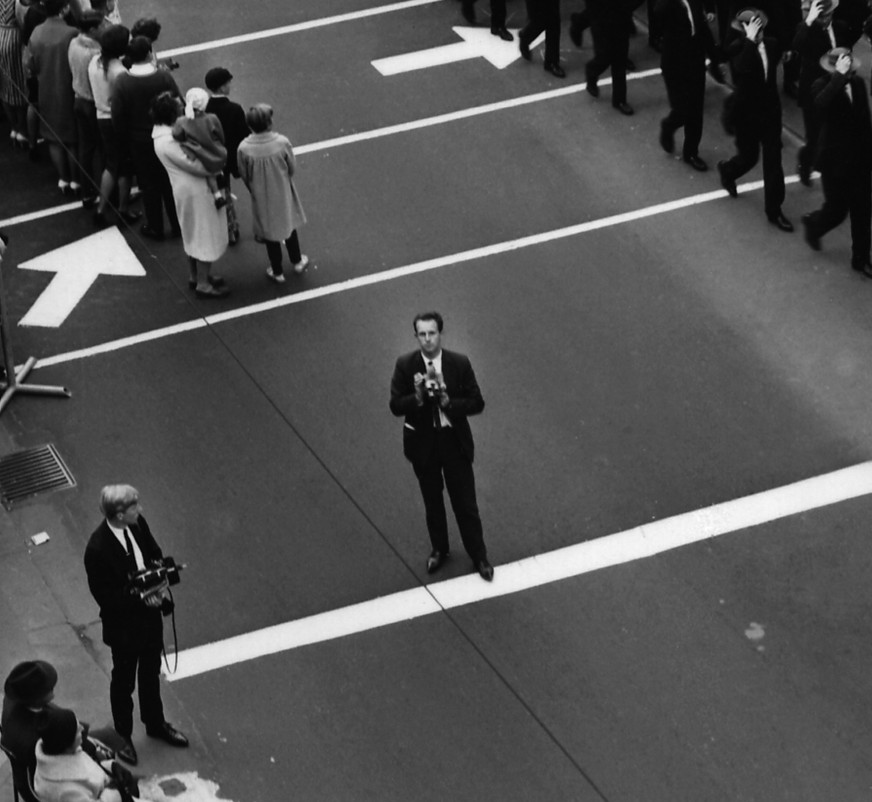
What makes the lantern slide experience distinctive from other media experiences?

What makes the lantern slide experience distinctive from other media experiences?


National Film and Sound Archive Scholars and Artists in Residence Presentation, 2011


The remarks I am going to make today are based on my initial brief encounter with the NFSA’s lantern slide collections. For the sake of brevity my remarks will not cover two significant collections in the Archive, the song slide collection, which is dealt with by the current excellent foyer show, and the theatre slide collection, which is large and fascinating, but falls outside the ambit of today’s talk. My remarks are based on several other diverse lantern slide collections in the Archive, but they do not go very deeply into any one collection, rather they are intended to be initial thoughts across a broad front which I offer in order to seek direction for the further research I might undertake. I’d also like to acknowledge that in preparing this talk I’ve relied on the previous published research of Elizabeth Hartrick, Chris Long and Shaune Lakin, as well as conversations with Dani Zuvela from Griffith University.


NEWLAND

In April 1848 the Daguerreotypist Joseph Newland placed an ad in the Sydney Morning Herald that offered customers, along with a minstrel show, the following:


BEAUTIFUL SCIENTIFIC EXHIBITION OF DISSOLVING VIEWS/ Powerful oxy-hydrogen microscope, and newly discovered optical instrument/ THE CHROMATROPE/Mr Newland will exhibit his beautiful collection of dissolving views (as shown at the Polytechnic, Adelaide Gallery, etc) powerful oxy-hydrogen microscope, and dazzling chromatropes, by the aid of the celebrated/ DRUMMOND LIGHT/the apparatus is of the most splendid and costly description being of a scale of magnificence never before introduced in the colonies — calculated to blend instruction with amusement — to gratify the learned and the unlearned — refresh the memory of the scholar — and afford the general auditor a magnificent display./ 10,000 SQUARE FEET OF ILLUMINATED SCENERY (Hatrick Figure 1.1)

Newland was augmenting his itinerant Daguerreotype business by showing imported hand painted slides on imported magic lanterns. He is also showing an ‘oxy hydrogen microscope’, where live insects trapped between two sheets of glass were enlarged onto the screen, as well as chromatropes, two circular sheets of painted glass which were rotated in opposite directions against each other. All three experiences are driven by the unprecedented optical experience of the high-powered, white, limelight. A further advertisement he placed two weeks later details the transitions the viewer would experience through a total of forty slides, while an orchestra played:


Part I 1. Ponti Rotti, Rome; changing to 2. Hammersmith Suspension Bridge; to 3. Colonnade, Venice; to 4. Sligo Cathedral, Ireland; to 5. Mount Vesuvius by day; to 6. Mount Vesuvius by night; to 7. Chromatrope; to 8. Val el Casat; to 9. Alloway Kirk – Burns’s Monument; to 10. View near Paris; to 11. Punch before dinner; to 12. Punch after Dinner; to 13. Tyre; to 14. Netley Abbey; to 15. Chromatrope; to 1.; Rustic View Summer; to 17. Rustic View Winter; to 18. Leap Frog; to 19. Crypt in York Cathedral; to 20 Chromatrope.


Part II Overture — “Gustavue” — Auber.

Illuminated Natural History

Part III repeated the pattern of part 1in a further twenty slides. (Vine Press House Lorrraine; El Sibal on the Salt Plains of Tunis , with natural bridge; Outside the Caen Cathedral; Inside the same cathedral;  Belem Castle near Lisbon; Tutertachen; Chromatrope; Shirbrook Bridge; Mount of Olives; Greenwich Hospital by Stanfield; Lea Bridge in Summer; Lea Bridge in Winter; Chromatrope; Lake Como, upper Italy; Army and Navy; Hall of 1000 pillars; Brickfielder; Kent East Indiaman in a gale; Kent East India Man on fire; Chromatrope.)


The principle spectacular effect was the dissolve, hence the title of the show ‘dissolving views’. Viewers experienced the frisson of seeing one hand-painted image dissolve into a quite different hand-painted image; or the jouissance of seeing the dissolve effect a temporal transition from day to night in the same scene. Other slides, such as ‘Leap Frog’ were probably single ‘slipping slides’, where a sheet of clear glass with strategically placed areas of black paint was quickly slipped across the hand painted image — obscuring one part of the image, while simultaneously revealing another; or mechanical slides, where one layer of class was quickly rotated, producing a simple animation effect. Between these transitions were placed three displays of the Chromatrope, an entirely abstract effect of colour, pattern and movement creating an almost pulsating effect three-dimensional illusion. Finally, the display of ‘Illuminated Natural History’ enlarged live insects onto the screen.


In the audience’s experience of the show it was the spectacular attraction of the apparatus and the various transition effects that were given priority, over the putative content of the views. When Newland took the show to Maitland in August 1848 the local newspaper specifically commented on the aesthetic and spectacular effects, rather than the actual content, of the three components to Newland’s show. ‘Mr. Newland showed great skill in the gradual fading away of one view and encroachment on it of the succeeding one, until one had finally disappeared, and the other was revealed in all its beauty.’ The paper also remarked on ‘the most dazzling effect’ and ‘brilliant colours’ of the chromatropes; while the ‘extraordinary size and quick and ferocious movements’ of the live weevils which were projected on the screen, ‘almost gave rise to a feeling of fear in the mind.’ (Maitland Mercury and Hunter River general Advertiser 9/8/48 p2


THE POWER OF THE DISSOLVE

The dissolve between two images was effected by having two lanterns focused on the one screen, with either an iris being closed over one lens while the other was opened; or a pivoting black metal fan with a feathered edges which ‘wiped’ one image while simultaneously ‘unwiping’ the other; or by the gas to one lantern being turned down while the gas to the other was turned up. As a variety of lecturers displayed them through the colonies during the rest of the century many other newspapers reported on the dramatic and narrative evocations dissolving views were able to create in their audience, particularly when accompanied by music and a lecture. In 1852 Alfred Cane exhibited a variety of chromatropes as well as dissolving views in Sydney, and the Sydney Morning Herald was quick to report on the effectiveness of the dissolve.


” A ship in a calm” was a particularly truthful representation of that most tedious, most trying, most wretched predicament. Grazing at the view, one might almost fancy one saw the lazy sharks crawling about in the blue water, carrying on their eternal war against every other creature… Then suddenly the scene changed, the ship is caught in a storm, and with double-reefed foresail only set, struggles vainly against the furious surge, which too fatally drives her onto the inexorable rock. These two representations of the chances of the ocean were followed by “the ship on fire,” and “the raft,” and elicited several rounds of applause, especially from the juvenile portion of the audience, who, with true British feeling, seemed to delight in the danger, although ’twas but in show. (SMH 30/1/52 p2)


Amongst the imported slides James Smith displayed in Melbourne in 1855 was the popular image of Vesuvius erupting. According to The Age the image began as:


‘[t]he Bay of Naples , smiling in the serenity of sunshine, with Vesuvius at rest lowering grandly in the distance. Then: Clouds and thick darkness come over the scene, and the volcano belches forth its red fires and gloomy vapours, and the effect produced is really admirable.” (9/5/55 p6).


SCIENTIFIC SPECTACLE

The dissolving effects, chromatropes and live microscopic projections were only part of these shows. Also on display was the spectacle of science itself. In Maitland in 1842 Newland also displayed the wonder of raw light itself:


The exhibition concluded with an illumination of the room by the Drummond light [limelight]: the room was too small to fully show the power of the light, but the operator tested its intense heat by burning in it a gimblet, which he actually burnt [it] into three pieces, the iron giving out brilliant sparks just before separating.


In 1854 (according to newspaper reports) nearly a thousand people saw Knight’s dissolving views in Hobart.

“The evening concluded by the exhibition of the chromatic fire cloud. This splendid and curious cloud of fire is caused by driving a quantity of muriatic acid against a board suspended parallel with the ceiling; the acid is then ignited, and a cloud of fire of various colours appears to descend.” (Hobart Courier 8/9/54 p2).


The great South Australian photographer Nicholas Caire found his photographic business failing in 1869 because of the drought, so he took to touring South Australia with two lanterns and sets of dissolving views imported from Britain. However as part of the show he also administered electric shocks from a galvanic battery to members of the audience who desired it. (Hartrick p74)


In the early 1900s the travelling troop of entertainers the Corricks purchased an eight horsepower electric dynamo from Paris which gave 5000 candle power of light to the projector, allowing slides to be projected on the outside of the hall. The dynamo also drove arc lights which illuminated the streets outside the hall, as well as stings of incandescent lights around the proscenium of the stage.


DISSOLVING VIEWS AND CHROMATROPES AS METAPHOR

We know that dissolving views were an important part of Australian colonial visual culture, because by the 1850s the terms ‘dissolving views’ and ‘chromatrope’ had firmly entered the Australian language as metaphors. For instance in 1857 a correspondent to the Hobart Courier satirized the various rhetorical exertions of colonial politicians in parliament as an exhibition of dissolving views. In his satire, taxes and debts were ‘dissolving’ the bright future Tasmania’s politicians were laying out:

A mist came over the glowing colours, extensive plains contracted to little valleys, undulating hills became rocky scrub, and the expected gold never came, and behind all appeared TAXES. Tax upon income; tax upon property; tax upon luxuries; tax upon four-wheeled carriages. It was evidently a mistake the obtrusion on so beautiful a vision of these unseemly and disagreeable objects, but unequivocally they made themselves apparent, and thus this beauteous scene dissolved away. (Hobart Courier 11/4/57 p3)


This would be equivalent to a satirist saying today that a politician’s promises were ‘virtual reality’.


In 1852 a poem called Ode to Melbourne was published in the Argus which was a satirical take on Melbourne’s poor drainage and alcoholic binge-drinking culture. It satirized Melbourne’s ‘filthy lanes’ and ‘atrocious smells’. Melbourne was full of pubs and drunkards, so the gutters ran with filth which reflected the debaucheries above:


Oh Pleasant city, full of pleasant places,

Thy very gutters show ‘dissolving views’


The dissolving view, far from the high minded transcendental language of the ads the exhibitors put in the papers, was here associated with the gaudy, the low, the inebriated and the insubstantial.


On the Irish poet’s Thomas Moore’s death in 1852, a literary reviewer critiqued the rich poetical imagery of his orientalist Romances, and used the optical experience of the Chromatrope, then only a few years old, as a powerful metaphor for the showy, the over the top, and the fake:


There is over-profusion of imagery [in Moore’s poem], and a uniformity of splendour, a constant succession of glittering images and high-strained emotions, by which the fancy, at first dazzled and excited, becomes sated and fatigued. We long for some relief and some repose. It is like the dazzling of the eye by too long gazing at a chromatrope, or other display of optical wonders. … The pleasure has been intense, but on that account all the more transitory, and followed by a feeling of disappointment. We have been looking at a grand pyrotechnic display with wonder and delight, but how different are the feelings of calm and lasting pleasure with which the glories of the nightly firmament fill the mind. Such contrast is here between Moore and other poets who are more true nature.


Why am I telling you about mid nineteenth century literary criticism? Because it shows by reflection what a profound impact lantern slides and chromatropes had on everybody during this period.


GEORGE SNAZELLE

Throughout the 1850s and 1860s lantern slides were being shown by photographers like Newland and Caire needing to diversify, or by other showmen exploiting the new technology, their exhibitions were never as successful as their ads made out. Often newspapers commented on what disappointing failures their displays were, when they were unable to produce enough light, unable to keep their slides in focus, or unable to correctly size the projected disc to the sheet. However, increasingly in the 1880s and 90s magic lanterns were mass produced and mass marketed, and slide sets accompanied by printed booklets were produced on mass and imported into Australia. Temperance unions such as the Band of Hope as well as religious groups increasingly used these lanterns and slide sets in their meetings.


They were also increasingly incorporated into music hall entertainments. For instance the English baritone George Snazelle toured the colonies in the late 80s and early 90s. His singing, accompanied by piano, organ and chorus was illustrated by dissolving views that added a ‘charming feature to a refined and amusing program’, which also included whistling, recitations and banter. (SMH 26/10/89 p12). His recitation of Tennyson’s The Brook was accompanied by eighteen dissolving views of the Thames. His singing of Gounod’s Nazareth was accompanied by six well know pictures, including Holman Hunt’s the Light of the World. He concluded his evenings with a display of chromatropes. (SMH 19/10/89 p12)


The Light of the World was fast becoming the most famous picture of the nineteenth century. Its Pre-Raphaelite painterly style created the effect of light seeming to emanate from the painting itself. It’s visual and symbolic melding of physical light with spiritual light was therefore perfectly suited to magic lantern projection. A version of the painting even went on a world tour in 1904, coming to Australia and New Zealand. Patrons sat in from of the painting and let it enter their eyes, then the lights in the room were turned down so they could discern a crucifix-like afterimage on their retinas.


The Chorus to Nazareth runs:

Tho’ poor be the chamber, come here, come and adore, Lo! The Lord of Heaven hath to mortals given Life For Evermore, Life For Evermore, Life For Evermore


Snazelle recorded his songs for the Gramophone and Typewriter Company of London between 1898 and 1906, and Nazareth was also recorded by the Australian singer Peter Dawson.


In 1893 Snazelle sung to lantern slides at the Melbourne Exhibition Buildings and the Melbourne Opera House, where they were projected as discs 30 feet in diameter. He displayed The Light of The World again, while singing the hymn Behold I Stand at the Door accompanied by a chorus. By this time Snazelle was also presenting life model slides, which were becoming increasingly popular. Companies such as Bamworth and Co produced slides with live models adopting narrative attitudes in front of painted backdrops. Snazelle presented thirty life-model slides of Dickens’ ‘ A Christmas Carol’, and his daughter sang ballads to the life model slide series Daddy, (Hartrick 100-103)


DADDY CAPTIONS

Daddy, Good Night

Take my head on your shoulder, Daddy

Why do your tears fall, Daddy

I often seem to hear her voice

But I’ve got you and you’ve got me


In life model slide sets the various poses of the life models told a story, but not in the sense of an action linearly extending within a defined length of time, rather in an iterative way, suited to the structure of a popular song with it repeating chorus and separate self-contained verses.


REMEDIATION AND CONVERGENCE

The 1890s saw the convergence of magic lantern lectures, which had been developing for fifty years, with the cinematograph. Companies marketed lantern slide sets as well as Lumiere films, and cinematographic adapters for lanterns were also for sale.


The two modes of display did find themselves in conflict for audiences. In 1897 Henry J. Walker wrote an article Animated Photographs versus Dissolving Views for the UK Magic Lantern Journal and Photographic Enlarger, in which he lamented that the new cinematographic craze which had been taken up by music halls was pushing aside the old dissolving view exhibitions. To defend dissolving views he retreated to the age old argument that the cinematograph was merely mechanical copying, whereas the dissolving view required manual craft on the part of the operator: “The animated photographs I put down as a mechanical triumph, and the success of dissolving views to the skill of the operator”. P110.


But in Australia the two co-existed for about a decade. For instance in1901 Snazelle returned to Sydney with a show called ‘Our Navy’ that combined his singing with imported lantern-slide sets, purchased biograph films and on-stage theatrical wave effects. Travelling companies such as Joseph Check’s Popular Variety Company toured Northern NSW in the late 1890s with a troop of burlesque artists and baritones who also exhibited Edison’s cinematograph, imported lantern slides, and lantern slides taken in the districts through which they were touring. The Corricks also illustrated their songs with sets of dissolving views, as well as screening biograph pictures. Following on from Snazelle, their rendition of ‘The Lads in Navy Blue’ was illustrated by ‘forty modern pictures of ‘Our Navy’’ which they had brought from the slide makers G. West and Sons, of Southsea, England, who specialized in maritime subjects.


SALVATION ARMY LIMELIGHT DEPARTMENT

In the 1890s Joseph Perry of the Salvation Army used off-the-shelf life-model slides and popular ballads in services to be what he termed ‘Spiritual Barnums’ (as in P T Barnum the American showman). He also projected the words of hymns and showed lantern slides during hymns singing. Most of the slides were purchased from the Melbourne slide importers T. W. Cameron or Cooper and Co. Often these slides were hand-coloured copies of popular engravings, such as those by Gustave Dore.


The War Cry of 16/1/92 reported on a service:


Some magnificent pieces from the life of Christ were introduced. These are from Dore’s pictures and are superb. They speak very loudly, as they are flung upon the sheet, and stand out in bold relief on the canvas. One could see the vindictive look on the faces of those who were driving the nails into the hands and feet of Christ.


Two years later the War Cry reported:


A great many were moved to tears at the sufferings of Jesus on the canvas so ably explained by the Captain. (War Cry 28/4/94)


Although Perry used off-the-shelf slides, he had a bigger budget than other lanternists and was able to refresh his stock frequently. In addition he was able to give his off the shelf slides, such as the Holman Hunt’s The Light of the World, which he had brought from the Melbourne slide shop T. W. Cameron, more directly scriptural significance, as opposed to the merely religiously sentimental meaning they were given by performers such as Snazelle.


The scenes which followed depicted some of the choicest incidents in the life of the ‘Man of Sorrows’, with here and there pictures of symbolical character thrown in. Perhaps it is superfluous to say that spiritual allegory is only understood by those whose spiritual eyes have been opened. To such, the picture ,’”Behold\ I stand at the door and knock’, would be as an open book; ‘For in every breast that liveth\ Is that strange, mysterious door. (War Cry 28/7/94)


The Salvation Army programs also included chromatropes, and it was there that Joseph’s son, Reg, remembers seeing his first chromatrope as a small child sitting on his step-mother’s knee. It made an intense and unforgettable impression on him, and his memory of it in the 1977 film Reg Perry Remembers returns us vividly to the power of nineteenth century visual technology. But even the meaning of the chromatrope, which had been a staple of lantern performances for fifty years by this time, was given more pointed meaning by Perry because it was shown at the same time as the collection plate went round. Minnie L Rowell told the War Cry:


The proceeds of the service were to be devoted to reducing the electric light bill of the corps, and the collection was foreshadowed by the appearance on the sheet of a kaleidoscopic slide resembling a plate. By some wonderful means the patterns on the plate began to turn in and out and round and round in a most indescribable way, till I almost wondered if my head or this comical arrangement would turn inside out. (War Cry 1/7/96)


From 1893 Perry began to produce his own slides based on the life-model slides produced by British companies such as Bamworth & Co. This activity increased in 1896 when Herbert Booth arrived from Britain. In 1897 the combination of lantern slide, phonograph and Kinematograph was being promoted within the Army as a ‘triple alliance’. They were combined in the lectures given by Booth in the late 1890s, with titles such as Social Salvation, which combined slides and films both shot by Perry and brought off the shelf.


In 1900 Booth and Perry produced a recruitment lecture combining both off-the-shelf and home-produced slides and films called Soldiers of the Cross. The lecture, based on the Roman persecution of the Christians, ran for approximately two hours. In it’s original form the fifteen of so films, none of which ran for more than 90 seconds, occupied only a small proportion of the lecture time. All the ones made in Australia are now lost.


The film segments were all single, locked-off shots using the same actors, narrative scenarios, and painted backdrops as the slides. Chris Long, in his Cinema Papers article, maintains that the narrative of the lecture flowed smoothly from slide sequence to film, however he does quote a later program for the film which states: ‘Scenes are first shown by still pictures and then the same incidents are reproduced by cinematograph display.


This produces a fascinating dynamic between the iterative, chorus like structure of the life model slide tableaus and the continuous motion of the short film segments. An early episode features a spectacular stoning of the martyr Stephen.


The War Cry (22/9/00) describes this sequence:

The events that lead to the martyrdom of Stephen passed in review. The Sanhedrim, [Jewish court] the trial, Stephen’s impeachment by the rulers and the stoning of the first martyr. The Kinematorgraphe was employed in this latter scene. The effect on the audience, as they beheld in a moving picture Stephen cruelly beaten to the earth, and killed by fiendish fanaticism of the formal religionist of the day cannot be described. The kinematographe gives way to a picture of Stephen lying dead upon the roadside, while Paul the persecutor stands over him in an attitude of painful contemplation.


The slide sequence begins with a series in the court-room which is similar to the structure of the Bamworth life-model slides, where a series of rhetorical poses are iterated. There is even, as was common in Bamworth slides, a superimposition of a host of angels, probably derived from a purchased slide. We can readily imagine how these would have meshed in with Booth’s lecture as they, to quote the War Cry, ‘passed in review’. But later the slide sequences aren’t iterative, but appear to be diegetic, like frames extracted from a continuous movement: do we see Stephen’s blood pooling around his head as the persecutor Paul appears? Did film of Stephen’s stoning replace the two slides of the stoning, which were only shown when the cinematographic film wasn’t? Or did it come after the slide sequence of the same stoning, to re-iterate it and therefore re-emphasise the familiar tableau-like attitudes of the slides in the new medium of continuous motion pictures? I’d like to argue that it was the latter, as the War Cry says, ‘the Kinematorgraphe was employed in [my emphasis] this latter scene.’


However in other instances Chris Long seems fairly certain that film followed on from slide sequences, and these slide sequences seem to be quite cinematic, almost building up momentum. For instance in a later version of the lecture a scene of Roman soldiers raiding a church service was apparently followed by a filmed chase sequence shot on a new camera in which, according to the War Cry, a Roman soldier is boinged off a bendy plank and splashed into a stream.


Long also mentions films like ‘Paul escaping from Damascus in a Basket’ being commented on in 1901, did they replace similar slide sequences, or repeat and re-emphasize the movement of the slide sequence of the same incident.


Other slide sequences show strongly the bricolage approach of Booth and Perry. This bricolage is fundamental to the way the lantern-slide lecture was developing into the twentieth century. The longest episode from the lecture is titled Christians in the Catacombs, and is about how the Christian rituals of birth and death were continued underground. It begins with a historical map of the catacombs, also inserted are slides made from old stereographs of the catacombs which have been hand coloured to integrate them into the visual flow. Also included are engravings of the catacombs, which seem to have been the basis for the Army’s painted backdrops. According to Chris Long the climax of the episode, a clandestine burial, was also filmed, but it also appears as a tight sequence of slides. So we have a wonderful mixture here of what would, twenty years or so later, become separate genres within twentieth century media. ‘Documentary’ photography; ‘fictional’ acting; cinematography; ‘artistic’ engravings and paintings; ‘travel guides’, and even ‘historical anthropology’ are here all bricolaged together so that one lends authority and rhetorical emphasis to the other.


Perhaps the splitting apart and quarantining of different genres — into say fiction and documentary — which was to happen in the 1910s and 20s, is now collapsing together again at the beginning of the twenty-first century. Perhaps the logic of a You Tube channel, a blog or a web site is now not dissimilar to a lantern slide lecture.


COLONIAL SPECTACLE

Lantern slides are the missing ingredient which link together previously siloed scholarship on nineteenth century Australian visual technology and spectacle. Mimi Colligan’s Canvas Documentaries: Panoramic Entertainments in Nineteenth Century Australia and New Zealand and Anita Callaway’s Visual Ephemera: Theatrical Art in Nineteenth Century Australia are both fabulous books. But neither of them directly address magic lanterns. Similarly, the history of Australian painting often forgets that paintings could be optical spectacles as well as precious objects, not only in Holman Hunt’s The Light of the World, but also in Longstaff’s Menin Gates at Midnight, which toured Australia in the 1927 and 1928 to the accompaniment of organ music.


From the point of view of today’s museums, magic lanterns and slides from the nineteenth century are especially important. All of the other wonderful visual technologies of colonial Australia have been lost. The ‘transformation scenes’ in pantomimes, which created illusions with lighting effects and mechanical scenery-changes, have been lost. The back-lit transparencies which decorated buildings have been destroyed, likewise the mechanical panoramas. The cyclorama buildings in Sydney and Melbourne have been knocked down long ago. But we do have chromatropes, and we do have mechanical slides, and they can be re-projected to give visitors some idea of the richness of the colonial visual experience. For instance the wonderful 250 watt Mazda light globe in the collection’s Praestantia lantern from Riley Brothers could be replaced with a cool, UV filtered LED light to replicate pretty closely the cool, actinic colour temperature of limelight.


A J ABBOTT

In the twentieth century the lanternslide slowly lost its sense of technological spectacle and uncanny magic. However it persisted as an important part of the emerging twentieth century mass media. Lantern slides increasingly became an ‘intermedia’, a conduit between different media platforms. They became a ‘vector’ along which images could travel. A good example of this is the slide collection of A. J. Abbott. ‘Professor’ Albert J Abbott was a palmist, a phrenologist, a Spiritualist and a pastor in the Free Christian Assembly, one of the many new radical churches which were springing up in Australia around the turn of the century. He couldn’t keep himself out of trouble, in 1896 he was accused of immorality for bestowing ‘pure kisses’ on female members of his congregation. And in 1906 a member of his congregations leapt on stage and hit him with her umbrella, accusing him of bigamy. He wrote various religious tracts, including one that subscribed to a widespread cult at the time that believed King George was descended from one of the tribes of Israel, and he drew elaborate diagrams of ‘God’s Dispensation’.


In about the 1910s he must have been attracted to Spiritualism, and begun to use lantern slides for his lectures. His lantern slide collection includes some old dissolving views, and some phrenological subjects, but are largely devoted to Spiritualism. They contain portraits of leading figures in the movement, including Emma Hardinge Britten who was the co-founder of Theosophy and visited Australia in 1880, and William Terry, leader of the Victorian Spiritualists and publisher of the journal Harbinger of Light. The lecture contains spirit photographs of all the major spirit photographers up to the 1910s: William Mumler, Frederick Hudson, Edouard Buguet, William Crookes, and Richard Boursnell. They are all copied out of books. For instance many are copied from a book published by Georgiana Houghton in 1882. The book was reproduced with carte de visites which had been turned into tiny lithographic plates, and these have been copied by Abbott.


If Abbott had access to the original book, he may have been able to recount the remarkable stories that Houghton told about how she conducted photographic séances at the glass house studio of Frederick Hudson and interacted with spirits in front of his camera. One image is of Georginia Houghton with a spirit called Zilla. Houghton described the photograph:


“We are standing face to face, her right hand is within mine, while with the left she gathers the drapery under her chin. There was a something that had puzzled me to understand, for it seemed almost like an arm passing round my left shoulder, yet it could not be, for both her hands were occupied.”


Houghton took the print to the medium Mrs Tebbs, who contacted the ‘Other Side’, and interpreted the bar of light linking the spirit to her:


“It is a ray of coloured light, flowing from her to you; they are shewing it to me” (here she moved her hands as if seeing the light issue from herself), “it is the link binding you to each other; it flows flows from the heart, but also from all this region below the heart, explaining the phrases  ‘his bowels did yearn upon his brother:’ ‘bowels of compassion’, etc and they are giving me to understand that unless that light can touch the other person, they ought not to have anything to do with one another: — a time is coming when that link will be perceptible to all of us, and thus we will know with whom we may beneficially hold communion. It does not seem the quantity of that stream of light, so much as the quality, which is of importance: — what they first showed me was a lovely pink colour, and now they are showing me some of a rich hue, like arterial blood. It encircles you, though you scarcely see it on this side (beneath the right arm), but it must come quite around, forming a complete bond of union: — you look as if you felt it, and the expression in your face is as if you had learned far more than words could tell; that language would only weaken the force you have received.”


CHARLES RYAN

Through the example of A J Abbott we can see that in the twentieth century lantern sliders were increasingly used as conduits through which various images were brought to audiences. They were vectors, not artefacts. For instance we can look at Charles Snodgrass Ryan and Ernest Brooks. Brooks was the official British photographer at Gallipoli, and Ryan was a surgeon, an ornithologist, and an amateur photographer. In April 1915, at the age of 62, Ryan was sent to Gallipoli as assistant director of medical services. He stayed at Gallipoli only until June 1915 when he was evacuated to London via Egypt with enteric fever. He had taken many personal stereo views in Egypt and on Gallipoli, and it was probably when he was in London that his personal stereos were acquired by the Central News Agency. Some of them were then reproduced in the Australian press in September and October 1915. For instance in September 1915 The Melbourne Leader published A captured Turkish Sniper screened by foliage attached to his clothing; On October 30 it published Brooks’ shot of Australians resting in the trenches at Gallipoli; a Ryan’s shots : a  ‘British Officer leading a Turkish officer blindfold through Australian Lines’;Using a periscope rifle in an Australian trench; General Birdwood taking a dip in the sea; ‘From the Lone Pine trenches after the battle Australian Troops all wear white arm bands.


Probably through the Central News agency these images were acquired by the London lantern slide manufacturers Newtons and Co, probably one of the largest global producers of slides (from whom the Salvation Army also imported slides). One half of some of Ryan’s stereo pairs were then hand coloured and sold as slide sets, augmented, by other stock slides of Egypt, same possibly dating from the nineteenth century. This set of slides eventually entered the NFSA collection through the World War Two correspondent Allan Anderson. Meanwhile the original stereos entered the collection of the Australian War Memorial and are on display there. So we have the same image existing during the War as illustrated magazine picture, a handcoloured lantern slide, and one half of a stereo pair. Each of these images identical images in a different forma entered different archives, The NLA, the NFSA and the AWM.


CONCLUSION

I think with that brief historical context we can now begin to disentangle the lantern experience its domination by other histories, such as the history of cinema or the history of painting. I think we can pull some of the threads together and make a rough table of what, at the turn of the twentieth century, distinguished the cinematograph from the magic lantern:


Cinematograph

Dissolving Magic Lantern Views

Music and inter-titles are diegetic (towards narrative and temporal movement) Music and lecture are ekphrastic (towards rhetorical emphasis of single images and statements)
Continuous motion Iterative gesture
Technology subsumed into image Image is a distinct part of a wider technological assemblage including limelight/electricity, dissolving mechanisms, audience wonder, etc
Editing Bricolage
A relatively discrete media object/event An intermedia vector shifting images between medias and genres


I believe that placing cinema in this broader context may help us have a more nuanced interpretation of viewer responses to film during this period. For instance the wonderful Pathé film Toto has been restored by the NFSA from the Corrick collection. Initially we may think that the audience’s main pleasure comes from the wonder of seeing a hand coloured simulation of a kaleidoscope up on screen. However, kaleidoscopes had been around since 1818, and the kaleidoscope craze had gripped Europe eighty years before the film was made. In addition, everybody in the audience had presumably already experienced, or at least heard about chromatrope slides. So the real pleasure for audiences at the time comes from feeling their point of view change from their position in the audience seeing projected images of people on the street, to the point of view of somebody within the film looking through an optical toy.


I also think that the qualities in the right hand column: ekphrasis, iteration, technological assemblage, bricolage, and image vector may have more in common with the contemporary producer and consumer of blogs, web pages and you tube channels, than the contemporary viewer of movies.


Martyn Jolly

Rupture, Generation or Continuity? The 70’s and an ’80’s Photography, 1984

Rupture, Generation or Continuity? The 70’s and an ’80’s Photography (A Speech from a Rostrum)

After the Artefact: An exhibition of Contemporary Photographic Practice

Wollongong City Gallery, 1984

At the end of 1983, as part of its normal exhibition programme, the Department of Photography at the Australian National Gallery held an exhibition ‘A decade of Australian photography 1972-1982’. The exhibition was drawn from the Philip Morris Arts Grant Collection, a corporate sponsorship programme that oriented itself around the work of ‘young bold and innovative artists’. The show was the latest of a succession of exhibitions and publications drawn from that collection, the largest and most significant collection of ’70’s Australian photography. It was not the exhibition’s intention to offer a significant reappraisal of the period’s photography, more to provide a curatorial summation of the collection itself. For these reasons the exhibition would have been largely familiar to anyone acquainted with recent Australian photography and the Philip Morris Arts Grant.

Yet something did distinguish this exhibition from previous Philip Morris Arts Grants exhibitions and publications: despite the fact that some works of quite recent execution were included, one couldn’t help but get the sense, when viewing the exhibition, that what was once a ‘now’ photography had become a ‘then’ photography, what was once ‘our’ photography had become ‘their’ photography.

The exhibition seemed to arouse little interest within the ranks of Australia’s newer photographers. This apparent disinterest in the work exhibited revealed, once and for all, that the photography ‘explosion’ of the early ’70’s, which had stopped the clocks for six or seven years, was now no longer even an echo. From the viewpoint of 1983 the ’70’s was, for photography at least, a long summer that didn’t so much turn into autumn as disappear over the horizon.

Not only were many of today’s emerging photographers ignorant of the emergence of their predecessors in the ’70’s, they were also disinterested. They seemed to find the work uninspirational and easily locatable within the larger histories of photography that they had been taught. To them, art-historical chapter-headings such as ‘formalism’, ‘expressionism’, ‘street photography’, or ‘feminist pedagogy’ accrued all too easily to the work exhibited.

Though they may have been ignorant of the photographers, they were not ignorant of the photography. They thought that they had seen it all before.

The exhibition revealed a distinct sense of rupture between the ’70’s and the ’80’s photography. This is, of course, only to be expected: historical rupture is a central tenet of Modernism, against whose bosom photography has always snuggled. (Postmodernism will be referred to later in this essay.) Yet if we closely examine Australian photography since the boom of the early ’70’s, we find that this rupture is more readily identifiable within the institutions of Australian photography than in the photography itself.

For instance the dealer photography galleries of Melbourne, to which the eager young photographers of the ’70’s came with their portfolios under their arms, have either closed or appear to be on the verge of doing so. The Australian Centre for Photography, which opened as a separate gallery and workshop in the heart of Sydney’s dealer gallery belt, has restructured in a single building on Oxford Street, intent on broadening its basis in both the general and photographic communities. The privileged pedagogy of one or two ‘leading’ art colleges, with its concomitant valorization of the guru-like teacher, has been expanded into a whole range of educational opportunities right across Australia. The photographic climate seems to have changed so much that a one or two person show at a dealer gallery, so highly valued on the CVs of the ’70’s, seems to almost have an air of presumption in the ’80’s, when photographers are just as willing to join together to hold group and theme shows at a variety of institutional spaces. (Witness the present exhibition.)

Hence we have those terms I have used so freely thus far—the 70’s and the ’80’s. But although the institutional changes within Australian photography clearly indicate such a distinction, it is not nearly as clear within Australian photography itself.

In fact the continuities of theme and practice are just as evident as the discontinuities. The phallocentric juvenilia of the 70’s—the soppy shots of nude girlfriends, the sepiaed ‘studies’ of nature, etc., etc.—has thankfully shriveled. The serendipitous snaps of ‘streetwise’ photographers, which certainly had more to offer, have been banished in the face of popularly read critiques of the single, coherent photographic image and its place in hegemonic visual culture (in particular liberal-humanist press, film and TV discourses). It is tempting to suggest that disdain for the single image is the mark of ’80’s photography, but it is not a mark that distinguishes it from the ’70’s. Many of the most important photographers of the ’70’s worked with serial imagery (e.g. John Rhodes) constructing narratives at various levels of interpretive ambiguity. Others (e.g. Carol Jerrems) constructed directorial, almost fictionalised spaces, implicating the photographer in, and therefore deneutralizing, the act of photographing itself. Other photographers (e.g. Micky Allan) overtly compromised the photographs glassy, windowlike surface with sophisticated, gestural handcolouring techniques. The cataloguing imperative, as a structuring process that defines the photographer as a self-conscious investigator of the limits of the photograph as an informational and aesthetic unit, is also common to both decades. It is not difficult to see the diachronic lines of continuity, influence and individual career that are deeply scored across both the ’70’s and the ’80’s. The rupture between the decades is a contextual and an institutional one, rather than a formal, stylistic, or thematic one.

But this fails to explain why newer photographers tend to find the work of their predecessors boring. The reason is, I think, in large part because they feel they have seen it, or else work very much like it, ‘all before’. To them it remains, for all intents and purposes, virtually indistinguishable from similar work produced by European or American photographers.

The only thing that does, ultimately, divide the two decades is that, during the 70’s, any regionalist problematic that may have disturbed, or even affected, Australian photographers was swamped by the sheer newness of their activity. The question of sustaining any artistic photographic practice at all usurped the question of sustaining any particularly Australian photographic practice. The commonality felt by the Australian photographers of the 70’s was a commonality of time, of nowness, rather than a commonality of place, of hereness.

The young photographers of the 70’s probably felt entirely untroubled by regionalist problematics as their eyes scanned the magazine racks for the silver cover of Creative Camera containing this month’s collection of portfolios by their fellow young photographers in Europe or America. Likewise, overseas visitors were invited to Australia for pontificate visits and treated with a fraternal familiarity when they arrived. ‘One could say that photography in Australia is on the same plane as elsewhere’ claimed the editorial of the inaugural edition of Light Vision, ‘Australia’s International Photography Magazine’.

Thus, although there are, of course, differences identifiable in retrospect between photography in Australia and elsewhere during the 70’s, any sense of continuity between the 70’s and ’80’s amongst Australian photographers themselves tends to be dissipated in the sea of ‘global photography’ to which they blithely subscribe. Because the difference between the practices of photographers in Australia and photographers elsewhere are scrupulously effaced there seems nothing in particular for one generation of Australian photographers to contribute to the next. Collections such as the Philip Morris Arts Grant appear to become vitiated by their look-alikeness before they are even complete.

The 70’s and the ’80’s, having lost hold of each, other, seem to be carried along independently by the currents of global photography with its global histories. (This is not to elevate ‘global photography’ to the status of a hegemonic bogey.


Neither is it to call for a parochial tradition of ‘Australian photography-Australian art has already gone through several re-runs of that episode. Nor is it to call for the invention of a paternalistic relationship between the two ‘generations’.)

However, if a sense of continuity could be established for Australian photography, going all the way back to when the boom began in the early 70’s, then perhaps a more complex, stronger Australian photography would result, one that felt more confident in itself and had a more substantial basis from which to contribute to the current upheavals in Australian culture generally and Australian art in particular. Australian photography still inhabits the peripheral: the longer it continues to construct itself as a series of youthful nowness, the longer it will maintain the familiar problematics that have accompanied it throughout its history. These problematics centre around the right, or ability, of photography and photographers to participate in the art discourse at all. And if so, at what level.

It is in the face of these weary, but continuing problematics that this call for continuity is made. Because, from the point of view of art in the ’80’s, to make a call for photographers to re-examine, or even just examine, such a thing as the 70’s for a sense of continuity may seem reactionary in the extreme. After all, the leitmotif of ’80’s art is, under the rubric of Postmodernism, precisely the ruptures and foliations of synchronic sets of cultural nownesses. But to regard such a call as reactionary or misplaced is to ignore the discursive formation of photography within art.

Quite simply there was little art photography of any consequence in Australia before the 1970’s. We have to go back, probably to the 1930’s, before we can again find photography locating itself in the art discourse. Nor can photography be conveniently counted as just another component of ’80’s Postmodernism, the site for which is, primarily, still the traditional art mediums. Photographic reproductive processes may be crucial to much Postmodernist art, but art photography is not; nor, on the evidence is it dead. (Again, witness the present show.) Although a good deal of current photographic activity, some even from this show, can be inscribed into Postmodernist discourses (as broad as they are becoming), much photography, some even from this show as well, could not.

Furthermore, most probably because of those very problematics of photography within art, photography still resolutely refuses to become institutionally integrated into art, or to die out. Despite the devout prayers of photographic and art practitioners alike it remains a discipline all too readily identifiable by that one word —photography. Although photography was warmly welcomed by art in the 70’s, the fact that it is still regarded from a safe distance is readily apparent when one examines the geography of the hanging of recent Biennales and Perspectas; photography’s representation and presentation by dealer galleries; the course structures of art schools; the books and magazines in which photographic writings appear; and even shows such as this one, the motivational rationale for which is, simply, that all the ten artists exhibiting use photography. The photographic medium, rather than the photographic practice, is still the fundamental criterion for evaluating and categorizing photographers.

Thus we are left with the situation of photography being a medium which, like it or not, is left largely to itself to determine its own status, write its own histories, and inscribe its own formation within art. It is from this position that a call for continuity can be regarded as properly made.

And it is shows such as this one, with its casually random mixture of the ‘older’ and the ‘newer’ photographers—photographers who were collected during the 70’s along with photographers who contributed to the institutional changes of the ’80’s and photographers who have only recently graduated from art colleges, which may be a very useful point from which to begin to establish a continuity stretching back further than just a year or two. In this way, part of the boom of the 70’s could be profitably recouped for the ’80’s.

Martyn Jolly March 1984

Robyn Stacey Presents, 1985

Robyn Stacey Presents

Mori Gallery, Sydney October 8-26, 1985


Photofile, Autumn 1986 page 30


Robyn Stacey’s photography has always been concerned with self-perception of self-image. Her handcoloured portraits portray an individual’s sense of their own special character as they present it to her camera.


Her first one person exhibition, held at The Australian Centre for Photography in 1983, approached this problem in a more casual, informal and ‘documentary’ manner than her recent show at Mori Gallery. For her first exhibition she photographed a range of social types, from topless barmaids to Aborigines, to Punks and Rockers. The portraits were generally taken in their subject’s ‘natural’ environments, then enlarged and delicately handcoloured with colour pencils. In this first exhibition, as in the second, her subjects confidently posed for their portraits. However, this self-contained display of self-image generally took place within a particular social environment. All of her subjects were immediately inscribed within a specific social relationship.

This often contradictory interaction between a self contained personality and the surrounding social landscape gave the images a poignant, bitter-sweet accent, as self-image played off social position. For instance in the Queensland Out West series, purchased by the Australian National Gallery, there is a memorable image of three Aboriginal youths clowning for the camera. One proudly wears a tee-shirt bearing the tragically ironic words ‘Shaddup You Face’, from the mock-Italian pop song of the time. In another series of photo­graphs, purchased by the Art Gallery of New South Wales, a punk father tenderly plays with his baby, who sports a mohawk haircut almost as impressive as his dad’s.

Robyn Stacey, Body and Soul I, 1985 colour print

Stacey’s sensitive handcolouring, with the fibres of her pencil strokes just breaking through the photographic surface, added to the emotive power of these images. Their immediate charm may lie in the fact that they fall safely into a long photographic tradition — the documentation of social and cultural phenomena in which the photographer acts as a hyper-sensitized reporter, sending poetic dispatches back from the periphery of society. This tradition has

been celebrated since Robert Frank, at least.

In her latest exhibition, subtitled Well Known Unknowns, Stacey confidently steps out of this tradition and onto the slippery, constantly sliding surface of mediatized imagery and personalised fantasy. In these portraits she retreats from a particular social environment into the non-specific cultural potentiality of the studio. Her subject’s self-perception of self-image becomes the therapeutic acting out of an inner fantasy. Character collapses into characterization as she photographs her friends as mermaids, devils, boxers and Film Noir heroes. She becomes complicit in their manifest imaginings. Quite another photographic tradition is being reinterpreted now, the tradition of the studio portrait, the

glamour photograph, and the fashion spread.

In the sense in which fantasy is important to us all, these image still function as portraits of ‘real’ people. However, Stacey does not sink into that well worn mode of portraiture in which fantasy is used to describe an interior ‘psychological’ space. These portraits are dislodged from a particular psychologi­cal reality, as well as a particular social or cultural environment. They freely float across a thoroughly mediatized field made up of an array of conno-tatively redolent costumes, props, colourful cutouts and dappling projections.

Her images have a disarmingly eccentric, 2D feel. Even the picture surface itself seems to participate in this retreat from the specific and the real. Some of the images, for instance Fantasy at 20,000 Fathoms, axe hand-coloured photographs that have been copied onto colour film; others, such as Water Baby, axe copied 20 x 24 inch Polaroids. These techniques give the photographs a sort of elusive non-presence which oscillates between two kinds of materiality: neither photo­graphic nor graphic, neither true not false, both handcrafted object and technological product.

The referent of these images is no longer a particular personality, rather it becomes popular culture as personal possession. Stacey’s photographs are portraits of chimeric individualities constructed from the dislocated fragments of lovingly remembered postcards, posters, cartoons, films, videos, toys and art works — all the things that comprise Western popular culture.

However, these images are not a commentary on pop culture, they are not reducible to the kitsch or the camp, or even to the second degree. They are to be believed in, Body and Soul. They have been made as serious and well meant additions to the field of mediatized imagery. Ultimately, they are more than just the fun and games of a particular inner city milieu. As portraits they function as images of a personal disavowal. Liberal-humanist notions of cultural and social determinancy are repudiated, and a global regime of univalent, non-denotational imagery is embraced.

However, in this delightful oscillation between personality and image there remains a Taste of Terror which finally gives these images their edge: these images so cunningly and wittily eschew the normal photographic referents of the ‘real’, the ‘psychological’ and the ‘commentary’, they are so self contained, yet so elusive, that they appear to be in danger of spinning Outta Sight all together.


Martyn Jolly


Photography’s Critical Stance? 1986

‘Photography’s Critical Stance?’

The Critical Distance, 1986, edited by Virginia Coventry, Hale and Iremonger. ISBN 0 86806 223, pp132-140


How is such a thing as the critical practice of photography possible? How does the specific nature of photography, its inherent characteristics and uses, define its relationship to critical cultural practice as a whole?

Photography and society and politics

Firstly, what is this thing called ‘the critical practice of photography or, as it is sometimes termed, ‘oppositional photography’? Oppositional photography is, first and foremost, a conscious photographic practice, a practice that takes a particular stance in relation to photography as a medium as well as to the society in which it operates. Oppositional photography demands a conscious stance because it sees both these things as structures that define the ways in which ‘our world’ is comprehended and the ways in which individuals behave in it. These structures are regarded as fundamentally oppressive – in need of critique and in need of change. Critical cultural practice assumes that forms of communication and representation – photography, film, newspapers, TV, and even art – cannot be j separated from the society in which they exist.

In the theory of ideology developed by Marx, the material basis of society, its eco­nomic functionings, produced a set of implicit assumptions and beliefs that masked its inherent contradictions. To Marx, the basic contradiction of capitalism was that economic wealth accrued to capital rather than to labour Ideology was« kind of false consciousness, the perfect reflection of the contradictions of capitalism. It is interesting to note that one of Marx’s own metaphors for this ‘wrong thinking’ was a camera-obscura, which makes upside-down images of the world in am darkened space.1 This metaphor relies on assumptions that are perhaps not so easy to maintain in the 1980s — assumptions of a’ real’ world, a’ false’ ideological image, and the distorting lens of simple class contradiction.

Within the Marxist tradition, theories of ideology were intensively developed dur­ing the twentieth century, when it was realised that classical Marxism had historical limits. It was more applicable to the nineteenth century capitalism which produced it, than to the increasingly subtle and complex forms of capitalism which developed during the twentieth century. An important theoretical develop­ment was the granting to ideology, society’s ‘superstructure’, a ‘relative autonomy11 from the economic base. The superstructure of society – culture, beliefs, etc.8 has a materiality of its own and is therefore as important an arena for revolutiona struggle as is the struggle between labour and capital. As the site for revolutic struggle has expanded, so has the cast of possible participants; no longer jud those directly oppressed by capital — the workers — but also those oppressed within other configurations of power — women, blacks, gays, the unemployed and those in the Third World.

Power is not simply direct economic oppression. Power can be technical, en­coded in social regimes or architecture.2 Power can be immanent, residing in f assumption that things are the way they are because of simple, ‘commonsense’ reasons. Power is pervasive. As much cultural as economic, it is best described as being hegemonic. Cultural and political power is derived from the assumption that this is a ‘natural’ ‘normal’ society. It is fundamentally oppositional practices that6 gage themselves with this assumption.

Photography is one of the most important and pervasive mediums for construe ing this ‘normalcy’ because it weds an apparently undeniable reality, an unassailable ‘piece of the world’, with specifically constructed, culturally determined, messages about that world. Photography is an essential part of the phenomena of the mass media. In the 1930s Walter Benjamin discussed the ways in which pho­tography, through the mass media, stripped reality of its unique and specific meanings for us as individuals and substituted a homogenous mass meaning, defined by the predominant interests in our society.3

Recently, such ideas have been developed further: the media is no longer simply seen as facilitating communication between individuals and sections of society, and thus passively reproducing capitalism’s contradictions, but rather as transact­ing in the signs of communication in the way capitalism transacts in any other commodity – as simply consumption for its own sake. Thus we can speak of an ‘economy of signs’ in which information is consumed and paid for as part of the same process as the consumption of products. Commodities and signs dissolve into each other. We are therefore robbed of the possibility of any real response to society because simple attack or transgression still circulates within the economy of the sign.4 Photography lies close to the heart of this process because, in a sense, it commodities the world. It turns pieces of ‘reality’ into messages that can be transacted within the economy of signs.

Photography’s privileged relationship with ‘the real’ has been dealt with by a variety of theorists, though not with the terminological coherency of straight politi­cal theory. Virtually all the writers who have discussed what I will call ‘the photo­graphic effect’ have been forced to use individualistic, quasi-metaphoric modes of speech when dealing with photography’s intoxicating, corporeal effects of im­mediacy and palpability.

Within the photographic tradition Walter Benjamin is celebrated as one of the first to theorise photography’s technological supremacy over all other imaging mediums. In referring to photography’s ‘magical value’, its ‘tiny spark of accident, the here and now’, Benjamin attempted to define the optical and chemical caus­ality of the photograph, its essential nature that not only characterises it as a medium but also absolutely distinguishes it from all other representational mediums.5

The semiologist Roland Barthes divided the photograph into layers, each of which, through different sign systems, carries different aspects of ‘the photo­graphic message’. One of these distinct, but inseparable layers of meaning, con­notation, carries specific cultural messages through the learnt codes of lighting, pose, composition, content, etc. The other layer, denotation, is a message sent without a code, undeniable reality resolutely recorded by the camera. This layer was for Barthes, as for all of us, the source of photography’s fascination. Thus Benjamin’s ‘flying spark of the here and now’ transmutes into ‘a message without a code’ for Barthes6 For Barthes, photography’s photographicness is not simply the bare bones of a linguistic/visual message lacking art, interpretation or even an enunciative creator; rather it is a potent, seductive and wily force naturalising and rendering innocent specific (bourgeois) messages within a brutal denotative/connotative alliance.

Through the mass media, with its increasing reliance on electronic, filmic, and mechanically reproduced photographic images, photography has assumed more and more of the very substance, the flesh, of our culture. Photography can thus also be said to play an increasingly important function within culture’s hegemonic structurings. Moreover, a direct correspondence can be made be­tween the ‘hegemonic’ and the ‘photographic’ structurings of our ‘reality’. The pho­tographic process, in its flawless and unquestionable conflation of a constructed, cultural message with ‘reality’, can be seen to operate in exactly the same way as the social hegemony at large, with its construction of a particular political and social order as the only commonsense ‘natural’ one. Marx’s metaphor of the camera-obscura can be revived and expanded: the cultural hegemony is like a photograph, it presents a particular order as the only conceivable order. But this relationship goes beyond being merely a metaphoric illustration: photography, or the ‘photographic effect’ (which spreads itself all the way from the video screen to the daguerreotype’s tarnished surface) can be seen to form part of the very body of our culture. Although, of course, linguistic,7 photography is not simply a mode of speech, not simply a cultural enunciation, it is a breath and a sound – the breath and the sound of the cultural hegemony.

In any oppositional practice the first thing that must be interrupted, therefore, is the even flow of the photographic breath. Oppositional photography of recent years has thus had a primary encounter with photography’s own ‘body’ – the pho­tographic effect. The Critical Distance not only implies a stance in relation to poli­tics and culture in Australia, but also a critical stance in relation to photography itself. The work collected under this title has concerned itself as much with disen­tangling itself from the photographic embrace as it has with social critique. Indeed it has not only had to deal with the two as thoroughly imbricated functions, but also as two absolute determinants of oppositional speech.

It is for these reasons that oppositional photographers characteristically break into their medium, rupturing it, tattooing it with texts, colouring and cutting it. These processes are of course historically relatable to the Modernist practices of mon­tage and collage, but it remains characteristic of most oppositional photographic discourses that one of the first things to be problematised is photography itself.

‘Photography and . . .’

 ‘. . . and  Photography’

Because of photography’s pervasive nature, because of its ethereal yet palpable presence in our day to day lives, it proves very difficult to come to terms with as medium or as a cultural practice in itself. Put simply, what we mean when we say the word ‘photography’ is never fully resolvable. Usually the word is used in con- j junction with some other term. It is always Art and Photography’8 ‘Photography and Pnntmaking’,9 ‘Photography and Language’.10 ‘Eros and Photography’,11 ‘Postmodernism and Photography’12 or ‘Photography and Politics’.13 Yet photography I persistently retains its identity no matter what it does and no matter what it is associated with. It is generally seen as an indivisible whole which merely displays I ‘aspects’ of itself for attention, aspects identifiable through their congruence with j other cultural discourses. Though there may be art photography, historical photography, erotic photography, and even political photography, somehow pho­tography always remains the dominant term. The ‘photographic’ sets all the images which it characterises into a firm gelatinous mass. The medium of paint­ing, for instance, is variegated, developing, changing and ruptured and can oil in some art discourses, be unified by such transcendent notions as ‘human expression’ or ‘artistic endeavour’. Photography, on the other hand, is fundamentally unified at the ontological level by its ‘photographicness’ and can only be divided and distinguished within itself on the discursive (historical, sociological, artistic) ‘ level. Photography remains predicated on the photographic, that intoxicating, corporeal effect of immediacy and palpability. The over-riding fact of photography, the unstoppable progression of the photographic effect, has always been the defining term of its various discursive formations.

Photography has thus played a problematic role within art and critical discourses,] yet this does not mean its role has been only marginal. Photography has existed close to the very centre of politics and art since its beginnings. It has always 1 dwelled close to the heart, if not the soul, of Modernism in art; by which it has been alternatively embraced or spurned, often as merely emblematic of the ‘spirit of the age’. In addition, it has shared many of its central figures with Modernism (e.g. Alfred Stieglitz or Man Ray). Whether sympathetically or not, photography has been evoked by Modernism as something either to react against or react with. ‘You know exactly what I think of photography’, Marcel Duchamp wrote to Alfred Stieglitz, 1 would like to see it make people despise painting until something else will make photography unbearable.’14

Photography is similarly evoked by traditional oppositional cultural practices in ambivalent, contradictory ways – as simultaneously a potent instrument of op­pression and a potential instrument for demystification. (In traditional oppositional discourses photography is usually seen to demystify by either ironically or parodically deconstructing society’s cultural manipulations [photomontage, etc.] or by acting as an ‘alternative’ photography, a separate voice against the dominant ideology [documentary, etc.].)

Thus, although photography itself is central to the cultural hegemony, photo­graphic theory tends to be marginalised within critical discourses. For instance, photographic theory is rarely taught as a distinct area of study in Australia’s tertiary institutions. Articles specifically concerned with photography rarely appear in books or magazines that deal with cultural theory or practice and photographic publications often find themselves begging texts from writers whose main con­cerns lie in other areas. While it is absurd to call for a separate entity called ‘photo­graphic theory’, the lack of a coherent or sustained theoretical discourse around photography in Australia is at least partially indicative of its ambivalent role within possible critiques of politics and culture. In addition, photography is often deployed within discourses of art and oppositionality as a vague shadowy presence, an evocation of the ‘photographic effect’ rather than a direct engage­ment with the set of images and practices that go to make up photography.

Some of the most successful art of the late 1970s and early 1980s, that of the ‘second degree’,15 relied implicitly on the photographic effect; but only as an evo­cation, an informant, a presence of itself. Photography as such is not significantly compromised by this art’s references to media images and media imaging. Else­where there are remarkably few artists who use photography in a deliberately self-referential or quotational way, and even Sherry Levine or Cindy Sherman use photographs already over-determined by either art-history or popular culture. It is the specifics of their over-determination, rather than the photographs themselves, that is the principle subject of these artist’s work. Since photography and the photographic effect form such a fundamental part of the very substance of our visual culture there is little leverage left for the operation of the semiotic second degree, for the necessary ‘detachment’. Photography cannot be as easily foliated from culture as painting; it runs through the veins of culture and hence cannot slide across its surface.

The revival, under the rubric of New Expressionism, of the ‘traditional’ primacy of painting has similarly illuminated the still problematic role of photography within art. ‘Has the time come’, a recent article in Art in America asks, taking its lead from Duchamp, ‘to despise photography . . . Expressionism on one level is the effort to transcend the photographic state of mind, and achieve a new philosophical out­look, a new freedom of understanding. It is resistance against everything pho­tography stands for, including the mechanistic society.’16 Arguments like this, of course, fall neatly into the art/photography rhetorical paradigm that has accom­panied photography since its beginnings (and incidentally supplied much of the engine-power for its art-historical development). But this argument, in the present-day context of a supposedly heterogeneous art discourse, does more than simply revive old issues, it throws into sharp relief the basic unease with which pho­tography still rests in the bosom of self-conscious cultural production.

Photography stands in a particularly strained and artificial relationship to cultural

theory and practice: its body is untouchable and its effect is demonic – both seductive and repulsive. Photography is still generally seen and used, even in the most ‘aware’ of cultural practices, as a single, albeit multifaceted, object. An object unassailable and unsplittable, without fractures or faultlines, an object whose vari­ous histories and cultural uses are conflated, through the agency of the photo­graphic effect into a single word — ‘photography’. This word bulges with associations, potent effects and mysterious powers. It is most often used as a rhe­torical trope standing in for an amorphous amalgam of photographic effects. It re­mains for many cultural producers simply an unstructured and awkward obstacle.

The oppositional photographer therefore has to deal with a photography that is constructed along at least two dimensions within society and its oppositional dis­courses. One dimension of photography is the very existence of itself as a set of continuous imagery stretching all the way back to 1839 and all the way up to the heights of connotational ineffability – a bank, or perhaps more appropriately, a body of imagery that must necessarily subsume any new photographs into itself. The other dimension is of the photographic effect, the ‘photographic’, which ani­mates the body of photography with the electricity of contiguity, immediacy and palpability — the electrical spark that leaps between ‘reality’ and the photograph. Both of these dimensions are absolutely implicated in, and compromised by, the hegemonic structurings of our culture and society.

Some critical practices and the ‘and’

What approaches are possible, therefore, for oppositional photographers as I have defined them. Historically, political photography has its roots in the represei tation of the ‘real’. The illustrative documentation of social conditions for the pur­pose of social change goes back almost to photography’s beginnings.17 The efficacy of these images resided primarily in the raw photographic effect. As ex­poses and revelations they were intended as much to stimulate emotion as pro­vide information. These direct, gritty, ‘confrontational’ images therefore acquired an aesthetic of their own. Explicitly intended to be unaesthetic and non-artistic, even to overtly repudiate artistry with its bourgeois associations, they nonetheles quickly became inscribed within the art-historical photographic discourse. Their implicit reliance on the transparency, and even purity, of their medium has much in common with Modernist notions of integrity to medium. Within the art-historicc photographic discourse the fully-fledged’Documentary Movement’arises at the same time as, and is directly relatable to, the purism of such photographers as Edward Weston or Paul Strand. Both took on the quasi-mystical values of truth ai truth-to-medium. Both were constructed within the paradigm of the transparent, incisive, unmarked18 photographic image.

The Documentary Movement thrived as much in Australia during the 1940s and 1950s as it did elsewhere.19 It was never able to develop a sufficiently coherent ideological or political base, or to fulfill its own expectations, and it rapidly becarr institutionalised as Photojournalism. Photojournalism’s propagandistic triumph, the Family of Man touring exhibition organised by Edward Steichen for the Museum of Modern Art, has become the quintessential example of all the wronc assumptions documentary photography made about the transparency of pho­tography, the universal language it spoke, and the humanist commonality to which it had access.20

The notion of documentary photography still has significant currency, however, within the socialist movement and its publications, and cannot be so easily dis­counted. The Photojournalism of the 1940s and 1950s has been merely shifted I the right in the traditional political spectrum as much as it has been subjected to fundamental criticism. This process has not significantly problematised the notii of ‘documentary’ itself, which still forms the backbone of the oppositional photography of the 1970s and 1980s. (For instance, during the late 1970s and early 1980s the European Worker Photographer movements of the inter-war years were excavated and used as models for current practice. Although these movements, which consisted of workers using simple, direct photographs to document their work and social environments, were assuredly an unprecedented form of worker unity and opposition at the time, their efficacy and relevance to contemporary practice was open to considerable doubt.21)

Documentary photographs are still generally seen as relatively unencumbered enemy agents within the oppressive structures of society itself. They still have cur­rency as ‘infotographs’ as one Canadian practitioner styles them.22 Emphasis is placed on the possibilities of their enunciation by the oppositional texts in which they are embedded, rather than by any oppositionality inherent to them as con­structed images. Such photographs are thus asked to ‘speak back at society; their voice is assuredly the voice of the hegemonic media, but it attempts to speak against it. Hence these photographs almost purposely delimit themselves; like the proletariat themselves, they have ‘working lives’.23 They share the same aspirations and structures as advertising or news photographs, only their functions are seen to be different. A little naivete, a little suspension of judgment, is thus almost es­sential to a current reading of these images. Although initially assuming an un­marked status, perhaps they eventually assume the mark of ‘the good fight’. As images they must be read along both the metaphoric and metonymic semiotic dimensions. It may be this metaphoric dimension which allows them to maintain the illusion that they can speak within the economy of signs against that very economy. Though they may give voice to certain sections of society, they must not be confused with attempts to destructure representation itself. Only by attacking the forms of representation (even oppositional representation) can the relentless circulation of statements within the oppressive economy of signs be disrupted.

Thus documentary photographs, in their emphasis on exposing the ‘realities’ of society and demystifying its veil of ideology, are most informed by the classic Marxist base/superstructure model of culture within society. With the development of more sophisticated analyses of ideology, and the dissemination of more sophisticated theories of representation and reception within those discourses, at­tention has shifted, as I have indicated, to the photographic medium itself. Notions of truth and the oppression of truth have ceased to be conceptual predicates. Knowledge is no longer assumed to be a separate entity which can be dis­covered, learnt and communicated by language, but instead is seen as some­thing that is embodied in language itself. Similarly, reality is not an ‘out there’ clearly or unclearly perceived through representation, but rather something per­ceived within representation.

Montage and collage, both with a long history in photography, have been resur­rected as ‘serious’ practices. Oppositional montage is based on the determination of meaning by medium and reinvents the formerly ‘transparent’ surface of the pho­tograph as a site for the playing out of the contradictions of capitalism. By juxta­posing two or more formerly transparent images on the surface of the photograph or photographic screen-print, the montage or collage creates a new meaning which has lost its transparency, but which in its overt and self-conscious recon­struction of that meaning gains force in reaction to the normal assumptions of photographic transparency. By cutting against the grain these images reveal and use the structure of that grain.24

The concept of truth remains vital to montage and collage, but it is transformed from being the central rationale, the substance of the image, to being a shifting term. No longer ‘the truth’, but ‘their truth’. A term to be dislocated from its construc­tion within the real and relocated on the surface of the photographic image as a manifestation of the image’s representational mechanics.


The subtlety of these juxtapositions is the index of their efficacy. Because they are codes constructed in the second degree they rapidly become exhausted of any­thing but rhetorical oppositional meaning. Their efficacy also depends on the significatory force of their original components. If these are exhausted of real potency within culture, or are simply rhetorical symbols of it, the ‘new’ meaning is rarely anything but similarly rhetorically oppositional. (This can be said of all those colourful, Heartfieldesque posters of bombs and Uncle Sams, so popular as decorations for living-room walls.)

In parallel with the oppositional use of montage and collage, texts have become increasingly integrated into the photographic image; even intruding across the photograph’s rectangular boundaries and onto its glassy surface. Rather than being merely a linguistic base which enunciates the photograph as simple evi­dence for the expositional progressions of newspapers, magazines or books, cap­tions and inscriptions are also used to compromise the photograph’s transparency and integrity as an unassailable unit of information. In addition the textual tattoo often serves as an expressionist rhythm with which to drum out the beat of an individually-proclaimed oppositionality, and thus to inscribe the work more legibly within the art discourse.25

The use of text and image also opens up the space in which to deploy an array of visual and verbal puns and parodies. Advertisements are obvious targets for parody since they rely on the ‘natural’ acceptance of certain cultural role and be­haviour models. Their construction subtly multiplies a range of visual and verbal correspondences and contrasts into specific messages for particular target groups.26 The transparency of an advertisement is different to that of the ordinary photograph. Although the narrative space of advertisements is explicitly fiction­alised, their transparency lies in the common language of consumerist desire and its potential fulfillment which both the advertisement’s actors and the advertise­ment’s subjects (ourselves) are implicitly assumed to share. This process natural­ises the process of consumption within capitalism. Puns and parodies, in laying bare the construction of the advertisement, draw attention to this process of naturalisation.

In a similar, but more complex way, captions can be used to dislocate the safety unified speaking and reading positions of the image and viewer respectively. They can fracture these unities along the faultline of gender, for instance, splitting what would appear to be a ‘woman to woman’ voice into a voice of the male op­pression of women.27

Handcolouring serves to give the photographic effect a specific, authorial voice; but not the one normally associated with oppositionality. The handcolourist’s voice is generally not a strident and discordant one to cut through the smooth soporific hummings of the cultural hegemony; rather it is one that speaks from within the history of art. Handcolourists, in their use of colour and in their employment of the gestures and skills of the painter, specifically evoke the artist’s traditional roles of privileged perception and concern. But a tension is thereby created because the site for this evocation is shifted from a neutral ground to the surface of the photo­graphic print. Both the role of the artist as one whose perception is somehow ‘in tune’ and the role of the photograph as a natural, unambiguous reflection of re­ality, are compromised by their conjunction on the one surface. The traditional op­position of ‘art’ and ‘photography’ remains, but now each exists on the other’s terms. Handcolouring profitably orchestrates the ‘authored’ and the ‘unauthored’ image into a whole which is not subject to the assumptions or expectations of either of its components.28

In conclusion, those phrases ‘photography and . . .’ or ‘. . . and photography’ can be seen to encode the basic formation of photography within most cultural discourses. Within oppositional discourses attention has been, and must continue to be, focused on the equating ‘and’ of these phrases. This ‘and’ is not the pivotal point of the equation, it is not even a point as such; rather it is the name of an im­plicit agreement, an agreement which subsumes the fundamental imbrication of photography within the cultural hegemony into a simple relation — merely a sys­tem of cause, effect and comparison between entities. Whatever their individual character, the words on either side of this ‘and’ retain the fact of their simple struc­tural relationship. It must therefore be this ‘and’, this artificial relationship which ob­scures the fundamental symbiosis of the photographic body within the hegemonic body, this subtle naming, placement and placation of photography within a relationship, that must be the object of attack and disruption. The smooth photographic speech must be given a stutter.

Martyn Jolly


  1. Cited in Sylvia Harvey. ‘Ideology: the base superstructure debate.’ Photography/Politics: one. Terry Dennet and Jo Spence (eds). Pho­tography Workshop, UK 1979.
  2. Michel Foucault. The History of Sexuality. Dis­cipline and Punish. Madness and Civilization. Vintage Books, USA.
  3. Walter Benjamin, ‘The Work of Art in the Age of Mechanical Reproduction.’ Illuminations. Translated by Harry Zahn, UK 1974.
  4. Jean Baudrillard, ‘Requiem for the Media.’ For a Critique of the Political Economy of the Sign. Translated by Charles Levin. Telos press, USA 1981.
  5. Walter Benjamin, A Short History of Pho­tography.’ Translated by Phil Patton. Artforum. February 1977, USA.
  6. Roland Barthes, ‘The Photographic Mes­sage.’ Image-Music-Text. Translated by Stephen Heath. Fontana/Collins, UK 1977.
  7. Roland Barthes, ibid.
  8. Aaron Scharf, Art and Photography, Penguin 1968.
  9. Gerry Badger, Photographer as Printmaker. Arts Council of Great Britain 1981.
  10. Lew Thomas (ed.), Photography and Lan­guage, NFS Press, USA 1979.
  11. Donna-Lee Phillips (ed.), Eros and Pho­tography. NFS Press, USA 1977.
  12. Michael Starenko, ‘Whafs an Artist to do?, a Short History of Postmodernism and Phc-tography.’,4fte/7mage. January 1983, USA.
  13. Terry Dennet and Jo Spence (eds), op. cit.
  14. Quoted in Donald B. Kuspit. ‘Rejoinder: Tired Criticism, Tired Radicalism.’ Art in America, April 1983.
  15. Paul Taylor, Australian “New Wave” and the “Second Degree”.’ Art & Text. Autumn 1981.
  16. Donald B. Kuspit, op. cit.
  17. John Thomson, London Labour and the Lon­don Poor. 1851. Illustrated with woodcuts from Richard Beard’s daguerreotypes.
  18. Roland Barthes, Elements of Semiology. Translated by Annette Lavers and Colin Smith. Hill and Wang, USA 1967, pp. 76, 77.
  19. Gael Newton, Silver and Grey. Angus & Robertson, 1980.
  20. Allan Sekula, ‘The Traffic in Photographs.’ WOPOP Australian Photography Conference Papers, 1980.
  21. For instance ‘Der Arbeiter Fotograf.’ Creative Camera. May/June 1981, UK; or Pho­tography/Politics: one. op. cit.
  22. Alan Wallach. ‘Info/tograph, the Art of Demystification.’Otoscura. Vol. 2, No. 5, Canada 1983.
  23. Helen Grace. ‘Working Pictures.’ Australian Centre for Photography exhibition notice, 1983.
  24. For instance see works by Ruth Waller.
  25. For instance see Virginia Coventry’s ‘Here and There: Concerning the Nuclear Power Industry.’
  26. Judith Williamson. Decoding Advertisement Marion Boyers, 1978.
  27. For instance see Sandy Edwards’ A Narrativi with Sexual Overtones.
  28. For instance see Micky Allan’s Botany Bay Today.

PERSPECTA 1989: DEEP WATER THICK SEDIMENT

PERSPECTA 1989: DEEP WATER THICK SEDIMENT


PHOTOFILE WINTER 1989 p 30

Amongst the various works in this year’s Perspecta, and amidst the pluralist ‘strategies’ and ‘tendencies’ so politely described in its introduction, two related types of painterly surface recur with a frequency that can’t be accidental.

Both types of surface are layered. The first is a kind of palimpsest in which transparent images are superimposed with varying degrees of deliberation. For instance in Fiona Macdonald’s An Untitled Illustration, Man’s Mind. I the ground plan of a Renaissance cathedral is laid over the fleshy portrait of a Renaissance man in order to describe a particular historical Ideal. Similarly, in Gordon Bennet’s aboriginal counter-myths, Triptych — Requiem, of Gran­deur, Empire, an overlay of Renaissance perspectival schemata re-enacts the colonization of an originary land­scape as signified by historic photographs of aborigines. Mark Titmarsh superimposes the merest outline of one historical picture onto the fading afterimage of another, creating a kind of painterly depiction of the act of cultural recollection. For Pat Hoffie the effects of Cultural Converg­ence are best represented by a random shuffling together of images from diverse Pacific nations, using equally diverse technologies of reproduction.

The effect in these instances is rather like peering through layers of tracing paper that have been alligned on a drawing board in order to show the various ‘levels’ of a historical construction. Or else it’s like a gel placed onto an overhead projector which suddenly connects a previously confusing pattern of dots. Similarly, but perhaps with less pedagogical intent, other surfaces from other pasts float deep within the paint of Su Baker’s Sustained Sensation. Looking at her work is like fathoming verv deep, but very clear water. Debra Dawes’ paintings are also optical events in which different Modernist formal sources create interfer­ence patterns which alternatelv absorb and repel the eye at a highly modulated frequency.

The second type of painterly surface which recurs in Perspecta is a kind of sedimentation: a historical precipita­tion rather than a system of overlays. For instance Andrew Arnaoutapoulos’ Industrial Surfaces on Large Canvases represents the grittv accretions of factorv walls. The mutual erasure of workers’ graffiti connotes, according to its essay, the impenetrable meanings of ancient runes on a cave wall. Similarly Chris Fitzallen encrusts laminated newspapers with brutal, dripping blocks of paint, encoding not so much expressionist zeal, as the residue of a past industry — in this case whaling at Albanv. Robert Kinder constructs metaphors for ‘state power’ by assembling its refuse — charred timber, torn text, tortured metal. He predicts Threat by constructing a surface which bears the scars of its aftermath. Likewise, Bernard Sachs’ dark, dreamy surfaces, with their pathetic artefacts attached, capture filaments of both cultural and personal memorv within the powdery fallout of his charcoal.

These two types of surface — one created by the superimposition of diaphanous screens, and the other by the sedimentation of gritty thicknesses — are obviously attempts to personallv mediate the intolerable burden of the past (or at least a good Millenium’s worth of it). But their recurrence in Perspecta, more than the collective intentions of any group of artists, signals a change in the nature of the past. These surfaces do not support an image of the past, nor do they contain an image from the past, rather they are meant to somehow embody the very workings of history itself. They present us with a site for visual archaelogy. These surfaces are either deep or thick, but they are also obscure and impenetrable. No matter how hard we strain, we just can’t see through to the bottom layer, we can’t reach down to feel the smooth texture of the primeval surface.

This enticing implacability tends to conflate the processes of personal memory and social historiography. Both remembrance and history are seen to erase, occlude, modulate and veil, just as they also uncover and preserve. Neither process is seen as empirical or innocent, both are contingent and motivated.

Of course. But this artistic strategy of vertical juxta­position isn’t quite the same as collage, or appropriation, or any of the other familiar strategies of postmodern quotation which reveal the contingency of subjectivity*. Quotation implies a quoter and a quoted, and therefore a distance between them. But within the virtual depth or thickness of these surfaces there is no distance or perspective, no possibility of reference or intertextuality, only an in­creasingly opaque accumulation, or an ever deepening pool in which artist and viewer swim. This is an archaelogy without location, it’s history without geography.

These surfaces implv the possibility of a dilated memory, a personal memory with a historical dimension. But in so doing they also forget. Their textural conflation nullifies the material difference between signifving surfaces — the photographic, the painterly, the textual. But not only, as we have been taught, do these signifying surfaces have different codes and histories, they also have different ontologies. So not only, as Tony Bond points out in his introduction, is “history …. [in Perspecta] …. used as a source of spectacle and is more often generalised as a non-specific otherness than as a specific historical mo­ment”, but also the very ‘substance’ of historv is homoge­nised.

I can handle the capitalization of individual histories into capital ‘H’ History. The proliferation of Doric Columns and Renaissance scroll-work is generally OK because there is always the artist’s cool stance of knowing ironv to at least rescue the image from banality. But the concomitant transformation of historical materiality into historical ambi­ence is harder to take. It means that the artist’s stance in relation to history has collapsed in a longing for historical-ity. The Perspecta’s hyper-historicality is seductive. But in its relaxing, lulling environment even a critical strategy such as irony tends to become merelY a vaguely troubling memory itself. It ends up as just another spectre in the uneasY dreams of the artist.


Mechanical motion versus manual dexterity in pre-cinematic Australian animation

‘Mechanical motion versus manual dexterity in pre-cinematic Australian animation’,

The Animation Machine, Society for Animation Studies Conference, RMIT University, 25-27 June 2012.


Before I begin I would like to acknowledge the National Film and Sound Archive Collection Scholar and Artist in Residence Fellowship program which supported the research that led to this paper. Some of my examples come form their collection as well.


For over fifty years, from the late 1840s to the early twentieth century, magic lantern operators astounded and delighted Australian audiences with exhibitions of a wide variety of optical phenomena. These ranged from swirling and pulsating patterns of pure colour as two hand-painted glass discs were rotated in opposite directions by the rack and pinion mechanism of the chromatrope, to the enlargement of live insects onto the screen. Central to their displays however were two key optical experiences, the essential visual pleasures of which are still familiar to us today. One was the dissolving view, the other was the mechanical slide. The dissolving view needed two aligned magic lanterns and a device for dissolving from one to the other, by either sweeping a feathered fan in front of the two lenses to give the audience the frisson of a defined ‘wipe’ from one image to another, or by turning down the gas supply on one lantern as it was simultaneously turned up on the other so that the audience experience the jouissance of one image literally dissolving into another. Dissolves could be done quickly, to give the impression of, say, a volcano suddenly erupting; or they could be done slowly, to give the impression of, say, day turning to night, or summer to winter. The second experience came from mechanical slides, which were hand-manipulated whilst in the projection-gate of the lantern. In slipping slides a sheet of clear glass with strategically placed areas of black paint was quickly slipped across the hand-painted image — obscuring one part of the image, while simultaneously revealing another. In lever slides one layer of circular glass was quickly rotated, producing a simple animation effect. Other slides used the circular rack and pinion mechanism of the chromatrope but replaced the kaleidoscopic patterns with hand-painted scenes.


For most of the period these phenomena were illuminated by limelight, a powerful white light produced when a gas flame heated a block of lime.

But they were also incorporated into larger intermedial performative contexts which might have included music played by an orchestra to accompany each slide, singing, and commentary from the lantern operator — either instructional information, light hearted patter or narrative storytelling. When lanternists purchased their sets of hand painted slides imported from overseas they also purchased booklets containing the accompanying patter.


In April 1848 the Sydney Daguerreotypist Joseph Newland offered customers a minstrel show, an orchestra, and a: BEAUTIFUL SCIENTIFIC EXHIBITION OF DISSOLVING VIEWS covering  10,000 SQUARE FEET OF ILLUMINATED SCENERY. His show featured several simple narrative transitions such as ‘Punch before Dinner’ to ‘Punch after Dinner’, and one based on a famous recent event, the burning of the East Indiaman ship the Kent in 1825, which transitioned from a ship in gale to a ship on fire. There was also at least one animated mechanical slide,  ‘Leap Frog’.


In the audience’s experience of the show it was the spectacular attraction of the apparatus and the various transition effects that were given priority, over the putative content of the views. When Newland took the show to Maitland in August 1848 the local newspaper specifically commented on the aesthetic and spectacular effects, rather than the actual content, of the various components to his show.


 Mr. Newland showed great skill in the gradual fading away of one view and encroachment on it of the succeeding one, until one had finally disappeared, and the other was revealed in all its beauty.(Maitland Mercury and Hunter River General Advertiser 9/8/48 p2


As a variety of other lecturers displayed them throughout the colonies during the rest of the century many other newspapers reported on the dramatic and narrative evocations dissolving views were able to create in their audience, particularly when accompanied by music and a well presented lecture. In 1852 Alfred Cane exhibited a variety of dissolving views in Sydney, and the Sydney Morning Herald was quick to report on the effectiveness of the sequence of dissolves.


” A ship in a calm” was a particularly truthful representation of that most tedious, most trying, most wretched predicament. Gazing at the view, one might almost fancy one saw the lazy sharks crawling about in the blue water, carrying on their eternal war against every other creature … Then suddenly the scene changed, the ship is caught in a storm, and with double-reefed foresail only set, struggles vainly against the furious surge, which too fatally drives her onto the inexorable rock. These two representations of the chances of the ocean were followed by “the ship on fire,” and “the raft,” and elicited several rounds of applause, especially from the juvenile portion of the audience, who, with true British feeling, seemed to delight in the danger, although ’twas but in show. (SMH 30/1/52 p2)


Alfred Cane must have been very skillful to create such a seamless effect and such an extended narrative from just four slides, a dissolving apparatus, and his own voice. Of course shipwrecks were particularly vivid for colonial audiences in Australia, and the narrative followed a familiar trajectory triggering socially programmed responses, but nonetheless the unified, single effect of a coherent animation of the painted pictures, produced in their midst by the magic lantern,  must have been very compelling for the audience. However they knew that, to use the newspaper’s words, ‘twas but in show’, so their pleasure was an alloy of both the enjoyment of the illusion itself, and the realization that the illusion was a mechanical creation.


Within their shows of other optical attractions such as chromatropes most dissolving view exhibitions  strove for extended narratives in at least one slide sequence. For instance the first exhibition of Mr Lillywhite’s views was described by the Adelaide Register in 1853 as containing an extended narrative involving a tiger:


The representations included pleasing landscapes, magnificent architecture, grotesque figures, and other features of a grave, fantastic, and startling character. The spectators were particularly delighted with some very amusing representations of the extraordinary means successfully resorted to by two Bengalees, who entrapped a ferocious tiger, which had scented them out whilst taking their noontide repast.


This exhibition also included a famous rack-work slide called ‘The Rat Catcher’.


Compelling short narratives were also being produced in the 1850s which relied on abrupt sudden unexpected changes, rather than a sequence of scenes.  James Smith displayed a series of imported slides in Melbourne in 1855. One was the popular image of Vesuvius erupting. According to The Age the image began as:


‘[t]he Bay of Naples , smiling in the serenity of sunshine, with Vesuvius at rest lowering grandly in the distance. Then: Clouds and thick darkness come over the scene, and the volcano belches forth its red fires and gloomy vapours, and the effect produced is really admirable.” (9/5/55 p6).


Newspaper reviews weren’t always so complimentary, however. For instance, a report in The South Australian of November 1847 commented on the mish-mash of the effects as well as the morally ambiguous subject matter of the dissolving views exhibited by Messrs Hall and Plush:


The exhibition was a sort of melange, consisting of optical illusions, phantasmagoria, fun, and harlequinade. The dissolving views were numerous and diversified, but contained too few representations of local objects. Some of the personal figures bordered upon indelicacy; so much so, as, in our opinion, to deter parents from treating their children to an otherwise harmless amusement; and it struck us that the dance of death savoured too much of profanity… a prudential change in their exhibition, with an improvement in the mechanical arrangement, would make it worthy of general patronage.


Although by the end of the century magic  lanterns had become associated  with didactic, scientific , religious,and temperance lectures, in the 1840s and 50s dissolving views and mechanical slides were still associated with ‘low’ entertainment — juvenile and obsessed with the occult —  often appealing to the baser instincts of their audiences. This is something that lanternists needed to both encourage and manage. But sometimes they weren’t able to entirely manage unpredictable audience responses in the dark. For instance a report of the lanternists’ Seymour and Gordon’s opening night in Adelaide in 1864 said:


The audience was not very large, and consisted entirely of occupants of the pit and gallery who, being unable to appreciate the nature of the entertainment, created such confusion that it was with great difficulty that the exhibition was gone through. The views were good, but the descriptive part was rendered inaudible by the noise.


Throughout the century newspapers regularly reviewed dissolving view performances and assessed as good or bad a consistent set of aspects of each evening’s entertainment, such as: the brightness and size of the disc of light on the screen (generally from 8 to 12 feet); the consistency of the illumination which was difficult to maintain because of a limited supply of gas; the focussing of the lantern; the  artistic control of the dissolve; the thematic appropriateness of the music (provided by orchestra, piano, accordion, or harmonium); the interest and relevance of the accompanying patter; the strength of the lecturer’s voice; the behaviour of the crowd (often the rowdiness of ill-bred children in the dark was commented on); the moral appropriateness of the subject matter (which ranged from ecclesiastical to occult themes); the topicality of the subject matter; and the educational value of the subjects. The wide range of experiences persistently commented on by the newspapers indicates the complex intermedial nature of the performances in which mechanical animations were embedded, and the way that they were an integral part of the re-organisation of modes of audience spectatorship.


We also know that dissolving views themselves were an important part of Australian colonial visual culture, because by the 1850s the term had firmly entered the Australian language as a metaphor. For instance in 1857 a correspondent to the Hobart Courier satirized the various rhetorical exertions of colonial politicians in parliament as an exhibition of ‘dissolving views’. In his satire, taxes and debts were ‘dissolving’ the bright future that Tasmania’s politicians were laying out:


A mist came over the glowing colours [of the politicians promises], extensive plains contracted to little valleys, undulating hills became rocky scrub, and the expected gold never came, and behind all appeared TAXES. Tax upon income; tax upon property; tax upon luxuries; tax upon four-wheeled carriages. It was evidently a mistake the obtrusion on so beautiful a vision of these unseemly and disagreeable objects, but unequivocally they made themselves apparent, and thus this beauteous scene dissolved away. (Hobart Courier 11/4/57 p3)


This would be equivalent to a satirist saying today that a politician’s promises were merely ‘virtual reality’.


In 1852 a poem called Ode to Melbourne was published in the Argus which was a satirical take on Melbourne’s poor drainage and alcoholic binge-drinking culture. It satirized Melbourne’s ‘filthy lanes’ and ‘atrocious smells’. Melbourne was full of pubs and drunkards, so the gutters ran with filth which reflected the debaucheries above:


Oh Pleasant city, full of pleasant places,

Thy very gutters show ‘dissolving views’


The dissolving view, far from the high minded education language of the ads the exhibitors put in the papers, remained associated with the gaudy, the low, the inebriated and the insubstantial.


It is clear from accounts such as this that it was the optical effects which were most responded to by audiences, rather than any putative content. However, when these effects could be extended over a narrative which linked them together they were responded to even more strongly. In the 1880s, a new kind of slide called ‘life model slides’ began to be produced. These hand-coloured live models adopting tableau-like attitudes in front of painted backdrops foregrounded narrative, rather than special effects, even more.


In life-model slide sets the various poses of the life models told a story, but not in the sense of a realistic story teleologically extending through linear time, rather in an iterative way, suited to the structure of a popular song with it repeating chorus and separate self-contained verses. These songs and recitations were issued in booklets along with the slide sets.


The sequence of life model slides called Daddy had a special effect, the appearance of an angel, double exposed  (or in our contemporary parlance, composited) on one slide, so it was suitable for a lanternist with a single lantern. However another series of life model slides, Jane Conquest, which would have been shown accompanied by a melodramatic poem about the mother of a sick baby who nonetheless managed to heroically ring a church bell in order to save fishermen from a shipwreck, was designed for dissolving lanterns, so a skilled lanternist could make the angel slowly appear and disappear above the baby’s crib.


REMEDIATION AND CONVERGENCE

The 1890s saw the convergence of magic lantern lectures, which had been developing for fifty years, with the cinematograph. Companies marketed lantern slide sets as well as Lumiere films, and cinematographic adapters for lanterns were also for sale.


Long-time lanternists were quick to defend themselves against the new technologies. For instance in 1897 the senior lanternist Edmund H. Wilkie wrote an article called ‘The Dawn of Animated Photography’ in the British journal The Magic Lantern Journal and Photographic Enlarger. First of all he dismissed motion pictures as an:


 ephemeral idea which will be the fashion for a season and then subside into the background to be seen no more … so far from superseding  general lantern work [animated photography]  will most likely act in the contrary manner, and by directing public attention to optical exhibitions give a powerful impetus to dissolving view entertainments generally.


But even after dismissing motion pictures as a fad he felt compelled to also argue that in fact magic lanternists such as himself had been involved in the same project as the new cinematographers all along:


Ever since the lantern emerged from what we may turn the chrysalis stage, and took rank amongst other valuable scientific instruments, attempts have been made to obtain natural motions with regard to the figures of human being and animals. The forces of nature, the great terrestrial and atmospheric phenomena presented generally no particular difficulty to the slide painter and mechanician, but with the appliances until recently obtainable, movements such as walking could only be imitated in a degree and with great difficulty, and could not be considered as successful. p21-22


Wilkie couldn’t have been more wrong about the future of animated photographs. This blind spot was because, as a veteran lanternist, he was focused solely on the optical effects of the new cinematograph, rather the indexical ‘reality effect’ it promised. He saw the natural motion of the cinematograph as just another category of illusion which happened now to merely incorporate the persistence of vision, as compared to the optical effects of the dissolving view, which had, in his eyes, the advantage of rich hand-painted colour and fine detail that at the time still far outstripped the cinematograph, particularly in spectacular and sublime weather effects, if not always in complex motion.


In the same issue of the Almanac  Henry J. Walker wrote an article Animated Photographs versus Dissolving Views, in which he, too, lamented that the new cinematographic craze was pushing aside the old dissolving view exhibitions. To defend dissolving views he retreated to the argument that the cinematograph was merely mechanical copying, whereas the dissolving view required manual craft on the part of the operator:


If animated photographs draw a large amount of applause from the audience, it is because they think the moving figures wonderful; but they do not know which requires the most skill, the dissolving views or animated pictures. The majority know, comparatively speaking, nothing of the working of the lantern; and have know idea of the skill required to carry through successfully a first class dissolving view exhibition … with some dissolving view effects, a very considerable amount of thought and skill is required to make the pictures projected on the screen appear ‘just right’ to the spectators … I think I shall be right when I say that, placed side by side [dissolving views take] infinitely more skill to turn out a first class entertainment … The animated photographs I put down as a mechanical triumph, and the success of dissolving views to the skill of the operator. P110.


But nonetheless the two co-existed for about a decade during a period of major technological remediation, both around the world and in Australia, as modes of mass spectatorship were re-organized around both established viewing conventions and emergent new technologies. Actuality, illusion and the trick were key terms during this crisis, but so was the idea of ‘animation’. At stake was not only what animation might become with the persistence of vision, but also what it had been. I would therefore like to argue for the discussion of the history of animation to not begin with the cinematograph but much, much earlier.


Obviously the long history of cartooning is one archaeological substrata to modern animation. For instance we can clearly see newspaper cartooning being remediated into cinematographic animation in the World War One films of Harry Julius, which open with him in his role of a traditional cartoonist, before zooming in on his hand doing ‘lightning sketches’ in front of the camera in real time, before cutting to a stop frame animation where his role as the artist has been totally sublimated into the retinal flow of the animation itself. This process, which happens in a few exhilarating seconds in Julius’s films, mimics a process which had been happening in the auditoriums of Australia and the world over for the previous two decades, when the projectionist moved from being a performer at the centre of the audience artfully manipulating his lantern and delivering his patter, to being invisible inside his bio box using his skill to make the cinematographic mechanism run so smoothly that the audience forgot it was there.


But while most people would recognize cartooning as a tradition which was mediated into the cinema and is still present — subsumed into twentieth and even twenty-first century animation, I wonder what happens when we put dissolving views into a similar remedial framework. The ruptures and discontinuities have already been clearly identified by our alarmed lanternists from the late 1890s. They saw that their hand-produced illusions, produced live in the midst of an audience who were willing to emotionally enter familiar narratives through the intermedial techniques of music and poetry, whilst also appreciating them as illusion, were gradually being replaced with automatically recorded and projected illusions that relied on the persistence of vision alone. But they were too alarmed by the new cinematographic technology to realize that other visual pleasures were also continuing from the dissolving view to cinematographic animation. The newspaper accounts of the shipwreck stories, or transformation scenes, reveal that the audiences felt a raw pleasure in seeing pictures  move and morph, and dissolve from one to another. In both the dissolving view and the cinematographic animation it seems to be the between states, the indeterminate states of fluidity, the constant change that caused the most pleasure. To me it is this raw visual pleasure which unites contemporary audiences with audiences of the 1840s, despite the massive changes in technology in the intervening 170 years. This unifying pleasure in transitional images needs further investigation.


Martyn Jolly


Exposing the Australians in Focus

Exposing the Australians in Focus

Harold White Fellowship Lecture, National Library of Australia, 2011


The books I’m going to talk about this evening are the books you find on the bottom shelf at the very back of the second-hand bookshop. They have been slowly bending the chipboard shelves with their weight over the past years forty-five years. Now I think it is time that they were dusted off and re-examined.


There had been a trickle of Australiana photobooks throughout the twentieth century. For instance the British photographer E. O. Hoppe came to Australia in 1930 and shot the book The Fifth Continent. In the next decade Oswald Ziegler began to publish a long series of large-format commemorative volumes co-sponsored by various governments and municipalities. Many of his publications were designed by the European trained designer Gert Sellheim, who often constructed elaborate double-page panorama-montages of national destiny using photographs from a diversity of anonymous sources. Usually the images he used came from stock sources, however every now and again we can trace a montage fragment back to its origin. For instance one of his montages from 1946 contains an image taken by Roy Dunstan, a photographer for the middle class travel magazine Walkabout, of Gwoja Tjungurrayi, known as ‘One Pound Jimmy’. The image was originally taken near T. G. H. Strehlow’s camp in 1935 and first published in Walkabout in January 1936 with the caption ‘The aboriginal, as seen by the early explorers’,


During the 1950s Frank Hurley began to publish his series of ‘Camera Study’ scenery books, and they continued to be published well into the early sixties, even after his death in 1962. And occasionally the posh fine-art publisher Ure Smith would produce genteel photobooks about Sydney, or surfing.


As the 1960s progressed photobooks in this well established mould continued to be produced, but at a steadily increasing rate, and in an increasing diversity of approaches. The New Zealand photographer Robin Smith continued the tradition of Hurley’s scenery books. One of his many books, Australia in Colour, sold 50,000 copies. But the dodgy colour reproductions and haphazard layouts of his books were were beginning to look very tired and old fashioned. As well, corporations such as BHP or James Miller Ropes produced books as promotional tools. An example is The James Miller Story published in 1962 which succeeds in making even the daggiest of industries, rope making, appear glossy, glamorous and modern.


However some creative experiments with photographic formats were also published. For instance in 1957 Angus and Robertson published Piccaninny Walkabout, a children’s book shot on an Aboriginal mission by Axel Poignant, which told it’s story almost entirely in photographs. Three years later a small, charming book of post-Pictorialist photographs won a ‘Book of the Year’ prize. It was Melbourne a Portrait, designed and shot by the photographer Mark Strizic with words, translated into French and German to appeal to the overseas gift market, by the architect David Saunders. The cover was by Len French. The judges commented:

This book of photographs, printed by offset, is an outstanding production. All the illustrations have an attractive softness. Not often is text printed by offset so clearly and evenly carried out. The preliminary pages have been well treated and refreshingly break away from the stereotyped pattern…..


The judge’s comments pointed to one major technological change which was leading to the expansion of photobooks. Offset printing, as opposed to letterpress printing, allowed text and image to be more cheaply, conveniently and intricately integrated on the one page, while retaining photographic quality and textual clarity. The book was printed from Griffin Press in Adelaide, who were to establish a reputation for high quality offset printing. In addition, access to large offset printers in Asia meant that Australian picture books could be printed in Singapore, Hong Kong or Japan in bulk and at low cost. Many glossy promotional books were beginning to be printed in Asia. The Age said of Strizic’s Melbourne a Portrait: ‘It gives a truer picture of Melbourne than a book of more glossily conceived and executed pictures could ever do. It also gives a picture of an exciting and a vital city” Melbourne Truth (2/12/60) called it ‘friendly and intimate … Melbourne’s old familiar places, caught and held by the art of the camera, come alive with fresh beauty…In comparison, the glossy production of the Victorian Promotion Committee, Melbourne — Big, Rich, Beautiful, sinks to the level of a singing commercial’.


But in the mid to late 1960s there was a dramatic acceleration to this increasing flow of photobooks. Books began to be published which were larger in format, better in design, and integrated text and image even more closely. In addition, these books were no longer simply about scenery, or worthy propaganda flattering the progress of this or that municipality, or this or that manufacturing company, they were about Australia itself. And they were timely, about Australia in the 1960s, rather than timeless, about a generic Australia. And they were quite explicitly about the new Australian identity that was emerging in the post war period.


During this period there was a radical increase in the number of independent, start-up publishers in Australia such as Rigby, Landsdowne, Nelson and Jacaranda, all trying to get a slice of the boom in book sales. The value of Australian publishing increased eight fold between 1961 and 1979; and from 1961 to 1971 membership of the Australian Book Publishers Association increased from 37 to 67, of which nearly 40 were Australian owned.


There was also a vibrant discourse on the nature of Australian identity being carried on during this period, with landmark texts being widely read and discussed. These included the smash hit post-war migration novel They’re a Weird Mob, 1957, which sold 300,000 copies in three years; critiques of Australia’s urban environment in The Australian Ugliness, Robin Boyd, 1960; discussion of the supposed success of Australia’s assimilation policies in I, the Aboriginal, by Douglas Lockwood, 1962; critiques of how Australia’s wealth and provincialism had made it uninspiring and indolent in The Lucky Country: Australia in the Sixties, Donald Horne, 1964; discussion of the country’s changing ethnic and age demography in Profile of Australia, Craig McGregor, 1966; and new approaches to thinking about Australian history in a world context in The Tyranny of Distance, Geoffrey Blainey, 1966.


As a background to this there was unprecedented wealth flowing from a mining boom, continuing mass migration from Southern Europe, and the beginnings of what would be our escalating commitment to the Vietnam War from 1966.


Significantly, as well, the Australian film industry would not undergo a renaissance until the 1970s. There were only a handful of feature films made in Australia during the sixties, and most were by overseas directors. The biggest hit was They’re a Weird Mob made by an English director in 1966, eight years after the book was first published. You can count the number of 1960s Australian feature films on the fingers of one hand, but at least sixty significant Australiana picture books were published during the same period


Looking back on this period from 1970, the novelist and journalist George Johnston commented:

I think it is significant that the rise over the past 20 years of a new, different, technological Australia runs almost parallel with the startling increase in and acceptance of books about Australia.’ The magazine quoting him added: ‘Perhaps there is also evidence that Australians are looking for an ‘instant heritage’”. [Walkabout 1970]


The Australians

In 1962 a National Geographic photographer named Robert Goodman came to Australia on assignment. Whilst here he met the Australian photographers Jeff Carter and David Moore, and worked with the Tasmanian born National Geographic staff writer Allan Villiers on a major National Geographic article on Australia. The article came out in September 1963 and established the dominant theme of the decade, the contrast between country and city. The articles he had assisted in lining up for Jeff Carter came out as ‘The Alice in Australia’s Wonderland’ in 1966; and for David Moore as ‘NSW The State That Cradled Australia’ in 1967. Whilst here, Goodman also conceived the idea of producing a high production value coffee table photobook about Australia for a global market.


Goodman, an extraordinarily energetic entrepreneur, got the support of a series of companies who were persuaded of the benefit of having a stock of books to be used as promotional gifts. 12 companies made $150,000 available over three years to finance the book, in return for10,000 copies to be used as promotional gifts. The companies were travel, mining and manufacturing companies and included: Qantas, the National Travel Association, Alcoa, Ansett, Associated Pulp and Paper, BHP, Commonwealth Bank, Felt and Textiles, IBM, International Harvester, Mutual Life and Citizens Assurance Company, P&O, H. C. Sleigh.


Goodman returned to Australia to shoot the book in 1964. He met the novelist George Johnston who had just returned from living abroad for fourteen years, and whose just-published sentimental autobiographical novel My Brother Jack was receiving critical and popular acclaim. Johnston agreed to write the text. Although many photobooks at this period were making use of the new Asian printers in Hong Kong, Japan and Singapore, Goodman ensured quality control by using the Adelaide independent publisher Rigby and the Adelaide printery Griffin Press, which was known for its quality, to have control over the colour separation, plate production, and paper quality. This control is indeed palpable in the final product. There is a wide variation in the print quality of the books I am discussing, but The Australians is amongst the best.


Goodman had also made important media connections, including with the class travel magazine Walkabout who a year out from the book’s publication began to build anticipation for it by covering his travel around Australia with his wife. When it was finally published in September 1966 the book was supported by an unprecedented publicity blitz, with articles and mentions in every magazine, from Pix, to the Women’s Weekly, to Walkabout, to Australian Photography, to Vogue Australia, as well as the newspapers. The coverage was tailored to each magazine, the Women’s Weekly featured his wife, Australian Photography showed the gear he had used. Even with the assistance of the copies going to the corporate sponsors, sales were excellent, despite the hefty coffee table price of $7.95. After it’s first edition of 35,000 copies sold out it went through several editions eventually staying in the best-seller list for a total of 14 months, and staying in print until well into the seventies. By 1970 it had sold 90,000 copies. [Walkabout 1970]


The big splash the book made was further increased by two exhibitions which were printed, one by the Australian Government for display in the US, and one by Ansett-ANA for display in Australia. 66 prints were sized from 1.5 metres x 1metre down to 75 cms x 50 cms. The book became a favourite corporate and government gift, being an official Gift of State at the Montreal Expo of 1967.


As well as its bar-setting production values, the other significant shift in the book was its change in subject matter from previous photobooks. It wasn’t about the continent of Australia simply inhabited by some people, it was about the people of Australia as formed by their continent. The empty urban and pastoral vistas of Hurley or Robin Smith, images of imperial potentiality, became landscapes of faces, a collective portrait.


The modernist designer Harry Williamson, a typographer who had trained at the London School of Printing, designed the book. Goodman and Williamson worked together projecting slides onto an enlarger baseboard. Goodman even returned to slide-rolls he had shot in 1962 on his first trip here, but flipped them and re-cropped them. Williamson cleaned up and de-cluttered each spread, and regularly punctuated the reader’s progress through the book with dramatic double-page images. But these spreads weren’t of vast distant landscapes or urban ravines, as we might expect from previous photobooks, but of the faces and most significantly the gazes, of Australians. Williamson said of his design of The Australians:


I believe it was quite a major statement in design. I tried to produce an integrated statement, to relate the pictures to the words and also to work to a specific grid which I designed, based on Bob Goodman’s 35mm shape. I could bleed the 35mm shape across on to the next page and it conditioned the column of text, generating a continuity throughout the book. I learned quite a bit about tuning things up from an editor from Newsweek [Jonathan Rinehart] who we used to edit the text. I’d do things in a rough sort of way, but he’d say ‘Look, we’re going to end every story on a big red shot, or … we’re always going to start this way.’ Although my grid was rational, I learned a lot from him about structure, about orchestration of pictures and that sort of thing.’ Caban 117


The flavour of The Australians was determined by its international context. It was photographed by a hot-shot American photographer, and narrated by a famous writer returning home after fourteen prodigal years as an expatriate. The bulk of Johnston’s text was a sequence of potted history chapters. These chapters followed a trajectory very familiar from lots of other Australiana photobooks — from the ‘land’ to the ‘people’ to ‘industry’, to ‘arts’, to ‘sport’ and finally ‘Anzac’ — but they were given personal colour by a series of short written vignettes mixing Johnston’s nostalgic recollections, anecdotes and social speculation. These paralleled the photographs quite closely, so text and image informed each other. For instance opposite an image of two Australians on a park bench we read:


The simplest generalization is that Australians and Americans are the two most instantly identifiable peoples of the western world. After ten years of living in Europe I could on a Mediterranean waterfront unerringly recognize from 150 yards away an Australian arriving on the noonday steamer. When I returned to my native land I had been absent for almost fourteen years. Yet everywhere I looked they were the same people I had recognized from the quayside, but infinitely multiplied. The first vivid impressions of homecoming I have not had reason to change…..


Reviews confirmed that The Australians had set a benchmark both in terms of the physical quality of the book, and in terms of its broadening of the themes and issues which could be encompassed by a Australiana photobook. Walkabout’s review of The Australians picked up on the book’s design sophistication and the closeness of the collaboration ‘His running text, which parallels the pictures, is a successful exercise in verbal interpretation which manages to avoid any trace of redundancy.” [September 1966]. While the bookseller trade journal Ideas indicated that this was a book to be sold as fundamentally about the national character of Australians caught between bush and city: ‘Both text and photographs reveal the outback — the back breaking pioneer character of the country which lead to the mateship quality of its inhabitants [as well as] the present-day, suburban, industrialized situation, which now leaves a question mark hanging over the character of today’s Australians’ [September 1966:]


Southern Exposure

The extraordinary success of The Australians prompted a series of replies from other publishers, as well as a series of attempts to jump on the Australiana bandwagon. The most trenchant reply came from Collins who published Southern Exposure in 1967, using a text by Donald Horne, who’s ironically titled The Lucky Country had been a talking point since it’s publication in 1964, and the photographer David Beal, whose black and white photographs had traces of the gritty documentary acerbity and class consciousness of photographers like Bill Brandt or Robert Frank.


The dust jacket states blurb its intention clearly:

Southern Exposure is the most original picture book on Australia yet to be published. It marks a departure from the stereotyped, quasi-official, ‘coffee table’ productions which portray in verbal and visual clichés an idealized picture of Australia. As Donald Horne says in his forward: ‘Neither of us — photographer or writer — could be bothered producing the ordinary kind of picture book on Australia. There are no photographs of koala bears in gum trees here … We are trying to get down in pictures and words the Australia we see…..


The cover images are just as explicit, and almost satirical. A prototype of ‘Norm’, the character Phillip Adams was to invent eight years later for a government sponsored exercise campaign called Life Be In It, holds a worker’s shovel but incongruously licks an ice cream — almost a visual encapsulation of The Lucky Country — while on the back cover the ‘real’ Australia remains dry and parched. The faces in The Australians were frontal and open with frank gazes, the faces in Southern Exposure are belligerent or turned away. Their gobs are plugged with bottles, cans or cigarettes. As in the cover, the book is full of sly and sardonic puns. A theatre-goer’s be-jeweled décolletage transmutes with the turn of the page to a drinker’s empty beer glass shoved down her blouse. The book ends with a sequence of two shots implying that both the bush and the suburbs are places where we are equally marooned. Other images, such as of bleached skeletons, a major visual trope of post war Australian iconography, seem to be out to directly trump Goodman’s more glamourized depictions, and Beal’s ANZACS, rather than looking weary but quaintly proud as in Goodman, just look smug and slovenly.


In contrast to Johnston’s expansive and easy-going anecdotes, Horne’s essays are densely written monologues, or almost harangues. To Horne, following on from The Lucky Country, Australians were provincial, complacent and intolerant. Just a skim through the chapter headings and sub-headings are sufficient to give a flavour of his text:

A transported civilization —What the Australians brought with them; Deserts of disaster —Australia’s manic-depressive cycles; The same but different — Australia as a province; Life in the south-seas — Good time Australia; Boxes of brick — Australia as a suburb; Mates— The Australians as a folk; Non-mates — The ‘Blacks’; Bosses — A crisis in leadership; The new Australia — A freshening; Existential Australia — A new style?


The pre-publicity for this book was nowhere near as extensive as that for The Australians. The trade journal Ideas said in July 1967:

Collins are very excited about this book and from what we can see have every reason to be. The photography is excellent and depicts the Australia that most of us know, rather than the Australia many publishers attempt to expose to the eyes of the world. … Absent are the clichés; the overtones of self-congratulation are missing’


The Australian newspaper was also keen:

Everything about it is brilliant, from its sardonic title and sleek presentation to its blistering essay and acute photographs (From ad in Ideas September 1967)


However the book raised the hackles of Walkabout, the travel journal that had doyens from the travel industry on its board, and which had supported The Australians. They complained:

This new genre of picture-book, solidly established last year by The Australians, was given an impeccable and sophisticated pattern by George Johnston’s text and Bob Goodman’s pictures. A welling, wholesome sanguineness swept through it. Australian frailties were admitted with grace, but Johnston’s pride in and Goodman’s American admiration for a people who had tamed but had been simultaneously moulded by a fiercely raw nature, and from scruffy beginnings had built a nation with no small part in the world’s affairs, arts, sciences and sports, seeped through unashamedly. Achievement was the keynote.

 [But]

In [Southern Exposure], people will read what is tantamount to a lecture to Australians themselves from a superior posture of niggling, radical intellectualism. The Top People, gibes Donald Horne, have come to a dead end, and can’t tell the rest what to do next. Australians are provincial, superficial, and existential, and they have lost the ability to “conceptualise”, raise issues and find broad meaning [except] in action which is now a relief from meaning. They have become imitators and adapters. Even their individualism has become group individualism. They are more concerned with “ordinariness” and mindless conformity.’ [September 1967]


Not surprisingly most Australians agreed with Walkabout’s assessment and weren’t going to pay money to be insulted. The book did reach the best seller list in September 1967, exactly one year after the Australian’s spectacular debut, but stayed there only one month, compared to Goodman’s fourteen. (However many other books I will discuss never made it to best seller status at all.)


It was clear from Walkabout’s over the top reaction that the agenda for photobooks had now shifted, from the purely promotional where it had been for decades, to the personal and political.


Jeff Carter Outback in Focus

Jeff Carter had cleared the equivalent of $3200 from his National Geographic assignment and, more importantly, it had left him with a stock of 3000 colour slides to draw upon. He was regularly publishing letterpress books, where photograph and text were printed on different pages, but in 1967 he moved into offset photobooks with Central Australia in 1967, and Outback in Focus in 1968, published by Rigby, the publishers of The Australians. These books enabled him to place the National Geographic slide stock, and the work he had been doing on an almost weekly basis for the popular magazines Pix and People into the broader more expanded context established by The Australians and Southern Exposure. Even some of the layouts that were occurring in the weekly magazines, such as Pix, People and Australasian-Post, could be transferred to books with higher quality printing.


These books took as their topic Carter’s favourite site, what he called ‘Centralia’. Outback in Focus valorised individual farmers, stockmen and fossickers, but took issue with the pastoral industry as a whole, which he accused of destroying the environment of central Australia. He also critiqued the standard assimilationist trajectories espoused by magazine like Walkabout. In these comforting narratives traditional Aborigines were noble, fascinating and grand, but they were inevitably the last of their generation. White education would produce new Aborigines fully functioning in white society, but still with some residual qualities of Aboriginality.


Carter was quite clear to his readers that this narrative couldn’t play itself out while there was still social and economic exploitation and injustice in Central Australia.  Quasi ‘anthropological’ gangs of figures or faces were a very popular graphic trope in many photobooks. It was used on any exotic species from opera dowagers to Aborigines. In one spread Carter seems to use this ganging layout to give us a standard assimilationist ascension to civilization across the two pages, but only when reading the caption do we realize that he is undermining it.


This Wailbri tribesman is amongst the last generation of Aborigines still capable of a nomadic life.

This man could still live in the bush too, but looks to the ways of the white man for a better life.

This Alice Springs policeman works as a white man, but is not paid as a white man or treated like one.’


On the page before Carter’s triptych another familiar image of a tousled hair aboriginal boy, commonplace enough since the days of Piccaninny Walkabout, comes with the warning:


Friendly, but doubtful now, this youngster’s attitude to white men will almost inevitably harden into active dislike. The onus is squarely on the white man to win the respect and trust of the black minority.


Walkabout, by now connoisseurs of travel books, praised the proximity Carter got to their beloved outback. They themselves had been responsible for reproducing frequently the head of ‘One Pound Jimmy’ taken by Roy Dunstan in 1935, such that it finally becoming iconicised into a postage stamp, so they praised the frank frontality of Carter’s Aboriginal heads — while ignoring the acerbity of their captions.


Some of his pictures here, in particular aboriginal portraits in colour, are magnificent. In flesh tint and texture, definition of form and line, use of light and projection of character they, in my view, transcend the mechanical and become Carter-creative. I have never seen better, nor such good reproduction by a Japanese printer.


Perhaps because two years had elapsed since the publication of The Australians, they didn’t directly take issue with his critiques of the outback as vehemently as they had Beal’s critiques of Australia as a whole.


The author-photographer describes the aboriginal population as he knows it, and deplores the poor treatment they get, despite legislation to improve their lot and their pay. ‘The new laws are scarcely worth the paper they are written on’, he asserts. A lot of outback topics Carter writes about are well in focus, starkly defined indeed. [August 1968]


Like Southern Exposure a year before Outback in Focus spent just one month in the best-seller list in August 1968.


Kings Cross

Other topics can also been looked at to trace this development in the sophistication and agenda of photobooks. Kings Cross was a staple subject of almost all photobooks about Sydney. Kenneth Slessor, author of the quintessential Sydney poem, 1939’s Five Bells and the book Darlinghurst Nights, was the virtual laureate of Sydney. In 1950 he wrote the text for a Ure Smith book on Sydney illustrated by a variety of photographers including Max Dupain, and in 1965 he wrote the text for a book on Kings Cross.


However his prose in Life at the Cross is rather journalistic and anodyne, and the photographs by Robert Walker are rather distant. The book, which in true promotional style includes a welcome from the Lord Mayor of Sydney, never really gets behind the scenes, or when it does there is a sense that the action has been staged. The design uses lots of small photographs to create a sense of business, but their grouping is incoherent, and their visual dynamism is dispersed.


However six years later, after several years of visitation to The Cross from US servicemen on R & R leave from the Vietnam War which began in late 1967, and the beginnings of the hippy movement, Kings Cross was done again by Rennie Ellis and Wes Stacey. Their book, Kings Cross Sydney, is much more satisfying than the earlier book. The picture groupings are graphically dynamic, and we are taken right into the dressing rooms and hippy pads of the area. The text, while not poetical, is nonetheless pungently personal.


Graham Kennedy’s Melbourne

Other publishers undoubtedly saw a bandwagon to jump on. The ‘King of Television’, Graham Kennedy, lent his name and his image to a book published by Nelson in 1967. The Channel 9 photographer Barrie Bell went round with Graham and took a total of six shots which were dropped in amongst the stock photos from the likes of Mark Strizic and Wolfgang Sievers. For a shot by Brian MacArdle of a South Yarra restaurant Graham comments:

Every second Melbournite has become a sort of instant connoisseur who can chat knowledgeably about Cabernet reds and steak Béarnaise. I know, because I’m one of them myself. I used to think it was snobbery to go beyond a steak (medium thanks) with chips, washed down with a lager. Now I know there are few things in this life to beat good cooking, good company, and a glass or two of good wine.


Made in Australia

When the English low cost, mass distribution publisher Paul Hamlyn entered Australian publishing they also saw potential in the photobook boom. After working with the English photographer David Mist on a book about Sydney. They accepted his idea of copying a 1967 book by the London fashion photographer John D Green called Birds of Britain, and doing a Swinging London, Carnaby Street style take on Australian women. The Sydney bon vivant and wine expert Len Evans would write the cheeky Playboy-style captions. Made in Australia the large format book that resulted in 1969 attempted a kind of groovy design aesthetic, but the ungainly addition of graphic elements like speech bubbles shows the limits of offset printing at the time. Nonetheless it was launched by none other than Patrick McNee from The Avengers TV series in Len Evans’ own restaurant.


In Her Own Right

Made in Australia deliberately and completely ignored the Women’s Movement. But in the same year Nelson published a book of essays called In Her Own Right edited by Julie Rigg which addressed what she called ‘the woman problem’:


The unresolved struggle for equal pay; the occupational problems faced by married women — whether or not to work in a society where industrial expansion depends on tapping married women as a convenient labour pool, but in which child care facilities are grossly inadequate — and the problems of the older married woman who finds her skills as a mother redundant once her children have grown, but is ill-equipped to do very much else; the inequalities of status and treatment which women still experience in many areas of occupational and social life.


The book was illustrated with photographs by Russell Richards, and its design was generally conservative and subservient to the text, however occasionally it breaks in to full bleed double page spreads reminiscent of The Australians.


To Sydney With Love

The combination of David Mist and Len Evans was a good one to target the upwardly-mobile, male, urban-dandy market, but other combinations seem more forced. In 1968 Nelson teamed the social commentator Craig McGregor, who had had the idea for In Her Own Right, with the Austrian-born landscape photographer Helmut Gritscher in To Sydney With Love. McGregor attempted a very personal beat-poetry meditation on Sydney. He opened his text late at night standing on the roof of a block of flats in Potts Point looking into Woolloomooloo:


I know this city, I comprehend it utterly, my guts and mind embrace it in its entirety, it’s mine. It was a moment of exhilaration, of exquisite and loving perception, my soul stretched tight like Elliot’s across this city which lay sleeping and partly sleeping around me and spread like some giant Rorschach inkblot to a wild disordered fringe of mountains, and gasping sandstone, and hallucinogenic gums.


But despite this attempt to ramp up the emotional ampage of the book Gritscher, primarily a landscape photographer most comfortable behind a long focal-length lens, shots things very much at a distance and brought the book back down again to the pedestrian level.


In The Making

However in 1968 McGregor collaborated with the photographers David Moore and David Beal as well as the designer Harry Williamson (the designer on The Australians) on another Nelson book which was to be the largest and most technically ambitious book of the decade. The reader’s experience of In the Making was very much led by Williamson’s design, which compared to the robust simplicity of The Australians, over-reached itself in its complexity. Ostensibly about the process of art making, from poetry to opera, the book must have been a confusing experience for the reader. McGregor’s potted biographies were quite trivial, and had a clever archness to them which failed to engage with any real issues. The photographs were often repetitive in their documentation of the artist at work or, confusingly, they were used as abstract design elements to illustrate the meaning of some poems or pieces of music. And the collage-like design with its lack of chapters and headings was often bewildering. It was a giant book, and at $19.95 a very expensive one, even if aimed at the Paddington or South Yarra coffee table market. It seems to have never made it anywhere near the bestseller list.


By the 1970s the number of Australiana photobooks being published died down. Although some notable photobooks were published from time to time in 1970s, not many took the totality of Australian identity as their topic, and few had the big corporate budgets of the 60s books. The adventures of travel writers like Jeff Carter transmuted into the gonzo TV shows of the Leyland Brothers or the films of Albie Mangles. The expeditions of Walkabout magazine transmuted into the TV shows of Bill Peach. What the seventies had, of course, which the sixties didn’t, was an Australian film industry. Perhaps the last book in the traditional style was A Day in the Life of Australia, initiated by another American photojournalist Rick Smolan, and published in 1981.


Conclusion

In conclusion I hope that I have convinced you that the late 1960s produced a series of photobooks which were not only important and formative collaborations between publishers, writers, artists and designers, but also engaged with real issues of the moment. Is there any legacy here for us? These books were produced during a period of economic boom and geopolitical re-alignment. Many of them were structured around the contrast between the economy and culture of the bush, in particular the mining industry and the pastoral industry, and the economy and culture of the city, in particular its suburban inhabitants. The 1960s had a two-speed economy and a two-speed culture. Mining and pastoral interests have recently re-entered our media and our cultural discourse in a big way to argue against things such as the Mining Industry Super Profits Tax, the temporary cessation of the live export trade, or a price on carbon, and to argue for such things as special industry assistance. In doing so they have been able to draw upon a deep well of iconography produced over many decades, largely, though of course not exclusively, by photobooks such as the ones I have discussed. I think at the background to many of these massive PR campaigns is the implication that real jobs, authentic Australians and nationally significant activities remain in the bush, rather than the suburbs, and should naturally take some kind of historical priority in defining the terms of everything else. This is exactly the same background implication that was at issue in The Australians, Southern Exposure, and Outback in Focus


This debate appears to be coming around again, but after having my head stuck in these books for the last couple of month, its terms, and its visual iconography, appear to me to be very familiar.