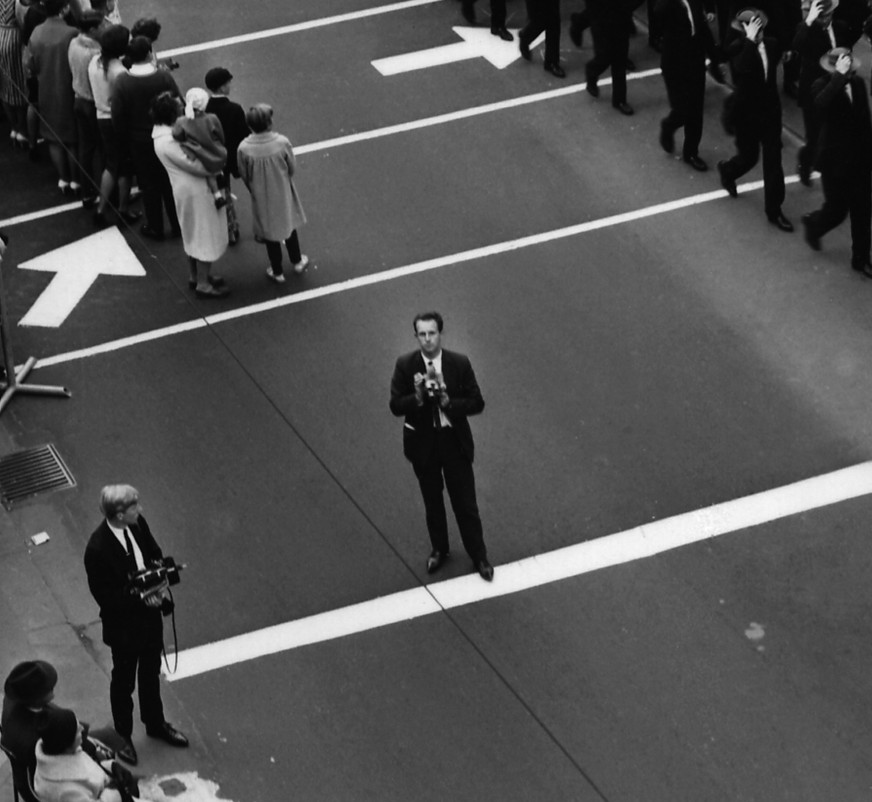
Panic and paranoia? The law and photography in Australia

‘Panic and Paranoia: Photography and the Law’, (with Katherine Giles), Photofile 80, 2007, pp22—25.

Martyn Jolly and Katherine Giles

Every day photographers are experiencing the effects of one of the great contemporary paradoxes of the medium. Never before have photographs been so easy to make and distribute, as millions of digital files are created with mobile phones or digital cameras and uploaded onto the web or distributed electronically. Yet never before have individual photographers felt themselves so inhibited in what they can photograph, where they can photograph and the messages they can put into their photographs. Whether these inhibitions are internalised as a vague feeling that certain types of photography may now be ‘inappropriate’, or whether they come directly from people telling them that photography is ‘not allowed here’, they are all underpinned by an ill-defined sense that the law has somehow changed in relation to photography. Photographers’ blogs are tangled with long threads of discussion about what may or may not be allowed, and are bulging with stories of police, security and members of the public stopping them from taking photographs. As the Sydney photographer, Andrew Nemeth, says on his excellent photographers’ rights website: “Photography is not a crime. Many photographers are fed up with being treated as if they were creeps”.[1]

But how much has the law actually changed? And how much else is now under threat in this current climate of panic and paranoia over morality and security?

PRIVACY

In Australia, there is not yet any legal cause of action for a ‘breach of privacy’. Existing privacy laws only refer to the use of personal data by organisations and governments. Nor is the taking of a photograph for the purposes of art, social documentation or as a hobby a commercial use, even if the photograph is later sold. So their subjects are not ‘models’ with the right to ‘release’ their image to the photographer for a particular use. Instead many other laws regulate the area, including: passing-off laws; trespass laws; confidentiality agreements; nuisance and harassment laws; obscenity laws; stalking laws and laws dealing with filming for an indecent purpose.

Denise O’Rourke is currently being sued by two girls under trade practice laws over their portrayal in his documentary Cunnamulla because, they are claiming, he entered into a misleading agreement with them about the subject of the interviews he wanted to do with them. The celebrity model Lara Bingle is using defamation laws to sue the men’s magazine Zoo Weekly for publishing bikini shots of her from earlier on in her career, with the addition of smutty captions.[2] Several men have been charged under offensive behavior laws with using their mobile phones to photograph topless bathers on beaches.

All of these existing laws should be enough to regulate irresponsible photographers, so that the situation in Australia can remain as it currently stands, where, in words of Justice Dowd, “a person … does not have a right not to be photographed”.[3] But nonetheless there is clearly a trend towards a general restriction on the right of photographers to document their world and the people in it. For instance Justice Michael Kirby has argued that extending the law in Australia to protect the ‘honour, reputation and personal privacy of individuals’ would be consistent with international developments in human rights law: “In recent years, stimulated in part by invasions of individual privacy, including by the media, deemed unacceptable to society, several jurisdictions have looked again at the availability under the common law of an actionable wrong of invasion of privacy.”[4]

Since 2002 the technological combination of mobile phone cameras and the internet has become a socially potent combination. This, mixed with publicity about the use of cameras as an integral tool to the sexual assaults on Diane Brimble aboard a cruise ship and a teenager at Werribee,  has led to widespread public concern about photography and pedophilia, pornography, immorality and misogyny. This is having an effect on photographers at large.

In early 2005 the Brisbane Courier Mail found a website with non-pornographic, non-offensive photographs of children playing at Southbank on it, they created an unsubstantiated panic that international child pornography rings had linked to the site. They hadn’t, and ultimately no action was taken. In Victoria, a site with close-ups of schoolboy rowers, which had been linked to by other pornographic sites, was also found.[5] Subsequently, several urban councils attempted, unsuccessfully, to use their municipal powers to stop parents photographing on their sports fields and council beaches. [6] Shortly after, Surf Life Saving Australia called for a complete ban on pictures of its 40,000 young members without the written permission of parents. Although they subsequently backed down, they initially claimed that their young members should be able to “reasonably expect” privacy, even if they were in public areas. Presumably unaware of any irony, they went on to say that they intended to advise their staff to record the appearance, attire and car registration numbers of anybody they spotted breaking this rule.[7]

But the Summary Offences Act 1988 (NSW) already bans photographing a person in a state of undress or engaged in a private act for the purposes of sexual gratification without their consent. Other jurisdictions prohibit taking photographs of private intimate activities in private personal places such as toilets or change rooms. And specific laws to prevent the new lewd uses suggested by camera phones, such as upskirting, are being bought in by various states, which the Standing Committee of Attorneys-General have now agreed to review and regularize. [8]

Of course, taking lewd pictures of people who might reasonably expect to be unobserved is indefensible, but the tenor of the Standing Committee of Attorneys-General’s discussion paper of August 2005, Unauthorised Photographs on the Internet and Ancillary Privacy Issues, implied a wider drift towards a general right for people to control their image, even when they are taken in public and are not offensive. The discussion paper suggested:

Publishing images of a person without their consent removes their freedom to choose how to present themselves to the world. Some may argue that consent is implicit because the activity is in a public place in full view of people. On the other hand, filming results in a permanent record that can be used in many ways. It is natural that where people are aware they are being filmed, they can adjust their behaviour accordingly. If a person has no knowledge they are being filmed they have no way of reducing the intrusion.[9]

In the new environment of hyperdistribution, this argument runs, the lack of control a subject has over the subsequent use of their image has changed the unposed photograph from simply being a candid image, to being an intrusive act. Arguments such as this are a threat to photographers. For instance one of the medium’s most celebrated genres is street photography, which has produced many masterpieces that have illuminated our sense of ourselves as citizens sharing urban space. In Susan Sontag’s words the street photographer is “an armed version of the solitary walker, reconnoitring, stalking, cruising the urban inferno, the voyeuristic stroller who discovers the city as a landscape of voluptuous extremes.” Is this time-honoured romantic alienation about to become criminalized? Possibly. For instance, whilst shooting a couple of bathers sleeping on the sands of Bondi Beach, in implicit homage to his father’s iconic Sunbaker (1937), Rex Dupain suddenly found himself surrounded by four police officers who questioned him for 25 minutes. “Lifeguards and the police are taking the law into their own hands” he complained, “they regard anyone with a camera as a potential pervert. We sit at home and watch close-ups of people lives on disturbing television reality shows but someone taking pictures at the beach is seen as a threat. Our days as a free society are over.” [10]

Police and security guards are not the only ones taking it upon themselves to constrain photographers, irrespective of any law, concerned parents are also getting jittery. In preparing for her exhibition of portraits of her son’s soccer team, Under Twelves, at the Ground Floor gallery in Balmain in late 2005, Ella Dreyfus was scrupulous in making sure all parents knew what she was doing. She showed them a sample of the style of her shots, and all agreed to her project enthusiastically. “Young boys are beautiful; their mothers know this, but does society allow us to acknowledge their beauty?” asked Dreyfus. But a few days before the show some parents apparently got nervous at the prospect of her portraits inadvertently inciting pedophilia, and Dreyfus suddenly found herself requested to withdraw two images from the exhibition, and mark six not for sale.

In September 2006 an amateur photographer called Jodie snapped a young man sitting on the steps at Flinders Street Station. He got up and demanded five dollars from her. When she said she didn’t have five dollars he demanded the film, when she told him it was a digital camera things got ugly, and she finally deleted one photograph in front of him before walking away, with him hurling abuse at her. The other shot she kept and uploaded to Flickr, but with his face blacked out. She asked her friends from the Flickr community: ‘Did I do the wrong thing? Should I have uploaded at all? Should I have left the original photo?’[11]

She had attempted to resolve all these dilemmas by erasing her subject’s face in a half guilty, half defiant, compromise to his supposedly violated ‘right to privacy’, while maintaining her own right to photograph the people with who she shares public space. This botched economic transaction between subject and photographer, and its clumsy resolution as the publication of a faceless figure, follows the rising logic of our contemporary visual culture — the logic of the celebrity image.

The celebrity’s commercial capital is their desirable lifestyle, and their enviable body, all encapsulated in their instantly recognizable face. So it is in their interest to regulate and control the production, interpretation and distribution of their image as closely as possible. There are now at least 30 paparazzi in Sydney, and they are at war with celebrities.[12] The frequent incidents between them, such as paparrazi squirting Heath Ledger with water pistols on the red carpet of the Brokeback Mountain premiere, after he allegedly spat at them during the shooting of Candy, are more than crass paparazzi ‘overstepping the mark’, they are symptoms of a fight for the control of a valuable commodity — the celebrity’s face. As one of the paparazzi succinctly put it, “It’s the price of fame, my son. If we stop taking his picture, his price goes down. This is give-and-take. It’s fame. It’s the name of the game. You give us some of your private life because you earn so much money. That’s the way it works”.[13]

Celebrities are applying pressure for a ‘right of privacy’ in Australia for their own purposes. By invoking such a spurious ‘right’ they hope to garner public sympathy for the control and regulation of the supply of their image, but it is harassment and defamation laws that they actually use against photographers. The most famous altercations are between Jamie Fawcett and Nicole Kidman. In early 2005 Kidman took out an interim restraining order against him, claiming he had harassed her and endangered her life by chasing her across Sydney at high speeds.[14] For her wedding, however, she established a temporary truce with the paparazzi, while preemptively devaluing any of their pictures by distributing an official wedding photograph world-wide a few seconds after the ceremony was over. But this New Year holiday season Fawcett and Kidman were at it again, with Kidman complaining of harassment to the Bateman’s Bay police and leaving the country early after he, and a Channel Ten news crew, followed her convoy to the South Coast.[15]

These days everybody is potentially a celebrity, however briefly, and everybody’s face has, at least potentially, a value. Fantasies of instant celebrity are regularly enacted in reality TV shows, and the world of the celebrity can suddenly open to those who have unexpectedly found themselves heroes in the public eye. For instance, the trapped Beaconsfield miners reportedly discussed who should play themselves in the inevitable movie of their rescue (Russell Crowe and Heath Ledger), and the settlement of their deal with Eddie McGuire was delayed while they were locked in negotiation with mine management and the coroner over who would own the rights to video footage the pair took to aide the rescuers during their confinement.

As a result of the pervasiveness of celebrity culture, if we are photographed in public we instinctively tend to think slightly less like citizens mingling in the town square, and slightly more like celebrities caught out on the town. We now carry our faces into public more as our commodity, something we own, something we have carefully grown, groomed and cultivated, something we can always potentially make money from. Within this logic the face is less an interface, and more a logo, a stamped unchangeable rebus of the self, a trademark always potentially on the verge of infringement.

Although there is no automatic right of privacy in Australia, the controllers of any commercial or government premises can make any rules they like as a condition of entry into their property. As the town square becomes the shopping mall, more and more public space is becoming privatised. Pedestrians are no longer citizens experiencing democratic interactions, but consumers having regulated retail experiences. Shopping centre owners want to keep their malls feeling lively and exciting, but they also know that shoppers want, above all else, to feel comfortable and protected, and this falls to automated surveillance systems and private security guards, who can make any rules they like. While the majority of people welcome blanket CCTV coverage because it makes them feel protected[16], self-expressive photography by ordinary individuals is treated with suspicion because its motivations and destinations are not obvious, and it can’t immediately be recuperated into the shopping experience.

For instance in July this year the Southgate shopping centre in Melbourne erected warning signs featuring a camera crossed out with a bright red slash. In one incident a Chubb security guard stopped the grandmother Val Moss from taking photographs from the public footpath “because”, he said, “of the terrorism overseas”. In response her camera club, the Knox Photographic Society staged a demonstration with over 100 photographers. A spokesperson for the shopping centre said; “There are safety, security, privacy and copyright issues which need to be considered with all photography and filming within the centre, and we reserve the right to ask people to stop filming or photographing if it is deemed inappropriate.” [17] No, no, no and no. Safety is not compromised by raising a camera to your eye, nor will security be breached by hand held snaps. There is no right of privacy in public space, so why should there be a right of privacy in the ‘new’ public space of the mall, and copyright is not infringed by taking photographs that will only include goods on display or advertising signs as incidental parts of a general scene.

The real reason for these kinds of blanket bans is to restrict the behavior of people using the mall. They attempt to focus the possible behaviors of customers to a narrow spectrum around the core function of shopping – buying, look into shop windows, recharging on coffee and cake, and feeling protected. This narrow band of profitable behavior excludes all other non-corporate behavior previously acceptable in public, such as self-expression.

SEDITION

Towards the end of 2005 the Federal Government introduced the Anti-Terrorism Act (No 2) 2005 (Cth) containing new sedition laws. To date the laws have not been used to prevent artists from expressing their views. But they could be, and in other countries they have been. The new laws go beyond the traditional definition of sedition as crime of intending to overthrow the government or interfere with elections. They broaden it so that it is an offence to simply urge violence in the community, urge interference in parliamentary elections, urge overthrow of the Government or Constitution or urge someone to assist the enemy or assist those engage in armed hostilities.

This shift of focus towards urging other people to commit seditious acts comes without a clear definition of what urging actually is. The courts will have to define what urging actually means when a case comes before them. In advice to Peter Garrett MP, Peter Gray SC stated that the term urging may, “cover indirect ‘urging’, by way of analogy, or dramatisation, or imagery, or metaphor, or allegory, or allusion, or any of the myriad devices and techniques available to a creative artist.”[18] The work of many artists would already fit within this definition, and the vague language creates an uncertain environment that questions the very nature of freedom of expression in Australia. Until a case comes before the courts, the practical effect of these laws on photographers remains unknown, but the chilling effect is already clear. The ability of photographers to create art that has a direct political message is at the cornerstone of a democratic society. Can art that mimics or comments on terrorism or questions the decisions of Government really be terrorism or sedition?

In 2005 the Australian Law Reform Commission examined the new laws and released a Discussion Paper and recommendations which explicitly recognised the concerns of the Australian arts community and the potential chilling effect on artists. The problem is that the sedition laws do not create a clear distinction between legitimate dissent, including the expression of dissent through of works of art, and actions which should be of concern to national security. This all adds to a climate of fear where the actions of a photographer in simply taking photographs, of, say, a public building or an industrial landscape, immediately becomes suspicious. The eventual implications of the new sedition laws on the Australian arts community are unclear, but the chilling effect is already upon us, and is flowing on to the wider social environment. When a photographer is stopped from taking photographs in a public place by a police officer or a security guard ‘because of the terrorism overseas’, this not only affects all other photographers, it also affects the way every one of us experiences our public places and shared spaces.

CONCLUSION

We live in a world where more is happening on camera, from everyday trips to the shops to orchestrated sexual assaults, yet more is happening off camera as well, from remote detention facilities to intensive industrial farming practices. However this polarisation of visibility is not really being defined by either the freedom of speech or the right to privacy, but by rules of access made by governments and corporations for their own purposes. In this context we need more photographs taken by thoughtful, curious, inquisitive, dallying, dilettantish photographers, armed with nothing more than an ordinary desire to represent their world, not less. But in order to be an effective mode of public speech photographers need to free themselves from the insidious inhibitions, vaguely wrapped up in concerns about intrusion and sedition, that are currently constraining them every time they lift the camera to their eye.

Martyn Jolly is Head of Photomedia at the Australian National University

Katherine Giles is a solicitor with the Arts Law Centre of Australia


[2] ‘Men’s Magazine Is Smutty: Judge’ The Canberra Times 9 December 2006 p12

[3] R v Sotheren [2001] NSWSC 204 (26 March 2001) paragraph 25 http://wwwaustliieduau/au/cases/nsw/supreme_ct/2001/204html [date accessed?]

[4] The Australian 10 July 2003 pB01

[5] ‘Unauthorised Photographs On The Internet And Ancillary Privacy Issues’ Discussion Paper Standing Committee of Attorneys-General August 2005 paragraphs 7–12

[6] Amanda Hodge ‘Fear Kills Joy Of Watching Children Play’ The Weekend Australian 26–27 February 2005 p8

[7] ‘Surf Body Call For Photo Ban’ Sydney Morning Herald 5 November 2005

[8] ‘Upskirting To Become A Crime’ Sydney Morning Herald 28 July 2006 np

[9] ‘Unauthorised Photographs On The Internet And Ancillary Privacy Issues’ Discussion Paper Standing Committee of Attorneys-General August 2005 paragraph 40

[10] ‘Dupain’s Beach Snaps Draw Police Focus’ DD McNicoll Weekend Australian 9–10 December 2006 p10

[12] ‘Snap Pack’ Dominic Cadden Sun Herald 13 February 2005 p14

[13] Quoted in the Australian Law Reform Commission issues paper number 31 Review of Privacy cited in ‘Shooting Star’ Sydney Morning Herald Good Weekend 1 July 2006 p26

[14] ‘Best starring role goes to the beak in Kidman’s paparazzi drama’ Justin Norrie Sydney Morning Herald 12 February 2005Sydney Morning Herald p13

[15] ‘Nicole cuts her hols short’ The Daily Telegraph 2 January 2007 np

[16] Wells Helene A Allard Troy Wilson Paul Crime and CCTV in Australia: Understanding the Relationship Centre for Applied Psychology and Criminology Bond University Australia (2006)

[17] ‘Picture this — if you’re allowed: city puts photo ban in the frame’ Carmel Egan The Sunday Age 30 July 2006 p3

Passion for Research

In order to respond to the two words in Gael’s title for today, ‘passion’ and ‘research’, I have decided on an experiment: to discuss a series of photographs which I have encountered in various archives. Most of these photographs are insignificant in themselves, not great works of art, but they have had something in them that I have found interesting, and which has sent me off on a tangent in my research. Because of these tangents, my research trajectory since I started my career at the NGA has followed a somewhat unexpected path, and has covered a lot of ground. To show you just how unexpected I will start my talk with some photographs I found myself getting excited about several months ago in the State Library of New Wales.

Margery Ectoplasm

Margery Seance

These are some photographs reproduced in the Proceedings of the Society for Psychical Research. The photographs are of some animal lung. This lung has been cut into the shape of a hand, with the animal’s trachea serving as a wrist, and the spongey lung tissue cut into fingers. This crude hand had recently been compressed into a woman’s vagina, and then expelled during a Spiritualist séance. It has been flash photographed in the dark by a psychic investigator, a person called Eric Dingwall, who was trying to establish whether or not the woman, called Margery Crandon, had the power to produce ectoplasm, a psychic matter extruded from the other side; and whether this wasn’t the hand of a psychic entity, a spirit manifesting itself to us from the other side of the veil of death.

As I eagerly looked at this photograph I had one of those moments, I thought ‘how did I get here’. I am an atheist, a rationalist, a sceptic, and a materialist. I have a house in the suburbs and a good job teaching photography at a respectable university. What am I doing getting excited about this photograph? I hoped that none of my colleagues would ever find out what I got up to on my research trips.

It was a bunch of photographs that led me down this trail.

When I first started at the NGA I was a callow graduate of an art school, rather than an art history department in a university. I had been trained to think of myself as a contemporary art photographer, though I had also developed a passionate, intimate and, I thought at the time, privileged, love for the history of photography, thanks to my practical art school training. I think what interested me mostly about photography at the time was it’s power as a historical medium, its power to palpably contain history.

What I realized when I began to work here was that this power was articulated by a machinery, mechanisms of memory and forgetting that operated every day through the processes of selection, accessioning, curating, cataloguing, researching, categorising, displaying, and publishing. And as a kid curator I was a small cog in this vast machinery producing the past.

For the next decade or so my research as an artist was all about the relationship between personal, micro moments of time and memory which were residual in individual photographs, and the public, macro uses of photography for master narratives of nation, history or ideology. It was also about how photography had been used to bind personal affect into collective ideology.

In the Australian War Memorial

In The Australian War Memorial

Whilst working at the gallery I made one series of art photographs, which were curated into a touring show by Geoffrey Batchen after I had left the gallery and returned to Sydney. They were called In The Australia War Memorial, and I was able to print them because a friend let me sneak into the Canberra School of Art after hours without the staff knowing. These are simple snaps of the displays at the war memorial. But I was interested in catching threads or shards of experience, seen here in the eyes of the soldiers in the photographs.

Wonderful Pictures

Installation

Wonderful Pictures

Installation

This led me, after a few other series of photographs, to a large series called Wonderful Pictures, which were copied from the pages of Australiana picture books. I skimmed over the curved pages of the opened books with a view camera and adjusted the camera movements so the images dilated out. Some of the prints were purchased by the National Gallery and are now in their collection.

Australia a Camera Study

Australia a Camera Study

By this time I was specifically interested in Australian propaganda, and the construction of Australian identities. Many of the books I photographed were produced by a publisher called Oswald Ziegler. He used the designers Gert Sellheim and Douglas Annand, whose poster work is in this collection. Other books were by Frank Hurley who published vast quantities of Australiana in the 1950s. And it was whilst looking at a book by Frank Hurley, Australia a Camera Study in the NGA research library that I had a little epiphany. The NGA library had brought the book second hand, and it had obviously originally been brought as a gift, probably by an English migrant to send back home. Still between its pages, and still probably there now upstairs in the library, were two pieces of toilet paper. On the toilet paper the original purchaser had traced his, or her, own personal, chthonic, quotidian routes and history of inhabitation. They have written: ‘Arthur, Marjorie’s brother lives just off the picture…This is where Jim Miller has his block of land — where we nearly built a Duplex….I pass along this road every time I go to White’s.” and “My Ferry Run”. Hurley photographs were banal, rhetorical, yet another iteration of his nationalist jingoism, yet two pieces of toilet paper can turn them into personal expressions of reconnection, whilst they remain, of course, essentially propaganda images.

Whilst I had been at the NGA I had been involved with the acquisition of some albums of WW11 propaganda photographs by Edward Cranstone, which I had exhaustively researched for an article in Photofile. So this interest in Hurley, and war propaganda, and Australian identity, and masculinity naturally led me to the First World War. I began to be very interested in propaganda photography, because propaganda is all about eliciting intense personal emotion, but in a collective context.

School Children at an Exhibition

I began to research a series of enormous propaganda exhibitions that were held in Britain in the last years of WW1. I was particularly fascinated by a series of composite murals which were produced by a company called Raines and Co.

Canadian Vimy Ridge in Paris

Vimy ridge straight

Vimy ridge component

British Dreadnoughts of the Battlefield

Australian ‘The Raid’ at Raines & Co.

These photographs were montages, and thus in one sense fake, but they were also spectacular, and some of their components were certainly at least taken on the battlefield, so they also had a real affective power for viewers desperate for images of the Front. In my PhD I wrote about how propagandists managed these competing terms of ‘the fake’ and ‘the spectacular’ in the context of an emerging mass media. I discovered that in terms of an individual’s response to the photograph, the two ideas — the true and the fake — were very labile indeed. A certain kind of affective truth can be orchestrated by a photograph.

You don’t have to spend too long amongst the visual culture of WW1 before you begin to get a bit disturbed. It is shot through with the uncanny. There is a real fascination with strange new industrial forms, particularly bomb blasts, by all the war photographers.

The Canadians ‘snapped’ bomb blasts like exotic butterflies. And Frank Hurley gave them allegorical meaning.

Canada in Khaki

Hurley Death’s Head

I had another mini epiphany in the storeroom of National Museum of Film Photography and Television in Bradford, England. I was there with my colleague Denise Ferris. She was researching an obscure nineteenth century printing technique, and I was looking through two official presentation albums of Australian War Photographs. Then I came across this page taken in the Middle East, probably by Hurley. The caption is “A wonderful cloud-like face hanging above the ancient town like a beautiful guardian angel”.

I knew Hurley liked his clouds, adding them as a kitsch benediction to his scenes. Since I had spent so much time rephotographing his books for Wonderful Pictures I also knew that in his later years he often used the same cloud twice. I also knew that the composite allegorical kitsch of the propagandists had been so pervasive that it had even influenced the high faluting Pictorialists. At the end of the War Harold Cazneaux, for instance, made this patriotic picture Peace after war, and memories, which brings all the tropes of the European battlefield composites back home to Australia. This picture is in the collection of the National Gallery.

Passchaendael

Cloud

Morning After the Battle of Passchendael

Australia a Camera Study

Australia a Camera Study

Harold Cazneaux, peace After War, and Memories

Presentation album

But I had never before seen a cloud so spiritually allegorised in such an official context as an expensive presentation album. My interest was piqued because the cloud wasn’t your usual piece of Hurley flummery, but a quite ordinary, innocent everyday cloud that just happened to be in the right spot at the right time. My interest in what was obviously a pervasive Spiritualism was further piqued when I read about Mrs Ada Deane in a book by Jay Winter, Sites of memory, sites of mourning: the Great war in European cultural history. Deane was a spirit photographer who in 1922 supposedly photographed the spirits of fallen soldiers above the crowds at London’s Cenotaph during the two minutes silence. From him I learnt that Spiritualism, and communication with the dead through séances, enjoyed a huge revival after WW1 as a kind of mass mourning ritual.

Ada Deane, Two Minute’s Silence

I had to think of something to do whilst I was in London for three months at the Australia Council studio, so I decided to see if I could find any spirit photography. I began a  research relationship with that wily old lady, Mrs Ada Emma Deane. In London I went to the Society for Psychical Research, and from there to their archives in the Cambridge University Library. Calling up all the Deane files I was rewarded with four huge albums containing over 3000 spirit photographs.

Deane album page

Deane photograph

Deane photograph

I found turning these pages a moving experience, not because of the fake cottonwool spirits, but for the genuine looks of yearning on the faces of the sitters.

From these album pages I produced a body of work called Faces of the Living Dead, where I paid Cambridge to make slides for me and I scanned the slide and burrowed into them in Photoshop.

Faces of the Living Dead

Faces of the Living Dead

Faces of the Living Dead

Faces of the Living Dead (Deane self-portrait)

In doing this work of re-visualizing the archive I continually came up against Mrs Deane herself. Most of the other archives I had worked with had been anonymous or institutional, but Mrs Deane’s personality still inhabited this one. I had to come to an agreement with her ghost by writing her biography, which I published in the form of an artist’s book

Deane and Barlow family.

This is an image of Deane and her daughter and their two spirit guides, along with one of her early patrons, Fred Barlow and his wife. When he died Barlow left his huge collection of spirit photographs to the British Library. They were annotated by Eric Dingwall, the person who had photographed the animal-lung ectoplasm of Margery in the early 1930s. When the British Library decided to publish a book on this collection they asked me to do it, so I re-immersed myself in the bizarre world of the Spiritualists.

I went all the way back to 1848, to the beginnings of spirit photography in the US, and track it all the way forward to the 1930s, to the forensic documentation of ectoplasm which I showed at the beginning of this talk. Along the way my colleague Helen Ennis told me about an Australian album of spiritualist carte-de-visites from the 1870s, and I’m delighted to say that this album is now in the collection of the NGA. It features many of the Spiritualist celebrities and some of the classic spirit photographs of the nineteenth century. It also illustrates the global trade in carte-de-visites that existed at the time.

Mrs Slater

Mr Guppy, Mr Williams and spirit

Miss Fairlamb (Mrs Melon)

Miss Georgina Houghton

Whilst always remaining a materialist and a sceptic I felt I understood the Spiritualist’s relationship to photography. Their use of the process of photography was just a heightened, exaggerated version of our own private uses of personal snapshots. They helped me understand that belief was something which could be invested in the photograph, as much as received from it. When they went through the ritual of posing for their spirit photographs, which was often accompanied by a laying on of hands onto the photographic plate and a saying of prayers over the camera, they entered into a kind of thaumaturgic contract with the photographer, and through them with the medium itself. As the spirit photograph was taken, and the film supposedly exposed to impressions from both the invisible spectrum and the psychic spectrum, the sitters engaged their own processes of memory as they tried to contact their loved ones with their minds. When they entered the alchemical cave of the darkroom and saw their own face well-up from the emulsion, to be joined by another face which, as often as not, they recognised, their belief was sealed by this thud of recognition they felt in their chests.

Spirit photography brings to the fore the performative, transactional nature of the photographic act, it also links the photographic image very close to the presence of the body. In the bizarre spiritualist imagination ectoplasm was closely related to photographic emulsion, it was a kind of bio/techno membrane between two worlds that was either able to form itself into proto limbs of spirit beings, or take the impressions of images projected from the other side. Although bizarre I can also see these séances as a kind of overheated performance about the power of the photograph, and its ability to directly connect us with bodies from the past.

In one sense these mediums are just tricksters, but in another sense they are conducting a kind of cathartic performance art, producing indexical photographic evidence that the dead are still present in the form a ectoplasmic images. But isn’t that what all photographs are, ectoplasmic images of the dead?  I’m not the first person to say that incidentally, the first person to say that was Roland Barthes.

The Spiritualists chose to believe in fake photographs, but isn’t the truth of all photographs a much a communal consensus as anything else? We only have to think of digital images, that ten years ago were feared as threatening photographic truth, which today have unproblematically created their own digital truth and are blithely consumed every day.

So I think all my research has been in one way or another about the palpable existence of the past in the present through the materiality of the photograph. It’s been about photographic truth as a collective act, rather than an inherent ontological trait. And it’s been about how individuals make private meaning through collective rituals.

My art and my writing have always fed each other. Initially I printed Faces of the Living Dead digitally on gloss photo paper, but I was never really happy with them. But since getting into ectoplasm with all it phlegmy materiality, which historically, besides being offal was also lengths of chiffon, I have decided to reprint some images onto silk-satin. This will happen in a few weeks. So on it goes.

I am also now working on the ACT Bushfire Memorial, which involves making some very public glass columns, out of some very private and precious family snapshots which I scanned during two extraordinary days of collective memory for Canberra’s bushfire victims, so my concerns are continuing.

Out of Time: Essays Between Photography & Art

‘Out of Time: essays between photography and art’ by Blair French, review in Photofile 81, 2007, p76.

Out of Time: Essays Between Photography & Art
Blair French
Contemporary Art Centre of South Australia, 2006
$25, 120 pp B/W  illustrations

In the 1990s Blair French was a curator at the Australian Centre for Photography (ACP) and managing editor of Photofile, before completing a PhD at Sydney University on the photograph’s central role within contemporary art. These sixteen short essays were mostly written following on from that PhD. Some were originally introductory catalogue essays, some were reviews, and a sequence of five, which are the most substantial in the collection, were commissioned by the CACSA for its Broadsheet. French not only analyses the key tendencies currently defining art photography, but also urges a continuing criticality on behalf of us, the viewers. He does not mean the ability to identify ‘good’ and ‘bad’ photographic genres, but a self-reflexive discrimination towards each specific photograph within its historical moment.

And this is a historical moment of posts: post postmodern simulacra and appropriation, post poststructuralist theories of representation, post the supposed threats of the digital revolution, and post the easy comforts of naïve humanism. But what we are not post, as this collection makes clear, is the reality of social experience, and the privileged indexical connection photography maintains to the real. At the same time, more than ever photography has become a heaving mass of imagery merged and flattened into a representational homogeneity which tends to commodify the image into banal spectacle. It is against this background that French tries to throw into critical relief the practices of a variety of contemporary  Australian and New Zealand photographers.

The essays concentrate on two groups of photographers. Initially he looks at those, such as Selina Ou, Darren Sylvester and Anne Zahalka, who work in the familiar style which has dominated art photography recently — the large, singular, seamless, hermetic, constructed pictorial scene. Later, he expands his attention to those who, in various ways, reprocess the direct presence of history, memory and death in the photograph, such as Lyndell Brown & Charles Green, Silvia Velez, or the New Zealand street-photographer Peter Black.

He writes in intelligent support of many of these photographers, but has thoughtful criticisms to make of others. For instance, although Deborah Paauwe’s photographs of sexualised adolescent girls knowingly mobilize a potent set of photographic conventions and social histories, for French they fail to connect with any tangible experience, so they ultimately don’t make any real trouble for the viewer, as they should. In another nicely nuanced reading of Selina Ou, French is worried by the stultifyingly conventional sense of detachment the photographs relentlessly give to their subjects. He occasionally widens his focus to encompass photography’s institutions. For instance he is critical of the installation of Trente Parke’s show Minutes to Midnight  at the ACP, where he finds the artist’s tendency to ‘optical hyperbole’ exacerbated by the overbearing theatricality of the hang which overcooked it into mere visual distraction.

Although I thought his rather forced discussions of artists like Derek Kreckler and Geoff Kleem needn’t have been reprinted, with perhaps more space spent on reproductions, this collection establishes Fernch as a serious thinker and an astute reader of the contemporary Australian photography.

Martyn Jolly

Martyn Jolly is Head of Photomedia at the Australian National University School of Art

Nicole and Jamie: Fatal Attraction

ABC Unleashed Blog November 2007

Nicole Kidman and Jamie Fawcett are at it again. Last week she took the stand in a Sydney courtroom to say, in a hushed whisper, that the paparazzo had made her feel ‘really, really, scared’ as he followed her car across Sydney while she was on her way to Greenwich for dinner with her parents. For his part Fawcett complained that while he had been photographing, on behalf of The Daily Telegraph, their first Christmas holidays together at Rosedale on the South Coast, Keith Urban had slowed their car down so Kidman could swear ‘f_ _k off, Jamie Fawcett’ to him from the passenger window.

Both were witnesses in a supreme court defamation hearing at which Fairfax was using the defence of truth against damages being awarded to Fawcett for a Sun Herald gossip column that had called him Sydney’s ‘most disliked freelance photographer’, and a ‘cowboy type’ who had wreaked ‘havoc’ on Kidman’s private life. The fatal attraction between the two is long and complex. Kidman is one of the world’s top celebrities, demanding huge fees for movies whether they are flops or hits, an actress whose fame does not rest so much on her thespian abilities (indeed critics often seem surprised when she turns in a good performance) as on her being constantly in the public eye because of her private life. Jamie Fawcett is merely the most notorious of the thirty or so paparazzi that work the Sydney beat, feeding the insatiable appetite of supermarket magazines for celebrity gossip. As Fawcett says, ‘Most readers of celebrity magazines want to see photographs of celebrities going about their lives, doing ordinary things, doing the shopping, arguing with the kids.’

Kidman took out an interim AVO against Fawcett after the car chase incident and accused him of planting a bugging device outside her home. Later, she attempted to create a temporary truce with Sydney’s photographer pack by sending a slab of beer out to them during her preparations for the Keith Urban wedding. But in April this year, presumably unaware of any contradiction,  parked a 24/7 solar-powered surveillance van of her own outside her Darling Point mansion to photograph anybody who approached, and demand they say their name into a tape recorder. Fawcett, on the other hand, hired a yacht to sail near to where Urban and Kidman were honeymooning in Tahiti to photograph them with an extreme telephoto lens. But these spats are just more skirmishes in on ongoing war between celebs and paps in Sydney. For instance Sydney photographers squirted Heath Ledger with water pistols on the red carpet of the Brokeback Mountain premiere in retaliation for him spitting at them while he was shooting Candy.

If we iris out to this larger war we can see that what is really at stake is not Nicole’s precious privacy but the circulation of her face in the media. A celebrity’s capital is their instantly recognisable face. It is that which tops the designer frock on the red carpet, and that which is imperfectly disguised behind goggle sunglasses as the designer tots are loaded into the Hummer. Like any economic capital the use and distribution of the celebrity face needs to be closely controlled and regulated: it needs to remain scarce so its value remains high, but it also needs to be continually used so that it maintains its currency. This is what both celebrity and paparazzo implicitly understand and why they must be perpetually in conflict. As one paparazzo succinctly put it: ‘It’s the price of fame, my son. If we stop taking his picture, his price goes down. This is give and take, it’s fame. It’s the name of the game. You give us some of your private life because you earn so much money. That’s the way it works.’

Both push against the wall of acceptability from opposite sides. To Fawcett a celebrity should accept the responsibility of being photographed from any public space, since there is no legal right of visual privacy in public spaces for the rest of us. To Kidman, returning to her home town should grant her special ‘time off’ from the Hollywood hurly-burly. Kidman refuses to acknowledge that Sydney is now no longer the quaint home town of mum’s lamb roast, but has been turned by PR agents such as her own Wendy Day into a permanently over-exposed stage for celebrity spectacle, plugged as instantly into the global circulation of celebrity images as Hollywood, London or Paris. Fawcett, who himself has now become a celebrity in his own right, photographed by the AAP snapper Dean Lewins leaving the court room in a grey overcoat, refuses to realize that the toxic contract between celebrity and photography has caused its own blow back, where everybody has become more suspicious of the ulterior motives of men with cameras. All of us, whether celebrity or pleb, now instinctively wonder about what contracts we may be unwittingly entering into when we are photographed in public.

Meanwhile the judge has reserved her decision.

Postscript:

On February 27 the NSW Supreme Court judge Carolyn Simpson ruled in favour of Fairfax. Fawcett was not entitled to any damages, plus he was ordered to pay Fairfax’s legal costs which, when added to his own legal bill, will amount to several hundred thousand dollars. The Judge accepted Fairfax’s argument that the defamatory meanings in the case — including that Fawcett had behaved in such an intrusive and threatening manner that he had scared the actor — were true. In her judgment she said: ‘Ms Kidman was clearly afraid. The evidence amply demonstrates that Mr Fawcett’s conduct was `intrusive’ and `threatening’. ‘He was clearly motivated to obtain such a photograph, and he recognised that his remaining opportunities on that evening were very limited indeed.’ The Justice also found that Fawcett had placed a listening device outside Kidman’s eastern Sydney home in 2005, despite police not having charged him after investigating the incident. Outside court Fawcett said he was very disappointed with the judge’s ruling and was likely to appeal. “It is a massive economic decision for me,” said Fawcett, adding that he was “already hurting financially”.

Although this was a defamation case against a newspaper about derogatory comments made in its gossip column, it is likely to be received as a case where paparazzo versed celebrity and the paparazzo lost. It is likely to be accepted as a case that gives credence to the growing belief that there is some right of ‘privacy’ that protects the face, even in public, and some prima facie intrusiveness to any use of the camera.

Martyn Jolly

Faces of the Living Dead

‘Faces of the Living Dead’, paper, Junk Writing Conference, University College Worcester, UK, 2002,  7 — 9 August.

In the aftermath of the World War One spirit photography became extraordinarily popular in Britain and Australia. Among its high profile advocates was Sir Arthur Conan Doyle, the famous creator of that arch rationalist Sherlock Holmes. In 1919 Doyle went to Britain’s most famous spirit photographer, William Hope, to try to obtain a photograph of his son who had died as a result of wounds received in the war. He published the resulting image in Britain’s Sunday Pictorial, and in Melbourne’s Herald, and wrote:

I opened the packet in the darkroom and put the plate in the carrier. I had already carefully examined the camera and lens. I was photographed, the two mediums holding their hands on top of the camera. I then took the carrier into the darkroom, took out the plate, developed, fixed and washed it, and then, before leaving the darkroom, saw the extra head upon the plate. On examining with a powerful lens the face of the ‘extra’ I have found such a marking as is produced in newspaper process work. It is very possible that the whole picture, which has a general, but not very exact, resemblance to my son, was conveyed onto the plate from some existing picture. However that may be, it was most certainly supernormal, and not due to any manipulation or fraud. [1]

Doyle’s testimony is characteristic of many people’s experience of spirit photography. There was a ‘laying on of hands’ by the spirit photographer; the presence of the sitter during the alchemical processes in the darkroom;  and despite obvious signs that the spirit image had been appropriated from another source, ultimate belief because the sitter felt a compelling sense of recognition for the spirit extra.

Doyle had been a jingoistic propagandist during the war, in which he not only lost his son, but also his brother. Virtually very other family was experiencing similar grief. Since the war the, “sight of a world which was distraught with sorrow and eagerly asking for help and knowledge”, had compelled him to use his fame and personal wealth to proselytise the cause in bluff pugnacious lectures delivered from platforms across the world.[2] In 1920 and 1921 he spoke to 50,000 people in Australia alone. According to Melbourne’s Age the message of his lectures, that the dead lived and could communicate, would provide implicit comfort to, “the mothers of Australian lads who died so grandly in the War”.[3]

In 1920 another medium photographer, Mrs Ada Deane, joined William Hope in offering sittings for one guinea each at the British College of Psychic Science in West London. The satirical newspaper John Bull sent two anonymous investigators to a sitting.

We were asked to sit on a wicker settee before a dark screen or background. Then, handing us each a hymn book, a hymn was selected and sung. At the close of this Mrs Deane commenced to sing vigorously We Shall Meet on the Beautiful Shore, and intimated that we should ‘join in’. … Mrs Deane then collected our slides in her hands, placing one at the top and one at the bottom. She instructed us to place our hands in a similar manner over hers, and in this position we recited the Lords Prayer.[4]

They took some of Mrs Deane’s photographic plates to the photographic manufacturer Ilford who examined them and reported that they had been pre-exposed to light in a plate-holder. The paper headlined with: AMAZING SPIRIT CAMERA FRAUDS, PSYCHIC EXPERIMENTER CAUGHT RED HANDED IN TRANSPARENT DECEPTION AND TRICKERY.

But many Spiritualist believers simply couldn’t understand how such a ordinary, earnest woman, as Mrs Deane so obviously was, who had brought comfort and joy to thousands of sorrowing hearts, could be periodically attacked by sceptics and accused of cheating her clients with elaborate sleight-of-hand tricks. Mr F. W. Fitzsimons, for instance, found Mrs Deane to be a cheery, pleasant faced old soul, simple and uneducated in the ways and evils of the world of men, and with the hallmark of absolute honesty imprinted on her face. On one of his visits to Mrs Deane, Fitzsimons encountered a sad, care-worn-looking man in the garb of a clergyman. The clergyman was clutching a psychic photograph of his recently deceased wife. “My wife and I had been married twenty years, and we were childless”, he explained, “she was all I lived for. Recently she died, and my religion has given me no comfort or solace. I was in despair, and grew resentful against God. A friend told me about faces of deceased people appearing on photographs. I had four exposures made. Two were blanks, one had the psychic face of someone I did not recognise, and the other held that of my wife, and here it is”. “Can such a thing be true?”, he asked Fitzsimons, tears gathering in his eyes, “To me it seems impossible, yet I succeeded in getting the picture of my wife”. “If such a thing be true, why does not the suffering, anguished world know about it?”, he cried. “Because”, Fitzsimons answered, “people as a whole are steeped in materialism, self-conceit, ignorance, intolerance and bigotry”.[5]

Spirit photographs functioned in quite a different way to the monumental, closed, mute, funeral portrait. The portrait photograph has often been associated with the irrevocability of death because it freezes a moment of life permanently in the past, while giving it only a vicarious presence in the present. In this morbid theory the photograph intimates our own mortality because one day we, too, will remain frozen in time. In a sense the photograph ‘corpses’ time. Spirit photography was such a compelling idea during this period because it took the ‘corpsed’ photograph and miraculously revivified it as evidence of life beyond the grave. By inserting a ghost into the photograph, it made the photograph itself less corpselike. It reversed the past tense, the ‘that has been’ of the photograph, into a future tense: ‘this will continue to be’.

I’ve been guiltily fascinated by spirit photography for a couple of years now. Very much against my better judgement I’ve devoted my time to becoming an expert on spirit photography, and have published a small biography of Mrs Deane. I just haven’t been able to stop myself going back day after day to libraries and archives to find out more about Spiritualism and early spirit photographers. In the Cambridge University Library I came across nearly one thousand spirit photographs taken by Mrs Ada Deane, pasted in grids of twelve into the pages of four large leather bound albums. I got Cambridge to make copies of some of the photographs for me and I burrowed into them with Photoshop to produce a series of art works for an exhibition. I found myself gravitating not to the spirit ‘extras’, but to the faces of those who had paid for their sitting with Mrs Deane. These people, once so desperate for an image of their departed loved ones, are now themselves all dead also, but ironically revenant in the photograph. As they were photographed in the act of channelling an image from the Other Side their faces appeared confused, doubtful, worried, tired and distracted.

I also published a small biography of Mrs Deane which I conceived of as a kind of artist’s book. The Spiritualists where prolix writers and enthusiastic publishers, and I found many journals, pamphlets, proselytising tracts and reminiscences to draw on. I collected all the ones relevant to Mrs Deane and then ordered them into a narrative and strung them together by either directly quoting, or closely paraphrasing them. I tried to retain the flavour of their original prose—which is always pulled between the breathless excitement the writer obviously feels for what they are experiencing, and the need they also feel to appear to be sober and dispassionate in their reporting of positive evidence for spiritualist phenomena—while homogenising and modernising the texts just enough to make it a smooth read. I sometimes thought that I was acting as an amanuensis for these people. Although I remain a materialist, my enthusiasm for their enthusiasm matched their enthusiasm for what was to them the manifest truths of spirit photography and automatic writing.

Besides spirit photography there were many other ways in which the dead made their continuing existence known to the living. Spirit guides acted as go-betweens, taking possession of the medium, speaking with her voice, and relaying messages from relatives and loved ones whilst she was in a trance. Spirits also moved planchettes or ouija borads to speel out messages letter by letter, or tapped in code. But beside the direct voice trance medium the most common means of communication was automatic writing. This was done either in a complete trance or whilst semiconscious.

Within Spiritualism theories of automatic writing didn’t draw on models of inspiration, delirium or poetic suggestion, rather they drew on technological models of telecommunication. For instance the experience of William Howitt is described by his daughter.

My father had not sat many minutes passive, holding a pencil in his hand upon a sheet of paper, ere something resembling an electric shock ran through his arm and hand; whereupon the pencil began to move in circles. The influence becoming stronger and ever stronger, moved not only the hand but the whole arm in a rotary motion, till the arm was at length raised, and rapidly— as if it had been the spoke of a wheel propelled by machinery—whirled irresistibly in a wide sweep, and at great speed, for some ten minutes, through the air. The effect of this rapid motion was felt by him in the muscles of the arm for some times afterwards. Then the arm being again at rest the pencil, in the passive fingers, began gently, but clearly and decidedly, to move.[6]

This was a mechanical model, seeing the medium as a kind of human telegraph machine. Within this model even infants could become automatic writers. Mr Wason, a well known spiritualist from Liverpool, saw a six months old baby write: “I love this little child. God bless him. Advise his father to go back to London on Monday by all means—Susan.” Celina, a child of three and a half, wrote: ” I am glad to manifest through a charming little medium of three and a half who promise well. Promise me not to neglect her.”

This direct machinic model of automatic writing was complemented by another model of collaborative amanuensis. This relied on a more complex quasi Freudian model of an inner and outer mind which separated an imagistic notion of an essential ‘thought message’ out from the language and scriptography into which it was translated. When the psychic pioneer Frederick Myers died he continued to write from the Other Side through a medium called Miss Cummins. His discarnate spirit wrote:

The inner mind is very difficult to deal with from this side. We impress it with our message. We never impress the brain of the medium directly, that is out of the question. But the inner mind receives our message and sends it on to the brain. The brain is a mere mechanism. The inner mind is like soft wax, it receives our thoughts, their whole content, but it must produce the words that clothe it. That is what makes cross-correspondence so very difficult. We may succeed in sending the thought through, but the actual words depend largely on the inner mind’s content, on what words will frame the thought.[7]

Towards the end of 1922 a London medium began to receive messages from the Other Side, via automatic writing, that a photographic group of ‘Tommies’ and sailors who had passed on in the war had been prepared, and if she carried out their directions they had every hope of getting this image onto a photographic plate. The spirits requested that Mrs Deane take a picture at Whitehall during the Two Minutes Silence. A group of spiritualists were placed in the crowd to produce a ‘barrage of prayer’ and so concentrate the psychic energy, and Mrs Deane took two exposures from a high wall over the crowd, one just before the Silence, and one for the entire two minutes of the Silence. When the plates were developed the first showed a mass of light over the praying Spiritualists, and in the second what was described by the spirit as a “river of faces” and an “aerial procession of men” appeared to float dimly above the crowd. Further spirit messages gave details about how the images were produced:

Material is used from the active body of the medium to build up the picture. The material is either impressed by the communicator directly himself, or moulds are made beforehand. The armistice photographs were probably prepared beforehand in groups and either impressed upon the plates before, during, or after the Two Minutes Silence.[8]

I am interested in spirit photographs because, on the one hand, in the emotional effect they had on their audience, and in the visceral connection with their absent loved ones which they gave them, they seem to confirm all that is most powerful about photography; however, on the other hand, in their structure and execution, and in their use of amateurish ‘special effects’, they seem to erode the very ontological foundations on which that photographic power is built. For me, therefore, spirit photographs enable an, admittedly eccentric, critique of the normative epistemology of twentieth century photography.

Spirit photographs are performative. Their power lies not in their relationship to a pro-filmic Real elsewhere in time and space, but their audience’s relationship to them in the audience’s own time and place. They solicit a tacit suspension of disbelief from their audience, while at the same time they brazenly inveigle a tacit belief in special effects. These special effects are traded from other genres such as cinema or stage-craft using the currency of the audience’s thirst for belief. They shamelessly exploit the wounded psychology of their audience to confirm their truth, not by their mute indexical reference to the Real, but through the audience’s own indexical enactment of their traumatic affect. Their truth is not an anterior truth, but a manifest truth that is indexed by the audience as they feel the shock of recognition of their departed loved ones.

The theory of the spiritualist portrait does not conform to the more obvious model of the photographer’s studio, with spirits manifesting themselves to be photographed in front of the camera. Rather the dominant model is the printer’s press, or sculptor’s foundry, where image moulds are prepared on the Other Side, and then impressed into soft photoplasm during the sitting. On an obvious level, the elaborate explanations which spiritualist researchers came up with to explain the effects were their attempts to maintain belief in the face of what were more easily explainable as signs of fraud (flat looking extras, hard cut-out edges, the presence of half-tone dot screens, different lighting, and so on). But in doing so they invented and sustained an extraordinarily compelling, moving, and poetic photographic system.

The complex theory of spirit photography sees the spirit photograph as a completely different thing to the ordinary photograph. The locus for the spiritualist system of photography is not the camera, the lens and the shutter. That technical assemblage, of a shutter vertically slicing a rectilinearly projected image, has been central to photographic theory, with a direct lineage going back to the renaissance. Instead, the locus for spiritualist photography was the sensitive photographic plate alone.

The process of making a spirit photograph is not that of ‘snapping’ an image of an anterior scene and thereby making a direct stencil from the Real; rather it is a process of activating the photographic emulsion as a soft, wet, labile membrane between two worlds — the living and the dead, experience and memory. The spirit photograph’s emulsion is sensitised chemically by the application of developers, and magically by the meeting of hands and the melding of mutual memories. The resultant image is not the mute and inert residue of an optical process, decisively excised from time and space, but a hyper-sensitised screen which two images had reached out from opposite sides to touch, both leaving behind their imprint.

Photographic emulsion — creamy, gelatinous, sensitive to light, bathed in chemicals, and cradled by hands — became poetically and technically related to the most mysterious, potent substance in the spiritualist’s world: ectoplasm. Ectoplasm was rooted in the materiality of the body, it was feminine, moist and labile and often smelt of the bodily fluids it was imagistically related to (because, in fact, it was usually chiffon secreted in the medium’s vagina, or ingested by her before the séance). Ectoplasm could form itself into shapes (in the nineteenth century it could even embody, or body forth, complete material spirits who would walk around the room), but it could also act as an emulsion — receiving imprints or filling moulds. In spirit photography ectoplasm was not only a physical stage in a process of transubstantiation, but also a technological interface, a bio/techno diaphragm.

To me the recently renewed interest in spirit photography reveals the continued power and enigma of the photographic image, despite predictions in the 1990s of its digital demise. The spirit photograph of the 1920s resonates with the ways the photograph as artefact is still used today in both public and private rituals of memory, mourning and loss.

Martyn Jolly

Sir Arthur Conan Doyle and his Son, Harbinger of Light, 1919, October 1919.

N. Fodor, Encyclopedia of Psychic Science, London, Arthurs Press Limited, 1933,

Conan Doyle in Australia, Light, 1920, December 18, 1920.

B. W. C. Pilley, AMAZING SPIRIT CAMERA FRAUDPSYCHC EXPERIMENTER CAUGHT RE HANDED IN TRANSPARENT DECEPTION AND TRICKERY, John Bull, 1921, 17 December 1921.

F. W. Fitzsimons, Opening the Psychic Door: Thirty Years Experiences, London, Hutchinson & Co, 1933,

E. Stead, Faces of the Living Dead, Manchester, Two Worlds Publishing Company, 1925,


[1]Sir Arthur Conan Doyle and his Son, Harbinger of Light, 1919, October 1919.

[2]Doyle entry in, Fodor, Encyclopedia of Psychic Science, London, Arthurs Press Limited, 1933.

[3]Conan Doyle in Australia, Light, 1920, December 18, 1920.

[4]Pilley, John Bull, 1921, 17 December 1921.

[5]Fitzsimons, Opening the Psychic Door: Thirty Years Experiences, London, Hutchinson & Co, 1933, .

[6] Automatic writing entry in, Fodor, Encyclopedia of Psychic Science, London, Arthurs Press Limited, 1933.

[7]

[8]Stead, Faces of the Living Dead, Manchester, Two Worlds Publishing Company, 1925, .

Eyes, Lies and Illusions

‘Eyes, Lies and Illusions’, review in Art Monthly Australia, May, 2007, pp10 — 14.

Drawn from the Werner Nekes Collection
Australian Centre for the Moving Image
2 November 2006 to 11 February 2007

Many popular histories of cinema insult the audiences of the past with the myth that at one of the first demonstrations of the cinematograph in 1895 the audience, convinced that a real train was bearing down on them, ran screaming from hall. Of course they didn’t. They certainly cried out in astonishment, but not because they were naively duped. Rather, as the operator made the familiar projected photograph suddenly lurch into movement they realized they were finally witnessing a new category of illusionism that had long been anticipated. This event was as much just another astounding moment from a centuries-long history of illusionism, as it was the nativity scene for the movies. For a long time the industrial-strength historicism of Hollywood has tended to occlude the larger and more dispersed history of which it is a part. But although it is full of arcane byways and bizarre events, this history can nonetheless still tell us a lot about our own mediated relationships with reality.

Although it has directly addressed central philosophical questions of optical perception, epistemological belief and physical embodiment over many centuries, the history of illusionism lies scattered over a bewildering array of toys, devices, instruments, performances, and barely creditable anecdotes. For instance we have the camera obscura, an instrument for the sober investigation of nature, which was modified into a magic lantern, rolling its phantasmic images out across the darkness. The magic lantern was then incorporated into the phantasmagoria — a diabolical theatre-show first staged in an abandoned French nunnery in Paris during the Terror. And then we have all the wonderful optical toys of the nineteenth century, ennobled with their fabulously ornate Greek names: the anorthoscope, the coptograph, the phenakistiscope, the thaumatrope and the zoetrope. Or we have all the many and various graphical illusions, finely engraved by the likes of Hogarth and Dürer, but also found as cheap reproductions on cigarette cards or on the backs of countless comic books.

This history has progressed from being associated with the diabolical in the medieval period, since illusionists copied the stratagems of the devil who also performed his seductions by mimicry; to being associated with the domestic parlour in the nineteenth century, where rational children were educated to be wary of tricks of perception or fickle appearance; to being associated with the mass distractions of popular entertainment in the modern period. Along the way each of these periods has embedded its potent associations into subsequent developments like geological substrata.

Like an optical illusion itself, this fabulously diverse history has evaded standard historiographic scrutiny or disciplinary recuperation. Yet it is a coherent field that brings together different disciplines which at first sight might appear to have very little in common, but which have increasingly becoming seen to be inextricably bound up with each other: optics, technology, physiology, perspective, colour theory, magic, religion, belief, and spectatorship. It has only been individual collectors, driven by their private passions and deep compulsions, who have intuited these connections and preserved this supremely ephemeral heritage for all of us.

Preeminent amongst these collectors is Werner Nekes, a German professor and experimental filmmaker, described as one of the last surviving baroque polymaths, who has been amassing his own Wunderkammer of the history of illusion for forty years.  Since 2001 parts of his vast collection have formed the basis of exhibitions at major institutions around the world such as the Getty and London’s Hayward Gallery. The Australian Centre for the Moving Image has cannily piggy-backed on the Hayward exhibition and staged their own version in Melbourne.

In the Melbourne selection we really got the sense that we are experiencing a major collection as we look, for example, at an original copy of Athanasius Kircher’s classic Ars Magna Lucis et Umbrae (The Great Art of Light and Shadow), from 1646, or look at one of the few magic lanterns to have survived from the 1600s, which even in its corroded and rudimentary simplicity is recognisably the direct ancestor of that staple of the contemporary art exhibition, the data projector.

The exhibition attempted to install the projection devices, peep boxes, transparent pictures and other illusions in the gallery space to recreate as sensitively as possible the often intimate encounter between viewer and image which the power of the illusion relied upon. It was also at pains to not just be an exhibition of pre-cinema, but carry the broader story of illusionism on in parallel to cinema. The core Werner Nekes collection was complemented by the work of twentieth century artists and contemporary international and Australian artists which recreated and relived some of the original wonder first felt by the original viewers of all these strange devices.

We had Duchamp’s Rotoreliefs from 1935, cheekily throbbing in and out as their motors ground away on the wall. We had Christian Boltanski’s The Shadows, playing a joke on the fear of death by reducing the scary shadows of skeletons and ghosts to the improvised little dolls from which they were cast. Then there was the show’s highlight, Anthony McCall’s magisterial Line Describing a Cone from 1973, which in its formal austerity could also be used as a prism through which to reconsider the whimsical extravagance of the rest of the show. Line Describing a Cone is a 16mm film shown in a fog-filled room. At the beginning of the thirty-minute duration of the film a single point of light is projected through the fog, this slowly grows to be a curved line, then eventually becomes a circle, drawing a complete hollow cone within the fog-filled space. As they move about in the space the bodies of participants incise themselves into the cone, revealing it as actual, physical and present, at the same time as it is optical, virtual and recorded.

The exhibition was accompanied by a fabulous catalogue, a reprint of the original Hayward publication which stands alone on its own terms. It has an essay by Marina Warner, the historian of belief and illusion, who covers the whole field in a characteristically panoramic sweep, from Aristotle who said ‘the soul never thinks without a mental image’, to the present day when, according to postmodern philosophers such as Slavoj Zizek, our reliance on visual prostheses has turned us all into wanderers in ‘the desert of the real’. There is also an authoritative and fascinating account of pre-cinema history by Laurent Mannoni. But the best thing about the catalogue is the illustrations, which retain all the sense of fun and wonder of the original objects. Roll up the supplied silvered cardboard into a tube to reveal a pornographic scene illicitly secreted within an anamorphic distortion of 1750. Move the supplied clear plastic sheet back and forth over Ludwig Wilding’s op-art graphic of 1999 to make the moebius strip appear to cycle around perpetually.

On page 190 the oldest illusion of them all — the afterimage, know even to the ancients — is demonstrated. You stare at a reproduction of a 1930s postcard for a minute or two, then flick your eyes across to the opposite blank white page. Suddenly an unmistakable image of Greta Garbo pulses out at you before fading, like a squid squirting ink into the ocean. Where was Greta? Was she on the page, or in our retina? And why did the retinal afterimage seem to suddenly cohere so surprisingly, and fade so poignantly? Was it because Garbo’s face, that of the reclusive movie star who straddled another paradigm shift in the history of illusion from silent to sound cinema, is still such a collectively recognisable icon in mass culture? Elsewhere the catalogue informs us that in 1765 the afterimage was scientifically investigated by Chevalier Patrice d’Arcy, who swung a lump of burning coal on a rope and timed the revolutions. Through this diabolically cunning method he established that the afterimage lasts for eight-sixtieths of a second, thereby establishing the minimum frame rate of sixteen frames a second for the cinematograph, which was not to be practicable for another 130 years.

The lesson this show teaches us is that historically deception keeps pace with perception. One will never outpace the other because they are in constant exchange. Our continual pleasure in illusion is the reminder, yet again, that each is grounded in the other. We may feel only a faint residual delight at the recreated lantern slide projections of two hundred years ago, which have been made historically quaint for us by the subsequently engineered elaborations on the basic technology, but we will assuredly be bodily thrown back in our seats by the latest CGI effects of the next Hollywood blockbuster we see. However we just need to enter Renato Colangelo and Darren Davison’s walk-in camera obscura erected for the show in Federation Square to feel the exact same wonder that underpins both historical moments. We see people silently walking, upside down, past Flinders Street Station. They are there, but here as well; real, but yet unreal at the same time.

Martyn Jolly

Facing the End of Street Photography

‘The End of Street Photography?’, seminar at Monash University, 2006 

Taking photographs on the street is one of the foundational practices of photography. Yet this practice now seems to be under direct attack, or at least undergoing fundamental change. Now photographers’ blogs are filled with stories of them being harassed by security guards, stopped by police and asked for ID, attacked and treated with immediate suspicion. Students have reported to me that security guards have harassed them for the taking images of the outside of office buildings, even though that practice is perfectly legal, and no copyright law covers images of built architecture. A martinet bus driver has confiscated the camera of another student, even though public transport is public space where no right of privacy exists. Another student of a colleague was actually detained for several hours by the police for taking pictures of the Adelaide Law Courts, echoing the experience of the entire Geelong Camera Club which was reported en masse for taking images of an oil refinery.

On one Sydney photographer’s web site its owner, Andrew Nemeth, is moved to say:

“Photography is not a crime. Many photographers are fed up with being treated as if they were creeps”.  JPG Magazine devoted an entire issue to that theme in February: “’Photography is Not a Crime’ is a rallying cry. It’s meant to remind everyone that amateur photographers are the documentarians of real life. We capture our world to help us understand it. We are not a threat.”

I want to tease out some recent events in Australia, the US and the UK and identify seven effects that have led to this state of affairs.

THE MALL EFFECT

Although there is no automatic right of privacy in Australia, the controllers of any coomercial or government premises can make any rules they like as a condition of entry into their premises. And more and more supposedly ‘public’ space in Australia is becoming privatized. The lost ideal of public space is the Athenean Agora, an open civic place in the middle of ancient Athens where Athenean men could interact as individuals, protected by an idea of the inherent value of civil intercourse. But for many critics of contemporary urbanity, such as Richard Sennett, Marshall Berman and Mike Davis, the dominant space of public interaction has gone from civic forum to shopping centre, from the city street to private mall. Pedestrians are no longer citizens but consumers, not experiencing democratic interactions, but having regulated retail experiences.

For instance in July this year the Southgate shopping centre in Melbourne erected warning signs featuring a camera crossed out with a bright red slash. In one incident a Chubb security guard stopped the grandmother Val Moss from taking photographs from the public footpath “because”, he said, “of the terrorism overseas’. In response her camera club, the Knox Photographic Society staged a demonstration with over 100 photographers. A spokesperson for the Mall said; “There are safety, security, privacy and copyright issues which need to be considered with all photography and filming within the centre, and we reserve the right to ask people to stop filming or photographing if it is deemed inappropriate.”  No there aren’t. Safety is not compromised by raising a camera to your eye, nor will security be breached by hand held snaps. There is no right of privacy in public space, so why should there be a right of privacy in the ‘new’ public space of the mall, and copyright is not infringed by taking photographs that will only include goods on display or advertising signs as incidental parts of a general scene.

The real reason for these kinds of blanket bans is to restrict the behavior of people using the mall. They attempt to focus the possible behaviors of customers to a narrow spectrum around the core function of shopping — buying, look into shop windows, recharging on coffee and cake, and feeling protected. This narrow band of profitable behavior excludes all other non-corporate behavior previously acceptable in public, such as mooching, or recording their environment.

THE OSAMA EFFECT

Ironically, of course, those areas in which guards prevent you from taking photographs which otherwise would be perfectly legal, are exactly the same areas which are under constant video surveillance. A generalized fear of terrorism and street crime is the justification for the surveillance cameras which cover our public and private urban spaces. But the effectiveness of this surveillance is highly doubtful, as evidenced earlier this by the investigative reporters for The Chaser. When dressed as Texan Tourists they were able to video on the Harbour Bridge and at Lucus Heights unmolested. When dressed as a pantomime sheik they only lasted three minutes.

THE iPOD EFFECT

One instinctive reaction reaction to this alienation of public space is a movement towards what could be called the ‘iPoding’ of the self whilst out in public. Cars have long been mobile lounge rooms creating a jealously guarded piece of domesticity within which to navigate through an alienating public space. Now headphones are creating an aural chassis around individuals — hard shells of indifference and distraction nobody is allowed to penetrate.

THE DOLLY DUNN EFFECT

When the notorious pedophile Dolly Dunn was finally arrested in 1997, a number of video tapes of young boys at the beach was found in his possession. This led to a general panic amongst the public of pedophiles using photographs to stalk and groom young people. And this panic is now affecting art photographers.

In preparing for her exhibition of portraits of her son’s soccer team, Under Twelves, at the Ground Floor gallery in Balmain in late 2005, Ella Dreyfus was scrupulous in making sure all parents knew what she was doing. She showed them a sample of the style of her shots, and all agreed to her project enthusiastically. “Young boys are beautiful; their mothers know this, but does society allow us to acknowledge their beauty?” asked Dreyfus. But a few days before the show some parents got nervous and accused her of inadvertently inciting pedophilia. Amongst a vaguely expressed fear of her pictures of their children being used by pedophiles, Dreyfus suddenly found that two images were withdrawn from the exhibition, and six were marked not for sale.

The media deliberately provoked other panics. In early 2005 the Brisbane Courier Mail found a website with non-pornographic, non-offensive photographs of children playing at Southbank on it, the created an unsubstantiated panic that international child pornography rings had linked to the site. They hadn’t. Ultimately no action was taken. In Victoria, a site with close-ups of schoolboy rowers, which had been linked to by other pornographic sites, was also found.

Subsequently several urban councils attempted, unsuccessfully, to use their municipal powers to stop parents photographing on their sporting fields and council beaches. Shortly after Surf Life Saving Australia called for a complete ban on pictures of its 40,000 young members, know as nippers. It said: “its young member can ‘reasonably expect’ privacy — even if they are in public areas — which could be violated with new technology such as camera phones. The organization says passers by should only be allowed to take photographs if they have the written permission of parents. It intends to advise its staff to record the appearance, attire and car registration numbers of anybody they spot breaking this rule.” SMH 5-6/11/05 Subsequently they backed down, but still seemed unaware of the irony of ‘recording the appearance, attire and car registration numbers of anybody they spot breaking their rule in order to protect their own supposed privacy.

This paranoia over photographs of children has led to some extreme examples, such as this article extolling the benefits of private schools, which felt compelled to blur the faces on a stock shot of some generic school children used as illustrative, not an editorial image. Why? How could this blurring possibly protect the children photographed, from what? And since the photograph was not being used for a commercial purpose, was not being used to sell any product (other than the benefits of private education) there was no obligation even for the photographer to obtain model releases.

THE MARK LATHAM EFFECT

Recently many Australian photographers have been physically attacked in public, on the spurious grounds that they were ‘invading the privacy’ of somebody. In the lead up to Mark Latham’s resignation as leader of the opposition police had used anti-gang laws to clear photographers from the front of his house. Later Latham smashed a photographer’s camera after he was photographed eating a hamburger with his children. He pleaded guilty to malicious damage and replaced the camera. In 2005 there were two other cases of photographers being assaulted

Currently there is no right of privacy in Australia. Existing privacy laws only refer to the use of personal data by organisations and government. There is noy yet any such crime as the photographic ‘invasion of privacy’. As Justice Dowd said in a 2001 ruling “A person, in our society, does not have a right not to be photographed”. Nor is the taking of a photograph for the purposes of art, documentation or as a hobby a commercial use, even if the photograph is sold, so the subjects are not ‘models’ with a commercial contract with the photographer. Instead many other laws regulate the area, including the passing-off law, the trade practice laws, trespass laws, stalking laws, defamation laws, offensive behavior laws, apprehended violence orders, confidentiality agreements, contractual laws, and entry regulations for commercial or government premises. So the girls who are suing Denise O’Rourke over their portrayal as the town’s under-age sluts are suing him under trade practice laws, because they are claiming, he entered into a prior agreement with them about the subject of the commercial documentary he wanted to make with them.

However specific anti-photography laws are being bought in. The state of NSW bans photographing a person for the purposes of sexual gratification without their consent in a state of undress or engaged in a private act. Other jurisdictions prohibit taking photographs of private intimate activities in private personal places such as toilets or change rooms— where people might reasonably expect to not be observed

Police have also attempted to stop people using mobile phones on public beaches to take pictures of topless bathers. But so far they have only securing a conviction when one of the people they arrested for offensive behavior under the Summary Offences Act caved in and pleaded guilty. Taking photographs of topless bathers is something nationally celebrated photographers like Rennie Ellis had been doing for decades, so it is the surreptitious networking and ditribution capabilities of the mobile phone that the police found so offensive. There have been a slew of new offensive behavior laws that try to more specifically cover ‘inappropriate’ behavior with mobile phones, covering the surreptitious use of mobile phones in change rooms, or for upskirting. Queensland was the first state to introduce these new laws and they have prosecuted ten people, whereas in Victoria stalking laws were used for one prosecution. The state Attorneys-general have now agreed to review their diverse laws. (SMH 29/7/06)

In September this year an amateur photographer called Jodie snapped a young man at Flinders Street Station in a generic homeless-youth style shot. However he decided not to play the role of a powerless homeless person, but an exotic ‘third world’ subject snapped by a ‘first world’ tourist photographer. He came up to her and demanded $5.00. When Jodie said she didn’t have $5 he demanded the film, when she told him it was digital camera he got even more pissed off. Finally she deleted one photograph in front of him and walked away, with him hurling abuse at her. The other shot she kept, and uploaded to Flickr, but with his face blacked out and a short caption wondering if she had done the right thing and asking for help in balancing her right to free expression with his supposed right to privacy. This photograph replicates a classic colonial relationship between rich powerful authoritative photographer looking down at a generic type who must passively bear the gaze, but only now the face is erased, as an after the fact attempt by the photographer to restore some supposedly violated ‘right to privacy’ to her subject.

Many people in Australia think that there should be a general tort of privacy, and this is following a world-wide trend. The most extreme laws are in France, where the law protects anyone from an intrusion into their privacy, or that of their family. In France it is illegal to print a picture of someone without their permission. But this prohibition against publishing seems to be interpreted by many as a prohibition against photography itself. Police are not sympathetic to paparrazi or photographers generally. The pack of photographers chasing Diana would not have found a legal outlet for their photographs in France, and three of them were convicted of taking photographs inside the wrecked car after the crash.

Kate Moss had no legal grounds to stop the publication of surreptitious image of her snorting coke at a recording studio. But in 2004 Naomi Campbell was awarded the princely sum of £3500 from a British newspaper which photographed her leaving Narcotics Anonymous, the money was awarded under new European Human Rights legislation on the grounds that a photograph of somebody attending NA would damage their efforts a self-rehabilitation. So in these limited circumstances at least, when a photograph is taken on the threshold of a site dedicated to self-therapy, private space had now spilled out onto the street.

Australia is not far behind. By 2005 following the few instances of images of children playing at playgrounds being posted on websites, and the proliferation of camera phones, the Standing Committee of Attorneys General to commission a discussion paper Unauthorised Photographs on the Internet and Ancillary Privacy Issues, it included the statement: “publishing images of a person without their consent removes their freedom to choose how they present themselves to the world.”

Justice Michael Kirby has also argued for that extending the law of privacy in Australia would be consistent with international human rights law, he said “any development of the common law in Australia, consistent with [human rights] principles, should provide effective legal protection for the honour, reputation and personal privacy of individuals. … In recent years, stimulated in part by invasions of individual privacy, including by the media, deemed unacceptable to society, several jurisdictions have looked again at the availability under the common law of an actionable wrong of invasion of privacy.” Aust, 10/7/03 B01

Some also predict that the recent capping of defamation payouts to a quarter of a mere million dollars, and the introduction of truth alone as a defence, rather than truth and public interest, will mean, that there will be a push by the rich and powerful towards stricter privacy laws in Australia.

THE NICOLE KIDMAN EFFECT

The celebrity’s commercial capital is their recognizable face, their desirable lifestyle, and their enviable body. So it is in their interest to regulate and control the production, interpretation and distribution of their image as closely as possible. There are now at least 30 paparazzi in Sydney and they are at war with celebrities. In 1993 Tom Cruise and Nicole Kidman unsuccessfully tried to use privacy as a grounds to stop New Idea publishing images of their daughter Isabella. In early 2005 Nicole Kidman took out an interim restraining order against two paparazzi Jamie Fawcett and Ben MacDonald after she claimed they had endangered her life by chasing her across Sydney at high speeds. The restraining orders were lifted after they agreed to not approach her house within 500metres.

Note that privacy was not the issue in this case. The interim AVO against Fawcett and McDonald was because of harassment, not invasion of privacy, in the words of her publicist they had made her feel “threatened, intimidated and unable to leave her home without fearing for her safety.” But when her wedding rolled around a kind of truse had been established. The paparazzi sang happy birthday to her through her intercom, and she sent out a slab of beer. The value of any of their pictures was planned to be pre-emptively devalued by her releasing an official wedding photograph immediately after the ceremony.

Recently Lara Bingle, the body behind the Australian Government’s latest international tourist campaign, claimed the men’s magazine Zoo Weekly had defamed her by implying that she was the sort of girl who would consent to have revealing images of her posing in a bikini published for the sexual gratification of men in the magazine Zoo Weekly, even though she had clearly approved of the original photographs being taken for a photographer’s model folio 11 months before, but before she became the fresh-faced face of Australia overseas.

In all of the above examples of the war between celebrity and paparrazi laws other than privacy laws were used.

THE Nussenzweig EFFECT

There is now a democratization of celebrity culture. Everybody is potentially a celebrity, however briefly. Fantasies of instant celebrity are enacted in reality TV shows. The world of the celebrity has never been more porous, open to those who have accidentally found themselves heroes in the public eye. For instance, the trapped Beaconsfield miners discussed who should play themselves in the inevitable movie after their rescue (Russell Crowe and Heath Ledger). The settlement of their first TV deal with Eddie McGuirre was delayed because they were locked in a fight with mine management over potentially lucrative video footage and photographs the pair took to aide the rescuers during their confinement. The hours of footage and dozens of photos, which could have been worth hundreds of thousands of dollars as part of a media deal, was held on to by the mine’s managers despite repeated requests from the two men.

So the celebrity logic of the face being one’s own private commercial capital has now spread from actual celebrities to all of the rest of us. In 2001 the photographer Philip-Lorca diCorcia set up his camera above a sidewalk in Times Square in New York, as people walked towards his camera and reached an x taped onto the sidewalk 20 feet below it, he stook pictures of them with a strobe light attached to construction scaffolding. Out of the thousand of images he took he selected 17 for an exhibition Heads at Pace McGill Gallery. Number 13 of the 17 he selected was an archetypal old-style European Jew, an image redolent with the weight of European history. The person who diCorcia had shot was Erno Nussenzweig, a fundamentalist Hasidic Jew from a small sect based in New Jersey. He wasn’t aware that his face had been used until almost four years after it was first exhibited, after it’s edition of 10 had completely sold out at US$20,000 to US$30,0000 a print, and until after it had won the Citibank Prize in London. When he did find out, three and a half years later, he sued the photographer and his gallery. He was seeking US$1.6 million damages for two reasons: that his image was being used for advertising or trade purposes without his permission, and that it violated his deeply held religious belief in the second commandment, thou shalt not make graven images. As his lawyer succinctly put the case: “It’s a beautiful picture. But why should this guy make money off of your face?” But as diCorcia is reported to have replied: “if he is as otherworldly as his face makes him out to be, why would he care?”

The defendants, diCorcia and his gallery claimed that the photographs were art, and were therefore protected by the First Amendment, guaranteeing the right to free speech. The judge agreed with the defendants that the photographs were art, even though they were reproducible photographs and not paintings, because they were accepted as art by the art world. Even though they were made for sale, this commercial use which was necessary to prevent the artist starving in his garret, was ancillary to their art value. As art they were protected by the first amendment. In addition although the court accepted that Nussenzweig was distressed by his religious aversion to graven images, the constitutional protection of the right to practice your religion only applies to actions of the state, not those of other free American individuals.

In the end this was a very satisfactory outcome, and clearly the correct one. But it will probably be only the first of many, and it does indicate a disturbing trend. Clearly Nussenzweig was resentful that somebody was making a living off of his face, and he had sympathisers. He had worked hard acquiring such a symbolic face, his Klausenberg Sect had been almost completely wiped out in the holocaust, and he had spent a lifetime in new Jersey as a diamond trader, now the face that he had grown had been removed from him, without his permission. No wonder his Lord had brought down a commandment against graven images. On the other hand, those who had supported the photographer replied that he had voluntarily gone out into a public space, Times Square no less, perhaps the most over-exposed place on earth, where everything was surveilled not only by CCT security cameras, but by out-of-town tourists taking it all in as the sights of the big city. His face was therefore in public, and part of the common wealth of the street. But nonetheless there is still something predatory about diCorcia’s approach to photography: the hidden camera, and the strobe lights erected on scaffolding that automatically fired when the unsuspecting subject passed within 20 feet of his camera, set him up as the ultimate disengaged hunter.

DiCorcia was photographing a melodramatic urban alienation. He was looking for photographs of faces that concealed rather than revealed. As the essay to the show, by Luc Sante stated: “You can take your deepest conflicts aad darkest designs out of the cell of your bedroom and air them on the avenue. Naturally, if you live in the city, many of your readiest thoughts  will just naturally be conflicted and dark. Even if someone catches you in the act — if an old friend, say, spots you before you see him, or if you are somehow included in a crowd shot that makes it onto the TV news — you do not have to feel vulnerable about looking troubled, since that is the uniform nearly all city faces wear when they walk alone. The look of doubt and worry even has its practical aspect; it can double as armour. It says ‘Go away’ and ‘Don’t ask’, and maybe even ‘I’ve got a gun’.”

This armoured face is the familiar twentieth-century face of street photography. The street photographer is someone who, in Susan Sontag’s words, is an “armed version of the solitary walker, reconnoitering, stalking, cruising the urban inferno, the voyeuristic stroller who discovers the city as a landscape of voluptuous extremes.” Their streets were no utopias, street photographers photographed a fragmented, alienating society, certainly. But at least it was a society. Everybody might have been going in different directions, and avoiding each other’s eyes, but at least they were sharing the same street. In Walker Evans’ photographs of commuters on the New York underground in WW2 the commuters are in their own private bubble, certainly, but their reveries are cradled by the public space of the subway.

Recently however, I think you can detect a change in the picturing of the street, to one where fragmentation and isolation, one person divided from another, is emphasized, as in the work of Phillip Lorca diCorcia, Beat Streuli and Trente Parke.

As part of this tendency the face itself is becoming increasingly privatized, just like public space itself. It is now less something we take with us into a space of public interaction in order to shield us from our equals, our fellow citizens; we now carry our faces into public in a similar way that celebrities have habitually taken their faces into public: it is now our commodity, something we own, something we have carefully grown, groomed and cultivated, something we can always potentially make money off of.

It is interesting that so many photographic interventions are happening to images of the face. At the same time as faces are being jealously guarded by their owners, they are also being erased, blurred by scared photographers. The celebrity face is leading the way here. The logic of the celebrity face is less an assemblage of orifices, the ‘white wall/black holes of Deleuze and Guattari, with which to interact with the world, even if that means screening it our, and more like a logo, a stamped unchangeable rebus of the self, a trade mark always potentially on the verge of infringement.

The logic of the media martyr perhaps follows the same logic as the celebrity. The faces of martyrs, such as assassinated politicians or ordinary people suddenly caught up in great events, become abstracted, commodified and deterritorialized. And in the same way each of us is potentially a celebrity, each of us is also potentially a martyr.

CONCLUSION

So we have a series of effects change street photography. In summary they are the:

THE MALL EFFECT
THE OSAMA EFFECT
THE iPOD EFFECT
THE DOLLY DUNN EFFECT
THE MARK LATHAM EFFECT
THE NICOLE KIDMAN EFFECT
THE Nussenzweig EFFECT

This change has happened in a period in Australia’s history when public space is undergoing unprecedented forces for fragmentation. This is a second narrative in the theory of contemporary public space, which parallels the first narrative of corporate enclosure. This parallel narrative sees the ideal public sphere as a mutually agreed space where different types of people — the young and the old, the poor and the rich, the black and the white — can interact directly, mix, mingle and compete, and at least attempt to come to a mutual accommodation with each other. But it sees contemporary public space becoming a place of segregation and division where, for instance, those with cash in their pockets are allowed in, those without are moved on by security guards. In this new city there is no longer any central space which it is agreed will be shared, rather each neighborhood or precincts is assigned a different class, ethnicity and function and quarantined from the other. This gives an appearance of increased order, harmony and control, until one of those divisions is suddenly breached, and neighbors who have remained strangers to each other meet in rage or riot.

Perhaps the closest thing to the Agora in Australia is the beach, and the Cronulla riots are an excellent example of the way that politics is spatial, and power is expressed through control of public space.

More than ever, therefore, street photography has a vital role to play in this context. Photographers should fight for their rights to freedom of expression in public space. They should fight against the seven effects I have identified. I suggest all photographers carry cards in their wallets outlining their rights and the phone number of a pro bono lawyer. And we should take back the streets.

Glossy 2: Faces Magazines Now

‘National Portrait Gallery, Glossy 2’, review in Photofile 77, 2006 p67

National Portrait Gallery
Commonwealth Place
25 November 2005 — 9 April 2006

Nobody can resist the allure of the celebrity for long. Even if we refuse to waste our own money on the slippery wad of a glossy magazine, we can’t resist sliding one out of the pile at the hairdressers, or having a quick flip at a friend’s place. Although it is as old as the mass media itself, celebrity culture has never been as complex, or as pervasive, as it is now. Celebrities may exist in a world far above that of you or I, but their planet has always been a democratic one where every inhabitant is equally endowed with the same intangible divinity, whether they have earned it through a long career involving spectacular achievement, or by simply being a model who goes to parties a lot. Now, however, access to this world seems at least potentially available to all of us. Fantasies of instant celebrity are regularly actualised in reality TV shows, and the pages of glossy magazines now await not just the precociously talented, the obscenely wealthy, or the hereditarily endowed, but also those who have accidentally found themselves in the news, and who have been able to parley their momentary fame into longer term celebrity status. But the increased porosity of the world of the celebrity comes at the price of a higher speed of celebrity turnover, as more faces come and go in a crueller and crueller economy of public admiration, envy and disdain — an economy of extravagant production and consumption the only raw material of which is the hapless celebrity themself.

With its characteristic nose for a good show, the National Portrait Gallery (NPG) has identified the rise in the importance of the celebrity as a defining part of our national culture, and the key role that the magazine photographer plays in it as something needing extended examination. Glossy 2 not only follows on from Glossy 1, of 1999, but also another important exhibition of 2002, POL: Portrait of a Generation, which examined in depth the seminal seventies magazine POL. The NPG has always teemed with celebrities — celebrity astronauts, celebrity chefs, pop stars and models — just as it has always moved quickly to honour celebrity photographers, such as Lewis Morey, who other institutions were slower to pick up on. But the NPG is smart enough to know that celebrity photographs aren’t ‘portraits’ in the traditional sense of the word, they don’t plumb the depths of an individual’s personality, or record the marks their lifetime of achievement has inscribed into the lineaments of their face. They are staged-managed confections, fictional tableaus created by teams of stylists to be consumed and discarded on a weekly or monthly cycle. But collectively, the NPG argues, they form an accurate historical portrait, not so much of the celebrities, but of us — our desires, our obsessions, and our sense of whom we would like to be.

This version of Glossy introduces the work of seven new Australian magazine photographers, some of who trained in Australia and now work overseas, and some of who were trained overseas but are working in Australia. (One interesting question this show raises is whether there is such a thing as a definable ‘Australian photography’ any more.) The show has eschewed the temptation to display the magazine pages for which these images were shot in the first place, which with their graphic layout, editorial content and varying print quality would have added interest to the installation. Instead, in order to focus attention on the individual styles of the photographers themselves, it has opted for a gallery-style hang. But few of the images themselves are powerful enough to justify such treatment, and many shots, such as US trained Ellen Dahl’s vapid pop portraits, are too slight and boring for a gallery wall.

It is true that each photographer has developed their own distinctive look which the gallery hang emphasises, but this is more a photographic ‘styling’ that involves developing a reliable way for each image to have a visual hook with which to capture the distracted eye of the reader as they flip through pages of the magazine. For instance Daniela Federici, trained in Melbourne but based in New York, digitally endows her images of contemporary beauties such as Natalie Imbruglia, with a monochrome air-brushed surface reminiscent of classic Hollywood glamour photography. On the other hand Ingvar Kenne, trained in Sweden but based in Sydney, frequently uses fill-flash or oblique afternoon lighting to deep-etch his subjects, such as a narcissistic Angus Young, against their square-format background. While the Sydney Morning Herald photographer Sahlan Hayes embeds his subjects, such as the regal Smokey Dawson waltzing with his wife, into satisfyingly complex backgrounds. Whereas Ben Baker, based in New York, is able to construct the impression that his subjects have been photojournalistically grabbed off the street, even though we know there are squads of publicists and press agents poised just off camera.

Few photographs in this show, however, have much sustaining power beyond their initial visual conceit. The show isn’t nearly as good as Glossy 1. Nothing comes close, for instance, to the power of Polly Borland’s fantastic shot of an alluring, but startled looking Monica Lewinski, which was the highlight of the 1999 show.

To continue the NPG’s commitment to examining celebrity culture they should consider next not a Glossy 3, but a Trashy 1. The paparazzi’s grubby, blurry shots of scurrying celebrities, which we guiltily flick through not at the hairdressers, but in the supermarket checkout line, are just as vital a part of the brutal celebrity economy as the art-directed publicity portrait. And Australia is host to its fair share of international paps, such as the notorious Jamie Fawcett, against whom our Nic was forced to seek an Apprehended Violence Order last year. A show devoted to the compelling, schadenfreudenish allure of this photography would indeed be interesting.

Martyn Jolly

Martyn Jolly is head of Photomedia at the Australian National University School of Art. His book Faces of the Living Dead: The Belief in Spirit Photography will be published this year.

Rennie Ellis: Aussies All

‘Rennie Ellis: Aussies All’, review in Photofile 78, pp71-72, 2006

National Portrait Gallery, Commonwealth Place
21 April – 27 August 2006

Nobody would seriously argue that Rennie Ellis was a great photographer. His photographs had neither a sophisticated visual wit, nor a clear-eyed charm. The best ones were unabashedly pervy pictures of people who were, by and large, also unabashedly flaunting themselves. Ellis may not have been a great photographer, but he was clearly a great character, with an endless appetite for people and parties. He and his camera cheerfully blammed their way through most of the brash characters and glitzy media events of the seventies, eighties and nineties. He shot at the sporting spectacles of yobbos, the nightclubs of sub-cultural habitués, and the kitsch homes of freshly minted millionaires. He loved subjects who flaunted their money and sexuality, the twin lenses through which he saw Australia. He delivered his best shots from sites of ostentatious display — the beach or the Melbournne Cup — and his best subjects were sports stars or business moguls who, pumped with their own success, willingly and openly burlesqued themselves for his camera.

During his career Ellis published a remarkable ten books about Australia, beginning with the seminal Kings Cross Sydney, 1971, produced with Wesley Stacey. That publication continued the long tradition of Australiana picture books, but orientated it away from the previous nationalistic trope of homogenous equality in a rural landscape, towards an acknowledgement of various distinct urban subcultures whose gritty co-existence was nonetheless still quintessential to an Australian egalitarianism. However, as a photographer, Ellis was to become most closely identified with his two later books, the mega-selling Life’s a Beach, 1983, and Life’s Still a Beach, 1998, which celebrated the nation with numerous long-shots of Australian tits and bums in bikinis. Now, three years after his death, this show, although primarily designed to feed Baby-Boomer nostalgia, deserves credit for bringing back to our attention many of the other portraits Ellis took for magazines like Playboy and Who Weekly. The National Portrait Gallery has also accompanied the portraits with their usual useful biographical captions, which sometimes speak volumes about their subjects in just 150 words.

Ellis styled himself as an egalitarian photographer, in his view all Aussies had an equal claim to this country’s fabulously open lifestyle. But, ironically, what he has most powerfully bequeathed to us is an image of the crass venality of so many Aussies, before their inevitable downfall and expulsion from the country’s carnival. Thus we can savour as a parable of hubris the ridiculous set-up shot from 1979 of Derryn Hinch wallowing in newspaper-strewn bed with a Playboy playmate, like a hirsute toad-prince in a swamp of tabloid journalism. On the other hand, if he was in the right place at the right time, Ellis was occasionally able to deliver quite complex and genuinely exciting images, such as the frieze of classic football types on either side of Ron Barassi, frozen whilst hysterically launching themselves into the air at the cue of a decisive try by their team.

Martyn Jolly

Photographing the dead

Early Spiritualist Photography

In 1848 two young sisters, Maggie and Kate Fox, who lived in a small house in upper New York State, began to hear rapping sounds in their bedroom, and modern Spiritualism was inaugurated. Thirteen years later mysterious ‘extra’ figures began to appear on the glass plates of the Boston photographer, William Mumler, and spirit photography was inaugurated. Public interest in Spiritualism and spirit photography peaked in the 1870s but had subsided by the turn of the century. But both underwent an extraordinary revival from the time of the First World War and throughout the 1920s.

The most famous example of spirit photography in the nineteenth century phase was the documentation, in the mid 1870s, of the full body ectoplasmic materialisation of the spirit Katie King, supposedly produced by the medium Florence Cook. Katie King was the daughter of a 200 year-old pirate. Florence Cook, the teenage medium from Hackney in London who produced her, was sponsored by, and the photographs were promulgated by, the eminent chemist Sir William Crookes, the discoverer of the element Thallium and researcher into cathode rays. This erotically charged ménage-a-trois, of an older, scientific, patriarchal sponsor and proselytiser; a supposedly passive, honest, ingenuous female medium; and a young coquettish spirit ‘control’ from beyond the grave, was quite common within spiritualism.

As with all of the cases I’m going to discuss, it is only within the dynamics of the various personal investments of these relationships, the personal desire of the client to believe, and the seductive scenarios enacted by the medium, that we can account for the fact that time and time again obvious fakes are believed. Sir William Crookes built up an ongoing relationship with the spirit Katie King. He reported that she was supremely beautiful, and felt and breathed like a living person, and he was convinced that she had a different height, heart rate and hair colour than the medium who ectoplasmically produced her as she supposedly lay in a supine trance in her cabinet.

And we too, at a stretch, can just be convinced how Crookes, flattered by the attentions of this Pre-Raphaelite spiritual beauty in the crepuscular hush of a Victorian parlour, lit by a galvanically powered arc light,[1] could be persuaded to momentarily believe she was supernatural, and then out of pride and scientific arrogance, refuse to recant for the rest of his life. It is probable that in fact Crookes, a married man, was having an affair with his young and beautiful medium at the time of the Katie King materialisations. [2]  Also, in the 1870s, still in the period of the photographic glass wet plate, before the mass dissemination and reproduction of the snapshot, the medium of photography was removed enough from the public ken to still be mysterious enough in itself to sustain the overheated theatrics of these documents.

Sir Arthur Conan Doyle and William Hope

The most famous British medium photographer of the early twentieth century was William Hope who worked with a partner from a studio in the north of England from the 1900s and regularly produced images with what were called ‘extras’, spirit manifestations of the living dead. Often these extras appeared swathed in cocoons of material which was identified as an ectoplasmic like substance.

Hope’s work was eagerly examined and endorsed by the SSSP, the Society for the Study of Supernormal Pictures, which had been formed by a group of well credentialled and eminent Spiritualists in 1918

Spirit photography had several high profile advocates. The famous creator of that arch-rationalist Sherlock Holmes, Sir Arthur Conan Doyle, was an evangelical spiritualist. He went to William Hope in 1919 to try to obtain a photograph of his son who had died as a result of wounds received in the Great War. He published the resulting image in Britain’s Sunday Pictorial, and in Melbourne’s Herald. In his testimonial letter Doyle wrote:

The plate was brought by me in Manchester. On reaching Mr Hope’s studio room in Crewe, I opened the packet in the darkroom and put the plate in the carrier. I had already carefully examined the camera and lens. I was photographed, the two mediums holding their hands on top of the camera. I then took the carrier into the darkroom, took out the plate, developed, fixed and washed it, and then, before leaving the darkroom, saw the extra head upon the plate. On examining with a powerful lens the face of the ‘extra’ I have found such a marking as is produced in newspaper process work. It is very possible that the whole picture, which has a general, but not very exact, resemblance to my son, was conveyed onto the plate from some existing picture. However that may be, it was most certainly supernormal, and not due to any manipulation or fraud. [3]

This quote is characteristic of many people’s experience of spirit photography. There was a ‘laying on of hands’ of the spirit photographer, the presence of the sitter during the alchemical processes in the darkroom, and, despite obvious signs that the spirit image came from another source, ultimate belief because there is nonetheless a revelation of recognition, and it appears as though fraud was impossible.

Doyle had been a jingoistic propagandist during World War One, during  which he lost his son and his brother. Virtually every other family was experiencing similar grief. Since that war the, “sight of a world which was distraught with sorrow and eagerly asking for help and knowledge”, had compelled him to use his fame and personal wealth to proselytise the cause in bluff pugnacious lectures delivered from platforms across the world. In each town and city he gave three lectures, two on spiritualism, and one, illustrated by lantern slides, on spirit photography. Conan Doyle’s lectures provided implicit comfort to the bereaved. The Melbourne Age reported:

Unquestionably the so-called ‘dead’ lived. That was his message to the mothers of Australian lads who died so grandly in the War, and with the help of God he and Lady Doyle would ‘get it across’ to Australia.[4]

Spirit photographs, in their openendedness, functioned in quite a different way to the monumental, closed, mute, funeral portrait. Spiritualism was always followed for selfish reasons. It was not concerned with the transcendently numinous, so much as the immediate desires of each individual soul for solace. For instance, when the Fox sisters publicly confessed to their childhood fraud in front of a packed house at the New York Academy of Music in 1888, forty years after they began Spiritualism, it was reported that, “spiritualists throughout the house cried out at having to face again the loss of loved ones they thought restored to them for ever”.[5]

The Spirit Photography of Mrs Ada Deane

In 1920 another spirit photographer joined William Hope on the British Spiritualist scenes: Mrs Ada Emma Deane. Although she had had many psychic experiences as a child it wasn’t until 1920, when she was 58 years old, that she began to develop her psychic powers. Her husband had left her many years before, and she had brought up three children on her own by working as a servant and charwoman. With the children grown she branched out into other occupations. She began to breed pedigree dogs, and she purchased a rickety old quarter-plate camera for nine pence with which she photographed her children, friends and neighbours. She also became involved in Spiritualism.

She finally obtained her first psychic photograph in June 1920. Her reputation soon spread amongst Spiritualists and she became one of Britain’s busiest  photographic mediums, holding over 2000 sittings where clients were photographed and, upon development, spirit ‘extras’, faces of their Departed, appeared on the plates.[6]

Late in 1920 Mrs Deane visited the Birmingham home of the psychic researcher Fred Barlow, secretary of the Society for the Study of Supernormal Pictures, to submit herself to a series of tests and experiments. He had supplied Mrs Deane with a packet of photographic glass-plates two weeks before the tests for ‘pre-magnetisation’ (derived, perhaps, from mesmerism’s theory of ‘animal magnetism’, this process involved keeping the plates close to the medium’s body). On development, the portraits Mrs Deane took held the faces of psychic extras swathed in either chiffon-like, or cottonwool-like surrounds.

“It appears”, Barlow reported, “as though the plates in some peculiar way became impregnated with the sensitive’s aural or psychic emanations”. The psychic extras had a flat appearance, which led Barlow to suggest, “I do not think the lens had anything to do with the formation of the psychic images which appear to have been printed on the photographic plate”. Closely examining the plates Barlow found signs that the shape of the plate-holder’s guiding channels had been exposed twice onto the edges of the plates. To him this was consistent with a psychic double exposure where the plate was, indeed, exposed twice: once to the normal spectrum through the lens, and once again at some other indeterminate point in the process when the wafer-thin space between the dark-slide of the plate-holder and the surface of the plate became filled with a psychic light, imprinting the psychic image. Barlow also noticed that some psychic extras were exactly duplicated, although the arrangement of their diaphanous surrounds had altered; to him this suggested that somehow the psychic images had been kept and used again by the mysterious operators from the Other Side of the Veil.

A final photograph, taken just before they said goodbye, confirmed for him that he had discovered in Mrs Deane an extraordinary phenomenon. Using his own half-plate camera, and his own photographic plate, Barlow took a group portrait of himself and his wife, along with Mrs and Miss Deane, arranging and then at the last moment rearranging the group himself. During their stay the mediums had mentioned several times that their spirit ‘guides’ had promised to be with them. After exposure he immediately developed the plate and was delighted to see that the beautiful guides of the ‘sensitives’ were to be seen on the negative and in correct relation to the sitters: ‘Bessie’, Mrs Deane’s guide appeared right above her head; whilst ‘Stella’, the guide of Miss Deane appeared above her’s. To Barlow the manifest beauty of this psychic picture was in itself wonderfully evidential.[7]

A World Distraught With Sorrow

Mrs Deane did have her detractors, though. By this stage she had joined William Hope, in offering sittings for one guinea each at the British College of Psychic Science in West London. The satirical newspaper John Bull sent two anonymous investigators to a sitting. They had refused to send in their plates for pre-magnetisation and didn’t receive any clear extras. But, amazingly, Mrs Deane agreed to give them some plates which she had already pre-magnetised. They immediately took these to the photographic manufacturer Ilford who examined them and confirmed that they had been pre-exposed to light in a plate-holder. The paper headlined with: AMAZING SPIRIT CAMERA FRAUDS, PSYCHIC EXPERIMENTER CAUGHT RED HANDED IN TRANSPARENT DECEPTION AND TRICKERY.

The reporter described the experience of a psychic sitting with Mrs Deane: “We were asked to sit on a wicker settee before a dark screen or background. Then, handing us each a hymn book, a hymn was selected and sung. At the close of this Mrs Deane commenced to sing vigorously We Shall Meet on the Beautiful Shore, and intimated that we should ‘join in’. We did so, but I must confess that the reverence usually associated with the singing of sacred verse was difficult to maintain. The broad daylight; Mrs Deane’s somewhat shrill voice; the absence of any accompaniment to the singing; the business like appearance of the studio; all of these things were entirely opposed to the creation of a ‘spiritual atmosphere’ such as one would regard as being most essential when dealing with the ‘living dead’. Mrs Deane then collected our slides in her hands, placing one at the top and one at the bottom. She instructed us to place our hands in a similar manner over hers, and in this position we recited the Lords Prayer. The next minute she was bustling about the studio arranging the camera and ourselves, and as soon as we were focussed six different exposures were made, each on a separate plate and each plate in a separate slide.”[8]

The Occult Committee of the Magic Circle, an exclusive group of stage magicians and conjurers, also attempted to expose fraudulent mediums as a way of generating publicity for their own abilities in illusionism. They tested Mrs Deane on February 1922 and found that a box of plates they sent in for pre-magnetisation had been tampered with. Shortly afterward Eric Dingwall himself made an appointment to visit Mrs Deane, accompanied by a Mrs Osmaston. He elaborately sealed the package of plates he sent in for pre-magnetisation, dying the ends of the cotton with invisible ink, lightly gluing sable hairs across the folds of paper and pricking aligned pinholes through the layers of paper. On their arrival for the appointment, however, they found that the packet had not been opened. They opened the packet themselves and loaded the plate-holders themselves, before giving them to Mrs Deane. But, Dingwall observed, Mrs Deane had ample opportunity to switch the plate-holders as she then proceeded across the room and thrust her hands, with the plate-holders, into her capacious handbag in order to retrieve her prayer book for the first hymn.

The Spiritualists’ other big gun, Sir Arthur Conan Doyle, also supported Mrs Deane against her exposure by the Magic Circle:

The person attacked is a somewhat pathetic and forlorn figure among all these clever tricksters. She is a little elderly charwoman, a humble white mouse of a person, with her sad face, her frayed gloves, and her little handbag which excites the worst suspicions in the minds of her critics.[9]

He sat for Mrs Deane himself and got a female face smiling from an ectoplasmic cloud above his left shoulder. The plate she used wasn’t his, so the image could have been easily faked. However Doyle chose to believe it was genuine because he had already been incontrovertibly convinced by the well publicised evidence of a sitting that Mrs Deane had had earlier that year — the so called Cushman Case. Dr Allerton Cushman was the director of the National Laboratories in Washington. He had suffered the loss of his daughter Agnes, but got back in touch with her through automatic writing. Her spirit agreed to co-operate in trying to get an image of herself back across from the Other Side. He came to London and immediately went to the British College of Psychic Science without an appointment or introduction. When he arrived he found Mrs Deane in the act of leaving. But he persuaded her to give a sitting, and then and there he obtained a photograph of his dead daughter which was, he declared, unlike any existing one, but more vital and characteristic than any taken in life. To Doyle this was, “the very finest result which I know of in psychic photography”.[10]

Another Spiritualist believer, Mr F. W. Fitzsimons, also couldn’t understand how such a simple, earnest soul, who had brought comfort and joy to thousands of sorrowing hearts, could be periodically attacked by sceptics and accused of cheating her clients with elaborate sleight-of-hand tricks. He visited Mrs Deane at her home and discovered the old lady busily washing a number of pedigree puppies. He found Mrs Deane to be a cheery, pleasant faced old soul, simple and uneducated in the ways and evils of the world of men, and with the hallmark of absolute honesty imprinted on her face. He could have talked dogs with her all afternoon, but finally she bustled off to wash her hands, slip off her overalls, and get out her rickety old tripod and camera. On another visit Fitzsimons found that his appointment time clashed with that of a sad, care-worn-looking man in the garb of a clergyman (appointment clashes weren’t uncommon with Mrs Deane). The clergyman was clutching a psychic photograph of his recently deceased wife that had been taken by the spirit photographer William Hope.

“My wife and I had been married twenty years, and we were childless”, he explained, “she was all I lived for. Recently she died, and my religion has given me no comfort or solace. I was in despair, and grew resentful against God. A friend told me about faces of deceased people appearing on photographs.  I had four exposures made. Two were blanks, one had the psychic face of someone I did not recognise, and the other held that of my wife, and here it is.”

“Can such a thing be true?”, he asked Fitzsimons, tears gathering in his eyes, “To me it seems impossible, yet I succeeded in getting the picture of my wife.”

“If such a thing be true, why does not the suffering, anguished world know about them?”, he cried.

“Because”, Fitzsimons answered, “people as a whole are steeped in materialism, self-conceit, ignorance, intolerance and bigotry”.[11]

Experiments in Psychics

Dingwall had no more success in convincing another psychic researcher, F. W. Warrick, that she was a fraud. Warrick was the wealthy chairman of a large London firm of wholesale druggists who became progressively obsessed by Mrs Deane, and her predominantly female household. Over eighteen months from 1923 to 1924 Warrick visited Mrs Deane’s house twice a week for personal sittings during which she exposed over 400 plates, mostly of Warrick himself.

Warrick imposed increasingly rigorous conditions on his experiments, cunningly sealing the packets of plates he gave to Mrs Deane for pre-magnetisation, and insisting on using his own camera and, most importantly, plate-holders. Although, as he admitted to Dingwall, the imposition of these stringent conditions resulted in the departure of the veiled extras, he determined to go on as long as Mrs Deane was willing, and his opinion of her remained the same. He switched his attention from the extras to the multitude of ‘freakmarks’ — chemical smudges and smears, and bursts of light — which appeared on her plates. These further investigations were also fruitless, but they did eventually lead him to undertake another 600 inconclusive thought transference experiments on Mrs Deane over the next three years. These tested her ability to write letters on sealed slates and to make marks on pieces of cartridge paper placed against her body. For the purposes of these experiments Warrick had Mrs Deane and her family move into a house he owned. One room was reserved for séances and a darkroom was built into it, as well as a small sealed cabinet for the thought transference experiments. Whilst Mrs Deane sat in the cabinet with her hands imprisoned in stocks, Warrick crouched outside and attempted to transmit his thought images to her.

Warrick scrupulously recorded all of his experiments. He eventually compiled and published them, along with his extended but inconclusive reasoning as to what they might mean, in a monumental 400-page book, Experiments in Psychics. Warrick reasoned that the disappearance of Mrs Deane’s extras as more stringent conditions were applied might be because his own desire for scientific proof was putting off Mrs Deane’s Invisible Operators; or perhaps his excessive precautions might be producing a subconscious inhibitory resentment in Mrs Deane herself. This view was confirmed for him at the weekly private séances he attended with the Deane household. At these Mrs Deane fell into a trance and spoke in the direct voice of her various spirit guides. At one of the séances Warrick asked a spirit guide Hulah —a young girl — about the absence of the extras, she replied that Warrick, “worried the medium”. At a later séance another of Mrs Deane’s spirit guides, the American Indian Brown Wolf, also confirmed that Warrick himself was the cause of the non-success of his own experiments.

Nonetheless Warrick’s obsessive fascination with Mrs Deane’s extras remained. She gave him access to her negative collection and he had 1000 of them printed up and bound, in grids of twelve per page, into four large albums, embossed with her name, which he presented to her. He asked the Society for Psychical Research to be responsible for their eventual preservation because, “the prints may be of great value — and may be sought after the world over for the purposes of study. They are unique in the world.”[12]

He scrutinised and worried over each portrait and extra. In November 1923 Mrs Deane took a portrait of Warrick on a plate that hadn’t been subject to his precautions against faking. An extra of a young woman duly appeared. Warrick thought he saw a peculiarity in the forehead of the extra and had it enlarged. Wandering over the enlargement with a strong lens he was astonished to see, in the pupil of the right eye of the extra, the image of his late father. Although indistinct it had a certain expression of the mouth which was strongly reminiscent of him. He had the eye further enlarged and the image was recognised by many people who knew his father. He had a commercial artist make a drawing of the image, and that too was recognised. He then had the eye enlarged a third time by a photo-microscopist who also testified that the image was the head of a man.

Unseen Men at the Cenotaph

Mrs Deane’s moment of greatest notoriety came in 1924 through her involvement with Estelle Stead, another eminence of the Spiritualist movement who ran a Spiritualist church and library called the Stead Bureau. Estelle Stead was the daughter of the W. T. Stead who had been photographed in the 1890s with the ‘thought mould’ extra of his spirit guide Julia. Stead was clairvoyant, but this faculty didn’t prevent him from booking a passage on the maiden voyage of the Titanic. Shortly after he drowned, however, his spirit reappeared at a London séance and continued his Spiritualist activities as busily as ever. He transmitted the posthumous experience of the passengers on the Titanic through automatic writing to his daughter, who published them as The Blue Island.

In 1922 Estelle Stead received another ‘wireless message’ from her father that they should arrange for Mrs Deane to take a photograph in Whitehall during the Two Minutes Silence that year. A group of spiritualists were placed in the crowd to produce a ‘barrage of prayer’ and so concentrate the psychic energy, and Mrs Deane took two exposures from a high wall over the crowd, one just before the Silence, and one for the entire two minutes of the Silence. When the plates were developed the first showed a mass of light over the praying Spiritualists, and in the second what was described by the discarnate W. T. Stead as a “river of faces” and an “aerial procession of men” appeared to float dimly above the crowd.

Spirit messages received from the Other Side gave further details about how the images were produced:

Material is used from the active body of the medium to build up the picture. The material is either impressed by the communicator directly himself, or moulds are made beforehand. The armistice photographs were probably prepared beforehand in groups and either impressed upon the plates before, during, or after the Two Minutes Silence. [13]

The discarnate W. T. Stead added that there was always a difficulty in the way of the communicators who were working to press the impressions into the plates. This was because on the spirit side there was such competition for results that the crowded atmosphere made it very difficult to use the medium.

Conan Doyle took this image with him on his second tour of America, which featured an entire lantern-slide lecture on Spirit Photography. In April 1923 he lectured to a packed house at Carnegie Hall. When the image was flashed upon the screen there was a moment of silence and then gasps rose and spread over the room, and the voices and sobs of women could be heard. The spirit of a deceased mother of a fallen soldier, who was keen to tell other bereaved mothers what had become of their sons, suddenly possessed a woman in the audience who screamed out through the darkness, “Don’t you see them? Don’t you see their faces?”, and then fell into a trance.[14]  The following day the New York Times described the picture on the screen:

Over the heads of the crowd in the picture floated countless heads of men with strained grim expressions. Some were faint, some were blurs, some were marked out distinctly on the plate so that they might have been recognised by those who knew them. There was nothing else, just these heads, without even necks or shoulders, and all that could be seen distinctly were the fixed, stern, look of men who might have been killed in battle.[15]

Two more photographs were taken during the following year’s Silence. Although the heads of the Fallen were impressed upside down on Miss Violet Deane’s plate, the pictures were circulated through the Spiritualist community. Many people recognised their loved ones amongst the extras, and those on the Other Side often drew attention to their presence in the group. H. Dennis Bradley, for instance, was in contact with the spirit of his brother-in-law who told him, through a direct voice medium, that he was, “on the right-hand side of the picture, not very low down”. On the following day Bradley obtained a copy of the photograph and, to his astonishment, among the fifty spirit heads visible in the picture he found one in the position described which, under the microscope, revealed a surprising likeness to his deceased brother-in-law.[16] A Californian woman, Mrs Connell, received a copy of the picture out of the blue from a friend. Intuitively feeling that it might be meant for her particularly, she got out her ouija board to communicate with her fallen son David. She asked him if he was in the picture. “Yes”, he said, “to the right of Kitchener”. She found Lord Kitchener’s face and there, to the right of it, was her son.[17]

During 1924 there was much excitement on both sides of the Veil in the lead up to Armistice Day. Estelle Stead was continually getting messages about preparations on the Other Side, where there seemed to be a great deal of training and grouping and other excitements. She was even told to give up smoking and meat to enhance her psychic sensitivity. At Mrs Deane’s own private séances there was also much discussion amongst her various spirit guides about the upcoming event. Hulah said that the spirits were trying to arrange for a border of nurses’ heads to frame the boys. And on 21 October the guides requested that there be no more sittings until after Armistice Day to store up power.

Mrs Deane and her daughter took two more photographs of the Cenotaph at Whitehall during the Two Minutes Silence. By this time Mrs Deane no longer required the plates beforehand for pre-magnetisation, and Mrs Stead supplied her and her daughter with special, factory sealed plates on the day. The Daily Sketch  beat its rival the Daily Graphic to get the rights to the pictures from Estelle Stead and reproduce them in their pictorial section. Initially the paper took an ambivalent approach to the images. The caption simply asked of the unseen faces: “Whose are they?”.[18]

The paper thought it had answered its own question with its front page story two days later: HOW THE DAILY SKETCH EXPOSED ‘SPIRIT PHOTOGRAPHY’, ‘GHOSTS’ VERY MUCH ALIVE, FACES OF POPULAR SPORTING IDENTITIES IDENTIFIED IN ARMISTICE DAY PHOTOGRAPH. It reproduced the portraits of thirteen footballers and boxers, matching with the faces in the Armistice Day photograph. It was no longer ambivalent:

The exposure of truth in regard to alleged spirit photography, which deeply interests and affects multitudes of people, would not have been possible if the Daily Sketch had not, at the risk of some obloquy to itself, submitted the pictures to the rigorous searchlight of publicity, and thereby set at rest the minds of thousands who at various times have been tempted to believe in ‘spirit’ photography. [19]

But, Estelle Stead protested, if anybody wanted to deliberately perpetuate a trick, the last thing they would do would be to use such easily recognised images. Besides, a person as simple as Mrs Deane would have no idea how to prepare such a picture. The paper found Mrs Deane herself to be unflappable. This little grey-haired middle-aged woman was the least disturbed person of the lot. Unlike the others she said little but answered all questions put to her with a practised ease that bespoke an unusually capable woman. She simply refused to accept that the sportsmen’s faces were the same as those in her print.

Three days later one of the paper’s staff photographers duplicated Mrs Deane’s effects under the same test conditions. He explained how he had secreted a positive transparency of copied faces into the front of his plate-holder through which his ordinary plate was exposed (thus offering one explanation for the extraordinarily long exposure times of Mrs Deane.) The paper also published some readers’ views on the incident. “Does it not appear dastardly cruel and harsh”, one reader wrote, “that individuals, especially women, should resort to these spirit photographs, thereby ridiculing these heroes of war, and perhaps causing sorrow and distress in many homes?” Another reader agreed, “when it comes to monkeying about with something as sacred as the Two Minutes Silence you are going just a step too far and are guilty of something more than merely bad taste.”[20]

That day the paper also challenged Mrs Deane to produce spirit photographs using its equipment and facilities. Not surprisingly, she refused. “She is a charlatan and a fraud”, the paper claimed, “who has already too long imposed on the sorrows and hopes of those who lost sons and husbands and brothers in the war.”[21] Mrs Deane replied:

You challenge me to do a psychic photograph under your conditions. Do you not understand that I cannot do one under any conditions? They do not come from me. They come from some power which works through me over which I have no control. My results are often very different from what I expect. Such a power may work to console the afflicted folk. But I doubt if money would tempt it to come at the bidding of a newspaper man.[22]

As in the case of the 1923 photographs many people claimed to recognise their loved ones in the photographs. Conan Doyle saw his nephew, and Mr Pratt from Burnley saw his son Harry who had been killed in action in 1918. “This knocks the Daily Sketch argument on the head”, he wrote, “for if only one is claimed, the case for genuine spirit photography is made out.”

At her discarnate father’s suggestion Estelle sent copies of the two photographs to the medium Mrs Travers-Smith asking her to submit them to her spirit guide, Johannes, to get further comments from the Other Side. He said, through the medium:

This is an arrangement prepared beforehand from our side. The person who took this (Mrs Deane) must have been very easy to use. I see this mass of material has poured from her. It is as if smoke or steam were blown out of an engine. This material has made the atmosphere sufficiently clear to take the impress of the prepared mould which you see here. It is not as it would be if the actual faces had pressed in on the medium’s mind. A number of faces were wanted for this photograph, so a mould was prepared. The arrangement is unnatural and does not represent a crowd pressing through to the camera because it has all been carefully prepared beforehand.[23]

“I Do No More Understand How Or Why Than You Do”

In the early 1930s Mrs Deane’s very first sponsor in Spiritualism, Fred Barlow (the former secretary of the Society for the Study of Supernormal Pictures) created a kafuffle by publicly repudiating his earlier passionate belief in, and promotion of, William Hope and Mrs Deane as genuine spirit photographers. Writing simultaneously in the sober pages of the Society for Psychical Research Proceedings and in the popular Spiritualist magazine Light, he now accused them both of fraud.[24]

Mrs Deane’s remaining staunch friend and patron, F. W. Warrick, asked her what she thought of Barlow’s sudden apostasy. Mrs Deane reminded him of the photograph whose self evident beauty had most impressed Barlow in 1920, and like the Cushman case seemed impossible to fake.

It was a sorry day for me when I discovered this photographic power. My life has lost all its ease and serenity. Before that I was respected and happy in my work, though poor; and to-day I am poor and look back on twelve years of worry and trouble and am a cock-shy for any newspaper penny-a-liner. I cannot understand Mr Barlow now saying that every Extra face that appeared on plates used by me has been put there by me fraudulently. In those days I was unsuspicious and not resentful of inquiry nor fearful of accusations. I had no knowledge then of the length the sceptic will go in his treatment of an unfortunate medium, as I am called. I put no obstacle in Mr Barlow’s way and was willing to accommodate myself to his every wish. … Once again, Mr Warrick, I assure you I have never consciously deceived sitters; I admit that many of the results obtained through me (in a way I have not the least inkling of) have every appearance of having been produced by trickery but I do no more understand how or why than you do.[25]

The authenticity of affect

I am interested in the spirit photograph because, on the one hand, in the emotional effect it had on its audience and in the visceral connection with their absent loved ones which it gave them, it seems to confirm all that is most powerful about photography. However, on the other hand, in its structure and its execution and in its use of amateurish ‘special effects’, it seems to erode the very ontological foundations on which that photographic power is built. For me, therefore, the spirit photograph enables an, admittedly eccentric, critique of the normative epistemology of the twentieth-century photograph.

On one obvious level these elaborate explanations which the spiritualists came up with to explain the effects were their attempts to maintain belief in the face of what were more easily explainable as signs of fraud (flat looking extras, hard cut-out edges, the presence of half-tone dot screens, different lighting, etc). But in doing so they invented and sustained an extraordinarily compelling, moving, and poetic photographic system.

The complex theory of spirit photography sees the spirit photograph as a completely different thing to the ordinary photograph. The locus for the spiritualist system of photography is not the camera, the lens and the shutter. That technical assemblage, of a shutter vertically slicing a rectilinearly projected image, has been central to photographic theory, with a direct lineage going back to the Renaissance. Instead, the locus for spiritualist photography was the sensitive photographic plate alone.

The process of making a spirit photograph is not that of ‘snapping’ an image of an anterior scene and thereby making a direct stencil from the Real; rather it is a process of activating the photographic emulsion as a soft, wet, labile membrane between two worlds—the living and the dead, experience and memory. The spirit photograph’s emulsion is sensitised chemically by the application of developers, and magically by the meeting of hands and the melding of mutual memories. The resultant image is not the mute and inert residue of an optical process, decisively excised from time and space, but a hyper-sensitised screen which two images had reached out from opposite sides to touch, both leaving behind their imprint.

Scientifically inclined spiritualists, and the anti-spiritualist media alike, were obsessed with establishing whether the spirit photograph was either an authentic, or a fake, document of an anterior psychic phenomenon. But for the mediums themselves, and their sitters, this missed the point. Authenticity was not found in the photograph as document, but in the photograph as transactional object. The spirit photograph was a voodoo or votive object passed between spirit, medium and sitter in the private ritual of the portrait sitting. The authenticity of the psychic photograph was not based on how closely it laminated itself to an anterior event, but how strongly it effected affect in its users.

Sceptics at the time pointed out again and again that the process of photography was thoroughly familiar, and the phenomena of double exposure, montage, light leaking, and chemical fogging were well known to any knowledgable person. (Indeed popular theatre and cinema had long been reproducing spiritualist and seance illusions, and thereby exposing them as explicit mechanical and optical effects.[26]) Maddeningly for the sceptics, the spiritualists quite agreed with them. But, as they wearily replied time and time again, just because spirit photographs could be faked, didn’t mean they were faked. Those on the Other Side had access to the same techniques as any Earth Plane photographer to manifest their presence.

The spiritualists were not concerned that the effects of the psychic photograph were shared by stage magicians or Hollywood films, or could be easily duplicated by fraudsters. In their ecumenical universe everybody—magicians, film makers, fraudsters, and the ‘Mysterious Operators of the Invisible’—had access to the same effects, but they could not, ultimately, produce quite the same affects in an audience. Only the Mysterious Operators could personally deliver to each and every viewer his or her own personal uncanny experience.

The spiritualists certainly wanted their beliefs to be positively validated. They wanted them to be scientifically authentic, and that authenticity required evidence. And, when they were absolutely compelled to recognise the face on a photographic plate as that of a departed loved one, that was their positive evidence. But, by its nature, this positive evidence, the conviction of recognition, could only manifest itself within the cocoon of their own previously formed belief and desire. The two reinforced each other, and no amount of scepticism was able to prise the couplet of recognition and belief apart.

The body and technology

The central Spiritualist tenet was that the human personality survived beyond bodily death. This belief downgraded the specificity, and the spatial and temporal obduracy, of the life lived within our bodies. Instead, Spiritualists valorised linkages: webs of connections, filial binds, and ties of mutual memory between people living and dead. Spiritualists, like all good early twentieth century modernists, were entranced by new technology, but they did not see technology as alien to the body. For them technology and the body interpenetrated each other, or interfaced with each other.

New technology played a vital role in the spiritualist crusade. Like all technologists, spiritualists saw themselves as pioneers of a new historical epoch. The modern march of technology, with the spectrum being pushed in both directions towards both radio waves and x-rays, proved that there was a ‘beyond’ to human knowledge of unknowable extent which could be, and was being, advanced upon by scientific investigation.

The spiritualist idea that human consciousness could be disembodied in death, but then supernaturally transmitted and re-embodied within the cast or template of an image, is not such an astonishing one in a technological context where living human bodies were already being delaminated, doubled and dispersed, peeled apart and projected, by the wireless, the telegraph, the wire picture, the x-ray and the telephone. Spirits were early adopters of this new technology, using all of it to get in touch with the Earth Plane.

Metaphors and analogies

The uncanniness of new technology, where material opacity melts and the unique became multiplied, operated as both a poetic metaphor and a positivist analogy for spiritualist practices. Hence, for instance, messages received from her deceased father by automatic writing were referred to by Estelle Stead as wireless messages.

Another common assemblage[27] of poetic metaphor/positivist analogy was the lantern slide screen, as in this message telegraphed from the discarnate W.T. Stead in 1917 which asked people receiving thought messages from the Other Side to keep their minds blank, so the images projected were not obliterated:

[T]he living self in the unseen must flash itself on the living self in the seen. [T]he screen of the conscious mind must be bare of images, so that the active mind in the unseen can throw its images onto a clear surface… While the conscious mind incarnate is active it is busily picturing what it desires… The screen of the mind is full of these thought images, and the images received from us are blotted and indistinct, confused and dimmed.[28]

The assemblage of the screen was technically related to the unexposed photographic plate and to the cinema screen, but it also drew upon every individual Spiritualist’s intimate, but communal, relationship with the lantern-slide lecture. In 1920 Arthur Conan Doyle arrived in Adelaide to begin his lantern-slide lecture circuit through Australia and a strange phenomenon occurred which he could only explain as a ghost inhabiting the machine itself.

I had shown a slide the effect of which depended upon a single spirit face appearing amid a crowd of others. This slide was damp, and as photos under these circumstances always clear from the edges when placed in the lantern, the whole centre was so thickly fogged that I was compelled to admit that I could not myself see the spirit face. Suddenly, as I turned away, rather abashed by my failure, I heard cries of “There it is”, and looking up again I saw this single face shining out from the general darkness with so bright and vivid an effect that I never doubted for a moment that the operator was throwing  a spotlight upon it. … [N]ext morning Mr Thomas, the operator, who is not a Spiritualist, came in in great excitement to say that a palpable miracle had been wrought, and that in his great experience of thirty years he had never known a photo dry from the centre, nor, as I understood him, become illuminated in such a fashion.[29]

Spirit communicators kept pace with the thickening density of audio and visual technologies. As the twentieth century progressed transmitted messages began to be received less as one-to-one psychic telegraphs, projections or impressions, and more as general psychic broadcasts. Spiritual forces increasingly revealed themselves to those inhabiting this side of the Veil in the temporarily legible patterning of chaotic matrices: from those who picked up transmissions from the dead in the static of radio receivers; to those who heard voices in the sound of tape hiss; to those who saw faces on their TV screens after the stations had shut down for the night.[30]

The theory of the spiritualist portrait

It is an important point that the theory of the spiritualist portrait does not conform to the more obvious model of the photographer’s studio, with spirits manifesting themselves to be photographed in front of the camera. Rather the dominant model is the printer’s press, or sculptor’s foundry, where prepared moulds are filled with ectoplasm, or impressed into soft photoplasmic emulsion.

Photographic emulsion—creamy, gelatinous, sensitive to light, bathed in chemicals and cradled by hands—became poetically and technically related to the most mysterious, potent substance in the spiritualist’s world: ectoplasm. Ectoplasm was definitely rooted in the materiality of the body, it was feminine, moist and labile and often smelt of the bodily fluids it was imagistically related to (because, in fact, it was usually chiffon secreted in the medium’s vagina, or ingested by her before the séance). Researchers noted that the medium’s body got lighter as the ectoplasm was extruded, and often the medium screamed if it was suddenly touched or exposed to light. Ectoplasm could form itself into shapes (in the nineteenth century it could even embody, or body forth, complete material spirits who would walk around the room), but it could also act as an emulsion—receiving imprints or filling moulds. So this substance was not only a physical stage in a process of transubstantiation, but also a technological interface, a bio/techno diaphragm. As Lady Conan Doyle explained:

A photographic medium is one who gives out enough special ectoplasm … for the Spirit folk to use in impressing their faces on the plate with the human sitter.[31]

History

For many decades spirit photography had absolutely no place in any reputable history of photography.[32]  That it is why it is difficult to think back eighty years to the 1920s when these images were scandalous, certainly, but also, in a sense, possible. That is, the affects of their effects had substantial currency. They briefly played big time in the mass media. By the 1930s, however, they had become impossible. They still had their adherents, but by then Conan Doyle’s regular posthumous appearance on the photographic plates of William Hope and Mrs Deane must have increasingly seemed to newspaper readers to be stories about human gullibility and eccentricity, rather than the possibility of seeing the dead. By then picture magazines were well established as the mass medium of the day. And their address to their readers was driven by a valorising of the photographer’s index finger, jerking in empathic response to fleeting scenes as they sped through time. The picture magazines fetishised the camera’s guillotining shutter blade slicing up this linear time—which moved in one direction only, from the past to the future—into historically fixed instants.

By the 1930s all photographs, even personal snapshots, had tended to become attached to the logic of press reportage, the logic of the decisive moment.[33] All photographs became irrevocably about pastness, about the instantaneous historicisation and memorialisation of time. But spirit photographs cheerfully included multiple times, and multiple time vectors. As personal snapshots kept in albums or cradled in hands they did not represent the exquisite attenuation of the ‘that has been’ of a moment from the past disappearing further down the time tunnel as it was gazed at in the present, nor the frozen image’s inevitable prediction of our own mortality, rather they were material witness to the possibility of endless recursions, returns and simultaneities.

These images are performative. They work best when their sitters had seen them well-up from the depths of the emulsion in the medium’s developing tray, or seen them suddenly flashed on the screen in a lantern slide lecture. Their power lies not in their reportage of a pro-filmic real elsewhere in time and space, but in their audience’s affective response to them in the audience’s own time and place. They solicit a tacit suspension of disbelief from their audience, while at the same time they brazenly inveigle a tacit belief in special effects. These special effects are traded from other genres such as film or stage-craft using the currency of the audience’s thirst for belief. They shamelessly exploit the wounded psychology of their audience to confirm their truth, not by their mute indexical reference to the Real, but through the audience’s own indexical enactment of their traumatic affect. Their truth is not an anterior truth, but a manifest truth that is indexed by the audience as they cry out at the shock of the recognition of their departed loved ones.

The recent resurgence of interest in spirit photography indicates that the photograph can still be regarded as something other than a snapshot image, it can still be recognised as an auratic object. Current interest in spirit photographs reveals the continued power and enigma of the photograph, despite predictions in the 1990s of its demise at the hands of universal digitisation. For me the spirit photograph of the 1920s especially resonates with the ways the photograph as artefact is still used today in both public and private rituals of memory, mourning and loss. Memory, mourning and loss, of course, also underpin the canonic theory of the photograph as it was developed during the twentieth century.


[1][Krauss, 1994 #2]

[2][Hall, 1962 #1]

[3][, 1919 #5]

[4][, 1920 #10]

[5][Brandon, 1983 #8]

[6]. F. W. Warrick, Experiments in Psychics: Practical Studies in Direct Writing, Supernormal Photography, and other phenomena mainly with Mrs Ada Emma Deane, London, Rider and Co, Paternoster House, 1939.

[7]. Fred Barlow, ‘Pychic Photographs, Interesting Experiments with a New Sensitive’, The Two Worlds, 19 November 1920.

[8]. B. W. Charles Pilley, John Bull, 17 December 1921.

[9]  Doyle spirit phot book

[10]. Sir Arthur Conan Doyle, The Case for Spirit Photography, London, Hutchinson and Co, 1922.

[11]. F. W. Fitzsimons, Opening the Psychic Door: Thirty Years Experiences, London, Hutchinson & Co, 1933.

[12]. F. W. Warrick, Letter to Eric Dingwall, 1924, Deane Medium File. These albums are now in the Society for Psychical Research Archive at the Cambridge University Library. They formed the basis of the exhibition Faces of the Living Dead, the appendix to this thesis.

[13]. Estelle Stead, Faces of the Living Dead, Manchester, Two Worlds Publishing Company, 1925.

[14]. Kelvin Jones, Conan Doyle and the Spirits: The Spiritualist career of Sir Arthur Conan Doyle, The Aquarian Press, 1989.

[15]. ‘Sir Arthur Conan Doyle at Carnegie Hall’, Harbinger of Light, July, 1923.

[16]. Nandor Fodor, Encyclopedia of Psychic Science, London, Arthurs Press Limited, 1933.

[17]. Mrs Connell, Letter to Society for Psychical Research, 1925, Deane Medium File.

[18]. ‘UNSEEN MEN AT CENOTAPH’, Daily Sketch, London, 13 November 1924.

[19]. ‘HOW THE DAILY SKETCH EXPOSED “SPIRIT PHOTOGRAPHY”, Daily Sketch, London, 15 November 1924.

[20]. ”SPIRITS’ WHILE YOU WAIT’, Daily Sketch, London, 18 November 1924.

[21]. ‘£1000 TEST FOR MEDIUM BIG SUM FOR CHARITY IF CENOTAPH CLAIMANT CAN TAKE ‘SPIRIT PICTURES UNDER FAIR CONDITIONS, WILL MRS DEANE ACCEPT THE CHALLENGE’, The Daily Sketch, London, 19 November 1924.

[22]. ”SPIRIT’ PHOTOGRAPHER RUNS AWAY’, Daily Sketch, London, 21 November 1924.

[23]. Estelle Stead, Faces of the Living Dead.

[24]. Fred Barlow, ‘Psychic Photography Debated: Major W.R. Rose and Mr Fred Barlow State Their Case Against William Hope’s Work’, Light, 19 May 1933. Fred Barlow, ‘Report on an Investigation in Spirit Photography’, Proceedings of the Society for Psychical Research, XLI, March 1933.

[25]. F. W. Warrick, Experiments in Psychics.

[26] [Gunning, 1995 #3]  p61. See also the Georges Melies film  A spiritualist Photographer, 1903.

[27]  To Gilles Deleuze an assemblage is, “simultaneously and inseparably a machinic assemblage and an assemblage of enunciation”. Jonathan Crary discusses modernity in terms of two related assemblages: the camera obscura and the stereoscope. See [Crary, 1990 #412], p31, and [Crary, 1999 #355]

[28]Stead, Estelle, “And Some of Them are Photographed”, Harbinger of Light, February 1918.

[29] [Doyle, 1921 #299], p76-77.

[30]  These reports were amongst the stories which motivated the British artist Susan Hiller in her long term engagement with the power of the paranormal in contemporary experience. See, [Hiller, 2000 #410]

[31] [Doyle, 1931 #411]

[32]  Exceptions are Helmut and Alison Gernsheim’s tongue in cheek “Photographing Ghosts”, in  Photography, London, Vol. X11, p53. Cited in [Krauss, 1994 #309], p135.

[33]  I am here bringing forward the famous phrase which wasn’t coined until later by Henri Cartier-Bresson in his book The Decisive Moment, Simon and Schuster, 1952.