Edward Ottway, an ‘operator’, ‘illuminator’ and ‘optician’
in the trans-imperial spectacles of entertainment and education 1879-1882
I gave this presentation at the Magic Lantern Society’s fiftieth anniversary international convention, held in Birmingham 9-11 October 2026. I illustrated it with some wood engravings made in Sydney around 1880, such as the one below. I even visited his grave at Waverley Cemetery.
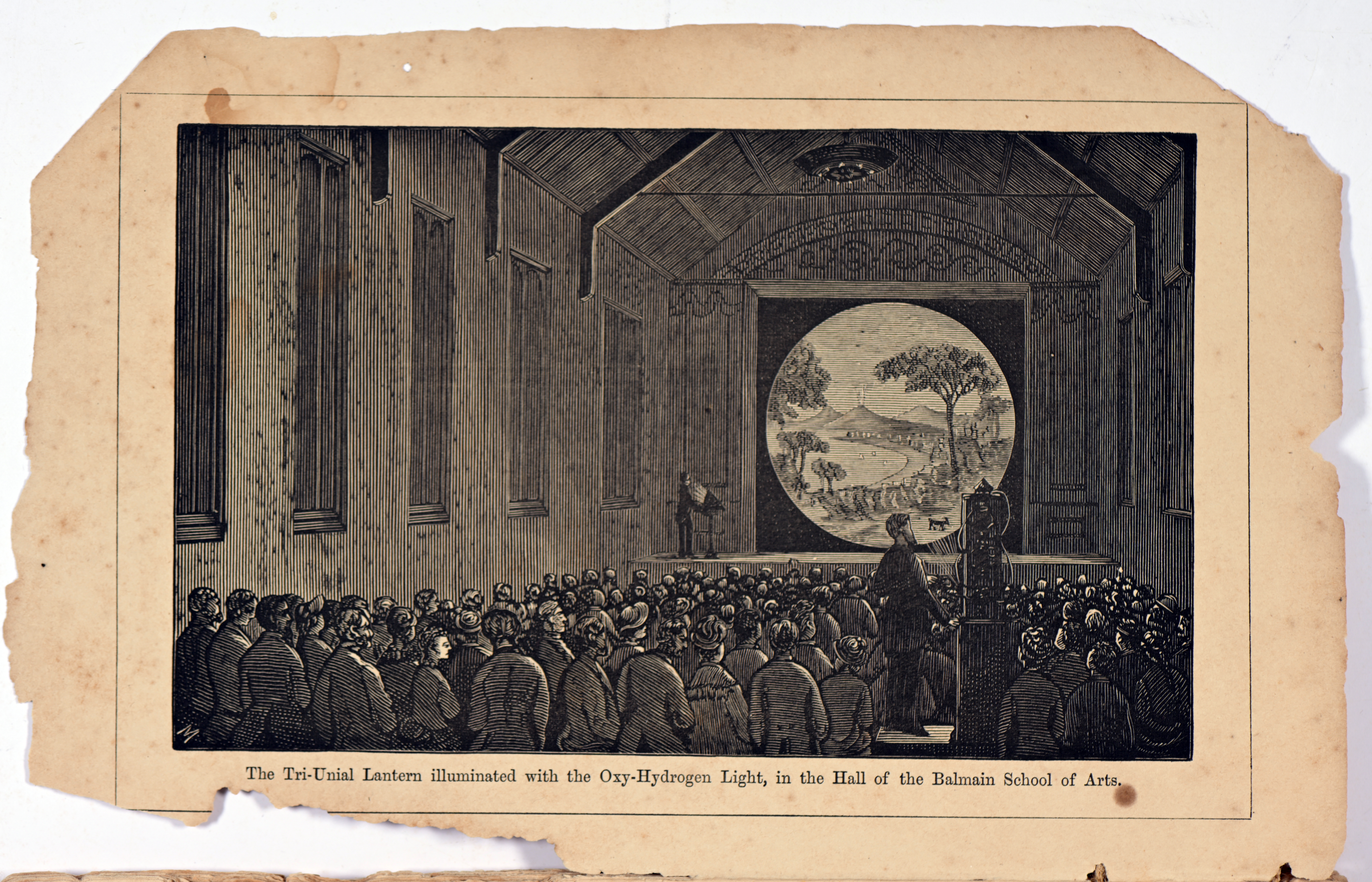
‘The Tri-Unial Lantern illuminated with the Oxy-Hydrogen Light, in the Hall of the Balmain School of Arts’, Illustrated Catalogue of Optical lanterns and Transparent Views and the newest forms of Bi-Unial and Tri-Unial Dissolving View Apparatus, by William Mac Donnell, Sydney, 312 George Street, 1882. Author’s collection.
Abstract:
The youngest scion of a prominent family of London opticians, Edward Ottway came to the Australian colonies in 1879 as part of Professor Henry Pepper’s entourage. His job was to manage Pepper’s special Ottway triunial (three lensed) magic lantern, but he left the tour in Sydney to become the colony’s main ‘illuminator’, specialising in triunials. He even rescued one from the burning Victoria Theatre. These machines were as charismatic in Sydney as elsewhere, and in the next few years several more reached the colony through various routes. With Ottway’s skills, they became crucial to the emerging push for worker’s technical education. Unfortunately, he died tragically young, and initially was a suspected suicide. Ottway was not a showperson, he was a technician — the operator ‘at the back of the room’ — yet his relatively obscure life can teach us much about the role of new, spectacular technologies in developing global networks of education and entertainment.

