International Spotlight as National Mirror: Robert B Goodman’s Trajectory Through The Pacific and Australia

Powerpoint presentation at Broken Images: American Photography in the Asia Pacific, 1850-1950, Queensland Art Gallery, 3 July 2014


INTRODUCTION

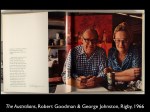
Robert B Goodman plunged through Australian photography like a comet — arriving in 1962 and departing in 1967 — and nothing was ever the same again. He inspired Australian photographers and designers, helped one of them get their first international gig, and expanded the horizons of all of them. He ‘raised the bar’, and ‘set new benchmarks’ in book production. He was a new model of photographer on the Australian scene: a wheeler and dealer, a mover and shaker, an inveterate publicist who saw photography not in terms of ‘art’, ‘documentary’, ‘advertising’ or ‘industrial’— the previous compass points between which Australian photography had languidly drifted for decades — but in terms of corporate publicity, marketing campaigns, sponsors, deals, promotions and pre-sales. He was a Yank in cohoots with mining companies, banks and tourist agencies; he was handsome and articulate, smooth talking, perpetually typing letters, always ready for the next meeting; he had an air that he could be anywhere in the world, really, but he was choosing, just at the moment, to be in Australia, because Australia was important, just at the moment. At the same time he was able to back up his talk — Goodman could efficiently and repeatedly nail high quality National Geographic style shots of anything: portraits, landscapes, industrial, street scenes, sport. Being a National Geographic photographer he understood 35mm film, and was completely at home with colour, at a time when most Australian photographers were still shooting on black and white, medium format film. And some Australian photographers were secretly jealous of him, so they set about publishing their own replies to his magnum opus, which they reviled as it kept selling month after month after month, from 1966 all the way through to 1970.


NATIONAL GEOGRAPHIC

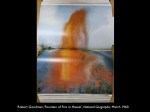
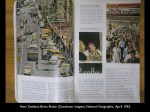
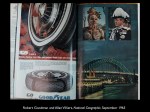
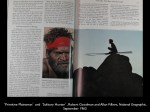
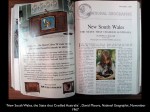
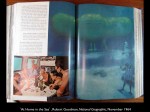
Goodman was born in Cincinnati and studied photography in Ohio, but was attracted to the romance of Hawaii and moved there in 1959 at the age of 21. His big break came when a National Geographic writer got him to photograph close to the mouth of an erupting volcano. His daredevil shots, published in March 1960, lead to them employing him. Although he travelled globally for the Geographic, he concentrated on the Pacific region. He contributed a substantial number of shots of New Zealand for an article primarily attributed to Brian Brake for National Geographic’s April 1962 edition, and by the October edition he had his own by-line for an article on Western Samoa. That year he was assigned to Australia for five months to work on a major article about the nation. In standard National Geographic style, and consistent with the previous New Zealand and Samoan articles, the layout for the Australian article played up the contrast between city and country, ancient and modern, aboriginal and western.


Whilst in Australia, Goodman met the Australian documentary photographer Jeff Carter. Carter remembered their meeting in the following vivid terms:


I was photographing Sydney’s Kings Cross, in particular the trendy, newly completed Rex Hotel in Macleay Street. … In order to get a dramatic low angle I crouched in the gutter opposite the entrance steps, honing in on a dapper male wearing an eye catching candy stripe suit exiting the building. After firing off a volley of rapid-fire exposures, I became aware the gentleman had halted directly in front of me. As I rose to my feet he addressed me in a strong American accent, ‘Say, you look like you can handle a camera. I’m Robert Goodman of the National Geographic magazine. Just arrived today. I’m here to contact some Aussie photographers, the names of David Moore, David Potts and Jeff Carter. You wouldn’t happen to know any of them?’


Carter’s and Moore’s subsequent National Geographic commission was published in 1966 and had a big impact on Carter’s career, he not only cleared $3200 from it, but he was left with an invaluable archive of three thousand colour slides to draw upon for years to come. David Moore already had international opportunities as a stringer for the Black Star agency, and was about to shoot a slim volume on Australia and New Zealand for Time Life World Library encyclopaedia; nonetheless his National Geographic article of 1967 enlarged his archive and his reputation.


Whilst on assignment in Australia Goodman conceived the idea of producing a high production-value coffee table photobook about Australia for a global market. The way Goodman told the story captures some of his charismatic style:

I was lying in my bedroom one afternoon at the Stuart Arms Hotel in Alice Springs, when it suddenly hit me that for all my travelling around I really knew nothing about Australia. I knew that to capture it in its entirety, its actuality, I needed more than just five months. For three days I stayed in that room trying to come to a decision. Here I was with a good job on the Geographic – I had only just joined them – a job any photographer would envy. Should I throw it up for what was only a hazy dream? How could I do it? Could I do it? I didn’t know, but the idea was there, and it grew stronger and stronger. You see, I didn’t think Australia was being publicised properly. … And, I reasoned, a stranger looking at the country and its people could possibly have clearer eyes than those who live here and perhaps cannot see the forest for the trees. So, there I was. I wanted to do a book on Australia.

After completing a National Geographic assignment on Jacques Cousteau in the Red Sea he resigned from the company and returned to Sydney to begin to raise money for the venture. He was an extraordinarily energetic entrepreneur and eventually, after a year, had gained the support of twelve leading travel, mining, banking and manufacturing companies who he persuaded of the benefit of having a book to promote Australia in general, and their industry in particular. They made $150,000 available over three years to finance the book, in return for ten thousand copies to be used as promotional gifts.


THE AUSTRALIANS

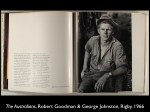
Goodman shot the book during 1963 and 1964, including a six-week caravan trip with his wife and young son. Sidney Nolan introduced him to the novelist George Johnston, who had just returned from living in Greece, and whose just-published sentimental autobiographical novel My Brother Jack was receiving critical and popular acclaim. He agreed to write the text. Goodman said:

George’s text for the book is the most moving I have ever read. His simple prose, every page verbally keyed to the pictures, is magnificent. I couldn’t have written any of it. I’m an American, and no matter how long I stay here I will always be one. But George is fifth-generation Aussie, and he talks of his country, its people, its future and past, and makes it all meaningful to his own people. Anyway, when we got lined up, I simply went out and took pictures —30,000 of them altogether — and as I took them George and I would go through them together.

Although many other Australian photobooks at this period were making use of the new Asian printers in Hong Kong, Japan and Singapore, Goodman ensured quality control by seeking out the Adelaide independent publisher Rigby and the Adelaide printery Griffin Press. He said:

I must have been as bold as brass then. There I was on four bob a day, talking to top-line printers, ink manufacturers, book-binders, telling them about my huge project, saying I would consider using them! It paid off, though. I really got the cream of the profession working for me.


The London trained modernist designer Harry Williamson designed the book. Goodman even returned to the Kodachrome rolls he had shot on his first trip to Australia, and Williamson flipped them and re-cropped them. Williamson established a unifying design grid based on the shape of Goodman’s 35mm slides which, compared to other books and magazines of the period, cleaned up and de-cluttered each spread while establishing a continuity throughout the book. Williamson also worked closely with the New York based, former Newsweek editor, Jonathan Rinehart who Goodman had hired to help him edit the text and image together so that, in his words, ‘the book, in its final expression would be neither picture nor word book, but rather a beautifully intertwined volume with a unity all of its own.’


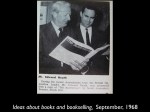
Goodman had already made important media connections during his earlier visit, particularly with the middle-class travel magazine Walkabout who, a year out from the book’s publication, began to build anticipation for it by covering his travels around Australia with his wife as a photo story in its own right. In the lead up to the release date the publishers took out a series of ads in the booksellers’ trade journal Ideas.


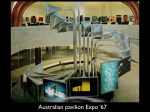
When it finally hit the shops in September 1966 the book was supported by an unprecedented publicity blitz, with articles and mentions in almost every magazine and newspaper. The coverage was tailored to each magazine, the Women’s Weekly highlighted the support of his wife and young son, while Australian Photography showed a display of all the Nikon camera gear he had used. The book became a favourite corporate and government gift — the Queen and President Johnson received theirs bound in merino skin. Enlargements and transparencies from the book also became the centrepiece of the modernist architecture for Australia’s Expo ’67 pavilion.


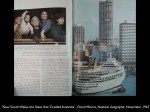
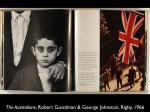
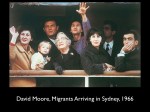
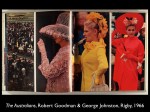
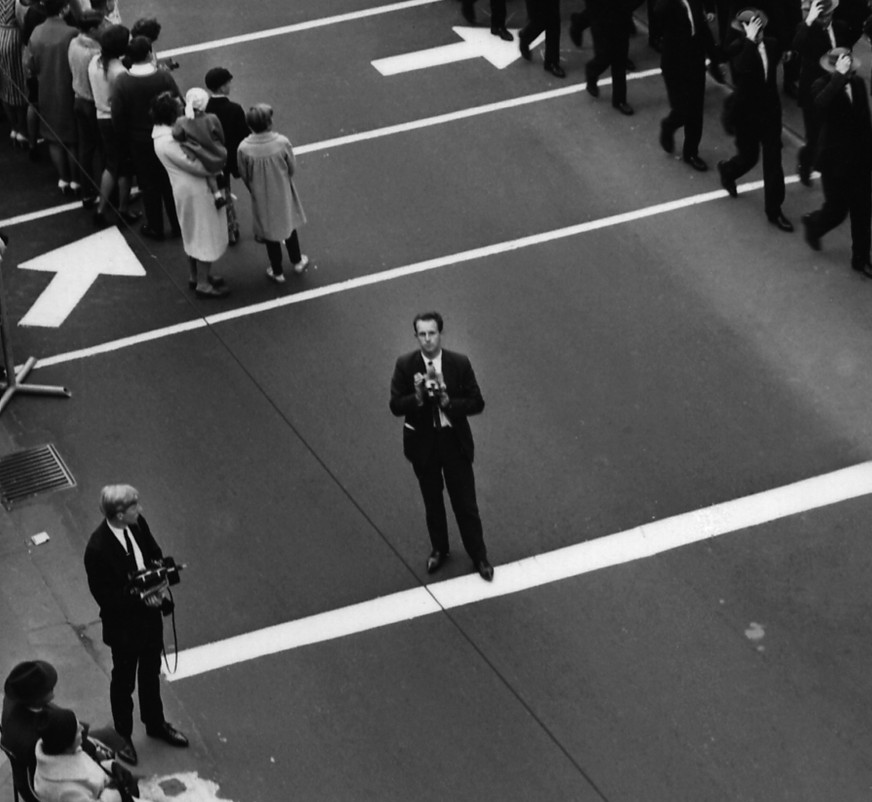
The book used sequencing to comment on Australian identity in the 1960s. For instance, as we turn from a vertical colour shot of distant backlit figures walking down a Sydney street beneath a Union Jack, to the next page, we are suddenly confronted with a double-page full-bleed spread containing a black and white close-up shot of three southern-European faces looking ahead with keen, lip-biting trepidation — ‘Immigrant Arrivals, Sydney Harbour’, the caption tells us. This spread describes the demographic change happening in Australia with a startling telephoto intimacy unprecedented in previous Australiana books. (The image was copied about a year later by David Moore on his assignment for National Geographic, but Moore’s version Migrants Arriving in Sydney 1966, eventually became a national icon.) Williamson also used colour with confidence. For instance the series of vertical slices arrayed across two pages conducts a kind of kind of typological census, in pink, yellow and red, of three generations of Australian womanhood at the Melbourne Cup.


The flavour of The Australians was determined by its international context. The fact that Goodman was a visiting American was articulated by the publicity as an advantage — as an unprejudiced but internationally knowledgeable outsider only he could see us as we really were. The book’s chapters followed a trajectory very familiar from lots of other Australiana photobooks — from the ‘Land’ to the ‘People’ to ‘Industry’, to ‘Arts’, to ‘Sport’ and finally to ‘Anzac’ — but they were given personal colour by a series of short written vignettes mixing Johnston’s nostalgic recollections with anecdotes and social speculation.


Reviews confirmed that The Australians had set a benchmark because of the physical quality of the book and because it broadened the themes and issues which could be encompassed by an Australiana photobook. The Australian newspaper, picked up on the book’s fundamentally optimistic and nationalistically flattering message. Although the faces in the book had ‘the sun cracked texture of parched land’, nonetheless they ‘did us proud’ in a way ‘that may seem oddly old fashioned in these days of national self analysis and criticism’.


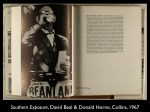
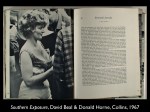
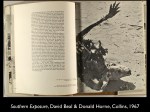
The book not only flattered Australians, it also flattered the mining, travel and finance companies who had backed it. Its unprecedented financial success encouraged other photographers to move into the market it had opened up, but it also goaded them into replying to its corporate jingoism. The most trenchant reply came the next year from Southern Exposure, a book with a text by Donald Horne, whose ironically titled The Lucky Country had been a talking point since its publication three years before, and photographs by David Beal, whose black and white images, rather than having the chromatic chutzpah of the classic National Geographic shot, had heavy doses of the gritty documentary acerbity of Bill Brandt and Robert Frank. The dust jacket blurb is clearly directed at a reader who is already thoroughly familiar with the success of of The Australians:


Southern Exposure is the most original picture book on Australia yet to be published. It marks a departure from the stereotyped, quasi-official, ‘coffee table’ productions which portray in verbal and visual clichés an idealised picture of Australia. […] ‘We are trying to get down in pictures and words the Australia we see.


The cover images are almost satirical. A beer-gutted Australian worker holds a shovel but incongruously licks an ice cream – almost a visual encapsulation of the argument of The Lucky Country – while on the back cover the ‘real’ Australia remains cracked and parched. The faces in Goodman’s The Australians were frontal and open with level gazes, whereas the faces in Beal’s Southern Exposure are belligerent or turned away. Their gobs are plugged with bottles, cans or cigarettes. Turning the pages doesn’t produce dramatic revelations, as in The Australians, but sardonic puns. For instance, a visiting English actress’s bejeweled décolletage at an opening night transmutes with the turn of the page into an empty beer glass shoved down a female pub drinker’s blouse. Other images, such as bleached animal skeletons, a major visual trope of postwar Australian iconography in painting and photography, seem to be out to trump Goodman’s more glamourised depictions. Compared to the ragged imprecation of Beal’s desiccated kangaroo in Southern Exposure, Goodman’s ‘Dead Ram, Witchelina Station, South Australia’ in The Australians begins to look almost choreographed. Rather than looking weary but quaintly proud as in Goodman, Beal’s returned Anzac soldiers just look smug and slovenly.


Southern Exposure raised the hackles of Walkabout, the travel journal that had doyens from the travel industry on its board which had directly supported Goodman’s The Australians. They complained:


The spate of picture books seems to be running into side-channels, not without stirring up mud. Southern Exposure is an example. […] This new genre of picture-book, solidly established last year by The Australians, was given an impeccable and sophisticated pattern by George Johnston’s text and Bob Goodman’s pictures. A welling, wholesome sanguineness swept through it. Australian frailties were admitted with grace, but Johnston’s pride in and Goodman’s American admiration for a people who had tamed but had been simultaneously moulded by a fiercely raw nature, and from scruffy beginnings had built a nation with no small part in the world’s affairs, arts, sciences and sports, seeped through unashamedly. Achievement was the keynote. [But] In [Southern Exposure], people will read what is tantamount to a lecture to Australians themselves from a superior posture of niggling, radical intellectualism.


Elsewhere I have argued that Beal and Horne’s reply to The Australians was followed by important books by Jeff Carter, and Rennie Ellis and Wesley Stacey, which were also not only published in the wake of, but defined against, The Australians. To quote Harry Williamson in a recent email to me: ‘David Beal, Jeff Carter, Wes (Stacey) and Rennie (Ellis) bring a gritty extension to what Bob Goodman started, and although in some ways he made it possible to get those books out and published, it was never something he would have intended to achieve himself.’


BACK TO HAWAII

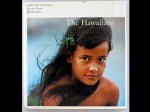
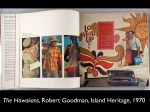
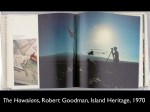
After the success of The Australians the trio of Harry Williamson, Jonathan Rinehart from New York, and Goodman stayed together and discussed other potential countries where businesses would want to invest money on publicising themselves and their country, such as South Africa, Mexico and Israel. However Goodman returned to his spiritual home Hawaii and the three worked on the book The Hawaiians, which came out in 1970. It closely followed the template set by The Australians: the cover also featured a frontal open face, the layout followed the same 35 mm shape across the double page spreads, there was a special deluxe edition, and presumably free copies for the thirty-four corporate sponsors.


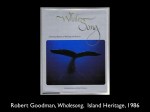
Rather than using a small independent publishing company, in Hawaii where he intended to live, Goodman set up his own company, Island Heritage. He offered Williamson a position in the company but Williamson decided to stay in Australia. Back in Hawaii Goodman eventually became more interested in book publishing than photography per se. With his friend Robert Spicer he produced a series of children’s books based on traditional folk tales in Hawaii. He became part of the renaissance of Hawaiian culture through his publishing association with the Hawaiian artist Herb Kane. After working on an early Macintosh computer to design a 1986 book about the Hawaiian whaling industry Whalesong, he became an advocate for desktop computer publishing.


CONCLUSION

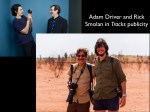
Goodman wasn’t the only photographer to publicise Australia to an international market. The world famous photographer E O Hoppe toured here in the late 1920s to add to his series of books on Britain, Germany and America with one on Australia. Called The Fifth Continent, it also mixed national typologies with landscapes; and from 1958 David Moore attempted to carve out Australia, S E Asia and the Pacific as his patch through The Black Star agency. And then of course there is Frank Hurley, who was similarly self-promotional, and who died in 1962, the year Goodman first arrived in Australia. However although Hurley exhibited his exploration films internationally, his Australiana books were aimed at modest domestic audience and had none of the social identity dimensions of Hoppe, Moore or Goodman. Ten years after Goodman left Australia another American National Geographic photographer came to our distant shores. Just like Goodman had before him, at some stage after photographing Robyn Davidson’s camel Journey for National Geographic in 1977, Rick Smolan (played by Adam Driver in the movie Tracks) conceived of his A Day in the Life of Australia book, where ‘one hundred of the world’s top photojournalists photographed Australia over twenty-four hours during 6 March 1981’. This was a similar to the business model Goodman had developed — both in its audacity, and in its invitation for the world to come and ‘show us to ourselves’. Goodman’s series only reached two countries, but Smolan’s A Day In The Life of … series extended from its beginning in Australia, to Hawaii (like Goodman) then to Canada, Japan, America, California, Spain and the Soviet Union.


Despite their differences all of these photographers deployed the same sets of elements: their own special personalities as galvanizing global photographers, their individual attempts to create new markets for photography, the compelling power of an international gaze trained upon Australia, which reflected back to a domestic audience tropes of Australian identity, such as national typologies or nationalistic landscapes, with increased intensity. In the case of all these photographers the international spotlight became a national mirror.


The memory of Goodman’s galvanizing effect on Australian photography has now been almost completely forgotten. For instance I myself remember, in 1981 as a Marxist, Foucaldian, Barthesian art student, attending a PR event about the production of Smolan’s A Day in the Life of Australia. As a postmodern cadet I was there to condemn and sneer at its clichéd depiction of Australia, but I still remember one bearded old photographer, I don’t remember who, saying that until A Day in the Life of Australia we had had no better picture book to send overseas than Goodman’s The Australians, which was at the time fifteen years old. ‘What was this book?’ I remember wondering at the time, ‘who was this Goodman? I had never heard of him.’ ‘Since I hadn’t heard of him, he certainly couldn’t be important’, I thought to myself at the age of twenty-two. But clearly Goodman’s trajectory through Australia had reverberated for at least fifteen years, and now I think it is time it is recognised again.


Martyn Jolly

Hey France, yes, ban the burka, but free the camera too!

Great to see that the European Court of Human Rights has just upheld France’s 2010 ban on the burka. No doubt the French quoted Emmanuel Levinas from Totality and Infinity: ‘The face opens the primordial discourse whose first word is obligation’ (p201). But despite this enlightened ban, France’s poorly written, post-Diana anti-paparazzi, privacy laws, in particular article 9 of the Civil Code and article 226-1 of the Penal Code, still mean that street photographers are routinely harassed on Parisean streets by people who believe their right of privacy, or their ‘proprietorial ownership’ of their own face, extends into civic space — thus closing down the street as a space to truly ‘live together’. What about some droits for photographes too?


A new word needs to be invented— perhaps it should be ‘re-engagement’?

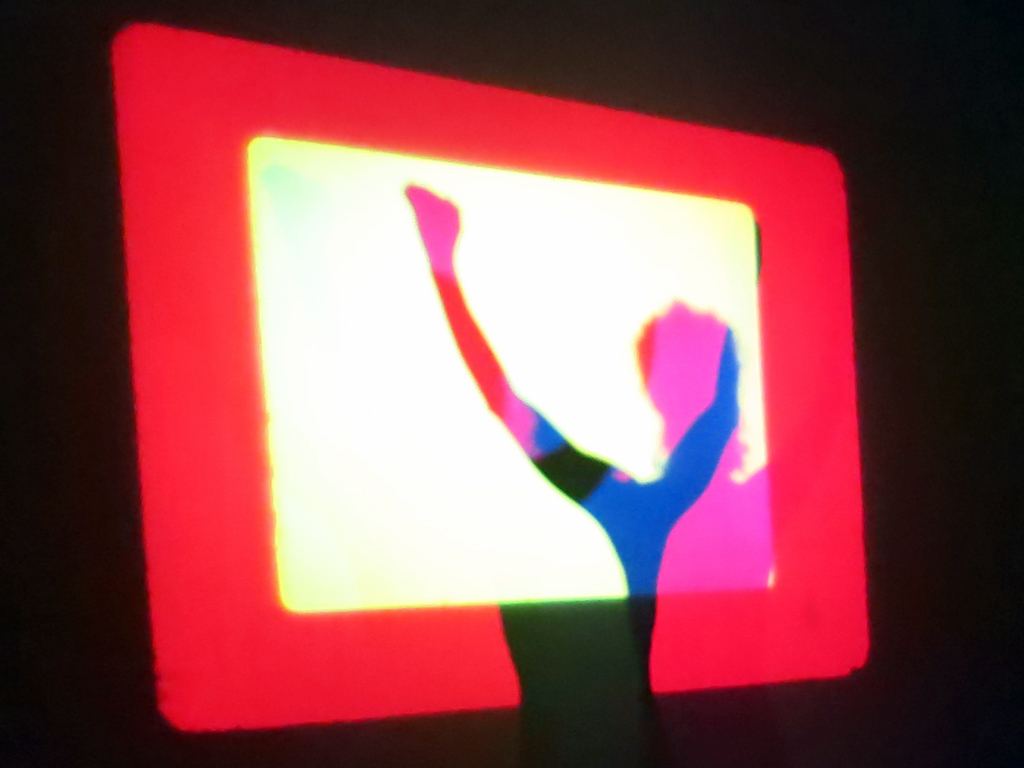
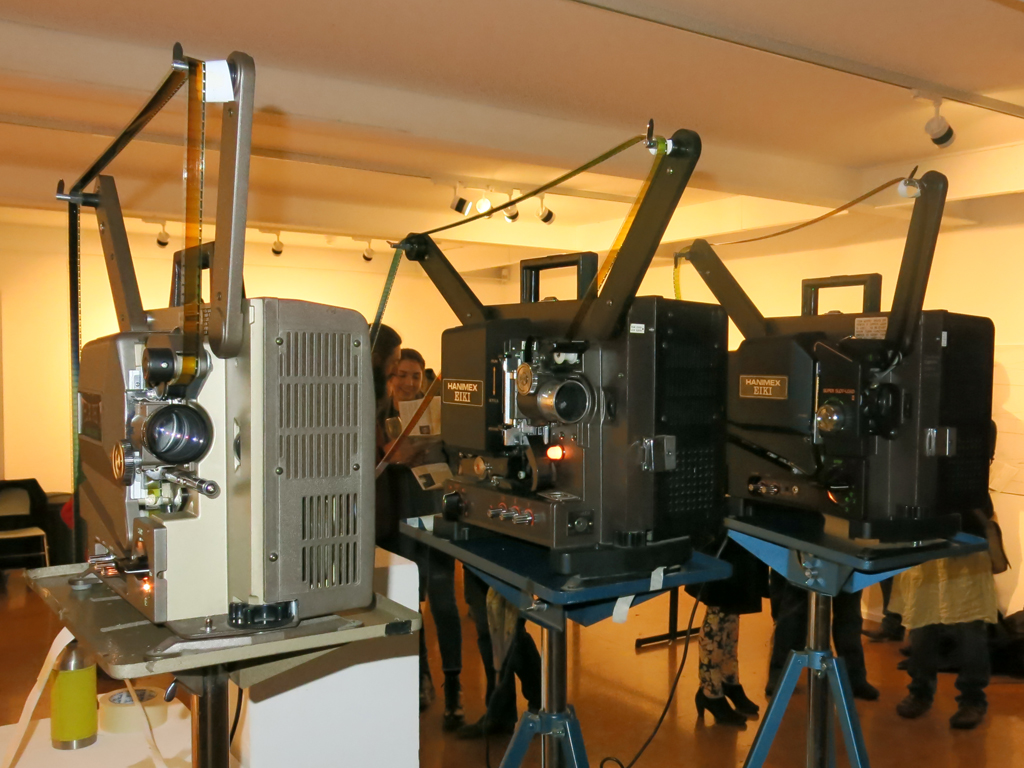
A new word needs to be invented for performances such as Teaching and Learning Cinema’s  (Louise Curham and Lucas Ihlein) performance of Malcolm le Grice’s Horror Film 1 (1971) and Guy Sherwin’s (Wo)man with a Mirror (1976), which happened yesterday at Canberra Contemporary Art Space and was, by the way, a top wet-Saturday-arvo’s excursion. Although based on meticulous historical research, they weren’t re-enactments in the sense that Civil War re-enactors re-fight old battles, because they acknowledged that the formal  and historical terms of the aesthetic battles to be fought have evolved since their first iteration (so performer-gender and sometimes media had to be changed); nor were they playing a score like an orchestra, because they were referring not to an originary written document but an originary ephemeral event (or even events). ‘Re-presentation’ or ‘re-iteration’ sound too passive and boring. Perhaps to keep the military metaphor going we could use ‘re-engagement’? One thing’s for certain a new word is going to be needed for sure because, although of course the Madonna of performance art Marina Ambramovic has ‘re-engaging’ with the performance art canon  for years, more and more other people in video, performance, silent cinema, pre-cinema, theatre, as well as Louise and Lucas’s beloved expanded cinema are going to be doing it in the future.

Re-engagement with Sherwin's Man with a Mirror at CCAS, by Teaching and Learning Cinema

Re-engagement with Sherwin’s Man with a Mirror at CCAS, by Teaching and Learning Cinema

Re-engagement with Le Grice's Horror Film 1 at CCAS, by Teaching and Learning Cinema

Re-engagement with Le Grice’s Horror Film 1 at CCAS, by Teaching and Learning Cinema

Ready to go

Ready to go

This used to be my office

This used to be my office, walls have been knocked down in preparation for the new mammoth UV-cured flatbed inkjet printer that will be craned in on Monday, along with our new Hasselblad drum scanner, and new Epson printer. The ugraded ANU Inkjet Research Facility is almost ready to accept researchers.

This used to be my office, walls have been knocked down in preparation for the new mammoth UV-cured flatbed inkjet printer that will be craned in on Monday, along with our new Hasselblad drum scanner, and new Epson printer. The ugraded ANU Inkjet Research Facility is almost ready to accept researchers.

Australian Photography Commissions

Talk at Australian Parliament House 20 June 2014 for Anne Zahalka Parliament House commission forum

Australian Photography, Corporate Commissions and Australia’s Parliament House

When Parliament House was being built the scene for art photography was very different to the scene now. Now photography has become just another imaging-option within art, and it really only gets public profile as a medium in its own right through a set of annual photography competitions, in which anyone — amateur, professional or student — can take their chances. But, twenty-five years ago, photography was still relatively ‘hot’ as an art medium and, as well as being seen to be publicly accessible, it was also associated with the young and innovative. Rather than today’s large photographic competitions, which are largely funded by the entry fees of photographers themselves, in the eighties corporate sponsorship was very important in offering new photographers their first break, and offering established photographers further opportunities. Companies such as Polaroid and Kodak sponsored photographers, but the biggest sponsor of the period was the cigarette company Philip Morris, who aligned itself with the National Gallery of Australia and, through its director James Mollison, purchased 700 photographs by over 100 photographers between 1976 and 1980.

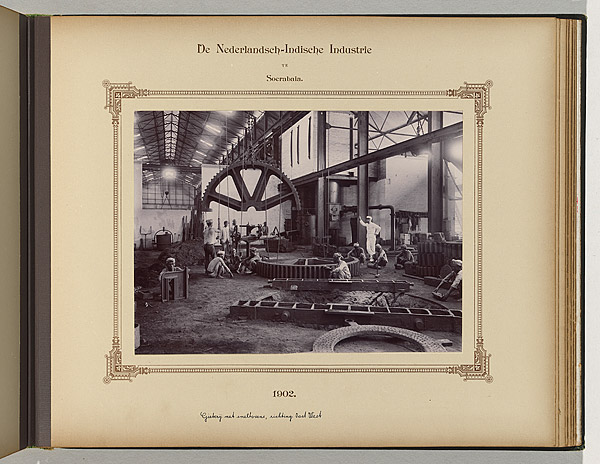
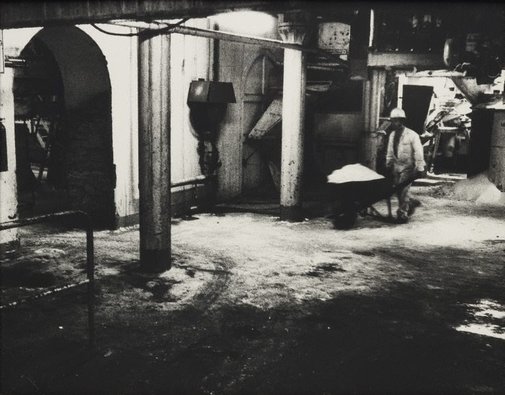
Other industries also saw the advantage of using photographers to not only document their activities, but also to gain a corporate shine from being seen to be with-it philanthropists to a young and exciting art medium. Of course photography has always been completely bound up in industry. From the early twentieth century onwards photographers and factories were close acquaintances. Photographers such as George Lewis, who features in the current NGA exhibition of Indonesian photography, was exemplary in importing the visual logic of the portrait studio onto the factory floor. Even before the industrial photographer unpacked his camera gear the machinery had to ‘photograph itself’ by momentarily pausing in its ceaseless whirring so that it would register solidly on the film rather than become a liquid blur. Workers, machinery and lighting were then choreographed, as in a portrait studio, to give just the right impression for the client.

George Lewis 1902

George Lewis 1902

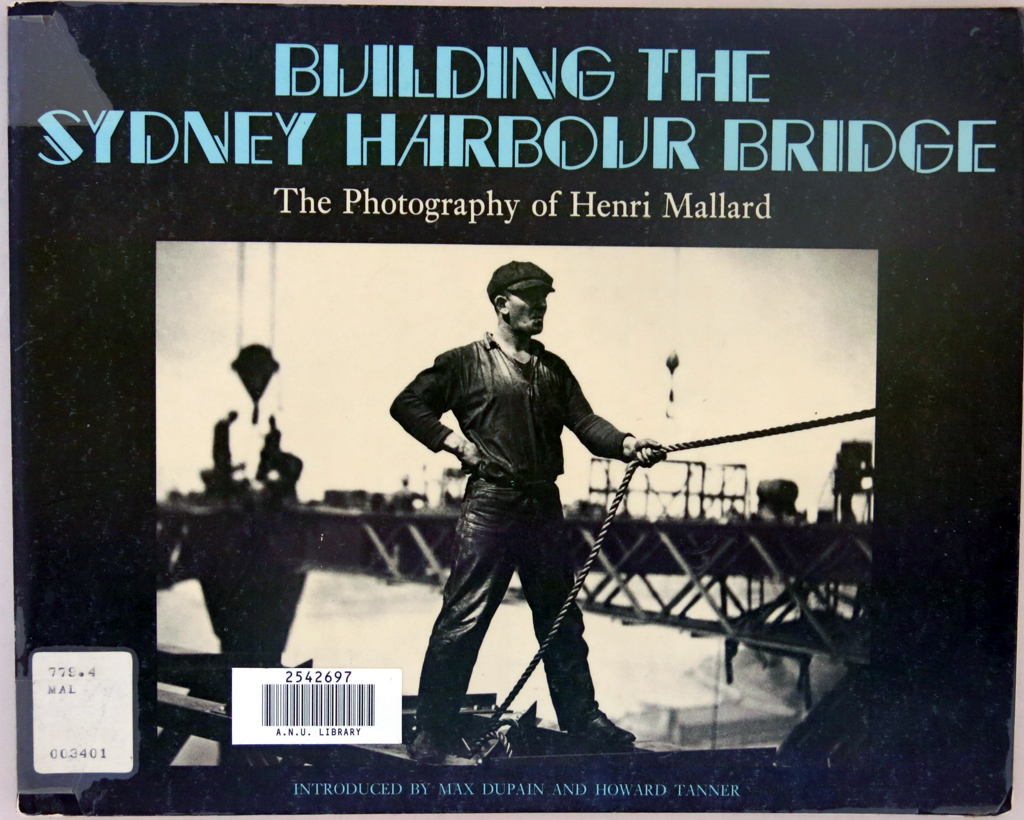
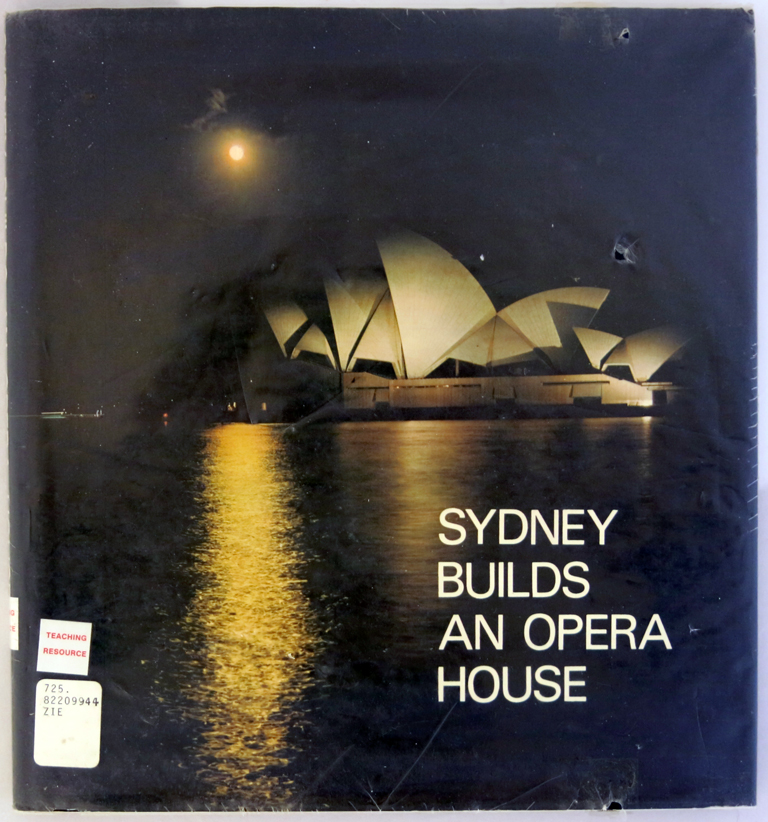
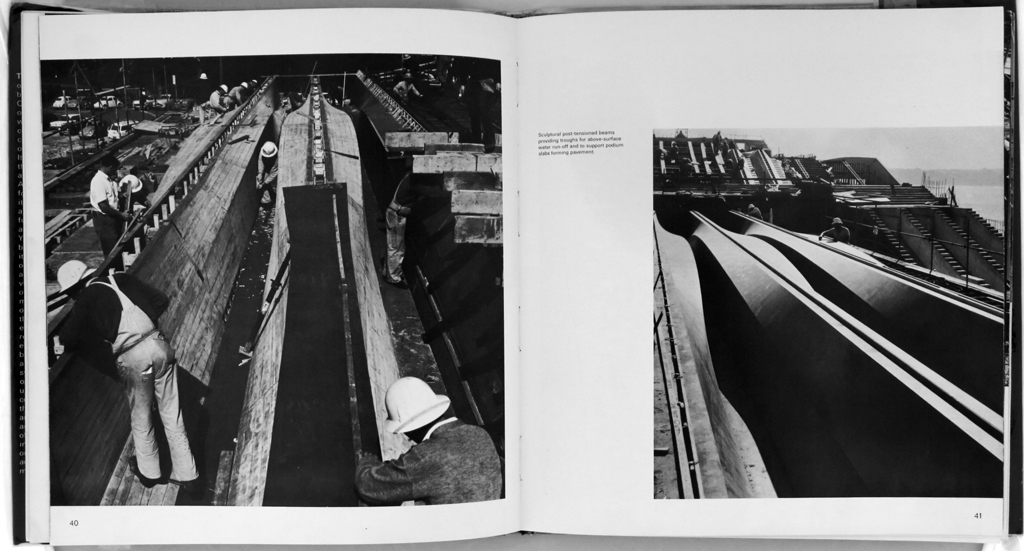
As was the case globally, Australian photographers have also always been associated with industry and architecture. Harold Cazneaux undertook a commission for BHP in 1935; and in 1973 the publisher Oswald Ziegler used Max Dupain’s photographs for one of his celebratory and commemorative volumes, Sydney Builds and Opera House. This exemplifies what could be called a modernist-heroic genre of architectural photography, celebrating industry and architecture primarily, and including workers as a function of the industrial process. Workers are certainly present and even celebrated, but they are a figured within the machinery of construction, a human accent to the formal architecture of the image. In this heroic mode it is the historical force of modernity itself which is the generative power, producing the ‘sculptural forms’ of the architecture which define the photograph, which in turn are ministered to by the supplicant workers who provide a fleshy torque to the composition’s hard architectonics. This heroic genre was getting a fair bit of profile twenty-five years ago. For instance in 1976 David Moore reprinted some photographs taken by Henri Mallard of the building of the Sydney Harbour Bridge for an Australian Centre for Photography travelling exhibition. Perhaps the last example of this heroic mode is David Moore’s own documentation of the building of the Glebe Island Bridge, published in 1996.

1976

1976

1973

1973

Sydney Builds an Opera House

Sydney Builds an Opera House

Sydney Builds an Opera House

Sydney Builds an Opera House

However, in 1978 one company, CSR, saw the advantage of uniting the benefits of the corporate philanthropy of Philip Morris with the opportunity to directly document the variety of their industrial activities. The story goes that they originally contacted the Australia Council to help them find a painter to celebrate the centenary of their Pyrmont refinery with a great big painting of the refinery. The council steered them toward getting more bang for their twelve thousand bucks by spending the same amount on a group of six photographers. The project, auspiced through Christine Godden, director of the Australian Centre for Photography, went on for a further four iterations. The project was structurally very similar to the future Parliament House Project, it commissioned emerging photographers, but also featured established photographers ‑ even towards the end getting Max Dupain to reprint some images originally taken in the 1950s. The emphasis was on a variety of approaches, from the traditional fine print to the more art school trained style of creative photography. Thus in 1978 Sandy Edwards broke the masculinist mold of the previous heroic mode by photographing the multicultural women on the production line. Micky Allan also broke the heroic mold of picturing workers as a mere manifestation of the Modernist imperative by incorporating noise andvibration — stilled in previous industrial photography — in her production line photographs. Even Bill Henson enveloped the younger workers in his trademark entropic twilight, making them not the vigorous propellers of progress, but the romantic bearers of a lugubrious weight. David Moore even assembled portrait-rows of them, matching the leatheriness of their multicultural faces with the marks on their multifunctional gloves. Also notable in the CSR collection was some of what was called at the time ‘constructed photography’, exemplified by Debra Phillips, who a decade before photoshop blended two separate photographs into the one experiential landscape; or Merryle Johnson who made multiple-viewpoint scenes of ordinary life. However the CSR commission also gave the opportunity for photographers like Grant Mudford to explore the formal properties of the medium using industrial materials and gravel.

Debra Phillips on CSR catalogue cover

Debra Phillips on CSR catalogue cover

Sandy Edwards 192 Cubes 1978. AGNSW Collection

Sandy Edwards 192 Cubes 1978. AGNSW Collection

Micky Allan 1978. AGNSW Collection

Micky Allan 1978. AGNSW Collection

Grant Mudford 1981. AGNSW Collection

Grant Mudford 1981. AGNSW Collection

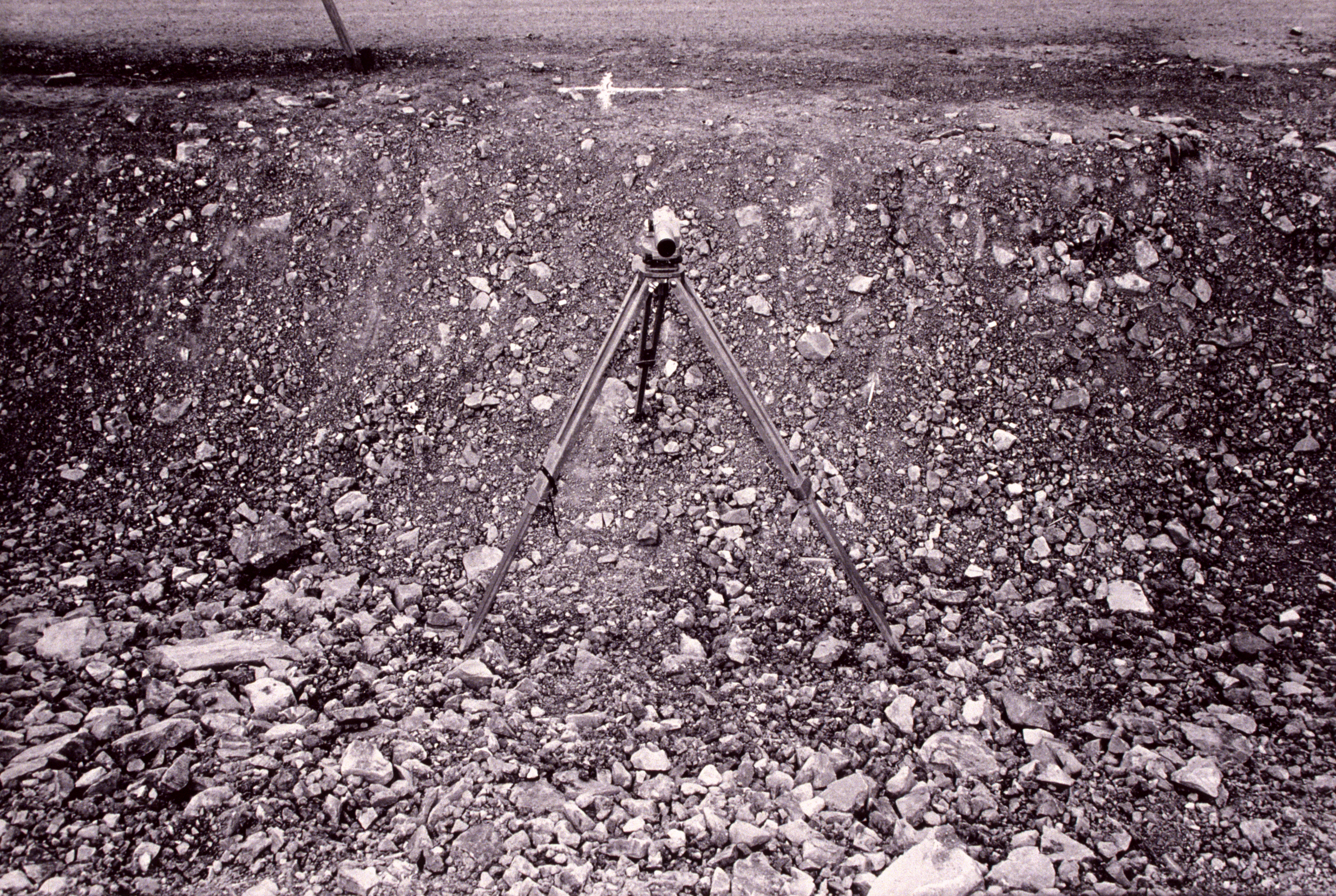
The Parliament House commission had a lot in common with the CSR commission, and many photographers who worked on Parliament House had previously worked at CSR. However some, for instance Bill Henson, who worked on the CSR commission unfortunately did not come back for Parliament House, I wonder what he would have done if he had? Many of the twenty-eight photographers who shot on the site around the year 1986 worked in a hyper formalist style. One example amongst many is Tony Perry who revelled in the mud and hard shadows, and formally played the white of the concrete off against the dark patterns of reinforcing mesh. For others, like Steven Lojewski, on-camera flash often flattened space, and horizon lines were often pushed way up to force a tension between the 3D space depicted in the image, and the 2D surface of the print. To anybody who lived through this period this is all very, very, familiar, but scrolling through the images now the viewer feels the clench of a claustrophobic air. But nonetheless this style dominates the collection. Other examples in black and white are: Fiona Hall, Glen O’Malley, John Elliot and Charles Page ; and in colour: Douglass Holleley and Ed Douglas. In many of these shots workers are excluded entirely, and in others, such as Fiona Hall’s, they are reduced to tiny ciphers.

Steven Lojewski C1986 Parliament House Collection

Steven Lojewski C1986 Parliament House Collection

Only some photographers seem to capture the full scale and spatial weirdness of the building, most notably Gerrit Fokkema who gave his photographs his trademark surreal irony; and Debra Phillips who seems to have begun her photography by responding to the spaces she entered, rather than imposing her own pre-determined formal sensibility, like a net, over the spaces she looked down into— which many of the other photographers seemed to do.

Gerrit Fokkema C1986 Parliament House Collection

Gerrit Fokkema C1986 Parliament House Collection

Debra Phillips C1986 Parliament House Collection

Debra Phillips C1986 Parliament House Collection

This was a national commission, photographers went anywhere in Australia from which Parliament House’s construction materials were sought, but there was a politics here too. Take for example the sourcing of timber: Anthony Green photographed the dense Huon pine forests of Tasmania as though it was just another formalist exercise, and Richard Stringer’s photographed in the jungles of Kuranda, in far north Queensland, as though it was a postcard; but Gillian Gibb took individual tree portraits in Tasmania, baptising each one with their proper botanical name.

Gillian Gibb C1986 Parliament House Collection

Gillian Gibb C1986 Parliament House Collection

Anthony Green C1986 Parliament House Collection

Anthony Green C1986 Parliament House Collection

Workers are not excluded entirely: Mark Kimber did Sanderesque portraits of them, while Richard Woldendorp and John Williams photograph them emeshed in their environment. (It is only after a little while that we realize with a shock what is missing from these twenty-five year old images of workers, where are the hi-viz vests, today’s instantly recognizable symbol of labour worn by everyone from the prime minister down— here totally absent?). Merryl Johnson, one of several overtly feminist photographers who were chosen, places them as part of a dynamic environment.

Mark Kimber C1986 Parliament House Collection

Mark Kimber C1986 Parliament House Collection

Merryle Johnson C1986 Parliament House Collection

Merryle Johnson C1986 Parliament House Collection

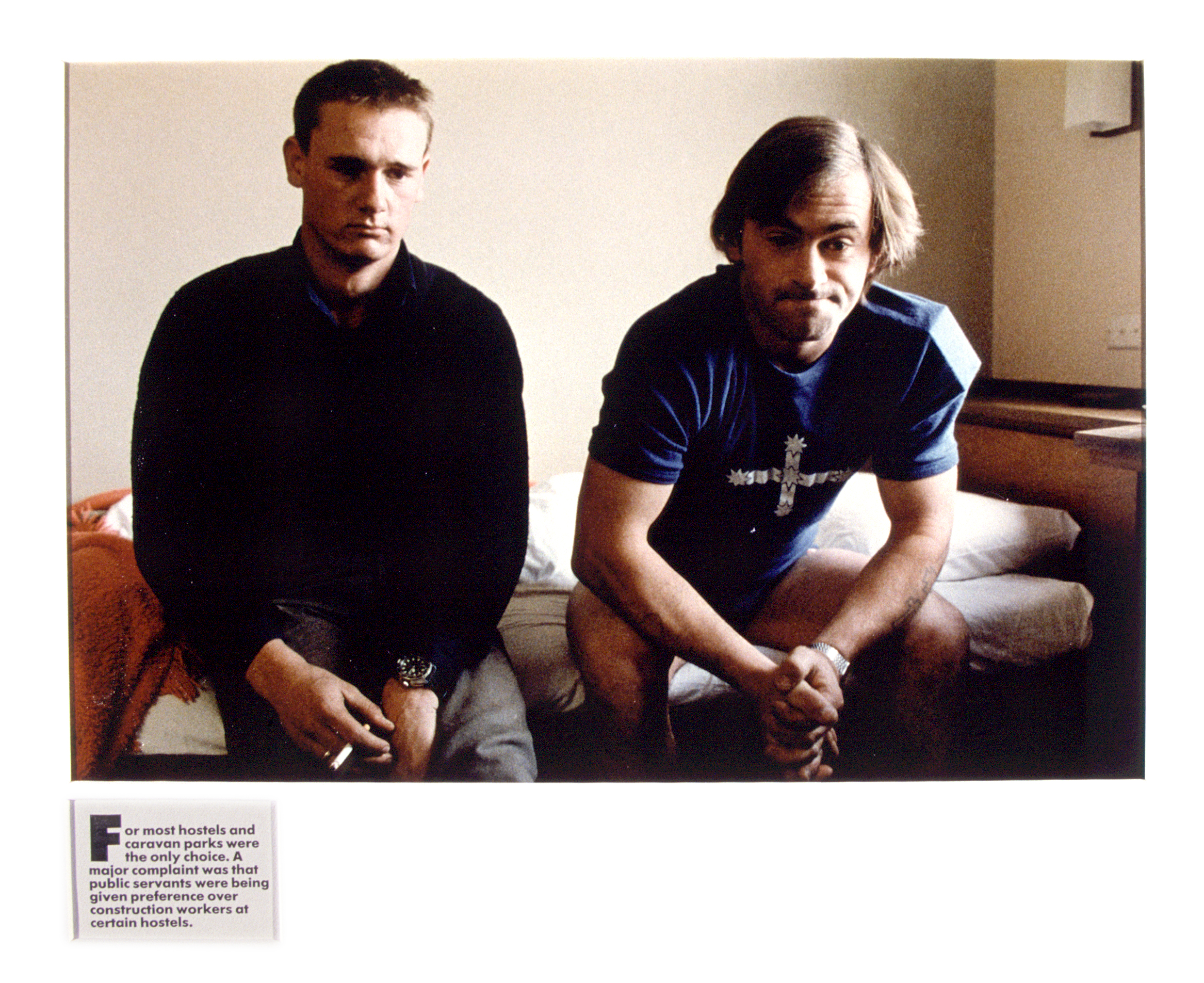
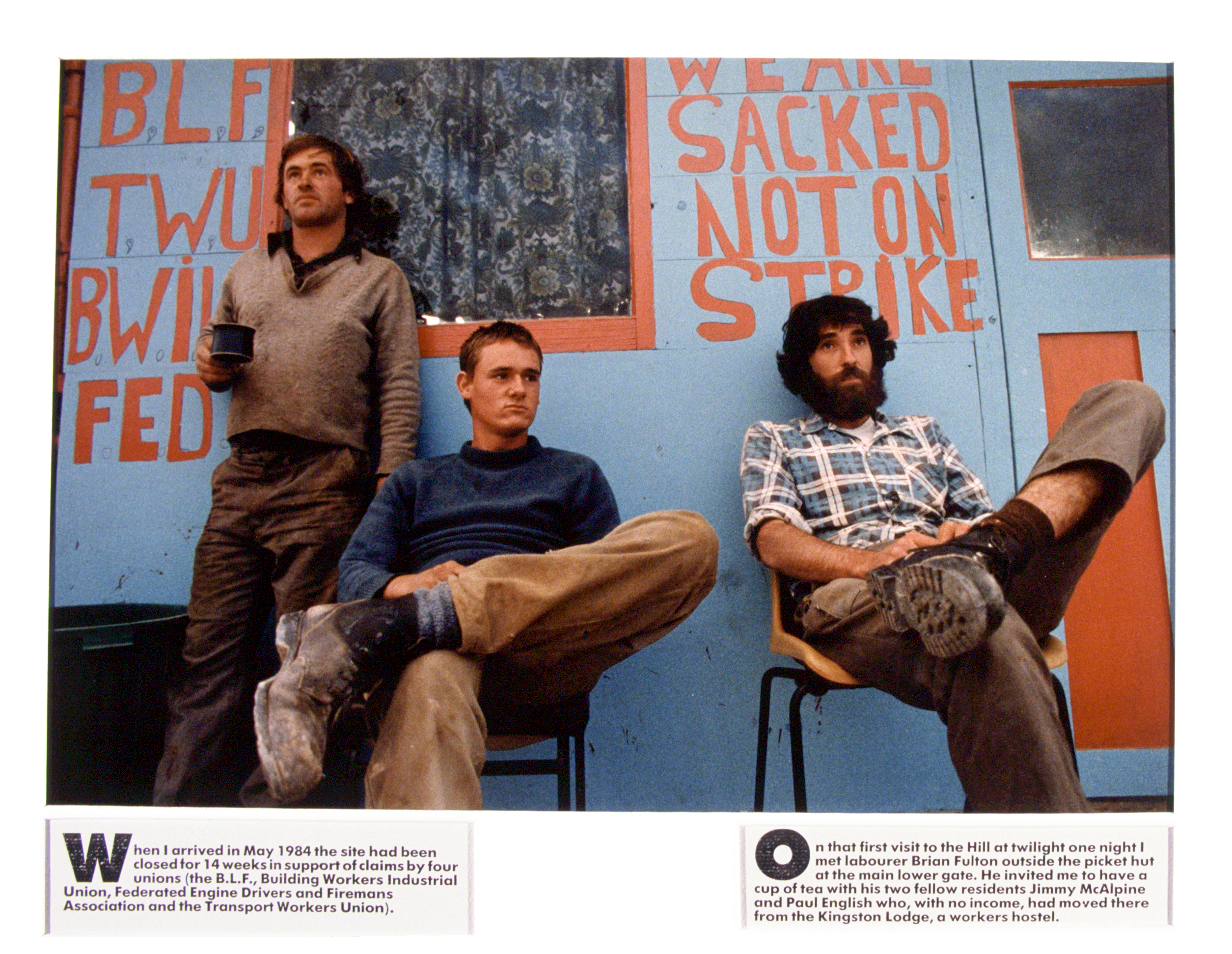
Standing out from all of the rest of the work is Sandy Edwards, who photographs workers not ‘on the job’, but involved in the controversial de-registering of the Builders Labourers Federation. She took photograph of three union members and other union activities in saturated colour. Beneath the images she placed labels filled with her own querulous first-hand experiences. I was around when this collection was first exhibited, and I’ve forgotten most of it, but I still remember the shock of seeing Sandy’s photographs. What comes through is her own tentative self-questioning, a self-conscious awareness of the fragility of the temporary relationships she forged with the unionists and strikers she photographed, and an acute awareness of the politics of the commission itself. (But now, encountering them 25 years later I can’t help but see them through the filter of all the all massive iconography of Thatcher’s Britain that has come out, particularly in cinema, since then. As always, it’s a tragedy that so much of Australia’s visual heritage remains hidden and dormant, while that of other countries spreads across the world.)

Sandy Edwards C1986 Parliament House Collection

Sandy Edwards C1986 Parliament House Collection

Sandy Edwards C1986 Parliament House Collection

Sandy Edwards C1986 Parliament House Collection

Sandy Edwards C1986 Parliament House Collection

Sandy Edwards C1986 Parliament House Collection

So, in these collections we can see larger political dramas — between feminism and patriarchy, between environmental consciousness and the perception of nature as imply a ‘resource’, between the historical project of modern development and the human experiences caught up in it — directly played out in the dialogue between the photographs.

Zahalka has inherited all of this. She, like photographers before her for over a century, has imported the logic of the studio into the workplace. Make no mistake, hers is an industrial photography. She, like photographers before her, has had to work out where to find the ‘dignity’ of labour. Not in the heroic tradition, where a worker’s labour and therefore their dignity is merely a product of a historical project far greater than the individual; and not either — at least in this case — in an oppositional tradition where the worker is cast as an actor in another historical drama of oppression resistance and rebellion. But rather, somewhere between them.

Martyn Jolly


My Anne Zahalka Parliament House 25th Anniversary Commission catalogue essay

Parliament House at Work, 25th Anniversary commission, Anne Zahalka

Anne Zahalka at Work

Everybody wants a behind the scenes tour. Documentary filmmakers and photographers have always catered to this desire to lift the hood on an institution and see how the human machinery underneath works. We all remember seeing documentaries about, for example, the ‘below stairs’ bustle of majestic mansions, the below decks drills of mighty warships at sea, the behind the scenes dramas of great opera houses, or the backroom machinations of political campaigns. Our Parliament House combines all of these aspects — from the aristocratic to the bellicose to the operatic to the Machiavellian  — in the one magnificent site that virtually every Australian has visited, or will visit, at one time or another. And even when we aren’t there in person — trailing through the public level in school groups, queuing for a spot in the public galleries, or attending a function in the Great Hall —we still see one or another of the several tips of the Parliamentary iceberg every night on TV: a shouting match in the chamber, a doorstop interview on a chilly Canberra morning, or the forced chit-chat of caucus or cabinet before the doors are closed on the cameras.

But how does it all run? Or, more specifically, who runs it all? Last year, twenty-five years after it opened, Anne Zahalka was commissioned to photograph Parliament House and, through a process of discussion and experimentation, eventually decided to work with the staff, the ordinary but essential people who keep the vast machinery of the legislature running day in day out, from year to year and from government to government. Of course Parliament House is an extraordinary piece of architecture, not so much a building set in a landscape as a citadel which is part building and part hill, a self-contained city voyaging through time on its own temporal rhythms driven by the imperatives of parliamentary sittings and legislative agendas. And photographers have always loved it; its flat planes, hard edges and abutted textures are made for the camera. Nor was Zahalka the first photographer to be commissioned to photograph it. As it was being built in the 1980s the Parliament House Construction Photography Project commissioned twenty-eight emerging and established photographers to respond to the construction process and the building as it grew into the hill. Most of the photographers concentrated on the tangled formal patterns which the concrete, reinforcing mesh, formwork, and so on made against the mud and bedrock. Only some, most notably Sandy Edwards, photographed the workers themselves — union members in her case — who were needed to actually do the work. As hill mutated into building other photographers, for instance Debra Phillips, got the opportunity to photograph the vast and complex cathedral like spaces that were opening themselves up beneath the buttresses and aprons of concrete above. These photographers can be seen as precedents to Zahalka’s anniversary commission.

But that heroic construction phase was long ago, the building and its staff have long since settled into a regular rhythm, chugging efficiently along as political storms rage above, and it is that on which Zahalka has concentrated. However in her work we still get a sense of the building’s full architectural scale, which so fascinated the construction phase photographers, through the building’s employees. A worker checks her phone in a storeroom for old furniture which has been built, at the lowest level of the building, into the roughly excavated bedrock of the hill itself. In another photograph another worker tugs apart the bus-sized flag which is about to fly high above the swards of rooftop grass, from the top of the massive quadrapod flagpole.

The architecture of the building has also written itself into the very compositional structure of Zahalka’s images. Like the building itself all of her images are strictly symmetrical and organised around a central axis which drives itself straight through the middle of her photographs. Some of her images are even bicameral like our Parliament house. The panoramas, made by digitally gluing several separate exposures together, seem to conjoin two visual halves into one unified image; and one image of the Parliamentary Library, made from two adjacent points of view, allows us to look down two bookshelf aisles at once.

There has always been a tableau-like quality to Zahalka’s photographs. For example in her series Welcome to Sydney, 2002, commissioned by Sydney Airport, new migrants to Sydney from different countries were posed against panoramic Sydney skylines as though they were giant postcards. Within the rectilinear pyramids of these Parliament House images the staff are arranged like actors on a well-lit stage waiting for the curtain to rise. Working with her subjects, Zahalka posed them in their work-settings, sometimes art-directing the furniture and ornaments, and sometimes styling vital details such as the orange electrical lead of the cleaner’s vacuum-cleaner which leads our eye in as it snakes across the carpet of the Prime Minister’s suite. As Zahalka works on the digital files after they had been captured she further controlled the final image.

This sense of the choreographed enactment of dignified work, rather than the instantaneous grabbing of workers from the midst of the mundanity of their labours, is not new in Australian photography. The photography of Wolfgang Sievers is another precedent to Zahalka’s approach. (Sievers did not participate in the 1980s Parliament House Construction Photography Project, though his contemporaries Max Dupain and David Moore did.) Sievers built his reputation constructing elaborate promotional photographs in factories, from which the worker-subjects were often sent home for clean shirts, shaved and cleaned-up, and posed as though they were masters of their machinery, which was dramatically lit against darkness. In front of Sievers’ camera even the grottiest factory looked dramatic, and the most grueling work felt heroic. No wonder Sievers’ photographs, originally taken to promote individual businesses, eventually became iconic images for Australia as a whole. Although not as extreme and artificial as this, Zahalka’s photographs do endow the staff of Parliament House with worth and national value. The image of the pond cleaner scrubbing the bottom of the ceremonial pond in the House’s forecourt, as the hose loops around his legs like a lazy eel, is not ironic. All edifices, no matter how grand, and all institutions, no matter how complex, require dedicated staff from top to bottom, and from outer perimeter garden to inner sanctum. All play their part. Even the cabinet table, around which crucial decisions will shortly be made ‘in camera’, needs to be cleaned, by somebody.

With a formally tuned, but visually witty, sensibility Zahalka has documented these diverse staff members in their diverse work environments; describing, twenty-five years after it was built, Parliament House not as simply a piece of architecture, and not as simply the seat of our government, but as a place, a symbiosis of people, power and architecture.

Martyn Jolly

Newton’s squidgy-vision.

I have Kevin Miller to thank for leading me to this wonderful page from one of Isaac Newton’s notebooks. At the same time as he was producing colour by refracting light with glass Newton was also perceiving colour by directly palpating his own eyeball with a wooden bodkin and deforming the wet squishy sphere, thereby putting direct physical pressure on the sensitive interior surface and sending signals which the brain interpreted as light and colour.

I tooke a bodkine gh & put it betwixt my eye & [the] bone as neare to [the] backside of my eye as I could: & pressing my eye [with the] end of it (soe as to make [the] curvature a, bcdef in my eye) there appeared severall white darke & coloured circles r, s, t, &c. Which circles were plainest when I continued to rub my eye [with the] point of [the] bodkine, but if I held my eye & [the] bodkin still, though I continued to presse my eye [with] it yet [the] circles would grow faint & often disappeare untill I removed [them] by moving my eye or [the] bodkin.

If [the] experiment were done in a light roome so [that] though my eyes were shut some light would get through their lidds There appeared a greate broade blewish darke circle outmost (as ts), & [within] that another light spot srs whose colour was much like [that] in [the] rest of [the] eye as at k. Within [which] spot appeared still another blew spot r espetially if I pressed my eye hard & [with] a small pointed bodkin. & outmost at vt appeared a verge of light.
 Had glass and the newly discovered laws of diffraction written the soul, the spirit and the imagination out of vision, he worried? No, because colour could be produced in vision by something other than the vitreous diffraction of light in either eye or prism. From our point of view his experiment at least established that the body, if not the soul, was deeply implicated in vision. But his notebook drawing of his heroic experiment, which Kevin and I found  at a Cambridge University Library online exhibition Footprints of the Lion: Isaac Newton at Work, is wonderful: the tiny hand inserts the bodkin, the sphere is indented like a foot kicking a football in a Harold Edgerton photograph, the concentric circumferences of the origins of the rings of colour are plotted on the retina, but then! — a virtual projection of what he perceived is projected out of the eye into the world. The eye is therefore not only a camera obscura but also a magic lantern! Virtuality, about to stage a comeback with the Oculus Rift is predicted!
8Bodkin