ABC Online 30 November 2014
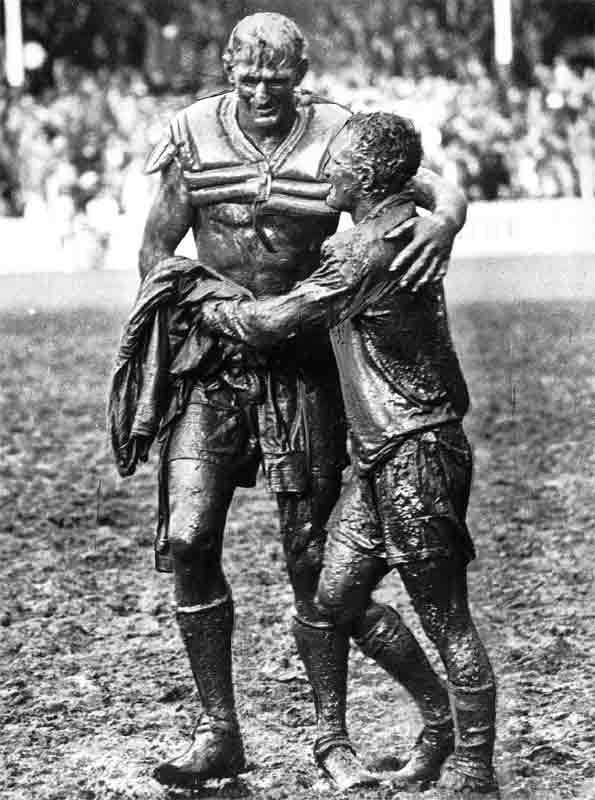
John O’Gready, The Gladiators, 1963
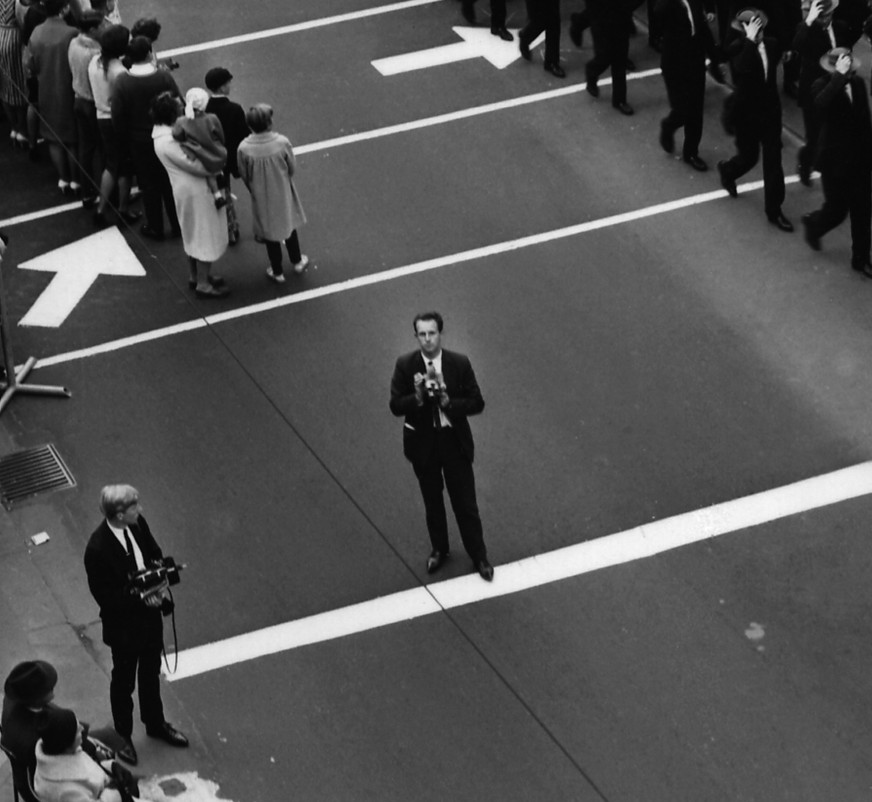
ABC Online 30 November 2014
John O’Gready, The Gladiators, 1963
Did I experience ‘uncanny bracket creep’ last night at the National Portrait Gallery, at In the Flesh? I remember the little intake of breath I took ten or so years ago when I saw my first Ron Mueck or Patricia Piccinini sculpture, or the little retinal undulation at my first glimpse of a figure flipping for a few milliseconds between the real and the unreal. But seeing the same sculptures again now, palisaded behind their PLEASE DO NOT TOUCH SIGNS, and theatrically lit like David Jones manikins, all I saw was plastic. Was I like an avid cinema goer in the 1950s who had viscerally thrilled at King Kong in 1930s, but seeing him again at the drive-in was able to finally laugh off his plasticine jerks? Had the general advances of the technologies of verisimilitude retrained my sensorium, and rehoned my perceptual scepticism, leaving these sculptures behind along with all the other uncanny automata going back to the eighteenth century?
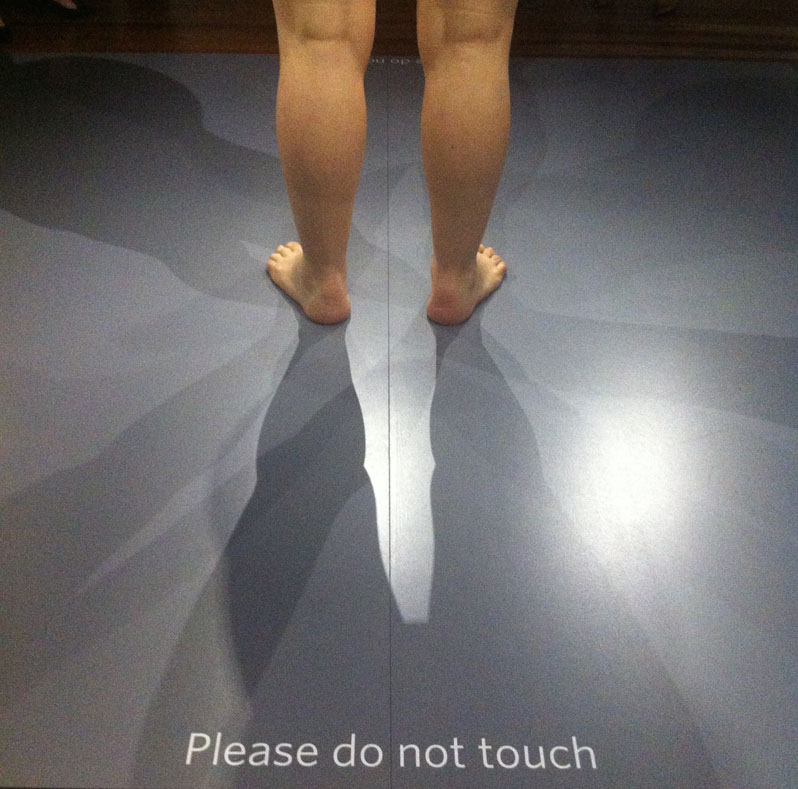
In the Flesh, National Portrait Gallery
Sarah Dellmann, from the Department of Media and Culture Studies, Utrecht University, kindly profiled my research in the newsletter of the Magic Lantern Society of the United Stats and Canada. The relevant pages are below. The newsletters of both the UK and US societies are always chock full of interesting stuff, and as Sarah demonstrates connect enthusiasts and collectors and researchers.

Magic Lantern Society News, October 2014
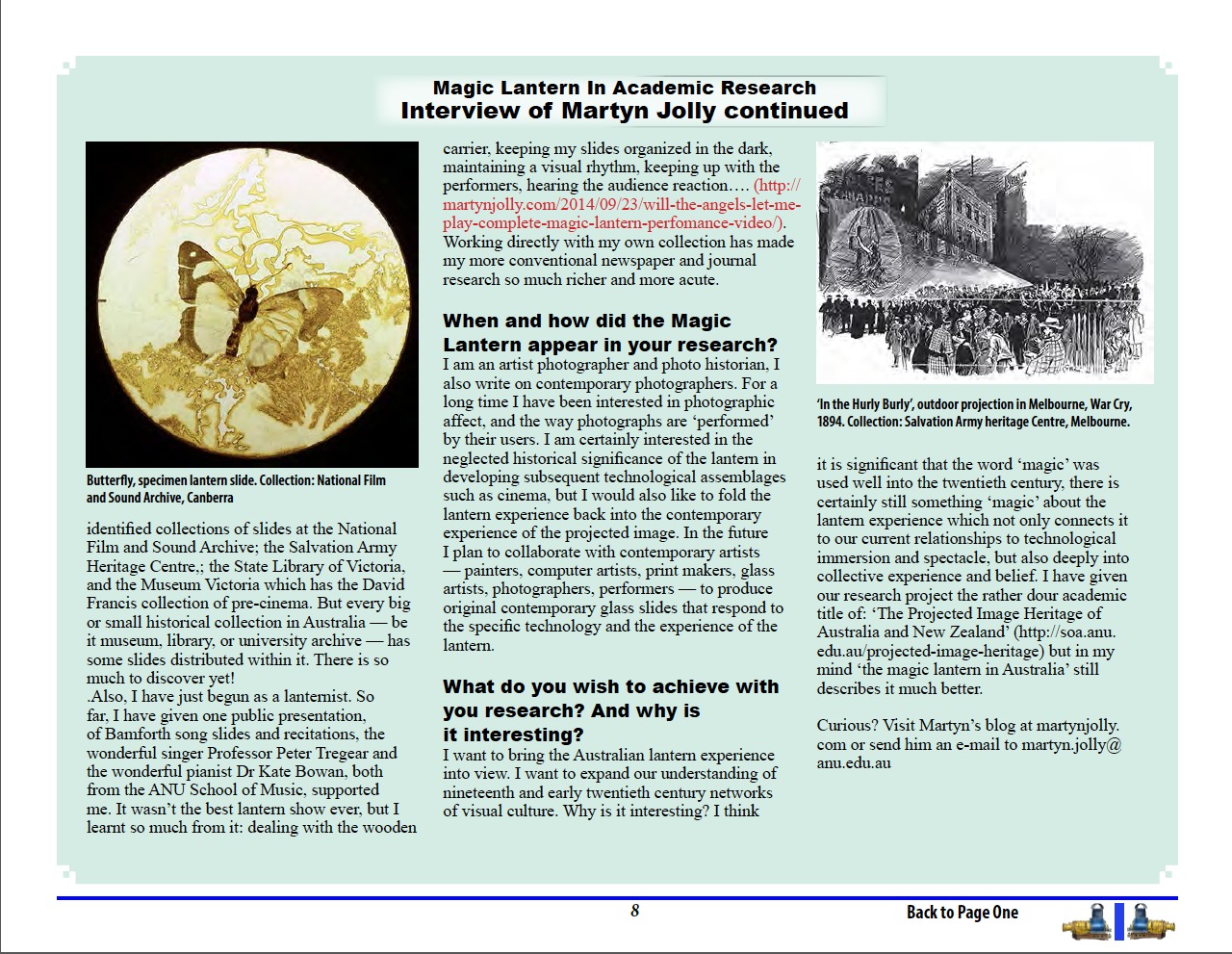
Magic Lantern Society News, October 2014
I’m sure Rowan Conroy wasn’t the only person photographing the sky from the bottom of Glebe Point Road that Thursday afternoon of 17 October 2013. As the dense smoke from the fires raging in the Blue Mountains rolled back over Sydney, I’d bet that plenty of people were using their cameras or iPhones to photograph the blotting out of the sun. Stranger may have even talked to stranger about the phenomenon, perhaps muttering under their breath words such as ‘awesome’, ‘apocalyptic’, ‘sublime’ or ‘portentous’. In a human gesture that goes back to the time of Stonehenge they all, including Conroy, looked deeply, and anxiously, into the sky. There was a sign there, the sky was telling us — the human race — something, but what? The sky portended doom, certainly, but what kind of doom exactly — was it nothing more than the business-as-usual doom of a cruelly cyclical mother nature, simply enacting the familiar Australian narrative of drought and flooding rains; or was there an additional doom, where climate change had already permanently pushed the weather into new realms of extremity.
Conroy’s carefully printed photographs are probably more terribly beautiful than the souvenir snaps other people took that afternoon. In some of his images, pewter-coloured puffs of smoke in the foreground chromatically shift the flame-tinged smoke in the background from copper to gold, giving the image a scaleless virtuality, like you see when you stare into the coals of a campfire for too long. In other shots, taken looking up towards the sun, we get the vertiginous feeling that we are a medieval sinner staring down into the bowels of hell. Still others stack up horizontal banks of cloud like an aerial geology that compresses the ragged remnants of dusky blue beneath. But each of the different terrible beauties of these photographs poses the same question — a question that worries many people: what is happening to our world?
Another worrier who looked into the skies was the nineteenth century art critic John Ruskin. To Ruskin nature was the origin of beauty on every level: aesthetic, moral and spiritual. But, in the early part of his career Ruskin warned his readers against a poetical conceit he called the ‘pathetic fallacy’, where weak people who are ‘over-clouded or over-dazzled’ by passionate emotion falsely attributed human feeling to nature itself. However to Ruskin this mistaken projection onto nature, where a flower is not a flower but a ‘a star, or a sun, or a fairy’s shield, or a forsaken maiden’, was still higher than the dull perception of an unfeeling person for whom the flower could never be anything but an unloved, symbolically inert organism. But, on a level higher than both these states, Ruskin placed the perception of one who was able to see the natural fact of the flower simultaneously intertwined with the spiritual associations and human feelings it evoked. Conroy does not succumb to the pathetic fallacy, his clouds are more than empty symbols of a fantasy apocalypse, they are also observed meteorological records, but records demanding a human response: this day happened, and it told us something.
About thirty years after writing on the pathetic fallacy, and towards the end of his life as he began to suffer bouts of mental illness, Ruskin wrote about the skies he had been observing and painting for decades. In the lecture The Storm-Cloud of the Nineteenth Century he claimed to have observed a new meteorological phenomenon that had arisen in the early 1870s. He called it the ‘plague wind’: a ‘dry black veil which no ray of sunshine can pierce’, looking as though ‘it were made of dead men’s souls’. When it blew, it blew tremulously, and made the leaves of trees shudder with a fitful distress. Its clouds, made of ‘sulphurous chimney-pot vomit’, were ‘thin, scraggy, filthy, mangy [and] miserable’; they did not redden the sun, but instead blanched it. In the scientific record of England’s climate there is scant actual evidence for the phenomena Ruskin observed (although temperatures in those decades were slightly lower than usual and rainfall slightly higher). But Ruskin’s observations weren’t scientific, they had succumbed to something like the pathetic fallacy he had previously condemned. His lecture, though based in close and highly-tuned personal observation, does more than just record the effect of industrial pollution on the environment, it also claims to see the moral and spiritual decay of England actually written in the sky.
Ruskin’s lecture was slightly mad, certainly, but it is a compelling, and relevant, read even today. In the last paragraph Ruskin says: ‘What is best to be done, do you ask me? The answer is plain. Whether you can affect the signs of the sky or not, you can the signs of the times. Whether you can bring the sun back or not, you can assuredly bring back your own cheerfulness, and your own honesty.’
Standing at the beginning of the climatic revolution of the twentieth-first century, rather than in the middle of the industrial revolution of nineteenth, perhaps ‘cheerfulness’ is no longer the best word to describe the ongoing communal resilience that will be required of us, but ‘honesty’ certainly is the best word to describe the change needed in our public discourse. To respond appropriately, and scientifically, to the threat of climate change we may need to embrace something like the revelatory vision of Ruskin. Conroy has.
Martyn Jolly
John Ruskin, ‘Of The Pathetic Fallacy’, Modern Painters, Volume 3, Part 4, 1856
John Ruskin, The Storm-Cloud of the Nineteenth Century, 1884
Brian J Day, ‘The Moral Intuition of Ruskin’s ‘Storm-Cloud’’, SEL Studies in English Literature 1500-1900, Volume 45, Number 4, Autumn 2005, pp917-933

Rowan Conroy, ‘Natura Naturans’, 2014
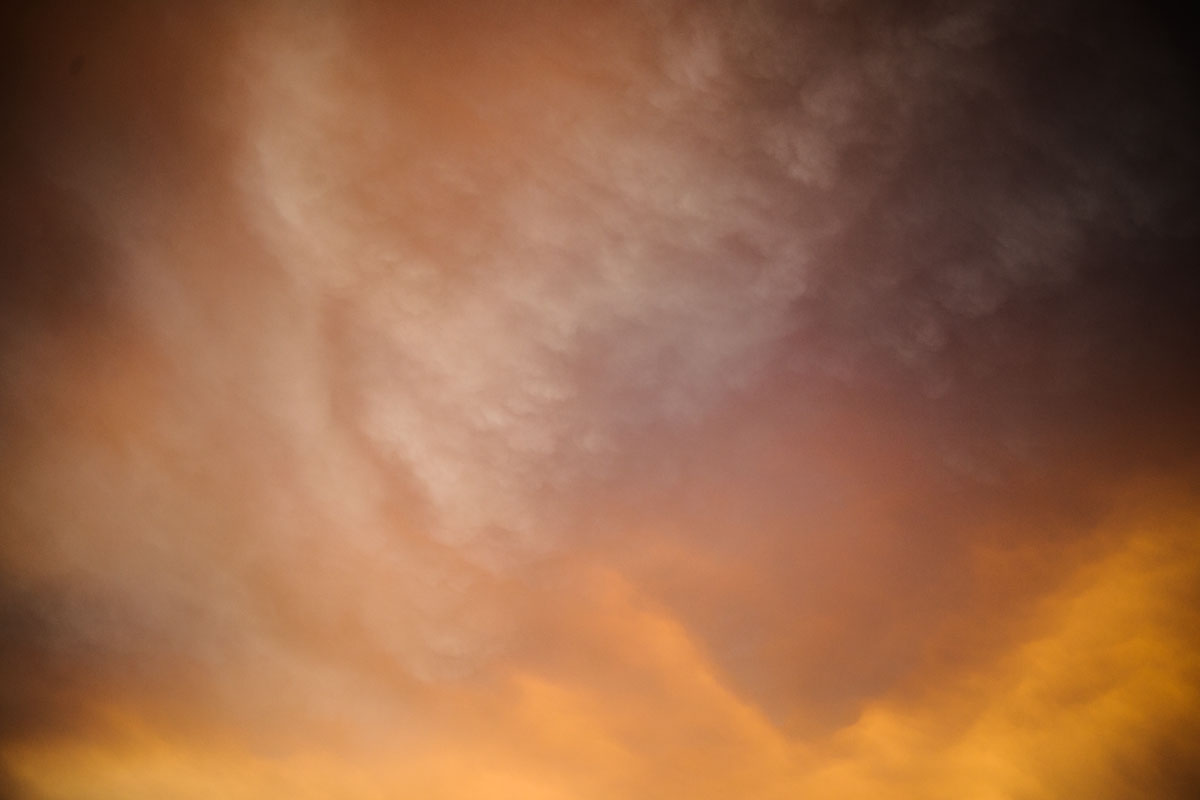
Rowan Conroy, ‘Natura Naturans’, 2014

Rowan Conroy, ‘Natura Naturans’, 2014
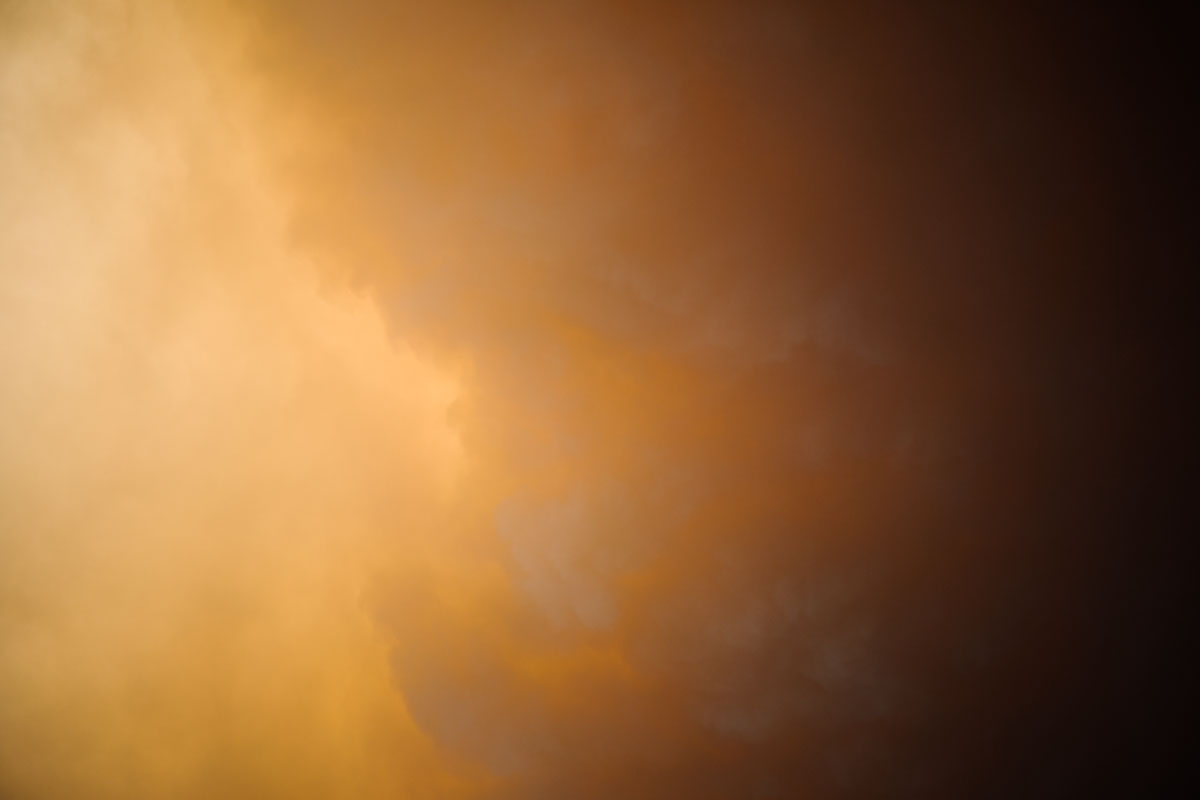
Rowan Conroy, ‘Natura Naturans’, 2014

Rowan Conroy, ‘Natura Naturans’, 2014
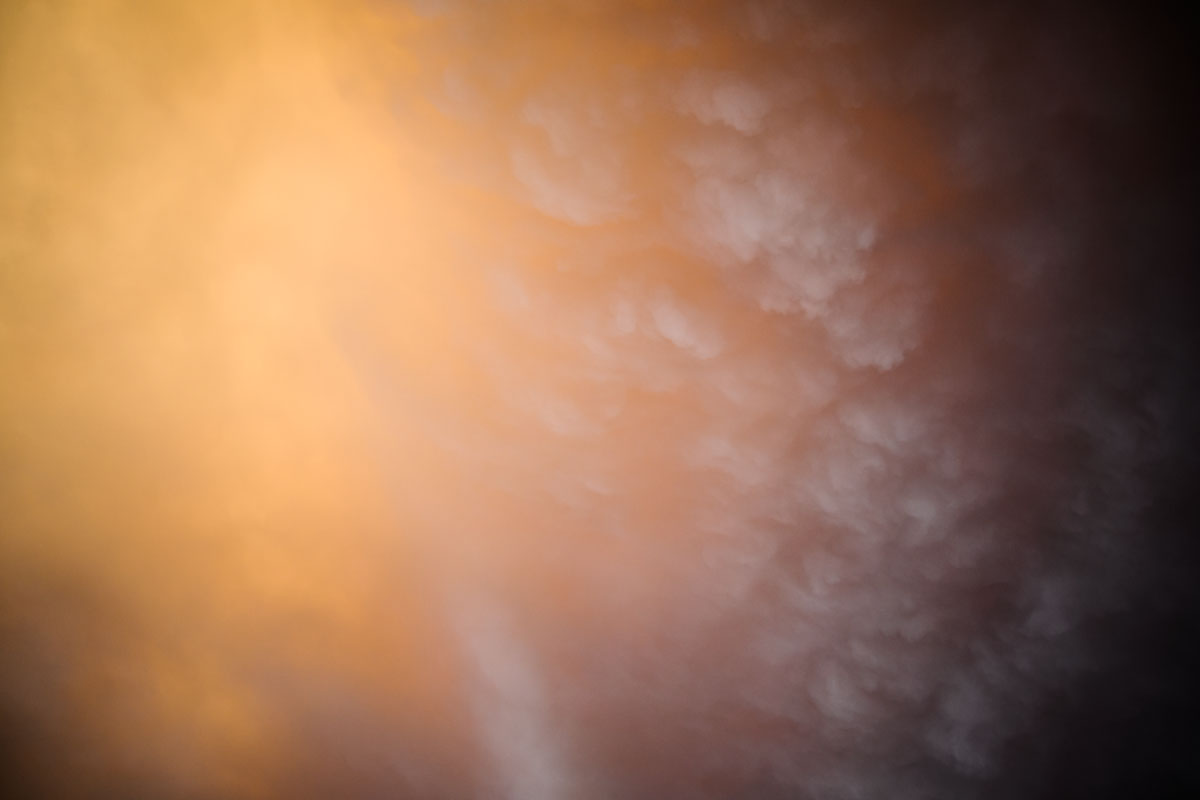
Rowan Conroy, ‘Natura Naturans’, 2014

Rowan Conroy, ‘Natura Naturans’, 2014

Rowan Conroy, ‘Natura Naturans’, 2014

Rowan Conroy, ‘Natura Naturans’, 2014
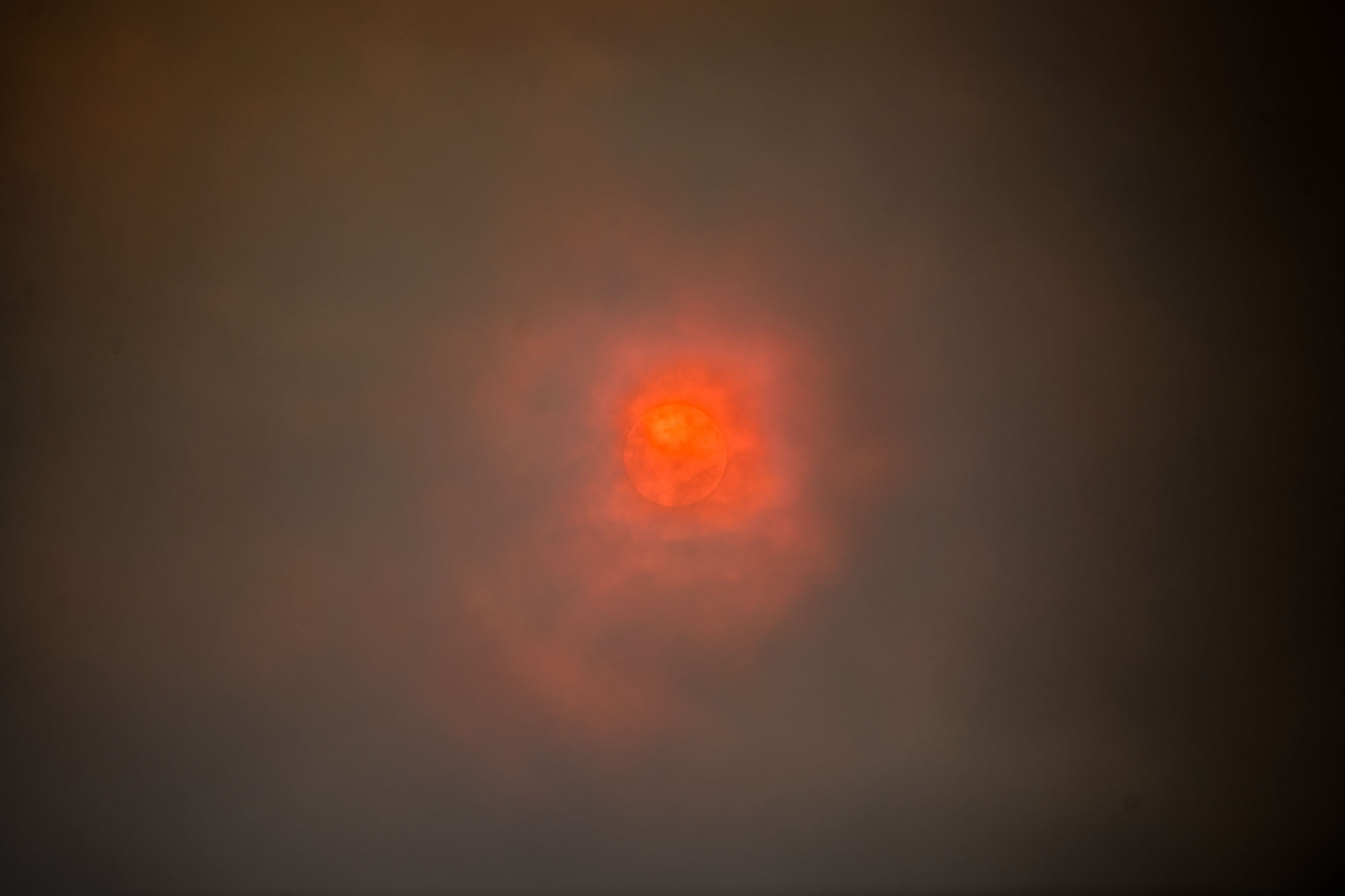
Rowan Conroy, ‘Natura Naturans’, 2014
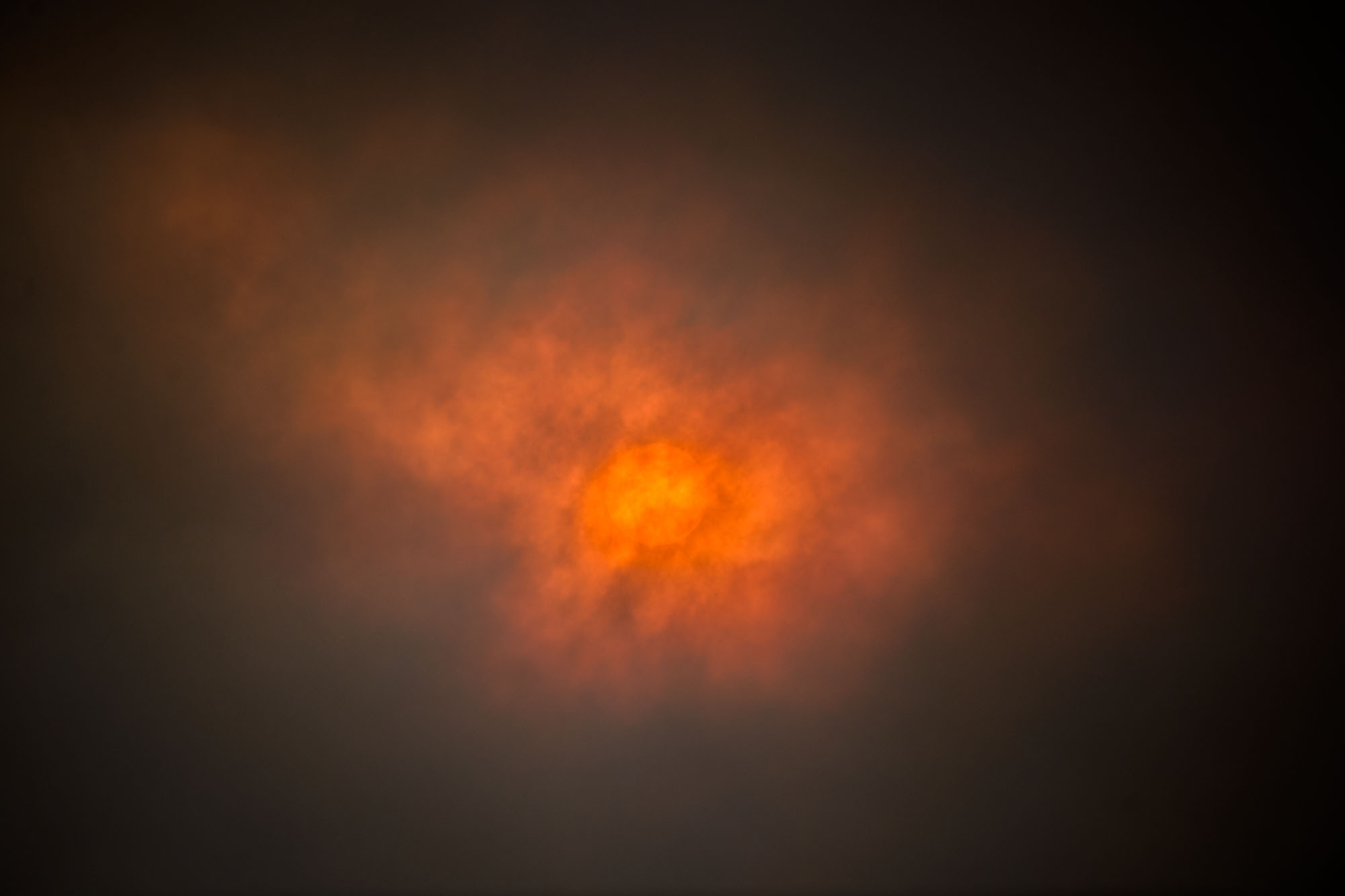
Rowan Conroy, ‘Natura Naturans’, 2014
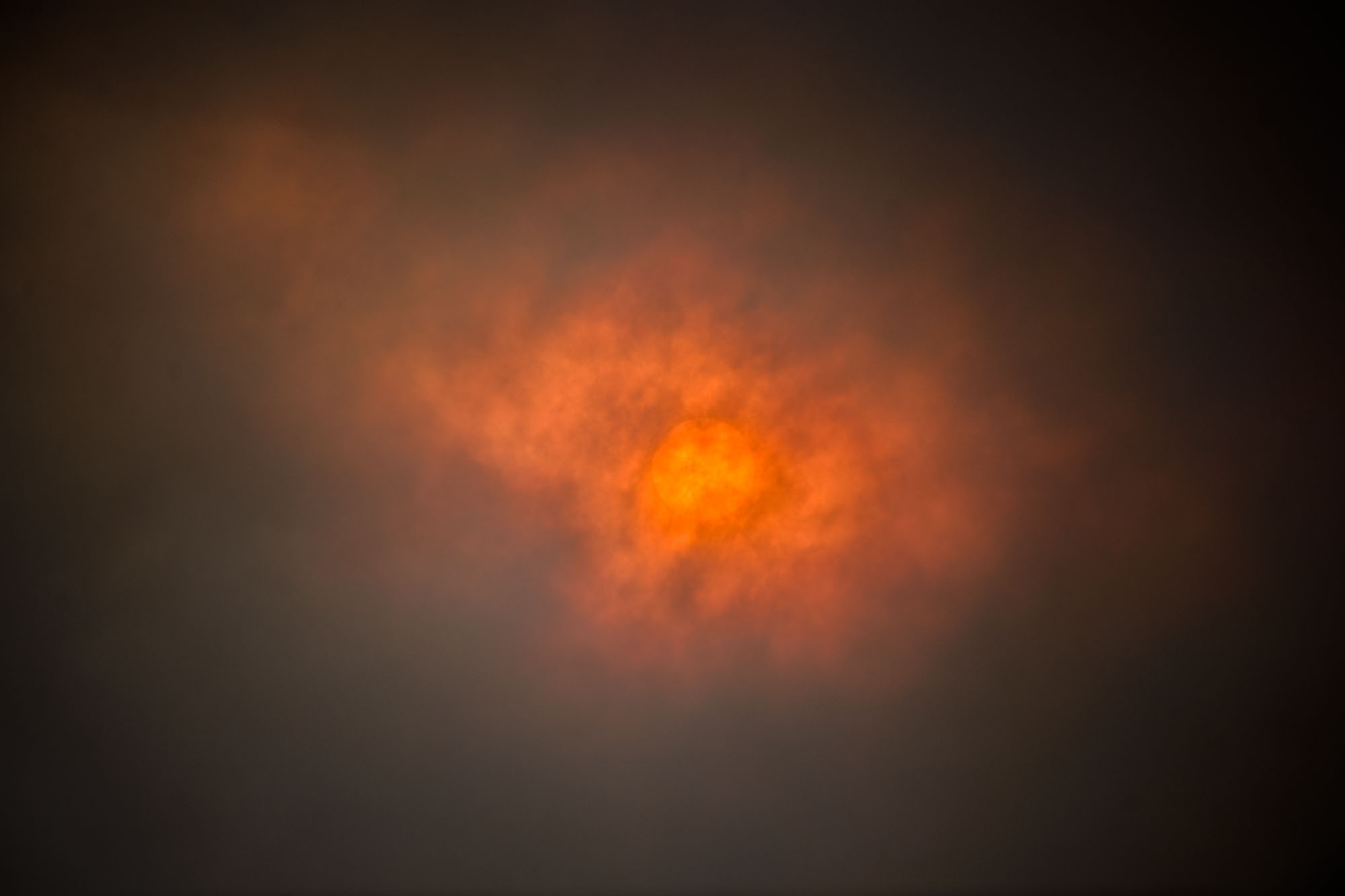
Rowan Conroy, ‘Natura Naturans’, 2014

Rowan Conroy, ‘Natura Naturans’, 2014
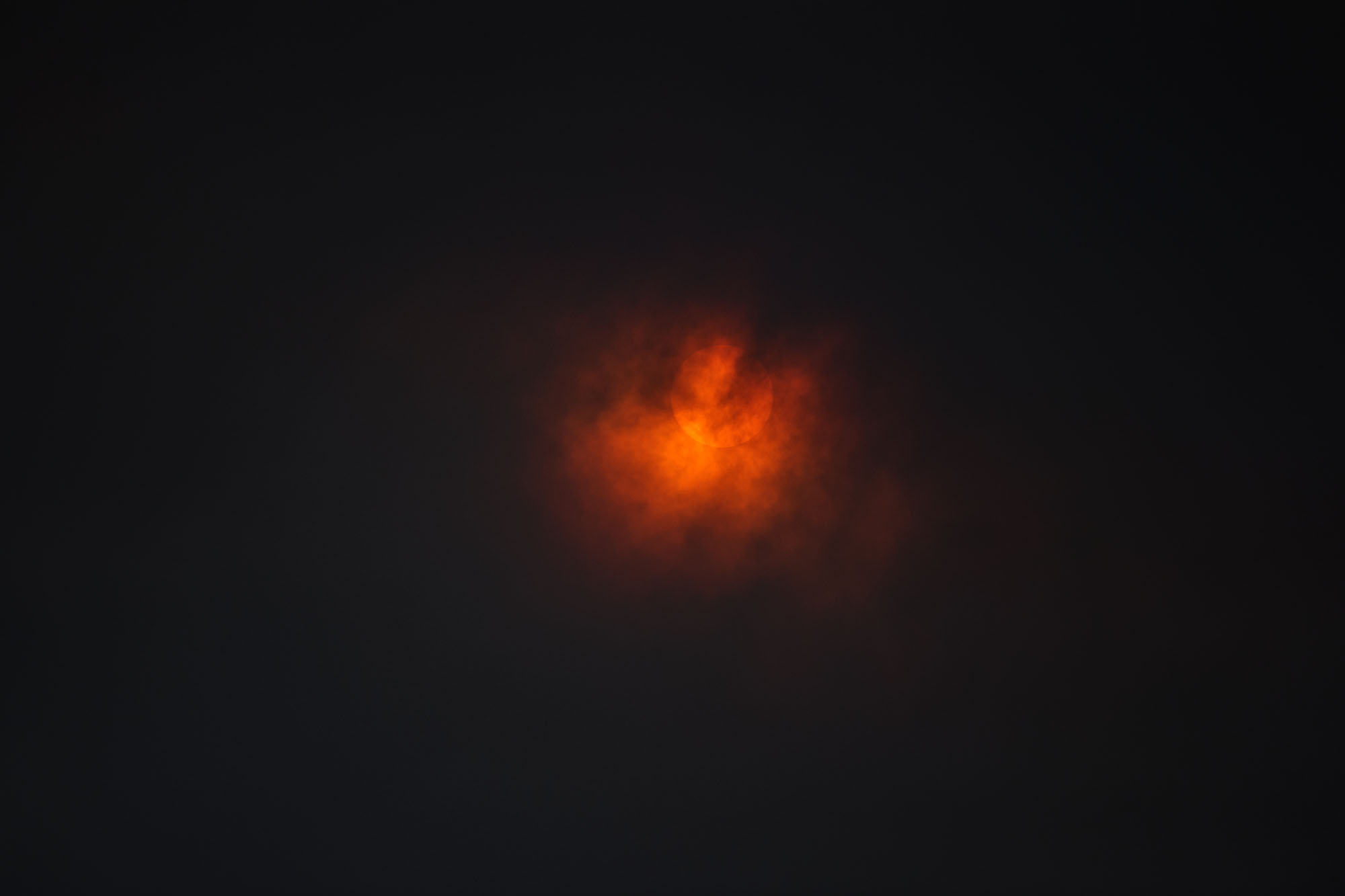
Rowan Conroy, ‘Natura Naturans’, 2014

Rowan Conroy, ‘Natura Naturans’, 2014

Rowan Conroy, ‘Natura Naturans’, 2014

Rowan Conroy, ‘Natura Naturans’, 2014
On July 24, 2014, I was able to project a show of five magic lantern song-slide sets and one recitation set from my ‘Iron Duke’ lantern of 1905, with some additional effects added from a smaller 1890s lantern. Professor Peter Tregear and Dr Kate Bowan from the ANU School of Music sang and played the original words and music, and they were fabulous. Trevor Anderson from the National Film and Sound Archive also operated the ‘effects’ lantern for the angel effect in Jane Conquest. The event was part of the History, Cinema Digital Archives organised by Jill Matthews from the Humanities Research Centre and held in the theatrette of the NFSA. Here is our original abstract:
Martyn Jolly, Kate Bowan and Peter Tregear: ‘Will the Angels Let Me Play’, and other songs and recitations: a performance of magic lantern slides with song and piano
Collections such as the National Film and Sound Archive or Museum Victoria hold hundreds of magic lantern ‘song slides’. These sets of hand-coloured glass transparencies were produced in the early twentieth century to promote the sale of the sheet music for popular songs. They were projected by a magic lantern and accompanied by musicians and singers. Their popularity peaked with the First World War. The slides that remain, with their sentimental and melodramatic storylines, surreal photographic montages, and lurid hand-colouring, are still fascinating when we see them on the museum light box, or see the digitized copy in a museum database. But they were made to be performed, and were part of a technical ensemble which included the magic lantern, a musician’s performance and, most importantly, a singer’s voice. For this presentation this complete ensemble will be brought together once more, the slides will be projected by vintage magic lanterns and accompanied by live music and singing from the original sheet music. Will this be a reenactment, like we might see at an historical theme park? Or will it be authentic interpretation, such as an early music ensemble might perform on their antique instruments in a concert hall? Why bother with an original magic lantern when the optics and resolution of a contemporary scanner and data projector can reveal more detail more conveniently? And, no matter how brilliant the performers are, is it even possible to re-enter the affective power of a long ago performance when so much has changed in the meantime? Through this practice-led research experiment, and through subsequent discussion with the audience, these questions and other will be explored.
Bronwyn Coupe has now edited a video of the complete performance, cunningly disguising my mistakes with edited-in digital copies of a few of the slides, but retaining the flavour of my projections, and the brilliance of Kate and Peter. Here it is:
I learnt a lot from the experience. Fortunately I had Ian Christie turning the pages of my cue sheets for me, otherwise I wouldn’t have been able to keep up with the changes for any of the songs! As it was I muddled two. Despite my rehearsals I need to have a better system for quickly accessing the slides in the dark, I was scrabbling around. I also think I should have realised that there was a certain amount of redundancy built into the slide sets by the manufacturers, and I could have left some out which would have given me more time to load the slide changer. The authority and smoothness (or lack of it) with which I changed and focussed the slides also became very important for the audience’s experience. The light levels in the auditorium— to satisfy both projection from the lanterns with their relatively low-lumen output from the LED floodlights I had in them, as well as the necessity for Kate and Peter to be able to read the music — was also crucial. I have been reading nineteenth and early twentieth century newspaper review of lantern shows in Australia and exactly these same issues are frequently reported on — both negatively and positively — by the writers. The audience discussion afterwards didn’t decisively answer any of the questions raised in the abstract. However it covered the historical accuracy, or inaccuracy, of our ‘re-enactment’ — a big issue with some of the experts in the audience — and the general visual culture of the period — in both America and the UK where the slides were made, and in Australia where they were shown. Also discussed were small but crucial details such as the lack of gain in the painted wall on which I was projecting, compared to the modern cinema screen on which the digital versions were projected. But there was enough there to go on with.
Below are simulations I reconstructed using digital copies of the slides we projected at the National Film and Sound Archive performance, and an NFSA recording of Peter Tregear and Kate Bowan’s wonderful performance. Unfortunately, in this recording Kate’s perfect piano is somewhat soft, except in Blue Bell and Holy City. I’ve selected two transitions from the video editing menu: a dissolve, which I wasn’t able to do on the night, but which was a very popular effect in the nineteenth century; and left-to-right/right-to-left slide transitions, which at least give a hint of the mechanical slide changer I used, but which are a lot smoother than mine! Unsimulated is the flame effect I produced in the window during Jane Conquest by flashing some red gel in front of the lens.

Louise Curham gently manipulates the super 8 projectors
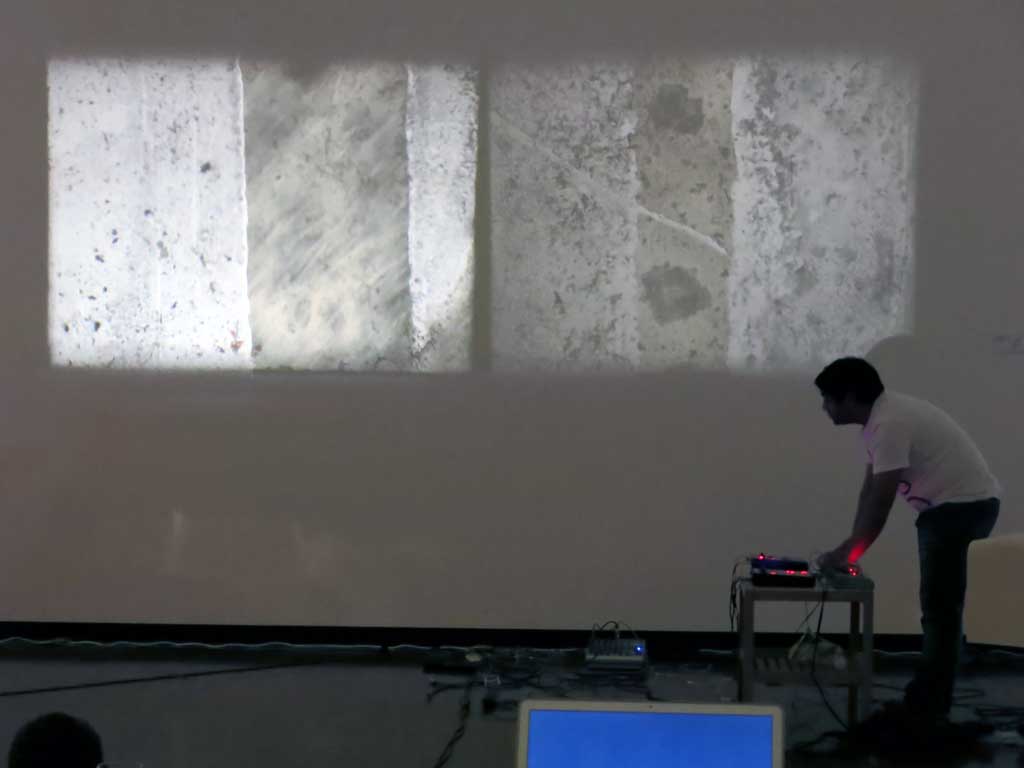
Shoeb Ahmad and Louise Curham’s projections

Ross Manning’s standing wave percussion

ANU School of Art Photography and Media Arts Students perform with Ross Manning

ANU School of Art Photography and Media Art and Painting handmade film projection

ANU School of Art Photography and Media Art and Painting handmade film projection

ANU School of Art Photography and Media Art and Painting handmade film projection

Photography and Media Arts projection on ANU Drill Hall exterior
My article on Australiana photobooks of the 1960s has finally come out. Follow this link to the History of Photography journal to get my citation rate up!.


Now that his trial has faded in our memories it is possible to take stock of the new punishment spectacles being developed in our society. In this case the body of the condemned was not available for public torture, but his self-caricature of a face — thick glasses, fussily groomed facial hair, and lasciviously darting tongue (always, we realised, incipiently Mephistophelian) — still haunted our memories. But this man was an entertainer, a creator, and even an artist of sorts. This not only made us, his naive and innocent audience, obscurely sinned against as well, but it also conveniently left us with a stock of his works — songs, paintings and murals — which through a process of sympathetic magic could substitute for his body. We could pillory these instead. Songs were ceremoniously removed from playlists, murals were ceremoniously painted over, and so on. Individuals took it upon themselves to correct the collective historical record on all of our behalves. The works destroyed or erased weren’t great, and weren’t even, in the end, all that numerous, but nonetheless I found this medieval hysteria worrying. Because of his crimes he may have forfeited some of his rights, but not his moral rights as an artist. Who will be next?
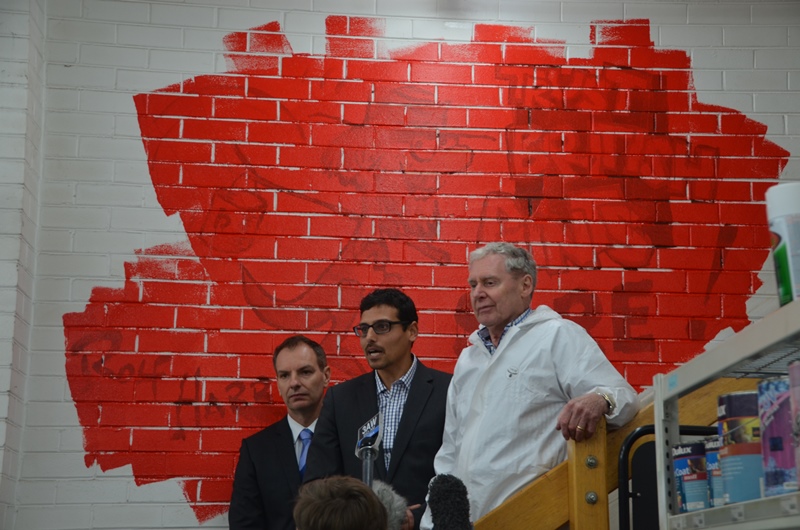
Rolf mural painted over in red paint

Rolf mural painted over in red paint
Rolf mural painted over in red paint

Rolf replaced in entertainer’s mural
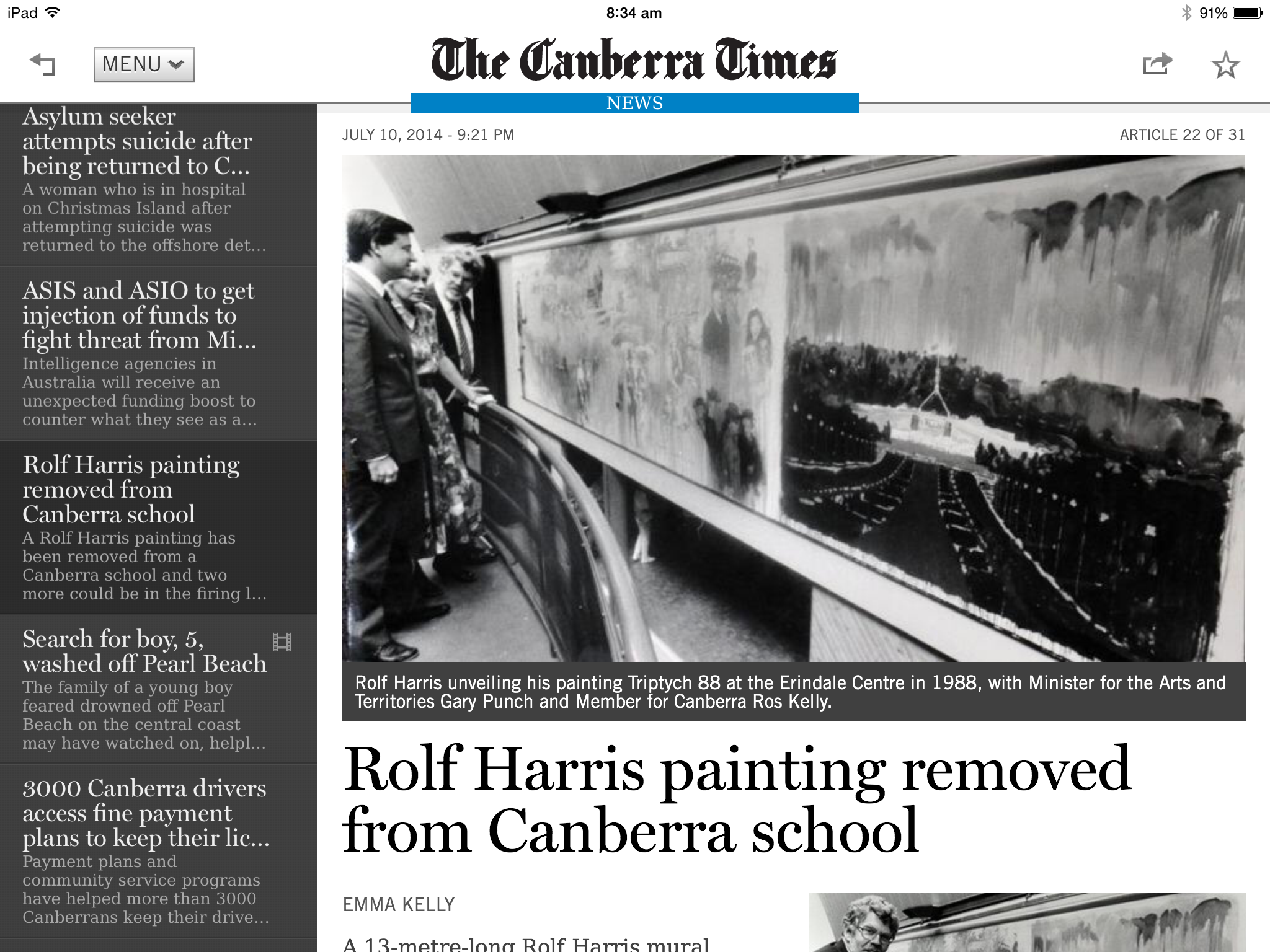
Rolf painting removed from Canberra school

Rolf painting removed from Canberra school

Rolf’s portrait removed from National Portrait Gallery
Powerpoint presentation at Broken Images: American Photography in the Asia Pacific, 1850-1950, Queensland Art Gallery, 3 July 2014
INTRODUCTION
Robert B Goodman plunged through Australian photography like a comet — arriving in 1962 and departing in 1967 — and nothing was ever the same again. He inspired Australian photographers and designers, helped one of them get their first international gig, and expanded the horizons of all of them. He ‘raised the bar’, and ‘set new benchmarks’ in book production. He was a new model of photographer on the Australian scene: a wheeler and dealer, a mover and shaker, an inveterate publicist who saw photography not in terms of ‘art’, ‘documentary’, ‘advertising’ or ‘industrial’— the previous compass points between which Australian photography had languidly drifted for decades — but in terms of corporate publicity, marketing campaigns, sponsors, deals, promotions and pre-sales. He was a Yank in cohoots with mining companies, banks and tourist agencies; he was handsome and articulate, smooth talking, perpetually typing letters, always ready for the next meeting; he had an air that he could be anywhere in the world, really, but he was choosing, just at the moment, to be in Australia, because Australia was important, just at the moment. At the same time he was able to back up his talk — Goodman could efficiently and repeatedly nail high quality National Geographic style shots of anything: portraits, landscapes, industrial, street scenes, sport. Being a National Geographic photographer he understood 35mm film, and was completely at home with colour, at a time when most Australian photographers were still shooting on black and white, medium format film. And some Australian photographers were secretly jealous of him, so they set about publishing their own replies to his magnum opus, which they reviled as it kept selling month after month after month, from 1966 all the way through to 1970.
NATIONAL GEOGRAPHIC
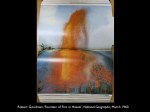
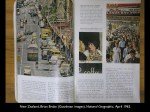
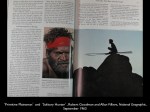
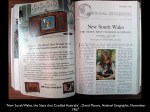
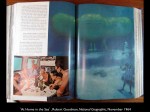
Goodman was born in Cincinnati and studied photography in Ohio, but was attracted to the romance of Hawaii and moved there in 1959 at the age of 21. His big break came when a National Geographic writer got him to photograph close to the mouth of an erupting volcano. His daredevil shots, published in March 1960, lead to them employing him. Although he travelled globally for the Geographic, he concentrated on the Pacific region. He contributed a substantial number of shots of New Zealand for an article primarily attributed to Brian Brake for National Geographic’s April 1962 edition, and by the October edition he had his own by-line for an article on Western Samoa. That year he was assigned to Australia for five months to work on a major article about the nation. In standard National Geographic style, and consistent with the previous New Zealand and Samoan articles, the layout for the Australian article played up the contrast between city and country, ancient and modern, aboriginal and western.
Whilst in Australia, Goodman met the Australian documentary photographer Jeff Carter. Carter remembered their meeting in the following vivid terms:
I was photographing Sydney’s Kings Cross, in particular the trendy, newly completed Rex Hotel in Macleay Street. … In order to get a dramatic low angle I crouched in the gutter opposite the entrance steps, honing in on a dapper male wearing an eye catching candy stripe suit exiting the building. After firing off a volley of rapid-fire exposures, I became aware the gentleman had halted directly in front of me. As I rose to my feet he addressed me in a strong American accent, ‘Say, you look like you can handle a camera. I’m Robert Goodman of the National Geographic magazine. Just arrived today. I’m here to contact some Aussie photographers, the names of David Moore, David Potts and Jeff Carter. You wouldn’t happen to know any of them?’
Carter’s and Moore’s subsequent National Geographic commission was published in 1966 and had a big impact on Carter’s career, he not only cleared $3200 from it, but he was left with an invaluable archive of three thousand colour slides to draw upon for years to come. David Moore already had international opportunities as a stringer for the Black Star agency, and was about to shoot a slim volume on Australia and New Zealand for Time Life World Library encyclopaedia; nonetheless his National Geographic article of 1967 enlarged his archive and his reputation.
Whilst on assignment in Australia Goodman conceived the idea of producing a high production-value coffee table photobook about Australia for a global market. The way Goodman told the story captures some of his charismatic style:
I was lying in my bedroom one afternoon at the Stuart Arms Hotel in Alice Springs, when it suddenly hit me that for all my travelling around I really knew nothing about Australia. I knew that to capture it in its entirety, its actuality, I needed more than just five months. For three days I stayed in that room trying to come to a decision. Here I was with a good job on the Geographic – I had only just joined them – a job any photographer would envy. Should I throw it up for what was only a hazy dream? How could I do it? Could I do it? I didn’t know, but the idea was there, and it grew stronger and stronger. You see, I didn’t think Australia was being publicised properly. … And, I reasoned, a stranger looking at the country and its people could possibly have clearer eyes than those who live here and perhaps cannot see the forest for the trees. So, there I was. I wanted to do a book on Australia.
After completing a National Geographic assignment on Jacques Cousteau in the Red Sea he resigned from the company and returned to Sydney to begin to raise money for the venture. He was an extraordinarily energetic entrepreneur and eventually, after a year, had gained the support of twelve leading travel, mining, banking and manufacturing companies who he persuaded of the benefit of having a book to promote Australia in general, and their industry in particular. They made $150,000 available over three years to finance the book, in return for ten thousand copies to be used as promotional gifts.
THE AUSTRALIANS
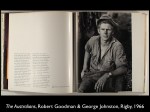
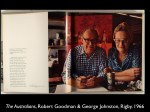
Goodman shot the book during 1963 and 1964, including a six-week caravan trip with his wife and young son. Sidney Nolan introduced him to the novelist George Johnston, who had just returned from living in Greece, and whose just-published sentimental autobiographical novel My Brother Jack was receiving critical and popular acclaim. He agreed to write the text. Goodman said:
George’s text for the book is the most moving I have ever read. His simple prose, every page verbally keyed to the pictures, is magnificent. I couldn’t have written any of it. I’m an American, and no matter how long I stay here I will always be one. But George is fifth-generation Aussie, and he talks of his country, its people, its future and past, and makes it all meaningful to his own people. Anyway, when we got lined up, I simply went out and took pictures —30,000 of them altogether — and as I took them George and I would go through them together.
Although many other Australian photobooks at this period were making use of the new Asian printers in Hong Kong, Japan and Singapore, Goodman ensured quality control by seeking out the Adelaide independent publisher Rigby and the Adelaide printery Griffin Press. He said:
I must have been as bold as brass then. There I was on four bob a day, talking to top-line printers, ink manufacturers, book-binders, telling them about my huge project, saying I would consider using them! It paid off, though. I really got the cream of the profession working for me.
The London trained modernist designer Harry Williamson designed the book. Goodman even returned to the Kodachrome rolls he had shot on his first trip to Australia, and Williamson flipped them and re-cropped them. Williamson established a unifying design grid based on the shape of Goodman’s 35mm slides which, compared to other books and magazines of the period, cleaned up and de-cluttered each spread while establishing a continuity throughout the book. Williamson also worked closely with the New York based, former Newsweek editor, Jonathan Rinehart who Goodman had hired to help him edit the text and image together so that, in his words, ‘the book, in its final expression would be neither picture nor word book, but rather a beautifully intertwined volume with a unity all of its own.’
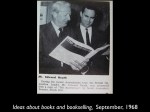
Goodman had already made important media connections during his earlier visit, particularly with the middle-class travel magazine Walkabout who, a year out from the book’s publication, began to build anticipation for it by covering his travels around Australia with his wife as a photo story in its own right. In the lead up to the release date the publishers took out a series of ads in the booksellers’ trade journal Ideas.
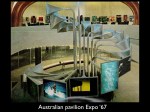
When it finally hit the shops in September 1966 the book was supported by an unprecedented publicity blitz, with articles and mentions in almost every magazine and newspaper. The coverage was tailored to each magazine, the Women’s Weekly highlighted the support of his wife and young son, while Australian Photography showed a display of all the Nikon camera gear he had used. The book became a favourite corporate and government gift — the Queen and President Johnson received theirs bound in merino skin. Enlargements and transparencies from the book also became the centrepiece of the modernist architecture for Australia’s Expo ’67 pavilion.
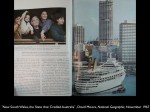
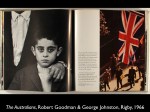
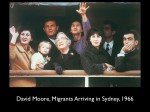
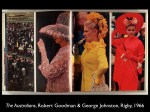
The book used sequencing to comment on Australian identity in the 1960s. For instance, as we turn from a vertical colour shot of distant backlit figures walking down a Sydney street beneath a Union Jack, to the next page, we are suddenly confronted with a double-page full-bleed spread containing a black and white close-up shot of three southern-European faces looking ahead with keen, lip-biting trepidation — ‘Immigrant Arrivals, Sydney Harbour’, the caption tells us. This spread describes the demographic change happening in Australia with a startling telephoto intimacy unprecedented in previous Australiana books. (The image was copied about a year later by David Moore on his assignment for National Geographic, but Moore’s version Migrants Arriving in Sydney 1966, eventually became a national icon.) Williamson also used colour with confidence. For instance the series of vertical slices arrayed across two pages conducts a kind of kind of typological census, in pink, yellow and red, of three generations of Australian womanhood at the Melbourne Cup.
The flavour of The Australians was determined by its international context. The fact that Goodman was a visiting American was articulated by the publicity as an advantage — as an unprejudiced but internationally knowledgeable outsider only he could see us as we really were. The book’s chapters followed a trajectory very familiar from lots of other Australiana photobooks — from the ‘Land’ to the ‘People’ to ‘Industry’, to ‘Arts’, to ‘Sport’ and finally to ‘Anzac’ — but they were given personal colour by a series of short written vignettes mixing Johnston’s nostalgic recollections with anecdotes and social speculation.
Reviews confirmed that The Australians had set a benchmark because of the physical quality of the book and because it broadened the themes and issues which could be encompassed by an Australiana photobook. The Australian newspaper, picked up on the book’s fundamentally optimistic and nationalistically flattering message. Although the faces in the book had ‘the sun cracked texture of parched land’, nonetheless they ‘did us proud’ in a way ‘that may seem oddly old fashioned in these days of national self analysis and criticism’.
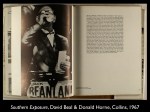
The book not only flattered Australians, it also flattered the mining, travel and finance companies who had backed it. Its unprecedented financial success encouraged other photographers to move into the market it had opened up, but it also goaded them into replying to its corporate jingoism. The most trenchant reply came the next year from Southern Exposure, a book with a text by Donald Horne, whose ironically titled The Lucky Country had been a talking point since its publication three years before, and photographs by David Beal, whose black and white images, rather than having the chromatic chutzpah of the classic National Geographic shot, had heavy doses of the gritty documentary acerbity of Bill Brandt and Robert Frank. The dust jacket blurb is clearly directed at a reader who is already thoroughly familiar with the success of of The Australians:
Southern Exposure is the most original picture book on Australia yet to be published. It marks a departure from the stereotyped, quasi-official, ‘coffee table’ productions which portray in verbal and visual clichés an idealised picture of Australia. […] ‘We are trying to get down in pictures and words the Australia we see.
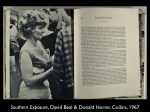
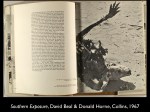
The cover images are almost satirical. A beer-gutted Australian worker holds a shovel but incongruously licks an ice cream – almost a visual encapsulation of the argument of The Lucky Country – while on the back cover the ‘real’ Australia remains cracked and parched. The faces in Goodman’s The Australians were frontal and open with level gazes, whereas the faces in Beal’s Southern Exposure are belligerent or turned away. Their gobs are plugged with bottles, cans or cigarettes. Turning the pages doesn’t produce dramatic revelations, as in The Australians, but sardonic puns. For instance, a visiting English actress’s bejeweled décolletage at an opening night transmutes with the turn of the page into an empty beer glass shoved down a female pub drinker’s blouse. Other images, such as bleached animal skeletons, a major visual trope of postwar Australian iconography in painting and photography, seem to be out to trump Goodman’s more glamourised depictions. Compared to the ragged imprecation of Beal’s desiccated kangaroo in Southern Exposure, Goodman’s ‘Dead Ram, Witchelina Station, South Australia’ in The Australians begins to look almost choreographed. Rather than looking weary but quaintly proud as in Goodman, Beal’s returned Anzac soldiers just look smug and slovenly.
Southern Exposure raised the hackles of Walkabout, the travel journal that had doyens from the travel industry on its board which had directly supported Goodman’s The Australians. They complained:
The spate of picture books seems to be running into side-channels, not without stirring up mud. Southern Exposure is an example. […] This new genre of picture-book, solidly established last year by The Australians, was given an impeccable and sophisticated pattern by George Johnston’s text and Bob Goodman’s pictures. A welling, wholesome sanguineness swept through it. Australian frailties were admitted with grace, but Johnston’s pride in and Goodman’s American admiration for a people who had tamed but had been simultaneously moulded by a fiercely raw nature, and from scruffy beginnings had built a nation with no small part in the world’s affairs, arts, sciences and sports, seeped through unashamedly. Achievement was the keynote. [But] In [Southern Exposure], people will read what is tantamount to a lecture to Australians themselves from a superior posture of niggling, radical intellectualism.
Elsewhere I have argued that Beal and Horne’s reply to The Australians was followed by important books by Jeff Carter, and Rennie Ellis and Wesley Stacey, which were also not only published in the wake of, but defined against, The Australians. To quote Harry Williamson in a recent email to me: ‘David Beal, Jeff Carter, Wes (Stacey) and Rennie (Ellis) bring a gritty extension to what Bob Goodman started, and although in some ways he made it possible to get those books out and published, it was never something he would have intended to achieve himself.’
BACK TO HAWAII
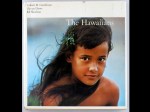
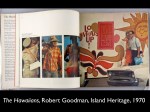
After the success of The Australians the trio of Harry Williamson, Jonathan Rinehart from New York, and Goodman stayed together and discussed other potential countries where businesses would want to invest money on publicising themselves and their country, such as South Africa, Mexico and Israel. However Goodman returned to his spiritual home Hawaii and the three worked on the book The Hawaiians, which came out in 1970. It closely followed the template set by The Australians: the cover also featured a frontal open face, the layout followed the same 35 mm shape across the double page spreads, there was a special deluxe edition, and presumably free copies for the thirty-four corporate sponsors.
Rather than using a small independent publishing company, in Hawaii where he intended to live, Goodman set up his own company, Island Heritage. He offered Williamson a position in the company but Williamson decided to stay in Australia. Back in Hawaii Goodman eventually became more interested in book publishing than photography per se. With his friend Robert Spicer he produced a series of children’s books based on traditional folk tales in Hawaii. He became part of the renaissance of Hawaiian culture through his publishing association with the Hawaiian artist Herb Kane. After working on an early Macintosh computer to design a 1986 book about the Hawaiian whaling industry Whalesong, he became an advocate for desktop computer publishing.
CONCLUSION
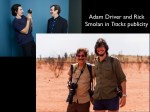
Goodman wasn’t the only photographer to publicise Australia to an international market. The world famous photographer E O Hoppe toured here in the late 1920s to add to his series of books on Britain, Germany and America with one on Australia. Called The Fifth Continent, it also mixed national typologies with landscapes; and from 1958 David Moore attempted to carve out Australia, S E Asia and the Pacific as his patch through The Black Star agency. And then of course there is Frank Hurley, who was similarly self-promotional, and who died in 1962, the year Goodman first arrived in Australia. However although Hurley exhibited his exploration films internationally, his Australiana books were aimed at modest domestic audience and had none of the social identity dimensions of Hoppe, Moore or Goodman. Ten years after Goodman left Australia another American National Geographic photographer came to our distant shores. Just like Goodman had before him, at some stage after photographing Robyn Davidson’s camel Journey for National Geographic in 1977, Rick Smolan (played by Adam Driver in the movie Tracks) conceived of his A Day in the Life of Australia book, where ‘one hundred of the world’s top photojournalists photographed Australia over twenty-four hours during 6 March 1981’. This was a similar to the business model Goodman had developed — both in its audacity, and in its invitation for the world to come and ‘show us to ourselves’. Goodman’s series only reached two countries, but Smolan’s A Day In The Life of … series extended from its beginning in Australia, to Hawaii (like Goodman) then to Canada, Japan, America, California, Spain and the Soviet Union.
Despite their differences all of these photographers deployed the same sets of elements: their own special personalities as galvanizing global photographers, their individual attempts to create new markets for photography, the compelling power of an international gaze trained upon Australia, which reflected back to a domestic audience tropes of Australian identity, such as national typologies or nationalistic landscapes, with increased intensity. In the case of all these photographers the international spotlight became a national mirror.
The memory of Goodman’s galvanizing effect on Australian photography has now been almost completely forgotten. For instance I myself remember, in 1981 as a Marxist, Foucaldian, Barthesian art student, attending a PR event about the production of Smolan’s A Day in the Life of Australia. As a postmodern cadet I was there to condemn and sneer at its clichéd depiction of Australia, but I still remember one bearded old photographer, I don’t remember who, saying that until A Day in the Life of Australia we had had no better picture book to send overseas than Goodman’s The Australians, which was at the time fifteen years old. ‘What was this book?’ I remember wondering at the time, ‘who was this Goodman? I had never heard of him.’ ‘Since I hadn’t heard of him, he certainly couldn’t be important’, I thought to myself at the age of twenty-two. But clearly Goodman’s trajectory through Australia had reverberated for at least fifteen years, and now I think it is time it is recognised again.
Martyn Jolly