
ABC Online 30 November 2014
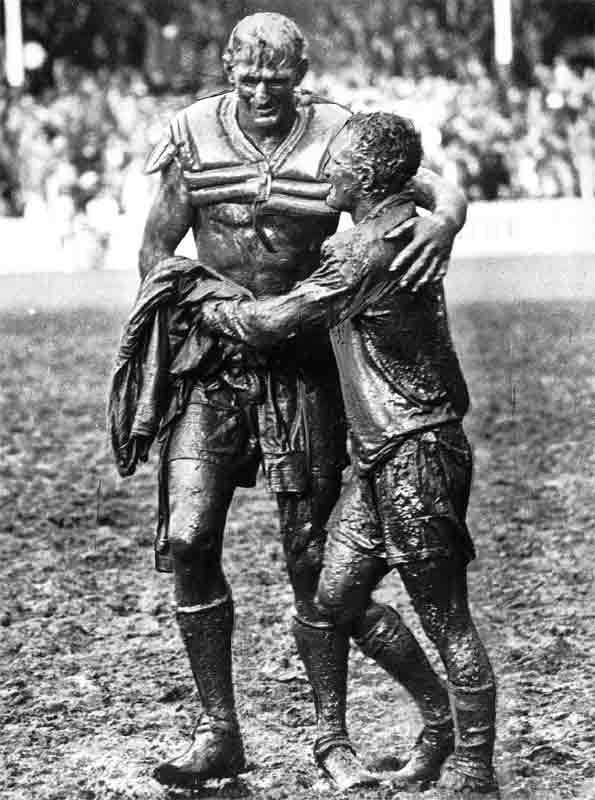
John O’Gready, The Gladiators, 1963
ABC Online 30 November 2014
John O’Gready, The Gladiators, 1963
Did I experience ‘uncanny bracket creep’ last night at the National Portrait Gallery, at In the Flesh? I remember the little intake of breath I took ten or so years ago when I saw my first Ron Mueck or Patricia Piccinini sculpture, or the little retinal undulation at my first glimpse of a figure flipping for a few milliseconds between the real and the unreal. But seeing the same sculptures again now, palisaded behind their PLEASE DO NOT TOUCH SIGNS, and theatrically lit like David Jones manikins, all I saw was plastic. Was I like an avid cinema goer in the 1950s who had viscerally thrilled at King Kong in 1930s, but seeing him again at the drive-in was able to finally laugh off his plasticine jerks? Had the general advances of the technologies of verisimilitude retrained my sensorium, and rehoned my perceptual scepticism, leaving these sculptures behind along with all the other uncanny automata going back to the eighteenth century?
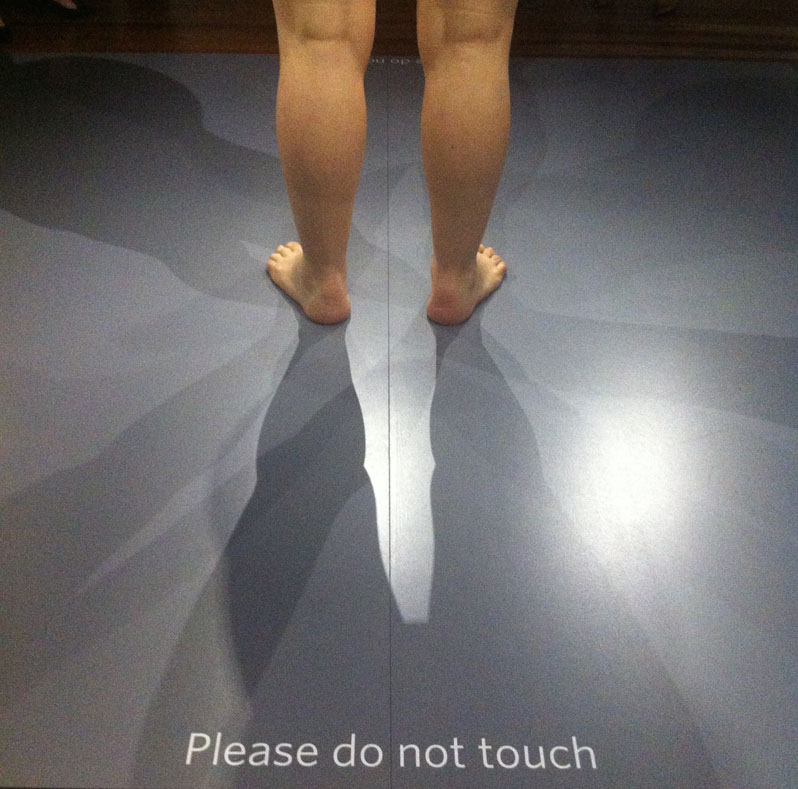
In the Flesh, National Portrait Gallery
Sarah Dellmann, from the Department of Media and Culture Studies, Utrecht University, kindly profiled my research in the newsletter of the Magic Lantern Society of the United Stats and Canada. The relevant pages are below. The newsletters of both the UK and US societies are always chock full of interesting stuff, and as Sarah demonstrates connect enthusiasts and collectors and researchers.

Magic Lantern Society News, October 2014
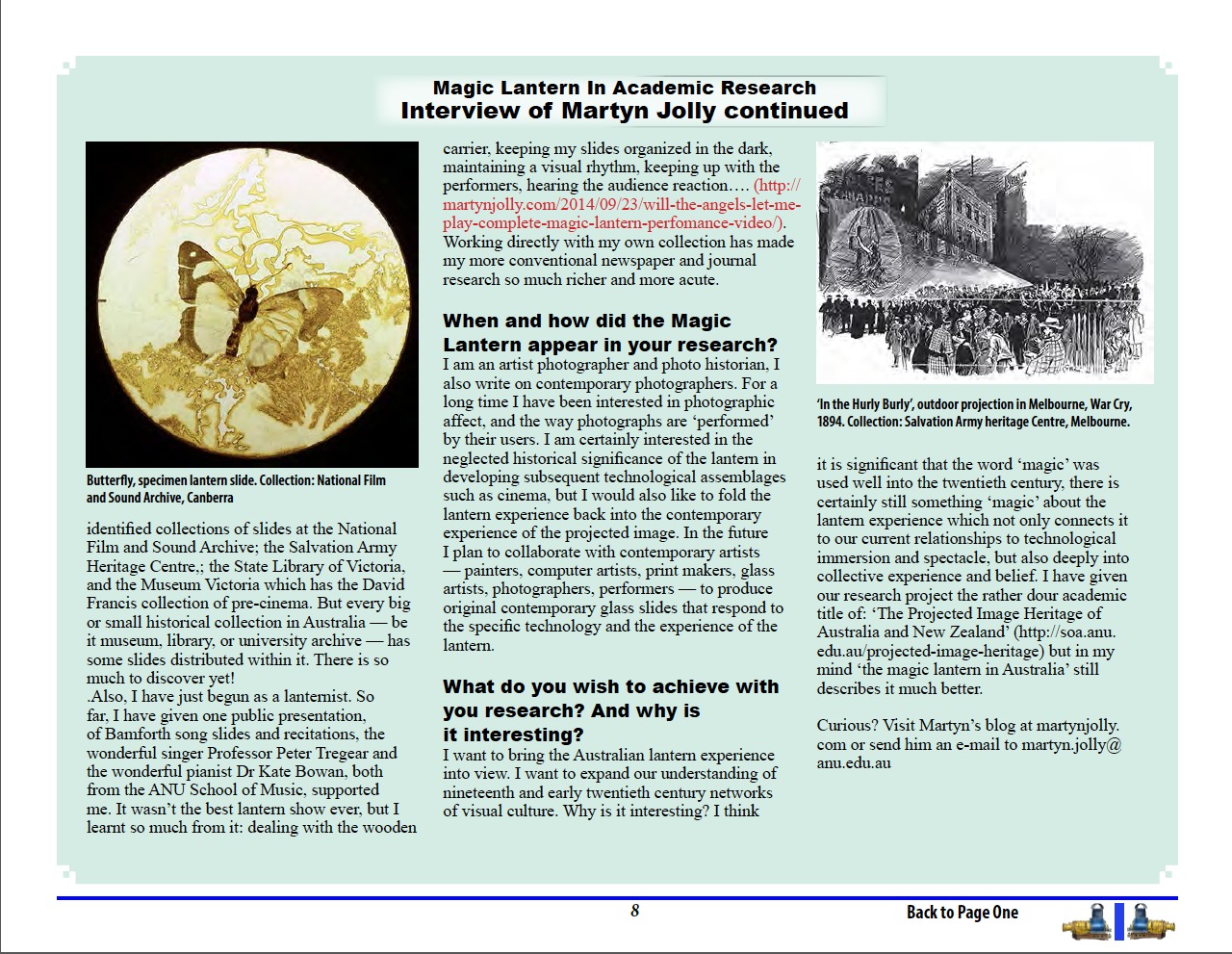
Magic Lantern Society News, October 2014
On July 24, 2014, I was able to project a show of five magic lantern song-slide sets and one recitation set from my ‘Iron Duke’ lantern of 1905, with some additional effects added from a smaller 1890s lantern. Professor Peter Tregear and Dr Kate Bowan from the ANU School of Music sang and played the original words and music, and they were fabulous. Trevor Anderson from the National Film and Sound Archive also operated the ‘effects’ lantern for the angel effect in Jane Conquest. The event was part of the History, Cinema Digital Archives organised by Jill Matthews from the Humanities Research Centre and held in the theatrette of the NFSA. Here is our original abstract:
Martyn Jolly, Kate Bowan and Peter Tregear: ‘Will the Angels Let Me Play’, and other songs and recitations: a performance of magic lantern slides with song and piano
Collections such as the National Film and Sound Archive or Museum Victoria hold hundreds of magic lantern ‘song slides’. These sets of hand-coloured glass transparencies were produced in the early twentieth century to promote the sale of the sheet music for popular songs. They were projected by a magic lantern and accompanied by musicians and singers. Their popularity peaked with the First World War. The slides that remain, with their sentimental and melodramatic storylines, surreal photographic montages, and lurid hand-colouring, are still fascinating when we see them on the museum light box, or see the digitized copy in a museum database. But they were made to be performed, and were part of a technical ensemble which included the magic lantern, a musician’s performance and, most importantly, a singer’s voice. For this presentation this complete ensemble will be brought together once more, the slides will be projected by vintage magic lanterns and accompanied by live music and singing from the original sheet music. Will this be a reenactment, like we might see at an historical theme park? Or will it be authentic interpretation, such as an early music ensemble might perform on their antique instruments in a concert hall? Why bother with an original magic lantern when the optics and resolution of a contemporary scanner and data projector can reveal more detail more conveniently? And, no matter how brilliant the performers are, is it even possible to re-enter the affective power of a long ago performance when so much has changed in the meantime? Through this practice-led research experiment, and through subsequent discussion with the audience, these questions and other will be explored.
Bronwyn Coupe has now edited a video of the complete performance, cunningly disguising my mistakes with edited-in digital copies of a few of the slides, but retaining the flavour of my projections, and the brilliance of Kate and Peter. Here it is:
I learnt a lot from the experience. Fortunately I had Ian Christie turning the pages of my cue sheets for me, otherwise I wouldn’t have been able to keep up with the changes for any of the songs! As it was I muddled two. Despite my rehearsals I need to have a better system for quickly accessing the slides in the dark, I was scrabbling around. I also think I should have realised that there was a certain amount of redundancy built into the slide sets by the manufacturers, and I could have left some out which would have given me more time to load the slide changer. The authority and smoothness (or lack of it) with which I changed and focussed the slides also became very important for the audience’s experience. The light levels in the auditorium— to satisfy both projection from the lanterns with their relatively low-lumen output from the LED floodlights I had in them, as well as the necessity for Kate and Peter to be able to read the music — was also crucial. I have been reading nineteenth and early twentieth century newspaper review of lantern shows in Australia and exactly these same issues are frequently reported on — both negatively and positively — by the writers. The audience discussion afterwards didn’t decisively answer any of the questions raised in the abstract. However it covered the historical accuracy, or inaccuracy, of our ‘re-enactment’ — a big issue with some of the experts in the audience — and the general visual culture of the period — in both America and the UK where the slides were made, and in Australia where they were shown. Also discussed were small but crucial details such as the lack of gain in the painted wall on which I was projecting, compared to the modern cinema screen on which the digital versions were projected. But there was enough there to go on with.
Below are simulations I reconstructed using digital copies of the slides we projected at the National Film and Sound Archive performance, and an NFSA recording of Peter Tregear and Kate Bowan’s wonderful performance. Unfortunately, in this recording Kate’s perfect piano is somewhat soft, except in Blue Bell and Holy City. I’ve selected two transitions from the video editing menu: a dissolve, which I wasn’t able to do on the night, but which was a very popular effect in the nineteenth century; and left-to-right/right-to-left slide transitions, which at least give a hint of the mechanical slide changer I used, but which are a lot smoother than mine! Unsimulated is the flame effect I produced in the window during Jane Conquest by flashing some red gel in front of the lens.

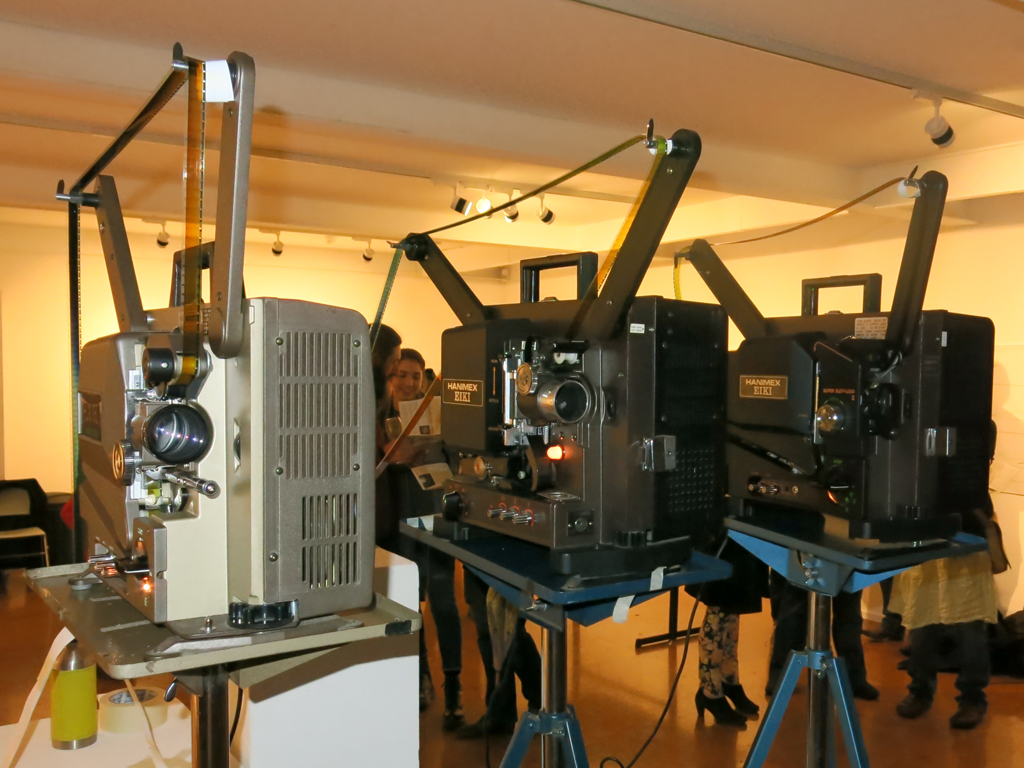
Louise Curham gently manipulates the super 8 projectors
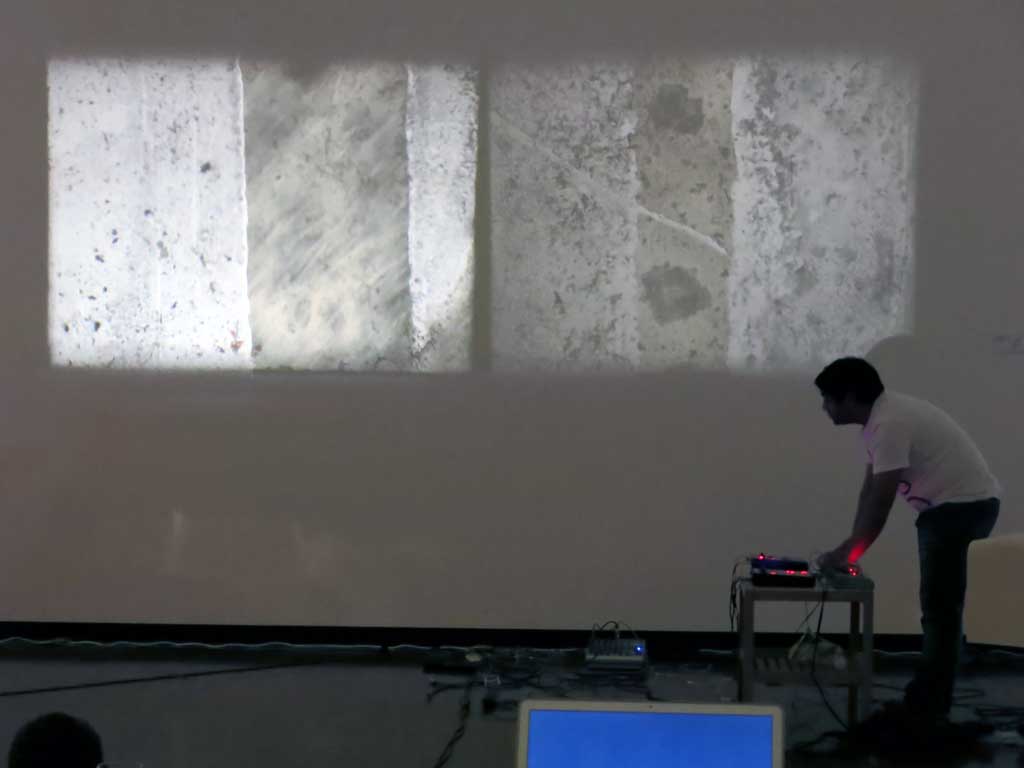
Shoeb Ahmad and Louise Curham’s projections

Ross Manning’s standing wave percussion

ANU School of Art Photography and Media Arts Students perform with Ross Manning

ANU School of Art Photography and Media Art and Painting handmade film projection

ANU School of Art Photography and Media Art and Painting handmade film projection

ANU School of Art Photography and Media Art and Painting handmade film projection

Photography and Media Arts projection on ANU Drill Hall exterior
My article on Australiana photobooks of the 1960s has finally come out. Follow this link to the History of Photography journal to get my citation rate up!.


Now that his trial has faded in our memories it is possible to take stock of the new punishment spectacles being developed in our society. In this case the body of the condemned was not available for public torture, but his self-caricature of a face — thick glasses, fussily groomed facial hair, and lasciviously darting tongue (always, we realised, incipiently Mephistophelian) — still haunted our memories. But this man was an entertainer, a creator, and even an artist of sorts. This not only made us, his naive and innocent audience, obscurely sinned against as well, but it also conveniently left us with a stock of his works — songs, paintings and murals — which through a process of sympathetic magic could substitute for his body. We could pillory these instead. Songs were ceremoniously removed from playlists, murals were ceremoniously painted over, and so on. Individuals took it upon themselves to correct the collective historical record on all of our behalves. The works destroyed or erased weren’t great, and weren’t even, in the end, all that numerous, but nonetheless I found this medieval hysteria worrying. Because of his crimes he may have forfeited some of his rights, but not his moral rights as an artist. Who will be next?

Rolf mural painted over in red paint

Rolf mural painted over in red paint
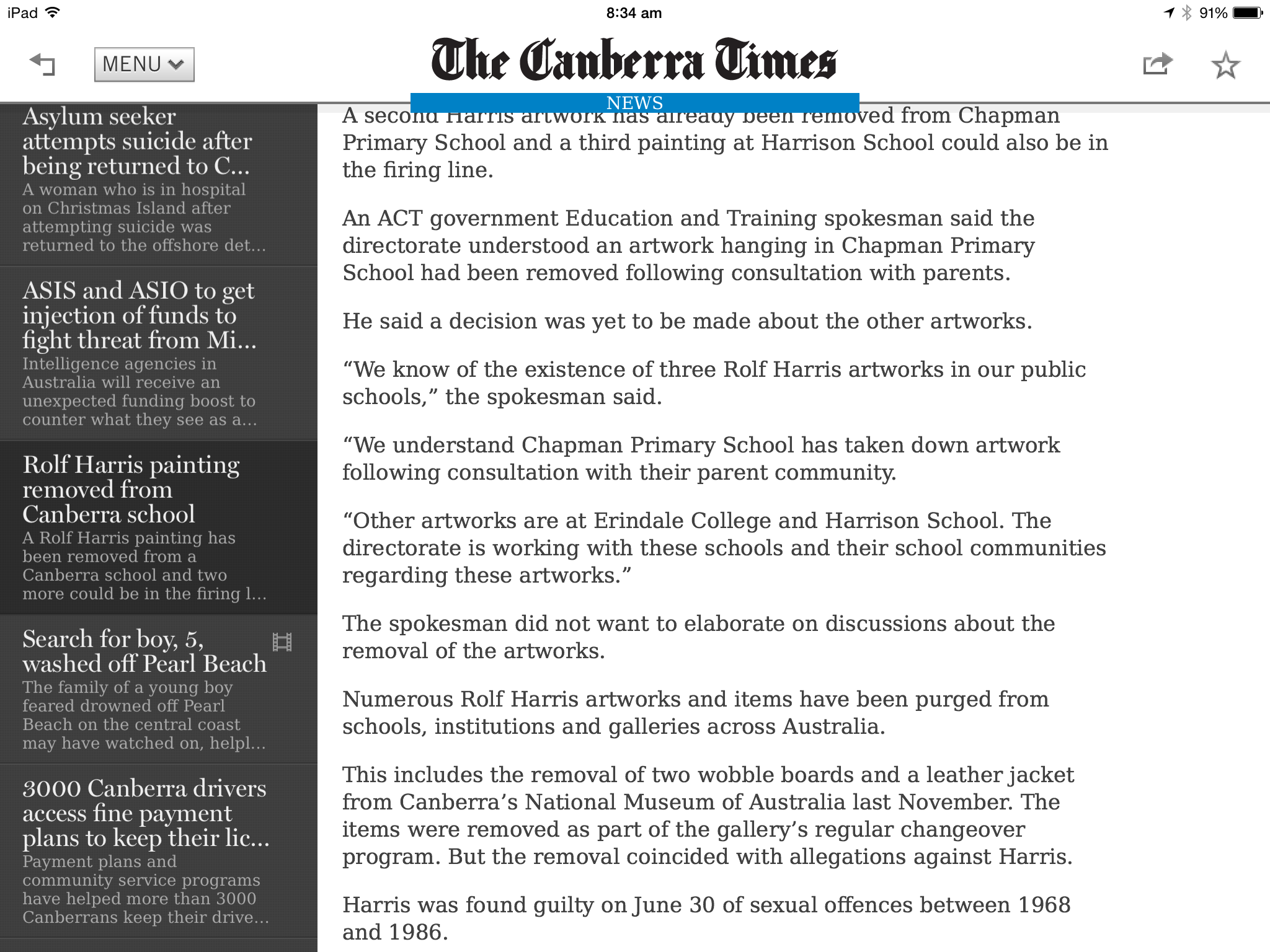
Rolf mural painted over in red paint

Rolf replaced in entertainer’s mural
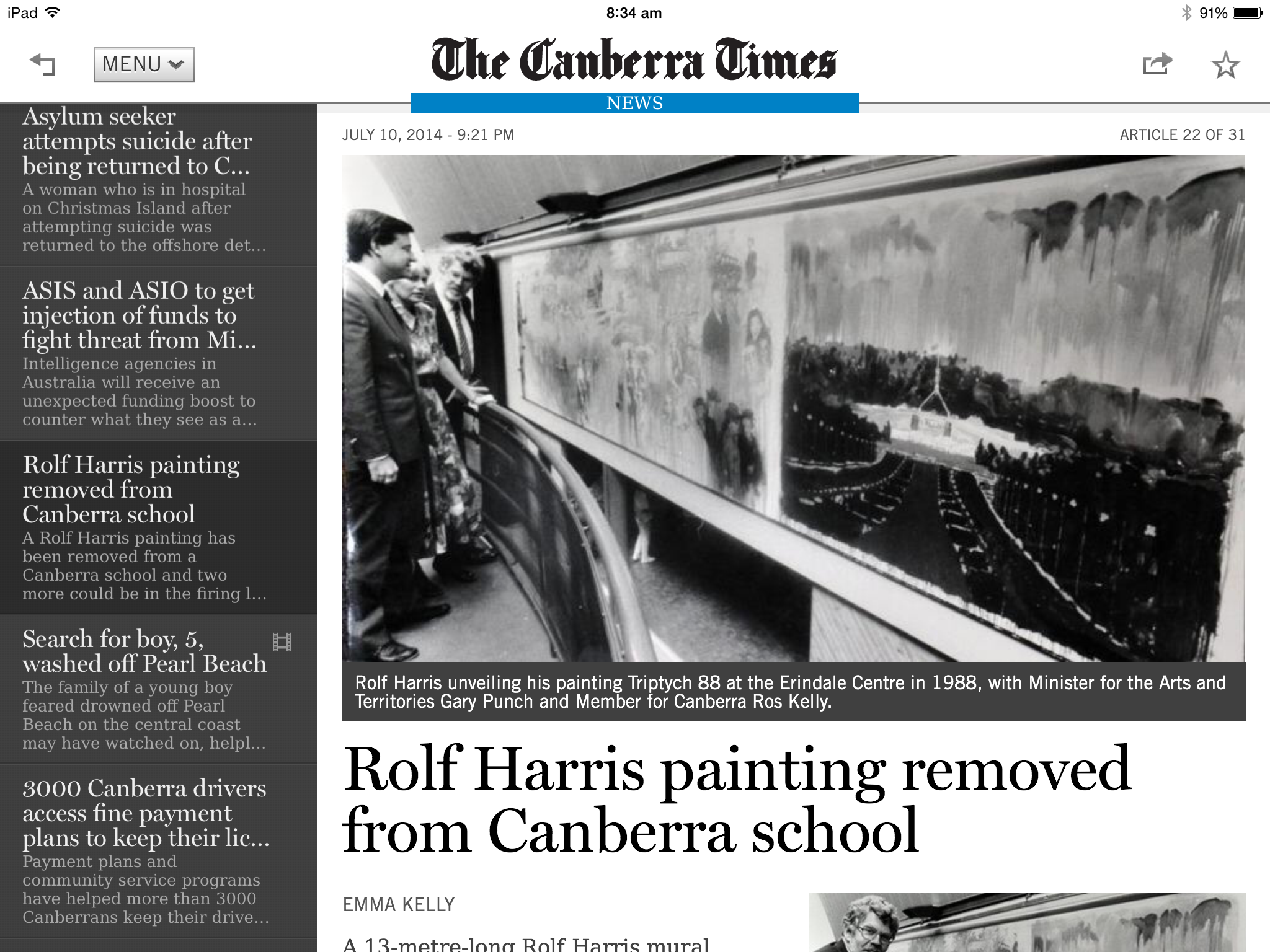
Rolf painting removed from Canberra school

Rolf painting removed from Canberra school

Rolf’s portrait removed from National Portrait Gallery
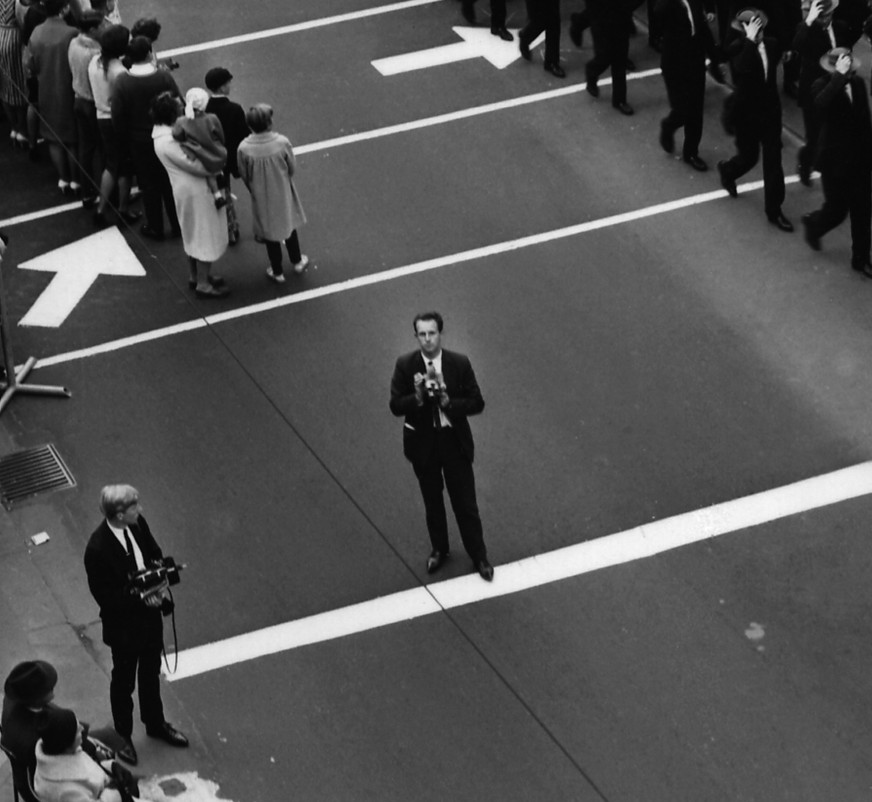
Great to see that the European Court of Human Rights has just upheld France’s 2010 ban on the burka. No doubt the French quoted Emmanuel Levinas from Totality and Infinity: ‘The face opens the primordial discourse whose first word is obligation’ (p201). But despite this enlightened ban, France’s poorly written, post-Diana anti-paparazzi, privacy laws, in particular article 9 of the Civil Code and article 226-1 of the Penal Code, still mean that street photographers are routinely harassed on Parisean streets by people who believe their right of privacy, or their ‘proprietorial ownership’ of their own face, extends into civic space — thus closing down the street as a space to truly ‘live together’. What about some droits for photographes too?
A new word needs to be invented for performances such as Teaching and Learning Cinema’s (Louise Curham and Lucas Ihlein) performance of Malcolm le Grice’s Horror Film 1 (1971) and Guy Sherwin’s (Wo)man with a Mirror (1976), which happened yesterday at Canberra Contemporary Art Space and was, by the way, a top wet-Saturday-arvo’s excursion. Although based on meticulous historical research, they weren’t re-enactments in the sense that Civil War re-enactors re-fight old battles, because they acknowledged that the formal and historical terms of the aesthetic battles to be fought have evolved since their first iteration (so performer-gender and sometimes media had to be changed); nor were they playing a score like an orchestra, because they were referring not to an originary written document but an originary ephemeral event (or even events). ‘Re-presentation’ or ‘re-iteration’ sound too passive and boring. Perhaps to keep the military metaphor going we could use ‘re-engagement’? One thing’s for certain a new word is going to be needed for sure because, although of course the Madonna of performance art Marina Ambramovic has ‘re-engaging’ with the performance art canon for years, more and more other people in video, performance, silent cinema, pre-cinema, theatre, as well as Louise and Lucas’s beloved expanded cinema are going to be doing it in the future.

Re-engagement with Sherwin’s Man with a Mirror at CCAS, by Teaching and Learning Cinema
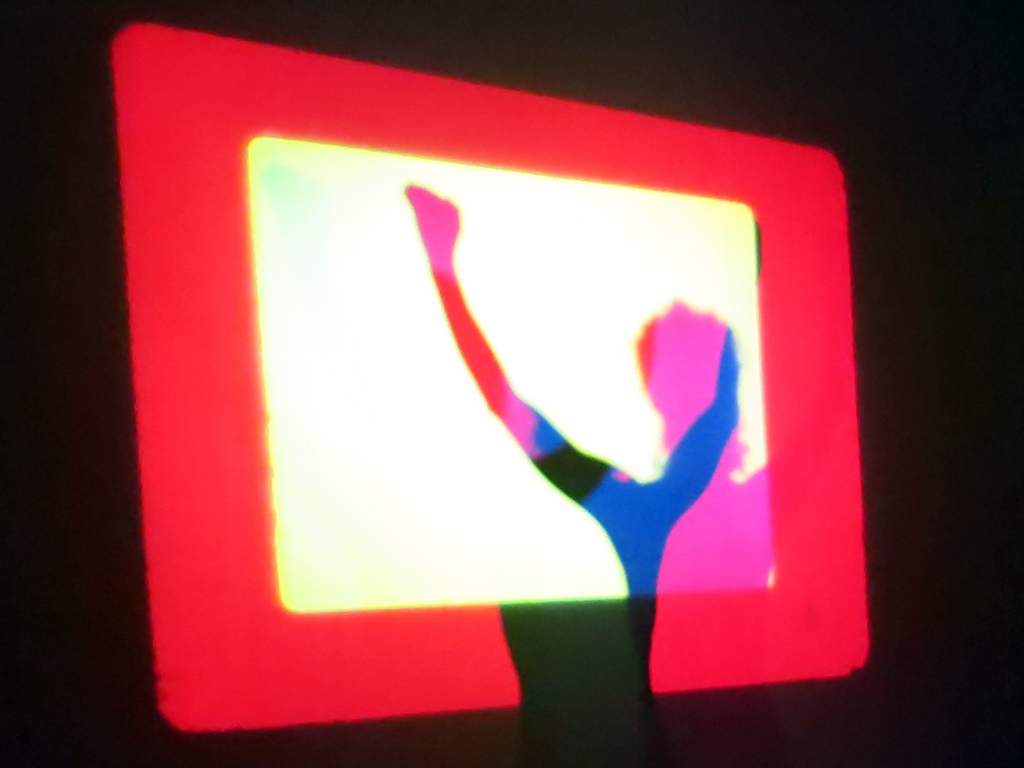
Re-engagement with Le Grice’s Horror Film 1 at CCAS, by Teaching and Learning Cinema
Ready to go
 Martyn Jolly