Braddon, Bloody Braddon

From the program to the

You Are Here Festival

March 18-22 2015

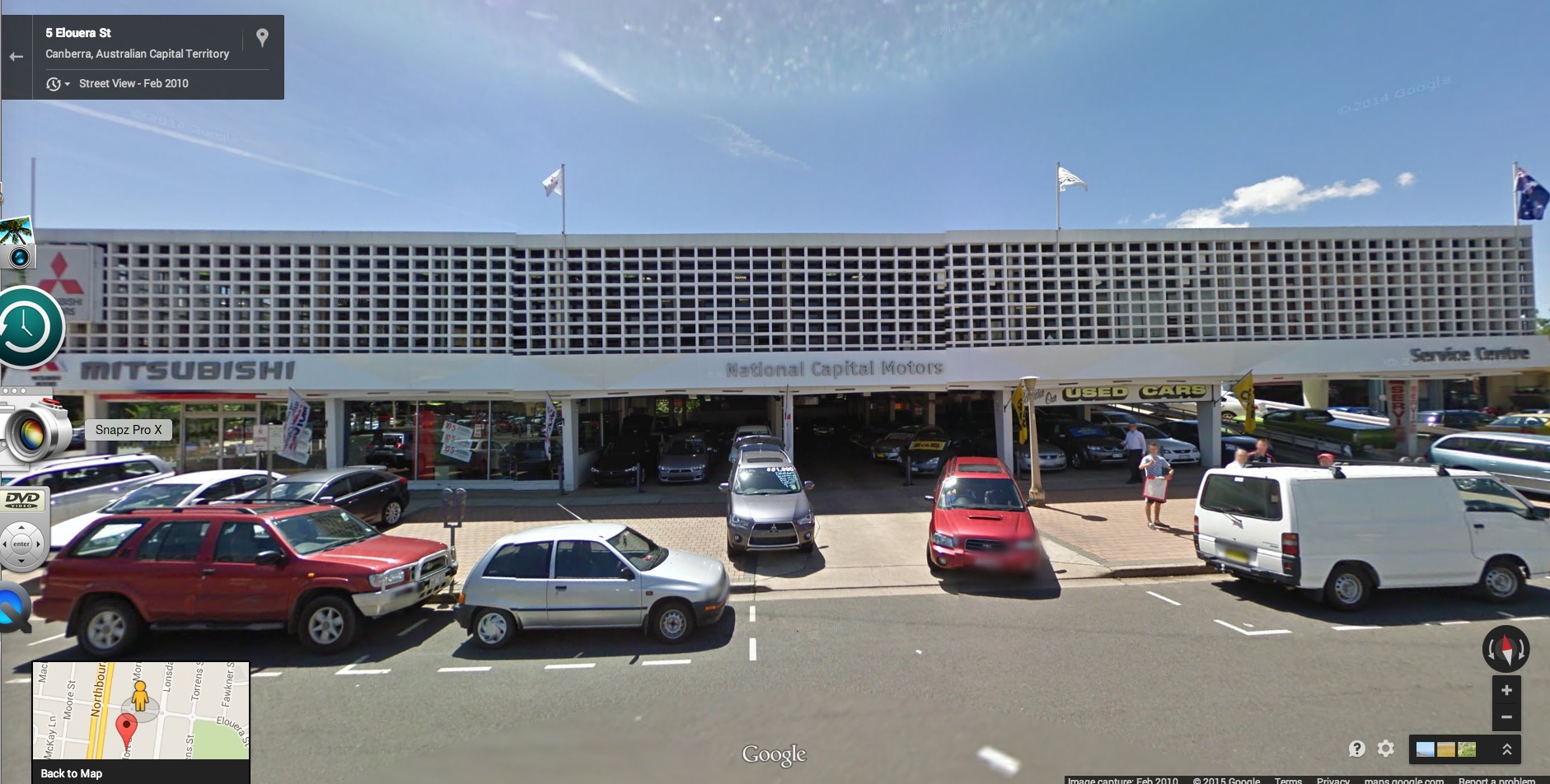
National Capital Motors from Google Street View

National Capital Motors from Google Street View

Braddon

The world snorted with derision when, for the second year in a row, the OECD nominated Canberra as the world’s best city. Critics pointed out that, although it had come out with the biggest numbers in the OECD’s nine ‘wellbeing indicators’, which included education, jobs, incomes and environment, this did not make for a great city. In fact, they chortled, Canberra is a terrible city. In The Guardian’s words: ‘Canberra is a deathly place.  It is a city conceived as a monument to the roundabout and the retail park, a bleak and relentless landscape of axial boulevards and manicured verges, dotted with puffed-up state buildings and gigantic shopping sheds. It is what a city looks like when it is left to politicians to plan.’ None of that is wrong (the ‘gigantic shopping sheds’ bit is particularly right). But it is very much an attenuated view from lofty London that begs many questions for those of us who are actually making a go of living here. For instance, maybe its monumental conception — Griffin’s grand design for utopian civic virtues — gives our city its brittly surreal, hyperreally heterotopic character for which many of us have developed a cool, wry affection. And maybe some of us like the regular irruptions into our day-to-day travels of raw bush and depthless sky, afforded by the skeletal nature of the relentless axial boulevards. And those axes have also begun to shelter at their fulcrums some fragile urban micro-climates which have slowly been developing over the years.

Since the 1960s, coincidentally Canberra’s heyday, urban discourse has shifted from the macro of the master plan to the micro of the precinct —the local area dense with textures, memories and experiences. Since the 1960s, across the world and without exception, many neighbourhoods of poverty or industry have been remade as waves of gentrification have swept over them. Artists have been the shock troops, reinforced by designers and architects, and followed by developers and trendies in a pattern as familiar and repeated as the tides. For fifty years urbanists have become adept at sniffing out the fluctuating nuances of the ‘local’ as waves of gentrification sweep back and forth. Antonioni’s 1966 masterpiece Blow Up, set in swinging London, is not only a film about the limits of knowledge in photography, it is also a film about the ever-transforming psycho-geographies of the postwar city. In his restless need to have everything he sees, the photographer visits a quiet nondescript London street to see a rundown junk shop he wants to buy. As soon as he notices two gay men incongruously walking a poodle there he knows, and the audience knows, that the local area’s character is already changing, and he must snap up the shop quickly. In Blow Up nothing is stable and nothing, not even the city, can ever completely becomes as it seems, before it must become something else. This is now the state for every city in the world, even Canberra.

For instance, ranged around the urban doughnut-hole of Civic are separated sites of local regeneration such as New Acton, Childers Street and Braddon. Of these perhaps only the transformation which Braddon is currently undergoing is intimately and intricately embedded in its past, however brief and prosaic that past may be. Braddon is basically only three parallel streets, and its car yards, hardware stores, panel beaters, takeaways and camping shops are only gradually giving way to coffee shops, restaurants, boutiques, bike shops and apartments. On their brief visit to Canberra the New York Times was kinder than The Guardian, identifying Braddon as Canberra’s ‘decidedly hipster underbelly’.

Pioneers such as the Helen Maxwell Gallery, once upstairs on Mort Street, predicted this urban renaissance many years ago, but couldn’t survive long enough to benefit from it; and some of the temporary pop-ups (who for a few months kept real estate spots warm before the temporary fencing went up around them) such as The Chop Shop, which was briefly located down an alley in Lonsdale Street, recognized past usages in their names. This rich and dense texture was just what sophisticated urbanists want, and is certainly what Canberra needs, probably more so than all the other ‘normal’ cities on the planet, so who am I to quibble?

Only to wish that because Canberra is different, there is the utmost delicacy as Braddon continues its inexorable makeover. Of course delicate urban renewal is what everyone wants, not least the developers themselves who love underbellies just like the rest of us, and for whom creative grunge has an intangible commercial value if handled correctly. But when it comes to the bottom line of the balance sheet, where income has to be plotted against expenditure down to the last percentile point over each individual square metre, the delicate presence of the past, or the tenuous tenancy of the under resourced, sometimes still lose out.

For instance Braddon has always been a car precinct (just as Canberra has always been a car city). From 1920 it was the site of Canberra Garage Limited, servicing the city’s fleet; and up until just a few years ago rev heads would spend their Saturday nights cruising up and down past the car yards, doing the circuit by languidly swinging round the roundabouts at Lonsdale and Torrens Streets; every now again pulling into the Caltex near the Mandalay at Girrawheen Street to pop their hoods for the admiring gazes of their mates; sometimes even attempting a burnout at the top of Lonsdale Street. If they ever ventured back to Braddon now the only circling they would be doing would be looking for a park.

One of the handsomest facades in Braddon was the delicate, white, open brickwork curtain that surrounded National Capital Motors on the corner of Mort and Elouera streets (perhaps the original site of Canberra Garage Limited?). But that piece of delightful architectural texture was flicked over like a house of cards to be replaced by a building of depressing, generic nastiness, with less architectural charm than the Centrelink office around the corner. All of the acres of recycled, undressed timber cladding, Dynabolted to the newly poured concrete walls of Braddon, can’t replace the authenticity of that lost texture. The only ghost I can find now of the facade is on Google Street View. The Google car had driven by National Capital Motors in 2010 and, thankfully, hasn’t been back to Braddon since. When it eventually does come back it will find quite a bit changed, but will implacably wipe away all the old ghosts with one sweep of its robotic camera.

In the meantime the de-Fyshwicking of Braddon continues, and for the pedestrian the mingling smells of gasoline and grease are regularly displaced by doughy, oily, blasts of hot air from each successive bistro kitchen’s exhaust. The pop-ups have popped off, and replacement aluminum and glass apartments have been cad-cammed into instantaneous existence. Street shop fronts have become enclosed retail experiences, and the artists left walking outside on the streets of Canberra’s erstwhile underbelly are beginning to feel the backs of their necks prickling as they are distantly surveilled by the area’s new residents from their be-Webered fifth-floor balconies.

These changes to Braddon are not just inevitable, they will probably end up being, on balance, ultimately good for Canberra too. They are nearly identical to the changes in a thousand similar inner city neighbourhoods around the world. But only nearly identical, not completely identical, because Canberra is different, Canberra, as we are frequently reminded by the rest of the world, is a special case. This makes any more than an absolutely necessary lack of delicacy in the ongoing gentrification of Braddon especially tragic, not that there will be of course.

Martyn Jolly (Thanks to Erin Hinton and Ursula Frederick for the tip-offs)

Oliver Wainwright, ‘50 years of gentrification: will all our cities turn into ‘deathly’ Canberra?’, The Guardian, 13 December, 2014

Emma Pearse, ‘36 Hours in Canberra, Australia’, New York Times, 5 June 2014

National Capital Motors from Google Street View
National Capital Motors from Google Street View
Thinking the Photobook Forum — Photobook Melbourne

I’m taking part in the forum Thinking the Photobook, as part of Photobook Melbourne. It’s on at ‘The Baron Said’, 83 Kerr Street Fitzroy, 5.30pm Sunday 15 February. What will I be talking about?

Question: How many Australian photobooks are in Parr and Badger’s massive, and massively selling, three volume encyclopaedia of almost 1000 photobooks?

Answer: Two only that I can find (Sleeth and Parke)

Question: Why are there so few?

Answer: Good question.

Beforehand Lee Grant is launching her new China book at the CCP, just up the road, at 3pm.

Uncanny Bracket Creep at In The Flesh, National Portrait Gallery

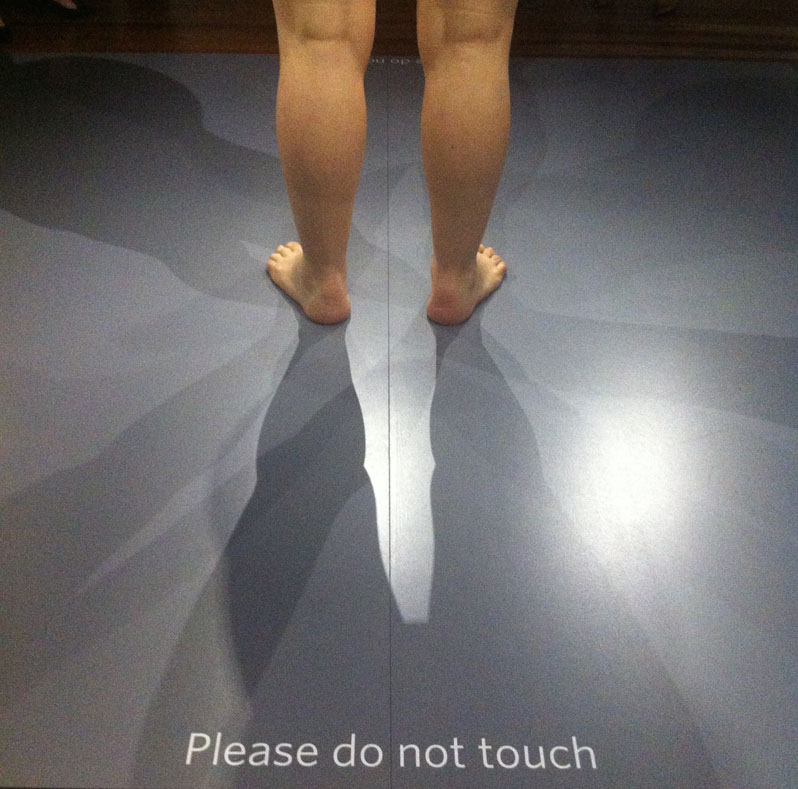
Did I experience ‘uncanny bracket creep’ last night at the National Portrait Gallery, at In the Flesh? I remember the little intake of breath I took ten or so years ago when I saw my first Ron Mueck or Patricia Piccinini sculpture, or the little retinal undulation at my first glimpse of a figure flipping for a few milliseconds between the real and the unreal. But seeing the same sculptures again now, palisaded  behind their PLEASE DO NOT TOUCH SIGNS, and theatrically lit like David Jones manikins, all I saw was plastic. Was I like an avid cinema goer in the 1950s who had viscerally  thrilled at King Kong in 1930s, but seeing him again at the drive-in was able to finally laugh off his plasticine jerks? Had the general advances of the technologies of verisimilitude retrained my sensorium, and rehoned my perceptual scepticism, leaving these sculptures behind along with all the other uncanny automata going back to the eighteenth century?

In the Flesh, National Portrait Gallery

In the Flesh, National Portrait Gallery

Profiled in United States Magic Lantern Society News, October 2014

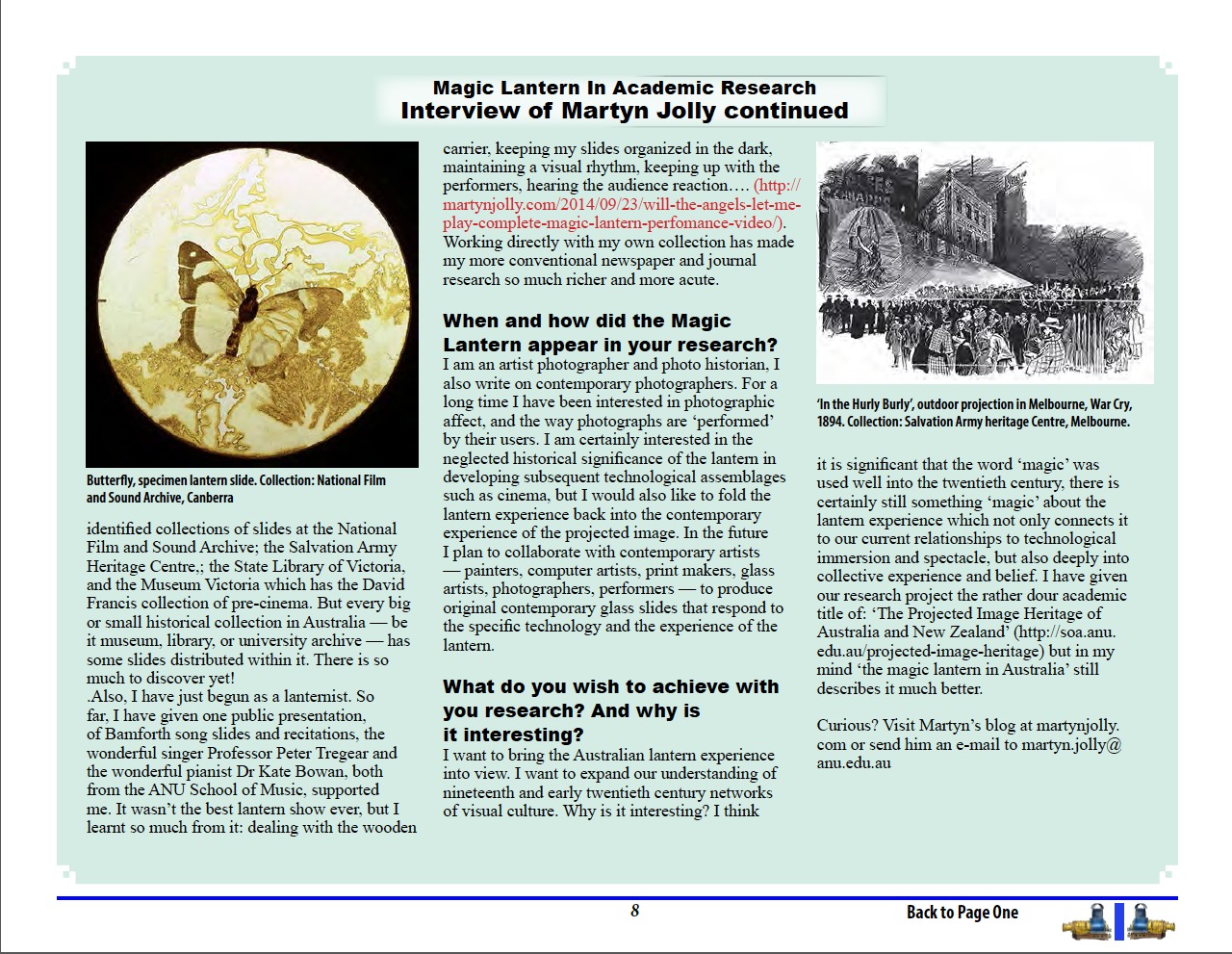
Sarah Dellmann, from the Department of Media and Culture Studies, Utrecht University, kindly profiled my research in the newsletter of the Magic Lantern Society of the United Stats and Canada. The relevant pages are below. The newsletters of both the UK and US societies are always chock full of interesting stuff, and as Sarah demonstrates connect enthusiasts and collectors and researchers.

Magic Lantern Society News, October 2014

Magic Lantern Society News, October 2014

Magic Lantern Society News, October 2014

Magic Lantern Society News, October 2014

Magic Lantern Society Newsletter

Will the Angels Let Me Play — complete magic lantern perfomance video

On July 24, 2014, I was able to project a show of five magic lantern song-slide sets and one recitation set from my ‘Iron Duke’ lantern of 1905, with some additional effects added from a smaller 1890s lantern. Professor Peter Tregear and Dr Kate Bowan from the ANU School of Music sang and played the original words and music, and they were fabulous. Trevor Anderson from the National Film and Sound Archive also operated the ‘effects’ lantern for the angel effect in Jane Conquest. The event was part of the History, Cinema Digital Archives organised by Jill Matthews from the Humanities Research Centre and held in the theatrette of the NFSA. Here is our original abstract:

Martyn Jolly, Kate Bowan and Peter Tregear: ‘Will the Angels Let Me Play’, and other songs and recitations: a performance of magic lantern slides with song and piano

Collections such as the National Film and Sound Archive or Museum Victoria hold hundreds of magic lantern ‘song slides’. These sets of hand-coloured glass transparencies were produced in the early twentieth century to promote the sale of the sheet music for popular songs. They were projected by a magic lantern and accompanied by musicians and singers. Their popularity peaked with the First World War. The slides that remain, with their sentimental and melodramatic storylines, surreal photographic montages, and lurid hand-colouring, are still fascinating when we see them on the museum light box, or see the digitized copy in a museum database. But they were made to be performed, and were part of a technical ensemble which included the magic lantern, a musician’s performance and, most importantly, a singer’s voice. For this presentation this complete ensemble will be brought together once more, the slides will be projected by vintage magic lanterns and accompanied by live music and singing from the original sheet music. Will this be a reenactment, like we might see at an historical theme park? Or will it be authentic interpretation, such as an early music ensemble might perform on their antique instruments in a concert hall? Why bother with an original magic lantern when the optics and resolution of a contemporary scanner and data projector can reveal more detail more conveniently? And, no matter how brilliant the performers are, is it even possible to re-enter the affective power of a long ago performance when so much has changed in the meantime? Through this practice-led research experiment, and through subsequent discussion with the audience, these questions and other will be explored.

Bronwyn Coupe has now edited a video of the complete performance, cunningly disguising my mistakes with edited-in digital copies of a few of the slides, but retaining the flavour of my projections, and the brilliance of Kate and Peter. Here it is:

Will the Angels Let Me Play and other songs and recitations, a performance re-enactment for magic lantern, voice and piano

I learnt a lot from the experience. Fortunately I had Ian Christie turning the pages of my cue sheets for me, otherwise I wouldn’t have been able to keep up with the changes for any of the songs! As it was I muddled two. Despite my rehearsals I need to have a better system for quickly accessing the slides in the dark, I was scrabbling around. I also think I should have realised that there was a certain amount of redundancy built into the slide sets by the manufacturers, and I could have left some out which would have given me more time to load the slide changer. The authority and smoothness (or lack of it) with which I changed and focussed the slides also became very important for the audience’s experience. The light levels in the auditorium— to satisfy both projection from the lanterns with their relatively low-lumen output from the LED floodlights I had in them, as well as the necessity for Kate and Peter to be able to read the music — was also crucial. I have been reading nineteenth and early twentieth century newspaper review of lantern shows in Australia and exactly these same issues are frequently reported on — both negatively and positively — by the writers. The audience discussion afterwards didn’t decisively answer any of the questions raised in the abstract. However it covered the historical accuracy, or inaccuracy, of our ‘re-enactment’ — a big issue with some of the experts in the audience — and the general visual culture of the period — in both America and the UK where the slides were made, and in Australia where they were shown. Also discussed were small but crucial details such as the lack of gain in the painted wall on which I was projecting, compared to the modern cinema screen on which the digital versions were projected. But there was enough there to go on with.

See magic lantern show simulation videos here

Below are simulations I reconstructed using digital copies of the slides we projected at the National Film and Sound Archive performance, and an NFSA recording of Peter Tregear and Kate Bowan’s wonderful performance. Unfortunately, in this recording Kate’s perfect piano is somewhat soft, except in Blue Bell and Holy City.  I’ve selected two transitions from the video editing menu: a dissolve, which I wasn’t able to do on the night, but which was a very popular effect in the nineteenth century; and left-to-right/right-to-left slide transitions, which at least give a hint of the mechanical slide changer I used, but which are a lot smoother than mine! Unsimulated is the flame effect I produced in the window during Jane Conquest by flashing some red gel in front of the lens.

Pictures from ANU School of Art and Drill Hall Gallery night of ‘Colour Music’ performances

Louise Curham gently manipulates the super 8 projectors

Louise Curham gently manipulates the super 8 projectors

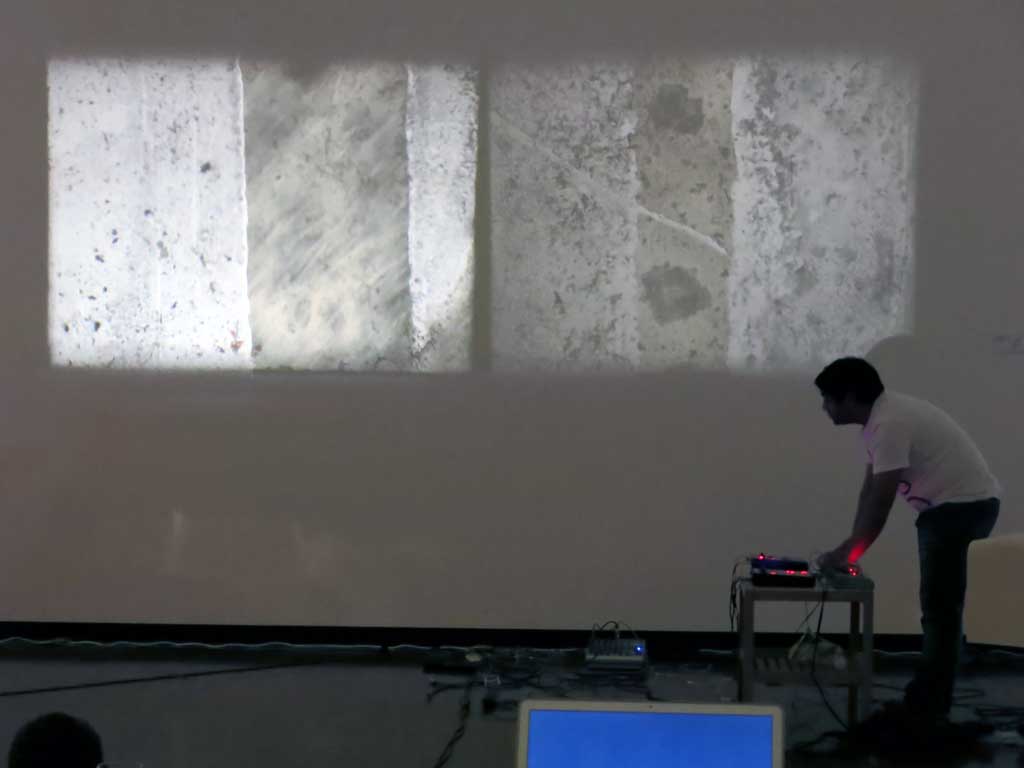
Shoeb Ahmad and Louise Curham's projections

Shoeb Ahmad and Louise Curham’s projections

Ross Manning's standing wave percussion

Ross Manning’s standing wave percussion

ANU School of Art Photography and Media Arts Students perform with Ross Manning

ANU School of Art Photography and Media Arts Students perform with Ross Manning

ANU School of Art Photography and Media Art and Painting handmade film projection

ANU School of Art Photography and Media Art and Painting handmade film projection

ANU School of Art Photography and Media Art and Painting handmade film projection

ANU School of Art Photography and Media Art and Painting handmade film projection

ANU School of Art Photography and Media Art and Painting handmade film projection

ANU School of Art Photography and Media Art and Painting handmade film projection

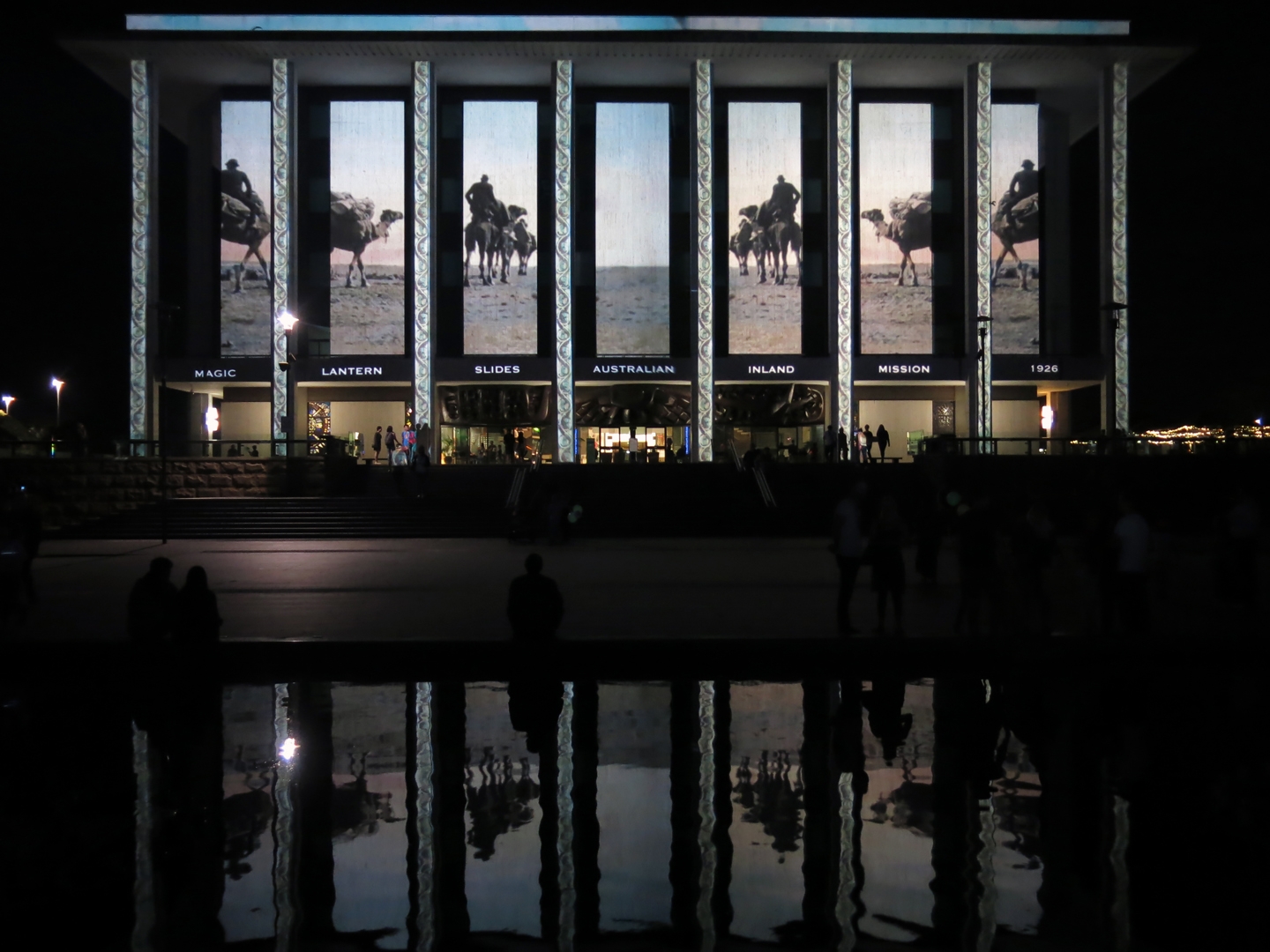
Photography and Media Arts projection on ANU Drill Hall exterior

Photography and Media Arts projection on ANU Drill Hall exterior

Rolfoclasm

Now that his trial has faded in our memories it is possible to take stock of the new punishment spectacles being developed in our society. In this case the body of the condemned was not available for public torture, but his self-caricature of a face — thick glasses, fussily groomed facial hair, and  lasciviously darting tongue (always, we realised, incipiently Mephistophelian) — still haunted our memories. But this man was an entertainer, a creator, and even an artist of sorts. This not only made us, his naive and innocent audience, obscurely sinned against as well, but it also conveniently left us with a stock of his works — songs, paintings and murals — which through a process of sympathetic magic could substitute for his body. We could pillory these instead. Songs were ceremoniously  removed from playlists, murals were ceremoniously painted over, and so on. Individuals took it upon themselves to correct the collective historical record on all of our behalves. The works destroyed or erased weren’t great, and weren’t even, in the end, all that numerous, but nonetheless I found this medieval hysteria worrying. Because of his crimes he may have forfeited some of his rights, but not his moral rights as an artist. Who will be next?

Rolf mural painted over in red paint

Rolf mural painted over in red paint

Rolf mural painted over in red paint

Rolf mural painted over in red paint

Rolf mural painted over in red paint

Rolf mural painted over in red paint

Rolf replaced in entertainer's mural

Rolf replaced in entertainer’s mural

Rolf painting removed from Canberra school

Rolf painting removed from Canberra school

Rolf painting removed from Canberra school

Rolf painting removed from Canberra school

Rolf's portrait removed from National Portrait Gallery

Rolf’s portrait removed from National Portrait Gallery