Anne Zahalka: Privacy, Publicity and Inhabitation

‘Anne Zahalka: spurs of the moment’, Art & Text, Number 54, April, 1996

Throughout its short history photography has had a special relationship with both privacy and publicity. It was invented during a period when the domestic sphere of social organisation was reaching new levels of importance. But it also inaugurated the era of mass media and the age of publicity. Photography redefined both the living room and the street.

On one hand photography became the ultimate medium of private communication. Under the rule of painting and its various genres portraiture had been fundamentally declarative—of wealth, status and ideology. With photography it became confessional—of desire, personal obligation and sheer bodily existence. For centuries portraits had been coolly assembled by trained experts out of a generic lexicon of social signifiers—costume, pose, accoutrements. With photography portraits became both more popular, and warmer. They were physically warmed by the cosy fires of the domestic mantelpieces on which they sat, or by the loving bodies against which they nestled; and spiritually warmed by the intimate urgencies they conveyed as mothers looked out of them at their sons who were far from home, or lovers used them to steal secret glances at each other. The inevitable accidents of amateur photography became part of portraiture’s poignancy—the random details, slight blurs and fleeting expressions becoming, in Barthes’s words, punctums to pierce the heart.

But on the other hand photography also represented the public to itself. As Benjamin pointed out, in the nineteenth century urban crowds not only came to dominate the social landscape, but also to demand that they themselves be portrayed, just “as the patrons did in the paintings of the Middle Ages.” . Benjamin recognised that in the twentieth century “mass movements, including war, constitute a form of human behaviour which particularly favours mechanical equipment”.  In the age of mass reproduction the masses best reproduced themselves through photography and film. Countless carefully orchestrated revolutions, rallies and sporting events since have confirmed his observation. Our experience of urban space has been slowly re-engineered by photography and film, and we are all now well used to imagining ourselves as civic actors, visible to ourselves every day in the crowds on the street.

Photography was therefore intractably intertwined with the social, architectural and technological changes which produced our modern conceptions of private and public relations, and domestic and civic spaces. In this context Anne Zahalka’s photographic work can be read as a response to recent changes in these fundamental categories of modernity.

Zahalka first began to work with portraiture in the 1987 series Resemblance, which were based on Dutch genre paintings. The delight audiences experienced in the elegant luxury of these large chromogenic prints, and their satisfying recognition of the art historical citations encoded into the images, perhaps masked what was most interesting about the works—the challenge they presented to our current conventions of photographic portraiture. Taking photographs which were intended to function, at least on one level, as ‘real’ portraits of contemporary people, but within a post modern quotational style referring to a painting genre which had been functionally redundant but aesthetically valorised for four centuries, stretched the assumptions underpinning our conventions of candid portraiture. But by jettisoning all of the casual punctums of the candid portrait in favour of cold generic citation Zahalka was potentially doing more than merely glibly tweaking portraiture’s re-conventionalised stylistics. Perhaps she was also engaged in a full blown documentary project, a social taxonomy of her historical period which, like August Sander’s Men of the Twentieth Century, choose its format and style to fully embody the temper of the times.

Side by side with her interest in portraiture Zahalka also pursued an examination of urban geography which she also regarded as a set of received spatial and iconic conventions to be parodied and pastiched. For instance in her Bondi: Playground of the Pacific 1989 series the famous beach was reduced to a painted backdrop for a staged re-enactment of various tableaus of multicultural nationhood. And in an earlier, charming series of straight photographs, precise points of view were chosen to deconstruct Centrepoint Tower’s iconic eminence over Sydney by, for instance, photographing it so that it appeared to be just another chimney sprouting from the roof of a suburban factory.

Both these long standing  interests have culminated in two recent series of large backlit transparencies. The Open House 1995 series are portrait tableau vivants staged by members of Sydney’s artistic beau monde within their authentic domestic environments. Fortresses and Frontiers 1993 are views taken in a recognisable Sydney, but of strangely redolent, heterotopic spaces. In some of these views various figures—everything from zoo animals to office workers—appear in a kind of purposeful but suspended pose.

The tableaus of the Open House series allow a kind of visual anthropology of some of Sydney’s domestic spaces. The meticulous art direction of the images, and the attention to the clothes, pose and gesture of the sitters, invites objective scrutiny. But on each of these carefully prepared stages a scene of slight, ambiguous domestic tension is also being enacted. These repeated domestic scenarios tell a story about the fundamental apartness of people, their ‘public’ selfconsciousness even within the bosom of the private. Zahalka’s living room inhabitants submit themselves to self display in the same way we all unconsciously ‘gather ourself’ the moment we step outside our front door. They are as aware of the other people around them, but as unresponsive, as people forced to share a seat on the bus.

In Fortresses and Frontiers Zahalka has set up a series of ironic visual relationships within each urban space. For instance in one image a lonely giraffe in the middle of a bare enclosure at Taronga Park Zoo looks out over the Harbour at the distant capitalist spires of Sydney. In another, a similarly lonely salary man carries his briefcase across a concrete walkway towards the same spires, now turned sulphurically brazen by the setting sun. In a third image a homeless man sits and waits for the evening tennis players from the brightly lit courts in the background to go home, before settling down for the night in a bizarre, cave-like, moulded concrete park shelter. (At Roslyn Oxley9 Gallery this image was hung next to another zoo image of several mountain goats resting on top of a similar concrete.)

In these deliberately ironic juxtapositions Zahalka isn’t revealing anything to us which isn’t already known and acknowledged by the city itself. Everybody has always known that the city is a ‘human zoo’, Zahalka is simply declaring what the city explicitly states on its own behalf every day. However by using these ‘concrete jungle’ cliches, Zahalka has managed to flatter the city into declaring its own implicit boundaries between the public and the private.

To be homeless in the city is to virtually cease to exist, so the two tennis players ignore the homeless man as they walk home after their game. He is a nocturnal, nomadic ‘urban caveman’, waiting in the shadows until it is late enough for the park, and his rustic shelter, to invert their designated function and become his private space. The potentially threatening indeterminacy of city space is also present in images such as the one of children playing on some bright, new, council playground equipment. But the children are playing at night, they have strayed outside their designated temporal zone in the city’s strict diurnal timetable, and a threatening shadow is phallically casting itself towards them. Fortresses and Frontiers documents the shifting physical and temporal boundaries of the city, and the dissolution into each other of the categories of public and private

For Zahalka the fluorescent light boxes on which her large transparencies are mounted refer to the preferred display technology of upmarket advertising, most commonly seen in airport concourses. Photography, film and TV have produced the airport as the key symbol of contemporary de-spatialisation—an affectless, shadowless interzone where will and autonomy are drained and subjectivity itself seems threatened. Airport light box ads for mobile phones, digital watches and other re-assuring accoutrements have a similar ambience to Zahalka’s work—they are declarative, yet inert.

Her light boxes produce quite a different effect to the grand ‘epic of the everyday’ scenes of Jeff Wall. There is no real sense of psychological or phenomenological experience in her images, and no sense of time—no sense of a moment on the verge of either explosion or implosion, as in Wall. Zahalka’s images are deliberately assembled with an art director’s imperative to leave nothing to chance, to leave no potentially disruptive visual excess or scenographic residue. All of her photographs are resolutely expository. They are lit and considered from corner to corner and edge to edge, and evenly irradiate refrigerated light. Even when atmospheric moods are employed, as in some of the Fortresses and Frontiers series, the lighting effects are so deliberately emplaced, and conform to such a corporate vision throughout the series, that they immediately declare themselves before the viewers eyes. All of this gives her images a curious inertness, despite their monumental visual exertions.

The two tennis players walking along the pathway in the background of the homeless man image from Fortresses and Frontiers are friends of the artist conscripted to play the part. But in a complete reversal of the ethic of the street photograph the camera doesn’t instantaneously capture them in mid stride, rather they are photographed standing in the attitude of walking—one foot held suspended, the tennis racket clenched at a particular angle—waiting patiently for the exposure to finish. But in their frozen movement they are not absorbed into the moment either, they are not like those figures seen in nineteenth century city views eternally poised getting their shoes shined. Time has not accreted around their stillness because Zahalka’s figures are already drained of blood and subjectivity.

This reverses the usual relationship between city and citizen. The citizen becomes the scenographic cut out against which the city acts itself out. It is the city which glows and shines, pulses and beckons. Her characters do not even serve the emblematic role of the figures conventionally found in the foreground of picturesque landscapes, they are not there to draw the viewer into the scene, but to confirm an unbridgeable abyss between the new imagistic virtual space of the city and the phenomenological space of the viewer.

Similarly, in the staged tableaus of Open House, the poses are directed to such an excruciating pitch, and held in such a deliberate way by her sitters, as to be neither ‘people posing for their portrait’, nor ‘people acting out a part’. The lighting is arranged to evenly illuminate every surface, every nook and cranny of the room, so the sitters almost become extensions of their furniture, materially continuous with their possessions. The clutter of each house is art directed to within an inch of its life, doing double duty as contemporary clutter, and second degree signifiers of social meaning á la Dutch portraiture. But in contrast to Dutch painting, in these light boxes there is no sumptuous thickness of paint for the ‘thingness’ of their possessions to grow into, no implacably ineffable expressions caught in a few enigmatic brush strokes and presented to our endless curiosity. Instead, brutally irradiated by fluorescent light, the domestic tableaus become almost forensically explicit. As in Fortresses and Frontiers the tableaus are not acted out, but instead enacted in a curiously constricted way.

Zahalka has cited TV sit coms as a point of reference for these works. And those ‘personalities’—actor/character hybrids who live out their lives in three-walled rooms, repeating the same hyperdomestic patterns under the shadowless, public glare of TV lights—could be the result of today’s dispersed, atomised publics demanding that they themselves be portrayed, just as the masses in modernity were, and the patrons of the Middle Ages before them. But Zahalka herself has largely abandoned even the sit com’s vestigial desire to represent particular ‘people’, and instead concentrates on contemporary ‘inhabitation’, where there is little to distinguish between being at home or being out on the street.

Martyn Jolly

Martyn Jolly is an artist, academic and writer and is Head of Photomedia at the ANU Canberra School of Art.

The Returned: Memory and History in Classic Australian Photographs

Media International Australia,  No. 78, November, 1995

In early 1992 the State Library of New South Wales mounted Sydney Exposures: Through the Eyes of Sam Hood & His Studio. The exhibition was the result of its curator, Alan Davies’, almost superhuman labour of cataloguing the 33,000 photographs left to the Library by the studio. The Library’s publicity department chose one of those, The boys on the beach, Bondi, 10 October 1932, to spearhead its publicity campaign. An article in the Sydney Morning Herald preview to the show related how Alan Davies was able to date the photograph to the day by looking with a magnifying glass at a crumpled newspaper lying in the sand in a corner of the photograph, and then going through the Library’s microfilm copies of that newspaper until he found the edition with that front page.(Summer Agenda, Sydney Morning Herald, 3 January 1992, 8)

A few days later, in an article headed ‘Bondi beach boys regroup on a wave of nostalgia’ the paper tells how a Mr Finn had seen himself in the photograph when it was reproduced in the SMH. He first rang up the paper, then three of his mates who were also in the photograph. They all visited the exhibition and were photographed in front of the image.

[…] “I didn’t think my past would ever catch up with me” retired solicitor John Hickey joked.
[…] Mr Hickey’s past has caught up with, and overtaken, him.
The image chosen by the State Library to promote its new exhibition is one called The Boys on the Beach. It appears on posters, handbills, and on the back on many State Transit Buses.
Sam Hood, […] snapped this group of 14 bronzed Aussies […] on Bondi Beach. He recorded it simply as ‘Beach Scene’, […].
[…] Looking straight at the camera, third from left, is John Hickey, who, like the other surviving members of the group, is in his 70s. (Three are dead.)
Four of the beach boys were reunited last week for a tour of Sydney Exposures: Mr Hickey, retired pharmacist Greg Williams (fourth from the right) retired publican Tom Moody (the group’s only blond) and CJ. Finn, who has “Done a bit of everything: (far right).
[…] Oddly enough, none of the four can remember the photographic session which produced this quintessential Sydney image.
They do, however, vividly remember those endless, carefree summers on Bondi Beach.
[…] They were there on February 6, 1938, the notorious Black Sunday, when nearly 200 people were swept off a sandbank at Bondi, and five drowned. “People were being pulled [out of the water] by the hair,” Mr Finn recalled.
Studying the Library’s huge blowups of the photograph, they identified most of the participants, […].
However the group disputes Mr Davies’s dating of the photograph, suggesting that it was probably taken in 1937, when they were 15 to 16 years old.”(Sydney Morning Herald, 18 January 1992, 22)

Oddly enough, none of the four can remember the photographic session which produced this quintessential Sydney image because they weren’t there. The photograph was taken in 1932 and it is not of them. Alan Davies was away on leave at the time, and was unable to defend his forensic method of dating the photograph, which had used the full scientific arsenal of the Library’s archival systems, against the organic, corporeal testimony of the men’s memories. Eventually a total of forty-eight people came forward claiming to be in the photograph, and Alan Davies has now, through proper curatorial verification, been able to positively identify each of the fourteen participants.

Mr Finn and his mates had hallucinated themselves into this quintessential image. The completeness and extent of their hallucination is extraordinary, identifying ‘most’ of the participants in the photograph. The SMH, also, was an active participant in this consensual hallucination, asking its readers, in the face of the evidence of the photograph itself, to believe that the young men in the photograph are only 15 or 16 years old.

What historic and mnemonic processes are at work to cause this mass hallucination? What is it about photography itself which has recently generated the slew of similar stories both in Australia and overseas, all of which involve the unlikely ‘return’ of participants out of classic historical photographs? I have collected ten of these stories from Australia alone.

A classic photograph has a lot in common with a classic painting. They both circulate endlessly throughout our visual culture: on stamps, postcards or T-shirts. They are both displayed as important works of art, or parodied by cheeky young artists and advertisers. They are both associated with art, skill and genius, which is seen to have somehow condensed and embodied a mythic aspect of nation, race or history.

But there are also important differences between a classic painting and a classic photograph. As they grow more famous both the classic painting and the classic photograph grow in power as public testaments. In the classic painting this testamentary power resides more and more in the very painting itself: the fibres of the canvas, the facture of the paint, and the patina of the grime grow in density as history impacts into them and compacts them down. Their aura as artefacts grows. However in a classic photograph the power of the photograph as auratic object increases only slightly (photographs are still no where near getting the same price at auction as paintings) but the power and focus of its referentiality becomes more acute as it becomes more famous. A classic photograph is able to suddenly swoop us down into a direct, personal experience of history, whereas a classic painting never can.

A good example of this occurred on a front page of the Weekend Australian in 1989 where two photographs appear under the heading ‘Snapshot of a Suburb’s Soul Revisited’. The larger photograph was of a woman standing in front of a terrace house with a tower block of flats behind, the smaller was David Moore’s classic Redfern Interior. The caption reads ‘Mrs Dawes Yesterday […] and, below, in bed with her child in the classic 1949 David Moore photograph’.

It is 1949 and a young mother lies in bed cradling her newborn, her husband’s belt hangs in reach “in case the kids muck up” and a hand-made hessian basinet stands alongside.
An old and worried woman stares intently into the future as she leans on the base of a rickety wooden bed while a mop-haired toddler sits at her feet clutching a doll.
The old woman was one of Redfern’s most familiar faces, Mrs Annie Plumber, and the blonde poppet with a dirty face was her grand daughter, Carol Stanley.
The young mother captured forever on film is Mrs Eileen Dawes and her story is a living sculpture of Australian suburban life.
She was born in Redfern—once Sydney’s quintessential Australian Suburb, now famous for its Aboriginal ghetto—in 1915, just weeks before Gallipoli forged the ideal of Australian nationhood.
She was a mother when crime queens Tilley Devine and Kate Leigh fought for influence in Sydney’s underworld.
In the austere post war environment of derelict inner city tenements and rutted narrow lanes, Eileen Dawes gave birth to a baby—one of 16 pregnancies—and  a stranger entered her life.
The stranger was an anonymous photographer brought to the crowded terrace to capture a classic scene of Australian life.
Forty years later Mrs Dawes was to learn that the visitor was a man named David Moore, now one of Australia’s best known photographers, and that her picture had become famous.
[…] Regularly republished in books and magazines the photograph Redfern Interior 1949, has hung on the walls of the world’s great art galleries and the scene has come to epitomise an Australia that is forever lost.
Months of searching for the photograph’s unknown subjects took The Weekend Australian back to within metres of where it had originally been shot so many years ago.
Hours spent scouring yellowing minutes and eviction notices from the now defunct Redfern Council, days of door knocking and false leads were eventually rewarded when Annie Plumber’s daughter, Celie, identified her mother.
[…] This week we went back to Redfern and back to Eileen Dawes, now 74. And the story of her life since the day this picture was taken is a tale of a battler who made it.
Mrs Dawes—nanna to 31 grandchildren and great nan to 16—said: “I remember the photo being taken. I had just had the baby and my neighbour came in and said there was a man who wanted to take my photo.
“I had nothing to lose, but when my Billy came home he went bloody crook for having a man in the bedroom.
“Poor old Mrs Plumber was there too, she had a hard life you know. But then, they were hard times.
“She was a great friend of my mother and her husband, Bert, used to sell rabbits during the depression.”
[…] It is many years since Eileen Butler walked up the cobbled back lane to marry William Dawes at St Pauls Church of England on January 18, 1933, and memories are blurred.
All the Dawes children have left, as has Carol Stanley, the child at the foot of the bed.
Now Mrs Townsend, Carol, 43, is married to a railway worker, has children of her own, and lives in Dapto on the NSW south coast. (Weekend Australian, 17 June 1989, 1)

This, like all of the other ‘returned’ articles, is rich with historiographic intertextuality. A massive historical span is measured in the trajectory from Gallipoli to a contemporary ‘aboriginal ghetto’. The incipient reference to the Nativity present in the original photograph is picked up by the journalist who enlists the photographer himself to play the part of the Three Wise Men as a ‘stranger’ who was ‘brought to her terrace’ and ‘entered her life’. Her nationalistic maternity is played off against the alternative, larrikin femininity of underworld crime queens. Labyrinthine slums are evoked by Dickensian cobbled back lanes, rutted narrow lanes, and tenements.

But what is of interest to me, more than the journalistic poetics, is the elaborate lengths to which the article goes to establish the simultaneous obscure privacy and public iconicity of the participants. Mrs Dawes is only found after an elaborate search by the Weekend Australian. She would have been lost to us entirely except for the chance recognition of a random door knock. She remained ignorant of her fame, and went on to personally spin a web of contingent anecdote around herself—tediously elaborated in the article with names, ages, and dates—whilst at the same time her image was congealing into an icon on the walls of the world’s greatest galleries. Yet the two processes seem related, and to affirm and reinforce each other. Although the classic photograph cannot accrete to itself the artefactual aura of the painting, in this case it has been able to discursively generate an aura around its participants. Their memories and bodies measured and recorded an epic time span as they slowly turned into living sculptures whilst their image was elsewhere, simultaneously turning into an icon.

But this mutual exchange between photograph and participant is not always stable. As it drifts further away from the moment when it was taken a classic photograph’s symbolic and iconic reference to an entire national collectivity becomes broader and more inclusive. However at the same time its testamentary and contingent reference to a local moment becomes narrower and more particular. The resultant tension between the classic photograph’s personally mnemonic power and its historically iconic power often leads to a scandal within our complacent assumptions about photography’s historical truth. For instance a few days after the death of Max Dupain in 1992 the Sydney Morning Herald carried a front page article, ‘Exposed: Max’s bronzed Aussie Sunbaker was a lilywhite Pom’, in which Australia’s top corporeal icon is revealed to have been not only palely English, but cultured as well.

It was taken on some empty south coast beach, where a group of friends was camping one summer weekend.
One, glistening from the surf, flung himself on the sand, pillowed his head on a forearm and slept in the sun.
Another of the group, the 26-year-old Max Dupain, photographed him as he lay, and the ensuing image Sunbaker 1937  became an Australian icon.
[…] It was an early example of the photographer’s gift for what friend and colleague David Moore once described as his “rigorous discipline of selection [which] honed the statements to a precise edge”
Its universality and power as icon bestowed anonymity on the Sunbaker —until this week, that is, when the death of Max Dupain 55 summers later brought what is possibly his most widely-known image to the fore.
On 2GB’s breakfast program on Thursday the question was asked: Who was the Sunbaker? A neighbour of John Salvage phoned him at work. “They’re asking about your father,” she said. Yesterday, after an interview at the station, John Salvage repeated the unlikely truth. The classic Australian image was indeed of his father—an English migrant, Harold Cyril Salvage by name. So English was he, his son recalls, that “until the day he died [in 1990], he remained an Englishman. He had a beautiful English accent which used to amaze my friends; but all the ladies used to love him. He had a great love of the arts and of classical music—he was very cultured.”
[…] It was on one of those idyllic prewar weekends that the photographs […] were taken.
[…] The war put paid to the close knit activities of the group. After war’s end, their ways struck out at different tangents, though they remained in contact all their lives.
Harold Salvage went on to become an architectural engineer with the Department of Works, […].
Max Dupain, however, stayed with photography, shaping his images, capturing the fall of light, perfecting his passion for form and the moment.
But more than one million negatives later, Sunbaker remains a quintessential Dupain photograph. (Sydney Morning Herald, 1 August 1992, 1)

The compulsion to spend several days of one’s time searching yellowing council files for Redfern Interior, or to ask ‘who was the Sunbaker’, seems intimately associated with the nature of photography itself. Asking similar questions of classic paintings, like ‘who was Shearing the Rams?’ or ‘is the Victory Girl a grandma now?’ doesn’t have the same imperative. Obviously the ontological nature of the photograph, its celebrated optical and chemical causality, allowed 2GB to ask the question. It is only a classic of Australian photography that can be commemorative on both an iconic and an evidential, a connotational and a denotational, a semiotic and a material, level. But even if photography allows such questions, why do they appear to be compelled? What is it about history and memory which demands those questions of the photograph?

Throughout Modernity, history and memory have increasingly come to be defined in dialectically oppositional terms to each other. For instance in ‘The Storyteller’ Walter Benjamin complained about the loss of traditional, ‘organic’ memory within Modernity. To Benjamin the experience of past and distant events which was once passed collectively, “mouth to mouth”, was being transformed by the technological dissemination of information. This was replacing the epic story with the commodified novel, experience and wisdom were being replaced by information and reportage, collective memory was losing way to explanatory history.(Benjamin 1973, 83-109)

On one level these newspaper stories take simple delight in reasserting the popularly mnemonic in the face of the institutionally historic. This leads to the tongue in cheek, but nonetheless triumphal, ‘exposing’ of a mnemonic scandal within historic iconicity. Mostly, however, both photographer and subject are presented as unwitting innocents equally caught up in the whirl of the past. For instance in a 1993 the SMH, under the heading ‘A ‘sticky beak’ seeks out the man who shot her in Corfu St’, three photographs appear: one of Henry Talbot’s Woolloomooloo Girl, taken in the 1950s, and two of its subject, Miss Janet Barlow, with the photographer forty years later.

Janet Barlow’s face has aged, but there is still that direct gaze which caught the eye of the photographer Henry Talbot 40 years ago and became a classic Australian image.
The photograph, Woolloomooloo Girl, can be found in the National and NSW Galleries: a snapshot of a young girl, aged 9 or 10, leaning over a fence on Corfu Street and staring down at the camera unabashed.
[…] The photograph became Talbot’s best known and one of his most cherished, although he never knew the girl’s name.
That is, until this week when, after 40 years, Janet Barlow and Henry Talbot came back to Corfu Street.
Their meeting was prompted after Miss Barlow’s niece received a birthday card with the Talbot photograph on it and recognised her aunt as the Woolloomooloo girl. […]
[I]t took only a search of the phone books by Miss Barlow before photographer and subject agreed to return to the scene.
Soon they were recalling how that photograph happened.
[…] “we went walking, looking for good photographs” […] “I saw the girl lean over the fence, thought that would make a nice picture and snap snap…”
For Miss Barlow, a neo-natal nurse from Russell Lea who turns 50 this year, the memory is even clearer.
“It would have been a Sunday because we washed our hair Sundays after we went down to the Domain to hear the soap box speakers,” she said. “I was getting my hair washed and I heard someone was taking pictures and just stuck my head up [over the fence].”
“It was just a sticky beak and I was the biggest sticky beak around.”
[…] Mr Talbot always thought the Woolloomooloo Girl was a photograph from 1956, but Miss Barlow said her family left Corfu Street in 1954 when she was 11, putting the photograph at ‘52 or ‘53. Either way, the photo, like their memories, essentially is timeless.(Sydney Morning Herald, 28 August 1993, 3).

The memories of photographer and subject are not commensurate, but any possible scandal is averted by them both accepting equally serendipitous roles in what are presented as the larger workings of time, history and the medium. Their lives briefly came together with the lightest of touches and then parted, only to meet again as if by fate when the infinitely complex historic and mnemonic interactions of the mass distribution of birthday cards and the sharp eyes of nieces inevitably intermeshed. They now willingly submit their memories to the “timeless” hegemony of history.

An important element in all of these stories is the crucial role of a media institution, either a radio station or a newspaper or magazine, as a mediator between memory and history. The media’s panopticism, its ubiquitous presence across time and space, is what completes the circuit and allows individuals to ‘return’ to the realm of lived memory from their iconic imprisonment in history. The front page newsworthiness of such transubstantiations lies as much in the newspaper’s celebration of its own power and custodianship over memory and history, as in the event of the coincidence itself. The SMH  obviously has a stake in implicating itself into the very substance of this memory/history fortuity. Although these stories could be seen as mere puff pieces, through them and similar faits divers (which in fact take up a large proportion of the paper) it may well be constructing itself as an ancient, capillary, historical and mnemonic presence in all our lives.

One plausible explanation of these stories is that the press is preparing its readers for a crisis in faith in its photographs brought on by computer digitalisation. In a future where the photograph, previously regarded as ontologically ‘truthful’, is realised as a infinitely mutable file of mathematical data, the newspaper’s curatorial process of archiving and publishing will become more important to a photograph’s ultimate authority than its diminished denotational power. Each of the stories emphasises the discursive nature of the classic photograph: analysing the nature of the photographer’s genius, performing sophisticated semiotic readings of its connotational procedures, and charting its role in our visual culture. These stories could therefore be encouraging us to invest faith not in the ultimate ontological authority of the photographic image, but in the ubiquitous systems of recuperation and transmittal represented by a new kind of social contract between the newspaper’s archive and its readership. For instance after the recent Papal tour the SMH, in an ad headed ‘Were you photographed with the Pope?’, invited its readers to come in to the Fairfax Photo Library and view the photographs taken by its journalists on the off chance that they had captured an accidental souvenir. Their photo libraries are one authoritive advantage the press still maintains over TV. TV uses ephemeral video tape, its news programming valorises instantaneity and brutal denotational effect, and the rest of its scheduling displays a notorious disregard for the orderly progression of time and the temporal particularity of events. To TV, the past can only be recalled in generalised, experiential, and imagistic terms.

In the article “Between Memory and History: Les Lieux de Mémoire” the French historian Pierre Nora elaborates on Benjamin’s originally ambivalent complaint by claiming that as a result of modernity there is now an unprecedented rupture of the present from the past. Modernity is obsessed with memory, but in a commodified, localised form. Because of the media we now ‘know’ more about recent and current events. But this has replaced a memory entwined in the intimacy of a collective heritage with an ephemeral, filmic knowledge. Memory which was once organic, natural and ubiquitous, must now be preserved in lieux de mémoire  which are “sites of memory, because there are no longer milieux de mémoire, real environments of memory.”(Nora 1989, 7) Because there is no longer natural, spontaneous memory, we must deliberately create archives, maintain anniversaries, organise celebrations, and pronounce eulogies. Since our connectivity to the past can no longer be experienced from the inside it has to be experienced from the outside, via its outward signs. Memory is absorbed and reconstituted in the archive which becomes a prosthesis-memory. Because this new historical memory is no longer a collective practice we tend to interiorise and individuate it. Everyone goes in search of their own memory, or that of their ethnic, class, or professional group—hence the recent boom in genealogy. The past becomes a skein of jealously maintained genealogies rather than a nurturing environment in which we all live. Memory also tends to become retinal, televisual, cinematic and narrativised because this is how we understand the present. In present day Australia the conjunction of the genealogical and the retinal is attaining its epiphany when nieces recognise aunts and sons recognise fathers in classic photographs.

Although not always seen in the apocalyptic terms of Nora, the memory history dialectic has been a key talking point within recent historiography. (Hamilton 1994, 9-32) Oral historians are well aware that history affects and changes memory, bending and mutating it to fit in with itself. Researchers into the experiences of Australian women on the Home Front during WW11 are confidently told by their subjects that they will learn every thing they need to know from watching The Sullivans. (Darian-Smith 1994, 137-157) Alistair Thomson’s book Anzac Memories: Living with the Legend chronicles the often traumatic reorganisation of memory under the rule of mythic history.

[T]he apparently private process of composing safe memories is in fact very public. Our memories are risky and painful if they do not fit the public myths, so we try to compose our memories to ensure they do fit with what is publicly acceptable. Just as we seek the affirmation of our personal identities within the publics in which we live, we also seek affirmation of our memories. […] [O]ur memories need the sustenance of public recognition, and are composed so that they will be recognised and affirmed.(Thomson 1994, 11).

At the same time, of course, popular memory does constitute a relatively autonomous form of history; and history itself is constantly maintaining and refreshing itself with strategic injections of memory. However, even if there is a cross infection of memory and history, it is still useful to think of individual memory and institutional history as fundamentally mutually opposed terms. In this light these stories can be seen as attempts by newspapers to establish themselves as Lieux de mémoire, as mediators between the combative forces of history and memory.

The other sites where such a mediation is required are in public processes of national commemoration and monumentalisation. The task of monuments and commemorative ceremonies is precisely to reconcile personal memory with public history. The builders of monuments, like newspaper journalists, also see benefits in searching for nuggets of memory in the mullock of history. In 1990 a small article appeared in the Sydney Morning Herald headed ‘Search for image to typify Vietnam War’:

In an attic or in a garage, among cherished papers or letters, could be the photograph that captures in one frozen image the essence of Australia’s involvement in the Vietnam War. A search is under way to find it and use it as the central figure of the new Australian Vietnam Forces National Memorial in Canberra. The photograph should evoke Australians in Vietnam, just as cameraman Damien Parer’s image of a wounded digger with bandaged eyes, leaning on his mate and crossing a New Guinea river, caught Australians in World War Two.[…] “It will be a tall order but I believe that between what is available in Canberra[…] and what is stored, probably in someone’s keepsakes, we will find something.” The committee is looking at photographs from the Australian War Memorial but is hoping that veterans, their families or other members of the public will submit photographs never before seen. “It could be a picture taken by a soldier hurt and killed in combat that only the parents or loved ones have that fits the bill.(Sydney Morning Herald,18 July 1990).

As it turned out, the mnemonic forces ritually invoked by this article didn’t work, no quintessential photograph manifested itself in a shoe box, or an attic, or a garage. The committee had to sift thorough an official collection to find the photograph they eventually used—a Kodachrome slide taken by an official photographer which had been part of the displays in the Memorial itself at least since the early 1980s.

Photographs are not only playing an increasing role in physical monuments and memorials, they are also becoming the set pieces in rituals and festivals of remembrance and commemoration. A SMH article, headed ‘Time to embrace a great moment of love over death’, about the photograph chosen to be the logo for the ‘Australia Remembers’ celebrations commemorating the 50th anniversary of the end of World War 11, had all of the elements discussed above.(Sydney Morning Herald , 31 December, 3.) But now, rather than being a newsworthy ‘scandal’ discovered within history, contingent memories were explicitly invoked in order to be institutionally re-colonised by history. In The Women’s Weekly of April 1995 another ‘found!’ article appeared, in this case also linked to the 50th anniversary celebrations of the end of WW11

Found! The dancing man. After a fleeting but unforgettable encounter on the day World War 11 ended, Freda Osborne and mystery man Ern Hill have been re-united at last.
[…] Ern, 67 […] was the young man pictured doffing his hat and whirling past two bemused young women, one of whom was Freda, and two soldiers.
That image of the “dancing man”, more than any other, symbolised the outpouring of joy which gripped Australia on August 15, 1945.
But although footage of the young man’s uninhibited display has been shown hundreds of times, his identity was unknown until The Women’s Weekly reproduced the picture as part of its “Australia Remembers” tribute to World War 11 last month.
[…] The Department of Veteran’s Affairs wanted to find the “dancing man” to help promote  the “Australia Remembers” celebrations […] It asked various service organisations for help, but without success. It was even thought that the “dancing man” could be dead.
[…] When Sydneysider Sue Butterfield saw the photograph she instantly recognised her father, Ern Hill, as the famous “dancing man”. Ern, now retired, reluctantly agreed that indeed he was the man in the picture.
[…] In last month’s issue, Freda Osborne told how she was with her friend Clarrie, when the “dancing man” twirled past. Then, when The Women’s Weekly told Freda that the “dancing man” had been found, she said she would “just love” to meet him.
[…] She told him that, as he whirled past her that afternoon, he shouted: “Come on luv, the War’s over so let’s dance.” Then she said Ern asked for a kiss. She remember laughing and telling him he was “a cheeky devil”.
“Strewth, I don’t remember the kiss bit,” Ern said. “But anything could have happened that day. Even though I hadn’t had a drink, we were all pretty much out of it.” […](Australian Women’s Weekly, April 1995, 18-19)

Again we have the triumphal, but somehow inevitable rescue of sticky mnemonic contingency from sublime historical symbolism. And again we have The Women’s Weekly, surely a much greater institution in any case, succeeding where the Department of Veterans’ Affairs had failed. Subsequently this article produced its own scandal when two other claimants—Patrick Blackall, who has taken out a statutory declaration saying “I’m the genuine dancing man”, and Mr Frank McAlary QC—came forward to challenge Ern’s right to his iconic memory. (Sydney Morning Herald, 29 July 1995, 3)

In all these accounts we have the strange figure of the return of the lost identity from some kind of incarceration in history, as though they were POWs finally released from History. These released Prisoners of History stumble out in a confused, jostling rush. They bring with them not only extra news and further poignant details from their memories—which may occasionally contradict, but generally reinforce our historical knowledge—they also bring the material testimony of their own selves, their weathered bodies and tangled pasts. But, just as glorious, contingent, unmotivated memory is liberated from history it is re-imprisoned to serve history once more. Just as memory fades under the retinal rule of modern history it is recuperated to be used once more to cast a final, auratic glow back onto that which is extinguishing it.

Benjamin, Walter 1973, ‘The Storyteller: Reflections on the Works of Nikolai Leskov’, in Illuminations, Fontana, 83-109.

Darian-Smith, Kate 1994, ‘War Stories: Remembering the Australian Home Front During the Second World War’, in Memory and History in Twentieth Century Australia, ed. Kate Darian-Smith and Paula Hamilton, Oxford University Press, Melbourne, 137-157.

Hamilton, Paula 1994, ‘The Knife Edge, Debates about Memory and History’, in Memory and History in Twentieth Century Australia, 9-32.

Nora, Pierre 1989, ‘Between Memory and History: Les Lieux de Mémoire’, Representations, 26, Spring, 7.

Thomson, Alistair 1994, Anzac Memories: Living with the Legend , Oxford University Press, Melbourne, 11.

Ruby Davies Photographs 1987 – 1995 Stills Gallery

‘Cinematic Distopias’, Ruby Davies review, Art Monthly, November, 1995

The empire of the city has risen and fallen in a little over two hundred years. The great cities of the world—Paris, New York, London— are on life support systems, relying on ‘urban renewal’, ‘inner city rejuvenation’ and ‘infilling’ to keep them alive. They were once the political capitals of empires, the psychological capitals of civilizations, and the imaginary capitals of entire centuries, now they are pathogenic trouble spots. Once towering metropolises, now they have collapsed into corroding sprawls.

But as ruins never have the great cities of the world been so romantic, even if their romanticism has changed from the days of their glory. The streets of the great cities are no longer filled with insouciant sophisticates parrying the many shocks and jolts of modernity, today’s urban flaneur must go off on a dedicated, lugubrious search for entropic events, imploded spaces and sunken monuments.

Ruby Davies’ photographs capture this feeling perfectly. They were shot on small format over the last eight years or so on various trips to St Petersberg, Tokyo, Berlin and New York (and there’s a couple shot back home in Sydney). For her recent exhibition at Stills  Davies went back to her contact sheets and scanned them once more. The images she chose to enlarge and exhibit tended to be long exposures, and often taken at dusk or night with lighting coming from diverse artificial and natural light sources. The combination of Fuji negatives and Fuji paper has produced chromatically intense images, but the saturated colours produced by the bright lights of the big city appear thickened and coagulated, as though tainted and by some foreign chromogen.

Davies was interested in the massive geopolitical changes her photographs spanned, but also in the intimate association of space and personal memory they embodied. The status of Moscow and Berlin, exactly what they are capitals of, has changed dramatically during the short period of her photography. But she was also interested in the spatialisation of experience which every traveller remembers and sometimes relives through photgraphs. As Benjamin pointed out in his Moscow and Berlin diaries of the 1930s, and Francis Yates pointed out in her classic The Art of Memory, cities are a way of thinking. They are a way of ordering and storing experience, sorting and retrieving personal and political data. Cities are mnemonic machines, on everything from an individual to an epochal level.

Davies’s was a critical tourism, combining a tourist’s eagerness to see the sights, with a traveller’s willingness to drift across the city and discover her own personally meaningful precincts and monuments. Her exhibition maps what the Situationist Guy Debord would call a ‘psychogeography’ of the city. Her cities are not made up of broad clear thoroughfares providing commanding views of citizens bustling about their business. Her’s is a fragmented city, made up of oblique and occluded glimpses—stilted, vaguely threatening portraits; details of lights, shadows and advertising signs verging on the undecipherable; and fleeting views down strange alleys.

Her photographs have the curious effect of solidifying people and desubstantiating architecture. The people she photographs monumentalise themselves, they appear stilled or temporarily absent from their bodies. The Russian soldier stiffly standing guard in Berlin in 1992, the potentially aggro black American soldier on R & R in Tokyo in 1988, and even the posing rock’n’roll singer in New York in 1988, all seem as uncannilly otherworldly and distant as the spotlit and familiarly heroic Lenin statue, which nobody had bothered to topple, photographed by Davies in St Petersburg in 1993. The Japanese girl asleep on the train to Mt Fuji 1988 has left behind her body to dream, as she leans her head against the steel window frame the dark interior of the carriage seems to absorbed her into itself.

In contrast, most of the solid monuments and buildings Davies photographs appear as though they are melting into sodium-vapour lit air. For instance a statue of General Sherman on horseback with attendant angel was photographed in Central Park in 1990. Shot from below and upwards towards a crepuscular blue sky the statue seems to move above us in ghostly procession, the brassy golden burnish on angel’s wing, horse’s head and general’s cloak melding into a slow motion feathery blur. Curtains at the Hermitage Museum in St Petersberg hang in beautiful, but wet looking scallops of cyan blue and orange. We look through the flourescent green stone columns of St Petersberg’s Kazanskii Cathedral towards a tiny figure, standing alone in a square of tungsten yellow light.

The exhibition space of Stills, with its two-and-a-bit tiny terrace house rooms, actually works to Davies’ advantage in her hang. Where it has all but destroyed many an exhibition there, the hanging of work up and down stairs, over light wells, and so on, helps to create a sense of fragmentation and distopia in this case. The disjointed hang made it clear that the influence of cinema has also been important to Davies, looking through the installation the cinema of distopian filmmakers such as Wim Wenders or Martin Scorcese, with their extended point-of-view Steadicam sequences, came to mind.

One key image in the show confirms a cinematic connection. It is an enlarged frame from a Super 8 film taken in the New York Cafe, Newtown, Sydney, in 1987. The painting is of the archetypal Manhattan skyline. It is the oldest image in the show and inaugurates the artist’s drift across the great metropolises of the northern hemisphere and modernity. The lure of New York painted on a cafe wall in Newtown shattered into thousands of images on photographic contact-sheets from which memory, spatial experience and history were recombined into a personal psychogeography. An image taken two years later, and used for the invitation, was of another commercially painted image representing the desire to traverse. This time it was photographed off the rear roller door of a delivery truck in Central Tokyo’s Tskiji Markets. A samurai crouches over the mane of a wild-eyed white horse which appears to be rearing slightly as it advances. Both rider and horse stare intently into the distance, out of the Tskiji Markets, out of Tokyo altogether, and into an impossible place.

Martyn Jolly

The viewer/observer/user an archaeology of interactive multimedia

‘The Viewer/Observer/User: an archaeology of Multimedia’, paper delivered at the Queensland College of Art, and Queensland University of Technology, September, 1995

The promise of multimedia is that it will profoundly change spectatorship. We will no longer be passive viewers, or distant observers, instead we will be users, or players, or the neologism ‘interactors’. The history of technologies of vision and display over the last several centuries has been seen to be one of a continual seduction, a gradual attractive force which the image has exerted on the viewer, drawing the viewer ever closer, until now we seem to be on the brink of being drawn into the image itself. Key scenes from films such as Videodrome or Poltergeist described this fatal seduction even before William Gibson’s final pioneering break through into cyberspace. The imbrication of the body of the spectator and the technology of the display has produced a multimedia/multisensory ensemble of machine and body, a perceptual cyborg. Of course the most dramatic image of this visual prosthesis is the person in the VR suit, but the ensemble is just as complete, if less anthropomorphic, in the computer based ‘multimedia interactive’. From the outside this cyborg looks fairly prosaic, nothing more than somebody siting in a chair in front of a computer with their arm outstretched to a mouse on a mouse pad. People have trouble making this ensemble look as interesting as it is, so in TV shows like the X Files computers are always used in dark rooms so they cast an exaggerated glow onto the face of the users, some of the computer screens seem to be also equipped with lenses that actually project the letters and words of the screen onto the face of the user. The promise of this immersion in the image can have both positive or negative connotations, there has been a spate of ads lately where people drive their cars or burst with their skateboards through billboards into a better life within the image, conversely the fear of cyberporn has gripped the imagination of the press, with some articles even reporting on the physical spiriting away of hapless children by strangers on the Net.

The homunculus of this new cyborg is simple too, a closed circuit system of screen/eyes/hand/mouse/cursor/screen/eyes/hand/mouse/cursor/screen etc. But within this charmed, circular apparatus, of course, there are wonders: an infinite, fluid space without boundaries because it folds in on itself; a world without gravity, or friction, or acceleration, or deceleration, a world whose only horizon seems to be the temporal lacunae when the cursor is replaced by a watch symbol and you can hear the disc spinning in the machine. A world without perspective, where distance is contained within the limits of a given resolution.

The viewer is immersed, but they also travel: they fly over terrains, follow branching pathways, move through rooms, navigate through labyrinths, explore rhizomes, etc. The viewer interacts. The new multisensory computer/user cyborg is dependent on immersion and interaction.

In this talk I want to do two things. First of all want to examine the precise nature of the ‘newness’ of multimedia. I want to historicise its newness. Secondly I want to examine the relationship, and possible tensions between immersion and interaction in multimedia.

In the 17th and 18th centuries the figure of the camera obscura was used in a very similar way to the ways in which multimedia or new technology are used today. The camera obscura was certainly a particular technology, a series of objects which were developed and refined during those centuries, the camera obscura also defined a series of specific cultural and social practices, artistic styles and ways of looking, but the camera obscura was also a philosophical model, a scientific and metaphysical metaphor for states of being and ways of knowing. The camera obscura was an assemblage, both a technical object and a discursive model. It is the fact that multimedia is also such an assemblage that makes it fascinating.

At the beginning of the 17th century Kepler used the camera obscura as a model for the functioning of the eyeball. The lens was like the pupil, and the retina was the piece of white paper or ground glass screen. He couldn’t work out, however, how the two images made their way from the retinas into the mind to produce a single image of the world. Later Descartes developed Kepler’s model of vision into a model of visual cognition by introducing intellectual understanding as a crucial complement to the cold image projection of the iris, the perceiver read the mini-movies that were being continually projected inside the skull in an equivalent way to the way they read the other signs of the world which were brought by the other senses, or which could be induced by thought. Descartes therefore elevated the camera obscura to a model of understanding itself. But in the camera obscura the viewer’s body is bracketed out, because the viewer is inside the machine the machine can take no regard of the viewer, all that matters is the punctal lens and the objective image which the viewer perceives with sober, detached scrutiny. As Descartes said “perception, or the action by which we perceive, is not a vision … but is solely an inspection by the mind.”(Crary 43)

Jonathan Crary, in his book Techniques of the Observer, claims that there was a monumental shift to this paradigm in the early 19th century. The body, which was bracketed out of Cartesian perception, became the very site of perception for 19th century scientists. The eye, which had been a cold dead optical instrument in the 16th and 17th centuries suddenly flowered into a febrile, quivering organ in the 19th century. Scientists and philosophers like Goethe, Schopenhauer introduced a temporal dimension into perception with their investigation of the phenomena of the persistence of vision (on which the apparatus of the cinema depends), others desperately tried to draw and catalogue the various varieties of afterimage before the faded, one blinded himself staring at the sun, other scientists furiously rubbed their eyes to create impressions of light and colour with no optical stimulus, others discovered the blind spot, other scientists discovered that any given nerve will give the same sensation no matter what the stimulus—optical, electrical, chemical or physical

Perception is not the sober inspection of some inner cinema, instead inside and outside mix so intimately that the cannot be distinguished. Perception is incarnated.

A whole range of apparatuses were developed as simultaneous amusements, tools of scientific investigation and epistemological models. Examples like the Thaumatrope, phenakisttiscope, zootrope and kaleidoscope are well known. I want to concentrate on the stereoscope and the phantasmogaoria.

There is no stereoscopic image, it is never stably projected anywhere for sober contemplation, instead it is formed by an exertion of the mind, nor is the stereoscope a replication of natural vision, it is an artificial simulacra of vision. It gives the temporary illusion of b binocular vision, not binocular vision itself. The virtual stereoscopic image is like a stage set, the planes appear recede like flat disjointed cardboard cut outs with a vacuum between. The stereoscope also announced for the first time the prosthetic interlocking of body and machine, though artificial, it is a thoroughly corporealised vision. But it also had the effect of taking vision out of the body, which is left behind, and producing a kind of phantom, body which travels through a virtual space.

Oliver Wendell Holmes writing in 1859 described this new form delirious navigation through virtual reality: “The first effect of looking at a good photograph through the stereoscope is a surprise such as no painting ever produced. The mind feels its way into the very depth of the picture. … Oh infinite volumes of poems that I treasure in this small library of glass and pasteboard! I creep over the vast feature of Rameses, on the face of his rockhewn Nubian temple; I scale the huge mountain-crystal that calls itself the pyramid of Cheops. I pace the length of the three titanic stones of the wall of Baalbec — mightiest masses of quarried rock that man has lifted into the air; and then I dive into some mass of foliage with my microscope, and trace the veinings of a leaf so delicately wrought in the painting not made with hands, that I can almost see its down and the green aphis that sucks its juices. I look into the eyes of the caged tiger, and on the scaly train of the crocodile, stretched on the sands of the river that has mirrored a hundred dynasties, I stroll through Rhenish vineyards, I sit under Roman arches, I walk the streets of once buried cities, I look into the chasms of Alpine glaciers, and on the rush of wasteful cataracts. I pass, in a moment, from the banks of the Charles to the ford of the Jordan, and leave my outward frame in the armchair at my table, while in spirit I am looking down upon Jerusalem from the Mount of Olives” (The Stereoscope and the Stereograph)

Stereoscopy, not surprisingly, quickly became associated with pornography in a similar way in which the Net and VR have instantaneously suggested porn to today’s press. Baudelaire railed against it in his famous diatribe against photography of the same year: “The love of pornography, which is no less deep rooted in the natural heart of man than the love of himself, was not to let slip so fine an opportunity of self-satisfaction. And do not imagine that it was only children on their way back from school who took pleasure in these follies; the world was infatuated with them. I was once present when some friends were discretely concealing some such pictures from a beautiful woman, a woman of high society, not of mine—they were taking upon themselves some feeling of delicacy in her presence; but ‘no’ she replied. ‘Give them to me! Nothing is too strong for me.’ I swear that I heard that but who will believe me?”(Salon of 1859)

The stereoscope was a kind of corporeal/visual labour on the part of the user, who is no longer a passive cartesian viewer, but an active observer, quite aware of the nature of the apparatus, which was transparent to them, and willingly submitting themselves to the surprise of the illusion, the production, within their corporeal selves, of a artificial shock, as Baudelaire’s scandalous lady say ‘nothing is too strong for me!”

The stereoscope was primarily a domestic technology, for armchair travellers or masturbators. Other technologies produced corporeal illusions in a public space, to observers who were logged into the cybernetic visual system, not through stereoscopes attached to their faces, but through having their bodies immobilised in auditorium chairs. These were dioramas, wax works, phantasmogaorias,  magic shows and early pre-narrative cinema.

It is one of the founding myths of cinema that the first audience for the Lumieré’s Arrival of a Train at a Station in 1896 caused panic amongst its audience because they thought they were about to be run over by an actual train. However recent film historians such as Tom Gunning have disputed this seductive myth. For one thing, audience in Europe were used to being astonished by mechanical and optical apparatuses. They were not a naive audience who assumed the apparatus to be transparent, Gunning claims that the astonishment of early audience was at the apparatus itself, and not at what it purported to represent. The apparatus tested the limits of an intellectual disavowal: I know, but yet I see, and that was its pleasure. This pleasure is an aesthetics of astonishment, where the viewer does not get lost in the fictional world of the film’s dram, but remains aware of the act of looking. Films with great titles like The Railroad Smash-Up, Photographing a Female Crook, Demolishing a Wall, and Electrocuting an Elephant, were exactly what the said they were. Safely ensconced in their seats the audience experience the pleasure of a discontinuous series of bodily shocks, which they know is being brought to them by the technology of cinema—a cinema, which in its structural logic is similar to the machinery of the factory, or the experience of a tram-ride through city streets. Critics in the 1920s and 30s, such as Benjamin, Kracauer and Jünger saw these shocks as a kind of training of the body, a hardening of it, to be able to accept the increasing jolts of modernity

This cinema of attractions persists throughout the history of cinema, even when another kind of psychological absorption into the diegetic narrative of the cinema is developed by DW Griffith and Hollywood through the combination of 19th century narrative modes and shot/reverse shot psychological identification with characters. Again, pornography is the most obvious examples of the sub-subterranean persistence of the cinema of attractions, but even Hollywood cinema retains elements of it. Recent mainstream films contain elements of the Ride Film, where the viewer’s body is subject to a series of vertiginous affects, optically and directly, not through psychological identification. Often, as in batman, these films are associated with real theme park rides, and the technologies of actual transport of the audience through real space, along a roller-coaster, and their virtual transport, via projected imagery, have been merging. Again this has precedents in the dioramas and panoramas of the 19th century where audience seating were mechanically moved from scene to scene.

My reason for elaborating all of these precedents to multimedia immersion is not simply to point out that it is all not such a new thing after all, and definitely not to celebrate multimedia as the inevitable culmination of centuries of striving for a ‘better’ vision. Rather I want to shift attention from the newness of the particular technologies—computers and their programs—to the ensemble of viewer/machine. I want to look at what is happening in the two feet or so of space between the user and the screen, and for that a kind of archaeology of the interface may be useful.

Within today’s interactive user of a computer interface there sits another historical figure, the corporealised observer of astonishing optical phenomena which are produced, or perhaps incarnated, within the observer themself, and within that figure lies another figure, the decorporealised cartesian viewer, soberly understanding the language of the outside world. I think we need to call upon all three—viewer, observer and user—to understand what is going on.

One of the most popular films of the ‘cinema of attractions’ was the phantom train ride where, instead of the train threatening to come out of the screen at the audience, a camera was mounted on the front of the engine and the audience was endlessly plunged through space along the camera’s central perspectival axis. The audience seemed to be carried forward not by the train, which was invisible, but by the thrust of vision itself.

Today, of course, the connection between lines of sight and ballistic trajectories has been firmly established by smart bombs. And in today’s VR environments or multimedia interfaces, it is not the train which is a phantom, but the user themself has a phantom double, which is recognised by the machine. The key rupture between old and new immersive environments is that in new immersive environments, the apparatus recognise us, as much as we recognise it. This can extend all the way from the computer responding with a new window when we point and click at a button with our simple cursor arrow on the screen, which is our punctal double in the program’s interface, to the shoot-em-up VR games where if your opponent sees you before you see them…they gleefully shoot you. Between are all the possibilities of interactivity, and all the possible architectures of the virtual environment: the hierarchical, the labyrinthine, the rhizomatic.

However the two qualities of today’s multimedia seem to have an inverse relationship to each other. Maximum effects of immersion rely on minimal interactive choices, more complex choices and hypermedia pathways rely on dense and complex interfaces which demand more of a sober Cartesian intellection than a spasmodic corporeal reaction. For instance most flight simulators, although being highly immersive, only allow the viewer to gradually inflect the trajectory, the paths are quite tightly constrained, and the machine needs time to process new data. In any case, how can more complex, meditative, cartesian decisions be made in a complex labyrinthine interface when the body is hurtling through virtual space. When there is no split between mind and body, when they are vertiginously thrust together by the G forces of immersion, can cartesian ‘choice’ be exercised in the same way? In real situations the body’s reactions are a matter of the somatic memory of relentless training and habitual corporeal drilling.

Most information rich multimedia actively work against the natural immersive seductions of the medium, interfaces which are discussed in terms of being user friendly, or ‘transparent’ seem to me to be on the contrary to act as speed humps. The provide a series of already recognised objects signifying sober selection, books on the shelf, doors along a hallway, pictures on the wall, on which the user must click. Acting like a virtual sphinx these interfaces say, pause before you choose.

There may be a very fundamental metaphoric flaw here. All the hypertext/hypermedia hype rotates around the metaphoric figure of exploration, the breath taking discovery of a new fact. The sudden, unprecedented surprise. The instantaneous enlightenment of dark continents. The Eureka! But all our post-colonial writers have told us that exploration was never like that, frontiers never moved across the face of the globe with the inexorable certainity of the dawn. Exploration was always preceded by speculation, myth, hypothesis, the new was always read through established models of what otherness should be. And of course, on the other side, the side of darkness there is always resistance, evasion, dissimilation and mimicry. Quite simply exploration is never simply spatial or territorial, it is also textual, incremental, layered, accumulative and a process of exchange, however out of balance.

I think that the tension between immersion and interactivity must be a very delicate one to balance, because, from my position solely as a user, multimedia producers seem to very often get it wrong. Astonishment fails, information exchange does not take place between computer and user, the user skims over the interface, checking to see that something, it doesn’t seem to matter what, happens as buttons are clicked. They interact with the interface, rather than the program. The multimedia exhausts itself when its interface, rather than the program itself, has ‘played itself out’. Boredom and impatience are spectres that haunt every multimedia developer.

Is this why the most psychologically engaging immersive interactivity practices are text based, not image based. MUDs and MOOs have a low data bandwidth, but a high informational bandwidth, courtesy of the English language. To my knowledge the only reported psychological trauma from a rape in cyberspace was textual and occurred in LAMDAMOO (?).

Exposed Fictions

‘Exposed Fictions: Anne Zahalka, Robyn Stacey, Tracey Moffat’, introductory essay for slide kit, 1992

Third Draft (Tertiary Version), Exposed Fictions, Three Australian Photographers

Introduction:

The three artists represented in this slide kit — Tracey Moffatt, Anne Zahalka, and Robyn Stacey — all grew up in Australia in the 1960s and 70s. And they each began to make art in the 1980s.

During the 1970s Australian art fragmented into a wider range of art practices. For example, artists became involved in community arts projects, performance art, political poster collectives, crafts and, for the first time, photography. Feminism played a key role in this assault on the traditional primacy of painting and sculpture. Younger artists saw mainstream disciplines as redundant, outdated and male dominated, and they began to be interested in Australia’s burgeoning mass media and popular culture.

In the 1980s many artists, particularly women artists, began to see these new ‘media environments’ or ‘cultural landscapes’ as sources for their most urgent subject matter. The image field of magazines, TV, films, and advertising was alluring and pleasurable, but it was also powerful and controlling. It was the site where what you were, or could be, as an Australian of a particular gender, race, class, age or ethnicity, was defined.

It’s not suprising, then, that in the 1980s, and through to the 1990s, some of the best Australian art was produced using photography, and that the most challenging photography is done by women. After all, the roles assigned to women within Australian culture, and their identities as defined by the mass media, are most fluid at this time. They have the most at stake in the image field to which photography is central.

The strategy of appropriation

Each of these photographers re-uses imagery which is already circulating in our media or culture. Robyn Stacey, for instance, directly copies images off the video screen to construct her works.  Anne Zahalka, in the seriesThe Landscape Re-presented, 1982, copies and collages Australian painting ‘classics’. But images from the past do not have to be directly copied to appropriated, their surface appearance, visual style, and dramatic genre can be mimicked. The photographed tableaus in Tracey Moffatt’sSomething More, 1989, for instance, look like enlarged film stills from a Technicolor melodrama film that might have been made in the 1950s. While Robyn Stacey’s Kiss Kiss Bang Bang, 1987,  evokes the 1940s Hollywood gangster genre of of the 1940s. In Resemblance, 1987, Anne Zahalka takes portraits of contemporary people, but in the manner of Dutch painters from the sixteenth century. And, in Some Lads, 1986, Tracey Moffatt’s portraits of young, spunky, Aboriginal men contain within them the visual memory of nineteenth century anthropological studies of Aborigines photographed by white colonisers. Tracey Moffatt said about this work: “Aborigines have been continually represented as ethnographic or documentary subjects. The idea behind my Some Lads series is an attempt to dispense with the seriousness and preciousness…which a lot of photographers…have cloaked us in…The images are intentionally posey and sensual. These are traits rarely assigned to Aborigines and rarely sought out and captured within photographs.”

In some cases these artists are using appropriation as a political strategy, a lever to prise apart things which are normally assumed to be glued together. For instance, the ‘golden summers’ paintings of the Heidelberg School, which celebrate the pastoral wealth of turn-of-the-century British colonisers, are often still used in advertising and the media as images of ‘Our Australia’. But where does this leave other Australias? Aboriginal Australia for instance? Or Migrant Australia? Or even Australia as a cultural satellite of the USA? In The Landscape Re-presented Anne Zahalka’s collaged interventions into these seamless Australian arcadias ask these questions on the level of the ‘truth’ of the image itself. At first the image appears familiar, then we notice a subtle alteration. Our momentary confusion forces us to re-think the familiar message of the original painting.

At other times appropriated visual genres are used as a powerful, shared language in which to talk about the artist’s personal emotions and desires. In a way we are all, as members the same culture, pre-programmed with a shared knowledge of the visual codes and rhetorics of the past. For instance the dramatic characters and spectacular scenarios of Robyn Stacey’s Kiss Kiss Bang Bang, Redline 7000, 1989, and All the Sounds of Fear, 1990, immediately seem familiar to us because they are condensed and refined out of the phosphorescent soup of media images, genre types, character poses, cityscapes and special effects in which we are all electronically emersed. But not only do we recognise them, we also directly feel them because, to a certain extent, our shared experience of the media has helped to form us all as the kind of people we are. Robyn Stacey has said: “By reducing or abbreviating the imagery to the very skeletal aspects of narrative, I could concentrate on the more sinister, or more potent aspects of each symbol … I was fascinated by the fact that now, so litle information is needed to tell a story. It is sufficient to simply signpost sitiuations because viewers bring their own associations to images … I wanted to leave space in the work for this to happen.”

In Something More Tracey Moffatt provisionally occupies the narrative space of that ‘familiar story’ of an ‘outsider’ girl leaving a brutal home for the big city. But she does not just re-tell this story one more time, rather she uses it as a kind of allegory for the dislocation, loss, desire and oppression felt by all colonised peoples everywhere.

Anne Zahalka’s Dutch-style portraits in Resemblance  are of real people, but her portraits don’t claim to ‘plumb the depths of their souls’ in the way a traditional portrait might, rather we see her subjects as individuals constructed out of a present permeated by the past. As in all of her portraits, their individuality is not an inborn kernel of being, but is dependent on their social environment. The viewer is aware that Zahalka is re-using a particular visual rhetoric to construct a particular, provisional ‘portrait’. Another rhetoric could be used to construct another portrait of the same person. “In the nineteenth century it was thought that a good portrait should depict the character and being of a historical period. Such judgement assumes the objectivity of facts and the possibility of true perception. But in our time the solid historical reference points are threatened with dissolution, without exception. Time without a past, in which one can break off masonry from the ruin ‘history’ to adorn oneself in accordance with one’s own history and need.”

Similarly, in Bondi: Playground of the Pacific, 1989, Zahalka has documented Bondi, but she hasn’t documented it as a simple ‘place’, rather she has photographed Bondi as an ensemble of myths, histories, memories and prior images.  And this ensemble, which is seen to somehow ‘reflect’ Australia, is always under contention. She has again used staged tableaus to show the provisional nature of such enactments of nationhood.

Our shared language of images

The relationship between the artist and the viewer in this kind of art is a special one. The viewer is not asked to ‘experience’ the art work as some kind of magical distillation of the artist themself; nor does the viewer simply read and ‘understand’ the image as though it was a direct copy of reality; rather there is a pleasurable complicity between artist and viewer. Both artist and viewer delight in the shared exploration of visual languages and in the enpowering thrill of role playing and masquerade. Both artist and viewer delight in raiding the citadels of history and trespassing on the gardens of culture.

But in the best examples of this kind of art such playful transgression has a very serious purpose. For women, for instance, it might have a political purpose. Women have usually been the subject of history and culture, not its object. That is, they have been the models and muses, rarely the artists or creators. They have been those who are desired, rarely those who desire. In short, women have usually been asked to ‘dress up’ as themselves for others. In these art works they ‘dress up’ as others for themselves. These artists do what they have always been asked to do — become seductive, spin a web of illusion — but now they do it on their own terms. “Feminist photographers … aim to unfix the pre-given truths of social and cultural discourses. They work on the assumption that woman has been excluded from any control over the truth and language of these texts in the first place. Therefore they have nothing to lose by destabilising the feminine performances of allegory, muse and model that have provided woman’s conditional access to social and  cultural truth.”

The new reality of the mass media image world

This kind of art also takes a new approach to ‘reality’ itself. In looking at these pictures we take an almost connoisseurial pleasure in the ‘look’ and ‘feel’ of the mediated image. We almost palpably savour the Technicolor gloss of Tracey Moffatt’s large Something More images, or and the Renaissance nobility of Anne Zahalka’s detailed Resemblance  tableaus, or the ‘cheap ‘n’ nasty’ inkiness of Robyn Stacey’s Kiss Kiss Bang Bang series. Her All the Sounds of Fear  incorporates the temporal dimension of the media flow into the images graphically: “Horizontal panels replace the jump cut linear sequence of television crime drama…”. Her computer generated and manipulated Infinity Gardens 1 & 11, 1992, seem to imply an entirely new spatiality of the image, no longer a perspectival projection of the world, but now a cold enveloping and undulating surface which electronically generates a virtual space all around us. “Each work becomes a ‘screen of knowledge’, the illusion of a well ordered, highly rational world. But this is merely staying on the surface of events and things; it is a window on the world that keeps distancing and making observers of us, rather than active, inventive participants.”

All this draws our attention to the mediated image as a new kind of fact. It is now an artefact from an image world which perhaps is becoming just as substantial as the physical world.

Our common sense notion of reality is that there is a real physical world which we are able know through our own visual perceptions of it and the representations of it in painting, photography, film, video etc. We think: “the world comes first, then we know it through representations of it, and the two together make up reality”. This art, however, argues that in fact the two now interpenetrate each other. It suggests that there is no prior truth — of the person, or of history, or of culture, or of gender, or of sexuality, or of desire, or of science — which we reach through representation. Rather, these artists claim, what we know as the truth is produced within representation, not revealed by it. Therefore the truth at any one time is always affected by its social political and historical context, so it is always under negotiation, and it is always up for grabs.

That is why the field of the image has become an important site for these artists to talk about their own reality. They are not so much exposing fictions as revealing the multiple truths within fiction.

Martyn Jolly

July 1992


PHOTODRAMAS – Both an exhibition of photographs and a telling of tales

Catalogue Essay for

PHOTODRAMAS,

Anne Zahalka, Ken Heyes, David James, Joy Stevens

Artspace, 16—23 March 1985


SCREEN GEMS

Firstly, the medium — the Cibachrome photograph. A beautiful, hard object, the sheer gloss of which often obliterates the image whilst dazzling the viewer. The viewer’s head must constantly move in an attempt to slip the gaze, almost surreptitiously, under the image’s emanation; whereupon flecks of silver can nearly be fancied embedded in the plasticized emulsion.

Truly a technology of restless desire — an object whose image tantalizes. Not an object of prolonged contemplation, where the viewer’s gaze can be comfortably absorbed into a palpable surface, or can come safely to rest on the tread of a brush-stroke. Rather an object from which the gaze skids — always nearly too quickly, always nearly out of control.

Cibachrome is a technology of loss, of almost but not quite. Like a film frame which is only projected momentarily we cannot focus on the image’s grain, cannot fully grasp its informational plenitude. All we seem to be allowed is the chance to prepare ourselves for the next, equally elusive, frame. These images are at once near and far. at stasis and in movement. They are Screen Gems, auratic and fugitive.


FILM STILLS WITHOUT A FILM

Secondly, the succession — the story. Not a series in the ‘Directorial Mode’ of the 1970s, not a relentless click-click-click leading to that inevitable punchline which invariably testifies to the directorial subjectivity of an artist. Nor a purposively muted ‘catalogue of events’. Rather, a procession of photographed tableaux with a diegetic reference, but not a narrative rationale. Images which are freed from the ruthless logic of temporal causality but which remain articulated within a metonymic succession.

Like film stills without a film they are nodes of dramatic over-determination left high and dry by a receding story line. These images take their cue from those other moments of film that are similarly marooned by cinematic narrative: those romantic moments on the ship’s deck against a back-projected moonlit sea; those dizzying car chases down Broadway where the back-projected pedestrians appear to sway drunkenly as they step from the kerb: those ‘significant’ close-ups on that vital clue; those attenuated ‘establishing shots’ before anything actually happens.

These Cibachromes are images which simultaneously ‘hold’ and ‘pull on’. They have metaphoric depth — they reach out to pull in the viewer’s powers of association — yet they also assume the viewer’s movement from one image to the next. They both burrow back into the gallery wall and point the way along it.

They are filmic without being cinematic. The standard cinematic suturing devices of ‘shot, reverse shot’, ‘point of view’, etc, are kept to a pragmatic minimum. The streamlined efficiency of the mechanics of traditional narrative is abandoned; each image is allowed, instead, the possibility of a ‘permutational unfolding’.

These successions are concatenations yet more still, since syntagmatic progressions are discounted each image is granted a multiplicity of paradigmatic levels on which to operate. These are not moments of connection between a before and an after, but moments of association within a configuration of befores, afters and nows.


TO SHOW AND TO SHOW TO SHOW

Thirdly, the image — the tableau. Not simply a photograph, since each image in enunciated by a scenario. Nor simply a montage, since there is no hope of a purely formal resolution to the image’s internal dynamics. Neither is there any surreal contradiction, nor any ostranenie. These are not dream images, nor images of formulaic play. No feats of imagination are required from the viewer, nor any self-satisfied grunts of privileged recognition — only work, reverie recharged as reading.

Each image is a semantic confine of diegetic elements — a careful assemblage of people, places, props, and other photographs into a plot, though not a plot closure. The awesome, rational, renaissance space of the camera is not attacked, nor embraced — merely assumed for the sake of argument.

These images proclaim their artifice, but have no point to make about it They both show and show to show for the viewer’s benefit, not their own. The viewer is faced with a referential emptiness in which a new reading must be made. The artifice of these images is a function of their considered construction from a lexicon of cultural redolences. The viewer’s reading of these images must be just as considered.

These tableaux are attempts to work with the visual culture without being subject to it, to manipulate cultural signs without simply being quotational or ironic. The viewer is left with the pleasure of working from one image to the next without consuming them. As part of this work reading may slow down, pause, reverse, or even speed up; whilst never losing sight of the ‘diegetic horizon’, nor ever simply following the logic of a story.


INHABIT FISSURES AND TRAVEL FAULTLINES

Finally, ‘Photodramas’ does not attack photography or film. It is not avant-garde, nor revolutionary. Rather it seeks to both loosen and rupture traditional cinematic and photographic modes of reading. The viewer is invited to inhabit the fissures and travel the faultlines of these ruptures, to read the stories without being their subject, to view the photographs without being the camera’s eye. In fact, to be the worst possible audience — interested but obstreperous.

Martyn Jolly

Sources

Roland Barthes. “The Third Meaning”, from Image Music Text Fontana, 1977

Alain Robbe-Gnllett. “Order and Disorder in Film and Fiction”, from Alpha, Trans, Chung, by Peter D’Agostino. NFS Press 1978.

KILLING TIME (What’s on our minds)

1985 Text for Mori Gallery exhibition Killing Time with Jeff Kleem, Jacky Redgate, Maureen Burns, Anne Zahalka, Ken Heyes, Juliee Pryor, Bruce Searle, Martyn Jolly, Mori Gallery January 1985

We no longer feel any joy in camera vision. We no longer delight In the eye. Photographers were once ever alert to the new, the revealing, the penetrating. Not any more. No more vertiginous camera angles, no more witty composltlons, no more frozen moments, no more timeless landscapes,

The photographer’s eye once strained to see as far as possible, penetrate as deeply as possible into the real. ‘The real’ was a complicated plot that only reluctantly revealed its secrets. It was a veil to be lifted, a chaos to be ordered, a depth to be plumbed. Not any more. Now our  photographer’s eyes are numbed. The stroboscopic ‘shocks of recognition’, provoked by ‘decisive moments’ in time, have reached the frequency of a tv’s pulsation. Everything now pereieved through the camera’s lens is an always already seen, known and read. Now we do see forever, for in photography we see everything always.

The photograph was once the function of a vertical thrust – a probing lens, a straining eye. Print clarity, lens resolution and artistic perception were all indices of this depth. Photography once seemed to be simply the collection of these photographs – a set of individual ‘seens’, a forest of camera extrusions. Now Its ubiquity has congealed into a field of contiguities. Each photograph is now merely one of all the photographs in the world – an image with edges but no boundaries. Each photograph shares in the same substance as every other photograph, each dips into the same pool of immediacy and veracity. The Integral history and historical location of each is subsumed into the immanent photographic presence. All the photographs in the world have congealed to form a global, gelatinous skin. Photography is now not so much a window on the world as an oily film which coats it.

Current photographic practice has ceased to be defined by the vertical thrust entailed In the act of taking a photograph. It Is no longer a series of Individualistic probes. Now it isdefined by the horizontal slide of the photograph’s infinite displacement and endless proliferation through reproduction. (A reproduction in which the mechanical and electronic exponentially multiply the photograph’s Inherent reproducibility.) Now we blindly feel our way across the global, mobius surface of photography with the expectation of revealing nothing new.

Yet photography qua photography persists. Its horizontallzation has not destroyed its priveleged relationslilp to the real  ‑ its optical andchemlcal -causality. Its almost carnal palpability. Only the particularity of the object, the eye and the Instant has been lost: individual photographs endlessly circulate beneath photography’s smooth skin; the photographer’s eye stares blankly ahead; the decisive moment expands to dissolve the instant.                                  –

We abandon vision In favour of the surface, penetration in favour of the survey. We Invite the quotatlonal, parodic and ironic to play across the photographic field. Photographs are rephotographed. Empty arcades are searched for the traces of previous photographers. The immaculate ‘reality’ that once-upon-a-time existed before the, cameras of famous photographers Is recreated and rephotographed in a cruel parody of ‘original vision’. Faces loom in a conflagration of masterpiece and blowup. Innocent, ‘sensitive’ emulsion is clinically spread to passively await its fate. The delicious pain of precious memories is nurtured in funereal swadling, or casually collected like holiday souvenirs. The two-dimensional and three-dimensional relentlessly fight it out. Texts and images gossip about each other behind their own backs. The game of portraiture is played out on an elaborate scale to once more gain our attention. Individual photographs supi-iliantly curl in their own transparent nests.

Martyn Jolly

“Who and What We Saw at the Antipodes” – who and what?

Unpublished manuscript for a talk on the album Who and What We Saw at the Antipodes, in the collection of the National Gallery of Australia. Written circa 1983. No citations. c1983

This album was assembled from photographs taken mainly in Australia between 1868 and 1870.  It was purchased by the Australian National Gallery and is one of a pair of albums.  The other, directly attributable to a Lady Fanny Jocelyn, is concerned with the domestic life of a British aristocratic family in the 1860s.

Viscountess Jocelyn was born Lady Frances Elizabeth Cowper around 1820, the younger daughter of Earl Cowper.  The invalid Earl died in 1837, and two years later her mother, Amelia Lamb, remarried the man with whom she had been having a well-publicised and glamorous love-affair for many years, Viscount Palmerston.  (There is speculation that her younger children, perhaps even Lady Fanny, were the daughters of Viscount Palmerston rather than the invalid Earl.) Viscount Palmerston was one of Queen Victoria’s closest advisers and a powerful force in British politics.  Lady Fanny herself was one of Queen Victoria’s ten bridesmaids and later a Lady-in-waiting.  In 1841 she married the dashing Viscount Jocelyn, who had recently returned from a six month expedition to the Chinese Opium War.  In her thirteen years of marriage, before her husband’s untimely death in 1854, she bore four children.

It was probably as a widow that Lady Fanny took up photography, which was becoming a very fashionable pass-time amongst the wealthy, educated and leisured classes.  Although women would have been discouraged from taking up the hobby, they were not absolutely precluded, particularly if they were wealthy and had fulfilled the Victorian obligations to their large families and their husband’s careers.  Other aristocratic women photographers of the period were Lady Clemintina Hawarden and the better known Julia Margaret Cameron (not strictly an aristocrat).

It was probably as a girl, that Lady Fanny acquired her watercolour skills, which would have been part of her education as a Lady.  A common pass-time for women of the period was the assemblage of elaborate albums and scrap-books containing poems, illustrations, sketches and drawings by themselves and others.  After the invention of photography, carte-de-visites of their friends, family and the famous were likewise assembled into elaborate, morocco-bound, brass-hasped, albums.  More rarely, the albums were embellished and decorated by hand, and more rarely still the purchased carte-de-visites were joined by photographs taken by the album’s owner.

The style, technique and predominant concerns of the two albums are closely related, and the album in the Gallery’s collection appears to have been owned by Lady Fanny Jocelyn. It may even have been assembled and decorated by her, but none of the photographs in our album were taken by her, quite simply because she is not recorded as being in Australia at the time.

In fact the exact identity of the person initially responsible for the Gallery’s album, and their connection with Lady Fanny Jocelyn, continues to evade my researches.  However by carefully analysing the album’s contents we are able to precisely locate their class, cultural and ideological position, which is just as useful for a deconstruction of the album.

The title page of the album shows Government House in Sydney and the vice-regal suite of the late 1860s.  They are most probably, from left to right:  Mr F.B. Toulmin, private secretary to the Governor; the Governor and his wife, the Earl and Countess of Belmore; and Mrs Beresford and Captain Beresford, aid-de-camp to the Governor.

The title is illuminated with ‘typically Australian” motifs: around the word ‘antipodes’ we see a grass-tree, a kangaroo, an aborigine, a boomerang, some parrots, a goanna, a ring-tailed possum and a snake.  This is the closest this album ever gets to showing non-European Australia, there are few photographs of such things elsewhere in the album, although they were freely available at the time.  The person who assembled the album, even though they stayed in Australia for three years, doesn’t appear to have encountered, or have been interested in encountering, any of these things first hand.  But nonetheless they remained acutely aware of their existence as signifiers of antipodality.  They were aware of the exotic charge the decorations gave to the word ‘antipodes’.  Other decorations in the album are similarly constructed within the paradigm of the ‘typically Australian’ but they exist, for the most part, only as decorations, as exotic embellishments to what remains, fundamentally, a stoically British existence in the colonies.  As will become clear, this is a profoundly insular and dissaffected album, one that shows Australia’s British masters’ poverty of experience of anything outside their own narrow society. Below the four carte-de-visites we have a photograph of Government House itself, showing the boathouse at the bottom and the masts of ships moored in Sydney Cove in the background.

The concurrence of the word ‘we’ with photographs of these five people, on the one page, would tend to suggest that one of them, or more, is the album’s originator.  To this question I shall return.  However it is immediately apparent that who ever the originator was, they were closely involved with the vice-regal family, as is demonstrated on another page which shows the Earl and Viscountess of Belmore and their four daughters dangling off a gum-tree branch.

The vice-regal suite arrived in Sydney on 7 January, 1868, after voyaging from England on the Sobraon.  The Earl of Belmore, on Eton and Oxford graduate, was only 32 when he took up his post, which he retained for four years before returning to Britain to attend to his estates and his career in British politics.  He and his wife are reported as making a very impressive vice-regal couple:  he being described as tall, and his wife as tall and dark.  Here she is pictured, at about the age of 25, with her first four daughters, she was to have six more daughters and three sons.  Her daughters are, from left to right:  Lady Therese, about 6; Lady Madelin, about 3; Lady Mary, about 1; and Lady Florence, about 4.

The Belmores, unlike many colonial governors, took a great deal of interest in the colony they governed, making sixteen arduous tours of its country areas.  On one tour of southern New South Wales and Victoria, undertaken in July 1868, the Countess was thrown bodily from her coach during an accident outside Goulburn.  But she was not hurt and continued on the tour, later removing her crinolines to descend a gold mine, the managers of which presented her with some nuggets when her attempts at panning proved unsuccessful.  However, despite her obvious devotion to her duties, she does not seem to have had much of a taste for Sydney’s social life, she is often recorded as not attending very important balls and picnics. One of the reasons for the Belmore’s return to England in 1872 was her failing health.  She obviously had an exhausting life in the colonies. On another page we have a photograph of Prince Alfred, the Duke of Edinburgh, flanked by his two equerries, Lord Newry and Elliot Yorke.  The photograhs were taken in Sydney in January 1868.

This was the occasion of the first Royal Tour of Australia, with Queen Victoria’s second son travelling to Adelaide, Melbourne, Sydney, Brisbane, Hobart and Launceston over six months, being shot at, and raising the patriotic emotions of colonial Australians to fever pitch.  The papers of the day are full of detailed accounts of the Prince’s every movement -his possum shooting parties, his visits to the theatre, etc. As well, they reproduced at tedious length all the speeches given in his honour, and all of his replies.

The Sydney Morning Herald even reported on the execution of this particular photograph.  It wrote: “The Duke of Edinburgh honoured Mr W. Bradley with a visit to his photographic establishment.  His Royal Highness afforded the artist on opportunity of taking seven very excellent likenesses”.  It goes on to describe the seven photographs, including this one, in which “His Royal Highness has assumed a slightly recumbent position near a sideboard.  His eyes are fixed upon an open book.  The face is what artists call three-quarter, and the expression more than that of any of the other photographs will remind some of the face of his Royal mother in her youthful days”.  The article concludes with “It is said that the Prince has expressed his approbation of the portraits.  Like others produced in this city, they are far before any which have been imported.  They will find a place, no doubt, in many albums, and tend to keep fresh in the remembrance of thousands the features of our Royal Sailor, and the festive days when his visit to this colony was commemorated”.  No doubt this portrait did feature in many albums, but few would have been privileged enough to have direct access to the Prince to have him sign this page himself.

Prince Alfred toured the colonies as Commander of the Royal Navy’s H.M.S.S. Galatea.  The Galatea arrived in Sydney Harbour from Melbourne on 21 January 1968.  The ceremonial welcome that had been planned for it, complete with flotillas of steamers in formation, welcome banners, and nine and seven gun salutes, was spoiled by a torrential and continual downpour of rain. The following day the Prince was welcomed to Sydney by a procession through Sydney’s streets, around Hyde Park and under no less than four triumphal arches.  That night, still in torrential rain, there was a display of fireworks and illuminated transparencies (large patriotic paintings, mounted in windows and on the fronts of buildings, lit from behind by gas lights). One of the most impressive displays was a fire-spitting winged dragon of over 30 metres that silently moved across the surface of the harbour.  It consisted of a steamer, entirely covered with detailed transparencies, trailing twenty-two smaller boats festooned with lanterns.  Men at the front of the steamer shot fireworks out of the dragon’s mouth and moved its jaws. Unfortunately, photography was not yet sufficiently technically advanced to record these events; although woodcuts made from sketches were included in the Illustrated Sydney News.

The album also contains two photographs of Clontarf, a popular picnic spot on Sydney’s Middle Harbour.  It was on this spot that, on 12 March, 1868, the Duke of Edinburgh was shot by a Fenian whilst attending a picnic to raise funds for a Sailors’ Home.  The would be assassin, James O’Farrell, fired into the Prince’s back from less than two metres, but the bullet’s republican progress was impeded by the several layers of rubber at the cross-over of the Royal Braces, so the Prince was not badly wounded.  Loyal Australians, however, were outraged, and over reacted in a way only colonists trying to prove their loyalty to the Empire can.  Some extremely Draconian legislation was enacted in New South Wales which, amongst other things, provided for up to two years imprisonment with hard labour for anyone “using language disrespectful to the Queen, or expressing sympathy with certain offenders”. Over a year later another picnic at Clontarf was not attended by Lady Belmore, the Governor’s wife, reportedly because she was too overcome with thoughts of the outrage she had witnessed there.

These images appear to have had wide circulation in Sydney. The top image most probably formed the basis of a chromolithograph by Thomas Picken, a resident of Sydney, which was published in “The Cruise of the Galatea” in 1868.  There was undoubtedly a high demand for pictures of the actual spot of such a dastardly attempt on the Prince’s life whilst he was in the very bosom of Sydney’s loyal economic and social elite. Picken was associated with the Royal Party through the watercolourist Oswald Brierly, who travelled on the Galatea as a guest of the Prince, and some of whose watercolours Picken had previously turned into chromolithographs.

The photograph of Mrs Susan Macleay, Miss Tiny and Miss Nelly Deas Thomson and Lord Newry (the Prince’s equerry) was taken in Sydney at Elizabeth Bay House, the home of William Macleay, probably during March or April 1868. The women in the photograph are three of the five daughters of Sir Edward Deas Thomson, a wealthy and powerful Sydney politician.  Susan Macleay, the woman standing on the left, was twenty-nine when this photograph was taken.  She had married William Macleay at the age of 18, but they had only been living at Elizabeth Bay House for three years.  William Macleay, besides pursuing the normal gentlemanly occupations of grazing and politics, was also, like his father-in-law, a keen naturalist,specializing in entomology.  Elizabeth Bay House was, at this time, a favourite meeting place for the colony’s leading scientists. Susan Macleay’s sisters were also frequent visitors to the House.  They lived close by, at “Barham” in Forbes Street Darlinghurst, only a mile or so through Kings Cross from Elizabeth Bay. “Barham” is now the Sydney Church of England Girls Grammar School.

Lord Newry seems to have stuck up a particularly close friendship with the Deas Thomson sisters during his stay in Sydney.  On the fourth of April 1868 he wrote to their mother, inviting her and her daughters on board the Prince’s ship that Sunday for Divine Service.  The relationship must have flowered because in August that year, safely back in England, he again wrote to the sisters thanking them for the birthday present they had sent him.  Unfortunately the letter does not mention what the present was.

Fancy dress was, of course, a favourite occupation of the Victorian leisured classes.  On Tuesday, 10 March, at the Prince of Wales Theatre, a public fancy dress ball was held in honour of the Duke of Edinburgh.  1,000 members of Sydney’s most fashionable society, from the Governor, Lord Belmore, down, attended.  The enthusiasm was so great that the next day a list of the costumes worn was published in the Sydney Morning Herald.  Tiny went as Evangeline, a French Canadian peasant character from a popular Longfellow poem; Nelly came as a Roman peasant; and Lord Newry came in the uniform of a volunteer.

The costumes in the photograph, however, seem to have a Middle Eastern or Mediterranean flavour, though of indeterminate country or class.  Viscount Newry’s monk costume, complete with false beard and bare feet.could perhaps relate sufficiently closely to those of the women to form some sort of ambiguous narrative, though nothing immediately suggests itself.  Any potential narrative is made more ambiguous by the pumpkin and grape vines, painted in watercolour, that surround the composition.  The grape vines may have been suggested by another of William Macleay’s gentlemanly pursuits -viticulture.

Lord Newry appears to have had a predilection for dressing-up and amateur dramatics.  On 2 March 1868 the Sydney Morning Herald reported that “There was a large and fashionable audience on Saturday evening [at the Prince of Wales Opera House] to witness the amateur performance given by Lord Newry and the officers of H.M.S. Charybidis in aid of the fund for the establishment of an Australian branch of the Royal Dramatic College.  The programme consisted of the comedietta “A Morning Call” and two farces “To Paris and Back for £5” and “Box and Cox”, the whole of which were played very creditably.

The band of the Galatea was present during the evening and played several pieces of popular music in an excellent manner”. However, this photograph does not appear to be related to either the fancy dress ball or the amateur performance.  It is probably just a tableau arranged and photographed for its own sake, perhaps illustrating a line of poetry.  The performance of tableaus was a popular pass-time throughout the nineteenth century.  It involved those with artistic pretentions dressing-up and disporting themselves in front of an audience for as long as they could remain still or keep from giggling. Tableaus were often viewed by the audience through a piece of dark gauze stretched inside a large gilt frame to give the impression of an old master painting, on which they were frequently based.  With the invention of photography a new impetus was given to the craze, the artistic efforts of the participants could now be immortalised and compared.

The background watercolour view in this composition is a topographically accurate portrayal of Sydney Pleads as seen from the front balcony of Elizabeth Bay House.  However, the photographic Dart of the composition is not of the morning room windows, the windows that actually frame this view, but is of some ground-floor windows towards the back of the house on the south-eastern side.  The photograph is actually taken outside the house, looking in to the butlery.  The doors and sandstone walls of the house have been cut out from the photograph to allow the painting of the background view, but the door architrave, wall-skirting and paving-stones have been retained and cleverly turned iside-out to act as ‘interior’ architectural features, perhaps to form a pseudo-verandah. This photographic conceit was necessary to obtain sufficient strong, even light for a good, sharp figure study.  A chair has been brought outside and covered with drapery to compositionally balance Lord Newry, and Tiny and Nelly have elegantly disported themselves over a grating leading to the cellars. The camera was located approximately one metre off the ground when this photograph was taken, this rather unusual camera position was chosen to ensure that the edges of the doorway remained parallel.

If this watercolour was done by Lady Fanny Jocelyn, it must have been painted in England, in which case of photograph of Sydney Heads taken from the front balcony of Elizabeth Bay House would have been needed.  Such a photograph is not in the album and has not been located elsewhere. (Tf, for that matter, the other floral decorations in the album were painted by Lady Fanny in England, actual specimens or other drawings would have, of course, been necessary; however this is not beyond the realms of possibility.)

Alternatively, the watercolour could have been provided by one of the Deas Thomson daughters themselves, their mother, Lady Anne Maria Deas Thomson, was known to paint in oils.

There is a further image of Mrs Susan Macleay later in the album, it was undoubtedly taken on the same occasion as the previous photograph.  Here she is posing as odalisque in a more obviously Ottomanesque setting.

It is interesting to note that the album, towards its end, contains carte-de-visites of ‘the real thing’, purchased in the Middle East on the return journey to Britain.  This interest in the natives of the Middle East contrasts with the disinterest shown in the natives of Australia, who were constructed within the paradigm of the ‘primitive’, rather than the ‘exotic’, and thus failed to appeal to refined tastes, even as parody.  Of course, Middle Eastern exotica was thoroughly inscribed within the iconography of nineteenth century art and literature . Another image from further on in the album is possibly also of the Deas Thomson sisters.  Here the watercolour background has been left uncompleted.  It may perhaps be of the sisters in their fancy dress ball costumes, because here they do seem to have a more peasanty flavour.

Lord Newry’s evening of amateur dramatics may possibly provide an explanation, in the absence of any other, for another page of the album which purports to show a Count Von Attems incarcerated in a convict’s cell by order of the Governor. Count Von Attems is probably a fictional name.  The Australian War Memorial suggests that the uniform may be Austrian, or it, too, may be fictional. The ship the Challenger was also photographed in Sydney Harbour.  It was the flag ship of the Royal Navy’s ‘Ships of War at the Sydney Station’ which usually numbered about five or so ships of various tonnages, classes and fire-power.  The album devotes many of its pages to these ships and the officers who came to Australia on them.  These officers formed a sort of portable social elite in which ever colony they happened to be stationed.  The photographs are carte-de-visites taken, most probably, by an enterprising Sydney photographer and sold to the general public.  The fact that there was a market for such photographs, in such a small city as Sydney,  is indicative of the adulation with which these embodiments of British power were treated in the Colony. The typographical details are cut from the navy List, an annual publication that recorded where every naval ship and officer was located within the Empire.

The commodore of the Challenger, as well as all the Royal Navy’s ships in Sydney, was Commodore Rowley Lambert who we see at the centre of this page surrounded by meticulously detailed watercolours of native Australian flora.  His wife, Mrs Lambert, is the person most under suspicion for originating the album.  The album has a strong naval flavour and Mrs Lambert was at many of the events the album records. She was also well acquainted with the vice-regal suite, and is often reported attending official functions with them.

Above and below Commodore Lambert are two gentlemen of Sydney. At the bottom we find Sir William Macleay, the entomologist of Elizabeth Bay House, who was a pillar of Sydney’s educated society. At the top of the page we find William Bede Dalley, described at the time as “short and thickset, with a jovial and often glowing countenance”.  He set trends in colonial dress, featuring colourful cravats and buttonholes.  He was renowned as the most scintillating conversationalist and after-dinner speaker in the Colony.  The son of Irish convict parents he quickly rose to prominence in politics and law.  He defended the bushranger Frank Gardiner and, at the time this photograph was taken, defended James O’Farrell, the would be assassin of the Duke of Edinburgh.

There is a very faint pencil inscription under three rare interior views in this album which reads “My drawing room, Phillip Street, Sydney”.  In 1870 two of our suspects for the origin of the album lived at Phillip Street.  Commodore and Mrs Lambert lived at number 46, and the Governor’s aid-de-camp, Captain Beresford and his wife lived across the street at number 45.  Phillip Street was obviously a preferred address, as well as being handy to Government House, Circular Quay and Farm Cove.

I think that the ‘my’ in the caption must refer to either Mrs Lambert or one of the Beresfords, most probably Mrs Lambert. The women whose small portrait appears above one of the photographs and who is also featured in the photographs themselves (holding her head to keep it still during an exposure of what must have been at least fifteen seconds) is Edith Helen Gladstone.  She was the younger sister of Countess Belmore and accompanied her on many vice-regal tours.  In 187 0, at the age of twenty, she married William Dumeresq, whose mother was cousin to William Macleay and whose father was a prominant public servant and landowner – one of the new generation of European immigrants who amassed huge fortunes in Australia by manipulating its governments.  For a bourgeois such as this the prospect of his son marrying into the British aristocracy must have been delicious indeed.

In one image Edith appears to be looking at a portfolio of photographs, or maybe chromolithographs.  Are they of the Blue Mountains?  Beside her a capacious handbag sits on a chair,most of the chairs are well covered, and there are fans and more photographs on the mantle piece.  Fern arrangements and books also decorate the room.

Interiors such as this would have been extremely difficult  photograph successfully because of the low light levels, and they are very rare.  We can, at this stage, only speculate as to who took them, most probably a local advanced amateur or willing professional was especially hired for the assignment.

Another photograph which may be by either a professional or an amateur is this rather charming scene of two women and a boy looking across Farm Cove to the Botanic Gardens from Mrs Macquarie’s Chair.  The italianate building on the left is Victoria Lodge, which still stands at the westerly gates to the Gardens.

The Flying Squadron consisted of six ships from the Royal Navy that circumnavigated the world between 1867 and 1870, doing little more than showing the Imperial flag.  They arrived in Sydney Harbour on 12 December and anchored in Farm Cove the following day, where we see them now.

The Commander of the Flying Squadron was Rear-Admiral G.T. Phipps Hornby, commander of the Squadron’s flagship, the Liverpool.  Another page contains a fine photograph of what is most probably the Liverpool. The Flying Squadron was a P.R. exercise that served the Empire in two main ways:  it gave its Naval Reserves some training, and it made its distant Colonies feel like loved and protected parts of the great British Empire.  As a Sydney journalist from the Empire gushed on the day of the Squadron’s arrival. “The arrival of the British Squadron, under Rear-Admiral Hornby is proof, if any were wanting, that England has a long arm and is able to protect her colonies if necessary. Probably not half of the twenty or thirty thousand people who saw the fleet coming in yesterday had ever witnessed anything so magnificent as those stately ships coming quietly through the water, with all their deadly armament, as it were, slumbering, but ready to pour out its terrific fire, if need were”. The ‘Sydney Morning Herald’ took a more pragmatic view.  “The visit of the Flying Squadron will divert the popular mind, in some measure, from political discussions, especially as the elections for the metropolis are past.  It may serve as a useful interruption in that kind of debate which tends toexasperate people against each other.”  This article is specifically referring to riots that occurred in Sydney, particularly the working class suburb of Balmam, in the lead up to the election.  The article ended with “the community may find satisfaction in the new evidence of British power”.

But the stately progress of the Squadron often bordered on farce.  Because it was largely manned by reserves it is unlikely that it could have protected anything, let alone Britain’s’ .flung colonies.  The six ships were constantly loosing each other at sea, or else running into each other at port.  During the voyage there were a total of 73 spars carried away, and 22 men died, four from falling from aloft. 16 men fell overboard of which only 10 were saved.  A total of 300 men deserted, a staggering 158 in Melbourne alone. However, details such as this didn’t mitigate the adulation of the colonists one bit, they remained totally besotted by these representatives of the British Empire.  There was another burst of sales of carte-de-visites of the Flying Squadron’s officers, as this page from the album testifies.

On leaving Sydney the Flying Squadron sailed to Hobart before continuing on to New Zealand.  They had on board with them Mrs Lambert and Captain Beresford, who they took as far as Tasmania.  A substantial portion of the album is devoted to the Flying Squadron’s Tasmanian visit, and other travels in Tasmania.

One page features Mr Charles Du Cane, Governor of Tasmania from 1869 to 1874.  On the right is his wife Georgina, who he married in 1863.  Between them is Mr Chichester, Du Cane’s private secretary.  Du Cane was a very popular Governor, mainly because he was fond of public appearances, he liked nothing better than giving speeches and opening things. Below is Mrs Du Cane’s boudoir in Government House, Tasmania, of which they were the first occupants.  Again we have a classic Victorian interior featuring, in common with the Sydney interiors, fern arrangements and portraits of friends and family, etc.  In addition are an inordinate number of figures and other representations of dogs – Mrs Du Cane was very fond of dogs.

On another page we have two views of Hobart, and one of a cricket match.  The Cricket match was played on 6 January, 1870 between the Southern Tasmanaian Cricket Association and the Flying Squadron, which had arrived from Sydney four days before.  The captain of the first team was Mr Du Cane himself, who was a keen cricketer; the captain of the second team was Rear-Admiral G.T. Phipps Hornby.  The day was described thus: “The weather was propitious, but rather windy.  A large number of spectators assembled both inside and outside the enclosure, and several carriages and equestrians on horseback.  In the pavilion were seated a goodly number of ladies and gentlemen. At the south-west end the governor’s tent was pitched, in which was a row of American arm chairs, in which sat His Excellency, the Hon. Mrs Du Cane, Mr CM. Chichester, A.D.C.; Mrs Lambert, Sir Valentine and Lady Fleming, Sir Francis Smith, Hon. T.D. Chapman, and other notabilities.  The fine band of Her Majesty’s ship “Endymion”, in a marquee, performed during the day.  A spacious refreshment booth for the cricketers and the public stood on the north-east side of the cricketers’ storehouse, erected and kept by Mr Courburn, of the Jolly Hatters, Melville Street, who had also in close proximity a booth for the dispensing of liquids”.

In the first innings of the Flying Squadron was, true to form, soundly beaten by the Association.  The loyal Tasmanians humbly excused their victory by claiming that the ship-bound Flying Squadron team had insufficient opportunity for batting and fielding practice. Obviously the photograph on the bottom of the page was not taken on the same occasion as the cricket match.  It would have been purchased from a photographer’s stock, perhaps to show how European Australia could look during the winter time.

On another page we have a photograph which was probably taken at a garden party held by Mrs Du Cane at Government House two days after the cricket match.  In the background is the Flying Squadron moored in the Derwent, Mrs Lambert looks at Mr Du Cane, Rear-Admiral G.T. Phipps Hornby leans on a chair over Mrs Du Cane who sits on the ground, finding herself incapable of holding her head still for the required exposure, Mr Chichester stands behind her.The garden party was described thus:

“the next afternoon (Saturday) being the last weekday, a general meeting took place to celebrate Mrs Du Cane’s garden party on the terrace of Government House, and there were gathered together all the youth, beauty and fashion for miles round, giving it an appearance of unusual animation, muslin and midshipmen being in great force.  Music, secluded paths, croquet, and other outdoor feminine amusements were largely patronized for some time, until a west wind, that had been inclined to be boisterous all the afternoon, began to blow the gauzy frocks about to such an extent as to imperil modesty … there was a general rush to the ball-room, where in the excitement of whirling to Flying tunes, and utterly regardless to the price of silk, the time was pleasantly wiled away till six o’clock, when there was a general break-up, to meet at the theatre afterwards, where the Squadron Amateurs appeared again, this time for the benefit of the Organ Fund”.

Another page contains two views of Melton Mowbray Hotel, near Jericho, on the road from Hobart to Launceston.  A Mr Blackwell. had turned the Hotel into a Hunting Lodge whose fame had spread across Australia and the world. Prince Alfred had lunched at the hotel on his way to Launceston two years before.

The next page features. Mona Vale, further up the road towards Launceston.  The house had been completed just two years at this time.  It was built by Robert Quayle Kermode, son of a wealthy land owner.  Prince Alfred stayed there on his way to and from Launceston.

We see Robert Kermode on the right, he was very ill at this time and was to die that year; on the left is his second wife Emily.  Mona Vale wa one of Australia’ s\grandest houses, set in extensive grounds with even an attempt ast landscape gardening in the eighteenth century manner:  the house overlooks an ornamental lake surrounded by willows.  The maintenance/of the house and grounds kept 100 people busy. These phonographs are cart-de-visites, indicating that they were probably taken by a local photographer for sale to the general public and tourists of Tasmania.  Kermode was proud of his house and would have been flattered by this popular attention.

At some stage during their visit to Australia either Mrs Lambert or Captain Beresford probably visited the Governor of Victoria.  There are two pages in the album devoted to the Victorian vice-regal suite. The Governor of Victoria was John Manners Sutton, who in 1869 became the Viscount Canterbury.  Like the Earl of Belmore he was an Eton and Cambridge graduate.  In 1839 he was unseated from the House of Commons for bribery, but this didn’t prevent him from receiving several Colonial Governmental appointments. He was an impoverished peer and relied on his salary to make ends meet.  He married his wife Georgina in 1838, and they are illustrated with three of their pudgy children, John, Mabel and Robert, along with the family dog.

There is another shot of the pair above Toorak, which was the Victorian Government House from 1854 to 1879.  The original site of Toorak covered 108 acres, and extended as far as the Yarra.  Considerable changes were made to the house after this photograph was taken, a balcony with a cast iron balustrade was added above the verandah, and a classical stone balustrade was added to the top of the tower.  Interestingly, the two gum trees standing in front of the house were cut down, and replaced by two much tidier and more European looking poplars. One of the gentlemen pictured on either side of the vice-regal couple is probably Lt. Rothwell, aid-de-camp to the Governor.

After describing for you who and what was seen at the antipodes the obvious question to ask, in conclusion, is how was it seen. Any deconstruction of the album must begin from the premise that it is an authored text.  The fact that the album follows a particular geographical route, orientates itself around a particular social elite, is extensively hand-worked, and shows strong interests and disinterests in certain themes, clearly indicates an author.  Further, we can safely say that the author was British with aristocratic associations who regarded themselves as merely sojourning in the exotic antipodes.

Finally, I think it is reasonable to assume that the author was a woman, simply because the practices of album assemblage and watercolour decoration were part of the nineteenth century construction of middle class femininity.  In addition, the person most implicated as the album’s originator is a woman -Mrs Lambert.

That being said, we can begin to see the whole album as being contrapuntally scored between the two themes of an antipodean ‘exotica’ and a specifically British ‘civilization’.  The first theme is carried primarily by the decorations, which are botanically accurate depictions of largely Australian flora: falling into the tradition of scientific naturalism within which Australia had first been perceived by Europeans on the scientific voyages of discovery that eventually led to the British invasion.  There are also, occasionally, photographs of antipodean exotica:  a stuffed Tasmanian devil, the Tasmanian bush, and a frontier station (complete with a carte-de-visite of its owner whose gentlemanly demeanour contrasts strongly with his brutally dishevelled piece of property).

The second theme, of British civilization, is carried exclusively by the photographs and the patterns of their placement on the album’s pages.  In this album British civilization is consciously separated from the ‘Australian’. Refuge is found in the replication of British familial, social and property structures as well as specifically British cultural practices.

The predominant social unit described in the album is the nuclear family, indeed it is the album’s recurring motif.  The portraits of family members are invariably laid out on the page to describe, in graphic terms, the filial relationships between them.   Often, by the inclusion of a photograph of the family house, property relations are directly inscribed within the family relations.  The depiction of these large Europeanized estates, safely encircled by their British owners, are further evidence of the clear distinction the album makes between ‘British civilization’ and ‘Australian antipodality’.

The comfortable interior photographs of rooms that were largely the domain of women – drawing rooms and boudoirs, were likewise intended as evidence of how tasteful life in Australia could be made to be.  The fern arrangements are the only immediately evident things that distinguish these interiors from European interiors.  The fern arrangements perform the same function for the interiors as the botanical decorations do for the album as a whole:  they provide an antipodean accent.

The rest of the album is largely made up of groups of carte-de-visite portraits grouped on the album’s pages.  These are rigorously arranged according to social circle.  We have Politicians of Sydney, Gentlemen of Sydney, Officers of the Ships of War at the Sydney Station, and Officers of the Flying Squadron.  In most of these pages the layout of the carte-de-visites establishes the relations of power and precedence within the group.  Usually the portraits rotate around a central, dominant figure.

Other pages, containing groups of largely unidentifiable women, tend to be arranged more rectilinearly, probably because the power relations between them were not as institutionalised.  The women are often integrated with children; and there are also pages devoted exclusively to children, often decorated with watercolours of botanical symbols of fecundity.

Finally, we have many pages devoted to naval ships moored in Sydney Harbour.  These potent symbols of British Imperial power were what initially brought the album’s author all the way out to the antipodes and were also what, after a brief sojourn safely ensconced in Sydney’s miniature replication of British social and political institutions, would return her home.

Martyn Jolly
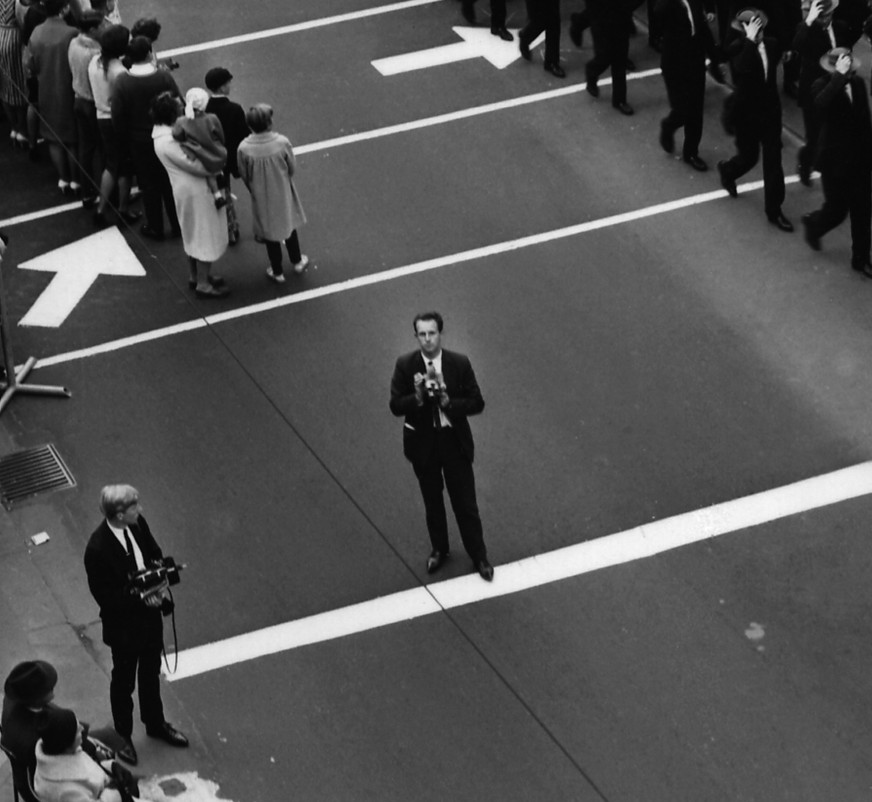
Text of ‘anecdote’ presented at Art School Anecdote performance by Zoe Walker and Neil Bromwich

Aren’t art schools great? I think by law every art school should have a papier maché Statue of Liberty outside, with a plaque saying:

Give me your tired, your poor, 
Your huddled masses yearning to breathe free, 
The wretched refuse of your teeming shore. 
Send these, the homeless, tempest-tossed to me, 
I lift my lamp beside the golden door Continue reading

Has the digital revolution changed documentary photography?

‘Has the digital revolution changed documentary photography? ‘, State Library of New South Wales Magazine , May, 2013

Documentary photography is very popular at the moment. Despite the much vaunted torrent of digital images from the 24/7 news feeds, the myriad Youtube channels, or the thousands of photographs uploaded every minute to social media sites such as Flickr, Instagram or Facebook, people still have an appetite for the honed, considered, still image taken by a photographer who has devoted his or her life to the profession. New high-quality books, exhibitions, festivals, blogs, and the iPad editions of newspapers such as the Guardian, are all continuing to use the single ‘decisive moment’ of the documentary photograph, and continuing to attract viewers with it. Yet there are clear signs that the advent of digital photography has put the assumptions of the documentary genre under an enormous amount of pressure.

Digital photography has long since ceased to be new. The apocalyptic scenarios sketched out on its behalf in the late 1980s and early 1990s have proved to be simplistic, self-serving and wrong. Photography hasn’t imploded because, instead of light falling on emulsion to activate chemical reactions, light now falls on charged coupler devices to activate algorithmic reactions. People haven’t lost ‘faith’ in the photograph because photography was always more than just a particular technology, it was an historical convention, a social practice, an entrenched media industry, a personal relationship, and a psychological space. Shifting from film to memory cards and darkrooms to Photoshop wasn’t going to change that.

And, even though the statistics for the number of photo uploads are mind-boggling (for instance Flickr upload rates peaked at almost 2 million a day in mid 2011) we shouldn’t be carried away by the current on-line revolution in photography, either. Photography has always been a numbers game, and its numbers have always been relatively astronomical. For instance, way back in 1861, a little over twenty years after the invention of the medium, the enthusiastic booster of nineteenth century photography, Oliver Wendell Holmes, claimed that he had personally viewed 100,000 stereographs and had 1000 in his collection. By the twentieth century those staggering numbers were beginning to appear puny. In that century, it could be argued, the most important artefact for photography became the filing cabinet, not the camera, as massive archives around the world began to fill with photographs. For instance the filing cabinets in in the Film Preservation Facility of the stock photography agency Corbis, alone, hold eleven million pre-digital photographs. Seen in this light the current numbers of images available on-line are merely part of a trend, an exponential trend certainly, but a trend inherent to the medium nonetheless.

Some commentators talk about on-line photo sharing as though it is a new thing, as though people had never shared photographs before. But photography has always been a medium of interpersonal exchange, too. The very raison d’etre of the most popular portrait form of the nineteenth century, the carte-de-visite, was so that multiple copies could be shared within social circles The carte-de-visite albums of the period were the Facebook pages of their time. And even the millions of postcards, snapshots and albums of the twentieth century were always also specific messages between individuals, as well as a photographer’s image of the world. You only have to turn over any old postcard or discarded snapshot you might happen to pick up in a junkshop to find on the back a hand written message from one person to another, as short and enigmatic as a tweet.

The so-called ‘digital revolution’, therefore, has not fundamentally destroyed, but has only intensified the trends and qualities already fundamentally inherent in the medium. But, documentary photographers have felt these intensifications particularly acutely.

Documentary photographers want to change the world, that is one of the defining precepts of the genre. The folk heroes of documentary are those who have gone in under the radar or embedded themselves behind the lines and brought back images that have changed people’s perceptions of a war or other humanitarian crisis. The icons of the twentieth century, the classic photographs from the Second World War or the Vietnam War that have burned themselves into our collective historical consciousness, were all taken by committed documentary photographers working for governments or news organisations. But the icons of the past ten years, of the Iraq War or the Arab Spring, which have been similarly burned into our collective visual consciousness, were all taken by participants, not documentary photographers. The terrible photographs that ushered in the century, the torture photographs of 2003 and 2004 from Baghdad’s Abu Ghraib prison, were taken by the abusers themselves — the American Military Police. As Susan Sontag was the first to recognize: ‘A digital camera is a common possession among soldiers. Where once photographing war was the province of photojournalists, now soldiers themselves are all photographers — recording their war, their fun, their observations of what they find picturesque, their atrocities — and swapping images among themselves and emailing them around the globe.’ (Susan Sontag ‘Regarding the Torture of Others’, New York Times Magazine, 23 May, 2004 p27.) These images changed the world, certainly, but the people who took them had no agenda and no photographic ethic, other than boredom and a need to use the camera to feel part of a social group, albeit a perverse one.

In the nine short years since the global shock of the Abu Ghraib photographs, the commonest possession amongst all of us has become a mobile phone with a camera linked to the internet. Now we are all potential photographers almost all the time, and so the stream of revelations continues. The screams of alleged police brutality on our streets, the blood running down the faces of the victims of random terrorist attacks overseas, the surging of crowds at democracy demonstrations, and the drunken scuffles of the dissolute middle classes at night, all the phantasmagorical images of our social and political nightmares have first been uploaded to the internet from the mobile phones of participants, and then harvested from social media websites by mainstream new organisations. (The police themselves are now increasingly using the mobile phone cameras of the general public as a ubiquitous surveillance system, they often use the mobile phone and Facebook postings of participants to identify rioters.)

Yet even in these new circumstances, where the previously separate roles of photographer and subject, participant and observer, witness and victim are collapsing, there is still a role for the documentary photographer. Younger documentary photographers, such as the New Yorker Ben Lowy, are recognising the need to work in both modes, to provide a continual ‘feed’ of images as well as delivering considered, edited essays, in order to survive and remain relevant in this new economy of images.

On their way to being published and consumed by viewers, all digital documentary photographs pass through an environment were computer manipulation, to some degree, is inevitable. In this sense documentary photographs are a lot like contemporary movies, they both have some element of CG in them, even if the audience isn’t aware of it. For a long time we have realized that ‘external’ factors such as captioning, context, point of view, cropping, focal length and so on, dramatically altered the presumed meaning of news photographs, and we have learnt to ‘read’ photographs accordingly. However because they use a workflow that includes digital post-production, newspapers and mainstream media outlets have quickly moved to establish strict protocols that protect the ‘internal’ visual integrity, the documentary ‘truth’ and therefore the news value of their images, from CG infection. For instance in 2006, during the Israel-Lebanon conflict, sharp-eyed bloggers caught out the Reuters news agency who had published images by one of their stringers, Adnan Hajj. He had taken a shot of smoke rising above Beirut after an Israeli bombardment, but he had not been able to resist using the Photoshop ‘clone’ tool to, rather inexpertly, increase the amount of black smoke that appeared to be billowing from the buildings, before selling it on to Reuters. Once the alteration had been identified Reuters quickly dropped Hajj as a stringer, removed all of his 920 images from sale, and sacked one of their picture editors.

However other photographers are experimenting with embracing to possibilities of CG to not so much manipulate a truth, as to tell a story with multiple truths within one frame. For instance the Israeli gallery-based photographer Barry Frydlender still documents real scenes in Israel, but he composites multiple times, and multiple points of view, into the one complete image. These images have to be read differently by viewers, they are not a decisive moment, but rather decisive moments through which the viewer has to carefully navigate, assembling the complex meaning of the scene themselves.

These examples indicate the stresses traditional documentary photography is under, while at the same time it remains vibrant and obviously needed. One thing is certain: as photography continues it exponential change under the impact of the technological revolutions to come, the documentary impulse will continue to be at its very core.

Martyn Jolly