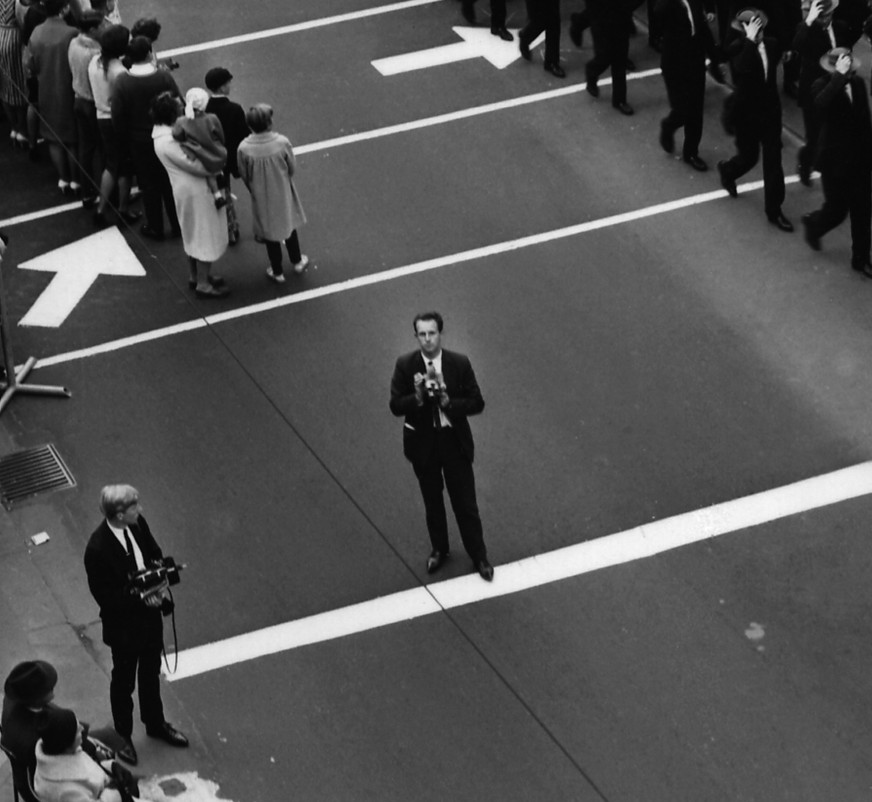
People’s faces are being pixelated more often in newspapers and on TV. It used to be that only the suspects of serious crime had their eyes obscured by the familiar black bar, but now lots of people we see on the news have their faces obscured by a circle of enlarged pixels. Even in Google Map’s new ‘Street View’ application the faces of people on the street are automatically blurred to protect their privacy. Privacy itself has also become an increasingly debated term recently, with more and more people claiming that they have a ‘right to privacy’, even when they are in public. In thinking about these issues I decided to experiment with a picture I had clipped from a newspaper. It was a school class portrait in which the newspaper had decided to pixelate the face of each student. I ‘deconstructed’ the conventional composition of this photograph by scanning small portions of the image, of only a few millimetres across, and then re-arranging them in various kinds of grids. With the original news context of the image stripped away, and each face isolated for comparison, I wondered if the viewer might experience the act of pixelation itself differently. What does it do to its subjects, besides preserving their privacy, does it turn them into criminals or victims?
Haunted Australia
‘Haunted Australia’, catalogue essay in Trace Elements: Spirit and Memory in Japanese and Australian Photomedia, 2008, Tokyo Opera City Art Gallery and Performance space edited by Bec Dean. English version, pp 52 – 57 of 142 page catalogue, ISBN 978-4-925204-22-4 C 0070
Every country has its ghosts, every country is haunted by spirits and memories. Even countries who once thought of themselves as being young, but are now realizing that they are in fact old, are finding themselves to be as haunted as anybody else. Thirty or so years ago if you had asked an Australian if there were many ghosts here they would have laughed — compared to England or Japan, no way! Sure, there was a ghost in our most popular national song, Waltzing Matilda — the ghost of a poor, sheep-stealing swagman who committed suicide rather than be caught by the colonial police — but that was about it. Recently, however, we have begun to see a persistent tradition of Australian ghosts emerging.
The swagman’s ghost stayed around the billabong in which he had drowned himself, mournfully repeating the refrain from his once cheerful song to warn and remind passers by of the injustice which had been done to him. And this pattern of repetition, mourning, warning and reminding conforms to many other ghost stories from the nineteenth century. On 16 June 1826 an ex-convict and successful farmer named Frederick Fisher suddenly disappeared, a few days later his ghost was seen sitting on a fence rail and pointing to a spot on the ground. When the spot was dug up his body was found, leading to the arrest and hanging of his neighbour for murder. Fisher’s ghost survived in colonial society as an urban myth until 1859 when John Lang published an elaborated form of the story as The Ghost Upon the Rail. In 1924 Australia’s pioneer filmmaker Raymond Longford made a silent film of the story, and in 1960 Douglas Stewart wrote a play. Ken Gelder discusses Fisher’s ghost and others like him in The Oxford Book of Australian Ghost Stories.
Fisher’s ghost appeared at the disjunction between the new convict-based settler society of Australia, the old established home of Britain from which the convicts had been cast out, and the prior possession of the land by Aborigines. In Lang’s version, in order to cover up his crime and get his hands on Fisher’s wealth, the murderous neighbour, an ex convict equally as successful in his new life as Fisher, used forgery and impersonation to create the elaborate ruse that Fisher had granted him power of attorney before disappearing home to England. To expose this delusion the spectre does not simply point to his own grave, as in the urban myth. Rather, he is seen sitting on the fence-rail with a gash on his forehead. But the light appears to shine straight through him, and he is as impalpable to the touch as empty air. An aboriginal tracker from the local tribe identifies ‘white man’s blood’ on the rail, then follows some faint tracks for nearly a mile to a dark pond scummed with ‘white man’s fat’. At the bottom of the pond is found a bag of bones, the rotting remains of Fisher’s body kept together only by his clothing. He wasn’t a world away in old England after all, but still here in new Australia all the time, demanding that justice be done. In addition, the ancient knowledge of the land held by the radically dispossessed Aborigines is needed to track his rotting body down. As Gelder says, ghost stories are one way ‘in which white settlement in this country is shown to be, in fact, fundamentally unsettled.’ [1] Ghosts are able to bring into conjunction times and spaces which are conventionally separated. They can reveal what was previously hidden, or dormant, or ignored.
In the early twentieth century Australian ghosts took on a greater role in bridging vast distances of time and memory. After 60,000 Australian Soldiers died and were buried on the distant battle fields of World War One an extraordinary cult of the dead grew up amongst those that were left to mourn them, but who had no grave to grieve at. This collective grief became focussed on the Anzac memorials being built in each town, and in the annual ritual of the Anzac Day Dawn Service and Commemorative March. Just before Anzac Day 1925 Melbourne Punch described Anzac Day as ‘that solemn day, on which … the spirits of the nation’s gallant dead come back again for a space, on ‘Home Leave’.’[2] Two years later the famous war artist and cartoonist Will Dyson published his best-known cartoon in the Melbourne Herald. In A Voice from Anzac two ghostly Australia soldiers left behind on the beachhead of Gallipoli draw solace from hearing the feet of the Returned Men marching in Australia. One of them says to the other: ‘Funny thing, Bill—I keep thinking I hear men marching!’.
By far the most popular painting of the period was Will Longstaff’s Menin Gates at Midnight, 1927, which depicted a psychic vision Longstaff had experienced during a midnight walk after the unveiling of the Menin Gate Memorial at Ypres, when he saw soldier spirits rising from the cornfields around him. When the painting toured Australia in 1928 and 1929 it was seen by perhaps half a million people, who filed reverently past it to the accompaniment of sombre organ music.[3] To this day the spooky painting still hangs in its own darkened grotto in the Australia War Memorial.
The emotional power of Dyson’s and Longstaff’s spectral imagery derived at least some of its legibility from Spiritualist photography. Spiritualist ideas were pervasive after the war. The period’s most famous proselytiser of Spiritualism was Sir Arthur Conan Doyle, the creator of the famous detective and arch rationalist Sherlock Holmes. Doyle had been a jingoistic propagandist during World War One, during which he lost his son and his brother. After that war, when virtually every other family was experiencing similar grief, the ‘sight of a world which was distraught with sorrow and eagerly asking for help and knowledge’, had compelled him to use his fame and personal wealth to proselytise the Spiritualist cause in lectures delivered from platforms across the world.[4] In 1920 and 1921 he travelled throughout Australia, eventually speaking to a total of 50,000 people. His most popular lecture was on spirit photography, where he showed lantern-slides of photographs taken by mediumistic photographers at photographic séances. In these images the faces of the dead where captured floating above the living, they seemed to have finally returned to join their loved ones once more within the photographic emulsion. When projected onto the lantern-slide screens of packed meeting halls these photographic ‘proofs’ of the ‘truth’ of spirit return provided implicit comfort to the bereaved families in Australia, whose sons had died thousand of miles away. The Melbourne Age reported:
Unquestionably the so-called ‘dead’ lived. That was his message to the mothers of Australian lads who died so grandly in the War, and with the help of God he and Lady Doyle would ‘get it across’ to Australia.[5]
Since that time the Anzac tradition has developed radically. It has changed from being a collective cult of memory for the dead intensely focussed on the physical absence of fallen soldiers, to being a more generalised set of nationalistic and quasi-religious rituals through which every Australian is meant to feel bonded to their country.
At the same time the mechanisms through which ghosts are conjured has developed and widened. Images of people from the past increasingly pervade the present through the power of photography. In the photographic archive the past lies hidden and buried, whilst always containing the potential for exploration and retrieval. The archive has increasingly become a terrain in which some artists feel as though they can meet people from the past and even, in some sense, bring them back to the present.
For example in 2003 two Sydney artists, Kate Richards and Ross Gibson, presented Life after Wartime at the Sydney Opera House. The work was an interactive ‘performance’ of an archive of crime-scene photographs that had been assembled by Sydney’s police force in the decades following the Second World War. The artists sat at laptops and midi keyboards and brought up strings of images which, combined with evocative haikus, were projected onto two large screens. Beneath the screens, The Necks, a jazz trio well known for its ominous movie music, improvised a live soundtrack of brooding ambience. Although not directly picturing spectres, the texts and images generated open-ended non-specific narratives around a set of semi-fictionalized characters and locations in Sydney. These characters became invisible presences occupying the creepy emptiness of the crime scenes. The element of automation, in the way the story engine generated the loose narratives, preserved the integrity, the historical artefactuality, of the original archive. Ross Gibson wrote:
Whenever I work with historical fragments, I try to develop an aesthetic response appropriate to the form and mood of the source material. This is one way to know what the evidence is trying to tell the future. I must not impose some pre-determined genre on these fragments. I need to remember that the evidence was created by people and systems of reality independent of myself. The archive holds knowledge in excess of my own predispositions. … Stepping off from this intuition, I have to trust that the archive has occulted in it a logic, a coherent pattern which can be ghosted up from its disparate details so that I can gain a new, systematic understanding of the culture that has left behind such spooky detritus. In this respect I am looking to be a medium for the archive. I want to ‘séance up’ the spirit of the evidence. [6]
In seeking to be a voodoo spiritualist ‘medium’ for the archive, the work was not trying to quote from it, or mine it for retro titbits ripe for appropriation, so much as to make contact with it as an autonomous netherworld of images. This sense of the palpability of other times preserved in the archive also informs the work of the Sydney photographer Anne Ferran. In 1997 she made a ‘metaphorical x-ray’ of a nineteenth-century historic house. She carefully removed items of the colonial family’s clothing from its drawers and cupboards and, in a darkened room, laid them gently onto photographic paper before exposing it to light. In the photograms the luminous baby dresses and night-gowns floated ethereally against numinous blackness. To Ferran, the photogram process made them look ‘three-dimensional, life-like, as if it has breathed air into them in the shape of a body … With no context to secure these images, it’s left up to an audience to deal with visual effects that seem to have arisen of their own accord, that are visually striking but in an odd, hermetic way.’[7]
Other Australia artists have gone beyond the generalised, enigmatic, uncanny ambience of the photographic archive, and have used archival photographs to directly create ghostly images. But these contemporary spectres — photographically produced apparitions from the past superimposed on the present — are not being invoked in order to console the living, as in the Anzac spectral tradition, but to cajole them, beseech them, or imprecate them, just as Fisher’s ghost did in the nineteenth century.
In 1980 Australia’s most eminent art historian, Bernard Smith, gave a series of lectures under the title ‘The Spectre of Truganini.’ In the nineteenth century, Truganini had been a much-photographed colonial celebrity as the ‘last’ of the ‘full-blood’ Tasmanian Aborigines. Smith’s argument was that, despite white Australia’s attempt to blot out and forget the history of its own brutal displacement of Australia’s aboriginal population, the repressed would continue to return and haunt contemporary Australia until proper amends were made.[8]
As aboriginal activism grew in intensity and sophistication during the 1980s and 1990s, anthropological portraits such as those of Truganini, began to be conceived of not only as the theoretical paradigm for colonial attempts at genocide but also as acts of violence in themselves, technically akin to, and instrumentally part of, that very process of attempted genocide. They began to be used by young aboriginal artists to ‘occult up’ their ancestors. Their reuse attempted to capture a feeling of active dialogue with the past, a two-way corridor through time, or a sense of New Age channelling. In a meditation on nineteenth-century anthropological photographs, the aboriginal photographer and curator Brenda L. Croft retroactively invested the agency of political resistance in the 140-year-old portraits.
Images like these have haunted me since I was a small child … [and] were instrumental in guiding me to use the tools of photography in my work … The haunted faces of our ancestors challenge and remind us to commemorate them and acknowledge their existence, to help lay them, finally, to rest.[9]
But aboriginal ghosts face a lot of work to do yet before they can finally rest. Aboriginal ghosts are needed to remind Australia that there is unfinished business, that the process of reconciliation with the past is not complete. Rather than laying their ancestors to rest, many aboriginal artists have photographically raised them from the dead to enrol them in various contemporary campaigns of resistance. One of the first Australian aboriginal photographers to receive international attention was Leah King-Smith. Her 1992 exhibition Patterns of Connection travelled throughout Australia as well as internationally. To make her large, deeply coloured photo[compositions she copied anthropological photographs from the State Library of Victoria, liberating them from the archive to be superimposed as spectral presences on top of hand-coloured landscapes. For her, this process allowed Aboriginal people to flow back into their land, into a virtual space reclaimed for them by the photographer. In the words of the exhibition’s catalogue: ‘From the flaring of velvety colours and forms, translucent ghosts appear within a numinous world.’[10]
King-Smith holds spiritualist beliefs of her own. She concluded her artist’s statement by asking that ‘people activate their inner sight to view Aboriginal people.’[11] Her work animistically gave the museum photographs she reused a spiritualist function. Some of her fellow aboriginal artists thought the work too generalist. It lacked specific knowledge of the stories of the people whose photographs were reused, and it didn’t have explicit permission from the traditional owners of the land they were made to haunt. But the critic Anne Marsh described that as a ‘strategic essentialism.’
There is little doubt, in my mind, that Leah King-Smith is a kind of New Age evangelist and many serious critics will dismiss her work on these grounds …But I am interested in why the images are so popular and how they tap into a kind of cultural imaginary [in order] to conjure the ineffable … Leah King-Smith’s figures resonate with a constructed aura: [they are] given an enhanced ethereal quality through the use of mirrors and projections. The ‘mirror with a memory’ comes alive as these ancestral ghosts … seem to drift through the landscape as a seamless version of nineteenth century spirit photography.[12]
While not buying into such direct visual spirituality, other aboriginal artists have also attempted to use the power of old photographs to make the contemporary viewer the subject of a defiant, politically updated gaze returned from the past. In a series of works from the late 1990s, Brook Andrew invested his nineteenth-century subjects, copied from various state archives, with a libidinous body image inscribed within the terms of contemporary queer masculinity, and emblazoned them with defiant Barbara Krugeresque slogans such as Sexy and Dangerous (1996), I Split Your Gaze (1997), and Ngajuu Ngaay Nginduugirr [I See You] (1998). Andrew exploits the auratic power of the original Aboriginal subjects to re-project the historically objectifying gaze straight back to the present, to be immediately reinscribed in a contemporary politico-sexual discourse. Although Andrew was also criticized for using the powerful portraits of the aboriginal subjects without appropriate consideration for their original tribal and geographical identity, these works have since become almost iconic in contemporary Australian art.
Since 1999 the photographer Darren Siwes, of aboriginal and Dutch heritage, has performed a series of spectral self portraits in Australia and the United Kingdom. By ghosting himself standing implacably in front of various buildings, he refers to an aboriginal haunting, certainly; but because he is ghosted standing to attention while wearing a generic suit, he also evokes the feeling of being surveilled by a generalized, accusatory masculinity – exactly the same feeling that a memorial Anzac statue gives. Like much other contemporary aboriginal photography in Australia, Siwes’s photographs are mannered, stiff, and visually dull, but they have proved to be extraordinarily popular with curators in Australia and internationally. It is not the intrinsic quality of the art that is so persuasive, but the rhetorical force of the spectres. As overwrought and histrionic as they are, ghosts are still able to directly address historical and cultural issues of broad contemporary concern.
In their book Uncanny Australia Ken Gelder and Jane Jacobs use Australian ghost stories to describe the uncanniness of Australia’s relationship to aboriginal spirituality. Although it is supposedly a settler country, in many ways Australia remains ‘unsettled’. In Australia both aboriginal and non-aboriginal relationships to the land have to co-exist, while its often violent history of possession, displacement and oppression underscore both relationships in different ways. For over two hundred years generations of non-aboriginal, settler Australians have forged strong spiritual bonds to the land, but aboriginal claims for the full recognition of their prior occupation of the continent, and for the precedence of their sacred relationship to the land, often give non-aboriginal Australians the uncanny feeling they are ‘foreigners at home’. In these postcolonial terms Gelder and Jacobs see hauntings as a productive occurrence, a means of acknowledging the inherent postcolonial contradictions in modern day Australia:
‘Ghosts’ simply could not function in a climate of sameness, in a country which fantasises about itself as ‘one nation’ or which imagines a utopian future of ‘reconciliation’ in which … all the ghosts have been laid to rest. But neither can they function in a climate of nothing but difference, where the one can never resemble the other, as in a ‘divided’ nation. A structure in which sameness and difference solicit each other, spilling over each other’s boundaries only to return again to their respective places, moving back and forward in an unpredictable, even unruly manner—a structure in which sameness and difference embrace and refuse each other simultaneously: this is where the ‘ghosts’ which may cause us to ‘smile’ or to ‘worry’ continue to flourish.[13]
Ghosts have re-emerged because both white and black Australians are now spiritually immersed in their country in a way which goes beyond the mutually exclusive binary of possession versus dispossession.
The haunting experiences of everyday Australians are explored by the historian Peter Read in his book Haunted Earth. He uses oral history interviews with over forty non-aboriginal and aboriginal Australians to explore their relationship to what he calls ‘inspirited places’. These are places defined by the nexus of place and history, time and spirit. For Read ‘inspiriting’ is a reciprocal process between the Earth and humans, where both old and new Australians bring inspiriting mythologies, rites and beliefs with them to the land they inhabit, just as particular landscapes are experienced by the humans who inhabit them as ‘haunted’ with a kind of soul or essence. Like many contemporary cultural historians Read is trying to go beyond hackneyed ‘paranormal’ explanations for some people’s intense experience of spiritual presence. He wants to understand these uncanny feelings as something more interesting and complex than the self-limiting notion that they are just the ‘epiphenomena of an excited or deluded brain’.
He recounts the vivid experience of people living in the suburbs built on the sandstone ridges north of Sydney which were once intensively occupied by Aboriginal people. He meets three separate families who believe they have either seen or felt the direct presence of Aboriginal spirits. ‘To the haunted families, the land itself, and the memories that the land holds independent of humans, carry profound meanings clearly related to invasion, dispossession and violence.’ However this haunting is not something to be banally expiated. If all the ghosts were ever to be exorcised then something would be lost to our contemporary experience. As he comments, ‘Those untroubled, those unhaunted, by the ghosts of the past have missed something profound.’ [14]
Australia has a long and persistent history of haunting. And its ghosts are a long way from being laid to rest, indeed more seem to be accumulating. The means through which we make these ghosts appear might have changed — from the genre of storytelling, to drawing and painting, to photographic superimposition. And the uncanny, unsettled worlds between which the ghosts communicated may have changed — from distant countries sundered by space, to not-so-distant pasts sundered by historical forgetting. But in all their over the top kitschiness, in all their histrionic posturing, ghosts have always continued to contribute to our sense of ourselves.
[1] The Oxford Book of Australian Ghost Stories, selected by K. Gelder, Oxford University Press, 1994, p. xi.
[2] R. McMullin, Will Dyson: Cartoonist, Etcher and Australia’s First War Artist, London, Angus & Robertson, 1984, p226.
[3] A. Gray, Will Longstaff’s Menin Gates at Midnight, Canberra, Australian War Memorial, nd, np.
[4] N. Fodor, Encyclopaedia of Psychic Science, London, Arthurs Press, 1933, p106.
[5] ‘Conan Doyle in Australia’, Light, December 18, 1920, np.
[6] R. Gibson, ‘Negative Truth: A new approach to photographic storytelling’, Photofile 58, 1999, p30.
[7] A. Ferran, ‘Longer Than Life’, Australian and New Zealand Journal of Art, 1, 1, 2000, pp166 -70.
[8] B. Smith, The Spectre of Truganini: 1980 Boyer Lectures, Sydney, Australian Broadcasting Commission, 1980.
[9] B. L. Croft, ‘Laying ghosts to rest’, in Portraits of Oceania, ed. by J. Annear, Sydney, 1997, p9, p14.
[10] J. Phipps, ‘Elegy, Meditation and Retribution’, in Patterns Of Connection, Melbourne, Victorian Centre for Photography, 1992, np.
[11] L. King-Smith, ‘Statement’, in Patterns of Connection, Melbourne, Victorian Centre for Photography, 1992, np.
[12] A. Marsh, ‘Leah King-Smith and the Nineteenth Century Archive’, History of Photography, 23, 2, 1999, p117.
[13]. K. Gelder and J. M. Jacobs, Uncanny Australia: Sacredness and Identity in a Postcolonial Nation, Melbourne University Press, 1998, p42.
[14] P. Read, Haunted Earth, Sydney, University of New South Wales, 2003, p59.
Bill Henson
Op ed, Canberra Times, 2008
You can call Bill Henson’s photographs many things: melodramatic, perhaps; overwrought, perhaps; repetitive, perhaps (he’s been shooting the same kind of brooding, heavy-lidded adolescents for decades). But one thing you can’t call them is pornographic. Contrary to the claims of the activist, Hetty Johnston, whose single complaint led to the police raid on the Roslyn Oxley 9 Gallery and the subsequent charges, a photograph of a naked teenager is not automatically pornography. And I’ve got news for Kevin Rudd, who finally fully revealed his own narrow-minded prudery by joining in with the baying of the pack, photographs of naked teenagers are not automatically disgusting. If they are not sexually titillating for viewers, as is the case with Henson’s images, and if, as in this work, they are covered in a heavy cloak of metaphorical significance produced by the model’s faraway expressions and the scene’s stygian lighting, they are not pornography they are art. Good enough art to represent Australia at the Venice Biennale, the cultural equivalent of the Olympic Games. Good enough art to pull 65,000 people to the Art Gallery of New South Wales without a single complaint, and good enough art to have been on the high school syllabus for years. Judging by their blog entries the high school students who visited Henson’s many previous exhibitions responded to his work with far more intelligence and thoughtfulness than our politicians.
Commentators such as Clive Hamilton, formerly of the Australia Institute, have recognised this, but have nonetheless accused Henson and his gallery of naivety. In the current cultural climate where corporations are sexualising children of younger and younger ages to sell them clothes or pop music, and where paedophiles are finding more and more images to feed their lusts by trawling the internet, how could Henson not expect there to be a backlash, Hamilton asks. Henson should have known better, he says. But why should artists pre-emptively buckle to pressure groups and media-manufactured witch-hunts? Maybe they have something important to say, which needs to be said. Maybe we should even respect artists and the international reputations they have built up over decades of hard work and hard thinking.
Girls don’t become women, and boys don’t become men, overnight. It is a time of magic, beauty, confusion, and yes, vulnerability. This simple cultural and biological fact has been the subject of art and poetry for millennia. But by now prohibiting the picturing of this period in life, when innocence mixes with knowing, who in fact is being protected? As has been proved time and time again, when things aren’t talked about, celebrated and discussed, that is the time when they become most vulnerable to exploitation. “This photographic exhibition violates the things for which we stand as Australians and indeed as parents”, Brendan Nelson brayed . Speaking as a parent, I refuse to be conscripted into a supposed army of the outraged. “I’d like to see the parents [of the models] well looked into”, demands the self-appointed guardian of our children, Hetty Johnston, “what parent in their right mind would allow their 12- or 13-year-old to strip off and display themselves all over the internet?” Well, if a photographer of Henson’s calibre and integrity approached me as a father, I just might.
Dr Martyn Jolly
Dr Martyn Jolly is Head of Photography and Media Arts at the Australian National University School of Art
Wolfgang Sievers’ Photographs: From the Future to the Past
‘Wolfgang Sievers’ Photographs: From the Future to the Past’, catalogue essay for Wolfgang Sievers 1913 — 2007: Work, curated by Stuart Bailey, pp 5 — 14, Glen Eira City Gallery, 2007.
One night in 1983 Wolfgang Sievers steadied himself on a tug as it heaved on the waves of Bass Strait and with a long hand-held exposure photographed an oil rig belching a giant tongue of flame and spouting a curtain of water. The experience was the high point of his career as a professional photographer. It was, in his own words, like the grand finale to a fantastic, dramatic opera. When Sievers saw the diabolical Wagnerian result, Inferno, Nymphea Oil Rig, Bass Strait, he thought that he couldn’t have done any better, and decided there and then that it was to be almost his last professional photograph[i]. But in making the decision to ‘stop whilst he was on top’ there was also an element of sourness and disappointment about the progress, or lack of progress, in Australian society, industry and architecture during the half-century his professional career had covered. As a bombastic vision of industrial power and excess the oil rig photograph was a long way from Sievers’ first industrial photographs. For instance it contrasts strongly with one of his favourite photographs taken in 1939 at the very beginning of his career in Australia, of the dipping of match heads at Bryant & May, in Richmond, Victoria. Although also of a toxic industrial process, this image had a delicate clarity that for him encapsulated the ideas of simplicity and functional beauty which he thought should underpin all of his work.
For Sievers, as for many of the other European artists, designers, photographers and architects who also fled to Melbourne to escape the rise of Nazism, the ideas of pure functional beauty they brought with them were inextricably linked to wider ideas of social progress. The political foment of 1920s Weimar Germany had given rise to the famous Bauhaus, which taught not only the importance of truth to function in design; but also the importance of unifying the artist and the designer, the machine and the worker, to forge a new future society. In the post-war period these ideas were to pervade the entire world through the global rise Modernism, but Sievers also had a direct connection to them through his years in the late 30s at Berlin’s Contempora School of Applied Arts, which was a small private school that had taken up the Bauhaus project after it was closed by the Nazis in 1933.
As a young man in Germany during the 1930s Sievers was inevitably caught up in, and forever formed by, the political events of the time. He moved to Portugal in 1934 to try to make a career as a photographer, but then became briefly involved in the Spanish Civil War against Franco, for which he was arrested by the Gestapo on his return to Germany in 1936. He was not Jewish, though his mother was a Jewish descent, but in 1937 he decided to arrange his emigration to Australia, using as one of his guarantors the documentary photographer Axel Poignant who himself had emigrated to Australia ten years before. He was forced to dramatically expedite his plans when the Luftwaffe called him up for two years service as an aerial photographer. He was given one day’s grace and immediately escaped to England.
He left Germany at the age of 25 steeped in the ‘New Objectivity’ style of photography: he had taken front-on, clear-eyed photographs of poverty in Portugal; he had taken deep-focussed architectural views of nineteenth-century palaces on behalf of his art-historian father; he had been commissioned by the contemporary expressionist architect and family friend Erich Mendelsohn to photograph the last of his buildings in Germany before he himself had fled for Britain in 1933; he had made advertisements for modern products such as sheer stockings, dramatically lit in the latest studio style; and he had made low-angled sunlit portraits of his fellow Contempora School students heroically looking into the future.
He arrived in Melbourne in 1938 and set up a studio in South Yarra with the latest photographic equipment which he had sent on ahead. But he found pre-war Melbourne to be very different to Berlin, and opportunities severely limited. He decided to specialise in industrial and architectural photography, where he could immediately apply what he had learnt about the purity of design and the essential honesty of the machine. He rapidly found several large clients, but from 1942 volunteered to assist in the Australian war effort. After the war Sievers’ career took off again, buoyed by Australia’s building and industrial boom. For his industrial clients Sievers provided shots for their annual reports, publicity brochures and advertising.
One of his biggest clients was the heavy engineers Charles Ruwolt, which were taken over by the British based company Vickers in 1948. A problem many industrial photographers faced was the visual mess and distraction of any factory floor. (This can still be seen in some of Sievers’ shots, such as the grim Sweatshop, Melbourne, 1958). The graphic designers of annual reports generally got around this problem by simply cutting the distracting background out of the photographs, often leaving a heavily airbrushed image of an odd-shaped piece of machinery floating isolated on the page with no sense of scale or drama. Sievers solved the problem photographically by either raising his camera to look down on the machinery, or lowering the camera to shoot upwards against the roof, and using his own lights to light the machinery whilst leaving the distracting background in darkness. For example in reality the Nordberg Crusher he photographed in 1969 was hemmed around with factory paraphernalia, but Sievers organised a thorough clean up of the area around the crusher and built a platform to elevate his camera, he then descended into the crusher with ladders to light its interior, emphasising its circular shape and its depth. As a bonus he wedged a dramatically lit lab-coated operator into the lower right hand corner for the final shot. The image then created its own graphic force and internal visual drama that could be used in any publicity situation. (According to Seivers himself the subsequent publication of the image in the financial press resulted in a multi-million contract for the company.)
Man and machine were Sievers’ quintessential subjects. To Sievers the essence of a good factory was not labour by itself, nor the technical process in isolation, but that ‘everything is as it should be’, with men directing machines efficiently, and each augmenting the other.[ii] In Sievers’ photographs the operators are functionally connected to the machine by their hands and their eyes — they peer through loupes, or pull levers, or intently measure the details of gigantic pieces of machinery with finely calibrated instruments. The image of a technician establishing the accurate positioning of a hydraulic pump crankshaft with a micro-alignment telescope, Quality Control at Vickers-Ruwolt, 1960, was published in a Vickers Ruwolt brochure. Running across the pages of the brochure in a kind of staccato modernist poem to industry were the words: “From a concentration of trained minds — emerges mechanical excellence … experience is combined with intelligence and work proceeds …from molten metal … to tools of high precision and great power …precision created out of precision … born in the toolroom … the climax—assembly and testing …”. [iii]
These sentiments of corporate pride were given an almost nationalistic resonance a few years later in another, even more constructed, shot for Vickers Ruwolt. In Gears for Mining Industry, 1967, an engineer, like an operatic hero ascending a stage mountain, climbs the teeth of a giant gear which has been especially raised upright by a crane, to steady with one hand and measure with the other the second half of the gear whose several tons has been suspended upside down above him.
During the 1970s and 1980s photographs such as these began their migration from the pages of company reports to the walls of art museums. In 1991 this image was one of four chosen by Australia Post to become a stamp to celebrate the 150th anniversary of Australian photography. It had become a fully fledged icon of Australia as an industrial nation, complementing other national icons such as Harold Cazneaux’s mighty gum tree The Spirit of Endurance, 1937, or Max Dupain’ Sunbaker, 1937, which encapsulated other aspects of the national myth — it’s land and its lifestyle.
However throughout his career there is a continuing visual tension in the respective role of worker and machine. His vision was clearly centred around the trained technician rather than the knockabout aussie manual worker, though he did love to photograph traditional workers who seem to have a heritage of noble labour going back centuries. For example in his 1962 image of a worker in the Miller Rope factory hefting the rough rope in his firm hands Sievers saw ‘the dignity of man … staring you straight in the face’. In other images, in contrast, such as Finishing of Hitachi Brand Valves for the Snowy Mountains Hydroelectric Scheme, 1967 or Coal Mining Dredges, Yallourn, Victoria, 1956, the technicians of the modern industrial age are squashed uncomfortably into tight corners by the looming bulk of the machine.
Workers by themselves, however, unconnected to any machine, rarely figure in Sievers photographs. He admits that his poor English initially made him scared of the human element, although later his bilingualism could be an advantage with Australia’s ethnically diversifying workforce. One of his rare photographs of workers by themselves and with their own autonomous personalities, is the crowd shot taken from an aerial point of view of the Shift Change at Kelly and Lewis, Springvale, 1949, where friendly workers smile and squint up at Sievers’ camera. Nowadays the idea of the dignity of manual labour has been grossly devalued, and corporations are unlikely anymore to be interested in commissioning photographs of their workers as a collective force. In this light the image now has an elegiac character, and reminds me of another Sievers’ aerial view with receding perspective, Old Frankfurt before its total destruction in World War 11, Germany, 1937 — both are photographs taken on the verge of destruction.
The metaphors of theatre or opera are the ones most commonly applied to Seivers’ industrial work. But other genres sometimes come to mind as well. For instance the dramatic side lighting used to apply strong shadows and bright sheens to the equipment in Lathe operator at Marweight, Burnley, Melbourne, 1968, not only isolates the lathe against a black background, but also gives the scene a B Grade Frankenstein appearance. Other shots, such as Sulphuric Acid Plant at Electrolytic Zinc, Hobart, 1959, could almost be described as industrial pornography as the gleaming steel tubes turn and curve in on themselves. (When it was reproduced full page and in full colour in the BHP book The Fabulous Hill, its caption was much more prosaic: ‘This new acid plant will bring Risdon’s capacity for the production of sulphuric acid to 170,000 tons a year.’)[iv]
As his career progressed the symbiotic relationship between his own ideals, forged in the Europe of the 1930s, and the reality of Australian industry swept up in the resources boom of the 1970s and 80s, began to pull apart. Sievers was always a political animal and proud of his past. In 1967, at the height of the Vietnam War, he placed a photograph of a GI holding up the severed head of a Vietnamese in his studio showcase window at the Collins Street entrance of the Australia Arcade. He accompanied the image, which had been taken from LIFE magazine, with the following sign: ‘I Wolfgang Sievers: victim of Nazi persecution — prisoner of the Gestapo —volunteer of the AIF and RAAF 1939 — volunteer Australian Army 1942- 1945 PROTEST against the undeclared war — against conscription by lottery — against imprisonment of conscientious objectors whose just stand has been laid down at the Nuremberg trials to be the duty of all men.’ As a result of this protest Sievers estimates he lost 60% of his industrial clients.[v]
Although they are certainly full of drama, Sievers’ photographs are devoid of any sense of noise, smell, dirt or toxicity. Floors have been cleaned, workers’ hands washed, and their chins shaved. Clean lab coats have been put on and 500-watt lights carefully positioned to obscure the ugly backgrounds. As Sievers himself admitted ‘industrial photography is lying most of the time.’ Increasingly, Sievers became concerned with the pollution that was produced by the industries that his photographs pictured as being pollution free, with ‘everything clean and wonderful.’ The worse it got, he said, the nearer he got to the end of his days as a photographer.[vi] He was also concerned with the foreign ownership of Australian resources.[vii] During the 1980s he concentrated more and more on retrospectives of his own career, as well as other historical and political interests.
Sievers was much more than just an industrial photographer, however. The artists, designers, architects and photographers who fled to Melbourne to escape Nazism made enormous contributions to Melbourne’s growth as a cosmopolitan city, and Sievers photographed much of it. For instance he made advertisements for the Prestige company which produced textiles designed by Gerhard Herbst who, like Sievers had trained in Germany and fled to Melbourne in 1939.[viii] Herbst also designed the striking poster advertising New Visions in Photography, a 1953 exhibition Sievers and another émigré photographer, Helmut Newton, held promoting their work as commercial photographers. A boldly designed sign in the exhibition announced: ‘the aim of this exhibition, the first of its kind in Melbourne, to demonstrate, through actual work done, the potential of industrial and fashion photography as a means of better promotion and bigger sales in business today.’[ix]
He also photographed the cutting edge modernist architecture of fellow émigrés Frederick Romberg, who arrived in Melbourne from Germany via Zurich in 1939 and also knew the influential expressionist architect Erich Mendelsohn; and Ernest Fooks who arrived in Melbourne in 1939 from Vienna where he was a progressive town planner and architect.[x] Like Sievers, both these architects saw their work as directly affecting the development of a socially progressive, technologically modern society. He photographed their work in the international architectural style, with dynamically receding horizontal lines, sternly orthogonal vertical lines, and cleanly isotropic spaces. These deeply-focused sharply-defined views of ideal modernist architecture could have been made at any time in any metropolis modernism had spread too— Europe, Japan, Canada, Brazil or Australia. Today they all seem uncannily empty and devoid of atmosphere, as though they are waiting for the future to happen
In the 1950s émigré architects designed many houses and modernist flats around the eastern suburbs of Melbourne. Sievers photographed the house Fooks designed and built for himself in Caulfield in 1966. His photographs beautifully capture the sense of the house experienced as a procession of enclosed and semi-enclosed spaces and courtyards from street frontage through to the garden, all modulated by Japanese inspired timber screens, an undulating timber ceiling, and detailed joinery — a testimony to Fooks’ Viennese heritage.[xi]
But, just as he had parted company with industry, Sievers also found himself parting ways from the mainstream of Australian architecture and design, where the ideal, designed future he envisaged appeared increasingly derailed by thoughtless and crass developments, which could be just as effectively photographed quickly with small format cameras. In 1988 he was invited out of his semi-retirement to photograph the new Parliament House in Canberra, but he refused because he did not approve of the design by the US architects Mitchell/Giurgola. Increasingly looking to the past, Sievers travelled to Berlin and Paris in 1989 to research war criminals who had also emigrated to Australia. Whilst there he briefly rediscovered his excitement in architecture as he photographed I. M. Pei’s newly opened pyramid entrance to the Louvre, with its spectacular and explicitly engineered glass walls.
Sievers’ work is now firmly ensconced in the nation’s image of its past. Art museums and libraries had consistently purchased his key images from the early 1970s onwards, and the National Gallery of Australia toured a major retrospective nationally in 1991 and 1992. In 2004 the National Library of Australia completed the purchase of his complete archive of 51,700 negatives and transparencies and 13,700 prints, which they are now in the process of digitising.[xii] His images, which were once about creating an ideal modern future for Australia, are now subsiding into the nation’s official past. The irony is that the future his photographs so keenly anticipated never actually happened. The wealth and prosperity they predicted certainly came, but the sense of social balance, equality and honesty, where ‘everything is as it should be’, which they were attempting to create, never really did. We can see that clearly now, but Sievers himself could feel it, twenty-five years ago.
Martyn Jolly
[i] Wolfgang Sievers, Wolfgang Sievers: Contemporary Photographers Australia, Writelight, 1998, np.
[ii] Photographers of Australia: Dupain, Sievers, Moore, Film Australia, 1992.
[iii] Vickers Ruwolt Proprietary Limited, Melbourne, Australia, nd, np.
[iv] Alfred Heintz, The Fabulous Hill, BHP, 1960, np.
[v] Daniel Palmer, ‘Wolfgang Sievers’, Flash, Centre for Contemporary Photography Newsletter, June-Spetmeber 2004, pp10-11.
[vi] Photographers of Australia
[vii] Helen Ennis, ‘Wolfgang Sievers’, Photographers of Australia: Dupain, Sievers, Moore, Film Australia, 1992, np.
[viii] Anne Brennan, ‘A Philosophical Approach to Design: Gerhard Herbst and Fritz Janeba’, in The Europeans : emigré artists in Australia, 1930-1960, (ed) Roger Butler, National Gallery of Australia, 1997.
[ix] Helen Ennis, ‘Blue Hydrangeas: Four Emigré Photographers’, in The Europeans : emigré artists in Australia, 1930-1960, p105.
[x] Conrad Hamann, ‘Frederick Romberg and the Problem of European Authenticity’, in The Europeans : emigré artists in Australia, 1930-1960.
[xi] Harriet Edquist, Ernest Fooks: Architect, RMIT, 2001, p20.
[xii] Linda Groom, ‘the Dignity of Man as a Worker; The Sievers Archive’, National Library of Australia News, January 2003, np.
Ten Series/106 Photographs
Mathew Sleeth, ‘Ten Series/106 Photographs’, review in Photofile 82, 2007, p76
Matthew Sleeth Aperture 2007
Maybe there are two ways to present groups of pictures: either as stories or as series. Matthew Sleeth’s picture book Tour of Duty from 2002 told the story of Australia’s mission to East Timor in wonderfully ironic pictures with powerfully centrifugal compositions — and became an instant classic. Since then, however, Sleeth has increasingly used simple ideas to assemble series of deadpan pictures, which he has either published as limited edition artists books, or exhibited as large scale installations. Ten of these series are gathered together for this handsome and rewarding book, under a title that doffs its hat to the patron saint of conceptual photography Ed Ruscha.
In most contemporary photobooks shots such as a red fire extinguisher wedged between two blue seats on a train, or an indoor plant’s drooping leaves illuminated by the same grimy sun that also picks out the smoke drifting from an unextinguished cigarette, would be used as occasional cutaways to add a psychological ambience of claustrophobia or ennui to the photographer’s unfolding drama. But in this book we find them in the two series 10 Fire Extinguishers and 13 Houseplants, where they can be nothing other than themselves.
Like countless photographers before him Sleeth is a traveller, a voyeuristic cruiser thorough the globalised world of Japan, China, Europe and Australia. His subject is the everyday, and everything about this book is understated, cool and downplayed. But his conceptual series are not as formally objective or archivally rigorous as in the ‘Düsseldorf school’ inspired by Bernd and Hilla Becher — Sleeth’s series are idiosyncratic, provisional and incomplete, and his compositions fractured and fleeting. Nor is his vision of our contemporary corporate reality as dystopian as other photographers — it is not as overheated as Wolfgang Tillmans, say, or as sardonic as Martin Parr. This is not only a humanistic book, it is also a happy book.
It opens with a short series Women in Uniform. These portraits, the only direct ones in the whole book, are not of your usual exotic Japanese cyborgs, but real people who just happen to be wearing uniforms, some of them endearingly scruffy. It ends with a series Feet shot on a Tokyo subway. Similarly these images of dislocated shoes and knees and vinyl are full of personality and warmth.
Sometimes Sleeth’s conceptual conceits for his series work very effectively. For instance his series Red China is linked together by a political pun on the colour red — the colour of communism but also the colour of capitalistic triumph used by corporations such as coco-cola. At other times his conceits can’t sustain the series. Photographing all the signs in the Louvre pointing tourists to the Mona Lisa might have seemed like a cute idea on the day, but it makes for a low point in the book.
The high point of the book is the series Kawaii Baby, in which a cavalcade of Japanese smile and laugh and coo at Sleeth’s toddler daughter, who only ever appears as a puff of golden hair at the bottom of some of the frames. Many individual photographs are tour de forces of compositional complexity combined with restrained emotion. For instance in Pictured #36 a window reflection overlays a network of Christmas lights over a private scene between two people, all superimposed onto a lonely railway platform.
Martyn Jolly
Panic and paranoia? The law and photography in Australia
‘Panic and Paranoia: Photography and the Law’, (with Katherine Giles), Photofile 80, 2007, pp22—25.
Martyn Jolly and Katherine Giles
Every day photographers are experiencing the effects of one of the great contemporary paradoxes of the medium. Never before have photographs been so easy to make and distribute, as millions of digital files are created with mobile phones or digital cameras and uploaded onto the web or distributed electronically. Yet never before have individual photographers felt themselves so inhibited in what they can photograph, where they can photograph and the messages they can put into their photographs. Whether these inhibitions are internalised as a vague feeling that certain types of photography may now be ‘inappropriate’, or whether they come directly from people telling them that photography is ‘not allowed here’, they are all underpinned by an ill-defined sense that the law has somehow changed in relation to photography. Photographers’ blogs are tangled with long threads of discussion about what may or may not be allowed, and are bulging with stories of police, security and members of the public stopping them from taking photographs. As the Sydney photographer, Andrew Nemeth, says on his excellent photographers’ rights website: “Photography is not a crime. Many photographers are fed up with being treated as if they were creeps”.[1]
But how much has the law actually changed? And how much else is now under threat in this current climate of panic and paranoia over morality and security?
PRIVACY
In Australia, there is not yet any legal cause of action for a ‘breach of privacy’. Existing privacy laws only refer to the use of personal data by organisations and governments. Nor is the taking of a photograph for the purposes of art, social documentation or as a hobby a commercial use, even if the photograph is later sold. So their subjects are not ‘models’ with the right to ‘release’ their image to the photographer for a particular use. Instead many other laws regulate the area, including: passing-off laws; trespass laws; confidentiality agreements; nuisance and harassment laws; obscenity laws; stalking laws and laws dealing with filming for an indecent purpose.
Denise O’Rourke is currently being sued by two girls under trade practice laws over their portrayal in his documentary Cunnamulla because, they are claiming, he entered into a misleading agreement with them about the subject of the interviews he wanted to do with them. The celebrity model Lara Bingle is using defamation laws to sue the men’s magazine Zoo Weekly for publishing bikini shots of her from earlier on in her career, with the addition of smutty captions.[2] Several men have been charged under offensive behavior laws with using their mobile phones to photograph topless bathers on beaches.
All of these existing laws should be enough to regulate irresponsible photographers, so that the situation in Australia can remain as it currently stands, where, in words of Justice Dowd, “a person … does not have a right not to be photographed”.[3] But nonetheless there is clearly a trend towards a general restriction on the right of photographers to document their world and the people in it. For instance Justice Michael Kirby has argued that extending the law in Australia to protect the ‘honour, reputation and personal privacy of individuals’ would be consistent with international developments in human rights law: “In recent years, stimulated in part by invasions of individual privacy, including by the media, deemed unacceptable to society, several jurisdictions have looked again at the availability under the common law of an actionable wrong of invasion of privacy.”[4]
Since 2002 the technological combination of mobile phone cameras and the internet has become a socially potent combination. This, mixed with publicity about the use of cameras as an integral tool to the sexual assaults on Diane Brimble aboard a cruise ship and a teenager at Werribee, has led to widespread public concern about photography and pedophilia, pornography, immorality and misogyny. This is having an effect on photographers at large.
In early 2005 the Brisbane Courier Mail found a website with non-pornographic, non-offensive photographs of children playing at Southbank on it, they created an unsubstantiated panic that international child pornography rings had linked to the site. They hadn’t, and ultimately no action was taken. In Victoria, a site with close-ups of schoolboy rowers, which had been linked to by other pornographic sites, was also found.[5] Subsequently, several urban councils attempted, unsuccessfully, to use their municipal powers to stop parents photographing on their sports fields and council beaches. [6] Shortly after, Surf Life Saving Australia called for a complete ban on pictures of its 40,000 young members without the written permission of parents. Although they subsequently backed down, they initially claimed that their young members should be able to “reasonably expect” privacy, even if they were in public areas. Presumably unaware of any irony, they went on to say that they intended to advise their staff to record the appearance, attire and car registration numbers of anybody they spotted breaking this rule.[7]
But the Summary Offences Act 1988 (NSW) already bans photographing a person in a state of undress or engaged in a private act for the purposes of sexual gratification without their consent. Other jurisdictions prohibit taking photographs of private intimate activities in private personal places such as toilets or change rooms. And specific laws to prevent the new lewd uses suggested by camera phones, such as upskirting, are being bought in by various states, which the Standing Committee of Attorneys-General have now agreed to review and regularize. [8]
Of course, taking lewd pictures of people who might reasonably expect to be unobserved is indefensible, but the tenor of the Standing Committee of Attorneys-General’s discussion paper of August 2005, Unauthorised Photographs on the Internet and Ancillary Privacy Issues, implied a wider drift towards a general right for people to control their image, even when they are taken in public and are not offensive. The discussion paper suggested:
Publishing images of a person without their consent removes their freedom to choose how to present themselves to the world. Some may argue that consent is implicit because the activity is in a public place in full view of people. On the other hand, filming results in a permanent record that can be used in many ways. It is natural that where people are aware they are being filmed, they can adjust their behaviour accordingly. If a person has no knowledge they are being filmed they have no way of reducing the intrusion.[9]
In the new environment of hyperdistribution, this argument runs, the lack of control a subject has over the subsequent use of their image has changed the unposed photograph from simply being a candid image, to being an intrusive act. Arguments such as this are a threat to photographers. For instance one of the medium’s most celebrated genres is street photography, which has produced many masterpieces that have illuminated our sense of ourselves as citizens sharing urban space. In Susan Sontag’s words the street photographer is “an armed version of the solitary walker, reconnoitring, stalking, cruising the urban inferno, the voyeuristic stroller who discovers the city as a landscape of voluptuous extremes.” Is this time-honoured romantic alienation about to become criminalized? Possibly. For instance, whilst shooting a couple of bathers sleeping on the sands of Bondi Beach, in implicit homage to his father’s iconic Sunbaker (1937), Rex Dupain suddenly found himself surrounded by four police officers who questioned him for 25 minutes. “Lifeguards and the police are taking the law into their own hands” he complained, “they regard anyone with a camera as a potential pervert. We sit at home and watch close-ups of people lives on disturbing television reality shows but someone taking pictures at the beach is seen as a threat. Our days as a free society are over.” [10]
Police and security guards are not the only ones taking it upon themselves to constrain photographers, irrespective of any law, concerned parents are also getting jittery. In preparing for her exhibition of portraits of her son’s soccer team, Under Twelves, at the Ground Floor gallery in Balmain in late 2005, Ella Dreyfus was scrupulous in making sure all parents knew what she was doing. She showed them a sample of the style of her shots, and all agreed to her project enthusiastically. “Young boys are beautiful; their mothers know this, but does society allow us to acknowledge their beauty?” asked Dreyfus. But a few days before the show some parents apparently got nervous at the prospect of her portraits inadvertently inciting pedophilia, and Dreyfus suddenly found herself requested to withdraw two images from the exhibition, and mark six not for sale.
In September 2006 an amateur photographer called Jodie snapped a young man sitting on the steps at Flinders Street Station. He got up and demanded five dollars from her. When she said she didn’t have five dollars he demanded the film, when she told him it was a digital camera things got ugly, and she finally deleted one photograph in front of him before walking away, with him hurling abuse at her. The other shot she kept and uploaded to Flickr, but with his face blacked out. She asked her friends from the Flickr community: ‘Did I do the wrong thing? Should I have uploaded at all? Should I have left the original photo?’[11]
She had attempted to resolve all these dilemmas by erasing her subject’s face in a half guilty, half defiant, compromise to his supposedly violated ‘right to privacy’, while maintaining her own right to photograph the people with who she shares public space. This botched economic transaction between subject and photographer, and its clumsy resolution as the publication of a faceless figure, follows the rising logic of our contemporary visual culture — the logic of the celebrity image.
The celebrity’s commercial capital is their desirable lifestyle, and their enviable body, all encapsulated in their instantly recognizable face. So it is in their interest to regulate and control the production, interpretation and distribution of their image as closely as possible. There are now at least 30 paparazzi in Sydney, and they are at war with celebrities.[12] The frequent incidents between them, such as paparrazi squirting Heath Ledger with water pistols on the red carpet of the Brokeback Mountain premiere, after he allegedly spat at them during the shooting of Candy, are more than crass paparazzi ‘overstepping the mark’, they are symptoms of a fight for the control of a valuable commodity — the celebrity’s face. As one of the paparazzi succinctly put it, “It’s the price of fame, my son. If we stop taking his picture, his price goes down. This is give-and-take. It’s fame. It’s the name of the game. You give us some of your private life because you earn so much money. That’s the way it works”.[13]
Celebrities are applying pressure for a ‘right of privacy’ in Australia for their own purposes. By invoking such a spurious ‘right’ they hope to garner public sympathy for the control and regulation of the supply of their image, but it is harassment and defamation laws that they actually use against photographers. The most famous altercations are between Jamie Fawcett and Nicole Kidman. In early 2005 Kidman took out an interim restraining order against him, claiming he had harassed her and endangered her life by chasing her across Sydney at high speeds.[14] For her wedding, however, she established a temporary truce with the paparazzi, while preemptively devaluing any of their pictures by distributing an official wedding photograph world-wide a few seconds after the ceremony was over. But this New Year holiday season Fawcett and Kidman were at it again, with Kidman complaining of harassment to the Bateman’s Bay police and leaving the country early after he, and a Channel Ten news crew, followed her convoy to the South Coast.[15]
These days everybody is potentially a celebrity, however briefly, and everybody’s face has, at least potentially, a value. Fantasies of instant celebrity are regularly enacted in reality TV shows, and the world of the celebrity can suddenly open to those who have unexpectedly found themselves heroes in the public eye. For instance, the trapped Beaconsfield miners reportedly discussed who should play themselves in the inevitable movie of their rescue (Russell Crowe and Heath Ledger), and the settlement of their deal with Eddie McGuire was delayed while they were locked in negotiation with mine management and the coroner over who would own the rights to video footage the pair took to aide the rescuers during their confinement.
As a result of the pervasiveness of celebrity culture, if we are photographed in public we instinctively tend to think slightly less like citizens mingling in the town square, and slightly more like celebrities caught out on the town. We now carry our faces into public more as our commodity, something we own, something we have carefully grown, groomed and cultivated, something we can always potentially make money from. Within this logic the face is less an interface, and more a logo, a stamped unchangeable rebus of the self, a trademark always potentially on the verge of infringement.
Although there is no automatic right of privacy in Australia, the controllers of any commercial or government premises can make any rules they like as a condition of entry into their property. As the town square becomes the shopping mall, more and more public space is becoming privatised. Pedestrians are no longer citizens experiencing democratic interactions, but consumers having regulated retail experiences. Shopping centre owners want to keep their malls feeling lively and exciting, but they also know that shoppers want, above all else, to feel comfortable and protected, and this falls to automated surveillance systems and private security guards, who can make any rules they like. While the majority of people welcome blanket CCTV coverage because it makes them feel protected[16], self-expressive photography by ordinary individuals is treated with suspicion because its motivations and destinations are not obvious, and it can’t immediately be recuperated into the shopping experience.
For instance in July this year the Southgate shopping centre in Melbourne erected warning signs featuring a camera crossed out with a bright red slash. In one incident a Chubb security guard stopped the grandmother Val Moss from taking photographs from the public footpath “because”, he said, “of the terrorism overseas”. In response her camera club, the Knox Photographic Society staged a demonstration with over 100 photographers. A spokesperson for the shopping centre said; “There are safety, security, privacy and copyright issues which need to be considered with all photography and filming within the centre, and we reserve the right to ask people to stop filming or photographing if it is deemed inappropriate.” [17] No, no, no and no. Safety is not compromised by raising a camera to your eye, nor will security be breached by hand held snaps. There is no right of privacy in public space, so why should there be a right of privacy in the ‘new’ public space of the mall, and copyright is not infringed by taking photographs that will only include goods on display or advertising signs as incidental parts of a general scene.
The real reason for these kinds of blanket bans is to restrict the behavior of people using the mall. They attempt to focus the possible behaviors of customers to a narrow spectrum around the core function of shopping – buying, look into shop windows, recharging on coffee and cake, and feeling protected. This narrow band of profitable behavior excludes all other non-corporate behavior previously acceptable in public, such as self-expression.
SEDITION
Towards the end of 2005 the Federal Government introduced the Anti-Terrorism Act (No 2) 2005 (Cth) containing new sedition laws. To date the laws have not been used to prevent artists from expressing their views. But they could be, and in other countries they have been. The new laws go beyond the traditional definition of sedition as crime of intending to overthrow the government or interfere with elections. They broaden it so that it is an offence to simply urge violence in the community, urge interference in parliamentary elections, urge overthrow of the Government or Constitution or urge someone to assist the enemy or assist those engage in armed hostilities.
This shift of focus towards urging other people to commit seditious acts comes without a clear definition of what urging actually is. The courts will have to define what urging actually means when a case comes before them. In advice to Peter Garrett MP, Peter Gray SC stated that the term urging may, “cover indirect ‘urging’, by way of analogy, or dramatisation, or imagery, or metaphor, or allegory, or allusion, or any of the myriad devices and techniques available to a creative artist.”[18] The work of many artists would already fit within this definition, and the vague language creates an uncertain environment that questions the very nature of freedom of expression in Australia. Until a case comes before the courts, the practical effect of these laws on photographers remains unknown, but the chilling effect is already clear. The ability of photographers to create art that has a direct political message is at the cornerstone of a democratic society. Can art that mimics or comments on terrorism or questions the decisions of Government really be terrorism or sedition?
In 2005 the Australian Law Reform Commission examined the new laws and released a Discussion Paper and recommendations which explicitly recognised the concerns of the Australian arts community and the potential chilling effect on artists. The problem is that the sedition laws do not create a clear distinction between legitimate dissent, including the expression of dissent through of works of art, and actions which should be of concern to national security. This all adds to a climate of fear where the actions of a photographer in simply taking photographs, of, say, a public building or an industrial landscape, immediately becomes suspicious. The eventual implications of the new sedition laws on the Australian arts community are unclear, but the chilling effect is already upon us, and is flowing on to the wider social environment. When a photographer is stopped from taking photographs in a public place by a police officer or a security guard ‘because of the terrorism overseas’, this not only affects all other photographers, it also affects the way every one of us experiences our public places and shared spaces.
CONCLUSION
We live in a world where more is happening on camera, from everyday trips to the shops to orchestrated sexual assaults, yet more is happening off camera as well, from remote detention facilities to intensive industrial farming practices. However this polarisation of visibility is not really being defined by either the freedom of speech or the right to privacy, but by rules of access made by governments and corporations for their own purposes. In this context we need more photographs taken by thoughtful, curious, inquisitive, dallying, dilettantish photographers, armed with nothing more than an ordinary desire to represent their world, not less. But in order to be an effective mode of public speech photographers need to free themselves from the insidious inhibitions, vaguely wrapped up in concerns about intrusion and sedition, that are currently constraining them every time they lift the camera to their eye.
Martyn Jolly is Head of Photomedia at the Australian National University
Katherine Giles is a solicitor with the Arts Law Centre of Australia
[1] http://www4020net/unposed/photorightsshtml [date accessed?]
[2] ‘Men’s Magazine Is Smutty: Judge’ The Canberra Times 9 December 2006 p12
[3] R v Sotheren [2001] NSWSC 204 (26 March 2001) paragraph 25 http://wwwaustliieduau/au/cases/nsw/supreme_ct/2001/204html [date accessed?]
[4] The Australian 10 July 2003 pB01
[5] ‘Unauthorised Photographs On The Internet And Ancillary Privacy Issues’ Discussion Paper Standing Committee of Attorneys-General August 2005 paragraphs 7–12
[6] Amanda Hodge ‘Fear Kills Joy Of Watching Children Play’ The Weekend Australian 26–27 February 2005 p8
[7] ‘Surf Body Call For Photo Ban’ Sydney Morning Herald 5 November 2005
[8] ‘Upskirting To Become A Crime’ Sydney Morning Herald 28 July 2006 np
[9] ‘Unauthorised Photographs On The Internet And Ancillary Privacy Issues’ Discussion Paper Standing Committee of Attorneys-General August 2005 paragraph 40
[10] ‘Dupain’s Beach Snaps Draw Police Focus’ DD McNicoll Weekend Australian 9–10 December 2006 p10
[11]http://flickrcom/photos/sheriffofnothing/193306127/ [date accessed?]
[12] ‘Snap Pack’ Dominic Cadden Sun Herald 13 February 2005 p14
[13] Quoted in the Australian Law Reform Commission issues paper number 31 Review of Privacy cited in ‘Shooting Star’ Sydney Morning Herald Good Weekend 1 July 2006 p26
[14] ‘Best starring role goes to the beak in Kidman’s paparazzi drama’ Justin Norrie Sydney Morning Herald 12 February 2005Sydney Morning Herald p13
[15] ‘Nicole cuts her hols short’ The Daily Telegraph 2 January 2007 np
[16] Wells Helene A Allard Troy Wilson Paul Crime and CCTV in Australia: Understanding the Relationship Centre for Applied Psychology and Criminology Bond University Australia (2006)
[17] ‘Picture this — if you’re allowed: city puts photo ban in the frame’ Carmel Egan The Sunday Age 30 July 2006 p3
[18] wwwvicpeaceorg/sedition/info/0002html [date accessed?]
Passion for Research
In order to respond to the two words in Gael’s title for today, ‘passion’ and ‘research’, I have decided on an experiment: to discuss a series of photographs which I have encountered in various archives. Most of these photographs are insignificant in themselves, not great works of art, but they have had something in them that I have found interesting, and which has sent me off on a tangent in my research. Because of these tangents, my research trajectory since I started my career at the NGA has followed a somewhat unexpected path, and has covered a lot of ground. To show you just how unexpected I will start my talk with some photographs I found myself getting excited about several months ago in the State Library of New Wales.
Margery Ectoplasm
Margery Seance
These are some photographs reproduced in the Proceedings of the Society for Psychical Research. The photographs are of some animal lung. This lung has been cut into the shape of a hand, with the animal’s trachea serving as a wrist, and the spongey lung tissue cut into fingers. This crude hand had recently been compressed into a woman’s vagina, and then expelled during a Spiritualist séance. It has been flash photographed in the dark by a psychic investigator, a person called Eric Dingwall, who was trying to establish whether or not the woman, called Margery Crandon, had the power to produce ectoplasm, a psychic matter extruded from the other side; and whether this wasn’t the hand of a psychic entity, a spirit manifesting itself to us from the other side of the veil of death.
As I eagerly looked at this photograph I had one of those moments, I thought ‘how did I get here’. I am an atheist, a rationalist, a sceptic, and a materialist. I have a house in the suburbs and a good job teaching photography at a respectable university. What am I doing getting excited about this photograph? I hoped that none of my colleagues would ever find out what I got up to on my research trips.
It was a bunch of photographs that led me down this trail.
When I first started at the NGA I was a callow graduate of an art school, rather than an art history department in a university. I had been trained to think of myself as a contemporary art photographer, though I had also developed a passionate, intimate and, I thought at the time, privileged, love for the history of photography, thanks to my practical art school training. I think what interested me mostly about photography at the time was it’s power as a historical medium, its power to palpably contain history.
What I realized when I began to work here was that this power was articulated by a machinery, mechanisms of memory and forgetting that operated every day through the processes of selection, accessioning, curating, cataloguing, researching, categorising, displaying, and publishing. And as a kid curator I was a small cog in this vast machinery producing the past.
For the next decade or so my research as an artist was all about the relationship between personal, micro moments of time and memory which were residual in individual photographs, and the public, macro uses of photography for master narratives of nation, history or ideology. It was also about how photography had been used to bind personal affect into collective ideology.
In the Australian War Memorial
In The Australian War Memorial
Whilst working at the gallery I made one series of art photographs, which were curated into a touring show by Geoffrey Batchen after I had left the gallery and returned to Sydney. They were called In The Australia War Memorial, and I was able to print them because a friend let me sneak into the Canberra School of Art after hours without the staff knowing. These are simple snaps of the displays at the war memorial. But I was interested in catching threads or shards of experience, seen here in the eyes of the soldiers in the photographs.
Wonderful Pictures
Installation
Wonderful Pictures
Installation
This led me, after a few other series of photographs, to a large series called Wonderful Pictures, which were copied from the pages of Australiana picture books. I skimmed over the curved pages of the opened books with a view camera and adjusted the camera movements so the images dilated out. Some of the prints were purchased by the National Gallery and are now in their collection.
Australia a Camera Study
Australia a Camera Study
By this time I was specifically interested in Australian propaganda, and the construction of Australian identities. Many of the books I photographed were produced by a publisher called Oswald Ziegler. He used the designers Gert Sellheim and Douglas Annand, whose poster work is in this collection. Other books were by Frank Hurley who published vast quantities of Australiana in the 1950s. And it was whilst looking at a book by Frank Hurley, Australia a Camera Study in the NGA research library that I had a little epiphany. The NGA library had brought the book second hand, and it had obviously originally been brought as a gift, probably by an English migrant to send back home. Still between its pages, and still probably there now upstairs in the library, were two pieces of toilet paper. On the toilet paper the original purchaser had traced his, or her, own personal, chthonic, quotidian routes and history of inhabitation. They have written: ‘Arthur, Marjorie’s brother lives just off the picture…This is where Jim Miller has his block of land — where we nearly built a Duplex….I pass along this road every time I go to White’s.” and “My Ferry Run”. Hurley photographs were banal, rhetorical, yet another iteration of his nationalist jingoism, yet two pieces of toilet paper can turn them into personal expressions of reconnection, whilst they remain, of course, essentially propaganda images.
Whilst I had been at the NGA I had been involved with the acquisition of some albums of WW11 propaganda photographs by Edward Cranstone, which I had exhaustively researched for an article in Photofile. So this interest in Hurley, and war propaganda, and Australian identity, and masculinity naturally led me to the First World War. I began to be very interested in propaganda photography, because propaganda is all about eliciting intense personal emotion, but in a collective context.
School Children at an Exhibition
I began to research a series of enormous propaganda exhibitions that were held in Britain in the last years of WW1. I was particularly fascinated by a series of composite murals which were produced by a company called Raines and Co.
Canadian Vimy Ridge in Paris
Vimy ridge straight
Vimy ridge component
British Dreadnoughts of the Battlefield
Australian ‘The Raid’ at Raines & Co.
These photographs were montages, and thus in one sense fake, but they were also spectacular, and some of their components were certainly at least taken on the battlefield, so they also had a real affective power for viewers desperate for images of the Front. In my PhD I wrote about how propagandists managed these competing terms of ‘the fake’ and ‘the spectacular’ in the context of an emerging mass media. I discovered that in terms of an individual’s response to the photograph, the two ideas — the true and the fake — were very labile indeed. A certain kind of affective truth can be orchestrated by a photograph.
You don’t have to spend too long amongst the visual culture of WW1 before you begin to get a bit disturbed. It is shot through with the uncanny. There is a real fascination with strange new industrial forms, particularly bomb blasts, by all the war photographers.
The Canadians ‘snapped’ bomb blasts like exotic butterflies. And Frank Hurley gave them allegorical meaning.
Canada in Khaki
Hurley Death’s Head
I had another mini epiphany in the storeroom of National Museum of Film Photography and Television in Bradford, England. I was there with my colleague Denise Ferris. She was researching an obscure nineteenth century printing technique, and I was looking through two official presentation albums of Australian War Photographs. Then I came across this page taken in the Middle East, probably by Hurley. The caption is “A wonderful cloud-like face hanging above the ancient town like a beautiful guardian angel”.
I knew Hurley liked his clouds, adding them as a kitsch benediction to his scenes. Since I had spent so much time rephotographing his books for Wonderful Pictures I also knew that in his later years he often used the same cloud twice. I also knew that the composite allegorical kitsch of the propagandists had been so pervasive that it had even influenced the high faluting Pictorialists. At the end of the War Harold Cazneaux, for instance, made this patriotic picture Peace after war, and memories, which brings all the tropes of the European battlefield composites back home to Australia. This picture is in the collection of the National Gallery.
Passchaendael
Cloud
Morning After the Battle of Passchendael
Australia a Camera Study
Australia a Camera Study
Harold Cazneaux, peace After War, and Memories
Presentation album
But I had never before seen a cloud so spiritually allegorised in such an official context as an expensive presentation album. My interest was piqued because the cloud wasn’t your usual piece of Hurley flummery, but a quite ordinary, innocent everyday cloud that just happened to be in the right spot at the right time. My interest in what was obviously a pervasive Spiritualism was further piqued when I read about Mrs Ada Deane in a book by Jay Winter, Sites of memory, sites of mourning: the Great war in European cultural history. Deane was a spirit photographer who in 1922 supposedly photographed the spirits of fallen soldiers above the crowds at London’s Cenotaph during the two minutes silence. From him I learnt that Spiritualism, and communication with the dead through séances, enjoyed a huge revival after WW1 as a kind of mass mourning ritual.
Ada Deane, Two Minute’s Silence
I had to think of something to do whilst I was in London for three months at the Australia Council studio, so I decided to see if I could find any spirit photography. I began a research relationship with that wily old lady, Mrs Ada Emma Deane. In London I went to the Society for Psychical Research, and from there to their archives in the Cambridge University Library. Calling up all the Deane files I was rewarded with four huge albums containing over 3000 spirit photographs.
Deane album page
Deane photograph
Deane photograph
I found turning these pages a moving experience, not because of the fake cottonwool spirits, but for the genuine looks of yearning on the faces of the sitters.
From these album pages I produced a body of work called Faces of the Living Dead, where I paid Cambridge to make slides for me and I scanned the slide and burrowed into them in Photoshop.
Faces of the Living Dead
Faces of the Living Dead
Faces of the Living Dead
Faces of the Living Dead (Deane self-portrait)
In doing this work of re-visualizing the archive I continually came up against Mrs Deane herself. Most of the other archives I had worked with had been anonymous or institutional, but Mrs Deane’s personality still inhabited this one. I had to come to an agreement with her ghost by writing her biography, which I published in the form of an artist’s book
Deane and Barlow family.
This is an image of Deane and her daughter and their two spirit guides, along with one of her early patrons, Fred Barlow and his wife. When he died Barlow left his huge collection of spirit photographs to the British Library. They were annotated by Eric Dingwall, the person who had photographed the animal-lung ectoplasm of Margery in the early 1930s. When the British Library decided to publish a book on this collection they asked me to do it, so I re-immersed myself in the bizarre world of the Spiritualists.
I went all the way back to 1848, to the beginnings of spirit photography in the US, and track it all the way forward to the 1930s, to the forensic documentation of ectoplasm which I showed at the beginning of this talk. Along the way my colleague Helen Ennis told me about an Australian album of spiritualist carte-de-visites from the 1870s, and I’m delighted to say that this album is now in the collection of the NGA. It features many of the Spiritualist celebrities and some of the classic spirit photographs of the nineteenth century. It also illustrates the global trade in carte-de-visites that existed at the time.
Mrs Slater
Mr Guppy, Mr Williams and spirit
Miss Fairlamb (Mrs Melon)
Miss Georgina Houghton
Whilst always remaining a materialist and a sceptic I felt I understood the Spiritualist’s relationship to photography. Their use of the process of photography was just a heightened, exaggerated version of our own private uses of personal snapshots. They helped me understand that belief was something which could be invested in the photograph, as much as received from it. When they went through the ritual of posing for their spirit photographs, which was often accompanied by a laying on of hands onto the photographic plate and a saying of prayers over the camera, they entered into a kind of thaumaturgic contract with the photographer, and through them with the medium itself. As the spirit photograph was taken, and the film supposedly exposed to impressions from both the invisible spectrum and the psychic spectrum, the sitters engaged their own processes of memory as they tried to contact their loved ones with their minds. When they entered the alchemical cave of the darkroom and saw their own face well-up from the emulsion, to be joined by another face which, as often as not, they recognised, their belief was sealed by this thud of recognition they felt in their chests.
Spirit photography brings to the fore the performative, transactional nature of the photographic act, it also links the photographic image very close to the presence of the body. In the bizarre spiritualist imagination ectoplasm was closely related to photographic emulsion, it was a kind of bio/techno membrane between two worlds that was either able to form itself into proto limbs of spirit beings, or take the impressions of images projected from the other side. Although bizarre I can also see these séances as a kind of overheated performance about the power of the photograph, and its ability to directly connect us with bodies from the past.
In one sense these mediums are just tricksters, but in another sense they are conducting a kind of cathartic performance art, producing indexical photographic evidence that the dead are still present in the form a ectoplasmic images. But isn’t that what all photographs are, ectoplasmic images of the dead? I’m not the first person to say that incidentally, the first person to say that was Roland Barthes.
The Spiritualists chose to believe in fake photographs, but isn’t the truth of all photographs a much a communal consensus as anything else? We only have to think of digital images, that ten years ago were feared as threatening photographic truth, which today have unproblematically created their own digital truth and are blithely consumed every day.
So I think all my research has been in one way or another about the palpable existence of the past in the present through the materiality of the photograph. It’s been about photographic truth as a collective act, rather than an inherent ontological trait. And it’s been about how individuals make private meaning through collective rituals.
My art and my writing have always fed each other. Initially I printed Faces of the Living Dead digitally on gloss photo paper, but I was never really happy with them. But since getting into ectoplasm with all it phlegmy materiality, which historically, besides being offal was also lengths of chiffon, I have decided to reprint some images onto silk-satin. This will happen in a few weeks. So on it goes.
I am also now working on the ACT Bushfire Memorial, which involves making some very public glass columns, out of some very private and precious family snapshots which I scanned during two extraordinary days of collective memory for Canberra’s bushfire victims, so my concerns are continuing.
Out of Time: Essays Between Photography & Art
‘Out of Time: essays between photography and art’ by Blair French, review in Photofile 81, 2007, p76.
Out of Time: Essays Between Photography & Art
Blair French
Contemporary Art Centre of South Australia, 2006
$25, 120 pp B/W illustrations
In the 1990s Blair French was a curator at the Australian Centre for Photography (ACP) and managing editor of Photofile, before completing a PhD at Sydney University on the photograph’s central role within contemporary art. These sixteen short essays were mostly written following on from that PhD. Some were originally introductory catalogue essays, some were reviews, and a sequence of five, which are the most substantial in the collection, were commissioned by the CACSA for its Broadsheet. French not only analyses the key tendencies currently defining art photography, but also urges a continuing criticality on behalf of us, the viewers. He does not mean the ability to identify ‘good’ and ‘bad’ photographic genres, but a self-reflexive discrimination towards each specific photograph within its historical moment.
And this is a historical moment of posts: post postmodern simulacra and appropriation, post poststructuralist theories of representation, post the supposed threats of the digital revolution, and post the easy comforts of naïve humanism. But what we are not post, as this collection makes clear, is the reality of social experience, and the privileged indexical connection photography maintains to the real. At the same time, more than ever photography has become a heaving mass of imagery merged and flattened into a representational homogeneity which tends to commodify the image into banal spectacle. It is against this background that French tries to throw into critical relief the practices of a variety of contemporary Australian and New Zealand photographers.
The essays concentrate on two groups of photographers. Initially he looks at those, such as Selina Ou, Darren Sylvester and Anne Zahalka, who work in the familiar style which has dominated art photography recently — the large, singular, seamless, hermetic, constructed pictorial scene. Later, he expands his attention to those who, in various ways, reprocess the direct presence of history, memory and death in the photograph, such as Lyndell Brown & Charles Green, Silvia Velez, or the New Zealand street-photographer Peter Black.
He writes in intelligent support of many of these photographers, but has thoughtful criticisms to make of others. For instance, although Deborah Paauwe’s photographs of sexualised adolescent girls knowingly mobilize a potent set of photographic conventions and social histories, for French they fail to connect with any tangible experience, so they ultimately don’t make any real trouble for the viewer, as they should. In another nicely nuanced reading of Selina Ou, French is worried by the stultifyingly conventional sense of detachment the photographs relentlessly give to their subjects. He occasionally widens his focus to encompass photography’s institutions. For instance he is critical of the installation of Trente Parke’s show Minutes to Midnight at the ACP, where he finds the artist’s tendency to ‘optical hyperbole’ exacerbated by the overbearing theatricality of the hang which overcooked it into mere visual distraction.
Although I thought his rather forced discussions of artists like Derek Kreckler and Geoff Kleem needn’t have been reprinted, with perhaps more space spent on reproductions, this collection establishes Fernch as a serious thinker and an astute reader of the contemporary Australian photography.
Martyn Jolly
Martyn Jolly is Head of Photomedia at the Australian National University School of Art
Nicole and Jamie: Fatal Attraction
ABC Unleashed Blog November 2007
Nicole Kidman and Jamie Fawcett are at it again. Last week she took the stand in a Sydney courtroom to say, in a hushed whisper, that the paparazzo had made her feel ‘really, really, scared’ as he followed her car across Sydney while she was on her way to Greenwich for dinner with her parents. For his part Fawcett complained that while he had been photographing, on behalf of The Daily Telegraph, their first Christmas holidays together at Rosedale on the South Coast, Keith Urban had slowed their car down so Kidman could swear ‘f_ _k off, Jamie Fawcett’ to him from the passenger window.
Both were witnesses in a supreme court defamation hearing at which Fairfax was using the defence of truth against damages being awarded to Fawcett for a Sun Herald gossip column that had called him Sydney’s ‘most disliked freelance photographer’, and a ‘cowboy type’ who had wreaked ‘havoc’ on Kidman’s private life. The fatal attraction between the two is long and complex. Kidman is one of the world’s top celebrities, demanding huge fees for movies whether they are flops or hits, an actress whose fame does not rest so much on her thespian abilities (indeed critics often seem surprised when she turns in a good performance) as on her being constantly in the public eye because of her private life. Jamie Fawcett is merely the most notorious of the thirty or so paparazzi that work the Sydney beat, feeding the insatiable appetite of supermarket magazines for celebrity gossip. As Fawcett says, ‘Most readers of celebrity magazines want to see photographs of celebrities going about their lives, doing ordinary things, doing the shopping, arguing with the kids.’
Kidman took out an interim AVO against Fawcett after the car chase incident and accused him of planting a bugging device outside her home. Later, she attempted to create a temporary truce with Sydney’s photographer pack by sending a slab of beer out to them during her preparations for the Keith Urban wedding. But in April this year, presumably unaware of any contradiction, parked a 24/7 solar-powered surveillance van of her own outside her Darling Point mansion to photograph anybody who approached, and demand they say their name into a tape recorder. Fawcett, on the other hand, hired a yacht to sail near to where Urban and Kidman were honeymooning in Tahiti to photograph them with an extreme telephoto lens. But these spats are just more skirmishes in on ongoing war between celebs and paps in Sydney. For instance Sydney photographers squirted Heath Ledger with water pistols on the red carpet of the Brokeback Mountain premiere in retaliation for him spitting at them while he was shooting Candy.
If we iris out to this larger war we can see that what is really at stake is not Nicole’s precious privacy but the circulation of her face in the media. A celebrity’s capital is their instantly recognisable face. It is that which tops the designer frock on the red carpet, and that which is imperfectly disguised behind goggle sunglasses as the designer tots are loaded into the Hummer. Like any economic capital the use and distribution of the celebrity face needs to be closely controlled and regulated: it needs to remain scarce so its value remains high, but it also needs to be continually used so that it maintains its currency. This is what both celebrity and paparazzo implicitly understand and why they must be perpetually in conflict. As one paparazzo succinctly put it: ‘It’s the price of fame, my son. If we stop taking his picture, his price goes down. This is give and take, it’s fame. It’s the name of the game. You give us some of your private life because you earn so much money. That’s the way it works.’
Both push against the wall of acceptability from opposite sides. To Fawcett a celebrity should accept the responsibility of being photographed from any public space, since there is no legal right of visual privacy in public spaces for the rest of us. To Kidman, returning to her home town should grant her special ‘time off’ from the Hollywood hurly-burly. Kidman refuses to acknowledge that Sydney is now no longer the quaint home town of mum’s lamb roast, but has been turned by PR agents such as her own Wendy Day into a permanently over-exposed stage for celebrity spectacle, plugged as instantly into the global circulation of celebrity images as Hollywood, London or Paris. Fawcett, who himself has now become a celebrity in his own right, photographed by the AAP snapper Dean Lewins leaving the court room in a grey overcoat, refuses to realize that the toxic contract between celebrity and photography has caused its own blow back, where everybody has become more suspicious of the ulterior motives of men with cameras. All of us, whether celebrity or pleb, now instinctively wonder about what contracts we may be unwittingly entering into when we are photographed in public.
Meanwhile the judge has reserved her decision.
Postscript:
On February 27 the NSW Supreme Court judge Carolyn Simpson ruled in favour of Fairfax. Fawcett was not entitled to any damages, plus he was ordered to pay Fairfax’s legal costs which, when added to his own legal bill, will amount to several hundred thousand dollars. The Judge accepted Fairfax’s argument that the defamatory meanings in the case — including that Fawcett had behaved in such an intrusive and threatening manner that he had scared the actor — were true. In her judgment she said: ‘Ms Kidman was clearly afraid. The evidence amply demonstrates that Mr Fawcett’s conduct was `intrusive’ and `threatening’. ‘He was clearly motivated to obtain such a photograph, and he recognised that his remaining opportunities on that evening were very limited indeed.’ The Justice also found that Fawcett had placed a listening device outside Kidman’s eastern Sydney home in 2005, despite police not having charged him after investigating the incident. Outside court Fawcett said he was very disappointed with the judge’s ruling and was likely to appeal. “It is a massive economic decision for me,” said Fawcett, adding that he was “already hurting financially”.
Although this was a defamation case against a newspaper about derogatory comments made in its gossip column, it is likely to be received as a case where paparazzo versed celebrity and the paparazzo lost. It is likely to be accepted as a case that gives credence to the growing belief that there is some right of ‘privacy’ that protects the face, even in public, and some prima facie intrusiveness to any use of the camera.
Martyn Jolly
Faces of the Living Dead
‘Faces of the Living Dead’, paper, Junk Writing Conference, University College Worcester, UK, 2002, 7 — 9 August.
In the aftermath of the World War One spirit photography became extraordinarily popular in Britain and Australia. Among its high profile advocates was Sir Arthur Conan Doyle, the famous creator of that arch rationalist Sherlock Holmes. In 1919 Doyle went to Britain’s most famous spirit photographer, William Hope, to try to obtain a photograph of his son who had died as a result of wounds received in the war. He published the resulting image in Britain’s Sunday Pictorial, and in Melbourne’s Herald, and wrote:
I opened the packet in the darkroom and put the plate in the carrier. I had already carefully examined the camera and lens. I was photographed, the two mediums holding their hands on top of the camera. I then took the carrier into the darkroom, took out the plate, developed, fixed and washed it, and then, before leaving the darkroom, saw the extra head upon the plate. On examining with a powerful lens the face of the ‘extra’ I have found such a marking as is produced in newspaper process work. It is very possible that the whole picture, which has a general, but not very exact, resemblance to my son, was conveyed onto the plate from some existing picture. However that may be, it was most certainly supernormal, and not due to any manipulation or fraud. [1]
Doyle’s testimony is characteristic of many people’s experience of spirit photography. There was a ‘laying on of hands’ by the spirit photographer; the presence of the sitter during the alchemical processes in the darkroom; and despite obvious signs that the spirit image had been appropriated from another source, ultimate belief because the sitter felt a compelling sense of recognition for the spirit extra.
Doyle had been a jingoistic propagandist during the war, in which he not only lost his son, but also his brother. Virtually very other family was experiencing similar grief. Since the war the, “sight of a world which was distraught with sorrow and eagerly asking for help and knowledge”, had compelled him to use his fame and personal wealth to proselytise the cause in bluff pugnacious lectures delivered from platforms across the world.[2] In 1920 and 1921 he spoke to 50,000 people in Australia alone. According to Melbourne’s Age the message of his lectures, that the dead lived and could communicate, would provide implicit comfort to, “the mothers of Australian lads who died so grandly in the War”.[3]
In 1920 another medium photographer, Mrs Ada Deane, joined William Hope in offering sittings for one guinea each at the British College of Psychic Science in West London. The satirical newspaper John Bull sent two anonymous investigators to a sitting.
We were asked to sit on a wicker settee before a dark screen or background. Then, handing us each a hymn book, a hymn was selected and sung. At the close of this Mrs Deane commenced to sing vigorously We Shall Meet on the Beautiful Shore, and intimated that we should ‘join in’. … Mrs Deane then collected our slides in her hands, placing one at the top and one at the bottom. She instructed us to place our hands in a similar manner over hers, and in this position we recited the Lords Prayer.[4]
They took some of Mrs Deane’s photographic plates to the photographic manufacturer Ilford who examined them and reported that they had been pre-exposed to light in a plate-holder. The paper headlined with: AMAZING SPIRIT CAMERA FRAUDS, PSYCHIC EXPERIMENTER CAUGHT RED HANDED IN TRANSPARENT DECEPTION AND TRICKERY.
But many Spiritualist believers simply couldn’t understand how such a ordinary, earnest woman, as Mrs Deane so obviously was, who had brought comfort and joy to thousands of sorrowing hearts, could be periodically attacked by sceptics and accused of cheating her clients with elaborate sleight-of-hand tricks. Mr F. W. Fitzsimons, for instance, found Mrs Deane to be a cheery, pleasant faced old soul, simple and uneducated in the ways and evils of the world of men, and with the hallmark of absolute honesty imprinted on her face. On one of his visits to Mrs Deane, Fitzsimons encountered a sad, care-worn-looking man in the garb of a clergyman. The clergyman was clutching a psychic photograph of his recently deceased wife. “My wife and I had been married twenty years, and we were childless”, he explained, “she was all I lived for. Recently she died, and my religion has given me no comfort or solace. I was in despair, and grew resentful against God. A friend told me about faces of deceased people appearing on photographs. I had four exposures made. Two were blanks, one had the psychic face of someone I did not recognise, and the other held that of my wife, and here it is”. “Can such a thing be true?”, he asked Fitzsimons, tears gathering in his eyes, “To me it seems impossible, yet I succeeded in getting the picture of my wife”. “If such a thing be true, why does not the suffering, anguished world know about it?”, he cried. “Because”, Fitzsimons answered, “people as a whole are steeped in materialism, self-conceit, ignorance, intolerance and bigotry”.[5]
Spirit photographs functioned in quite a different way to the monumental, closed, mute, funeral portrait. The portrait photograph has often been associated with the irrevocability of death because it freezes a moment of life permanently in the past, while giving it only a vicarious presence in the present. In this morbid theory the photograph intimates our own mortality because one day we, too, will remain frozen in time. In a sense the photograph ‘corpses’ time. Spirit photography was such a compelling idea during this period because it took the ‘corpsed’ photograph and miraculously revivified it as evidence of life beyond the grave. By inserting a ghost into the photograph, it made the photograph itself less corpselike. It reversed the past tense, the ‘that has been’ of the photograph, into a future tense: ‘this will continue to be’.
I’ve been guiltily fascinated by spirit photography for a couple of years now. Very much against my better judgement I’ve devoted my time to becoming an expert on spirit photography, and have published a small biography of Mrs Deane. I just haven’t been able to stop myself going back day after day to libraries and archives to find out more about Spiritualism and early spirit photographers. In the Cambridge University Library I came across nearly one thousand spirit photographs taken by Mrs Ada Deane, pasted in grids of twelve into the pages of four large leather bound albums. I got Cambridge to make copies of some of the photographs for me and I burrowed into them with Photoshop to produce a series of art works for an exhibition. I found myself gravitating not to the spirit ‘extras’, but to the faces of those who had paid for their sitting with Mrs Deane. These people, once so desperate for an image of their departed loved ones, are now themselves all dead also, but ironically revenant in the photograph. As they were photographed in the act of channelling an image from the Other Side their faces appeared confused, doubtful, worried, tired and distracted.
I also published a small biography of Mrs Deane which I conceived of as a kind of artist’s book. The Spiritualists where prolix writers and enthusiastic publishers, and I found many journals, pamphlets, proselytising tracts and reminiscences to draw on. I collected all the ones relevant to Mrs Deane and then ordered them into a narrative and strung them together by either directly quoting, or closely paraphrasing them. I tried to retain the flavour of their original prose—which is always pulled between the breathless excitement the writer obviously feels for what they are experiencing, and the need they also feel to appear to be sober and dispassionate in their reporting of positive evidence for spiritualist phenomena—while homogenising and modernising the texts just enough to make it a smooth read. I sometimes thought that I was acting as an amanuensis for these people. Although I remain a materialist, my enthusiasm for their enthusiasm matched their enthusiasm for what was to them the manifest truths of spirit photography and automatic writing.
Besides spirit photography there were many other ways in which the dead made their continuing existence known to the living. Spirit guides acted as go-betweens, taking possession of the medium, speaking with her voice, and relaying messages from relatives and loved ones whilst she was in a trance. Spirits also moved planchettes or ouija borads to speel out messages letter by letter, or tapped in code. But beside the direct voice trance medium the most common means of communication was automatic writing. This was done either in a complete trance or whilst semiconscious.
Within Spiritualism theories of automatic writing didn’t draw on models of inspiration, delirium or poetic suggestion, rather they drew on technological models of telecommunication. For instance the experience of William Howitt is described by his daughter.
My father had not sat many minutes passive, holding a pencil in his hand upon a sheet of paper, ere something resembling an electric shock ran through his arm and hand; whereupon the pencil began to move in circles. The influence becoming stronger and ever stronger, moved not only the hand but the whole arm in a rotary motion, till the arm was at length raised, and rapidly— as if it had been the spoke of a wheel propelled by machinery—whirled irresistibly in a wide sweep, and at great speed, for some ten minutes, through the air. The effect of this rapid motion was felt by him in the muscles of the arm for some times afterwards. Then the arm being again at rest the pencil, in the passive fingers, began gently, but clearly and decidedly, to move.[6]
This was a mechanical model, seeing the medium as a kind of human telegraph machine. Within this model even infants could become automatic writers. Mr Wason, a well known spiritualist from Liverpool, saw a six months old baby write: “I love this little child. God bless him. Advise his father to go back to London on Monday by all means—Susan.” Celina, a child of three and a half, wrote: ” I am glad to manifest through a charming little medium of three and a half who promise well. Promise me not to neglect her.”
This direct machinic model of automatic writing was complemented by another model of collaborative amanuensis. This relied on a more complex quasi Freudian model of an inner and outer mind which separated an imagistic notion of an essential ‘thought message’ out from the language and scriptography into which it was translated. When the psychic pioneer Frederick Myers died he continued to write from the Other Side through a medium called Miss Cummins. His discarnate spirit wrote:
The inner mind is very difficult to deal with from this side. We impress it with our message. We never impress the brain of the medium directly, that is out of the question. But the inner mind receives our message and sends it on to the brain. The brain is a mere mechanism. The inner mind is like soft wax, it receives our thoughts, their whole content, but it must produce the words that clothe it. That is what makes cross-correspondence so very difficult. We may succeed in sending the thought through, but the actual words depend largely on the inner mind’s content, on what words will frame the thought.[7]
Towards the end of 1922 a London medium began to receive messages from the Other Side, via automatic writing, that a photographic group of ‘Tommies’ and sailors who had passed on in the war had been prepared, and if she carried out their directions they had every hope of getting this image onto a photographic plate. The spirits requested that Mrs Deane take a picture at Whitehall during the Two Minutes Silence. A group of spiritualists were placed in the crowd to produce a ‘barrage of prayer’ and so concentrate the psychic energy, and Mrs Deane took two exposures from a high wall over the crowd, one just before the Silence, and one for the entire two minutes of the Silence. When the plates were developed the first showed a mass of light over the praying Spiritualists, and in the second what was described by the spirit as a “river of faces” and an “aerial procession of men” appeared to float dimly above the crowd. Further spirit messages gave details about how the images were produced:
Material is used from the active body of the medium to build up the picture. The material is either impressed by the communicator directly himself, or moulds are made beforehand. The armistice photographs were probably prepared beforehand in groups and either impressed upon the plates before, during, or after the Two Minutes Silence.[8]
I am interested in spirit photographs because, on the one hand, in the emotional effect they had on their audience, and in the visceral connection with their absent loved ones which they gave them, they seem to confirm all that is most powerful about photography; however, on the other hand, in their structure and execution, and in their use of amateurish ‘special effects’, they seem to erode the very ontological foundations on which that photographic power is built. For me, therefore, spirit photographs enable an, admittedly eccentric, critique of the normative epistemology of twentieth century photography.
Spirit photographs are performative. Their power lies not in their relationship to a pro-filmic Real elsewhere in time and space, but their audience’s relationship to them in the audience’s own time and place. They solicit a tacit suspension of disbelief from their audience, while at the same time they brazenly inveigle a tacit belief in special effects. These special effects are traded from other genres such as cinema or stage-craft using the currency of the audience’s thirst for belief. They shamelessly exploit the wounded psychology of their audience to confirm their truth, not by their mute indexical reference to the Real, but through the audience’s own indexical enactment of their traumatic affect. Their truth is not an anterior truth, but a manifest truth that is indexed by the audience as they feel the shock of recognition of their departed loved ones.
The theory of the spiritualist portrait does not conform to the more obvious model of the photographer’s studio, with spirits manifesting themselves to be photographed in front of the camera. Rather the dominant model is the printer’s press, or sculptor’s foundry, where image moulds are prepared on the Other Side, and then impressed into soft photoplasm during the sitting. On an obvious level, the elaborate explanations which spiritualist researchers came up with to explain the effects were their attempts to maintain belief in the face of what were more easily explainable as signs of fraud (flat looking extras, hard cut-out edges, the presence of half-tone dot screens, different lighting, and so on). But in doing so they invented and sustained an extraordinarily compelling, moving, and poetic photographic system.
The complex theory of spirit photography sees the spirit photograph as a completely different thing to the ordinary photograph. The locus for the spiritualist system of photography is not the camera, the lens and the shutter. That technical assemblage, of a shutter vertically slicing a rectilinearly projected image, has been central to photographic theory, with a direct lineage going back to the renaissance. Instead, the locus for spiritualist photography was the sensitive photographic plate alone.
The process of making a spirit photograph is not that of ‘snapping’ an image of an anterior scene and thereby making a direct stencil from the Real; rather it is a process of activating the photographic emulsion as a soft, wet, labile membrane between two worlds — the living and the dead, experience and memory. The spirit photograph’s emulsion is sensitised chemically by the application of developers, and magically by the meeting of hands and the melding of mutual memories. The resultant image is not the mute and inert residue of an optical process, decisively excised from time and space, but a hyper-sensitised screen which two images had reached out from opposite sides to touch, both leaving behind their imprint.
Photographic emulsion — creamy, gelatinous, sensitive to light, bathed in chemicals, and cradled by hands — became poetically and technically related to the most mysterious, potent substance in the spiritualist’s world: ectoplasm. Ectoplasm was rooted in the materiality of the body, it was feminine, moist and labile and often smelt of the bodily fluids it was imagistically related to (because, in fact, it was usually chiffon secreted in the medium’s vagina, or ingested by her before the séance). Ectoplasm could form itself into shapes (in the nineteenth century it could even embody, or body forth, complete material spirits who would walk around the room), but it could also act as an emulsion — receiving imprints or filling moulds. In spirit photography ectoplasm was not only a physical stage in a process of transubstantiation, but also a technological interface, a bio/techno diaphragm.
To me the recently renewed interest in spirit photography reveals the continued power and enigma of the photographic image, despite predictions in the 1990s of its digital demise. The spirit photograph of the 1920s resonates with the ways the photograph as artefact is still used today in both public and private rituals of memory, mourning and loss.
Martyn Jolly
Sir Arthur Conan Doyle and his Son, Harbinger of Light, 1919, October 1919.
N. Fodor, Encyclopedia of Psychic Science, London, Arthurs Press Limited, 1933,
Conan Doyle in Australia, Light, 1920, December 18, 1920.
B. W. C. Pilley, AMAZING SPIRIT CAMERA FRAUDPSYCHC EXPERIMENTER CAUGHT RE HANDED IN TRANSPARENT DECEPTION AND TRICKERY, John Bull, 1921, 17 December 1921.
F. W. Fitzsimons, Opening the Psychic Door: Thirty Years Experiences, London, Hutchinson & Co, 1933,
E. Stead, Faces of the Living Dead, Manchester, Two Worlds Publishing Company, 1925,
[1]Sir Arthur Conan Doyle and his Son, Harbinger of Light, 1919, October 1919.
[2]Doyle entry in, Fodor, Encyclopedia of Psychic Science, London, Arthurs Press Limited, 1933.
[3]Conan Doyle in Australia, Light, 1920, December 18, 1920.
[4]Pilley, John Bull, 1921, 17 December 1921.
[5]Fitzsimons, Opening the Psychic Door: Thirty Years Experiences, London, Hutchinson & Co, 1933, .
[6] Automatic writing entry in, Fodor, Encyclopedia of Psychic Science, London, Arthurs Press Limited, 1933.
[8]Stead, Faces of the Living Dead, Manchester, Two Worlds Publishing Company, 1925, .
 Martyn Jolly