Reusing historic photographs in contemporary Australian photography

‘Reusing Historic Photographs in Contemporary Australian Photography’, The Power to Move, exhibition forum, Queensland Art Gallery, February, 1996 

One of the most famous and evocative images from photography’s history is Nadar’s photograph of neatly stacked bones and skulls in the Paris catacombs. It might seem a strange image with which to begin a talk on contemporary Australian photography, but I’ve had this photograph in my mind recently as a kind of visual metaphor for the present state of photography. Taken a few decades after photography’s invention, the image is still compelling because it comes from photography’s prelapsarian period—when the medium seemed new born amidst an Edenic profusion of fresh new things to see, and photographers relished the innocent discovery and capture all the wonders of the visible. (Nadar was able to photograph underground for the first time because of his daring use of portable electric lights and posed mannequins.) But for me this image has now come to represent the medium’s state at the end of its history, when the huge subterranean presence of the subsequently accumulated Total Photographic Archive seems to be defining photography’s current lugubriously retrospective mood.

Certainly this ‘presence of our past’ within photography is well established in Australian visual culture. Examples are numerous. For instance there is the deliberate reuse, parodic or otherwise, of well known classics of Australian photography, such as Max Dupain’s Sunbaker. And his Meat Queue has recently been computer collaged to advertise jeans in a fashion magazine. There is the creation of non-specific, but nonetheless precisley authentic photographic atmospheres from the past, produced for numerous fashion, real estate, or breakfast cereal ads. And photographs are now regularly used in Australia when the highest spiritual values of the nation need to be ritually embodied, as in the Vietnam War Memorial, the 1995 Australia Remembers Celebrations, and the Winfield Cup.

These tactics for evoking the past which occur in our broad visual culture are reflected in miniature in the visual strategies of that small part of it called art photography. Over the past fifteen years or so many Australian photographers have reused historic photographs in their work. This reuse ranges from cheeky quotational parodies to historical excavations at the implacable centre of the image. I also include in this tendency the recreation of past visual styles to give an authentic mnemonic charge to contemporary image making.

For example Anne Zahalka’s appropriational work from the mid to late 1980s takes a straight Postmodern pastiche approach, where the authority of the original is deliberately deflated in order to be inserted into a semiotic process of citation and comment. When we look at her works we apply them in our minds back to the originals. They are glosses on the received visual texts of the past—gently critiquing their patriarchal or ethnocentric assumptions, or through humorous juxtaposition asking us if these well worn Australian classics might not need to be updated in the light of subsequent history.

I want to characterise this as a ‘reading’ process, where through either a process of cut and paste collage, or recreated dress-up tableaus, images are metonymically and metaphorically juxtaposed in order to be compared and judged by a complicit and knowing audience.

The 1979 collages of Peter Lyssiotis, Industrial Woman, also require a similar ‘reading’ process of visual semiotics. While Zahalka targets particular famous images or easily recognised periods and genres, the images Lyssiotis collages tend to be anonymous—drawn, I would guess, from the thousands of photographs produced every month for annual reports, publicity brochures, magazines and so forth. Only occasionally, and perhaps accidentally, are the images recognisable. Both artists, however, rely on a pre-existent photographic archive: in Zahalka’s case the valorised museum collection, and in Lyssiotis’s case a kind of virtual archive of ubiquitous mass imagery. The images Lyssiotis uses are not nagged into a state of autocritique, as in Zahalka’s work; instead, through the collaged juxtaposition, and through our prior knowledge of the conventional political blandishments which the image fragments would have originally signified, we read a critique of the current state of Australian politics. The nefarious nature of photographs is assumed, and through semiotic reconfiguration the true state of things which they once masked is revealed.

For my purposes I would like to characterise both these processes of reading as ‘horizontal’, because the viewer makes meaning by scanning across the photograph’s content—the past is cited, removed from its original context, and inserted into a new visual text.

In contrast we have another set of images, mainly from the later 1980s and into the 1990s, which I think have a stronger ‘vertical’ axis. By which I mean that we seem to look down into the depths of the image. Leah King-Smith, for instance, also went to the archive to find images, not to chastise them for their political errors, but to liberate them. There is a painful and inconsolable paradox at the heart of her project. Thousands of photographs were taken of Aboriginal people during the nineteenth century—putatively in the name of positivist anthropological taxonomy, but also as part of a process of colonisation, displacement and genocide. As a Koori artist in residence at the State Library of Victoria King-Smith rephotographed some of these images, thereby removing the Aborigines from their scientific classifications, and then montaged them over fish-eye shots of the land they once inhabited. They return as frozen ghosts to haunt a land which has irrevocably changed beneath them. So, even though the prison wall of the archive may have been burst assunder, there has been no real liberation, all that is found are ephemeral spectres. Although the Aborigines in the photographs still have strong individual facial expressions, evidence of a former personality (and perhaps of silent resistance  to the camera), in King-Smith’s work they remain doomed. They look up at us through the depths of history, silent and drowned. The only function of these images is mourning. There is nothing to be read, nothing to be said.

The superimposition, hand colouring and fish eye effects give a sense of spatial depth to the images—a vertical dimension back into the ineffable depths of time, history and photography, which in this work all collapse into one another.

Although not as deeply pitched as Leah King-Smith, Jeff Gibson’s Skin Deep, Amoré and Delusions of Grandeur series have a similar elegiac mood. Gibson found and rephotgraphed images of 1950s matinee idol pin-ups, which were once the Platonic models of the ideal form of masculine beauty and the objects of socially sanctioned female sexual desire. He shows them as subject to the corrosive forces of time. But this temporal corrosion has not romantically patinated them: because their potency was always only skin deep anyway, it has eaten away at their essence. Gibson’s elegy for a redundant masculine ideal is suffused with irony: the original images were produced for the female spectatorial gaze, and within the libidinal visual economy of the 1950s the requisite thick make-up, glamour lighting and passive poses entailed a kind of ‘feminisation’ of the male. They were therefore always problematic within Australian masculinity. Gibson’s own relationship to them as a man from at least one generation later is doublely problematic: they loom too large in the visual archive of masculinity for him to simply dismiss them as his gender’s kitsch, but neither are they really viable (except in a suffocatingly nostalgic way) as a historical referent for contemporary men. But that irony aside, his faces have a similar mutely morbid quality to Leah King-Smith, and Gibson similarly uses a process of montaged superimposition which gives a vertical depth to the image.

If the semiotic metonymy and metaphor of collage describes the citational uses of historic photographs in the work of artists like Anne Zahalka or Peter Lyssiotis, perhaps a suitable metaphor for the reuse of archival photographs with all their mnemonic powers intact, which occurs in the work of Leah King-Smith or Jeff Gibson, may be stratigraphy—the archaeological examination of layers of rock. The crucial difference is that the photographs reused by the latter artists remain embedded in history and memory, they are not levered out to be processed, reordered and redeployed in the present.

All of these photographers recognise that photgraphy is generating a new ‘power to move’. The most powerful quality of the medium has always been its notorious verisimiltude—its intoxicating intimacy with fragments of the real and with particular moments of time. But now, after one hundred and fifty years of the accumulation of these billions of isolated physical and temporal fragments, photography is producing an intoxicating intimacy with communal history and popular memory. Roland Barthes, in the book Camera Lucida, described the essence of photography as an equisite, individual moment of personal remembrance, such as he experienced when he held in his hand a snapshot of his dead mother taken of her as a child. Those individuated moments have become collectivised. The private spaces of photographs have joined together through communal use to become shared, almost public spaces. The pricks and pangs of the photographic image have almost become environmental.

This communal power is exploited by Tracey Moffatt. Her work sets melodramatic misé en scenes within pungent atmospheres which seem to rise up and envelop us like a repressed memory. Scarred for Life evokes the printing quality and layout of picture magazines like Life or Post, but they also have a kind of Kodak Instamatic flavour to them. Something More evokes the saturated colours of cheap books, cheap movies or cheap bedroom wall posters. These atmospheres give us a shiver of the uncanny—they are simultaneously from the past and in the present. They are hyper-real and strange, but yet somehow still intimately of us. What charges Moffatt’s melodrama with authentic psychological trauma is the strong mnemonic force of her various photographic styles.

But there seems to be more at stake here than in the knowing stylistic citations of, say, Robyn Stacey, where the artist remains a distanced virtuoso, coolly orchestrating her battery of special effects. Moffatt’s tactic, which certainly in the end is just as knowing, is to allow herself to be enveloped, and to succumb with an almost masochistic delight to the collective memories she unleashes. All of this defies language and takes the viewer beyond the image itself, beyond its mere historical referentiality, and into associated mnemonic, phenomenological and psychological states. The function of these images seems to be to destabilise us, to cast us adrift across the chromogenic currents of personal association.

It is tempting to see these different uses of historic photographs, from horizontal semiotic juxtaposition to vertical stratigraphic layering, as part of a shift in Australian art generally. You could say that they are indicative of the general ‘flight from the sign’ that characterises the shift from the eighties to the nineties—from the classic postmodern concern with textuality to the more recent interest in material and spatial qualities and associations. But I would like to draw an even longer bow, I think that we can also perhaps see here the symptoms of a kind of epochal event within the medium of photography as a whole. Unlike the medium in which Nadar was a pioneer, which was orientated to the future, and scientifically and phenomenologically explorative, photography now is fundamentally retrospective. The medium’s residue, its huge archive, now casts its shadow over every new photograph taken. There are no new prospects for photography, just various new forms of retrospective curatorship.

I think this curatorship may become an important part of the next phase of art photography. We can see it happening in the work of some of the artists in this exhibtion which I have discussed. We can see it in the slew of new coffee table books published very year, such as the Joel Peter Witkin selected Masterpieces of Medical Photography, which excavate and aesthetically valorise ever more arcane pockets of the Total Photographic Archive. We can see it in the ever more sophisticated mannerism of many photographers (and filmmakers) who tweak, embellish and distil past styles. We see it in the work of many photographers (and painters such as Gordon Bennett) who are only able to think the past through the photographic misé en scene—who have no other way of accessing, evoking and imaging pastness itself except through photography. A Kodak slogan from a few years ago, used to market a new, high tech product, seems to capture the current mood of photography pefectly—’the future of memories’.

Martyn Jolly

Photography’s past and its future

‘Photography’s past and its future’, Like Life or Life Like forum, Art Gallery of New South Wales, May, 1996 

One of the most famous and evocative images from photography’s history is Nadar’s photograph of neatly stacked bones and skulls in the Paris catacombs. I’ve had this photograph on my mind recently as a kind of visual metaphor for the present state of photography. Taken in the 1860s, the image is still compelling because it comes from photography’s prelapsarian period—when the medium seemed new born amidst an Edenic profusion of fresh new things to see, and photographers relished the innocent discovery and capture of all the wonders of the visible. (Nadar was able to photograph underground for the first time because of his daring use of portable electric lights and posed mannequins.) But for me this image has now come to represent the medium’s state at the end of its history. Since Nadar’s photograph was taken an incalculable number of photographs have become accumulated in millions of archives around the world—ranging from museum collections and government records to private photo albums. The huge subterranean presence of what I call the Total Photographic Archive seems to be defining photography’s current lugubriously retrospective mood.

Certainly this ‘presence of our past’ within photography is well established in Australian visual culture. Examples are numerous. For instance there is the deliberate reuse, parodic or otherwise, of well-known classics of Australian photography, such as Max Dupain’s Sunbaker and Meat Queue. There is the creation of non-specific, but nonetheless precisely authentic photographic atmospheres from the past, produced for numerous fashion, real estate, or breakfast cereal ads. And photographs are now regularly used in Australia when the highest spiritual values of the nation need to be ritually embodied, as in the Vietnam War Memorial, the 1995 Australia Remembers Celebrations, and the Winfield Cup.

These tactics for evoking the past which occur in our broad visual culture are reflected in miniature in the visual strategies of that small part of it called art photography. Over the past fifteen years or so many Australian photographers have reused historic photographs in their work. However lately this reuse has tended to change in its character. In the eighties photographers such as Anne Zahalka raided the archive to appropriate and pastiche well known cultural icons. The authority of the original was deliberately deflated in order to be inserted into a semiotic process of citation and comment. These images were glosses on the received visual texts of the past, gently critiquing their patriarchal or ethnocentric assumptions, or through humorous juxtaposition asking us if those well worn Australian classics might not have needed to be updated in the light of subsequent history. This was a process of historical ‘reading’, where through either cut and paste collage, or recreated dress-up tableaus, images were metonymically and metaphorically juxtaposed in order to be compared and judged by a complicit and knowing audience.

In the 1990s, however, references to the past in Australian art photography are less likely to be cheeky quotational parodies and more likely to be historical excavations into the implacable depths of the image. For instance Leah King-Smith also went to the archive to find images, not to chastise them for their political errors, but to liberate them. There is a painful and inconsolable paradox at the heart of her project. Thousands of photographs were taken of Aboriginal people during the nineteenth century—putatively in the name of positivist anthropological taxonomy, but also as part of a process of colonisation, displacement and genocide. As a Koori artist in residence at the State Library of Victoria, King-Smith rephotographed some of these images, thereby removing the Aborigines from their scientific classifications, and then montaged them over fish-eye shots of the land they once inhabited. They return as frozen ghosts to haunt a land which has irrevocably changed beneath them. Even though the prison wall of the archive may have been burst asunder, there has been no real liberation, all that is found are ephemeral spectres. Although the Aborigines in the photographs still have strong individual facial expressions, evidence of a former personality (and perhaps of silent resistance  to the camera), in King-Smith’s work they remain doomed. They look up at us through the depths of history, silent and drowned. The only function of these images is mourning. There is nothing to be read, nothing to be said. The superimposition, hand colouring and fish eye effects give a sense of spatial depth to the images—a vertical dimension back into the ineffable depths of time, history and photography, which in this work all merge into one another.

If the semiotic metonymy and metaphor of collage describes the citational uses of historic photographs in the work of artists in the 1980s, perhaps a suitable metaphor for the reuse of archival photographs with all their temporal associations intact, which occurs in the work of artists in the 1990s such as Leah King-Smith, may be stratigraphy—the archaeological examination of layers of rock. In contrast to a horizontal citational reading of the past, here we have a vertical stratigraphic excavation of the image. The crucial difference is that the photographs reused by the latter artists remain embedded in history and memory, they are not levered out to be processed, reordered and redeployed in the present.

The residual mnemonic power of photographs is exploited by Tracey Moffatt. Her work sets melodramatic misé en scenes within pungent atmospheres which seem to rise up and envelop us like a repressed memory. Something More evokes the saturated colours of cheap books, cheap movies or cheap bedroom wall posters. The colour off-set pages of Scarred for Life evoke the printing quality and layout of picture magazines like Life, but they also have a kind of Kodak Instamatic flavour to them. The strong mnemonic force of her various photographic styles charges Moffatt’s melodramas with authentic psychological trauma. There seems to be more at stake here than in the knowing stylistic citations of, say, Robyn Stacey, where the artist remains a distanced virtuoso, coolly orchestrating her battery of special effects. Moffatt’s tactic, which certainly in the end is just as knowing, is to allow herself to be enveloped, and to succumb with an almost masochistic delight to the collective memories she unleashes. All of this takes the viewer beyond the image itself, beyond its mere historical referentiality, and into associated mnemonic, phenomenological and psychological states. These images cast us adrift across the chromogenic currents of personal association.

It is a familiar complaint about the twentieth century that the past has become increasingly ruptured from the present. Under the reign of Modernity’s technological progress we experience the past less as a supporting, nurturing tradition which is perpetually engendering the present, and more as a commodified series of retinal scenarios which we access retrospectively from a distance. For us now History is a series of stories with causes and outcomes, told within dramatic structures with the aid of pictures. History is technologically produced in the present—encoded for us into books, novels, films, TV shows, re-enactments, historical restorations, and anniversaries—in order to serve the present’s social objectives. This change in history from the environmental to the scenographic has produced a similar change in our collective memory. It is no longer passed hand to hand and mouth to mouth, within a unifying sense of time and place. It too has become retinal and commodified, embodied in photographs, songs, slogans, and fragments of film and TV footage. These images don’t constitute a complete mnemonic environment (as myth and ritual do in tribal societies), but instead prompt individual memories which are then collectivised into popular memory.

Photography therefore has a special relationship with both history and memory. Photographs allow us a ‘window’ on the past, and are therefore the principal showcases of technologically transmitted history. But at the same time photographs act as sharp mnemonic probes into the soft, cerebral matter of personal memory. Sometimes the two functions of the photograph collide, as in the filmed image of the “Dancing Man”, used as an iconic centrepiece to the historical celebrations of the end of WW11, which brought forward separate, mutually exclusive, personal memories from at least four different men, each of whom was absolutely convinced that he was the one and only true “Dancing Man”

The most powerful aspect of photography’s intoxicating verisimilitude is its semiotic indexicality— its optical and chemical adherance to fragments of the real moments of time. But now, after one hundred and fifty years of the accumulation of these billions of isolated physical and temporal fragments, photography is producing an intoxicating intimacy with communal history and popular memory. Now those individuated moments have become collectivised. The private spaces of photographs have joined together through communal use to become almost a social landscape, such that we can now, for instance, almost talk of the one ‘national’ box brownie shot taken in the suburban backyard with the paling fence in the background. The pricks and pangs of the photographic image have become shared, tradeable commodities. Photographs are increasingly becoming negotiable processes for re-establishing broken connections with our forebears, for re-affirming the continuity of fragmented temporalities, and for giving us a reassuring sense of long duration beyond what is an increasingly isolated sense of ‘now’.

For example Fiona Foley uses historic photographs and the genetic continuity and materiality of her own body to re-establish ancestral connections with her dispossessed People of Fraser Island. She poses in the pose to which one of her ancestors was subjected over a century earlier. But she does not simply mourn, or glibly heroicise herself by defiantly returning our gaze. Rather she re-enacts the exchange of gazes which once took place in a nineteenth century photographic studio. By reincarnating the libidinal visual economy of nineteenth century anthropological photography in a twentieth century art gallery she keeps the processes of memory and history alive. One critic has identified here a different kind of response to the end of the millennium: a “custodial aesthetics rather than the prevailing pseudo-existentialist obsession with death and nothingness” (Olu Oguibe, Medium and Memory in the Art of Fiona Foley, Third Text, Winter 1995-96, p60)

Perhaps we are all a bit like that replicant in Blade Runner who, tragically doomed to live in an eternal present with no future and no past, comes to rely on a few photographs to verify her artificial memory implant. Photographs have become our prosthesis memories, simulacra of our past. But now these various memory prosthetics are becoming collectivised and communally transacted. We can see inklings of this in projects such as the Library of Congress’s National Digital Library Program accessed through their Web page American Memory Collection where photographs and other records are available on line, an idea being emulated on a smaller scale by our own Australian Archives.

The past for us is becoming a consensual memory hallucination created by a collectively and simultaneously jacking in to the Total Photographic Archive. I have deliberately recast William Gibson’s famous formulation of cyberspace because if photography is now increasingly identified with the past, the question is raised, what will its role be in the future?

Since I have invoked Blade Runner and Neuromancer, please bear with me while I indulge in a millenarian fantasy of my own. Try to imagine the past. It is relatively easy—the past is made up of photographs and films, real and fictional. Now try to imagine the future. That is much harder. For me, no conventional images readily come to mind, although I suspect that if the same question had been asked in the 1950s it would be easy to imagine, and believe in, conventional SF imagery of a techno-utopia, or alternatively a techno-distopia—depending on taste. Now, however, the futuristic is just another retro style. The past remains photographic or filmic: it is scenographic, perspectival, and prosceniumed. The future, however, has become liquescent: it is fractaled, phenomenological, and vertiginous. (Perhaps some of the hostility to the Museum of Sydney is that it has refused the conventional stability of the photographic or filmic tableau in its displays about the past, and instead has deliberately created a hysterical polyphony of ghosts and virtual presences—a style generally reserved these days for imagining the future.)

In the future there will be no ground on which to plant your feet, and no walls to put your back against. Even the indexical image will be perpetually morphing and fracturing, opening up spatially to admit us into its VRML interior, or denoting something quite different than the photograph’s conventional anterior reality, as in the digitally composite Time cover “The Face of America”, where a national census is both statistically and indexically denoted.

But of course there will still be conventional photographs in the future. Without doubt the private function of the photograph as personal memento will continue. And newspapers are busily trying to establish protocols to contain and stabilise the new liquidity of the image. When they are caught egregiously darkening the only lightly negroid skin of O. J. Simpson, or giving demonic eyes to Martin Bryant, they immediately apologise and dissemble profusely. So it is possible to imagine a time when the photograph, as we conventionally think of it, becomes just one category within a larger set of liquescent, though still indexical, images. It will be protected and valorised, carefully quarantined against digital infection by strict contextual protocols. Rather than being the current representational norm against which visual deviance is measured, it will become a ‘limit case’, with special functions and powers.

Like all millenarian fantasies mine is probably wildly overstated. Certainly photography has always been potentially liquescent right from the start, think for example of the huge enthusiasm for ‘spirit photography’ in the late nineteenth century, or the avant-garde experiments with collage, ostranenie, and visual immersion amongst the Russian Constructivists. But, at the very least, my millenial fantasy of a photography caught between a residual past and a phantasmagoric future casts a useful light on contemporary photographic phenomena. For instance the State Library of NSW’s current exhibition, Photo Documentary: Recent images of everyday life, has a strong sense of its greater eventual importance to an imagined future audience rather than its present day one. The catalogue introduction states: “few personal photographs have significance to anyone other than their owner. But some photographs are much more important. These are documentary photographs which are more public images, showing us aspects of society or our environment that need to be recorded for the future. In addition to the […] ability of the photograph to simply record, they strive to reveal images of enduring interest from everyday life and ordinary spectacle.” The audience is encouraged to project itself into the future and to look back on the present with a historian’s eye. For instance the caption to a Peter Elliston photograph performs a extraordinarily complex hermeneutic forensics on the image (similar to the forensic enhancement and narrativization of a photograph performed by Harrison Ford in Blade Runner) deducing in fetishistic detail the time, date and personal relationships in the image.

It is significant I think that the artists I have mentioned so far, who excavate the implacable heart of the photograph, combine it with another term: the land once inhabited by a dispossessed people as in Leah King Smith, the body of the historical subject genetically persisting, as in Fiona Foley, or pungent memories of adolescent trauma as in Tracey Moffatt. (Nor is it any accident, of course, that they are all Aboriginal. Memory is a much more acutely political and emotional term when history weighs heavily.) I think we have here an indication that in its new protected and cosseted state the photograph will become increasingly a custodial keeping place for a sense of ordered time. I predict that it will grow in ontological status more towards the nameless materiality of the body, land, and organic memory, and away from aesthetics, citational intertextuality and semiotic connotation. There will truly be a corpus of photographs, no longer a conventional document archive to be read, but a monumental virtual catacomb to be exhumed.

Unlike the medium in which Nadar was a pioneer, which was orientated to the future and scientifically and phenomenologically explorative, photography now is fundamentally retrospective, interiorising and densely accretive. There are no new prospects for photography as a medium, just various new forms of retrospective curatorship. We can see evidence of this in the slew of new coffee table books published very year, such as the Joel Peter Witkin selected Masterpieces of Medical Photography, which excavate and aesthetically valorise ever more arcane pockets of the Total Photographic Archive. We can see it in the ever more sophisticated mannerism of many photographers (and filmmakers) who tweak, embellish and distil past styles. We see it in the work of many photographers such as Fiona MacDonald, Alan Cruikshank, Destiny Deacon, John F. Williams and Elizabeth Gertsakis and artists such as Gordon Bennett and Narelle Jubelin who think the past through the photographic misé en scene—who use the photograph to be pastness itself.

A Kodak slogan from a few years ago, used to market their Photo-CD seems to capture the current mood of photography perfectly—’the future of memories’.

Martyn Jolly

May 1996

Photography is Dead! Long Live Photography!

‘Photography’s Afterlife’, Photography Is Dead! Long Live Photography!, exhibition catalogue, Museum of Contemporary Art, 23 July – 10 November 1996. ISBN 1 875632 47 6, pp 22-25

Let’s get one thing straight. The dawn of the digital age will not mean the death of photography, any more than the birth of photography meant the end of painting—despite the painter Paul Delaroche’s headline grabbing proclamation in 1839 that “from today painting is dead”. Particular inventions do not suddenly drop from the sky and kill off entire visual mediums, like a meteor might kill off dinosaurs. But although photography has not yet met its apocalypse, without a doubt it is currently going through the most profound and radical transformation of its history. Digital imaging and manipulation technologies, various new interactive and immersive technologies, the newly developed ability to package and disseminate multimedia, and the thickening of the telecommunications system into a global web, have all transformed photography so fundamentally that we have to admit that we are witnessing both the death, and the simultaneous rebirth, of the medium.

We cannot speak about these new technologies without also speaking of the cultural practices with which they are imbricated. For instance new technological tools always coexist with old habits of use. Certain aspects of old cultural practices come to be seen, in retrospect, as having always contained prior forms of supposedly new modes of perception. And everything is ultimately determined by the bottom line politics of industrial production and consumption. For these reasons it is impossible to analyse the transformation in photography without acknowledging the sutures of social structure which always bind future technologies to past cultural forms.

Today’s ‘new’ digitally manipulative, immersive, and interactive technologies have many historical precedents. For example theatrical phantasmagorias and the early ‘cinema of attractions’ delighted nineteenth century crowds by testing their scopic credulity against elaborate technological displays of visual illusion. The massively popular ‘spirit’ photographs of the early twentieth century gave grieving relatives the convincing illusion that they were surrounded by the virtual presences and of their deceased loved ones. The sophisticated avant-garde experiments of the Russian Constructivists expanded the conventional perspectival point of view of the photograph and developed new spatially enveloping ways of presenting images in elaborate interactive architectural environments. And the darkroom techniques of the Surrealist photographers generated liquid, ‘convulsive’ images of morphing bodies in non-cartesian spaces.

Photography has always been more or less open to such darkroom ‘fakery’ and other kinds of manipulation. But to point to this in order to play down the present transformation of photography is to be in danger of missing the point about digitisation. From the moment of photography’s invention the fascination of the medium was that, for the first time, the world was not only being represented by the photographer, but also automatically representing itself. The photograph was optically and chemically caused by the real, and was therefore always intrinsically ‘laminated’ to it. The photograph gave us a direct optical transcription of a prior scene. It gave us palpable contact with real bodies. And it gave us the ‘there then’ of the past within the ‘here now’ of the present. Despite the strong non-realist current that has always flowed through photography, up until now each and every photograph’s normative ontological status was based on its indexical relationship to the real.

The relative liquidity of the photographic image has always been in deviation from this solid core of indexicality. The sense of the normative function of the realist photograph is implied in the very words used to describe variations from it—manipulation, fakery, etc. Paradoxically, even the most extreme non-realist photographic image called upon a residual indexicality for its underlying power. No matter how warped the conventional photograph became, the trace of its ultimate origin in the real still gave it a unique corporeal and temporal charge.

It is possible now to speak of the death of photography because this central indexical core, the ontological basis of the image, has become irrevocably softened. The transformation of an optical and chemical image into a data and pixel image has finally prised apart the previously necessary lamination of the photograph to its anterior optical reality. This lamination may still exist in some instances, but it is not necessary, nor is it any longer the central norm around which relative degrees of deviance are permitted.

For example an image like the Time magazine cover “The New Face of America” is still indexical—it was made by morphing together in statistical proportion the photographed faces of various ethnic models to create a single portrait. The seamless, accumulative montage-face represents a national ethnic census both statistically and visually. (A technique, incidentally, which can be traced back, through the computer artist Nancy Burson, to the composite portraiture of the nineteenth century English eugenicist Francis Galton) This photograph does not represent a single anterior reality—a particular woman—but it does still corporeally index a panoptic, genographic ‘sur-reality’—the new face of America.

Images such as this give us an inkling of the way in which, in the future, photography’s indexicality will become more attenuated, certainly, but also more fluid. Recently many artists have experimented with the exhilarating possibilities offered by the digital motility of the photograph’s content, and the pixelated lubricity of its surface. It is increasingly becoming easier, and more common, for photographs to be morphed together to form navigable panoramas; opened up spatially to invite us deep into their VRML interiors; fractured into a myriad hyper-linked shards; selectively enhanced in their salient details; or stretched beyond their rectangular boundaries to distend themselves through space and time.

Digitisation has entered the very flesh of the photographic process. Every newspaper photograph routinely goes through a digital imaging program such as Photoshop before it reaches the presses. However, even with that knowledge, I still habitually ‘believe my eyes’ when I open my morning newspaper. Now it is the protocols of journalism and the context of the newspaper, rather than the ontology of the medium, upon which my faith must ultimately rest. Hence there is good reason for the fuss created when newspapers are occasionally discovered manipulating their photographs. When they are caught egregiously darkening the only lightly negroid skin of O. J. Simpson, or giving demonic eyes to Port Arthur’s Martin Bryant, they are forced to immediately apologise and dissemble profusely. They must shore up any potential leakage of the denotational power of their reportage photographs, even as they tentatively experiment with the illustrative possibilities of the liquescent digital image.

Until now the normative photograph has been scenographic—it was a prosceniumed stage presenting a miniature theatre of the real to our monocular viewpoint. But it is possible to imagine a time when this kind of photograph becomes just one category within a larger set of liquescent, though still indexical, images. Rather than being the current representational norm against which visual deviance is measured, the scenographic photograph will become a ‘limit case’ with special functions and powers. In the future such traditional photographs, with their precious but delicate connection to a particular fragments of the real and precise moments in time, will need to be protected and valorised—carefully quarantined against digital infection by strict contextual protocols.

So even as some photographers are experimenting with the newly liquescent image, others are re-affirming their allegience to the scenographically stable photograph. For instance the State Library of New South Wale’s recent exhibition Photo Documentary: Recent Images of Everyday Life passionately argues for the continued prime importance of the conventional photograph on the grounds that it is the best way of granting future viewers an accurate and reliable window back onto the present. This raises an interesting, but for the moment unanswerable, question. After the rebirth of photography into the digital age, will posterity come to know the present as intimately and as accurately by the nature of our image manipulations and morphs, as by our selective scenographic realities?

The dominant metaphor for the normative photograph has always been the window. (The first ever photograph was taken from one.) Photography has been our window on the world, and our window on the past. But significantly there are few windows in Photography is Dead!, Long Live Photography! —virtually no images mounted in a conventional mat board and frame, and not one image behind a pane of glass. In this exhibition’s version of the long post-mortem life of photography it appears that the scenographic photograph will no longer reign supreme.

The artist photographers chosen for this exhibition have responded in a particular way to the displacement of the scenographic from the centre of their medium and the photograph’s liquid dispersal throughout cyberspace. They show an almost obsessional compensatory concern for the materiality of their images. Each artist gives their photographs a style-conscious, post-industrial facture. For instance Geoff Kleem glues billboard images directly onto the walls of the gallery; Julie Rrap’s ink jet images are printed onto working window blinds; Fiona Macdonald’s photographs are mounted in thick rubber frames; Felicia Kan’s Cibachromes are pinned to curl under their own weight, whilst Anne Zahalka’s are mounted in light boxes, and Rosemary Laing’s are intrinsically bonded onto aluminium or acrylic sheets; Bill Henson’s prints are cut, torn and gaffer-taped back together again onto marine ply; Merilyn Fairskye’s transparencies double themselves by throwing their shadow on the wall; Fiona Macdonald weaves her historical copy photographs together; and so on.

These artists fetishise a particular type of indeterminate materiality—neither hand crafted texture, nor standardised technical substrate. Their images are not transparent like a window or subjectively reflective like a mirror, rather they tend towards a sticky, or sometimes vaporous, opacity. They are either abstract or oneiric, hyperreal or unfamiliar, overtly posed or melodramatically enacted. What, exactly, they are photographs of is also indeterminate. Are they photographs of anterior realities?—in which case those realities are usually unavailable or unfamiliar to the naked eye. Are they photographs of other photographs?—in which case they denote an anterior genre of depiction before they denote any specific anterior reality. Or are they simply photographs of themselves?—aesthetic images of their own material existence.

In this exhibition the photograph is (often literally) laminated to a fabricated technical ensemble, rather than a scenographic reality. These technical ensembles give equal material weight to both the architectonic deployment of the photograph as an object in the gallery space, and the indexical presence of the photograph as an image in the viewer’s phenomenological apperception. These artists have largely abandoned photography’s now deposed scenographic transcription—they do not see the need to either quarantine or valorise it. But they remain deeply enamoured of photography’s persistent consanguinity with the real—which they deliberately amplify into a hybrid physical and optical presence.

Photography is now dispersing in all directions before our eyes. These artists are following one line of flow: the photograph as image corpus, as a persistent bodying forth of the real, even into the newly liquescent, virtual world of the image.

Martyn Jolly

June 1996

‘Sorely tried men’ : the male body in World War Two Australia

as published with illustrations in Artlink, Vol 16, No 1, Autumn, 1996.

During World War Two  the Australian Government’s Department of Information represented the male body in at least two distinct ways. The photographer Edward Cranstone photographed a heroically active, phallicised body; and the cameraman Damien Parer filmed a heroically suffering, abject body.

Edward Cranstone’s main assignment for the DOI was to photograph the Civil Construction Corps of the Allied Works Council. (1) Established in 1942 the AWC conscripted men between the ages of 35 and 55, who were otherwise ineligible for military service, to work on large building projects in northern and interior Australia. However the CCC quickly began to attract adverse publicity. There was industrial unrest on many projects with workers accusing the management of inefficiency and rorting, and management accusing the workers of unpatriotic union activity. (2) Against this background the DOI sent Cranstone, accompanied by a journalist who wrote captions, on an extended assignment to all the AWC projects. His photographs were extensively published in the press, in everything from the Tribune to the Women’s Weekly, and were eventually formed into a large exhibition, which also included paintings of CCC workers by Dobell and other artists, that toured capital cities in 1944.

As a member of the Communist Party of Australia Cranstone was exposed to a rich source of propagandistic imagery. Soviet socialist photographs were regularly published in the Tribune, and the Soviet Australia Friendship League held frequent screenings of classics of revolutionary cinema. Their influence can be clearly seen in Cranstone’s Modernist visual rhetoric — his use of upward looking camera angles, strong diagonal compositions, bright sunlit forms and heroic poses. Although the Soviet photography published in the Tribune can be identified as a specific source for Cranstone, his was a global style shared by other American, British and German propaganda photographers of the period.

Cranstone’s photographs appear to have been effective in persuading the public of the value of the CCC’s contribution to the War effort. As one article reviewing the exhibition stated:

The Australian worker—bareheaded, steady-eyed, stripped to the waist—is the dusty, sweating keynote to a display of about 450 photographs [….] It would be surprising if most people did not take away a warm impression of that typical Australian, stripped to the waist, working on untouched land, levelling it, digging into it or building up from it. In a real immediate way, the show tells the story of how Australia—the country itself— has gone to war.(3)

Cranstone’s men are heroic soldier/worker/pioneer hybrids. The battle which they fight is in the familiar industrial workplace and on the equally familiar colonial frontier. There is a strong erotics to many of Cranstone’s photographs: skin is pneumatically pumped out by muscle, sheened by sweat, and ribboned by shadow; the men vigorously swing crowbars and work machinery.  His photographs turn their bodies, which were by definition not Australia’s finest, into splendid specimens indeed.

Although Cranstone’s photographs were widely exhibited and published and generally well received, some commentators reacted against their overt visual rhetoric and mechano-eroticism. In Canberra the exhibition was displayed hidden away in the basement of Parliament House rather than in the usual exhibition space of Kings Hall. The Speaker of the House, complaining about the Modernist paintings of William Dobell with their thick fleshy strings of paint, claimed that the show “was a grave reflection on the manhood of Australia generally, and particularly the fine types who have discharged essential duties during a critical period in Australia’s history.” He added, in reference to Cranstone’s brand of photographic Modernism, that a “photograph allegedly taken in a quarry made me feel that I was in Dartmoor [Gaol].”(4)

Damien Parer was also employed by the DOI, but as a war cameraman. The footage he shot in New Guinea was supplied to newsreel companies to be cut into their weekly newsreels. Parer’s two most famous newsreels, Cinesound’s Kokoda Frontline and Assault on Salamau, were essentially collaborations between himself and the head of Cinesound Ken Hall. In both cases Damien Parer appeared as the ‘star’ to introduce the newsreels. After some titles telling us that Parer has already been responsible for some of the ‘classic footage’ of the War and that he is a reliable witness, Kokoda Frontline opens on Parer, in his uniform, in an empty domestic room, leaning casually against a table. The camera slowly moves in on his handsome face as he speaks directly to the camera.

Eight days ago I was with our advanced troops in the jungle facing the Japs at Kokoda. Its an uncanny sort of warfare, you never see a Jap, even though he is only twenty yards away. They are complete masters of camouflage and deception, […] Don’t underestimate the Jap, he’s a highly trained soldier, well disciplined and brave, and although he’s had some success up until the present, he’s now got against him some of the finest and toughest troops in the world, troops with a spirit amongst them that makes you intensely proud to be an Australian. […] When I returned to Moresby I was full of beans, it was the spirit of the troops and the knowledge that General Rowell was on the job, and now that we had a really fine command. But when I came back to the mainland, what a difference, I heard girls talking about dances, and men complaining about the tobacco they didn’t get; at the front, they were smoking tea some of the time. There seems to be an air of unreality, as though the war were a million miles away. Its not, its just outside our door now. I’ve seen the war, and I know what your husbands, your sweethearts and brothers are going through. If only everybody in Australia could realise that this country is in peril, that the Japanese are a well equipped and dangerous enemy, they might forget about the trivial things and go ahead with the job of licking them.

After this introduction the film cuts to some spectacular combat footage, but most important to the film are the intimate close-ups of the soldiers in retreat down the Kokoda Trail with which the film ends. The soldiers either pass in slow procession past the camera, or compose themselves into tableaus as they have their bandages tenderly applied by their mates, or their cigarettes lit. Cut into these sequences are extended close-up shots of the faces of native bearers and Australian soldiers which act as still portraits of various emotions. The hortatory voice over commentary during these scenes contrasts with Parer’s tender pain, but it re-emphasises the theme he established:

[…] [Here are the] first vivid, starkly dramatic glimpses of the eerie jungle conflict. [Showing] almost incredible hardship. […] Where the patrols go the bearded Parer goes too, so that this strange uncanny warfare can be vividly brought to the outside world. […] This is war, the real thing. The utter weariness of sorely tried men is evident in their faces. […] These are grim pictures, brutally, terribly real, they smash a complacency as nothing written or spoken ever possibly could. […] Half the distance from Sydney to Melbourne men are sweating, suffering, dying in that jungle so that it cannot happen here. Are they getting all the support the deserve, from the mines, from the factories, from the ordinary civilian? […]

In the final seconds Parer’s soft face of concern returns, angelically superimposed over shots of the feet of the soldiers pushing down through mud. He repeats, but now in ghostly tones:

I’ve seen the war, and I know what your husbands, your sweethearts and brothers are going through. If only everybody in Australia could realise that this country is in peril, that the Japanese are a well equipped and dangerous enemy, they might forget about the trivial things and go ahead with the job of licking them.

The newsreel was immediately successful, with a queue snaking out from Sydney’s State Theatre newsreel theatrette and around into George Street. The soldiers in Parer’s films are very different to Cranstone’s workers. The frontline on which they fight is not the domesticated colonial frontier of the purifying, astringent desert, but the dark uncannily wet tunnels of a jungle beyond the borders of Australia. The men are not assertively doing, but passively suffering. Parer’s soldiers are sick, bleeding and blinded. They rely on the tenderness of comrades or natives to survive. Their feet slip through mud as they lean on sticks or each other. They are not symbolic nationalist cyphers like Cranstone’s men, they are individuals, suffering psychological, as well as physical privations on our personal behalf.

Parer was a devout Catholic and many have seen spiritual and religious connotations in his work.

Ron Williams [another DOI filmmaker] believes that Parer was portraying redemption emerging out of suffering in these sequences. While Damien’s notes give no indication of any such intention, one particular shot does have a religious undertone. It shows Salvation Army Major Albert Moore on the far right of the frame lighting a cigarette for a wounded soldier. This is carefully balanced by a group of soldiers on the other side. Parer’s composition is similar to a medieval or Renaissance painting showing as its centrepiece Christ being taken down from the cross. The religious analogy is strengthened by the fact that the soldier is naked, covered from the waist down by an army blanket.(5)

Through their suffering these men will lead us to redemption. We, the audience of Parer’s newsreels, are feminised: we are wives, mothers or sisters who weakly complain at home and don’t acknowledge the danger from overseas. Like Orpheus, Parer has been both there and here. He has suffered too, and has returned, but our indifference is making him suffer again. Unabashed emotion and direct physical contact is both the conduit and evidence of this transaction—it becomes the subject of the newsreel itself. We see with our own eyes that our delusion and triviality has personally dispirited Parer, when he arrived back he was ‘full of beans’ with ‘the spirit of the troops’ but now he has experienced our complacency, he is worried and upset. His voice drops, and his face tightens.

There is an eroticism here too. Not the auto-phallicisation of man and machine as in the CCC, but a polymorphous blending of mate into mate and man into mud. Australians would have easily recognised this eroticism as already part of the ANZAC myth, Australian men similarly suffered together on the beaches of Gallipoli or in the trenches of France. Citing Julia Kristeva and Klaus Theweleit, Leigh Astbury has explained how this eroticism was understood into gender terms.

Again and again accounts of war emphasise the stinking ooze, mud, slush, stench, slime, rotting corpses, gore, human excreta—hybrid substances and odours that could be associated in the male mind with the body, especially with its orifices and, negatively, with the erotogenic zones of the female. Given the soldier’s morbid fear of anxiety-producing, hybrid substances connected with the body, abjection could only be held in abeyance through controlling the body’s purity and integrity and expelling from it the improper and unclean. (6)

However rather than conventionally describing it as that against which the phallic ANZAC heroically struggles to define itself, to Parer the abjection of New Guinea is something to which this generation of ANZAC, mired in the grimmest days of the War, must heroically succumb.

Parer’s trinity of ‘mother, wives and sisters’ had been evoked once before in relation to Australian warrior masculinity. The sculptural centrepiece for the memorial which Sydney had built for its WW1 ANZACs was Rayner Hoff’s Sacrifice 1934. In this sculpture a symbolic Australian mother, wife and sister hold aloft a lithe, cleansed and perfect male body crucified on a sword, they successfully bear him up out of the miasma of battle and into a transcendent erotic masculinity. However in Kokoda Frontline Parer is sadly compelled to inform the women of WW11 Australia that, unlike these women, they have abandoned their soldiers to an abject eroticism.

The newsreel’s powerful message is that, in the darkest hour of the War, while their women are still enthralled by false images and trivial concerns, it is up to desperately abjected soldiers, redeemed by a spiritually defined homo eroticism, to defend Australia. In contrast to Parer’s psychologically specific homo-eroticism, Cranstone’s internationally symbolic, stylised auto-eroticism redeemed the home front labours of another potentially unstable category of Australian male—the worker.

Whilst these two types of male body were produced at a particular extraordinary juncture of Australian history and culture I cannot resist the temptation to extrapolate them into later manifestations. Cranstone’s phallic cyphers of labour have certainly found their way into corporate annual report photography. Large corporations such as BHP still, from time to time, use these ‘masculinist automatons’ as nostalgic labourist archetypes, particularly in areas which are undergoing extreme technological transformation. (7)  However this type of pneumatic body, flexing itself against machinery in self-absorbed labour, is perhaps more commonly seen today in the productivist potlaches of the gym.

The Winfield Cup statuette, The Gladiators, sculpted from a photograph of two David and Goliath sized Grand Final team captains helping each other off a muddy football field in 1963, has strong references back to WW11 imagery of the abjected soldier. Does the eroticism of male sport still rely on a mute accusation against sisters, mothers and wives?

Martyn Jolly

1 Martyn Jolly ‘Edward Cranstone: Photographer’ Photofile Vol 1 No 1 1984, pp1-3.

2 H.P. Brown,(Commissioner) Inquiry under the National Security Regulations into certain allegations concerning the administration of the Allied Works Council    5 March 1943.

3 K.K. ‘Australia Portrayed Stripped to the Waist’ Melbourne Herald 3 August 1944, p5.

4 Massey Stanley ‘Art Critic’ Sunday Telegraph 24 September 1944, p10.

5 Neil McDonald War Cameraman: The Story of Damien Parer, Lothian 1994, pp157-158.

6 Leigh Astbury ‘Death and eroticism in the ANZAC Legend’ Art and Australia  Spring 1992 Vol 30 No 1, pp68-73.

7 Charles Pickett ‘BHP & the Village People’ The Lie of the Land, Powerhouse and National Centre for Australian Studies, Monash University, pp27-28.

Captions will be supplied with illustrations


Frank Hurley’s Vision Splendid

‘Frank Hurley’s domesticated sublime’, Australian Centre for Photography forum. October 26, 1996

David Millar, Snowdrift and Shellfire, David Ell Press, 1984.

Julian Thomas, Showman, National Library of Australia, 1990.

Scot Bukatman, ‘The Artificial Infinite’, in Visual Display:   Culture Beyond Appearances, eds Lynne Cook & Peter Wollen, 1995.

Ken. G. Hall, Directed by Ken G. Hall, Lansdowne Press, 1977

Anne-Marie Condé, ‘A Marriage of Sculpture and Art: dioramas at the memorial’, Journal of the Australian War Memorial, November 1991, pp56-59

Hurley Chronology:

Postcard trade and camera club movement 1900s

Mawson Antarctica 1911-13

Shackleton Antarctica 1914-16

Flanders and Palestine AIF 1917

Papua New Guinea  early 1920s

Mawson Antarctica 1929-31

Cinesound cameraman 1930s

Middle East AIF 1940s

‘Camera Study’ books 1946-66 (even after his death)

Captain Frank Hurley was much more than just a photographer, he was also a filmmaker, a performer, an adventurer and, by the end of his career, a household name. Colleagues such as the film director Ken G Hall and the journalist Maslyn Williams referred to Hurley as a ‘showman’. By that they meant that he himself was the essential subject of all his work, and that he strove for customer satisfaction, entertainment value, and spectacular effect above all other considerations, including veracity.

For instance Hurley made many combination prints out of the material he shot in Flanders as one of Australia’s two official war photographers. He immediately ran into conflict with the Australia’s war correspondent, later to be Australia’s official war historian, Charles Bean, who needed simple factual documents of the War. Hurley, however, wanted immediate “publicity pictures and aesthetic results”.[Millar 48]

“None but those who have endeavoured can realise the insurmountable difficulties of portraying a modern battle by camera. To include the event on a single negative, I have tried and tried, but the results are hopeless. Everything is on such a vast scale. Figures are scattered—the atmosphere is dense with haze and smoke—shells will not burst where required—yet the whole elements are there could they but be brought together and condensed. The battle is in full swing, the men are just going over the top—and I snap! A fleet of bombing planes is flying low, and a barrage burst all around. On developing my plate there is disappointment! All I find is a record of a few figures advancing from the trenches—and a background of haze. Nothing could be more unlike a battle. I might be a rehearsal in a paddock.” [Millar 50] “[I] Am thoroughly convinced that it is impossible to secure effects without resorting to combination pictures”[Millar 51]

To Hurley photographed battles must be coherent, legible, and dramatic. However Bean was implacably opposed to this argument and called Hurley’s combination pictures ‘fakes’. He wanted historical documents from which a posterior account of the war could be properly constructed. For this reason Bean was very supportive of the concept of the model dioramas built for the Australian War Memorial in the 1920s which, in their dramatic logic, cinematic power, spatial compression and explanatory completeness are, in fact, very similar to the Hurley combination prints he so disapproved of in 1917. For the purposes of this sanctioned presentation of history Bean himself even urged the sculptors involved to judiciously edit and combine the facts of the battles to make for a more expository, emotionally engaging diorama. [Anne-Marie Condé]

Hurley displayed six of his combination prints in London in 1918 as giant seven by three metre enlargements accompanied by 130 or so smaller straight prints and continuous projections of full colour lantern slides. The viewer of Hurley’s combination prints in 1918 would have comprehended them not as literal truth, but as an emotional attraction. They would have seen the combination techniques not as illicit fakery, but as entirely licit ‘special effects’—where it is the production of an effect worthy of emotional and phenomenological investment by the viewer that counts. For the contemporaneous viewer, his WW1 images were verifiable by reference not to reality but to the reality of their affect—on an emotional and ideological as well as a pictorial level. So, despite Bean’s objections, Hurley’s combination prints were never fakes in the sense that a manipulated image would be called a fake later when, with the elaboration of the documentary mode in photography and film, viewers were trained to read an image from the fragmentary, contingent point of view of the participant. By the late 20s and 30s readers of picture magazines and viewers of weekly newsreels had been taught to valorise the sense of physical proximity to the actual moment the photograph conveyed, over its scenographic exposition of the unfolding event.

Hurley was prevented by Bean from bringing this phantasmagoric attraction to Australia. But in the display of smaller images which he was eventually allowed to exhibit at the Kodak Salon in Sydney in 1919 he freely admitted to using combination printing. In the catalogue he states:

“In order to convey accurate battle impressions, I have made several composite pictures, utilising a number of negatives for the purpose. The elements of these composites were all taken in action and submitted to the G.O.C. A.I.F.  who gave his approval for their production.”

However Hurley is clearly being disingenuous here, perhaps in response to his dispute with Bean. A large part of the motivation for his use of combination printing wasn’t, in fact, to create a theatrically complete, legible, battle tableau. His addition of piles of cumulus or storm clouds, through which shafts of sunlight are breaking, and the proscenium frames of church architecture, are clearly pictorial tropes of the sacred and the sublime which provide the moral benediction of God and Nature to Imperial victory.

Hurley had extensive experience with the production of popular attractions at this time, all of which used the latest film and photographic technology, and all of which featured himself as ‘showman’. As a postcard photographer in the 1900s he had specialised in pushing the envelope of the new photographic technologies, producing postcards taken at night, using flash or extended exposures, or photographs which dangerously froze high speed trains or crashing waves. The appeal of these images to contemporaneous audiences would have been as much in their status as artefacts of a new technology, as in their pictorial aesthetics.

In 1913 his film on the Mawson expedition Home of the Blizzard screened in Sydney whilst Mawson was still stranded in Antarctica. Hurley appeared at each screening as the figure of the returned Imperial explorer to give a personal recitation to accompany the film. In 1914 he shot and again appeared with Into Australia’s Unknown about Francis Birtles car expedition across Australia. In 1919-1920 he toured internationally with In the Grip of the Polar Ice about the crushing of ‘The Endurance’ on Shackleton’s expedition. And in 1919 he exhibited and narrated With the Australians in Palestine.

In 1920 he appeared with The Ross Smith Flight, about the first flight from the UK to Australia in under thirty days. He accompanied Smith on the final legs of the flight, but the film also incorporated previous footage shot in Palestine and on the Birtles expedition. It also, significantly, had metres of blank film cut into it for the projection of colour lantern slides, and trick effects to produce the illusion of the pilot’s point of view whilst approaching Australian cities, created by jiggling postcards of the cities in front of a tracking camera. Pearls and Savages, shot on two expeditions to New Guinea, ran for five months in 1922 with specially composed piano music, chemical and hand tinting, interspersed colour slides, and a personal appearance and recitation by Hurley as the returned explorer.

These films were made before the Documentary Movement. They had none of the diegetic logic developed by Documentary pioneers such as Grierson and Flaherty after Flaherty’s seminal Nanook of the North of 1922. Nor did they assume the objective invisibility of the filmmaker. Rather they revolved around Hurley’s actual physical presence as the returned hero who was not so much auteur of, as physical witness to, the disjointed sections of film projected on the screen. He was also, of course, the showman impresario of the various technological effects he created and displayed. They therefore conform to the ‘cinema of attractions’ as it has been theorised by Tom Gunning and Miriam Hansen: that is, a cinema of presentation, rather than representation, where the space and time of the film, and the space and time of the audience in the auditorium, remain continuous and are not severed by the illusion of cinematic montage and the diegetic drive of narrative.

Although Hurley’s films were made pre Documentary, they are not proto Documentary. Hurley remained essentially anti Documentary throughout his life. When he was sent to Africa with Australian troops at the beginning of WW11 as head of the Department of Information’s film unit he ran into trouble once more with both the requirements of the Department for exciting newsreel footage, and with his younger colleagues who were intoxicated by the Documentary ethos. As an exasperated Damien Parer wrote back to Max Dupain:

“Hurley hasn’t much news sense which is necessary to the job: he goes mad about bloody native boats, and mosques and clouds (cumulus variety only)…[and] worries about ‘quality’.”

For the decade before WW11 Hurley had been Cinesound’s chief cameraman. In 1924 he had made two ‘location’ fictional films on Thursday Island, Hound of the Deep and The Jungle Woman which he conceived of as extensions on Pearls and Savages, however these were not successful. But at Cinesound he was able to add his ability to shoot sweeping, operatic landscapes, plus his affinity for special affects, to Cinesound’s series of nationalistic features directed by Ken G. Hall. Thus, for instance, for The Squatter’s Daughter he devised the opening sequence of a mob of 10,000 sheep, which in Hall’s words:

“seemed to float like a long white cloud down the valley, stirred by the rising sun. The purely photographic sequence still stands vividly in my memory as a projection of Australia with which I am glad to be associated. I used it at some length in the feature and the rest went into the Cinesound library for use on innumerable occasions” [78 Hall].

He also helped devise the final climatic bushfire sequence lit by festooning the trees with thousands of feet of Australia’s film heritage in the form of flammable nitrate stock. He became something of a specialist outdoors and effects cinematographer throughout the 1930s. Charles Chauvel brought him in to shoot the horse charge sequence in Forty Thousand Horsemen, about the Australian Light Horse in Palestine, where Hurley used a similar technique to one used by Leni Riefenstahl in Olympia, and placed the camera in a deep pit over which the horses jumped.

Eventually Hurley’s outmoded deep focus style, plus with inability to empathise with filming anything other than landscapes, combined with his reluctance to work as part of a team, forced Hall to move him sideways into his own ‘Industrial Division’ to make documentaries for corporate and government clients. This work culminated in the 1938 sesqui-centenary featurette A Nation Is Built where Hurley’s imperial, industrial sublime reaches its highest pitch. The film features some more special effects, such as a scene where Governor Phillip imagines a modernist city rising out of his Sydney Cove tents. But it is most memorable for panoramic sweeps of cities, industry and pastoral landscapes.

The climax features not a floating cloud of sheep, but a field of golden grain beneath his by now trademark cumulus clouds. The narrator declares:

“The amazing transformation of a country of wild bush land into a highly developed commonwealth in the brief one hundred and fifty years has no parallel in history. Nor could we today be harvesting the benefits of a great past were it not for the fact that our nation builders were imbued with a sublime patriotism. […]  Nor are our peoples unmindful of the beneficence which has been showered down upon our land by the Creator of all things. This lovely scene inspires us to something more than mere admiration. The bounty of the earth impels us to look up to the good will which is in the heavens and to say ‘We Thank Thee’. Just as those of the past had visions of the greatness  of the future, so we the builders of today must build towards our nation’s mightiness of the morrow. In harmony and consort our voices are raised: “God who made thee mighty, make thee mightier yet’.”

The heavens above are invoked in A Nation is Built in the same way as they were in his Flanders combination prints: as a technologically produced special effect, as a sublime pictorial supplement, and as a divine cum natural benediction on the Empire. In the filmic montage we can more clearly see how, as well as being simply a pictorial trope, Hurley’s sublime clouds actually provide an additional spatial vector to the image. The camera pans around in proprietorial survey of the bounty of Empire. Wipes and dissolves move us horizontally along in a cavalcade of history not unlike the procession of floats up Macquarie Street in the Sesquicentenary Parade. But then the camera also lifts us up ecstatically to the clouds for us to receive a divine blessing on our Imperial progress.

After WW11 Hurley began to produce a series of Camera Study books on each state, major city, and eventually on Australia as a whole. These books ended up selling a total of 168,500 copies. The books are quite different to other ‘Australiana’ picture books. Unlike, say, Ernistine Hill, Ion Idriss, Bill Peach, Albie Mangles, the Leyland Brothers or the Bush Tucker Man, Hurley is not interested in collecting and stringing together anecdotal travel stories or eccentric characters as signs of nationhood. Rather he is interested in nationhood enacted by scenery itself. His landscapes are conceived of as gigantic prosceniumed stage sets complete with all the theatrical machinery of flies, flats and backdrops. His people are not characters, but extras.

In that sense, of course, his sublime is rooted in the eighteenth and nineteenth centuries. But Hurley’s sublime is much more circumscribed than the Burkian sublime of astonishment, terror and awe at a power far greater than the human, a power which paradoxically uplifts us because it threatens to annihilate us, a power whose immensity provokes a crisis in the viewer which can only be resolved by their identification with it. Hurley’s sublime is more circumscribed, even, than the manifest destiny of the nineteenth century  American Luminists, with their ideological investment in the natural inevitability of the great American nation evidenced by its sublime wildernesses. Hurley’s own vision splendid takes place within a comforting horizon of civic, industrial or pastoral scenery. His nation’s manifest destiny is domesticated and almost suburban. In all of the 220 pages of Australia: A Camera Study of 1955 there are only a few pages devoted to outback scenery, and virtually none devoted to what we would now affirmatively call wilderness, a word which had entirely negative connotations for Hurley. Aborigines do not appear at all.

His photographs are therefore empty stage sets, images of an imperial potentiality, a libidinal void waiting to be filled with flowing floods of sheep or churning turbines. All his landscape are technologised to some extent, mechanically and repetitively clunking themselves through their pictorial machinations. They encourage us to lob our gazes, almost ballistically, across them. The technique of special effects was still felt by Hurley to be necessary to his project, he still combined negatives to add in clouds, sunrays, birds and aeroplanes.

Summary of points:

Hurley’s photography is anti-documentary. And his cinema conforms to the ‘cinema of attractions’ rather than the proto documentary. It is non-diegetic, non anthropological, and uninterested in actuality. It is interested in affect and is based on the figure of Hurley as showman.

Although Hurley’s sublime aesthetic had its roots in the nineteenth century (via the postcard trade and the camera club movement’s connections to art photography) it was expressed within a twentieth century technic. His sublime is pictorially troped and technologically tamed into a special effect.

Hurley’s sublime is not a phenomenological excess—a visual plenitude which takes us to a great infinity beyond the pictorial space of the image. Rather it gives his images two distinct vectors:

[1] The horizontal pan around a horizon which is spatially consistent with a proprietorial panoptic survey, but also with a temporal cavalcade of history.

[2] A vertical pan up to a transcendent, beneficent, affirming God who is above the imperial thrust of history, but confirms it.

Anne Zahalka: Privacy, Publicity and Inhabitation

‘Anne Zahalka: spurs of the moment’, Art & Text, Number 54, April, 1996

Throughout its short history photography has had a special relationship with both privacy and publicity. It was invented during a period when the domestic sphere of social organisation was reaching new levels of importance. But it also inaugurated the era of mass media and the age of publicity. Photography redefined both the living room and the street.

On one hand photography became the ultimate medium of private communication. Under the rule of painting and its various genres portraiture had been fundamentally declarative—of wealth, status and ideology. With photography it became confessional—of desire, personal obligation and sheer bodily existence. For centuries portraits had been coolly assembled by trained experts out of a generic lexicon of social signifiers—costume, pose, accoutrements. With photography portraits became both more popular, and warmer. They were physically warmed by the cosy fires of the domestic mantelpieces on which they sat, or by the loving bodies against which they nestled; and spiritually warmed by the intimate urgencies they conveyed as mothers looked out of them at their sons who were far from home, or lovers used them to steal secret glances at each other. The inevitable accidents of amateur photography became part of portraiture’s poignancy—the random details, slight blurs and fleeting expressions becoming, in Barthes’s words, punctums to pierce the heart.

But on the other hand photography also represented the public to itself. As Benjamin pointed out, in the nineteenth century urban crowds not only came to dominate the social landscape, but also to demand that they themselves be portrayed, just “as the patrons did in the paintings of the Middle Ages.” . Benjamin recognised that in the twentieth century “mass movements, including war, constitute a form of human behaviour which particularly favours mechanical equipment”.  In the age of mass reproduction the masses best reproduced themselves through photography and film. Countless carefully orchestrated revolutions, rallies and sporting events since have confirmed his observation. Our experience of urban space has been slowly re-engineered by photography and film, and we are all now well used to imagining ourselves as civic actors, visible to ourselves every day in the crowds on the street.

Photography was therefore intractably intertwined with the social, architectural and technological changes which produced our modern conceptions of private and public relations, and domestic and civic spaces. In this context Anne Zahalka’s photographic work can be read as a response to recent changes in these fundamental categories of modernity.

Zahalka first began to work with portraiture in the 1987 series Resemblance, which were based on Dutch genre paintings. The delight audiences experienced in the elegant luxury of these large chromogenic prints, and their satisfying recognition of the art historical citations encoded into the images, perhaps masked what was most interesting about the works—the challenge they presented to our current conventions of photographic portraiture. Taking photographs which were intended to function, at least on one level, as ‘real’ portraits of contemporary people, but within a post modern quotational style referring to a painting genre which had been functionally redundant but aesthetically valorised for four centuries, stretched the assumptions underpinning our conventions of candid portraiture. But by jettisoning all of the casual punctums of the candid portrait in favour of cold generic citation Zahalka was potentially doing more than merely glibly tweaking portraiture’s re-conventionalised stylistics. Perhaps she was also engaged in a full blown documentary project, a social taxonomy of her historical period which, like August Sander’s Men of the Twentieth Century, choose its format and style to fully embody the temper of the times.

Side by side with her interest in portraiture Zahalka also pursued an examination of urban geography which she also regarded as a set of received spatial and iconic conventions to be parodied and pastiched. For instance in her Bondi: Playground of the Pacific 1989 series the famous beach was reduced to a painted backdrop for a staged re-enactment of various tableaus of multicultural nationhood. And in an earlier, charming series of straight photographs, precise points of view were chosen to deconstruct Centrepoint Tower’s iconic eminence over Sydney by, for instance, photographing it so that it appeared to be just another chimney sprouting from the roof of a suburban factory.

Both these long standing  interests have culminated in two recent series of large backlit transparencies. The Open House 1995 series are portrait tableau vivants staged by members of Sydney’s artistic beau monde within their authentic domestic environments. Fortresses and Frontiers 1993 are views taken in a recognisable Sydney, but of strangely redolent, heterotopic spaces. In some of these views various figures—everything from zoo animals to office workers—appear in a kind of purposeful but suspended pose.

The tableaus of the Open House series allow a kind of visual anthropology of some of Sydney’s domestic spaces. The meticulous art direction of the images, and the attention to the clothes, pose and gesture of the sitters, invites objective scrutiny. But on each of these carefully prepared stages a scene of slight, ambiguous domestic tension is also being enacted. These repeated domestic scenarios tell a story about the fundamental apartness of people, their ‘public’ selfconsciousness even within the bosom of the private. Zahalka’s living room inhabitants submit themselves to self display in the same way we all unconsciously ‘gather ourself’ the moment we step outside our front door. They are as aware of the other people around them, but as unresponsive, as people forced to share a seat on the bus.

In Fortresses and Frontiers Zahalka has set up a series of ironic visual relationships within each urban space. For instance in one image a lonely giraffe in the middle of a bare enclosure at Taronga Park Zoo looks out over the Harbour at the distant capitalist spires of Sydney. In another, a similarly lonely salary man carries his briefcase across a concrete walkway towards the same spires, now turned sulphurically brazen by the setting sun. In a third image a homeless man sits and waits for the evening tennis players from the brightly lit courts in the background to go home, before settling down for the night in a bizarre, cave-like, moulded concrete park shelter. (At Roslyn Oxley9 Gallery this image was hung next to another zoo image of several mountain goats resting on top of a similar concrete.)

In these deliberately ironic juxtapositions Zahalka isn’t revealing anything to us which isn’t already known and acknowledged by the city itself. Everybody has always known that the city is a ‘human zoo’, Zahalka is simply declaring what the city explicitly states on its own behalf every day. However by using these ‘concrete jungle’ cliches, Zahalka has managed to flatter the city into declaring its own implicit boundaries between the public and the private.

To be homeless in the city is to virtually cease to exist, so the two tennis players ignore the homeless man as they walk home after their game. He is a nocturnal, nomadic ‘urban caveman’, waiting in the shadows until it is late enough for the park, and his rustic shelter, to invert their designated function and become his private space. The potentially threatening indeterminacy of city space is also present in images such as the one of children playing on some bright, new, council playground equipment. But the children are playing at night, they have strayed outside their designated temporal zone in the city’s strict diurnal timetable, and a threatening shadow is phallically casting itself towards them. Fortresses and Frontiers documents the shifting physical and temporal boundaries of the city, and the dissolution into each other of the categories of public and private

For Zahalka the fluorescent light boxes on which her large transparencies are mounted refer to the preferred display technology of upmarket advertising, most commonly seen in airport concourses. Photography, film and TV have produced the airport as the key symbol of contemporary de-spatialisation—an affectless, shadowless interzone where will and autonomy are drained and subjectivity itself seems threatened. Airport light box ads for mobile phones, digital watches and other re-assuring accoutrements have a similar ambience to Zahalka’s work—they are declarative, yet inert.

Her light boxes produce quite a different effect to the grand ‘epic of the everyday’ scenes of Jeff Wall. There is no real sense of psychological or phenomenological experience in her images, and no sense of time—no sense of a moment on the verge of either explosion or implosion, as in Wall. Zahalka’s images are deliberately assembled with an art director’s imperative to leave nothing to chance, to leave no potentially disruptive visual excess or scenographic residue. All of her photographs are resolutely expository. They are lit and considered from corner to corner and edge to edge, and evenly irradiate refrigerated light. Even when atmospheric moods are employed, as in some of the Fortresses and Frontiers series, the lighting effects are so deliberately emplaced, and conform to such a corporate vision throughout the series, that they immediately declare themselves before the viewers eyes. All of this gives her images a curious inertness, despite their monumental visual exertions.

The two tennis players walking along the pathway in the background of the homeless man image from Fortresses and Frontiers are friends of the artist conscripted to play the part. But in a complete reversal of the ethic of the street photograph the camera doesn’t instantaneously capture them in mid stride, rather they are photographed standing in the attitude of walking—one foot held suspended, the tennis racket clenched at a particular angle—waiting patiently for the exposure to finish. But in their frozen movement they are not absorbed into the moment either, they are not like those figures seen in nineteenth century city views eternally poised getting their shoes shined. Time has not accreted around their stillness because Zahalka’s figures are already drained of blood and subjectivity.

This reverses the usual relationship between city and citizen. The citizen becomes the scenographic cut out against which the city acts itself out. It is the city which glows and shines, pulses and beckons. Her characters do not even serve the emblematic role of the figures conventionally found in the foreground of picturesque landscapes, they are not there to draw the viewer into the scene, but to confirm an unbridgeable abyss between the new imagistic virtual space of the city and the phenomenological space of the viewer.

Similarly, in the staged tableaus of Open House, the poses are directed to such an excruciating pitch, and held in such a deliberate way by her sitters, as to be neither ‘people posing for their portrait’, nor ‘people acting out a part’. The lighting is arranged to evenly illuminate every surface, every nook and cranny of the room, so the sitters almost become extensions of their furniture, materially continuous with their possessions. The clutter of each house is art directed to within an inch of its life, doing double duty as contemporary clutter, and second degree signifiers of social meaning á la Dutch portraiture. But in contrast to Dutch painting, in these light boxes there is no sumptuous thickness of paint for the ‘thingness’ of their possessions to grow into, no implacably ineffable expressions caught in a few enigmatic brush strokes and presented to our endless curiosity. Instead, brutally irradiated by fluorescent light, the domestic tableaus become almost forensically explicit. As in Fortresses and Frontiers the tableaus are not acted out, but instead enacted in a curiously constricted way.

Zahalka has cited TV sit coms as a point of reference for these works. And those ‘personalities’—actor/character hybrids who live out their lives in three-walled rooms, repeating the same hyperdomestic patterns under the shadowless, public glare of TV lights—could be the result of today’s dispersed, atomised publics demanding that they themselves be portrayed, just as the masses in modernity were, and the patrons of the Middle Ages before them. But Zahalka herself has largely abandoned even the sit com’s vestigial desire to represent particular ‘people’, and instead concentrates on contemporary ‘inhabitation’, where there is little to distinguish between being at home or being out on the street.

Martyn Jolly

Martyn Jolly is an artist, academic and writer and is Head of Photomedia at the ANU Canberra School of Art.

The Returned: Memory and History in Classic Australian Photographs

Media International Australia,  No. 78, November, 1995

In early 1992 the State Library of New South Wales mounted Sydney Exposures: Through the Eyes of Sam Hood & His Studio. The exhibition was the result of its curator, Alan Davies’, almost superhuman labour of cataloguing the 33,000 photographs left to the Library by the studio. The Library’s publicity department chose one of those, The boys on the beach, Bondi, 10 October 1932, to spearhead its publicity campaign. An article in the Sydney Morning Herald preview to the show related how Alan Davies was able to date the photograph to the day by looking with a magnifying glass at a crumpled newspaper lying in the sand in a corner of the photograph, and then going through the Library’s microfilm copies of that newspaper until he found the edition with that front page.(Summer Agenda, Sydney Morning Herald, 3 January 1992, 8)

A few days later, in an article headed ‘Bondi beach boys regroup on a wave of nostalgia’ the paper tells how a Mr Finn had seen himself in the photograph when it was reproduced in the SMH. He first rang up the paper, then three of his mates who were also in the photograph. They all visited the exhibition and were photographed in front of the image.

[…] “I didn’t think my past would ever catch up with me” retired solicitor John Hickey joked.
[…] Mr Hickey’s past has caught up with, and overtaken, him.
The image chosen by the State Library to promote its new exhibition is one called The Boys on the Beach. It appears on posters, handbills, and on the back on many State Transit Buses.
Sam Hood, […] snapped this group of 14 bronzed Aussies […] on Bondi Beach. He recorded it simply as ‘Beach Scene’, […].
[…] Looking straight at the camera, third from left, is John Hickey, who, like the other surviving members of the group, is in his 70s. (Three are dead.)
Four of the beach boys were reunited last week for a tour of Sydney Exposures: Mr Hickey, retired pharmacist Greg Williams (fourth from the right) retired publican Tom Moody (the group’s only blond) and CJ. Finn, who has “Done a bit of everything: (far right).
[…] Oddly enough, none of the four can remember the photographic session which produced this quintessential Sydney image.
They do, however, vividly remember those endless, carefree summers on Bondi Beach.
[…] They were there on February 6, 1938, the notorious Black Sunday, when nearly 200 people were swept off a sandbank at Bondi, and five drowned. “People were being pulled [out of the water] by the hair,” Mr Finn recalled.
Studying the Library’s huge blowups of the photograph, they identified most of the participants, […].
However the group disputes Mr Davies’s dating of the photograph, suggesting that it was probably taken in 1937, when they were 15 to 16 years old.”(Sydney Morning Herald, 18 January 1992, 22)

Oddly enough, none of the four can remember the photographic session which produced this quintessential Sydney image because they weren’t there. The photograph was taken in 1932 and it is not of them. Alan Davies was away on leave at the time, and was unable to defend his forensic method of dating the photograph, which had used the full scientific arsenal of the Library’s archival systems, against the organic, corporeal testimony of the men’s memories. Eventually a total of forty-eight people came forward claiming to be in the photograph, and Alan Davies has now, through proper curatorial verification, been able to positively identify each of the fourteen participants.

Mr Finn and his mates had hallucinated themselves into this quintessential image. The completeness and extent of their hallucination is extraordinary, identifying ‘most’ of the participants in the photograph. The SMH, also, was an active participant in this consensual hallucination, asking its readers, in the face of the evidence of the photograph itself, to believe that the young men in the photograph are only 15 or 16 years old.

What historic and mnemonic processes are at work to cause this mass hallucination? What is it about photography itself which has recently generated the slew of similar stories both in Australia and overseas, all of which involve the unlikely ‘return’ of participants out of classic historical photographs? I have collected ten of these stories from Australia alone.

A classic photograph has a lot in common with a classic painting. They both circulate endlessly throughout our visual culture: on stamps, postcards or T-shirts. They are both displayed as important works of art, or parodied by cheeky young artists and advertisers. They are both associated with art, skill and genius, which is seen to have somehow condensed and embodied a mythic aspect of nation, race or history.

But there are also important differences between a classic painting and a classic photograph. As they grow more famous both the classic painting and the classic photograph grow in power as public testaments. In the classic painting this testamentary power resides more and more in the very painting itself: the fibres of the canvas, the facture of the paint, and the patina of the grime grow in density as history impacts into them and compacts them down. Their aura as artefacts grows. However in a classic photograph the power of the photograph as auratic object increases only slightly (photographs are still no where near getting the same price at auction as paintings) but the power and focus of its referentiality becomes more acute as it becomes more famous. A classic photograph is able to suddenly swoop us down into a direct, personal experience of history, whereas a classic painting never can.

A good example of this occurred on a front page of the Weekend Australian in 1989 where two photographs appear under the heading ‘Snapshot of a Suburb’s Soul Revisited’. The larger photograph was of a woman standing in front of a terrace house with a tower block of flats behind, the smaller was David Moore’s classic Redfern Interior. The caption reads ‘Mrs Dawes Yesterday […] and, below, in bed with her child in the classic 1949 David Moore photograph’.

It is 1949 and a young mother lies in bed cradling her newborn, her husband’s belt hangs in reach “in case the kids muck up” and a hand-made hessian basinet stands alongside.
An old and worried woman stares intently into the future as she leans on the base of a rickety wooden bed while a mop-haired toddler sits at her feet clutching a doll.
The old woman was one of Redfern’s most familiar faces, Mrs Annie Plumber, and the blonde poppet with a dirty face was her grand daughter, Carol Stanley.
The young mother captured forever on film is Mrs Eileen Dawes and her story is a living sculpture of Australian suburban life.
She was born in Redfern—once Sydney’s quintessential Australian Suburb, now famous for its Aboriginal ghetto—in 1915, just weeks before Gallipoli forged the ideal of Australian nationhood.
She was a mother when crime queens Tilley Devine and Kate Leigh fought for influence in Sydney’s underworld.
In the austere post war environment of derelict inner city tenements and rutted narrow lanes, Eileen Dawes gave birth to a baby—one of 16 pregnancies—and  a stranger entered her life.
The stranger was an anonymous photographer brought to the crowded terrace to capture a classic scene of Australian life.
Forty years later Mrs Dawes was to learn that the visitor was a man named David Moore, now one of Australia’s best known photographers, and that her picture had become famous.
[…] Regularly republished in books and magazines the photograph Redfern Interior 1949, has hung on the walls of the world’s great art galleries and the scene has come to epitomise an Australia that is forever lost.
Months of searching for the photograph’s unknown subjects took The Weekend Australian back to within metres of where it had originally been shot so many years ago.
Hours spent scouring yellowing minutes and eviction notices from the now defunct Redfern Council, days of door knocking and false leads were eventually rewarded when Annie Plumber’s daughter, Celie, identified her mother.
[…] This week we went back to Redfern and back to Eileen Dawes, now 74. And the story of her life since the day this picture was taken is a tale of a battler who made it.
Mrs Dawes—nanna to 31 grandchildren and great nan to 16—said: “I remember the photo being taken. I had just had the baby and my neighbour came in and said there was a man who wanted to take my photo.
“I had nothing to lose, but when my Billy came home he went bloody crook for having a man in the bedroom.
“Poor old Mrs Plumber was there too, she had a hard life you know. But then, they were hard times.
“She was a great friend of my mother and her husband, Bert, used to sell rabbits during the depression.”
[…] It is many years since Eileen Butler walked up the cobbled back lane to marry William Dawes at St Pauls Church of England on January 18, 1933, and memories are blurred.
All the Dawes children have left, as has Carol Stanley, the child at the foot of the bed.
Now Mrs Townsend, Carol, 43, is married to a railway worker, has children of her own, and lives in Dapto on the NSW south coast. (Weekend Australian, 17 June 1989, 1)

This, like all of the other ‘returned’ articles, is rich with historiographic intertextuality. A massive historical span is measured in the trajectory from Gallipoli to a contemporary ‘aboriginal ghetto’. The incipient reference to the Nativity present in the original photograph is picked up by the journalist who enlists the photographer himself to play the part of the Three Wise Men as a ‘stranger’ who was ‘brought to her terrace’ and ‘entered her life’. Her nationalistic maternity is played off against the alternative, larrikin femininity of underworld crime queens. Labyrinthine slums are evoked by Dickensian cobbled back lanes, rutted narrow lanes, and tenements.

But what is of interest to me, more than the journalistic poetics, is the elaborate lengths to which the article goes to establish the simultaneous obscure privacy and public iconicity of the participants. Mrs Dawes is only found after an elaborate search by the Weekend Australian. She would have been lost to us entirely except for the chance recognition of a random door knock. She remained ignorant of her fame, and went on to personally spin a web of contingent anecdote around herself—tediously elaborated in the article with names, ages, and dates—whilst at the same time her image was congealing into an icon on the walls of the world’s greatest galleries. Yet the two processes seem related, and to affirm and reinforce each other. Although the classic photograph cannot accrete to itself the artefactual aura of the painting, in this case it has been able to discursively generate an aura around its participants. Their memories and bodies measured and recorded an epic time span as they slowly turned into living sculptures whilst their image was elsewhere, simultaneously turning into an icon.

But this mutual exchange between photograph and participant is not always stable. As it drifts further away from the moment when it was taken a classic photograph’s symbolic and iconic reference to an entire national collectivity becomes broader and more inclusive. However at the same time its testamentary and contingent reference to a local moment becomes narrower and more particular. The resultant tension between the classic photograph’s personally mnemonic power and its historically iconic power often leads to a scandal within our complacent assumptions about photography’s historical truth. For instance a few days after the death of Max Dupain in 1992 the Sydney Morning Herald carried a front page article, ‘Exposed: Max’s bronzed Aussie Sunbaker was a lilywhite Pom’, in which Australia’s top corporeal icon is revealed to have been not only palely English, but cultured as well.

It was taken on some empty south coast beach, where a group of friends was camping one summer weekend.
One, glistening from the surf, flung himself on the sand, pillowed his head on a forearm and slept in the sun.
Another of the group, the 26-year-old Max Dupain, photographed him as he lay, and the ensuing image Sunbaker 1937  became an Australian icon.
[…] It was an early example of the photographer’s gift for what friend and colleague David Moore once described as his “rigorous discipline of selection [which] honed the statements to a precise edge”
Its universality and power as icon bestowed anonymity on the Sunbaker —until this week, that is, when the death of Max Dupain 55 summers later brought what is possibly his most widely-known image to the fore.
On 2GB’s breakfast program on Thursday the question was asked: Who was the Sunbaker? A neighbour of John Salvage phoned him at work. “They’re asking about your father,” she said. Yesterday, after an interview at the station, John Salvage repeated the unlikely truth. The classic Australian image was indeed of his father—an English migrant, Harold Cyril Salvage by name. So English was he, his son recalls, that “until the day he died [in 1990], he remained an Englishman. He had a beautiful English accent which used to amaze my friends; but all the ladies used to love him. He had a great love of the arts and of classical music—he was very cultured.”
[…] It was on one of those idyllic prewar weekends that the photographs […] were taken.
[…] The war put paid to the close knit activities of the group. After war’s end, their ways struck out at different tangents, though they remained in contact all their lives.
Harold Salvage went on to become an architectural engineer with the Department of Works, […].
Max Dupain, however, stayed with photography, shaping his images, capturing the fall of light, perfecting his passion for form and the moment.
But more than one million negatives later, Sunbaker remains a quintessential Dupain photograph. (Sydney Morning Herald, 1 August 1992, 1)

The compulsion to spend several days of one’s time searching yellowing council files for Redfern Interior, or to ask ‘who was the Sunbaker’, seems intimately associated with the nature of photography itself. Asking similar questions of classic paintings, like ‘who was Shearing the Rams?’ or ‘is the Victory Girl a grandma now?’ doesn’t have the same imperative. Obviously the ontological nature of the photograph, its celebrated optical and chemical causality, allowed 2GB to ask the question. It is only a classic of Australian photography that can be commemorative on both an iconic and an evidential, a connotational and a denotational, a semiotic and a material, level. But even if photography allows such questions, why do they appear to be compelled? What is it about history and memory which demands those questions of the photograph?

Throughout Modernity, history and memory have increasingly come to be defined in dialectically oppositional terms to each other. For instance in ‘The Storyteller’ Walter Benjamin complained about the loss of traditional, ‘organic’ memory within Modernity. To Benjamin the experience of past and distant events which was once passed collectively, “mouth to mouth”, was being transformed by the technological dissemination of information. This was replacing the epic story with the commodified novel, experience and wisdom were being replaced by information and reportage, collective memory was losing way to explanatory history.(Benjamin 1973, 83-109)

On one level these newspaper stories take simple delight in reasserting the popularly mnemonic in the face of the institutionally historic. This leads to the tongue in cheek, but nonetheless triumphal, ‘exposing’ of a mnemonic scandal within historic iconicity. Mostly, however, both photographer and subject are presented as unwitting innocents equally caught up in the whirl of the past. For instance in a 1993 the SMH, under the heading ‘A ‘sticky beak’ seeks out the man who shot her in Corfu St’, three photographs appear: one of Henry Talbot’s Woolloomooloo Girl, taken in the 1950s, and two of its subject, Miss Janet Barlow, with the photographer forty years later.

Janet Barlow’s face has aged, but there is still that direct gaze which caught the eye of the photographer Henry Talbot 40 years ago and became a classic Australian image.
The photograph, Woolloomooloo Girl, can be found in the National and NSW Galleries: a snapshot of a young girl, aged 9 or 10, leaning over a fence on Corfu Street and staring down at the camera unabashed.
[…] The photograph became Talbot’s best known and one of his most cherished, although he never knew the girl’s name.
That is, until this week when, after 40 years, Janet Barlow and Henry Talbot came back to Corfu Street.
Their meeting was prompted after Miss Barlow’s niece received a birthday card with the Talbot photograph on it and recognised her aunt as the Woolloomooloo girl. […]
[I]t took only a search of the phone books by Miss Barlow before photographer and subject agreed to return to the scene.
Soon they were recalling how that photograph happened.
[…] “we went walking, looking for good photographs” […] “I saw the girl lean over the fence, thought that would make a nice picture and snap snap…”
For Miss Barlow, a neo-natal nurse from Russell Lea who turns 50 this year, the memory is even clearer.
“It would have been a Sunday because we washed our hair Sundays after we went down to the Domain to hear the soap box speakers,” she said. “I was getting my hair washed and I heard someone was taking pictures and just stuck my head up [over the fence].”
“It was just a sticky beak and I was the biggest sticky beak around.”
[…] Mr Talbot always thought the Woolloomooloo Girl was a photograph from 1956, but Miss Barlow said her family left Corfu Street in 1954 when she was 11, putting the photograph at ‘52 or ‘53. Either way, the photo, like their memories, essentially is timeless.(Sydney Morning Herald, 28 August 1993, 3).

The memories of photographer and subject are not commensurate, but any possible scandal is averted by them both accepting equally serendipitous roles in what are presented as the larger workings of time, history and the medium. Their lives briefly came together with the lightest of touches and then parted, only to meet again as if by fate when the infinitely complex historic and mnemonic interactions of the mass distribution of birthday cards and the sharp eyes of nieces inevitably intermeshed. They now willingly submit their memories to the “timeless” hegemony of history.

An important element in all of these stories is the crucial role of a media institution, either a radio station or a newspaper or magazine, as a mediator between memory and history. The media’s panopticism, its ubiquitous presence across time and space, is what completes the circuit and allows individuals to ‘return’ to the realm of lived memory from their iconic imprisonment in history. The front page newsworthiness of such transubstantiations lies as much in the newspaper’s celebration of its own power and custodianship over memory and history, as in the event of the coincidence itself. The SMH  obviously has a stake in implicating itself into the very substance of this memory/history fortuity. Although these stories could be seen as mere puff pieces, through them and similar faits divers (which in fact take up a large proportion of the paper) it may well be constructing itself as an ancient, capillary, historical and mnemonic presence in all our lives.

One plausible explanation of these stories is that the press is preparing its readers for a crisis in faith in its photographs brought on by computer digitalisation. In a future where the photograph, previously regarded as ontologically ‘truthful’, is realised as a infinitely mutable file of mathematical data, the newspaper’s curatorial process of archiving and publishing will become more important to a photograph’s ultimate authority than its diminished denotational power. Each of the stories emphasises the discursive nature of the classic photograph: analysing the nature of the photographer’s genius, performing sophisticated semiotic readings of its connotational procedures, and charting its role in our visual culture. These stories could therefore be encouraging us to invest faith not in the ultimate ontological authority of the photographic image, but in the ubiquitous systems of recuperation and transmittal represented by a new kind of social contract between the newspaper’s archive and its readership. For instance after the recent Papal tour the SMH, in an ad headed ‘Were you photographed with the Pope?’, invited its readers to come in to the Fairfax Photo Library and view the photographs taken by its journalists on the off chance that they had captured an accidental souvenir. Their photo libraries are one authoritive advantage the press still maintains over TV. TV uses ephemeral video tape, its news programming valorises instantaneity and brutal denotational effect, and the rest of its scheduling displays a notorious disregard for the orderly progression of time and the temporal particularity of events. To TV, the past can only be recalled in generalised, experiential, and imagistic terms.

In the article “Between Memory and History: Les Lieux de Mémoire” the French historian Pierre Nora elaborates on Benjamin’s originally ambivalent complaint by claiming that as a result of modernity there is now an unprecedented rupture of the present from the past. Modernity is obsessed with memory, but in a commodified, localised form. Because of the media we now ‘know’ more about recent and current events. But this has replaced a memory entwined in the intimacy of a collective heritage with an ephemeral, filmic knowledge. Memory which was once organic, natural and ubiquitous, must now be preserved in lieux de mémoire  which are “sites of memory, because there are no longer milieux de mémoire, real environments of memory.”(Nora 1989, 7) Because there is no longer natural, spontaneous memory, we must deliberately create archives, maintain anniversaries, organise celebrations, and pronounce eulogies. Since our connectivity to the past can no longer be experienced from the inside it has to be experienced from the outside, via its outward signs. Memory is absorbed and reconstituted in the archive which becomes a prosthesis-memory. Because this new historical memory is no longer a collective practice we tend to interiorise and individuate it. Everyone goes in search of their own memory, or that of their ethnic, class, or professional group—hence the recent boom in genealogy. The past becomes a skein of jealously maintained genealogies rather than a nurturing environment in which we all live. Memory also tends to become retinal, televisual, cinematic and narrativised because this is how we understand the present. In present day Australia the conjunction of the genealogical and the retinal is attaining its epiphany when nieces recognise aunts and sons recognise fathers in classic photographs.

Although not always seen in the apocalyptic terms of Nora, the memory history dialectic has been a key talking point within recent historiography. (Hamilton 1994, 9-32) Oral historians are well aware that history affects and changes memory, bending and mutating it to fit in with itself. Researchers into the experiences of Australian women on the Home Front during WW11 are confidently told by their subjects that they will learn every thing they need to know from watching The Sullivans. (Darian-Smith 1994, 137-157) Alistair Thomson’s book Anzac Memories: Living with the Legend chronicles the often traumatic reorganisation of memory under the rule of mythic history.

[T]he apparently private process of composing safe memories is in fact very public. Our memories are risky and painful if they do not fit the public myths, so we try to compose our memories to ensure they do fit with what is publicly acceptable. Just as we seek the affirmation of our personal identities within the publics in which we live, we also seek affirmation of our memories. […] [O]ur memories need the sustenance of public recognition, and are composed so that they will be recognised and affirmed.(Thomson 1994, 11).

At the same time, of course, popular memory does constitute a relatively autonomous form of history; and history itself is constantly maintaining and refreshing itself with strategic injections of memory. However, even if there is a cross infection of memory and history, it is still useful to think of individual memory and institutional history as fundamentally mutually opposed terms. In this light these stories can be seen as attempts by newspapers to establish themselves as Lieux de mémoire, as mediators between the combative forces of history and memory.

The other sites where such a mediation is required are in public processes of national commemoration and monumentalisation. The task of monuments and commemorative ceremonies is precisely to reconcile personal memory with public history. The builders of monuments, like newspaper journalists, also see benefits in searching for nuggets of memory in the mullock of history. In 1990 a small article appeared in the Sydney Morning Herald headed ‘Search for image to typify Vietnam War’:

In an attic or in a garage, among cherished papers or letters, could be the photograph that captures in one frozen image the essence of Australia’s involvement in the Vietnam War. A search is under way to find it and use it as the central figure of the new Australian Vietnam Forces National Memorial in Canberra. The photograph should evoke Australians in Vietnam, just as cameraman Damien Parer’s image of a wounded digger with bandaged eyes, leaning on his mate and crossing a New Guinea river, caught Australians in World War Two.[…] “It will be a tall order but I believe that between what is available in Canberra[…] and what is stored, probably in someone’s keepsakes, we will find something.” The committee is looking at photographs from the Australian War Memorial but is hoping that veterans, their families or other members of the public will submit photographs never before seen. “It could be a picture taken by a soldier hurt and killed in combat that only the parents or loved ones have that fits the bill.(Sydney Morning Herald,18 July 1990).

As it turned out, the mnemonic forces ritually invoked by this article didn’t work, no quintessential photograph manifested itself in a shoe box, or an attic, or a garage. The committee had to sift thorough an official collection to find the photograph they eventually used—a Kodachrome slide taken by an official photographer which had been part of the displays in the Memorial itself at least since the early 1980s.

Photographs are not only playing an increasing role in physical monuments and memorials, they are also becoming the set pieces in rituals and festivals of remembrance and commemoration. A SMH article, headed ‘Time to embrace a great moment of love over death’, about the photograph chosen to be the logo for the ‘Australia Remembers’ celebrations commemorating the 50th anniversary of the end of World War 11, had all of the elements discussed above.(Sydney Morning Herald , 31 December, 3.) But now, rather than being a newsworthy ‘scandal’ discovered within history, contingent memories were explicitly invoked in order to be institutionally re-colonised by history. In The Women’s Weekly of April 1995 another ‘found!’ article appeared, in this case also linked to the 50th anniversary celebrations of the end of WW11

Found! The dancing man. After a fleeting but unforgettable encounter on the day World War 11 ended, Freda Osborne and mystery man Ern Hill have been re-united at last.
[…] Ern, 67 […] was the young man pictured doffing his hat and whirling past two bemused young women, one of whom was Freda, and two soldiers.
That image of the “dancing man”, more than any other, symbolised the outpouring of joy which gripped Australia on August 15, 1945.
But although footage of the young man’s uninhibited display has been shown hundreds of times, his identity was unknown until The Women’s Weekly reproduced the picture as part of its “Australia Remembers” tribute to World War 11 last month.
[…] The Department of Veteran’s Affairs wanted to find the “dancing man” to help promote  the “Australia Remembers” celebrations […] It asked various service organisations for help, but without success. It was even thought that the “dancing man” could be dead.
[…] When Sydneysider Sue Butterfield saw the photograph she instantly recognised her father, Ern Hill, as the famous “dancing man”. Ern, now retired, reluctantly agreed that indeed he was the man in the picture.
[…] In last month’s issue, Freda Osborne told how she was with her friend Clarrie, when the “dancing man” twirled past. Then, when The Women’s Weekly told Freda that the “dancing man” had been found, she said she would “just love” to meet him.
[…] She told him that, as he whirled past her that afternoon, he shouted: “Come on luv, the War’s over so let’s dance.” Then she said Ern asked for a kiss. She remember laughing and telling him he was “a cheeky devil”.
“Strewth, I don’t remember the kiss bit,” Ern said. “But anything could have happened that day. Even though I hadn’t had a drink, we were all pretty much out of it.” […](Australian Women’s Weekly, April 1995, 18-19)

Again we have the triumphal, but somehow inevitable rescue of sticky mnemonic contingency from sublime historical symbolism. And again we have The Women’s Weekly, surely a much greater institution in any case, succeeding where the Department of Veterans’ Affairs had failed. Subsequently this article produced its own scandal when two other claimants—Patrick Blackall, who has taken out a statutory declaration saying “I’m the genuine dancing man”, and Mr Frank McAlary QC—came forward to challenge Ern’s right to his iconic memory. (Sydney Morning Herald, 29 July 1995, 3)

In all these accounts we have the strange figure of the return of the lost identity from some kind of incarceration in history, as though they were POWs finally released from History. These released Prisoners of History stumble out in a confused, jostling rush. They bring with them not only extra news and further poignant details from their memories—which may occasionally contradict, but generally reinforce our historical knowledge—they also bring the material testimony of their own selves, their weathered bodies and tangled pasts. But, just as glorious, contingent, unmotivated memory is liberated from history it is re-imprisoned to serve history once more. Just as memory fades under the retinal rule of modern history it is recuperated to be used once more to cast a final, auratic glow back onto that which is extinguishing it.

Benjamin, Walter 1973, ‘The Storyteller: Reflections on the Works of Nikolai Leskov’, in Illuminations, Fontana, 83-109.

Darian-Smith, Kate 1994, ‘War Stories: Remembering the Australian Home Front During the Second World War’, in Memory and History in Twentieth Century Australia, ed. Kate Darian-Smith and Paula Hamilton, Oxford University Press, Melbourne, 137-157.

Hamilton, Paula 1994, ‘The Knife Edge, Debates about Memory and History’, in Memory and History in Twentieth Century Australia, 9-32.

Nora, Pierre 1989, ‘Between Memory and History: Les Lieux de Mémoire’, Representations, 26, Spring, 7.

Thomson, Alistair 1994, Anzac Memories: Living with the Legend , Oxford University Press, Melbourne, 11.
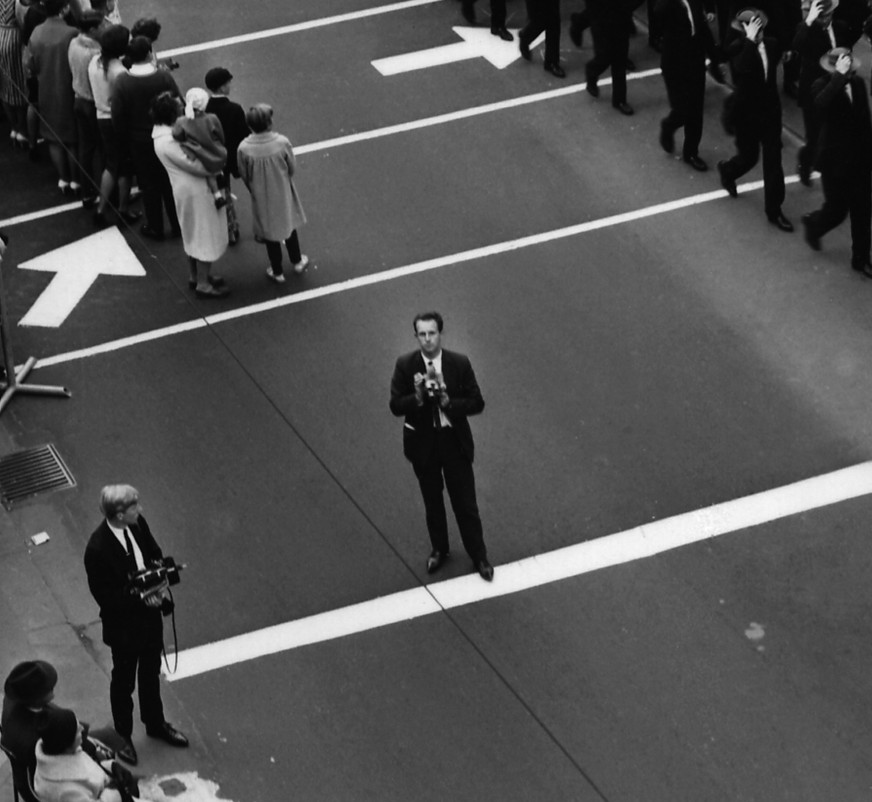
Ruby Davies Photographs 1987 – 1995 Stills Gallery

‘Cinematic Distopias’, Ruby Davies review, Art Monthly, November, 1995

The empire of the city has risen and fallen in a little over two hundred years. The great cities of the world—Paris, New York, London— are on life support systems, relying on ‘urban renewal’, ‘inner city rejuvenation’ and ‘infilling’ to keep them alive. They were once the political capitals of empires, the psychological capitals of civilizations, and the imaginary capitals of entire centuries, now they are pathogenic trouble spots. Once towering metropolises, now they have collapsed into corroding sprawls.

But as ruins never have the great cities of the world been so romantic, even if their romanticism has changed from the days of their glory. The streets of the great cities are no longer filled with insouciant sophisticates parrying the many shocks and jolts of modernity, today’s urban flaneur must go off on a dedicated, lugubrious search for entropic events, imploded spaces and sunken monuments.

Ruby Davies’ photographs capture this feeling perfectly. They were shot on small format over the last eight years or so on various trips to St Petersberg, Tokyo, Berlin and New York (and there’s a couple shot back home in Sydney). For her recent exhibition at Stills  Davies went back to her contact sheets and scanned them once more. The images she chose to enlarge and exhibit tended to be long exposures, and often taken at dusk or night with lighting coming from diverse artificial and natural light sources. The combination of Fuji negatives and Fuji paper has produced chromatically intense images, but the saturated colours produced by the bright lights of the big city appear thickened and coagulated, as though tainted and by some foreign chromogen.

Davies was interested in the massive geopolitical changes her photographs spanned, but also in the intimate association of space and personal memory they embodied. The status of Moscow and Berlin, exactly what they are capitals of, has changed dramatically during the short period of her photography. But she was also interested in the spatialisation of experience which every traveller remembers and sometimes relives through photgraphs. As Benjamin pointed out in his Moscow and Berlin diaries of the 1930s, and Francis Yates pointed out in her classic The Art of Memory, cities are a way of thinking. They are a way of ordering and storing experience, sorting and retrieving personal and political data. Cities are mnemonic machines, on everything from an individual to an epochal level.

Davies’s was a critical tourism, combining a tourist’s eagerness to see the sights, with a traveller’s willingness to drift across the city and discover her own personally meaningful precincts and monuments. Her exhibition maps what the Situationist Guy Debord would call a ‘psychogeography’ of the city. Her cities are not made up of broad clear thoroughfares providing commanding views of citizens bustling about their business. Her’s is a fragmented city, made up of oblique and occluded glimpses—stilted, vaguely threatening portraits; details of lights, shadows and advertising signs verging on the undecipherable; and fleeting views down strange alleys.

Her photographs have the curious effect of solidifying people and desubstantiating architecture. The people she photographs monumentalise themselves, they appear stilled or temporarily absent from their bodies. The Russian soldier stiffly standing guard in Berlin in 1992, the potentially aggro black American soldier on R & R in Tokyo in 1988, and even the posing rock’n’roll singer in New York in 1988, all seem as uncannilly otherworldly and distant as the spotlit and familiarly heroic Lenin statue, which nobody had bothered to topple, photographed by Davies in St Petersburg in 1993. The Japanese girl asleep on the train to Mt Fuji 1988 has left behind her body to dream, as she leans her head against the steel window frame the dark interior of the carriage seems to absorbed her into itself.

In contrast, most of the solid monuments and buildings Davies photographs appear as though they are melting into sodium-vapour lit air. For instance a statue of General Sherman on horseback with attendant angel was photographed in Central Park in 1990. Shot from below and upwards towards a crepuscular blue sky the statue seems to move above us in ghostly procession, the brassy golden burnish on angel’s wing, horse’s head and general’s cloak melding into a slow motion feathery blur. Curtains at the Hermitage Museum in St Petersberg hang in beautiful, but wet looking scallops of cyan blue and orange. We look through the flourescent green stone columns of St Petersberg’s Kazanskii Cathedral towards a tiny figure, standing alone in a square of tungsten yellow light.

The exhibition space of Stills, with its two-and-a-bit tiny terrace house rooms, actually works to Davies’ advantage in her hang. Where it has all but destroyed many an exhibition there, the hanging of work up and down stairs, over light wells, and so on, helps to create a sense of fragmentation and distopia in this case. The disjointed hang made it clear that the influence of cinema has also been important to Davies, looking through the installation the cinema of distopian filmmakers such as Wim Wenders or Martin Scorcese, with their extended point-of-view Steadicam sequences, came to mind.

One key image in the show confirms a cinematic connection. It is an enlarged frame from a Super 8 film taken in the New York Cafe, Newtown, Sydney, in 1987. The painting is of the archetypal Manhattan skyline. It is the oldest image in the show and inaugurates the artist’s drift across the great metropolises of the northern hemisphere and modernity. The lure of New York painted on a cafe wall in Newtown shattered into thousands of images on photographic contact-sheets from which memory, spatial experience and history were recombined into a personal psychogeography. An image taken two years later, and used for the invitation, was of another commercially painted image representing the desire to traverse. This time it was photographed off the rear roller door of a delivery truck in Central Tokyo’s Tskiji Markets. A samurai crouches over the mane of a wild-eyed white horse which appears to be rearing slightly as it advances. Both rider and horse stare intently into the distance, out of the Tskiji Markets, out of Tokyo altogether, and into an impossible place.

Martyn Jolly

The viewer/observer/user an archaeology of interactive multimedia

‘The Viewer/Observer/User: an archaeology of Multimedia’, paper delivered at the Queensland College of Art, and Queensland University of Technology, September, 1995

The promise of multimedia is that it will profoundly change spectatorship. We will no longer be passive viewers, or distant observers, instead we will be users, or players, or the neologism ‘interactors’. The history of technologies of vision and display over the last several centuries has been seen to be one of a continual seduction, a gradual attractive force which the image has exerted on the viewer, drawing the viewer ever closer, until now we seem to be on the brink of being drawn into the image itself. Key scenes from films such as Videodrome or Poltergeist described this fatal seduction even before William Gibson’s final pioneering break through into cyberspace. The imbrication of the body of the spectator and the technology of the display has produced a multimedia/multisensory ensemble of machine and body, a perceptual cyborg. Of course the most dramatic image of this visual prosthesis is the person in the VR suit, but the ensemble is just as complete, if less anthropomorphic, in the computer based ‘multimedia interactive’. From the outside this cyborg looks fairly prosaic, nothing more than somebody siting in a chair in front of a computer with their arm outstretched to a mouse on a mouse pad. People have trouble making this ensemble look as interesting as it is, so in TV shows like the X Files computers are always used in dark rooms so they cast an exaggerated glow onto the face of the users, some of the computer screens seem to be also equipped with lenses that actually project the letters and words of the screen onto the face of the user. The promise of this immersion in the image can have both positive or negative connotations, there has been a spate of ads lately where people drive their cars or burst with their skateboards through billboards into a better life within the image, conversely the fear of cyberporn has gripped the imagination of the press, with some articles even reporting on the physical spiriting away of hapless children by strangers on the Net.

The homunculus of this new cyborg is simple too, a closed circuit system of screen/eyes/hand/mouse/cursor/screen/eyes/hand/mouse/cursor/screen etc. But within this charmed, circular apparatus, of course, there are wonders: an infinite, fluid space without boundaries because it folds in on itself; a world without gravity, or friction, or acceleration, or deceleration, a world whose only horizon seems to be the temporal lacunae when the cursor is replaced by a watch symbol and you can hear the disc spinning in the machine. A world without perspective, where distance is contained within the limits of a given resolution.

The viewer is immersed, but they also travel: they fly over terrains, follow branching pathways, move through rooms, navigate through labyrinths, explore rhizomes, etc. The viewer interacts. The new multisensory computer/user cyborg is dependent on immersion and interaction.

In this talk I want to do two things. First of all want to examine the precise nature of the ‘newness’ of multimedia. I want to historicise its newness. Secondly I want to examine the relationship, and possible tensions between immersion and interaction in multimedia.

In the 17th and 18th centuries the figure of the camera obscura was used in a very similar way to the ways in which multimedia or new technology are used today. The camera obscura was certainly a particular technology, a series of objects which were developed and refined during those centuries, the camera obscura also defined a series of specific cultural and social practices, artistic styles and ways of looking, but the camera obscura was also a philosophical model, a scientific and metaphysical metaphor for states of being and ways of knowing. The camera obscura was an assemblage, both a technical object and a discursive model. It is the fact that multimedia is also such an assemblage that makes it fascinating.

At the beginning of the 17th century Kepler used the camera obscura as a model for the functioning of the eyeball. The lens was like the pupil, and the retina was the piece of white paper or ground glass screen. He couldn’t work out, however, how the two images made their way from the retinas into the mind to produce a single image of the world. Later Descartes developed Kepler’s model of vision into a model of visual cognition by introducing intellectual understanding as a crucial complement to the cold image projection of the iris, the perceiver read the mini-movies that were being continually projected inside the skull in an equivalent way to the way they read the other signs of the world which were brought by the other senses, or which could be induced by thought. Descartes therefore elevated the camera obscura to a model of understanding itself. But in the camera obscura the viewer’s body is bracketed out, because the viewer is inside the machine the machine can take no regard of the viewer, all that matters is the punctal lens and the objective image which the viewer perceives with sober, detached scrutiny. As Descartes said “perception, or the action by which we perceive, is not a vision … but is solely an inspection by the mind.”(Crary 43)

Jonathan Crary, in his book Techniques of the Observer, claims that there was a monumental shift to this paradigm in the early 19th century. The body, which was bracketed out of Cartesian perception, became the very site of perception for 19th century scientists. The eye, which had been a cold dead optical instrument in the 16th and 17th centuries suddenly flowered into a febrile, quivering organ in the 19th century. Scientists and philosophers like Goethe, Schopenhauer introduced a temporal dimension into perception with their investigation of the phenomena of the persistence of vision (on which the apparatus of the cinema depends), others desperately tried to draw and catalogue the various varieties of afterimage before the faded, one blinded himself staring at the sun, other scientists furiously rubbed their eyes to create impressions of light and colour with no optical stimulus, others discovered the blind spot, other scientists discovered that any given nerve will give the same sensation no matter what the stimulus—optical, electrical, chemical or physical

Perception is not the sober inspection of some inner cinema, instead inside and outside mix so intimately that the cannot be distinguished. Perception is incarnated.

A whole range of apparatuses were developed as simultaneous amusements, tools of scientific investigation and epistemological models. Examples like the Thaumatrope, phenakisttiscope, zootrope and kaleidoscope are well known. I want to concentrate on the stereoscope and the phantasmogaoria.

There is no stereoscopic image, it is never stably projected anywhere for sober contemplation, instead it is formed by an exertion of the mind, nor is the stereoscope a replication of natural vision, it is an artificial simulacra of vision. It gives the temporary illusion of b binocular vision, not binocular vision itself. The virtual stereoscopic image is like a stage set, the planes appear recede like flat disjointed cardboard cut outs with a vacuum between. The stereoscope also announced for the first time the prosthetic interlocking of body and machine, though artificial, it is a thoroughly corporealised vision. But it also had the effect of taking vision out of the body, which is left behind, and producing a kind of phantom, body which travels through a virtual space.

Oliver Wendell Holmes writing in 1859 described this new form delirious navigation through virtual reality: “The first effect of looking at a good photograph through the stereoscope is a surprise such as no painting ever produced. The mind feels its way into the very depth of the picture. … Oh infinite volumes of poems that I treasure in this small library of glass and pasteboard! I creep over the vast feature of Rameses, on the face of his rockhewn Nubian temple; I scale the huge mountain-crystal that calls itself the pyramid of Cheops. I pace the length of the three titanic stones of the wall of Baalbec — mightiest masses of quarried rock that man has lifted into the air; and then I dive into some mass of foliage with my microscope, and trace the veinings of a leaf so delicately wrought in the painting not made with hands, that I can almost see its down and the green aphis that sucks its juices. I look into the eyes of the caged tiger, and on the scaly train of the crocodile, stretched on the sands of the river that has mirrored a hundred dynasties, I stroll through Rhenish vineyards, I sit under Roman arches, I walk the streets of once buried cities, I look into the chasms of Alpine glaciers, and on the rush of wasteful cataracts. I pass, in a moment, from the banks of the Charles to the ford of the Jordan, and leave my outward frame in the armchair at my table, while in spirit I am looking down upon Jerusalem from the Mount of Olives” (The Stereoscope and the Stereograph)

Stereoscopy, not surprisingly, quickly became associated with pornography in a similar way in which the Net and VR have instantaneously suggested porn to today’s press. Baudelaire railed against it in his famous diatribe against photography of the same year: “The love of pornography, which is no less deep rooted in the natural heart of man than the love of himself, was not to let slip so fine an opportunity of self-satisfaction. And do not imagine that it was only children on their way back from school who took pleasure in these follies; the world was infatuated with them. I was once present when some friends were discretely concealing some such pictures from a beautiful woman, a woman of high society, not of mine—they were taking upon themselves some feeling of delicacy in her presence; but ‘no’ she replied. ‘Give them to me! Nothing is too strong for me.’ I swear that I heard that but who will believe me?”(Salon of 1859)

The stereoscope was a kind of corporeal/visual labour on the part of the user, who is no longer a passive cartesian viewer, but an active observer, quite aware of the nature of the apparatus, which was transparent to them, and willingly submitting themselves to the surprise of the illusion, the production, within their corporeal selves, of a artificial shock, as Baudelaire’s scandalous lady say ‘nothing is too strong for me!”

The stereoscope was primarily a domestic technology, for armchair travellers or masturbators. Other technologies produced corporeal illusions in a public space, to observers who were logged into the cybernetic visual system, not through stereoscopes attached to their faces, but through having their bodies immobilised in auditorium chairs. These were dioramas, wax works, phantasmogaorias,  magic shows and early pre-narrative cinema.

It is one of the founding myths of cinema that the first audience for the Lumieré’s Arrival of a Train at a Station in 1896 caused panic amongst its audience because they thought they were about to be run over by an actual train. However recent film historians such as Tom Gunning have disputed this seductive myth. For one thing, audience in Europe were used to being astonished by mechanical and optical apparatuses. They were not a naive audience who assumed the apparatus to be transparent, Gunning claims that the astonishment of early audience was at the apparatus itself, and not at what it purported to represent. The apparatus tested the limits of an intellectual disavowal: I know, but yet I see, and that was its pleasure. This pleasure is an aesthetics of astonishment, where the viewer does not get lost in the fictional world of the film’s dram, but remains aware of the act of looking. Films with great titles like The Railroad Smash-Up, Photographing a Female Crook, Demolishing a Wall, and Electrocuting an Elephant, were exactly what the said they were. Safely ensconced in their seats the audience experience the pleasure of a discontinuous series of bodily shocks, which they know is being brought to them by the technology of cinema—a cinema, which in its structural logic is similar to the machinery of the factory, or the experience of a tram-ride through city streets. Critics in the 1920s and 30s, such as Benjamin, Kracauer and Jünger saw these shocks as a kind of training of the body, a hardening of it, to be able to accept the increasing jolts of modernity

This cinema of attractions persists throughout the history of cinema, even when another kind of psychological absorption into the diegetic narrative of the cinema is developed by DW Griffith and Hollywood through the combination of 19th century narrative modes and shot/reverse shot psychological identification with characters. Again, pornography is the most obvious examples of the sub-subterranean persistence of the cinema of attractions, but even Hollywood cinema retains elements of it. Recent mainstream films contain elements of the Ride Film, where the viewer’s body is subject to a series of vertiginous affects, optically and directly, not through psychological identification. Often, as in batman, these films are associated with real theme park rides, and the technologies of actual transport of the audience through real space, along a roller-coaster, and their virtual transport, via projected imagery, have been merging. Again this has precedents in the dioramas and panoramas of the 19th century where audience seating were mechanically moved from scene to scene.

My reason for elaborating all of these precedents to multimedia immersion is not simply to point out that it is all not such a new thing after all, and definitely not to celebrate multimedia as the inevitable culmination of centuries of striving for a ‘better’ vision. Rather I want to shift attention from the newness of the particular technologies—computers and their programs—to the ensemble of viewer/machine. I want to look at what is happening in the two feet or so of space between the user and the screen, and for that a kind of archaeology of the interface may be useful.

Within today’s interactive user of a computer interface there sits another historical figure, the corporealised observer of astonishing optical phenomena which are produced, or perhaps incarnated, within the observer themself, and within that figure lies another figure, the decorporealised cartesian viewer, soberly understanding the language of the outside world. I think we need to call upon all three—viewer, observer and user—to understand what is going on.

One of the most popular films of the ‘cinema of attractions’ was the phantom train ride where, instead of the train threatening to come out of the screen at the audience, a camera was mounted on the front of the engine and the audience was endlessly plunged through space along the camera’s central perspectival axis. The audience seemed to be carried forward not by the train, which was invisible, but by the thrust of vision itself.

Today, of course, the connection between lines of sight and ballistic trajectories has been firmly established by smart bombs. And in today’s VR environments or multimedia interfaces, it is not the train which is a phantom, but the user themself has a phantom double, which is recognised by the machine. The key rupture between old and new immersive environments is that in new immersive environments, the apparatus recognise us, as much as we recognise it. This can extend all the way from the computer responding with a new window when we point and click at a button with our simple cursor arrow on the screen, which is our punctal double in the program’s interface, to the shoot-em-up VR games where if your opponent sees you before you see them…they gleefully shoot you. Between are all the possibilities of interactivity, and all the possible architectures of the virtual environment: the hierarchical, the labyrinthine, the rhizomatic.

However the two qualities of today’s multimedia seem to have an inverse relationship to each other. Maximum effects of immersion rely on minimal interactive choices, more complex choices and hypermedia pathways rely on dense and complex interfaces which demand more of a sober Cartesian intellection than a spasmodic corporeal reaction. For instance most flight simulators, although being highly immersive, only allow the viewer to gradually inflect the trajectory, the paths are quite tightly constrained, and the machine needs time to process new data. In any case, how can more complex, meditative, cartesian decisions be made in a complex labyrinthine interface when the body is hurtling through virtual space. When there is no split between mind and body, when they are vertiginously thrust together by the G forces of immersion, can cartesian ‘choice’ be exercised in the same way? In real situations the body’s reactions are a matter of the somatic memory of relentless training and habitual corporeal drilling.

Most information rich multimedia actively work against the natural immersive seductions of the medium, interfaces which are discussed in terms of being user friendly, or ‘transparent’ seem to me to be on the contrary to act as speed humps. The provide a series of already recognised objects signifying sober selection, books on the shelf, doors along a hallway, pictures on the wall, on which the user must click. Acting like a virtual sphinx these interfaces say, pause before you choose.

There may be a very fundamental metaphoric flaw here. All the hypertext/hypermedia hype rotates around the metaphoric figure of exploration, the breath taking discovery of a new fact. The sudden, unprecedented surprise. The instantaneous enlightenment of dark continents. The Eureka! But all our post-colonial writers have told us that exploration was never like that, frontiers never moved across the face of the globe with the inexorable certainity of the dawn. Exploration was always preceded by speculation, myth, hypothesis, the new was always read through established models of what otherness should be. And of course, on the other side, the side of darkness there is always resistance, evasion, dissimilation and mimicry. Quite simply exploration is never simply spatial or territorial, it is also textual, incremental, layered, accumulative and a process of exchange, however out of balance.

I think that the tension between immersion and interactivity must be a very delicate one to balance, because, from my position solely as a user, multimedia producers seem to very often get it wrong. Astonishment fails, information exchange does not take place between computer and user, the user skims over the interface, checking to see that something, it doesn’t seem to matter what, happens as buttons are clicked. They interact with the interface, rather than the program. The multimedia exhausts itself when its interface, rather than the program itself, has ‘played itself out’. Boredom and impatience are spectres that haunt every multimedia developer.

Is this why the most psychologically engaging immersive interactivity practices are text based, not image based. MUDs and MOOs have a low data bandwidth, but a high informational bandwidth, courtesy of the English language. To my knowledge the only reported psychological trauma from a rape in cyberspace was textual and occurred in LAMDAMOO (?).

Exposed Fictions

‘Exposed Fictions: Anne Zahalka, Robyn Stacey, Tracey Moffat’, introductory essay for slide kit, 1992

Third Draft (Tertiary Version), Exposed Fictions, Three Australian Photographers

Introduction:

The three artists represented in this slide kit — Tracey Moffatt, Anne Zahalka, and Robyn Stacey — all grew up in Australia in the 1960s and 70s. And they each began to make art in the 1980s.

During the 1970s Australian art fragmented into a wider range of art practices. For example, artists became involved in community arts projects, performance art, political poster collectives, crafts and, for the first time, photography. Feminism played a key role in this assault on the traditional primacy of painting and sculpture. Younger artists saw mainstream disciplines as redundant, outdated and male dominated, and they began to be interested in Australia’s burgeoning mass media and popular culture.

In the 1980s many artists, particularly women artists, began to see these new ‘media environments’ or ‘cultural landscapes’ as sources for their most urgent subject matter. The image field of magazines, TV, films, and advertising was alluring and pleasurable, but it was also powerful and controlling. It was the site where what you were, or could be, as an Australian of a particular gender, race, class, age or ethnicity, was defined.

It’s not suprising, then, that in the 1980s, and through to the 1990s, some of the best Australian art was produced using photography, and that the most challenging photography is done by women. After all, the roles assigned to women within Australian culture, and their identities as defined by the mass media, are most fluid at this time. They have the most at stake in the image field to which photography is central.

The strategy of appropriation

Each of these photographers re-uses imagery which is already circulating in our media or culture. Robyn Stacey, for instance, directly copies images off the video screen to construct her works.  Anne Zahalka, in the seriesThe Landscape Re-presented, 1982, copies and collages Australian painting ‘classics’. But images from the past do not have to be directly copied to appropriated, their surface appearance, visual style, and dramatic genre can be mimicked. The photographed tableaus in Tracey Moffatt’sSomething More, 1989, for instance, look like enlarged film stills from a Technicolor melodrama film that might have been made in the 1950s. While Robyn Stacey’s Kiss Kiss Bang Bang, 1987,  evokes the 1940s Hollywood gangster genre of of the 1940s. In Resemblance, 1987, Anne Zahalka takes portraits of contemporary people, but in the manner of Dutch painters from the sixteenth century. And, in Some Lads, 1986, Tracey Moffatt’s portraits of young, spunky, Aboriginal men contain within them the visual memory of nineteenth century anthropological studies of Aborigines photographed by white colonisers. Tracey Moffatt said about this work: “Aborigines have been continually represented as ethnographic or documentary subjects. The idea behind my Some Lads series is an attempt to dispense with the seriousness and preciousness…which a lot of photographers…have cloaked us in…The images are intentionally posey and sensual. These are traits rarely assigned to Aborigines and rarely sought out and captured within photographs.”

In some cases these artists are using appropriation as a political strategy, a lever to prise apart things which are normally assumed to be glued together. For instance, the ‘golden summers’ paintings of the Heidelberg School, which celebrate the pastoral wealth of turn-of-the-century British colonisers, are often still used in advertising and the media as images of ‘Our Australia’. But where does this leave other Australias? Aboriginal Australia for instance? Or Migrant Australia? Or even Australia as a cultural satellite of the USA? In The Landscape Re-presented Anne Zahalka’s collaged interventions into these seamless Australian arcadias ask these questions on the level of the ‘truth’ of the image itself. At first the image appears familiar, then we notice a subtle alteration. Our momentary confusion forces us to re-think the familiar message of the original painting.

At other times appropriated visual genres are used as a powerful, shared language in which to talk about the artist’s personal emotions and desires. In a way we are all, as members the same culture, pre-programmed with a shared knowledge of the visual codes and rhetorics of the past. For instance the dramatic characters and spectacular scenarios of Robyn Stacey’s Kiss Kiss Bang Bang, Redline 7000, 1989, and All the Sounds of Fear, 1990, immediately seem familiar to us because they are condensed and refined out of the phosphorescent soup of media images, genre types, character poses, cityscapes and special effects in which we are all electronically emersed. But not only do we recognise them, we also directly feel them because, to a certain extent, our shared experience of the media has helped to form us all as the kind of people we are. Robyn Stacey has said: “By reducing or abbreviating the imagery to the very skeletal aspects of narrative, I could concentrate on the more sinister, or more potent aspects of each symbol … I was fascinated by the fact that now, so litle information is needed to tell a story. It is sufficient to simply signpost sitiuations because viewers bring their own associations to images … I wanted to leave space in the work for this to happen.”

In Something More Tracey Moffatt provisionally occupies the narrative space of that ‘familiar story’ of an ‘outsider’ girl leaving a brutal home for the big city. But she does not just re-tell this story one more time, rather she uses it as a kind of allegory for the dislocation, loss, desire and oppression felt by all colonised peoples everywhere.

Anne Zahalka’s Dutch-style portraits in Resemblance  are of real people, but her portraits don’t claim to ‘plumb the depths of their souls’ in the way a traditional portrait might, rather we see her subjects as individuals constructed out of a present permeated by the past. As in all of her portraits, their individuality is not an inborn kernel of being, but is dependent on their social environment. The viewer is aware that Zahalka is re-using a particular visual rhetoric to construct a particular, provisional ‘portrait’. Another rhetoric could be used to construct another portrait of the same person. “In the nineteenth century it was thought that a good portrait should depict the character and being of a historical period. Such judgement assumes the objectivity of facts and the possibility of true perception. But in our time the solid historical reference points are threatened with dissolution, without exception. Time without a past, in which one can break off masonry from the ruin ‘history’ to adorn oneself in accordance with one’s own history and need.”

Similarly, in Bondi: Playground of the Pacific, 1989, Zahalka has documented Bondi, but she hasn’t documented it as a simple ‘place’, rather she has photographed Bondi as an ensemble of myths, histories, memories and prior images.  And this ensemble, which is seen to somehow ‘reflect’ Australia, is always under contention. She has again used staged tableaus to show the provisional nature of such enactments of nationhood.

Our shared language of images

The relationship between the artist and the viewer in this kind of art is a special one. The viewer is not asked to ‘experience’ the art work as some kind of magical distillation of the artist themself; nor does the viewer simply read and ‘understand’ the image as though it was a direct copy of reality; rather there is a pleasurable complicity between artist and viewer. Both artist and viewer delight in the shared exploration of visual languages and in the enpowering thrill of role playing and masquerade. Both artist and viewer delight in raiding the citadels of history and trespassing on the gardens of culture.

But in the best examples of this kind of art such playful transgression has a very serious purpose. For women, for instance, it might have a political purpose. Women have usually been the subject of history and culture, not its object. That is, they have been the models and muses, rarely the artists or creators. They have been those who are desired, rarely those who desire. In short, women have usually been asked to ‘dress up’ as themselves for others. In these art works they ‘dress up’ as others for themselves. These artists do what they have always been asked to do — become seductive, spin a web of illusion — but now they do it on their own terms. “Feminist photographers … aim to unfix the pre-given truths of social and cultural discourses. They work on the assumption that woman has been excluded from any control over the truth and language of these texts in the first place. Therefore they have nothing to lose by destabilising the feminine performances of allegory, muse and model that have provided woman’s conditional access to social and  cultural truth.”

The new reality of the mass media image world

This kind of art also takes a new approach to ‘reality’ itself. In looking at these pictures we take an almost connoisseurial pleasure in the ‘look’ and ‘feel’ of the mediated image. We almost palpably savour the Technicolor gloss of Tracey Moffatt’s large Something More images, or and the Renaissance nobility of Anne Zahalka’s detailed Resemblance  tableaus, or the ‘cheap ‘n’ nasty’ inkiness of Robyn Stacey’s Kiss Kiss Bang Bang series. Her All the Sounds of Fear  incorporates the temporal dimension of the media flow into the images graphically: “Horizontal panels replace the jump cut linear sequence of television crime drama…”. Her computer generated and manipulated Infinity Gardens 1 & 11, 1992, seem to imply an entirely new spatiality of the image, no longer a perspectival projection of the world, but now a cold enveloping and undulating surface which electronically generates a virtual space all around us. “Each work becomes a ‘screen of knowledge’, the illusion of a well ordered, highly rational world. But this is merely staying on the surface of events and things; it is a window on the world that keeps distancing and making observers of us, rather than active, inventive participants.”

All this draws our attention to the mediated image as a new kind of fact. It is now an artefact from an image world which perhaps is becoming just as substantial as the physical world.

Our common sense notion of reality is that there is a real physical world which we are able know through our own visual perceptions of it and the representations of it in painting, photography, film, video etc. We think: “the world comes first, then we know it through representations of it, and the two together make up reality”. This art, however, argues that in fact the two now interpenetrate each other. It suggests that there is no prior truth — of the person, or of history, or of culture, or of gender, or of sexuality, or of desire, or of science — which we reach through representation. Rather, these artists claim, what we know as the truth is produced within representation, not revealed by it. Therefore the truth at any one time is always affected by its social political and historical context, so it is always under negotiation, and it is always up for grabs.

That is why the field of the image has become an important site for these artists to talk about their own reality. They are not so much exposing fictions as revealing the multiple truths within fiction.

Martyn Jolly

July 1992