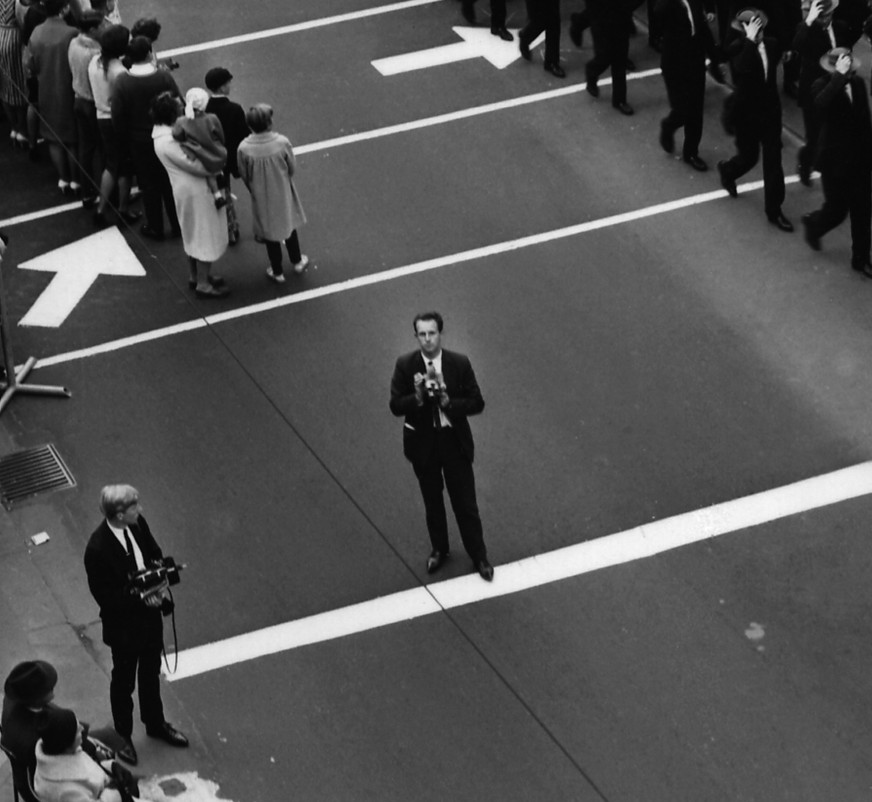
Down Turn

‘Downturn’, book foreword to Downturn, 2009. edited by Lee Grant, unpaginated one page ISBN 978-0-646-51556-4

Documentary photography’s prime responsibility is to take the abstract and make it concrete, to put a ‘human face’ to broad historical events, and create from raw actuality something understandable and legible. Documentary photography came into its own and consolidated its central precepts during another global turn down, the Great Depression of the 1930s, when photographers such as Dorothea Lange shot the key icons of the style — emotionally charged images of hapless individuals caught up in global currents they could barely comprehend that tugged at the heartstrings of sympathetic viewers.

Our own global down turn is even more abstract than the Great Depression, which is its only comparator. It has no time for the plangent majesty of the phrase ‘the great depression’, instead it goes by a brisk acronym: the GFC. It started only last year when a chain reaction was suddenly triggered in the interlocking money markets, and it may be even be over by the end of this year. I have hardly felt it effects at all, I haven’t lost my job and in fact the cost of my mortgage has gone down while I have received two refreshing splashes of cash. Yet I know that it has been historically catastrophic in some way or other, because I have seen the jagged red lines plunging downwards again and again, on my TV screen and in my newspaper. And I’m vaguely aware that perhaps it has directly affected people I might know. Perhaps some of my students have found it harder to get shifts at wherever they have to work to pay their way through uni, perhaps the relatives of some of my friends might have lost their jobs, perhaps….

So there is a task here for documentary photography. And there is particularly a task for young documentary photographers. Young people are continually being accused of being disengaged from the world, insulated from social responsibility by the upholstered solipsism of youth. Yet, as they are also being constantly reminded, it is they who will inherit and have to solve the seemingly intractable problems we have created for them.

How then, do they respond to the assignment of documenting the GFC? Each in their own individual way, of course. But some themes do emerge. For instance there is a persistent concern with stuff — the end residue of that urgent impulse to consume that drives the modern economy. Why do we need all this stuff, what are we going to do with it, what does it look like? And notice how it hangs around even after we ourselves have gone and have no use for it. Another visual trope is the threshold, the spatial barrier of the gate or the fence that either separates people or forces them together. Fences, gates and walls define spaces, and many photographers in this book are sensitive to the nuances of space — both the social space of the street and the private space of the home. Those spaces are where people are forced to live together, and with economic down-turns edges get sharper and surfaces get rawer as people rub up against each other. So we have the ‘haves’ and the ‘have nots’ studiously ignoring each other on the street an in other public spaces, while developers continue to push the suburbs out further and further by building individual houses separated from each other by darkness. Meanwhile within those houses people continue to just about manage their lives in congested and claustrophobic rooms.

Having seen these photographs I now feel I know just a little bit more about the great economic downturn of our time.

Martyn Jolly

Head, Photography and Media Arts

ANU School of Art

David Wills

Made up of over eight thousand photographs and seven hundred fragments of overheard conversations — all meshed together by nearly a thousand keywords — Turnstile is an extraordinary cultural archive. David Wills has spent the last four years trawling through our contemporary urban environment like a human drift-net. He has developed a finely attuned radar for cultural objects that are so marginal, so detrital, that they barely register as artefacts at all. He taxonomizes and cross-references this ‘cultural mulch’ using an acute historical sensibility that mixes irony with a passion for his world, as well as nostalgia with a love for the contemporary, in equal parts.  The interlacing of the threads of images and information forms an on-line network vast in scale and microscopic in detail, but unified in structure.

He has not only constructed his own world, but has also produced a thoroughly compelling document of our time, which depicts the early twenty-first century not so much pictorially as granularly.

The archive is a key motif of photography, from nineteenth century ethnographers, through twentieth century artists such as Gerhard Richter and Hans Peter-Feldman, to today’s sardonic flaneurs such as Martin Parr. And of course online archives such as Corbis or Flickr already allow us access to numbers of images at an astronomical scale. But only Turnstile combines the automatic logic of a search engine with the personal sensibility of a singular artist.

Collateral Damage – Denise Ferris and Martyn Jolly

‘Collateral Damage’ (with Denise Ferris), Art Monthly Australia, July, 2008, pp3—5

Now that the nightmare is finally over for Bill Henson, and the dust is settling, what will be the residual damage to Australian culture?

Photography plays a complex role in our culture, it produces direct evidence of reality, but at the same time it deals in social symbols and metaphors, and creates personal ideals and icons. The attack on Bill Henson cut through this complexity with a syllogism devastating in its fundamentalist simplicity: nakedness is always sexual, and photographers always exploit their subjects, therefore photographs of naked children are always exploitative child pornography. This equation efficiently short-circuited any other mechanisms of representation, or expression, or interpretation that until now were assumed to be intrinsic to photographing models posing for the camera. In her strident way Hetty Johnston from the lobby group Bravehearts put it best. When she heard that the DPP had finally dropped the charges she declared: ‘We are just handing our children on a bloody plate to paedophiles. This is a disgrace for this country, absolutely shameful.’

In this formulation, not only are all photographs of naked children always equivalent to paedophilia itself, but they also condemn the whole society. As the Sydney academic Ruth Barcan pointed out in Nudity a Cultural Anatomy, ‘Images of children and youth function as mirrors to an adult society eager to verify its own moral state. This might help explain why representations of children can be subject to idealization, but also why both the effect of images on youth and the representation of youth in images can become concentrated sites of social unease and regulation.’

Any attempt to resist an over-regulation of photography driven by such social unease is immediately met with the ultimate foreclosing reply: child protection. In supporting the initial raids of his police officers the NSW Police Commissioner Andrew Scipione said, ‘the most important thing here, the thing we cannot lose sight of, is we have to protect our children’. As more police started to raid art museums, rifling through their racks looking for thirty year old art works, Hetty Johnston agreed,  ‘Nobody is above the law, not artists, they just can’t be, children are suffering as a result.’

But how might actual children suffer as a result of Bill Henson’s photographs? Perhaps a paedophile might see one and be so erotically inflamed they may abuse a child. But there is plenty of real child pornography available on the net, and no proof that the mere existence of further images of naked children in artistic scenarios and artistic poses will exacerbate a paedophile’s behaviour. Perhaps a child might see one and become ‘sexualised’ too early in her emotional development. But an image of a normal pubescent child simply standing there is unlikely to provoke body-image confusion in other children, who must also be regularly seeing their own friends’ bodies. Perhaps his models may be traumatised by the experience of posing for him, even if they don’t yet realize it. But no Henson model has yet reported that they found posing for him anything other than enjoyable and creative experience. Or perhaps the ‘innocence’ of a child is ‘exploited’ by Henson making money from it. But child actors have long delighted us with their precocious presence in popular films and TV shows, so why should art be any different.

Whilst the DPP was considering whether or not to charge Henson, other police were spending their time more usefully by using actual child pornography to track down real paedophiles. The images they traced, which were downloaded at least 1500 times to Australia, were quite unlike Henson’s, being images of actual sex-acts. Although police operations like Operation Centurion have established that the circulation of pornographic images is an important part of paedophilic behaviour, no research conducted anywhere has been able to establish any causal links between images of the type produced by Henson and aberrant behaviour.

Nonetheless, we have arrived at a time when the naturalist’s slogan ‘nude ain’t rude’ seems historical and quaint, and when talking about nakedness as being just the way we were born sounds like old-fashioned hippy speak. The British sociologist Frank Furedi has described this as a ‘culture of fear’ where ideas of social change (including how we see ourselves represented) are experienced as risks, not opportunities for new orientations. This exaggerated sense of risk is driven by a powerful ‘cognitive illusion’. As the Harvard cognitive psychologist Steven Pinker has argued, we estimate the probability of an event from how easy it is to recall examples. And examples of abuse are continually made forcefully present to us through the media. The incentive structure of activism and opinion markets adds to this — no one ever attracted followers and donations by announcing that things keep getting better.

Potential risks inevitably lead to potential victims. Every photographic act is now more readily viewable through the prism of victim and abuser, than artist and subject. And so Hetty Johnston is able to claim that, ‘the liberties the art world take … harm the whole cause of child protection.’ Even more authoritative commentators such as Clive Hamilton, the campaigner against ‘corporate paedophilia’, says that Bill Henson and Roslyn Oxley should have known better, and have only themselves to blame. They should have realized that they would suffer collateral damage from a society finally waking up to the fact that it has let its children become sexualised too early. But Henson isn’t the only artist to be sustaining collateral damage. For example in April 2007 Polixeni Papapetrou’s photograph Olympia Wearing Her Grandmother’s Jewels was withdrawn from the Gosford leg of the Australian Centre for Photography’s touring show Changeling: Childhood and the Uncanny after complaints from the public. And in 2005, just prior to the opening of Ella Dreyfus’s exhibition, two of her images of soccer players in her son’s team were withdrawn from display, four were withdrawn from sale, and two remain covered over in the catalogue.

Do these few examples really matter? Why bother with those who think they can definitively tell right from wrong, and who set themselves up as experts who know what’s good for all of us? Because these harmful helpers also wantonly mishandle exactly what adults are entrusted with — the social and cultural future of our young. Their self-indulgent disgust and uncorroborated fantasies of harmful art will have significant long-term effects on the world our children will inherit.

Their world would drop a visual veil over our children until the age of eighteen. The marvellous extended process of a child becoming an adult would take place in the dark. The transition period when children are most vulnerable to exploitation (from somebody they know and trust in 85% of cases) would take place largely unseen and unspoken about. The complexities, doubts, fears and dreams of puberty would be left to the tabloids, the television and the advertisers to articulate with their banal sexual dichotomies and overheated social scenarios. The psychologically supporting network of loving looks and mutual regard we want our children to grow up in would be ripped away. The complexity of children would become publicly invisible — except for the photographs that sell products to them.

Their world sees only two possible contracts between adult and child, either one of parental or pedagogical authority, or one of sexual exploitation. All other contracts based on mutuality, creativity, fun or play, are suspect. The chance these teenagers had, through symbolically representing ‘youth’ for Henson (with mum and dad’s permission and with their own free will) to briefly pretend to be someone different, and collaborate on producing something mysterious and beautiful and powerful, would exist no more. By all accounts Henson’s models down through the years still value the experience, some even hang the resulting photographs on their walls for their own children to admire.

The world of the over-anxious sees no social role for art, or creativity or expression. Hetty Johnston sees Henson’s art in only two lights, it is either to make him money by selling images of children, or for his ‘personal satisfaction’. For her, art seems to be a furtive personal activity closely allied to pornography in any case, and without wider social or cultural benefit. ‘If we keep allowing artists to do whatever their whim allows, whatever they want to do, what’s the next boundary that’s going to be challenged by the likes of Bill Henson’, she demands. In her view, and in the view of her cheer squad in our parliaments and in the media, art is a habit a small section of society has, a personal indulgence rather than part of a larger conversation.

Moral panics rise and fall. Eventually this one, too, will subside. But after it has there will have been a tectonic shift in the attitude of the public and the law to what we can and can’t see, what we can and can’t make. The deadening effect will hang like a pall over all of us.

Peace After War and Memories, 1918

‘Peace after war and memories’, catalogue essay in Harold Cazneaux: Artist in Photography, 2008, edited by Natasha Bulluck, Art Gallery of New South Wales. PP136-137 ISBN 978-1-74174-022-6

Cazneaux was a photographer of taste and restraint. His reputation was built on understated images with elegant compositions and carefully modulated lighting effects. Which is not to say that he didn’t tackle big topics, his central theme was the process of historical change itself, the gentle overlapping of one epoch with the next. However, a few images stand out as intriguingly different in Cazneaux’s work. One example is Peace After War and Memories, 1918, exhibited at the London Salon of 1920. Unlike most of Cazneaux’s pictorialist work it is not a generalised view of this or that backstreet of Sydney, or this or that picturesque by-way in the countryside. Its title and date refer to a specific historical event, the end of the Great War. The main figure is presumably a soldier settler, one of the thousands who were given small blocks to farm as a form of repatriation, and in order to build up the Australian nation by forging the returning diggers into a class of agrarian yeomanry. (Although, even in 1918 as a severe drought began to bite, it was becoming clear that the utopian dream of the soldier settler schemes was destined for failure.) The horse-drawn plough of the farm is a familiar enough Cazneaux trope — an anachronistic technology teetering on the edge of nostalgia — but it is the dusty smoky paddock it ploughs that is the most arresting. It is a strange, uncanny landscape, a doubled landscape, at once an image of a precarious attempt to make the harsh Australian land productive and a visual echo of the blasted landscape of the Front returning. The bare trees in the background would have reminded contemporary viewers of the skeletal trees of the Somme, stripped of their leaves by bomb blasts; and the drifting smoke from the burn-off would have reminded them of the newspaper pictures they had seen of the bombs themselves. The dispersing clouds are also a familiar pictorialist convention, but the shafts of light beneath which the soldier/farmer bows his head now seem to directly offer divine benediction to his reverie. Cazneaux has clearly felt compelled to lard all of these extra symbols into his image in order to express his personal reaction to the historical cataclysm that was the most epoch changing event of his time. Although he was a sentimentalist, this mannered symbolism was new terrain for him. However similar images were occurring regularly in lower-brow culture, and Cazneaux drew on this visual vocabulary for his own salon image. For instance in 1915 Melbourne’s Weekly Times Annual printed a montage of a digger on guard duty in a bare battle field, leaning over his rifle and dreaming, in a photographic thought bubble, of his mother waiting for him back home. And in 1919 Frank Hurley was to exhibit The Dawn of Passchendaele at Sydney’s Kodak Salon, in which he montaged a holy-card sky above a terrible battle scene. By the 1920s Cazneaux was back to making sleek images for classy magazines like The Home. It wasn’t until World War Two, when he rechristened his 1937 photograph of an ancient gum tree tenaciously clinging to a dry creek bed The Spirit of Endurance, that he made another of his images resonate in a similar way. That nationalist allegory was more enduring and remains popular to this day.

Weekly Times Annual, Melbourne 4 November 1915, The Mothers Daydream, The Son’s Lonely Vigil, pp12-13

Alex James’s Landscape Photographs of Time and History

‘Photographs of Time and History’, book foreword in The Twilight of Mr Kemp: Landscapes 1797-1897, by Alexander James, unpaginated two pages. ISBN 0-9532458-4-5

In that period after the sun sets below the horizon, but before the landscape sinks into complete darkness, Alex James works like a demon. With a view camera he urgently exposes sheet after sheet of large-format film. As the gloaming intensifies, his exposures lengthen, from several seconds to many minutes. Eventually he is focussing only on the beam of a torch, and the chemical phenomenon of reciprocity departure has curdled the colour of the last remaining glow of sky a sour yellow.

James is photographing sites where, perhaps, tragedies once occurred. As Europeans moved across the landscape they sowed the ground with such stories. There were not only the massacres and dispersals they perpetuated on the indigenous population, but also their own random mishaps and misadventures — their drownings, their shootings, their shipwrecks, their bungled escapes and their disappearances.

Not for James the antiseptic, suprahuman wildernesses of, say, a Peter Dombrovskis. Against those anodyne microcosmic or macrocosmic spectacles James counterposes a large-format landscape photography where places are entangled with stories, light seems to grow up and out from the ground, and the landscape is not there to be consumed by the viewer, but instead sometimes threatens to engulf the viewer themself.

James is born and bred in south eastern New South Wales and has a profound affection for the place. Since he was a child he has skied, bushwalked and surfed from the Snowy Mountains to the South Coast. [M1] He also loves the process of large-format photography, the muscular physical challenge of getting his camera to the spot, the forensic accumulation of detail, and the dilation of time during the exposure. Like many locals a starting point for establishing a deeper connection to his land and its uncomfortable past began with various local histories. As a genre, these popular local histories are often not much more than patchwork compilations of picturesque anecdotes from various sources which, their authors enthusiastically presuppose, have somehow combined to form the unique character of the region and its current inhabitants. However by re-attaching them to specific landscapes, James has used these local stories to produce a sophisticated visual experience.

In one such history he found an account of a twelve-year old boy who had drowned in the Molonglo River in 1843. This story, complete even with a spooky premonition by the boy’s mother, is typical of the hundreds of such stories from the nineteenth century which testify to the disquieting sense of unbelonging which underscored colonial expansion and settlement.

James returned to the site — now, probably, just below the dam that forms Lake Burley Griffin — to photograph a shallow watercourse choked with weeds and swallowed up by scrubby trees. The receding surface of the water is crawling with worm-like tree-flowers and striated with reflections from the trees, while the vertical plane of the photograph is criss-crossed by a latticework of falling branches which further repel the eye. The threads of light which do manage to penetrate this suffocating space are stained an eerie, indistinct colour — a colour which we know has not been dialled up in Photoshop, but is the chemical and optical result of the process of photography itself at this time of day.

Another oral-history story, which almost has the metaphorical resonances of a fable, concerns a horse which, in the 1890s, escaped a cruel owner on Montagu Island by swimming back to the mainland nearly nine kilometres away — not once, not twice, but three times. In James’s photographs of a low rock platform sloping away into the sea (the only place on the island where the horse could conceivably have entered the water to begin its epic swims) the waves have dissolved under his long exposure into an etheric vapour, and the horizon-line appears like the impossibly distant edge of the world.

Various views of South Coast beaches and headlands are gathered under the title Spring 1797. The date refers to the months when a group of shipwrecked sailors attempted to walk up the coast towards Sydney from Victoria. Despite considerable help from the local indigenous tribes the group progressively died of starvation until only three remained to be found, near death, a few miles south of Botany Bay. James’s crepuscular photographs of the regions they passed through turn what could have been pretty postcard views of holiday beaches, or pleasant pastoral scenes from tourist drives, into something like the ominous and brooding landscape the sailors must have experienced as they trudged through them.

An even more scary ambience is created in a series of rainforest views James titles Spring 1830, in reference to a letter sent at that time by a Batemans Bay resident to the Governor seeking his permission to murder a group of local Aborigines who had been spearing cattle. In James’s airless photographs his wide-angle lens appears to have spreadeagled the ground itself, and the serpentine forms of roots and branches writhe and twist away, plunging into the loam beneath the dense leaf-litter. Each of these shadowless scenes is steeped in an identical sanguineous light.

From these low chthonic reaches, James also took his camera higher, up into the airy tops of the High Country and even above the snow line. For instance Spring 1862 refers to Eugene von Guerard’s expedition to Mount Kosciusko accompanying a scientific survey led by the German scientist George Neumayer, where yet again the expedition’s work was interrupted by a member of the party who got himself lost for several days. But in rephotographing von Guerard’s original famous view from Mount Townsend one hundred and forty-six years later James found himself, like his predecessors, dangerously caught out by the rapidly changing weather, and barely able to make it back to the safety of his tent after darkness unexpectedly closed in.

In these images the scale opens out to approach the majestic, but the horizon line remains high and the colours remain cloying. In the summer of 1835 a mounted policeman shot an escaping bushranger who was desperately swimming across the Snowy River, and his body was never seen again. In James’s photographs of the river the surface of the water becomes skinned with a viscous and glaucous blur.

Towards the end of the book the images approach white-out and the spatial stability offered by a horizon line all but disappears. The series Autumn 1983 is based on the story of a settler who was thrown from his horse and drowned after being caught in a freak snow storm while running cattle in the Snowy Mountains. At this elevation stories such as these seem to have created their own small seismic events as they crack the collapsing crust of snow, revealing the basalt bones beneath. Up here, where the delicate balance of the weather defines the look of the landscape, these fracturing, brittle surfaces have an almost apocalyptic beauty.

All of James’s landscapes are entangled and layered. In his vision time is folded into space, and history is folded into geography. His love for his home, the south-eastern regions of New South Wales, has been deepened by his use of local histories and the bizarre range of stories they offer up. But his photographs do not celebrate the bravery and struggle of the white ‘pioneers’ who ‘opened’ up the land for us. Nor, on the other hand, do they dismissively condemn them for the dispossession of those that, some claim, still have the only authentic relationship to the land — the Aborigines.[M2]  Rather, the loose connections he makes between story and place mobilise the imagination of the audience to narrativize the scenes in a provisional, unsettled way. The viewer virtually enters the scenes and animates them by following along the tracks and lines of tree trunks with their eye, or by spreading their gaze out to suffuse them up to the horizon.

These sites are not monuments to Australian history, like Gallipoli Cove or the Burke and Wills ‘Dig Tree’. They are not sites for prescribed acts of historical memory as a form of national allegiance. The photographs are probably not even taken precisely where the event actually took place, even if, indeed, the event actually happened in precisely the dislocated, fragmentary way in which it has eventually come down to us. Nonetheless story and place adhere to each other like a vague haunting, intermixing and catalysing in the imagination of the viewer. These photographs are experiments in producing a new relationship between ourselves and the land we have inherited — for better or for worse, and along with all of its stories.

Martyn Jolly

October 2008

Dr Martyn Jolly is Head of Photography and Media Arts at the Australian National University School of Art.


 [M1]I mainly ski these days so if you could put “skied” instead of snowboarded and “surfed” instead of swum.

[M2]Again use indigenous Australians or indigenous population, or finish sentance after ‘relationships with land’ – whatever you think.

International Documentary Photography

Of course every photograph is in some sense a document of something else. The very essence of the photography is its ability to make pictorial ‘documents’ of events, be they an abstracted photogram of glass objects arranged and exposed in a darkroom, or an image of a car running a red light recorded by an automatic traffic camera. Nonetheless, the word ‘documentary’ has become used to describe a very particular photographic practice within the medium, or perhaps more accurately, a very particular ethos subscribed to by some photographers. The word has become used not so much to describe a discrete photographic style, or even a particular historical movement, but a complex set of almost moral attitudes to the medium passionately adhered to by some photographers. To the documentary photographer the camera is a tool with which they can personally witness, and perhaps even change, the world.

During the American Civil War (1861-65) the photographer Matthew Brady hired a corps of other photographers to cover all of the major battles for him from their photographic vans, feeding a hungry market in the cities with over 8000 stereo views and cartes-de-visite, which were available for sale from his New York studio. Some were also hand-cut into wood engravings for illustrated magazines. Although the vast majority of the photographs were relatively mundane, the battle views, which because of long exposure times had to be taken after the event, quickly became the most famous. Even though some photographers re-arranged the corpse-strewn battlefields, dragging the corpses into more dramatic compositions and even getting assistants to pose as additional corpses, the visceral connection such photographs forged between the war and the viewer at home was overwhelming. In 1862 the New York Times commented: ‘If [Mr Brady] has not brought bodies and laid them in our door-yards and along the streets, he has done something very like it. […] These pictures have a terrible distinctness. By the aid of a magnifying-glass the very features of the slain may be distinguished.’ [1]

Towards the end of the 1800s the New York police reporter turned social reformer Jacob Riis began to use the flare of magnesium flash powder to penetrate the obscurity of the slums of the Lower East Side. Riis’s flash photographs captured his dishevelled subjects in raw oblivion to the camera’s presence. As the New York Sun reported the ‘night pictures were faithful and characteristic, being mostly snapshots and surprises. In the daytime [the photographers] could not always avoid having their object known, and struggle as they might against it, they could not altogether prevent the natural instinct of fixing up for a picture from being followed’[2] Riis showed his pictures as lantern slides with accompanying commentary, and published them, not as hand cut wood engravings, but as direct half-tone reproductions, in the seminal book How the Other Half Lives, 1890. As a result of his campaigning significant changes were made to the laws surrounding New York’s tenements.

The National Child Labour Committee also recognised the persuasive power of the photograph. Between 1908 and 1918 they hired the sociologist Lewis Hine to travel around the US taking photographs of child labourers in mines and factories. He used deliberate camera angles and framing to emphasise the small stature and pathetic isolation of the child workers, and recorded their names, ages, origins and circumstances. The resulting images, such as Dinnertime. Family of Mrs A. J. Young, Tifton G.A. 1909; Raymond Bykes, Western Union, Norfolk, Va. 1911 and Norman Hall, 210 Park Street, G.A. 1913, were published in the social reform magazine Survey, and used for lantern slide lectures and posters. In the posters the photographs were often laid out graphically to visually tell a story. In ‘Making Human Junk’ for instance, the ‘good material’ of healthy children is processed by a factory into the ‘junk’ of child labourers. To Hine the photograph was a ‘symbol that brings one immediately into close touch with reality […] it tells a story packed into the most condensed and vital form. […] it is more effective than the reality would have been because, in the picture, the non-essential and conflicting interests have been eliminated.’[3]

By the 1920s that the word ‘documentary’ was being used to describe this new genre of photography. In 1926 the British influential film theorist John Grierson coined the most commonly used definition of the word: the ‘creative treatment of actuality’. This phrase somewhat gnomically captured documentary’s double sense of the camera penetrating a raw social reality, supposedly unaffected by the photographer’s presence, while at the same time the photographer’s ‘vision’ selected, interpreted, symbologized and narrativised that reality in order for it to have maximum impact on the viewer.

This ethic reached its full flowering during the Great Depression of the 1930s. In 1935 the US Government under its New Deal policies set up the Farm Security Administration. Its Historical Section conducted a photographic survey of rural deprivation. The economist Roy Stryker hired a group of photographers, including Dorothea Lange and Walker Evans, to travel across the continent, particularly in the poor South, and send back exposed film to him in Washington to be developed, edited, captioned and distributed to newspapers and magazines. By the end of its life the FSA had assembled an archive of 180 000 images.

Dorothea Lange had previously produced documentary photographs of depression poverty such as White angel breadline, San Francisco of 1932, which with its dynamic composition dramatically compressed the human tension in the scene. For the FSA she produced another image with a similarly compacted triangular composition — Migrant Mother 1936. It was reproduced immediately in the San Francisco News, leading to food being sent to the pea pickers camp where it had been taken, and was hung in the Museum of Modern Art in 1941, which led to it becoming a national icon of madonna-like forbearance in the face of suffering.

Walker Evans shot his subjects frontally with a large-format camera, describing, as in Untitled (street scene Southern city) c1936, the solidity of surfaces and forms in objective, rectilinear detail. In 1938 he exhibited his FSA photographs at the Museum of Modern Art and published them in the monograph American Photographs, where for the first, rather than being reproduced amongst columns of text in magazines and newspapers, they were reproduced as art in a careful sequence, one image at a time, and with minimal captioning. The introduction to the book described Evans’s work as ‘straight’ photography — ‘there has been no need for Evans to dramatize his material with photographic tricks, because the material is already, in itself, intensely dramatic. Even the inanimate things, bureau drawers, pots, tires, bricks, signs, seem waiting in their own patient dignity, posing for their picture.’[4]

In 1936 Evans had lived for a time in the shack of an Alabama sharecropper family. On assignment from Fortune magazine, he and the writer James Agee probed into the minutia of the their downtrodden lives as they shared their private space. When Evans’s fine-grained images of the dry, scrubbed surfaces of the house and the lined, weathered faces of the family were reproduced, together with Agee’s extended lyrical text, in the book Let Us Now Praise Famous Men, 1941, they served to not only dignify, but almost ennoble the family’s stoical poverty.

Many FSA-style photographs were reproduced in Life magazine, the most famous picture magazine of the period. Commencing publication in 1936, Life used new high-speed presses, coated paper-stock, and quick-drying inks to cheaply reproduce photographs in both quality and quantity. Featuring easy to digest ‘picture stories’ — photographs with short captions spread across several pages — Life reached a circulation of six million by 1960, before the alternative entertainment of television began erode it sales figures.

Life’s optimistic patriotism and belief in American values fed directly into a massive exhibition of 503 giant photographic enlargements selected from 273 photographers by the famous photographer and curator Edward Steichen. Called The Family Of Man, it was exhibited as a spectacular installation at the Museum of Modern Art in 1955, and then toured the world in several versions as a form of Cold War propaganda, even reaching Moscow in 1959. It saw the human race as one big ‘family’, modelled on the supposed ideal the American nuclear family, and celebrated birth, love, marriage, and death as eternal humanist values. The exhibition was massively popular, but was not without its critics. When it reached Paris in 1956 the cultural theorist Roland Barthes excoriated it for cloaking continuing social inequalities across the world with supposed ‘universal’ values: ‘Whether or not the child is born with ease or difficulty, whether or not his birth causes suffering to his mother, whether or not he is threatened by a high mortality rate, whether or not such and such a type of future is open to him: this is what your Exhibitions should be telling people, instead of the eternal lyricism of birth. The same goes for death: must we really celebrate its essence once more, and thus risk forgetting that there is still so much we can do to fight it?’[5]

The advent of smaller cameras such as the Leica, designed around cinematographic film and introduced in 1925, had allowed photographer to work  in more difficult and different places. Picture agencies, such as Berlin’s Dephot agency founded in 1928, or New York’s Black star Agency founded in 1936, began to supply photographs from their networks of photographers to the new, cheap, mass circulation, flick-through, picture magazines such as Berliner Illustrirte Zeitung (begun 1884), Britain’s Picture Post (begun 1938) and Paris’s Vu (begun 1928), who used skilled graphic designers to lay them out in visually exciting collages of image and text.

In 1936 Vu sent the Dephot agency photographer Robert Capa to cover the Spanish Civil War, where he photographed a falling republican soldier. When the photograph was republished by Life the following year it was captioned: ‘Robert Capa’s camera catches a Spanish soldier the instant he is dropped by a bullet through the head in front of Cordoba.’[6] Although recent scholarship has convincingly suggested that this famous photograph was staged, it is still a touchstone for twentieth century photo-journalism because it gave the viewer a strong sense of the intrepid bravery of the photographer risking his own life so the viewer could be vicariously immersed in the unfolding event itself.[7]

Henri Cartier-Bresson switched to the Leica in 1932 and began a caree photographing around the world selling his images through picture agencies. He photographed nimbly, moving quickly and unnoticed through events, seeking the instant where the three dimensions of the event, and the two dimensions of the photograph, would cohere into what he called the ‘decisive moment’. In his 1952 book The Decisive Moment he wrote: ‘In photography there is a new kind of plasticity, [a] product of the instantaneous lines made by movements of the subject. […] But inside movement there is one moment at which the elements in motion are in balance. Photography must seize upon this moment and hold immobile the equilibrium of it.’[8] This famous philosophy, which is evident in various degrees in all of his photographs, including At the Opera 1950s, became a shorthand way to describe the visual power of the attuned photographer to apparently encapsulate an entire event in a single image.

In 1947 Cartier-Bresson, Capa, and other photographers, founded the photo agency Magnum, which became the most prestigious and famous face of the documentary ethos. In the 1950s Ernst Haas (Egyptian boys, 1955); Elliot Erwitt (New York City, 1953 and Moscow, 1959); and Willy Ronis (Le vigneron girondin, 1945), were members. Recent members have included Sebastiao Salgado and the art photographer Martin Parr. Salgado works on global projects with big humanitarian themes, such as his book Workers of 1993. Although grittily ‘real’, his photographs are also highly stylised, with compositions echoing old master paintings and endowed with a heightened sense of universal significance by dramatic high-contrast printing. Parr, on the other hand, who also works in book form, celebrated the cheap pleasure of the British working classes in bilious colour and with cruel irony in such books as The Last Resort, 1986.

As other forms of mass entertainment began to compete with the picture magazines, documentary photographers relied more and more on the art book and the gallery exhibition as a venue for their work. Weegee blasted New York’s late-night streets with a flash-gun and press camera to produce images such as Tramp 1940. But his shocking high-contrast crime scenes only became true pulp-opera when they were assembled into the inkily-black book New York, Naked City in 1945. In 1955 Robert Frank received a Guggenheim Fellowship to travel through America on a Beat-style road trip. Taking 28,000 photographs with his Leica, he sequenced 83 of them into the book The Americans, published in 1959. Although Frank was inspired by Evans’s American Photographs, his book subscribed to neither the desiccated nobility of the FSA, nor the cosy humanism of the Family of Man, rather it discovered isolated and lonely Americans caught within a worn-out, grainy America, which was in the process of fracturing into subcultures.

In the subsequent decades American photographers such as Lee Friedlander, Garry Winogrand  and William Eggleston  incessantly worked the sidewalks with their 35mm cameras, cramming the jumble of the street into their photographic frames. They edited the hundreds of thousands of photographs they took into thematic books and exhibitions with little or no text. An exception to this model of the street photographer was Diane Arbus, perhaps the most famous of the post war American documentary photographers, who was still working for magazines such as Harpers Bazaar when she was selected, along with Friedlander and Winnogrand, for the Museum of Modern Art’s seminal New Documents exhibition of 1967. Her portraits of eccentric, marginalised, vulnerable people undergoing ‘slow-motion private smashups’, to use Susan Sontag’s words, gained in universal power as they were removed from the narrative context of the picture stories for which they were taken, and exhibited in isolation on the gallery wall.[9]

Although it is now considerably more threadbare than in its glory days of the 1930s the genre of documentary photography still survives. The advent of digital photography has not changed the fundamentally ‘documentary’ nature of the photograph— we all still habitually believe that a photograph represents actuality. We are all still curious about ‘how the other half lives’, be they the desperately poor, the obscenely rich, or the distantly exotic. The decisive moment of the photograph retains its power to stop us in our tracks and momentarily mesmerise us, in a way a video grab still can’t.

Perhaps the aspect of documentary to have suffered the most damage is the idea of intrepid documentary photographers heroically seeking after the truth. Now they have to share space in the public’s imagination with less savoury types of photographers, such as sleazy paparazzi. In addition many of their icons have been revealed to be as theatrically staged as the rest of photography’s genres, and their motivations and effectiveness have also come into question. Once their photographs are out in the public domain can they protect their meanings from being hijacked by the many different contexts in which they are used, and the different captions they are given? Are they not just feeding our desire for short-term spectacle, our need to visually consume a momentary ‘hit’ of pity or disgust before we turn the page?

Photographers have responded to these questions in a variety of ways. For instance Larry Clark in Tulsa, 1971 or Nan Goldin in The Ballad of Sexual Dependency, 1986 abandoned any sense of sociological objectivity or creative distance as they photographed from within their own lives, documenting the subcultures they were members of, and desperate events they actively took part in. Other photographers such as Laura Mulvey in The Bowery in two inadequate descriptive systems, 1975 attempted to reveal the ‘constructed’ nature of photographic truth by treating their photographs not as self-sufficient and self-explanatory chunks of reality, but by embedding them in laborious structures of textual qualification which declared that photography too was just another language system. The Chilean photographer Alfredo Jaar photographed in Rwanda just after the massacres of 1994. He wanted to bear witness to the genocide, but refused to flood the world with yet more disposable images of horror and despair. Instead, in the work Real Pictures, 1995, he built funereal monuments out of 372 sealed black boxes, each one containing one of his colour photographs of the massacres, with a textual description of the unseen image on the top of the box. Recently the ‘other half’, once the mere passive subjects of the documentary photographer’s compassionate camera, have now become image-makers themselves. Examples include Britain’s Black Audio Film Collective set up by black photographers and filmmakers in Hackney in London in 1982 in the aftermath of inner-city protests against racism

Perhaps the enduring thing documentary photography has bequeathed to us is not so much the familiar historical icons it has produced over its history, but its vast repositories of millions of unknown images which are now collected in picture libraries and data banks around the world. Many of them, like the Corbis archive, founded by Bill Gates in 1989, are now online and instantly accessible. But even these mega documentary archives, which have consumed older picture libraries, photo agency and newspaper collections, are being rivalled by the smaller quirky personal collections and the diverse vernacular archives which are constantly being unearthed. Perhaps these personal snapshots and anonymous record photographs, which were taken not in order to advance a social cause or express a creative vision, will ultimately be just as valuable to us as those taken under the banner of the word ‘documentary’.


[1] Quoted in Michel Frizot. A new history of photography, Kèonemann, Kèoln 1998, p144

[2] ‘Flashes from the Slums: Pictures Taken in Dark Places by the Lightning Process, Some of the Results of a Journey through the City with an Instantaneous Camera —the Poor the Idle and the Vicious’, New York Sun, February 12, 1888, reprinted in Beaumont Newhall. Photography : essays & images : illustrated readings in the history of photography, Secker & Warburg, London 1981, p156)

[3] Lewis Hine, ‘Social Photography: How the Camera May Help in Social Uplift’, quoted in Alan Trachtenberg. Reading American photographs : images as history, Mathew Brady to Walker Evans, Hill and Wang, New York, NY 1989, p207

[4] Walker Evans and Lincoln Kirstein. American photographs, The Museum of Modern Art, New York, N.Y 1988 np

[5] Roland Barthes, Mythologies, Paladin Grafton, London 1973, p102

[6] Life, 12 July 1937, p19

[7] Alex Kershaw. Blood and champagne : the life and times of Robert Capa, Macmillan, London 2002; Caroline Brothers. War and photography : a cultural history, Routledge, London ; New York 1997

[8] Henri Cartier-Bresson, ‘The Decisive Moment’, in Vicki Goldberg. Photography in print : writings from 1816 to the present, Simon and Schuster, New York 1981, p385

[9] Susan Sontag. On photography, Penguin Books, Harmondsworth 1979, p36

David Wills’ B3

Absolutely everybody in Australia, and many other people around the world, would recognise the Bananas in Pyjamas instantly.  To Australian children the lovable bananas in their blue and white striped pyjamas come from a phase they all went through in pre-school. They adore B1 and B2, as the characters call each other, as they rollick across their TV screens getting themselves into, and out of, all sorts of muddles with a delightfully light sense of humour. To Australian adults they are probably the least annoying of all the children’s TV characters. With their slightly camp relationship to each, and their absolutely unique shape — not a cuddly teddy bear or a twee fairy but a two metre tall banana — the identical odd couple of B1 and B2 are ripe for affectionate parody.

The Bananas in Pyjamas are part of the stable of children’s TV characters shown by the Australian Broadcasting Corporation. A vast range of Banana merchandise, from plush toys to bed sheets, to backpacks, is available under licence for parents and grandparents to buy for their children’s presents. The ABC guards its copyright as jealously as any other corporation, but at the same time ordinary Australian people feel a sense of ownership and participation in the ABC that they don’t feel for other trans-national media organisations. Therefore, patterns from which you can knit your own Banana have been regularly published in popular magazines such as the Australian Women’s Weekly and in various home-craft magazines. Vernacular, home knitted Bananas regularly appear in children’s bedrooms, alongside the officially merchandised Banana clones which are produced in their thousands by factories in China.

You can’t just walk in and buy these lovingly knitted Bananas from toyshops or ABC franchises. You have to be attending a school fete or Saturday morning market, where you will stumble across them lying in anticipation on a lady’s trestle table, newly knitted in fresh wool and nestled amongst the piles of all of her other knitting — baby’s clothes and coat-hanger covers and beanies. Or you have to be browsing through a garage sale or Op Shop, where you might find one, with its wool smudged and fluffed after a lifetime’s use, amongst all of the other bruised and battered toys a child has grown out of, which they are now offering up for hopeful sale.

For several years David Wills has been rescuing Bananas from the lonely isolation of such places and assembling them into a collection. These ‘other’ Bananas aren’t stamped from the same factory template as the official plush toys, rather a different pair of hands has knitted each one from the same pattern. Each knitter has been more or less skillful in her stitching, each has chosen wool at a higher or lower level of virulence in the Bananas’ signature colours of yellow, blue and white, and each has stuffed the Bananas with more or less wadding, distending the stitches to different degrees in different shapes. Most importantly, each has applied in her own unique way those vital details: the stitching of the mouth and eyes and stalk — that last touch that finally animates the previously inert Banana with personality and life.

David Wills has taken each of these alternate Bananas — aberrant offshoots from an ideal root-stock — and made a series of respectful head and shoulder portraits of them. Toys and dolls have long been a favourite subject for photographers. But these images aren’t just microscopic still-lives of toys, or table-top tableaus of dolls and figurines enacting some socially parodic scenario. They are fully constituted portraits. Each Banana squarely faces the camera, and is allowed to present his own stitched-on face and his own acquired personality to the viewer. This is not a rogues gallery of mugshots. Photographed against a red background and framed in gold, the Bananas present an array of faces to be admired, like oil paintings in an ancestral hall, executive portraits in a boardroom, or graduand portraits in a yearbook. Bravely posing for their portraits in front of Wills’ camera, these knitted toys have none of the abjection of Mike Kelley’s hand knitted toys. They are not the pathetic tragic residue of an excess of cloying love, rather the individuality of that love, which is revealed by the careful repetition of Wills’s respectful portraiture, seems to have granted them an uncanny vitality, independence and autonomy.

Looking along the rows of faces the viewer can compare and contrast the ways in which the identical DNA of the original Banana knitting pattern has been nurtured into unique individuality. In general these Bananas, like their original models, exude generous bonhomie, they open their arms out to us and give us a great big goofy smile. Intelligence was never the original Bananas’ strong point. Part of B1 and B2’s charm, apart from the fact that they are only differentiated by the small ‘B1’ and ‘B2’ embroidered on their collars, is that as they are getting themselves into yet another muddle they are the are always the last to realize what their pre-school audience already, delightedly, knows. Most of the faces stitched onto the other knitted Banana have a similar naïve openness. Some even seem to open their pyjama jackets to us, showing us their generous woolly hearts like a cuddly Jesus. But not all of them. Once the core Banana DNA has bolted the stable of industrial replication it can genetically mutate into all kinds of new creatures. Some of the knitted Bananas seem to have changed gender, growing a well-padded maternal bosom between their outstretched arms. Others seemed to have even crossed over to the other side, with the blue stripes of their pyjamas darkening to black, and their wide grins being pinched into a Mephistophelian leer.

What allows these contrasts to take place, of course, is not only the unique love and care with which they were originally knitted, but the rigorous system of portraiture that allows us compare them. Evolution has trained us to interpret faces. We have to read the language of the face, no matter how crudely the eyes and mouth are delineated, just as we have to compare expressions when we see them presented in a clean grid, where the nuances of expressive inflection are amplified by their modulation of a serial pattern. In David Wills’ care these Bananas, who are mustered together after being scattered to the far corners of Australian vernacular culture, are now no longer alone, but re-united with their siblings. This family of ‘B3s’ are found to be just like each other on the one hand, but also utterly strange to each other on the other. And in that they are exactly like us.

Martyn Jolly

Digital versus Analogue Photography

‘Digital and Analogue Photography’, panel at Queensland Photography Festival Conference, Queensland University of Technology, 8 October 2006.

As I stared more, at images of people in business suits, on picnics, in a taxi, I became frightened. I looked at the people sitting across from me in the subway car for reassurance, but they too began to seem unreal, as if they were also figments of someone’s imagination. It became difficult to choose who or what was ‘real’, and why people could exist but people looking just like them in photographs never did. I became very anxious, nervous, not wanting to depend upon my sight, questioning it. It was as if I were in a waking dream with no escape, feeling dislocated, unable to turn elsewhere, even to close my eyes, because I knew when I opened them there would be nowhere to look and be reassured—Fred Ritchin, In Our Own Image: The coming revolution in photography. 1990.[1]

This apocalyptic prediction from 16 years ago never came to pass. The ‘threat’ of the digital is now a dead issue. Nobody cares. Photography is still real. For instance, an army of self-righteous bloggers stands poised to pounce on any photojournalist who dares to apply a Photoshop tool to a reportage image. As they did to a hapless Lebanese stringer for Reuters called Adnan Hajj, sprung for not resisting the temptation to add an extra dose of theatre to Israel’s attacks on Bierut with his clone tool.

The digital has become so familiarised that one can easily imagine a 21st century Roland Barthes stumbling on a long forgotten folder in the depths of his hard drive, idly double-clicking on a half-forgotten jpeg and involuntarily being plunged into a mnemonic reverie as the file opens up.

Of course the world hasn’t ended, because photography is a social convention as much as it is a technological invention, stupid! The last decade has established that the indexical is not an immutable technological connection embedded within the photo, it is a mutable effect produced by the photo. And within the current conventions of photography the analogue and the digital are functionally continuous with each other. So now for all intents and purposes there is no difference between the two. They are no longer disjunctive, but now conjunctive.

Nonetheless the whole digital vs analogue thing isn’t quite over yet. In an article “How to make Analogies in a Digital Age” from October 117, Summer 2006, Whitney Davis suggests that, in the work of photographers such as Andreas Gursky, the digital manipulation within the realistic photographs is a direct analogy of the bland, globalised, corporatised, commodified, replicated, conformist world of market capitalism they depict. The cookie-cutter tools of Photoshop are analogous to the cookie-cutter architectural production of today’s corporate spaces. Moreover, this analogy is stitched into the world depicted — something only photography, either digital or analogue, can do!

In Australia there are a bunch of photographers — Pat Brassington, Julie Rrap or Anne Zahalka for instance — who also deliberately embed evidence of digital manipulation more or less deeply into their realistic photographs of real things. These photographs also analogise how real things themselves are ‘manipulated’: the body is manipulated by social conventions, or formed by laws of desire; nature is defined by culture; and the real is produced by artifice.

In some senses this kind of work reminds me a bit of Pictorialism. Like Pictorialists these artists deliberately leave visual evidence of their own conceptual intention on the surface of the work. Both strategies arose during a period of transition in the medium. The impressionistic Pictorialists were leaving evidence of traditional hand-crafted art techniques in order to claim a new higher aesthetic status for the medium. The digital pictorialists cling to a digital look in order to retain a still central conceptual and theoretical status for the medium. One claims for photography the prestige of the aesthetic, the other the prestige of the theoretical. Also, both groups of artists make framed or prosceniumed pictures, which need to be institutionally stabilised for a certain kind of sophisticated connoisseurial scrutiny, in order to work. If Pat Brassington’s images weren’t printed in thick pigment on rag paper, or Anne Zahalka’s images weren’t giant glossy prints, they would quickly lose their conceptual focus as theoretical objects.

Interestingly, all of these artists are of a certain ‘generation’ (my generation), they can all remember 1990, and the apocalyptic hysteria of the period. There still needs to be an echo of Fred Ritchin’s 1990 paranoia, a residual shiver of the uncanny, for their digital analogies to work. But one wonders how much longer these frissons will continue to be generated as we become even more habituated to the digital

I think younger artists are less interested in all of this — in creating a disjunctive conjuncture between the digital and the analogue. They grew up with the digital, so there is nothing to compare it to, no disjunctive ontology with which to conjoin it. But they are seeing in inkjet printing technology the potential for a whole new mobility, plasticity and mutablity of the photograph. Just as the photograph is dematerialising into the Powerpoint slide show or email attachment, they are exploring a counter-strand. Ironically they are interested in materialising the digital image, in manifesting the ‘photographic’ not as a picture, but as an artefactual event. The indexical is used as a ‘value added’ quality to the sculptural. Some examples to end with come from the ANU’s inkjet research facility.

For instance Steven Holland scanned a real 30 foot python skin, then inkjetted the image onto a sheet of paper made by gluing together the cigarette-paper thin pages of a bible, this print was then sloughed around a plaster cast recreating a simulacra of the original snake.

Rachel Kingston has made a bone-porcelain slip using, as the bone in the porcelain, the cremated remains of her deceased grandmother. One of her grandmother’s own photographs, taken before she died, is then inkjetted onto the porcelain. In other experiments she is dusting the ash onto the wet ink before it dries.

In my own work on the ACT Bushfire Memorial I used a process that inkjetted a pigment derived from automotive paint on the membrane between two sheets of safety glass annealed together in a kiln. This allowed me to install five mosaic columns of 300 full colour, full resolution images derived from community snapshots in full sunlight

In conclusion I think that this might be one of the last conferences in which there is a session on the digital and the analogue. I think the discussion is reaching its use by date. For instance, I recently convened a conference roundtable session with other Photomedia departments, amongst the many things we discussed was the way many of us still valued darkrooms and darkroom processes in our departments. A colleague from a new media department, one of those annoying guys who is always the first to tell you of the latest paradigm shift, irritated us all by repeatedly labelling this as mere nostalgia. But he missed the point. We have gone past the point of nostalgia for the analogue. Darkroom processes for students are now a pedagogical opportunity, a chance for them to slow down for instance, or experience the process of image making in a new way. They are becoming a new alternative, not a nostalgic retreat.


[1]  F. Ritchin, In Our Own Image: The Coming Revolution in Photography, New York, Aperture Foundation, 1990.

The Eight-Storey Flats

Artist’s statement Social Capital, group exhibition at Canberra Contemporary Art Space, curated by Lisa Byrne. , 9 March to 15 April. Catalogue, 32 pp,  ISBN 1 921 157 02X.

Martyn Jolly

The eight storey flats, 2006.

Eight inkjet prints on rag board

(Images sourced from National Archives of Australia)

900 x 1112 mm

Eight framed inkjet prints

200 x 250 mm

The Eight-Storey Flats

With the onset of the cold war in the 1950s the government’s attempts to transfer reluctant public servants to Canberra took on a new political urgency. The families of senior public servants uprooted from their lives in Sydney and Melbourne needed suburban bungalows, and flats for the younger transferees also needed to be built — quickly and in quantity. A model was provided by the new medium and high-density housing schemes of Britain. These modernist town plans featured groupings of walk-up flats that would hopefully create community environments, as well as tall apartment blocks spaced widely apart in park-like landscapes.

Unfortunately, the government’s lack of proper funding, lack of time, lack of understanding and lack of imagination meant that Canberra’s experiments with these modern developments were yet another opportunity wasted. To the architectural critic Phillip Jackson the pleasant sense of scale that could have been created by grouping the three-storey Allawah Flats north-east of Civic, was absolutely destroyed by the huge and completely unrelated eight-storeyed blocks of the Currong Flats right behind them.

Nonetheless, when they were completed in 1959, the two hundred or so small flats in what was then the tallest building in Canberra, with their views over the Molonglo River toward the Brindabella Ranges, as well as their central heating, delivery hatches and incinerator chutes, were highly sought after by Canberra’s newly transferred single workers. As Canberra matured during the 1960s, the flats formed a modern architectural backdrop to Civic, they became a kind of bachelor machine generating Canberra’s much needed urban life.

In the 1970s and 80s public housing policy in the nation’s capital shifted to become more in line with the rest of Australia — a service for low-income social welfare clients. By the 1990s the flats were tenanted by elderly people still ensconced from its halcyon days, along with short-term tenants who were often involved in the criminal justice or mental health systems, all toxically mixing within buildings that were themselves suffering the effects of long-term neglect. Although many support services and community activities were taking place within the complex, to the rest of Canberra the flats came to be regarded as a kind of a Dickensian eyrie hulking over the burgeoning shopping malls of Civic.

Today, a new wave of high-density housing has swept over Canberra, as every week newspaper ads for yet another fomecore development offer us the chance to invest in ‘stylish apartment living’. However the old Currong Flats stubbornly remain a Canberra landmark. They are still right behind Civic, and they are still eight storeys high. But at the end of their life the impetus of their vertical vector has pivoted. They no longer elevate their tenants to a pleasant prospect over a growing city, instead their high balconies provide a readily accessible spot from which to commit suicide — a final plummet no safety net can catch.

Martyn Jolly

Sources: Architecture in Australia, December 1959. Cornerstone of the Capital: A History of Public Housing in Canberra, Bruce Wright, 2000. If these walls could speak…, Mary Hutchison, 2005.


Spectres from the Archive

‘Spectres from the Archive’, chapter in Image and Imagination: Le Mois de la Photo, edited by Martha Langford, McGill-Queens University Press, Montreal, pp 173 -184. ISBN 0-7735-2969-1

The dead have been making themselves visible to the living for millennia. In Purgatory, Dante asked Virgil how it was that he was able to see the souls of the dead with whom he was speaking, while their bodies had been left behind in the grave. Virgil beckoned a spirit, who replied that, just as the colours of reflected rays filled rain-filled air, so the unresurrected soul virtually impressed its form upon the air.[1] Similarly, the ghost of Hamlet’s father was as invulnerable to blows from a weapon as the air. It was a mere image, which faded at cock-crow. But, for the last several centuries, these diaphanous, insubstantial condensations of light and air have been acquiring a technological, rather than a natural, phenomenology. And now contemporary artists are deploying those spectres as a means to directly address the present from the past.

In the years following the French Revolution, Étienne-Gaspard Robertson terrified crowds with the first phantasmagoria show, which he staged in a convent that had been abandoned by its nuns during the Terror. He made his magic-lantern projections of paintings of gory figures such as The Bleeding Nun appear to be phantasmic entities by blacking out their glass backgrounds and projecting them onto stretched gauzes, waxed screens, and billows of smoke. By placing the magic lantern on wheels, which was dollied backwards by an operator, he gave these luminous, translucent apparitions the power, suddenly, to loom out over the audience. At an 1825 London phantasmagoria show, the impact on the audience of this effect was electric. According to an eyewitness, the hysterical screams of a few ladies in the first seats of the pit induced a cry of “lights” from their immediate friends. When the operator made the phantom, The Red Woman of Berlin, appear to dash forward again, the “confusion was instantly at a height which was alarming to the stoutest; the indiscriminate rush to the doors was prevented only by the deplorable state of most of the ladies; the stage was scaled by an adventurous few, the Red Woman’s sanctuary violated, the unlucky operator’s cavern of death profaned, and some of his machinery overturned, before light restored order and something like an harmonious understanding with the cause of alarm.”[2]

In the eighteenth century the host of supernatural beings, such as ghosts, devils, and angels, that had long inhabited the outside world alongside humans were finally internalized under the illumination of Reason as mere inner-projections of consciousness – fantasies of the mind or pathologies of the brain. During this period, in Terry Castle’s phrase, “ghosts and spectres retain their ambiguous grip on the human imagination; they simply migrate into the space of the mind.”[3] But, as she goes on to explain, technologies such as the phantasmagoria allowed these images of consciousness to project themselves outside the mind once more, into the space of shared human experience. They were destined to return from the brain to respectralize visual culture.

The eighteenth century also changed the way in which death was experienced. No longer an ever-present communal experience, the effect of someone’s death became focused onto a few individuals – the family – just as the various processes of death and mourning became privatized and quarantined within the institutions of the home, the hospital, and the necropolis.[4] One response to this change was the rise in the nineteenth century of an extraordinary cult of the dead – Spiritualism – which gripped the popular imagination well into the twentieth century. Spiritualism was the belief that the dead lived and that they could communicate. It  was a quintessentially modernist phenomenon, and Spiritualists, as well as the spirits themselves, used all emerging technologies to demonstrate the truth of survival.[5]

The early years of Spiritualist communication were conducted under the metaphoric reign of the telegraph. In 1848 the world’s first modern Spiritualist medium, a young girl called Kate Fox, achieved worldwide fame by developing a simplified Morse code of raps to communicate with the spirits who haunted her small house in upstate New York. Twenty years later, portraits of spirits began to appear on the carte-de-visite plates of the world’s first medium photographer, William Mumler. Spirit photographs were a personal phantasmagoria. Just as Robertson’s phantoms were lantern slides projected onto screens, spirit photographs were actually prepared images double-exposed onto the negative. But the spirit photographer’s clients sat for their portrait filled with the belief that they might once more see the countenance of a loved one; they concentrated on the loved one’s memory during the period of the exposure; and they often joined the photographer in the alchemical cave of the darkroom to witness their own face appear on the negative, to be shortly joined by another face welling up from the emulsion – a spirit whom they usually recognized as a loved one returning to them from the oblivion of death. For these clients, the spirit photograph was not just a spectacle; it was an almost physical experience of the truth of spirit return.

Public interest in spirit photography reached its highest pitch in the period just after the First World War, when the unprecedented death toll of the war, combined with the effect of an influenza pandemic, caused a public craze for Spiritualism.[6] On Armistice Day in 1922 the London spirit photographer Mrs Ada Deane stood above the crowd at Whitehall and opened her lens for the entire duration of the Two Minutes Silence. When the plate was developed it showed a “river of faces,” an “aerial procession of men,” who appeared to float dimly above the crowd.[7]

When the ardent Spiritualist convert Sir Arthur Conan Doyle lectured to a packed house at Carnegie Hall the following year, he flashed this image up on the lantern-slide screen. There was a moment of silence, then gasps rose and spread over the audience, and the voices and sobs of women could be heard. A woman in the audience screamed out through the darkness, “Don’t you see them? Don’t you see their faces?” before falling into a trance.[8] The next day the New York Times described the image on the screen: “Over the heads of the crowd in the picture floated countless heads of men with strained grim expressions. Some were faint, some were blurs, some were marked out distinctly on the plate so that they might have been recognised by those who knew them. There was nothing else, just these heads, without even necks or shoulders, and all that could be seen distinctly were the fixed, stern, look of men who might have been killed in battle.”[9]

The Spiritualist understanding of photography was underwritten by a keen and highly imaginative conception of two substances: ether and ectoplasm. Since Morse’s first telegraphing of the words “What hath God wrought?” in 1844, and Kate Fox’s first telegraphing to the spirits four years later, the air had steadily thickened as it was filled by more and more of the electromagnetic spectrum: from the electrical ionization of residual gas in a cathode-ray tube (discovered by Sir William Crookes, who also photographed the full body materialization of a spirit Katie King by electric light), to x-rays (developed in part by Sir Oliver Lodge, who communicated with his dead son, Raymond, for many years after he fell in the First World War),  to radio waves, to television transmission. From the late nineteenth century until the period when Einstein’s theories made it redundant, most physicists agreed that some intangible interstitial substance, which they called ether, must be necessary as the medium to carry and support X-rays, radio waves, and perhaps even telepathic waves, from the point of transmission to point of reception. Since sounds, messages, and images could be sent through thin air and solid objects, why not portraits from the other side?[10]

If ether allowed Spiritualist beliefs to be made manifest through electrical science, ectoplasm allowed them to be made manifest through the body. For about thirty years after the turn of the century, various mediums, most of them women, extruded this mysterious, mucoid, placental substance from their bodily orifices while groaning, as though they were giving birth. Ectoplasm continued the long association between Spiritualist receptivity and the feminine – mediums were supposedly passive and unintellectual, but sensitive and attuned at a more elemental level.

Sometimes this all-purpose, proto-plasmic, interdimensional stuff seemed to be able to grow itself into the embryonic forms of spiritual beings, while at other times it acted as a membranous emulsion that took their two-dimensional photographic imprint. For instance, on 1 May 1932 a psychic investigator from Winnipeg, Dr T.G. Hamilton, photographed a teleplasmic image of the spirit of Doyle (who had “crossed over” the year before) impressed into the ectoplasm that came from the mouth and nostrils of a medium.[11]

Just as spirit photographs were, in fact, various forms of double exposure, teleplasms were small photographs and muslin swallowed by the medium and then regurgitated in the darkness – to be caught, briefly, by the investigator’s flash during the intense psychodrama of the séance. Nonetheless, for the Spiritualists, they confirmed an associative chain that poetically and technically extended all the way from ectoplasm to photographic emulsion – creamy, hyper sensitive to light, and bathed in chemicals.[12]

While the Spiritualists were placing photography at the centre of their cult of the dead, modernity’s cultural theorists were placing death at the centre of their response to photography. They compared photography to embalming, resurrection, and spectralization. For them, the horrible, uncanny image of the corpse, with its mute intimation of our own mortality, haunted every photograph. To Siegfried Kracauer, writing in the 1920s, a photograph was good at preserving the image of the external castoff remnants of people, such as their clothes, but could not capture their real being. The photograph “dissolves into the sum of its details, like a corpse, yet stands tall as if full of life.”[13] The blind production and consumption of thousands upon thousands of these photographs was the emergent mass media’s attempt to substitute itself for the acceptance of death, which was implicit in personal, organic memory: “What the photographs by their sheer accumulation attempt to banish is the recollection of death, which is part and parcel of every memory image. In the illustrated magazines the world has become a photographable present, and the photographed present has been entirely eternalised.”[14]

To a subsequent critic, André Bazin, our embrace of the photograph was also a pathetic attempt to beat death. The sepia phantoms in old family albums were “no longer traditional family portraits, but rather the disturbing presence of lives halted at a set moment in their duration … by the power of an impassive mechanical process: for photography does not create eternity, as art does, it embalms time, rescuing it simply from its proper corruption.”[15]

In Roland Barthes’s Camera Lucida, his almost necrophilic meditation on photography, written while in the grim grip of grief for his mother, the photograph’s indexicality, the fact that it was a direct imprint from the real, made it a phenomenological tautology, where both sign and referent “are glued together, limb by limb, like the condemned man and the corpse in certain tortures.”[16] In posing for a portrait photograph, he says, “I am neither subject nor object but a subject who feels he is becoming an object: I then experience a micro-version of death … I am truly becoming a spectre.”[17] Later he reduces the essence of the portrait photograph down even further. It is not only an exact process of optical transcription but an exquisitely attenuated chemical transfer, an effluvial emanation of another body – “an ectoplasm of ‘what-had-been’: neither image nor reality, a new being, really.”[18]

Although also wildly extrapolating upon the intimate connection between photography and death, the Spiritualist use of photography ran counter to this conception of the photograph as irrevocably about pastness, about the instantaneous historicization and memorialization of time. Spirit photographs cheerfully included multiple times and multiple time vectors. Spirit photographs were collected and used by Spiritualists very much as the millions of other personal snapshots were kept in albums and cradled in hands. But for them these photographs did not represent the exquisite attenuation of the ‘that has been’ of a moment from the past, disappearing further down the time tunnel as it was gazed at in the present, or the frozen image’s inevitable prediction of our own mortality. Rather, they were material witnesses to the possibility of endless emergences, returns, and simultaneities.

The images were performative. They worked best when their sitters saw them well up from the depths of the emulsion in the medium’s developing tray, or suddenly flash on the screen in a lantern-slide lecture. Their power lay not in their reportage of a pro-filmic real elsewhere in time and space, but in their audience’s affective response to them in the present time and place. They solicited a tacit suspension of disbelief from their audience, at the same time as they brazenly inveigled a tacit belief in special effects. Spirit photographs used the currency of the audience’s thirst for belief to trade up on the special effects they borrowed from cinema and stage magic – which had also descended from the phantasmagoria. They shamelessly exploited the wounded psychology of their audience to confirm their truth, not by their mute indexical reference to the real, but through the audience’s own indexical enactment of their traumatic affect. Their truth was not an anterior truth, but a manifest truth that was indexed by members of the audience as they cried out at the shock of recognition for their departed loved ones.

In mainstream thought about photography, the two signal characteristics that  defined photography and photography alone, physical indexicality and temporal ambiguity, were, in their turn, produced by two technical operations: the lens projecting an image of an anterior scene into the camera, and the blade of the shutter slicing that cone of light into instants. But the Spiritualist theory of photography discounted that technical assemblage, along with the “decisive moments” it produced. It shifted the locus of photography back to the stretched sensitive membrane of the photographic emulsion, and it dilated the frozen instant of the snapshot over the full duration of the séance.

Many contemporary artists are rediscovering the richly imaginative world the Spiritualists created for themselves. Others are strategically deploying the same technical effects once surreptitiously used by spirit photographers. These contemporary invocations are no longer directly underpinned by Spiritualist faith, but they reinhabit and reinvent the metaphysical, performative, and iconographic legacy of the Spiritualists. For these artists, as much as for the Spiritualists themselves, images, bodies, beliefs, and memories swirl around and collide in intoxicating obsession. And technologies of image storage, retrieval, transmission, and reproduction are simultaneously the imaginative tropes, and the technical means, for communicating with the beyond. For the Spiritualists, the beyond was a parallel “other side” to our mundane existence. For some contemporary artists, it is quite simply the past.[19]

The New York-based artist Zoë Beloff, for example, folds famous episodes from the history of Spiritualism back into her use of new interactive technologies. Examples are the interactive CD-Rom, Beyond (1997); the stereoscopic film based on the extraordinary “auto-mythology” of the nineteenth-century medium Madame D’Esperance, Shadowland or Light from the Other Side (2000); and the installation of stereoscopic projections based on the first séances of Spiritualism’s most famous ectoplasmic medium, Ideoplastic Materializations of Eva C. (2004). Some of Beloff’s works resurrect dead-end technologies and apparatuses, such as a 1950s stereoscopic home-movie camera, to link contemporary notions of virtuality directly to nineteenth-century stage illusions, such as “Pepper’s Ghost,” where a live performer behind a sheet of glass interacted with a virtual phantasm reflected in it. She deploys the occult to reintroduce desire, wonder, fear, and belief into what most media histories would have us think was just the bland march of ever-increasing technological sophistication. Like many of us, and like all the people to first see a photograph or hear a sound recording, Beloff is still fascinated by the fact that the dead live on, re-embodied in technology. She remains interested in conjuring them up and interfacing between past and present like a Spiritualist medium.[20]

For his installation The Influence Machine (2000), the New York video artist Tony Oursler projected giant ghost heads of the pioneer “mediums” of the ether, such as Robertson, John Logie Baird, and Kate Fox, onto trees and billows of smoke in the heart of the world’s two biggest media districts, London’s Soho Square and New York’s Madison Square Park. These disembodied heads uttered disjointed phrases of dislocation and fragmentation, while, elsewhere, a fist banged out raps, and ghostly texts ticker-taped up tree trunks. In his Timestream, an extended timeline of the development of “mimetic technologies,” Oursler drew an occult trajectory through the more conventional history of media “development,” and he identified that the dead no longer reside on an inaccessible “other side” but survive in media repositories. To him, “television archives store millions of images of the dead, which wait to be broadcast … to the living … at this point, the dead come back to life to have an influence … on the living. Television is, then, truly the spirit world of our age. It preserves images of the dead which then continue to haunt us.”[21]

The most famous spectre of the nineteenth century was the spectre of Communism, which, in the very first phrase of the Communist Manifesto, Marx declared to be haunting Europe. But this, unlike almost every other spectre, was not a grim revenant returning from the past but a bright harbinger of the future, when capitalism would inevitably collapse under its internal contradictions, ushering in the golden age of Communism. But now Communism is dead and buried, and when its spectre is raised it is not to haunt us, but to be a parable affirming the supposed “naturalness” of capitalism.[22]

This circular irony formed the background to Stan Douglas’s installation Suspiria from Documenta 11 of 2003. The spectral temper of the imagery was achieved by overlapping a video signal with the oversaturated Technicolor palette of the 1977 cult horror film Suspiria. The piece deconstructed Grimm’s 250 fairy tales into a database of narrative elements, often centring on characters vainly seeking shortcuts to wealth and happiness by extracting payments and debts. These fragments were videoed using actors wearing clothes and make-up in the primary colours. The chromatic channel of the video signal was separated and randomly superimposed, like an early model colour TV with ghosting reception, over a switching series of live surveillance video-feeds from a stony subterranean labyrinth. These fleeting evanescent apparitions endlessly chased each other round and round the blank corridors.[23]

In addition to the phantasmagoric apparatuses of projection and superimposition, with their long histories in mainstream entertainment as well as the occult, artists such as Douglas or Oursler have begun to deploy another newly occulted apparatus – the database. For instance, Life after Wartime, presented at the Sydney Opera House in 2003, was an interactive  performance of an archive of crime-scene photographs that had been assembled by Sydney’s police force in the decades following the Second World War. Kate Richards and Ross Gibson sat at laptops and midi keyboards and brought up strings of images which, combined with evocative haikus, were projected onto two large screens. Beneath the screens, The Necks, a jazz trio well known for its ominous movie music, improvised a live soundtrack of brooding ambience. Although not directly picturing spectres, the texts and images generated open-ended non-specific narratives around a set of semi-fictionalized characters and locations in the “port city” of Sydney. These characters became invisible presences occupying the creepy emptiness of the crime scenes. The element of automation, in the way the story engine generated the loose narratives, preserved the integrity, the artifactuality, of the original archive. Ross Gibson wrote:

Whenever I work with historical fragments, I try to develop an aesthetic response appropriate to the form and mood of the source material. This is one way to know what the evidence is trying to tell the future. I must not impose some pre-determined genre on these fragments. I need to remember that the evidence was created by people and systems of reality independent of myself. The archive holds knowledge in excess of my own predispositions. This is why I was attracted to the material in the first instance – because it appeared peculiar, had secrets to divulge and promised to take me somewhere past my own limitations. Stepping off from this intuition, I have to trust that the archive has occulted in it a logic, a coherent pattern which can be ghosted up from its disparate details so that I can gain a new, systematic understanding of the culture that has left behind such spooky detritus. In this respect I am looking to be a medium for the archive. I want to “séance up” the spirit of the evidence. [24]

In seeking to be a voodoo spiritualist “medium” for the archive, the work was not trying to quote from it, or mine it for retro tidbits ripe for appropriation, so much as to make contact with it as an autonomous netherworld of images. This sense of the autonomy of other times preserved in the archive also informs the work of the Sydney photographer Anne Ferran. In 1997 she made a “metaphorical x-ray” of a nineteenth-century historic house. She carefully removed items of the colonial family’s clothing from its drawers and cupboards and, in a darkened room, laid them gently onto photographic paper before exposing it to light. In the photograms the luminous baby dresses and night-gowns floated ethereally against numinous blackness. To Ferran, the photogram process made them look “three-dimensional, life-like, as if it has breathed air into them in the shape of a body … With no context to secure these images, it’s left up to an audience to deal with visual effects that seem to have arisen of their own accord, that are visually striking but in an odd, hermetic way.”[25]

In contrast to this diaphanous ineffability, Rafael Goldchain’s Familial Ground (2001) was an autobiographical installation in which the artist physically entered the archive of the family album, seeking to know and apprehend the dead. He re-enacted family photographs of his ancestors, building on his initial genetic resemblance to them by using theatrical make-up, costuming, and digital alteration, weaving the replicated codes of portraiture through their shared DNA. He saw these performances, along with the uncannily doubled portraits they produced, as acts of mourning, remembrance, inheritance, and legacy for his Eastern European Jewish heritage, which had been sundered by the Holocaust. The portraits supplemented public acts of Holocaust mourning with a private genealogical communion with the spectres of his ancestors who still inhabited his family’s albums. The dead became a foundation for his identity, which he could pass on to his son. They took on his visage as they emerged into visibility, reminding him of the unavoidable and necessary work of inheritance.[26]

The Canadian First Nations artist Carl Beam also builds his contemporary identity on the basis of a special connection he feels to old photographs. He uses liquid photo-emulsion, photocopy transfer, and collage to layer together historic photographs, such as romanticized portraits of Sitting Bull, and personal photographs, such as family snaps, into ghostly palimpsests. The collages directly call on spectres from the past to authorize his personal, bricolaged, spiritual symbology. They allow him to time travel and to rebuild a foundation for his identity out of fragments from the past.

In 1980, Australia’s most eminent art historian, Bernard Smith, gave a series of lectures under the title “The Spectre of Truganini.” In the nineteenth century, Truganini had become a much-photographed colonial celebrity as the “last” of the “full-blood” Tasmanian Aborigines. Smith’s argument was that, despite white Australia’s attempt to blot out and forget the history of its own brutal displacement of Australia’s indigenous population, the repressed would continue to return and haunt contemporary Australia until proper amends were made.[27]

As indigenous activism grew in intensity and sophistication during the 1980s and 1990s, anthropological portraits, such as those of Truganini, began to be conceived of not only as the theoretical paradigm for colonial attempts at genocide but also as acts of violence in themselves, technically akin to, and instrumentally part of, that very process of attempted genocide. They began to be used by young indigenous artists to “occult up” their ancestors. Their reuse attempted to capture a feeling of active dialogue with the past, a two-way corridor through time, or a sense of New Age channelling.

The anthropological photographs used by urban indigenous photographers are not monuments, as the statues or photographs of white pioneers might aspire to be, because they do not commemorate a historical closure on the past. In a way they are anti-monuments, images of unquiet ghosts who refuse to rest in their graves. In a Barthesian-inspired meditation on nineteenth-century anthropological photographs, the indigenous photographer Brenda L. Croft, who uses Photoshop to float imprecatory words of loss within images of her ancestors, retroactively invested the agency of political resistance in the portraits. “Images like these have haunted me since I was a small child … [and] were instrumental in guiding me to use the tools of photography in my work … The haunted faces of our ancestors challenge and remind us to commemorate them and acknowledge their existence, to help lay them, finally, to rest.”[28]

However, rather than laying their ancestors to rest, some indigenous artists have photographically raised them from the dead to enrol them in various campaigns of resistance. One of the first Australian indigenous photographers to receive international attention was Leah King-Smith. Her 1992 exhibition “Patterns of Connection” travelled throughout Australia as well as internationally. For her large, deeply coloured photo compositions, anthropological photographs were copied and liberated from the archives of the State Library of Victoria and superimposed as spectral presences on top of hand-coloured landscapes. This process allowed Aboriginal people to flow back into their land, into a virtual space reclaimed for them by the photographer. In the words of the exhibition’s catalogue: “From the flaring of velvety colours and forms, translucent ghosts appear within a numinous world.”[29]

Writers at the time commented on the way her photographs seemed to remobilize their subjects. The original portraits “contained” their subjects as objects, which could be held in the hand, collected, stored, and viewed at will. Their placement of the figure well back from the picture plane within the fabricated environment of a photographer’s studio created a visual gulf between viewer and object. But King-Smith reversed that order. Her large, colour-saturated images “impressed” the viewer: “The figures are brought right to the picture plane, seemingly extending beyond the frame and checking our gaze with theirs.”[30]

King-Smith comes closest to holding spiritualist beliefs of her own. She concluded her artist’s statement by asking that “people activate their inner sight to view Aboriginal people.”[31] Her work animistically gave the museum photographs she reused a spiritualist function. Some of her fellow indigenous artists thought the work too generalist. It lacked specific knowledge of the stories of the people whose photographs were reused, and it didn’t have explicit permission from the traditional owners of the land they were made to haunt. But the critic Anne Marsh described that as a “strategic essentialism.” “There is little doubt, in my mind, that Leah King-Smith is a kind of New Age evangelist and many serious critics will dismiss her work on these grounds,” she wrote. “… But I am interested in why the images are so popular and how they tap into a kind of cultural imaginary [in order] to conjure the ineffable … Leah King-Smith’s figures resonate with a constructed aura: [they are] given an enhanced ethereal quality through the use of mirrors and projections. The ‘mirror with a memory’ comes alive as these ancestral ghosts … seem to drift through the landscape as a seamless version of nineteenth century spirit photography.”[32]

While not buying into such direct visual spirituality, other indigenous artists have also attempted to use the power of the old photograph to make the contemporary viewer the subject of a defiant, politically updated gaze returned from the past. In a series of works from the late 1990s, Brook Andrew invested his nineteenth-century subjects, copied from various state archives, with a libidinous body image inscribed within the terms of contemporary queer masculinity and emblazoned them with defiant Barbara Krugeresque slogans such as Sexy and Dangerous (1996), I Split Your Gaze (1997), and Ngajuu Ngaay Nginduugirr [I See You] (1998).


Andrew exploits the auratic power of the original Aboriginal subjects simply to re-project the historically objectifying gaze straight back to the present, to be immediately reinscribed in a contemporary politico-sexual discourse. However, other strategic reoccupations of the archive show more respect for the dead and seek only to still the frenetic shuttle of appropriative gazes between us and them. In Fiona Foley’s re-enactments of the colonial photographs of her Badtjala ancestors, Native Blood (1994), the gaze is stopped dead in its tracks by Foley’s own obdurate, physical body. To the post-colonial theorist Olu Oguibe: “In Foley’s photographs the Other makes herself available, exposes herself, invites our gaze if only to re-enact the original gaze, the original violence perpetrated on her. She does not disrupt this gaze nor does she return it. She recognises that it is impossible to return the invasive gaze … Instead Foley forces the gaze to blink, exposes it to itself.”[33]

But the ghosts of murdered and displaced Aborigines aren’t the only spectres to haunt Australia. White Australia also has a strong thread of spectral imagery running through its public memory for the ANZAC digger soldiers who fell and were buried in their thousands in foreign graves during all of the twentieth century’s major wars. Following the First World War, an official cult of the memory developed around the absent bodies of the dead, involving painting, photography, elaborate annual dawn rituals, and a statue erected in every town.

Like indigenous ghosts, Anzac ghosts also solicit the fickle memory of a too self-absorbed, too quickly forgetful later generation. Since 1999 the photographer Darren Siwes, of indigenous and Dutch heritage, has performed a series of spectral photographs in Australia and the United Kingdom. By ghosting himself standing implacably in front of various buildings, he refers to an indigenous haunting, certainly; but because he is ghosted standing to attention while wearing a generic suit, he also evokes the feeling of being surveilled by a generalized, accusatory masculinity – exactly the same feeling that a memorial ANZAC statue gives.

Siwes’s photographs are mannered, stiff, and visually dull, but they have proved to be extraordinarily popular with curators in Australia and internationally. One reason for his widespread success may be that the spectre he creates is entirely generic – a truculent black man in a suit – and therefore open to any number of guilt-driven associations from the viewer. Similarly, many of the other indigenous artists who have used photographs to haunt the present have produced works that are visually stilted or overwrought. But they, too, have been widely successful, not because of their inherent visual qualities but because of the powerful ethical and political question that the idea of a spectre is able to supplicate, or exhort, from viewers who themselves are caught up in a fraught relationship between the present and the past, current government policy and historical dispossession. That question is straightforward: What claims do victims from past generations have on present generations to redeem them?[34]

As photographic archives grow in size, accessibility, and malleability, they will increasingly become our psychic underworld from which spectres of the past are conjured. Like Dante’s purgatory, they will order virtual images of the dead in layers and levels, waiting to interrogate the living or be interrogated by them. Through photography, the dead can be invoked to perform as revenants. They will be increasingly used to warn, cajole, inveigle, polemicize, and seduce. But, as always, it is we, the living, who will do the work of interpretation or perform the act of response. Like the viewers of Robertson’s phantasmagoria, we think we know that these spectres are mere illusions, the products of mechanical tricks and optical effects. But we also know that the images we are seeing were once people who actually lived, and that the technologies through which they are appearing to us now will uncannily project our own substance through time and space in the future, when we ourselves are dead. This knowledge gives photographic spectres more than just rhetorical effect. They can pierce through historical quotation with a sudden temporal and physical presence. Yet, at the same time, they remain nothing more than the provisional technical animation of flat, docile images. In the end, they are as invulnerable to our attempts to hold onto them as the air.

Martyn Jolly


[1] Purgatory, 25, 11, 94-101, cited in Warner, “’Ourself Behind Ourself — concealed”…’. For a discussion of Dante’s Heaven, Hell, and Purgatory in relation to cyberspace, see M. Wertheim, The Pearly Gates of Cyberspace: A History of Space from Dante to the Internet, (Sydney: Doubleday, 1999), 44-75.

[2] M. Warner, ”Ourself Behind Ourself — Concealed’: Ethereal whispers from the dark side’, in Tony Oursler the Influence Machine, ed. by (London: Artangel, 2001), 75. For more on the phantasmagoria, see T. Castle, ‘Phantasmagoria and the Metaphorics of Modern Reverie’, in The Female Thermometer: Eightenth-Century Culture and the Invention of the Uncanny, ed. by (Oxford: Oxford University Press, 1995).

[3] T. Castle, ‘The Spectralization of the Other in The Mysteries of Udolpho‘, in The Female Thermometer: Eightenth-Century Culture and the Invention of the Uncanny, ed. by (Oxford: Oxford University Press, 1995), 135.

[4] P. Ariés, The Hour of Our Death, (New York: Alfred A. Knopf, 1981), cited ibid.

[5] For Spiritualism and photography, see M. Jolly, Faces of the Living Dead: The Belief in Spirit Photography, (London: British Library, in press), and T. Gunning, ‘Phantom Images and Modern Manifestations: Spirit Photography, Magic Theatre, Trick Films, and Photography’s Uncanny’, in Fugitive Images: From Photography to Video, ed. by P. Petro (Bloomington: Indiana University Press, 1995) and T. Gunning, ‘Haunting Images: Ghosts, Photography and the Modern Body’, in The Disembodied Spirit, ed. by A. Ferris (Brunswick, Maine: Bowdoin College, 2003)

[6] For postwar memory and Spiritualism, see J. Winter, Sites of memory, sites of mourning: The Great War in European cultural history, (Cambridge: Cambridge University Press, 1995).

[7] Jolly.

[8] K. Jones, Conan Doyle and the Spirits: the spiritualist career of Sir Arthur Conan Doyle, Aquarian Press, 1989), 193.

[9] ‘Sir Arthur Conan Doyle at Carnegie Hall’, Harbinger of Light, July (1923), ,np..

[10] For more on the electromagnetic occult, see R. Luckhurst, The invention of telepathy, 1870-1901, (Oxford ; New York: Oxford University Press, 2002), and J. Sconce, Haunted Media: Electronic Presence from Telegraphy to Television, (Durham, NC: Duke University Press, 2000). Artists who have been inspired by the electro-acoustic occult include Susan Hiller, Scanner (Robin Rimbaud), Mike Kelley, Joyce Hinterding, David Haines, Chris Kubick, and Anne Walsh.

[11] T. G. Hamilton, Intention and Survival, (Toronto: MacMillan, 1942), plates 25 and 27.

[12] For more on ectoplasm, see K. Schoonover, ‘Ectoplasm, Evanescence, and Photography’, Art Journal, 62, (Fall), 3and M. Warner, ‘Ethereal Body: The Quest for Ectoplasm’, Cabinet, Fall 2003 – Winter 2004 (2003).

[13] S. Kracauer, ‘Photography’, in The Mass Ornament: Weimar Essays, ed. by T. Levin (Cambridge: Harvard University Press, 1995), 55.

[14] Ibid., 59. For a discussion of Walter Benjamin’s thought on death in relation to photography, see E. Cadava, Words of Light: Theses on the Photography of History, (Princeton: Princeton University Press, 1997), 7-13.

[15] A. Bazin, ‘The Ontology of the Photographic Image’, in What is Cinema, ed. by (Berkeley and Los Angeles: University of California Press, 1967), 242.

[16] R. Barthes, Camera Lucida, (London: Jonathan Cape, 1982), 5-6.

[17]  Ibid, 14.

[18] Ibid, 87.

[19] For a recent exhibition exploring this connection, see A. Ferris, ‘The Disembodied Spirit’, in The Disembodied Spirit, ed. by A. Ferris (Brunswick, Maine: Bowdoin College, 2003).

[20] See http://www.zoebeloff.com, and Whitney Biennial 2002, ed. by L. R. Rinder, (New York: Whitney Museum of American Art, 2002).

[21] Warner, ”Ourself Behind Ourself — Concealed’: Ethereal whispers from the dark side’, in ed. by , 72.

[22] For Marx’s spectralization, see J. Derrida, Specters of Marx : the state of the debt, the work of mourning, and the New international, (New York: Routledge, 1994), and F. Jameson, ‘Marx’s Purloined Letter’, New Left Review, 209, January/February.

[23] S. Douglas, ‘Suspiria’, in Documenta 11_Platform 5: Exhibition Catalogue, ed. by 2002), 557.

[24] R. Gibson, ‘Negative Truth: A new approach to photographic storytelling’, Photofile, (1999), 30.

[25] A. Ferran, ‘Longer Than Life’, Australian and new Zealand Journal of Art, 1, 1, 166, 167-70.

[27] B. Smith, The Spectre of Truganini: 1980 Boyer Lectures, (Sydney: Australian Broadcasting Commission, 1980). For subsequent work on Australia’s indigenous haunting, see K. Gelder and J. M.Jacobs, Uncanny Australia: Sacredness and Identity in a Postcolonial Nation, Melbourne University Press, 1998), and P. Read, Haunted Earth, (Sydney: University of New South Wales Press, 2003).

[28] B. L. Croft, ‘Laying ghosts to rest’, in Portraits of Oceania, ed. by J. Annear (Sydney: Art Gallery of New South Wales, 1997), 9, 14.

[29] J. Phipps, ‘Elegy, Meditation and Retribution’, in Patterns Of Connection, ed. by (Melbourne: Victorian Centre for Photography, 1992), np.

[30] C. Williamson, ‘Leah King-Smith: Patterns of Connection’, in Colonial Post Colonial, ed. by (Melbourne: Museum of Modern Art at Heide, 1996), 46.

[31] L. King-Smith, ‘Statement’, in Patterns of Connection, ed. by (Melbourne: Victorian Centre for Photography, 1992), np.

[32] A. Marsh, ‘Leah King-Smith and the Nineteenth Century Archive’, History of Photography, 23, 2, 117.

[33] O. Oguibe, ‘Medium and Memory in the Art of Fiona Foley’, Third Text, Winter, 58-9.

[34] “The past carries with it a temporal index by which it is referred to redemption. There is a secret agreement between past generations and the present one. Our coming was expected on earth. Like every generation that precedes us, we have been endowed with a weak Messianic power, a power to which the past has a claim. That claim cannot be settled cheaply.” W. Benjamin, ‘Theses on the Philosophy of History’, in Illuminations, ed. by H. Arendt (Glasgow: Fontana/Glasgow, 1973), 256. For another extensive response to this epigram in the context a photographic archive from the Holocaust, see U. Baer, ‘Revision, Animation, Rescue’, in Spectral Evidence : The Photography of Trauma, ed. by (Cambridge, Mass.: MIT Press, 2002).