Reconfiguring of camera technologies and camera/subject relationships

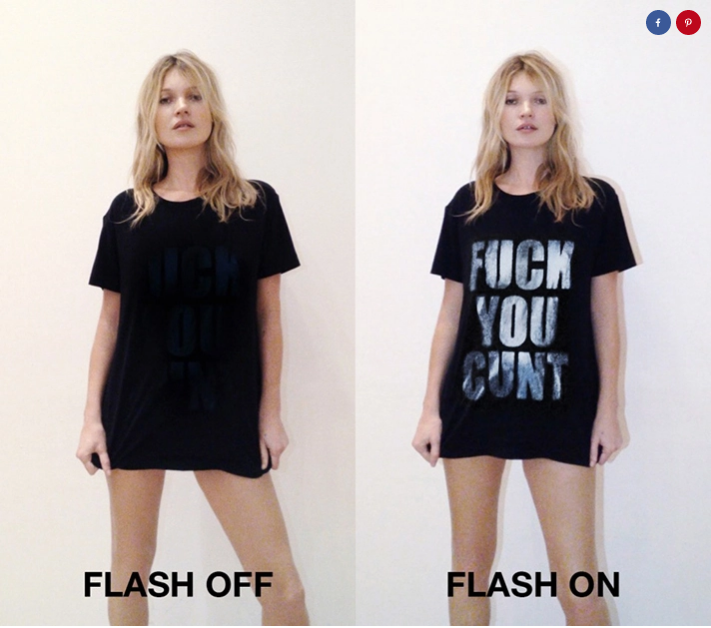
The camera is being reconfigured, so we have to rethink camera/subject relations. Not only is the thing itself disappearing, with production of one of the most emblematic objects of modernity halving in one year (thanks to Jason O’Brien from the ANU for that tip-off), but there are more and more signs that the shuttling back and forth of object and image is becoming a permanent enmeshment. Clothing is being engineered to resist the paparazzi’s blast. Kate Moss, one of the most papped women of all time, models a T shirt engineered just for her. Seemingly an innocent black T shirt, it briefly broadcasts ‘FUCK YOU CUNT’ when hit with a photographer’s flash, thereby supposedly rendering the image worthless in the celebrity marketplace (although, cannily, this anti-pap campaign only adds to Kate’s celebrity value). Apple have also just patented a ‘concert camera blocker’, which undermines one of the main uses of its own smart phones by emitting infrared signals from a stage disabling smart phone cameras, technologically enforcing ‘reality’ onto concert goers who may prefer their pop culture mediated. I’m sure there are other examples. We photo theorists are still too hung up on images and image ubiquity, we need to think about other dissolving technological categories as well.

Kate Moss modelling her  anti-paparazzi T shirt

Kate Moss modelling her anti-paparazzi T shirt

Apple's patent for a 'concert camera blocker'

Apple’s patent for a ‘concert camera blocker’

Catoptrics literally and figuratively

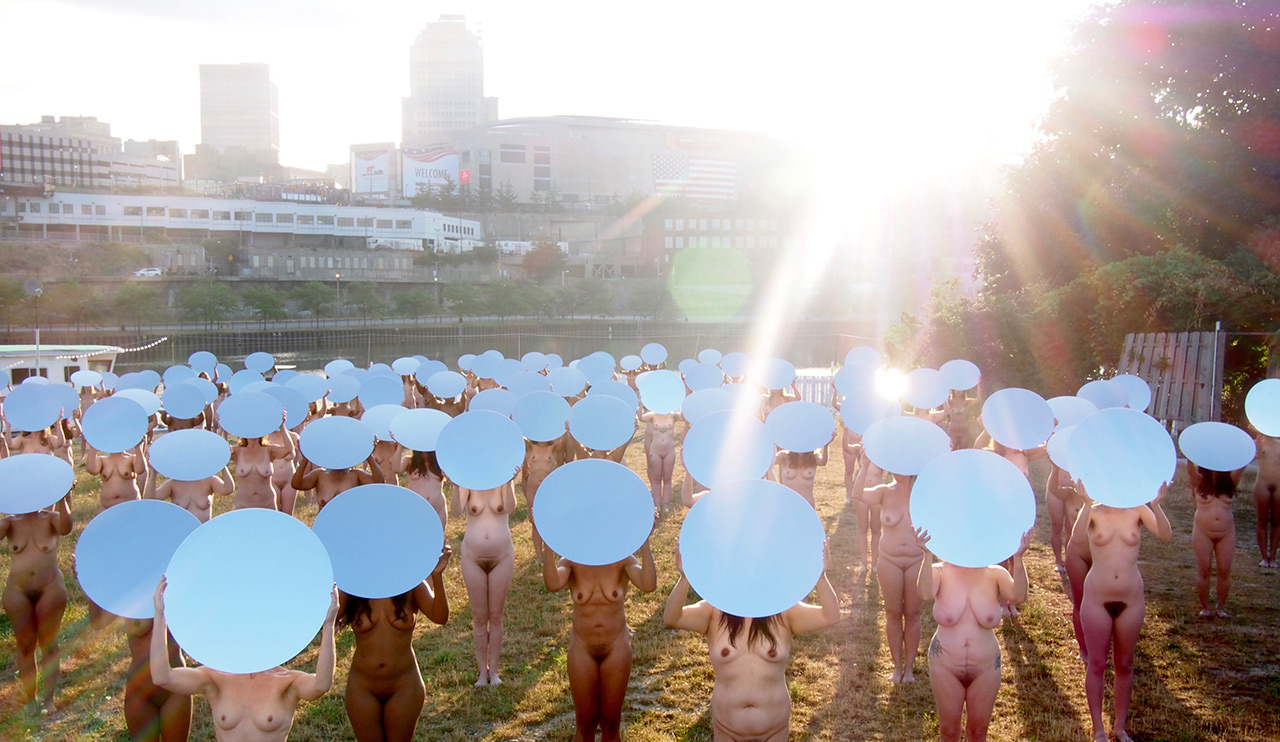
In 212BC Archimedes supposedly used a parabolic ‘burning mirror’ to set the attacking Roman ships on fire. In 1646 Anthanasius Kircher, in his book The Great Art of Light and Shadow speculated that Archimedes would have had more success if he had used multiple mirrors each focusing the sun in a giant parabolic shape. Kircher’s groundbreaking catoptrics were borne out in today’s solar furnaces and generators. Now Spencer Tunick revises the idea at the current republican convention and with his trademark naked participants. As 100 nude women hold large mirror discs ‘to reflect the knowledge and wisdom of progressive women and the concept of “Mother Nature” into and onto the convention center’ Tunick joins the figurative metaphor of enlightenment to age old catoptric science. However the women are phalanxed to form a series of flat reflective surfaces. The work would have had a different valency if he had organised their naked bodies into a parabolic surface as Kircher suggested, focussing their rays onto Trump , who invites volatility.

Frontispiece, Anthanasius Kircher, The Great Art of Light an Shadow, 1646

Frontispiece, Anthanasius Kircher, The Great Art of Light an Shadow, 1646

 Anthanasius Kircher, The Great Art of Light an Shadow, 1646

Anthanasius Kircher, The Great Art of Light an Shadow, 1646

Anthanasius Kircher, The Great Art of Light an Shadow, 1646

Anthanasius Kircher, The Great Art of Light an Shadow, 1646

Spencer Tunick work at republican convention, 2016

Spencer Tunick work at republican convention, 2016

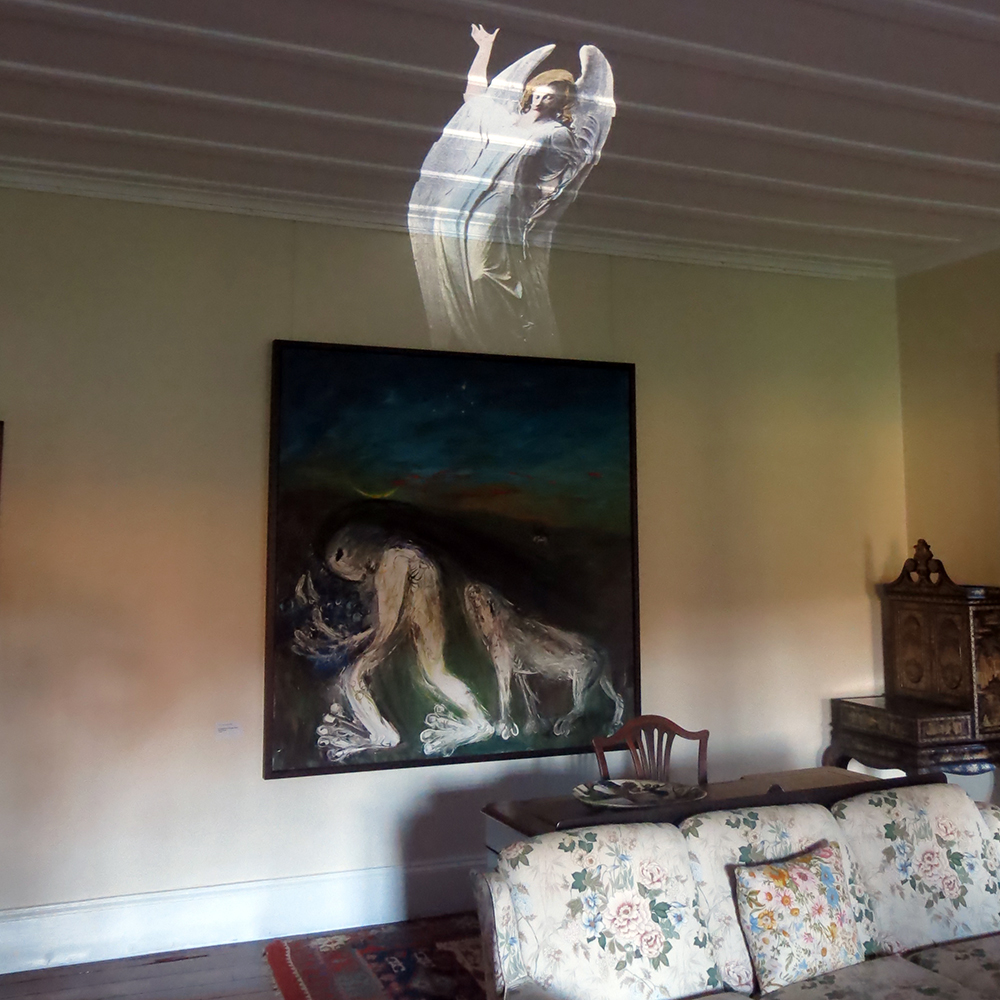
Exeperimental magic lantern projection at Bundanon Homestead

I did a late afternoon experimental magic lantern projection in the front room of Arthur Boyd’s homestead in the last days of my Bundanon residency . I enjoyed anamorphizing the popular Biblical iconography of nineteenth century melodrama against Boyd’s expressionistic elongations and agonistic Biblical references. (Thanks to Jennifer Thompson and John Baylis) I’m doing something (along with Alexander Hunter from ANU School of Music) for Bundanon’s Siteworks event, 24 September. Come along)IMG_1747 (1)

Photos of my magic lantern show at Canberra Obscura

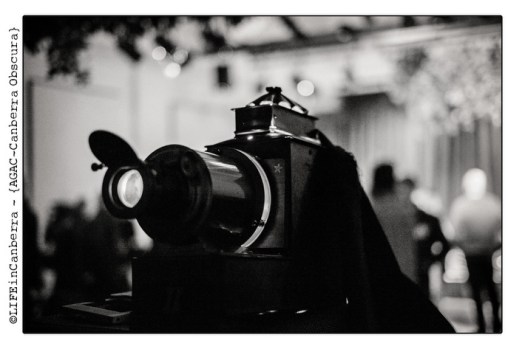
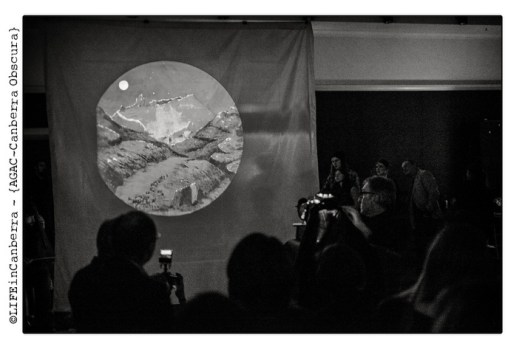
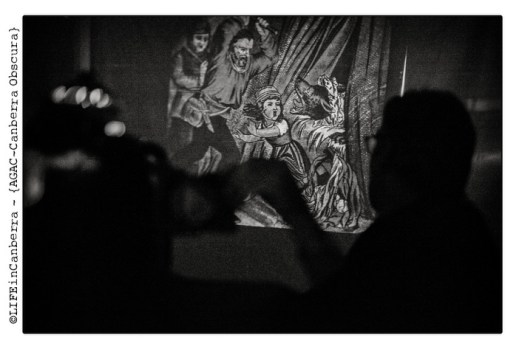
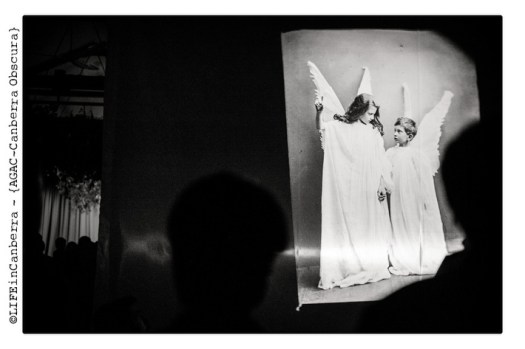
The estimable Andrew Sikorski has posted some shots of my magic lantern performance (along with Andromeda is Coming) amongst his documentation of the Canberra Obscura Art Party on his site Life in Canberra.

You can see me using my own latest technological innovation in projection which I call ‘a bit of cardboard with a hole in it’. Derived from the ‘burning in tool’ of the traditional darkroom printer, the ‘bit of cardboard with a hole in it’ held over the lantern lens spotlights details and narrativises the slides like Ken Burns did with his (now infamous) ‘Ken Burns effect’ in such landmark ‘archivally based’ documentary series  as  his The Civil War of 1990. I was also inspired to use the ‘bit of cardboard with a hole in it’ by the author of Sherlock Holmes, Sir Arthur Conan Doyle. He came to Australia in 1920 on a magic lantern tour to show people photographic evidence that the dead returned from beyond the veil. In Adelaide, according to Doyle’s account on page 76 of his book Wanderings of a Spiritualist, ghosts literally inhabited the machine and took over the magic lantern to demonstrate the proof of their survival:

I had shown a slide the effect of which depended upon a single spirit face appearing amid a crowd of others. This slide was damp, and as photos under these circumstances always clear from the edges when placed in the lantern, the whole centre was so thickly fogged that I was compelled to admit that I could not myself see the spirit face. Suddenly, as I turned away, rather abashed by my failure, I heard cries of “There it is”, and looking up again I saw this single face shining out from the general darkness with so bright and vivid an effect that I never doubted for a moment that the operator was throwing  a spotlight upon it. … [N]ext morning Mr Thomas, the operator, who is not a Spiritualist, came in in great excitement to say that a palpable miracle had been wrought, and that in his great experience of thirty years he had never known a photo dry from the centre, nor, as I understood him, become illuminated in such a fashion.


Andrew Sikorski, Canberra Obscura, Martyn Jolly with 'Andromeda is Coming'

Andrew Sikorski, Canberra Obscura, Martyn Jolly with ‘Andromeda is Coming’

LIFEinCanberra_050

Andrew Sikorski, Canberra Obscura, Martyn Jolly with ‘Andromeda is Coming’


LIFEinCanberra_055

Andrew Sikorski, Canberra Obscura, Martyn Jolly with ‘Andromeda is Coming’

LIFEinCanberra_056

Andrew Sikorski, Canberra Obscura, Martyn Jolly with ‘Andromeda is Coming’

LIFEinCanberra_058

Andrew Sikorski, Canberra Obscura, Martyn Jolly with ‘Andromeda is Coming’

LIFEinCanberra_059

Andrew Sikorski, Canberra Obscura, Martyn Jolly with ‘Andromeda is Coming’

LIFEinCanberra_060

Andrew Sikorski, Canberra Obscura, Martyn Jolly with ‘Andromeda is Coming’

LIFEinCanberra_062

Andrew Sikorski, Canberra Obscura, Martyn Jolly with ‘Andromeda is Coming’

LIFEinCanberra_063

Andrew Sikorski, Canberra Obscura, Martyn Jolly with ‘Andromeda is Coming’

#standupstripdown

The hashtag #standupstripdown has been invented to be used by people like Heather Whitten who want to post family photographs with naked children. In the latest of a string of such incidents her image of her naked husband cradling her sick and naked son in a shower has been taken down several times by Facebook following complaints by people disgusted by the potentially paedophilic readings the photograph could carry. The disgusted complainers who are having such a lamentable chilling effect on our visual culture misunderstand both semiotics and paedophilia. Even if it unpleasant to imagine  the occasional paedo using such images for sexual gratification, the psychological effect on our whole society of NOT seeing images of such rich aspects of life, love and bodies is far worse. Others complain that the children in such photographs cannot give their consent and may be shamed or embarrassed when they grow up. But image making and image sharing in our culture cannot be reduced to a infinite series of micro-contracts over ‘self image’ between two quasi-legal parties. Such a legalistic conception of self image as an owned ‘property’ also reduces the complexity and richness of our collective visual culture. I’ve previously written about this so I don’t know why people aren’t taking any notice of me. Perhaps I didn’t think of inventing a hashtag.

Heather Whitten

Heather Whitten

In Bangkok triangulating Francis Chit and being reminded of Charles Bayliss

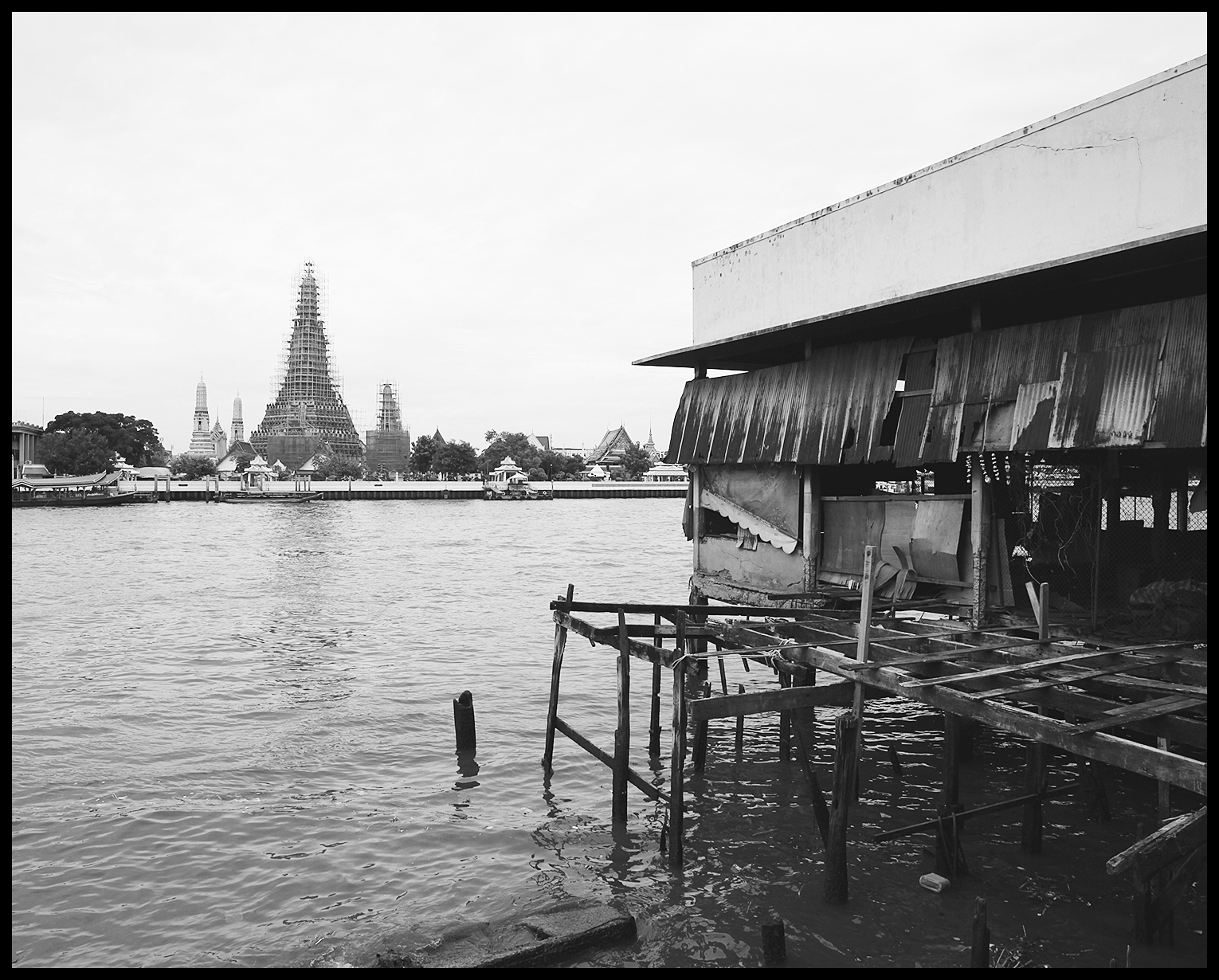
When we were recently in Bangkok we had a lovely afternoon with the super gracious Gun Susangkarakan who we had met when I was giving some seminars at Chiang Mai University Faculty of Fine Arts Department of Media Arts. Gun is an ace temple photographer (hard-core old-school, 8×10 selenium-toned contact prints). He took us to Wat Arun (Temple of Dawn).

Gun Susangkarakan, 'Wat Arun from Tha Tian', 2015

Gun Susangkarakan, ‘Wat Arun from Tha Tian’, 2015

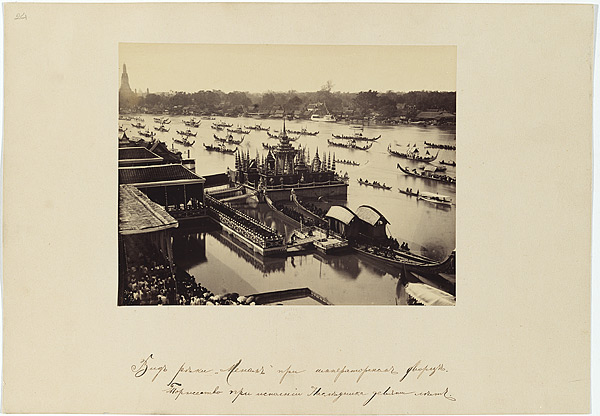
You can also just glimpse this temple in the left hand corner of Francis Chit’s fabulous 1886 shot of Prince Vajirunhis being escorted to the Grand Palace for his investiture as crown prince, which is now in the National Gallery of Australia, and featured in Gael Newton’s 2008 show Picture Paradise.

Francis Chit, 'Prince Vajirunhis escorted to the Grand Palace for his investiture as crown prince. 'Bangkok 14 January 1886. National Gallery of Australia

Francis Chit, ‘Prince Vajirunhis escorted to the Grand Palace for his investiture as crown prince. ‘Bangkok 14 January 1886. National Gallery of Australia

Chit had previously shot the Wat Arun from across the river in 1865.

Francis Chit, 'Wat Arun', 1865

Francis Chit, ‘Wat Arun’, 1865

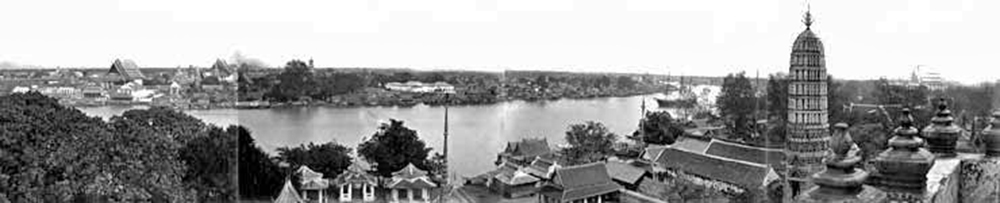
And he had climbed its stair to use it as a platform for a four-frame river panorama in 1863/64, when the river was a rice export port.

Francis Chit, 'Panorama', Babgkok, 1863/64

Francis Chit, ‘Panorama’, Bangkok, 1863/64

I was reminded of the five-frame Sydney Harbour panorama Charles Bayliss made from the roof of that ‘temple of commerce’, The Sydney International Exhibition Building, in about 1880, before it burnt down. Both have the same ‘aspirational’ loftiness, with architectural details from their improvised platforms projecting into the frames

Charles Bayliss, 'Panorama', c1880

Charles Bayliss, ‘Panorama’, c1880

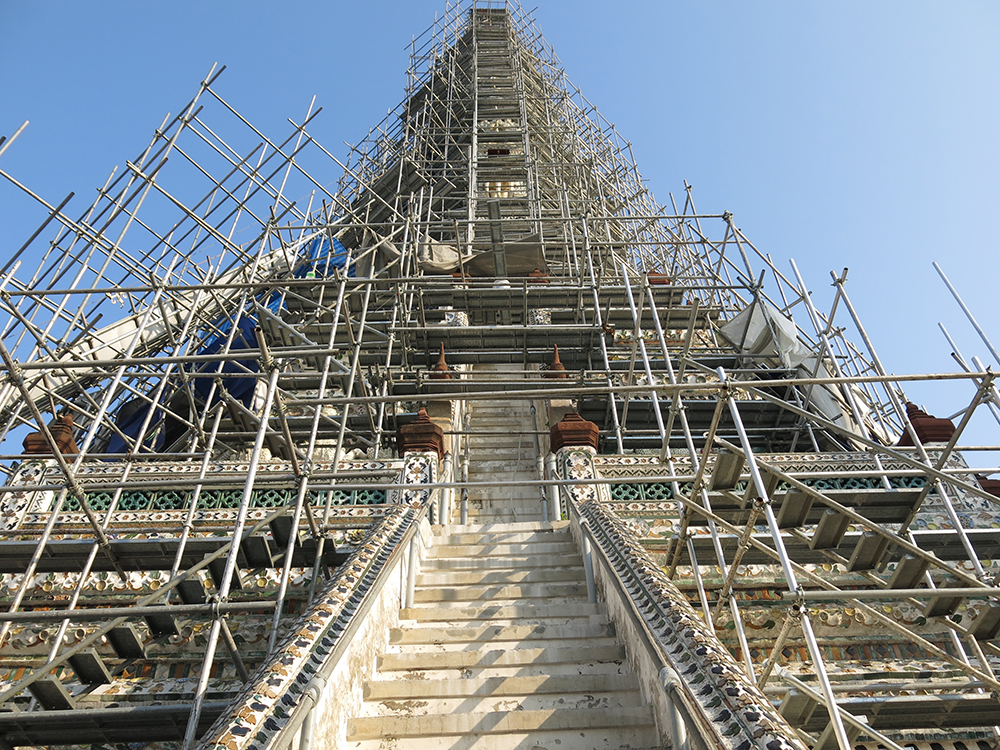
Fortunately Wat Arun is now being restored and is covered with a fine cross-hatching of scaffolding.

Wat Arun, 2015

Wat Arun, 2016

IMG_0954

Wat Arun, 2016

But the question remains, from where in the Grand Palace precinct did Chit shoot the investiture flotilla? Nineteenth century photographers around the world craved elevation and were always intrepid in gaining it. Did Chit get a special tower made, or was there a tower already there as part of the port infrastructure?

Francis Chit, 'Prince Vajirunhis escorted to the Grand Palace for his investiture as crown prince. 'Bangkok 14 January 1886. National Gallery of Australia

Francis Chit, ‘Prince Vajirunhis escorted to the Grand Palace for his investiture as crown prince. ‘Bangkok 14 January 1886. National Gallery of Australia

My review of ‘The Photograph and Australia’

In The Australian & New Zealand Journal of Art, Vol 15, No 2, 2015

The Photograph and Australia, curated by Judy Annear, Art Gallery of New South Wales 21 March — 8 June, 2015; Queensland Art Gallery 4 July — 11 October, 2015

There haven’t been enough books or exhibitions about photography and Australia, given that the medium is so popular and so fundamental to our visual culture, and given that it has left such rich resources in our museums, libraries and archives.[1] There was Jack Cato’s anecdotal The Story of the Camera in Australia, first published in 1955 but still in print in 1977. Then in 1988 the confluence of the bicentenary and the one hundred and fiftieth anniversary of the invention of the medium led to two further books to succeed Cato’s: Gael Newton’s Shades of Light: Photography and Australia, accompanied by a National Gallery of Australia exhibition, which linked Australian photography to international aesthetic narratives such as modernism; and Anne-Marie Willis’s Picturing Australia, which took a socio-critical approach to photography as a medium of power. Next came some institutional collection showcases, which used the idea of ‘Australia’ as a framing device.[2] Then, in 2007, Helen Ennis’s Photography and Australia used the medium, which she regarded as having ‘no singular or monolithic form’, to reflect on key themes in Australian society such as indigenous/settler interactions, the land, modernity, and our relationship to the rest of the world.

Now we have the Art Gallery of New South Wales’ The Photograph and Australia, like Shades of Light both a book and an exhibition. Unlike its predecessors it does not deal with Australian photography as an industry, or an aesthetic project, or a source of social power, or a national conversation. Instead, it deals with Australian photographs as ‘a phenomenon rather than simply a form[3]. It puts the ontology of the photograph, its special status as a ‘message without a code’, at the heart of its methodology. It embraces the multiplicity and ambiguity of the roles and meanings diverse photographs have had in Australia. The starting point for the project was the direct aesthetic, emotional and intellectual engagement of Judy Annear, the Curator of Photography at the AGNSW, with the thousands upon thousands of individual photographs she trawled through in museums, libraries, archives, and dealers. Although the exhibition will be seen at two art galleries, the AGNSW and the Queensland Art Gallery, the visual power of the show was not primarily derived from state and national art gallery collections, which have been defined by the careful choices made by their curators since they first began to collect photography forty or so years ago. Rather, the exhibition was driven by the resonance Annear found with unexpected finds from relatively ‘uncurated’ archives and libraries — diverse institutions that have been acquiring more photographs for much longer than galleries. The show’s fascination is driven by the sheer eccentricity of some of these finds which Annear has winkled out of the archival recesses, such as Thomas Hinton’s kinky federation patriotism in four cabinet card dioramas featuring Australian heraldry and him wearing a loincloth, or Henry Tillbrook’s environmental self portraiture, or even CEW Bean’s hand-scrawled trigonometric annotations across one of his views of the Gallipoli Peninsula.

The book (assiduously researched by Annear and her team, and complete with biographies, checklists, timelines and glossaries as well as contributed essays) is divided into five chapters, from ‘Time’ to ‘Transmission’. The exhibition hang at the AGNSW explored four themes — settler and Indigenous relations, exploration, portraiture, and transmission — through nine rooms, from ‘Self and image’, through ‘Critique’, to ‘Transmission’ (again). But nonetheless, from the point of view of the visitor, the exhibition tended to remain a series of separate encounters with different photographs. It was up to the viewer to discover and interpret their own finds. There was no conventional authorial, aesthetic or technical hierarchy within the exhibition. An image which had faded to being little more than a sepia smudge, such as Richard Daintree’s circa 1860 image of his son Alfred asleep in a cot, was nonetheless included in the show because it remained a powerful ‘phenomena’ of paternal love, and anticipated the family snap of the twentieth century. There were other Daintrees in the show, for instance his promotional images of Queensland which had been printed and thickly covered with oil paint in London, but there was no way of reconciling these entirely different images by the one person, one supremely private the other explicitly public, into anything like an artistic oeuvre. That was not what this show was about.

Something of the sense of the raw unmediated archive carries over into the installation itself, the overwhelming impression for the viewer as they strained to peer into photograph after photograph after photograph was quantity, there has simply never been a show in Australia with so many photographs in it. Of course the point is that photography has always been a medium of quantity, that is part of the phenomenon, but still Annear brooks her viewers no quarter. She commands her visitors to look equally at every photograph, from the postage stamp sized heads in a tintype album or commemorative photomosaic to the tiny detail caught in the corner of a Melvin Vaniman platinum-print panorama. After finally exiting the exhibition — and if they have seen it all they must inevitably have sore eyes and the beginnings of a headache — perhaps Annear’s ideal viewer will nonetheless feel the same sense of satisfaction that a historical researcher is familiar with feeling after a hard day’s slog in the archive: that although they feel that they are not much closer to understanding their topic they have nonetheless engaged with the brut stuff of history.

There are no reproductions or enlargements in the show. The experience of the exhibition was concentrated on photographs as physical things — daguerreotypes in cases, albumen prints in albums, mammoth collodion negatives on light boxes, and cartes de visite by the hundred. If this turn to the materiality of the photograph was welcome, and very much in keeping with recent scholarship in photography, what remains for future exhibitions to properly address is that photography was a retinal phenomenon, as well as a physical one. As I looked through the top of a glass case down to William Hetzer’s stereographs of Sydney from the late 1850s (alongside their cute little original storage box), how I longed to see them in a stereoscope, so the new buildings of Sydney would pop up in relief along the receding length of Macquarie Street as he intended. Other museums are able to contrive safe stereo viewers for stereographs, why not the AGNSW?

Nonetheless some pockets of the exhibition represented a profound privilege for the viewer. Literally thousands of daguerreotypes were taken in Australia, but 99% have disappeared. Only a handful of them remain identifiable, and most of those seemed to be in this exhibition. There were a whole family of George Goodman daguerreotypes, four Douglas Kilburn groups of aboriginal people reunited at last from the National Galleries of Victoria and Australia, a JW Newland daguerreotype from 1848 of a twinkle-eyed Sydney publican in an extremely loud check suit looking like he was just about to step into a Dickens novel, and many other delights. As we bent over the glass cases in the gloom trying to get a visual purchase on the slippery, silvery images below us, we were subjected to one of Annear’s curatorial flourishes. Ricky Maynard’s series Portrait of a Distant Land, 2005, and Tracey Moffat’s Beauties, 1994, invigilated us from up high on the walls, from the same place where ancestral portraits might be hung in a great hall.

In a similar inversion Annear used the work of other contemporary photographers to pivot the historical photographs into the present. In some rooms this strategy was effective. For instance Anne Ferran’s Lost to Worlds series of 2008 — almost abstract images of grass mounds on the site of an old convict female factory — worked very well on the end wall of the room called ‘Picturing the Colony’. They added an extra dimension of time elapsation to John Watt Beattie’s creepy images of Port Arthur and Charles Woolley’s melancholic images of the ‘last’ Tasmanian aborigines. However other contemporary photographers found themselves with nothing to say to the historic photographs around them. Rosemary Laing’s giant image of an upside-down house-frame, Eddie, 2010, certainly added a dramatic sense of scale to the ‘Critique’ room, but it was too caught up in its own conceptual manoeuvres to be able to dialogue with the other images. However in the next room, called ‘Technology and time’, the the mortal time of Sue Ford’s epic autobiography Self Portrait with Camera, 2008, resonated across the room with the cosmic time of James Short and Joseph Turner’s late nineteenth century astronomical photographs.

One theme that strongly ran through the show were the many images that complicated the standard picture of white/black relations we have received. Historians such as Jane Lydon (who has an essay in the book) and curators like Helen Ennis and Michael Aird (who also has an essay in the book) have already begun the task of taking the photography of aboriginal people beyond the victim/oppressor paradigm. This show continues that project with its many wonderfully complex images of the entanglement of black and white lives, such as those by the amateur John Hunter Kerr, made in some kind of collaboration with aboriginal people on his Victorian property, or the intimate mixture of races in the carefully posed mission portrait-groups by the anthropologist Walter Baldwin Spencer and the photographer Walter William Thwaites.

The Photograph and Australia is overwhelmingly about nineteenth century photography, radically displacing what have conventionally been seen, until now, to be the two key decades in defining the Australianness of Australian photography — the 1930s with it international modernism, and the 1970s with its national counter-culturalism. In an exhibition which eschews teleology these decades are still there, but crammed uncomfortably into the weakest room in the exhibition, the room called ‘Critique’, where the icons of Australian photography such as Carol Jerrems’s Vale Street and Max Dupain’s Sunbaker are given a curatorial détournement. For instance Cazneaux’s heroic The Spirit of Endurance tree, 1937, is clustered with two other small Cazneaux snaps of soil erosion.

Cartes de visite, those ubiquitous photographs glued onto visiting cards, which are usually quickly dealt with en masse by most photo histories, were the artefacts that ran through the veins of this show from beginning to end. Small, cheap, ubiquitous and easily transmitted, when they were first taken each carte de visite would have delivered a specific packet of emotional punch for their original sitter and original recipient, but now most cartes are cast adrift in history, nameless and ambiguous. However the carte, this exhibition implies, most presciently anticipates contemporary uses of photography in social media, while containing riches of historical ambiguity pressurized into each tiny frame. Even the show’s magical publicity image of an antipodean Alice reflected in a looking glass of water in Middle Harbour turns out to be just a tiny carte when we finally encounter it at the very end of the exhibition.

Cartes de visite returned in bulk in this final room, titled ‘Transmission’. Two hundred and twenty-seven of them are installed on a grid on wall, while on other walls kitsch postcards and photobooks intimate the coming of mass media. In the middle of the room is a computer installation and online work Compound Lens Project by contemporary artists Patrick Pound and Rowan McNaught. This installation has the herculean task of swinging the whole massive exhibition behind it and orienting it to the twenty-first century where photography is, of course, digital, virtual, exponential, archival, online, and tagged. Their cross platform installation might work very well in another context where viewers have the inclination to pay the necessary attention to its algorithmic searching, selection, and graphic filtering of online photographs, particularly when the conceptual and visual connections between these iterative processes are not immediately evident, but in this context there was not enough visual plenitude on offer to engage with visitors whose eyes and brains were already wearying.

Annear would be the first to say that this is not a definitive exhibition. Although carried out with intelligence, ambition, passion, an acute eye, and considerable curatorial flair, her vast exhibition nonetheless is but one scratch of the surface. However it proves just how much remains unscratched. There must be more books and exhibitions about photography and Australia in the future.

Disclaimer: The reviewer contributed an essay to the book, and discussed aspects of the exhibition with Judy Annear during her research phase.

[1] For more on the historiography of Australian photography see: ‘Agency and Authorship in Australian Photo Histories’, Catherine De Lorenzo, in Photography, History, Difference, edited by Tanya Sheehan and ‘Other Histories: Photography and Australia’, Helen Ennis, Journal of Art Historiography 4 (2011).

[2] At Home in Australia, Peter Conrad, National Gallery of Australia and Thames & Hudson, 2003. An Eye for Photography: The Camera in Australia, Alan Davies, Carlton, Miegunyah Press and State Library of New South Wales, 2004. Intersections: Photography, History and the National Library of Australia, Helen Ennis, National Library of Australia, 2004

[3] ‘Introduction’, The Photograph and Australia, Judy Annear, Art Gallery of New South Wales, 2015, p13.
 

Breasts

In the last week Facebook has banned the aged breasts in the background a photograph from 1999 posted by Ella Dreyfus, and the indigenous breasts from a traditional Aboriginal ceremony posted by Celeste Liddle. Both bans are of course absurd and offensive. But Facebook’s explanations are revealing. On the one hand it claims that ‘diversity is central to Facebook’s mission of creating a more open and connected world’, but on the other hand, it explains: ‘The reason we restrict the display of nudity is because some audiences within our global community may be sensitive to this type of content – particularly because of cultural background or age. In order to treat people fairly and respond to reports quickly, it is essential that we have policies in place that our global teams can apply uniformly and easily when reviewing content. As a result, our policies can sometimes be more blunt than we would like, and restrict content shared for legitimate purposes.’ Facebook’s mission is actually to circulate messages and images to as many consumers as possible, as rapidly as possible, so they can view ads. It may fantasise that it is something like a Habermasian public sphere, but on Facebook discursive relations are always subsumed in market relations. The connected world is a global market. (Plus, as Clementine Ford points out, Facebook HQ is still permeated by frat boy culture). Unfortunately, because of the ruthless efficiency of its image distribution model, for many artists and activists  it remains indispensable.

Ella Dreyfus, Age and Consent, 1999

Ella Dreyfus, Age and Consent, 1999

Chris Graham, Aboriginal Women at a Northern Territory public, 2016

Chris Graham, Aboriginal Women at a Northern Territory public ceremony, 2016

Won’t You Buy My Pretty Flowers?

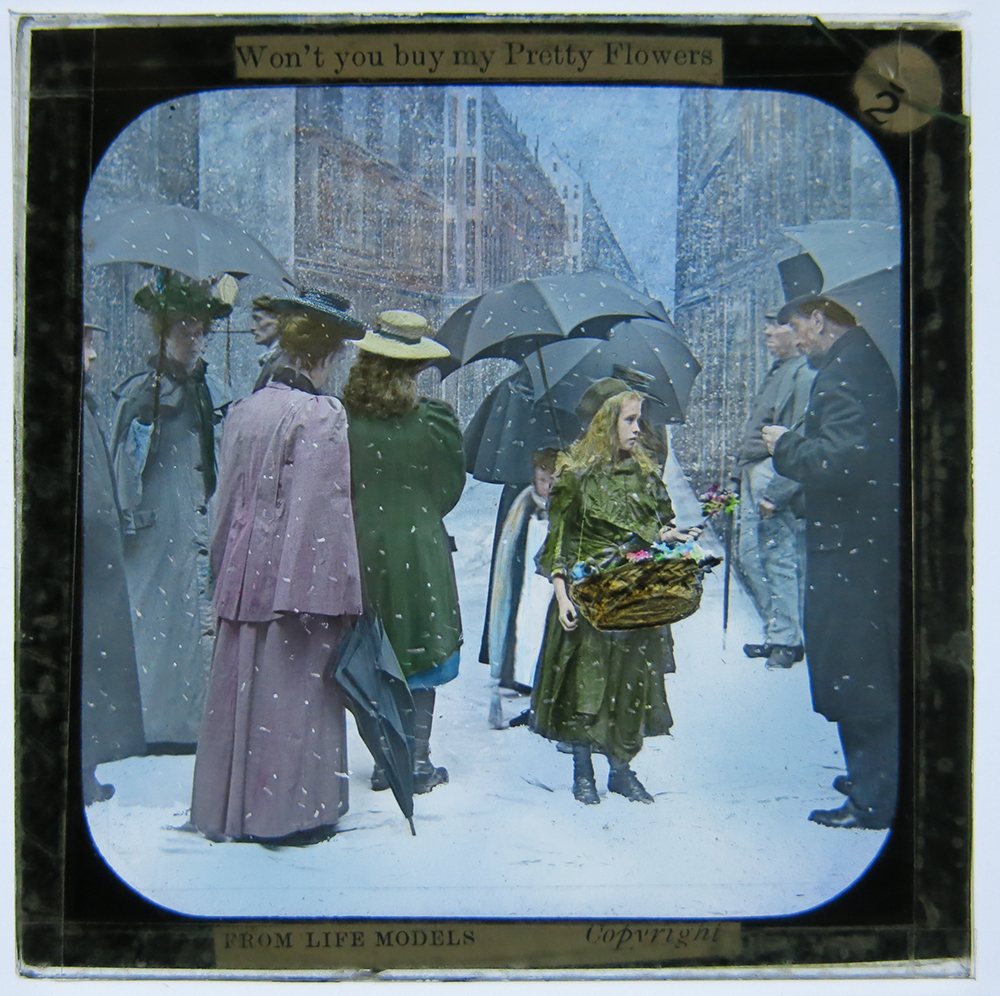
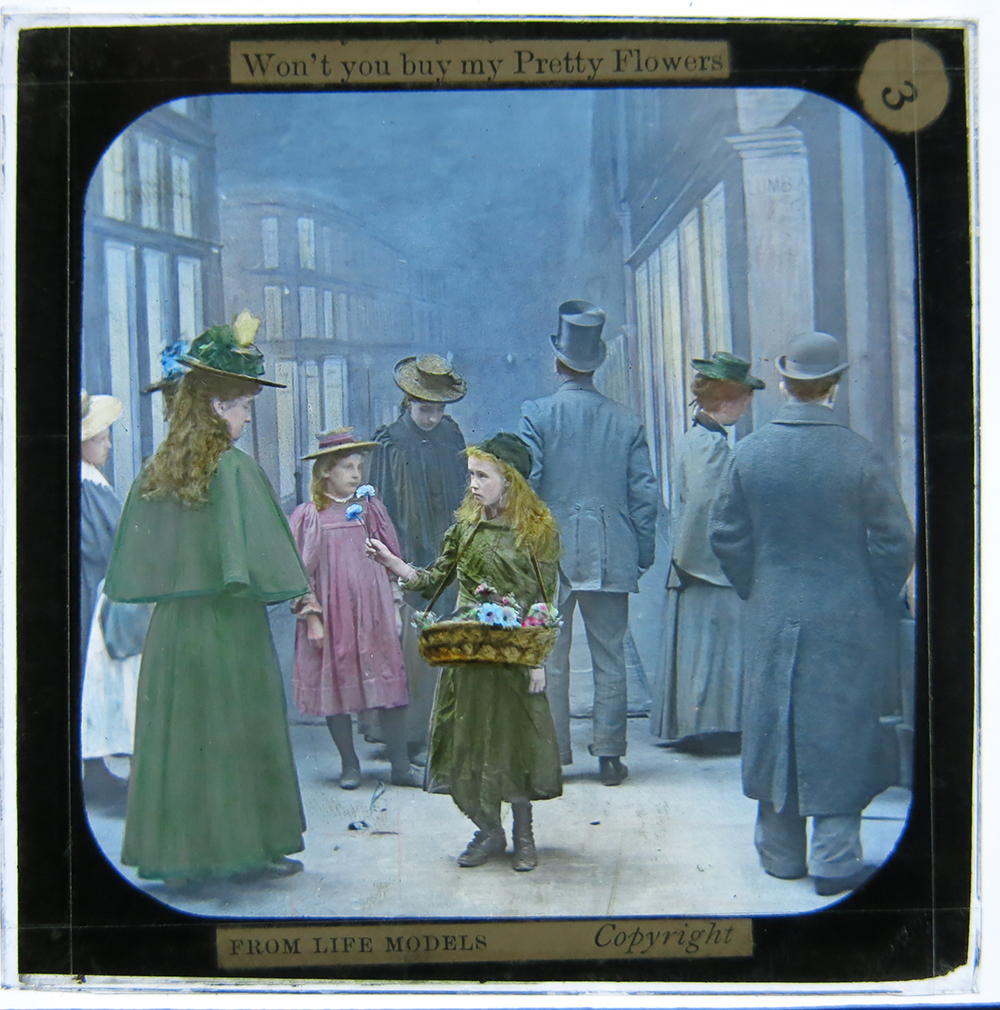
Here is a new set of life model magic lantern slides I have just acquired. I love the twin perspectival vanishing points of the first painted backdrop, the photogrammed snow flurries in slide two, and the weirdly frozen Beckettian choreography of the passers-by in the final slide. They were made by Bamforth and Co after 1897 in the UK. The song originates from the US in 1877 and is by George W Persley, Arthur W French, George Clare. (Although interestingly it was re-published in 1887 under the names of the American stage actress Miss Jennie Calef and producer H. P. Danks, after they had used it in their play “Little Muffets” — a clear case of IP theft and copyright infringement.) Later Bamforth and Co. recycled the original shots as postcards with the choruses as printed captions. I’m looking forward to one day projecting these slides, perhaps life size and outside in an urban setting, accompanied by a singer, as part of our project Heritage in the Limelight: The Magic Lantern in Australia and the World.WYBMPF small 1

Underneath the gas light’s glitter,

Stands a fragile little girl;

Heedless of the night winds bitter,

As they round about her whirl.

While the thousands pass unheeding

In the evening’s waning hours;

Still she cries with tearful pleading,

Won’t you buy my pretty flowers?

Refrain.

There are many sad and weary

In this pleasant world of ours,

Crying in the night winds bitter.

Won’t you buy my pretty flowers?

WYBMPF small 2

Ever coming, ever going,

Men and women hurry by.

Heedless of the tear drops gleaming.

In her sad and wistful eyes.

While she stands there sadly sighing,

In the cold and dreary hours,

Listen to her sweet voice crying,

Won’t you buy my pretty flowers?

Refrain.

There are many sad and weary

In this pleasant world of ours,

Crying in the night winds bitter.

Won’t you buy my pretty flowers?

WYBMPF small 3

Not a loving word to cheer her.

From the passers by is heard;

Not a friend to linger near her,

With a heart by pity stirred.

On they rush the selfish thousands,

Seeking pleasure’s pleasant bowers;

None to hear with sad compassion,

Won’t you buy my pretty flowers?

Refrain.

There are many sad and weary

In this pleasant world of ours,

Crying in the night winds bitter.

Won’t you buy my pretty flowers?