Category Archives: Blog
Stephen Zagala
Imagining a Real Australia: The Documentary Style 1950–1980
My review of Stephen’s book has been published in The History of Photography journal.
ARTHUR WHITE’S ARCHITECTURAL SLIDE SHOWS
Australian Institute of Architects Architecture Bulletin
Volume 82 No 1, 2025 “Treasures of Tusculum” pp 81 to 83
Arthur White must have been a methodical man. The medium format colour photographic transparencies he shot around the country from the mid 1950s to the mid 1960s came to the Australian Institute of Architects Archive mounted and pre-loaded into plastic slide carriers. He had labelled and numbered each ‘Rollei Magazin 77’, which held 30 sequenced slides ready to be inserted into a Rollei automatic slide projector and shown on a screen. Some slides in the collection, such as a photograph of the words ‘The End’ hand painted with a flourish, confirm that these images were made to be performed. Performed for who? Friends, family, colleagues? And what narration did White provide as he projected them?

Such performances were part of a centuries long practice. In the nineteenth century hand painted magic lantern slides of European cathedrals and other scenes transported Australian viewers to the great sites of Europe. When photographic slides, sometimes hand coloured, were adopted in the latter part of that century, great buildings remained a major subject matter, and the idea of travel — the slide lecture transporting its audience to other places — remained central to the practice. Colleges and universities also adopted glass slides as visual teaching aids, and they continued to be used well into the middle of the twentieth century. Melbourne University’s Visual Cultures Resource Centre holds several hundred glass architectural teaching slides once used, its archived records reveal, by the likes of Roy Grounds and Robin Boyd.
The development of colour transparency film meant that slides could be directly made in the camera, amenable to both projection and colour printing in magazines, brochures and posters. In 1958 under the heading “CALLING ALL COLOUR SLIDE ENTHUSIASTS” the popular Australian travel and tourism magazine Walkabout (1 November 1958, 9) solicited transparencies from its readers to celebrate its transition from a black and white to a colour magazine. Eventually, cheaper, smaller 35 millimetre slides overtook the six centimetre by six centimetre medium format slides White made, and the type of short 30-slide magazine he used was extended and curved into a circle by Kodak for their famous ‘Carousel’ projector. And nowadays, of course, we are more likely to just google and right click the jpegs we need for talks and articles, and when we are lucky enough to travel post the things we photograph on Instagram as we go.
The tight connection between camera and projector embodied in the slide magazines in which White’s archive came to the Institute was not uncommon in the late 1950s and early 1960s. Advertisements by the German Rollei company who made White’s projector, offered cameras and projectors in combination. (Pacific Islands Monthly, February 1961, 66)

If White was a Walkabout reader, maybe he saw an advertisement from November 1959, which on page nine described Rollei as ‘the professional camera that every amateur wants to own. When you use a Rollei you define your status as a knowledgeable and discriminating amateur — for whom nothing but the very best is good enough.”
And White was knowledgeable and discriminating. He had a Diploma in Architecture from the Sydney Technical College, registered as an architect in 1940, and was a member of the Australian Institute of Architects. He may have worked for the Department of Lands, based in Orange. Most of the slides seem to have been taken on holiday, but these aren’t your average holiday snap. White has extensively documented the transformations in the built environment of the day: feats of engineering, factories, churches, public buildings, motels, small town streetscapes, bowling alleys, cinemas, supermarkets, blocks of flats, neon signs, car showrooms, bandstands, fire stations. His interests range from the dusty and spindly vernacular buildings, weathered to grey ghosts, he photographed in outback Queensland, to the neon lights of Sydney.


Like many people in Australia at the time, he was interested in its engineering triumphs — dams, bridges and the Snowy Hydro scheme — and took every opportunity to get in a plane for aerial views of Australian progress, such as the lake and radial roads of Canberra taking shape. But in such a large collection, personal idiosyncrasies also emerge. For instance, White had an interest in technologies of display. In 1962 he documented the intricate pictographic fruit displays at the Royal Easter Show, where he also used almost a whole roll of film on the stand for Metters, Australia’s own oven manufacturer. Their slogan? “Metters For Moderns!”.


White put on his slide shows, with their enthusiastic endorsement of Australia’s future, during a period in which there were also profound changes in our attitude to our old buildings. Walkabout subscribed to the project of modernising Australia and even endorsed some of the innovative houses and office buildings being designed by its contemporary architects. (“Australian Architecture”, Walkabout,1 April. 1965, 28.) But at the same time, they were also concerned with reinforcing the norms of Australian history, and promoted, along with modernisation, its complement — heritage. A 1958 article written by the new state-based National Trusts argued that Australia’s built heritage was as “significant to Australia as her feudal manors and abbey ruins are to Britain. […] Unfortunately, a great many of our historic buildings have fallen under the wrecker’s hammer, but there is a growing appreciation of the importance of saving what we still can.” (“Preserving Our National Heritage: The National Trusts of Australia”, Walkabout, October 1958, 18.)
Alongside the work of the National Trust movement, contemporary architects themselves also became part of the turn to heritage. In 1966, the Professor of Architecture at the University of New South Wales, J. W. Freeland, wrote The Australian Pub illustrated with over 100 black and white photographs. (In his acknowledgments Freeland thanked his university for funding “the extensive travelling involved in seeing the pubs for myself”.) Then, in 1969, he joined the contemporary architect Philip Cox on Rude Timber Buildings in Australia, with 134 photographs by Wesley Stacey.
Books like these, enthusiastically reviewed in Walkabout, inextricably linked the new appreciation of Australia’s architectural heritage with travel and tourism. White’s trips from the regional city of Orange where he lived, to Sydney, Queensland, Victoria, Canberra, and Tasmania conform to this mode. Although he’s on holiday — there is an occasional photograph of family member smiling happily into the camera — his photographs remain compositionally very ‘architectural’. At the time, architectural photographers like Wolfgang Sievers or Max Dupain still used large format black and white film in cameras with movements that allowed them to correct perspective and maintain orthogonal verticals. But increasingly during the sixties, younger architectural photographers like Mark Strizic or Wesley Stacey were using handheld medium format cameras like White’s — without movements, but with the capacity to add increased dynamism into their compositions. Stuck with the square format of his medium format camera, White resolutely shot straight ahead, so his buildings’ verticals stay vertical. For instance, in a shot of the Marlin Lounge he sacrifices the bright blue holiday sky above the Marlin Lounge in favour of the sandy macadam of the road taking up half the picture in the foreground — but the pub stays firmly on the square!

Only sometimes, such as a when he crouches down to capture the cars whizzing around the corner into Sydney’s College Street does he jerk his camera up, so St Mary’s Cathedral perspectivally collapses in on itself.
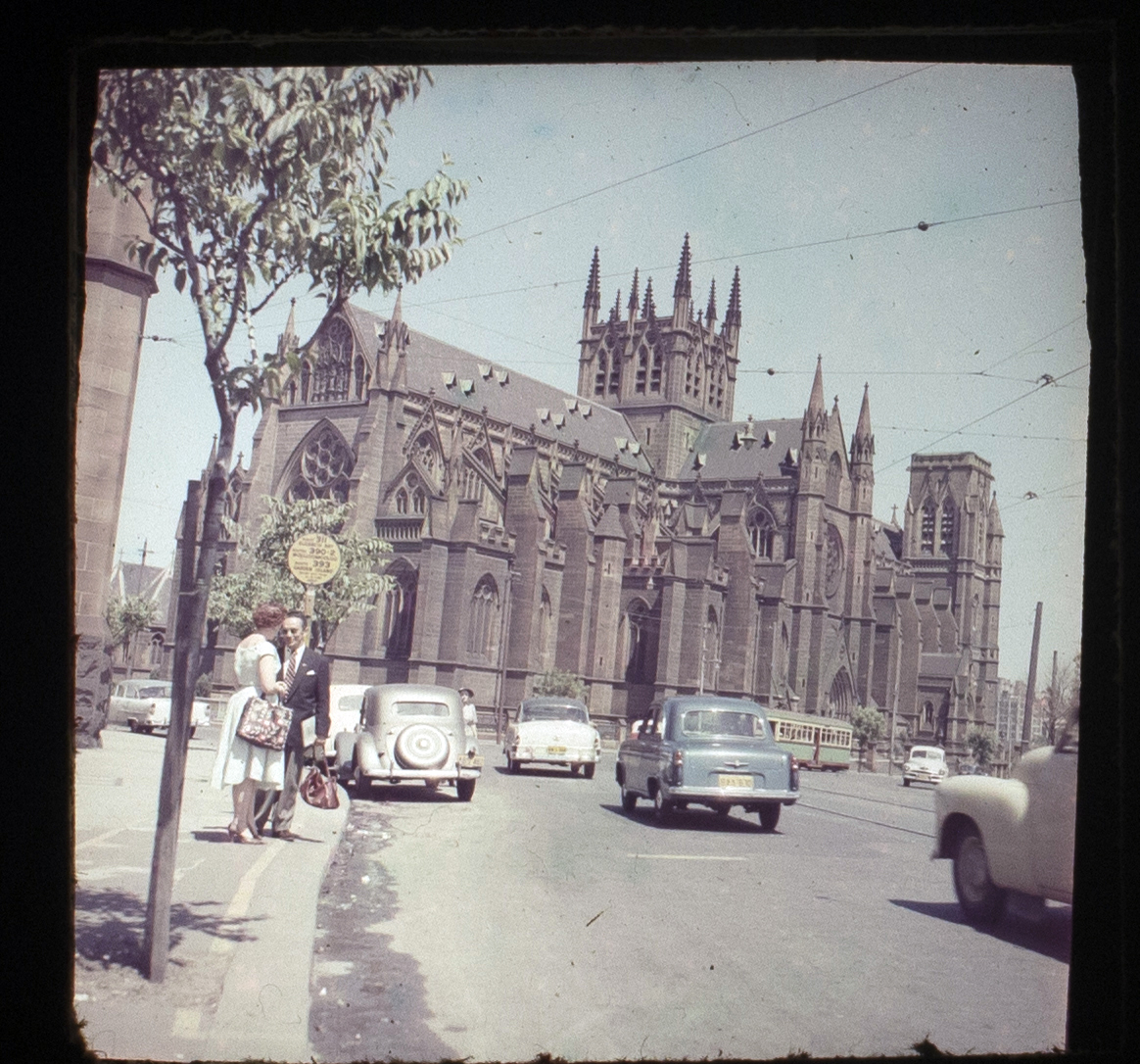
From images such as these we get the sense that, on the occasions Arthur White projected these colour transparencies, the chat must have been lively with, perhaps, personal anecdotes woven into discussions of Australia’s progress and heritage. But we will never exactly know what was talked about. We do know, however, his slide shows created an extraordinarily rich and useful archive for us. Even though he is no longer here to narrate them, they still tell a story of a formative period in Australia’s architectural history.
Martyn Jolly
UNESCO Australia Memory of the World Register
Very happy to have been able to assist the Salvation Army Australia Museum with the process of inscribing their remarkable collection of magic lantern slides into the UNESCO Australia Memory of the World Register.
Until Justice Comes – Juno Gemes
My book review in Australian Historical Studies of Juno Gemes’s ‘Until Justice Comes: Fifty Years of the Movement for Indigenous Rights Photographs 1970–2024‘ is now online.
‘The Light of the World’
Magic lantern slide projection
At the conclusion of the Australian National University, School of Art and Design, Art History and Art Theory seminar, ‘Led By The Beam’, where Dr Keren Hammerschlag, Dr Georgia Pike-Rowney and myself discussed the extraordinary phenomenon of Holman Hunt’s famous pre-raphaelite painting The Light of the World, Anita Pollard and myself projected ten original magic lantern slides of the painting, each one hand-coloured slightly differently. As the images of the painting dissolved one into the other the audience heard Charles Gounod’s sacred song ‘Nazareth’. This had been sung to the magic lantern projection of the painting by the celebrity singer George Snazelle during his tour to Australia in the 1889. We used a Newton and Co. biunnial magic lantern from the same period.
Documentation of the six minute projection is now on Youtube.
Pygmalion in the Archive: The Mythic Desires of Colourisation
The special issue of Visual Studies, ‘Colourised Histories’, Volume 40, Issue 1 (2025) Is now online. My article ‘Pygmalion in the Archive: The Mythic Desires of Colourisation’, is open access for a limited time.
Abstract
In order to argue against the continued use of colourisation by our visual archives, I explore the desire for colour from the origins of photography onwards. I focus on the first desires for colour, which underpin all subsequent chromatic elaborations in both photography and film. Rather than dwelling on the metropolitan inventors of various colour processes, I look at some less well-known examples of colour in use by photographers and filmmakers associated with Australia and New Zealand. I argue that colourisation is another process within the continual entanglements of the ‘monochromatic’, the ‘tinted’, the ‘toned’, the ‘painted’ and the ‘naturally coloured’ which have defined the desire for colour from the beginning. Further, these original desires were realized differently in different places. Our archives should respect this richly variegated history and the capacity of their audiences to appreciate it, rather than being seduced by a mythic notion of a ‘lifelike’ image.

Figure 12. Unknown. “Ned Kelly in his last stand at Glenrowan as depicted in the 1906 feature film, The Story of the Kelly Gang.” Online publicity image for Australia in Colour from the National Film and Sound Archive. Accessed June 1 2024. Reproduced courtesy of the National Film and Sound Archive.
Max Dupain: A Portrait
‘Wrecked’ a magic lantern show for the Headland Writers Festival, Tathra Hall, 19 October 2024
With performer Andrew Gray, composers and musicians Alexander Hunter and Charles Martin, magic lanternists Martyn Jolly and Anita Pollard, and video production Bronwyn Coupe.
Rennie Ellis: Melbourne Out Loud, State Library Victoria
I’ve written a review of this exhibition for Australian Historical Studies.
It discusses exhibition installation, the archive, and Ellis’s technique. Here’s the first paragraph:
“I have to confess, I used to be snooty about Rennie Ellis (1940-2003). When I was a postmodern cadet at art school and being taught to deconstruct the photographic gaze, I condemned the cheap souvenir books he was producing then — such as Life’s a Beach (1983) and Life’s a Parade (1986) — for pandering to the viewer’s pervy propensities. How wrong can you be. He is one of Australia’s greatest photographers and was, as the photography historian Gael Newton comments within this exhibition, years ahead of us art school types when it came to autoethnography.”

