Erica Hurrell

Erica Hurrell does more than just ‘shoot from the hip’, she incorporates imaging into the jagged flow of her life. You have to use the ungainly word ‘imaging’ because her photography is more than just individual stills taken with a camera, and more than just videos grabbed with a handcam. It’s a staccato of images that can be reconfigured in any number of ways — projected, printed, bound, screened — whilst retaining its aesthetic unity. These intense images, with their pungent colours, distorted sounds and ragged laughter, are all plucked from the immediacy of her life: her family and friends, and their families and their friends. Living in the outlands of Canberra they puncture their boredom with moments of high speed intensity, or briefly reinvent themselves in a camp karaoke performance, or lovingly deliver doses of tender pain to each other, before sinking back into the mundanity of the day to day. Erica participates in it all, even encourages it, realizing that her camera is ramping up the stakes of all this bad behaviour. But it’s worth it for these intimate, ultimately beautiful images.

Martyn Jolly

Martyn Jolly is head of Photomedia at ANU School of Art

The darkroom in the age of post-film photography

‘The darkroom in the age of post-film photography’, Artlink, Vol 25, No 1, 2005, pp 28 — 30.

We just don’t know how precipitously the drop off in the production of traditional photographic film will be. In both amateur and professional photography the few multinational corporations that control the industry have collectively marshalled their marketing strategies to capitalise on recent advances in digital technology. In the areas of image capture and image output they are busily creating new demand for digital photography as a contemporary fad, as well as shifting existing photographic demand to digital products. Film manufacturers are deleting specialist film types from their inventories at an accelerating rate, and a drop in demand for film of 15% per annum has led to the unceremonious closure of Kodak’s Australasian film manufacturing plant in Melbourne.

Of course there will always be a residual ‘niche’ of enthusiasts for film-based photography. But within the globally aggregated economies of scale of the photographic industry, any niche has to be a pretty big one to commercially justify continued production. Luckily for these die-hards, Kodak International is continuing to invest in film production to supply huge, but less readily manipulable, markets in China, India, Latin America and Eastern Europe. Customers in these markets don’t yet have the financial discretion to shift to digital, but their steadily growing wealth means that they are set to increase their appetite for film at double-digit rates for at least the next couple of years. One thing is certain though, a commitment to the range or diversity of the materials available for image production won’t be a factor as the manufacturers crunch the numbers, because it never has been.

But even if it remains possible for the foreseeable future to import film, paper and film cameras from those parts of the global economy assigned the role of late adopters, it is certain that in countries like Australia all photographic culture, will quickly become entirely digital. (Recently I was showing a prospective student around our darkrooms, and told him the number of enlargers we had, “what are they?” he asked.)

So every art school has to invest in as many digital cameras, video cameras, computers, scanners, inkjet printers and software applications as it possibly can. Every art school has to teach its student colour management so they can control their own data and communicate effectively with the technicians who will most probably be realizing their final output. At the same time every art school has to strive to embed it’s image-making in a broadening technological and media context. Why then should art schools also re-invest in expensive darkrooms, with all of their attendant costs of increased occupational health and safety standards for air circulation, silver recovery and chemical disposal?

For a while at least there was a certain logical flow in teaching from the darkroom to the computer lab, because software developers had reverse-engineered their user-friendly interfaces back to familiar darkroom concepts, such as burning and dodging. But these design conveniences are becoming increasingly attenuated, and often now serve to merely confuse the profound shift in the conceptualisation of, for example, colour space, that is required in thinking digitally. In addition students need to fundamentally rethink the still image not just as an updated version of the photographic print, but as one type of new media object continuous with many others, which might include different types of physical output, or different screen-based events.

But nonetheless, for many students, working in the darkroom remains an enriching and productive process, for all those ageless reasons: the alchemical magic as a latent image appears, the direct haptic control of the image as fingers and fists are used to mould and modulate the cone of light under the enlarger lens, and the instantaneous feedback as decisions made have an immediate impact on the image as it produces itself. Most importantly the quiet concentration of enlarger printing, shared either convivially in the communal darkroom, or in the intensity of the solitary late night printing session, is compelling for photographers who understand themselves to be working in a studio-based environment similar to other areas of their visual arts study. In the end there is something very satisfying for a student to be able to shoot film, develop it, and print it, all in one day, all relatively cheaply, and all knowing that they had physical control over every phase of the process.

It is this sense of a profoundly personal involvement with an intimate image making process that can continue to create a vital pedagogic role for darkrooms, beyond a mere nostalgia for traditional materials and techniques. In Photomedia at the ANU School of Art, for example, we designed our new darkroom complex to open out, via a skylit area, onto an informal, open space filled with computers for working with still and video digital images. In this shared communal space the digital and the darkroom invigorate each other, and our ink jet research facility is only a short walk up the corridor.

The distinction between film-based and non film-based photography is often shorthanded down to ‘analogue’ and ‘digital’, or ‘wet’ and ‘dry’. Perhaps the words wet and dry are the most compelling. The part of the darkroom process which is now becoming most interesting for many people isn’t the act of enlarger printing — the analogical projection of a field of tonality or colour from a negative matrix — but the chemical contagion of developers reacting with sensitised paper or film. It is the sense of chemicals physically trapping light that seems to be at the core of the widespread ‘post-photographic’ interest in alternative techniques, contact printing and photograms.

For instance handmade emulsions such as silver- bromide, cyanotype and vandyke, which have always been a marginal part of the art school photography repertoire, are gaining renewed vigour. And even more arcane emulsions, such as milk prints (made from the milk protein casein, dichromate and pigment) are also being researched. These emulsions are no longer simply an ‘alternative technique’ to the silver-gelatine norm. The photographers working with these techniques can now see how their materiality and processes can become integrated into meaning in new ways. The specific materiality of the emulsion itself, the manual process of hand coating, followed by the inexact exposure in the sun that is required to make the emulsion receive and tenuously hold onto an image, all become integral to the content of the print. F or instance, in the case of the milk prints of the ANU artist Denise Ferris, the emulsion, which is literally a ‘poisoned mix’ of milk and dichromate, is conceptually and materially linked to the lactic, liminal look of the images, which is also conceptually and materially linked to their subject matter — the tender but conflicted nature of maternal desire.

It is well known that digital photography desacralized the negative: it is no longer a single unchanging point of origin for the picture, but a mutable file of data.  And in contemporary contact printing, too, the inter-negative from which the image is printed under sunlight is also no longer a purely optical matrix. Some inter-negatives are now being inkjet printed, and digitally modified to bring the greatest tonal range out of that particular hand-made emulsion. For instance for Carolyn Young’s cyanotype take on the Kodachrome clichés of  ‘the great peaks of the world’, she digitally applied customised contrast curves separately to their high, mid-tones and shadows. The three layers were then merged down, reversed, and inkjet printed as an inter-negative. Other inter-negatives, such as Denise Ferris’s, are also digitally composited from a variety of sources.

Fundamental to the relationship between the digital inter-negative and handmade print is not only the power of contagion and touch in themselves, but the fact that their outcome is never exactly repeatable. Each time the process is performed something changes, and something happens for the first and only time — the emulsion is mixed slightly differently, the exposure is different, and so on. Each print is a unique outcome of a manual process. Each print is a physical object to be experienced in its own visual obduracy. This is not nostalgia for some lost artisanal past, or a desire for some auratic re-enthralment, it is a quite contemporary interest in seeing the results of human bodies, and human actions, directly and palpably working themselves out against images and things, both digital and analogue, wet and dry.

Experts with sophisticated and specialised colour management skills, and control of expensive printers, can now replicate the look of the traditional photographic print, and we should be training our students to be masters of that environment. But there is so much more that we could be doing with still images in the digital realm. Not only pushing the image into virtual data spheres, such as the web, but also bringing the image back into the haptic realm of the body.  The darkroom will continue to be a laboratory for this kind of visual arts research for some time to come.

Martyn Jolly

Head, Photomedia
ANU School of Art

Captions:

Denise Ferris, Home Decorum (Detail), 2003
Cassein contact print from digital negative

Carolyn Young, Almyer, 2003
Cyanotype contact print from digital inter-negative

Carolyn Young, The Matterhorn, 2003
Cyanotype contact print from digital inter-negative

Carolyn Young, Milford Sound, 2003
Cyanotype contact print from digital inter-negative

Carolyn Young, Paddock, 2003
Vandyke contact print from digital inter-negative

POOLS

‘Pools’, catalogue essay for Marcia Lochhead, Canberra Contemporary Arts Space, May, 2004.

Like most Australians, Marcia Lochhead loves swimming. Her body and soul need the cathartic grip of plunging into cold water, the amniotic experience of immersion, and the astringency of chlorine drying on skin.

Nothing more natural, then, than to document the pools of Canberra, where she lives and swims. She approaches her subject with a casual familiarity. Although all of her pools are unoccupied, she has not photographed them with an eye for the ennui of nothingness or the irony of emptiness, like many other documenters of the contemporary suburban landscape. Nor, like some other conceptual photographers, is each pool added to a pre-determined formal series in an identically composed and lit shot. In some of her images, such as the atmospheric night-time shot of Canberra’s oldest and most fondly remembered pool, the art deco Manuka pool[i], we are taken down almost to water level, as though readying ourselves to swoosh out into the water. In other images, such as of the aerial obstacle course suspended above the brutally utilitarian Australian Defence Force Academy pool, the extraordinary ceilings almost invite us to float on our backs beneath the echoes. Undisturbed by swimmers, the surface of each pool becomes both mirror and glass, quietly slipping reflections of its surrounds back into the water.

Her image of the daggy Captains Flat pool most closely reflects my own pool memories. When I was growing up, my local council pool was nothing more than a wedge of Harpic blue incised into a flat acre of parched grass, surrounded by a cyclone wire fence. Back in those pre-cancerous times the only person offered any shade was the bloke who sold you the tickets and the Paddle Pops.  Now shade-cloth, and even trees, surround our outdoor pools. But they still follow a seasonal cycle. Photographed in stand-down mode the Jamison pool gracefully collects autumn leaves as its water thickens to an opalescent green for the winter.

Indoor pools follow other, more institutional, cycles. The sleek Parliament House pool is out of bounds when Parliament is sitting, in case a Member needs to re-centre themself. The pool at the Australian Institute of Sport was built because our medal haul at the 1976 Montreal Olympics wasn’t up to our own opinion of ourselves. The public can swim in that pool, under its huge exhortatory Australian flag, all year round. Except, of course, when our current medal hopefuls are training.

In Australia, swimming in pools is not a privilege, or an occasional indulgence, it’s a national right. Our first international swimming star, Annette Kellerman, is even reputed to have said, “there is nothing more democratic than the public swimming pool”. We are brought closer to our fellows at a pool than anywhere else, even perhaps the dance floor. In the changing room we see them shuck off their clothes and step into their togs (or their bathers, or their swimmers, depending on which state you come from). Then, safe in the carefully balanced chemical asepticity of the pool’s water, we happily swim amongst floating tendrils of their phlegm. But this lubricious democracy, like all democracies, is still regulated by wavering, deeply-immersed lines of demarcation. Pools not only recall our private sensual experiences, they also record our society and our history.

For instance, in 1965 the citizens of Moree were prepared to defend their apartheid council regulation, which banned aborigines from using the town swimming pool. When the student Freedom Ride bus returned to the town for a second attempt to have kids from the local aboriginal reserve admitted to the pool, a crowd of 500 town’s people quickly gathered outside the pool to scream obscenities and spit at the students, while the mayor waded amongst the students yanking them away by the scruffs of their necks. After three hours the barrage of rotten eggs and fruit finally forced the students to retreat to the Freedom Ride bus, to be escorted out of town by the police.[ii]

In 1994, Fitzroy’s literati swung into action when Jeff Kennett’s newly appointed commissioners for the City of Yarra decided, because it wasn’t making money, to close the Fitzroy Pool. After thousands of people rallied, and hundreds filled the empty pool for an evening-news helicopter shot, the commissioners backed down.[iii]

The moral dilemma Australia has most keenly grappled with over the last few years was not over going to war, or accepting refugees, but a matter of pool etiquette. After Ian Thorpe accidentally tumbled into the pool and disqualified himself, should Craig Stevens surrender his 400 metres freestyle Olympic berth to increase Australia’s chances of medalling? The answer was obvious from the start: the end justifies the means.

Pools bring us close to the turbulent heart of Australia.

Martyn Jolly


[i] Clive Harvie, That’s where I met my wife: a story of the first swimming pool in the National Capital at Canberra, 1994.

[ii] freedomride.net

[iii] “Drowning By Numbers”, Ian Walker, Background Briefing, ABC Radio National, Sunday 29 November 1998, available at ABC online.

‘Spectres from the Archive’, MESH 18, Experimenta Media Arts, Melbourne, 2005

Spectres from the Archive

The dead have been making themselves visible to the living for millennia. In Purgatory, Dante asked Virgil how it was that he was able to see the souls of the dead with whom he was speaking, while their bodies had been left behind in the grave. Virgil beckoned a spirit who replied that, just as the colours of reflected rays filled rain-filled air, so the un-resurrected soul virtually impressed its form upon the air.[1] Similarly, the ghost of Hamlet’s father was as invulnerable to blows from a weapon as the air. It was a mere image which faded at cock-crow. But, for the last several centuries, these diaphanous, insubstantial condensations of light and air have been acquiring a technological, rather than a natural, phenomenology.

In the years following the French Revolution Etienne-Gaspard Robertson terrified crowds with the first phantasmagoria show, which he staged in a convent that had been abandoned by its nuns during The Terror. He made his magic-lantern projections, of paintings of gory figures such as The Bleeding Nun, appear to be phantasmic entities by blacking out their glass backgrounds and projecting them onto stretched gauzes, waxed screens, and billows of smoke. By placing the magic-lantern on wheels, which was dollied backwards by an operator, he gave these luminous, translucent apparitions the power to suddenly loom out over the audience. At an 1825 London phantasmagoria show the impact of this effect on the audience was electric. According to an eyewitness the hysterical screams of a few ladies in the first seats of the pit induced a cry of ‘lights’ from their immediate friends, but the operator made the phantom, The Red Woman of Berlin, appear to dash forward again. The confusion that followed was alarming even to the stoutest: “the indiscriminate rush to the doors was prevented only by the deplorable state of most of the ladies; the stage was scaled by an adventurous few, the Red Woman’s sanctuary violated, the unlucky operator’s cavern of death profaned, and some of his machinery overturned, before light restored order and something like an harmonious understanding with the cause of alarm”.[2]

In the eighteenth century the host of supernatural beings — such as ghosts, devils and angles — who had long inhabited the outside world alongside humans, were finally internalised under the illumination of Reason as mere inner-projections of consciousness — fantasies of the mind or pathologies of the brain. During this period, in Terry Castle’s phrase,  “Ghosts and spectres retain their ambiguous grip on the human imagination; they simply migrate into the space of the mind”.[3] But, as she goes on to explain, technologies such as the phantasmagoria allowed these images of consciousness to project themselves outside the mind once more, into the space of shared human experience. They were destined to return from the brain to re-spectralize visual culture.

The eighteenth century also changed the way in which death was experienced. No longer an ever-present communal experience, the effect of someone’s death became focussed onto a few individuals — their family — just as the various processes of death and mourning became privatised and quarantined within the institutions of the home, the hospital, and the necropolis.[4] One response to this was the rise in the nineteenth century of an extraordinary cult of the dead  — Spiritualism — which gripped the popular imagination well into the twentieth century. Spiritualism was the belief that the dead lived, and that they could communicate. Spiritualism was a quintessentially modernist phenomenon, and Spiritualists, as well as the spirits themselves, used all emerging technologies to demonstrate the truth of survival.[5]

The early years of Spiritualist communication were conducted under the metaphoric reign of the telegraph. In 1848 the world’s first modern Spiritualist medium, a young girl called Kate Fox, achieved world-wide fame by developing a simplified morse-code of raps to communicate with the spirits who haunted her small house in upstate New York. Twenty years later portraits of spirits began to appear on the carte-de-visite plates of the world’s first medium photographer, William Mumler. Spirit photographs were a personal phantasmagoria. Just as Robertson’s phantoms were lantern-slides projected onto screens, spirit photographs were actually prepared images double-exposed onto the negative. But the spirit photographer’s clients sat for their portrait filled with the belief that they might once more see the countenance of a loved one; they concentrated on the loved one’s memory during the period of the exposure; and they often joined the photographer in the alchemical cave of the darkroom to see their own face appear on the negative, to be shortly joined by another face welling up from the emulsion — a spirit who they usually recognised as a loved one returning to them from the oblivion of death. For these clients the spirit photograph was not just a spectacle, it was an almost physical experience of the truth of spirit return.

Public interest in spirit photography reached its highest pitch in the period just after World War One, when the unprecedented death toll of the war, combined with the effect of an influenza pandemic, caused a public craze for Spiritualism.[6] On Armistice Day in 1922 the London spirit photographer Mrs Ada Deane stood above the crowd at Whitehall and opened her lens for the entire duration of the Two Minutes Silence. When the plate was developed it showed a ‘river of faces’, an ‘aerial procession of men’, who appeared to float dimly above the crowd.[7]

When the ardent Spiritualist convert, Sir Arthur Conan Doyle, lectured to a packed house at Carnegie Hall the following year, he flashed this image up on the lantern-slide screen. There was a moment of silence and then gasps rose and spread over the audience, and the voices and sobs of women could be heard. A woman in the audience screamed out through the darkness, “Don’t you see them? Don’t you see their faces?” before falling into a trance.[8] The following day the New York Times described the image on the screen: “Over the heads of the crowd in the picture floated countless heads of men with strained grim expressions. Some were faint, some were blurs, some were marked out distinctly on the plate so that they might have been recognised by those who knew them. There was nothing else, just these heads, without even necks or shoulders, and all that could be seen distinctly were the fixed, stern, look of men who might have been killed in battle.”[9]

The Spiritualist understanding of photography was underwritten by a keen, and highly imaginative, conception of two substances: ether and ectoplasm. Since Morse’s first telegraphing of the words “what hath God wrought” in 1844, and Kate Fox’s first telegraphing to the spirits four years later, the air had steadily thickened as it was filled by more and more of the electromagnetic spectrum: from the electrical ionisation of residual gas in a cathode-ray tube (discovered by Sir William Crookes, who also photographed the full body materialization of a spirit Katie King by electric light); to x-rays (developed in part by Sir Oliver Lodge, who communicated with his dead son, Raymond, for many years after he fell in World War One);  to radio-waves; to television transmission. From the late nineteenth century until the period when Einstein’s theories made it redundant, most physicists agreed that some intangible interstitial substance, which they called ether, must be necessary as the medium to carry and support X-rays, radio waves, and perhaps even telepathic waves, from the point of transmission to point of reception. Since sounds, messages and images could be sent through thin air and solid objects, why not portraits from the other side?[10]

If ether allowed Spiritualist beliefs to be made manifest through electrical science, ectoplasm allowed them to be made manifest through the body. For about thirty years after the turn of the century various, mainly female, mediums extruded this mysterious, mucoid, placental substance from their bodily orifices, whilst groaning as though they were giving birth. Sometimes this all-purpose, proto-plasmic, inter-dimensional stuff seemed able to grow itself into the embryonic forms of spiritual beings, at other times it acted as a membranous emulsion which took their two dimensional photographic imprint. For instance on 1 May 1932 a psychic investigator from Winnipeg, Dr T. G. Hamilton, photographed a teleplasmic image of the spirit of Doyle (who had ‘crossed over’ the year before) impressed into the ectoplasm that came from mouth and nostrils of a medium.[11]

Just as spirit photographs were in reality various forms of double exposure, such teleplasms were in reality small photographs and muslin swallowed by the medium and then regurgitated in the darkness to be briefly caught by the investigator’s flash during the intense psychodrama of the séance. Nonetheless, for the Spiritualists they confirmed an associative chain that poetically and technically extended all the way from ectoplasm to photographic emulsion — creamy, hyper-sensitive to light, and bathed in chemicals.[12]

The Spiritualists placed photography at the centre of their cult of the dead. And modernity’s cultural theorists placed death at the centre of their response to photography. Photography was compared to embalming, resurrection, and spectralization. The horrible, uncanny image of the corpse, with its mute intimation of our own mortality, haunted every photograph. For instance to Siegfried Kracauer, writing in the 1920s, a photograph was good at preserving the image of the external cast-off remnants of people, such as their clothes, but could not capture their real being. The photograph: “dissolves into the sum of its details, like a corpse, yet stands tall as if full of life.”[13] The blind production and consumption of thousands upon thousands of these photographs was the emergent mass-media’s attempt to substitute itself for the acceptance of death implicit in personal, organic memory: “What the photographs by their sheer accumulation attempt to banish is the recollection of death, which is part and parcel of every memory image. In the illustrated magazines the world has become a photographable present, and the photographed present has been entirely eternalised.”[14]

To a subsequent critic, Andre Bazin, our embrace of the photograph was also a pathetic attempt to beat death. The sepia phantoms in old family albums were, “no longer traditional family portraits, but rather the disturbing presence of lives halted at a set moment in their duration … by the power of an impassive mechanical process: for photography does not create eternity, as art does, it embalms time, rescuing it simply from its proper corruption.”[15]

In Roland Barthes’ Camera Lucida, his almost necrophilic meditation on photography written while in the grim grip of grief for his mother, the photograph’s indexicality, the fact that it was a direct imprint from the real, made it a phenomenological tautology, where both sign and referent, “are glued together, limb by limb, like the condemned man and the corpse in certain tortures.”[16] In posing for a portrait photograph, he says, “I am neither subject nor object but a subject who feels he is becoming an object: I then experience a micro-version of death … : I am truly becoming a spectre.”[17] Later he reduces this essence of the portrait photograph down even further. It is not only an exact process of optical transcription, it is also an exquisitely attenuated chemical transfer, an effluvial emanation of another body—“an ectoplasm of ‘what-has-been’: neither image nor reality, a new being really.”[18]

Although wildly extrapolating upon the intimate connection between photography and death, the Spiritualist use of photography ran counter to the dominant perception of the photograph as irrevocably about pastness, about the instantaneous historicisation and memorialisation of time. Spirit photographs cheerfully included multiple times, and multiple time vectors. Spirit photographs were collected and used by Spiritualists very much like the millions of other personal snapshots that were being kept in albums and cradled in hands. But for them they did not represent the exquisite attenuation of the “that has been” of a moment from the past disappearing further down the time tunnel as it was gazed at in the present, nor the frozen image’s inevitable prediction of our own mortality. Rather, they were material witnesses to the possibility of endless emergences, returns and simultaneities.

The images were performative. They worked best when their sitters had seen them well-up from the depths of the emulsion in the medium’s developing tray, or seen them suddenly flashed on the screen in a lantern-slide lecture. Their power lay not in their reportage of a pro-filmic real elsewhere in time and space, but in their audience’s affective response to them in the audience’s own time and place. They solicited a tacit suspension of disbelief from their audience, at the same time as they brazenly inveigled a tacit belief in special effects. Spirit photographs used the currency of the audience’s thirst for belief to trade-up on the special effects they borrowed from cinema and stage magic —which had also descended from the phantasmagoria. They shamelessly exploited the wounded psychology of their audience to confirm their truth, not by their mute indexical reference to the real, but through the audience’s own indexical enactment of their traumatic affect. Their truth was not an anterior truth, but a manifest truth that was indexed by the audience as they cried out at the shock of recognition for their departed loved ones.

In mainstream thought about photography the two signal characteristics which defined photography and photography alone, physical indexicality and temporal ambiguity, were in their turn produced by two technical operations: the lens projecting an image of an anterior scene into the camera, and the blade of the shutter slicing that cone of light into instants. But the Spiritualist theory of photography discounted that technical assemblage, along with the ‘decisive moments’ it produced. It shifted the locus of photography back to the stretched sensitive membrane of the photographic emulsion, and dilated the frozen instant of the snapshot over the full duration of the séance.

Many contemporary artists are rediscovering the richly imaginative world the Spiritualists created for themselves. Others are strategically deploying the same technical effects once surreptitiously used by spirit photographers. These contemporary invocations are no longer directly underpinned by Spiritualist faith, but they do reinhabit and reinvent the metaphysical, performative and iconographic legacy of the Spiritualists. For these artists, as much as for the Spiritualists themselves, images, bodies, beliefs and memories swirl around and collide in intoxicating obsession. And technologies of image storage, retrieval, transmission and reproduction are simultaneously the imaginative tropes, and the technical means, for communicating with the beyond. For the Spiritualists the beyond was a parallel ‘other side’ to our mundane existence, for some contemporary artists it is quite simply the past.[19]

For instance the New York based artist Zoe Beloff folds famous episodes from the history of Spiritualism back into her use of new interactive technologies. Examples are the interactive CD-Rom, Beyond, 1997; the stereoscopic film based on the extraordinary ‘auto-mythology’ of the nineteenth-century medium Madame D’Esperance, Shadowland or Light From the Other Side, 2000; and the installation of stereoscopic projections based on the first séances of Spiritualism’s most famous ectoplasmic medium, Ideoplastic Materializations of Eva C., 2004. Some of Beloff’s works resurrect dead-end technologies and apparatuses, such as a 1950s stereoscopic home-movie camera to, for instance, directly link contemporary notions of virtuality to nineteenth century stage illusions, such as ‘Pepper’s Ghost’, where a live performer behind a sheet of glass interacted with a virtual phantasm reflected in it. She deploys the occult to re-introduce desire, wonder, fear and belief into what most media histories would have us think was just the bland march of ever-increasing technological sophistication. Like many of us, and like all of the people to first see a photograph or hear a sound recording, Beloff is still fascinated by the fact that the dead live on, re-embodied in technology. She remains interested in conjuring them up and interfacing between past and present like a Spiritualist medium.[20]

For his installation The Influence Machine, 2000, the New York video artist Tony Oursler projected giant ghost-heads of the pioneer ‘mediums’ of the ether, such as Robertson, John Logie Baird and Kate Fox, onto trees and billows of smoke in the heart of the world’s two biggest media districts, London’s Soho Square and New York’s Madison Square Park. These disembodied heads uttered disjointed phrases of dislocation and fragmentation, while elsewhere a fist banged out raps, and ghostly texts ticker-taped up tree trunks. In his Timestream, an extended timeline of the development of ‘mimetic technologies’, Oursler drew an occult trajectory through the more conventional history of media ‘development’, and identified that the dead no longer reside on an inaccessible ‘other side’, but survive in media repositories. To him: “Television archives store millions of images of the dead, which wait to be broadcast … to the living … at this point, the dead come back to life to have an influence … on the living Television is, then, truly the spirit world of our age. It preserves images of the dead which then continue to haunt us.”[21]

The most famous spectre of the nineteenth century was the spectre of communism which, in the very first phrase of the Communist Manifesto, Marx declared to be haunting Europe. But this, unlike almost every other spectre, was not a grim revenant returning from the past, but a bright harbinger of the future when capitalism would inevitably collapse under its internal contradictions ushering in the golden age of communism. But now communism is dead and buried, and when its spectre is raised it is not to haunt us, but to be a parable affirming the supposed ‘naturalness’ of capitalism.[22]

This circular irony formed the background to Stan Douglas’s installation Suspiria from Documenta 11 of 2003. The spectral temper of the imagery was achieved by overlapping a video signal with the over-saturated Technicolor palette of the 1977 cult horror film Suspiria. The piece deconstructed Grimm’s 250 fairy tales into a data-base of narrative elements, often centring on characters vainly seeking short cuts to wealth and happiness by extracting payments and debts. These fragments were videoed using actors wearing clothes and make-up in the primary colours. The chromatic channel of the video signal was separated and randomly superimposed, like an early-model colour TV with ghosting reception, over a switching series of live surveillance video-feeds from a stony subterranean labyrinth. These fleeting evanescent apparitions endlessly chased each other round and round the blank corridors.[23]

As well as the phantasmagoric apparatuses of projection and superimposition, with their long histories in mainstream entertainment as well as the occult, artists such as Douglas or Oursler have begun to deploy another newly occulted apparatus — the data-base.  For instance, Life after Wartime, presented at the Sydney Opera House in 2003, was an interactive, ‘performance’ of an archive of crime scene photographs which had been assembled by Sydney’s police-force in the decades following the Second World War. Kate Richards and Ross Gibson sat at laptops and midi keyboards and brought up strings of images which, combined with evocative haikus, were projected onto two large screens. Beneath the screens The Necks, a jazz trio well known for their ominous movie music, improvised a live soundtrack of brooding ambience. Although not directly picturing spectres, the texts and images did generate open-ended non-specific narratives around a set of semi-fictionalised characters and locations in the ‘port city’ of Sydney. These characters became invisible presences occupying the creepy emptiness of the crime scenes. The element of automation in the way the story engine generated the loose narratives preserved the integrity, the artefactuality, of the original archive. Ross Gibson wrote:

Whenever I work with historical fragments, I try to develop an aesthetic response appropriate to the form and mood of the source material. This is one way to know what the evidence is trying to tell the future. I must not impose some pre-determined genre on these fragments. I need to remember that the evidence was created by people and systems of reality independent of myself. The archive holds knowledge in excess of my own predispositions. This is why I was attracted to the material in the first instance — because it appeared peculiar, had secrets to divulge and promised to take me somewhere past my own limitations. Stepping off from this intuition, I have to trust that the archive has occulted in it a logic, a coherent pattern which can be ghosted up from its disparate details so that I can gain a new, systematic understanding of the culture that has left behind such spooky detritus. In this respect I am looking to be a medium for the archive. I want to ‘séance up’ the spirit of the evidence … [24]

In seeking to be a voodoo spiritualist ‘medium’ for the archive, the work was not trying to quote from it, or mine it for retro tidbits ripe for appropriation, so much as to make contact with it as an autonomous netherworld of images. This sense of the autonomy of other times preserved in the archive also informs the work of the Sydney photographer Anne Ferran. In 1997 she made a ‘metaphorical x-ray’ of a nineteenth-century historic house. She carefully removed items of the colonial family’s clothing from its drawers and cupboards and, in a darkened room, laid them gently onto photographic paper before exposing it to light. In the photograms the luminous baby dresses and night-gowns floated ethereally against numinous blackness. To Ferran the photogram process made them look, “three-dimensional, life-like, as if it has breathed air into them in the shape of a body. … With no context to secure these images, it’s left up to an audience to deal with visual effects that seem to have arisen of their own accord, that are visually striking but in an odd, hermetic way.”[25]

In contrast to this diaphanous ineffability, Rafael Goldchain’s Familial Ground, 2001, was an autobiographical installation in which the artist physically entered the archive of the family album, seeking to know and apprehend the dead. He re-enacted family photographs of his ancestors, building on his initial genetic resemblance to them by using theatrical make-up, costuming, and digital alteration, weaving the replicated codes of portraiture through their shared DNA.  He saw these performances, along with the uncannily doubled portraits they produced, as acts of mourning, remembrance, inheritance and legacy for his Eastern European Jewish heritage, which had been sundered by the Holocaust. The portraits supplemented public acts of Holocaust mourning with a private genealogical communion with the spectres of his ancestors who still inhabited his family’s albums. The dead became a foundation for his identity, which he could pass on to his son. They took on his visage as they emerged into visibility, reminding him of the unavoidable and necessary work of inheritance.[26]

The Native American artist Carl Beam also builds his contemporary identity on the basis of a special connection he feels to old photographs. He uses liquid photo-emulsion, photocopy transfer and collage to layer together historic photographs — such as romanticised portraits of Sitting Bull — and personal photographs —such as family snaps — into ghostly palimpsests. The collages directly call on spectres from the past to authorise his personal, bricolaged spiritual symbology. They allow him to time travel and re-build a foundation for his identity out of fragments from the past.

In 1980 Australia’s most eminent art historian Bernard Smith gave a series of lectures under the title The Spectre of Truganini. In the nineteenth century Truganini had become a much-photographed colonial celebrity as the ‘last’ of the ‘full-blood’ Tasmanian Aborigines. Smith’s argument was that, despite white Australia’s attempt to blot out and forget the history of its own brutal displacement of Australia’s indigenous population, the repressed would continue to return and haunt contemporary Australia until proper amends were made.[27]

As indigenous activism grew in intensity and sophistication during the 1980s and 1990s, anthropological portraits, such as those of Truganini, began to be conceived of as not only the theoretical paradigm for colonial attempts at genocide, but also as acts of violence in themselves, technically akin to, and instrumentally part of, that very process of attempted genocide. They began to be used by young indigenous artists to ‘occult up’ their ancestors. Their re-use attempted to capture a feeling of active dialogue with the past, a two way corridor through time, or a sense of New Age channelling.

The anthropological photographs used by urban indigenous photographers are not monuments, like the statues or photographs of white pioneers might aspire to be, because they do not commemorate a historical closure on the past. In a way they are anti-monuments, images of unquiet ghosts who refuse to rest in their graves. In a Barthesian meditation on nineteenth-century anthropological photographs the indigenous photographer Brenda L. Croft, who uses Photoshop to float imprecatory words of loss within images of her ancestors, retroactively invested the agency of political resistance in the portraits. “Images like these have haunted me since I was a small child and … [and] were instrumental in guiding me to use the tools of photography in my work. … The haunted faces of our ancestors challenge and remind us to commemorate them and acknowledge their existence, to help lay them, finally, to rest.”[28]

However, rather than laying their ancestors to rest, some indigenous artists have photographically raised them from the dead to enrol them in various campaigns of resistance. For instance one of the first Australian indigenous photographers to receive international attention was Leah King-Smith. Her exhibition Patterns of Connection, 1992, travelled throughout Australia as well as internationally. For her large deeply-coloured photo-compositions anthropological photographs were copied and liberated from the archives of the State Library of Victoria to be superimposed as spectral presences on top of hand-coloured landscapes. This process allowed Aboriginal people to flow back into their land, into a virtual space reclaimed for them by the photographer. In the words of the exhibition’s catalogue: “From the flaring of velvety colours and forms, translucent ghosts appear within a numinous world.”[29]

Writers at the time commented on the way her photographs seemed to remobilise their subjects. The original portraits ‘contained’ their subjects as objects, which could be held in the hand, collected, stored and viewed at will. Their placement of the figure well back from the picture plane within a fabricated environment created a visual gulf between viewer and object. But King-Smith reversed that order. Her large colour-saturated images ‘impressed’ the viewer: “The figures are brought right to the picture plane, seemingly extending beyond the frame and checking our gaze with theirs”.[30]

Leah King-Smith comes closest to holding spiritualist beliefs of her own. She concluded her artist’s statement by asking that, “people activate their inner sight to view Aboriginal people.”[31] Her work animistically gave the museum photographs she re-used a spiritualist function. Many of her fellow indigenous artists criticised her for being too generalist, for not knowing the stories of the people whose photographs she used, and not asking the permission of the traditional owners of the land she makes them haunt. But the critic Anne Marsh described this as a “strategic essentialism”. “There is little doubt, in my mind, that Leah King-Smith is a kind of New Age evangelist and many serious critics will dismiss her work on these grounds. … But I am interested in why the images are so popular and how they tap into a kind of cultural imaginary [in order] to conjure the ineffable. …  Leah King-Smith’s figures resonate with a constructed aura: [they are] given an enhanced ethereal quality through the use of mirrors and projections. The ‘mirror with a memory’ comes alive as these ancestral ghosts … seem to drift through the landscape as a seamless version of nineteenth century spirit photography.”[32]

While not buying into such direct visual spirituality, other indigenous artists have also attempted to use the power of the old photograph make the contemporary viewer the subject of a defiant, politically updated gaze returned from the past. In a series of works from the late 1990s Brook Andrew invested his nineteenth century subjects, copied from various state archives, with a libidinous body image inscribed within the terms of contemporary queer masculinity, and emblazoned them with defiant Barbara Krugeresque slogans such as Sexy and Dangerous, 1996, I Split Your Gaze, 1997 and Ngajuu Ngaay Nginduugirr [I See You], 1998.

Andrew uses the auratic power of the original Aboriginal subjects to simply re-project the historically objectifying gaze straight back to the present, to be immediately re-inscribed in a contemporary politico-sexual discourse. However other strategic re-occupations of the archive show more respect for the dead, and seek only to still the frenetic shuttle of appropriative gazes between us and them. For instance in Fiona Foley’s re-enactments of the colonial photographs of her Badtjala ancestors, Native Blood, 1994, the gaze is stopped dead in its tracks by Foley’s own obdurate, physical body. To the post-colonial theorist Olu Oguibe: “In Foley’s photographs the Other makes herself available, exposes herself, invites our gaze if only to re-enact the original gaze, the original violence perpetrated on her. She does not disrupt this gaze nor does she return it. She recognises that it is impossible to return the invasive gaze … Instead Foley forces the gaze to blink, exposes it to itself.”[33]

But the ghosts of murdered and displaced Aborigines aren’t the only spectres to haunt Australia. White Australia also has a strong thread of spectral imagery running through its public memory for the ANZAC digger soldiers, who fell and were buried in their thousands in foreign graves during all of the twentieth century’s major wars. Following World War One an official cult of the memory developed around the absent bodies of the dead, involving painting, photography, elaborate annual dawn rituals, and a statue erected in each and every town.

Like indigenous ghosts, Anzac ghosts also solicit the fickle memory of a too self-absorbed, too quickly forgetful later generation. Since 1999 the photographer Darren Siwes, of indigenous and Dutch heritage, has performed a series of spectral photographs in Australia and the UK. By ghosting himself standing implacably in front of various buildings, he refers to an indigenous haunting, certainly; but because he is ghosted standing to attention whilst wearing a generic suit, he also evokes the feeling of being surveilled by a generalised, accusatory masculinity — exactly the same feeling that a memorial ANZAC statue gives.

Siwes’ photographs are mannered, stiff and visually dull, but they have proved to be extraordinarily popular with curators in Australia and internationally. One reason for his widespread success may be that the spectre he creates is entirely generic — a truculent black man in a suit — and therefore open to any number of guilt-driven associations from the viewer. Similarly, many of the other indigenous artists who have used photographs to haunt the present have produced works which are visually stilted or overwrought.  But they too have been widely successful, not because of their inherent visual qualities, but because of the powerful ethical and political question which the very idea of a spectre is still able to supplicate, or exhort, from viewers who themselves are caught-up in a fraught relationship between the present and the past, current government policy and historical dispossession. That question is: what claims do victims from past generations have on us to redeem them?[34]

As photographic archives grow in size, accessibility and malleability they will increasingly become our psychic underworld, from which spectres of the past are conjured. Like Dante’s purgatory they will order virtual images of the dead in layers and levels, waiting to interrogate the living, or to be interrogated by them. Through photography the dead can be invoked to perform as revenants. They will be used to warn, cajole, inveigle, polemicise and seduce. But as always it is we, the living, who will do the work of interpretation, or perform the act of response. Like the viewers of Robertson’s phantasmagoria we think we know that these spectres are mere illusions, the products of mechanical tricks and optical effects. But just as surely we also know that the images we are seeing were once people who actually lived, and that the technologies through which they are appearing to us now will also uncannily project our own substance through time and space in the future, when we ourselves are dead. This knowledge gives photographic spectres more than just rhetorical effect. They can pierce through historical quotation with a sudden temporal and physical presence. Yet at the same time they remain nothing more than the provisional technical animation of flat, docile images. In the end, they are as invulnerable to our attempts to hold onto them as the air.

Martyn Jolly

“Sir Arthur Conan Doyle at Carnegie Hall”, Harbinger of Light, (1923)

P. Ariés, The Hour of Our Death (New York: Alfred A. Knopf 1981)

U. Baer, “Revision, Animation, Rescue”, Spectral Evidence : The Photography of Trauma, (Cambridge, Mass.: MIT Press 2002)

R. Barthes, Camera Lucida (London: Jonathan Cape 1982)

A. Bazin, “The Ontology of the Photographic Image”, What is Cinema, (Berkeley and Los Angeles: University of California Press 1967)

W. Benjamin, “Theses on the Philosophy of History”, Illuminations, (Glasgow: Fontana/Glasgow 1973)

E. Cadava, Words of Light: Theses on the Photography of History (Princeton: Princeton University Press 1997)

T. Castle, “Phantasmagoria and the Metaphorics of Modern Reverie”, The Female Thermometer: Eightenth-Century Culture and the Invention of the Uncanny, (Oxford: Oxford University Press 1995)

T. Castle, “The Spectralization of the Other in The Mysteries of Udolpho“, The Female Thermometer: Eightenth-Century Culture and the Invention of the Uncanny, (Oxford: Oxford University Press 1995)

B. L. Croft, “Laying ghosts to rest”, Portraits of Oceania, (Sydney: Art Gallery of New South Wales 1997)

J. Derrida, Specters of Marx : the state of the debt, the work of mourning, and the New international (New York: Routledge 1994)

S. Douglas, “Suspiria”, Documenta 11_Platform 5: Exhibition Catalogue, 2002)

A. Ferran, “Longer Than Life”, Australian and New Zealand Journal of Art, 1, 1, (2000)

A. Ferris, “Diembodied Spirits: Spirit Photgraphy and Rachel Whiteread’s Ghost“, Art Journal, 62, 3, (2003)

A. Ferris, “The Disembodied Spirit”, The Disembodied Spirit, (Brunswick, Maine: Bowdoin College 2003)

K. Gelder and J. M.Jacobs, Uncanny Australia: Sacredness and Identity in a Postcolonial Nation Melbourne University Press 1998)

R. Gibson, “Negative Truth: A new approach to photographic storytelling”, Photofile, 58, (1999)

T. Gunning, “Phantom Images and Modern Manifestations: Spirit Photography, Magic Theatre, Trick Films, and Photography’s Uncanny”, Fugitive Images: From Photography to Video, (Bloomington: Indiana University Press 1995)

T. Gunning, “Haunting Images: Ghosts, Photography and the Modern Body”, The Disembodied Spirit, (Brunswick, Maine: Bowdoin College 2003)

T. G. Hamilton, Intention and Survival (Toronto: MacMillan 1942)

F. Jameson, “Marx’s Purloined Letter”, New Left Review, 209, January/February, (1995)

M. Jolly, Faces of the Living Dead: The Belief in Spirit Photography (London: British Library in press)

K. Jones, Conan Doyle and the Spirits: the spiritualist career of Sir Arthur Conan Doyle Aquarian Press 1989)

L. Kaplan, “Where the Paranoid Meets the Paranormal: Speculations on Spirit Photography”, Art Journal, 62, 3, (2003)

L. King-Smith, “Statement”, Patterns of Connection, (Melbourne: Victorian Centre for Photography 1992)

S. Kracauer, “Photography”, The Mass Ornament: Weimar Essays, (Cambridge: Harvard University Press 1995)

R. Luckhurst, The invention of telepathy, 1870-1901 (Oxford ; New York: Oxford University Press 2002)

A. Marsh, “Leah King-Smith and the Nineteenth Century Archive”, History of Photography, 23, 2, (1999)

O. Oguibe, “Medium and Memory in the Art of Fiona Foley”, Third Text, Winter, (1995-96)

J. Phipps, “Elegy, Meditation and Retribution”, Patterns Of Connection, (Melbourne: Victorian Centre for Photography 1992)

P. Read, Haunted Earth (Sydney: University of New South Wales Press 2003)

L. R. Rinder, Whitney Biennial 2002, (New York: Whitney Museum of American Art 2002)

K. Schoonover, “Ectoplasm, Evanescence, and Photography”, Art Journal, 62, 3, (2003)

J. Sconce, Haunted Media: Electronic Presence from Telegraphy to Television (Durham, NC: Duke University Press 2000)

B. Smith, The Spectre of Truganini: 1980 Boyer Lectures (Sydney: Australian Broadcasting Commission 1980)

M. Warner, “‘Ourself Behind Ourself — Concealed’: Ethereal whispers from the dark side”, Tony Oursler the Influence Machine, (London: Artangel 2001)

M. Warner, ‘Ourself Behind Ourself — Concealed?’: Ethereal whispers from the dark side, Tony Oursler web site 2001)

M. Warner, “Ethereal Body: The Quest for Ectoplasm”, Cabinet, 12 (2003)

M. Wertheim, The Pearly Gates of Cyberspace: A History of Space from Dante to the Internet (Sydney: Doubleday 1999)

C. Williamson, “Leah King-Smith: Patterns of Connection”, Colonial Post Colonial, (Melbourne: Museum of Modern Art at Heide 1996)

J. Winter, Sites of memory, sites of mourning: The Great War in European cultural history (Cambridge: Cambridge University Press 1995)


[1] Purgatory, 25, 11. 94-101, cited in, Marina Warner, ‘Ourself Behind Ourself — Concealed?’: Ethereal whispers from the dark side,  np. For a discussion of Dante’s heaven hell and purgatory in relation to cyberspace see, Margaret Wertheim, The Pearly Gates of Cyberspace: A History of Space from Dante to the Internet, 44-75.

[2] Marina Warner, “‘Ourself Behind Ourself — Concealed’: Ethereal whispers from the dark side”, 75. For more on the phantasmagoria see Terry Castle, “Phantasmagoria and the Metaphorics of Modern Reverie”,

[3] Terry Castle, “The Spectralization of the Other in The Mysteries of Udolpho“, 135.

[4] P Ariés, The Hour of Our Death,  cited in Castle.

[5] For Spiritualism and photography see, Martyn Jolly, Faces of the Living Dead: The Belief in Spirit Photography,  and Tom Gunning, “Phantom Images and Modern Manifestations: Spirit Photography, Magic Theatre, Trick Films, and Photography’s Uncanny”, andTom Gunning, “Haunting Images: Ghosts, Photography and the Modern Body”, ;Louis Kaplan, “Where the Paranoid Meets the Paranormal: Speculations on Spirit Photography”,

[6] For post war memory and Spiritualism see Jay Winter, Sites of memory, sites of mourning: The Great War in European cultural history,

[7] Martyn Jolly, Faces of the Living Dead: The Belief in Spirit Photography,

[8] Kelvin Jones, Conan Doyle and the Spirits: the spiritualist career of Sir Arthur Conan Doyle, 193.

[9] “Sir Arthur Conan Doyle at Carnegie Hall”, np.

[10] For more on the electromagnetic occult see: Roger Luckhurst, The invention of telepathy, 1870-1901,  and Jeffrey Sconce, Haunted Media: Electronic Presence from Telegraphy to Television,  Artists who have been inspired by the electroacoustic occult include Susan Hiller, Scanner, Mike Kelley, Joyce Hinterding, David Haines, Chris Kubick and Anne Walsh.

[11] T. Glen Hamilton, Intention and Survival, plates 25 & 27.

[12] For more on ectoplasm see, Karl Schoonover, “Ectoplasm, Evanescence, and Photography”, and Marina Warner, “Ethereal Body: The Quest for Ectoplasm”,

[13] Siegfried Kracauer, “Photography”, 55.

[14] Kracauer, 59. For a discussion of Walter Benjamin’s thought on death in relation to photography see Eduardo Cadava, Words of Light: Theses on the Photography of History, 7-13.

[15] André Bazin, “The Ontology of the Photographic Image”, 242.

[16] Roland Barthes, Camera Lucida, 5-6.

[17] Barthes, 14.

[18] Barthes, 87.

[19] For a recent explorations of this connection see, Alison Ferris, “The Disembodied Spirit”, and Alison Ferris, “Diembodied Spirits: Spirit Photgraphy and Rachel Whiteread’s Ghost“,

[20] See http://www.zoebeloff.com, and Lawqrence R. Rinder, Whitney Biennial 2002,

[21] Marina Warner, “‘Ourself Behind Ourself — Concealed’: Ethereal whispers from the dark side”, 72.

[22] For Marx’s spectralization see Jacques Derrida, Specters of Marx : the state of the debt, the work of mourning, and the New international,  and Fredertic Jameson, “Marx’s Purloined Letter”,

[23] Stan Douglas, “Suspiria”, 557.

[24] Ross Gibson, “Negative Truth: A new approach to photographic storytelling”, 30.

[25] Anne Ferran, “Longer Than Life”, 166,167-170.

[27] Bernard Smith, The Spectre of Truganini: 1980 Boyer Lectures, . For subsequent work on Australia’s indigenous haunting see Ken Gelder and Jane M.Jacobs, Uncanny Australia: Sacredness and Identity in a Postcolonial Nation,  and Peter Read, Haunted Earth, .

[28] Brenda L. Croft, “Laying ghosts to rest”, 9, 14.

[29] Jennifer Phipps, “Elegy, Meditation and Retribution”, np.

[30] Clare Williamson, “Leah King-Smith: Patterns of Connection”, 46.

[31] Leah King-Smith, “Statement”, np.

[32] Anne Marsh, “Leah King-Smith and the Nineteenth Century Archive”, 117.

[33] Olu Oguibe, “Medium and Memory in the Art of Fiona Foley”,  58-59.

[34] “There is a secret agreement between past generations and the present one. Our coming was expected on earth. Like every generation that preceded us, we have been endowed with a weak Messianic power, a power to which the past has a claim. That claim cannot be settled cheaply.” Walter Benjamin, “Theses on the Philosophy of History”, 256. For an extensive response to this epigram in the context a photographic archive from the Holocaust see Ulrich Baer, “Revision, Animation, Rescue”,

The Darkroom by Anne Marsh

‘The Darkroom by Anne Marsh’,  review in Photofile 71, p79, 2004

The Darkroom: Photography and the Theatre of Desire, Anne Marsh, Macmillan, Melbourne, 2003.

There is a slow but seismic change going on in the world of photographic theory. When the idea of a ‘theory of photography’ first took off in the 1970s it was built around a model of the camera as an instrument for surveillance and objectification. Recently a range of theorists and historians have been re-evaluating and re-interpreting the original texts which have underpinned photographic theory, and have started to turn over the ground in previously neglected areas of photographic history. Anne Marsh’s book is an important contribution to this wider movement. She writes an account of photography which sees photographs as not only capturing reality, but also providing transactional spaces for both photographer and subject to perform their own desires and embody their own memories. The photograph is still a veridical, ideological document, but it is also a phantasmogoric space of fantasy and corporeal resistance.

This is a history of photography in which the central technology is not the cold glass eye and the guillotining shutter blade, but the dark room — be it a camera obscura, photographer’s studio, séance room, or ritualistic performance space. This is a history of photography where it matters, for example, that the camera obscura was initially a room-sized space in which people moved about, within the introjected image; or where it matters that to many people it felt as though photographs were able to preserve the diaphanous ‘skins’ which seemed to be perpetually emanating from bodies. This is a history in which photography is not only the paradigm of modern technological verisimilitude, but also a ‘virus’ infecting Modernity’s authority with its fleshy fantasias.

Marsh ranges across photographic history, from its technological pre-history to the present, and from well-worn global figures to little-known local ones. Surrealist photography is discussed, again, but so is spirit photography, which is only now beginning to receive critical attention. Famous nineteenth century photographers such as Lewis Carroll and Julia Margaret Cameron are discussed, again, but so are contemporary queer photographers. The book could have been even more engaging if it had relied even less on stock examples from the European and American avant-garde, and gone even further into alternative, vernacular or local photographies.

Marsh spends most of her time using Lacanian psychoanalysis to develop her theoretical position out of the last twenty-five years or so of structuralist and post-structuralist theory (Foucault, Barthes and so on). Even though these sections are leavened with the occasional new and unexpected example (such as the media self-performance of the 1920s celebrity-crim Squizzy Taylor) she never seems quite able to make the multifarious secondary-sources she uses her own, and she jumps around a fair bit between them. The reader waits with anticipation for a pay-off in the final section where she deals with contemporary queer performance and photography, as well as some current Australian photographers. There is no doubt that her take on Gordon Bennett, Tracey Moffatt, Linda Sproul, Deborah Paauwe, Anne Ferran and Polixeni Papapetrou will be a crucial contribution to discussions of the way racial, sexual and maternal subjectivities, inherited from the ‘optical unconscious’ of the photo archive, are being re-written in Australia. Yet at this point her analysis becomes slightly selective and equivocal, she never seems quite willing to grapple with the work of these photographers in all of its disparate physical complexity, perhaps ultimately having reached the extent of her psychoanalytic methodology.

Martyn Jolly

Martyn Jolly is an artist and a writer. He is head of Photomedia at the ANU School of Art. He has a Phd in Visual Arts.

Shock Photographs, Monumental Photographs and Haptic Photographs

‘Shock Photographs, Monumental Photographs and Haptic Photographs’, The ANU National Institutes Public Lecture Series, 2003, National Museum of Australia

Introduction

As I stared more, at images of people in business suits, on picnics, in a taxi, I became frightened. I looked at the people sitting across from me in the subway car for reassurance, but they too began to seem unreal, as if they were also figments of someone’s imagination. It became difficult to choose who or what was ‘real’, and why people could exist but people looking just like them in photographs never did. I became very anxious, nervous, not wanting to depend upon my sight, questioning it. It was as if I were in a waking dream with no escape, feeling dislocated, unable to turn elsewhere, even to close my eyes, because I knew when I opened them there would be nowhere to look and be reassured—Fred Ritchin. 1990.[1]

This attack of ontological paranoia occurred to a New York Times Magazine picture editor called Fred Ritchin in 1990 after seeing his first digitally altered photograph. In his book In Our Own Image: The coming revolution in photography he goes on to worry, after this alarming introduction, that the seamless and undetectable computer manipulation of the photograph would erode a viewer’s faith in the inherent veracity of photography, and compromise the bond of trust photojournalists had historically built up with their audience.

Of course Ritchin’s apocalyptic vision of thirteen years ago now seems silly and hubristic. The digitisation of photojournalism hasn’t led to the deliquescence of reality itself. In fact, rather than dissolving as a distinct medium into generalised streams of digital data, as was commonly predicted a decade ago, photography now seems as distinct a medium as ever. And, I intend to argue, at least in some of its forms the photograph as an object now seems more solid, more substantial than it has been for over a hundred years.

Certainly, within the mass media at least, photography has left its media specificity long behind. We now learn about the world from live satellite video-feeds, rather than wired press photos. Even in our newspapers, most of our most exciting newsworthy images are frame grabs from video, rather than shots taken as stills. All photojournalism is now  nothing more than a temporary freeze-frame, a blip in the continuous flow of mutable data. But, on the other hand, rather than this leading to a loss of faith in photography as a whole, which Ritchin predicted, there seems to have been an increased faith in some photographs, and as well an increase in their specific gravity and artefactual density.

Many of photography’s great theorists, such as Walter Benjamin, held a special regard for the photographs from the first few years of it invention. The long exposure times of the early photographs of the 1840s, combined with the still relative rarity and specialness of the act itself gave them, for Benjamin writing in 1931 at the beginning of the age of the photographic duplication and dissemination, a special solidity which the later invention of the mass-reproduced snapshot destroyed. In his A Small History of Photography Benjamin wrote:

The first people to be reproduced entered the visual space of photography with their innocence intact … photography had not yet become a journalistic tool … The human countenance had a silence about it in which the gaze rested. In short, the portraiture of this period owes its effect to the absence of contact between actuality and photography. … The procedure itself caused the subject to focus his life in the moment rather than hurrying on past it; during the considerable period of the exposure, the subject as it were grew into the picture, with the sharpest contrast to appearances in the snapshot. … Everything about these early pictures was built to last.[2]

My argument in this talk will be that, with our current journalistic tools now no longer being still cameras as much as live video-crosses, and with actuality hurrying on past us now in the form of a tide of digital media rather than a avalanche of snapshots, some photographs are re-aspiring to the solidity and the density that Benjamin imagined he saw in the medium’s incunabula, it originary prelapsarian objects.

I’m going to do a skimming survey of the current state, not of photography as a medium, but of photographs as distinct things. I’m going to make large and abrupt leaps from one small group of photographs to another, to try to identify and explain why some of those photographs have a higher specific gravity than was formally the norm.

Photojournalism

Lets start with the digital mass media. The biggest media event this year has of course been the Second Gulf War, the US invasion of Iraq. The coverage bore all the usual hallmarks of postmodern, hyperreal media coverage: it was scheduled into network programming with a precise beginning and end that bore little relationship to the actual status of military operations on the ground; the coverage was treated as a special form of entertainment programming with its own titles, logos and correspondent/stars; journalists weren’t figured as reporters independently covering the action, but returned to the status they had in the first and second world wars of being an integral part of the army structure and therefore also of the army’s logic of military success and public morale; and images were used, as they had been in the first gulf war, ballistically, transmitted into each belligerent’s media space to inflict maximum propaganda and morale damage; and so on.

From where I was sitting there seemed to be a split in the coverage: the moving image TV coverage tended, in terms of its formal characteristics, towards the rawness of unmediated surveillance-camera footage, while still relying on an authoritative exegesis from the well established figure of the grisled war-correspondent. The still photographs in the broadsheet press and the news magazines went in the opposite direction. They were perfectly exposed, perfectly composed, and shot in the same carefully colour-graded palette of many recent war movies. They were generic objects: not grabbed action snapshots so much as finely crafted photo-art objects that quoted the glorious history of twentieth century combat photography — a history seemingly accessed not directly, but through the Hollywood war-movie translation of that body of imagery. There was something about their skillfullness and visual completeness that reminded me of updated academic history painting. These images looked made for the white mat and wooden frame of the gallery wall rather than the newspaper page. They were displayed on the front pages of our bellicose papers not as reportage, or even as spectacles of the new, but as easily recognisable, familiar looking trophies, affective images of our commitment to the coalition of the willing.

Only in a few instances did images break through this generic blanket. When a BBC video cameraman became collateral damage, the footage his camera continued to capture as he lay wounded was broadcast, and still frames were extracted from it and frequently reproduced — particularly one showing a drop of blood on the camera filter. But this seeming irruption of the viscera of reality into the world of the image was, for me, disappointing. It too, seemed generic. The cameras of other cameramen, for instance the Australian Neil Davies, had also kept on automatically filming as they died. The drop of blood seemed too arch after the Blair Witch Project, too much like the ultimate special effect.

Roland Barthes, in his famous article, Shock Photographs, complained that in too many photographs designed to shock the photographer made the mistake of substituting his own feelings into the image, reacting on the viewer’s behalf and thereby divesting the viewer of everything but the “simple right of intellectual acquiescence.” [3]   Now it might be ungrateful of me, but I feel the same about the poor BBC photographer’s sacrifice: ‘no thanks, ho hum, seen it all before.’ His blood on the camera lens immediately and inevitably became semiotic, quotational.

But one photograph did shock me during this period. It wasn’t taken in the official or ‘formal’ war itself (to use the felicitous Whitehouse phrase), but in the informal media warm-up, the ‘Countdown to War’. I opened my paper to find a double page spread. On the left-hand page were the usual generic, perfectly composed photographs I have already described: crazy arabs shouting slogans, and pious Americans getting a quick pre-battle baptism. But on the right-hand page was the image of an Israeli bulldozer which had just run over and killed a young protester as it was going about its business of demolishing Palestinian houses in a refugee camp. Here, to once again quote Barthes from Shock Photographs, was a photograph in which “the fact, surprised, explodes in all its stubbornness, its literality, the very obviousness of its obtuse nature.” This is an image which, again to quote Barthes, seemed “alien, almost calm, inferior to [its] legend.” [4]

The photograph is uncomposed, the bulldozer sits obdurately at the centre of the frame, its blade a dull blank face. But why I think this photograph is for me a shock photograph is because of the surface of the image — there is something like snow or rain across the face of the photograph. It can’t be snow, and it’s highly unlikely to be rain either since the picture taken moments before, also by an unnamed photographer, is in bright sunlight. It’s some kind of visual noise. Is this an old-fashioned film-based photograph, perhaps shot on a cheap disposable camera, which has been scanned for the picture agency which distributed it, Associated Press? Or is this an image snapped on an amateur digital camera at too low a resolution, or a video frame grab, or a jpeg thumbnail pulled down off the web and interpolated, unsharp-masked and anti-aliased up to size but beyond the capacity of the original file? Whatever it is, its surface indeterminacy paradoxically means that for me it is more than just a mere image, it is a document — an object or artefact from a singular point in space and time, with a physical weight or visual heft all its own, a picture with its origins outside the digital data-flows of the media.

Photograms

I’m going to use my fascination with the surface of this image, which is indeterminate, but nonetheless physical and palpable and dense, to make a huge leap in my survey of the current state of the photograph to the narrow, small little world of art photography. The world I live in.  And one can’t help noticing that within art photography there has been a return to surface, and more specifically to emulsion. For instance the National Gallery of Victoria held an exhibition earlier this year called First Impressions, which featured the work of twelve Australian artists who work in the medium of the photogram. One of the stars of that show was Anne Ferran. You all know her work. She completed a residency here at the Museum last year and she began working with the photogram as a medium in 1995 during a collaboration with the ANU School of art’s Anne Brennan at the Hyde Park Barracks.

Although I am going to be using the current photogram craze in Australia to illustrate qualities I think are present in some other photographs, in fact the photogram is a very different thing to the photograph. The photogram is not like an ordinary photo, it doesn’t consist of the snapping of an anterior scene, its technical assemblage is not one of a shutter-blade vertically slicing through a cone of light projected by a lens, and thereby excising an instant from time and space. It is rather a residue of an event — the optical and chemical event of an object touching photo-paper. The photogram has a different relationship to time and history than the photograph, it doesn’t grant the present information, knowledge, detail or anecdote about the past; rather it is a generalised presence of the past still physically present within the now. Crucially, the photogram isn’t a record of a separate object as a photograph is, it doesn’t even look much like the object that produced it, rather it is a record of a tactile event, and the event of object and shadow meeting on a sensitive surface persists in its record. The photogram is a physical performance which is perpetually taking place in the image.

Other photogram artists represented in the NGV show were Ruth Maddison, who was represented with her photogram self-portrait, and Simone Douglas, where again we get the sense that we are seeing an ongoing performance of light and chemistry rather than a record of someone’s physiognomy as it looked at a particular time.

In the catalogue to the show the curator of the exhibition Isobel Crombie, quotes Helen Ennis, from the School of Art’s  Theory Workshop, from a forward for a special issue of Photofile called ‘Traces’, which she edited on a similar theme. Isobel Crombie writes:

One notable feature of contemporary photograms is the fluid concept of time they embody. A dynamic understanding of what is past and what is present in these works questions our Western notions of linear time. Indeed what we find in Photograms is that the past has often become congruent with the present. As the photography writer Helen Ennis has noted recently: ‘No longer constructed in terms of a rupture between past and present or even fade-outs between the two, time is reconfigured as a continuum. And so, it becomes conceivable that objects, events and experiences from the past have a ‘living presence’.[5]

Contemporary Indigenous Photography

Something of the qualities of ‘living presence’, ‘tactility’, and ‘performance’ which attracts artists to the photogram, also attracts other artists to ‘perform’ images across or within a photographic surface — not a photographic surface conceived of as a slice of an optical pyramid excised from time and dislocated from space, but as a stretched membrane, a semi-conducting diaphragm.

Again, this shift allows the artist to figure time, history and memory very differently. Many contemporary indigenous artists have take part in this shift. Much recent indigenous photography has attempted to call the past forward to bear witness to the present. For instance Leah King-Smith, in an immensely popular exhibition Patterns of Connection from 1992 ‘performs’ two images together onto a single gelatinous surface: archival images of her ancestors which she has liberated from their imprisonment in the State Library of Victoria, and landscapes of her own land. This is an attempt to magically conjure the still living presence of her ancestors into the now. They fantasise that the Library portraits are not just historical images—dead, gone and in the past—but ghosts, still revenant and with agency in the present. As Clare Williamson has described it:

The figures are brought right to the picture plane, seemingly extending beyond the frame and checking our gaze with theirs.[6]

This is obviously a crucial move to make within the context of recent debates in Australia over reconciliation, the debate which raged in the mid 1990s between bleeding-heart black-armband history and bottom-line white-blindfold history about our responsibility to the past. As the indigenous curator Brenda Croft has written:

The haunted faces of our ancestors challenge and remind us to commemorate them and acknowledge their existence, to help lay them, finally, to rest. [7]

Brook Andrew invests the bodies of his nineteenth century subjects—who he releases from the closet of the past by copying their images from the archive of the nineteenth century postcard photographer Charles Kerry—not only with a libidinous body image re-inscribed within the terms of a contemporary ‘queer’ masculinity, but also with defiant Barbara Krugeresque slogans such as Sexy and Dangerous, 1996, I Split Your Gaze, 1997 and Ngajuu Ngaay Nginduugirr, [I see you], 1998. These works attempt to reverse the relationship of subject and object in the nineteenth century colonial portrait around the axis of the trajectory of the gaze, and to make the contemporary viewer the subject of a defiant, politically updated gaze returned from history itself. The image is turned into a reflective surface which bounces the historical objectifying gaze straight back to the present moment to be immediately re-inscribed in a contemporary politico-sexual discourse.

Darren Siwes has more recently brought this idea of haunting to the fore in his performance photographs. Again, these images aren’t snapshots, but extended exposures where the photographer has exited the scene halfway during the exposure to perform himself as a spectral masculine presence laminated into contemporary Australia.

Monumental Photographs

Something about the way Siwes is standing to truculently surveille a contemporary Australia that seems too self absorbed to recognise him reminds me of all the Anzac memorial statues that similarly haunt Australia with their almost forgotten presence. And this allows me to make another leap to a set of photographs which have also been turned, literally, to stone.

To most theorists of photography the photograph could never be monumental. It was constructed out of time itself, and so can never transcend time. For instance in 1982 Barthes wrote:

Not only does [the photograph] commonly have the fate of paper (perishable), but even if it is attached to more lasting supports, it is still mortal: like a living organism, it is born on the level of the sprouting silver grains, it flourishes a moment then ages … attacked by light, by humidity, it fades, weakens, vanishes; there is nothing left to do but throw it away. Earlier societies managed so that memory, the substitute for life, was eternal and that at least the thing which spoke death should be immortal: this was the monument. But by making the (mortal) Photograph into the general and somehow natural witness of ‘what has been’, modern society has renounced the monument. A paradox; the same century invented History and Photography. But history is a memory fabricated according to positive formulas, a pure intellectual discourse which abolishes mythic Time; and the photograph is a certain but fugitive testimony; so that everything, today, prepares our race for this impotence: to be no longer able to conceive duration, affectively or symbolically.[8]

But photographs are being eternalised today, to stand as affective, public monuments to duration. Photographs have long stood on mantelpieces in improvised household shrines to remembered dead and acknowledged ancestors, but now historic photographs also have the unprecedented privilege of being the centrepieces of virtually every official commemoration. In these public ceremonies official photographs are performing the same role for the nation, city or town, as the faded snapshot or sepia studio portrait does for the family.

For most of this century the photograph, as a form of media reportage, has traded on the fact that it was able to pluck a fleeting instant out of the rush of time. But in the case of the Kodachrome slide taken by the Australian army PR photographer Sergeant Mike Coleridge of B Company RAR, which was cropped, enlarged to cinematic size, and etched into granite for the Vietnam War Memorial, the evanescent instant captured by the army public relations photographer has been literally turned to eternal stone. Within this commemorative context the shutter blade’s slice of time acquires not only an architectonic presence, but becomes the locus for the same contemplative temporal dilation as a roll call of the dead, or a minute’s silence.

Monumental photographs perform the bodies of their viewers. They either tower over them and physically interpellate them in their nationalist ideological subjectivity, or they compel them to proceed past, or through them, in a spatialised memory/history experience.

Monumental photographs are hybrid objects, between the obduracy of the mute architectural obelisk, and the evanescence of the virtual photographic image. Transformations of scale and material are important to contemporary monumental photographs. They are transmuted into a historically eternalised set of elemental minerals: stone, glass and metal. This takes the organic, perishable, gelatinous emulsive flesh of the photograph and smelts it into the marmoreal, the vitreous, and the metallurgical. Both private memory and public history are equally grist to these civic memory mills—private snapshots are recuperated as avidly as archival record photographs. For instance joining the Vietnam memorial along Anzac Parade are private snapshots which are slumped into glass sheets in the nurses memorial, and a cinematic montage, a cavalcade of archival images full of wipes and dissolves, which is transmuted into a frieze in Robert Boynes’ Air Force memorial.

Haptic Photographs

From the beginning photographs have been used as public talismans of private memory. In the nineteenth century post mortem daguerreotypes were sometimes re-photographed, being cradled by grieving relatives. But lately this private performance has become a public one. Perhaps the aetiology of this public performance of the photograph as a talismanic witness to absence goes back to the Argentinean Grandmothers of May Square, who from 1976 stood in silent vigil with photographs of the Disappeared. In Australia I first noticed the practice with members of the Stolen Generations in the mid 1990s. But over the last couple of years what was initially an occasional semi-private ritual performed in the photographer’s studio, and then a brave public declaration, has become a bit of media stunt, performed at the behest of newspaper and magazine photographers again and again by anybody with a loss to declare. They are now routine public statements, ritualised declarations of loss or trauma. They are mute testimonies, where the intractable visual evidence of the photograph voices the silence of the witness.

Sometimes, as in the case of Australian Aborigines from the Stolen Generation, it is archival, government photographs which are held, re-personalising the public record and performing a grim parody of the anthropological photograph. Sometimes it is already published journalistic images which are cradled, connecting individual and public memory, direct and mediated experience.

The effectiveness of these media images depends on two gestures, two aspects of the way the private photograph is literally ‘performed’ in the public: the quality of touch between the sitter and the photograph they hold; and the expression on their face. Is the photograph cradled, clutched, formally perched alongside, or primly pinched between thumb and forefinger? Is it defiantly held out to the camera, or half hidden beneath encircling arms? Or does the sitter look wistful, lost in internal reverie, or defiant? Despite the clichéd reiteration of these types of images in our press the combination of gesture and expression still frequently produces an effective and moving image, which connects with our anxieties about the instability of contemporary memory and history. The indexical verity of the photographic image which they hold anchors the sitter in history and legitimates their memories. The photographic surface of the haptic photograph becomes a membrane which seals together two images from two times, the past and the present.

Touch, thingness and performance

I’m not the first person to identify the themes in photography that I have been trying to draw out here. A few years ago the photographic theorist Geoffrey Batchen gave a lecture in the Art School’s Art Forum program on vernacular photography, in which he identified the quality of touch as a key aspect of the popular relationship to photography which had been excluded, up until then, from its formal history. And a few months ago the visual anthropologist Elizabeth Edwards gave a talk at the National Library of Australia in which she identified the ‘thingness’ of photographs, their quality as objects and the marks of their use which they bear, as crucial to our full understanding of their meaning and power. As I hope by now is clear, ‘touch’ and ‘thingness’ are crucial to the increase in the specific gravity of some photographs which I have tried to describe here. But I think a third aspect is still waiting for full attention, and that is performance. As can be seen time and time again in the haptic photograph, photographs are also performed into meaning.

Touch and thingness belong firmly to the paradigm of the analogical photograph — a paper print chemically produced from an instantaneous snapshot. Those concepts do not easily map across to the digital paradigm, where, inherently, there is no ‘thing’ to touch. Yet clearly digital photographs will and do perform some of the same ritual functions as analogical photographs. Unlike touch and thingness, I think the concept of performance does map across to the digital. Think of the way you perform images in your computer, the family images you turn into your desktop background, and the downloaded net-porn you nest several folders down in an obscure corner of your hard disk. The net is full of e-mailed jpegs destined to be glanced at and either saved or deleted. The web is full of on-line albums and photo memorials. Notable on-line memorials include the archive of images of those killed on the Cambodian killing fields, and the Argentinean Wall of Memory commemorating the disappeared in Argentina.

A more hokey example of the on-line memorial was sponsored by Kodak and AOL to commemorate September the 11th. Called the Tribute to American Spirit Photoquilt, this corporate exercise deliberately drew on a previously sanctified form of American folk memory — the quilt — to produce, within the user’s computer, the effect of a monumental surface which seemed to stretch epically beyond the edges of the computer screen. The viewer could track across and zoom into this mosaic-like surface, or enter search-terms into a data-base. All the shibboleths of the corporately defined web are therefore combined: screen-space and data-space are conflated, and an on-line community consensus — in this case of grief and shock — seems to be instantaneously produced and confirmed.

Conclusion

I began this talk with two literary images. The first was the fantasised threat, thirteen years ago, of the end of the world as we know it brought about by the end of photography as we knew it. The second was Benjamin’s feeling of 1931 that there was an ontological split between the prelapsarian photo-documents of the 1840s and the mechanically reproducing images of the 1930s. I want to end with a third image drawn from the greatest book ever written about photography, Camera Lucida, by Roland Barthes. Written whilst he was in the grim grip of grief for his mother the book is driven by Barthes’ obsession with a small group of dog-eared snapshots from his family’s past. In re-experiencing his mother’s death through these photographs Barthes tries to consolidate the intractable truth of his grief around his own few hidden photographs, and to jealously shelter these photographs, as precious, private artefacts, from the rest of photography and the media, what he calls the brash world of images.

I experience the photograph and the world in which it participates according to two regions: on the one side the Images, on the other my photographs; on the one side unconcern, shifting, noise, the inessential (even if I am abusively deafened by it), on the other the burning, the wounded.[9]

It seems to me that now, after unexpectedly surviving its own death, photography is automatically splitting along similar lines to those drawn by Benjamin and Barthes. Some photographs are now no longer about shutter blades irrevocably slicing up cones of light into decisive slivers of time and space, they are about image surfaces, dispersed fields of reflection or transmission, stretched membranes barely separating two worlds. These scarified skins allow us to transfer touch across time and space. Some photographs are no longer documentary images of elsewhere, but voodoo objects which co-occupy our lives with us. They are arenas in which, and talismans with which, we perform daily rituals, testimony and witness to memory and loss.

Martyn Jolly

August 2003


[1]  F. Ritchin, In Our Own Image: The Coming Revolution in Photography, New York, Aperture Foundation, 1990.

[2] W. Benjamin, ‘A Small History of Photography’, One Way Street and Other Writings, London, NLB, 1931, pp 244-245.

[3] Roland Barthes, ‘Shock Photographs’, The Eiffel Tower and Other Mythologies, Hill and Wang, 1979, p71.

[4] P73.

[5] Isobel Crombie, First Impressions: Contemporary Australian Phootgrams, National Gallery of Victoria, 2003.

[6]  Clare Williamson, ‘Leah King-Smith: Patterns of Connection’, Colonial Post Colonial, Melbourne, Museum of Modern Art at Heide, 1996, p46.

[7]  Brenda L. Croft, ‘Laying ghosts to rest’, Portraits of Oceania, Judy Annear, Sydney, Art Gallery of New South Wales, 1997, p9 &  14.

[8] R. Barthes, Camera Lucida, 1982, p93.

[9] p98.

Faces of the Living Dead

The Belief in Spirit Photography

‘Faces of the Living Dead’, lecture, Centre for Contemporary Photography, Melbourne, November, 2002.

In Britain in the 1920s a group of Spiritualists formed the Society for the Study of Supernormal Pictures. They were convinced that spirit photographers were able to capture images of the dead returning from the other side to be photographed with their loved ones. Their belief was disputed by the Society for Psychical Research, a society (that exists to this day) that dedicated itself to the objective scientific investigation of paranormal phenomena. The SPR successfully exposed as frauds several spirit photographers supported by the SSSP.

To members of the SPR, once exposed as fakes spirit photographs could be only one thing, incontrovertible evidence not of spirit return, but of human stupidity. However recently the student of photographic culture, rather than psychic phenomena, has become interested in spirit photographs. Historians, curators and artists have realized that although ‘fakes’ on one level, they nonetheless remain powerful photographic evidence on another level. They now speak to us more strongly of faith, desire, loss and love than gullibility. They raise new questions: not are they fake or are they real, but how and why did they come to be made, and what did they mean, emotionally, to the people who once treasured them? Looking into these portraits now their fakery seems crude and self-evident, but if we keep on looking another very real quality emerges from the faces of the people who were photographed — their ardent desire to see and touch a lost loved-one once more.

In the late nineteenth century and early twentieth century the advances of modernity seemed to offer to the people in these photographs the incredible possibility that the eternal desire to communicate with the departed might finally be realizable. The belief in this possibility was called Spiritualism. Modern Spiritualism traced its origin back to one day in 1848, when two young sisters apparently began to here mysterious rapping noises in their house in upstate New York. They supposedly worked out a simplified Morse code by which they could rap back questions to the spirit who haunted the house, and receive answers. The two girls, Kate and Margaret Fox, went on to become Spiritualism’s most famous mediums, holding séances throughout the US and the UK for the rest of the century. Many other mediums, professional and amateur, also began to hold private and public séances. At these séances the mediums would communicate with the dead through raps, or they would fall into a trance and, supposedly under the control of an intermediary spirit guide, speak in the voices of spirits who had messages for the living. As the ranks of believers in these phenomena swelled, they formed themselves into associations and churches and Spiritualism became a widespread social movement. [i]

But it is not only the elaborate paraphernalia of Spiritualism that makes spirit photographs continue to be so compelling for us now, it is something about the essential nature of photography itself. Photography stops an image of a living person dead in its tracks, and peels that frozen image away from them. In this sense all portrait photographs are spirit photographs because they all allow us to see, and almost touch, people as they lived in the past. The people in these images, once so desperate for an image of their deceased loved ones, are now themselves all dead also, but ironically revenant in their portraits. Perhaps we too can almost reconnect with them, in a way not dissimilar to their own attempts to reconnect with those on the other side of the veil.

One of Spiritualism’s most energetic and public converts was the notorious reformist journalist and publisher William T. Stead. In 1893 Stead re-published a report on spirit photography in his popular magazine, the Review of Reviews. The report was by the editor of the respected professional publication the British Journal of Photography, J. Traill Taylor. Taylor was also a Spiritualist who had been investigating spirit photography since the 1860s. Although he was convinced that the phenomenon was genuine, he had to admit to his more sceptical photographic colleagues that the spirit figures, which were called ‘extras’, behaved badly before the camera. Some were in focus, others not. Some were lit from the right, while the living sitter was lit from the left. Some monopolized the entire plate, obliterating the sitter, while others looked as though they had been cut out of another photograph by a can-opener and held up behind the sitter. In addition, when photographed with a stereoscopic camera the spirits appeared in two dimensions, not three, and were out of alignment on the stereo plates. This led Taylor to the conclusion that the images were produced without the aid of the camera, at some other stage in the process than the initial act of portraiture. ‘But still the question obtrudes, how came these figures there? I again assert that the plates were not tampered with, by either myself or anyone present. Are they crystallizations of thought? Have lens and light really nothing to do with their formation?’[ii]

For the Spiritualists one fact again and again dispelled all the doubts and ambiguities that surrounded spirit photographs — that fact was the incontrovertible thud of recognition they felt in their chests when the belief that they were seeing a familiar face once more hit home. During this period big companies such as Kodak were marketing their cameras by heavily promoting the mnemonic value of amateur family snapshots, and more and more people were able to afford regularly updated professional portraits for their family albums. Amateur and professional photographs were gaining new authority as the prime bearers of family memory. The photographic portrait became an even more intense arena for experiencing, nurturing and sharing feelings of affection and connection. In this context, when the spirits revealed, through the voices of the mediums, that they had specific emotional and filial motivations for appearing within the family portrait, the act of recognition was sealed even more strongly onto the amorphous face of the extra.

At a séance the medium was controlled by the spirit of a woman who had returned to her husband as an extra on spirit photograph of him. She tried to explain the process by which spirits such as herself established an ethereal connection back to our side of the veil through the force of spirit memory itself.

When we think of what we were like upon the earth, the ether condenses around us and encloses us like an envelope. […] our thoughts of what we were like, and what we would be better known by, produce not only the clothing, but the fashioning of the forms and features. It is here that the spirit-chemists step in […] using their own magnetic power over the etherealised matter [they] mould it so, and give to it the appearance such as we were in earth life.[iii]

One Saturday afternoon in 1905 a carpenter from the English town of Crewe was experimenting with photography with a friend. To his surprise on one of the plates he found a transparent form, through which a brick wall remained visible. The friend recognised it as his sister, who had been dead for many years. Shortly afterwards the carpenter, William Hope, formed a séance circle with the medium Mrs Buxton, the wife of the organist from the Crewe Spiritual Hall. The circle concentrated on spirit photography, with Hope photographing in a ramshackle glasshouse behind his house. Hope and the Crewe Circle came into their own immediately after the First World War, when the world was swept with a new craze for Spiritualism following the immense combined death-toll of the war and the influenza epidemic. Their work was eagerly examined, promoted and endorsed by the SSSP

If clients made the pilgrimage to Crewe, Hope charged four shillings sixpence for a dozen prints, based on his wages as a carpenter. As his fame grew he regularly travelled to London to hold sittings at the imposing premises of the British College of Psychic Science. The BCPS had been set up in opposition to the SPR in 1920. It was owned by Mr and Mrs McKenzie, two zealous promoters of Spiritualism who had lost their son to the war. They charged two guineas for a sitting with Hope. For some reason spirit extras eschewed the multi-exposure roll-film cameras that were becoming standard in the post-war period, and would only appear on glass-plates in old-fashioned plate-holders, where each negative had to be individually handled by the photographer. On departure sitters signed an agreement indemnifying the BCPS against any legal action. And they were not allowed to take the negatives from the premises.

The famous creator of that arch-rationalist Sherlock Holmes, Sir Arthur Conan Doyle, had been a jingoistic propagandist during World War One. Following the deaths of his brother and his eldest son, Kingsley, as a result of wounds received in the war he became an evangelical Spiritualist. He used his wealth and fame to proselytise the cause in bluff pugnacious lectures delivered from platforms across the world. In 1920 and 1921 he spoke to 50,000 people in Australia alone. He was feted by Spiritualists, and criticized by churchmen, while he lobbied the press and courted politicians. He was even occasionally attended by the odd unexplainable psychic phenomena of his own. In Brisbane, for example, he showed his good will by investing £2000 in Queensland Government Bonds. The government photographer turned up to take his portrait handing over the cheque on the steps of parliament house, but Sir Arthur was obscured by what appeared to be a cloud of ectoplasmic light on the plate. Doyle’s equable comment was:

I am prepared to accept the appearance of this aura as being an assurance of the presence of those great forces for whom I act as humble interpreter. At the same time, the sceptic is very welcome to explain it as a flawed film and a coincidence [iv]

Conan Doyle’s lectures provided implicit comfort to the bereaved. The Melbourne Age reported: ‘Unquestionably the so-called ‘dead’ lived. That was his message to the mothers of Australian lads who died so grandly in the War, and with the help of God he and Lady Doyle would ‘get it across’ to Australia’.[v] In the context of collective post-war grief the spirit photographs that Doyle projected worked in quite a different way, in their open-endedness, to the monumental and mute funeral portrait. In 1919 the Australian Spiritualist newspaper Harbinger of Light took delight in quoting the Rev. T. E. Ruth, the minister of the Collins Street Baptist church, Melbourne:

I have been impressed by the fact that [spiritualist literature] has been concerned with the practical comfort of mourning multitudes, while ordinary church papers have been almost as deficient in spiritual consolation and guidance as that dreadful ‘In Memoriam’ doggerel about there being nothing left to answer but the photo on the wall.[vi]

Doyle was one of the vice-presidents of the SSSP, and a key promoter of Hope. He went to Hope to obtain a photograph of his fallen son, and published the resultant image in newspapers and magazines around the world. The Sunday Pictorial reproduced the photograph flanked by a photographic reproduction of Doyle’s handwritten testimony:

The plate was brought by me in Manchester. On reaching Mr Hope’s studio room in Crewe, I opened the packet in the darkroom and put the plate in the carrier. I had already carefully examined the camera and lens. I was photographed, the two mediums holding their hands on top of the camera. I then took the carrier into the darkroom, took out the plate, developed, fixed and washed it, and then, before leaving the darkroom, saw the extra head upon the plate. No hands but mine ever touched the plate. On examining with a powerful lens the face of the ‘extra’ I have found such a marking as is produced in newspaper process work. It is very possible that the whole picture, which has a general, but not very exact, resemblance to my son, was conveyed onto the plate from some existing picture. However that may be, it was most certainly supernormal, and not due to any manipulation or fraud.[vii]

Spiritualism was always followed for selfish reasons. It was not concerned with the transcendently numinous, so much as the immediate desires of each individual soul for solace. When, in 1888, forty years after they began modern Spiritualism, the Fox sisters publicly confessed to their childhood fraud in front of a packed house at the New York Academy of Music, Spiritualists throughout the house cried out at having to face again the loss of loved ones they thought restored to them for ever.[viii]

Although the product of extreme credulity, spirit photography was nonetheless a collective act of imagination which in many ways was no more than an amplification of the way normal photographs were coming to be used every day in people’s habitual processes of remembering and mourning. In many ways spirit photographs served the same function as precious family photographs. But they were not snapshots of passing events, rather, they were the central magic objects in elaborate rituals and performances. They didn’t find their truth in the documentation of a prior reality, they created their truth within the wounded psychology of their audience. Their truth was manifested and sealed by the undeniable thud of recognition viscerally felt by the customers for whom they were made.

The power of the spirit photograph was not built around the conventional mechanism of the snapshot — the camera, the lens and the shutter. Instead it was compressed into the sensitive photographic plate alone. Photographic emulsion was imaginatively linked to ectoplasm and activated as a soft, wet, labile membrane between two worlds — the living and the dead, experience and memory. The spirit photograph’s emulsion was sensitised chemically by the application of developers, and psychically by the meeting of hands and the melding of mutual memories. No spirit photographer exemplified this better than Mrs Ada Emma Deane, who joined William Hope on the British Spiritualist scene in 1920.

Late in 1920 Deane visited the Birmingham home of Fred Barlow, secretary of the SSSP, to submit herself to a series of tests and experiments. He had supplied Deane with a packet of photographic glass-plates two weeks before the tests for her to pre-magnetize them to psychic impressions by keeping them close to her body. On development, the portraits Deane took held the faces of psychic extras swathed in chiffon-like and cottonwool-like surrounds. ‘It appears’, Barlow reported, ‘as though the plates in some peculiar way became impregnated with the sensitive’s aural or psychic emanations’.

If Barlow was seeking any further proof that Deane was genuine he found it a year later in August 1921. In the interim his father had died, and in the last solemn moment of his father’s earthly life Barlow’s repeated but unspoken cry was: ‘Father, if it is possible, come back and prove to us that you still live.’ Barlow’s young female cousin was visiting the family, and at a home séance Barlow’s father manifested himself and told her, ‘Don’t return home yet — stay on a little longer!’ The following day Deane and her family arrived to spend their August holidays with the Barlows. After a short religious service, Deane photographed Barlow’s cousin, who had taken the spirit’s suggestion and decided to stay on. On one of the plates they secured as an extra a likeness of Barlow’s father which was immediately recognised by all of the family as very similar to how he had appeared during the last moments of his earthly life. Barlow concluded: ‘Our would-be critics are silenced! How can they be otherwise in face of perfect proof, such as this, which week by week is steadily accumulating?’[ix] A year or so later Barlow and three sceptical friends motored to Crewe for a sitting with Deane’s fellow spirit photographer William Hope. They disturbed the family at tea, but Hope agreed to make some exposures by magnesium light. The four received as an extra an image of Barlow’s father that was identical with an extra previously received on Deane’s plate.

But, rather than evidence of collusion, Barlow speculated that this duplication was because the subconscious portion of his mind was being employed to project, or print, the picture onto the plate. But how was the psychic investigator to know whether the images he was examining originated entirely in the mind of the sitters, or whether their unconscious minds had become instruments used by the invisible operators for the production of phenomena originating on the other side?

Is it blind or automatic intelligence that sends these photographs in response to the prayers of the widow and the cry of the mother for proof that the dead still live. Are they just brain freaks? Chemical results produced by ourselves to deceive ourselves? Man’s commonsense and woman’s intuition revolt against such a likelihood. In many instance we see clear evidence that other minds are at work, distinct from and often superior in intelligence to those of medium and sitters. These intelligences claim to be the so called dead. They substantiate their claims by giving practical proof that they are those who they purport to be. In no uncertain voice they claim to be discarnate souls. Surely they ought to know![x]

The Occult Committee of the Magic Circle also tested Deane and found the sealed packet of plates they sent to her for pre-magnetisation had been tampered with.  (See Figure 89) But without hesitation Doyle, who had sat for Deane himself and got a female face smiling from an ectoplasmic cloud, (See Figure 90) sprang to her defence:

The person attacked is a somewhat pathetic and forlorn figure among all these clever tricksters. She is a little elderly charwoman, a humble white mouse of a person, with her sad face, her frayed gloves, and her little handbag which excites the worst suspicions in the minds of her critics.[xi]

F. W. Warrick, the wealthy chairman of a of wholesale druggist firm, became progressively obsessed by Deane and her predominantly female household. Over eighteen months from 1923 to 1924 Warrick visited Deane’s house twice a week for personal sittings during which she exposed over 400 plates, mostly of Warrick himself. Deane’s seemingly ingenuous personality immediately convinced him that her psychic powers were real, a view he never wavered from even after 1400 inconclusive experiments with her. He assured Dingwall:

She makes no profession of honesty, but she is just honest. […] Mrs Deane is very friendly towards me. I now know her family well and have entree to their kitchen and scullery. I am perfectly convinced that Mrs D. practices no fraud. I admire her character and the sturdy independence of her spirit. She is not ‘out for money’.[xii]

Nonetheless Warrick imposed increasingly rigorous conditions on his experiments, cunningly sealing the packets of plates he gave to Deane for pre-magnetisation, and insisting on using his own camera and, most importantly, plate-holders. Although, as he admitted to Dingwall, the imposition of these stringent conditions resulted in the departure of the veiled extras, he determined to go on as long as Deane was willing, and his opinion of her remained the same. He switched his attention from the extras to the multitude of ‘freakmarks’ — chemical smudges and smears, and bursts of light — which appeared on her plates. These further investigations were also fruitless, but they did eventually lead him to undertake another 600 inconclusive thought transference experiments on Deane over the next three years. These tested her ability to write letters on sealed slates and to make marks on pieces of cartridge paper placed against her body. For the purposes of these experiments Warrick had Deane and her family move into a house he owned. One room was reserved for séances and a darkroom was built into it, as well as a small sealed cabinet for the thought transference experiments. Whilst Deane sat in the cabinet with her hands imprisoned in stocks, Warrick crouched outside and attempted to transmit his thought images to her.

Warrick scrupulously recorded all of his experiments. In the tradition of previous obsessive psychic researchers he compiled and published them, along with his extended but inconclusive reasoning as to what they might mean, in a monumental 400 page book. She gave him access to her negative collection and he had 1000 of them printed up and bound, in grids of twelve per page, into four large albums, embossed with her name, which he presented to her. He asked the Society for Psychical Research to be responsible for their eventual preservation because, ‘the prints may be of great value — and may be sought after the world over for the purposes of study. They are unique in the world.’[xiii]

Deane’s greatest fame came in the mid 1920s through her involvement with Estelle Stead, another eminence of the Spiritualist movement who ran a Spiritualist church and library called the Stead Bureau. Estelle Stead was the daughter of the W. T. Stead who had been photographed in the 1890s with the ‘thought mould’ extra of his spirit guide Julia. Stead was clairvoyant, but this faculty didn’t prevent him from booking a passage on the maiden voyage of the Titanic. Shortly after he drowned, however, his spirit reappeared at a London séance and continued his Spiritualist activities as busily as ever. In 1923 Estelle Stead received another ‘wireless message’ from her father that they should arrange for Deane to take a photograph in Whitehall during the Two Minutes Silence that year. A group of spiritualists were placed in the crowd to produce a ‘barrage of prayer’ and so concentrate the psychic energy, and Deane took two exposures from a high wall over the crowd, one just before the Silence, and one for the entire two minutes of the Silence. When the plates were developed the first showed a mass of light over the praying Spiritualists, and in the second what was described by the discarnate W. T. Stead as a ‘river of faces’ and an ‘aerial procession of men’ appeared to float dimly above the crowd. The images were commercially printed together and distributed amongst Spiritualists.

Conan Doyle took this image with him on his second tour of America, which featured an entire lantern-slide lecture on spirit photography. In April 1923 he lectured to a packed house at Carnegie Hall. When the image was flashed upon the screen there was a moment of silence and then gasps rose and spread over the room, and the voices and sobs of women could be heard. A woman in the audience screamed out through the darkness, ‘Don’t you see them? Don’t you see their faces?’, and then fell into a trance.[xiv] The following day the New York Times described the picture on the screen:

Over the heads of the crowd in the picture floated countless heads of men with strained grim expressions. Some were faint, some were blurs, some were marked out distinctly on the plate so that they might have been recognised by those who knew them. There was nothing else, just these heads, without even necks or shoulders, and all that could be seen distinctly were the fixed, stern, look of men who might have been killed in battle.[xv]

Two more photographs were taken during the following year’s Silence. Although the heads of the fallen were impressed upside down on Violet Deane’s plate, the pictures were circulated through the Spiritualist community. Many people recognised their loved ones amongst the extras, and those on the other side often drew attention to their presence in the group. H. Dennis Bradley, for instance, was in contact with the spirit of his brother-in-law who told him, through a medium, that he was, ‘on the right-hand side of the picture, not very low down’. On the following day Bradley obtained a copy of the photograph and, to his astonishment, among the fifty spirit heads visible in the picture he found one in the position described which, under the microscope, revealed a surprising likeness to his deceased brother-in-law.[xvi] A Californian woman, Mrs Connell, received a copy of the picture from a friend. Intuitively feeling that it might be meant for her particularly, she got out her ouija board to communicate with her fallen son David. She asked him if he was in the picture. ‘Yes’, he said, ‘to the right of Kitchener’. She found Lord Kitchener’s face and there, to the right of it, was a face she recognised as her son’s.[xvii]

At her discarnate father’s suggestion Estelle sent copies of the two photographs to the medium Mrs Travers-Smith asking her to submit them to her spirit guide, Johannes, to get further comments from the other side. He said, through the medium:

This is an arrangement prepared beforehand from our side. The person who took this (Mrs Deane) must have been very easy to use. I see this mass of material has poured from her. It is as if smoke or steam were blown out of an engine. This material has made the atmosphere sufficiently clear to take the impress of the prepared mould which you see here. It is not as it would be if the actual faces had pressed in on the medium’s mind. A number of faces were wanted for this photograph, so a mould was prepared. The arrangement is unnatural and does not represent a crowd pressing through to the camera because it has all been carefully prepared beforehand.[xviii]

Seventy years after the heyday of Spiritualism, the belief in spirit photography is now only maintained by a few of the most wilfully credulous. While the general belief in the presence of ghostly experiences has not substantially diminished since the 1920s,[xix] the faith in photography as a foolproof way for positively recording them is now only found scattered at the outer limits of paranormal enthusiasm, or in the furthest reaches of the World Wide Web. The Spiritualist religion, once a mass-scale social movement, has given way to a plethora of New Age spiritualities. Plenty of earnest psychic investigators still exist, but they have shrunk in eminence and shifted their attention to other supposedly paranormal phenomena, such as ESP. And the great celebrity mediums of the past, who conducted their séances before batteries of scientists, have been succeeded by either franchised telephone psychics or tabloid TV entertainers.

But during the late nineteenth and early twentieth centuries Spiritualism implanted its powerful visions and mysterious characters deeply into popular consciousness. Even non-believers couldn’t help but be fascinated. And this legacy of ideas and images is still very much with us. Spiritualism’s phantasmagoric images haunted our entertainment media right from the start. Spiritualist thaumaturges shared many of their surreptitious techniques — phosphorescence, ventriloquism, and sleight-of-hand — with the impresarios of eighteenth-century magic-lantern shows or a nineteenth-century stage-magic acts. Within a few years of the invention of cinema trick films such as G. A. Smith’s Photographing a Ghost, 1898, or Georges Melies’ The Spiritualist Photographer, 1903, were openly displaying in the film theatre the same special effects of double exposure and superimposition as the spirit photographers were cunningly deploying in the séance. The films were explicitly tricks, and generally poked fun at Spiritualism, but they too relied on evoking, within the conventions of entertainment, a parallel sense of wonder at the uncanny visual world the new technology of the cinema was opening up.[xx]

Later, in the 1920s, Hollywood responded to the post-war craze for Spiritualism by making many films featuring Spiritualistic phenomena, which were represented as being either fake or real depending on the plot of the film. For example Darkened Rooms, 1929, starred a fake spirit photographer who is tricked by his kind-hearted girlfriend, posing as a spirit, into renouncing his dubious profession; while Earthbound, 1920, featured the apparition of a murdered man, earthbound by his allegiance to the worn out credo of no God and no afterlife, being finally able to release himself by appearing to his wife and making amends for his sins. Films such as this, even though they used special effects to recreate spiritualistic phenomena, received the warm approbation of Spiritualists. One Spiritualist, Dr Guy Bogart, even visited the set of another film with a pro-Spiritualistic theme, The Bishop of the Ozarks, which featured a séance and mental telepathy, and was convinced he saw a real spirit manifest itself on the set to complement the film’s special effects.[xxi]

The Spiritualists were modernists, they understood the phenomena they witnessed, and believed in, to be part of the same unfolding story of progress as science and technology. Even if they failed in their expectation that they would be the heralds of a new dawn of expanded awareness, the imaginative world they created for themselves still provides compelling ideas and powerful images for the present. In the last decade or so, the relatively dormant ideas and images of Spiritualism have undergone a resurgence in contemporary culture. The plots of many contemporary horror films are twisting again on the spectral convergence of the ghost and the photographic image that spirit photography has always shared with cinema.[xxii] The enigmatic figure of the spirit photographer is making occasional appearances in novels.[xxiii] Various contemporary video and installation artists are using new technologies to create spectral effects borrowed from the history of Spiritualism. In their art works these phantasmagoric images of disembodied entities are cast adrift into a technologically occulted ‘beyond’. Like the Spiritualists before them the artists imagine this as an electromagnetic world sundered from our own, yet still connected to it by the various media technologies, new and old.[xxiv] Historians of cinema, photography and visual culture have begun to pay attention to spirit photography and to treat it as an important part of the experience of modernity.[xxv] And finally the idea of ‘haunting’ — where unquiet ‘ghosts’ from the historical past return to the present to challenge us to redeem them — is being increasingly invoked in contemporary philosophy and cultural studies. It even has its own name: hauntology. [xxvi]

There is no doubt that the Spiritualists were extremely credulous. But credulity is a relative term, most often used by those with social or intellectual authority to dismiss those who have none. The Spiritualists’ legacy can still be felt today because they used their credulity actively and creatively. Most people buffeted by the incredible wars, deaths, losses and changes of the late nineteenth and early twentieth centuries kept their insistent thoughts and desires safely internalised as psychological fantasy, private reverie, or familiar ritual. But the Spiritualists externalised them — they collectively dramatized them in their séances, or projected them into new and uncanny technologies such as telegraphy, the wireless, or photography.

The Spiritualists’ sense of themselves as pioneers of a new age meant that they were able to take large ideas and use them for their own ends. They took the idea of the afterlife, present in the Judeo-Christian tradition for thousands of years, and domesticated it, bringing it down to the scale of the parlour. They took the idea of the photograph, which had been touted for decades as a personal mnemonic machine able to capture and fix shadows, and enlarged it to fill the universe. In the end, spirit photography turned out to not be a scientific truth, or a religious miracle. But, for its historical time, it remains an extraordinary act of collective imagination. Together, gullible clients, cunning mediums, opportunistic mentors and hubristic investigators created a rich imaginative economy where ideas, images and interpretations circulated, cross infected and interpenetrated each other.

Photography remained the central tool in the psychic investigator’s arsenal for so long because it promised mechanical objectivity. In 1891 the scientist and Spiritualist Alfred Russel Wallace challenged the SPR to properly investigate spirit photographs because they were ‘evidence that goes to the very root of the whole inquiry and affords the most complete and crucial test in the problem of the subjectivity or objectivity of apparitions.’[xxvii] But what ensnared those who looked to photographic evidence as a forensic test was that photographs had the same problem of subjectivity and objectivity as apparitions. The faces they documented changed, depending on who was looking at them. Eleanor Sidgwick, the SPR’s most clear headed thinker, pointed out: ‘It must be remembered that if one frequently sees a portrait of an absent person, one’s recollection is of the portrait, not really of the original, so that once a person has clearly made up his mind as to the likeness, his recollection of the original would adapt itself.’[xxviii]

When a client chose to believe that the dead lived and were struggling to transmit news of their continued existence back from the other side; and when, in the mysterious alchemical cave of the darkroom, that client saw before their very eyes a face emerge to join their own face on a photographic plate; and when they decided, perhaps even after some initial trepidation, to let themselves be flooded with the absolute conviction that they recognised that face as a lost loved one; then a certain photographic truth was revealed. Not a forensic truth, but an affective truth. That incontrovertible truth remains as relevant today as it ever was. Photographs are never just simple images of reality, they are also ideas and interpretations. The portrait photograph is not just made by the bald technical operation of snapping someone in front of the camera, it is also constituted by the context of the ‘performance’ of the portrait, and by the way the resultant image is incorporated into people’s lives after it is made.

Despite all the subsequent technological changes of the late twentieth and early twenty-first centuries, despite the complete digitization and computerization of the photographic process, in looking back to spirit photography’s overheated milieu and intense images, we can still our own attitudes to, and uses of, the portrait photograph written large — very large. For us, as for those that made the decision to visit spirit photographers, by looking into a photograph we believe that we can see and feel the presence of someone sundered from us by death, or by time itself.

‘Different Viewpoints!’ Harbinger of Light, October (1919),

‘Mysterious ‘Spirit’ Photograph’, Sunday Pictorial, 13 July 1919,

‘Conan Doyle in Australia’, Light, December 18 (1920),

‘Sir Arthur Conan Doyle at Carnegie Hall’, Harbinger of Light, July (1923),

U. Baer, Spectral evidence : photography and trauma, (Cambridge, Mass.: MIT Press, 2002)

F. Barlow, ‘Psychic Photography. Perfect Proof’, Light, 20 August

F. Barlow, ‘Does Psychic Photography Prove Survival’, Light, 28 October (1922),

R. Brandon, The Spiritualists : The Passion for the Occult in the Nineteenth and Twentieth Centuries, (London: Weidenfeld And Nicolson, 1983)

J. Coates, Photographing the Invisible: Practical studies in Spirit Photography, Spirit Portraiture, and other Rare but Allied Phenomena, (London: L.N. Fowler & Co, 1911)

Society for Psychical Research, Cambridge University Library, M. Connell, Letter to SPR, 4 March, 1925, Deane Medium File

J. Derrida, Specters of Marx : the state of the debt, the work of mourning, and the New international, (New York: Routledge, 1994)

A. C. Doyle, The wanderings of a spiritualist, (London,: Hodder and Stoughton, 1921)

A. C. Doyle, The Case for Spirit Photography, (London: Hutchinson and Co, 1922)

A. Ferris, ‘The Disembodied Spirit’, in The Disembodied Spirit, ed. by A. Ferris (Brunswick, Maine: Bowdoin College, 2003)

N. Fodor, Encyclopedia of Psychic Science, (London: Arthurs Press Limited, 1933)

A. F. Gordon, Ghostly matters: Haunting and the Sociological Imagination, (Minneapolis: University of Minnesota Press, 1997)

T. Gunning, ‘Phantom Images and Modern Manifestations: Spirit Photography, Magic Theatre, Trick Films, and Photography’s Uncanny’, in Fugitive Images: From Photography to Video, ed. by P. Petro (Bollomington: Indiana University Press, 1995)

T. Gunning, ‘Haunting Images: Ghosts, Photography and the Modern Body’, in The Disembodied Spirit, ed. by A. Ferris (Brunswick, Maine: Bowdoin College, 2003)

F. Jameson, ‘Marx’s Purloined Letter’, New Left Review, 209, January/February

M. Jolly, ‘Spectres from the Archive’, in Le Mois de la Photo a Montreal, ed. by M. Langford (Montreal: McGill-Queens University, 2005)

G. Jones, Sixty Lights, (London: Random House, 2004)

K. Jones, Conan Doyle and the Spirits: the spiritualist career of Sir Arthur Conan Doyle, Aquarian Press, 1989)

H. Norman, The Haunting of L., (London: Picador, 2003)

J. Oppenheim, The other world : spiritualism and psychical research in England, 1850-1914, (Cambridge Cambridgeshire ; New York, NY: Cambridge University Press, 1985)

A. Owen, The Darkened room : women, power and spiritualism in late nineteenth century England, (London: Virago, 1989)

P. C. Phillips, ‘Close Encounters — Thematic Investigation: Photography and the Paranormal’, Art Journal, 62, (Fall 2003), 3

J. Sconce, Haunted media : electronic presence from telegraphy to television, (Durham, NC: Duke University Press, 2000)

E. Sidgwick, ‘On Spirit Photographs: A Reply to Mr A. R. Wallace’, Proceedings of the Society for Psychical Research, 1891-1892 (1891-1892),

E. Stead, Faces of the Living Dead, (Manchester: Two Worlds Publishing Company, 1925)

J. T. Taylor, ”Spirit Photography’ with remarks on fluorescence’, British Journal of Photography, 17 March (1893),

P. Thurschwell, ‘Refusing to Give Up the Ghost: Some Thoughts on the Afterlife from Spirit Photography to Phantom Films’, in The Disembodied Spirit, ed. by A. Ferris (Brunswick, Maine: Bowdoin College, 2003)

Deane Medium File, SPR Archives, Cambridge University Library, F. W. Warrick, Letter to Eric Dingwall, 25 May 1923, 1923, Deane Medium File

Society for Psychical Research, Cambridge University Library, F. W. Warrick, Letter to Eric Dingwall, 28 January 1924, 1924, Deane Medium File

J. Winter, Sites of memory, sites of mourning: The Great War in European cultural history, (Cambridge: Cambridge University Press, 1995)

R. Wiseman, M. Smith and J. Wisman, ‘Eyewitness testimony and the paranormal’, Skeptical Inquirer, (November /December 1995),

R. Wiseman, C. Watt, P. Stevens, E. Greening and C. O’Keefe, ‘An investigation into alleged ‘hauntings”, British Journal of Psychology, 94, (2003),


[i]  See, R. Brandon, The Spiritualists : The Passion for the Occult in the Nineteenth and Twentieth Centuries, (London: Weidenfeld And Nicolson, 1983); J. Oppenheim, The other world : spiritualism and psychical research in England, 1850-1914, (Cambridge Cambridgeshire ; New York, NY: Cambridge University Press, 1985); A. Owen, The Darkened room : women, power and spiritualism in late nineteenth century England, (London: Virago, 1989) and the indispensable N. Fodor, Encyclopedia of Psychic Science, (London: Arthurs Press Limited, 1933).

[ii] J. T. Taylor, ”Spirit Photography’ with remarks on fluorescence’, British Journal of Photography, 17 March (1893), p. 34.

[iii] J. Coates, Photographing the Invisible: Practical studies in Spirit Photography, Spirit Portraiture, and other Rare but Allied Phenomena, (London: L.N. Fowler & Co, 1911)p. 199.

[iv] A. C. Doyle, The wanderings of a spiritualist, (London,: Hodder and Stoughton, 1921), p. 252.

[v] ‘Conan Doyle in Australia’, Light, December 18 (1920),

[vi] ‘Different Viewpoints!’ Harbinger of Light, October (1919),

[vii] ‘Mysterious ‘Spirit’ Photograph’, Sunday Pictorial, 13 July 1919,

[viii] Brandon, , pp228-229.

[ix] F. Barlow, ‘Psychic Photography. Perfect Proof’, Light, 20 August, p. 453.

[x] F. Barlow, ‘Does Psychic Photography Prove Survival’, Light, 28 October (1922),

[xi] A. C. Doyle, The Case for Spirit Photography, (London: Hutchinson and Co, 1922), p.53.

[xii] Deane Medium File, SPR Archives, Cambridge University Library, F. W. Warrick, Letter to Eric Dingwall, 25 May 1923, 1923, Deane Medium File.

[xiii] Society for Psychical Research, Cambridge University Library, F. W. Warrick, Letter to Eric Dingwall, 28 January 1924, 1924, Deane Medium File.

[xiv] K. Jones, Conan Doyle and the Spirits: the spiritualist career of Sir Arthur Conan Doyle, Aquarian Press, 1989), p. 193.

[xv] ‘Sir Arthur Conan Doyle at Carnegie Hall’, Harbinger of Light, July (1923).

[xvi] Fodor, p. 79.

[xvii] Society for Psychical Research, Cambridge University Library, M. Connell, Letter to SPR, 4 March, 1925, Deane Medium File.

[xviii] E. Stead, Faces of the Living Dead, (Manchester: Two Worlds Publishing Company, 1925)p. 59.

[xix] See R. Wiseman, M. Smith and J. Wiseman, ‘Eyewitness testimony and the paranormal’, Skeptical Inquirer, (November /December 1995), ; R. Wiseman, C. Watt, P. Stevens, E. Greening and C. O’Keefe, ‘An investigation into alleged ‘hauntings”, British Journal of Psychology, 94, (2003),

[xx] For more on magic, spirit photography and cinema see T. Gunning, ‘Phantom Images and Modern Manifestations: Spirit Photography, Magic Theatre, Trick Films, and Photography’s Uncanny’, in Fugitive Images: From Photography to Video, ed. by P. Petro (Bollomington: Indiana University Press, 1995).

[xxi] Letter to Dr Prince from Dr Guy Bogart American Society for Psychical Research, File #21,  05028/05028B. See the Americam Film Institute Silent Film Catalog, www.afi.com/members/catalog/silentHome.aspx?s=1. For contemporary ghost films see P. Thurschwell, ‘Refusing to Give Up the Ghost: Some Thoughts on the Afterlife from Spirit Photography to Phantom Films’, in The Disembodied Spirit, ed. by A. Ferris (Brunswick, Maine: Bowdoin College, 2003).

[xxii] For instance The Others, 2001 and The Ring, 2002. See also M. Jolly, ‘Spectres from the Archive’, in Le Mois de la Photo a Montreal, ed. by M. Langford (Montreal: McGill-Queens University, 2005).

[xxiii] H. Norman, The Haunting of L., (London: Picador, 2003); G. Jones, Sixty Lights, (London: Random House, 2004)

[xxiv] For instance the work of Susan Hiller, Tony Oursler, Zoe Beloff and many others. See also A. Ferris, ‘The Disembodied Spirit’, in The Disembodied Spirit, ed. by A. Ferris (Brunswick, Maine: Bowdoin College, 2003).

[xxv] J. Winter, Sites of memory, sites of mourning: The Great War in European cultural history, (Cambridge: Cambridge University Press, 1995); T. Gunning, ‘Haunting Images: Ghosts, Photography and the Modern Body’, in The Disembodied Spirit, ed. by A. Ferris (Brunswick, Maine: Bowdoin College, 2003); P. C. Phillips, ‘Close Encounters — Thematic Investigation: Photography and the Paranormal’, Art Journal, 62, (Fall 2003), 3; J. Sconce, Haunted media : electronic presence from telegraphy to television, (Durham, NC: Duke University Press, 2000).

[xxvi] J. Derrida, Specters of Marx : the state of the debt, the work of mourning, and the New international, (New York: Routledge, 1994); A. F. Gordon, Ghostly matters: Haunting and the Sociological Imagination, (Minneapolis: University of Minnesota Press, 1997); F. Jameson, ‘Marx’s Purloined Letter’, New Left Review, 209, January/February; U. Baer, Spectral evidence : photography and trauma, (Cambridge, Mass.: MIT Press, 2002).

[xxvii] Quoted in E. Sidgwick, ‘On Spirit Photographs: A Reply to Mr A. R. Wallace’, Proceedings of the Society for Psychical Research, 1891-1892 (1891-1892), p. 268.
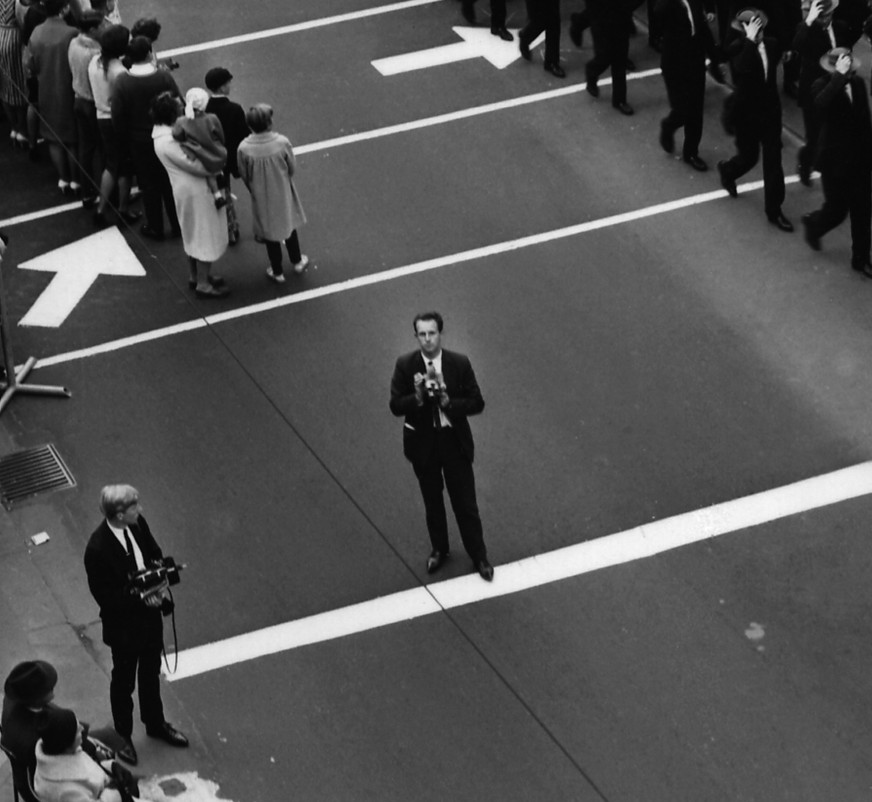
[xxviii] p. 282.


Australian Centre for Photography, Encyclopedia Entry, 2001

The Australian Centre for Photography, Sydney, New South Wales, Australia.

The Australian Centre for Photography (ACP) is a publicly funded gallery curating exhibitions of Australian and international photography, combined with a workshop offering courses to the public and access to photographic facilities. It also publishes the magazine Photofile.

The ACP opened in 1974 and it was very much a child of its time. Interest in photography as a creative art was booming in Australia in the early 1970s. Art museums were establishing departments to collect and exhibit international and Australian photography, art schools were establishing photography departments to turn out graduates in what was then regarded as the hottest new medium to be in to, entrepreneurial individuals were opening (mostly short lived) private photography galleries, and magazine and book publishers were experimenting with (mostly short lived) publications devoted to the new art form. The boom took off first in Melbourne, but spread to other capital cities. Australia was undergoing a general cultural and social renaissance during this period because in 1972 a progressive federal government had been elected which greatly increased arts funding.

In this climate a small group, led by the important Australian documentary photographer David Moore, successfully applied to the government for funds to set up a ‘Foundation’ for photography. Their initial plans were wildly grand: they  conceived of it having a populist, social role (somewhat akin to Edward Steichen gathering to the Museum of Modern Art, New York, the millions of photographs from which he selected the Family of Man exhibition) as well as a professional role in supporting individual photographers — from giving them direct grants and commissions to collecting their work. But within a year or two of its opening it had settled into a mode of exhibiting curated shows of photography to an art audience on a gallery/museum model, occasionally touring exhibitions, and offering facilities and courses to the general public in a Workshop which was established in 1976.

The ACP has always suffered an uneasy relationship with its shifting and fractious constituency. In its formative years it was resented by some for draining scarce funds away from the other artist-run photography spaces, quasi-commercial photography galleries, and small photography magazines that were springing up and struggling to survive right across Australia. A single institution, located in the heart of Australia’s largest and wealthiest city, was always going to be subject to accusations of elitism and being out of touch with ‘real’ photography — whatever that was, since the term covered a constantly changing and expanding range of practices.

The ACP came into its own under the aegis of American museum based formalism. In its formative years the ACP imported exhibitions by American masters, such as Diane Arbus; and American masters themselves, such as the then Director of the Photography Department of the Museum of Modern Art New York, John Szarkowski, in 1974, and the photographer Lee Friedlander in 1977.  However the ACP also began to exhibit and support the first generation of Australian art school graduates, for instance Carol Jerrems, Bill Henson and Max Pam. It also began to bring important aspects of Australia’s photographic heritage to light, for instance by giving Australia’s most important photographer, Max Dupain, his first retrospective in 1977. Olive Cotton, now one of Australia’s most loved photographers, was virtually unknown when she held her first retrospective at the ACP in 1984.

Between 1978 and 1982 its director, the US trained Christine Godden, established a new level of museum professionalism in the gallery, and succeeded in moving the ACP to its present location in a busy and fashionable shopping precinct. But during this period the ACP was criticised for institutionally perpetuating an increasingly marginalised formalist photo ghetto, when camera images were exponentially increasing in quantity, proliferating in format, becoming the central theoretical object of postmodern theories of representation, and forming the lingua franca of contemporary art in general.

From 1982, with Tamara Winikoff as director, the ACP deliberately tried to broaden and connect itself to a wider variety of communities. In 1983 it began to publish Photofile, which contained reviews and longer historical, critical and theoretical articles.  The gallery program now often featured community based and issue oriented exhibitions exemplified by the ‘suitcase shows’ it toured, which were inspired by the radical socially aware practices of British photographers like Jo Spence.

Photofile was particularly exciting in the mid 1980s, with the critic Geoffrey Batchen as editor, because by then a whole range of sophisticated discourses had taken the photograph as their principal subject, and a new generation of theoretically savvy art school graduates placed the photographic image — if not the idea of photography as an autonomous, historicised, fine art medium — at centre stage in Australian art.

During the 1990s, with Denise Robinson as director, this new wave of art school graduates, such as Tracey Moffatt, Anne Zahalka or Robin Stacey, were all featured in the gallery, which also became an important Sydney Biennale and Sydney Gay and Lesbian Mardis Gras venue. At the same time, however, the Workshop was languishing, Photofile was disappearing under a miasma of thick prose and arch imagery, and the ACP was falling into debt.

Much of the tenure of the next director Deborah Ely, appointed in 1992, was involved with successfully negotiating the re-financing and extension of the ACP’s building, as well as upgrading and updating the Workshop and revitalising Photofile. The gallery, although closed for refurbishment for long periods, continued the trend of exhibiting work in photographically related, particularly digital, media.

The current director, Alasdair Foster faces an entirely different climate from the one into which the ACP was born. Photography is no longer a young medium impatiently knocking on the doors of art. As an art practice its edges have long since dissolved into digital media, film, performance and installation. It is now a pervasive cultural and psychological phenomena. The ACP is no longer the sole ‘foundation’ for photography in Australia, it is now just a small part of a vibrant and well established matrix of museums, libraries, galleries, magazines, and art schools right across the continent.

Martyn Jolly

Further Reading

Ely, Deborah, “The Australian Centre for Photography”, in The History of Photography (Australia issue), 23, no. 2, (1999)

French, Blair, editor, Photo Files,  Sydney: The Australian Centre for Photography and Power Publications, 1999

Newton, Gael, Shades of Light: Photography and Australia 1839-1988, Canberra: Australian National Gallery, 1988

Willis, Anne-Marie, Picturing Australia: A History of Photography, Sydney: Angus and Robertson, 1988

Marta Penner’s Pinhole Photographs of Brasilia

‘Marta Penner’s Pinhole Photographs of Brasilia’, Canberra/Brasilia, Shane Breynard and Marta Penner exhibition catalogue, edited by Jane Barney, Canberra Contemporary Art Space, pp23-26. ISBN 1875526 70, 2001

Marta Penner takes her pinhole camera, made out of an old coffee tin, off to the sides of the monumental boulevards and precincts of Brasília. She nestles it behind a foreground of rocky outcrops, shaggy trees and scrappy grass to take picturesque views of Brasília’s grand architecture in the background. These awry looks at Brasília’s symbolic public spaces form an affectionate critique of the place. Her quirky activities become a series of almost performative gestures, provocative towards utopian Modernism and the political hubris of nation states, but conciliatory to the possibility of a sort of ironic habitation of this living ruin.

First, the pinhole camera: cheap, portable — available. But certainly not chosen out of any artisanal nostalgia, since the resulting paper negatives are scanned, reversed and printed out to any required size by a computer. Penner’s use of the pinhole camera (the only kind of camera there is which to use is to each time rediscover afresh the wonder of nature picturing itself), in the context of the ‘Ideal City’ of Brasília, evokes for me the mythic origins perspective (and photography) in Fifteenth Century Italy. In Florence, for instance, the architect Bruneleschi (sic) famously performed an ad hoc but elegant experiment which provided a natural proof of the laws of perspective. He painted, probably with the aid of a camera obscura, a reversed view across a city square. He then punctured a eye-hole in the vanishing point of the image, turned it over and held the back of the painting to his eye to view the scene he had just painted. With his other hand he then brought up a mirror which reflected and re-reversed the painted image, and replaced, in perfect register, the real city with its manufactured image. The natural laws of perspective drawing thereby established had to be codified, geometrised and re-tooled for the functional purpose of projecting planned spaces and buildings across the tabula of the page. Perspective allowed planning not only spatially, but also temporally. Right from the start it seemed to produce automatically from itself the possibility of, and the plans for, an Ideal City of the future. Some drawings of a Fifteenth Century Italian Ideal City exist, perhaps by Piero Della Francesca, which feature classical colonnades and vast civic spaces all in an airless, isomorphic geometric space.

Penner’s wilful use of the pinhole camera’s ‘natural’ optic, which grants a universal depth of field and dilates as it grows out from the centre towards its cradling penumbra — is crucial. On one level the non-rectilinear ‘organic’ perspective of her pinhole images humorously chides at the isomorphic single-point perspective of the modernist architectural plan. And, on another level, it also allows us to return to the historical vanishing point of perspective itself, an originary time before perspective and the Ideal City had acquired any of the ‘fascistic’ ‘anti-human’ baggage which was destined to weigh on the Modernist Ideal City

Something about Marta Penner’s anachronistic activities with her coffee tin also reminds me of a later moment in perspective’s history, whenn Eighteenth Century travellers took their Claude Glasses and their portable camera obscuras on the Grand Tour, seeking an interesting angle or unusual vantage point — preferably featuring a gnarled knoll, blasted trunk, or craggy gap — with which to frame some Ozymandian ruin or other. In Penner’s perspective the trees and rocks and grass, initially carefully planned by the landscape designer Burle Marx, seem to be running wild and caught in the act of reclaiming for nature the serried public buildings along either side of The Esplanada dos Ministérios. Her pinhole pictures, again humorously and with wry affection, reverse the temporal projection of the Ideal City, not forward towards the social Utopia of a future Brazil, but back to the ancient ruins of the Twentieth Century

Brasília’s plan was initially drawn out freehand by its designer, Lucio Costa, on five small sheets of paper. The blank sheet of paper is the starting point for every Ideal City — on these particular sheets were inscribed the straight lines of the symbolic axis, the curved wings of the residential axis, and the loops of the artificial lake. This plan was then transcribed from the five sheets of paper onto the hot, high, savanna plateau of Brazil, a site chosen precisely because it was a tabula rasa, a potentially dangerous void in the centre of Brazil. By contrast, in our imaginings of the origins of the great historical cities (London, Paris and so on) they have grown organically. Initially jagged on, and then accreted around, some convenient natural feature, they lapped over and folded in on themselves, layering themselves up and compacting themselves down so that they eventually seemed to have emerged chthonically from the ground. This imagining may or may not be true, but it does mean that the remnant spaces of the historical city have a different valency, they may threaten the body of the city, but they share in the city’s history and its future.

By definition there is no remnant space in the planned city, only negative space to separate out its various sectors, or to be a ground against which the figures of its buildings will be contrasted. The swards and swathes of the Ideal City were drawn into its plans to add graphic structure to the vistas, dimensional amplitude to the scopic vectors, and symbolic scale to the public spaces But in practice, from an oblique anamorphic perspective on the ground, when the aerial plan loses its grip on the civic experience, the planned city’s negative spaces can become activated as loci for historical and social conflict. They can become positive spaces, adumbrating the city’s ideality with history and habitation.

In fact, I was told, the picturesque pictures of these negative grounds are specifically about habitation. From its inception Brasília has been surrounded and serviced by xmillionsx of poor itinerant rural workers. who live in satellite cities, There is great pressure on space within city of Brasília. These spaces need to be protected and policed, or else people will move into them, light cooking fires, dry their washing, and build shanties.

When I was told this I was somewhat shocked, this acute high-stakes politics of population and space seemed so foreign to the Australian experience. Then, on my way home I drove home past Old Parliament House and the Aboriginal Tent Embassy.Here there were at least two kinds of spatial politics going on. Along the most symbolically charged scopic vector in the country, along Canberra’s land axis from Parliament House to the Australian War Memorial, there was a geometric jousting with the symbolism of the plan, running interference through strategically placed ceremonial fires, spear emplacements, murals and humpy like structures. But there was also the use of habitation itself as a politics: the embassy shed is an up front parody of the suburban house complete with letterbox and strangled shrub; and there is also a supporting encampment ensconced neatly within a snug crease on Canberra’s plan formed by two lines of bordering trees, it looks like a section of an outer suburban caravan park complete with council wheelie bin.

Marta Penner is bringing her coffee tin to Canberra. I wonder what pictures she will take.

The monumental axis/precinct/bouvelard

What has the Australian Centre for Photography ever done for me?

‘What has the Australian Centre for Photography ever done for me?’, Art Monthly, September, 1999

This year is the Australian Centre for Photography’s twenty fifth birthday as an exhibiting gallery. It was a child of the ‘photography boom’ of the 1970s, but since then the ACP has not only been a major player in the appropriational use of photography 1980s, but it has also successfully accommodated the dispersal of media categories in the 1990s to now be in a stable financial position, secure in its own building, and with a new director with an international reputation.

But nonetheless, throughout its history, there has always seemed to have been something wrong with the ACP. And there’s always been somebody willing to point it out. Its problems were right there in its name. How could a gallery and workshop in Sydney’s Paddington  service the needs of photographers Australia wide? And what exactly did it mean by ‘photography’ anyway? Who were the photographers the ACP was set up to enfranchise? And through what means could a ‘Centre’ constitute them as a community in Australia’s limited funding environment and against a rapidly changing technological and cultural landscape? Any photographer anywhere in Australia could legitimately ask ‘what has the ACP done for me?’, and not get much of an answer.

The ACP has always suffered an uneasy, mutually suspicious relationship with its shifting and fractious constituency. It has never wholly escaped the manner of its birth: in 1973 it had been established as a ‘Foundation’ for photography, by decree of the Australia Council, after the successful lobbying of a small group of well connected men.  Since then it has seemed to be always already there, burdened by an accumulation of prior ambitions and allegiances, and perpetually  trying to reinvent its role for a mutating constituency.

But the fact that there was always something wrong with the ACP is what makes its history so fascinating. The ACP has never, in fact, been central to Australian photography. It was always one, albeit better funded and more stable, player amongst the many artist run spaces, quasi-commercial galleries, dealer galleries, small magazines, art school departments and art museum departments which all sprang up in response to the new interest in photography in Australia. By and large the ACP worked cooperatively and supportively with all these other players. But throughout it all it also managed to hang on to the lion’s share of public funding for photography, so that the quarter-century saga of the its internal coup d’états,  public self-flagellations, and internecine snipings are the only thread which runs consistently through recent Australian photography.

The ACP came into its own under the aegis of American museum based formalism. The grandly wild ambition of its founding fathers had conceived of it having an inclusive, populist, social role (somewhat akin to Edward Steichen’s papal role in gathering to the Museum of Modern Art the millions of photographs from which he selected the Family of Man exhibition), as well as an extensive role in supporting individual photographers — from giving them direct grants and commissions to collecting their work. But within a year or two of its opening it had settled into a mode of exhibiting curated shows of art photography to an art audience on a hybrid gallery/museum model — a model which persists to this day.

The personalities of its various directors have always defined the ambience of the ACP. During the tenure of some directors it seemed as though the place had a distinct chill that came from more than just its air conditioning. However directorial style and personality were also a lightning rod for various external disgruntlements. However it must be said that no director lacked vision or courage, and under each the ACP either expanded or consolidated itself as an institution. Nor did any director preside over an entirely homogenous exhibition program. Looking back over the ACP’s archival scrapbooks it is clear that although there were distinct directorial agendas, each director also attempted to answer the demands of the ACP’s rumbustious constituency — they programmed plenty of exceptions to my generalisations below. Nonetheless the succession of ACP directors is a convenient way of periodising the ACP’s style and direction.

In the formative years from 1973 to 1978, under Graham Howe and Bronwyn Thomas, the ACP established an educational workshop and imported American master shows, such as Diane Arbus, and American masters themselves, such as Lee Friedlander. After 1978 Christine Godden consolidated the gallery with an emphasis on professionalism, quality and presentation. Anybody who worked at the ACP during the 70s and 80s will remember its storeroom full of stacked aluminium frames in standard sizes: twelve by sixteen inches, sixteen by twenty inches, and twenty by twenty four images. The walls of the carpeted gallery were clad in sheet steel and wrapped in beige cloth, and the frames were attached in regular rows with industrial strength magnets. The problem was that the kind of photography that this unique hanging system was devoted to —the isolated fine print — was already problematic. The ACP was institutionally perpetuating an increasingly marginalised art ghetto when camera images were proliferating in quantity, dispersing in format, becoming the central theoretical object of postmodern theories of representation, and forming the lingua franca of contemporary art in general. Godden received much criticism from critics such as Anne-Marie Willis. But she was also responsible for moving the ACP from its cramped terrace buildings to a prime Oxford Street location. And she did program agenda-setting non ‘fine art’ shows such as Giorgio Colombo’s exhibition of criminological photography ‘A Suspect Image’, and the conceptual/political work of the Canadians Carole Conde and Karl Beveridge.

From 1982, with Tamara Winikoff as director, the ACP deliberately tried to broaden and connect itself to a wide variety of communities. It began to publish a tabloid format magazine — Photofile; lectures, talks and forums became more regular; the smaller gallery became ‘Viewpoints’ which was devoted to young and emerging photographers selected by a curatorium; and the Workshop became more sophisticated and elaborate in the courses it offered. The gallery program itself swung away from fine art and towards a British, community based, pedagogic model exemplified by the ‘suitcase shows’ it toured. Although this did tap into the expanding number of government grant categories, some found this style of exhibition uninteresting, politically exhausted and theoretically out of date as an art practice. However during this period the ACP also supported ambitious multi media installations such as Dennis Del Favero’s “Quegli Ultimi Momenti” of 1984.

Photofile was particularly exciting in the mid 1980s, after it moved to a magazine format with Geoffrey Batchen as editor. By then a whole range of sophisticated discourses had taken the photograph as their principal subject, and a new generation of relatively theoretically savvy art school graduates placed the photographic image — if not the idea of photography as an autonomous, historicised, fine art medium — at centre stage in Australian art.

Denise Robinson, coming well credentialled from Melbourne’s hip and up-to-date Ewing and George Paton Gallery in 1986, imposed a theoretically driven style that attempted to bring the ACP to the cutting edge of contemporary Australian art, but which many found tendentious, pretentious, cliquish, visually unsatisfying and ultimately alienating.  But during the late 1980s staff discovered that they could paint the beige cloth walls white, they could drive nails through the sheet metal and even pull the carpet up for installations (although, come the early 1990s, the sheet metal walls finally defeated the new de rigour fashion for punctiliously pinning elegantly curled prints to the wall). The new wave of art school graduates were featured in the galleries, which also became important Sydney Biennale and Sydney Gay and Lesbian Mardis Gras venues. However, whilst successful projects such as the 1990 billboard project ADD MAGIC were being staged, the Workshop was languishing, Photofile was disappearing under a miasma of thick prose and arch imagery, and the ACP was falling into debt.

Much of the tenure of the next director Deborah Ely, appointed in 1992, was involved with successfully negotiating the re-financing and extension of the ACP’s building in an epic legal, political and financial battle. However she also got Photofile back on the rails and revamped the Workshop into a technologically relevant professional education provider. The gallery, although closed for long periods, continued the trend of incorporating work of photographically related, particularly digital, media.

The current director, Alasdair Foster, who comes to the ACP from Britain after establishing the internationally successful photography festival Fotofeis, faces an entirely different climate from the one into which the ACP was born twenty five years ago. Photography is no longer a young medium impatiently knocking on the doors of art. As an art practice its edges have long since dissolved into digital media, performance and installation. As a cultural phenomena photography is no longer constituted by the simple accumulation of all the individual photographs published in the media and pasted into our family albums, now photography is a temporal-spatial ‘effect’ which haunts all art. Photography is no longer just a cultural presence, it has become culture’s central nervous system. To Foster this makes the role of the ACP, an institution whose gravitational centre will remain photo-based art, more vital than ever.

Standing in the cavernous, Gyprocked white cube of the ACP’s new gallery, trying to ignore the echoing clatter of cutlery and crockery from the La Mensa cafe at the front of the building and the roar of traffic from Oxford Street, it certainly seems that in one sense the ACP has come a long way from its original cramped terrace-house rooms. In another sense it is in exactly the same position as it has always been: needing to justify itself to sceptical funding bodies, sponsors, and an undefinable constituency of photo-based artists who will be always asking “what has the ACP done for me?”

Martyn Jolly was a student intern at the ACP in 1981, worked as a curator there between 1985 and 1987, had one person shows there in 1988 and 1998, and  has served on various ACP committees and sub-committees since 1982. He still tries to visit whenever he is in Sydney.