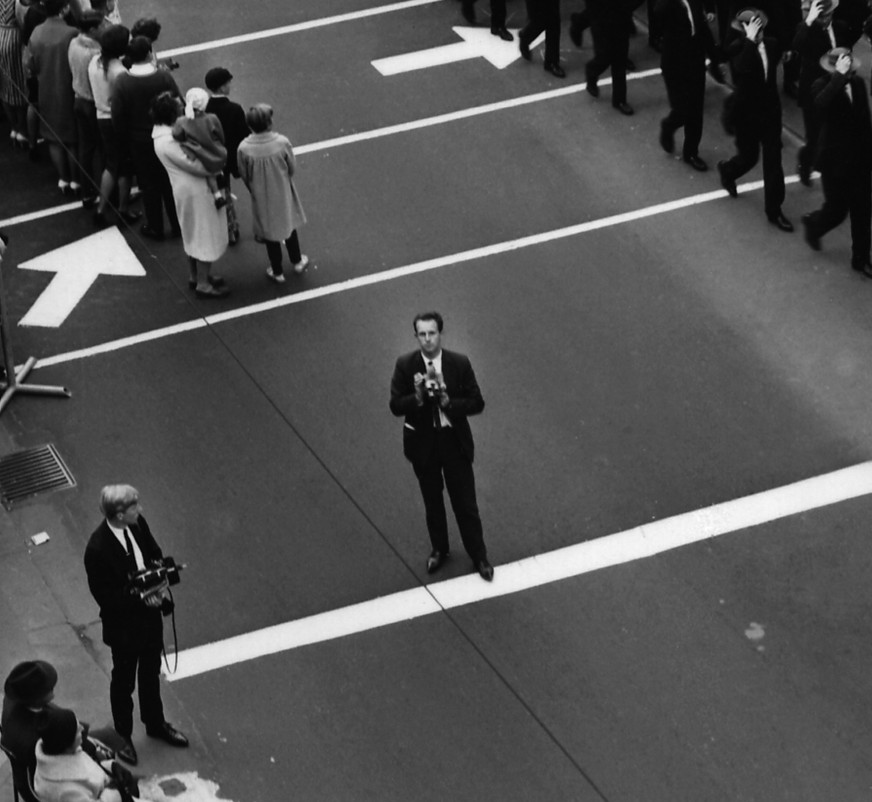
Photography’s Critical Stance? 1986

‘Photography’s Critical Stance?’

The Critical Distance, 1986, edited by Virginia Coventry, Hale and Iremonger. ISBN 0 86806 223, pp132-140


How is such a thing as the critical practice of photography possible? How does the specific nature of photography, its inherent characteristics and uses, define its relationship to critical cultural practice as a whole?

Photography and society and politics

Firstly, what is this thing called ‘the critical practice of photography or, as it is sometimes termed, ‘oppositional photography’? Oppositional photography is, first and foremost, a conscious photographic practice, a practice that takes a particular stance in relation to photography as a medium as well as to the society in which it operates. Oppositional photography demands a conscious stance because it sees both these things as structures that define the ways in which ‘our world’ is comprehended and the ways in which individuals behave in it. These structures are regarded as fundamentally oppressive – in need of critique and in need of change. Critical cultural practice assumes that forms of communication and representation – photography, film, newspapers, TV, and even art – cannot be j separated from the society in which they exist.

In the theory of ideology developed by Marx, the material basis of society, its eco­nomic functionings, produced a set of implicit assumptions and beliefs that masked its inherent contradictions. To Marx, the basic contradiction of capitalism was that economic wealth accrued to capital rather than to labour Ideology was« kind of false consciousness, the perfect reflection of the contradictions of capitalism. It is interesting to note that one of Marx’s own metaphors for this ‘wrong thinking’ was a camera-obscura, which makes upside-down images of the world in am darkened space.1 This metaphor relies on assumptions that are perhaps not so easy to maintain in the 1980s — assumptions of a’ real’ world, a’ false’ ideological image, and the distorting lens of simple class contradiction.

Within the Marxist tradition, theories of ideology were intensively developed dur­ing the twentieth century, when it was realised that classical Marxism had historical limits. It was more applicable to the nineteenth century capitalism which produced it, than to the increasingly subtle and complex forms of capitalism which developed during the twentieth century. An important theoretical develop­ment was the granting to ideology, society’s ‘superstructure’, a ‘relative autonomy11 from the economic base. The superstructure of society – culture, beliefs, etc.8 has a materiality of its own and is therefore as important an arena for revolutiona struggle as is the struggle between labour and capital. As the site for revolutic struggle has expanded, so has the cast of possible participants; no longer jud those directly oppressed by capital — the workers — but also those oppressed within other configurations of power — women, blacks, gays, the unemployed and those in the Third World.

Power is not simply direct economic oppression. Power can be technical, en­coded in social regimes or architecture.2 Power can be immanent, residing in f assumption that things are the way they are because of simple, ‘commonsense’ reasons. Power is pervasive. As much cultural as economic, it is best described as being hegemonic. Cultural and political power is derived from the assumption that this is a ‘natural’ ‘normal’ society. It is fundamentally oppositional practices that6 gage themselves with this assumption.

Photography is one of the most important and pervasive mediums for construe ing this ‘normalcy’ because it weds an apparently undeniable reality, an unassailable ‘piece of the world’, with specifically constructed, culturally determined, messages about that world. Photography is an essential part of the phenomena of the mass media. In the 1930s Walter Benjamin discussed the ways in which pho­tography, through the mass media, stripped reality of its unique and specific meanings for us as individuals and substituted a homogenous mass meaning, defined by the predominant interests in our society.3

Recently, such ideas have been developed further: the media is no longer simply seen as facilitating communication between individuals and sections of society, and thus passively reproducing capitalism’s contradictions, but rather as transact­ing in the signs of communication in the way capitalism transacts in any other commodity – as simply consumption for its own sake. Thus we can speak of an ‘economy of signs’ in which information is consumed and paid for as part of the same process as the consumption of products. Commodities and signs dissolve into each other. We are therefore robbed of the possibility of any real response to society because simple attack or transgression still circulates within the economy of the sign.4 Photography lies close to the heart of this process because, in a sense, it commodities the world. It turns pieces of ‘reality’ into messages that can be transacted within the economy of signs.

Photography’s privileged relationship with ‘the real’ has been dealt with by a variety of theorists, though not with the terminological coherency of straight politi­cal theory. Virtually all the writers who have discussed what I will call ‘the photo­graphic effect’ have been forced to use individualistic, quasi-metaphoric modes of speech when dealing with photography’s intoxicating, corporeal effects of im­mediacy and palpability.

Within the photographic tradition Walter Benjamin is celebrated as one of the first to theorise photography’s technological supremacy over all other imaging mediums. In referring to photography’s ‘magical value’, its ‘tiny spark of accident, the here and now’, Benjamin attempted to define the optical and chemical caus­ality of the photograph, its essential nature that not only characterises it as a medium but also absolutely distinguishes it from all other representational mediums.5

The semiologist Roland Barthes divided the photograph into layers, each of which, through different sign systems, carries different aspects of ‘the photo­graphic message’. One of these distinct, but inseparable layers of meaning, con­notation, carries specific cultural messages through the learnt codes of lighting, pose, composition, content, etc. The other layer, denotation, is a message sent without a code, undeniable reality resolutely recorded by the camera. This layer was for Barthes, as for all of us, the source of photography’s fascination. Thus Benjamin’s ‘flying spark of the here and now’ transmutes into ‘a message without a code’ for Barthes6 For Barthes, photography’s photographicness is not simply the bare bones of a linguistic/visual message lacking art, interpretation or even an enunciative creator; rather it is a potent, seductive and wily force naturalising and rendering innocent specific (bourgeois) messages within a brutal denotative/connotative alliance.

Through the mass media, with its increasing reliance on electronic, filmic, and mechanically reproduced photographic images, photography has assumed more and more of the very substance, the flesh, of our culture. Photography can thus also be said to play an increasingly important function within culture’s hegemonic structurings. Moreover, a direct correspondence can be made be­tween the ‘hegemonic’ and the ‘photographic’ structurings of our ‘reality’. The pho­tographic process, in its flawless and unquestionable conflation of a constructed, cultural message with ‘reality’, can be seen to operate in exactly the same way as the social hegemony at large, with its construction of a particular political and social order as the only commonsense ‘natural’ one. Marx’s metaphor of the camera-obscura can be revived and expanded: the cultural hegemony is like a photograph, it presents a particular order as the only conceivable order. But this relationship goes beyond being merely a metaphoric illustration: photography, or the ‘photographic effect’ (which spreads itself all the way from the video screen to the daguerreotype’s tarnished surface) can be seen to form part of the very body of our culture. Although, of course, linguistic,7 photography is not simply a mode of speech, not simply a cultural enunciation, it is a breath and a sound – the breath and the sound of the cultural hegemony.

In any oppositional practice the first thing that must be interrupted, therefore, is the even flow of the photographic breath. Oppositional photography of recent years has thus had a primary encounter with photography’s own ‘body’ – the pho­tographic effect. The Critical Distance not only implies a stance in relation to poli­tics and culture in Australia, but also a critical stance in relation to photography itself. The work collected under this title has concerned itself as much with disen­tangling itself from the photographic embrace as it has with social critique. Indeed it has not only had to deal with the two as thoroughly imbricated functions, but also as two absolute determinants of oppositional speech.

It is for these reasons that oppositional photographers characteristically break into their medium, rupturing it, tattooing it with texts, colouring and cutting it. These processes are of course historically relatable to the Modernist practices of mon­tage and collage, but it remains characteristic of most oppositional photographic discourses that one of the first things to be problematised is photography itself.

‘Photography and . . .’

 ‘. . . and  Photography’

Because of photography’s pervasive nature, because of its ethereal yet palpable presence in our day to day lives, it proves very difficult to come to terms with as medium or as a cultural practice in itself. Put simply, what we mean when we say the word ‘photography’ is never fully resolvable. Usually the word is used in con- j junction with some other term. It is always Art and Photography’8 ‘Photography and Pnntmaking’,9 ‘Photography and Language’.10 ‘Eros and Photography’,11 ‘Postmodernism and Photography’12 or ‘Photography and Politics’.13 Yet photography I persistently retains its identity no matter what it does and no matter what it is associated with. It is generally seen as an indivisible whole which merely displays I ‘aspects’ of itself for attention, aspects identifiable through their congruence with j other cultural discourses. Though there may be art photography, historical photography, erotic photography, and even political photography, somehow pho­tography always remains the dominant term. The ‘photographic’ sets all the images which it characterises into a firm gelatinous mass. The medium of paint­ing, for instance, is variegated, developing, changing and ruptured and can oil in some art discourses, be unified by such transcendent notions as ‘human expression’ or ‘artistic endeavour’. Photography, on the other hand, is fundamentally unified at the ontological level by its ‘photographicness’ and can only be divided and distinguished within itself on the discursive (historical, sociological, artistic) ‘ level. Photography remains predicated on the photographic, that intoxicating, corporeal effect of immediacy and palpability. The over-riding fact of photography, the unstoppable progression of the photographic effect, has always been the defining term of its various discursive formations.

Photography has thus played a problematic role within art and critical discourses,] yet this does not mean its role has been only marginal. Photography has existed close to the very centre of politics and art since its beginnings. It has always 1 dwelled close to the heart, if not the soul, of Modernism in art; by which it has been alternatively embraced or spurned, often as merely emblematic of the ‘spirit of the age’. In addition, it has shared many of its central figures with Modernism (e.g. Alfred Stieglitz or Man Ray). Whether sympathetically or not, photography has been evoked by Modernism as something either to react against or react with. ‘You know exactly what I think of photography’, Marcel Duchamp wrote to Alfred Stieglitz, 1 would like to see it make people despise painting until something else will make photography unbearable.’14

Photography is similarly evoked by traditional oppositional cultural practices in ambivalent, contradictory ways – as simultaneously a potent instrument of op­pression and a potential instrument for demystification. (In traditional oppositional discourses photography is usually seen to demystify by either ironically or parodically deconstructing society’s cultural manipulations [photomontage, etc.] or by acting as an ‘alternative’ photography, a separate voice against the dominant ideology [documentary, etc.].)

Thus, although photography itself is central to the cultural hegemony, photo­graphic theory tends to be marginalised within critical discourses. For instance, photographic theory is rarely taught as a distinct area of study in Australia’s tertiary institutions. Articles specifically concerned with photography rarely appear in books or magazines that deal with cultural theory or practice and photographic publications often find themselves begging texts from writers whose main con­cerns lie in other areas. While it is absurd to call for a separate entity called ‘photo­graphic theory’, the lack of a coherent or sustained theoretical discourse around photography in Australia is at least partially indicative of its ambivalent role within possible critiques of politics and culture. In addition, photography is often deployed within discourses of art and oppositionality as a vague shadowy presence, an evocation of the ‘photographic effect’ rather than a direct engage­ment with the set of images and practices that go to make up photography.

Some of the most successful art of the late 1970s and early 1980s, that of the ‘second degree’,15 relied implicitly on the photographic effect; but only as an evo­cation, an informant, a presence of itself. Photography as such is not significantly compromised by this art’s references to media images and media imaging. Else­where there are remarkably few artists who use photography in a deliberately self-referential or quotational way, and even Sherry Levine or Cindy Sherman use photographs already over-determined by either art-history or popular culture. It is the specifics of their over-determination, rather than the photographs themselves, that is the principle subject of these artist’s work. Since photography and the photographic effect form such a fundamental part of the very substance of our visual culture there is little leverage left for the operation of the semiotic second degree, for the necessary ‘detachment’. Photography cannot be as easily foliated from culture as painting; it runs through the veins of culture and hence cannot slide across its surface.

The revival, under the rubric of New Expressionism, of the ‘traditional’ primacy of painting has similarly illuminated the still problematic role of photography within art. ‘Has the time come’, a recent article in Art in America asks, taking its lead from Duchamp, ‘to despise photography . . . Expressionism on one level is the effort to transcend the photographic state of mind, and achieve a new philosophical out­look, a new freedom of understanding. It is resistance against everything pho­tography stands for, including the mechanistic society.’16 Arguments like this, of course, fall neatly into the art/photography rhetorical paradigm that has accom­panied photography since its beginnings (and incidentally supplied much of the engine-power for its art-historical development). But this argument, in the present-day context of a supposedly heterogeneous art discourse, does more than simply revive old issues, it throws into sharp relief the basic unease with which pho­tography still rests in the bosom of self-conscious cultural production.

Photography stands in a particularly strained and artificial relationship to cultural

theory and practice: its body is untouchable and its effect is demonic – both seductive and repulsive. Photography is still generally seen and used, even in the most ‘aware’ of cultural practices, as a single, albeit multifaceted, object. An object unassailable and unsplittable, without fractures or faultlines, an object whose vari­ous histories and cultural uses are conflated, through the agency of the photo­graphic effect into a single word — ‘photography’. This word bulges with associations, potent effects and mysterious powers. It is most often used as a rhe­torical trope standing in for an amorphous amalgam of photographic effects. It re­mains for many cultural producers simply an unstructured and awkward obstacle.

The oppositional photographer therefore has to deal with a photography that is constructed along at least two dimensions within society and its oppositional dis­courses. One dimension of photography is the very existence of itself as a set of continuous imagery stretching all the way back to 1839 and all the way up to the heights of connotational ineffability – a bank, or perhaps more appropriately, a body of imagery that must necessarily subsume any new photographs into itself. The other dimension is of the photographic effect, the ‘photographic’, which ani­mates the body of photography with the electricity of contiguity, immediacy and palpability — the electrical spark that leaps between ‘reality’ and the photograph. Both of these dimensions are absolutely implicated in, and compromised by, the hegemonic structurings of our culture and society.

Some critical practices and the ‘and’

What approaches are possible, therefore, for oppositional photographers as I have defined them. Historically, political photography has its roots in the represei tation of the ‘real’. The illustrative documentation of social conditions for the pur­pose of social change goes back almost to photography’s beginnings.17 The efficacy of these images resided primarily in the raw photographic effect. As ex­poses and revelations they were intended as much to stimulate emotion as pro­vide information. These direct, gritty, ‘confrontational’ images therefore acquired an aesthetic of their own. Explicitly intended to be unaesthetic and non-artistic, even to overtly repudiate artistry with its bourgeois associations, they nonetheles quickly became inscribed within the art-historical photographic discourse. Their implicit reliance on the transparency, and even purity, of their medium has much in common with Modernist notions of integrity to medium. Within the art-historicc photographic discourse the fully-fledged’Documentary Movement’arises at the same time as, and is directly relatable to, the purism of such photographers as Edward Weston or Paul Strand. Both took on the quasi-mystical values of truth ai truth-to-medium. Both were constructed within the paradigm of the transparent, incisive, unmarked18 photographic image.

The Documentary Movement thrived as much in Australia during the 1940s and 1950s as it did elsewhere.19 It was never able to develop a sufficiently coherent ideological or political base, or to fulfill its own expectations, and it rapidly becarr institutionalised as Photojournalism. Photojournalism’s propagandistic triumph, the Family of Man touring exhibition organised by Edward Steichen for the Museum of Modern Art, has become the quintessential example of all the wronc assumptions documentary photography made about the transparency of pho­tography, the universal language it spoke, and the humanist commonality to which it had access.20

The notion of documentary photography still has significant currency, however, within the socialist movement and its publications, and cannot be so easily dis­counted. The Photojournalism of the 1940s and 1950s has been merely shifted I the right in the traditional political spectrum as much as it has been subjected to fundamental criticism. This process has not significantly problematised the notii of ‘documentary’ itself, which still forms the backbone of the oppositional photography of the 1970s and 1980s. (For instance, during the late 1970s and early 1980s the European Worker Photographer movements of the inter-war years were excavated and used as models for current practice. Although these movements, which consisted of workers using simple, direct photographs to document their work and social environments, were assuredly an unprecedented form of worker unity and opposition at the time, their efficacy and relevance to contemporary practice was open to considerable doubt.21)

Documentary photographs are still generally seen as relatively unencumbered enemy agents within the oppressive structures of society itself. They still have cur­rency as ‘infotographs’ as one Canadian practitioner styles them.22 Emphasis is placed on the possibilities of their enunciation by the oppositional texts in which they are embedded, rather than by any oppositionality inherent to them as con­structed images. Such photographs are thus asked to ‘speak back at society; their voice is assuredly the voice of the hegemonic media, but it attempts to speak against it. Hence these photographs almost purposely delimit themselves; like the proletariat themselves, they have ‘working lives’.23 They share the same aspirations and structures as advertising or news photographs, only their functions are seen to be different. A little naivete, a little suspension of judgment, is thus almost es­sential to a current reading of these images. Although initially assuming an un­marked status, perhaps they eventually assume the mark of ‘the good fight’. As images they must be read along both the metaphoric and metonymic semiotic dimensions. It may be this metaphoric dimension which allows them to maintain the illusion that they can speak within the economy of signs against that very economy. Though they may give voice to certain sections of society, they must not be confused with attempts to destructure representation itself. Only by attacking the forms of representation (even oppositional representation) can the relentless circulation of statements within the oppressive economy of signs be disrupted.

Thus documentary photographs, in their emphasis on exposing the ‘realities’ of society and demystifying its veil of ideology, are most informed by the classic Marxist base/superstructure model of culture within society. With the development of more sophisticated analyses of ideology, and the dissemination of more sophisticated theories of representation and reception within those discourses, at­tention has shifted, as I have indicated, to the photographic medium itself. Notions of truth and the oppression of truth have ceased to be conceptual predicates. Knowledge is no longer assumed to be a separate entity which can be dis­covered, learnt and communicated by language, but instead is seen as some­thing that is embodied in language itself. Similarly, reality is not an ‘out there’ clearly or unclearly perceived through representation, but rather something per­ceived within representation.

Montage and collage, both with a long history in photography, have been resur­rected as ‘serious’ practices. Oppositional montage is based on the determination of meaning by medium and reinvents the formerly ‘transparent’ surface of the pho­tograph as a site for the playing out of the contradictions of capitalism. By juxta­posing two or more formerly transparent images on the surface of the photograph or photographic screen-print, the montage or collage creates a new meaning which has lost its transparency, but which in its overt and self-conscious recon­struction of that meaning gains force in reaction to the normal assumptions of photographic transparency. By cutting against the grain these images reveal and use the structure of that grain.24

The concept of truth remains vital to montage and collage, but it is transformed from being the central rationale, the substance of the image, to being a shifting term. No longer ‘the truth’, but ‘their truth’. A term to be dislocated from its construc­tion within the real and relocated on the surface of the photographic image as a manifestation of the image’s representational mechanics.


The subtlety of these juxtapositions is the index of their efficacy. Because they are codes constructed in the second degree they rapidly become exhausted of any­thing but rhetorical oppositional meaning. Their efficacy also depends on the significatory force of their original components. If these are exhausted of real potency within culture, or are simply rhetorical symbols of it, the ‘new’ meaning is rarely anything but similarly rhetorically oppositional. (This can be said of all those colourful, Heartfieldesque posters of bombs and Uncle Sams, so popular as decorations for living-room walls.)

In parallel with the oppositional use of montage and collage, texts have become increasingly integrated into the photographic image; even intruding across the photograph’s rectangular boundaries and onto its glassy surface. Rather than being merely a linguistic base which enunciates the photograph as simple evi­dence for the expositional progressions of newspapers, magazines or books, cap­tions and inscriptions are also used to compromise the photograph’s transparency and integrity as an unassailable unit of information. In addition the textual tattoo often serves as an expressionist rhythm with which to drum out the beat of an individually-proclaimed oppositionality, and thus to inscribe the work more legibly within the art discourse.25

The use of text and image also opens up the space in which to deploy an array of visual and verbal puns and parodies. Advertisements are obvious targets for parody since they rely on the ‘natural’ acceptance of certain cultural role and be­haviour models. Their construction subtly multiplies a range of visual and verbal correspondences and contrasts into specific messages for particular target groups.26 The transparency of an advertisement is different to that of the ordinary photograph. Although the narrative space of advertisements is explicitly fiction­alised, their transparency lies in the common language of consumerist desire and its potential fulfillment which both the advertisement’s actors and the advertise­ment’s subjects (ourselves) are implicitly assumed to share. This process natural­ises the process of consumption within capitalism. Puns and parodies, in laying bare the construction of the advertisement, draw attention to this process of naturalisation.

In a similar, but more complex way, captions can be used to dislocate the safety unified speaking and reading positions of the image and viewer respectively. They can fracture these unities along the faultline of gender, for instance, splitting what would appear to be a ‘woman to woman’ voice into a voice of the male op­pression of women.27

Handcolouring serves to give the photographic effect a specific, authorial voice; but not the one normally associated with oppositionality. The handcolourist’s voice is generally not a strident and discordant one to cut through the smooth soporific hummings of the cultural hegemony; rather it is one that speaks from within the history of art. Handcolourists, in their use of colour and in their employment of the gestures and skills of the painter, specifically evoke the artist’s traditional roles of privileged perception and concern. But a tension is thereby created because the site for this evocation is shifted from a neutral ground to the surface of the photo­graphic print. Both the role of the artist as one whose perception is somehow ‘in tune’ and the role of the photograph as a natural, unambiguous reflection of re­ality, are compromised by their conjunction on the one surface. The traditional op­position of ‘art’ and ‘photography’ remains, but now each exists on the other’s terms. Handcolouring profitably orchestrates the ‘authored’ and the ‘unauthored’ image into a whole which is not subject to the assumptions or expectations of either of its components.28

In conclusion, those phrases ‘photography and . . .’ or ‘. . . and photography’ can be seen to encode the basic formation of photography within most cultural discourses. Within oppositional discourses attention has been, and must continue to be, focused on the equating ‘and’ of these phrases. This ‘and’ is not the pivotal point of the equation, it is not even a point as such; rather it is the name of an im­plicit agreement, an agreement which subsumes the fundamental imbrication of photography within the cultural hegemony into a simple relation — merely a sys­tem of cause, effect and comparison between entities. Whatever their individual character, the words on either side of this ‘and’ retain the fact of their simple struc­tural relationship. It must therefore be this ‘and’, this artificial relationship which ob­scures the fundamental symbiosis of the photographic body within the hegemonic body, this subtle naming, placement and placation of photography within a relationship, that must be the object of attack and disruption. The smooth photographic speech must be given a stutter.

Martyn Jolly


  1. Cited in Sylvia Harvey. ‘Ideology: the base superstructure debate.’ Photography/Politics: one. Terry Dennet and Jo Spence (eds). Pho­tography Workshop, UK 1979.
  2. Michel Foucault. The History of Sexuality. Dis­cipline and Punish. Madness and Civilization. Vintage Books, USA.
  3. Walter Benjamin, ‘The Work of Art in the Age of Mechanical Reproduction.’ Illuminations. Translated by Harry Zahn, UK 1974.
  4. Jean Baudrillard, ‘Requiem for the Media.’ For a Critique of the Political Economy of the Sign. Translated by Charles Levin. Telos press, USA 1981.
  5. Walter Benjamin, A Short History of Pho­tography.’ Translated by Phil Patton. Artforum. February 1977, USA.
  6. Roland Barthes, ‘The Photographic Mes­sage.’ Image-Music-Text. Translated by Stephen Heath. Fontana/Collins, UK 1977.
  7. Roland Barthes, ibid.
  8. Aaron Scharf, Art and Photography, Penguin 1968.
  9. Gerry Badger, Photographer as Printmaker. Arts Council of Great Britain 1981.
  10. Lew Thomas (ed.), Photography and Lan­guage, NFS Press, USA 1979.
  11. Donna-Lee Phillips (ed.), Eros and Pho­tography. NFS Press, USA 1977.
  12. Michael Starenko, ‘Whafs an Artist to do?, a Short History of Postmodernism and Phc-tography.’,4fte/7mage. January 1983, USA.
  13. Terry Dennet and Jo Spence (eds), op. cit.
  14. Quoted in Donald B. Kuspit. ‘Rejoinder: Tired Criticism, Tired Radicalism.’ Art in America, April 1983.
  15. Paul Taylor, Australian “New Wave” and the “Second Degree”.’ Art & Text. Autumn 1981.
  16. Donald B. Kuspit, op. cit.
  17. John Thomson, London Labour and the Lon­don Poor. 1851. Illustrated with woodcuts from Richard Beard’s daguerreotypes.
  18. Roland Barthes, Elements of Semiology. Translated by Annette Lavers and Colin Smith. Hill and Wang, USA 1967, pp. 76, 77.
  19. Gael Newton, Silver and Grey. Angus & Robertson, 1980.
  20. Allan Sekula, ‘The Traffic in Photographs.’ WOPOP Australian Photography Conference Papers, 1980.
  21. For instance ‘Der Arbeiter Fotograf.’ Creative Camera. May/June 1981, UK; or Pho­tography/Politics: one. op. cit.
  22. Alan Wallach. ‘Info/tograph, the Art of Demystification.’Otoscura. Vol. 2, No. 5, Canada 1983.
  23. Helen Grace. ‘Working Pictures.’ Australian Centre for Photography exhibition notice, 1983.
  24. For instance see works by Ruth Waller.
  25. For instance see Virginia Coventry’s ‘Here and There: Concerning the Nuclear Power Industry.’
  26. Judith Williamson. Decoding Advertisement Marion Boyers, 1978.
  27. For instance see Sandy Edwards’ A Narrativi with Sexual Overtones.
  28. For instance see Micky Allan’s Botany Bay Today.

PERSPECTA 1989: DEEP WATER THICK SEDIMENT

PERSPECTA 1989: DEEP WATER THICK SEDIMENT


PHOTOFILE WINTER 1989 p 30

Amongst the various works in this year’s Perspecta, and amidst the pluralist ‘strategies’ and ‘tendencies’ so politely described in its introduction, two related types of painterly surface recur with a frequency that can’t be accidental.

Both types of surface are layered. The first is a kind of palimpsest in which transparent images are superimposed with varying degrees of deliberation. For instance in Fiona Macdonald’s An Untitled Illustration, Man’s Mind. I the ground plan of a Renaissance cathedral is laid over the fleshy portrait of a Renaissance man in order to describe a particular historical Ideal. Similarly, in Gordon Bennet’s aboriginal counter-myths, Triptych — Requiem, of Gran­deur, Empire, an overlay of Renaissance perspectival schemata re-enacts the colonization of an originary land­scape as signified by historic photographs of aborigines. Mark Titmarsh superimposes the merest outline of one historical picture onto the fading afterimage of another, creating a kind of painterly depiction of the act of cultural recollection. For Pat Hoffie the effects of Cultural Converg­ence are best represented by a random shuffling together of images from diverse Pacific nations, using equally diverse technologies of reproduction.

The effect in these instances is rather like peering through layers of tracing paper that have been alligned on a drawing board in order to show the various ‘levels’ of a historical construction. Or else it’s like a gel placed onto an overhead projector which suddenly connects a previously confusing pattern of dots. Similarly, but perhaps with less pedagogical intent, other surfaces from other pasts float deep within the paint of Su Baker’s Sustained Sensation. Looking at her work is like fathoming verv deep, but very clear water. Debra Dawes’ paintings are also optical events in which different Modernist formal sources create interfer­ence patterns which alternatelv absorb and repel the eye at a highly modulated frequency.

The second type of painterly surface which recurs in Perspecta is a kind of sedimentation: a historical precipita­tion rather than a system of overlays. For instance Andrew Arnaoutapoulos’ Industrial Surfaces on Large Canvases represents the grittv accretions of factorv walls. The mutual erasure of workers’ graffiti connotes, according to its essay, the impenetrable meanings of ancient runes on a cave wall. Similarly Chris Fitzallen encrusts laminated newspapers with brutal, dripping blocks of paint, encoding not so much expressionist zeal, as the residue of a past industry — in this case whaling at Albanv. Robert Kinder constructs metaphors for ‘state power’ by assembling its refuse — charred timber, torn text, tortured metal. He predicts Threat by constructing a surface which bears the scars of its aftermath. Likewise, Bernard Sachs’ dark, dreamy surfaces, with their pathetic artefacts attached, capture filaments of both cultural and personal memorv within the powdery fallout of his charcoal.

These two types of surface — one created by the superimposition of diaphanous screens, and the other by the sedimentation of gritty thicknesses — are obviously attempts to personallv mediate the intolerable burden of the past (or at least a good Millenium’s worth of it). But their recurrence in Perspecta, more than the collective intentions of any group of artists, signals a change in the nature of the past. These surfaces do not support an image of the past, nor do they contain an image from the past, rather they are meant to somehow embody the very workings of history itself. They present us with a site for visual archaelogy. These surfaces are either deep or thick, but they are also obscure and impenetrable. No matter how hard we strain, we just can’t see through to the bottom layer, we can’t reach down to feel the smooth texture of the primeval surface.

This enticing implacability tends to conflate the processes of personal memory and social historiography. Both remembrance and history are seen to erase, occlude, modulate and veil, just as they also uncover and preserve. Neither process is seen as empirical or innocent, both are contingent and motivated.

Of course. But this artistic strategy of vertical juxta­position isn’t quite the same as collage, or appropriation, or any of the other familiar strategies of postmodern quotation which reveal the contingency of subjectivity*. Quotation implies a quoter and a quoted, and therefore a distance between them. But within the virtual depth or thickness of these surfaces there is no distance or perspective, no possibility of reference or intertextuality, only an in­creasingly opaque accumulation, or an ever deepening pool in which artist and viewer swim. This is an archaelogy without location, it’s history without geography.

These surfaces implv the possibility of a dilated memory, a personal memory with a historical dimension. But in so doing they also forget. Their textural conflation nullifies the material difference between signifving surfaces — the photographic, the painterly, the textual. But not only, as we have been taught, do these signifying surfaces have different codes and histories, they also have different ontologies. So not only, as Tony Bond points out in his introduction, is “history …. [in Perspecta] …. used as a source of spectacle and is more often generalised as a non-specific otherness than as a specific historical mo­ment”, but also the very ‘substance’ of historv is homoge­nised.

I can handle the capitalization of individual histories into capital ‘H’ History. The proliferation of Doric Columns and Renaissance scroll-work is generally OK because there is always the artist’s cool stance of knowing ironv to at least rescue the image from banality. But the concomitant transformation of historical materiality into historical ambi­ence is harder to take. It means that the artist’s stance in relation to history has collapsed in a longing for historical-ity. The Perspecta’s hyper-historicality is seductive. But in its relaxing, lulling environment even a critical strategy such as irony tends to become merelY a vaguely troubling memory itself. It ends up as just another spectre in the uneasY dreams of the artist.


Mechanical motion versus manual dexterity in pre-cinematic Australian animation

‘Mechanical motion versus manual dexterity in pre-cinematic Australian animation’,

The Animation Machine, Society for Animation Studies Conference, RMIT University, 25-27 June 2012.


Before I begin I would like to acknowledge the National Film and Sound Archive Collection Scholar and Artist in Residence Fellowship program which supported the research that led to this paper. Some of my examples come form their collection as well.


For over fifty years, from the late 1840s to the early twentieth century, magic lantern operators astounded and delighted Australian audiences with exhibitions of a wide variety of optical phenomena. These ranged from swirling and pulsating patterns of pure colour as two hand-painted glass discs were rotated in opposite directions by the rack and pinion mechanism of the chromatrope, to the enlargement of live insects onto the screen. Central to their displays however were two key optical experiences, the essential visual pleasures of which are still familiar to us today. One was the dissolving view, the other was the mechanical slide. The dissolving view needed two aligned magic lanterns and a device for dissolving from one to the other, by either sweeping a feathered fan in front of the two lenses to give the audience the frisson of a defined ‘wipe’ from one image to another, or by turning down the gas supply on one lantern as it was simultaneously turned up on the other so that the audience experience the jouissance of one image literally dissolving into another. Dissolves could be done quickly, to give the impression of, say, a volcano suddenly erupting; or they could be done slowly, to give the impression of, say, day turning to night, or summer to winter. The second experience came from mechanical slides, which were hand-manipulated whilst in the projection-gate of the lantern. In slipping slides a sheet of clear glass with strategically placed areas of black paint was quickly slipped across the hand-painted image — obscuring one part of the image, while simultaneously revealing another. In lever slides one layer of circular glass was quickly rotated, producing a simple animation effect. Other slides used the circular rack and pinion mechanism of the chromatrope but replaced the kaleidoscopic patterns with hand-painted scenes.


For most of the period these phenomena were illuminated by limelight, a powerful white light produced when a gas flame heated a block of lime.

But they were also incorporated into larger intermedial performative contexts which might have included music played by an orchestra to accompany each slide, singing, and commentary from the lantern operator — either instructional information, light hearted patter or narrative storytelling. When lanternists purchased their sets of hand painted slides imported from overseas they also purchased booklets containing the accompanying patter.


In April 1848 the Sydney Daguerreotypist Joseph Newland offered customers a minstrel show, an orchestra, and a: BEAUTIFUL SCIENTIFIC EXHIBITION OF DISSOLVING VIEWS covering  10,000 SQUARE FEET OF ILLUMINATED SCENERY. His show featured several simple narrative transitions such as ‘Punch before Dinner’ to ‘Punch after Dinner’, and one based on a famous recent event, the burning of the East Indiaman ship the Kent in 1825, which transitioned from a ship in gale to a ship on fire. There was also at least one animated mechanical slide,  ‘Leap Frog’.


In the audience’s experience of the show it was the spectacular attraction of the apparatus and the various transition effects that were given priority, over the putative content of the views. When Newland took the show to Maitland in August 1848 the local newspaper specifically commented on the aesthetic and spectacular effects, rather than the actual content, of the various components to his show.


 Mr. Newland showed great skill in the gradual fading away of one view and encroachment on it of the succeeding one, until one had finally disappeared, and the other was revealed in all its beauty.(Maitland Mercury and Hunter River General Advertiser 9/8/48 p2


As a variety of other lecturers displayed them throughout the colonies during the rest of the century many other newspapers reported on the dramatic and narrative evocations dissolving views were able to create in their audience, particularly when accompanied by music and a well presented lecture. In 1852 Alfred Cane exhibited a variety of dissolving views in Sydney, and the Sydney Morning Herald was quick to report on the effectiveness of the sequence of dissolves.


” A ship in a calm” was a particularly truthful representation of that most tedious, most trying, most wretched predicament. Gazing at the view, one might almost fancy one saw the lazy sharks crawling about in the blue water, carrying on their eternal war against every other creature … Then suddenly the scene changed, the ship is caught in a storm, and with double-reefed foresail only set, struggles vainly against the furious surge, which too fatally drives her onto the inexorable rock. These two representations of the chances of the ocean were followed by “the ship on fire,” and “the raft,” and elicited several rounds of applause, especially from the juvenile portion of the audience, who, with true British feeling, seemed to delight in the danger, although ’twas but in show. (SMH 30/1/52 p2)


Alfred Cane must have been very skillful to create such a seamless effect and such an extended narrative from just four slides, a dissolving apparatus, and his own voice. Of course shipwrecks were particularly vivid for colonial audiences in Australia, and the narrative followed a familiar trajectory triggering socially programmed responses, but nonetheless the unified, single effect of a coherent animation of the painted pictures, produced in their midst by the magic lantern,  must have been very compelling for the audience. However they knew that, to use the newspaper’s words, ‘twas but in show’, so their pleasure was an alloy of both the enjoyment of the illusion itself, and the realization that the illusion was a mechanical creation.


Within their shows of other optical attractions such as chromatropes most dissolving view exhibitions  strove for extended narratives in at least one slide sequence. For instance the first exhibition of Mr Lillywhite’s views was described by the Adelaide Register in 1853 as containing an extended narrative involving a tiger:


The representations included pleasing landscapes, magnificent architecture, grotesque figures, and other features of a grave, fantastic, and startling character. The spectators were particularly delighted with some very amusing representations of the extraordinary means successfully resorted to by two Bengalees, who entrapped a ferocious tiger, which had scented them out whilst taking their noontide repast.


This exhibition also included a famous rack-work slide called ‘The Rat Catcher’.


Compelling short narratives were also being produced in the 1850s which relied on abrupt sudden unexpected changes, rather than a sequence of scenes.  James Smith displayed a series of imported slides in Melbourne in 1855. One was the popular image of Vesuvius erupting. According to The Age the image began as:


‘[t]he Bay of Naples , smiling in the serenity of sunshine, with Vesuvius at rest lowering grandly in the distance. Then: Clouds and thick darkness come over the scene, and the volcano belches forth its red fires and gloomy vapours, and the effect produced is really admirable.” (9/5/55 p6).


Newspaper reviews weren’t always so complimentary, however. For instance, a report in The South Australian of November 1847 commented on the mish-mash of the effects as well as the morally ambiguous subject matter of the dissolving views exhibited by Messrs Hall and Plush:


The exhibition was a sort of melange, consisting of optical illusions, phantasmagoria, fun, and harlequinade. The dissolving views were numerous and diversified, but contained too few representations of local objects. Some of the personal figures bordered upon indelicacy; so much so, as, in our opinion, to deter parents from treating their children to an otherwise harmless amusement; and it struck us that the dance of death savoured too much of profanity… a prudential change in their exhibition, with an improvement in the mechanical arrangement, would make it worthy of general patronage.


Although by the end of the century magic  lanterns had become associated  with didactic, scientific , religious,and temperance lectures, in the 1840s and 50s dissolving views and mechanical slides were still associated with ‘low’ entertainment — juvenile and obsessed with the occult —  often appealing to the baser instincts of their audiences. This is something that lanternists needed to both encourage and manage. But sometimes they weren’t able to entirely manage unpredictable audience responses in the dark. For instance a report of the lanternists’ Seymour and Gordon’s opening night in Adelaide in 1864 said:


The audience was not very large, and consisted entirely of occupants of the pit and gallery who, being unable to appreciate the nature of the entertainment, created such confusion that it was with great difficulty that the exhibition was gone through. The views were good, but the descriptive part was rendered inaudible by the noise.


Throughout the century newspapers regularly reviewed dissolving view performances and assessed as good or bad a consistent set of aspects of each evening’s entertainment, such as: the brightness and size of the disc of light on the screen (generally from 8 to 12 feet); the consistency of the illumination which was difficult to maintain because of a limited supply of gas; the focussing of the lantern; the  artistic control of the dissolve; the thematic appropriateness of the music (provided by orchestra, piano, accordion, or harmonium); the interest and relevance of the accompanying patter; the strength of the lecturer’s voice; the behaviour of the crowd (often the rowdiness of ill-bred children in the dark was commented on); the moral appropriateness of the subject matter (which ranged from ecclesiastical to occult themes); the topicality of the subject matter; and the educational value of the subjects. The wide range of experiences persistently commented on by the newspapers indicates the complex intermedial nature of the performances in which mechanical animations were embedded, and the way that they were an integral part of the re-organisation of modes of audience spectatorship.


We also know that dissolving views themselves were an important part of Australian colonial visual culture, because by the 1850s the term had firmly entered the Australian language as a metaphor. For instance in 1857 a correspondent to the Hobart Courier satirized the various rhetorical exertions of colonial politicians in parliament as an exhibition of ‘dissolving views’. In his satire, taxes and debts were ‘dissolving’ the bright future that Tasmania’s politicians were laying out:


A mist came over the glowing colours [of the politicians promises], extensive plains contracted to little valleys, undulating hills became rocky scrub, and the expected gold never came, and behind all appeared TAXES. Tax upon income; tax upon property; tax upon luxuries; tax upon four-wheeled carriages. It was evidently a mistake the obtrusion on so beautiful a vision of these unseemly and disagreeable objects, but unequivocally they made themselves apparent, and thus this beauteous scene dissolved away. (Hobart Courier 11/4/57 p3)


This would be equivalent to a satirist saying today that a politician’s promises were merely ‘virtual reality’.


In 1852 a poem called Ode to Melbourne was published in the Argus which was a satirical take on Melbourne’s poor drainage and alcoholic binge-drinking culture. It satirized Melbourne’s ‘filthy lanes’ and ‘atrocious smells’. Melbourne was full of pubs and drunkards, so the gutters ran with filth which reflected the debaucheries above:


Oh Pleasant city, full of pleasant places,

Thy very gutters show ‘dissolving views’


The dissolving view, far from the high minded education language of the ads the exhibitors put in the papers, remained associated with the gaudy, the low, the inebriated and the insubstantial.


It is clear from accounts such as this that it was the optical effects which were most responded to by audiences, rather than any putative content. However, when these effects could be extended over a narrative which linked them together they were responded to even more strongly. In the 1880s, a new kind of slide called ‘life model slides’ began to be produced. These hand-coloured live models adopting tableau-like attitudes in front of painted backdrops foregrounded narrative, rather than special effects, even more.


In life-model slide sets the various poses of the life models told a story, but not in the sense of a realistic story teleologically extending through linear time, rather in an iterative way, suited to the structure of a popular song with it repeating chorus and separate self-contained verses. These songs and recitations were issued in booklets along with the slide sets.


The sequence of life model slides called Daddy had a special effect, the appearance of an angel, double exposed  (or in our contemporary parlance, composited) on one slide, so it was suitable for a lanternist with a single lantern. However another series of life model slides, Jane Conquest, which would have been shown accompanied by a melodramatic poem about the mother of a sick baby who nonetheless managed to heroically ring a church bell in order to save fishermen from a shipwreck, was designed for dissolving lanterns, so a skilled lanternist could make the angel slowly appear and disappear above the baby’s crib.


REMEDIATION AND CONVERGENCE

The 1890s saw the convergence of magic lantern lectures, which had been developing for fifty years, with the cinematograph. Companies marketed lantern slide sets as well as Lumiere films, and cinematographic adapters for lanterns were also for sale.


Long-time lanternists were quick to defend themselves against the new technologies. For instance in 1897 the senior lanternist Edmund H. Wilkie wrote an article called ‘The Dawn of Animated Photography’ in the British journal The Magic Lantern Journal and Photographic Enlarger. First of all he dismissed motion pictures as an:


 ephemeral idea which will be the fashion for a season and then subside into the background to be seen no more … so far from superseding  general lantern work [animated photography]  will most likely act in the contrary manner, and by directing public attention to optical exhibitions give a powerful impetus to dissolving view entertainments generally.


But even after dismissing motion pictures as a fad he felt compelled to also argue that in fact magic lanternists such as himself had been involved in the same project as the new cinematographers all along:


Ever since the lantern emerged from what we may turn the chrysalis stage, and took rank amongst other valuable scientific instruments, attempts have been made to obtain natural motions with regard to the figures of human being and animals. The forces of nature, the great terrestrial and atmospheric phenomena presented generally no particular difficulty to the slide painter and mechanician, but with the appliances until recently obtainable, movements such as walking could only be imitated in a degree and with great difficulty, and could not be considered as successful. p21-22


Wilkie couldn’t have been more wrong about the future of animated photographs. This blind spot was because, as a veteran lanternist, he was focused solely on the optical effects of the new cinematograph, rather the indexical ‘reality effect’ it promised. He saw the natural motion of the cinematograph as just another category of illusion which happened now to merely incorporate the persistence of vision, as compared to the optical effects of the dissolving view, which had, in his eyes, the advantage of rich hand-painted colour and fine detail that at the time still far outstripped the cinematograph, particularly in spectacular and sublime weather effects, if not always in complex motion.


In the same issue of the Almanac  Henry J. Walker wrote an article Animated Photographs versus Dissolving Views, in which he, too, lamented that the new cinematographic craze was pushing aside the old dissolving view exhibitions. To defend dissolving views he retreated to the argument that the cinematograph was merely mechanical copying, whereas the dissolving view required manual craft on the part of the operator:


If animated photographs draw a large amount of applause from the audience, it is because they think the moving figures wonderful; but they do not know which requires the most skill, the dissolving views or animated pictures. The majority know, comparatively speaking, nothing of the working of the lantern; and have know idea of the skill required to carry through successfully a first class dissolving view exhibition … with some dissolving view effects, a very considerable amount of thought and skill is required to make the pictures projected on the screen appear ‘just right’ to the spectators … I think I shall be right when I say that, placed side by side [dissolving views take] infinitely more skill to turn out a first class entertainment … The animated photographs I put down as a mechanical triumph, and the success of dissolving views to the skill of the operator. P110.


But nonetheless the two co-existed for about a decade during a period of major technological remediation, both around the world and in Australia, as modes of mass spectatorship were re-organized around both established viewing conventions and emergent new technologies. Actuality, illusion and the trick were key terms during this crisis, but so was the idea of ‘animation’. At stake was not only what animation might become with the persistence of vision, but also what it had been. I would therefore like to argue for the discussion of the history of animation to not begin with the cinematograph but much, much earlier.


Obviously the long history of cartooning is one archaeological substrata to modern animation. For instance we can clearly see newspaper cartooning being remediated into cinematographic animation in the World War One films of Harry Julius, which open with him in his role of a traditional cartoonist, before zooming in on his hand doing ‘lightning sketches’ in front of the camera in real time, before cutting to a stop frame animation where his role as the artist has been totally sublimated into the retinal flow of the animation itself. This process, which happens in a few exhilarating seconds in Julius’s films, mimics a process which had been happening in the auditoriums of Australia and the world over for the previous two decades, when the projectionist moved from being a performer at the centre of the audience artfully manipulating his lantern and delivering his patter, to being invisible inside his bio box using his skill to make the cinematographic mechanism run so smoothly that the audience forgot it was there.


But while most people would recognize cartooning as a tradition which was mediated into the cinema and is still present — subsumed into twentieth and even twenty-first century animation, I wonder what happens when we put dissolving views into a similar remedial framework. The ruptures and discontinuities have already been clearly identified by our alarmed lanternists from the late 1890s. They saw that their hand-produced illusions, produced live in the midst of an audience who were willing to emotionally enter familiar narratives through the intermedial techniques of music and poetry, whilst also appreciating them as illusion, were gradually being replaced with automatically recorded and projected illusions that relied on the persistence of vision alone. But they were too alarmed by the new cinematographic technology to realize that other visual pleasures were also continuing from the dissolving view to cinematographic animation. The newspaper accounts of the shipwreck stories, or transformation scenes, reveal that the audiences felt a raw pleasure in seeing pictures  move and morph, and dissolve from one to another. In both the dissolving view and the cinematographic animation it seems to be the between states, the indeterminate states of fluidity, the constant change that caused the most pleasure. To me it is this raw visual pleasure which unites contemporary audiences with audiences of the 1840s, despite the massive changes in technology in the intervening 170 years. This unifying pleasure in transitional images needs further investigation.


Martyn Jolly


Exposing the Australians in Focus

Exposing the Australians in Focus

Harold White Fellowship Lecture, National Library of Australia, 2011


The books I’m going to talk about this evening are the books you find on the bottom shelf at the very back of the second-hand bookshop. They have been slowly bending the chipboard shelves with their weight over the past years forty-five years. Now I think it is time that they were dusted off and re-examined.


There had been a trickle of Australiana photobooks throughout the twentieth century. For instance the British photographer E. O. Hoppe came to Australia in 1930 and shot the book The Fifth Continent. In the next decade Oswald Ziegler began to publish a long series of large-format commemorative volumes co-sponsored by various governments and municipalities. Many of his publications were designed by the European trained designer Gert Sellheim, who often constructed elaborate double-page panorama-montages of national destiny using photographs from a diversity of anonymous sources. Usually the images he used came from stock sources, however every now and again we can trace a montage fragment back to its origin. For instance one of his montages from 1946 contains an image taken by Roy Dunstan, a photographer for the middle class travel magazine Walkabout, of Gwoja Tjungurrayi, known as ‘One Pound Jimmy’. The image was originally taken near T. G. H. Strehlow’s camp in 1935 and first published in Walkabout in January 1936 with the caption ‘The aboriginal, as seen by the early explorers’,


During the 1950s Frank Hurley began to publish his series of ‘Camera Study’ scenery books, and they continued to be published well into the early sixties, even after his death in 1962. And occasionally the posh fine-art publisher Ure Smith would produce genteel photobooks about Sydney, or surfing.


As the 1960s progressed photobooks in this well established mould continued to be produced, but at a steadily increasing rate, and in an increasing diversity of approaches. The New Zealand photographer Robin Smith continued the tradition of Hurley’s scenery books. One of his many books, Australia in Colour, sold 50,000 copies. But the dodgy colour reproductions and haphazard layouts of his books were were beginning to look very tired and old fashioned. As well, corporations such as BHP or James Miller Ropes produced books as promotional tools. An example is The James Miller Story published in 1962 which succeeds in making even the daggiest of industries, rope making, appear glossy, glamorous and modern.


However some creative experiments with photographic formats were also published. For instance in 1957 Angus and Robertson published Piccaninny Walkabout, a children’s book shot on an Aboriginal mission by Axel Poignant, which told it’s story almost entirely in photographs. Three years later a small, charming book of post-Pictorialist photographs won a ‘Book of the Year’ prize. It was Melbourne a Portrait, designed and shot by the photographer Mark Strizic with words, translated into French and German to appeal to the overseas gift market, by the architect David Saunders. The cover was by Len French. The judges commented:

This book of photographs, printed by offset, is an outstanding production. All the illustrations have an attractive softness. Not often is text printed by offset so clearly and evenly carried out. The preliminary pages have been well treated and refreshingly break away from the stereotyped pattern…..


The judge’s comments pointed to one major technological change which was leading to the expansion of photobooks. Offset printing, as opposed to letterpress printing, allowed text and image to be more cheaply, conveniently and intricately integrated on the one page, while retaining photographic quality and textual clarity. The book was printed from Griffin Press in Adelaide, who were to establish a reputation for high quality offset printing. In addition, access to large offset printers in Asia meant that Australian picture books could be printed in Singapore, Hong Kong or Japan in bulk and at low cost. Many glossy promotional books were beginning to be printed in Asia. The Age said of Strizic’s Melbourne a Portrait: ‘It gives a truer picture of Melbourne than a book of more glossily conceived and executed pictures could ever do. It also gives a picture of an exciting and a vital city” Melbourne Truth (2/12/60) called it ‘friendly and intimate … Melbourne’s old familiar places, caught and held by the art of the camera, come alive with fresh beauty…In comparison, the glossy production of the Victorian Promotion Committee, Melbourne — Big, Rich, Beautiful, sinks to the level of a singing commercial’.


But in the mid to late 1960s there was a dramatic acceleration to this increasing flow of photobooks. Books began to be published which were larger in format, better in design, and integrated text and image even more closely. In addition, these books were no longer simply about scenery, or worthy propaganda flattering the progress of this or that municipality, or this or that manufacturing company, they were about Australia itself. And they were timely, about Australia in the 1960s, rather than timeless, about a generic Australia. And they were quite explicitly about the new Australian identity that was emerging in the post war period.


During this period there was a radical increase in the number of independent, start-up publishers in Australia such as Rigby, Landsdowne, Nelson and Jacaranda, all trying to get a slice of the boom in book sales. The value of Australian publishing increased eight fold between 1961 and 1979; and from 1961 to 1971 membership of the Australian Book Publishers Association increased from 37 to 67, of which nearly 40 were Australian owned.


There was also a vibrant discourse on the nature of Australian identity being carried on during this period, with landmark texts being widely read and discussed. These included the smash hit post-war migration novel They’re a Weird Mob, 1957, which sold 300,000 copies in three years; critiques of Australia’s urban environment in The Australian Ugliness, Robin Boyd, 1960; discussion of the supposed success of Australia’s assimilation policies in I, the Aboriginal, by Douglas Lockwood, 1962; critiques of how Australia’s wealth and provincialism had made it uninspiring and indolent in The Lucky Country: Australia in the Sixties, Donald Horne, 1964; discussion of the country’s changing ethnic and age demography in Profile of Australia, Craig McGregor, 1966; and new approaches to thinking about Australian history in a world context in The Tyranny of Distance, Geoffrey Blainey, 1966.


As a background to this there was unprecedented wealth flowing from a mining boom, continuing mass migration from Southern Europe, and the beginnings of what would be our escalating commitment to the Vietnam War from 1966.


Significantly, as well, the Australian film industry would not undergo a renaissance until the 1970s. There were only a handful of feature films made in Australia during the sixties, and most were by overseas directors. The biggest hit was They’re a Weird Mob made by an English director in 1966, eight years after the book was first published. You can count the number of 1960s Australian feature films on the fingers of one hand, but at least sixty significant Australiana picture books were published during the same period


Looking back on this period from 1970, the novelist and journalist George Johnston commented:

I think it is significant that the rise over the past 20 years of a new, different, technological Australia runs almost parallel with the startling increase in and acceptance of books about Australia.’ The magazine quoting him added: ‘Perhaps there is also evidence that Australians are looking for an ‘instant heritage’”. [Walkabout 1970]


The Australians

In 1962 a National Geographic photographer named Robert Goodman came to Australia on assignment. Whilst here he met the Australian photographers Jeff Carter and David Moore, and worked with the Tasmanian born National Geographic staff writer Allan Villiers on a major National Geographic article on Australia. The article came out in September 1963 and established the dominant theme of the decade, the contrast between country and city. The articles he had assisted in lining up for Jeff Carter came out as ‘The Alice in Australia’s Wonderland’ in 1966; and for David Moore as ‘NSW The State That Cradled Australia’ in 1967. Whilst here, Goodman also conceived the idea of producing a high production value coffee table photobook about Australia for a global market.


Goodman, an extraordinarily energetic entrepreneur, got the support of a series of companies who were persuaded of the benefit of having a stock of books to be used as promotional gifts. 12 companies made $150,000 available over three years to finance the book, in return for10,000 copies to be used as promotional gifts. The companies were travel, mining and manufacturing companies and included: Qantas, the National Travel Association, Alcoa, Ansett, Associated Pulp and Paper, BHP, Commonwealth Bank, Felt and Textiles, IBM, International Harvester, Mutual Life and Citizens Assurance Company, P&O, H. C. Sleigh.


Goodman returned to Australia to shoot the book in 1964. He met the novelist George Johnston who had just returned from living abroad for fourteen years, and whose just-published sentimental autobiographical novel My Brother Jack was receiving critical and popular acclaim. Johnston agreed to write the text. Although many photobooks at this period were making use of the new Asian printers in Hong Kong, Japan and Singapore, Goodman ensured quality control by using the Adelaide independent publisher Rigby and the Adelaide printery Griffin Press, which was known for its quality, to have control over the colour separation, plate production, and paper quality. This control is indeed palpable in the final product. There is a wide variation in the print quality of the books I am discussing, but The Australians is amongst the best.


Goodman had also made important media connections, including with the class travel magazine Walkabout who a year out from the book’s publication began to build anticipation for it by covering his travel around Australia with his wife. When it was finally published in September 1966 the book was supported by an unprecedented publicity blitz, with articles and mentions in every magazine, from Pix, to the Women’s Weekly, to Walkabout, to Australian Photography, to Vogue Australia, as well as the newspapers. The coverage was tailored to each magazine, the Women’s Weekly featured his wife, Australian Photography showed the gear he had used. Even with the assistance of the copies going to the corporate sponsors, sales were excellent, despite the hefty coffee table price of $7.95. After it’s first edition of 35,000 copies sold out it went through several editions eventually staying in the best-seller list for a total of 14 months, and staying in print until well into the seventies. By 1970 it had sold 90,000 copies. [Walkabout 1970]


The big splash the book made was further increased by two exhibitions which were printed, one by the Australian Government for display in the US, and one by Ansett-ANA for display in Australia. 66 prints were sized from 1.5 metres x 1metre down to 75 cms x 50 cms. The book became a favourite corporate and government gift, being an official Gift of State at the Montreal Expo of 1967.


As well as its bar-setting production values, the other significant shift in the book was its change in subject matter from previous photobooks. It wasn’t about the continent of Australia simply inhabited by some people, it was about the people of Australia as formed by their continent. The empty urban and pastoral vistas of Hurley or Robin Smith, images of imperial potentiality, became landscapes of faces, a collective portrait.


The modernist designer Harry Williamson, a typographer who had trained at the London School of Printing, designed the book. Goodman and Williamson worked together projecting slides onto an enlarger baseboard. Goodman even returned to slide-rolls he had shot in 1962 on his first trip here, but flipped them and re-cropped them. Williamson cleaned up and de-cluttered each spread, and regularly punctuated the reader’s progress through the book with dramatic double-page images. But these spreads weren’t of vast distant landscapes or urban ravines, as we might expect from previous photobooks, but of the faces and most significantly the gazes, of Australians. Williamson said of his design of The Australians:


I believe it was quite a major statement in design. I tried to produce an integrated statement, to relate the pictures to the words and also to work to a specific grid which I designed, based on Bob Goodman’s 35mm shape. I could bleed the 35mm shape across on to the next page and it conditioned the column of text, generating a continuity throughout the book. I learned quite a bit about tuning things up from an editor from Newsweek [Jonathan Rinehart] who we used to edit the text. I’d do things in a rough sort of way, but he’d say ‘Look, we’re going to end every story on a big red shot, or … we’re always going to start this way.’ Although my grid was rational, I learned a lot from him about structure, about orchestration of pictures and that sort of thing.’ Caban 117


The flavour of The Australians was determined by its international context. It was photographed by a hot-shot American photographer, and narrated by a famous writer returning home after fourteen prodigal years as an expatriate. The bulk of Johnston’s text was a sequence of potted history chapters. These chapters followed a trajectory very familiar from lots of other Australiana photobooks — from the ‘land’ to the ‘people’ to ‘industry’, to ‘arts’, to ‘sport’ and finally ‘Anzac’ — but they were given personal colour by a series of short written vignettes mixing Johnston’s nostalgic recollections, anecdotes and social speculation. These paralleled the photographs quite closely, so text and image informed each other. For instance opposite an image of two Australians on a park bench we read:


The simplest generalization is that Australians and Americans are the two most instantly identifiable peoples of the western world. After ten years of living in Europe I could on a Mediterranean waterfront unerringly recognize from 150 yards away an Australian arriving on the noonday steamer. When I returned to my native land I had been absent for almost fourteen years. Yet everywhere I looked they were the same people I had recognized from the quayside, but infinitely multiplied. The first vivid impressions of homecoming I have not had reason to change…..


Reviews confirmed that The Australians had set a benchmark both in terms of the physical quality of the book, and in terms of its broadening of the themes and issues which could be encompassed by a Australiana photobook. Walkabout’s review of The Australians picked up on the book’s design sophistication and the closeness of the collaboration ‘His running text, which parallels the pictures, is a successful exercise in verbal interpretation which manages to avoid any trace of redundancy.” [September 1966]. While the bookseller trade journal Ideas indicated that this was a book to be sold as fundamentally about the national character of Australians caught between bush and city: ‘Both text and photographs reveal the outback — the back breaking pioneer character of the country which lead to the mateship quality of its inhabitants [as well as] the present-day, suburban, industrialized situation, which now leaves a question mark hanging over the character of today’s Australians’ [September 1966:]


Southern Exposure

The extraordinary success of The Australians prompted a series of replies from other publishers, as well as a series of attempts to jump on the Australiana bandwagon. The most trenchant reply came from Collins who published Southern Exposure in 1967, using a text by Donald Horne, who’s ironically titled The Lucky Country had been a talking point since it’s publication in 1964, and the photographer David Beal, whose black and white photographs had traces of the gritty documentary acerbity and class consciousness of photographers like Bill Brandt or Robert Frank.


The dust jacket states blurb its intention clearly:

Southern Exposure is the most original picture book on Australia yet to be published. It marks a departure from the stereotyped, quasi-official, ‘coffee table’ productions which portray in verbal and visual clichés an idealized picture of Australia. As Donald Horne says in his forward: ‘Neither of us — photographer or writer — could be bothered producing the ordinary kind of picture book on Australia. There are no photographs of koala bears in gum trees here … We are trying to get down in pictures and words the Australia we see…..


The cover images are just as explicit, and almost satirical. A prototype of ‘Norm’, the character Phillip Adams was to invent eight years later for a government sponsored exercise campaign called Life Be In It, holds a worker’s shovel but incongruously licks an ice cream — almost a visual encapsulation of The Lucky Country — while on the back cover the ‘real’ Australia remains dry and parched. The faces in The Australians were frontal and open with frank gazes, the faces in Southern Exposure are belligerent or turned away. Their gobs are plugged with bottles, cans or cigarettes. As in the cover, the book is full of sly and sardonic puns. A theatre-goer’s be-jeweled décolletage transmutes with the turn of the page to a drinker’s empty beer glass shoved down her blouse. The book ends with a sequence of two shots implying that both the bush and the suburbs are places where we are equally marooned. Other images, such as of bleached skeletons, a major visual trope of post war Australian iconography, seem to be out to directly trump Goodman’s more glamourized depictions, and Beal’s ANZACS, rather than looking weary but quaintly proud as in Goodman, just look smug and slovenly.


In contrast to Johnston’s expansive and easy-going anecdotes, Horne’s essays are densely written monologues, or almost harangues. To Horne, following on from The Lucky Country, Australians were provincial, complacent and intolerant. Just a skim through the chapter headings and sub-headings are sufficient to give a flavour of his text:

A transported civilization —What the Australians brought with them; Deserts of disaster —Australia’s manic-depressive cycles; The same but different — Australia as a province; Life in the south-seas — Good time Australia; Boxes of brick — Australia as a suburb; Mates— The Australians as a folk; Non-mates — The ‘Blacks’; Bosses — A crisis in leadership; The new Australia — A freshening; Existential Australia — A new style?


The pre-publicity for this book was nowhere near as extensive as that for The Australians. The trade journal Ideas said in July 1967:

Collins are very excited about this book and from what we can see have every reason to be. The photography is excellent and depicts the Australia that most of us know, rather than the Australia many publishers attempt to expose to the eyes of the world. … Absent are the clichés; the overtones of self-congratulation are missing’


The Australian newspaper was also keen:

Everything about it is brilliant, from its sardonic title and sleek presentation to its blistering essay and acute photographs (From ad in Ideas September 1967)


However the book raised the hackles of Walkabout, the travel journal that had doyens from the travel industry on its board, and which had supported The Australians. They complained:

This new genre of picture-book, solidly established last year by The Australians, was given an impeccable and sophisticated pattern by George Johnston’s text and Bob Goodman’s pictures. A welling, wholesome sanguineness swept through it. Australian frailties were admitted with grace, but Johnston’s pride in and Goodman’s American admiration for a people who had tamed but had been simultaneously moulded by a fiercely raw nature, and from scruffy beginnings had built a nation with no small part in the world’s affairs, arts, sciences and sports, seeped through unashamedly. Achievement was the keynote.

 [But]

In [Southern Exposure], people will read what is tantamount to a lecture to Australians themselves from a superior posture of niggling, radical intellectualism. The Top People, gibes Donald Horne, have come to a dead end, and can’t tell the rest what to do next. Australians are provincial, superficial, and existential, and they have lost the ability to “conceptualise”, raise issues and find broad meaning [except] in action which is now a relief from meaning. They have become imitators and adapters. Even their individualism has become group individualism. They are more concerned with “ordinariness” and mindless conformity.’ [September 1967]


Not surprisingly most Australians agreed with Walkabout’s assessment and weren’t going to pay money to be insulted. The book did reach the best seller list in September 1967, exactly one year after the Australian’s spectacular debut, but stayed there only one month, compared to Goodman’s fourteen. (However many other books I will discuss never made it to best seller status at all.)


It was clear from Walkabout’s over the top reaction that the agenda for photobooks had now shifted, from the purely promotional where it had been for decades, to the personal and political.


Jeff Carter Outback in Focus

Jeff Carter had cleared the equivalent of $3200 from his National Geographic assignment and, more importantly, it had left him with a stock of 3000 colour slides to draw upon. He was regularly publishing letterpress books, where photograph and text were printed on different pages, but in 1967 he moved into offset photobooks with Central Australia in 1967, and Outback in Focus in 1968, published by Rigby, the publishers of The Australians. These books enabled him to place the National Geographic slide stock, and the work he had been doing on an almost weekly basis for the popular magazines Pix and People into the broader more expanded context established by The Australians and Southern Exposure. Even some of the layouts that were occurring in the weekly magazines, such as Pix, People and Australasian-Post, could be transferred to books with higher quality printing.


These books took as their topic Carter’s favourite site, what he called ‘Centralia’. Outback in Focus valorised individual farmers, stockmen and fossickers, but took issue with the pastoral industry as a whole, which he accused of destroying the environment of central Australia. He also critiqued the standard assimilationist trajectories espoused by magazine like Walkabout. In these comforting narratives traditional Aborigines were noble, fascinating and grand, but they were inevitably the last of their generation. White education would produce new Aborigines fully functioning in white society, but still with some residual qualities of Aboriginality.


Carter was quite clear to his readers that this narrative couldn’t play itself out while there was still social and economic exploitation and injustice in Central Australia.  Quasi ‘anthropological’ gangs of figures or faces were a very popular graphic trope in many photobooks. It was used on any exotic species from opera dowagers to Aborigines. In one spread Carter seems to use this ganging layout to give us a standard assimilationist ascension to civilization across the two pages, but only when reading the caption do we realize that he is undermining it.


This Wailbri tribesman is amongst the last generation of Aborigines still capable of a nomadic life.

This man could still live in the bush too, but looks to the ways of the white man for a better life.

This Alice Springs policeman works as a white man, but is not paid as a white man or treated like one.’


On the page before Carter’s triptych another familiar image of a tousled hair aboriginal boy, commonplace enough since the days of Piccaninny Walkabout, comes with the warning:


Friendly, but doubtful now, this youngster’s attitude to white men will almost inevitably harden into active dislike. The onus is squarely on the white man to win the respect and trust of the black minority.


Walkabout, by now connoisseurs of travel books, praised the proximity Carter got to their beloved outback. They themselves had been responsible for reproducing frequently the head of ‘One Pound Jimmy’ taken by Roy Dunstan in 1935, such that it finally becoming iconicised into a postage stamp, so they praised the frank frontality of Carter’s Aboriginal heads — while ignoring the acerbity of their captions.


Some of his pictures here, in particular aboriginal portraits in colour, are magnificent. In flesh tint and texture, definition of form and line, use of light and projection of character they, in my view, transcend the mechanical and become Carter-creative. I have never seen better, nor such good reproduction by a Japanese printer.


Perhaps because two years had elapsed since the publication of The Australians, they didn’t directly take issue with his critiques of the outback as vehemently as they had Beal’s critiques of Australia as a whole.


The author-photographer describes the aboriginal population as he knows it, and deplores the poor treatment they get, despite legislation to improve their lot and their pay. ‘The new laws are scarcely worth the paper they are written on’, he asserts. A lot of outback topics Carter writes about are well in focus, starkly defined indeed. [August 1968]


Like Southern Exposure a year before Outback in Focus spent just one month in the best-seller list in August 1968.


Kings Cross

Other topics can also been looked at to trace this development in the sophistication and agenda of photobooks. Kings Cross was a staple subject of almost all photobooks about Sydney. Kenneth Slessor, author of the quintessential Sydney poem, 1939’s Five Bells and the book Darlinghurst Nights, was the virtual laureate of Sydney. In 1950 he wrote the text for a Ure Smith book on Sydney illustrated by a variety of photographers including Max Dupain, and in 1965 he wrote the text for a book on Kings Cross.


However his prose in Life at the Cross is rather journalistic and anodyne, and the photographs by Robert Walker are rather distant. The book, which in true promotional style includes a welcome from the Lord Mayor of Sydney, never really gets behind the scenes, or when it does there is a sense that the action has been staged. The design uses lots of small photographs to create a sense of business, but their grouping is incoherent, and their visual dynamism is dispersed.


However six years later, after several years of visitation to The Cross from US servicemen on R & R leave from the Vietnam War which began in late 1967, and the beginnings of the hippy movement, Kings Cross was done again by Rennie Ellis and Wes Stacey. Their book, Kings Cross Sydney, is much more satisfying than the earlier book. The picture groupings are graphically dynamic, and we are taken right into the dressing rooms and hippy pads of the area. The text, while not poetical, is nonetheless pungently personal.


Graham Kennedy’s Melbourne

Other publishers undoubtedly saw a bandwagon to jump on. The ‘King of Television’, Graham Kennedy, lent his name and his image to a book published by Nelson in 1967. The Channel 9 photographer Barrie Bell went round with Graham and took a total of six shots which were dropped in amongst the stock photos from the likes of Mark Strizic and Wolfgang Sievers. For a shot by Brian MacArdle of a South Yarra restaurant Graham comments:

Every second Melbournite has become a sort of instant connoisseur who can chat knowledgeably about Cabernet reds and steak Béarnaise. I know, because I’m one of them myself. I used to think it was snobbery to go beyond a steak (medium thanks) with chips, washed down with a lager. Now I know there are few things in this life to beat good cooking, good company, and a glass or two of good wine.


Made in Australia

When the English low cost, mass distribution publisher Paul Hamlyn entered Australian publishing they also saw potential in the photobook boom. After working with the English photographer David Mist on a book about Sydney. They accepted his idea of copying a 1967 book by the London fashion photographer John D Green called Birds of Britain, and doing a Swinging London, Carnaby Street style take on Australian women. The Sydney bon vivant and wine expert Len Evans would write the cheeky Playboy-style captions. Made in Australia the large format book that resulted in 1969 attempted a kind of groovy design aesthetic, but the ungainly addition of graphic elements like speech bubbles shows the limits of offset printing at the time. Nonetheless it was launched by none other than Patrick McNee from The Avengers TV series in Len Evans’ own restaurant.


In Her Own Right

Made in Australia deliberately and completely ignored the Women’s Movement. But in the same year Nelson published a book of essays called In Her Own Right edited by Julie Rigg which addressed what she called ‘the woman problem’:


The unresolved struggle for equal pay; the occupational problems faced by married women — whether or not to work in a society where industrial expansion depends on tapping married women as a convenient labour pool, but in which child care facilities are grossly inadequate — and the problems of the older married woman who finds her skills as a mother redundant once her children have grown, but is ill-equipped to do very much else; the inequalities of status and treatment which women still experience in many areas of occupational and social life.


The book was illustrated with photographs by Russell Richards, and its design was generally conservative and subservient to the text, however occasionally it breaks in to full bleed double page spreads reminiscent of The Australians.


To Sydney With Love

The combination of David Mist and Len Evans was a good one to target the upwardly-mobile, male, urban-dandy market, but other combinations seem more forced. In 1968 Nelson teamed the social commentator Craig McGregor, who had had the idea for In Her Own Right, with the Austrian-born landscape photographer Helmut Gritscher in To Sydney With Love. McGregor attempted a very personal beat-poetry meditation on Sydney. He opened his text late at night standing on the roof of a block of flats in Potts Point looking into Woolloomooloo:


I know this city, I comprehend it utterly, my guts and mind embrace it in its entirety, it’s mine. It was a moment of exhilaration, of exquisite and loving perception, my soul stretched tight like Elliot’s across this city which lay sleeping and partly sleeping around me and spread like some giant Rorschach inkblot to a wild disordered fringe of mountains, and gasping sandstone, and hallucinogenic gums.


But despite this attempt to ramp up the emotional ampage of the book Gritscher, primarily a landscape photographer most comfortable behind a long focal-length lens, shots things very much at a distance and brought the book back down again to the pedestrian level.


In The Making

However in 1968 McGregor collaborated with the photographers David Moore and David Beal as well as the designer Harry Williamson (the designer on The Australians) on another Nelson book which was to be the largest and most technically ambitious book of the decade. The reader’s experience of In the Making was very much led by Williamson’s design, which compared to the robust simplicity of The Australians, over-reached itself in its complexity. Ostensibly about the process of art making, from poetry to opera, the book must have been a confusing experience for the reader. McGregor’s potted biographies were quite trivial, and had a clever archness to them which failed to engage with any real issues. The photographs were often repetitive in their documentation of the artist at work or, confusingly, they were used as abstract design elements to illustrate the meaning of some poems or pieces of music. And the collage-like design with its lack of chapters and headings was often bewildering. It was a giant book, and at $19.95 a very expensive one, even if aimed at the Paddington or South Yarra coffee table market. It seems to have never made it anywhere near the bestseller list.


By the 1970s the number of Australiana photobooks being published died down. Although some notable photobooks were published from time to time in 1970s, not many took the totality of Australian identity as their topic, and few had the big corporate budgets of the 60s books. The adventures of travel writers like Jeff Carter transmuted into the gonzo TV shows of the Leyland Brothers or the films of Albie Mangles. The expeditions of Walkabout magazine transmuted into the TV shows of Bill Peach. What the seventies had, of course, which the sixties didn’t, was an Australian film industry. Perhaps the last book in the traditional style was A Day in the Life of Australia, initiated by another American photojournalist Rick Smolan, and published in 1981.


Conclusion

In conclusion I hope that I have convinced you that the late 1960s produced a series of photobooks which were not only important and formative collaborations between publishers, writers, artists and designers, but also engaged with real issues of the moment. Is there any legacy here for us? These books were produced during a period of economic boom and geopolitical re-alignment. Many of them were structured around the contrast between the economy and culture of the bush, in particular the mining industry and the pastoral industry, and the economy and culture of the city, in particular its suburban inhabitants. The 1960s had a two-speed economy and a two-speed culture. Mining and pastoral interests have recently re-entered our media and our cultural discourse in a big way to argue against things such as the Mining Industry Super Profits Tax, the temporary cessation of the live export trade, or a price on carbon, and to argue for such things as special industry assistance. In doing so they have been able to draw upon a deep well of iconography produced over many decades, largely, though of course not exclusively, by photobooks such as the ones I have discussed. I think at the background to many of these massive PR campaigns is the implication that real jobs, authentic Australians and nationally significant activities remain in the bush, rather than the suburbs, and should naturally take some kind of historical priority in defining the terms of everything else. This is exactly the same background implication that was at issue in The Australians, Southern Exposure, and Outback in Focus


This debate appears to be coming around again, but after having my head stuck in these books for the last couple of month, its terms, and its visual iconography, appear to me to be very familiar.


Digital post-production, the photographic document, and truth

Digital post-production, the photographic document, and truth

The Power of Images, Sir Peter Herbst seminars, 4 September, ANU. 

Earlier this year Paul Hansen’s image of two children killed by Israeli missiles, Gaza Burial, won the World Press Photo contest. The image attracted attention because it had a cinematic feel, as though an expert director of photography from films such as Kathryn Bigelow’s Hurt Locker or Zero Dark Thirty had lit it with movie lights. A suspicious forensic image analyst called Neal Krawetz, asked to examine the submitted JPEG file, and tracked the history of the file’s Photoshop ‘saves’. He found that, on the day it was taken, 20 November 2012, a JPEG image had been converted from the original RAW file. (RAW is the format of the first readable image file written as the camera uses firmware algorithms to convert the various voltages generated by its CCD sensor into digital data. In the RAW file image information like contrast and colour is stored as separate metadata, rather than saved and compressed within the image itself as in a TIFF or JPEG file.) Then, about six weeks later, and two weeks before the competition’s submission date, a further two images were converted from RAW formats and added to the first JPEG file. This analysis led Krawetz to accuse Hansen of breaking the implied rules of the World Press Photo composition by collaging three different images together.

The photographer replied to this accusation by admitting that he had given the image a post-production treatment similar to a High Dynamic Range photograph, where three different camera exposures of the same scene are superimposed. The JPEG files, he explained, were each ‘save as’ from the one RAW file, giving maximum tonal range and different chromatic saturation in turn to the shadows, mid-tones and highlights, before being superimposed in Photoshop. This had the effect of modulating the otherwise harsh lighting across the whole image, de-saturating the distracting light on the walls, giving the skin of the subjects a smoother, more ‘inner’ glow, balancing the viewer’s attention equally between all of the men in the alley, and heightening the dramatic illumination on the faces and shrouds of the two dead children. The superimposition was then merged. Hansen submitted the original RAW file, which he had neglected to do when he originally entered the competition, to another image forensics analyst, Eduard de Kam, who declared: ‘all of the pixels are in exactly the same place’. So, Hansen claimed, rather than shifting pixels, he had merely modulated each pixel’s colour and intensity in situ, acceptable to World Press Photo rules. An analogy that springs to mind could be to a beauty pageant, which would allow entrants to use make-up to enhance their natural beauty, but not to undergo plastic surgery to artificially create beauty.

Krawetz was not deterred, however, and subjected the JPEG image to a further ‘Error Level Analysis’ that indicated which pixels had been altered to which degree. The outlines around all the figures showed the systematic operation of Photoshop’s sharpening algorithm but also, according to Krawetz, betrayed some localized pixel modification. Meanwhile, an original reproduction of the image, before its submission to high dynamic range post-processing, had surfaced and been brought into the argument, and Krawetz noticed that some pixels had in fact been shifted. For instance the bruise on the right hand corpse’s forehead had been shortened to emphasize the glow of light on her round forehead.

Fifty years ago Roland Barthes identified six different connotational procedures at work in the press photograph, which were working away to inflect the ‘natural’ denotation of the image with cultural meaning. One of these he called ‘photogenia’, defined as: ‘the image itself ‘embellished’ (which is to say in general sublimated) by techniques of lighting, exposure and printing.’ Hansen’s post-production was pure photogenia, sublimating the brutal facts of the Gaza funeral within the elevated cinematic aesthetic that could be called: ‘the universal tragedy of contemporary warfare’ or ‘the nobility of the oppressed Palestinian people’. At the conclusion of his discussion of photogenia Barthes suggests that perhaps in the press photograph ‘there is never art, but always meaning.’ (IMT 23-24) Perhaps if Hansen had used as his photogenic reference point not Hollywood movies but, say, the gritty black and white style of old school photojournalism with its historical connotations of ‘meaningful concern’, his image would have passed without notice — but perhaps, also, it wouldn’t have won.

The furor over this image, and the subsequent digital forensics of Krawetz and de Kam, indicates that my neat analogy of plastic surgery versus make-up just doesn’t hold up any more; and nor can Barthes’ fifty-year-old mutual exclusion between ‘art’ and ‘meaning’ in press photography be sustained either. There is no ‘original’ data, which is subsequently modified in a computer. Even before the image is extracted from a camera’s CCD sensor and turned into a RAW file, firmware algorithms have been at work, sharpening edges and interpolating colour. Programs such as Photoshop provide further semi-automatic modifications along the same line. In this environment there is no single point where pre become post production, where denotation become connotation. Clearly there is a point, somewhere, where the image we see in our newspapers or on-line, in which we may still be happy to invest belief as being ‘true’, becomes just another Photoshop job; but where is that point? Clearly there is also a point where the aestheticization of the image shifts a photograph from the genre of news or reportage, to the genre of personal universalized meditation on the state of contemporary war, from specific referential meaning to generalized aesthetic art; but where is that point?

This make it much harder for people such as myself to stay up on our high horses, looking down on the plebs below unable to appreciate the different valencies and experiential nuances of various photographs. We will have to perform prettier and prettier dances in the future to stay ahead.

Martyn Jolly

Art from Archives

‘Art from Archives’

 Shaping Canberra, Humanities Research Centre, ANU, 17-20 September 2013

This is the age of the archive. It is the age when newly discovered collections of idiosyncratic or vernacular oddities are brought to light virtually every week; it is the age of the dataset; it is the age of the digitization and dissemination of vast, previously subterranean, institutional archives in massive labour-intensive projects of scanning and metadata matching; it is an age when those same institutions develop interfaces on their websites to encourage visitors to add their own metadata to the archive; it is the age when institutions, desperate to hit the KPIs of the their funding masters, hire ‘creatives‘ — what an odious term — to do funky things with their archival images in order to attract a younger audience.

Paradoxically, to be contemporary now is to be archival. Archives are everywhere, and in art archival strategies are ubiquitous. To quote from the back cover of the recent ‘Documents of Contemporary Art’ anthology The Archive:

Among art’s most significant developments worldwide since the 1960s has been a turn to the archive — the nexus of images, objects, documents and traces through which we recall and revisit individual and shared memories and histories. … the archive has become central in visual culture’s investigations of history, memory, testimony and identity.

But I want to spend some time sketching out how I think the notion of archive is operating at the moment in Australia, but particularly in Canberra. During the last thirty years more and more contemporary artists have been using archival strategies. They usually work in one of two modes.

The first  mode is to create your own archive. This takes the normal personal declarations of the artist and sublimates them within an archival structure. Instead of composing a work or moulding a form, the artist simply nominates and then assembles a collection of found objects or images in a rudimentary taxonomic structure. Examples of this mode could be the work of David Wills who, for instance, produced a very moving work about grandmotherly love and growing up. Called B3 he brought  thirty-three different Bananas in Pajamas from op shops. All had been knitted from the same Women’s Weekly pattern by different loving grandmothers, and all had eventually been abandoned by their recipients. Wills’ website, Turnstile, is an interactive interlocking database of his own continual process of collecting and archiving through the camera, which the viewer jumps around in via hyperlinked metadata. Another example could be Patrick Pound who collects snapshots from junk shops and places them into idiosyncratic categories.  His po-faced taxonomy draws attention to the profound individuality and uniqueness of the relationship between the anonymous photographer and subject found in each image. A third example could be Maureen Burns, who cruises Ebay and downloads and reprints the photographs people have posted selling items of mid twentieth century design. This becomes a comment on history, design, taste and domesticity. In these cases the art’s meaning or content becomes potential, rather than stated. It  is up to the viewer to navigate the archival structure, do their own aesthetic research amongst the idiosyncratic taxonomies the artist has folded into the collection, and find their own meaning. And in these cases also, the artist’s work borrows some of the prestige of the archive as a complete, autonomous, and somehow authentically ‘natural’ structure which automatically generates meaning independent of overt authorial intention.

The second mode of archival work is to work within an existing archive. There are two distinct approaches within this mode. Some artists  ‘mine’ or ‘sift’ archives to reclaim lost memories or reconnect severed filaments of time. An example of this may be my own 1996 work 1963: News and Information, from where I cropped small samples of material texture and details of body language out of an archive of government propaganda photographs held in the Australian Archives. (When I did this work in 1996 I used the same archive which the National Archives of Australia has subsequently mined for their exhibition Faces of Australia.) Other artists ‘interrogate’ the archive to ask questions of the historical assumptions that underpin its structure. An example of this might be Fiona Macdonald’s 1993 work Universally Respected, where she wove together two archival photographs of white colonists and black labourers in a process of photographic miscegenation.

The mining or sifting approach sees the archive as a positive, generative presence, a material heritage which needs to be refined, distilled or concentrated in order to have its signal to noise ration enhanced, or to tune into the different frequencies which are hidden within it. The second approach, the interrogative approach, takes a more critical stance to the authority of the archive, it sees the archive as a negative presence, a subterranean power that in its very structure reproduces old politics in the present. Yet in both these approaches to working with existing archives, the generative approach or the interrogative approach, the archive remains an almost occult presence. It has its own power, its own personality, its own presence. Far from being inert or passive, it seems to have an almost autonomous agency to conceal or reveal, to generate spectres or exhale miasmic atmospheres.

The most popular photographic archive in Australia by far is the Justice and Police Museum archive of 130,000 police photographs. It has spawned exhibitions at the Justice and Police Museum itself; history books by Peter Doyle; a mens clothing range by Ralph Lauren;  the production design of documentaries like Utopia Girls; and, not least, inspiration for artists. For over ten years the Sydney artist Ross Gibson and Kate Richards have made works based on the collection under the general title of ‘Life After Wartime’, this has included performances with a live soundtrack and generated haikus performed at the Opera House, as well as various computer coded interactive installations and site specific projections in the windows of an old house at the Rocks

Writing in 1999 Gibson acknowledged that he felt a kind of occult power coming from the archive:

Whenever I work with historical fragments, I try to develop an aesthetic response appropriate to the form and mood of the source material. This is one way to know what the evidence is trying to tell the future. I must not impose some pre-determined genre on these fragments. I need to remember that the evidence was created by people and systems of reality independent of myself. The archive holds knowledge in excess of my own predispositions. … Stepping off from this intuition, I have to trust that the archive has occulted in it a logic, a coherent pattern which can be ghosted up from its disparate details so that I can gain a new, systematic understanding of the culture that has left behind such spooky detritus. In this respect I am looking to be a medium for the archive. I want to ‘séance up’ the spirit of the evidence. [1]

In seeking to be a voodoo spiritualist ‘medium’ for the archive, the work was not trying to quote from it, or mine it for retro titbits ripe for appropriation, so much as to make contact with it as an autonomous netherworld of images.

Indigenous Australians have always had the strongest stake in our photographic archives. As early as 1986 Tracey Moffat was entering into direct and explicit dialogue with J. W. Lindt’s photographs in her series Some Lads, where her sexy dancers playfully appropriated and parodied the stiff colonial gaze built into Lindt’s studio tableaus.

However as aboriginal activism grew in intensity and sophistication during the 1980s and 1990s, anthropological portraits began to be conceived of not only as the theoretical paradigm for colonial attempts at genocide, but also as acts of violence in themselves, technically akin to, and instrumentally part of, that very process of attempted genocide. They began to be used by young aboriginal artists to ‘occult up’ their ancestors. Rather than just creating a feeling of active dialogue with past photographs, these new forms of indigenous reuse attempted to use photography to create a two-way corridor through time, a sense of New Age channelling back to the actual subjects of the photographs. For instance, in a meditation on the archive of nineteenth-century anthropological photographs left behind by the Northern Territory policeman Paul Foelsche, the indigenous photographer and curator Brenda L. Croft retroactively invested the agency of political resistance in to the 140-year-old portraits.

Images like these have haunted me since I was a small child … [and] were instrumental in guiding me to use the tools of photography in my work … The haunted faces of our ancestors challenge and remind us to commemorate them and acknowledge their existence, to help lay them, finally, to rest.[2]

But, rather than laying their ancestors to rest, many aboriginal artists have photographically raised them from the dead to enrol them in various contemporary campaigns of resistance. One of the first Australian aboriginal photographers to receive international attention was Leah King-Smith. Her 1992 exhibition Patterns of Connection travelled throughout Australia as well as internationally. To make her large, deeply coloured photo-compositions she copied anthropological photographs from the State Library of Victoria, liberating them from the archive to be superimposed as spectral presences on top of hand-coloured landscapes. For her, this process allowed Aboriginal people to flow back into their land, into a virtual space reclaimed for them by the photographer. In the words of the exhibition’s catalogue: ‘From the flaring of velvety colours and forms, translucent ghosts appear within a numinous world.’[3]

King-Smith held spiritualist beliefs which she enacted in her photographs. She concluded her artist’s statement by asking that ‘people activate their inner sight to view Aboriginal people.’[4] Her work animistically gave the archival photographs she reused a spiritualist function. Some of her fellow aboriginal artists thought the work too generalist. It lacked specific knowledge of the stories of the people whose photographs were reused, and it didn’t have explicit permission from the traditional owners of the land they were made to haunt. But the critic Anne Marsh described that as a ‘strategic essentialism.’

There is little doubt, in my mind, that Leah King-Smith is a kind of New Age evangelist and many serious critics will dismiss her work on these grounds …But I am interested in why the images are so popular and how they tap into a kind of cultural imaginary [in order] to conjure the ineffable … Leah King-Smith’s figures resonate with a constructed aura: [they are] given an enhanced ethereal quality through the use of mirrors and projections. The ‘mirror with a memory’ comes alive as these ancestral ghosts … seem to drift through the landscape as a seamless version of nineteenth century spirit photography.[5]

A new age spirituality also permeates the recent work of the indigenous artist Christian Thompson. As part of a large ARC project returning digital copies of nineteenth century ethnographic portraits back to the communities from which they came, he was invited to work on the collection of nineteenth century photographs held in one of the most famous anthropological archives in the world, the Pitt Rivers Museum at Oxford. The curator of photographs at the Pitt Rivers Museum, Christopher Morton, puts the original photographs as artefacts, as distinct from their reproducibility as images, on the same continuum as the actual remains — the skulls or bones — of aborigines. He says:

But in the case of archives – and in particular photographs – those ancestors held in the images remain in the storerooms of remote institutions even after copies have been returned or shared online.The reproducibility of the photographic image means that the surface information it holds can easily be shared, especially in the digital age. But the images of ancestors, as ethnographic studies around the world now show us, are more than the chemical traces of light on a surface – they have a direct and spiritual connection to the person photographed, and so hold significant spiritual and emotional qualities. It is this creative tension, between the archive as a permanent ancestral resting place, and yet as a reproducible, re-codable, and dynamic historical resource, that lies at the heart of Thompson’s concept of the exhibition space as a spiritual zone. (Catalogue essay to We Bury our Own)

For his part Christian Thompson saw his role as an artist in shamanistic terms:

I wanted to generate an aura around this series, a meditative space that was focused on freeing oneself of hurt, employing crystals and other votive objects that emit frequencies that can heal, ward off negative energies, psychic attack, geopathic stress and electro magnetic fields, and, importantly, transmit ideas. …. I asked the photographs in the Pitt Rivers Museum to be catalysts and waited patiently to see what ideas and images would surface in the work, I think with surprising results. Perhaps this is what art is able to do, perform a ‘spiritual repatriation’ rather than a physical one, fragment the historical narrative and traverse time and place to establish a new realm in the cosmos, set something free, allow it to embody the past and be intrinsically connected to the present?

Another example in this mode of intergenerational animism is the drawings which Vernon Ah Kee exhibited last year based on the Tindale collection of aboriginal portraits taken in the 1930s. For many years this archive has been a genealogical resource for aboriginal people trying to stitch back together the torn connections to their sibling, parents and grandparents, but in Transforming Tindale Ah Kee re-drew the photographic portraits of his own family members. Through the loving ministrations of his soft pencil graphite the images were humanized, transformed from ‘ethnographic samples’ or ‘genealogical evidence’ to ‘human portrait’.

While not buying into such direct visual spirituality as Leah King Smith or Christian Thompson, or direct family connection as Vernon Ah Kee, other aboriginal artists have also attempted to use the power of old photographs to make the contemporary viewer the subject of a defiant, politically updated gaze returned from the past.

Most recently Brook Andrew has worked in the personal archive mode, curating an exhibition for the MCA called Taboo, where racist imagery from around the world was gathered together into a cabinet of curiosities. However earlier, in the mid 1990s, Andrew had made some of the most iconographic imagery re-using archival photographs. In a series of works from the mid 1990s, Brook Andrew invested his nineteenth-century subjects, copied from various state archives, with a libidinous body image inscribed within the terms of contemporary queer masculinity, and emblazoned them with defiant Barbara Krugeresque slogans such as , I Split Your Gaze (1997), Ngajuu Ngaay Nginduugirr [I See You] (1998) and Sexy and Dangerous (1996) Andrew exploits the auratic power of the original Aboriginal subjects to re-project the historically objectifying gaze straight back to the present, to be immediately re-inscribed in a contemporary politico-sexual discourse. Although Andrew was also criticised for using the powerful portraits of the aboriginal subjects without appropriate consideration for their original tribal and geographical identity, these works have since become almost iconic in contemporary Australian art.

The iconicity of these archival art works is beginning to feedback into the historical archive itself. For instance, in May this year Sotheby’s put an ad in the paper advertising their upcoming auction of six albums of ethnographic photographs by Kerry and King. Out of all the images they could have chosen from the albums for the ad they chose the same one Brook Andrew had chosen 17 years before. Perhaps, like Andrew, they were attracted to the sexiness of the man; but I think also that the fame that Andrew’s appropriation had given to this man, and his posthumous conscription to the identity debates of contemporary Australia, had changed the value and valency of the original photograph as historical document in a kind of reverse historicism.

These transcultural uses of the archive by contemporary indigenous artists, who put themselves in the front line of contemporary debates around Australian identity and historical obligation, may seem a long way from the genteel streets of Canberra. But nonetheless I think the strong shadows they cast  help to illuminate the way we all relate to the photographic archive, even on a day-to-day level.

Canberra is an archival city. Not only in the sense that it houses some of the nation’s biggest archives, but that an archival presence continually pinpricks our civic space. Perhaps back in some utopian Old World, Europeans like me may have walked down urban precincts with their mixture of old and new buildings and felt a chthonic connection to time and place. But now we need memory markers, picture boards that remind us of what buildings or precincts once looked like. This attempt to create a collective sense of place and time is now no longer performative, but archival. Archival photographs are found, reproduced and irrupted into our streets on sign boards, to be more or less ignored by passers by. Thus, marginalised urban precincts, seen in need of a relevance injection, are embellished with evidence from the archive which hopefully reminds people that they are walking through a lieux de mémoire with a rich and rounded history.

Similarly, in acts of national commemoration the archive is replacing other modes of memorialization, such as symbol, prayer or song. Since the the Vietnam Memorial of 1992, many other memorials such as the Nurses Memorial, the Airforce memorial and Reconciliation and Federation place, have followed its lead in reproducing the momentary slice of time of the photograph within various ageless, either vitreous or lithic, surfaces. Lately, also, Canberra’s national memorial architecture is increasingly becoming a screen for the projection of archival photographs. Charles Bean had always put a library of photographs at the heart of his conception for the future Australian War Memorial, but I doubt that even he could have imagined the outside walls of the Memorial becoming a screen for the projection of Archival photographs in the lead-up to the Dawn Service, as happened this year.

For these reasons it perhaps was inevitable that photographs should feature  in the ACT Bushfire Memorial. Because of my interest in re-using archival photographs I was invited to submit a proposal to design the proposed Memorial, I realized I had no chance of getting the gig until I teamed up with Tess Horwitz and Tony Steele; their public-art smarts combined with my photographic credentials meant we had an unbeatable proposal. We held two sausage sizzle days where victims of the fire came in to meet the artists and look at our maquette, as well as inscribe a brick and show me the snaps they had taken on the day of the fires and in the aftermath leading to their recovery. I got a scan of the photos I liked, and got them to fill out a sheet giving me copyright permission and relevant metadata. One of the textural themes of the Memorial was the humble house brick, so I cut out brick-sized details from my scans and laid them out vertically into five glass columns. The palette ran from earthy and fiery tones at the bottom, up to images of people and incidents at eye level, and then up to the greens and blues of regeneration towards the sky. Captions giving the photographer’s name and a short title were placed in the ‘mortar’ between the images. I still think that this memorial is rather unique because, rather than choosing one image to be iconically embody the whole experience of the event being memorialized, as in the Vietnam Memorial, or doing an impressionistic collage of different elements, as in the Nurses or Air Force memorials, individually tagged and identifiable photographs, albeit details of them, are presented in a grid which retains their individual specificity. I think this approach worked because the victims were all fairly homogenous — middle class suburbanites with cameras — and the event was concentrated and coherent in its narrative meaning — ‘fire comes, community suffers but regenerates’ — with only some minor counter-narratives — of the financial culpability of various governments — around the edges. This approach may not have worked in memorials to more complex disasters, or addressing more heterogenous constituencies.

I’ll finish by talking a little bit about a small installation I have in the show which is opening tonight. In my head I divide the history of Canberra into two periods. There is the utopian period from its foundation to self-government, where Canberra was used by the Commonwealth Government as a model of an ideal Australian polity, and a kind of ideal template for a future Australian city. During this utopian period, which in my imagination peaks in the 1960s,  Canberra was tolerated as a noble experiment by most Australians. Then there is the distopian period from self-government till now, where Canberra is regarded by Australians and governments alike as parasitical, perverse, pretentious, indulgent and ‘out of touch’. In both these Canberras there are no actual people. In the distopian Canberra of today the people who live here are despised as a vitiated, degenerated, foppish sub-category of the real Australian. They are people of literally no account. As Clive Palmer said last week:‘In Canberra they have the best roads, but nobody to drive on them’. However the utopian Canberra was also devoid of actual people, the few people that appear in the photographs are national cyphers, actors in a political fantasy, like the schematic figures that occur in architectural drawings.

So I’ve collected tourist brochures and NCDC publications from the utopian period of Canberra, making my own archive. Using an ‘Office Works’ aesthetic I have covered up the generic photographs with coloured sheets of A4 paper, obscuring the various civic vistas of national potentiality but revealing hapless pedestrians or passers by accidentally caught in the photographer’s camera, thereby pulling them out of their unwitting role as national cyphers, an perhaps returning to them their individuality as people.

My work is cool and ironic, it is a million miles from the fervent spiritual juju of indigenous artists. It is affectionate, rather than interrogative. But nonetheless I think that on some level we are all engaged with the same occultish power of the archive.

Martyn Jolly


[1] R. Gibson, ‘Negative Truth: A new approach to photographic storytelling’, Photofile 58, 1999, p30.

[2] B. L. Croft, ‘Laying ghosts to rest’, in Portraits of Oceania, ed. by J. Annear, Sydney, 1997, p9, p14.

[3] J. Phipps, ‘Elegy, Meditation and Retribution’, in Patterns Of Connection, Melbourne, Victorian Centre for Photography, 1992, np.

[4] L. King-Smith, ‘Statement’, in Patterns of Connection, Melbourne, Victorian Centre for Photography, 1992, np.

[5] A. Marsh, ‘Leah King-Smith and the Nineteenth Century Archive’, History of Photography, 23, 2, 1999, p117.

A Melbourne Spiritualist’s carte-de-visite album

‘A Melbourne Spiritualist’s carte-de-visite album’,


 Migration and Exchange Symposium, Potter Gallery, Melbourne University, 29- 30 November, 2012.


At first glance it’s an unassuming album, barely twelve by fifteen centimetres in size and about six centimetres thick. It’s made up of only eighteen cardboard leaves between morocco covers, and each page has a pre-cut pocket so the owner could slide in a carte-de-visite photograph. The anonymous owner purchased the blank album for three shillings in Melbourne, Australia, in the early 1880s, and the thirty-six cartes-de-visite she slipped into it were originally taken in Australia, Britain and the US from the late 1850s onwards.


So far there is not much to distinguish this album, which is in the collection of the National Gallery of Australia, from the hundreds of other carte-de-visite albums which were assembled in the latter part of the nineteenth century. Cartes-de-visite were portrait photographs, mounted onto pieces of card of about six by ten centimetres, which were used as the visual currency for extended networks of social exchange. Thousands of photographic studios around the world printed them in multiples of eight and sold them cheaply. Album owners would fill their albums by exchanging cartes of themselves with their friends and families, as well as buying cartes of celebrities such as politicians, actors and royalty. Carte albums visually located their owners within widening concentric circles of immediate family, social groups and political classes. Carte albums were oral objects as well as visual objects, they were narrated by their owners as they showed them to their family and friends in the parlour. Although they were domestic objects, the images they contained opened out onto the whole world.


In most carte albums portraits of intimate friends rubbed shoulders with portraits of famous personages, but in this album these images also rubbed shoulders with portraits of spirits. The album documents one person’s passion for the religion of Modern Spiritualism. Its owner was probably a member of the Victorian Association of Spiritualists, and her album uses photographic portraits to map the spiritual, social and political world the Victorian Spiritualists created for themselves. Recently, photographic historians have become increasingly fascinated by spirit photography. (For instance see my book Faces of the Living Dead: The Belief in Spirit Photography) However hitherto our focus has tended to be on the mysterious ‘extras’ which appeared within the emulsion of the image, which seemed to hyperbolize the indexicality of the photograph; or our focus has been on the moment of the photographic séance, where a thaumaturgic medium-photographer photographed the sitter in the act of channelling their lost loved ones, which seemed to hyperbolize the ritual of portrait photography; or our focus has been on the body of the medium, which in its ability to manifest phantoms and extrude ectoplasm seemed to hyperbolize the fertile power of the female body. But this album, full of its faded carte-de-visite portraits, enables us to expand our focus to the ordinary Spiritualist herself, and the personal, social and metaphysical world she constructed for herself. The world she constructed may, in fact, even share some characteristics with the mediated worlds we construct for ourselves in contemporary media spaces such a social networking sites.


Looking through this album, 130 years after it was compiled, we are missing the all-important narration its owner would have provided, but it is possible to recover some of the knowledge she would have recalled about each subject as she slid their photograph into its pocket. The portraits were inserted into the album in no particular order and most are, in themselves, visually unremarkable. However analysing the album as a complete, integral object is still worthwhile, because when we know the things the album’s original owner knew about each portrait the disparate images begin to network together into a complex world-view made up of succeeding spheres of the local, the famous, and the disincarnate. A description of even a small representative sample of the thirty-six portraits in the album still gives an indication of the extent of the album’s reach, all the way from Melbourne, to Britain, to the US, and on to the Beyond.


The Network of Portraits

The album contains portraits of Melbourne spiritualists who its owner probably would have known personally. Perhaps she even obtained their portraits in exchange for her own. Most significant is a portrait of William H. Terry by the Melbourne photographers Stewart & Co. Terry was Melbourne’s most prominent Spiritualist. In 1859 at a Melbourne séance he received evidence that his brother had survived death. He wrote:


Never shall I forget the eventful night when I realized the grand truth of man’s continuous sensuous existence after death. I felt the presence of my brother, and it was indeed a happy reunion. (Gabay, p31)


A vegetarian teetotaller, Terry became a spiritual healer, diagnosing ailments through what he called a ‘spiritual telegraph’ with the Beyond. He opened a bookshop and herbal emporium, importing some of his herbs from the Banner of Light organization in Boston. In 1870 he set up the Victorian Association of Spiritualists and established the long-running Spiritualist magazine the Harbinger of Light. The magazine’s title came from a vision a young medium had, when she saw a spirit holding a scroll inscribed with the words ‘Harbinger of Light’ and the motto:


Dawn Approaches, error is passing away; men arising shall hail the day


Throughout the 1870s, popular interest in Spiritualism and séances continued to grow so that by 1878 a reporter for the Melbourne Age was confessing:


Though I do not profess to being a Spiritualist, I own to having been infected with the fashionable itch for witnessing ‘physical manifestations’ as they are called, and accordingly I have attended several séances with more or less gratification. (Britten, p238)


By 1881, at about the time this album was being compiled, the membership of the VAS had climbed 853 members, at a time when Melbourne’s population was barely 300,000.


The VAS sponsored the visits of many prominent international spiritualists to Melbourne, and their cartes-de-visite were placed into the album. The glamorously bearded American lecturer, Dr J M Peebles, who came to Melbourne in 1872 and again in 1878, visited the same Melbourne photographer Terry had, Stewart & Co, to have his carte-de-visite made.  He lectured to standing-room-only crowds of up to 3000 people every Sunday for three months. His greatest enthusiasm was for progressive vegetarian diet reform. He styled himself as a ‘Professor of Ontology and Biodynamics’ from the Eclectic Medical College of Battle Creek, Michigan, where he had previously been pastor at a Free Church. The small town of Battle Creek, with its strong Freethought and Seventh Day Adventist culture, was world famous amongst progressives. For example it was where John Harvey Kellogg was born, and where, from 1875, he ran the Battle Creek Health Reform Sanitarium, which eventually led, by the late 1890s, to Kellogg and his brother inventing the corn flake. (Gabay pp83-86)


One of the most high-profile mediums to visit Australia was J J Morse. Supposedly an uneducated barman, he suddenly became full of erudition when entranced. An investigator put to him the most difficult questions in psychology, and received wise and eloquent answers, however when released from the trance he appeared to be at a loss for sufficient language in which to express a commonplace idea. He also appeared to be able to withstand fire and physically elongate his body. (Fodor p246) His carte in the album was taken by the photographer James Bowman of Glasgow. The album also features a Bowman portrait of Morse’s spirit guide, Tien Sien Tie. Tien Sien Tie, supposedly a Chinese philosopher who had lived on Earth in the reign of the Emperor Kea-Tsing, first ‘controlled’ Morse in 1869.  The spirit portrait is in fact a photographic copy made by Bowman of a trance drawing produced by the Glasgow medium David Duguid. Duguid would take a plain card, previously identified by a sitter, and breathe on it and rub it between his hands in order to ‘magnetize’ it. He would then place it in a sealed envelope in the centre of the séance table, while the sitters placed their hands on the envelope and sang hymns in order to protect the fine mechanisms of the spirits from outside influences as they worked. When the envelope was eventually opened a spirit drawing was found on it. Duguid’s trance drawing is not the swirling abstract vortexes of energy produced by other trance drawers of the period, rather it is a stilted piece of proto ‘photo-realism’. However as a drawing it is adapted to being turned into a carte-de-visite, allowing the spirit to take his place amongst the other personages in the album.


Conventional cartes-de-visite of many of the senior figures of the international movement were also placed in the album. For instance it contains a thoroughly unremarkable portrait of Modern Spiritualism’s first and most famous medium Kate Fox, who, as a young girl in 1848, had first established a code of raps for communicating with a spirit that haunted her house in upstate New York, thus sparking the growing craze for Spiritualism which spread across the world. She held many séance sittings, but by1888 had confessed to making the noises with her toe joints. (Fodor, pp146-148)


These cardinal figures are supported by a range of lesser known writers, proselytisers and investigators for the movement such as the industrial chemist Professor James J Mapes who had set down the three basic principles of modern Spiritualism:


First, there is a future state of existence, which is but a continuation of our present state of being…Second, that the great aim of nature, as shown through a great variety of spiritual existences, is progression, extending beyond the limits of this mundane sphere…Third, that spirits can and do communicate with mortals, and in all cases evince a desire to elevate and advance those they commune with. (Fodor p,215 and http://www.aspsi.org/feat/life_after/tymn/testimonials.htm#Mapes)


However without doubt, the highlights of the album are the spirits themselves. The world’s first spirit photographer was William Mumler of Boston, and his photographs were circulated widely throughout the global Spiritualist community as visual testimony to Spiritualist truths. Perhaps the most famous testimony associated with Mumler’s photographic mediumship came from Moses A. Dow. The faded, desiccated spirit we see slipped into the album today gives the contemporary viewer little indication of the intense emotions and complex interactions that surrounded the photograph. Dow had taken a talented young woman, Mabel Warren, under his wing and eventually came to regard her as a dearly beloved daughter. She was suddenly taken ill and quietly passed into spirit land, leaving Dow grief stricken. The spirit stayed in touch with Dow through several different Boston mediums before announcing that she wished to give Dow her spirit picture. At the studio Dow sat for five minutes before the camera, while Mumler stood with his back to him with his left hand resting on the camera. As the exposure was finishing Mumler’s wife, who was also a medium, came into the room and, immediately falling into a trance under the control of Mabel said: ‘Now I will give you my picture, it will be here in a few minutes. … I put into it all the magnetism I possess.’ As Mrs Mumler came to herself, Mumler re-entered the room with the developed plate. Dow took the plate and looked at it:


Mabel stands partially behind my right shoulder, dressed in a white well fitting robe. Her hair is combed back, and her head is encircled by a wreath of white lilies. Her head inclines forward so as to lay her cheek on my right temple, from which my hair is always parted. Her right hand passes over my left arm and clasps my hand. Her left hand is seen on my left shoulder, and between the thumb and forefinger of this hand is held an opening rose bud, the exact counterpoint of the one I placed there while she lay in the casket at her funeral. (Jolly p19)


For three shillings sixpence for a packet of three, spiritualists living in Britain and Australia were able to order copies of these photographic proofs that the dead lived.  However in this album all traces of that rose bud have finally leached out of the photograph.


The other key photographer in Spiritualism was the London photographer Frederick Hudson. His 1872 group portrait of two mortals and a spirit is inserted into the album’s first page. The medium Charles Williams, who is seated, could supposedly produce fully materialized spirits while he sat tied up and entranced in a curtained-off cabinet. He benefited from the patronage of Samuel Guppy who is photographed standing beside him. The wealthy Guppy had married the medium Agnes Nichols in1867and they became London Spiritualism’s ‘first couple’. The Guppys had reportedly discovered Hudson’s powers of spirit photography when they received, supposedly by chance, an extra image of a draped figure on the plate when they visited him for a photograph on a whim in March 1872. In this portrait the top half of a shrouded spirit appears to be materializing in front of the two men, assertively looking towards the viewer and raising his hand in a biblical gesture.


Some Spirits were known by name. The best-known spirit of the day was John King, who spoke in direct voice through a floating trumpet and said he was Henry Owen Morgan, the buccaneer. Many mediums claimed to be able to materialize him, including Charles Williams, and with his trademark turban King frequently appeared at séances in London. He even posed behind some studio scenery in substantial form (though with suspiciously similar facial features to Charles Williams himself) for his carte-de-visite, which is in this album.


Hudson’s fame quickly grew amongst Spiritualists and he began to accept many clients into his studio, producing draped spirits on the plates for them as well. However his most important collaborator was Miss Georgiana Houghton, an accomplished upper class women who in 1859 found her true passion in Spiritualism and ebulliently developed her own amateur mediumship. In the 1860s she produced vertiginous abstract spirit paintings and drawings, quite unlike Duguid’s stiff portraits, which were exhibited in Melbourne.


She had read the first reports of William Mumler’s spirit photographs in the Spiritual Magazine of December 1862. She at once believed, and purchased one of the packets of Mumler photographs that the magazine offered to its readers. Ten years later the Guppys introduced her to Frederick Hudson. She recounted her subsequent four years of experimentation with him in a book illustrated with fifty-four miniaturised cartes-de-visite called Chronicles of the Photographs of Spiritual Beings and Phenomena Invisible to the Material Eye, which joined her previous work Evenings at Home in Spiritual Séance. In the preface to the book Houghton granted her photographs a privileged role in proving Spiritualism’s truths:


I send them forth in full assurance that they carry a weight of evidence as to the substantiality of spirit being far transcending any other forms of mediumship.


Houghton travelled across London every Thursday to Hudson’s backyard glasshouse studio, meeting Mrs Guppy for a regular appointment at which Hudson would coat, sensitise and expose three plates of her. Hudson wholesaled his photographs of Houghton back to her, and she retailed them to her Spiritualist correspondents around the world, thus increasing his clientele as well as making enough profit for Houghton to cover her own costs. Miss Houghton and Mrs Guppy took turns to be photographed after mesmerizing the other in a ‘cabinet’ — a curtained-off part of a room which supposedly collected and concentrated the psychic energy of entranced mediums. The mesmerized women acted as batteries of stored-up spirit-power which could be drawn upon by the spirits to supplement their own spirit-power as they externalised themselves. To Houghton the draped figures could not possibly be collaborators dressed-up, they were too flat and unfilled-out. Their draped appearance was the result of the spirits using her reserve spiritual power with wise economy. Spirits told the lady experimenters to wear clothes that they had had about their person for a considerable time, and to avoid wearing clothes that had just been laundered. Houghton went a step further, used one of her black satin petticoats to construct her own dark-cloth for Hudson to cover and uncover the lens of his camera.


What, for Houghton, was most genuine about the shrouded figures in her photographs was the simple, unassuming modesty of their attitudes (poses we would now see as stilted eschatological theatrics). In contrast, she noted, living people usually wanted their portraits taken in order to exhibit their ego, and photographers were paid to make the most of any good feature. For her, the hundreds of cartes-de-visite displayed in shop windows, where the sitters were full of self-consciousness and had an air of self-gratification, contrasted badly with the air of peaceful repose of the spirits which she she saw in Hudson’s photographs.


In a photograph taken in May 1872 a spirit appeared standing very close to Houghton. She thought she recognised who it was, but since they had passed away over thirty years previously she couldn’t be sure. Her sister, however, confirmed her recognition. It was her Aunt Helen who had died of heart disease brought on by grief at the loss of her husband. She had left half her fortune to Houghton who had gratefully spent it all on her Spiritualist enthusiasms. She appeared now standing right behind Houghton to indicate that she continuing to support her from beyond the grave. The compiler of this album purchased this double portrait for her album.


A key Hudson portrait for the album is of Dr Walter Lindesay Richardson, who was a successful doctor in Ballarat and became the first president of the Victorian Association of Spiritualists, while also holding other eminent posts in colonial society such as the Senate of Melbourne University. He was so successful in business he was able to return to Britain for a tour of the Continent with his family in 1873 and 1874. Whilst there he wowed British Spiritualists with an address that connected progressive Spiritualism to the manifest destiny of the colonies. He said:


I come from a far country where […] the Teuton and the Celt and the Anglo-Saxon are founding a new republic and […] the great wave of modern Spiritualism is spreading over the length and breadth of the land. It is sapping the foundations of ecclesiastical Christianity; it is splitting asunder corporations based on self-interest and human greed […] It is, amid much ridicule and denunciation, proclaiming the brotherhood of the human race and the absolute and unconditional freedom of each immortal soul. (Green, p5)


When in London Richardson also attended séances with London’s leading mediums including Charles Williams, Mrs Guppy and Miss Houghton. He witnessed the materialization of London’s most celebrated spirits as well, including John King. In early 1874 he visited Frederick Hudson, as so many others were doing. After cleaning the plates himself and followed every stage of the process through to development, he received spirits on three out of the four plates, sending prints back to William H Terry in Melbourne. The most remarkable of the three successes is in the album. Terry, writing in the Harbinger of Light, tried to wrap his head around exactly what he was seeing:


…a Gothic chair is standing before the sitter with its back in close proximity to his knees; a female figure which is kneeling in front of him seems to permeate the chair, portions of the chair being visible through the form, as though the matter of the chair offered no obstruction to the more refined material of the Spirit form. (HoL July 1st 1874, p651)


So, this form must be a transition stage to full materialization…..


As far as we understand it, the Materialized Spirit form which appears on these occasions, is a condensation of sublimated matter, brought about by a scientific process known to Spirits who have studied Chemistry. The power used is Electricity, brought to bear through the magnetic emanations of the Medium, and but few Media (sic) have the necessary emanation to enable the spirits to complete the process. (HoL July 1st 1874, p651)


Richardson also sat in on several séances with the leading matron of London Spiritualism Mrs MacDougall Gregory, who was also the widow of his old Chemistry professor. Hudson’s carte of Mrs Gregory is also in the album. The shrouded spirit who has joined her, identified in the caption as the sister of her departed husband, has eschewed the self-conscious formal poses of the standard carte, and instead sits comfortably cross-legged on the floor beside her, imitating the sitting conventions of the American Indians and Orientals who were often Spirit Controls for British mediums.


Spiritualism and Nineteenth Century Science

For us, one hundred and thirty years later, merely knowing bare facts such as these about the subjects of the cartes may have only succeeded in filling the album with bewildering chatter from the procession of grifters, hucksters, naifs and idealists who crowd its pages. But, if we could hear how it would have been narrated by its owner in the 1880s, this silent collection of now-faded cartes-de-visite would become full of the urgent discourse, the very presence, of all of the key protagonists in the Spiritualists’ world. These personages formed themselves into series of conceptual concentric circles around her: local campaigners such as Terry and Richardson; foundational elder members of the movement; celebrity propagandists and mediums who had visited and performed in Melbourne such as Morse; famous mediums and writers from overseas who she had only read of or heard about; and finally, in the outer circle, the spirits themselves, such as Charles Williams’ tall and turbaned John King or Georgiana Houghton’s stalwart Aunt Helen.


This structure of progressive elevation and etherealization was also how, in a cross-pollination of their Swedenborgian and Copernican cosmologies with progressive ideas of political progress and social evolution, the Spiritualists conceived of this life and the afterlife — as a series of concentric spheres through which mortals and spirits gained more knowledge as they continued their ascent towards God.


Not only were developments in politics and social philosophy shaping the movement’s progressive social agenda, but developments in science were also structuring its metaphysical imagination. Nineteenth century advances in evolutionary biology, geology, physics and chemistry, which emphasised that matter and being changed incrementally over time, were crucial to Spiritualism. The new technologies arising from these sciences also formed a specific context for Spiritualism. They not only provided tangible evidence that science was progressing and opening up hitherto unknown worlds of knowledge, which the Spiritualists were confident already contained confirmed examples of spirit communication, they also provided enabling metaphors and analogies which were joyfully inhabited and extrapolated upon by the Spiritualist imagination — an imagination which had the capacity to stretch far beyond the breaking point of incredulity other people had.


Nineteenth century spirits were much more chaste and eschatological than the bizarre bodily eruptions of ectoplasm through which they manifested themselves in the twentieth century. The reigning metaphor was the telegraph, the electrical wonder of the age, which allowed communication over vast distances. For instance in the 1850s two separate magazines called themselves The Spiritual Telegraph. In the faraway Australia of the 1870s the telegraph was a particularly potent piece of technology. Australia was finally connected to the outside world via telegraph in 1871, when a cable from Java was pulled ashore at Darwin and subsequently connected via the overland telegraph line to Adelaide, Melbourne and Sydney. In 1880 a home séance circle, which included employees of the New South Wales Magnetic Telegraph Office, began to use a disconnected telegraph key as the means of communication with the Beyond. They would place it in the middle of the séance table and it would automatically begin to tap, transmitting from the Other Side in Morse Code while ‘spirit lights’ hovered around the key.  (Britten, p254-255) Spiritualism was therefore a theory of communication as much as it was a conventional religion. It was not so much a faith in a deferred redemption, as an active belief in the current opportunities provided by supposed communication with those who already had higher knowledge — the spirits.


Mediated Intimacy

If Spiritualism was a theory of technological communication, can contemporary theories of the media cast any light on the activity of this anonymous compiler of carte-de-visites? In his 1995 book The Media and Modernity: A Social Theory of Media, John Thompson argues that, because of today’s new technologies such as TV and the internet, our social relationships and sense of ourselves are increasingly characterised by what he calls ‘mediated intimacy’, an intimacy exemplified by the real sense of closeness many fans feel with the stars they idolize. He says:


It is this new form of mediated, non-reciprocal intimacy, stretched across time and space, which underlies, for example, the relationship between fan and star. It can be exhilarating, precisely because it is freed from the reciprocal obligations characteristic of face-to-face interaction. But it can also become a form of dependence in which individuals come to rely on others whose very absence and inaccessibility turn them into an object of veneration. p208


Within modernity the sense of ‘self’ is regarded less as something innate to the individual, and more as the product of an ongoing symbolic project that the individual actively constructs. In one sense the availability of media products enriches this reflexive organization of narratives of the self, because it gives individuals more choice over the sort of self they want to be. But in another sense, Thompson warns, it makes them more dependent on larger systems over which they have little control. This may lead to a kind of symbolic overload which can eventually absorb the self, so that what he calls ‘mediated quasi-interactions’ become ends in themselves, rather than a resource individuals can choose to draw on and incorporate reflexively into their developing narratives of the self.


Thompson warns us that celebrities, which are taking up more and more space in the daily discourse our lives, can begin to overshadow and redefine other aspects of our social interactions. For Thompson, the state of being a fan is rooted in a ‘non-reciprocal relation of intimacy with distant others’. Fans create their own customised worlds by taking up, transforming and incorporating media products into a structured symbolic universe inhabited only by themselves. So, for a while, being a fan may seem to be an effective strategy of the self, because it enables individuals to tap into a rich source of symbolic materials which can be used to cultivate non-reciprocal bonds which are incorporated reflexively into a project of self-formation. But, beware, because fandom can become addictive and take over. When this occurs the individual may find it difficult to sustain the distinction between the world of the fan and the practical contexts of daily life. The two worlds become inextricably entangled, and the project of self becomes inseparable from, and increasingly shaped by, the experience of being a fan. (Thompson p222—225)


Because of media technologies, Thompson says, we are all living in a mediated world in which we are increasingly unconstrained by our location or our time, but only at the cost of the displacement of immediate ‘lived’ experience:


As these mediated experiences are incorporated reflexively into the project of self-formation, the nature of the self is transformed. It is not dissolved or dispersed by media messages, but rather is opened up by them, in varying degrees, to influences which stem from different locales. […]. If we compare our lives today with the lives of individuals who lived two or three centuries ago, it seems clear that the structure of experience has changed in significant ways. […] While lived experience remains fundamental, it is increasingly supplemented by, and in some respects displaced by, mediated experience, which assumes a greater and greater role in the project of self-formation. P233


Perhaps we can see the owner of this album, who lived a mere one hundred and thirty years ago, as a pioneer of both the pleasures, and the pitfalls, of this use of mediated experience for a project of self formation. She probably never left Melbourne, but through the global interchange of cartes-de-visite, and through the global reach of Spiritualist networks, she assembled a coherent world for herself out of fragments of photographically mediated experience.


She probably did this by sending money overseas to magazines like Boston’s Banner of Light and London’s Spiritual Magazine, as well as to individuals like James Bowman from Glasgow, and Georgiana Houghton from London. In addition she brought cartes off visitors to Melbourne, and probably exchanged her own image for cartes of her fellow Melbourne Spiritualists. They all come together in her little parlour album — from Battle Creek, from London, and from Boston — all assembled in the ready-made pockets of her album.


These cartes construct an entire world, with the compiler’s firm place at the centre of it implied, but never stated. Some of the images were drawn from lived experience in the colony of Victoria, and some were drawn from the higher planes of the spirit world, where celebrity spirits such as John King perpetually hovered, intimately near, but yet always out of reach — very much like a contemporary fan’s relationship to their favourite celebrity. As media objects they were all flattened, delocalised and mobilised by the globalised conventions of the various photographic studios around the world, which produced cartes-de-visite in a standardised format, in standardised glass-house studios, with standardised photographic conventions. (The Glasgow photographer Bowman even transduced trance drawing of supposed spirits into conventional cartes-de-visites.) They were all brought together into the compacted space of the album, where they were available for instant retrieval and sharing. In many respects they are like a page on a contemporary social networking site such as Facebook. In contemporary social networking close intimates, social acquaintances and favourite celebrities are all similarly flattened into ‘friends’, which orbit around the empty centre of us, constructing what we now call our ‘profile’ through our connections, rather than our innate selves.


Conclusion

Thompson warns us that there are both strengths and dangers in mediated intimacy, both pleasures and pitfalls. Did our compiler experience any of these pitfalls? Was this album, and the extraordinarily intimate, yet mediated, world it constructed simply the product of a passing enthusiasm? Did the owner, perhaps with too much money and time on her hands, simply jump on the bandwagon at the height of the fad, collecting cartes indiscriminately before eventually getting bored with Spiritualism’s breathless rhetoric of progress and revelation, or perhaps disillusioned with its charlatans. Did the interpenetrating spheres she built up in her album all suddenly collapse in on her like a house of cards? Or, did she remain one of the social, spiritual and technological pioneers of Australia, expanding on the conventions of the portrait album to describe both the palpable and the evanescent world she lived in. Did she seriously manage to incorporate the worlds she constructed in her album, although they were ultimately built only within her imagination, into a sustained, and sustaining, personal commitment to her new religion?


We will never know.


Martyn Jolly


Bibliography


Alfred J. Gabay, Messages from Beyond, Spiritualism and Spiritualists in Melbourne’s Golden Age, 1870-1890, Melbourne University Press, 2001


Alfred Russel Wallace, On Miracles of Modern Spiritualism: Three Essays, Spiritualist Press, 1874


Georgiana Houghton, Chronicles of the Photographs of Spiritual Beings and Phenomena Invisible to the Material Eye, Interblended with Personal Narrative, E. W. Allen, 1882


Dorothy Green, ‘Walter Lindesay Richardson: the Man the Portrait and the Artist’, Meanjin Quarterly, March 1970


John Thompson, The Media and Modernity: A Social Theory of Media, Cambridge Polity Press, 1995.


Emma Hardinge Britten, Nineteenth Century Miracles: or Spirits and their work in every country of the earth: A complete historical compendium of the great movement known as ‘Modern Spiritualism’, William Britten, New York,1884


Nandor Fodor, Encyclopaedia of Psychic Science, Arthurs Press, 1933


Harbinger of Light, Melbourne.


Martyn Jolly, Faces of the Living Dead: The Belief in Spirit Photography, British Library, 2006


Captions:


Frederick Hudson, Samuel Guppy (left), the medium Charles Williams, and a spirit, c1872, carte-de-visite in album page, National Gallery of Australia, Canberra.


Frederick Hudson, Miss Houghton and spirit of her aunt, c1872, carte-de-visite, National Gallery of Australia, Canberra.


Frederick Hudson, Dr Richardson and spirit of his sister, 1873-74, carte-de-visite in album page, National Gallery of Australia, Canberra.


Frederick Hudson, Professor Gregory’s wife and spirit of his sister, c1873, carte-de-visite, National Gallery of Australia, Canberra.


Unknown, The spirit John King, c1870s, carte-de-visite in album page, National Gallery of Australia, Canberra.


James Bowman (Glasgow), J J Morse’s Controlling Spirit Tien Sien Tie, c1874, carte-de-visite in album page, National Gallery of Australia, Canberra.


2.5D and the Photographic Document

‘2.5D and the Photographic Document’,

Visible Evidence Conference, Australian National University, 19-21 December 2012.

In this paper I want to attempt to analyse the visceral offence I take at seeing the CGI process know as 2.5D used in documentary films.

First of all, what is 2.5D? It is a relatively simple process — at least for experts — which is available through such popular software packages as Aftereffects and even Photoshop. It takes a scan of a still photograph and slices it up, cutting out individual picture elements and putting them on separate transparent layers. The background picture elements are then extended out beyond their initial edges by cloning the original pixels. Gaussian blur may be added to the background elements to increase the sensation of depth of field. The layers are then separated in virtual space, while a virtual camera tracks through them to create the feeling of motion parallax and to produce a stereographic visual sensation in the viewer. Sometimes animation is added to the picture elements — clouds can scud across the sky, arms and legs can pivot at their elbows or knees, smoke can rise from chimneys or cigarettes, and water can sparkle. Sometimes, even, final sound effects can be added.

The popular 2007 TV documentary Ten Pound Poms makes use of all of these effects to animate the personal family snapshots of the British migrant subjects of the show, who are also interviewed in a studio. These were then intercut with newsreel and home movie footage. From the point of view of the documentary filmmakers all of these effects only add to the photograph. They endow it with movement, time, spatiality, animation and even diegetic sound. All of these things can only enhance the experience for the viewer — to give them more sensation, to make them feel more like ‘they were really there’, and to integrate the boring old still photographs with the fabulous newsreel footage, staged re-enactments, emotional remembrances and talking heads which make up the rest of the film. They supplement for what the still photograph is so manifestly lacking, so what’s the problem? I think there is a problem.

However, I am not entirely a purist when it comes to the use of photographs in documentary films. I recognise the value of using still photographs in a variety of ways which enable the photograph to take part in the specifically filmic syntax of the documentary film.

Sometimes 2.5D is described as just a turbo-charged extension of the notorious Ken Burns effect, an effect so famous they named an iPhoto default setting after it.  The use of still photographs filmed on a rostrum camera had been growing steadily in documentary TV and film since the 1950s, and some docos of the 1980s used slow zooms and pans across the surface of historic photographs. But when, in the television series The Civil War which was about a historical period before cinema but at the height of the carte-de-visite craze, Ken Burns combined the extensive panning and zooming of his 16mm rostrum camera with soulful music, stentorian voiceovers, and long contemplative landscape shots over empty fields, the effect came in to its own. The Ken Burns effect narrativised the still photograph. Reframing, re-sizing and tracking slowly revealed faces and incidents that had been cropped out by the rostrum camera. By zooming, details were given emotional and dramatic emphasis. This is not dissimilar to the way an actual photograph is pored over by an avid viewer in real life, when perhaps small details initially unnoticed are delightedly pointed out, or perhaps a lover’s face is intently gazed into. Most importantly, from my point of view, the photograph remains in tact. After filming it is picked up of the rostrum table and returned to the archive, its ontological integrity respected.

Nor am I against the photograph being used as a collage element, or as a re-enactment trope. Still photographs offer the opportunity for expository collages which many doco filmmakers can’t resist. For instance this year’s television documentary on Australian suffragettes, Utopia Girls, makes extensive use of both photographs as documents, and photographs as expository tropes. The resultant phantasmagoria makes me squirm and cringe, but it doesn’t give me the visceral outrage of 2.5D. I’m used to naff anachronisms in documentaries —footage from fictional war films intercut with actual newsreel war footage; or film footage from the twentieth century used to illustrate events in the nineteenth century. And the producers of Utopia Girls take these anachronisms to new heights. Why, for instance, do they make a mock ‘slide show’ of Charles Bayliss’s famous and beautiful collodion glass-plate negatives of the gold fields, complete with added surface dirt and the clunk of a twentieth century slide projector, when to my knowledge they were never even used as lantern slides? Why do they embed twentieth century newsreel footage in the decorated pages of a nineteenth century photograph album? Why are the stained backdrops of the photographic studio, in which actors act out the written words of the historical characters, based on the Sydney underworld police photographs of the 1920s made famous by the recent book City of Shadows, rather than the middle-class studio portraiture conventions of the late nineteenth century, where the actual historical characters would have actually been photographed?  Why?

Nonetheless I understand and accept that perhaps these devices are there to try to make history ‘come alive’. They take the complex, disparate stories of Australian radicalism over a sixty-year period and turn it into a palatable piece of TV by recasting it as a single, self-contained, linear, racy detective story, with our historian as our own personal guide. In Utopia Girls, as well, these techniques, which essentially translate one less familiar media form into another more familiar media form, are used to explicitly link the past to the present — the young actors hired to play the protagonists, the film implies, only have their political rights because of the bravery of the women they are portraying.  All young women, therefore, should admire the pioneering Utopia Girls just as much as they admire the Spice Girls. Perhaps in these cases the loses of the specific artefactual quality of the documents which are being used — the smooth collodion of Bayliss’s glass plate negatives, for instance, are outweighed by the gains — the patience of the TV viewer at home which isn’t strained.

But I think that when it comes to the 2.5D even this isn’t the case. Why am I specifically against 2.5D? Because the photograph is ontologically different to film and 2.5D destroys that. The photograph has a particular relationship to time. Obviously it freezes time. It is a snapshot but it can also be, as Henri Cartier-Bresson called it in the 1950s, a ‘decisive moment’, a stilled action which nonetheless contains compacted into it a sense of the extended action from which it was extracted. Photographs are moments in which time is held. Roland Barthes even says they are ‘engorged’ with time (p91) and 2.5D deflates this engorgement. A documentary like this year’s Croker Island Exodus relies on the testimony of eye-witnesses to time. The memories of the young Aboriginal children are written on their faces when, as old ladies now, they are recounted directly to camera. These faces are intercut with acted out re-enactments of their epic walk across Australia. And again, as in Utopia Girls, those re-enactments which use young Aboriginal kids as actors connect past to present. However the historic photographs which are used to segue between testimony and re-enactment also given the 2.5D treatment, though admittedly not as extreme as in Ten Pound Poms. There is a little bit of motion parallax, and the addition of colour. But, if the women themselves can give their testimony through their own presence and in their own words, why aren’t photographs also allowed to give their testimony in their own way as well? Why must their still moments be given an alien filmic propulsion?

In Photography and Fetish, 1985, the film theorist Christian Metz defines the photograph as being fixed in the past, and therefore standing in for an absence. On the other hand, he said, film unfolds in time and orchestrates the viewer’s desire. The photographic theorist Roland Barthes agreed with this basic dichotomy. In his 1980 book Camera Lucida he said of the photograph:

‘…this very special image gives itself out as complete  — integral, we might say … The photographic image is full, crammed: no room, nothing can be added to it. In the cinema, whose raw material is photographic, the image does not, however, have this completeness (which is fortunate for the cinema). Why? Because the photograph, taken in [the] flux [of a film], is impelled, ceaselessly drawn toward other views; in the cinema, no doubt, there is always a photographic referent, but this referent shifts, it does not make a claim in favour of its reality, it does not protest its former existence; it does not cling to me: it is not a spectre. … in it, no protensity, whereas the cinema is protensive … Motionless, the Photograph flows back from presentation to retention.’ P89-90

I think this dichotomy is still very useful, despite changes in technology since then, when the photograph and video converged on the same digital platform. The experience of looking at a photograph is still very different to the experience of watching a film. We still don’t watch a photograph, and we still don’t gaze upon a film. The photograph still holds time, while the film still propels time.  The viewer still contemplates the photograph as an object, but enters the psychologically enveloping virtual space of the film.

For generations of photographic theorists such as Roland Barthes the photograph’s power came from it paradoxical relationship to time. From the point of view of the viewer’s experience the photograph is simultaneously both ‘here now’ and ‘there then’, however from the point of a viewer absorbed in a movie, filmic movement and montage has collapsed this paradox. The photographic image remains in the past while the moving and edited image creates its own present. Extrapolating further from this dichotomy, many writers have discussed the various ways in which the photograph is associated with the closure and distance of death, while film is associated with the flow and relentless becoming of life.

Of course this dichotomy is complex and entangled, and defined very much by the dominant social and historical uses of the twin technologies in the past: on the one hand the rise of the social habit of personal snapshot photography— which has tended to emphasise the mnemonic aspects of the photograph as an object; and on the other hand the rise of the movie industry— which has tended to emphasise the temporal compulsions of story and spectacle in movies which are experienced in cinemas. And you are all right now no doubt thinking of exceptions as well: the elegiac moments of a child waving from your grandfather’s Kodachrome standard 8 holiday film on the one hand, or the way that the various ‘decisive moments’ of news photographs were put together into the unfolding quasi-cinematic picture layouts of illustrated magazines like Life, on the other.

But nonetheless the fundamental ontologies of the dichotomy remain. Even within the filmic technology itself this distinction holds I think. In the 1890s early cinema exhibitors delighted their audiences by showing the first frame of the kinematograph frozen like a lantern slide, before suddenly cranking the projector forward into life. Since then countless fiction filmmakers have apotheosised their characters in a sudden freeze frame. Over the years millions of art school students have revelled in the uncanny temporality of Chris Marker’s 1964 film La Jetee, a film made up almost entirely of stills. And generations of video artists such as Douglas Gordon, Bill Viola or Gillian Wearing have made, and still make, work exploring the tension between stillness and movement.

But when, within the documentary genre, it comes to bringing together two related but distinct social practices — the photograph as documentary artefact, and the film as narrativized event; and two related and distinct recording technologies — snapping and filming, then I think this ontological dichotomy must be respected.

2.5D does a violence to the ontological integrity of the historic photograph, and it does a violence to the psychological power of the phenomenological experience of the photograph as historical object. The photograph does not need to be animated with CG effects because its unique power lies precisely in its lack of animation. In Camera Lucida Roland Barthes describes the effect this power had on him.

In this glum desert, suddenly a specific photograph reaches me; it animates me, and I animate it. So that is how I must name the attraction which makes it exist: an animation. The photograph itself is in no way animated (I do not believe in ‘lifelike’ photograph), but it animates me: this is what creates every adventure.’ (p20)

The photograph must retain its temporal retention over which this animation can reach. Even embedded in the syntax of the documentary, the stillness of the photograph, and its historical authority as document and artefact, can still create the precious feeling of mutual animation over a mysterious distance of time. It must continue to be allowed to.

Martyn Jolly

Before Carol, Australian photography of the 1960s

‘Before Carol, Australian photography of the 1960s’,

Carol Jerrems symposium, National Gallery of Australia, 8 September 2012. The images that accompanied the presentation can be found below the text as either a PDF or a Powerpoint

Before I begin I’d like to thank the National Library of Australia, who gave me a fellowship to do some of this research, and Gael Newton, who gave me access to some of her research materials.

As the great Shirley Strachan once put it, I feel a bit like ‘I’m in a payphone without any change’ standing up here, because I don’t really have very much to add to the discussion of Carol Jerrems. I think many excellent people have done a lot of excellent work on Jerrems and her milieu, and I don’t really have a problem with any of it. The only thing I do have a slight problem with is: whatever happened to the sixties? Even though Jerrems did her art school training in the closing years of the sixties she is rightly seen as the quintessential seventies photographer.  But, too often I think, the early seventies, of which Carol is the preeminent photographer, is seen to be the Edenic origin of contemporary Australian art photography, with the decade before being simply some undifferentiated primordial slime of bad commercial and worse amateur photography.  There certainly was a lot of bad photography in the sixties, but it wasn’t all undifferentiated slime.

It’s understandable why this view would slowly become the norm. All of the infrastructure which we still more or less enjoy  — the galleries, the collections, the funding — began in either the very late sixties or the very early seventies. 1968: The Australian Council for the Arts established. 1972: the NGV photo department commenced, and Rennie Ellis’s Brummels Gallery opened. 1973: the Australian Centre for Photography opened. 1974: four, count them, four books of Australian photography came out, two in Sydney published by the brand new government funded Australian Centre for Photography, and two in Melbourne published, with the assistance of Australia Council grants, by Outback Press, a small start-up publishing company which had emerged out of Melbourne University student publications, and which also published poetry and politics. The two ACP books classily surveyed the extraordinary efflorescence over the previous couple of years of purely ‘personal’ photography by the new generation of art school trained photographers; while the two books by Outback Press combined the photography of two of that new generation with new writing. Into the Hollow Mountains combined Robert Ashton’s photographs of Fitzroy with poems and experimental literature about the suburb by the likes of Helen Garner; while A Book About Australian Women combined the writing of Virginnia Fraser with the photographs of Carol Jerrems

In her 1973 application to the Visual Arts Board Jerrems had said of the proposed book:

The emotions, attitudes, sexuality and intellect of Australian women through the eyes of women has not been considered in the anticipated format, and a greater depth will be achieved by going beyond the single picture concept, and by intermeshing of photographs and words concerning themes personally experienced by the artists involved.

In the end however, as was the case for many other picture books before them, the words and photographs weren’t as enmeshed as the grant application had envisaged. Rather than in tandem, Fraser and Jerrems worked separately on their sections, which were alternated on different paper stock throughout the book. But in her layout for her sections, printed on glossier, thicker stock than Fraser’s, Jerrems certainly did go ‘beyond the single picture concept’, with cinematic sequences of shots being laid out like frames from a film. The sister book, Robert Ashton’s Into the Hollow Mountains, also separated text and word. But although, like Jerrems, Ashton also experimented with multiple picture layouts, he didn’t do it as consistently as she had. Jerrems even retained the book’s layout unchanged when she worked on the wall for the Brummels exhibition the two held together at the launch of their respective books.

In the years before the book came out Jerrems had had the opportunity to experiment with multiple picture layouts when she contributed several photo series to the Melbourne University magazine Circus, on which the publishers at Outback Press cut their teeth. For instance in the final issue of Circus Jerrems interspliced the photoseries Hanna, about Ross Hannaford, with the Photoseries Hanging About, with Pearl, and in addition, experimented with repeating the image from the previous page in Hanging About, with Pearl as a kind of thumbnail afterimage on each new page.

A year after A Book About Australian Women, Jerrems worked on a much smaller scale for the cheap, hip-pocket sized paperback, Skyhooks: Million Dollar Riff. Jerrems’ sections of back-stage photographs, again printed on gloss stock and bound in between Jenny Brown’s prose, retained the same sequential layout structure as her previous work.

The popularity of these small paperbacks had been promoted in the sixties by publishers such as Sun books. There were a wide variety of book experiments being undertaken in the late 1960s, as small publishers jostled against each other for new angles onto the market. Even film tie-ins were experimented with. In 1968 Tim Burstall made a semi-autobiographical feature film about a creative young man feeling stultified by, but bound to, Australia. Called Two Thousand Weeks, the film bombed at the box office, with audiences rejecting its subject matter and European art-house stylings as self-indulgent and pretentious, so probably the accompanying photo-roman produced by Mark Strizic bombed in the bookshops as well, even though in the tiny arena of the double page spread Strizic tried to integrate film dialogue and sequential photographs in a new way.

A Book About Australian Women, produced during the international year of women, and launched by Margaret Reid, Australia’s first commissioner for women, was a feminist project. But it was intended to be feminism from the ground up, through the eyes and the mouths of as wide a range of women themselves as possible. Had women been considered before in Australian photography, if not quite in Jerrems’ anticipated format of ‘themes personally experienced by the artists involved’? Well, yes they had. By way of complete contrast I can’t resist taking a cheeky look at the Sydney photographer David Mist’s Made in Australia, which in 1969 stole an idea from a 1967 British book called Birds of Britain. It responded to the emerging independence and self-assertion of women throughout the 1960s by packaging up different young Australian women into a useful compendium aimed at the aspirational, cravat-wearing, bachelor-playboy market. The Outback Press books were cheap, cheap, cheap, printed cut-price at a suburban newspaper and imperfectly bound so that they fell apart almost immediately. Mist’s book, on the other hand, was printed in Hong Kong by the British publisher Paul Hamlyn who was seeking new angles to access what was a very healthy Australian market for books about contemporary Australia.

However in 1969, the same year as Made in Australia came out and was launched by Patrick MacNee, the dapper star of the 1960s TV series The Avengers, another major international publisher with offices in Australia, Nelson, published a series of feminist essays on the new 1960s woman called In Her Own Right. This book, well bound and printed in Hong Kong, was edited by Julie Rigg, and illustrated with photographs by the unknown photographer Russell Richards. Perhaps it was the visual approaches of books such as these that Jerrems had in mind when, four years later, she counterposed against them the ‘greater depth’ of her multiple picture approac’ taken as though through the eyes of women themselves. However, amongst the stilted studio shots that illustrate In Her Own Right’s essays there were also long-lensed portraits taken in photojournalistic style. These, in their frankness and frontality, are effective; even if they convey no sense of the personal connection or warmth feminist photographers like Jerrems were to seek for later.

The unnamed designer of Julie Rigg’s book had clearly been greatly influenced by the single most important book of the 1960s, The Australians, which was still a best seller in 1969 three years after it was first published. Shot by a hot-shot National Geographic photographer called Robert Goodman, and funded by the mining and tourism industries, The Australians dominated the photographic landscape well into the 1970s and initiated a slew of imitations, such as the design and photography of In Her Own Right.

If the ‘new woman’ was a major topic in the late sixties and early seventies, ‘woman’ in general had become a category of mainstream interest even earlier. In the early sixties a group of three male amateur photographers, Albert Brown, George Bell, and John Crook, broke away from the camera club movement and formed their own group called Group M. They were particularly inspired by the Museum of Modern Art’s Family of Man exhibition that had finally made it to Melbourne in 1959. In 1963 they staged an exhibition of their work in the Melbourne Town Hall under the theme Urban Woman.  Like the Family of Man it was arranged from youth to age, but it failed to get close to its subject, relying on telephoto lenses. Even the woman invited to open the show, Myra Roper from Melbourne University’s Women’s College, complained that: ‘a lot of the pictures show women just waiting — waiting for buses, waiting in queues, or waiting for a man to finish his tea.’

Because of exhibitions such as this and books like The Australians, the long-lensed street-shot became a major trope of late sixties photography; so much so that, in talking to the journalist Craig McGregor for Men Vogue in 1977 Jerrems told him that, because she was looking for sympathetic warm portraits, she did not use a wide-angle lens because it distorted, nor a telephoto lens because, to quote her, ‘it seems like you should have walked up closer’.

Jerrems’ period, the early 1970s, came immediately after a period from the mid sixties on when there had been a real thirst for photography books about Australia. The sixties were a period of economic boom because of mining and manufacturing, and a period of social transformation because of wealth and immigration. While there were only a handful of feature films made during the period, there were tens upon tens of picture books published. If the main topic of the 1970s was the personal — personal relationships, personal politics, personal journeys, personal spiritual experiences — the main topic of the 1960s was national identity — what was an Australian, what did they look like, how were they different to other nationalities, what was special about them, how did they collectively define Australia? (When this national 1960s anxiety persisted into the 70s it was usually as caricature or parody.) The new publishers of the 1970s, like Outback Press, followed on from their start-up predecessors in the 1960s, like Sun books, by also being small, lean, front-room publishing operations. But they differed from 1960s publishers because they were able to produce even cheaper large-format offset paperbacks for distribution, as well as apply for government grants to support their books.

It was the journalist Craig McGregor who had first suggested the idea of In Her own Right to Julie Rigg, and who had covered the new generation of Australia photographers, including Roger Scott, John Williams, Richard Harris, Wesley Stacey and Carol Jerrems for Men Vogue. In the same year he used a detail from Vale Street on the cover of his novel The See-Through Revolver. In the 1960s McGregor had written books attempting to statistically measure Australian society and define Australian identity as a whole, but he also had sympathy for the kind of intensely personal experience that characterized the 1970s. In 1968 he worked with Helmut Gritscher on the photobook To Sydney With Love. The photographs themselves were prosaic, but they allowed McGregor the opportunity to attempt a very personal beat-poetry meditation on Sydney that predicted the expressionistic writing of the 1970s. Unusually for the period, he opened the book’s text with his experience of a late night epiphany standing on the roof of a block of flats in Potts Point looking into Woolloomooloo:

I know this city, I comprehend it utterly, my guts and mind embrace it in its entirety, it’s mine. It was a moment of exhilaration, of exquisite and loving perception, my soul stretched tight like Elliot’s across this city which lay sleeping and partly sleeping around me and spread like some giant Rorschach inkblot to a wild disordered fringe of mountains, and gasping sandstone, and hallucinogenic gums.

The two Outback Press photobooks of 1974 both concentrated on Australia’s social and political demimonde, as well as on notorious areas of urban pressure and social change. In fact a poem by Peter Oustabasadis on the final page of Into the Hollow Mountains, complained about the very process of groovy gentrification that the book itself was part of:

Get out of Fitzroy/ you’ve side-stepped the blood pools/the pus holes &/raised the rents/classed the restaurants/closed down the hamburgers/gouged the stomachs out of houses/& photoed the bedrooms of drunks/you’ve made this place hell/WE’LL BURN THE STREET SIGNS/we know our way around

But other earlier books had identified similar sub-cultures and potent urban sites. For instance in 1965 the poet Kenneth Slessor and the photographer Robert Walker produced the first picture book about Kings Cross. It was pretty boring, but six years later Rennie Ellis and Wesley Stacey produced a much more vivid and lively portrait published by Nelson, the same publisher as In Her Own Right. Kings Cross Sydney: A Personal look at the Cross by Rennie Ellis and Wesley Stacey, 1971, used the double page spreads of the book in a graphically exciting way, and took the reader into the dressing rooms of Les Girls, as well as into the bedrooms of junkies.

Institutionally, sixties phtography was dominated by two major formations. The Institute of Australian Photographers, represented the commercial photographers — the industrial, illustrative, fashion and advertising photographers; and the Australian Photographic Society, representing the amateurs — still largely pursuing Pictorialism through their camera clubs. By the late 1960s and early 1970 this photographic divide had produced two distinctive strands when it came to the category of ‘creative’ photography, both of which relied on very high contrast printing. The 1972 book Concern: The Ilford Photographic Exhibition showcased both approaches. The overall winner of the competition to address the theme of ‘concern’, who walked away with prize money of $1000 and a round the world plane ticket for two, was Barrie Bell. He had submitted four gritty street-drunk shots, which were well and truly clichéd even in 1972. A photographer with Melbourne’s Channel 9, Bell took the opportunity to defend his patch against the prominence of the new generation of personal photographers, he said: ‘I hate to see photography abused, particularly by those with no professional training, offering photography from a backyard, doing poor stuff, taking work from the pro, and giving photographers and photography a bad name.’ There were other more effective photographs from this genre of gritty realism in Concern, for instance Rennie Ellis submitted four junkie photographs from the Kings Cross

The other dominant ‘creative’ style during these years was a quasi-surreal, darkroom crafted, graphically designed, high-contrast negative composite. This style had been showcased three years before Concern in 1969, in a publication from the Melbourne University Photography Club called Spilt Image. With layout design by Suzanne Davies, it juxtaposed experimental short stories with photo-sequences that were described by the Melbourne Herald at the time as ‘quite sick’, “way out”, and ‘weird’. The style was represented again in Concern by the Gordon de’Lisle with a series that attempted ‘to show the raped land, Australia, as it would appear to a woman who returns from the dead to discover that her country, too, is dying.’ (Although why the woman is beautiful and nude, de’Lisle didn’t explain.) Paul Cox, Carol Jerrems’ mentor at Prahran CAE, straddled both well-worn genres with three sets of photographs accepted into Concern — negative double exposures, window lit portrait tableaus, and journalistic travel photographs. A year earlier Cox too, like Stacey and Ellis, and Julie Rigg, also produced a book with the publisher Nelson. His was based on two trips to New Guinea, described by him in his autobiography as ‘a romantic journey in search of man’s childhood’. In Home of Man: The People of New Guinea his high contrast images were juxtaposed by the writer Ulli Beier with poetry by New Guinean students.

So the few years around 1974 were certainly a watershed for Australian photography. Even looking forward one year to 1975 we have the publication of the crucial and very sophisticated book Green Bans by Marion Marrison and Peter Manning, published by the Australian Conservation Foundation; as well as the first of the widely popular Rennie Ellis books, Australian Graffiti. And by the late seventies, of course, museums were collecting heaps of photos and the boom was well and truly on. However, clearly, any direct causality between the Australian photography of the 1960s and that of the 1970s was minor, obviously what was happening in the US and to a lesser extent the UK was far more important to Jerrems and her generation. But nonetheless if we widen our scope out from just gallery exhibitions and museum collections to books and magazines we can see that the transition in Australia itself was not from nothing to something, but from something to something else.

During the transition the telephotos and fisheye lenses were dropped; the contrast of photographic paper went down from grade 4 and 5 to grade 2 and 3; the darkroom faux-surrealism and neo-pictorialism by-and-large faded away — at least until the invention of Photoshop; and the figure of the personally expressive photographer became central to progressive Australian art and culture, not marginal to it. But, lest we forget, there were at least a handful of important Australian photography books published before that key date, back in the mid to late sixties.

Martyn Jolly

Click here for a PDF of the pictures:

Before Carol

Click here for a Powerpoint of the pictures:

Before Carol

Shaping Canberra

This year it’s been great to be invited to be in shows: by Cathy Laudenbauch and Patsy Payne for a show at the Front in Canberra called Undertone, and by Mary Hutchinson and Ruth Hingston for a show called Shaping Canberra at the ANU School of Art Gallery. The Shaping Canberra show went along with a conference also called Shaping Canberra, at which I gave a paper called Art from Archives, the paper’s in the writing part of this blog, at the end I talk about the work I did for the show thus:

I’ll finish by talking a little bit about a small installation I have in the show which is opening tonight. In my head I divide the history of Canberra into two periods. There is the utopian period from its foundation to self-government, where Canberra was used by the Commonwealth Government as a model of an ideal Australian polity, and a kind of ideal template for a future Australian city. During this utopian period, which in my imagination peaks in the 1960s,  Canberra was tolerated as a noble experiment by most Australians. Then there is the distopian period from self-government till now, where Canberra is regarded by Australians and governments alike as parasitical, perverse, pretentious, indulgent and ‘out of touch’. In both these Canberras there are no actual people. In the distopian Canberra of today the people who live here are despised as a vitiated, degenerated, foppish sub-category of the real Australian. They are people of literally no account. As Clive Palmer said last week: ‘In Canberra they have the best roads, but nobody to drive on them’. However the utopian Canberra was also devoid of actual people, the few people that appear in the photographs are national cyphers, actors in a political fantasy, like the schematic figures that occur in architectural drawings.

So I’ve collected tourist brochures and NCDC publications from the utopian period of Canberra, making my own archive. Using an ‘Office Works’ aesthetic I have covered up the generic photographs with coloured sheets of A4 paper, obscuring the various civic vistas of national potentiality but revealing hapless pedestrians or passers by accidentally caught in the photographer’s camera, thereby pulling them out of their unwitting role as national cyphers, an perhaps returning to them their individuality as people.


My work is cool and ironic, it is a million miles from the fervent spiritual juju of indigenous artists. It is affectionate, rather than interrogative. But nonetheless I think that on some level we are all engaged with the same occultish power of the archive.