Lecture at Art Gallery of New South Wales, in association with the exhibition The Photograph and Australia, 29 March 2015
(The research for this lecture was done in association with Dr Daniel Palmer as part of our ARC Discovery Project Photography Curating in the Age of Photosharing)
the powerpoint is below
INTRODUCTION
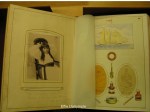
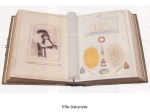
When the Art Gallery of New South Wales asked me to write an essay on nineteenth century photograph albums for the catalogue to the exhibition The Photograph and Australia they emailed me some jpegs of the albums they would be exhibiting. One jpeg was from an album in the State Library of Queensland that had been compiled by the Lethbridge family of pastoralists. It showed a charming fresh faced girl and I could see immediately why the curator, Judy Annear, had been attracted to it. The photograph’s informality, and the girl’s easy manner was quite anachronous in the context of the other photographs of the period, which I guess was around the early 1870s. A member of the Lethbridge family member had evidently come along later and written in pencil on the album page: ‘Effie Dalrymple, sister of Florence Lethbridge (nee McLean)’. Of course I did what every highly skilled and highly trained photographic researcher with thirty years experience in the field does with such precious metadata, I typed it into Google and hit return. In 0.49 seconds the results came back, I clicked on ‘images’, and in another fraction of a second I was looking at Effie again, this time in 1900. In less than a second she had aged thirty years and all of the fresh bloom of youth had drained from her face which was now pinched and tightly pulled back by her hair. The second photograph Google found for me also came from the State Library of Queensland, but it came via a circuitous root, my first hit was to a computer-student’s blog. He had used the SLQ’s on line image database for a class exercise in data management. It is only through his blog that I got to the SLQ digital record. A few more searches took me to some genealogical sites, and the site of the Mackay Historical Society, and within minutes and I knew what had happened to the lovely girl in the photograph: in 1880 she had married the Mayor of Mackay who went on to become a widely disliked right wing politician in Queensland, and had had four children by him.
My little story exemplifies two things photography does best. First it deals with aging and mortality. Photography can show us with a shock how bodies and faces age and die. By freezing time it makes the passing of time more tragic, especially when you spend that time married to a right wing Queensland politician. The second thing my story shows is that photography is a networked medium. Photographs by themselves don’t mean as much as photographs in relation to other photographs. And photographs are slippery things, they do not want to stay in one format, as objects secured in albums for instance, they want to be copied and duplicated. With the digital revolution photographs are now everywhere, they are digitized into ‘digital assets’ and available in Digital Asset Management Systems, along with other digital assets such as sound files or text files, which are accessible through various Content Management Systems. Individual end users like you and me and the student blogger though which I found Effie again are connecting and threading those databases together as we blog and tweet photographs.
At the preview to The Photograph and Australia the director of the AGNSW Dr Michael Brand proudly announced that the Art Gallery of New South Wales photography collection now numbered 5000 objects. My first thought was: ‘what, only 5000? Is that anywhere near enough? I’ve got more than that on my iPhone in my pocket, and some of them aren’t too bad either.’ Of course what was implied in Dr Brand’s boast was that these were carefully selected photographs, it was a curated collection, assembled by a succession of experts who had developed collection plans, strategic directions, and curatorial policies, which interlinked with the plans, directions and policies of the Art Gallery as a whole. These strategies are even outlined in the 2007 book Guide to the Photography Collection.
ART GALLERY COLLECTION
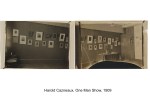
There are several things to say about the AGNSW’s collection, as well as the photography collections in other art galleries. This is a collection of photographs as art, and that therefore means it is a collection of photographs as art objects. Since the beginnings of art photography the photo object, as opposed to the photo-image, has been primary. We only need to go back the Alfred Stieglitz’s 291 Gallery in 1906 to see the paradigmatic display of photo-objects, each isolated in its elegant amplitude of olive and grey, burlap and hessian. It was clearly to this heightened aesthetic attention to the photograph as object that Harold Cazneaux aspired three years later in his 1909 one man show, although his hang still has the feeling of a cluttered Edwardian parlour, rather than an elegant New York Gallery. Nonetheless the foundation curator of the AGNSW collection, Gael newton chose Harold Cazneux and his Pictorialist friends in the Sydney Camera Circle to be the firm foundation stones of the collection because, in her words Pictorialism was ‘a conscious art movement, aimed at using the camera more creatively.’
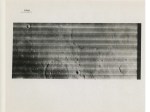
The main artefact of this approach to curating is the print. And amongst prints the most highly valued are vintage prints, those made by the photographer close to the date the image was taken. The idea of the vintage print, which still rules the market, contains all of the fetishizations of art objects: a single point of origin in time, a singular artistic vision, and the artist’s crafting hand. Even when there is no artist, the power of the vintage print still remains. For instance on online photo dealer recently offered for sale a set of press prints which had been released to the press by NASA in 1966. The images were made robotically by the Lunar Orbiter 1 as it circled the moon, and radioed data back to earth to be read out in strips onto 35 mm film like a fax achine. The site offers them as ‘vintage silver prints’ in very good condition, not mounted. Their slight yellowing adds to their aura as precious relics from the space age, and these press prints would be worth less, I think if they were still crisp and white.
Around this idea of the vintage print other scopic machineries are built. One is the passé partout (pas par too) mat board, which the Pictorialists loved, which isolates the single image from visual contamination. Another piece of museal engineering is the solandar box where the few lucky prints selected to be collected will be preserved until the end of time. When I was a young curator I was frequently reminded that the initial cost of buying a print was minimal, it was the ongoing cost as that print had to be accessioned, catalogued, tracked, conserved and stored in controlled conditions for ever and ever which was the real cost.
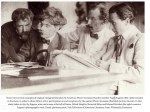
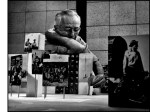
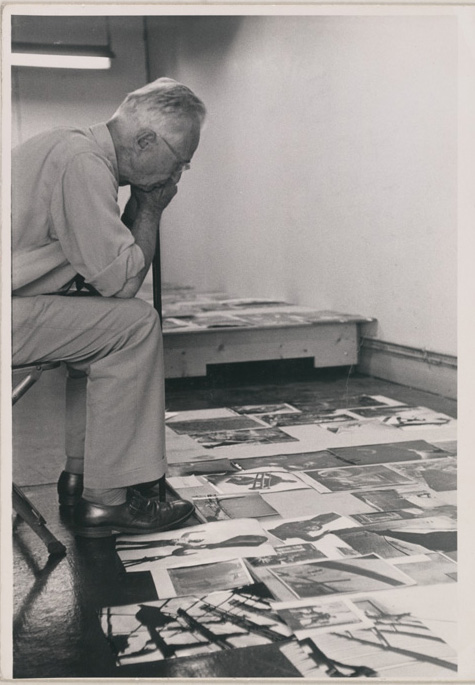
If the matt board and the solandar box are the museal engineering for art photography, the curators are the engineers. Here we see Ralph Eugene, Alfred Stieglitz, Heinrich Kuhn and Edward Steichen gazing intently at a print, I like to imagine that Kuhn is looking so surprised because the print is beginning to smoke under the intensity of their gazes, like we used to burn paper with our magnifying glasses when we were children. After his Pictorialist phase Steichen became a visual engineer of propaganda shows, and he was photographed in action with the Family of Man, building visual architectures out of prints.
This concern with the photograph as object is of course a natural fit for an art gallery. When most art gallery collections were being founded in the 1970s it fitted in with the collection logic all of their other objects — prints, paintings, sculptures, decorative art and so on which had previously been collected in the season before. Only since the 1990s, with the growth in video art, computer art and multimedia art has another potentially ‘virtual’ or non-object based collecting category entered the art gallery. But the idea of a curated collection of photographs is still a natural fit to an art gallery. The collection to which Dr Brand referred, then, is very different to an archive. While an archive is potentially infinitely expandable and is only restricted by contingencies such as storage space, the collection is deliberately shaped. Representative selections are handpicked from representative photographers, so that the collection itself in its very structure forms a picture of photography, or as the curators would hasten to add I’m sure, one picture amongst many other possible pictures.
Curators are continually rewriting their policies in order to re-draw the picture they want to make of the photograph and Australia. For instance Gael Newton began the AGNSW collection in the 1970s with an emphasis on Pictorialism, while before she retired from the National Gallery of Australia last year she shifted the collecting emphasis of that collection to the Asia and the Pacific, in order to re-draw the picture it was making of photography relevant to Australians in the twenty-first century. While there can never be too many images in an archive, here can be too much in a curated collection which needs to be restricted in number so it can be shaped. Notions of quality come into play.
LIBRARY ARCHIVE
In a curated collection an image of ‘poor quality’, from a set of say twenty prints brought from a photographer, will reduce the effectiveness of the entire set; however in an archive where there might be hundreds or thousands of photographs, so one more or less good or bad image doesn’t matter. For instance while the National Library of Australia has catalogued 10,987 Wolfgang Sievers photographs and put them on line. The AGNSW has just 22. The 22 the AGNSW owns are a fine selection, covering his career from his early days in Germany to his later big scale corporate work, as well as some early colour. The selection of 22 tells us what has been accepted by scholars as Sievers’ main story as a creative artist, the relationship between the noble worker and his industrial tools. The NLA on the other hand acquired the lot when Sievers died a few years ago, and has almost completed the mammoth task of putting them online, with only a couple of thousand to go. It would take a lot of work to get the shape of Sievers as a creative photographer from the NLA’s vast archive, but it is a resource within which we can find evidence Australian industry, architecture and advertising.
THE AUSTRALIA HISTORY OF THE DISTINCTION BETWEEN COLLECTION AND ARCHIVE
So that might seem to be one distinction between gallery and library, collection and archive — one tells us about the creative individual, the other is a resource through which their photographs can tell us about our society and history. This distinction has been characterized by other scholars as that between ‘canon’ and ‘archive’. Another distinction might be between curation and retrieval: in a gallery collection photographs have already been selected to tell a story, and other experts will, from time to time, sequence them into exhibitions; in the archive meanings await retrieval through user searches.
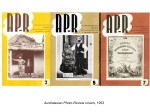
But this distinction between canonical collection and archive and is not clear-cut, and in fact they have been institutionally entangled for the last 100 years. For instance, at the end of the First World War, perhaps in the throes of the same nationalistic fervour we are feeling one hundred years later, the amateur photographic magazine the Australasian Photo Review called for a ‘national collection of Australian photographic records’. The Mitchell Library was one of several institutions who responded positively to this idea, even suggesting a list of twelve different categories of photographs which amateurs could take for a future repository. The photographs included:
- The topography of districts, such as panoramic views, extended landscapes etc., showing general features of districts
- Street views and principal thoroughfares, artistic by-ways, etc., not only cities and town, but even of small country centres.
- Celebrations, pageants, festivities, great functions, etc, no matter whether they are political, civic, social or religious
- Celebrities and even oddities (including public men, politicians, authors, artists, actors, leaders of industry, agitators and reformers, town characters, etc.)
- Trade and industry, commerce and transport, depicting the various operations connected therewith
- Public buildings, statues, monuments, churches — old and new, architectural curiosities and follies, etc.
- Public parks and gardens and memorial avenues.
- Prize stock, famous horses, cattle, sheep, dogs, etc.
- Sport and pastimes, such as racehorses and their jockeys, racing yachts and their crews, famous cricketers and footballers, sculliers, etc.
- Nature studies, such as growing trees and flowering plants in situ, birds nests in natural position, animals at play, etc.
- Aboriginals, showing their physical features, corroborees, habits and customs, sports and pastimes
- Any other phase of life, scientific photographs, collections of views illustrative of tours in Australasia and the Pacific
It is interesting that The Photograph and Australia conforms almost perfectly to this hundred year old template.
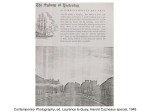
Thirty years later, at the end of the Second World War, the idea of a national collection was raised again. Laurence le Guay, the editor of the new magazine Contemporary Photography, devoted an entire issue to new sharp bromide enlargements Harold Cazneaux made from his Pictorialist negatives of Old Sydney, and declared that they ‘would be a valuable acquisition for the Mitchell Library or Australian Historical Societies.’ However, once more the library failed to follow through, and Cazneaux’s photographs remained uncollected.
Nevertheless, the interest in photography as an Australian tradition and the persuasiveness of the idea of significant public collections of historic photographs continued to build. By the 1960s both libraries and state art galleries were beginning to make serious policy commitments to collecting photographs. The aims were to both collect photographs as documents of Australian life, and to record the importance of photography as a visual medium. For instance, the National Librarian of Australia, Harold White, began to work with Keast Burke who in 1956 had proposed a two tier national collection: one part to be purely about the information which photographs contained, and assembled by microfilming records and copying images in the library’s own darkrooms; the other part to be about the medium itself, made up of ‘artistic salon photographs’ and historic cameras.
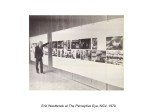
The National Gallery of Victoria became the first state gallery to collect photography. The first work to enter the collection – David Moore’s documentary photograph Surry Hills Street (1948) – was acquired through a grant from Kodak. In the same year the NGV imported The Photographer’s Eye, a touring exhibition from New York’s Museum of Modern Art, which had been the first art museum to establish a Department of Photography in 1940. The exhibition was curated by MoMA’s John Szarkowski, undoubtedly the most influential photography curator of the second half of the twentieth century, and a curator in the lineage of Stieglitz and Steichen. The Photographer’s Eye was a statement of his formalist position on photographic aesthetics. Its title was adapted for a local version, The Perceptive Eye (1969–1970).
By 1973 the yet-to-be-opened National Gallery of Australia had purchased its first photograph, an artistic confection by Mark Strizic (Jolimont Railway Yards, 1970) that looked more like a print than a photograph. Two years later the AGNSW was laying the foundation for its collection with the acquisition, exhibition and book on the early twentieth century photographs of Harold Cazneaux, collected by them as fine-art Pictorialist prints, rather than as the sharp bromide enlargements that had been published by Contemporary Photography in 1948. However at the same time the National Library of Australia was also collecting Cazneux prints in accordance with its policies to collect exemplars of the medium, and documents of history. In the end the AGNSW ended up with 203 carefully selected Cazneaux’s, while the NLA ended up with 1414.
It was only after this period, in the late 1970s, that the dual nature of the photograph as both a carrier of historical and social information, and an aesthetic art object and exemplar of an individual’s creativity, which had co-existed over the previous decades, was finally separated between libraries and galleries. Both galleries and libraries found themselves embedded in the newly constructed infrastructure of the Whitlam era: the newly established Australia Council, rapidly expanding tertiary courses in photography, new magazines and commercial galleries, and the establishment of the Australian Centre for Photography in Sydney in 1974.
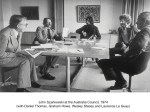
In this historical context the photographer as creative artist, and the photograph as art object gained brief cultural ascendancy. The longed-for acknowledgement from overseas materialised in the form of John Szarkowski himself, who was invited on a ‘papal’ tour by the ACP in 1974. Szarkowski gave six public lectures titled “Towards a Photographic Tradition’ .The purpose of the national tour, as Howe put it at the time, “was to liberate photography from the world of technique and commerce and to suggest that it could also be of absorbing artistic and intellectual interest.”
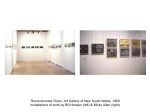
Photography was considered to be a medium with its own intrinsic characteristics”. At the AGNSW Gael Newton deployed a clear art historical teleology, she built on the Pictorialist foundation with a monograph on Max Dupain in 1980, seen as the modernist successor to the Pictorialists. However, galleries also engaged with the contemporary art photography of the graduates from the new art schools, as well as emerging postmodern ideas. For instance the title of the Art Gallery of New South Wales’ 1981 exhibition Reconstructed Vision defined this new style of work against, but within the overall trajectory of, the newly established historical traditions.
While the gallery use art historical strategies to embed photography within their structures was certainly in the cultural ascendancy at this time, nonetheless libraries were also confirming their commitment to photography, but as a non aesthetic-object based, content-driven, curatorial strategy. The contemporary cultural relevance of the subjectivist photo boom of the seventies, combined with Modernist and Postmodernist teleologies, drove the aesthetic strategies of galleries, but the nationalistic socially cohesive agendas of events like the 1988 Bicentenary drove the content-based strategies of library photo collecting. At the same time as curators in galleries were building such art historical teleologies, library curators like Alan Davies at the State Library of New South Wales were taking a more encyclopedic approach producing comprehensive surveys such as 1986’s The Mechanical Eye in Australia. At the same time as gallery curators were seeing ‘creative’ photography finally getting the recognition it deserved from a reluctant art establishment still fixated on painters like Brett Whitley, vision of vast searchable databases began to open up for librarians. In a forerunner to today’s participatory online photographic projects, in 1983 Euan McGillivray and Matthew Nickson proposed a snapshot collecting project, Australia as Australians Saw It, which would copy photographs in the possession of individuals, then index them and make them accessible through the latest technology, which at that time was microfiche. Their idea never got off the ground. But, two years after the publication of The Mechanical Eye in Australia, during the bicentenary, Alan Davies, curator at the State Library of New South Wales, travelled to twenty-three country towns and copied about seven thousand vernacular photographs from 576 individuals. Under the title At Work and Play, they were made accessible by a videodisc keyword search (a forerunner to today’s digital database and tagging methodology).
CRIMP
The contest between the logic of the gallery and the library in the 1970s and 1980s was a global phenomenon, and part of poststructuralist, Marxist theoretical discourse. This situation was dramatized in the US by the critic Douglas Crimp in 1979 who saw the institutional aesthetization of photography as a contraction of its power as a medium. In The Museum’s Old, the Library’s New Subject he wrote:
Photography will hereafter be found in departments of photography or divisions of art and photography. Thus ghettoized, it will no longer primarily be useful within other discursive practices; it will no longer serve the purposes of information, documentation, evidence, illustration, reportage. The formerly plural field of photography will henceforth be reduced to the single, all-encompassing aesthetic. Just as, when paintings and sculptures were wrested from the churches and palaces of Europe and consigned to museums in the late eighteenth and early nineteenth centuries, they acquired a newfound autonomy, relieved of their earlier functions, so now photography acquires its autonomy as it too enters the museum. But we must recognize that in order for this new aesthetic understanding to occur, other ways of understanding photography must be dismantled and destroyed. Books about Egypt will literally be torn apart so that photographs by Francis Frith may be framed and placed on the walls of museums. Once there, photographs will never look the same. Whereas we may formerly have looked at Cartier-Bresson’s photographs for the information they conveyed about the revolution in China or the Civil War in Spain, we will now look at them for what they tell us about the artist’s style of expression.
THE CURRENT DISTINCTION BETWEEN COLLECTION AND ARCHIVE
Fast forward to the present in Australia. Over the intervening 40 years, since the establishment of various departments and the ACP, the boundaries of photography have expanded. However, galleries have largely kept to the historical trajectories inaugurated in the 1970s. In the 1980s, photographic reproductive processes became central to postmodern art, which had the flow-on effect of boosting photography’s place in the art museum. But postmodernism did not fundamentally alter the increasing focus of departments of photography on artefacts of ‘art photography’.
Into the 1990s and 2000s, and until perhaps the AGNSW’s The Photograph and Australia show, departments of photography essentially continued a monographic and consolidation phase, aided by the international prominence of large-scale colour photography as art, such as the Düsseldorf School. Simultaneously, we have witnessed the digital revolution, which has produced a whole new generation of photographers using online photosharing services like Flickr and Instagram, whose effects until now have been felt much more widely felt outside the gallery. In response to the digital revolution libraries and social history museums have invested institutional effort into digitizing their image collections and making them available online. They have brought software from international companies that give them sophisticated Digital Asset Management Systems for organizing images and other data in the same digital space, and they have brought Content Management Systems for delivering that information to users in different ways. In the digital space of social history museums and libraries the logic of ‘asset management’ and ‘content delivery’ is merging. For instance the popular Emu Digital Asset Management System advertises a ‘narrative’ module which automatically connects together diverse digitized objects within the catalogue itself, but across normal taxonomic categories, for instantaneous publishing on line, or to be available for public searches. This is in contrast to traditional gallery spaces where storerooms, catalogues, and exhibition spaces are maintained as separate entities. Likewise the Android labels on objects in museums are multimedia rich, and can be updated instantaneously from a curator’s desktop through the institution’s Content Management System. This is in contrast to the art gallery’s commitment to the status as an object to be experienced in the flesh, hung in static exhibition installations.
The Melbourne scholar Scott McQuire has compared the ‘vault’ approach to what he calls an ‘operational archive’, in the vault approach the collection is kept in a specific space, from which its objects are occasional produced; the ‘operational archive’ on the other hand is continually active as data is transferred in and out. In this distinction there is a shift from cataloguing, where a discrete process of description and accessioning adds static information such as title, date, subject, to active ‘tagging’ where users continue to add tags to the image. This shift might also be between a curated exhibition, where a set of pictures is chosen and sequenced, to an active search, where an archive is sampled using a keyword. A further distinction might be between a spatialized ‘display’ of photographs, and a temporalized ‘stream’ of photographs in, say, an Instagram feed.
FUTURES
If the primary aim of photography curating in the 1970s was to establish photography as art, this has clearly been achieved. Photography is ubiquitous within contemporary art, but ironically now not as an autonomous tradition – rather as a mode integrated within wider practices. But if the now forty-year old institutional structures are still largely with us, if museums continue to have departments, curators and galleries of photography, this is still largely for the autonomous and separate history of photography, for the knowledge of specific collections and conservation techniques, rather than for its networked ubiquity with our art and culture. So even if photography is now safely and deeply embedded in the art museum, its precise role is still up for grabs.
Clearly, museum departments can no longer work in isolation. However, what the mere integration of photography into the newly contemporary art museum all too easily elides is that photography’s place there has always been unstable, its ambiguous status as object and information continually threatening the grounds of the art museum’s hierarchies and collection policies.
We have seen this in Australia in relation to the location of photography between the library and the art museum, in terms of a split between information and aesthetics, a documentary database versus an aesthetic object. Photography’s recent insertion into digital networks reveals these tensions yet again, but with even more complexity. Within the modernist logic which originally auspiced photography in the art gallery, the networked digital image, circulating as reproducible information, is guaranteed to be excluded. If gallery photography departments continue to adhere to the logic which gave birth to them the potential for different kinds of photography in the art gallery could go largely unnoticed. But there may be the potential for art galleries to judiciously incorporate some aspects of the archival image mode, retain their integrity, and enhance their relevance to contemporary culture.
In identifying the future potential of photography in the art gallery, perhaps we can learn from artists. For instance The Photograph and Australia has deliberately placed Patrick Pound’s computer programming work, which is about the continual digital slippage of photographs, next to a bank of cartes de visite and postcards. Furthermore, if curators are engaged in creating innovative contexts for public engagement, networked photography opens up new possibilities for this to happen. I am not arguing that the art gallery ought to emulate the hyper-linked experience of the internet, or the swipe-based logic of mobile media. However, I am proposing that authoritarian presentations of a connoisseurial canon need to become part of a larger project: exploring photography’s protean nature as a medium and its potential to complicate spectatorship and activate audiences in new ways.
HISTORY IN PICS
It is clear that the cat is already out of the bag, and that previously separate spaces and categories have already collapsed for art galleries as they have for libraries and museum. For instance something that drive curators in both galleries and libraries absolutely crazy is twitter feeds such as @historyinpics, which is run by two teenagers, a 17 year old from Victoria and a 19 year old from Hawaii. The experts say that this Twitter stream is a genuine phenomenon. Last year it had twice as many followers as the Library of Congress, and reportedly earned the teenagers $50,000 a month, last week it had 2.38 million followers, of which, apparently, only 5% are bots. Every day a new photo which has been scraped from an online archive is tweeted, and though there is preponderance of Hollywood movie stars the feed is addictive, and it is now how many people understand historic photographs. But these photographs are entirely cast adrift, without authors or attribution or location. The site infringes copyright, frequently posts fake photographs, and rarely credits the photographer. It may be history candy, but it give its followers no sense of history.
GOOGLE INSTITUTE
The Google institute is a way that institutions can wrest back this powerful internet space from the ignorant teenagers who currently rule it. It allow them to put parts of their collections online, and it allows users to ‘curate’ their own sequences. For instance the AGNSW’s ‘Posts from the Past’ is an online slide show of 22 cartes de visite from the exhibition The Photograph and Australia with some captioning, and some ability for the user to re-arrange and compare the photographs. However this is essentially still a very short slide show, a short extract from a larger installation, and it still has the sense of a finite experience served up to the user
HISTORY PIN
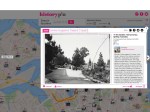
Similarly HistoryPin is used by institutions to pin images from their collections onto Google maps.
COLLECTION FISHING
The hashtag #collectionfishing is also used by archivists to try to get their collections out to the public.
AUSTRALIAN WAR MEMORIAL
Some more interesting examples of how curators in social history museums are using the opportunities afforded by Digital Asset Management Systems and Content Management Systems can be found in the new World War One Galleries of the Australian War Memorial. The gallleries cost over thirty million dollars to prepare, but from my point of view the results are problematic. The spaces are congested with technology, and the visitor’s head is filled with audio soundtracks featuring ‘war’ sound effects and children singing plaintive songs. Any personal affective response which the viewer may have to the auratic power of the artefactual material is pre-empted and crowded out by the emotional manipulation of the galleries themselves which think and feel for us — and think and feel a very restrictive, jingoistic version of the ANZAC myth as formative to our national identity. Nonetheless there are some interesting aspects to the installation which indicate future directions for development. One aspect is to do with quantity, the other is to do with scale.
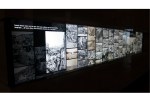
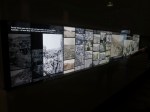
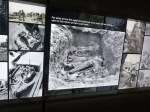
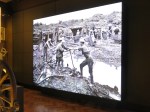
A large quantity of photographs are included in The Life at Anzac display which was developed to showcase the Memorial’s collection of amateur photographs taken by the soldiers at Gallipoli, and to introduce visitors to the realities of soldier life at Gallipoli – beyond the narrative of the landing and battles at Lone Pine and the Nek which are frequently reproduced in the media. The Memorial’s curators wanted to minimise the curatorial voice and draw directly from the records of soldiers to interpret their experience at Gallipoli. The 372 photographs selected for use in the display were uploaded to the Collection Management System. Twenty-two tags were developed based on what the photographs and diaries illustrate – what the soldiers have chosen to capture and tell us about their experiences. For example: living amongst the dead, lost friends, dugouts, behind the lines, weather — storm, heat, snow — faces, general views, medical, religion. From this set of twenty-two, one to three tags were assigned to each photograph, so that multiple subjects could be explored in each photograph. The Memorial curators told me that they didn’t have to force any of the tags onto the images, most images ‘spoke’ to them pretty clearly, they said. Each column in the display relates to a tag, some tags cover multiple columns because of the quantity of images. 153 quotes from soldier diaries were also entered on to the CMS and assigned tags. These appear at random when a visitor pulls up a photograph. The Memorial has the ability to change the display remotely through the CMS, adding new content (images, tags & quotes), theming the selection to a particular event or visit, or changing the selection entirely. The photographs selected represent a very small proportion of what the Memorial holds and it hopes to include more as resources/allow. The users interaction is subtle which was important given the limitations of the physical space. The ‘falling rain’ or cascade appearance was chosen to give the impression of an infinite collection and introduce some movement and graphic energy.
The other aspect is scale, this is seen in a slide show produced from a high-resolution scans of the glass plate negatives made by Frank Hurley and Hubert Wilkins, these are projected from a bank of 49 separate data projectors, so the projection is not pixelated and is at the level of the film grain. However unfortunately the visual power of this technology is compromised by its positioning.
While not suggesting that art galleries do anything like these kind of social history displays, which are very ideologically directed in their affective power, perhaps there may be some clues for art museum to develop new ways to approach contemporary photographic practice.
Interestingly, although the Australian War Memorial World War One galleries rely so much on digital images, they still need to evoke the artefactual, auratic quality of snapshots, however these need to be simulated in inkjet prints.
LEE GRANT
The digital revolution is affecting the practice of art photographers. Many artists do not work in a single visual space any more, producing prints for books or exhibition, say. They work across platforms. For instance the photographer Lee Grant carefully edited 65 photographs into the book Belco Pride, about the Canberra suburb of Belconnen. But she has 200 photographs of Belconnen that she considers to be part of the set. Many other photographers work in this way, so there could be a curated selection of say 65 photographs, or there could be various iterations of the archive produced by users.
Many other photographers produce a continual stream of Instagram posts, which are as integral to their practice as their officially published work.
Other artists return to particular topics or subjects over an extended period of time revisiting them and changing them.
CONCLUSION
This implies that there could be the potential for curators to not only purchase a selection of prints from a photographer, but to ‘contract’ with a photographer to maintain an interface to their ‘operational archive’ to use Scott McQuire’s term, as it grows and mutates. There could be the potential to not replace the power and the beauty of the unique object, but to augment it with other ways of creatively experiencing the photograph as a networked image, as well as a crafted print.
-

- Powerpoint to: ‘Should Art Galleries think of themselves as collections or archives.’





































Martyn Jolly









 Martyn Jolly