Won’t You Buy My Pretty Flowers?

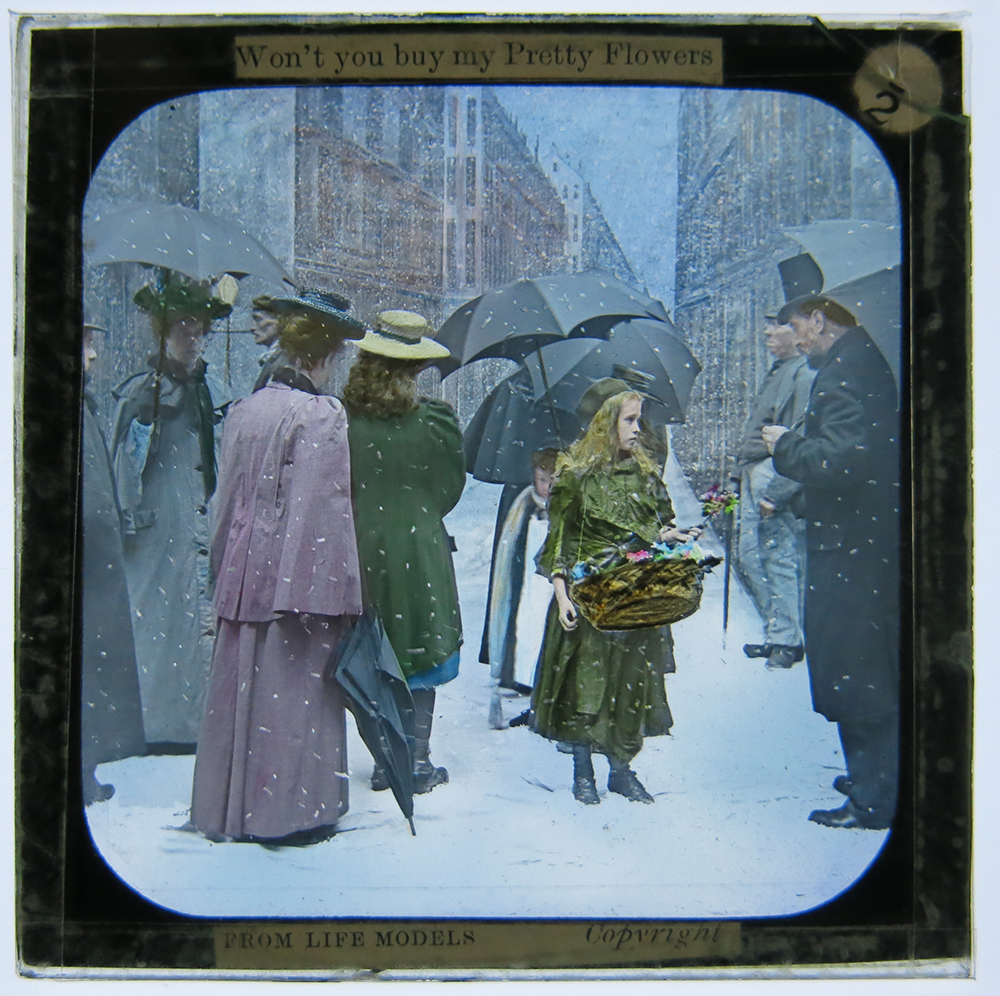
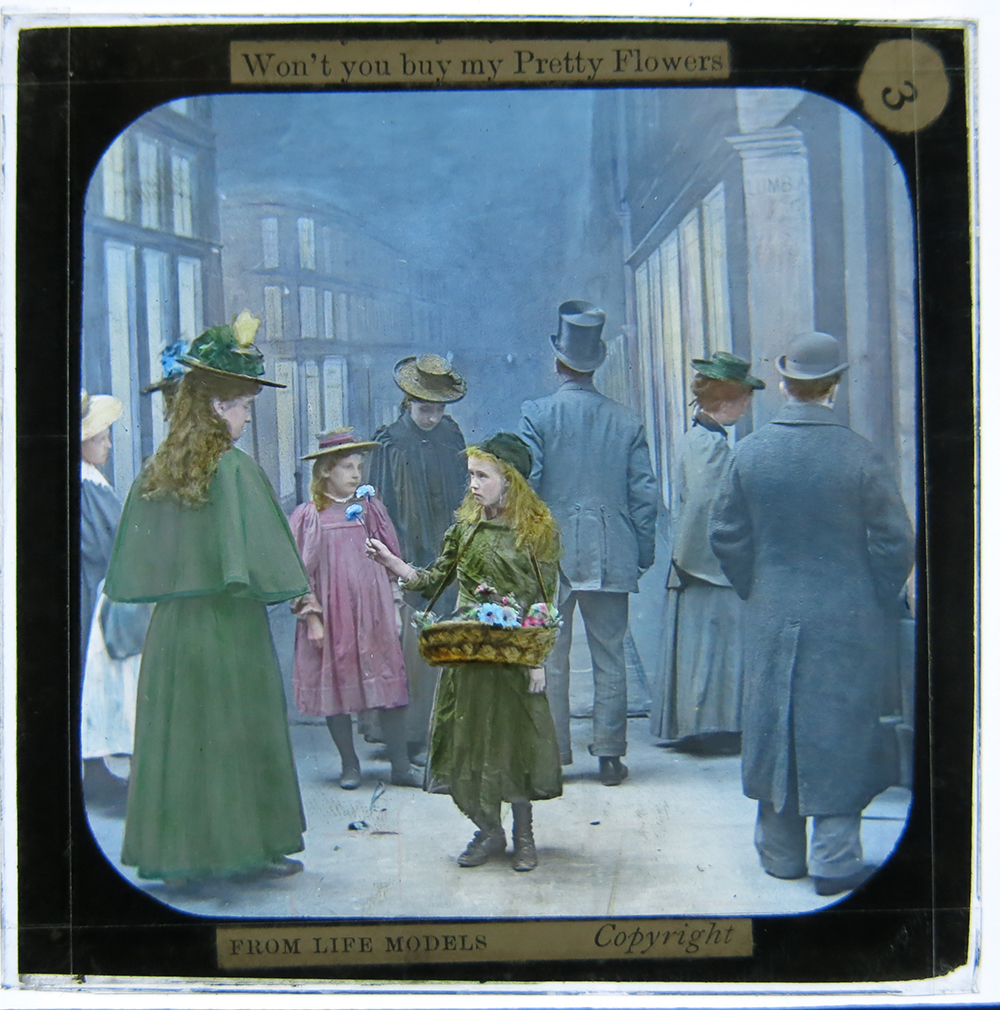
Here is a new set of life model magic lantern slides I have just acquired. I love the twin perspectival vanishing points of the first painted backdrop, the photogrammed snow flurries in slide two, and the weirdly frozen Beckettian choreography of the passers-by in the final slide. They were made by Bamforth and Co after 1897 in the UK. The song originates from the US in 1877 and is by George W Persley, Arthur W French, George Clare. (Although interestingly it was re-published in 1887 under the names of the American stage actress Miss Jennie Calef and producer H. P. Danks, after they had used it in their play “Little Muffets” — a clear case of IP theft and copyright infringement.) Later Bamforth and Co. recycled the original shots as postcards with the choruses as printed captions. I’m looking forward to one day projecting these slides, perhaps life size and outside in an urban setting, accompanied by a singer, as part of our project Heritage in the Limelight: The Magic Lantern in Australia and the World.WYBMPF small 1

Underneath the gas light’s glitter,

Stands a fragile little girl;

Heedless of the night winds bitter,

As they round about her whirl.

While the thousands pass unheeding

In the evening’s waning hours;

Still she cries with tearful pleading,

Won’t you buy my pretty flowers?

Refrain.

There are many sad and weary

In this pleasant world of ours,

Crying in the night winds bitter.

Won’t you buy my pretty flowers?

WYBMPF small 2

Ever coming, ever going,

Men and women hurry by.

Heedless of the tear drops gleaming.

In her sad and wistful eyes.

While she stands there sadly sighing,

In the cold and dreary hours,

Listen to her sweet voice crying,

Won’t you buy my pretty flowers?

Refrain.

There are many sad and weary

In this pleasant world of ours,

Crying in the night winds bitter.

Won’t you buy my pretty flowers?

WYBMPF small 3

Not a loving word to cheer her.

From the passers by is heard;

Not a friend to linger near her,

With a heart by pity stirred.

On they rush the selfish thousands,

Seeking pleasure’s pleasant bowers;

None to hear with sad compassion,

Won’t you buy my pretty flowers?

Refrain.

There are many sad and weary

In this pleasant world of ours,

Crying in the night winds bitter.

Won’t you buy my pretty flowers?

Networking the Tradition: Curating Photography in Australia

Photofile

Vol. 95, Spring/Summer, pp48-55.

(with Daniel Palmer)

Australia’s big galleries and libraries have been seriously buying and curating photographs for over forty years now, during a period when the medium itself has undergone profound transformations. It’s time now to take an overview of the interaction between the institutional imperatives of our state and national collecting institutions and the changes in photography as a medium.

Although the institutional curating of photography did not begin in earnest until the 1970s, in the five or so decades before then the powerful idea of collecting photographs was intermittently discussed, at various levels of institutional authority, and with various degrees of vigour. For instance, at the end of the First World War, the amateur photographic magazine the Australasian Photo Review called for a ‘national collection of Australian photographic records’. The Mitchell Library was one of several institutions who responded positively to this idea, even suggesting a list of twelve different categories of photographs which amateurs could take for a future repository. However the librarians did not follow through on their initial positive noises and collections failed to materialise.

Thirty years later, at the end of the Second World War, the idea of a national collection was raised again. Laurence le Guay, the editor of the new magazine Contemporary Photography, devoted an entire issue to new sharp bromide enlargements Harold Cazneaux made from his Pictorialist negatives of Old Sydney, and declared that they ‘would be a valuable acquisition for the Mitchell Library or Australian Historical Societies.’ However, once more the library failed to follow through, and Cazneaux’s photographs remained uncollected.

Nevertheless, the interest in photography as an Australian tradition and the persuasiveness of the idea of significant public collections of historic photographs continued to build. By the 1960s both libraries and state galleries were beginning to make serious policy commitments to collecting photographs. The aims were to both collect photographs as documents of Australian life, and to record the importance of photography as a visual medium. For instance, the National Librarian of Australia, Harold White, began to work with Keast Burke who in 1956 had proposed a two tier national collection: one part to be purely about the information which photographs contained, and assembled by microfilming records and copying images in the library’s own darkrooms; the other part to be about the medium itself, made up of ‘artistic salon photographs’ and historic cameras.

The National Gallery of Victoria, under Director Eric Westbrook, became the first state gallery to collect photography. Despite forthright opposition from some members (one of whom referred to photography as “cheat’s way of doing a painting”), the Trustees approve the establishment of Department of Photography in 1967.[ii] The first work to enter the collection – David Moore’s documentary photograph Surry Hills Street (1948) – was acquired through a grant from Kodak. In the same year the NGV imported The Photographer’s Eye, a touring exhibition from New York’s Museum of Modern Art, which had been the first art museum to establish a Department of Photography in 1940.[iii] The exhibition was curated by MoMA’s John Szarkowski, undoubtedly the most influential photography curator of the second half of the twentieth century, as a statement of his formalist position on photographic aesthetics. Its title was adapted for a local version, The Perceptive Eye (1969–1970).

By 1973 the yet-to-be-opened National Gallery of Australia had purchased its first photograph, an artistic confection by Mark Strizic (Jolimont Railway Yards, 1970) that looked more like a print than a photograph. Two years later the AGNSW was laying the foundation for its collection with the acquisition, exhibition and book on the early twentieth century photographs of Harold Cazneaux, collected by them as fine-art Pictorialist prints, rather than as the sharp bromide enlargements that had been published by Contemporary Photography in 1948.

In this period the dual nature of the photograph as both a carrier of historical and social information, and an aesthetic art object and exemplar of a tradition, which had co-existed within the formulations of the previous decades, was finally separated between libraries and galleries. Library collecting focused on the photograph as a document of Australian life. For example in 1971 the National Library of Australia clarified its collection policy: it would only collect photographs as examples of photographic art and technique from the period up to 1960, leaving post-1960s ‘art for art’s sake’ photography to the new state and federal gallery photography departments.[iv]

The stage was set for the much-vaunted ‘Photo Boom’ of the 1970s, when, as Helen Ennis has pointed out, the baby boomer generation turned to photography for its contemporaneity in the context of a counter-cultural energy.[v] Galleries and libraries found themselves embedded in the newly constructed infrastructure of the Whitlam era: the newly established Australia Council, rapidly expanding tertiary courses in photography, new magazines and commercial galleries, and the establishment of the Australian Centre for Photography in Sydney in 1974.

In this context the need to define photography as both a tradition and a new language became more urgent. Such initiatives were largely driven by photographers themselves, whose leading figures made themselves aware of what was happening internationally. Thus Athol Shmith, a key member of the NGV Advisory Committee set up in the late 1960s, corresponded and travelled regularly to Europe. David Moore, one of the key figures in the establishment of the ACP, was familiar with plans for the International Centre for Photography in New York. The first director of the ACP, Graham Howe, was brought back from a stint at the London Photographers’ Gallery. Developments were typically framed around a broadly didactic mission: that photography is central to visual culture but ‘the public needs educating’ in the art of photographic seeing. In addition, the longed-for acknowledgement from overseas materialised in the form of John Szarkowski himself, who was invited on a ‘papal’ tour by the ACP in 1974. Szarkowski gave six public lectures titled “Towards a Photographic Tradition’ (recently recounted in Photofile Vol 93). The purpose of the national tour, as Howe put it at the time, “was to liberate photography from the world of technique and commerce and to suggest that it could also be of absorbing artistic and intellectual interest.”[vi]

Although Szarkowski’s approach was put under sustained stress during the period of postmodernism – especially by feminist critics – his ‘formalist’ approach to the medium continued to dominate the way that photography was understood in the art museum for the ensuing decades. Even as the discourse emerged of an Australian tradition with, for instance, the NGV’s investment in Australian documentary photographers in the late sixties, this became embedded in a model of Euro-American modernism. As Ennis put it, “The argument for ‘photography as art’ was based on the critical position of Modernism. Photography was considered to be a medium with its own intrinsic characteristics”.[vii] At the AGNSW Gael Newton deployed a clear art historical teleology, with the acquisition of Pictorialist photography by Harold Cazneaux and other members of the Sydney Camera Circle forming the foundation for the collection. Pictorialism was important to Newton because it was a: ‘conscious movement, aimed at using the camera more creatively’[viii] Her exhibitions of Harold Cazneaux and Australian Pictorial Photography in 1975 closely followed by a monograph on Max Dupain in 1980, seen as the modernist successor to the Pictorialists. However, the galleries also engaged with the contemporary art photography of the graduates from the new art schools, as well as emerging postmodern ideas. For instance the title of the Art Gallery of New South Wales’ 1981 exhibition Reconstructed Vision defined this new style of work against, but within the overall trajectory of, the newly established historical traditions.

In Melbourne a slightly different but equivalent art historical strategy was taking place within the institution of the NGV. This included the mass importation of canonical images from overseas. For instance, shortly after her appointment, the NGV’s inaugural curator (and first ever curator of photography in Australia), Jennie Boddington, ordered Farm Security Administration re-prints from the Library of Congress’s reproduction service. However at the same time the NGV also held solo exhibitions by the young, art school-trained artists Carol Jerrems in 1973 and Bill Henson in 1975.[ix]

While galleries were using art historical strategies to embed photography within their structures, libraries were also confirming their commitment to photography, but as a non aesthetic-object based, content-driven, curatorial strategy. The contemporary cultural relevance of the subjectivist photo boom of the seventies, combined with Modernist and Postmodernist teleologies, drove the aesthetic strategies of galleries, but the nationalistic socially cohesive agendas of events like the 1988 Bicentenary drove the content-based strategies of library photo collecting. In a forerunner to today’s participatory online photographic projects, in 1983 Euan McGillivray and Matthew Nickson proposed a snapshot collecting project, Australia as Australians Saw It, which would copy photographs in the possession of individuals, then index them and make them accessible through the latest technology. During the Bicentenary year Alan Davies, curator at the State Library of New South Wales, travelled to twenty-three country towns and copied about seven thousand vernacular photographs from 576 individuals. Under the title At Work and Play, they were made accessible by a videodisc keyword search (a forerunner to today’s digital database).

Fast forward to the present. Over the intervening 40 years, since the establishment of various departments and the ACP, the boundaries of photography have expanded. However, galleries have largely kept to the historical trajectories inaugurated in the 1970s. In the 1980s, photographic reproductive processes became central to postmodern art, which had the flow-on effect of boosting photography’s place in the art museum (Tracey Moffatt, Bill Henson, Anne Zahalka, etc.). But postmodernism did not fundamentally alter the increasing focus of departments of photography on ‘art photography’. Indeed, as many writers have observed, the wholesale acceptance of photography as art by the institutions and market occurred precisely at the moment of the critique of art photography, as it had been defined within the ‘formalist’ tradition, by artists and postmodern critics.

Photography’s potential as a protean medium to disturb or at least promote a dialogue between institutional disciplines and ordering systems has only rarely been explored by curators. Perhaps the most notable is the disruptive placement of contemporary Indigenous work, like Brook Andrew’s Sexy and Dangerous (1996) – which appropriates an image by the Charles Kerry photography studio – within galleries of nineteenth-century colonial painting at the NGV. Into the 1990s and 2000s, departments of photography essentially continued a monographic and consolidation phase, aided by the international prominence of large-scale colour photography as art, such as the Düsseldorf School (including photographers such as Andreas Gursky), or what Julian Stallabrass dubs “museum photography”.[x]. Meanwhile, we have seen the ongoing integration of photography as part of interdisciplinary art practice which may also include sculpture, performance or installation (sometimes dubbed the ‘post-medium condition’). Simultaneously, we have witnessed the rise of digital photography, which has produced a whole new generation of photographers using online photosharing services like Flickr and Instagram, whose effects are much more widely felt outside the museum. In response to these complex historical changes libraries have invested institutional effort into digitizing their image collections and making them available online, while art museums have embraced photography’s status as an object to be experienced in the flesh, hung in exhibition galleries.

If the primary aim of photography curating in the 1970s was to establish photography as art, this has clearly been achieved. Photography is ubiquitous within contemporary art, but not as an autonomous tradition – rather as a mode integrated within wider practices. And if the now forty-year old institutional structures are still largely with us, if museums continue to have departments, curators and galleries of photography, this is largely for the history of photography, for the knowledge of specific collections and conservation techniques. However, even if photography is now deeply embedded in the art museum, its precise role is still up for grabs. For instance, in 2013 the dedicated photography gallery at the NGV International was given up without any controversy (along with prints and drawings). In the early 1970s, photography enthusiasts had fought for a dedicated area, even just a corridor outside the Department of Prints and Drawings in 1972.[xi]Recently, in a delicious irony, the former photography space was occupied by Patrick Pound’s installation The Gallery of Air (2013) – which the wall label described as a poetic “site specific installation comprising 91 works from the collection of the NGV and 286 works from the collection of the artist” organized around the idea of air. Pound’s work included a wide variety of media in its playful exploration of collecting (both personal and institutional), but its inspiration lay in photography’s role as an ordering system. Various inclusions (such as Man With a Tie) were included in a previous work of found photographs, Portrait of the Wind (2010).

Clearly, museum departments can no longer work in isolation. However, what the mere integration of photography into the newly contemporary art museum all too easily elides is that photography’s place there has always been unstable, its ambiguous status as object and information continually threatening the grounds of the art museum’s hierarchies and collection policies. This instability manifests itself in different ways in different periods, but as we have already hinted at, one of the underlying themes in photography in the museum is the constant exclusion of the vernacular and of reproducibility itself. As Douglas Crimp argued in the late 1970s, the inclusion of photography within the canon of modernist art practice, by its own logic, excludes photography as reproduction.[xii] We have seen this in Australia in relation to the location of photography between the library and the art museum, in terms of a split between information and aesthetics, a documentary database versus an aesthetic object. Photography’s recent insertion into digital networks reveals these tensions yet again, in a new guise. Within a modernist logic, the networked digital image, circulating as reproducible information, is guaranteed to be excluded. The potential for different kinds of photography in the art museum goes largely unnoticed.

It could be argued that similar issues are faced by other Departments such as Painting, in the ‘post-medium’ age. And indeed that the sway of the MoMA Photography Department could be compared to the influence of the massively influential travelling show Two Decade of American Painting in 1967. However, we argue that the protean and unstable nature of the medium of photography makes its placement more problematic. As a result, within the rapidly growing discourse of curating contemporary art, we argue that more attention needs to be paid to the specific situation of photography and the history of photography exhibitions. This is not to regress into conventional medium specificity. It is simply to acknowledge that photography’s multiple, democratic and ambiguous presence as image and object within our culture complicates its place in the art gallery. Photography as a creative art has a more or less integrated tradition that we can and should continue to value because it drives further developments. But we should simultaneously recognize that this tradition is based on a series of exclusions, and addressing these exclusion can also energize the medium. As Peter Galassi once put it, the tradition is both indispensable and inadequate.

In identifying the future potential of photography in the art gallery, perhaps we can learn from the popularity of ‘metaphotographers’ such as Patrick Pound, working with the (always incomplete) archive.. Furthermore, if curators are engaged in creating innovative contexts for public engagement, networked photography opens up new possibilities for this to happen. We are not arguing that the art gallery ought to emulate the hyper-linked experience of the Internet, or the swipe-based logic of mobile media. However, we are proposing that authoritarian presentations of a connoisseurial canon need to become part of a larger project: exploring photography’s protean nature as a medium and its potential to complicate spectatorship and activate audiences in new ways.

Daniel Palmer & Martyn Jolly

[i] This essay derives from early research into the various forces currently influencing photography curating in Australian art galleries, funded in the first instance by an Australian Council grant.

[ii] Isobel Crombie and Susan van Wyk, 2nd sight: Australian photography in the National Gallery of Victoria (Melbourne: National Gallery of Victoria, 2002), 7.

[iii] Founded in 1929, MoMA presented its first photography exhibition in 1937 (the major Beaumont Newhall exhibition on the history of photography in 1938–1937). MoMA held their first one-person exhibition, by Walker Evans, in 1938, and established their Department of Photography in 1940, then the only one in any art museum.

[iv] Helen Ennis, ‘Integral to the Vision: A National Photographic Collection’ in Peter Cochrane (ed.), Remarkable Occurrences: The National Library’s First 100 Years (Canberra: National Library of Australia, 2010), 210

[v] See Helen Ennis, ‘Contemporary Photographic Practices’ in Gael Newton, Shades of Light: Photography and Australia 1839–1988 (Canberra : Australian National Gallery, 1988), 134.

[vi] Graham Howe, ‘The Szarkowski Lectures, Art & Australia, July–September , 1974, 89.

[vii] Ennis, ‘Contemporary Photographic Practices’, 136.

[viii] Gael Newton, Silver and Grey: Fifty Years of Australian Photography 1900-1950 (Sydney: Angus and Robertson, 1980), np

[ix] In Canberra the National Gallery not only purchased photographs from young art-school trained Australian photographers through the largesse of the Phillip Morris Arts Grant, but also, in 1980, before it even opened, gained Ministerial approval to spend $150,000 for the Ansel Adams Museum Set from an American gallery.

[x] Julian Stallabrass, ‘Museum Photography and Museum Prose’, New Left Review, no. 65, September-October 2010, 93–125.

[xi] Crombie and van Wyk, 2nd sight, 10

[xii] Douglas Crimp, ‘The Museum’s Old/The Library’s New Subject’ in Richard Bolton, ed., The Contest of Meaning: Critical Histories of Photography (Cambridge MA: MIT Press, 1989), pp. 3-13. See also Andrew Dewdney, ‘Curating the Photographic Image in Networked Culture’ in Martin Lister, ed., The Photographic Image in Digital Culture, Second edition (London: Routledge, 2013), 95–112.
The difficulties of producing a nineteenth century spirit photograph revealed with the help of Craig Tuffin and Lisa Clunie!

Last year I was enjoying watching the participants of the Alchemists Workshop make tintypes and salt prints at the ANU School of Art, which they were doing after having their minds blown by the early photography collection of the National Gallery of Australia. The highly knowledgable and highly generous Craig Tuffin, and the intelligent and light hearted Lisa Clunie, agreed to help me in riffing off a carte de visite of the Melbourne spiritualist Dr Walter Lindsey Richardson and a kneeling spirit, taken by the spirit photographer Frederick Hudson in London in 1873-4, and now in the collection of the National Gallery of Australia. I have previously written about this very important carte de visite, and its reception back in Australia. And I kind of thought I sort of knew how Hudson had made it. But it is only when you are confronted with the task of creating a similar image, under similar conditions and using wet collodion emulsion, as Hudson did (although he used collodion on glass, not metal as we did) that you realize the complexity of detail and organisation which Hudson needed to command. If the exposure was made on one wet plate, and if Richardson was to remain unaware of the presence of the human model for the incarnate spirit, then, while Richardson was detained, perhaps with chatter from an accomplice, in the small waiting room of Hudson’s suburban backyard glasshouse studio, the spirit must have been exposed, but against some kind of moveable black screen. Then both spirit and screen must have been removed out of sight before Richardson was invited to enter the glasshouse. The alternative is a negative sandwich, but to me the similar sharpness of both Richardson and the spirit does not suggest a sandwich.

Craig Tuffin, Lisa Clunie and Martyn Jolly, response to spirit photograph of Dr Richardson by Frederick Hudson, tintype, 2015

Craig Tuffin, Lisa Clunie and Martyn Jolly, response to spirit photograph of Dr Richardson by Frederick Hudson, tintype, 2015

Frederick Hudson, Spirit photograph of Dr Walter Lindsey Richard, carte de visite, 1873-74

Frederick Hudson, Spirit photograph of Dr Walter Lindsey Richardson, carte de visite, 1873-74. Collection: National Gallery of Australia

Man to Eat Rats once more

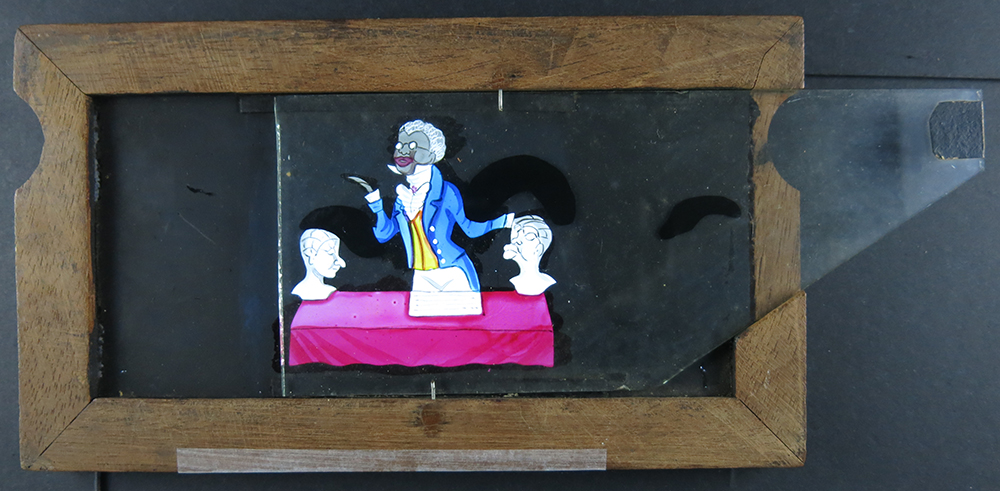
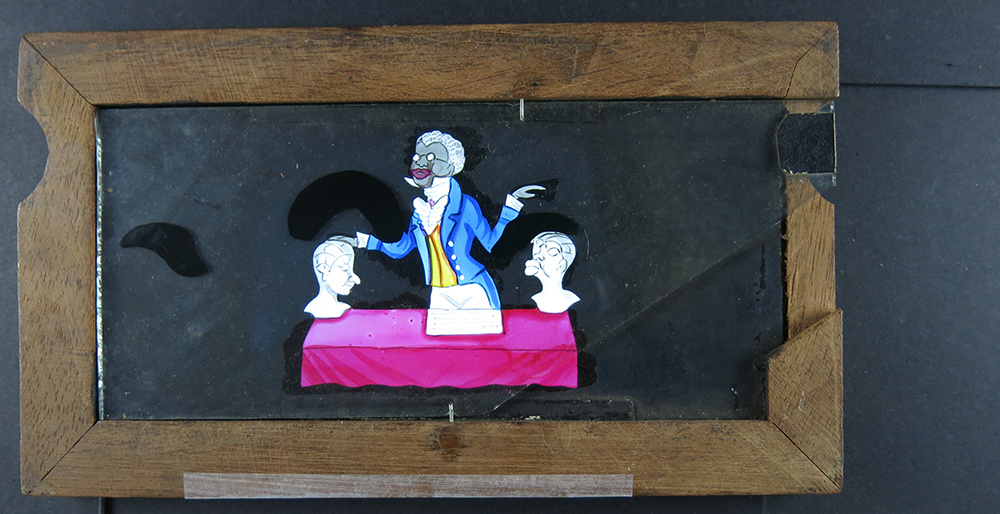
By far the most popular magic lantern slide of the nineteenth century was ‘Man Eating Rats’. Lanternists would even specifically promise it in their newspaper advertisements, so audiences knew they could go along and enjoy themselves making the requisite snoring and chomping and lip-smacking noises. I’ve had a copy of the slide for a while. But while the circulating rackwork rats worked perfectly, the sleeping man’s gluttonously bearded jaw was missing. Fortunately the ANU School of Art has a wealth of skill and knowledge and Waratah Lahy was able to paint me a  beautiful new jaw and beard (on a replacement piece of polycarbonate) which works perfectly. I’ll be showing it this Friday evening at the National Portrait Gallery in Canberra. I’ve also just brought a slipping slide of a phrenologist alternately examining a head of a ‘low’ type and a head of a ‘high’ type. Once again Australian National University historical expertise, through my colleague Alexandra Roginski, was able to provide me with actual phrenological readings from the period. So we’ll be performing this slide as well. There’ll be heaps of other slides, including The Gin Fiend.

'Man Eating Rats', hand painted and copperplate printed rackwork and slipping slide, c1890s.

‘Man Eating Rats’, hand painted and copperplate printed rackwork and slipping slide, c1890s.

'Phrenologist', hand painted and copperplate printed slipping slide, c1890s

‘Phrenologist’, hand painted and copperplate printed slipping slide, c1890s

'Phrenologist', hand painted and copperplate printed slipping slide, c1890s

‘Phrenologist’, hand painted and copperplate printed slipping slide, c1890s

History of Photography, The

The estimable Belinda Hungerford is doing a fabulous job researching and organising the archives of the Australian Centre for Photography. Her research led me to find, in the back of a cupboard, copies of a small booklet I produced with my students in 1990 (!). It was to accompany a show we put on at the ACP. Some students from back then are still doing important work in the field, I’m gratified to note. Reading through the anecdotes we collected back then it’s interesting that in that pre-digital period the minilab, now a lost site of visual profligacy and collective concatenation, served a not-dissimilar lubricious function to the ‘on-line’ environment now. If you want a copy of our booklet I’ll be glad to send you one, the price hasn’t changed in 25 years.

Australian Research Council funding for Heritage in the limelight: the magic lantern in Australia and the world

The ARC has funded a three year Discovery Project I will lead. The project aims to discover and analyse the large number of glass magic lantern slides that remain under-used in our public collections. International scholarship has recently begun to show that lantern slide shows were a ubiquitous, globalised and formative cultural experience. The project aims to explore the international reach and diversity of this globalised modernist apparatus from the Australian perspective. It plans to understand how diverse audiences affectively experienced these powerful forms of early media, and to develop ways for today’s Australians to re-experience their magic, invigorating and expanding our cultural heritage.

The team is Dr Martyn Jolly and Associate Professor Martin Thomas Australian National University; Professor Jane Lydon, University of Western Australia; Professor Nicolas Peterson and Professor Paul Pickering, Australian National University; Associate Professor Joe Kember, University of Exeter, UK.

With scholars like that we are guaranteed to find amazing material around Australia, and do wonderful things with it, in terms of identification, critical analysis and re-presentation. It’s also great that we will be working  with the European project A Million Pictures: Magic Lantern Slide Heritage as Artefacts in the Common European History of Learning. And I’m also looking forward to working even more with my friends from the lantern slide fraternity around Australia and the world. I can’t wait. I’m also really looking forward to picking up steam in my other ARC Discovery Project led by Dr Daniel Palmer, Monash University,’ Photography Curating in the Age of Photosharing’.

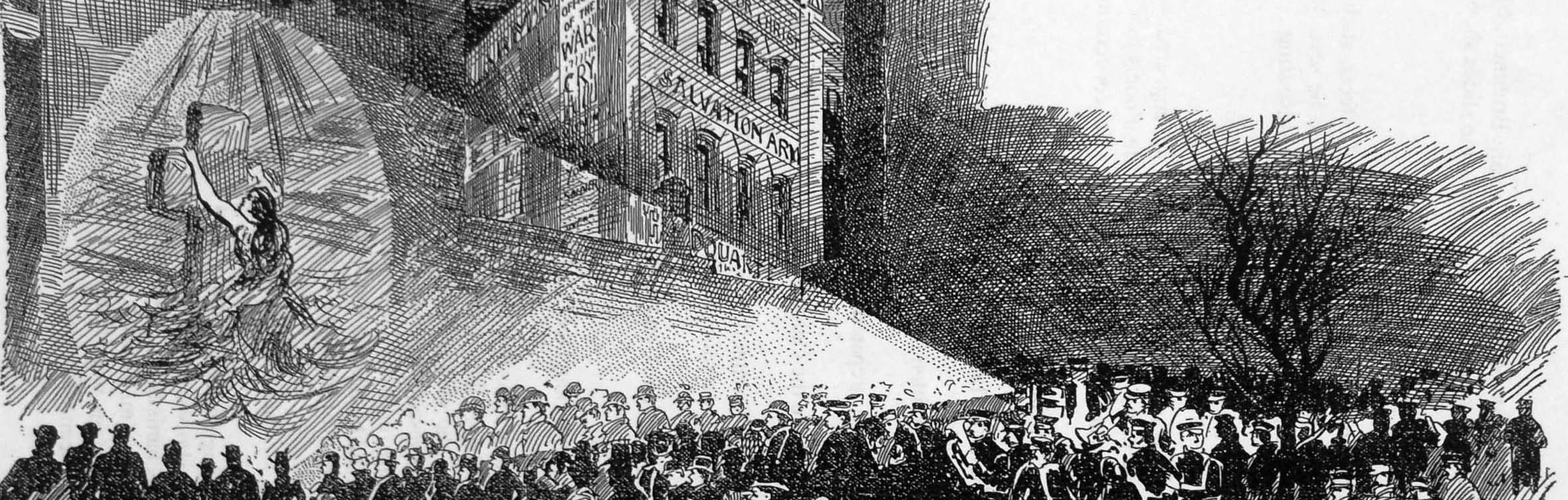
'In the Hurly Burly', detail from Salvation Army Melbourne War Cry, 1894

‘In the Hurly Burly’, detail from Salvation Army Melbourne War Cry, 1894

.


Catalogue Essay: The Alchemists: Rediscovering Photography in the Age of the Jpeg

The Alchemists: Rediscovering Photography in the Age of the Jpeg

Australian Centre for Photography

Essay by Martyn Jolly, Cherine Fahd, Suzanne Buljan

Full catalogue below


It is often said that it was the painters who invented Photography (by bequeathing it their framing, the Albertian perspective, and the optic of the camera obscura). I say: no, it was the chemists. For the noeme “That-has-been” was possible only on the day when a scientific circumstance (the discovery that silver halogens were sensitive to light) made it possible to recover and print directly the luminous rays emitted by a variously lighted object. The photograph is literally an emanation of the referent. Roland Barthes. [1]

Photographs are both pictures of things and emanations from things. Over the last twenty years all the buzz has been on the ‘picturing’ side of photography: we are astounded by the latest estimate of the astronomical number of smartphone images uploaded to the internet every second, we are shocked by the latest sickening images tweeted from a violent war zone, we are awed by the majestic detail in the latest mural photograph mounted behind pristine acrylic in an art museum, and we are habituated to the sleek look of digital images — either Photoshopped into high-dynamic-range conformity or with one selection from a convenient menu of retro Instagram-filters laid on top.

But lately a global movement of artists has been building around the world, not so much interested in the medium as the endless iteration of separately framed scenes, but rather fascinated by it as an ongoing process of chemical and visual becoming. The works they are producing are not photographs of things, they are photographs as things. In various ways these photographers are directly re-approaching the core power of photography — the touching of time and light.

This core power was present at the medium’s birth. Many of William Henry Fox Talbot’s first images in the 1840s were photograms — of lace or leaves laid directly on salted paper in the sun — so that object physically touched the resultant image. Photograms went on to become a staple of high modernism in the 1920s and 30s, with photographers such as Lazlo Moholy-Nagy, Man Ray and Max Dupain producing a ‘new vision’ out of pure light. To the modernists these darkroom impressions were a future orientated extension of the technical capacity of new photographic technology; but to subsequent photographers, photograms and other images of their ilk became a way of bypassing the whole corporate apparatus of photography and getting back to the elemental forces of nature itself.

After the rise of industrially manufactured amateur photography in the 1890s, signaled by the invention of the Kodak, Pictorialists began to make their own emulsions in gum-bichromate, or produce ink impressions in bromoil transfer, to declare their independence from the emerging mass photography, and their allegiance to fine art. In the 1970s, handmade emulsion and photograms returned to art schools, which were beginning to teach fine-art photography alongside other media such as printmaking. Courses in so-called ‘alternative techniques’, along with their accompanying ‘darkroom cookbooks’, became very popular.[2] Similarly, pinhole cameras and the construction of camera obscuras have been integral to thousands of introductory photography courses around the world for decades. And, in the 1990s in the immediate wake of the digital revolution, ‘post-photographers’ such as Adam Fuss used pinhole cameras, photograms and other ‘obsolete’ processes to stage spectacular conceptual deconstructions of the transforming medium.

But in the last ten years these longstanding and historically disparate tendencies have combined with new energy and conceptual force. Not only have a thousand instructional YouTube videos from enthusiasts around the world replaced the darkroom cookbooks of old, but more photographers are more seriously exploring the fundamentals of the medium. Many of the artists in the The Alchemists had their initial student training in digital photography, but felt a curiosity for learning about ‘analogue’ photography that replaced the dry, precise, virtual environment of the computer screen with the liminal and wet laboratory-place of the darkroom. This discovery of the darkroom was paralleled by the discovery of vintage cameras and retro processes, not only by art school trained photographers, but by amateur photographers as well, who were able to buy Lomo cameras and refurbished Polaroid cameras from museum gift shops, or Sunprint cyanotype kits from craft stores.

What is ‘new’ about this photography is that: images are magically produced by the simple optical fact of the camera obscura, rather than the factory manufactured equipment of the camera; the photographic print is treated not as neutral screen for the image, but as a physical object layered with light sensitive halides and dyes — potential eruptions of colour waiting to be revealed; hand-made emulsions, such as collodion which is freighted with a hundred and fifty years of historical association because it was used for nineteenth century ambrotypes, tintypes and wet-plate negatives, are used in modern large-format cameras; and photographers continue to find enormous wells of inspiration in the photogram, where three-dimensional objects and two-dimensional images meet and mingle in cradles of light.

This is not just a nostalgic retreat to the past, a hipster reinvention of the outmoded, or a retro fad. Nor is it part of some redundant ‘debate’ between the lost ‘purity’ of the analogue in the face of the encroaching contamination of the ‘digital’. Rather it is a discovery of another mode of making — a slower making, a more curious making, and a making which looks, in the words of one young artist, ‘simultaneously backwards and forward.’[3]

A series of exhibitions and books from London, New York and Los Angeles have already showcased these artists internationally.[4] But, what is happening in Australia and our region? Recently there have been several thoughtful attempts to address the Australianness of Australian photography. While taking different approaches, two books, The Photograph and Australia[5], and Photography and Australia[6], both identify the relatively recent — compared to the US, for instance ‑— colonization of the continent and displacement of its indigenous inhabitants as crucial to our photography. While Australian photography is obdurately oriented to people and land, every realistic portrait and landscape remains nonetheless marked in some way by the ambiguities and complexities of colonization. As Helen Ennis suggests:

These [significant local] differences [of photography in Australia] stem from one inescapable historical reality: photography in Australia is not simply a product of the modern era, but is tied inextricably to the imperialist and colonialist underpinnings of modernity. This distinguishes Australian photographic practice from its counterparts in Great Britain and various European countries, aligning it in crucial ways with that of other colonized countries such as India, Indonesia and New Zealand instead. Of primary importance therefore is the interaction between Indigenous and settler Australians. This has given rise to some of the most potent images in Australian visual culture.[7]

All of the works in The Alchemists are driven by joy and pleasure: the joy of seeing the fundamentals of optics and chemistry magically manifest themselves; and the pleasure of being the one to ride the unleashed processes of transmission, projection, refraction, filtration, sensitization, exposure, impression, reaction, absorption, precipitation, development and fixation to the unknown destination of a material outcome. But at the same time every artist, to varying degrees, attempts to use that joy and pleasure to engage with some other aspect of Australia, New Zealand, or Asia, not to ‘take a picture’ of it, but to materially and critically participate in it.

As one example amongst many, we could cite the oldest work in the exhibition, Catherine Rogers’ The Nature of Evidence, from 1986. This work was an interrogation of the dodgy forensic evidence and popular witch hunt which eventually led to the conviction of Lindy Chamberlain for the murder of her baby Azaria at Uluru, rather than accepting that a dingo had taken it as she claimed. (The trial took place in a media frenzy that mobilized many Australian anxieties about living in a recently colonized country.) Through the bleeding of developer over darkroom projections of multiple negatives, as well as photograms of significant objects such as scissors, the works directly participated in the same ‘aesthetics of the forensic’ that had convinced the jury to wrongly convict Chamberlain in the first place. As Helen Grace identified at the time:

In The Nature of Evidence, each of the frames of counter-evidence […] interrogates both the ‘official story’ of the Chamberlain case and the ‘official story’ of photography itself, since the techniques of photography (at the level of the image rather than the camera) are laid bare.[8]

Like Rogers, other artists in this exhibition also unite various photographic processes with various political, historical, personal, and environmental processes. For example, collodion emulsion and daguerreotypes, literally the stuff of colonial photography, are used by contemporary Australian and New Zealand photographers, some of whom have indigenous heritage, with powerfully ironic results. In these works the past is not just re-enacted, but also, in a sense, optically re-materialized in the present.

Other artists simply mainline themselves into larger forces and expanded networks, either urgent bodily forces of sexuality, slowed-down spiritual forces of nature, or expanded cosmic forces of the electro-magnetic spectrum. Still others engage in the purely formal and abstract possibilities of lines and shapes and tones in a rectangle. But, in all of these works, beauty — the non-descriptive, non-referential, non-semiotic beauty of fundamental propulsions and ineluctable balances — is wordlessly reclaimed.

Finally, hovering above this exhibition, only occasionally directly referred to, but nonetheless always present — are the largest and most indefinable processes on the planet, but ones with the most tangible ultimate results. The processes of mixing, swirling, condensation, melding and melting, which we see at micro scale in so many of the works in The Alchemists, are the same as are happening at macro scale in our atmospheres, oceans and continents as ice caps melt, reactors leak, rivers break their banks, and the ground cracks apart.

Plenty of digital photographs have been taken, and will continue to be taken, of the environment we all share. But photography in the digital epoch can only show us our world as virtual pictures before our two eyes. Alchemical photography, on the other hand, attempts to manifest our world as physical events we must encounter with our whole body.

[1] Camera Lucida, Roland Barthes, Jonathan Cape, 1982, p. 80.

[2] Most popular was: Breaking the Rules: A Photo Media Cookbook, Bea Nettles, Light Impressions, 1977

[3] Kylie Banyard, ‘A Politics Of The Outmoded’, Photography & Fictions: Locating the Dynamics of Practice, (ed. V. Garnons-Williams), QCP, Brisbane, 2014, p.44.

[4] Shadow Catchers: Cameraless Photography, at the Victoria and Albert Museum, London, 2010-2011. The Edge of Vision: Abstraction in Contemporary Photography, toured by the Aperture Foundation, 2010-2013. What is a Photograph?, at the International Centre for Photography, New York, 2014. Light, Paper, Process: Reinventing Photography, at the J Paul Getty Museum, Los Angeles, 2015.

[5] The Photograph and Australia, Judy Annear, Art Gallery of New South Wales, Sydney, 2015.

[6] Photography and Australia, Helen Ennis, Reaktion Books, London, 2007

[7] Ennis, p8.

[8] Helen Grace, ‘A Shroud of Evidence’, Photofile, Summer 1986, Australian Centre for Photography, Sydney.

TheAlchemistscatalogue

The Truth About Digital Photography

From the ANU Reporter Vol. 46 No. 2, May 2015

In the world Trending #2

There have been two different phases in the relatively short history of digital photography.

First was the apocalyptic phase, when there were dire warnings of ‘the end of photography’. The coming ‘revolution’, it was claimed, would fundamentally reconfigure the photographic ‘eye’.

We would be cast adrift from the firm shores of analogue photography, where chemical emulsion reliably reacted to the light reflected from real-world scenes, and left to float on a digital sea where pictures, now just data, could be changed at will.

Like many apocalypses, this one didn’t come. Although iconic names such as Kodak were swept away into history, the practice of photography itself went from strength to strength.

Cameras got cheaper and smaller and people took more and more photos to post on social media. Far from being bankrupted, the newly ubiquitous medium gained more impact than ever.

What those Chicken Littles didn’t realise is that photography is much more than just a technology, it is a social practice, a personal habit, a psychological need, an accumulated history of looking and, increasingly, a global network of exchange.

Photographic truth is supported by social protocols, and it is the multiple micro-recalibrations of these that we are currently experiencing in the second phase of digital photography. News organisations still protect direct photon to pixel mapping.

When Adnan Hajj, a hapless stringer for Reuters, was caught out by sharp-eyed bloggers using Photoshop’s clone tool to increase the amount of smoke rising from Beirut after a 2006 Israel bombing raid, he was summarily dropped. All 920 of his images were immediately removed from the Reuters site and a picture editor was sacked.

However, while minor excisions and additions to the image are strictly policed, enhancements or modifications to the connotational ‘feel’ of the reportage image as a whole are still allowed by press photography protocols.

In 2010, Stepan Rudik was stripped of his World Press Photo award.  He had radically cropped thephotograph he submitted, Street Fighting, Kiev, Ukraine, and  applied a heavy Photoshop filter to it. But that wasn’t why he was stripped of the award, it was because he had digitally removed a tiny pinch of pixels representing the intrusive foot of an irrelevant figure in the background of the image.

This year, 20 per cent of World Press Photo entries were disqualified for similar digital cutting and pasting and controversies like these, big and small, continue to erupt across the Internet.

But if we take a sideways step into celebrity photography, we find not only a tolerance for digital enhancement, but an expectation of it.

We are all now so completely habituated to seeing the flawless, poreless, skin of our celebrities stretched over their cheekbones that we barely give the routine post-production enhancement of the glossy images we consume a second thought. Indeed we now expect it as a kind of fantasy ‘truth’.

When 224 un-retouched photographs from a Beyoncé advertising shoot were released on a fan site earlier this year, before the texture of her tiny acne scars, moles and wrinkles had been digitally smoothed away, her fans “freaked out”, and were left “shocked and lost”.

The site was forced to remove the photographs of what they maintained was just Beyoncé as a “naturally beautiful” “regular woman” because “some of the things we have seen posted were just horrible, and we don’t want any part of it”.

But, before we laugh too quickly at the betrayal Beyoncé’s deluded fans felt, we must realise that reportage photos are also routinely undergoing similar makeovers.

In 2013, another controversy engulfed the World Press Photo Award when winner Paul Hansen’s Gaza Burial was accused of digital manipulation. It was eventually revealed that it was the product of the superimposition of three separately modulated versions of the one file, which gave the final digital composite a cinematic feel as though the director of photography on a big Hollywood movie had lit it with movie lights. Nonetheless it retained the prize because, although it had been enhanced, no pixels had been removed or added.

The meaning of the words ‘photographic manipulation’ is shifting before our eyes and growing in complexity. Today’s digital cameras don’t take pictures, they record data.

In this new imaging logic, the journey from scene to image is a continuity where image manipulation can feedback into a scene’s ‘truth’.

Add to this the exponential proliferation of images online, the acceleration of their transmission, and their accumulation into vast data-bases and we are set for yet more fascinating recalibrations in photographic truth.

Holy City and Jack the Ripper

Holy City was the million-seller song of 1892. A little while ago, accompanied by a singer and pianist, I projected  my set of magic lantern slides, complete with double exposures and hand colouring, which were made to illustrate the song. Imagine my surprise this weekend when I read that its composer, the singer Michael Maybrick, has just been fingered as Jack the Ripper by the latest contribution to Ripperology, the 800 page They All Love Jack: Busting the Ripper (it’s all the fault of the Masons, apparently). If the book’s author, Bruce Robinson, is right, Maybrick had given up ripping a few years before he penned Holy City. I had always been fascinated by the song because of the way it took the trope of sublime religious vision, and reduced it to a nineteenth century opiated dream of travel. I had always been fascinated by my slides because they transcode the idea of the hallucinatory travelogue, as the dreamer takes a metaphysical Cook’s Tour to Heaven,  to the visual technology of the double exposure and the dissolve — presaging the transitive media of the twentieth century. But now it may also be an act of expiation by its author!