Facial Velocities

‘Facial Velocities’, Time Machine Magazine, Issue 2, on-line from 28 October, 2011, http://timemachinemag.com/current-issue/facial-velocities-by-martyn-jolly/

Facial Velocities Talk Text

That configuration of eyes, nose and mouth stuck to the front of our heads, which we call the face, not only connects the outer sociological self to the inner psychological self— the old ‘window on the soul’ idea — but it also connects one person to another in a relationship.  For the philosopher Emmanuel Levinas the face was the place of authentic encounter between self and other: ‘The face opens the primordial discourse whose first word is obligation’. (1979, p. 210) According to Levinas, when two faces face each other, each demands something from the other, even if it is only recognition. It is the power of ideas such as this that still underpin controversies around the role of the face in public places of social interaction. For instance the debate around recent attempts by various European governments to ban the burqa and the niqab in public, place the face at the very centre of contemporary definitions of personal autonomy and public citizenship. (Chesler 2010)

In order to perform this social function of human interaction the face has to be abstracted away from the body so that it can enter into a system of semiotic exchange. Deleuze and Guattari (1988) called this ‘faciality’, a process that over-codes the organism of the body with other strata of signification and subjectification. To them, the face is an abstract machine of ‘black holes in a white wall’. It is a technology increasingly becoming enmeshed with other technologies.

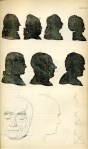
But in many ways this process of abstraction and ‘over-coding’ begins much earlier, with John Caspar Lavatar’s popular Essays in Physiognomy from the 1770s. Lavater defined his new science of physiognomy as the ‘the science … of the correspondence between the external and the internal man, the visible superficies and the invisible contents.’ (1885, p. 11) He established that correspondence by either visual analogy, where a bovine-looking person must exhibit dull, bovine personal characteristics; or by biometric algorithms, where the slope of a brow, for instance, indexed cranial capacity and thus intelligence. A brow at a high angle above the nose was the mathematical index of a large brain, but also the visual equivalent of Roman nobility. A brow at a low angle indicated a small brain, and was also literally simian. Lavater’s analogical mapping and algorithmic vectorization allowed him to compare and classify faces, but they also removed the face from the ranks of the purely human, and placed it into an abstracted morphing space which was also shared by animals. Plate 80 of his Essays in Physiognomy demonstrates this with startling clarity as Lavater’s illustrator morphs a drawing of a frog’s face through twelve separate frames. The frog’s eyes slowly become more almond shaped and the whole face lengthens until, by the twelfth frame, we find ourselves looking into the face of an androgynous human.

Eighty years later Charles Darwin completed the project of placing the human face within the realm of animals with his discovery of evolution. In his wildly popular follow-up book of 1872, The Expression of the Emotions in Man and Animals, he homed in on the mechanics of the face and established that human facial expression was an instinctual animal behaviour, rather than a social language. (1872) He demonstrated the automatic, biological mechanics of expression by artificially decoupling the external hydraulics of the facial muscles from their usual inner, instinctual motivations. For instance, for plate 7 he obtained from the French scientist Dr Duchene a photograph of the facial muscles of an intellectually impaired man being twitched into the expression of ‘horror and agony’ by the external application of the terminals of a galvanic battery. He then juxtaposed this with a photograph he had commissioned of the photographer Oscar Rejlander acting out exactly the same expression. By photographically proving that muscles could be manipulating by two entirely separate methods — electricity and pantomime — to produce exactly the same expression, Darwin demonstrated that the face lay on top of the self. The face alone, without the self, could enter the plane of abstracted analysis and comparison.

Lavater’s physiognomic analogs and algorithms, and Darwin’s muscular decoupling, had the effect of conceptually delaminating the face from the body. But it was photography that then circulated that face within society. The greatest celebrity of Victorian England was the royal courtesan, partygoer, actress, beauty, and endorser of Pears Soap, Lillie Langtry. Through photography her face left the realm of her body and entered other media spaces. In Victorian England the most lubricious place where newly mobilised images bumped up against each other was the stationer’s shop window, and Lillie’s photographs were right in the middle of every window, disturbing the pre-existing social order. A writer at the time commented on:

… that democratic disregard of rank which prevails in our National Portrait Gallery of the present day — the stationer’s shop window — where such discordant elements of the social fabric as Lord Napier and Lillie Langtry …  rub shoulders jarringly. (Ewing 2008)

Langtry was also the very first person in the world to find herself in a photographic feedback loop, that is, to feel the effects of her photographed face, as it circulated though Victorian visual culture, reflecting back on to her actual body. She recalled:

Photography was now making great strides, and pictures of well-known people had begun to be exhibited for sale. The photographers, one and all, besought me to sit. Presently, my portraits were in every shop-window, with trying results, for they made the public so familiar with my features that wherever I went — to theatres, picture galleries, shops — I was actually mobbed. Thus the photographs gave fresh stimulus to a condition which I had unconsciously created. One night, at a large reception at Lady Jersey’s, many of the guests stood on chairs to obtain a better view of me, and I could not help but hear their audible comments on my appearance as I passed down the drawing-room. Itinerant vendors sold cards about the streets with my portrait ingeniously concealed, shouting ‘The Jersey Lily, the puzzle is to find her’. (1925, p. 40)

In the subsequent 130 years, of course, the velocity of that photographic circulation has only increased in speed and brutality. And now it is not just the mega-famous who find themselves caught up in photographic feedback loops.

Erno Nussenzweig is the poster boy for the ever-present possibility that any of us can become an accidental celebrity. One day in 2000 this elderly, bearded, orthodox Jewish man innocently emerged onto the sidewalk from a subway at Times Square. It wasn’t until five years later that he discovered that at that decisive moment he had been photographed by Philip-Lorca diCorcia who had exhibited the portrait at Pace/McGill Gallery, published it in a book called Heads, sold out its edition of ten prints at between twenty and thirty thousand dollars each, and had eventually won London’s prestigious Citibank Prize with it. Nussenzweig sued for 1.6 million dollars claiming the photographer had used his face for purposes of trade, as well as violated his religious beliefs. His lawyer, Jay Golding, put his case best succinctly to the New York Post who in their report ‘What’s a picture worth — he wants 1.6 Mil’ quoted him as saying: ‘It’s a beautiful picture. But why should this guy make money off of your face?’. (Hafetz 2005, p. 23)  DiCorcia’s lawyer, however, was able to convince the judge that the photographs were taken primarily for the purpose of artistic expression, not commerce, and were therefore protected by the First Amendment.

Or consider the case of Neda Soltan. In 2009 she was videoed by the mobile phones of three separate pro-democracy demonstrators in Iran as she lay dying from a government-sniper’s bullet. After the videos went viral on the internet her face was even turned into a mask and worn by pro-democracy demonstrators at a protest in Paris. (Wikipedia, ‘Death of Neda Agha-Soltan’ 2013) Meanwhile, in the hours after her death, some eager journalists mistakenly harvested a photograph of another Iranian woman with a similar name, Neda Soltani, from her Facebook page. It was this face that was used in many improvised shrines to the other, assassinated Neda. Iranian authorities then began to harass Soltani in order to get her to cooperate with them in claiming hat the original murder had been a set-up by the western media. After twelve days of harassment the other Neda was forced to flee Iran and seek refuge in Germany, from where she wrote a book about her experience, My Stolen Face. (Soltani 2012)

Or put yourself in the shoes of Nicole McCabe, an Australian citizen living in Jerusalem and pregnant with her first child. She also had her photograph harvested from Facebook. In 2010 the Israeli Government had stolen McCabe’s her identity for a Mossad agent to use in order to assassinate a Hamas official. When the story broke and the passports the Israeli’s had forged were circulated in the media, complete with their actual passport numbers, Nicole McCabe decided she did not want to talk to Australian journalists, or be photographed by them. But after having the door slammed on them by McCabe’s angry husband, the journalists simply sourced photographs of her from Facebook, where friends had posted her wedding photographs. Nicole said she felt:

‘sick, angry, embarrassed and upset … even if Facebook is public, they have no right to take what they want without asking. I was more determined than ever not to let anyone take a photo of me.’ (Media Watch 2010)

Or consider the fate of the footballer Sonny Bill Williams. In 2007 he embarked on an afternoon drinking session at the Clovelly Hotel with his team-mates and a group of football groupies that included celebrity iron woman Candice Falzon. Later that night one Clovelly local got a message on his phone. The local reported: “It said Candice Falzon had followed Sonny Bill into the toilets upstairs at the pub and everyone knew about it. The next message I got was an … um … action shot.”  The shot, taken by putting a mobile phone under the toilet door as William and Falzon had sex, was soon being widely circulated amongst the mobile phones of Clovelly, and when it was eventually published on The Daily Telegraph’s website, it attracted a record number of hits. Williams reportedly had to spend all the following morning buying up copies of newspapers in his area in a futile attempt to stop his girlfriend learning of his toilet tryst. Although the person who took the photograph could have been liable for two years jail under the summary offences act for taking lewd photographs in toilets and change rooms, the newspaper itself could not be successfully prosecuted for posting the photograph once it was taken. (The Daily Telegraph 2007)

Incidents such as this show that faces don’t just have features, they also have velocities. The more famous you are the more recognizable you are to more people, but also the faster your face is circulated in the media. Even if you aren’t famous, a lightning bolt of sudden celebrity can dramatically, thought temporarily, catapult your face into a higher strata of recognizability, which propels exchange at a faster velocity.

While some have felt themselves suddenly swept up into these currents of facial velocity, others have attempted, with mixed success, to ride those turbulent currents to even greater fame. Consider the career of Lara Bingle. Once an ordinary bikini model, her celebrity stocks rose in 2006 when she was chosen for a tourism campaign. The men’s magazine Zoo Weekly then published revealing photographs of her that had been taken eleven months earlier, before she was chosen to be the wholesome face of Australia. She sued the magazine for defamation. She won the case when the judge accepted that the magazine was smutty and had implied that she had willingly consented to pose for the sexual titillation of its readers. (Sydney Morning Herald 2006a, 2006b) However by the end of 2006 the tourism campaign had flopped, and Bingle was having an illicit affair with the married footballer Brendan Fevola. But by 2008 her stocks had risen again, she was engaged to the cricketer Michael Clark, and they were one of Sydney’s foremost celebrity couples, even endorsing an energy drink. By early 2010 she had even signed up with celebrity agent Mark Marxson. But then Woman’s Day published a mobile-phone photograph her ex-lover Brendan Fevola had taken of her in the shower back in 2006, which his football mates had been circulating between their mobile phones for some time. Her engagement with Michael Clark broke down and the energy drink company dropped them. Mark Marxson threatened to ‘strike a blow for women’s rights’ by getting her to sue Fevola, but she did not have a case because, unlike in the Zoo Weekly case, no specific laws of defamation were broken. (Byrne 2010) Bingle’s stocks in the celebrity marketplace plummeted but, after a period of careful career management including charity work, family-friendly television appearances, and the avoidance of footballers, they begun to rise again. They rose so far that by 2012 she successfully negotiated with a TV production company to become the subject of a ‘reality’ TV series Being Lara Bingle on a commercial television network. Conveniently, just before the premiere was about to air, another controversy erupted when she was supposedly photographed surreptitiously by the famous paparazzi Darryn Lyons (who was in fact a business partner of Bingle’s) standing nude near the window of the Bondi flat that had been rented for the show. This confected ‘invasion of privacy’ allowed her to tell breakfast radio that: “There should be a law against someone shooting inside your house …. it’s just not right”, thus garnering pre-publicity for the series, and conveniently forming the content of the first episode. That first TV episode rated highly, however subsequent episodes in the series steadily lost viewers, to the point where Bingle’s career languishes once more. (O’Brien 2012)

The camera has ruled Lara Bingle’s career as celebrity, someone defined by our desire to look at her. But this has been the case ever since Lillie Langtry. However the roller coaster ride of Bingle’s value as a bankable celebrity has also been ruled by the sudden eruptions or irruptions, whether planned or not, ‘authorised’ or not, of particular recognisable photographs which re-attach the ‘face’ of Bingle to the ‘brand’ of Bingle in different ways. The speed of their circulation through both social media and the mainstream media, create the volatility of the market for her images. Celebrities sometimes are forced to engage in this market directly. For example, in 2013 the TV and radio presenter Chrissie Swan, who had acquired her celebrity status dispensing homespun wisdom to ordinary women, was photographed smoking whilst she was pregnant, something she herself had campaigned against. So that they could never be published, she engaged in a bidding war with two magazines for the photographs, eventually pulling out after offering $53,000, two thousand dollars less than the winning bid by Womens Day. (news.com.au 2013)

These examples indicate the high speed of facial velocity. But what of facial vectorization? The terrain of the face continues to be the site of scientific research that updates Lavater’s and Darwin’s pioneering efforts and re-affirms the face’s muscular mechanics as central to our humanity — although now not by indexing some immutable inner person as Lavater had supposed, but through their intrinsic role within language comprehension. Contemporary cognitive psychologists such as professor Rolf Zwan, from Erasmus University Rotterdam, are researching the ways that facial muscle-movement directly feedbacks to the brain. For example experiments have shown that if you are smiling you can read sentences about emotions quicker than if you are frowning; and if you have had Botox you have more difficulty interpreting photographic portraits of emotions because in conversation your facial muscles subtly enter into a feedback loop of micro-mimicry with your interlocutor, which Botox decouples. (Lingua Franca 2011; White 2011; Zwaan 2013) Other experiments suggest that if you are in the presence of the representation of a face your moral standards are higher. (Bourrat, Baumard, McKay 2011; Smith 2011)

While the face as a concept remains central to discourses of the human, individual faces are also increasingly caught up in ever-finer meshes of delamination, vectorization, and mobilization. For instance plastic surgery is moving down the social scale from being the prerogative of the famous and the fatuous, to being a commonplace convention practice for all of us. ‘Extreme makeovers’ are increasingly re-mapping everyday faces, and recalibrating the vectoral angles between eyes, noses and chins in order to shift their owners up in scales of beauty.

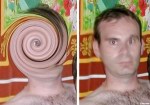
If the facial structure itself can be morphed through surgery, in other instances the facial pixel maps representing the person can be manipulated. The regular Photoshoping of celebrity portraits in our magazines simply replicates in two dimensions the effects of the cosmetic surgeon’s scalpel, and the amount of pixelated deviation away from the ‘truth’ can even be algorithmically calculated and given a value. (Fahid, Kee 2011) Photoshop can also be used to disguise faces. Consider the case of Christopher Paul Neil who liked to post pictures of himself sexually abusing Vietnamese and Cambodian children on paedophile websites. He applied a swirl filter to his face to disguise his identity, but German police simply applied the same filter in reverse and unswirled the pattern and reveal his face. Interpol then posted the image on their website where he was recognised by five different people and identified. After his face was picked up by a surveillance camera at Bangkok Airport he was eventually arrested in. (Daily Mail 2007; Wikipedia  ‘Christopher Paul Neil’2013)

Neil was recognised by a human being, but the technological possibility exists that eventually his face could have been recognised by a machine. Facial recognition software applies algorithms to the same sets of vectors between eyes, nose and mouth that Lavater originally identified. Australia is at the forefront of facial recognition research. We have not only already introduced ‘smart gates’ at our airports to match our facial algorithms with a database, but National ICT Australia (NICTA) received 1.5 million dollars from the Cabinet to research what it describes as the ‘holy grail’ of surveillance: ‘real-time face-in-the-crowd recognition technology’. Concurrent with these Australian research projects, international protocols are also being developed. For instance the US Department of Commerce’s National Institute of Standards and Technology hosted the Face Recognition Grand Challenge open to entrants from industry, universities and research institutes. This means, according to NICTA, that:

The surveillance industry is currently undergoing the same revolutionary changes that shook up the computer industry when internet use took off in the 1990s. Instead of each supplier providing a unique product, the sector will soon be dominated by standards and interoperability. Surveillance will eventually merge into a virtually seamless multimedia network embracing social media, location services, mobile devices, maps, and 3D models. (Advanced Surveillance Project 2013; (Bigdeli, LovellMau, 201abc)

However even though technology is yet to actually deliver on its promise, the idea of facial recognition and facial manipulation has already become commonplace in the media, and almost domesticated. For several years it has been something we can all indulge in as a kind of game. A whole class of smart phone apps are based on face recognition software.  We can also apply face recognition algorithms to the vast reservoirs of faces on the internet, or on Facebook, or in our iPhoto libraries, in order to locate friends we are looking for even when the metadata tags aren’t available; or to look for celebrities; or to calculate how much we look like a celebrity; or to calculate which of our children most looks like us. Many new cameras also have face recognition software built in which recognises, automatically focuses on, and tags, particular people even before the shutter is clicked.

In a way of thinking about the face that is very similar to Lavater’s and Darwin’s, the frontier of contemporary 3D computer animation is the mapping of actual micro-muscular movements onto animated wire-frames. The most famous example of this so far has occurred in the movie Avatar, 2009, where actors wore head-rigs which filmed the movement of motion-tracking markers on their faces. This digital information was then ‘peeled’ off the actor’s face and re-applied to a 3D animation wire-frame model. The use of the same rigs on the actor Andy Serkis for the movie Rise of the Planet of the Apes, 2011, finally placed the human face and its expressions in the realm as animals, as imagined by Lavater 230 years ago. Significantly, this technology has also become domesticated in on-line games such as Macdonald’s website Avartize Yourself. Other games take forensic ‘age progression’ software used by missing-persons bureaus, and turn them into games such as the iPhone app Hourface.

Why is worthwhile looking so closely at tabloid trash and silly on-line games? Because they, as much as high-end cutting-edge research, are the symptoms of two new tendencies in the valency of the face. Firstly, we are all becoming celebrities, at least potentially. The velocity of our own faces can suddenly speed up when we least expect it. Secondly, our faces are all part of what NICTA calls a ‘virtually seamless multimedia environment’. This is not just analogical space, the bit-mapping and comparison of appearances, but algorithmic space, where faces are vectorised and turned into equations that can instantly interact with a myriad of other equations. The pervasiveness of celebrity culture, combined with the explosion of algorithmic biometrics within merging media and data spaces, has had a profound effect upon the ways in which every one of us regards our own face. The face is congealing as a bastion from which to advance privacy rights and proclaim property rights.

There has been a consistent and inexorable drift in legal opinion in Australia towards a tort of privacy — which we currently do not have — that is ultimately focussed on protecting the human face. Way back in 2001 Justice Dowd was able to confidently claim that a person ‘does not have a right not to be photographed’. But by 2003 Justice Michael Kirby was commenting that extending the law in Australia to protect the ‘honour, reputation and personal privacy of individuals’ would be consistent with international developments in human rights law. (Nemeth 2012)

By 2008 Professor David Weisbot, president of the Australian Law Reform Commission, was saying that during their inquiry into privacy law, the ALRC had:

consistently heard strong support for the enactment of a statutory cause of action for serious invasion of privacy. While the debate overseas has focussed on the activities of paparazzi photographers, interestingly, most of the concerns expressed to the ALRC related more to the private sphere than the mainstream media — and to the protection of ordinary citizens rather than celebrities. People are extremely concerned about new technology and the ease with which their private personal images may be captured and disseminated.

In their recommendations the ALRC called for: ‘a private cause of action where an individual has suffered a serious invasion of privacy, in circumstances in which the person had a reasonable expectation of privacy’. (Australian Law Reform Commission 2008)  And in 2011 the NSW Law Reform Commission agreed, releasing draft laws that stated that an invasion of privacy should exist where a person ‘has a reasonable expectation of privacy’, which could potentially even include a public place. (New South Wales Law Reform Commission 2010; Marr 2009))

So, why this paradox? Why, when our personal information is flowing more freely than ever before, when 80% of people want CCTV cameras in their public spaces, and when the vast majority of Facebook users are happy to use its default settings where there is little or no privacy at all, why are we getting increasingly paranoid about our faces? I think it is because the face is caught up in a wider transformation. It is swimming against the tide that is pulling the private into the public because it is part of a stronger current, from signification to possession. Those of us feeling the effects of both celebrity culture and algorithmic data-media are regarding privacy less as a singular inherent right, and more as a fungible personal commodity which can be exchanged in a market place. For instance Nicole McCabe knew her participation in Facebook was not free, she knew she had ‘sold’ it some of her privacy in order to enjoy its benefits, but suddenly and unexpectedly she came to realize that perhaps she had ‘traded off’ too much of her privacy. This mercantile logic is also beginning to pervade other environments of facial interaction, such as public places. Within the politics of the face the receding sense of the private, in the sense of the ‘the discreet’, is being overtaken by an encroaching sense of the privatised, in the sense of ‘the owned’. We all increasingly agree implicitly with Nussenzweig’s lawyer: ‘why should this guy make money off of your face?’.

The abstraction, delamination and mobilization of the face has led to its reification. The face is closing down on the sense of mutual obligation that, in Levinas’s terms, once arose when one face faced another. This reification is intensified by the way that all faces, even our own, can be peeled away from bodies to enter new virtual spaces. Celebrities are merely at the vanguard of this transformation. Celebrities believe they are their own commodity. They believe that their face is the result of their labour and their talent. It is their capital, their brand, their corporate logo. They believe they therefore have a proprietary right in it. In America their faces are even protected by a common law ‘right of publicity’ which grants them, in the words of one key judgement, ‘the exclusive right to control the commercial value and exploitation of [their] name, picture, likeness or personality.’ (Wikipedia, ‘Personality Rights’ 2013) And, just like them, we ordinary people also feel that our own faces are also becoming more monologic, less a window or an interface, and more a logo for ‘Brand Me’. That configuration of eyes, nose and mouth stuck to the front of our heads, which we call the face, is now not so much a portal to the inner self, or a species of physiognomic autobiography, or an interface to our fellow citizens, as much as a rebus of identity, or perhaps a corporate logo for the persona.

Martyn Jolly

Bibliography:

Advanced Surveillance Project 2013 NICTA, viewed 31 January 2013, http://nicta.com.au/research/projects/safe_as

Australian Law Reform Commission  2008, ‘For Your Information: Australian Privacy Law and Practice (ALRC Report 108)’, viewed 31 January 2013, http://www.alrc.gov.au/publications/report-108,

Bigdeli, A & Lovell, B & Mau, S  2011a ‘You, yes you: welcome to the world of advanced surveillance”, The Conversation, 23 May, viewed 31 January 2013, < http://theconversation.edu.au/>

Bigdeli, A & Lovell, B & Mau, S  2011b ‘Something to watch over me: policing our national bordersThe Conversation, 26 May, viewed 31 January 2013, < http://theconversation.edu.au/>

Bigdeli, A & Lovell, B & Mau, S  2011c ‘All-seeing eye: the future of surveillance and social media’ The Conversation, 27 May, viewed 31 January 2013, < http://theconversation.edu.au/>

Bourrat, P & Baumard, N & McKay R 2011 “Surveillance Cues Enhance Moral Condemnation.” Evolutionary Psychology,  9(2) pp193-199

Byrne, L 2010 ‘Lara Bingle to sue Brendan Fevola over nude photo’, Herald Sun, 2 March, viewed 31 January 2013 <http://www.heraldsun.com.au/news/victoria/lara-bingle-to-sue-brendan-fevola-over-nude-photo/story-e6frf7l6-1225835852364 >

Chesler, P 2010  ‘Ban the Burqa? The Argument in Favor’, The Middle East Quarterly, Fall, pp34-45.

Daily Mail 2007, ‘Police name internet paedophile caught out in digitally altered images’, 16 October, viewed January 31 2013 < http://www.dailymail.co.uk/news/article-486334/Police-internet-paedophile-caught-digitally-altered-images.html&gt;

Darwin, C 1872, The Expression of Emotion in Man and Animals, J Murray London.

David Hafetz 2005 ‘What’s a picture worth — he wants 1.6 Mil’, New York Post, 26 June 2005, p23

Deleuze, G & Félix Guattari, F 1988, ‘Year Zero: Faciality’, A Thousand Plateaus: Capitalism and Schizophrenia, , trans Massumi, B, Athlone Press, London.

Ewing, W A 2008, Face: the new photographic portrait, Thames & Hudson, London.

Fahid, H & Kee, E 2011, ‘A perceptual metric for photo retouching’, Proceedings of the National Academy of Sciences of the Unites States of America, 28 November, PNAS 108 (50) 19907-19912

Langtry, L 1925 The Days I Knew, George H Doran Company, New York,.

Lavater, C 1885 Essays on physiognomy, also one hundred physiognomical rules, taken from a posthumous work by J.G. Lavater, and a memoir of the author, 17th ed, trans Holcroft, T, Ward Lock, London, p11.

Law Reform Commission of New South Wales 2010, ‘Report 127 – Protecting Privacy in New South Wales’, viewed 31 January 2013, <http://www.lawlink.nsw.gov.au/lawlink/lrc/ll_lrc.nsf/pages/LRC_r127toc>

Levinas, E 1979, Totality and Infinity: An Essay on Exteriority, trans Alphonso (Lingis, M. Nijhoff Publishers The Hague, Boston, p201.

Lingua Franca 2011, ‘Embodied Cognition, interview with Professor Rolf Zwaan’, ABC Radio National Broadcast 10 September, viewed 31 January 2013 <http://www.abc.net.au/radionational/programs/linguafranca/embodied-cognition/2939354>

Marr, D 2009 ‘Pesky Press Annoying You? Now You Can just Sue Them’, The National Times, Sydney Morning Herald, 15 August 2009, viewed 31 January 2013, <http://www.smh.com.au/opinion/pesky-press-annoying-you-now-you-can-just-sue-them-20090814-el51.html>

Media Watch 2010, ‘Identity Fully Revealed’, Episode 05, 8 March, viewed 31 January 2013, <http://www.abc.net.au/mediawatch/transcripts/s2839839.htm>

Nemeth, A 2012, NSW Photo Rights: Street Photography Legal Issues, 4020, viewed 31 January 2013 < http://4020.net/words/photorights.php>

news.com.au 2013, ‘Tearful Chrissie Swan admits she hasn’t been able to quit smoking while pregnant’, viewed 10 February 2013, < http://www.news.com.au/entertainment/celebrity/mix-fm-presenter-chrissie-swan-admits-to-smoking-cigarettes-while-pregnant/story-e6frfmqi-1226572082685&gt;

O’Brien, S 2012 ‘Lara Bingle’s nude paparazzi snaps a privacy invasion’, Herald Sun, 2 May, viewed 31 January 2013, <http://www.heraldsun.com.au/opinion/lara-bingles-nude-paparazzi-snaps-a-privacy-invasion/story-fn56aaiq-1226344709298>

Smith, D 2011 ‘Why one look will put the fear of god into you’ June 11, Sydney Morning Herald, viewed 31 January 2013 < http://www.smh.com.au/national/why-one-look-will-put-the-fear-of-god-into-you-20110610-1fx30.html>

Soltani, N 2012, My Stolen Face: The Story of a Dramatic Mistake, Random House, Kailash.

Sydney Morning Herald , 2006, ‘Bingle bites back — sues men’s mag’, Stay in Touch, , 11 May, viewed 31 January 2013, < http://www.smh.com.au/news/stay-in-touch/bingle-bites-back–sues-mens mag/2006/05/10/1146940612505.html>

Sydney Morning Herald 2006, ‘Judge Backs Bingle on Zoo Smut’, 8 December viewed 31 January 2013, <http://www.smh.com.au/articles/2006/12/08/1165081128065.html?from=rss>

The Daily Telegraph 2007, ‘Sonny Bill, Candice toilet Joke’, Sydney Confidential, 14 April, viewed 31 January 2013, <http://www.dailytelegraph.com.au/news/sonny-bill-candice-toilet-joke/story-e6frewt0-1111113317469 >

White, S 2011 ‘Pardon the Expression’, Spectrum, Sydney Morning Herald, 6-7 August, p23

Wikipedia 2013, ‘Christopher Paul Neil’, viewed 31 January 2013, <http://en.wikipedia.org/wiki/Christopher_Paul_Neil>

Wikipedia 2013, ‘Death of Neda Agha-Soltan’, entry, viewed 31 January 2013,  <http://en.wikipedia.org/wiki/Death_of_Neda_Agha-Soltan>

Wikipedia 2013, ‘Personality Rights’, viewed 31 January 2013, <http://en.wikipedia.org/wiki/Personality_rights&gt;

Zwaan, R 2013 Brain & Cognition, Erasmus University Rotterdam, viewed 31 January 2013 <http://www.brain-cognition.eu/>

Illustrations:

Facial Fascination

‘Facial Fascination’, National Portrait Gallery, 13 April, 2011

Temperature of the face has increased:

Faces always important:

Scientific basis:

  1. Nineteenth century science erroneously believed that facial ‘types’ indicated criminality and intelligence.
  2. Charles Darwin established that expression was an instinctual animal behaviour.
  3. Paul Ekman’s work in the 1960s established that facial expression, and unconscious microexpressions were biological, a result of deep evolution, rather than cultural. His work has become wide popularized and influenced popular TV shows like ‘Lie to Me’.

The face is still seen as the repository of the self.

Also long history of painted portraiture, miniatures and photography.

But at the same time recent changes have raised the ‘temperature’ of the way that we interact with faces.

Burkas and niqabs

Yesterday the French law threatening fines of 200 euros to women wearing burkas or niqabs came into force. No matter which side of the debate you fell on, nonetheless it established how important faces are. To one side of the argument, since the face is the self it should be open and frank and engaged when out in the collective civic space, to signify your participation in the civic community. To the other side, female faces are dangerous things, constantly soliciting licentious gazes, therefore women are more safe and self-contained if their faces are covered

Technology

Facial recognitions software is beginning to effect the way we think about the face, basically it transforms the bit-mapped map of the face as a terrain and transforms it into a short algorithm based on the angles between eyes, nose and mouth.

  1. Camera focusing automatically finds faces in the viewfinder
  2. iPhoto automatically finds faces in my iPhoto library
  3. Airport security
  4. Animation, in movies such as avatar the microexpressions of real actors are peeled of their skulls and directly mapped onto 3D animation wireframes

Celebrity

Then there’s the rise of celebrity culture. This has also ramped up and invaded our own everyday lives, so we are beginning to think more like celebrities, where our face is less an interface, but more a logo for ‘brand me’. Our face is private, less in the sense that it discreetly ours and more in the sense that it is privatized, our property:

  1. Plastic surgery is becoming more commonplace, faces can be morphed and improved
  2. There are continual battles between paparazzi and celebrities, such as that between Nicole Kidman and Jamie Fawcett over the circulation of the celebrity image.
  3. In America people in street photos have attempted to sue photographers

Privacy

There has been a long line of scandals involving the increasing ease and speed with which photos can be taken and circulated. Lets track back through the scandals, all of which have happened in substantial legal grey areas.

  1. Currently there’s Kate, whose sex with another ADFA cadet was Skyped to the next room.
  2. There’s the St Kilda Photo scandal, where a 17 year old schoolgirl maliciously posted naked photos of footballer Nick Riewoldt on a bed, which she had appropriated from footballer’s Sam Gilbert’s computer, on the web. (Although he also took part in a campaign for bed linen for Linen House)
  3. Another footballer sent his mates mobile phone photographs of Joel Monaghan having sex with a dog, which circulated for a few weeks amongst the mobile phones of footballers, before being tweeted by an animal rights campaigner.
  4. Then there’s Brendan Fevola, sending mobile phone photographs of Lara Bingle in the shower to his mates, which eventually led to the breakdown of her engagement to the cricketer Michael Clarke.
  5. Lara Bingle had previously successfully sued Zoo Weekly for defamation when they photographed sexy photographs of her during the Australian tourism campaign, but she had no legal basis to sue Fevola.
  6. Or then there’s Sonny Bill Williams photographed with a mobile pone having sex with iron woman Candice Falzon in a pub’s toilet cubicle. After the photograph was sent to the Daily telegraph he had to spend all the next day buying up copies of the newspaper in his area so his girlfriend wouldn’t find out.
  7. Then there’s Nicole McCabe, an Australia woman living in Israel. She had her identity stolen by Israel so they could give it to one of their agents to assassinate a Hamas official. Then, when she decided she didn’t want to talk to the Australian media, the media simply lifted her wedding photographs off Facebook. Facebook can do anything it likes with the photos you post, and regularly sells private photographs to the press.

Moral Panics

Then there’s moral panics over the supposed predatory behaviour of photographers.

  1. We have widespread panics over the art photography of Bill Henson.
  2. Regulations against using mobile phones in change rooms and pools
  3. Attempts by councils to widen those regulations to cover beaches and parks.

So this produces the following subtle, but I think profound, tendencies:

Trends in legal opinion

There has been a consistent and inexorable drift in legal opinion in Australia towards a tort of privacy, which we currently do not have, which would be focussed on protecting the human face. Way back in 2001Justice Dowd was able to confidently claim that a person ‘does not have a right not to be photographed’. But by 2003 Justice Michael Kirby was citing the European Convention on Human rights to say that jurisdictions were beginning to look toward an actionable wrong of invasion of privacy ‘stimulated in part by invasions of individual privacy, including by the media, deemed unacceptable to society’. And in 2008 the Australian Law Reform Commission said that it consistently heard strong support for a tort of privacy. Although it noted: ‘the concerns expressed … related more to the private sphere than the mainstream media — and to the protection of ordinary citizens rather than celebrities.’ This year the NSW Law Reform Commission released draft laws that state that an invasion of privacy would exist where a person ‘has a reasonable expectation of privacy’, which could also include a public place.

Consistent with this trend in legal opinion, street photographers consistently report that ordinary people are more wary about being photographed than they were ten years ago. They report that security guards and police feel perfectly entitled to stop photographers photographing even when what they are doing is perfectly legal.

The exhibition

Has all this had an effect on the exhibition? Well obviously not directly. But the whole show does feel quite private and secure.

Many galleries, including this one, balance a public appetite for celebrity with an interest in the psychology of the face. (Martin Schoeller Close Up, playing recognisability off against uncanny closeness; next show: Inner Worlds. The current Annie Liebovitz show has her magazine work enlarged up big, interspersed with her ‘personal’ snaps following he life of her family and her partner printed small and in black and white, when I was there at the weekend, hardly anyone was looking at the black and whites, but they were all gathered around the colour celebrity shots.

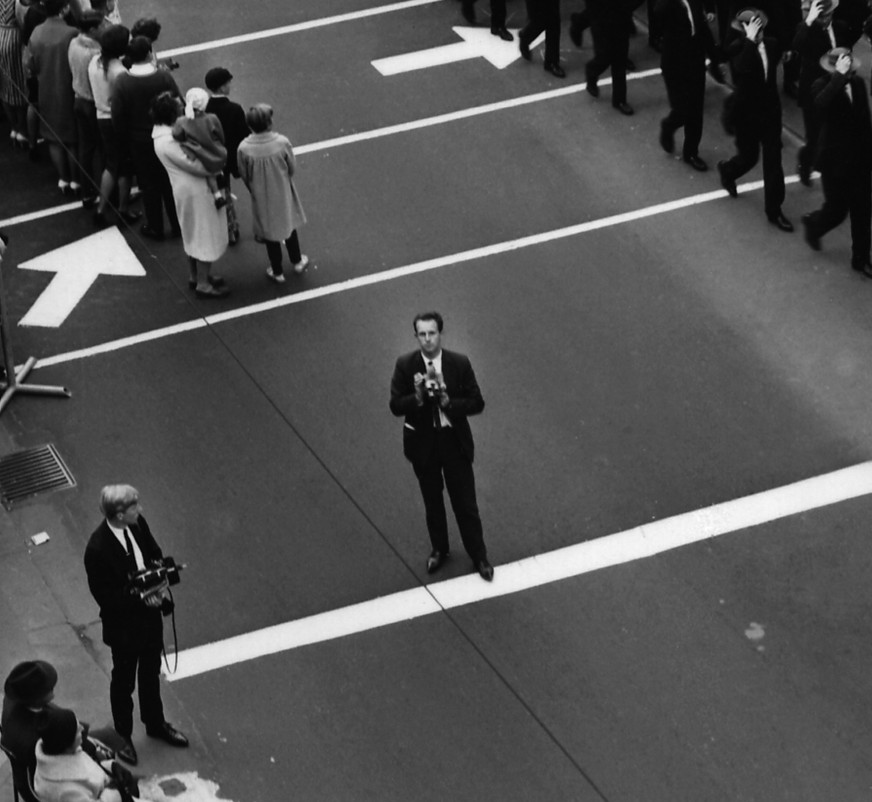
Only a very few photographs are candid, taken without the sitter being aware of the camera. Only three photographs (Ballet dancer, journalists, wife and baby) are taken on the street, the place where faces are in most contention. And in only one photograph is there an ‘audience’ within the photograph (NAIDOc Ball). These photographs stand out for me because they relieve the intense domestic privacy of the rest of the show. Quite a few photographs are taken at the beach, that other place of contention, but that has also been made a private almost domestic space by their framing. Similarly there are only a few staged or studio tableau shots.

Australian Photography as a whole

Australian photography dominated by prizes.

  1. National Photography Prize 25,000 1200 x 25 = $30,000 One in twenty chance of being picked.
  2. Doug Moran Contemporary Photography Prize SLNSW $100,000
  3. Head On Portait Prize ACP $50,000
  4. Albury Gallery acquisition Prize
  5. Monash Gallery Bowness Photography Prize
  6. Gold Coast Gallery Joseph Ulrick and Win Schubert Contemporary Photography prize

Curator Sarah Engledow — according to catalogue essay, has deliberately avoided the sensational or the gimmicky or the too arty, perhaps to contrast it against the Head On portrait prize. The dominant style seems to be an intense, basic sincerity. The overall themes that emerge are the family, and the stages of life

Winner is deliberately low key, non-gimmicky, but intense.

The Hang

The hang is given some coherency, as we follow from childhood to adolescence to old age, with a final room based on the eternal cycles of birth and death. This could be called a ‘Family of Man’ hang. Photography’s most famous show from the 1950s, where the metaphor of growing up in a family was applied to the entire human race.

Because these shows are selected from emailed jpegs, and it is up to the photographer to enlarge and print their photographs, there are often unfortunate errors of scale which have to accommodated. But fortunately in this show too big pictures and tacky frames are kept to a minimum with some exceptions:

Too big: Sisters; Les and Eileen

Too small: My ancestors, myself and my alternate

Just right: Donna Gibbons, Martin Smith

Too tacky: Robert; Vicki Lee and Bill Higginson

Successful walls:

Wall of patriarchs, good solid photography harking back to ‘traditional styles’ of say August Sander

Australian tableau photography in the 1980s

‘Australian tableau photography in the 1980s’, National Gallery of Australia photography symposium, 21 May, 2011.

1980s Australian Art Photography

Three formal techniques characterize 1980s Australian art photography: hand colouring, collage and tableau. I want to argue that these three things were determined by one underpinning factor: that the new art photographers of the 1980s were very aware that they were a new generation, succeeding preceding generations. I will also argue that these three techniques were infuenced by several key theoretical ideas which were widely influential at the time.

GENERATIONS

Let’s pick a date at random: 1984. The Australian Centre for Photography was one decade old. It is now almost four decades old. Specialist magazines like Photofile were widely read, and other magazines like Art Network regularly discussed photography; museums like the Art Gallery of New South Wales, the National Gallery of Victoria and the National Gallery of Australia regularly exhibited photography; and corporations like Phillip Morris, CSR and Polaroid all had Australian photography collections.

A previous generation of photographers, lets call them the ‘1970s’, had succeeded in establishing this infrastructure of art photography. In the decades before the 1970s — the 1960s — Australian art schools didn’t teach art photography much, commercial galleries didn’t sell art photography much, museums and collectors didn’t buy it much, and art magazines didn’t review it much. But in the 1980s they did.

The decade of change — the 1970s — was a decade dominated by the 35mm black and white snapshot. Of course there are some exceptions. Some conceptual and performance artists such are Robert Rooney, Tim Johnson [Johnson SLIDE] or Robert Owen did use photographs as a kind of ‘neutral’ recording tool for their performances or for their conceptual stratagems. And some photographers did work in colour or alternative techniques during the 1970s. Nonetheless the dominant paradigm was the snapshot. [Jerrems SLIDE]The snapshot was the way the 1970s generation defined themselves against the previous generation or primarily commercial and journalistic photographers. In 1978 the Australian’s reviewer Sandra McGrath took up the cause of the 1960s generation of commercial photographers who had been disenfranchised by what she termed ‘the great camera art explosion’.

‘’He’s a commercial photographer’ has overtones of — well he’s not that creative, or his work isn’t personal, or maybe it isn’t arty enough. It all seems a bit unfair. The usual photographic exhibitions in recent years have been obsessed on the “snapshot” generation, who in turn have been obsessed with photographing their pregnant girlfriends, party antics, bed-sitters, friends making love, shooting up or drinking beer. Everything has been photographed very casually, very intimately and very informally. It may be more appropriate to call this younger generation the Narcissus generation.’

If that was the 1970s, look how it had changed by the 1980s. The title of a project show curated by Gael Newton in 1981 summed it up. She called it: Reconstructed Vision: Contemporary Work with Photography. [Install SLIDE]The titles of other key books and exhibitions from the period continue this them, such as Kurt Brereton’s Photodiscourse from 1981 or the Virginia Coventry edited book, The Critical Distance, from 1985.The automatic vision of the snapshot was under interrogation, it needed to be broken down, rebuilt, and deliberately worked with. This new generation were not narcissists casually inhabited the medium, but self-conscious camera workers breaking their vision down from the outside.

IDEAS

What tools were used to reconstruct vision? Several potent ideas were circulating in Australia at the time, which were distilled from a much wider body of writing collectively called ‘theory’. In the art world of the 1980s these ideas, which were often quite simple, and extracted from larger and more complex, circumspect and philosophically embedded texts, gained an almost autonomous status as free-floating short-hand ideas, charged with contemporaneity and ready to be appropriated and applied to a wide variety of creative circumstances.

The Gaze

Laura Mulvey’s 1975 article Visual Pleasure and the Narrative Cinema, which was widely anthologised at the time, took the scopic structures of classical Hollywood cinema as the paradigm for the more general act of looking within patriarchal culture at large. Hollywood cinema gave pleasure to both men and women, but the pleasure it gave through the filming of its beautiful stars actually had encoded within it patriarchal ideology itself.

‘In a world ordered by sexual imbalance, pleasure in looking has been split between active/male and passive/female. The determining male gaze projects its phantasy on to the female form which is styled accordingly.’

Cameras therefore bore a gendered gaze, a look which turned women from active subjects to passive objects. This power was insidiously built into the very structure of camera vision. To resist patriarchy you must also resist the gendering power of the camera’s look. [Rrap SLIDE]At the opening of the decade Julie Rrap’s installation Disclosures: A Photographic Construct brought her own performed body directly in the line of fire of the camera’s gaze to provoke, ricochet, expose and deconstruct it’s role. As George Alexander said: Julie Brown-Rrap’s work is both a physical ordeal as well as a visual experience. As she acts out objectification, she displaces it.

[Hewson/Waker SLIDE]

Semiotics:

The semiotician Roland Barthes’ two key articles The Photographic Message and The Rhetoric of the Image from the early 1960s were translated into English and published in 1977, and were widely influential. Barthes mapped the science of signification from the linguistic realm onto the visual realm. Photographs became texts that could be interpreted and analysed, but only with a set of tools available to the cognoscenti. They now had two layers, the layer of denotation, still attached to the real, but on top of that, another layer, a layer of connotation, which was attached not to the real, but to culture and politics. A photograph of somebody was no longer just a photograph of somebody. It was a piece of that actual person transferred onto the paper, on top of which the rhetorical language of their pose, their clothing, their gesture, their background, their lighting, and the angle with which they’d been shot were all added. Moreover, the bottom layer of denotation worked to make innocent (Barthes’ potent word) the top layer of connotation. The cultural and political messages of various powerful interests were thus surreptitiously slipped into photographs that, if we weren’t careful, might appear to be reality itself! Luckily ordinary people had art photographers to protect them from the pernicious influence of these messages.

Precession of the Simulacra

This hyperbolic reading of the power of images was ramped up further by Jean Baudrillard. In 1983 one of his articles was translated by the Australians Paul Foss and Paul Patton and received its first global publication in English in Art & Text  magazine. In Baudrillard’s formulation the simulacra was not an inferior copy of an original and unique real, rather it is part of an infinite chain of simulation which the real itself had now become part of. The real was not the beginning point off this chain of simulation, it was now produced by simulation — the ‘precession of the simulacra’ of the article’s title. In this millenarian fantasy the real itself was so corroded by images that it had become, in Baudrillard’s words, a desert! Baudrillard said:

‘It is no longer a question of imitation, nor of reduplication, nor even of parody. It is rather a question of substituting signs of the real for the real itself, that is, an operation to deter every real process by its operational double, a metastable, programmatic, perfect descriptive machine which provides all the signs of the real and short circuits all its vicissitudes.’

What is produced by these significatory operations is hyperreality — a physical reality sheltered from any distinction between the real and the imaginary. The following year Baudrillard himself visited Sydney to a celebrity’s reception. At about the same time the Italian theorist Umberto Eco also visited Australia to a hero’s reception. His book Travels in Hyperreality was published in English 1986. It was a collection of old newspaper essays which took a playful anthropological look at various ‘hyperreal’ phenomena, particularly in America, like wax works and Disneyland.

The simulation machines of the 1980s were not only the wax works, theme parks and automata which Eco loved, but also: glossy magazines; movies; television (particularly live television broadcast via satellite); xerox machines and billboards. This media landscape was not dissimilar to the media landscape which had been the background of pop art in the 1960s. However forms of electronic and live media were becoming increasingly important, and the age of the personal computer was just on the horizon. The photograph was a cheap, efficient way to evoke and engage with all of these industrialized forms of simulation at the domestic scale of the photo artist.

Heady, apocalyptic theories such as these had a big effect on young impressionable photographers. In 1985 one of them overdosed on Baudrillard, and gave himself Marinetti-like delusions. He wrote:

We no longer feel any joy in camera vision. We no longer delight in the eye. Photographers were once ever alert to the new, the revealing, the penetrating. Not any more. No more vertiginous camera angles, no more witty compositions, no more frozen moments, no more timeless landscapes… Now our photographer’s eyes are numbed. The stroboscopic ‘shocks of recognition’, provoked by ‘decisive moments’ in time, have reached the frequency of a TV’s pulsation. … The photograph was once the function of a vertical thrust – a probing lens, a straining eye. Print clarity, lens resolution and artistic perception were all indices of this depth. …. All the photographs in the world have congealed to form a global, gelatinous skin. Photography is now not so much a window on the world as an oily film which coats it. …Current photographic practice has ceased to be defined by the vertical thrust entailed in the act of taking a photograph. It is no longer a series of individualistic probes. Now it is defined by the horizontal slide of the photograph’s infinite displacement and endless proliferation through reproduction. (A reproduction in which the mechanical and electronic exponentially multiply the photograph’s inherent reproducibility.) Now we blindly feel our way across the global, mobius surface of photography with the expectation of revealing nothing new. … We abandon vision in favour of the surface, penetration in favour of the survey. We invite the quotational, parodic and ironic to play across the photographic field.

Who wrote that? I think it might have been me. I wrote it for a sheet that accompanied a show called Killing Time at Mori Gallery which was curated by Bruce Searle and included Jacky Redgate, Anne Zahalka and Kendal Heyes, amongst others.

Aura

Another key philosophic term which was dislodged from it’s original context and made available for re-use in the 1980s was Walter Benjamin’ concept of aura. In 1936 Benjamin had argued that the magical value of the old fashioned authentically hand-made, original and unique work of art, it’s aura, which had worked away over centuries to kept the masses enthralled to the cult of art, was being stripped away in the modern epoch by mass-consumed and mechanically-reproduced photographs and films. Yet photographers in the 1980s remained enthralled by the aura. Supposedly a redundant bourgeois value, it nonetheless remained fascinating and seductive, particularly for those working in mechanical mediums. Could an aura be remanufactured, or at least simulated, within the very medium that was supposed to destroy it?

Despite the power of these ideas of the gaze, the simulacra, hyperreality, the aura and visual rhetoric, the photographers of the 1980s continued to be very interested in the Real. Not the real directly — the personal narcissism of the 1970s snapshooters in their bedrooms and at their parties — but the overarching narratives of reality. I will show that the narratives which most concerned them were identity narratives, particularly Australian identity, subcultural identity, and gender identity.

TOOLS

Three techniques were used in response to these ideas: handcolouring, collage and tableau. Each was reconstructive, each signalled a generational break with the snapshooters of the seventies, while also signalling an allegiance to both longer histories of critical resistance and to larger bodies of ‘authentic’ art production.

Collage

Collage bore the most explicit allegiance to social and cultural critique. We had all been taught about John Heartfield’s anti-Nazi montages at art school, and the German collage artist Klaus Staeck, a second generation Heartfield, was exhibited at the first WOPOP conference in Melbourne1980. [Staeck SLIDE]

Collage directly intervened in the smooth media flows of books and magazines. All you needed were scissors and glue and a retouching brush. Significantly, these were the first tools to be the most frequently used from the Photoshop palette when it finally came along ten years later in the early nineties.

In 1980 Anne Zahalka played with kitsch images of Australiana in her series Beautiful Australia, [SLIDE] as did Midnight Oil four years later when they used an apocalyptic collage by the Japanese artist Tsunehisa Kimura for their album Red Sails in the Sunset. [SLIDE] Zahalka also used collage to reinscribe received Australian historical narratives. [SLIDE] In The Immigrants she used family snapshots to write the post-war migrant history of her family into McCubbin’s anglo-colonial painting The Pioneer. In collaging iconic imagery, works such as these appropriated some of that iconic imagery’s residual political and cultural power.

Handcolouring

Less explicit, I think, were the historical links that handcolouring had to women’s practice in the industrial photo studios of the earlier part of the twentieth century. But in Robyn Stacey’s hands handcolouring went from a feminizing, hand crafted application of nurturing care directly onto the surface of the print as object, [SLIDE] [SLIDE] [SLIDE] towards a more hyperreal mediatised space, as she used punkish flouro colours [SLIDE] [SLIDE], or reshot her handcoloured images and reprinted them on glossy Cibachrome paper. [SLIDE] [SLIDE] The handcolouring was therefore shifted from the personal register, where it had been in the 1970s, to the mediated register. From the physical to the virtual.

This technique introduced another element into the mix, historical genre. Historical genres were amateurised and domesticated, taken from the control of industrialized media production and overarching historical narratives and given idiosyncratic and personal meanings. Other photographers, such as Fiona Macdonald, also produced series, without hand colouring, which nonetheless recreated familiar media genres in a deliberately lo-fi way. [SLIDE] [SLIDE] To a certain extent there was an element of retro-hipsterism in this play with genre, but also a recognition that genre meant power and that there was a politics in you controlling genre rather than it controlling you. Robyn Stacey’s retro handcolouring looked great on the covers of Died Pretty records, [SLIDE] [SLIDE] [SLIDE] but it could also construct historical allegories when, for instance, it was reproduced during 1988 the Bicentennial year in the book Island in the Stream in a work called Modified Myths. [SLIDE] [SLIDE] [SLIDE] [SLIDE]

The Cibachrome print with its hard metallic duco was the perfect print-medium for the period. It was as far as possible as you could get from the Kodak tri-x film D76-developer print of the 1970s, and as close as you could get to glamour and spectacle and artefactual ‘aura’ on a tight budget. It did, however, restrict the scale of the print; and scale, how to get as much of it as possible, was something which all photographers at this time struggled with. Sometimes the need for scale drove photographers back to black and white to get the size they wanted, for example in Jacky Redgate’s magnificent cornucopia image, which seemed monumental at the time. [SLIDE] When the Polaroid corporation brought out their massive Polaroid camera that took 50 x 60 cm unique polaroids, photographers such as Fiona Hall, Anne Zahalka, Robyn Stacey and Debra Phillips got the opportunity to make giant polaroids. [SLIDE]

Tableaus

But of course the leitmotif of the period was the tableau. [Zahalka SLIDE] No other visual tactic sums up the period as succinctly as the tableau. At the time I think the tableau artist were largely unaware of the long history of tableaus in photography and lantern-slides, except for the famous examples of Oscar Rejlander and Henry Peach Robinson. Their tableaus leapfrogged these more immediate histories and gave them access to visual rhetorics drawn from the history of western painting that had been absorbed as a kind of collective unconscious into mass media imagery.

Tableaus and techniques like handcolouring could be used to manufacture a kind of photographic aura. As Catriona Moore wrote in the catalogue Pure Invention, a show of women photographers, including Robyn Stacey and Jacky Redgate that travelled to Japan, faking aura could be a form of feminist empowerment:

Our feelings are prompted by the attention these photographs give to technique, stage-craft, masquerade. This work has an almost tactile, artisanal or sculptural quality, built through an association with cinematic, painterly or theatrical forms. Mechanical reproduction here paradoxically invests an almost carnal aura of hitherto denigrated or low-life popular cultural signs. The complicitous spectator appreciates this ‘faked’ auratic quality. We too take centre-stage to feign a [past] connoisseurial glory, an immersion and abandonment to the seduction of palpable surface effects and stylish mise-en-scene. We recognise well-known codes and gambits of glamour, and appreciate our own informed sensibility.

[Ferran SLIDE] Tableaus referred both to the weight of western visual patrimony via the prestige of painting, as well as to the dominant media for the twentieth century imaginary, cinema. As Adrian Martin wrote in an article about Scenes on the Death of Nature in a 1986 Photofile, tableaus could slow down the heady onrush of media imagery:

Tableau based work is curious and paradoxical: we witness films slowing down to, desiring to emulate the still photograph, and literally trembling with the tension required: and we gaze at photos in a perpetually frozen moment of torsion as if trying to animate themselves in order to take their place as simply passing frames in some unknown, imaginary film.

As well they could evoke supposedly timeless myths:

the question today is… what can you know with the movable (not immutable or originary) structures of myth? Modern culture is full of strategic ‘drifts’, from the rewritings of mythic fiction…that choose not to adopt the regressive mode of ‘return’ to a before-and-beyond. Myths told in the present are (whether they know it or not) of and for the present.

Anne Ferran herself agreed. She said:

The idea was not to claim any power of resistance for these images but to go the other way, to make them overtly passive and unresistant to see what effect that would have. One of the problems to be dealt with is whether these pictures are literally passive and compliant or whether they are (instead/also) somehow about passivity and compliance. Whether they are exactly what the pretend to be or something else as well.

Not all tableaus of the period relied on a manufactured aura, or shifted questions of desire into a rhetorical space. Some, such as Judith Ahern’s magnificent Cowboygirl were, while being allegorical, also just as immediate and painfully autobiographical as well. [Ahern SLIDE]

Other tableaus more explicitly referred to film. In 1985 Kendal Heyes, Anne Zahalka, and two others (Joy Stevens and David James) held an exhibition of Cibachromes at Artspace. To our eyes now these Cibachromes look quite small. They were shot in a studio with a rear projected 35mm slide, with the figures in the foreground also being lit by slide projectors. In a period before the self-equalizing digital image the projector’s hotspot gives each image a wonderfully groggy, gluggy, overheated feel.

Anne Zahlka’s Tourist as Theorist (Theory Takes a Holiday) [SLIDE] [SLIDE] [SLIDE] [SLIDE]  used the artificiality of the tableau and it’s seqentiality to visually ‘theorize’ the hyperrerality of tourism —where the simulacrum of the glossy colour brochure precedes the real experience of jostling crass crowds. Zahalka wrote: ‘In an attempt to possess, to appropriate, the tourist photographed the sight, was photographed with the sight, brought souvenirs and postcards, but was never able to fully accede to its pure presence’.

Kendal Heyes’s series From a Shipwreck [SLIDE] [SLIDE] [SLIDE] [SLIDE] [SLIDE] was made up of: ‘philosophical fragments, metaphorical figure by some of my favourite authors, brought together in ‘set pieces’ from a hypothetically completed text, a movie.’

As I concluded in my catalogue essay to the show:

‘Photodramas’ does not attack photography or film. It is not avant-garde, nor revolutionary. Rather it seeks to both loosen and rupture traditional cinematic and photographic modes of reading. The viewer is invited to inhabit the fissures and travel the faultlines of these ruptures, to read the stories without being their subject, to view the photographs without being the camera’s eye. In fact, to be the worst possible audience — interested but obstreperous.

COMPARISON BETWEEN NOW AND THEN

[Mental as Anything SLIDE] How are we different to those strange creatures from long ago, back last century in the 1980s, those ancient photographers with their crazy ideas and theories of everything. I would like to conclude by making some extremely broad and sweeping generalizations, to which you will all be able to immediately think of exceptions I know. But I will make them anyway.

They were historically conscious. We aren’t.
They were concerned with the past as a presence and a force in the present. We aren’t.
They were interested in photography as a discipline and a medium. We aren’t.
They read books that seemed to be of the moment and attempted to put what they read into action. We don’t.
They thought of themselves as a new generation, not necessarily avant-garde or radical, but definitely a new generation succeeding the previous ones. Our young photographers no longer do.
They thought of themselves as Australian, not in a parochial or nationalistic sense, but in the sense that they were concerned with the problem of Australian identity, or with the problem gendered, racial and sexual identities within an Australian context as much as a global context. We no longer worry about ‘Australianness’ in that way.
They were more suspicious than we are.
They were suspicious of pictures of the body. There are very few bodies in this period. With the obvious exception of Bill Henson few photographers photographed bodies. The body was generally displaced during this period. [Fereday SLIDE] It is often evoked through metonymic substitutes for it, folds of red drapery being a favourite. [MacDonald SLIDE] When bodies did appear, such as in the work of Julie Rrap, it was in a clinical laboratory of the gaze for the purposes of auto-critique. [Rrap SLIDE]
They were suspicious of public spaces. They didn’t go out much with their cameras. Public spaces and landscapes were often displaced into the studio. [Zahalka SLIDE] The kept to their studios and handled a lot of the issues of the day not directly, but by proxy.

Thank You

Martyn Jolly

Present Tense: An Imagined Grammar of Portraiture in the Digital Age

‘Present Tense’, National Portrait Gallery, Real Time Media Arts, August, 2010

National Portrait Gallery Until 22 August

What has become of the genre of portraiture in the digital age? What actual works have artists made in response to that vague list of usual suspects we all automatically reel off whenever contemporary media technologies are mentioned: social networking sites, mobile phone cameras, 3D scanners, rapid prototypers, tomography, and on-line avatars? This show answers that question with a diverse collection of strong works by twenty-seven well-established Australian and international artists, which are installed with intelligence and wit. It’s good to see a show of photography and digital media which has been fully thought through and tightly selected by a proper curator, Michael Desmond, who has a broad knowledge and an international horizon. This show is a refreshing change from those loose surveys ‘around’ themes which appear to be chosen mainly for their convenience, or even worse, those ubiquitous but lazily conceived competitions which we get too often.

A good way of looking at the show as a whole is that it is about the interaction of new technologies with the traditional methods of portraiture — painting, sculpture and photography — which already have their own pre-established ‘grammars’. Thus we have Jonathan Nichols’ flat, though engaging, paintings of young girls, each with a slight air of ambiguous familiarity. But wait, these aren’t paintings of the girls themselves, but of their Facebook thumbnails. The tug we feel is not towards their offering of themselves to us as individual viewers, but the offering of themselves to the generalized gaze of the world wide social network.

In another breathtaking remodalization of an old technology, both Chuck Close and Aaron Seeto work with daguerreotypes, that primeval photographic process where all of photography’s uncanniness seems to manifest itself most magically. From the point of view the twenty-first century, Close’s daguerreotyped heads and bodies remind the viewer a bit of a holograms. And as viewers move their head from side to side to get the right angle, and the image wells up from the visual depths like a surfacing whale, that familiar tingle up the spine they get, that simultaneous feeling of proximity and distance, is no longer configured historically — back into the depths of the mid nineteenth-century — but existentially, from one human presence to another. In contrast, Aaron Seeto’s daguerreotype translations of right-click grabs from web reports of the 2005 Cronulla Riots make a more overt, even arch, point about the permanence and impermanence, the legibility and illegibility, of historical memory when it is entrusted to the oceanic swirls and currents of the internet.

The viewer has to do fair bit of head wiggling in this show. Installed across from the daguerreotypes there are two anamorphic skulls, both referring to the Holbein’s famous vanitas intervention at the bottom of his 1553 portrait of The Ambassadors.  In a diptych the painter Juan Ford bravely confronts an X-Ray of a skull. From our point of view, in front of the diptych, the skull is safely distorted and in another space. But, we realize, from his point of view within the diptych it would be restored to its correct, archetypal shape of warning and fear. The American Robert Lazzarini’s anamorphic skull is a life-size three-dimensional sculpture made of actual bone material embedded in resin. As we circle warily around, it fleetingly looms out of its anamorphic parallel universe and into our own.

In a similar way, the faces of Justine Khamara’s angry and surprised parents suddenly pop out at us when we stand directly in front of the bulging aluminium constructions on which their flat images have been printed. It is the viewer’s exact position at the apex of the constructions which animates them, seemingly jolting them out of some kind of two dimensional repose.

This show foregrounds the fundamental image-making actions which have now become proper to contemporary portraiture. No longer just the snap the of camera’s shutter or the incremental description of the painter’s brush, but now also the trundling progress of the flatbed scanner and the circular pan of the 3D scanner.

Stelarc, in classic techno-narcissist style, stretches the skin of his head across a flat acrylic table that measures 1.2 times 1.8 metres, to invite us to delectate on every one of his pores and bristles. The German artist Karin Sander makes exact, three dimensional, indexical sculptures of her subjects at one-fifth scale by using three-dimensional scanning and rapid prototyping technology. What are these mini-thems? Three-dimensional photos? Optical clones? Plastic avatars? Whatever they are, one isn’t enough. I found myself wanting the artist to be true to her namesake, August Sander, and methodically create an army of miniature German people.

In contrast to the indexical, technologically produced three dimensional portrait, the Korean artist Osang Gwon takes hundreds of small photographs of every inch of her young, punky, Korean subject, and glues them on to hand-carved life-sized Styrofoam figure in a loose collagistic style. This produces a strong but unstable sense of the physical presence of her subject, as if her skin and clothes, and indeed her whole persona, is on the verge of peeling away with nothing left beneath.

There are plenty of hits of humanist sympathy to be had from this show. In 2008 the Dutch artist Geert van Kesteren collected mobile phone shots SMSed out of Iraq and Syria. Enlarged, framed and gridded up the wall, these ephemeral and off-the-cuff of images become a monumental document of geo-political conflict where snapshots of happy family gatherings and friends at play, sit insouciantly beside shots taken out of the windows of moving cars of dead bodies by the road or the interiors of burnt out houses.

The masterful Dutch photographer Rineke Dijkstra provides the emotional centre of gravity for the show. Her simple nude photographs of startled young mothers clutching their newborn babies like bags of shopping about to burst remind us again of the power of the straight photo. But her stunning two-gun video installation, The Buzzclub, LiverpoolUK/Mysteryworld, Zaandam NL, also from the mid-nineties, confirms the pre-eminence of the video portrait. Dijkstra has, presumably, momentarily pulled young off-their-faces clubbers straight from the dance floors of the two clubs and put them in front of her video camera in a bare white space off to the side. But the laser lightshows and the duff duff are obviously still going on inside their skulls. As they continue to work their jaws and jig robotically we get full voyeuristic access to them and, even though their interior individualities have temporarily gone AWOL, we nonetheless feel an extraordinary tenderness welling up for them.

The theme of interior and exterior slowly emerges as a thread in this show. For instance Scott Redford videoed fellow artist Jeremy Hynes performing a private, improvised homage to Kurt Cobain by writing his name on a cigarette and inhaling its now transubstantiated smoke deep into his lungs, before sobbing with genuine loss and longing. In a sucker punch for the attentive reader of the catalogue we learn that Jeremy Hynes was himself killed in a road accident a few months after the video was shot. Across the way from this projection is Petrina Hicks’ Ghost in the Shell where we silently circle around a pure, innocent young girl — or perhaps she rotates before us? Then, ever so discreetly, ever so elegantly, a tendril of smoke or mist escapes from between her lips. Her spirit? Her soul? Just her ciggy smoke? She just continues to rotate without answer.

In the end this is a humanist show, about ghosts more than shells. It argues that despite all of the cold digital technology in the world portraits are still about the promise of finding the warm interior of a person via their exterior. The show’s inclusion of some three-dimensional ultrasound images of foetuses in the womb could have easily been over-the-top and obvious in its point about our intimate adoption of new imaging technologies. Until we see one intrauterine image of twins in which one foetus is caught sticking its toe into the eye of its sibling. A rivalry which, we think to ourselves, will no doubt continue for the rest of their lives.

Martyn Jolly

Martyn Jolly is Head of Photography and Media Arts at the Australian National University School of Art.

Photographies: New Histories, New Practices

Foreword for unpublished book based on PHOTOGRAPHIES: NEW HISTORIES, NEW PRACTICES conference at ANU

As a discipline, the history of photography has undergone significant transformation in the past few decades. It has long since overflowed the channels of traditional art history which it first followed. and has now become concerned with more than establishing the canonic artists of the medium, or tracing the teleologies and genealogies of its visual styles or artistic genres. Scholars in disciplines as diverse as anthropology, history and cultural studies have found many uses for photographs and much to explore. Since the early 1980s these developments have been chronicled in such signal articles as Douglas Crimp’s ‘The Museum’s Old / The Library’s New Subject’.[1] It could be argued that the particular ubiquity of photographs has driven the whole ‘pictorial turn’ in philosophy where, as W. J. T. Mitchell describes it, ‘pictures form a point of peculiar friction and discomfort across a broad range of intellectual enquiry … emerging as a central topic of discussion in the human sciences in the way that language [once] did …’.[2]

This broad pictorial turn in the humanities has been complemented by a cultural and social turn in the history of photography itself. The histories which are now most commonly referred to by photography students, such as Mary Warner Marien’s Photography: A Cultural History or Michel Frizot’s A New History of Photography, tend to follow the innovative model established by books such as Giséle Freund’s Photography and Society, with its separate sections each tackling a different aspect of the medium, rather than once classic texts such as Beaumont Newhall’s History of Photography, with it cumulative teleology of styles and techniques.[3] Current photographic histories approach the problem of photography from a variety of different directions, and discuss the medium by taking different slices through it, or core sample from it, rather than telling it as a unified story. Chapter headings in generalist histories of photography are now more likely to be conjunctive phrases such as ‘Photography and War’, Photography and Science’, or ‘Photography and the Body’, rather than the bald labels of particular genres or periods within photography. Another new approach to photographic history, exemplified by Singular Images: Essays on Remarkable Photographs, is to focus down to a small selection of key images as the starting points for broader investigations into the various ideas that every photograph mobilises.[4]

Anthologies such as Christopher Pinney and Nicolas Peterson’s Photography’s Other Histories have gone even further towards breaking apart the pre-given mold in which photographic history has been cast.[5] In books such as these, photography is a powerful cultural practice performed differently by different cultures, at different times, and in different private or public contexts. It produces meanings which are far from being self-evident or universal, but which can nonetheless empower cross-cultural dialogue. Other anthropologically orientated anthologies, such as Elizabeth Edwards’s Photographs Objects Histories: On the Materiality if Images, have focussed not on photography as an ever-widening pool of images, but the photograph itself as a discrete anthropological artefact.[6] This shift of critical focus away from interpreting the visual content of images towards understanding the social exchange of images as objects, is characteristic of recent photographic scholarship.

Perhaps this shift has been accelerated by the fact that photography has finally ceded to new media its position as the ultimate medium of theoretical contemporaneity. Several decades ago the photograph, with it ubiquitous presence throughout culture and society, was the very sign of contemporary experience within cultural theory. Now the explosion of new media has eclipsed it. But even within new media the single photograph survives, pretty much in tact, as an absolutely crucial and fundamental component of the accelerated trajectories of mobile and on-line technologies. Today photographs are taken in their billions to be emailed or uploaded, but in the nineteenth century they were also taken in their hundreds of thousands to be circulated amongst individuals. The discourses generated by new media therefore continue to owe much to the history and theory of photography, while the study of photography itself continues its close attention to the continuing reality of photographs in our lives.

None of the disciplines that have recently turned to photographs for new sources of meaning have been able to use them as simple, unproblematic evidence for historical research or cultural discourse. Photographs are, and remain, not just slippery semiotically, but also ambiguous ontologically; so their simultaneous status as historical documents, physical objects and time events continues to be explored and re-explored by a widening range of theorists, philosophers and writers. Even literary writers are undergoing a photographic turn. Photographs have become literary objects, as much as artistic objects, found in novels as well as in art galleries. The photograph has long been used as a figurative metaphor or a plot device for novelists exploring the memories or desires of their characters, but now actual photographs are being used, not as extraneous ‘illustrations’, but as textual operators. W. G. Sebald is the most famous of a range of writers who have recently used the deadpan allusiveness of the photograph as an integral, if not entirely comfortable, component of their texts, to be read by the reader in the same poetical mode as the words in which they are embedded. Sebald’s literary photography is now even beginning to have an impact back onto art photographers.[7]

Photographs have therefore been the grist to many mills. They have given rise to an extraordinarily rich and varied quantity of research, writing and speculation — from historical research to imaginative creative writing — in an extraordinarily diverse range of theoretical contexts. Photographs are convenient because there is no shortage of them and they are all around us all the time. Nothing is simpler than plucking some out and turning them to work. But often in this work the photograph itself is considered with only enough attention to make a larger point, before any further investigation of it is dropped. The specificity of the individual photograph itself, along with all of its attendant uses and re-uses over time, its transformations and modifications as both physical object and mobile image, are often left far behind. The meanings of particular photographs have formed a key currency of critical thought in disciplines such as history, cultural studies, anthropology, and so on. But once those meanings get caught up in the theoretical streams within whatever discipline they are serving, they sometimes seem to flow over and around the actual photographs themselves, forming larger currents that, through their own dynamic turbulence, obscure the original objects beneath.

Lately, however, a wider and wider range of scholars are turning back to the photograph itself, as both a semiotic event and a material artefact. They work from the photograph up, rather than the theory down. They do this not to re-invent some kind of connoisseurship of the artefact, or to reduce the image to a static collection of facts, but to assert that much remains to be learnt by returning as often as possible to the source of photographic meaning, which is not just particular photographers, nor just particular reproductive technologies, but both of them together. Photographs are dense complex things in their own right, and these scholars want to slow our attention down to give that density its due. Each of the authors, irrespective of their interest or approach, have been primarily driven by the particular qualities of particular photographs. This turn to the specificity of the photograph itself is the first of three themes which run through the chapters in this book.

For instance, Geoffrey Batchen’s research re-embeds photographs in the context that gave rise to them in the first place, which is never just the rarified thoughts and feelings of the photographer, or their visionary ambition, but often complex commercial imperatives and technological realities. From this basis he has been able to propose an alternative model of photographic history which puts photography as work at its centre. In discussing the rivalry between Talbot’s photographic business in Reading which used his own process, and the first studios in London which licensed the daguerreotype process, Batchen establishes that photographs are never just the product of one local context, they were always, right from the moment of their origin, embedded in international currents.

As well as the importance of a close attention to the photograph as object, the currents through which these photographs circled the globe form the second dominant theme of this book. But in addition, we shift the focus of these global currents southwards, away from the dominant presence of Europe and America as the site for photographic history, towards Asia and the Pacific. For too long the photography of these regions, where the global politics and social change of the last two hundred and fifty years has been at its most raw and intense, has only been seen reflected in the mirror of European and American photography. Questions were often framed merely in terms of how Asia and the Pacific changed European and American photographers as they passed through the region, or how the careers of Asian and Pacific photographers could be stitched into larger global narratives generated in Europe and America. The writers in this collection are not interested in such an approach because they start from specific photographs in specific contexts.

Ken Hall, for example, starts with an almost forensic examination of a partially obscured inscription on an early studio group portrait depicting a British colonist settler and a group of South Island Maori, and then proceeds to open the image out to a large and complex story. John L. Tran looks at Taisho Pictorialism, a Japanese strain of the global Pictorialist movement, which used Pictorialist nostalgia to help construct an emerging Japanese identity. Likewise, Victoria Garnons-Williams casts a new and surprising light on the well-known Grafton Aboriginal portraits of J.W. Lindt. These images have long circulated in Australian history almost as icons of the colonial treatment of Aborigines. However Garnos-Williams returns to their source in Grafton, to the almost microscopic surface of the photograph itself. Other chapters read and analyse well-know photographs with an unprecedented closeness, and with an unprecedented access to the original context of their production to offer new and more complex understandings. For instance Shelley Rice’s survey of the evolution of political directorial photography and masquerade within American photography, and its complex relationship to photography’s more usual ‘documentary’ and touristic function, is given even more complexity in terms of the globalised currents of identity politics when photographers such as Australia’s Fiona Foley and Samoa’s Shigeyuki Kihara are added to the discussion.

These chapters reflect the recent burgeoning scholarship from Australian and New Zealand Universities, and reveal the fresh perspectives that are still being opened up by the close reading of key photographs and collections. For instance through Tim Smith’s detailed work on the glass plates of the photographer Paul Foelsche, a more complete understanding of the circumstances behind the photographs emerges which complicates the historical narratives they have previously been used to justify. Max Quanchi analyses a large collection of postcards from four Pacific colonies in the late nineteen and early twentieth centuries. His quantitative analysis of the various categories of subject matter, as well as his analysis of individual images, reveals a unified visual construction of the colonial world which was posted back to various metropolitan centres, irrespective of whether the colonies were German, British, French or Australian.

In a more poetic meditation on the ontology of photography, Australian novelist Gail Jones, who is well known for using the idea of photography as an element in her fiction, considers the encounters with portrait photography of a wide range of writers, from Henry James to Don DeLillo. All of her literary sources have responded in various ways to the subtle, yet compelling mysticism of photographs, which for them comes from the ambiguous and mysterious relationship in each of the images they encounter between fixity and flux, presence and absence.

In this final chapter Jones homes in on what has emerged as a third major theme of this book: that is, that the return to the specificity of the photograph as object, and the increased attention to the networks and flows in which those photographs are embedded, only brings us closer to the photograph’s ultimate ineffability. No matter how forensically close we get to actual images, to the faces and the eyes of their subjects, and no matter how detailed and sophisticated our analysis of the specific conditions of their production and dissemination, it is still the narrow but unbridgeable fissure between reality and the uncanny copy of that reality that drives our fascination with the photograph. As Jones quotes Giorgio Agamben, the photograph remains the site of a gap, a ‘sublime breech’ between what we can see and what we can know.

Martyn Jolly and Helen Ennis

Crimp, D. (1989). The Museum’s Old/The Library’s new Subject. The Contest of meaning : critical histories of photography. R. Bolton. Cambridge, Mass., MIT Press: xix, 407 p.

Edwards, E. and J. Hart (2004). Photographs objects histories : on the materiality of images. London ; New York, Routledge.

Freund, G. (1980). Photography & society. London, Fraser.

Frizot, M. (1998). A new history of photography. Köln, Könemann.

Marien, M. W. (2006). Photography : a cultural history. London, Laurence King.

“This survey of international photography, which examines the discipline across the full range of its uses by both professionals and amateurs, has been expanded and brought up to date for this second edition. Each of the eight chapters takes a period of up to forty years and examines the medium through the lenses of art, science, social science, travel, war, fashion, the mass media and individual practitioners.”–BOOK JACKET.

Mitchell, W. J. T. (1994). The Pictorial Turn. Picture theory : essays on verbal and visual representation. Chicago, University of Chicago Press: 11 – 34.

Newhall, B. (1997). The history of photography : from 1839 to the present. New York

Boston, Museum of Modern Art ;

Distributed by Bulfinch/Little Brown.

Patt, L., Dlilbohner, et al. (2007). Searching for Sebald : photography after W. G. Sebald. Los Angeles, Calif., Institute of Cultural Inquiry.

Pinney, C. and N. Peterson (2003). Photography’s other histories. Durham, Duke University Press.


[1] Crimp, D. (1989). The Museum’s Old/The Library’s new Subject. The Contest of meaning : critical histories of photography. R. Bolton. Cambridge, Mass., MIT Press: xix, 407 p.

[2] Mitchell, W. J. T. (1994). The Pictorial Turn. Picture theory : essays on verbal and visual representation. Chicago, University of Chicago Press: p13.

[3] Marien, M. W. (2006). Photography : a cultural history. London, Laurence King.
Frizot, M. (1998). A new history of photography. Köln, Könemann.
Freund, G. (1980). Photography & society. London, Fraser.
Newhall, B. (1997). The history of photography : from 1839 to the present. New York Boston, Museum of Modern Art ; Distributed by Bulfinch/Little Brown.

[4] Howarth, Sophie, (Ed.) (2006) Singular Images: Essays on Remarkable Photographs, New York, Aperture

[5] Pinney, C. and N. Peterson (2003). Photography’s other histories. Durham, Duke University Press.

[6] Edwards, E. and J. Hart (2004). Photographs objects histories : on the materiality of images. London ; New York, Routledge.

[7] Patt, L., Dlilbohner, et al. (2007). Searching for Sebald : photography after W. G. Sebald. Los Angeles, Calif., Institute of Cultural Inquiry.

Equivalent to What?

‘Equivalent to What? Alfred Stieglitz’s Clouds in Context’, Art Gallery of New South Wales Alfred Stieglitz Symposium, June 19, 2010

‘A generation that had gone to school on a horse-drawn street car now stood under the open sky in a countryside in which nothing remained unchanged but the clouds, and beneath these clouds, in a field of force of destructive torrents and explosions, was a tiny, fragile human body.’
Walter Benjamin The Storyteller, 1936

In Walter Benjamin’s remarkable image of post-war Europe the indifferent aerial nature of the clouds serves as a figurative contrast to the cataclysmic historical changes on the ground. But today I want to argue that, contrary to Benjamin, the clouds did in fact change in the early part of the twentieth century. They didn’t change meteorologically of course, that would take another seventy years, but what they meant to those who gazed up at them and photographed them, that certainly did change.

In fact, the ways in which clouds were perceived had been changing for a hundred years even before the destructive torrents of the early twentieth century. In the early1800s the scientist Luke Howard began to paint watercolours of the clouds in order to classify them. In his 1803 Essay on the Modification of Clouds he applied a Linnaean system to their ever-changing shapes, naming three main cloud types: cumulous, cirrus and stratus.

His extraordinarily popular work informed romantic painting and poetry. Percy Bysshe Shelley’s 1820 poem The Cloud reproduces the newly-discovered scientific knowledge of cloud formation, while also animistically linking clouds to the eternal but ephemeral verities of birth and death, construction and destruction. The final stanza reads:

I am the daughter of Earth and Water,
And the nursling of the Sky;
I pass through the pores of the ocean and shores;
I change, but I cannot die.
For after the rain when with never a stain
The pavilion of Heaven is bare,
And the winds and sunbeams with their convex gleams
Build up the blue dome of air,
I silently laugh at my own cenotaph,
And out of the caverns of rain,
Like a child from the womb, like a ghost from the tomb,
I arise and unbuild it again.

By the twentieth century this romantic vision had become commonplace in popular culture.

One fan of Percy Bysshe Shelley was the Blue Mountains photographer and printer Harry Phillips. Phillips was a publisher of tourist view-books about the beauties of the mountains, and in 1915 he published one which illustrated every stanza of Shelley’s famous poem. The book was simultaneously a tourist souvenir and a deeply felt personal statement. And it reveals clouds, and his interpretation of what they might mean, as being central to Phillips’ life. In the book he also printed his personal testament, Clouds in my life and how the were dispelled, in which he recounted in detail his peripatetic life as a journeyman letterpress machinist over twenty years, during which time he strayed away from God and fell into drinking, before being converted into the Baptist Church, givng up the grog, and finding peace in the Blue Mountains.  The Mountains provided him with evidence of the inseparable mingling of Spiritual phenomena and natural phenomena. For instance once, while photographing the mist rising out of a valley early one morning, the rising sun suddenly cast his shadow onto the cloud as it rose up before him. Phillips said:

‘I stood spellbound. Before me, about 200 feet away, a figure stood upright, and encircling the head was a beautiful rainbow-coloured halo. I had my camera under my arm, but my thoughts were too fully occupied with the realization of the possibility of Christ having a halo round his head when on earth. Twice since, with others, I have seen our own shadows cast down into the valley of mist, with rainbows or halos round our heads, but these were not so convincing as the first figure I had seen standing upright over the top of the a Blue Mountains.’

So, for Phillips, the Blue Mountains provided proof positive that if sunlight, shadow and clouds could produce a natural halo, then Christ could have worn a halo while he was on Earth.

An even more startling revelation, and an even more specific message, came from another image Phillips photographed, this time in the late afternoon, rather than the early morning. As he reported in The Cloud:

… on March 25th, 1909, whilst fully conscious of the presence of Christ, I took a photo of a remarkable sunset scene. Three large black clouds were drifting about as if sparring for certain places. For some time it was impossible to take the photo, owing to the glaring of the sun into my lens; but immediately one ominous looking cloud obscured the sun I made my exposure, and secured the now remarkable picture called ‘War Clouds’. Rushing to my dark room, I developed the plate, and was then fully aware that it was a sign that I had to deliver to the proper authorities.

He posted copies to Lord Kitchener, the King, Lord Roberts and Sir George Reid. Telling them that the clouds were a sign that there would soon be a war with Germany. He did not hear if the parcels were received, but felt confident that they were.

When Lord Kitchener was in Australia on his tour of inspection and preparation for possible invasion, I posted some copies to him, one of which was marked explaining and showing the representatives of the several nationalities. I also sent him several other cloud pictures to show that the one was a most unusual effect. Then again, shortly before the coronation of King George, I posted to Sir George Reid in London a large parcel containing books of views and several cloud photographs; also three 15 x 12in enlargements of the ‘War Clouds’, one each to the King, to Lord Roberts and to Sir George Reid. I marked another photo for identification, and wrote a guarantee on the back of it, stating that it was absolutely free from faking or retouching in any way, and that I felt quite sure that it was a sign that there would soon be a great war with Germany. I did not hear if these parcels were received, but feel confident that they were.

Phillips described in enormous detail the specific prophecy the clouds held:

Directly in the centre of the photo, and obscuring the sun, is a cloud resembling the German Eagle poised with outspread wings. Securely clutched in its talons is a figure that appeared to me to represent Belgium. The eagle’s head is turned to the right of the picture, looking defiantly at the second black cloud, which represents the British Lion. Between the eagle and the Lion is a light spook-like cloud symbolising the War Spirit. It is facing and looking down on the Eagle as if pondering whether to wedge itself between England (the Lion) and Germany (the Eagle) or to withdraw and let them wage war upon each other. England and Scotland are represented in one cloud, the latter by a fully clad Scotchman, who is anxiously looking to see what Russia’s representative, the Bear, will do. On top of the third black cloud is a chicken or ‘young Turkey’.  Directly beneath the Scotchman’s knee is an anxious face looking towards the German eagle. Does this represent Ireland. Turn the picture upside down and on the other end of the black cloud and almost muzzle with the Russian Bear is the head of a Leopard. The Leopard is used prophetically as a type of the Grecian Empire and of the anti-Christian power (Dan. Vii.6; Rev. xiii. 2). Turn the picture right way up and near the centre on the left hand side two faces can be seen; one represents a corpse, with a face immediately above. This represents the horror of a battlefield. Directly above there is a cloud like an exploding shell. Here are five distinct human heads and faces. One resembling the Czar of Russia, with a woman looking over his head, and a Jew is depicted with a flowing beard. Now turn the picture with the left corner to the top, and a typical Russian face is seen, the hair of the woman and the beards of the Jew and the Russian are represented in the same black spot. Next to the Russian is a head resembling our late beloved Queen Victoria with a white cap on her head. I am strongly impressed with the opinion that this apparently exploded shell represents the past, and that the future is clearly shown on the opposite or right hand corner. Turn the picture right way up, and over in the right hand top corner a dark skull like face is seen. This black cloud is like a skull with patches of white, and reminds one of the pictures of Mephistopheles or Satan, about to be loosed on the earth.
The Cloud, Harry Phillips, 1914, reprinted in Phillip Kay, The Far-Famed Blue Mountains of Harry Phillips, Second Back Row Press, Leura, 1985.

1909 was a big year for Phillips. As well as converting to the Baptist Church and photographing War Clouds, he befriended Sydney’s youngest and most exciting postcard photographer Frank Hurly. Hurley came from the area, Lithgow and, just like Phillips, was an outdoorsman and a self-made businessman in photography. In 1909 Phillips sent Hurley a photograph of valley mists near Katoomba, and Hurley promptly used it to create a combination print of an aeroplane crossing the Blue Mountains, which he returned to Phillips. Hurley’s collage uncannily predicted the end of the Ross and Keith Smith Flight from London to Sydney ten years later.  Hurley joined the flight on its last legs within Australia in order to produce a film about the adventure. He photographed their plane in a single exposure heroically emerging out of the clouds.

Montages such as these were not unusual. The amateur photographer H. M. Cockshott created one the same year as the Ross and Keith Smith flight to illustrate his article ‘The Gentle Art of Faking’, seventy years before Photoshop. These combination prints were part of a general fascination with aircraft in the period, which even Alfred Stiegltiz shared, taking two photographs of aircraft against clouds in 1910. These uncanny images signalled a changed valency for both human machinery and natural phenomena. The clouds endow the planes with a Wagnerian supernatural drama, and the planes connect the clouds directly to human affairs.

Like Phillips, Hurley had also had personal epiphanies connected to meteorological phenomena. He had personally experienced at least two occasions where weather effects seemed to both signal to him, and create within him, some kind of personal revelation or message. In 1910 his Sydney postcard business had collapsed, but one night after climbing up the stairs to his premises feeling overwhelmed by his misfortune he saw “a silvery beam that shone through a window and flooded the stairway with light”. With that he felt a renewal of energy to carry on and “turn the corner”. Soon after, he was off to the Antarctic as an official expedition photographer for the Mawson expedition. On that expedition he and some companions were caught by the weather whilst returning from an attempt to reach the Pole by sled. All seemed lost, but then the weather suddenly cleared and the exhausted party found themselves looking at Commonwealth Bay:

A strange feeling came over me, infinitely comforting. Some indelible force seemed to be beside me and guiding me on. In a state of high exaltation I knew we were going to win through. Our jaded bodies, still and frostbitten, rebelled, but WILL won.

Hurley went on to use clouds again and again as holy-card tropes for his propaganda photography, signifying a divine benediction to earthly Australian will. Often these images were combination prints. The most famous example of this is the image Morning after the Battle of Paeschendaele produced from two negatives, and exhibited in London and Sydney. Throughout his life Hurley added to his library of cloud plates, which he used again and again. Sometimes the same cloud manifests itself on two different pages of the same book!

Spectacular clouds were very commonplace within both the popular photography and the Pictorialist photography of the period, where they were extraordinarily accretive of extra connotations and associations, much more so than other Pictorialist conventions such as trees, or laneways. For example the doyen of Australian Pictorialists, Harold Cazneaux, mentored a young photographer called William Fell who was his studio assistant. After Fell joined up and was killed in 1918, he left his war negatives to Cazneaux, who printed up a negative of an Australian Fleet at rest in Albany before its departure for Egypt in fine Pictorialist style. Here the clouds are more than just a simple Pictorialist convention, they are the sombre presages of disaster.

After the war Cazneaux made another Pictorialist image, Peace After War, and Memories, about a returned soldier attempting to return to a nostalgic agrarian yeomanry as part of Australia’s doomed soldier settler scheme. The clouds in the background, made smoky by the burning off of scrub, refer the soldier’s mind back to the battlefields of France. This fine-art Pictorialist photograph plugs directly into all of the uncanny cloud, bomb-blast, gas and smoke imagery of the Great War which was frequently reproduced in newspapers, magazines and books during the period. Some were part of the meteorological hermeneutics which read shapes and signs into clouds. Others reproduced uncanny new sites and scenes peculiar to Modernity which, contrary to Benjamin, directly connected terrestrial and atmospheric events in a terrible symbiosis.

However in a photograph Cazneaux took ten years later, The Old and the New, the clouds have changed their valency yet again, they are now thoroughly optimistic and forward-looking. The image is diagonally bisected — nineteenth century slums are shrouded in shadow in the lower left half, and twentieth modernity thrusts up into the upper right half, towards the bright, fresh, watery clouds of the future.

SEGUE

At this point it is reasonable to ask: what does all this have to do with Stieglitz? Stieglitz was an avant-gardist, not a populist. By this time he had seceded from the conventions of Pictorialism. He would have despised the crazy patriotic pieties of Phillips, the overwrought melodramas of Hurley, and the stolid conventionalisms of Cazneaux. The provincial earnestness of Australian photographers would have been an irrelevance to him. In any case Stieglitz’s cloud photographs weren’t about anything other than themselves, totally unlike the clouds in Phillips, Hurley, Fell or Cazneaux, which were dripping with semiosis. However, if there was such a strong popular discourse around clouds in Australia, there was certainly one globally as well. This is because, I think, the destructive torrents of modernity had refigured the conventional role of the sky as the home of God, and allowed humans in their aeroplanes and with their explosions to co-exist with the clouds in heaven. I hope my examples from Australia have established the extraordinary magnetic power clouds had to accrete symbolic meanings to themselves during this period. And I claim that Stieglitz must inevitably have been part of this field of accretive force which clouds had.

Yet if you read accounts of Stieglitz’s photography his shift to clouds in the 1920s is entirely internally driven. Stieglitz’s career must be the most documented of any photographer on earth — by himself, his acolytes, and subsequent historians. In each of the accounts in this procession which has led up to his current heroic status, the cloud pictures are seen the zenith of his career, and in some cases the end point of modernist photography itself. The details of the accounts vary, but in each of them — from his own self-mythologising of ‘How I came to Photograph Clouds’ of 1923, to Waldo Frank and Lewis Mumford’s America and Alfred Stieglitz of 1934, to Dorothy Norman’s hagiographic Alfred Stieglitz: American Seer of 1960 — personal libido and heroic destiny have driven a move forward, and upward, to an endpoint in the clouds.

Some accounts put the clouds in a wider high-art tradition. For instance Mike Weaver has pointed out the Equivalents owe a profound debt to the German Romanticism that Stieglitz steeped himself in during the 1880s. Weaver sees the photographs as forming part of a continuum from the overt allegory of the nineteenth century, exemplified by Adolf Menzel, Joseph Koch and Albert Pinkham Ryder, to the non-symbolic abstraction of the twentieth, exemplified by the member of Stieglitz’s own circle Marsden Hartley. Weaver concludes that Stieglitz remained a German Romantic throughout his life, fantasizing about himself as a ‘solitary horseman, traveling through the landscape by night with only the music of a silent universe to accompany him. An internal alien in America, alienated by it automatism and mechanicalness….’ (H of P p302)

However most others commentators, beginning with Lewis Mumford in the 1930s, have seen Stieglitz’s libidinal drive as the key to his work. There is plenty of evidence they can point to. Amongst the vast volume of Stieglitz’s constant stream of words about photography there is plenty of evidence that he saw his career in libidinal terms. Everybody quotes the thing the sixty-two year old photographer told the 21 year old Dorothy Norman shortly after they met: ‘When I make a picture I make Love’ (Norman p13). Others point to his formidable pornography collection, or quote another comment of his:  “Woman receives the world through her womb. That is the seat of her deepest feeling. Mind comes second”. And I counted three separate occasions when he used the penile strength of his own erection as a measure of aesthetic quality. Although it is easier to over-emphasize the importance of small sound-bytes, plucked out of larger contexts, I think it is safe to say that in common with many male artists of the period art making was part of a libidinal economy.

Commentators such as David Peeler and Jay Bochner have cast the clouds as the final act in a libidinal drama of sublimation and transcendence which played itself out at Lake George. In these accounts this drama begins with the sudden re-eroticization of Stieglitz’s photography in a series of Ellen Koeniger in her bathing suit taken in 1915, when Stieglitz was 51. It continuing with his extended portrait of Georgia O’Keefe, in which an intense intellectual, artistic and emotional dialogue is glued together with a strong eroticism. But Stiegliz’s visual libido was promethean, because at the same time as he was photographing O’Keeffe he was also photographing his 16 year old niece Georgia Engelhard, as well as Rebecca Strand, the wife of his protégé Paul Strand.

But then, in the early 1920s, his mother died and his estranged daughter Kitty suffered a mental collapse. He turned to nature, and lifted his head away from the earthy bodies of the females around him and towards the sky. By 1924 (when he was 60) he had made almost his last nudes of O’Keeffe (except for one valedictory session in 1931) and was photographing the sky. However whether his libido was sublimated or transcended in these photographs, all the commentators agreed it nonetheless remained present as a driving force in the overall trajectory of his career.

Does this libidinal understanding of Stieglitz’s drive as America’s leading art photographer inform the ways in which symbolic meaning accretes to his cloud studies? Jay Bochner has pointed out that the name for the cloud pictures went through three stages: first there was Music, when the earth still grounds the sky; then Songs of the Sky, when a hint of terrestrial incident maintains a force of gravity; then the Equivalents where all reference to time and place is lost. As Bochner points out, this transition also favours the different meteorological cloud types which were first named by Luke Howard. Although not strictly chronological, those originally titled Music tend to favour cumulus clouds, the cloud type favoured by Hurley and Phillips into which we are most used to projecting recognizable shapes and symbols, or creating scenarios of Wagnerian passion out of. These clouds can still seem like human bodies projected up into the sky, and at one stage Stieglitz was talking about making a film in which shots of clouds were intercut with close-ups of women’s bodies. Many of the Songs of the Sky are wispy cirrus clouds, not amenable to the imaginative pictorial projection of cumulus clouds, but redolent nonetheless of light brush-strokes, or the delicate tactility of human hair. One of these was for a time re-named Equivalent: Portrait of Georgia No. 3, 1925. However the full-blown Equivalents are of stratus clouds which, many commentators point out, owe much to the ascetic rigors of modernist seriality.

In these ultimate Equivalents the photographic frame has, in Rosalind Krauss’s words, ‘the effect of punching the image …  out of the continuous fabric of the sky.’ Stieglitz takes the picture by choosing an instant out of a constantly changing field, so both the sky and Stieglitz make the picture together. These final images, devoid of horizon, terrestrial incident or gravity are, according to Bochner, gestural. Yet the expressionistic, abstract gesture belongs to Stieglitz and to the cloud at one and the same time. It is this which licenses the viewer to produce their own affective response to the abstract images, which are nonetheless of real things. Bochner says: ‘It is their quality of appearing found that frees the viewer.’ (p264) These rigorous, rhythmic, grid-like stratus clouds seem to have finally transcended the Wagnerian drama of the cumulous clouds, or the sensual sweeps of the cirrus clouds.

Yet, to return to my segue from the Australian clouds to Stieglitz’s clouds, in considering the ascetic rigour of the Equivalents, I don’t see how we can ignore the wider popular discourse around clouds at the time, where they were semiotically pregnant with meaning, and always on the verge of having something important to say to us.

And no matter how hard Stieglitz tried to abstract his images and remove them from the symbolic realm, the question of meaning just refused to go away. In the final and fully developed theory of the Equivalent meaning is certainly produced, but only within the reciprocal relationship of viewer and image. In that respect it is rather like Roland Barthes’ ‘punctum’. The ‘equivalence’ exists only for the single viewer, it is ineffable, it can’t be explained or communicated by one viewer to another, and it is created when the viewer invests meaning in the image, just as the image generates emotion in the viewer.

A solitary viewing by Nancy Newhall of a solander-box full of Equivalents reduced her to tears, she came out with a thunderstorm in her head. ‘Oh Stieglitz’, she said, ‘there must be a way to lead those who don’t understand into these things…’. He replied to her: ‘You will have to make your own Equivalents’. Yet nonetheless in 1941 he went through a set off Equivalents being acquired for the Museum of Modern Art and explained to Newhall what they were equivalent to for him. Not surprisingly, themes of birth and death predominated.

Of one he said:  “This, as you know, is the Immaculate Conception. I can tell you that because you understand—you don’t misinterpret me.

Of another: “And that—that’s death riding high in the sky. All these things have death in them.” “Ever since the middle Twenties,” Newhall said. “Exactly,” he said, “ever since I realized O’Keeffe couldn’t stay with me.”

Of another he said: “And that’s reaching up beyond the sun, the living point, into darkness, which is also light.”

Of an image which wasn’t of clouds, but of apples and a gabled roof, but which nonetheless ended up being included in the Equivalence series, Stieglitz said to Newhall: “My mother was dying. She was sitting on the porch that day. O’Keeffe was around. I’d been watching this thing for years, wondering, ‘Could I do it?’ I did, and it said something I was feeling.”

However earlier, in discussion with another viewer, he had been even more specific about how the death of his mother produced, in this image, a symbolic ‘Equivalence’ for him. He had said:

‘Perhaps the raindrops are tears. And perhaps that dark entrance that seems to you mysterious is the womb, the place whence we came and where we desire when we are tired and unhappy to return …That is what men desire, and thinking and feeling and working in my way I have discovered this for myself.’

This highly metaphorical reading by Stieglitz of his own photograph returns us to libido. It’s clear from a survey of his nudes that Alfred was a tit-man. As he wrote to the novelist Waldo Frank: ‘I’m hyper-sensitive about Woman and Breast myself’. For me Stieglitz never really achieved lift-off from the earth, he never left the currents and desires of his own body. So, can I tentatively offer a equivalence of my own, a metaphorical reading of Stieglitz’s high-art clouds made from the point of view of the more popular interpretations of cloud messages which were prevalent at the time. If he himself can see raindrops as tears, and a shuttered window as a womb, then I feel justified in seeing his clouds as equivalent to his semen spread out against the sky. Or, if not his semen, then the maternal milk of the women he photographed.

I make this claim rhetorically, rather than gratuitously, in order to maintain that the Equivalents needn’t just be Stieglitz’s and Stieglitz’s alone, they can also be seen as part of a wider visual discourse in the early twentieth century that goes, literally, from the sublime to the ridiculous.

CONCLUSION

In conclusion: what of clouds now? The process of the loss of innocence which began with the Great War has only continued. After a century of nuclear explosions, cloud seeding, a hole in the ozone layer, pollution, and global warming, the clouds are as sullied and compromised as the rest of us. Yet they retain their redemptive power. In 1991, when she was eighty, the great Australian photographer Olive Cotton took a photograph which looks very much like a ‘Song of the Sky’. But it’s of a vapour trail from one of the commercial jets which flew over her property Spring Forest near Cowra on the Sydney to Adelaide run. Nonetheless it is as elegant as anything Stieglitz did, and speaks of transience and the permanence of impermanence as powerfully as he ever did. This photograph, like all cloud pictures, allows us to put ourselves in two places at once, on the ground and up in the sky, in the here and now and in a space of transition between past and future. But they are no longer the product of the natural respiration of vapour and water as they were for Shelley, but are the result of jet engines hurtling through the sky. Yet on the ground, here in Australia, we remain tiny fragile bodies under clouds which are unchanging in their changeability.

Martyn Jolly

Spirit Photography and Australia

A Spiritualist’s carte-de-visite album’, paper delivered at  Spiritualism and Technology in Historical and Contemporary Contexts, a AHRC funded conference at the University of Westminster, London, September 26, 2009.

In 1878 by an enthusiastic member of the Victorian Association of Progressive Spiritualists assembled a carte-de-visite album, which is now in the collection of the National Gallery of Australia. Victorian Spiritualists, like Spiritualists everywhere at the time, believed that the human personality survived beyond death, and that departed spirits were seeking to communicate with the living via specially endowed people called mediums. In the nineteenth-century they combined this modern religious belief with a progressive social agenda that included new ideas about education, social organization and gender roles.

Like every carte de visite album, this one is a collection of cartes of distant celebrities, social acquaintances and close friends. For instance the album includes a stiffly formal carte of the American A. J. Davis, who wrote one of the foundational texts of the movement. It also included cartes of celebrity mediums, including the most famous medium of all, Kate Fox, who as a girl was the first to apparently hear raps from the Beyond in New York State in 1848. It included cartes of the British trance medium J. J. Morse, as well as his spirit guide, Yun Sen Lie, present in the form of a photographic reproduction of a portrait-drawing based on the detailed self-description of the spirit, who ‘controlled’ and spoke through the medium while he was entranced.

It included portraits of the English slate writing medium, Henry Slade, who visited the Colony in 1878 to demonstrate how spirits were able to write messages on sealed slates in the darkness of a séance. (Although a Sydney surgeon Dr Samuel Knaggs secreted a mirror into one of his séances and by holding it between his knees saw Slade remove his foot from his kid slippers, and write on the slate under the table with a pencil held between his toes.) It included portraits of the well know platform proselytisers, William Denton and James Peebles, who in 1878 also visited Melbourne from the US to lecture to halls packed with Spiritualists.

The album also featured portraits of Melbourne’s own Spiritualists, including William Terry, the founder of the Association, who had arranged and financed the tours. It also included a spirit photograph of another Melbourne Spiritualist, Dr Walter Richardson, the first president of the Victorian Association. The photograph was taken during a visit to London in 1873, when Richardson visited the spirit photographer Frederick Hudson for a photographic séance. Hudson captured the transparent spirit of Richardson’s departed sister on the plate, perhaps by previously coating the plate with another layer of collodion and exposing it with an accomplice before Richardson arrived, or perhaps by double printing two negatives in the darkroom as Richardson waited for his carte-de-visite. (Incidentally, Richardson died of Syphilis back in Melbourne in 1879, and was the basis of the character Richard Mahony in the novel by his daughter Henry Handel Richardson.) At about the same time Hudson had used the same technique to photograph two London Spiritualists, Samuel Guppy and the Medium Charles Williams, with a spirit, which is also in the album.

We can see the same ornate chair as in Richardson’s carte in Hudson’s voluptuous photograph of the young London medium Florence Cook (although this image is not in the Victorian album). Cook was a materializing medium, meaning she would entrance herself in a ‘cabinet’, a curtained off enclosure, and behind the curtain supposedly materialize a fully embodied spirit which would step out from behind the curtain while the medium would supposedly remain entranced in the cabinet. In 1874 the London physicist William Crookes photographed Cook’s spirit, Katie King, by incandescent lights driven by galvanic batteries. This very rare photograph is not in the Victorian album, but an image of Katie King’s spirit father, the 16th century pirate John King, is in the album.

How did these cartes find there way to Melbourne and into the album? Some were probably brought in Melbourne during tours, some exchanged with fellow Spiritualists, and some perhaps purchased through the London magazine The Spiritualist. Georginia Houghton, for instance, who worked with Hudson over an extended series of photographic séances, financed the sittings by retailing his photographs of her though the magazine. (The VAPS also acquired a set of Houghton’s spirit paintings, which she had painted during the mid 1860s in various trance states.)

The album also includes a carte of two other materializing mediums Miss Wood and Annie Fairlamb, who came from Newcastle in the north of England. Hudson has photographed them with the spirit of the Indian, Syna. The pair did automatic writing, trance speaking, and materializations. By  1890 the two had quarrelled and Miss Fairlamb was working alone. The Edinburgh photographer J. Stewart Smith photographed her with the partially materialised Cissie, the spirit of a little African girl who was one of her spirit guides. Shortly afterwards, after several embarrassing exposures, Fairlamb left on a tour of New Zealand and Australia, married a J. B. Mellon in Sydney, and set up as a professional medium, charging ten shillings a sitting.

She not only materialized Cissie, but also Josephine, a beautiful young woman, and Geordie, a gruff Scotsman. On her visit to Sydney the prominent Theosophist Annie Bessant was impressed by one of Mellon’s séances at which, Sydney’s Sunday Times reported, she exchanges flowers with Cissie and conversed with Geordie. The Sunday Times participated in a series of experiments with Mellon, which attempted to establish the truth of her materializations by clearly capturing both a spirit and the medium at the same time and on the same photographic plate. The séances were held at the home of the prominent Sydney spiritualist Dr Charles MacCarthy, who had already photographed Josephine by herself in 1894. They were conducted under test conditions, which meant Mellon’s clothing was searched by two lady Spiritualists beforehand; and, rather than wearing white underclothing, she wore coloured flannels which would remain recognisable under a thin drapery of muslin.

Rather than the near-darkness usually required, the séances were conducted in daylight for the camera. Daylight may have been necessary because artificial light was still expensive and experimental in Sydney at the time. Big studios such as Charles Kerry, for instance, had used galvanically driven arc-lights for portraits at a ball, and magnesium flares in Jenolan Caves, but artificial light worked best in large open spaces because of the smoke, and was hard to control. So although twenty years earlier Crookes, as Britain’s leading physicist, was able to construct his own galvanic batteries and incandescent lights for the documentation of Katie King, and 15 years later, in 1909, a materialization at a séance in London was photographed by the light of a burning magnesium ribbon, for the Sydney séances the Sunday Times was compelled to use daylight as illumination

Normally spirit materializations took place in very dim light. The mediums conveniently claimed that anything other than a very brief ruby light damaged the sensitive spirit materializations, and caused them great pain. But because Mellon’s photographic séances for the Sunday Times had to be conducted in daylight for the camera, rather than darkness, the sitters were requested to sit with their back to the cabinet because, Mellon claimed, that in the daylight their direct gaze would bore holes into the spirits. Although the first test was photographically inconclusive, two sitters managed to obtain a clear view of the materialization by surreptitiously using hand mirrors to look over their shoulders. At the second test-séance all the sitters came equipped with mirrors. As a result, two whole hours of hymn singing failed to produce a single spirit, and only the gift of some valuable jewellery mollified the offended medium afterwards. Four days later, on 9 August 1894, while the sitters sat with their eyes tight shut, the camera which had been pre-focussed on the curtains of her cabinet, photographed her standing beside the partially materialized, flat, form of Geordie.

Mellon reported that during materializations she felt a chilling and benumbing sensation as the psychoplasm came out of her left side and from her fingertips. The vapoury mass first fell at her feet in waves and clouds and then slowly assumed a distinct human shape. She became weaker, and as the form reached completion it staggered as though it would fall.

The telepathist, clairvoyant and mesmerist Thomas Shekleton Henry had been working with the editor of the Sunday Times in the photographic tests. He was initially a devotee of Mellon’s, writing an ode to Josephine’s beauty and becoming possessed himself by Geordie’s spirit as he held the spirit’s photograph in his hand. He said he was planning to write a pamphlet about Mellon’s abilities to be called Mysteries in our Midst. However he began to become suspicious of the constrained movements the spirits made, the doll-like appearance of their faces, the sewn hems visible in their psychoplasmic drapery, and the fact that they could not leave footprints on the sooted slates he placed under them. At a séance in Mellon’s own house, after the singing of hymns, a form appeared and nodded when it was asked if it was the deceased niece of Mrs Gale, one of the sitters. Sobbing with great emotion Mrs Gale came forward and kissed the spirit on its forehead. Later, after more singing and more apparitions, the form of the child-spirit Cissie appeared between the curtains of the cabinet. Henry suddenly got up and seized Cissie, crying: “light up!” An accomplice immediately struck three matches. Henry had hold of Mellon who was on her knees with muslin over her head and shoulders, black material over her face, and her skirt turned up over her stockingless legs. The matches were blown out. The accomplice struck another, which was also blown out. Finally, struggling against several male Spiritualists, he managed to light the gas jets above his head. Henry was set upon by several other spiritualists in the audience, and Mellon’s husband, who at all of her séances was always at the back of the room regulating the gaslight, rushed forward and grabbed him by the throat. Mellon hid what she could under her petticoats, though some more muslin, a false beard, and a flat black bag with tapes attached to it was glimpsed insider her cabinet. She scrambled back into the cabinet and squatted on top of her properties. Surrounded by three female Spiritualists who drew the cabinet’s curtains, she pushed the beard down between her breasts and pinned something up between her legs, under her petticoats.

In a subsequent interview with the Sunday Times Mellon explained that as the delicate spirit form had been interfered with, the science of materialization dictated that either the spirit form must be reabsorbed back into the medium, or the medium be absorbed by the form. As the form was held fast by Henry, her remaining matter had to be pulled forward off her chair and had shot into the spirit form. The spirit drapery then rapidly dissolved in a steam off her. Since the psychoplasmic matter had been drawn from the lower part of her body her legs had shrunk, which had caused her shoes and stockings to fall off. The black bag was a duster for her music box.

In the kafuffle Mellon’s husband hastily agreed to give a test séance in the offices of the Sunday Telegraph under the paper’s own conditions. The paper built a wire cage in their offices. Mellon was searched and seated herself on a chair inside the cage, which was then padlocked and the curtains drawn. After half an hour of hymn singing had produced no manifestations Mellon was discovered prostrated in a swoon.

Henry’s planned paean to Mellon became the triumphal record of his exposure, the pamphlet: Spookland ! A record of research and experiment in a much-talked-of realm of mystery, with a review and criticism of so called Spirit Materialisation, and hints and illustrations as to the possibility of artificiality producing the same.

The Spiritualists quickly replied with A Counterblast to Spookland, or Glimpses of the Marvellous which ridiculed the erratic and volatile nature of his Henry’s own mediumship, lampooned him as a snake in the grass, and produced voluminous counter-testimony from Spiritualist adherents.

However Mellon continued to practice well into the twentieth century. At a Melbourne séance a doctor from Darwin called Dr Haworth saw “a spot of mist on the carpet which rose into a column out of which stepped a completely embodied human being who was recognized.” (Fodor 239)

Thus in these two Australian instances — an 1878 carte-de-visite album and a 1894 pamphlet — we have photography being used in three ways by spiritualists:

  • The international exchange and circulation of carte-de-vistes bound Spiritualism together as a global movement, and expanded the role of the personal album as a keeping place where friends, peers and celebrities all surrounded and supported the album’s unknown compiler, only in this case some were living and some were dead.
  • We also see photography become a kind of performance, a way of expanding on the ritual of the séance and providing an emulsive arena where the living and dead can be re-united once more.
  • Finally, we have the photograph’s veracity used forensically, satisfying a public curiosity about mysterious phenomena, and providing supposedly incontrovertible truth that the dead live.

Alfred J. Gabay, Messages from Beyond: Spiritualism and Spiritualists in Melbourne’s Golden Age, Melbourne University Press, 2001.

T. S. Henry, Spookland ! A record of research and experiment in a much-talked-of realm of mystery, with a review and criticism of so called Spirit Materialisation, and hints and illustrations as to the possibility of artificiality producing the same, (Sydney: W. M. Maclardy and Co, 1894)

Psyche, A Counterblast to Spookland, or Glimpses of the Marvellous, (Sydney: W. M. Maclardly & Co., 1895)

Remarks for practice-led research forum

‘Practice-Led Research’, forum panel as part of Beginning, Middle and End, new media festival, Australian National University, September 18, 2009

A place at the university table

When it comes to university research, we in the creative arts, and particularly the creative media arts are the new kids on the block. Certainly the other disciplines generally welcome us, but they don’t need us in their universities. Rather it is us who needs them we need them. University teaching and research paradigms were fine and complete before we began to get amalgamated with them twenty years ago. We need a place at their table and a slice of their pie. So we have to inevitably argue for our case on their terms. And this is what we have done, reasonably successfully over the last fifteen years, so exhibitions now more or less smoothly into translate to publications, studio practice translates to laboratory experiment, audience response translates into new knowledge. We can argue about the exchange rate, but the basic principles are accepted. This process has led to the pretty much global bedding down of the concept of practice led research. That is that the activities of a studio practice undertaken within the established forms, processes histories and goals of the creative arts can be the prime motive force of a research program, both in terms of method and outcome.

At the same time as this has been happening each university as a whole has being put under ever increasing pressure to measure itself and quantify its value to society in order to compete with other universities for funds. There is no doubt that this has put enormous pressure on us over the last decades, and that the creative arts are under more pressure than other areas of the university. But I don’t think we can argue with this. We can’t say our students shouldn’t be accountable. We can’t say that the things we do as practice based academics on our rare ‘research days’ shouldn’t be measured by the people who pay us to do them.

Nonetheless there have been some extraordinary over the top reactions to this process of migration of art schools into universities. For instance in a recent Broadsheet (and I’d like to thank Peter Fitzpatrick for drawing it to my attention) John Conomos argues that the radicality of contemporary art is being killed off by university orthodoxies about teaching and research. This is particularly a worry for the creative media arts he says, where the ‘intricate multi-dimensional media environment in terms of new digital technology and their intricate links between mediation, connection, immersion and community’ are under threat of a blanding out, becoming ‘decorative, ahistorical ‘wallpaper’ entertainment, journalistic lifestyle spruiking for the status quo and the academy.’

This all sounds like a mighty fine rallying cry, but the problem I have with John’s argument is that the alternative systems to universities for supporting radical contemporary art practices which challenge the status quo — the market, arts funding, patronage, the creative industries — aren’t much better. But, despite my reservations with his argument, John does indicate that the complexity of creative media art practice makes the process of the translation of art based processes and outcomes to university based processes and outcomes that much trickier. This is because the creative media arts are dispersed across various disciplinary fields and technological paradigms; they are in a state of perpetual emergence; a cycling flux between innovation and recuperation, the new and old, the latest invention and its instant redundancy, digital and analogue, this or that history, and so on and so on.

For instance I have great respect for my colleagues in say, Painting. I think they are great.  But their research — of working in a studio for a year and producing say twelve paintings each on stretchers which each engage with the long-established history of painting, which has also formed the core of the established university discipline of art history for a hundred years, and which all go off on their identical stretchers to be exhibited together in a gallery along with a glossy illustrated catalogue— I think that process is easier to translate into ‘publication’, ‘experimentation’, or ‘new knowledge’ than, say, somebody who is writing code to create a new environment for a platform that hasn’t quite been invented yet, for a purpose that is only just emerging as a possibility. I think both are equally exciting and important, it’s just that in one case the holes are slightly less round and the pegs are slightly less square.

On the other hand, it must be said that media arts has the advantage that it is still incredibly sexy, cool and groovy, and somewhat mysterious, so we have an advantage there. But some of this sexiness might be wearing off as university administrators realize that it is also incredibly expensive, and continues to be expensive, every two to three years.

Media arts have a voracious appetite for money, and at the same time a more complicated process to negotiate in order to produce the high yield research outcomes universities crave in order to justify their budgets.

The problem of logocentrism.

The currency of universities is words. Our currency is pictures, or sounds, or things. Therefore our research — our art — has to be accompanied by words. Personally I don’t think this is a big ask. We have successfully established that these words are exegetical, that’s why the written bit of a practice based research thesis is called an exegesis. In a creative arts thesis nobody should be asked that they ‘explain’ what the work means. It is quite clear that the exegesis describes the process of meaning production, not the meaning itself. It should describe the theoretical context for the process, not substitute verbiage for poor art. If you don’t get that you don’t get practice based research, and if you can’t do that then don’t come to university. I think all these issues are being handled quite well within the various PhD programs, and if they aren’t in individual universities there are plenty of ways that they can be sorted out.

However what I do think is exciting about the concept of practice based research goes beyond the defensive posture it sometime adopts, you know, the posture of: “oh, why we have to do all this painful stuff just so we can get a seat at the table which is our right anyway, how dare you do it to us, can’t you trust us to know what’s best for us, oh it’s all too much”. What is exciting is the new research tools it brings to the academy. I think that is really exciting.

As has been well documented, in the humanities there has been a ‘pictorial turn’. In the last couple of decades, humanities disciplines like anthropology, archaeology, english, and cultural studies have embraced the visual. When that pictorial turn in the humanities meets practice-based research from the creative arts it gets really interesting. This is because other organs come into play: looking becomes a critical practice in and of itself, not just a means of providing sense-data to be written about, the same goes for hearing and touch. This is what is really exciting and positive about practice led research, and for me it’s happening in our PhD programs across the country, particularly where candidates from other disciplines or other backgrounds incorporate ‘our’ methods into their ‘methods’. When, for instance they are given permission to look and do — rather than look, describe what they think they saw, then do something based on that description — new methodological tools become available.

Again, I think the creative media arts are crucial here, and are naturally at the forefront. Although, as I have said, they are in a state of perpetual emergence, they are also intrinsically discursive. They are multi-sensorial, they are multi-user, they deal with data-sets, iterations, automated procedures, interactions. All this makes well know forms of academic process — like the essay, the conversation, the dialogue, the experiment — absolutely intrinsic to the creative media arts, rather than something which can be applied to them. You can have a conversation about a traditional art-work, you can have a conversation in creative media arts. You can write an essay about a conventional art experience, you can make an essay within a creative media arts piece.

So, paradoxically, although the creative media arts don’t fit in with some paradigms of the measurable research output, they do fit in with other paradigms of academic discourse.

Conclusion

For me the concept of practice led research comes down to the resistance of things. When I try to take a photograph it doesn’t all get in the frame or all in focus. When I exhibit something, people don’t think what I want them to think. Reality is obdurate and intractable. The fact that REALITY RESISTS US defines our lives, and for me only practice led research gets right down onto that interface. It’s not only a ticket to the small crowded table of university funding, it also helps me work out for myself, why isn’t the world exactly the way I want it to be.

Martyn Jolly

The Face of Australia NPG

INTRODUCTION

In this talk I want to look at a neglected aspect of Australian photography, that is the photo books published about Australia. I think these ‘Australiana’ picture books, which have been published in a steady trickle from the 1930s till the present, are particularly interesting. In particular these books had their heyday in the 1960s and 70s. These books generally aren’t high quality art books. They were often cheaply printed and poorly designed and they were usually the product of several authors, not only the photographer, but also the publisher, book designer and writer. Many of the photographs were radically cropped and resized, and many of the photographers works for which they are now best known weren’t published at all. Nonetheless they provide us with a rawer and more immediate access to the visual culture of their time.  They were what picture editors and photographers thought their readers wanted at the time the photographs were taken. They only reproduce photographs as they were selected and laid out by picture editors at the time, rather than as today’s curators and dealers have subsequently excavated them from photographer’s archives.

Secondly, the photographers, writers, designers and picture editors on many of these books took it upon themselves to either implicitly or explicitly attempt to explain and document for their readers what kind of society Australia was, and what typical Australians looked like. These books, which had titles like This is Australia, or The Australians were, in a period before the burgeoning of Australia’s TV and film industry, were often the only forum Australians had to picture themselves to each other. Many of the books saw themselves as on a social mission to describe ‘the face of Australia’.

I hope to prove to you that they were largely successful because we can all, now, readily conjure such a face in our mind’s eye — the weathered skin, the stubbly chin, the tousled hair, the craggy profile, the thousand-mile stare.

Although such an idea has recently been made very fraught by debates around multiculturalism, the idea is still a live one in our popular culture. For instance,` would this famous photograph of a Cronulla rioter be as effective semiotically if the head and face of the boy who is wearing the flag like a cape wasn’t of such a fresh-faced anglo type, if for instance he had dark curly hair, sallow skin and glasses?

THE 1960s

Mny things changed in Australian visual culture in the 1960s. There was a burgeoning of overseas interest in Australia because of our involvement in the Vietnam War, and the use of Sydney as an R & R base by American servicemen. There was also a massive increase in the publishing industry because Australian publishers could use Asian presses for cheaper printing, and aggressive overseas publishers like Paul Hamlyn entered the market aiming books at a popular supermarket audience. An explosion of interest in all things Australian —Australian history, Australian wildlife, Australian touring holidays (think Bill Peach and the Leyland Brothers) — combined with the effects of postwar immigration, the baby boom, the increase in wealth, and the shift in our allegiance from Britain to America, to put questions of national identity and national character on the popular agenda. Examples of this popular discussion were the publication of Donald Horne’s The Lucky Country in 1964, the massive popularity of Michael Powell’s film They’re a Weird Mob in 1966, and the unpopularity of Wake in Fright from 1971.

Some of the books were aimed at Australians who were loading up their Holdens and Falcons and heading round Australia. Examples are Rigby’s 1966 book Around Australia on Highway One. Others were aimed at an overseas audience, for instance in 1964 David Moore shot widely for an assignment on Australia and New Zealand for the LIFE World Library. The writer for the LIFE book, Colin McInnis describes the Australian type thus:

Certainly the Australian male is tough — very tough — and in appearance lean-eyed, hatchet-jawed, relaxed and slightly ungainly. The girls generally come in two types — either a rather stringy, small-breasted leggy girl with a sun-baked complexion, or else one with a large-hipped figure and an easy grace of posture.

ROBERT GOODMAN

But the watershed book came in 1966. Called, significantly, The Australians, it was the first true coffee table book in the Australiana genre. A ruminative, fifty-thousand word text by the novelist and journalist George Johnston supported an extended photographic essay shot over two years by the American National Geographic photographer Robert Goodman. Their stated objective was,

 [T]he fair and unpropagandised presentation of the Australian in his unique and many-faceted setting. The essential image, if you like, of a race apart from the others.’[i]

It had a budget of $200,000, fronted up by twelve of Australia’s biggest companies such as BHP and QANTAS, and ended up printing ninety thousand copies, which sold in the shops at the upmarket retail price of $8.95.[ii]

The book’s chapters followed a similar trajectory to Ziegler’s, from the ‘land’, to the ‘land’s people’ (meaning white settlers, more than Aborigines) through to ‘the economy’, ‘science’, ‘the arts’, ‘sport’, and culminating in ‘Anzac’. But its photographs home in on the faces of Australians, who look out from the pages in frank close-up. Their faces are enlarged right up into full-page or double-page spreads, often bleeding to the edge in the contemporary style of picture-magazine layouts. The cast of characters was cosmopolitan. There was the familiar dusty-but-lithe stockman, the craggy farmer, and the sweaty worker, but also the winsome office girl, and the intense artist.

The centrality of art and artists to popular accounts of Australian identity in the sixties might come as something of a surprise to those of us who have got in to the lazy historical habit of identifying the beginning of the renaissance of post-war Australian culture with the signal ‘It’s Time’ campaign in 1972, prior to which everything cultural was cringing. In The Australians, Johnston confidently asserted that there were already:

… more good painters in Australia than there were good jockeys’. ‘Australians’, he claimed, perhaps a tad over-optimistically, ‘who like to think of themselves as easy-going people, rough and ready, physical rather than cerebral, who are deeply suspicious of the longhair and the intellectual, also pay the greatest respect, homage and even, of late, cash, to their artists. There is no country in the world, not even in Scandinavia, where the easel painter of even reasonable competence can survive as comfortably as in Australia.[iii]

A few pages on, spread across both pages in full and virulent colour, Russel and Maisie Drysdale lean toward the camera. One of Drysdale’s desert-red canvases is behind them and, because of the book’s advanced six-plate colour printing, their blue eyes seem to pop out from behind their extravagantly rimmed glasses as they warmly smile at us. There’s a cigarette jammed between Drysdale’s fingers and a can of Resch’s slammed on the table beside the crumple of Masie’s hankie, house keys, cigarettes and matches.

The most powerful spread in Goodman’s book is a chiaroscuro tableau of anxious faces called ‘Immigrant arrivals, Sydney Harbour’. These shipboard faces don’t engage the reader’s gaze, as Russell and Maisie Drysdale do, but search the unknown space of the dock beyond the reader. (A very similar, and now much more famous, copycat photograph was taken in the same place the following year by the Australian photographer David Moore, whilst on assignment for the National Geographic article ‘New South Wales: The State that Cradled Australia’.[iv] )

SOUTHERN EXPOSURE

Other books followed Goodman’s lead. In 1967 Donald Horne collaborated with the photojournalist David Beal on a book called Southern Exposure, which in its acerbic treatment of Australia was almost like a pictorial version of The Lucky Country. Horne wrote in the book’s introduction:

Neither of us — photographer nor writer — could be bothered producing the ordinary kind of picture book on Australia. There are no photographs of koala bears in gum trees here. We are trying to get down in pictures and words the Australia we see — a nation in which more people live in big cities than happens in any other nation, but which is set in a largely empty continent, a continent which seems very strange to non-Australians. In this nation people lead a life not quite the same as the life led anywhere else, but they are so indifferent to it that they hardly care what kind of life it is that they lead. … We have a special theme — to suggest some answers to the following question: What happened to European civilization when it came to Australia?

The chapter headings don’t follow the usual triumphalist trajectories of most over picture books, but capture the text’s acerbic tone: ‘A transported Civilization’; ‘Deserts of Disaster’; ‘The Same but Different’; ‘Boxes of Brick’; ‘Mates’; ‘Non-Mates’; ‘Bosses’; ‘The New Australia’; ‘Existential Australia’.

OUTBACK IN FOCUS

In the following year Jeff Carter’s Outback in Focus a travel book aimed at the rising market of tourists and campers was nonetheless not shy in commenting on Australian civilization in general. In the book physiognomic close-ups are arranged across the pages for comparison. The dryly cynical captions to some of his sequences include:

This Wailbri Tribesman is amongst the last generations of Aborigines still capable of a nomadic life;

This man could still live in the bush, too, but looks to the ways of the white man for a better life

This Alice Springs policeman works as a white man, but is not paid as a white man or treated like one.

KINGS CROSS SYDNEY

Occasionally younger photographers attempted to modify the mould that had now been well established for picture books about Australia. For instance in 1971 Rennie Ellis and Wes Stacey self published a small 81-page book about the effect of the R & R day on Kings Cross called Kings Cross Sydney. This book takes a deliberately cosmopolitan, bohemian approach to the idea of an Australian type.

MADE IN AUSTRALIA

In 1969 the commercial photographer David Mist produced a kind of Playboy guide to Australia, punningly titled Made in Australia, it claimed to be:

… a book of Australia’s bird life (of the non-feathered variety).

And it saw Australian women as a multiracial cocktail.

The beauty of Australian woman is unlike that found in any other nationality, yet its unique style is a combination of the characteristics of every nation. Beginning with the elegance of the English and the tranquil dignity of the Aboriginal, we have since added Italian vivacity, Slavic warmth, German discipline, Greek joi de vivre, Asian serenity and American ingenuity — what emerges is ‘Australian’ — a look that has claimed the Miss International and Miss World titles.

A BOOK ABOUT AUSTRALIAN WOMEN

Five years later a rejoinder came with the feminist A Book About Australian Women with photographs by Carol Jerrems and text edited from interviews with various women by Virginia Fraser. Fraser wrote of her interviews:

They can’t represent the whole experience of all women in Australia. There is not just one way of being a person. They are some individual experiences of being a female in this society, dominated by a culture that sees biological gender as a decisive difference between people, instead of one aspect of human possibility and individual uniqueness; in which the institutions traditions and mythology are defined and controlled by men, out of their experience and in their interests.

A DAY IN THE LIFE OF AUSTRALIA

Despite these counter-cultural efforts even in subsequent mainstream picture books the city largely remains a dystopian place and true character still lies out in the bush. For instance on Friday March 6 in 1981 seventy top international photojournalists joined thirty Australian photographers to shoot Australia across a 24 hour period for A Day in the Life of Australia, but the pattern of coverage has not significantly changed in 20 years.

However these books did solve the problem of picturing the character of a multicultural Australia by gridding photographs up into mosiacs. However they still persisted in locating bush types as the baseline against which to contrast shifts in identity.

NATIONAL PORTRAIT GALLERY

To my knowledge there have been no significant picture books about Australia since then. The resurgence of the film industry in the 1970s, and the continuing dominance of television, have taken over the task of visually defining and redefining what might be our national character. But our bookshops are still awash with biographies of Australian heroes and anti-heroes. And the interest in the face, captured in the frame for scrutiny, remains. In 1998 the National Portrait Gallery opened in Canberra with the vision that at least in part took up where the Australian picture books left of, the gallery’s mission was to:

increase the understanding of the Australian people – their identity, history, creativity and culture – through portraiture.

The inaugural National Portraiture award attracted nearly 1500 entries.

AUSTRALIAN TYPE

Is there still such a thing as a ‘typical Australian’. Let’s see. In Australian Photography 1947 Laurence le Guay published a studio portrait of the film actor Chips Rafferty, craggy, unshaven, staring off into space. Rafferty made his name playing lank ANZACs in films like Forty Thousand Horseman in 1940 and the Rats of Tobruk in 1944, and a drover in the Hollywood film The Overlanders in 1946. Twenty years later Chips Rafferty played the cranky patriarch in They’re a Weird Mob who begrudgingly allowed the Italian migrant to marry his beautiful daughter.  For me Chips is an ur-type for a distinct lineage of men that travel through Paul Hogan, to Les Hiddens the Bush Tucker Man, up to Steve Irwin the Crocodile Hunter (Whose portrait now hangs in the NPG). What are the physiognomic characteristics of this type? I think they are:

  • A no-nonsense non-cosmopolitan haircut
  • Laugh-lines or sun-creases around the eyes
  • A weathered complexion — freckles, sunburn, etc
  • A clear-eyed, open gaze
  • A sinewy, lanky body

In essence these are the characteristics which make the face and the body a synecdoche and an analogue for the continent of Australia itself. It is a type where the weather seems to have indexically inscribed itself onto the face to turn it into its own Australian landscape. And they are also the characteristics which physically materialize the supposedly decent, frank personality of the Australian.

Significantly, even though this type obviously had its origins in some kind of Aryan racial ideal, beneath even its digger and drover manifestations, I think it has now transcended it. In the sixty years since it emerged it has now crossed ethnic, racial and even gender lines. Steve bequeathed it to Bindii. And I see the net-baller Liz Ellis as very much of the type, as, perhaps was Fred Hollows. I’m even going to go out on a limb and include Ernie Dingo in my category.

The type is always susceptible to self-parody. Jack Thompson first appeared as a drunken kangaroo shooter in Wake in Fright, but I was startled to see Jack Thompson’s face being used by the Byron Bay Chilli Company on their new range of BBQ sauces. Our Jack is no Paul Newman, and there is something about the implied sexual rapacity of his unruly beard which undermines he fundamental decency of the type.

As yet I haven’t been able to think of any celebrities who represent migrant communities, although I think somebody from the South-East Asian communities must be ready for it. For instance Ahn Do has certainly captured the larrikin aspects of the type, but he is too metropolitan and lacks the embodiment of the outdoors and the bush that is there even in the suburban girl Liz Ellis, via the netball court.

OTHER TYPES

Perhaps there are other types that I could have explored, for instance the stolid, indomitable woman — the middle aged woman built on a sturdy framework of bone, and with a secure layer of subcutaneous fat. Max Dupain and David Moore specialized in this type, though I can’t think of any current examples.

CONCLUSION

Now of course these types aren’t really types in the old nineteenth century mode at all. They now no longer grow up from the national soil, but are constructed by the national media. Yet I think that they are more than just superficial media stereotypes as well. While there is a level of self-parody in many of these figures, there is still a way in which in their very physiognomies they persist in embodying a material, physical history that goes back a century.

I think also that if we look back at the picture books about Australia we certainly find a very fragmented, interrupted, and meagre history. But nonetheless it is one that has been totally ignored until now, and it demonstrates that photography played an important role in the popular conversation around national identity well before the recent art photography boom.

Martyn Jolly


[i] George Johnston and Robert Goodman, The Australians, Rigby, 1966, p292.

[ii] John Currey, ‘Australian Books Are Selling FAST!’, Walkabout, March 1970. (My thanks to Gael Newton for this reference)

[iii] p 214, p210.

[iv] Howell Walker, ‘New South Wales: The State that Cradled Australia’, National Geographic, November 1967

The Face of Australia

The Face of Australia’, lecture at the Art Gallery of New South Wales, with accompanying exhibition floor talk, January 16, 2008.

INTRODUCTION

August Sander wanted to produce an atlas of the German people based on social typologies. The ability to interpret facial physiognomy was crucial to his project, and his landmark book of 1929 Face of the Time explicitly linked the human face to national and historical destiny. Can similar ideas be detected within Australian photography? Although nobody embarked on a project as extensively or methodically as Sander, an incipient desire to photograph ‘the face of Australia’ can be detected in the work of many of our most famous photographers. (We can all readily conjure such a face in our mind’s eye — the weathered skin, the stubbly chin, the tousled hair, the craggy profile, the thousand-mile stare.)

Although such an idea has recently been made even more fraught by debates around multiculturalism, the idea is still implicit in our popular culture. For instance would this famous photograph of a Cronulla rioter be as effective semiotically if the head and face of the boy who is wearing the flag like a cape wasn’t of such a fresh-faced anglo type, if for instance he had dark curly hair, sallow skin and glasses?

Using Sander’s extraordinary project as a model I will try to trace the ‘face of Australia’ through Australian photography in the full knowledge that my attempt, like Sander’s is doomed to ultimately fail. Because I will be taking Face of Time and his unpublished monumental opus Citizens of the Twentieth Century as my models, I will confine my survey to picture books published about Australia from 1930 to the present. I will only be looking at photographs as they were selected and laid out by picture editors at the time, rather than as they have been subsequently excavated from photographer’s archives by today’s curators and dealers.

SANDER

For my understanding of Sander I am relying on the Getty’s fabulous book August Sander in Focus. The ideas of physiognomy — that a person’s innate character manifests itself and is legible in their features — consistently run through Sander’s commentary on his own photographs, and dominated the critical reception of Face of the Time in 1929. Physiognomy had a long history that had received considerable scientific attention in the nineteenth century from Charles Darwin and other biologists. Social ethnologists also used it as a key principal to describe and document both European ethnic minorities as well as indigenous peoples in the European colonies. It was of broad popular interest in Sander’s time.

Of course genetic science has long since disapproved that there is any biological basis to the idea to physiognomics. And as the twentieth century progressed the thoroughly bogus physiognomic science was about to receive heaps of even more bad press, particularly on the left, through its association with eugenics and racism. Nonetheless, it remains a compelling undercurrent throughout the twentieth century.

Sander seems to have used the ideas in a loose and contradictory way, for him the face showed individual social experience which was layered on top of inherited traits that belong to pre-given ‘types’. In a radio lecture in 1931 he said:

every person’s story is written plainly on their face, though not everyone can read it. These are the runes of a new, but also ancient language. … More than anything physiognomy means an understanding of human nature. We know that people are formed by light and air, their inherited traits, and their actions, and we recognize people and distinguish one from the other by their appearance. We can tell from appearance the work someone does or does not do; we can read in his face whether he is happy or troubled, for life unavoidably leaves its trace there. … Each group carry in their physiognomy the expression of their times and the mental attitude of their group. Individuals who display these qualities in a particularly obvious manner can be called types.

Sander grounded his monumental physiognomic schema, which he intended to call Citizens of the Twentieth Century, in the peasantry from around his birthplace in Westerwald. In the 1910s many of these peasants had commissioned him to take their individual and family portraits. In preparing the sixty portraits in Face of the Time Sander returned to the portraits he had been commissioned to make earlier and re-used them within his grand typology. He re-cropped them more tightly to create a standardised, ‘anthropological’ format. The cropping emphasised the shape of the head, the arrangement of the features, the outline of the profile, and the set of the expression. This allowed physiognomic markers such as ears, noses, lips and brows to be read and compared and ‘types’ identified. As the introduction to Face of the Time stated:

Just as there is a comparative anatomy which enables one to understand the nature and history of organs, so here the photographer has produced a comparative photography, thereby gaining a scientific standpoint which places him beyond the photographer of detail.

In the 1930s he continued to work on the monumental Citizens of the Twentieth Century which was to contain 500 photographs in seven sections totally 45 portfolios. He planned to preface the work with a ‘portfolio of archetypes’ or a ‘generative folio’ made from the cropped details out of the photographs the Westerwald peasants had been commissioned he take. In 1954 he wrote that he classified all the types he encountered in relation to this basic, generative, type who, by virtue of their strong connection with nature had all the characteristics of mankind in general. These peasants were the physiognomic baseline against which all other social classes and professions would be measured. Sander planned to arrange the portraits in Citizens of the Twentieth Century in a circular system. Beginning with the earthbound farmer the photographs would ascend through all the social classes and professions to ‘the representatives of the highest civilization’ before descending through the unemployed and the vagrant to the ‘idiots, the sick … and the dying’. This arrangement reflected his belief that civilizations develop in circular patterns, an idea popularised by the historian Oswald Spengler in his two volume Decline of the West (1918-22). According to Spengler, who was avidly read by Sander, all great cultures are rooted in the country, gradually evolving to sophisticated urban markets before collapsing in the soulless bureaucracies of rhe city. Accordingly, Sander entitled the final section of his photographic inventory, containing the mentally ill, the physically disabled and the dead, ‘The Last People’. However in contradiction to this idea of a civilization in inevitable decline, Sander also saw all of the occupations he photographed as arranged into a fixed hierarchy, a kind of  ‘estate’ or ‘guild’ system.

Sander’s own brilliant photography undermined his classificatory project. For instance his photographs of bohemia provided vivid proof that social identities in Weimar Germany were far more complex and fluid than any typology could contain. They began to undermine his classificatory system, by resisting precisely the certainties that his ‘types’ were supposed to provide, namely that people could be documented, classified, and thus understood. Sander’s project recognised that physiognomy was mobile.

HOPPE

So there’s a magnificently fraught, dangerously ambitious, massively contradictory model as our guide. Let’s now turn to Australia.

A photographer who was imbued with many of the same interests in physiognomy as Sander, and who came form a similar cultural background, came to Australia in 1930 in order to shoot a travel book about Australia aimed at the English and German markets. He was E. O. Hoppe, and his time in Australia has recently been researched by Erika Essau.

Born in Germany Hoppe emigrated to England in 1900 at the age of 22, and by the 1910s had become a famous society photographer. He kept up a strong connection to German culture and also became interested in physiognomic typologies. In his autobigraphy he wrote:

I became interested in the psychology of the by-products and offshoots of the social order and spent much time looking for and photographing character types.

He contributed  character studies of the lower strata of society to the sociological book Taken from Life, 1922 by J. D. Beresford, and in 1926 published a book called London Types. He produced luxury travel books on England in 1926 and the Unites States in 1927  and came to Australia for ten months in 1930 on commission from a German publisher. The resultant book, The Fifth Continent, came out in German and English in 1931.

Hoppe shot many Australian types during his 10 months here, focussing in on their heads in a physiognomic manner. However the German Picture editor saw  it as primarily a travel book and concentrated on scenery, as well as having a concluding section on Aboriginal culture. However five ‘types’ did made it into the book: The Man From Outback, Mine Host at Eden, NSW; a 90 year Young Fruit Grower; Old Miner, Kalgoorlie, Western Australia; Young  Axeman, Pemberton, WA. In accordance with Spengler’s circular historical schema of civilizations rising from the agrarian and declining into the metropolis, the types from the young country of Australia reproduced in The Fifth Continent are all connected to the land. In the introduction Hoppe wrote:

The character of the Australian is a surely moulded as much by the sun as by his Northern ancestry. In a land of almost perpetual sunshine he is inclined to invest his life with a roseate hue and push troubles aside in a gay impersonal way which is the prerogative of abiding youth. Although he may not be strongly addicted to the discipline of long hours at routine work, he has none of the indolence of the languid East.

Hoppe sees the Australian character as being formed by the impact of a new landscape on a predetermining racial substrate.

ZIEGLER

The subsequent history of photographic Australiana is fascinating, though largely unwritten. For instance from the 1930s to the 1970s the editor and publisher Oswald Ziegler produced lavish publications such as This is Australia, 1946 or Australia from the Dawn of Time to the Present Day, 1964[i]. These massive picture books were often sponsored by various governments, and compiled from photographs supplied by their publicity departments. The photographs were cut and collaged together, by European-trained designers like Gert Sellheim or Douglas Annand, into modernist graphic friezes that leapt across each double-page spread. It is hard to know now who were the intended audience for these books. Like all government publicity they were probably largely unwanted by those who were forced to gratefully receive them, either as official gifts, or patriotic presents from well-meaning relatives.

In Ziegler’s books people were mere actors in national scenarios of industrial and agrarian development, and the photographers themselves mostly anonymous. The sequence of chapters told a story of European development which was briefly prefaced with a chapter on Aborigines and the geology of the continent itself which were seen to be inertly waiting for the colonists to arrive. They then rapidly followed in a sequence with industrial and pastoral development, ending with modern city, sport and culture. There is little or no interest in physiognomy or typology. In these books the Australian character doesn’t reside in the people themselves who are still regarded as being innately nothing more than another variety of British citizen. Rather, national personality and character is generated by the landscape and the climate. Accordingly, the nationalistic panoramas in which Australians themselves do predominantly feature are those panoramas to do with aspects of the country that had already been established as ‘character forming’, those to do with the outback, or the beach, or sport, or, most significantly, war.

HURLEY

The explorer photographer Frank Hurley firmly attached the imprimatur of his name to his enormously successful series of Camera Study books, which ended up selling 168,500 copies by the time of his death 1962. In the 1950s Hurley was a household name because of his expeditions to Antarctica, New Guinea and both world wars. To market the books he leveraged his youthful explorer’s reputation for journeying into the unknown into the returned man’s patriotic touring of each state and territory of the commonwealth. But in Hurley’s books Australia is still the star, not Australians. People are the spear-carrying extras, the scale markers placed in the picture in order to be dwarfed by the grand proscenium arches of cliffs, valleys, buildings and factories.

BEAN

An interest in Australian character types hadn’t entirely disappeared from Australian photographic publishing, however. In the 1930s the visual image of the ANZAC soldier began to take predominate in Australian visual culture as memorials were built in every town. In 1937 Charles bean capped of his monumental twelve volume official history of the Great War with a volume devoted entirely to official photographs. It was the biggest selling volume of the series, and featured photographs of typical diggers, dressed in informal workman like uniforms, or stripped to the waist and engaged in strenuous work. These images were meant to be photographic proof that the heroic, knockabout digger Bean had describe din his histories actually did exist.

AUSTRALIAN PHOTOGRAPHY 1947

An interest in typological character portraits persisted in the real of commercial and pictorial photography as well. In 1947 Ziegler published an annual of photography drawn from 700 submissions from amateur and professional photographers, and selected by himself, Hal Missingham, Max Dupain, Athol Shmith and Russell Roberts. The gold plaque was awarded to Axel Poignant’s, Mary (Since re-titled Aboriginal Mother and New Born Baby) and his Head Stockman was also reproduced. Both were shot in 1942 on the Canning stock route where he had documented other Australian types. A digger type from George Silk, Man of Crete, was also reproduced in the annual. As was a typological character study by Olga Sharpe.

THE 1960’S

Ziegeler and Hurley’s panoramic style of Australian picture book, which had dominated the market for twenty years, changed dramatically in the mid 1960s. Many factors came together at this point. There was a burgeoning of overseas interest in Australia because of our involvement in the Vietnam War, and the use of Sydney as an R & R base by American servicemen. There was also a massive increase in the publishing industry because Australian publishers could use Asian presses for cheaper printing, and aggressive overseas publishers like Paul Hamlyn entered the market aiming books at a popular supermarket audience. An explosion of interest in all things Australian —Australian history, Australian wildlife, Australian touring holidays (think Bill Peach and the Leyland Brothers) — combined with the effects of postwar immigration, the baby boom, the increase in wealth, and the shift in our allegiance from Britain to America, to put questions of national identity and national character on the popular agenda. Examples of this popular discussion were the publication of Donald Horne’s The Lucky Country in 1964, the massive popularity of Michael Powell’s film They’re a Weird Mob in 1966.

Some of the new, overseas printed, picture books, such as Rigby’s 1966 book Around Australia on Highway One, simply updated the old panoramic formats of Ziegler and Hurley. And in 1964 David Moore shot widely for an assignment on Australia and New Zealand for the LIFE World Library.

ROBERT GOODMAN

But the watershed book came in 1966. Called, significantly, The Australians, it was the first true coffee table book in the Australiana genre. A ruminative, fifty-thousand word text by the novelist and journalist George Johnston supported an extended photographic essay shot over two years by the American National Geographic photographer Robert Goodman. Their stated objective was,

[T]he fair and unpropagandised presentation of the Australian in his unique and many-faceted setting. The essential image, if you like, of a race apart from the others.’[ii]

It had a budget of $200,000, fronted up by twelve of Australia’s biggest companies such as BHP and QANTAS, and ended up printing ninety thousand copies, which sold in the shops at the upmarket retail price of $8.95.[iii]

The book’s chapters followed a similar trajectory to Ziegler’s, from the ‘land’, to the ‘land’s people’ (meaning white settlers, more than Aborigines) through to ‘the economy’, ‘science’, ‘the arts’, ‘sport’, and culminating in ‘Anzac’. But its photographs home in on the faces of Australians, who look out from the pages in frank close-up. Their faces are enlarged right up into full-page or double-page spreads, often bleeding to the edge in the contemporary style of picture-magazine layouts. The cast of characters was cosmopolitan. There was the familiar dusty-but-lithe stockman, the craggy farmer, and the sweaty worker, but also the winsome office girl, and the intense artist.

The centrality of art and artists to popular accounts of Australian identity in the sixties might come as something of a surprise to those of us who have got in to the lazy historical habit of identifying the beginning of the renaissance of post-war Australian culture with the signal ‘It’s Time’ campaign in 1972, prior to which everything cultural was cringing. In The Australians, Johnston confidently asserted that there were already:

… more good painters in Australia than there were good jockeys’. ‘Australians’, he claimed, perhaps a tad over-optimistically, ‘who like to think of themselves as easy-going people, rough and ready, physical rather than cerebral, who are deeply suspicious of the longhair and the intellectual, also pay the greatest respect, homage and even, of late, cash, to their artists. There is no country in the world, not even in Scandinavia, where the easel painter of even reasonable competence can survive as comfortably as in Australia.[iv]

A few pages on, spread across both pages in full and virulent colour, Russel and Maisie Drysdale lean toward the camera. One of Drysdale’s desert-red canvases is behind them and, because of the book’s advanced six-plate colour printing, their blue eyes seem to pop out from behind their extravagantly rimmed glasses as they warmly smile at us. There’s a cigarette jammed between Drysdale’s fingers and a can of Resch’s slammed on the table beside the crumple of Masie’s hankie, house keys, cigarettes and matches.

The most powerful spread in Goodman’s book is a chiaroscuro tableau of anxious faces called ‘Immigrant arrivals, Sydney Harbour’. These shipboard faces don’t engage the reader’s gaze, as Russell and Maisie Drysdale do, but search the unknown space of the dock beyond the reader. (A very similar, and now much more famous, copycat photograph was taken in the same place the following year by the Australian photographer David Moore, whilst on assignment for the National Geographic article ‘New South Wales: The State that Cradled Australia’.[v] )

SOUTHERN EXPOSURE

Other books followed Goodman’s lead. In 1967 Donald Horne collaborated with the photojournalist David Beal on a book called Southern Exposure, which in its acerbic treatment of Australia was almost like a pictorial version of The Lucky Country. Horne wrote in the book’s introduction:

Neither of us — photographer nor writer — could be bothered producing the ordinary kind of picture book on Australia. There are no photographs of koala bears in gum trees here. We are trying to get down in pictures and words the Australia we see — a nation in which more people live in big cities than happens in any other nation, but which is set in a largely empty continent, a continent which seems very strange to non-Australians. In this nation people lead a life not quite the same as the life led anywhere else, but they are so indifferent to it that they hardly care what kind of life it is that they lead. … We have a special theme — to suggest some answers to the following question: What happened to European civilization when it came to Australia?

The chapter headings don’t follow the usual triumphalist trajectories of most over picture books, but capture the text’s acerbic tone: ‘A transported Civilization’; ‘Deserts of Disaster’; ‘The Same but Different’; ‘Boxes of Brick’; ‘Mates’; ‘Non-Mates’; ‘Bosses’; ‘The New Australia’; ‘Existential Australia’.

OUTBACK IN FOCUS

In the following year Jeff Carter’s Outback in Focus a travel book aimed at the rising market of tourists and campers was nonetheless not shy in commenting on Australian civilization in general. In the book physiognomic close-ups are arranged across the pages for comparison. The dryly cynical captions to some of his sequences include:

This Wailbri Tribesman is amongst the last generations of Aborigines still capable of a nomadic life;

This man could still live in the bush, too, but looks to the ways of the white man for a better life

This Alice Springs policeman works as a white man, but is not paid as a white man or treated like one.

KINGS CROSS SYDNEY

Occasionally younger photographers attempted to modify the mould that had now been well established for picture books about Australia. For instance in 1971 Rennie Ellis and Wes Stacey self published a small 81-page book about the effect of the R & R day on Kings Cross called Kings Cross Sydney. This book takes a deliberately cosmopolitan, bohemian approach to the idea of an Australian type.

MADE IN AUSTRALIA

In 1969 the commercial photographer David Mist produced a kind of Playboy guide to Australia, punningly titled Made in Australia, it claimed to be:

… a book of Australia’s bird life (of the non-feathered variety).

And it saw Australian women as a multiracial cocktail.

The beauty of Australian woman is unlike that found in any other nationality, yet its unique style is a combination of the characteristics of every nation. Beginning with the elegance of the English and the tranquil dignity of the Aboriginal, we have since added Italian vivacity, Slavic warmth, German discipline, Greek joi de vivre, Asian serenity and American ingenuity — what emergesis ‘Australian’ — a look that has claimed the Miss International and Miss World titles.

A BOOK ABOUT AUSTRALIAN WOMEN

Five years later a rejoinder came with the feminist A Book About Australian Women with photographs by Carol Jerrems and text edited from interviews with various women by Virginia Fraser. Fraser wrote of her interviews:

They can’t represent the whole experience of all women in Australia. There is not just one way of being a person. They are some individual experiences of being a female in this society, dominated by a culture that sees biological gender as a decisive difference between people, instead of one aspect of human possibility and individual uniqueness; in which the institutions traditions and mythology are defined and controlled by men, out of their experience and in their interests.

A DAY IN THE LIFE OF AUSTRALIA

Despite these counter-cultural efforts even in subsequent mainstream picture books the city largely remains a dystopian place and true character still lies out in the bush. For instance on Friday March 6 in 1981 seventy top international photojournalists joined thirty Australian photographers to shoot Australia across a 24 hour period for A Day in the Life of Australia, but the pattern of coverage has not significantly changed in 20 years.

However these books did solve the problem of picturing the character of a multicultural Australia by gridding photographs up into mosiacs. However they still persisted in locating bush types as the baseline against which to contrast shifts in identity.

NATIONAL PORTRAIT GALLERY

To my knowledge there have been no significant picture books about Australia since then. The resurgence of the film industry in the 1970s, and the continuing dominance of television, have taken over the task of visually defining and redefining what might be our national character. But our bookshops are still awash with biographies of Australian heroes and anti-heroes. But the interest in the face, captured in the frame for scrutiny, remains. In 1998 the National Portrait Gallery opened in Canberra with the vision to:

increase the understanding of the Australian people – their identity, history, creativity and culture – through portraiture.

The inaugural National Portraiture award attracted nearly 1500 entries.

AUSTRALIAN TYPE

Are there any remnants of a Sanderesque typology in any of this? A group, which in Sander’s words carries “in their physiognomy the expression of their times and the mental attitude of their group. Individuals who display these qualities in a particularly obvious manner can be called types.” Let’s see. In Australian Photography 1947 Laurence le Guay published a studio portrait of the film actor Chips Rafferty, craggy, unshaven, staring off into space. Rafferty made his name playing lank ANZACs in films like Forty Thousand Horseman in 1940 and the Rats of Tobruk in 1944, and a drover in the Hollywood film The Overlanders in 1946. Twenty years later Chips Rafferty played the cranky patriarch in They’re a Weird Mob who begrudgingly allowed the Italian migrant to marry his beautiful daughter.  For me Chips is an ur-type for a distinct lineage of men that travel through Paul Hogan, to Les Hiddens the Bush Tucker Man, up to Steve Irwin the Crocodile Hunter (Whose portrait now hangs in the NPG). What are the physiognomic characteristics of this type? I think they are:

  • A no-nonsense non-cosmopolitan haircut
  • Laugh-lines or sun-creases around the eyes
  • A weathered complexion — freckles, sunburn, etc
  • A clear-eyed, open gaze
  • A sinewy, lanky body

In essence these are the characteristics which make the face and the body a synecdoche and an analogue for the continent of Australia itself. It is a type where the weather seems to have indexically inscribed itself onto the face to turn it into its own Australian landscape. And they are also the characteristics which physically materialize the supposedly decent, frank personality of the Australian.

Significantly, even though this type obviously had its origins in some kind of Aryan racial ideal, beneath even its digger and drover manifestations, I think it has now transcended it. In the sixty years since it emerged it has now crossed ethnic, racial and even gender lines. Steve bequeathed it to Bindii. And I see the net-baller Liz Ellis as very much of the type. I’m even going to go out on a limb and include Ernie Dingo in my category.

Unfortunately I think the type is being debased. I was startled to see Jack Thompsons face being used by the Byron Bay Chilli Company on their new range of BBQ sauces. Our Jack is no Paul Newman, and there is something about the implied sexual rapacity of his unruly beard which undermines he fundamental decency of the type.

As yet I haven’t been able to think of any celebrities who represent  migrant communities, although I think somebody from the South-East Asian communities must be ready for it. For instance Ahn Do has certainly captured the larrikin aspects of the type, but he is too metropolitan and lacks the embodiment of the outdoors and the bush that is there even in the suburban girl Liz Ellis, via the netball court.

OTHER TYPES

Perhaps there are other types that I could have explored, for instance the stolid, indomitable woman — the middle aged woman built on a sturdy framework of bone, and with a secure layer of subcutaneous fat. Dupain and Moore specialized in this type, though I can’t think of any current examples.

CONCLUSION

Now of course these types aren’t really types in the old nineteenth century mode at all. They now no longer grow up from the national soil, but are constructed by the national media. Yet I think that they are more than just superficial media stereotypes as well. While there is a level of self-parody in many of these figures, there is still a way in which in their very physiognomies they persist in embodying a material, physical history that goes back a century.

I think also that if we look back at the picture books about Australia we certainly find a very fragmented, interrupted, and meagre history. But nonetheless it is one that has been totally ignored until now, and it demonstrates that photography played an important role in the popular conversation around national identity well before the recent art photography boom.

Martyn Jolly


[i] Oswald Ziegler (Ed.), This is Australia, Oswald Ziegler Publications, 1946; Australia from the Dawn of Time to the Present Day, Oswald Ziegler Publications, 1964.

[ii] George Johnston and Robert Goodman, The Australians, Rigby, 1966, p292.

[iii] John Currey, ‘Australian Books Are Selling FAST!’, Walkabout, March 1970. (My thanks to Gael Newton for this reference)

[iv] p 214, p210.

[v] Howell Walker, ‘New South Wales: The State that Cradled Australia’, National Geographic, November 1967