Before Carol, Australian photography of the 1960s

‘Before Carol, Australian photography of the 1960s’,

Carol Jerrems symposium, National Gallery of Australia, 8 September 2012. The images that accompanied the presentation can be found below the text as either a PDF or a Powerpoint

Before I begin I’d like to thank the National Library of Australia, who gave me a fellowship to do some of this research, and Gael Newton, who gave me access to some of her research materials.

As the great Shirley Strachan once put it, I feel a bit like ‘I’m in a payphone without any change’ standing up here, because I don’t really have very much to add to the discussion of Carol Jerrems. I think many excellent people have done a lot of excellent work on Jerrems and her milieu, and I don’t really have a problem with any of it. The only thing I do have a slight problem with is: whatever happened to the sixties? Even though Jerrems did her art school training in the closing years of the sixties she is rightly seen as the quintessential seventies photographer.  But, too often I think, the early seventies, of which Carol is the preeminent photographer, is seen to be the Edenic origin of contemporary Australian art photography, with the decade before being simply some undifferentiated primordial slime of bad commercial and worse amateur photography.  There certainly was a lot of bad photography in the sixties, but it wasn’t all undifferentiated slime.

It’s understandable why this view would slowly become the norm. All of the infrastructure which we still more or less enjoy  — the galleries, the collections, the funding — began in either the very late sixties or the very early seventies. 1968: The Australian Council for the Arts established. 1972: the NGV photo department commenced, and Rennie Ellis’s Brummels Gallery opened. 1973: the Australian Centre for Photography opened. 1974: four, count them, four books of Australian photography came out, two in Sydney published by the brand new government funded Australian Centre for Photography, and two in Melbourne published, with the assistance of Australia Council grants, by Outback Press, a small start-up publishing company which had emerged out of Melbourne University student publications, and which also published poetry and politics. The two ACP books classily surveyed the extraordinary efflorescence over the previous couple of years of purely ‘personal’ photography by the new generation of art school trained photographers; while the two books by Outback Press combined the photography of two of that new generation with new writing. Into the Hollow Mountains combined Robert Ashton’s photographs of Fitzroy with poems and experimental literature about the suburb by the likes of Helen Garner; while A Book About Australian Women combined the writing of Virginnia Fraser with the photographs of Carol Jerrems

In her 1973 application to the Visual Arts Board Jerrems had said of the proposed book:

The emotions, attitudes, sexuality and intellect of Australian women through the eyes of women has not been considered in the anticipated format, and a greater depth will be achieved by going beyond the single picture concept, and by intermeshing of photographs and words concerning themes personally experienced by the artists involved.

In the end however, as was the case for many other picture books before them, the words and photographs weren’t as enmeshed as the grant application had envisaged. Rather than in tandem, Fraser and Jerrems worked separately on their sections, which were alternated on different paper stock throughout the book. But in her layout for her sections, printed on glossier, thicker stock than Fraser’s, Jerrems certainly did go ‘beyond the single picture concept’, with cinematic sequences of shots being laid out like frames from a film. The sister book, Robert Ashton’s Into the Hollow Mountains, also separated text and word. But although, like Jerrems, Ashton also experimented with multiple picture layouts, he didn’t do it as consistently as she had. Jerrems even retained the book’s layout unchanged when she worked on the wall for the Brummels exhibition the two held together at the launch of their respective books.

In the years before the book came out Jerrems had had the opportunity to experiment with multiple picture layouts when she contributed several photo series to the Melbourne University magazine Circus, on which the publishers at Outback Press cut their teeth. For instance in the final issue of Circus Jerrems interspliced the photoseries Hanna, about Ross Hannaford, with the Photoseries Hanging About, with Pearl, and in addition, experimented with repeating the image from the previous page in Hanging About, with Pearl as a kind of thumbnail afterimage on each new page.

A year after A Book About Australian Women, Jerrems worked on a much smaller scale for the cheap, hip-pocket sized paperback, Skyhooks: Million Dollar Riff. Jerrems’ sections of back-stage photographs, again printed on gloss stock and bound in between Jenny Brown’s prose, retained the same sequential layout structure as her previous work.

The popularity of these small paperbacks had been promoted in the sixties by publishers such as Sun books. There were a wide variety of book experiments being undertaken in the late 1960s, as small publishers jostled against each other for new angles onto the market. Even film tie-ins were experimented with. In 1968 Tim Burstall made a semi-autobiographical feature film about a creative young man feeling stultified by, but bound to, Australia. Called Two Thousand Weeks, the film bombed at the box office, with audiences rejecting its subject matter and European art-house stylings as self-indulgent and pretentious, so probably the accompanying photo-roman produced by Mark Strizic bombed in the bookshops as well, even though in the tiny arena of the double page spread Strizic tried to integrate film dialogue and sequential photographs in a new way.

A Book About Australian Women, produced during the international year of women, and launched by Margaret Reid, Australia’s first commissioner for women, was a feminist project. But it was intended to be feminism from the ground up, through the eyes and the mouths of as wide a range of women themselves as possible. Had women been considered before in Australian photography, if not quite in Jerrems’ anticipated format of ‘themes personally experienced by the artists involved’? Well, yes they had. By way of complete contrast I can’t resist taking a cheeky look at the Sydney photographer David Mist’s Made in Australia, which in 1969 stole an idea from a 1967 British book called Birds of Britain. It responded to the emerging independence and self-assertion of women throughout the 1960s by packaging up different young Australian women into a useful compendium aimed at the aspirational, cravat-wearing, bachelor-playboy market. The Outback Press books were cheap, cheap, cheap, printed cut-price at a suburban newspaper and imperfectly bound so that they fell apart almost immediately. Mist’s book, on the other hand, was printed in Hong Kong by the British publisher Paul Hamlyn who was seeking new angles to access what was a very healthy Australian market for books about contemporary Australia.

However in 1969, the same year as Made in Australia came out and was launched by Patrick MacNee, the dapper star of the 1960s TV series The Avengers, another major international publisher with offices in Australia, Nelson, published a series of feminist essays on the new 1960s woman called In Her Own Right. This book, well bound and printed in Hong Kong, was edited by Julie Rigg, and illustrated with photographs by the unknown photographer Russell Richards. Perhaps it was the visual approaches of books such as these that Jerrems had in mind when, four years later, she counterposed against them the ‘greater depth’ of her multiple picture approac’ taken as though through the eyes of women themselves. However, amongst the stilted studio shots that illustrate In Her Own Right’s essays there were also long-lensed portraits taken in photojournalistic style. These, in their frankness and frontality, are effective; even if they convey no sense of the personal connection or warmth feminist photographers like Jerrems were to seek for later.

The unnamed designer of Julie Rigg’s book had clearly been greatly influenced by the single most important book of the 1960s, The Australians, which was still a best seller in 1969 three years after it was first published. Shot by a hot-shot National Geographic photographer called Robert Goodman, and funded by the mining and tourism industries, The Australians dominated the photographic landscape well into the 1970s and initiated a slew of imitations, such as the design and photography of In Her Own Right.

If the ‘new woman’ was a major topic in the late sixties and early seventies, ‘woman’ in general had become a category of mainstream interest even earlier. In the early sixties a group of three male amateur photographers, Albert Brown, George Bell, and John Crook, broke away from the camera club movement and formed their own group called Group M. They were particularly inspired by the Museum of Modern Art’s Family of Man exhibition that had finally made it to Melbourne in 1959. In 1963 they staged an exhibition of their work in the Melbourne Town Hall under the theme Urban Woman.  Like the Family of Man it was arranged from youth to age, but it failed to get close to its subject, relying on telephoto lenses. Even the woman invited to open the show, Myra Roper from Melbourne University’s Women’s College, complained that: ‘a lot of the pictures show women just waiting — waiting for buses, waiting in queues, or waiting for a man to finish his tea.’

Because of exhibitions such as this and books like The Australians, the long-lensed street-shot became a major trope of late sixties photography; so much so that, in talking to the journalist Craig McGregor for Men Vogue in 1977 Jerrems told him that, because she was looking for sympathetic warm portraits, she did not use a wide-angle lens because it distorted, nor a telephoto lens because, to quote her, ‘it seems like you should have walked up closer’.

Jerrems’ period, the early 1970s, came immediately after a period from the mid sixties on when there had been a real thirst for photography books about Australia. The sixties were a period of economic boom because of mining and manufacturing, and a period of social transformation because of wealth and immigration. While there were only a handful of feature films made during the period, there were tens upon tens of picture books published. If the main topic of the 1970s was the personal — personal relationships, personal politics, personal journeys, personal spiritual experiences — the main topic of the 1960s was national identity — what was an Australian, what did they look like, how were they different to other nationalities, what was special about them, how did they collectively define Australia? (When this national 1960s anxiety persisted into the 70s it was usually as caricature or parody.) The new publishers of the 1970s, like Outback Press, followed on from their start-up predecessors in the 1960s, like Sun books, by also being small, lean, front-room publishing operations. But they differed from 1960s publishers because they were able to produce even cheaper large-format offset paperbacks for distribution, as well as apply for government grants to support their books.

It was the journalist Craig McGregor who had first suggested the idea of In Her own Right to Julie Rigg, and who had covered the new generation of Australia photographers, including Roger Scott, John Williams, Richard Harris, Wesley Stacey and Carol Jerrems for Men Vogue. In the same year he used a detail from Vale Street on the cover of his novel The See-Through Revolver. In the 1960s McGregor had written books attempting to statistically measure Australian society and define Australian identity as a whole, but he also had sympathy for the kind of intensely personal experience that characterized the 1970s. In 1968 he worked with Helmut Gritscher on the photobook To Sydney With Love. The photographs themselves were prosaic, but they allowed McGregor the opportunity to attempt a very personal beat-poetry meditation on Sydney that predicted the expressionistic writing of the 1970s. Unusually for the period, he opened the book’s text with his experience of a late night epiphany standing on the roof of a block of flats in Potts Point looking into Woolloomooloo:

I know this city, I comprehend it utterly, my guts and mind embrace it in its entirety, it’s mine. It was a moment of exhilaration, of exquisite and loving perception, my soul stretched tight like Elliot’s across this city which lay sleeping and partly sleeping around me and spread like some giant Rorschach inkblot to a wild disordered fringe of mountains, and gasping sandstone, and hallucinogenic gums.

The two Outback Press photobooks of 1974 both concentrated on Australia’s social and political demimonde, as well as on notorious areas of urban pressure and social change. In fact a poem by Peter Oustabasadis on the final page of Into the Hollow Mountains, complained about the very process of groovy gentrification that the book itself was part of:

Get out of Fitzroy/ you’ve side-stepped the blood pools/the pus holes &/raised the rents/classed the restaurants/closed down the hamburgers/gouged the stomachs out of houses/& photoed the bedrooms of drunks/you’ve made this place hell/WE’LL BURN THE STREET SIGNS/we know our way around

But other earlier books had identified similar sub-cultures and potent urban sites. For instance in 1965 the poet Kenneth Slessor and the photographer Robert Walker produced the first picture book about Kings Cross. It was pretty boring, but six years later Rennie Ellis and Wesley Stacey produced a much more vivid and lively portrait published by Nelson, the same publisher as In Her Own Right. Kings Cross Sydney: A Personal look at the Cross by Rennie Ellis and Wesley Stacey, 1971, used the double page spreads of the book in a graphically exciting way, and took the reader into the dressing rooms of Les Girls, as well as into the bedrooms of junkies.

Institutionally, sixties phtography was dominated by two major formations. The Institute of Australian Photographers, represented the commercial photographers — the industrial, illustrative, fashion and advertising photographers; and the Australian Photographic Society, representing the amateurs — still largely pursuing Pictorialism through their camera clubs. By the late 1960s and early 1970 this photographic divide had produced two distinctive strands when it came to the category of ‘creative’ photography, both of which relied on very high contrast printing. The 1972 book Concern: The Ilford Photographic Exhibition showcased both approaches. The overall winner of the competition to address the theme of ‘concern’, who walked away with prize money of $1000 and a round the world plane ticket for two, was Barrie Bell. He had submitted four gritty street-drunk shots, which were well and truly clichéd even in 1972. A photographer with Melbourne’s Channel 9, Bell took the opportunity to defend his patch against the prominence of the new generation of personal photographers, he said: ‘I hate to see photography abused, particularly by those with no professional training, offering photography from a backyard, doing poor stuff, taking work from the pro, and giving photographers and photography a bad name.’ There were other more effective photographs from this genre of gritty realism in Concern, for instance Rennie Ellis submitted four junkie photographs from the Kings Cross

The other dominant ‘creative’ style during these years was a quasi-surreal, darkroom crafted, graphically designed, high-contrast negative composite. This style had been showcased three years before Concern in 1969, in a publication from the Melbourne University Photography Club called Spilt Image. With layout design by Suzanne Davies, it juxtaposed experimental short stories with photo-sequences that were described by the Melbourne Herald at the time as ‘quite sick’, “way out”, and ‘weird’. The style was represented again in Concern by the Gordon de’Lisle with a series that attempted ‘to show the raped land, Australia, as it would appear to a woman who returns from the dead to discover that her country, too, is dying.’ (Although why the woman is beautiful and nude, de’Lisle didn’t explain.) Paul Cox, Carol Jerrems’ mentor at Prahran CAE, straddled both well-worn genres with three sets of photographs accepted into Concern — negative double exposures, window lit portrait tableaus, and journalistic travel photographs. A year earlier Cox too, like Stacey and Ellis, and Julie Rigg, also produced a book with the publisher Nelson. His was based on two trips to New Guinea, described by him in his autobiography as ‘a romantic journey in search of man’s childhood’. In Home of Man: The People of New Guinea his high contrast images were juxtaposed by the writer Ulli Beier with poetry by New Guinean students.

So the few years around 1974 were certainly a watershed for Australian photography. Even looking forward one year to 1975 we have the publication of the crucial and very sophisticated book Green Bans by Marion Marrison and Peter Manning, published by the Australian Conservation Foundation; as well as the first of the widely popular Rennie Ellis books, Australian Graffiti. And by the late seventies, of course, museums were collecting heaps of photos and the boom was well and truly on. However, clearly, any direct causality between the Australian photography of the 1960s and that of the 1970s was minor, obviously what was happening in the US and to a lesser extent the UK was far more important to Jerrems and her generation. But nonetheless if we widen our scope out from just gallery exhibitions and museum collections to books and magazines we can see that the transition in Australia itself was not from nothing to something, but from something to something else.

During the transition the telephotos and fisheye lenses were dropped; the contrast of photographic paper went down from grade 4 and 5 to grade 2 and 3; the darkroom faux-surrealism and neo-pictorialism by-and-large faded away — at least until the invention of Photoshop; and the figure of the personally expressive photographer became central to progressive Australian art and culture, not marginal to it. But, lest we forget, there were at least a handful of important Australian photography books published before that key date, back in the mid to late sixties.

Martyn Jolly

Click here for a PDF of the pictures:

Before Carol

Click here for a Powerpoint of the pictures:

Before Carol

Shaping Canberra

This year it’s been great to be invited to be in shows: by Cathy Laudenbauch and Patsy Payne for a show at the Front in Canberra called Undertone, and by Mary Hutchinson and Ruth Hingston for a show called Shaping Canberra at the ANU School of Art Gallery. The Shaping Canberra show went along with a conference also called Shaping Canberra, at which I gave a paper called Art from Archives, the paper’s in the writing part of this blog, at the end I talk about the work I did for the show thus:

I’ll finish by talking a little bit about a small installation I have in the show which is opening tonight. In my head I divide the history of Canberra into two periods. There is the utopian period from its foundation to self-government, where Canberra was used by the Commonwealth Government as a model of an ideal Australian polity, and a kind of ideal template for a future Australian city. During this utopian period, which in my imagination peaks in the 1960s,  Canberra was tolerated as a noble experiment by most Australians. Then there is the distopian period from self-government till now, where Canberra is regarded by Australians and governments alike as parasitical, perverse, pretentious, indulgent and ‘out of touch’. In both these Canberras there are no actual people. In the distopian Canberra of today the people who live here are despised as a vitiated, degenerated, foppish sub-category of the real Australian. They are people of literally no account. As Clive Palmer said last week: ‘In Canberra they have the best roads, but nobody to drive on them’. However the utopian Canberra was also devoid of actual people, the few people that appear in the photographs are national cyphers, actors in a political fantasy, like the schematic figures that occur in architectural drawings.

So I’ve collected tourist brochures and NCDC publications from the utopian period of Canberra, making my own archive. Using an ‘Office Works’ aesthetic I have covered up the generic photographs with coloured sheets of A4 paper, obscuring the various civic vistas of national potentiality but revealing hapless pedestrians or passers by accidentally caught in the photographer’s camera, thereby pulling them out of their unwitting role as national cyphers, an perhaps returning to them their individuality as people.


My work is cool and ironic, it is a million miles from the fervent spiritual juju of indigenous artists. It is affectionate, rather than interrogative. But nonetheless I think that on some level we are all engaged with the same occultish power of the archive.

Photography and an Australian indigenous spirituality

‘Contemporary Australian Indigenous Photography’, lecture at the Kluge-Ruhe Collection, University of Virginia, USA, 2004.

Recently there has been a flowering of Australian indigenous photography, mostly by urban Aborigines and Torres Strait Islanders. Before the 1980s there were very few active indigenous photographers—Mervyn Bishop is virtually the only example. During the course of the eighties, as Bishop’s own career came to be recognised[1], a few other indigenous photographers also came to prominence: most spectacularly Tracey Moffatt, but also Michael Riley, Brenda Croft and Ricky Maynard.[2] But in the 1990s there was a veritable explosion.[3] There was also a general change in the style of indigenous art photography: away from a relatively straightforward documentary style, and towards a more postmodern, theoretically savvy, ‘art school’ style.[4]

This explosion parallels similar explosions of urban Aboriginal and Torres Strait Islander creativity in painting, film and theatre. But more importantly it also parallels a growth in indigenous history telling, much of which relied on archival photographs.[5] As well, this explosion accompanied a ratcheting up of the pitch of popular debate about indigenous issues that happened in the late eighties and early nineties about our ethical responsibility to the history and memory of race relations in Australia. Media debates and court cases about land rights, the British legal doctrine of terra nullius and the stolen generation planted a specific array of images in our collective visual consciousness: barefooted kids in orphanages, Aboriginal ‘murderers’ in chains, and anthropological portraits.

It is perhaps not surprising, then, given the legal framework in which the debates took place and the media imagery which accompanied it, that contemporary urban indigenous photography is characterised by two things: a wordiness, a play or struggle with the weight of words — both English and indigenous; and the re-use of old photographs — both historical documents and family snapshots.

Virtually all indigenous photographers have, at some time or other, re-used old photographs: Leah King-Smith, Brook Andrew, Rea[6], Julie Gough, Fiona Foley and the painter Gordon Bennett have all directly copied and re-used archival museum and gallery photographs; Fiona Foley, the early Tracey Moffatt[7] and Darren Siwes have renegotiated their relationship to these ‘received’ images by some kind of performative response in the present; Brenda Croft, Destiny Deacon and Gordon Bennett have directly re-used family snapshots in their work; and received styles or retro atmospheres have also been evoked latterly by Tracey Moffatt, Destiny Deacon and Brenda Croft.

This is not unique to indigenous photography. Old photographs, both personal and historic, and retro atmospheres, both oppressive and kitsch, haunt contemporary photography globally. In particular migrant artists have used old photographs to talk about their dislocation from the past and their, at least partial, alienation from a present which still marginalises their heritage. Many settled white artists also re-use old photographs in the 1980s to talk about general issues of post colonialism in Australia and elsewhere. But then, today everybody is dislocated from their past. It is part of our general millennial condition in which we have been cast adrift by the multitude of twentieth century geopolitical diasporas, and muffled by mediating technologies which make historical consciousness and collective memory vicarious experiences.[8]

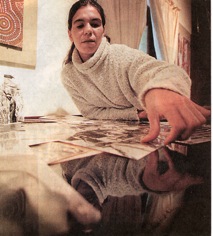
Indigenous photography is a more politically intense instance of this general phenomenon. Certainly few peoples have been so brutally dislocated from their past as Australian Aborigines and Torres Strait Islanders. And they have long used photography both symbolically and forensically to find their past. Many indigenous narratives of historical discovery start with family snapshots. And several Australian museums now take a proactive role in using their collections to re-forge individual historical connections. For instance the South Australian Museum’s Aboriginal Community and Family History Unit helps Aboriginal people learn more about their families and communities using photographs originally taken by Norman Tindale and Joseph Birdsell and held in the Museum’s Anthropology Archives. [9]

Coming to terms with history: Lorraine Hunter catalogues photographs at the Berendt Museum, Picture Megan Lewis, The Australian, 14/7/99 p44.

However the irony is that unlike a white person using family snaps as aide memoires at a family reunion, or historical images as forensic genealogical clues, indigenous seekers after their family history are often using anthropological photographs that were not made to document individuals, but to identify anthropological types; and not as systematic social records, but as fragmented scientific specimens. They were originally taken not to confirm historical presence, but to file away an archival record in order to posthumously confirm the historical extinction of the original. It is this bitter irony that makes the symbolic use of old photographs in urban indigenous art, and the forensic use of old photographs by Aboriginal people of the stolen generation, more prevalent than migrant or mainstream uses of old photographs.

In the late eighties and early nineties Gordon Bennett was making paintings such as Tryptych, 1989, one section of which, titled Requiem, superimposed the geometric lines of three perspectival pyramids ‘shooting’ towards an image of Trucanini derived from the well know C.A. Woolley photograph of 1866. The image was made spectral and degraded by a process which looks like multiple photocopying. But to Gordon Bennett even perspective itself is political

[P]erspective may be seen as symbolic of a certain kind of power structure relating to a particular European world view … Aborigines caught in this system of representation remain ‘frozen’ as objects within the mapped territory of a European perceptual grid.[10]

Lately anthropological portraits has been held up by indigenous artists as not only the theoretical paradigm of colonial attempts at genocide, but also as acts of violence technically akin to, and instrumentally part of, that very process of that attempted genocide.

Thus Rea used archival photographs of aboriginal domestic servants to talk about her own grandmother’s life. And Fiona Gough domesticates and passifies the residual power of archival photographs by engulfing them in granny’s fluffy slippers.

The photographs used by urban indigenous photographers are not monuments, because they do not commemorate a historical closure on the past. In a way they are anti-monuments, images of unquiet ghosts who refuse to rest in their graves. Their re-use attempts to capture a feeling of active dialogue with the past, a two way corridor through time, almost a voodoo quality, or a sense of New Age channelling. Brenda Croft in her Barthesian meditation on nineteenth century colonial Aboriginal photographs “Laying Ghosts To Rest”, comes closest to articulating this feeling. She allows herself the indulgence of retroactively investing the agency of political resistance in the portraits when she says:

Images like these have haunted me since I was a small child and … [and] were instrumental in guiding me to use the tools of photography in my work. … The haunted faces of our ancestors challenge and remind us to commemorate them and acknowledge their existence, to help lay them, finally, to rest. [11]

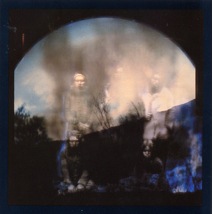
Leah King-Smith. Untitled (4/17), Cibachrome photograph, 1.2m x 1.2m. 1991

One of the first indigenous photographers to receive unexpected international success with a series that re-used old photographs was Leah King-Smith. Her exhibition Patterns of Connection, 1992, travelled nationally and internationally. In her large deeply coloured ‘photo-compositions’ anthropological  photographs were liberated from the State Library of Victoria to be superimposed as spectral presences on indigenous landscapes. In the catalogue the process was described as allowing:

Aboriginal people [to] flow into the land, into space reclaimed for them by the photographer … From the flaring of velvety colours and forms, translucent ghosts appear within a numinous world.[12]

Clare Williamson describes how King-Smith pictorially, rather than rhetorically, invests her original images with the same ability Brenda Croft feels to project the past into the present.

It is instructive to examine King-Smith’s imagery alongside the historical images which are her sources. These small black and white photograph’s ‘contain’ their aboriginal subjects as objects which can be held in the hand, collected, stored and viewed at will. Their placement of the figure within a fabricated European (or a constructed ‘native’ one), and set well back from the picture plane, creates a gulf between viewer and subject, and an inequitable relationship in favour of the viewer. King-Smith reverses the order. Large colour saturated images ‘impress’ the viewer. The figures are brought right to the picture plane, seemingly extending beyond the frame and checking our gaze with theirs.[13]

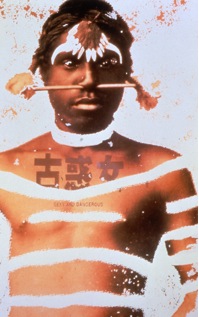
Brook Andrew invests the bodies of his nineteenth century subjects—who he releases from the closet of the past by copying their images from the archive of the nineteenth century postcard photographer Charles Kerry—not only with a libidinous body image inscribed within the terms of a contemporary ‘queer’ masculinity, but also with defiant Barbara Krugeresque slogans such as Sexy and Dangerous, 1996, I Split Your Gaze, 1997 and Ngajuu Ngaay Nginduugirr, [I see you], 1998. These works attempt to reverse the relationship of subject and object in the nineteenth century colonial portrait around the axis of the trajectory of the gaze, and to make the contemporary viewer the subject of a defiant, politically updated gaze returned from history itself.

Brook Andrew, Sexy and dangerous, digital phootgraph, 1996

Charles Kerry, sheet of copied photographs, 1880s-1890s, Art Gallery of New South Wales.

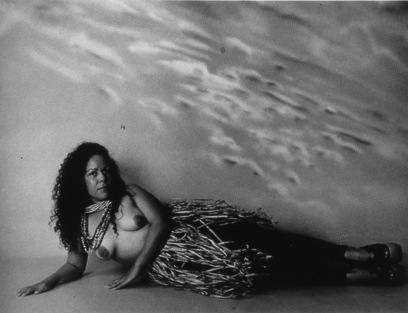
Even when the contemporary Aboriginal artist’s body ritualistically and purgatorially takes on colonial subjugation, the historic photograph and, more significantly, the alignment of gazes, is still the vitalising channel of connection. In the work of Brook Andrew the trans-historical objectifying gaze is simply reflected straight back to the present contingent moment to be immediately re-inscribed in a contemporary politico-sexual discourse. However, in contrast, in Fiona Foley’s re-enactments of the colonial photographs of her Badtjala ancestors, Native Blood, 1994, the gaze is stopped dead in its tracks by Foley’s own obdurate, physical body. To the post-colonial theorist Olu Oguibe:

In Foley’s photographs the Other makes herself available, exposes herself, invites our gaze if only to re-enact the original gaze, the original violence perpetrated on her. She does not disrupt this gaze nor does she return it. She recognises that it is impossible to return the invasive gaze, that what purports to be a returned gaze is only a mimicry. Instead Foley forces the gaze to blink, exposes it to itself.[14]

Fiona Foley, Native blood, 1994.

Tosca Studios, Candelo, West Queensland Aboriginal, c1900, Queensland Museum.

In all of these contemporary uses of the colonial photograph the intention of the original historic photographer is evacuated. We find ourselves in his empty shoes, shuttling back and forth along a two way channel formed along the alignment of the two interlocking gazes of sitter and viewer, object and subject, past and present. Certainly, to at least some extent, this sense of channelling pervades all the contemporary uses of old photographs. But the indigenous use of old photographs gives this channeling a different political valency to equivalent uses of old photographs by migrant or long-term settler photographers.

In their book Uncanny Australia Ken Gelder and Jane Jacobs use Australian ghost stories to describe the uncanniness of Australia’s relationship to indigenous spirituality. In postcolonial terms they see hauntings as a productive occurrence:

‘Ghosts’ simply could not function in a climate of sameness, in a country which fantasises about itself as ‘one nation’ or which imagines a utopian future of ‘reconciliation’ in which … all the ghosts have been laid to rest. But neither can they function in a climate of nothing but difference, where the one can never resemble the other, as in a ‘divided’ nation. A structure in which sameness and difference solicit each other, spilling over each other’s boundaries only to return again to their respective places, moving back and forward in an unpredictable, even unruly manner—a structure in which sameness and difference embrace and refuse each other simultaneously. : this is where the ‘ghosts’ which may cause us to ‘smile’ or to ‘worry’ continue to flourish.[15]

Aboriginal ghosts remind Australia that there is unfinished business. Gelder and Jacobs quote Raymond Williams who has made a distinction between the archaic and the residual in the contemporary experience of the past, the ‘residual’ is “still active in the political process”. Anthropological indigenous photographs cannot yet be monuments because they are still left over from the past, residual to history.[16]

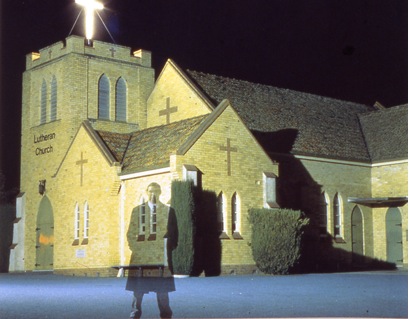
The idea of ghosts soliciting the fickle memory of a too self-absorbed, too quickly forgetful later generation also scans across to the role of Anzac ghosts in Australian collective memory. This cross-scan to a twentieth century settler spectral tradition of the Anzac myth is implicitly referred to a series of photographs by Aboriginal photographer Darren Siwes taken from 1999 to 2002, which have also proved to be extraordinarily popular with curators nationally and internationally. By ghosting himself standing implacably in front of various buildings in a series of night photographs taken around Adelaide, he refers to an indigenous haunting, certainly; but in many images he is ghosted standing to attention whilst wearing a generic suit, so he also evokes the feeling of being surveilled by a generalised, truculent Australian masculinity — exactly the same feeling that an Anzac memorial statue gives.

Darren Siwes, Church 1, 2000.

New Agers have often appropriated Aboriginal spirituality for use in their own impromptu spiritual systems, and at the same time contemporary Aborigines and Torres Strait Islanders and New Agers are occasionally fellow travellers.[17]  Leah King-Smith is perhaps the most explicitly New Age of contemporary Aboriginal artists. She concludes her artist’s statement by asking that: “… people activate their inner sight to view Aboriginal people.”[18]   Her work animistically gives the museum photographs she re-uses a spiritualist function. Many of her fellow Indigenous artists have criticised her for being too generalist, for not knowing the stories of the people whose photographs she used, and not asking the permission of the traditional owners of the land she makes them haunt. But, by referring to Spivak’s “Can the Subaltern Speak?”, Anne Marsh describes this as a ‘strategic essentialism’. She says:

There is little doubt, in my mind, that Leah King-Smith is a kind of New Age evangelist and many serious critics will dismiss her work on these grounds. Others will point to the artist’s misplaced desire to represent Aboriginal Australia: to talk for the subaltern, as it were. But I am interested in why the images are so popular and how they tap into a kind of cultural imaginary and use the mythology of photography’s syntax … to conjure the ineffable. …  Leah King-Smith’s figures resonate with a constructed aura: the skin which is shed onto the photographic plate is given an enhanced ethereal quality through the use of mirrors and projections. The ‘mirror with a memory’ comes alive as these ancestral ghosts, already simulacra in their Anglo costumes, seem to drift through the landscape as a seamless version of nineteenth century spirit photography.[19]

This sense of Aboriginal ancestors, re-born as spiritually replete by the demands of their descendents, and liberated by contemporary Aboriginal artists to drift through a numinous landscape, is also present in the work of Michael Riley. In the photographic series Sacrifice, 1993, and Flyblown, 1998, Riley used objects like crucifixes as both literal and allegorical symbols of mission-life oppression. But in a later series, Cloud, 2000, these symbols have taken on a more autonomous spirituality. They have lost some of their grounding in past historical circumstances, but gained access to a New Age style symbolic bricolage. In Brenda Croft’s words:

[The have] shifted from terra firma to other-worldly locations, including the paranormal.[20]

The role of performance is also important to these photographs. In discussing the Bringing Them Home report on the Stolen Generation of 1997, John Frow comments that the report supplements the standard historiographic citation of the past with collaged-in fragments of first-person testimony. He quotes De Certeau who contrasts collage with historiographic citation. Citation allows the past to lend an effect of reality that validates historical knowledge in the present, through citation the present makes the past intelligible, but also separates past from present. Collage on the other hand gives the past direct affectivity and  answerability within the present. In the Stolen Generations inquiry the unmediated, cathartic, performed testimony of witnesses allows the past to report on the present, just as the present is supposedly meant to be soberly reporting on the past.[21] In the debate between the so-called ‘black armband’ and ‘white blindfold’ view of the history of white Australia’s contact with indigenous Australians the ‘admissibility’ of evidence which is not forensically factual, but based in oral history, myth and even the numinous, is one major point of contention. For instance a revisionist article disparagingly quotes the experience of an  anthropologist Dr Bruce Shaw, called as an expert witness in a Native title case: “I … experienced a shift of awareness when reading some of the longer passages [to the court]. At times I felt like those men were speaking through me. That is not to suggest that I have the abilities of a spiritualist medium; it means that I was experiencing the same sort of responses as some of my listeners … when such narratives are recited in court the subjective, which includes the metaphysical and at times the numinous, slips into proceedings.” Quoted in Rod Moran, “Was there a massacre at Bedford Downs?”, Quadrant, November 2002.

Similarly, in their re-use of old photographs, indigenous photographers do not see themselves as citing them, or ‘appropriating’ them in the standard ironic mode of postmodernist quotation, so much as collaging them into the present, using them to demand an answer from the present. They are trying not to so much appropriate them across culture, as collage them across time. They ‘re-perform’ the old photograph in the present in order to generate this sense of temporal collage.

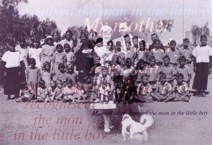
It might be this urgently felt need to re-perform the historic photograph in the present which, for me, gives many of these photographs their overwrought feeling. They seem histrionic, melodramatic, and pictorially overproduced — as though urban aboriginal photographers have to try very hard to ritualistically get in touch with their ancestors. They use an excessive bricolage of special effects verging on the banal to generate a sense of connection. Brenda Croft, for instance, in In My Father’s House, and In My Mother’s Garden, 1998, overlays family snaps of her father, mother and grandmother with repeatedly floating words like ‘bereft’ and ‘weeping’, in multiple layers of Photoshop, in cursive fonts, at different colours, sizes and levels of transparency. Certainly these literally over-wrought surfaces were partially a result of the acute personal grief these works deal with,[22] but this quality also characterizes her later work such as Irrisistable/irresistible, 2000, as well as the work of many other indigenous artists with a more intergenerational yearning for the lost ancestors they never knew.

Brenda L. Croft, Don’t go kissing at the garden gate (Love is blind but the neighbours aint), 1998.

Brenda L. Croft, My mother recognised the man in the little boy, 1998.

In the context of Australia’s fraught race politics, an important aspect of the affectivity of these works for white viewers is the supplementation of the viewer’s own sense of shame—our desire (or otherwise) to say ‘sorry’ for the crimes of our ancestors, which we bring to the image. The imprecatory tone of many of the works I have discussed is best understood in that context. For instance shortly after being elected to office Australia’s new conservative Prime Minister, John Howard, discussed Aboriginal reconciliation and native land tenure with the populist magazine Who Weekly.

Most Australians—now don’t misunderstand this—most Australians grow up not having any contact with Aboriginal people. Now, that’s not their fault but equally they shouldn’t sort of be blamed for something in which they played no part. Aborigines were terribly treated in the nineteenth century, I understand that, and in many cases into the twentieth century. I accept that completely and it ought to be taught in schools and understood. I understand all that, but if you grow up in a neighbourhood where you didn’t have any contact with Aborigines—and that was the lot of most Australians, I mean I didn’t have any contact with Aboriginal kids when I grew up because there weren’t any living in my suburb. In some country areas and a few urban areas there were. And that was it. Now to say to me and to say to my kids and to say of my parents, who never treated them poorly, to say you’re all to blame and you should apologise, it’s something people just can’t get a handle on and they think it’s odd.[23]

This kind of thinking allocated to the indigenous community a deracinated sense of history and an experiential forgetting which inevitably weakened the indigenous stake in Australia’s future. If Howard’s view—that any historical processes affecting the Aboriginal community which were not personally experienced may be discounted in favour of a synchronic assessment of social need—were applied across the board, then all of the structures he holds dear would collapse. The bonds of nationhood, the Westminster system, and the common law all rely on the diachronic transmission of a sense of ownership and responsibility not only directly, person to person, but also indirectly through collective assumptions and investments which are shared and transmitted experientially—narratively and imagistically.

Indeed the Prime Minister’s sense of his own statesmanship is closely interwoven with his mission to keep Anzac memory alive.[24] This also requires an affective remembering where those who come from the past are seemingly brought up to witness the present. For instance Anzac rituals such as the Minute’s Silence or the Dawn Service encourage us to homeopathically re-experience long past historical moments. The sacred phrase ‘Lest We Forget’ warns us against letting the experience of war slip away.

In Australia there has not only not been a social and historical reconciliation between black and white, there has also not been a reconciliation between the two mnemonic traditions. Will they co-exist? Will they merge? Will one extinguish the other? These questions remain stalled in history. This background of fraught race politics and conflicting mnemonic traditions goes at least part way to explaining the over-wrought, imprecatory tone of much contemporary urban Aboriginal art, as well as the curatorial success which has greeted the ghosts it has called forth.

Both the well established Anzac mnemonic tradition, and the emergent indigenous mnemonic tradition, seem to be developing along very similar structural and iconographic lines, both incorporating at various times spectral photographic imagery. In both photography’s special effects, its power to not just reproduce the real, but to conjure apparitions and laminate them to the present, are called upon.

Contemporary indigenous artists have politically deployed the spiritual, spectral magic of photographs of their ancestors on a wide scale. This strategic deployment has a higher valency than standard appropriation because the photographs are being reactivated to call the present to account. But are these precious old photographs, whilst being made politically active in the present, kept in a dialectical relationship to it? After all, photographs of long dead Aborigines are, in fact, merely insubstantial ghosts, they are not the Aborigines themselves. Are contemporary indigenous photographers, such as for instance the sassy and savvy Brook Andrew with his ‘sexy and dangerous’ nineteenth century aboriginal men, hijacking the past for their own strategic politico/aesthetic ends? In their attempts to break through the historical impasse that tragically freezes contemporary Australian political discourse, are they, not unlike a supplicant to a spirit photographer, attempting to collapse time itself, by co-opting the past into a fantasy of presentness that risks being banally synchronic?

Lately the spectral Aborigine has become part of mainstream iconography. For instance a popular book summarising the result of the Royal Commission into the stolen generation superimposes the face of an aboriginal child over the ruins of a mission. And Aborigines are regularly photographed by press photographers holding anthropological portraits as defiant talismans. A recent memorial to Reconciliation was controversial because it asked us to remember aboriginal children removed to missions primarily as happy, cricket playing youngsters. So recently some Indigenous artist have upped the ante and have complicated this convenient trope of haunting.

Fiona Foley, for instance, has recently photographed herself with native Americans not, I think, to promote some banal idea of a pan-global ‘nation’ of First Peoples, but more to overtly and cheekily experiment with a kind of post-colonial drag, to lay authoritative claim to a bricolage not stalled in a perpetual relationship to nineteenth century ancestors and mired historical processes.

Brenda Croft, too, in simply reproducing Kodachrome slides from the 1950s of her father in the series  Man About Town, allows them to maintain their ineffable distance from us in the present. There is plenty of space left for us to fantasise and speculate about his life when he was a young single man, before he met the artist’s mother, before he knew that he had a twin sister, and before he found his mother from whom he had been taken as a baby.


[1] In Dreams: Mervyn Bishop Thirty Years Photography 1969-1990, curated by Tracey Moffatt, Australian Centre for Photography, 1991.

[2]  The first group exhibition of Aboriginal photographers, Naidoc Week Aboriginal and Islander Phototgraphers Exhibition, was held in Sydney in 1986. See an exhibition review by Tracey Moffatt, Photofile, Summer 1986.

[3]  National Gallery of Australia,  Re-take: Contemporary Aboriginal and Torres Strait Islander Phootgraphy, 1998-1999.

[4] [Gellatly, 1999 #397]

[5].[Langton, 1983 #333] Catherine De Lorenzo, ‘Delayed Exposure: Contemporary Aboriginal Photography’, Brenda Croft ‘Blak Lik Mi’,  Art In Australia, 1997, 35, 1,

[6]  Look Who’s calling the Kettle Black, 1992.

[7] Some Lads. 1986

[8]. Andreas Huyssen, Twilight  Memories: Marking time in a culture of amnesia, New York and London, Routledge, 1995, , Introduction pp3-9

[9]See also the Berndt Collection in the Western Australian Museum, and the exhibition Portraits of our Elders by the Queensland Museum. Michael Aird, Portraits of our Elders, Brisbane, Queensland Museum, 1993. And[Poignant, 1996 #51]

[10]. Gordon Bennett, ‘Aesthetics and Iconography: an artist’s approach’, Aratjara: Art of the First Australians, Dusseldorf, Kunstsammlung Nordrhein-Westfalen, 1993,

[11]. Brenda L. Croft, ‘Laying ghosts to rest’, Portraits of Oceania, Judy Annear, Sydney, Art Gallery of New South Wales, 1997, p9, 14

[12] [Phipps, 1992 #401]

[13]. Clare Williamson, ‘Leah King-Smith: Patterns of Connection’, Colonial Post Colonial, Melbourne, Museum of Modern Art at Heide, 1996, p46

[14]. Olu Oguibe, ‘Medium and Memory in the Art of Fiona Foley’, Third Text, 1995-96, Winter 1995-96, , pp58-59

[15]. Ken Gelder and Jane M.Jacobs, Uncanny Australia: Sacredness and Identity in a Postcolonial Nation, Melbourne University Press, 1998, p42

[16] Raymond Williams Dominant, Residual and Emergent”, Marxism and Literature, Oxford University Press, 1977. Quoted in. Ken Gelder and Jane M.Jacobs, Uncanny Australia: Sacredness and Identity in a Postcolonial Nation, Melbourne University Press, 1998, p18

[17]. L. R. Hiatt, ‘A New Age for an Old People’, Quadrant, 1997, 16, 337,

[18]. Leah King-Smith, ‘Statement’, Patterns of Connection, Melbourne, Victorian Centre for Photography, 1992,

[19]. Anne Marsh, ‘Leah King-Smith and the Nineteenth century Archive’, History of Photography, 1999, 23, 2, p117

[20] [Croft, 2002 #402]

[21]. John Frow, ‘The Politics of Stolen Time’, Meanjin, 1998, 57,2,

[22]  “For the artists … photography and family histories entwine as the act of making art becomes a way of dealing with grief.” [Gellatly, 1998 #403]

[23]  [John Howard, 1996 #404]

[24]  See for instance: “Keep the Anzac fire alight”, The Australian , 26 April, 2000, p1 and  “Statesmanship forged on a fatal shore”, The Weekend Australian , 29 April-2000 , Pp3.

Soldiers of the Cross and the Quo Vadis connection

Soldiers of the Cross and the Quo Vadis connection, blog entry, National Film and Sound Archive

One of the highlights of my CSAR Fellowship a couple of years ago was the chance to see the two hundred or so glass magic lantern slides from Soldiers of the Cross on the light-table out at Mitchell. I’m really interested in magic lantern slides and the history of the magic lantern in Australia. I kind of suspected that maybe these slides hadn’t yet received the attention they deserved because Soldiers of the Cross, an evangelical lecture produced by the Salvation Army in Melbourne in 1900, had been thought about by historians primarily interested in finding the origins of Australia’s cinema industry, and of course the cinematic part of the original presentation, the thirteen or so kinematographic films, had been lost. The slides, however, far from being just the remnants of a primarily movie-related event, are fascinating in their own right.

There is a lot visual information recorded on the 9 cm by 9cm glass slides, not to mention their extravagant handcolouring, or their careful and inventive narrative sequencing. One of people responsible for the production, Herbert Booth, the youngest son of the founder of the Salvation Army, left the Army in 1902 and took the slides with him overseas as an independent evangelist. He died in 1926, and the slides he had used for all those years didn’t return to Australia until the fifties. When I got access to some of the high resolution digital copies the NFSA’s Darren Weinert had made, in order to show them as part of Arc’s ‘Autumn Silents’ program, it was wonderful to be able to dive in to the detail in the slides, particularly the faces of the members of the Salvation Army who had dressed up as Romans or Christian martyrs to reenact the stories of the persecution of the early Christians. By showing the slides in sequence I hope I established that there were several distinct modes of temporality in the production, including what I dubbed the ‘iterative’, ‘expository’ and ‘action’ modes.

We had always known that some of the slides in the set that came back to Australia had been made a long time after the original production — the tableaus were more complex and the costumes and sets more elaborate. So I became intrigued to know where exactly the later slides had come from. At the Salvation Army Heritage Centre in Melbourne I had been shown a page from the Illustrated London News of 1907 where Booth was featured with his ‘evangelisation by tableaux vivants’ and ‘bioscope lecture’, so Booth was ‘on the road’ with slides and film for quite a long time. He was still touring when his first wife died in 1920.

I showed some of the later slides to colleagues in the lantern-slide researcher community, as well as the cinema historian community, and dropped them in to Google Image Search. I found that some were production stills from the 1913 Italian blockbuster Quo Vadis. Quentin Turnour had also cunningly programmed Quo Vadis into the NFSA’s season of ‘Autumn Silents’, and when I saw the film at Arc I identified twelve slides from the NFSA’s Soldiers of the Cross set as having their origin in Quo Vadis. They were most probably a set made by a commercial slide manufacturer in association with the exhibition of the blockbuster, purchased by Booth, and interleaved amongst the existing Soldier of the Cross set.

Back in 1900 the Salvation Army had incorporated slides of many famous nineteenth century paintings directly in their production, as well as using them as inspiration for their painted backdrops. Two of the paintings they had used, Thumbs Down and Last Prayers of the Christian Martyrs featured scenes in the coliseum and were by the popular French academic painter Jean Léon Gérome, also know for his soft-core porn harem scenes. The same paintings were clearly also the inspiration for the sets and costumes of the 1913 Italian Quo Vadis. My ANU colleague Gino Moliterno put me on to an article by Ivo Blom about the relationship of Gerome’s paintings to the Quo Vadis film where, as in Soldiers of the Cross, several scenes are directly modeled on the paintings. Blom’s article also discussed the relationship between the tableau vivant and early European cinema, as well as the general interest in ‘sword and sandal’ (or what I prefer to call ‘blood on the toga’) themes from the nineteenth century into the twentieth century, and indeed right up to the present day, including the Quo Vadis novel about early Christian martyrs published in 1895.

Clearly much work remains to be done. But I think we now have a richer, more international and more intermedial context for the Archive’s Soldiers of the Cross slides.

In thinking about the narrative and temporal sequencing of these slides I had relied on the numbers painted on the edge of each slide. But the numbering system incorporates the Quo Vadis slides, so these numbers were added after 1913, at least 13 years after the first slides were produced back in Melbourne. What was going through Booth’s head, I wondered, as he interleaved, amongst the slides he himself had produced a decade and a half earlier, the new slides from a mega commercial blockbuster which drew on the same literary and visual sources he had drawn on. But I think Lindsay Cox from the Salvation Army Heritage Centre gets it right when he says:

“First and foremost the prime motivation in Herbert Booth’s life was the spreading of the Gospel of Jesus Christ! It consumed him in his Salvation Army service and then as ‘Ambassador’ Booth the travelling evangelist. His creativeness and entrepreneurial skills were in their entirety for his work for God. The production achievements of Herbert were entirely a means to an end. If Herbert could not see a direct connection between using the technology and the saving of souls, he would have discarded it. Herbert Booth was adamant that his lecture was ‘not an entertainment.’ As commander of the Australasian Territory he was able to draw upon resources he never could have after leaving the Army. He was not a wealthy man, although no doubt, comfortable. Nor was his family wealthy, or able to, or perhaps desiring to support him. So, I do not feel that he had the resources to make the slides himself. There is also no evidence that he had anything other than artistic involvement in the productions. All the technical and processing stuff was Perry’s domain. I’m comfortable with the thought he just used whatever commercially available slides were available.”

Soldiers of the Cross – NFSA

‘Herbert Booth and Joseph Perry’s Soldiers of the Cross of 1900’, National Film and Sound Archive, Arc Cinema, 1 March, 2013

I’d like to thank Quentin for the opportunity, and Clare, Darren and Brooke for the yummy files.

I want to go back to the turn of last century and try to re-imagine the experience that audience members might have had at the Salvation Army evangelist lecture Soldiers of the Cross. This massive production, the most elaborate of the Army’s many technologically cutting-edge productions, was seen by large numbers of people around Australia, and was particularly aimed at recruiting young men.

What other media experiences would the excited crowds we see milling about Her Majesty’s Theatre in Melbourne or the Sydney Town hall have had, before the went inside to take their seats? They would certainly have seen many dissolving view magic lantern shows, featuring hand painted slides in series such as Jane Conquest, or life model slides of actors in tableau vivant photographed against backdrops, such as Daddy. These slide shows used a dissolving mechanism to produce special effects by, for instance, dissolving an angel over a scene with a separate magic lantern, or creating a montage on the slide itself. They would have experienced stereo views, where they clamped a viewer onto their face and immersed themselves in virtual three dimensional space as they took a trip through a sequence of twelve scenes, usually of exotic locations they had no hope of visiting in real life. They might have visited one of the new kinetoscope parlours — there was one across the road from the Army headquarters — where they could bend their heads to eyepieces and crank through sixty seconds of animated pictures. They may even have seen animated pictures projected onto a screen from an adaptor placed at the front of a magic lantern. They might have gone to the Melbourne cyclorama building, where they could immerse themselves bodily in a panorama of the Siege of Paris. And they would have been aware of the great celebrity paintings of the day which they would have mainly know from numerous lantern slide reproductions or prints, but even perhaps by experiencing the aura of the paintings themselves. Some celebrity paintings such as Holman Hunt’s 1850s Light of the World, after being familiar for decades through slide and reproduction, physically toured the world like aging rock stars. And finally they would have experienced the hurly burly of the cosmopolitan streets themselves.

All this can be summed up in three buzz words from the period: thrills, animated photographs and colour. So all that was in their heads as they took their seats, but what had been going on behind the scenes? Soldiers of the Cross was produced in the Salvation Army’s Limelight Studios, headed by Joseph Perry, which combined gramophones, magic lanterns and the kinematograph in a ‘triple alliance’. However the key piece of equipment was the most unglamorous, and the most overlooked — it was the copy camera, which could take virtually any flat image, and turn it into a glass slide that could them be hand-coloured before projection. For this production Perry, along with the Commandant of the Army in Australia Herbert Booth and his wife Cornelie produced about 250 glass lantern-slides and approximately fifteen sixty-second strips of Lumiere film. Of the slides about thirty were copied from other sources, and of the films about two were produced by the Lumiere company. The rest were produced in Melbourne, and the whole lot was integrated together by the Booths and Perry. The script has been lost, as well as the films the Army shot. But a large proportion of the slides, and two Lumiere films, survive.

The best way of thinking about the logic of Soldiers of the Cross is to imagine it as a turn of the twentieth century Powerpoint. Like Powerpoint it brought together disparate sources into a singly formatted lecture. Like Powerpoint every time it was performed it was slightly different. And like Powerpoint it was the lecturer who made the show. The Booths wrote the script and read it, while Perry and his team dissolved the slides one into the other and projected the cinematographs. A band also played well-known hymns from the period, and led the congregation is singing. Although it included narratives, these were chapters embedded in an overarching structure which was liturgical and sermonic.

THE ST STEPHEN SEQUENCE

The production began with general scenes of the Life of Christ derived from reproductions of prints and painting, as well as two commercial kinematographs which were each one-minute reels, Christ’s Entry into Jerusalem and the Crucifixion, from the thirteen one-minute-reels of the Lumiere production The Life and Passion of Jesus Christ made in 1898. It is important to look carefully at these Lumiere films. Although they weren’t shot in Melbourne they give an indication of what the Melbourne footage may have looked like. In these films it is the micro-movements, the swish of the palm fronds, the pounding of the Roman hammer, and the movement of the sponge through the air, these unmistakable markers of living animation, which would have most excited the audience.

After this introduction the first chapter of the lecture was the Martyrdom of St Stephen.  This is based on the biblical story of the first Martyr. It opens with St Stephen before the Jewish court. Why, one wonders, does this first chapter open with five very repetitive slides where not much is happening, where the narrative isn’t moving? This is because in Chapter 7 of the Acts of the Apostles St Stephen spends 53 Biblical verses defending himself against the Jewish court by recounting the story of Moses’ persecution. So it appears as though these slides would be dissolved, one in to another, perhaps quite slowly, as Booth recounted those 53 biblical verses.

After that, the Biblical narrative suddenly picks up. Stephen looks up and Heaven opens up to him. There he sees God with Jesus on his right hand. The Bible says:

But he, being full of the Holy Ghost, looked up steadfastly into heaven, and saw the glory of God, and Jesus standing on the right hand of God, and said, Behold, I see the heavens opened, and the Son of man standing on the right hand of God. Then they cried out with a loud voice, and stopped their ears, and ran upon him with one accord, and cast him out of the city, and stoned him: and the witnesses laid down their clothes at a young man’s feet, whose name was Saul. And they stoned Stephen, calling upon God, and saying, Lord Jesus, receive my spirit. And he kneeled down, and cried out in a loud voice, Lord, lay not this sin to their charge. And when he had said this, he fell asleep.’ Acts 7 55-60

Booth and Perry have superimposed a commercial slide of Jesus and angels for the effect of Heaven opening up.

The way the slides in this sequence have been made differ. We begin with slides shot with live models standing in front of a painted backdrop. But the slide of St Stephen being removed from the city is assembled in a different way. It is a collage of cut-out photographs pasted onto a painted background, and re-shot onto a glass-slide before being hand-coloured. Both quite different techniques are used throughout the Army’s productions.

The slides only follow the Biblical text loosely, but the general narrative would have been familiar enough to the audience. The account of this chapter in the Salvation Army magazine the War Cry closely follows the slides we have:

The events that lead to the martyrdom of Stephen passed in review. The [Sanhedrim, the] trial, Stephen’s impeachment by the rulers and the stoning of the first martyr. The kinematograph was employed in this latter scene. The effect on the audience, as they beheld in a moving picture the innocent Stephen cruelly beaten to the earth, and killed by fiendish fanaticism of the formal religionists of his day cannot be described. The kinematograph give place to a picture of Stephen lying dead upon the roadside, while Paul (sic) the persecutor stands over him in an attitude of painful contemplation.’ (MWC 22/9/00 p9)

The backdrop painting for the exteriors has clearly been inspired by a Gustave Doré engraving. There are three slides numbered in sequence for the stoning, two are shot against a backdrop, the third is a collage. The kinematograph would have come after this sequence of slides, which may have been dissolved more quickly, perhaps, than the earlier court slides. So the audience would have seen the same action again, repeated, but this time in moving picture.

We can get an indication perhaps of how this might have worked by looking at the script of a later set of life model slides called Lazarus, produced by the Army in 1902. This is a set of eight slides. The script for the later and shorter slide set tells the story of the raising of Lazurus with the usual cues for slide changes. At the end of the story the cue changes to ‘Kino’. Unfortunately the corner of the script has been torn off, but the lecturer says something like:

We shall now show you … (missing) … actually took place … (missing) … this remarkable miracle, most impressive and realistic. WE WILL SHOW YOU IN LIVING FORM WHERE MARTHA MEETS CHRIST, and tells him Lazurus is dead,…….’

The script then runs on as a commentary on the kinematograph, with prompts for the reader of the script for when the kinematograph scenes will change.

To return to the earlier, longer, Soldiers of the Cross production, as the War Cry says, the kinematograph then gives way to a slide of Stephen lying dead, with Jesus receiving his spirit. Then we see a hand-coloured copy of a lithographic reproduction of a Pre-Raphaelite Millais painting of St Stephen, before cutting back to two slides of Salvation Army Officer Colonel James Annetts, who played St Stephen, lying on the ground. Between the final two slides we see his crimson blood poo, as though a few moments of time have elapsed, and a crucial character for the next chapter, Saul, appear to look over him.

So in this chapter, even though viewers are experiencing a synthesized production, it is not built on anything like a unified visual syntax. Instead they are experiencing   at least five different modalities of affect, and four different expressions of time:

  1. A strophic, verse-like, iterative mode of slowly dissolving lantern slides, familiar from previous commercial slide sets
  2. An expository mode of tableaus taking us through key narrative points
  3. A faster, time-based, action mode, often in couplets or triplets, and perhaps linked to an accelerated lantern dissolve, which is an innovation of the commercial slide format
  4. The real-time animation and realistic living-picture mode of the kinematograph, giving a visceral feeling of natural movement
  5. The contemplative mode of a familiar work of ‘great art’ which is embedded in some kind of universal historical/symbolic/aesthetic time

These five different modalities I have identified are reflected in the contemporaneous comments on the production. For instance often the micro-movements magically captured by the kinematograph are mentioned, such as the splash of water as a martyr is thrown in a river, the rising of smoke, or the falling of stones. But also the beautiful colour of the slides is frequently mentioned. All of these modes, although not syntactically unified in any way we would recognize from subsequent cinema history, nonetheless worked together to directly involve the audience with the story through shared sight. This sense of collective witnessing, which this opening sequence sets up, is caught well by the War Cry:

We saw the great stones falling thick and fast upon the white robbed figure on the ground, till it grew strangely still. Then the ‘witnesses’ left the scene, and Saul of Tarsus stood alone looking down upon the dead young man. (MWC 29/9/00 p14)

SAUL

The next slide, after we have shared with Saul our contemplation of the dead St Stephen, is a shot of contemporary Damascus extracted from a stereograph. But this clever segue still follows the Bible pretty closely, because after being transported to contemporary Damascus as it was in 1900, the next slide whooshes us back to Biblical times for Saul’s conversion. We then see a tight sequence of three slides, shot outside rather than in a studio, which is a time-based triplet shows us St Paul’s escape by basket from the walls of Damascus to continue his preaching.

These time-based ‘runs’ of slides often seem to pick up momentum towards a kinematographic climax. For instance at slide number 72 there is a sequence of Romans raiding an outdoor service by Christians who are then forced to flee underground to continue their worship clandestinely in the catacombs. In 1901 this sequence was added to with a kinematograph of the Romans chasing the Christians across a plank over a stream, augmented with the much commented on comic relief of a Roman boinging off the springy plank and into the stream.

CATACOMBS

A later sequence focuses on life in the catacombs, perhaps to parallel life for Salvationists in the midst of pagan Melbourne. Like an establishing shot from a movie of twenty years later, it begins with an aerial map of the catacombs, and then swoops us down through the contemporary underground stone passages using stereo views from a commercial stereograph set. We then see daily life— worship, marriage, birth, sickness and eventual death — carried on in what I have called the ‘iterative’ mode through a mixture of Army collages and copies of prints and engravings. As the War Cry put it:

All these scenes, painted and reproduced to sight and sound by word and art pictures, simply enchain the mind, and carry one in thought 1800 years back through the ages. The listener sups, prays, praises, adores worships, suffers and dies with these saints of apostolic times.

The mode switches from ‘iterative’ to ‘time-based’ for a detailed and strangely beautiful, even today, funeral sequence of four monochrome slides. Once more there is kinematographic climax, before a final extended contemplation of souls ascending into heaven painted in brilliant supersaturated colour, which may perhaps have been accompanied by music or singing.

LIME KILNS

About twenty slides later another quartet of slides appears which encapsulates a tight action. A Christian woman is about to be burnt to death in a lime-kiln. Will she offer just one grain of incense to the Pagan Gods and save herself? No! After pointing upwards to the one true God she disappears into the kiln. This again was followed by a kinematograph of martyrs joyfully jumping into the kiln, with the added bonus of smoke effects.

COLISUEM

Fourteen slides later another run of five slides introduces an extended piece of action. Christians wait at the gate of the Coliseum, while a stuffed tiger with a virulent red tongue threatens them from a cage. Then the gates inch open in the final three slides, before a kinematograph shows the Christians entering the Coliseum and being approached by lions, after which individual slides show their martyrdom.

PERPETUA SEQUENCE:

The final sequence of the two and half hour show was for many people the most affecting, in Hobart for instance, it caused ‘general sobbing’ in the audience. (MWC 26/1/01 p9)

Perpetua, played by the young, attractive Army member, Cadet Mabel Tolley was a young wealthy Roman woman who chose to give up her baby and be martyred in the coliseum rather than renounce Christ. A script with slide and music cues exists, probably for a stand-alone version made shortly after Soldiers of the Cross. The surviving script is also punctuated with nine popular hymns requiring audience participation, with a hymn supplementing the narrative about every four slides. However in Soldier of the Cross itself there were most probably far fewer hymns because of the whole production’s larger scale.

The script is ekphrastic, that is, it describes what the audience is seeing with their own eyes, and rhetorically explains what they should be feeling. For instance, during a dissolve between two opening slides the script says:

We may picture the surprise of this Christian lady when sitting in one of her well furnished rooms. The stillness of the occasion was broken by the intrusion of two armed men. On learning the object of their sudden appearance, Perpetua showed neither fear nor alarm.

This was immediately followed by a hymn. Later, when she is cast into prison, the script tells the audience:

Glory filled her soul amidst the gloom of her surroundings.

Later on, a tight sequences of slides showed the visual evidence of interpersonal conflict, while the script provided the ekphrasis. After her father leaves, disappointed that he has not been able to convince her to drop the whole Jesus thing, the script says:

This was to her a dark and trying moment. The grey beard, the fatherly face, the agitated frame, the loving entreaties, and the stern rebuke; as well as the somber environment of the place, all spoke to her heart with a weird-like eloquence. Still she faltered not. An invisible power supported her even now.

As we have seen in the St Stephen sequence at the beginning of the production, the script is often self-referential, making direct links between Perpetua’s experience and the experience of the audience seeing the projected slides in Melbourne eighteen hundred years later. After Perpetua has finally handed over her baby to her mother the script says:

But when the mother had gone a dreary lull set in. The baby’s prattle had given way to a deep silence. The past rose in vivid pictures, and strong as she was in the grace of God, her poor heart was grief stricken. But there is always solace in prayer, and even in this dark dungeon Perpetua might well prove the unfailing words, ‘My grace is sufficient for thee’.’

The script then calls for the hymn What a friend we have in Jesus.

In a second courtroom sequence more tight time-based, rather than expository, action is shown. She is offered pagan incense to burn and her mother and father show her the baby which will be returned to her if only she renounce Jesus. She refuses. Her father remonstrates with her once more, and is struck to the round by a guard.

After Perpetua has been martyred and before the final hymn the script ends with:

But the end was near, for soon Perpetua lay bruised and bleeding upon the floor of that slaughter house on iniquity still praying to Him she loved. The excited crowd yelled that her misery and pain might end with a thrust of the gladiator’s sword. A moment later the soul of Perpetua had gone to be with God, gone to hear her master say, “Now that thou hast been faithful unto death, I will give thee a Crown of Life”.

THE VOICE

Now we have looked in as much detail as possible at a few of the many sequences in this production, what general conclusions can be drawn? The unifying force in the piece was the voice, the live human voice reciting that sermon. That voice was provided first by the charismatic Herbert Booth, youngest son of William Booth, the founder of the Salvation Army movement. Herbert spoke in ‘short and harmonious’ sentences, ‘constructed with due regard to the balance and equilibrium of the whole’ (MWC 22/9/00). After he got sick the lecture was conducted by his equally charismatic wife. The War Cry  reported:

The lights went down, and the audience were hushed into breathless silence as the immense pictures were thrown upon the canvas. The Commandant’s voice alone broke the stillness thrilling the enthralled audience with burning words fitted in compact sentences, forming an eloquent and beautiful tribute to the heroic deeds and unflinching endurance of the saints whose pictorial reproduction riveted every eye. (MWC 22/9/00 p9)

Other connecting forces were musical, the familiar hymns and masses played by the orchestra and sung by the audience. But the dominant force which distinguished the limelight lecture from others was the lanternist himself, who was always present in the audience’s consciousness as his lanterns hissed and spluttered and projected their beam above their heads. As the War Cry noted:

Carefully watching the screen as the lecture progressed, and noting the rapid changes from one slide to another, from slide to kinematograph film, and then again from kinematograph film to slide, each appearing exactly at the right time, one could not help but admire the consummate skill with which Major Perry manipulated his elaborate and complicated apparatus. (MWV13/10/00 p8)

RETINAL POWER

The presence of the lanternist signaled the radical shift in focus of the site of principle address which the Salvation Army made in their evangelism: from the body, or the ear, or the mind, or the voice — although these were of course still present — to the eye and to the retina; from the phenomenological architecture of the church to the dominating address of the projection sheet; from the magical ritual of the service to the narrative power of the projected image.

The magic lantern shifted the locus of the spiritual to the limelight itself, and turned the lanternist into a kind of thaumaturge. For instance, before the third presentation of Soldiers of the Cross at South Melbourne Town Hall Brigadier Unsworth prayed with the congregation:

that the pictures might be luminous with Divine light, [instilled] with divine power, and fruitful in bringing about more of that spirit of heroism that dominated the lives of the Christian martyrs of old. (MWC 13/10/00 p8)

The Army’s spiritual bellicosity was evoked in another comment by the War Cry:

The lecture is a double-barreled weapon, which captivates both sense of sight and enchains the mind, while indelible impressions are made upon it. (MWC 22/9/00 )

THE DISSOLVE

The Army’s slides, like all slides of the period, were propelled forward by the retinal frisson of the dissolve, as one image appeared to materialize itself within the very optical substance of the image it was replacing.  The rhetoric of the Army frequently equates the light of the lantern with the light of salvation, and the magical transformation of the dissolve with the transformative power of Jesus.

INNOVATION

The Army’s main innovation was to use lantern slides to describe tight time-based actions, rather than expository narrative elements or iterative strophic elements. This I think is globally significant at the time.

The Army’s second innovation was to scale up the traditional lantern lecture into a complete evening’s production, and to give it a thematic unity. As the War Cry reported:

Although the audience was taken through a great variety of scene and incident, the intervals were cleverly bridged or, to change the metaphor, the stories, instead of being scattered gems were strung on an elocutionary necklace and, in their semblance or contrast made into a beautiful and complete circlet. (MWC 29/09/00 p8)

A third innovation was to work the kinematograph into the slides more closely. In Booth’s words:

I saw at a glance that living pictures, worked in conjunction with life-model slides, would provide a combination unfailing in its power of connecting narrative.’ (Citation)

THRILLS

These three innovations were all in search of thrills — Army thrills to compete with all of the other thrills young people, particularly young men, had to divert them in 1900. In its pre-publicity for Soldiers of the Cross, the War Cry described it as a ‘new sensation’. It was the power of the thrill which led Booth to chose as his subject the martyrdom of the early Christians, because the bloody and violent martyrdoms provided opportunity for spectacle and action. If the thrill was one key concept, the other was realistic action. The intention was to create a retinal connection between the audience and the Christian martyrs. The ultimate objective was for people, particularly men, to pledge their souls to Christ and their lives to the Army at the end of the lecture. Realism was one conduit of empathy, the other was the contemporary travel shots of the Holy Land and the copies of the great and familiar paintings which introduced each chapter.

As the War Cry predicted before opening night:

The thrilling scenes in the arena, the cruel tests, the thrilling presentiments of Christians under torture, the sustaining power of the presence of the invisible Christ should bring forth all that is best in the nature of the observers, while the graphic and eloquent word-pictures of our leader should tinge with colour, as with the hands of an artist in studies of human nature, these pictures, which all but speak their own story. May God’s spirit be poured upon lecturer, operator and audience alike!’ (MWC 15/9/00) p8)

TRANSPORT

Part of this thrill was also a sense of transport, to take the audience out of their seats in Melbourne, and into another spatio-temporal realm. As Booth promised:

I have sought to make everything absolutely correct. From the plumes on the Roman helmet and the imperial robe of Nero to the rough garments of the pagan slave, everything will be exact. You only have to follow the screen and you will be as much in Rome as if you had been there – now in the palace of Caesar, then in the open square – now in the residence of the patrician, then in the den of the libertine — now in the coliseum then in the Catacombs, where the early Christians concealed themselves for safety — all will be absolutely exact’ (MWC 18/8/00 p9)

This is very similar to the promises which had been made by stereograph manufacturers since the 1850s. By the 1900s sellers like Underwood and Underwood were marketing complete ‘Travel Systems’ incorporating, stereographs, guidebooks and maps, to give a similar, touristic sense of optical and retinal transport.

But to the Army audience this transport was more than just virtual tourism, it was transport of a more profound kind. A later report on a limelight meeting said:

the meeting almost becomes as a séance, and our spirits seem to blend with the spirits of these just ones.’(MWC 9/2/01 p9)

AFFECT

Was Soldiers of the Cross effective? The War Cry frequently reported on the ‘involuntary interjections, moans of pity, sighs of relief’ coming from the audience. (MWC 29/09/00 p8) All the Army reports are ecstatic, but they would be, wouldn’t they. However even the hard-bitten seen-it-all mainstream press confirmed the affective power of the production. The premiere scored a review from two out of the three of Melbourne papers, and both used the word ‘thrilling’.

The Age said:

To have some of the most tragic episodes of Christian history carried out in all savage but ?should? destroying realism is an accomplishment essentially of today. It was done by the aid of the kinematograph, when Commandant Booth delivered his thrilling lecture last night.

The Argus said:

Opening with the last days of the life of Christ, Commandant Booth dealt with the lives of the disciples [… ] and the thrilling scenes that were enacted in the arena of the Coliseum. Bold as the lecture was in conception, the illustration were even more daring. (MWC 22/9/09)

CONCLUSION

Soldiers of the Cross is extremely important because it was Australia’s first large scale multimedia production. On at least several occasions it kept close to 2000 people simultaneously enthralled by a production that was experientially integrated over an entire two and a half hour period. It innovated on narrative formats from the nineteenth century, and incorporated technology that would come to dominate the twentieth century.  It created an entirely new experience by weaving familiar visual forms and technological experiences in with established viewing protocols and ritualized behaviours that had been developed and inculcated into Australian audiences during the previous five decades. The scale and the complexity of the integration of these experiences looked forward to twentieth century media forms. One of those media forms was certainly the cinema, but others include the history of the lantern itself which continued in parallel to cinema for another five decades, as well as much later media forms such as broadcast radio and television, and even, at a stretch, contemporary digital media platforms. For these reasons it is an extraordinarily important event in Australian history. Much more important than we first realized.

Martyn Jolly

Mark Strizic

‘Mark Strizic’, National Library of Australia Magazine, 2013

Mark Strizic, who died in December last year, was the last of his generation. He was the last of an important group of European émigré photographers, which also included Wolfgang Sievers and  Henry Talbot, who immeasurably enriched Australian photography. These photographers were, in their turn, part of a larger group of émigré artists, craftspeople, designers and architects who immeasurably enriched Australia as a whole. But Strizic was a bit different. After arriving in Melbourne from Zagreb in 1950, and taking up photography in the mid fifties, Strizic’s subsequent fifty-year career was much more complex, diverse and manifold than any of the other émigré photographers. He not only worked in many different photographic styles, but he was also interested in new and experimental photographic techniques, as well as book design and production, architectural murals and tertiary teaching.

Artistic collaboration was fundamental to Strizic’s career, and the two major groups of his photographs in the National Library of Australia come from collaborative projects. In  1960 Strizic worked with the architectural critic, historian and lecturer David Saunders on producing a picture book about Melbourne. Although modestly scaled, the book, Melbourne: A Portrait, is still a charming object even today. Unusually for a book of the period the entire publication is printed using the new offset printing process, rather than the photographs being printed from plates separately engraved to the letterpress text. However Strizic’s softly sunlit, cleanly composed, almost Pictorialist photographs translated well to the pages via offset. As the book’s designer, Strizic was able to freely move the rectangular photographs up and down or across the square pages so that the composition of one visually interlocked with the composition of the next, while expansive fields of blank paper, which sometimes also included floating lines of text, brought each consecutive double-page spread together into a different graphic composition visually relating to the subject matter of the photographs.

Although modestly scaled, and priced, the book didn’t lack ambition, Saunders’ text was repeated in Italian and German, envisaging a global market for images of cosmopolitan Melbourne. Strizic himself acknowledged that the inspiration for the book came from a book called Light and Shade.  which his father, an architect, had published on his home town of Zagreb in 1955. It was clearly to this more contemplative, ambling, European style of the ‘city book’ that Strizic aspired, rather than the strident, commercial boosterism of other Australian photo books of the time, although both kinds of book cast Melbourne in a very positive light. The Book of The Year award which Melbourne: A Portrait won in 1961 duly recognised the integrated design of the complete book package, including a bright and chirpy cover design by Leonard French, that the offset printing, carried out by Adelaide’s Griffin Press, Australia’s premier printer of the period, had allowed.

An architecturally transforming Melbourne continued as one of Strizic’s main themes for the next two decades, and he developed a distinctive style, often shooting straight into the light to produce extreme contrast, with blown-out highlights silhouetting black shadows. The old is often juxtaposed with the new, and hot gritty sunlight often shears across cliff-like facades. The people of Melbourne, caught in a headlong rush hour or in exhausted repose, also feature; but Strizic’s photographs were recording the radical expansion and verticalisation of Melbourne during this period, as skyscrapers pushed upwards and car-choked roads pushed outwards, so Melbournians are often left behind or pushed out of the way, squashed down at the bottom of his shots, or squeezed in by his constricting framing. By the late 1970s Strizic’s Melbourne had changed radically from his gentle1960s vision, it had become thoroughly dystopian, an inhuman place of ugly pavements and tangled wires. Using a process he called ‘photochrome’ he even began to print his black and white negatives on colour paper, as well as experimenting with duplicating them onto colour film with high-contrast lithographic film, electrifying Melbourne with intense, sometimes even psychedelic colours that gave his cityscapes a psychological, even hallucinatory, edge.

In 1967 and 1968 Strizic worked on two other important projects with Sun Books, a start-up publishing company which was experimenting with different ways of taking advantage of the boom in paperback publishing that was bringing book prices down and increasing the popular market for a diverse range of formats and subjects. For one project Strizic worked as a stills photographer on Tim Burstall’s pioneering film 2000 Weeks, and turned the stills into a complete, cheap, paperback-novel sized, photo-roman tie-in for the film, with each page tightly packed with his photographs and dialogue from the film. 2000 Weeks was made in a self-consciously European art-house style, and told the existential story of a young artistic man torn between his allegiance to a still provincial Australia and the lure of bigger career opportunities of Britain.  It bombed at the box office, so presumably Strizic’s book bombed at the bookstore as well. As a filmmaker Burstall changed tack entirely and eventually found success with cheeky sex comedies unashamedly celebrating crass Australia.

As a photographer Strizic worked with Sun Books again on a posh, self-consciously arty, limited edition book called Involvement, edited by the philanthropist Andrew Grimwade. The idea was that Strizic would collaborate with the painter Clifton Pugh and take photographs of the same sitters Pugh had painted over the years, and painting and photograph would be shown side by side. However the book was not designed by Strizic himself, as had been the case with Melbourne: A Portrait and 2000 Weeks, but by the designer Les Gray, who was incapable of graphically handling the juxtaposition of the tipped-in colour plates of Pugh’s paintings with Strizic’s black and white photographs, so each spread had an out of balance, cluttered feel. This, combined with the book’s pretentious leather binding and grandiose text by Geoffrey Dutton, makes for a curiously unsatisfying package. In his portraits, which he took in Australia, the US, the UK and Europe, Strizic answered the angular, chromatic fondue of Pugh’s paintings by developing his own extremely idiosyncratic photographic style. He doubled the speed of his 35mm film with extended development, which increased the contrast and graininess of the images, and shot his sitters against dominating backgrounds, and with intruding out-of-focus foreground elements. This had the effect of amplifying the sitter’s personalities, who appear to be strongly asserting themselves against their environment. The head of the ABC, Sir Charles Moses, is photographed through a curtain of cigar smoke, while Barry Humphries is captured amongst the eccentric antiques of his London flat, leering at us from behind his flop of hair. In 1968 this set of photographs was exhibited, as Some Australian Personalities, at the National Gallery of Victoria, in that institution’s first one-person photography show.

Strizic’s involvement with other artists, architects and designers was significant on many other levels. In 1988 he was commissioned to comprehensively document the works of the sculptor John Davis and the furniture designer Schulim Krimper for their Australia Council funded monographs. Strizic’s relationship with Krimper furniture went all the way back to 1959, when he first documented his work for a National Gallery of Victoria retrospective on Krimper’s work. Strizic was also at home with the technological avant-garde. He knew the abstract artist Asher Bilu, and in 1967 made the only surviving record of Bilu’s pioneering interactive electronic artwork, Sculptron. In this photograph Strizic was able to handle with aesthetic sympathy and technical aplomb the tricky task of lighting and simultaneously exposing for the glowing oscillating patterns on the work’s eight cathode ray tubes, as well as its Perspex flowers, chrome spheres, and electronic control box. (Jones 2011)

Strizic also had a significant career as a muralist, he built his own photographic mural processor to print architecturally scaled murals for numerous corporate headquarters and government offices, which often combined his ‘photochromes’ with his paintings. In 1970 he even collaborated with the important electronic artist Stanislav Ostoja-Kotkowski on a twelve-metre long mural for the architect Gerd Block’s Ciba-Geigy building in Preston. Ostoja-Kotkowski’s colour infra-red photography was combined with Strizic’s ‘photochromes’ in a swirling abstraction of amoeboid forms and laser light refraction. Later, in the mid1980s, he became deeply involved with the industrial ‘Superscan’ process which made large photographic prints on canvas, an analogue forerunner of today’s digitally produced giant inkjet prints. (Do any of Strizic’s architectural murals still exist I wonder, or have they, like Sculptron, also been lost?)

A final important collaboration was with the architect and cultural critic Robin Boyd. In 1970 Strizic photographed and designed Boyd’s book Living in Australia, in which Boyd put forward his own design philosophy to counter the ugliness which both he and Strizic saw as enveloping Australia. Strizic’s graphically compelling photography, in which the exposed wooden beams and large picture windows of Boyd’s domestic architecture are shot in deeply penetrating diagonal focus, reinforces the larger social message of the book. The book has recently been repackaged and republished with additional photography by John Gollings.

Unlike many of his fellow photographers who established their careers in the sixties, Strizic also sustained a busy career as an exhibiting artist, either solo or in collaboration, at key commercial galleries such as Gallery A Melbourne, and Holdsworth Galleries Sydney. In 1988, after a long period teaching in the new photography departments which were starting up in Melbourne art schools and technical colleges as part of the 1970s photography boom, he returned to his early negatives of Melbourne streets for an exhibition at Christine Abrahams Gallery. Since then he has gradually became most well known as a nostalgic photographer of ‘old Melbourne’, or ‘disappearing Melbourne’ or ‘marvelous Melbourne’. But, seen in its entirety, his career is much more complex than that. Through his constant experimentation, and his long-term engagement on many different levels with many different artists and designers, he played an important if under-the-radar role, in much that was new, innovative, and important in Australian culture.

Martyn Jolly

Sources:

NLA Photographers Files

NLA Clippings Files

Stephen Jones, Synthetics: Aspects of Art and Technology in Australia, 1956-1975, MIT Press, 2011, p145

Further Reading

Mark Strizic, Melbourne: Marvelous to Modern, Text by Emma Matthews, Thames& Hudson, 2009

Robin Boyd, Mark Strizic, Living in Australia, new edition, Thames and Hudson, 2013

The Disinfected City in Australia

‘The Disinfected City in Australia’, Eugene Atget Symposium, Art Gallery of New South Wales, 25 August, 2012

Disinfected Sydney
The Panoramic, the Evidential and the Picturesque
The idea of Atget and archival delirium in Australian photography

Of course there is no antipodean Atget. The very idea is ridiculous. Any relationship drawn between a singularly exceptional photographer working in early twentieth-century Paris, the city which as the ‘capital of the nineteenth century’ was central to global shifts in urban culture, and any other photographer working far away in the colonial settler society of Australia, at the dusty extremity of a European empire, must be attenuated in the extreme.

Yet nonetheless Atget is here, and perhaps the mystique that surrounds him can be used as a lens to look afresh at some aspects of Australian photography.

The idea of Atget

Firstly what have been the reactions to Atget? The surrealists saw Atget’s photographs as suspended between fact and dream, between the prosaic and the poetic. Subsequent interpretations, particularly in the US, emphasised the prosaic, factual pole of this tension. Atget’s commercial imperatives were seen to have produced an archive of empirically authentic documents.

Walter Benjamin was attracted to Atget because his photographs thematised the spatially and temporarily liminal. Both were interested in contested and transformed spaces; and in the outmoded, which has the capacity to erupt into the present at the very moment it is consigned to history, challenging the linear distinctions between past, present and future.

In 1931 Benjamin said of Atget:

‘ … he disinfected the sticky atmosphere spread by conventional portrait photography … He cleansed this atmosphere, he cleared it; …  He sought the forgotten and the neglected, … such pictures turn reality against the exotic, romantic, show-offish resonance of the city name; they suck the aura from reality like water from a sinking ship.  … Atget almost always passed by the ‘great sights and so-called landmarks’ … the city in these pictures is swept clean like a house which has not yet found a new tenant. These are the sort of effects with which surrealist photography established a healthy alienation between environment and man, opening the field for a politically educated sight, in the face of which all intimacies fall in favour of the illumination of details.’

Five years later Benjamin praised Atget once again for eschewing the nineteenth century portrait ritual and the romance of the human face:

To have pinpointed this new stage constitutes the incomparable significance of Atget … It has quite justly been said of him that he photographed [the streets] like scenes of crime. The scene of a crime, too, is deserted; it is photographed for the purpose of establishing evidence. With Atget, photographs become standard evidence for historical occurrences, and acquire a hidden political significance. They demand a specific kind of approach; free-floating contemplation is not appropriate to them. They stir the viewer; he feels challenged by them in a new way.’

What I take from all of that is that Atget’s photographs are dreamlike, but also authentic documents. They create a ‘disinfected’ city cleansed of the cloying atmospheres of myth, and cleared of the ideology of romantic humanism. They are made up of details that need to be read with a ‘healthy alienation’, rather than contemplated within a comfortable aesthetic familiarity. They document liminal temporalities where the smooth flow of history is folded back on itself; and liminal spaces where the seamless ideologies of civic space are unpicked to reveal urban gaps and layerings.

Urban photography in Australia

During roughly the same period in which Atget was working there were three dominant modes in the picturing of Australian cities, and each I think resonates in different ways with Benjamin’s comments on Atget. The three modes are the panoramic, the evidential, and the picturesque.

The Panoramic

Colonial audiences loved panoramas, and photographers took every opportunity to take them. Charles Bayliss used Holtermann’s North Sydney Tower in 1875, the roof of the Garden Palace Exhibition Buildings in 1879, and the GPO Tower in the 1890s, as vantage points for his panoramas of the growing city. Even some of his terrestrial views were panoramic, working to extend the viewer’s eye across long and deep diagonals that led all the way to infinity down long vanishing streets which are completely delineated by the sun. In the twentieth century the American adventurer Melvin Vaniman also took a panorama of Sydney from a tethered balloon, as well as from the mast of a ship.

The Evidential

Tucked away on the far right of Vaniman’s ship-mast panorama is The Rocks area, which is the first site of the second mode of photography I want to discuss, the evidential. In 1900 the Department of Public Works assembled 300 ‘Views Taken During Cleansing Operations, Quarantine Areas’. They were taken by John Degotardi, under the supervision of the engineer George McCredie. They documented the cleansing of The Rocks area following the outbreak of the Bubonic Plague in January 1900 from which 103 people died. The photographs were commissioned as evidence of dereliction to forestall possible litigation from slum landlords whose properties were to be either demolished or cleansed. The quarantined residents, unable to leave, were employed to cleanse their own streets, and to finish with whitewashing their own walls. Whitewashing had no sanitary value, but was purely a signifier of cleanliness. Degotardi himself often wore white, and often his photographs capture a face-off between cleansing official and hapless denizen of the quarantined area.  Indeed the scale of the project gives it now, in retrospect, something of the same moral force that Jacob Riis’s much more famous flash-lit reportage of New York’s slums had. Some of the basements and toilets are lit by flashlight, as Riis’s was, but Degotardi’s usual illuminant was the purifying sun angled into the backyards.

The actual identity of the photographer was only established in about 1980 by the sharp-eyed historian Max Kelly who recognized, eighty years after they were first taken, that Degotardi had exceeded his initial brief.

…  he offers us a way to know this previously unknown world rather more intimately than a literary or statistical account could provide. Here people are as they were. There is no artifice. Some are caught unawares, some are apprehensive. Others are just as interested in the photographer as he is in them. Most have only rarely, if ever, had their photographs taken. The same is true for the buildings — the terraces, shacks, doss-houses, warehouses and make-do shelters.’

In 1977 he published some of the archive in the important book A Certain Sydney which went into three printings. It began with the epigraph:

‘Most of the people pictured here are dead. Nearly all of the houses have been demolished and a number of the streets no longer exist. The book tries to resurrect an aspect of Sydney’s life which, even in its time, was largely forgotten.’

Thirty years after this statement, this period of The Rocks is now permanently remembered as part of the tourist’s heritage experience. If Max Kelly saw the collection as documents of city life, the cultural critic and artist Helen Grace saw them as documents of city politics. In a 1991 article she noted that the buildings themselves became suspects under interrogation. She claimed that many of the photographs are like mug shots, ‘portraits’ of the front of the buildings. But the buildings’ facades initially resist penetration by the official gaze. ‘This is the age of the façade’ Grace asserts, ‘a building which does not have a noble visage, a building which is hidden away from other buildings, in a side lane, for example, must have something to hide’. Therefore the official desire to see the building beyond the façade, as though unclothed, becomes almost pornographic. For Grace this penetration beyond the façade brings into view an ‘invisible city’:

[T]hat space which must be brought into existence so that the mechanisms of the modern city can begin to operate. Public health is the focal point around which revolves the impetus for discovery of the invisible city of unspeakable horrors and sanitary evils. Once the official has tentatively ventured down a side lane there is no stopping him; his curiosity is excited; he loses his fears of the inhabitants of these forbidden places. He is ready to enter the other side, the reversal of the facade.

But in Grace’s narrative the pleasure which the European bourgeoisie traditionally took in their own revulsion at the Dickensian squalor of the Other is complicated because such familiar and comfortable old-world squalor is not even supposed to exist in the modern cities of the new world. The threat posed to the optimism of the new world by the unexpected irruption of the old world put additional pressure on the photograph to be proof of a social evil. Therefore, in an emerging evidentiary paradigm, the photograph combined with writing so that they reinforced each other, the photograph adopted an anti-aesthetic, style-free visual rhetoric, while the accompanying text adopted the status of legal eye-witness testimony. The image was able to prove the meaning of the words, and this new authority was put to immediate use by the government.

In Grace’s analysis the outbreak of the plague, and the commissioning of the photographs, was a convenient excuse for the state to not only rid the city of the disease itself, but also of certain sections of the population, in particular the Chinese, and to reclaim land from the people through an ad hoc slum reclamation program.

Shortly after her political analysis of the plague photographs Grace herself made an art series that also used photographs and legal deeds to create a polyvalent archive that documented the politics and psycho-geography of land use in inner-city Sydney. In Secret Archives of the Recent Past she counterposed spookily radiant infra-red photographs of buildings which had been the sites of now mostly forgotten political activism, with a suspended parchment palimpsest of the official property deeds and changing ownerships of the same building. To quote from this Gallery’s guide to the collection: ‘In the space between image and manuscript lie the unrecorded activities of the site — ‘the ghosts which redevelopment attempts to exorcise but can’t’, writes Grace. (p296)

If, with her ‘politically educated sight’ Helen Grace was, like Atget, more focused on the activities of a site rather than the people per se, then Max Kelly, as an historian, was more interested in the people themselves who were caught in the emulsion.  A few years after the success of A Certain Sydney he produced another important book, Faces of the Street, based on another set of albums that were also taken for evidential purposes by another photographer ,Milton Kent, under the official authorship of the City Building Surveyor, Robert Brodrick.  These were the ‘Demolition Books’, compiled by the council to record condemned properties about to be demolished.

Kelly’s new book concentrated on photographs taken over a period of just one week, in 1916, of the building to be demolished for a widening of William Street inspired by Haussman’s improvements in Paris. Milton Kent’s photographs are not only a one-week snapshot of the south side of the street, but they could be extracted from the archive and re-assembled to form a new kind of terrestrial panorama of the lost street façade, a sort of proto Google Street View.

By entering this systematic space and enlarging sections from the evidentiary photos, Kelly performs a kind of retro street photography within the archive. Writing in Photfile in 1983 he argued for photographs as a new kind of historical document, a human document which objectively recorded things other forms of record couldn’t, importantly, intimate, contingent, human things. He noted:

[I]n an endeavor to tune the reader’s eye, and to motivate his and her mind, I included enlarged details from a number of the original photographs. It is interesting to note that it has been these details, thus isolated, that readers have remembered best.’  P10

Something of the sort had been done previously within Australian photographic historiography. In Keast Burke’s 1973 book Gold And Silver, based on the 1951 discovery of a cache of Bayliss and Merlin gold-field negatives, most of the reproductions were severely cropped, while Burke also occasionally selected extreme details for enlargement — ‘emphasizing elements of human or sociological appeal’ he said. (p57). (Of course this technique had been used in documentary filmmaking since the late 1950s. Ken Burns used it heavily throughout the 1990s, and his name is now irrevocably attached to the technique.)

But back in 1983 Kelly’s book took this technique a few steps further than even Keast Burke had. Like a documentary filmmaker he used literary texts and newspaper reports to add contextual ambience to the demolition photographs which he mined for as much evocative detail as possible. For instance, even though no working prostitutes were captured in the demolition photos, there was still a section of his book about the prostitutes of William Street. It used reports from The Truth newspaper, plus poems by Henry Lawson, Mary Gilmore and Kenneth Slessor, and was illustrated, not with images of real women, but with a tiny detail of shop window dummies the ever-vigilant Kelly had spotted in one facade.

While Max Kelly was concerned with the direct resurrection of the historical past, and Grace with our political education, other more contemporary artists are concerned with a more acknowledged fictionalized and poeticized evocation of history, but one with foundations still sunk deeply into the bedrock of evidential fact found in the photographic archive nonetheless. For instance Kate Richards and Ross Gibson have quarantined 3000 photographs off from the much larger collection at the Justice and Police Museum. They regard this data base of Sydney crime scene photographs from the 1940s, 50s and 60s as a self-contained ‘world’ which, under the title Life After War Time, they have iterated into various versions by introducing new poetic texts and various algorithmic sequencing techniques. Writing in 1999 Gibson described the uncanny relationship between artist and evidentiary archive.

The archive holds knowledge in excess of my own predispositions. This is why I was attracted to the material in the first instance — because it appeared peculiar, had secrets to divulge and promised to take me somewhere past my own limitations. Stepping off from this intuition, I have to trust that the archive has occulted in it a logic, a coherent pattern which can be ghosted up from its disparate details so that I can gain a new, systematic understanding of the culture that has left behind such spooky detritus. In this respect I am looking to be a medium for the archive. I want to ‘séance up’ the spirit of the evidence….

The Picturesque — Harold Cazneaux

My third mode is the picturesque. At about the same time as Degotardi and Kent, the artistic photographer Harold Cazneaux trod the very same streets of Sydney. In 1910 he wrote an article called In and about the City with a Hand Camera. Although ostensibly a guide for other aspiring Pictorialists, it is really a very personal record of his own engagement with the streets which, he said, ‘have all the humour and pathos of life’.  However, unlike the evidentiary photographers, Cazneaux did not shoot with the cleansing sun over his shoulder, rather he shot into the sun, as well as into the mist, into the haze, into the steam and into the rain. In Cazneaux’s words this ‘[cut] down insistent detail, so that the masses and tones become more picturesque’, but it also immediately re-infected the city with an anachronistic yearning for the free-floating contemplation of a city built to a European blueprint. The article also took the reader along Cazneaux’s personal itinerary through the various areas of the city, each with its own pungent atmosphere, from the brisk CBD streets, to the smoky docks, to the bustling markets, to the steamy railway, and to finally to the secret alleys of the The Rocks. The article makes clear that while the streets do contain picturesque subject matter and artistic lighting effects waiting to be discovered by the intrepid Pictorialist, they are also resistant to the his gaze; and without the official authority of a engineer or a surveyor to back him up, the mute stand-off we have seen in the evidentiary pictures could quickly become an outright hostility that destroys the Pictorialist’s personal old world fantasy. As Cazneaux warned:

Hand and eye must work together, and to hesitate is sometimes to lose. If you are once caught in the act of presenting the camera, your work is almost invariably spoilt as expressions are not pleasant when the subjects are aware that the camera is pointing their way. It is much better to move about calmly, and knowing your camera, study any little group or street scenes. Whilst moving past, decide upon the best view point, mentally calculate the exposure and distance, adjust the shutter, stop the focusing scale. Then, returning to the chosen viewpoint, turn and bring the camera up, locate the image quickly on the finder and expose at once, with perhaps no one but yourself aware that an exposure has been made. …  A trip down to the Rocks Area and Argyle Cut will convince any worker with Pictorial imagination of what is to be had, but photography is difficult in this neighborhood. To be successful the worker should have had some experience, as any nervousness of manner and lack of tact whilst working here would only end up by being ridiculed. However go by all means and get broken in. Tact and expert manipulation of one’s camera is necessary if you wish to deal successfully with side street work in this locality. Still, the chances are that you may not like to return again.

Despite these dangers Cazneaux’s photography was part a larger genre of ‘Old Sydney’, and pretty soon a plague of artists like Sydney Ure Smith, Julian Ashton and Lionel Lindsay were congesting the streets and alleyways with their quaint and charming views.

In the 1910s and 20s Cazneaux had turned many of the negatives he exposed into pictorial gems, such as the wee little gum-bichromate print of North Sydney, which is positively putrid with old world atmospheres. However in 1948 the young photographer Laurie Le Guay, editor of Contemporary Photography magazine, saw some of these prints in Cazneauz ‘s studio. He suggested  Cazneaux make new prints for a special of the magazine. In the subsequent article Cazneaux relegates the Old Sydney of his youth to a past now decisively brushed aside by Modernism, rather than still caught in a bubble of the outmoded, and the ‘old worlded’, as it had been in 1910:

The old Sydney is changing. The March of Time with modern ideas and progress is surely brushing aside much of the old — the picturesque and romantic character of Sydney’s highways, byways and old buildings. Some still remain, hemmed in and shadowed by towering modern structures. ….

Cazneaux goes on to describe how he restored his 250, forty year-old negatives, and made new prints on modern, smooth contrastier bromide papers. Le Guay now saw the collection in documentary, historical and nationalistic terms. Once Cazneaux himself had willingly disinfected them of their Pictorialism, they became for le Guay, as Atget’s images were for others at the same time, exemplars for the Documentary movement that le Guay was promoting in Australia. He said:

[These prints] must assume the same importance as Atget’s photographs of Paris. As a document of early Sydney, they are undoubtedly the finest prints of the period, and would be a valuable acquisition for the Mitchell Library or Australian Historical Societies. Photographically, they are remarkable for their quality. With slow plates, relatively unprotected from halation, the against the light effects have exploited the range of film and paper with maximum efficiency, while Bromoil and rough textured prints have been dispensed with entirely. It is hoped that this collection may furnish an incentive for a more direct and accurate approach to photographing Australia today.

Kid Stakes

If, in the tasteful aesthetics of the Old Sydney school of the 1910s and 20s, Cazneaux, Ure Smith, Lindsay and Ashton had re-infected the slums of Sydney with the sticky atmosphere of old world anachronism, it was left to popular culture to disinfect old Sydney again. The popular children’s film Kid Stakes, made in 1927 by Tal Ordell contains an astonishing sequence that perfectly, elegantly and poetically, captures the spatial politics of Sydney in the 1920s. Based on a comic strip, the film centres on the slum kids of Woolloomooloo who play cricket and live their lives freely in front of the wharves and ships of Woolloomooloo Bay. Above them lies Potts Point, full of its posh mansions and restrictive mores. Suddenly, out of the rows of grand houses at the bottom of Victoria Street, emerges Algie Snoops, an upper class boy who yearns for the freedoms of the Wolloomooloo kids. Through the bars of his suburban prison he performs a panoramic sweep of the city across the bay, including St Mary’s cathedral. But this panorama is not a projection into the future, as Bayliss’s and Vaniman’s had been, instead Algernon is assaying a potential itinerary, just as the nervous and highly strung Harold Cazneux who, a bit like Algie, lived on the salubrious North Shore had his favourite itinerary through the city. Algie sees the kids playing, and the camera irises in. The Woolloomooloo steps dwarf him as he descends down them like a latter-day Dante, but the steps are leading him towards the salvation of the slums. Initially the slum kids taunt him, but when he proves he can fight he joins their gang, and, his velvet clothes now torn and put on backwards by the girls in the gang, he is free. He is able to lead the kids back up the steps, past a sleeping policeman on guard between the two elevations, the two classes, of Sydney, and into the wilds of Potts Point for further adventures.

Conclusion

By applying the lens of Atget, that is the tension between the prosaic and poetic, the descriptive and the uncanny, to what I have identified as the three modes of urban photography during the same period — the panoramic, evidentiary and picturesque — I think I have been able to identify the archive, and not the single photograph, as the key object of both photography and photographic historiography. Some photographers have re-invented their own archives within their own lifetimes; while historians have produced others, who were one anonymous functionaries, into significance. Some historians have gone into archives as resurrectionists, seeking to bring back the lives of the dead (something Atget never did); while other artists (perhaps a bit closer to Atget’s mystique) have attempted to use the residual power of archives to pick at the seams of the city and expose the spatially and temporally liminal nature of so much of Sydney. Yet all, and in this sense alone they are exactly like Atget, have been infected with the delirium of the archive.

Martyn Jolly

Dana MacFarlane , Photography at the Threshold: Atget, Benjamin and Surrealism, History of Photography 34:1, 17-28)

Short History of Photography 1931

Work of Art in the Age of Mechanical Reproduction, 1936Continuum, Photogenic Papers Vol6, No 2 1991

Photofile, Winter 1983 p10.

Harold Cazneaux: ‘In and about the City with a Hand Camera’ The Australasian Photo-Review August 22, 1910:

Photofile 58, December 1999

Soldiers of the Cross: Time, Narrative and Affect

‘Herbert Booth and Joseph Perry’s Soldiers of the Cross of 1900’, Magic Lantern Convention, Australasian Magic Lantern Society, Melbourne, 27-28 October 2012.

INTRODUCTION

The Salvation Army lecture of 1900, Soldiers of the Cross, was an extremely important event in the history of Australian media. It is reasonably well known, but because it included fifteen sections of kinematographic film along with its 200 lantern slides, until now it has largely been seen through the lens of subsequent Australian cinema history. Although it does have a place in that narrow teleology, it is much more important to a larger archaeology of media experience in Australia.  So I would like to discuss it on its own terms, and in particular try to think about it from the point of view of its audience’s experience. I would like to tease out two related aspects of that experience: the sense of realistic action it gave its audience, and the emotional affect it generated in them. In doing so I am building on the previous work of Chris Long, who discussed the production in the 1990s from the point of view of cinema, Elizabeth Hartrick who discussed it recently from the much more relevant point of view of broader Australian lantern slide culture, and Lindsay Cox who has discussed it from the point of view of the heritage of the Salvation Army. I’d also like to thank the National Film and Sound Archive who gave me access to the Soldiers of the Cross slides during my Collection Scholars and Artist Residency fellowship.

THE MYTH

Soldiers of the Cross has acquired a mythic status as Australia’s first film. It was not. Furthermore, a fixation on its an some kind of lost originary text has worked to obscure the complex multimedia work of the Salvation Army at the time, as well as the complex multimedia landscape of Australia as a whole. So one must return to it with circumspection. In addition, large parts of the production have been lost — the fifteen or so kinematographic films, and the script itself. All that remains are about 250 slides in the collection of the National Film and Sound Archive, which have not even all been scanned. In addition, this collection may have been modified after the initial production. Nonetheless, through looking carefully at the slide which are available, and putting them in their projection sequence by following the numbering system written on their edges, and then correlating that with published accounts of the production as well as scripts from other related productions, I think it is possible to make some general speculations about how it would have been experienced at the time. Further, I want to argue that seen on its own terms, stripped of its myth, it is an even more important and precious part of Australia’s history than we first thought

THE LIMELIGHT DEPARTMENT

Soldiers of the Cross was made in the middle of an extraordinary period of Australian media, from 1891 to 1909, when the Salvation Army were using advanced technologies to do two things: to convert souls to Christ, and to recruit new members to the Army. During this period the Army saw themselves as competing for attention with all of the other fantastic, thrilling, colourful attractions of the nineteenth century: the panoramas, the cycloramas, the dioramas, the pantomimes, the illuminated transparencies, the kinetoscope parlours, and the moving cavalcade of the streets themselves.

For instance in 1894 Joseph Perry of the Army’s Limelight Department used a limelight magic lantern to stage an outdoor meeting in a vacant lot on a cold and wet night in the middle of winter in the middle of Melbourne to divert the people who were aimlessly drifting along Little Collins street. The illustration in the Army’s magazine War Cry of this somewhat dismal event dramatized how the lantern not only obliterated with a blast of light the Schnapps ad on the side of the pub across which they had stretched their projection sheet, it also literally shouldered aside the attractions offered by Melbourne’s Cyclorama building. Other War Cry illustrations visually dramatized the ways the Army directly pitted their limelight lectures against the tired old productions of the theatre.

During this early period Perry used a variety of commercially produced and distributed media. From later in the 1890s they began to use commercial kinematographic films, as well as the gramophone recordings. But right from the early 1890s they extensively used many different types of lantern slide, these included: dissolving mechanical slides and chromatropes, which had been shown in Australia for over forty years; painted slides and life-model slides, that is hand-coloured photographed slides of models enacting a sequence of tableaus in front of painted backdrops to accompany the verses of a song, poem or short narrative, which had been popular for several years; ‘social’ slides, photographs of slum life and charitable works; song slides which projected the words of hymns for audience participation; and finally hand-coloured copies of famous paintings and engravings, such as Millais’s Light of the World  or Doré’s bible engravings.

The commercial slides the Army used before Soldiers of the Cross tell their stories in an iterative way, like visual verses. Some, such as Jane Conquest, which the Army used, are entirely painted, so they are able to move their narratives through a series of diverse scenes, though they are nonetheless locked into the repetitive verse structure of the accompanying poem that will be read by the lecturer. Other, such as the life-model set Daddy, are photographic, so they repeat exactly the same scene with only slight variation, in a strophic way. Many of these slides also feature additional special effects, usually angels, projected over another slide by a skilled lanternist, or collaged onto a slide by a skilled slide maker. Many commercial slide manufacturers copied each other in the competition for market share, so there is not much innovation during the 1890s.

From 1894 the Limelight Department began to produce its own life model slides, social slides and, from 1897, kinematographs of both ‘life model’ and ‘social’ topics. And they began to innovate on commercial formats.

When Herbert Booth took over as Commandant of the Salvation Army in 1896 he moved this production to the centre of the Army’s proselytizing, and began to work closely with Joseph Perry. They produced a major slide and kinematograph lecture in the ‘social’ genre called Social Salvation in 1899, and then embarked on another lecture in 1900 in the ‘life-model’ genre to be called Soldiers of the Cross. Even after the departure of Herbert Booth, who quit the Army in 1901 and took Soldiers of the Cross with him to the US, the Army continued to make slide and kinematograph lectures for a further eight years, as well as becoming an independent and active production company, before being precipitously closed down in 1909.

THE PRODUCTION

So what of Soldier of the Cross itself? What was it? It was a lecture. Although it included narratives, these were chapters embedded in an overarching structure which was liturgical and sermonic. What did the lanterns project? Occasionally, during the two and a half hours of the performance, about fifteen 90 second Lumiere kinomatographs were shown, but primarily the audience experienced about 250 slides dissolving one into another. These slides were a bricolage from various sources: copies of paintings and Gustav Doré bible engravings; copies of one half of stereo view photographs, which had been previously sold in sets of twelve as travel views for viewing in a home stereoscope; and commercially produced life model slides. But, predominantly, the production featured Army produced life model slides.

THE ST STEPHEN SEQUENCE

The production began with general scenes of the Life of Christ, as well as two commercial kinematographs which were each one-minute reels, Christ’s Entry into Jerusalem and the Crucifixion, from the thirteen one-minute-reels of the Lumiere production The Life and Passion of Jesus Christ made in 1898.

After this introduction the first chapter was the Maryrdom of St Stephen.  This is based on the biblical story of the first Martyr. It opens with St Stephen before the Jewish court. Why, one wonders, does this first chapter open with five very repetitive slides where not much is happening, where the narrative isn’t moving? This is because in Chapter 7 of the Acts of the Apostles St Stephen spends a whole 53 verses defending himself against the Jewish court by recounting the story of Moses’ persecution. So it appears as though these slides would be dissolved, one in to another, perhaps quite slowly, as Booth recounted these 53 biblical verses.

After that, the Biblical narrative suddenly picks up. Stephen looks up and Heaven opens up to him. There he sees God with Jesus on his right hand. The Bible says:

 But he, being full of the Holy Ghost, looked up stedfastly into heaven, and saw the glory of God, and Jesus standing on the right hand of God, and said, Behold, I see the heavens opened, and the Son of man standing on the right hand of God. Then they cried out with a loud voice, and stopped their ears, and ran upon him with one accord, and cast him out of the city, and stoned him: and the witnesses laid down their clothes at a young man’s feet, whose name was Saul. And they stoned Stephen, calling upon God, and saying, Lord Jesus, receive my spirit. And he kneeled down, and cried out in a loud voice, Lord, lay not this sin to their charge. And when he had said this, he fell asleep.’ Acts 7 55-60

Booth and Perry have superimposed a commercial slide of Jesus and angels for the effect of Heaven opening up. (This effect could have been dissolved as a superimposition on top of the slide if they had been using a triurnial lantern, but they reportedly used a biurnial lantern, so to give the animated effect of the heavens opening, only a dissolve from one slide to another double-exposed version of the same slide was possible.) The backdrop painting for the exteriors has clearly been inspired by a Doré engraving, but the way the slides in this sequence have been made seems to differ. We begin with slides shot with models standing in front of a painted backdrop. But the slide of St Stephen being removed from the city seems to be assembled in a different way. I think it is a collage of cut-out photographs pasted onto a painted background, and re-shot onto a glass-slide before being hand-coloured. Both quite different techniques are used throughout Soldiers of the Cross.

The slides only follow the Biblical text loosely, but the general narrative would have been familiar enough to the audience. In the effect generated by the montage with the commercial slide we see Jesus and angels, not Jesus on the right hand of God. We don’t see the court stopping their ears, or other details. However the account of this chapter in the War Cry closely follows the slides we have:

The events that lead to the martyrdom of Stephen passed in review. The Sanhedrim, the trial, Stephen’s impeachment by the rulers and the stoning of the first martyr. The kinematograph was employed in this latter scene. The effect on the audience, as they beheld in a moving picture the innocent Stephen cruelly beaten to the earth, and killed by fiendish fanaticism of the formal religionists of his day cannot be described. The kinematograph give place to a picture of Stephen lying dead upon the roadside, while Paul (sic) the persecutor stands over him in an attitude of painful contemplation.’ (MWC 22/9/00 p9)

There are three slides numbered in sequence for the stoning, two are produced in one method, the third in the other method. The kinematograph would have come after this sequence of slides, which may have been dissolved more quickly, perhaps, than the earlier court slides. So the audience would have seen the same action again, repeated, but this time in moving picture.

We can get an indication perhaps of how this might have worked by looking at the script of a later set of life model slides called Lazarus, produced by the Army in 1902. This is a set of eight slides. The script for the later and shorter slide set tells the story of the raising of Lazurus with the usual cues for slide changes. At the end of the story the cue changes to ‘Kino’. Unfortunately the corner of the script has been torn off, but the lecturer says something like:

We shall now show you … (missing) … actually took place … (missing) … this remarkable miracle, most impressive and realistic. WE WILL SHOW YOU IN LIVING FORM WHERE MARTHA MEETS CHRIST, and tells him Lazurus is dead,…….’

The script then runs on as a commentary on the kinematograph, with prompts for the reader of the script for when the kinematograph scenes will change.

To return to the earlier, longer Soldiers of the Cross production, as the War Cry says, the kinematograph then gives way to a slide of Stephen lying dead, with Jesus receiving his spirit. Then we see a handcoloured copy of a lithographic reproduction of a Pre-Raphaelite Millais painting of St Stephen, before cutting back to two slides of Salvation Army Officer Colonel James Annetts, who played St Stephen, lying on the ground. Between the final two slides we see his crimson blood pool, and a crucial character for the next chapter, Saul, appear to look over him.

So in this chapter, even though viewers are experiencing a synthesized production, it is not built on anything like a unified visual syntax. Instead they are experiencing   at least four different modalities of affect, and four different expressions of time:

  1. A strophic, verse-like, iterative mode of slowly dissolving lantern slides, familiar from previous commercial slide sets
  2. A faster, more expository mode of action-tableaus, often in couplets, perhaps linked to an accelerated biurnial dissolve, which is an innovation of the commercial slide format
  3. The real-time animation and realistic living-picture mode of the kinematograph, giving a visceral feeling of natural movement
  4. The contemplative mode of a familiar work of ‘great art’ which is embedded in some kind of universal historico/aesthetic time

These different modalities I have identified are reflected in the contemporaneous comments on the production. For instance often the micro-movements magically captured by the kinematograph are mentioned, such as the splash of water as a martyr is thrown in a river, the rising of smoke, or the falling of stones. But also the beautiful colour of the slides is frequently mentioned. All of these modes, although not syntactically unified in any way we would recognize from subsequent cinema history, nonetheless worked together to directly involve the audience with the story through shared sight. This sense of collective witnessing, which this opening sequence sets up, is caught well by the War Cry:

We saw the great stones falling thick and fast upon the white robbed figure on the ground, till it grew strangely still. Then the ‘witnesses’ left the scene, and Saul of Tarsus stood alone looking down upon the dead young man. (MWC 29/9/00 p14)

SAUL

The next slide, after we have shared with Saul our contemplation of the dead St Stephen, is a shot of contemporary Damascus extracted from a stereograph. But we are still following the Bible pretty closely, because after being transported to contemporary Damascus as it was in 1900, the next slide whooshes us back to Biblical times for Saul’s conversion. We then see Saul’s own persecution, and a tight sequence of three slides which in an expository triplet show us his escape by basket from the walls of Damascus to continue his preaching.

These expository ‘runs’ of slides often seem to pick up momentum towards a kinematographic climax. For instance at slide number 72 there is a sequence of Romans raiding an outdoor service by Christians who are then forced to flee underground to continue their worship clandestinely in the catacombs, or by the cover of night. In 1901 this sequence was added to with a kinematograph of the Romans chasing the Christians across a plank over a stream, augmented with the much commented on comic relief of a Roman boinging off the springy plank and into the stream.

CATACOMBS

A later sequence focuses on life in the catacombs, perhaps to parallel life for Salvationists in the midst of pagan Melbourne. Like an establishing shot from a movie of twenty years later, it begins with an aerial map of the catacombs, and then swoops us down through the underground stone passages using stereo views from a commercial stereograph set. We then see daily life— worship, marriage, birth, sickness and eventual death — carried on in what I have called the ‘iterative’ mode through a mixture of Army collages and copies of prints and engravings. As the War Cry put it:

All these scenes, painted and reproduced to sight and sound by word and art pictures, simply enchain the mind, and carry one in thought 1800 years back through the ages. The listener sups, prays, praises, adores worships, suffers and dies with these saints of apostolic times.

The mode switches from ‘iterative’ to ‘expository’ for a detailed and strangely beautiful, even today, funeral sequence of four monochrome slides. Once more there is kinematographic climax, before a final extended contemplation of souls ascending into heaven painted in brilliant supersaturated colour, which may perhaps have been accompanied by music or singing.

About twenty slides later another quartet of slides appears which encapsulates a tight action. A Christian woman is about to be burnt to death in a lime-kiln. Will she offer just one grain of incense to the Pagan Gods and save herself? No! After pointing upwards to the one true god she disappears into the kiln. This again may have been followed by a kinematograph, with the added bonus of smoke effects. We have quite good scans of these slides and we can burrow into their details to appreciate the fine brushwork of the Army’s colouring studio applying swathes of colour on the robes and dabs of optical accents. These scans also bring us extraordinarily close to the ordinary Australian faces of the Army members who have consented to Booth’s request that they pose for his production.

Fourteen slides later, after another contemporary view of the coliseum, another run of five slides introduces an extended piece of action. Christians wait at the gate of the Coliseum, while a stuffed tiger with a virulent red tongue threatens them from a cage. Then the gates inch open in the final three slides, before a kinematograph shows the Christians entering the Coliseum (check), after which individual slides show their martyrdom. In the publicity for the production much is made of the violence of the scenes, but often the extreme action is not in the Army slides but in the copied prints. It seems unlikely to me that the kinematographs would have been any more violent than the slides.

PERPETUA SEQUENCE:

The final sequence of the two and half hour show was for many people the most affecting, in Hobart for instance, it caused ‘general sobbing’ in the audience. (MWC 26/1/01 p9)

Perpetua, played by the young, attractive Army member, Cadet Mabel Tolley was a young wealthy Roman woman who chose to give up her baby and be martyred in the coliseum rather than renounce Christ. This sequence of twenty slides perhaps only used the kinematograph at the very end. (CHECK) The sequence was remade at least two times again after Booth took Soldiers of the Cross away with him, and a script with slide and music cues exists, probably for a stand-alone version made shortly after Soldiers of the Cross. Although the slide cues of this script do not correspond exactly with the slides in Soldiers of the Cross they are pretty close and still, I think, give us a good sense of how the voice of the lecturer would have unified the experience for the audience. The surviving script is also punctuated with nine popular hymns requiring audience participation, with a hymn supplementing the narrative about every four slides. However in Soldier of the Cross itself there were most probably far fewer hymns because of the whole production’s larger scale, and they may have been sung for the audience.

The script is ekphrastic, that is, it describes what the audience is seeing with their own eyes, and rhetorically explains what they should be feeling. For instance, during a dissolve between two opening slides the script says:

We may picture the surprise of this Christian lady when sitting in one of her well furnished rooms. The stillness of the occasion was broken by the intrusion of two armed men. On learning the object of their sudden appearance, Perpetua showed neither fear nor alarm.

This was immediately followed by a hymn. Later, when she is cast into prison, the script tells the audience:

Glory filled her soul amidst the gloom of her surroundings.

Later on, a tight sequences of slides showed the visual evidence of interpersonal conflict, while the script provided the ekphrasis. After her father leaves, disappointed that he has not been able to convince her to drop the whole Jesus thing, the script says:

This was to her a dark and trying moment. The grey beard, the fatherly face, the agitated frame, the loving entreaties, and the stern rebuke; as well as the somber environment of the place, all spoke to her heart with a weird-like eloquence. Still she faltered not. An invisible power supported her even now.

As we have seen in the St Stephen sequence at the beginning of the production, the script is often self-referential, making direct links between Perpetua’s experience and the experience of the audience seeing the projected slides in Melbourne eighteen hundred years later. After Perpetua has finally handed over her baby to her mother the script says:

But when the mother had gone a dreary lull set in. The baby’s prattle had given way to a deep silence. The past rose in vivid pictures, and strong as she was in the grace of God, her poor heart was grief stricken. But there is always solace in prayer, and even in this dark dungeon Pepretua might well prove the unfailing words, ‘My grace is sufficient for thee’.’

The script then calls for the hymn What a friend we have in Jesus.

After Perpetua has been martyred and before the final hymn the script ends with:

But the end was near, for soon Perpetua lay bruised and bleeding upon the floor of that slaughter house on iniquity still praying to Him she loved. The excited crowd yelled that her misery and pain might end with a thrust of the gladiator’s sword. A moment later the soul of Perpetua had gone to be with God, gone to hear her master say, “Now that thou hast been faithful unto death, I will give thee a Crown of Life”.

THE VOICE

Now we have looked in as much detail as possible at a few of the many sequences in this production, what general conclusions can be drawn? The unifying force in the piece was the voice, the live human voice reciting that sermon. That voice was provided first by the charismatic Herbert Booth, who spoke in ‘short and harmonious’ sentences, ‘constructed with due regard to the balance and equilibrium of the whole’ (MWC 22/9/00) then after he got sick by his equally charismatic wife. The War Cry  reported:

The lights went down, and the audience were hushed into breathless silence as the immense pictures were thrown upon the canvas. The Commandant’s voice alone broke the stillness thrilling the enthralled audience with burning words fitted in compact sentences, forming an eloquent and beautiful tribute to the heroic deeds and unflinching endurance of the saints whose pictorial reproduction riveted every eye. (MWC 22/9/00 p9)

Other connecting forces were musical, the familiar hymns and masses played by the orchestra and sung by the audience. But the dominant force which distinguished the limelight lecture from others was the lanternist himself, who was always present in the audience’s consciousness as his lanterns hissed and spluttered and projected their beam above their heads. As the War Cry noted:

Carefully watching the screen as the lecture progressed, and noting the rapid changes from one slide to another, from slide to kinematograph film, and then again from kinematograph film to slide, each appearing exactly at the right time, one could not help but admire the consummate skill with which Major Perry manipulated his elaborate and complicated apparatus. (MWV13/10/00 p8)

RETINAL POWER

The presence of the lanternist signaled the radical shift in the site of principle address which the Salvation Army made in their evangelism: from the body, or the ear, or the mind, or the voice — although these were of course still present — to the eye and to the retina; from the phenomenological architecture of the church to the dominating address of the projection sheet; from the magical ritual of the service to the retinal power of the projected image. This separation of the Army lecture from convention religious experiences was signaled as early as 1891. For instance in reporting on a 1891 limelight lecture by the Army’s founder, General William Booth, at the Melbourne Exhibition Buildings the War Cry reported:

A dim religious light pervades the building, which was, however, relieved at one end by a huge white sheet, behind which a mysterious manufacturing of light and shade seemed to be going on. (Citation)

The magic lantern shifted the locus of the spiritual to the limelight itself, and turned the lanternist into a kind of thaumaturge. For instance, before the third production of Soldiers of the Cross at South Melbourne Town Hall Brigadier Unsworth prayed with at congregation:

that the pictures might be luminous with Divine light, [instilled] with divine power, and fruitful in bringing about more of that spirit of heroism that dominated the lives of the Christian martyrs of old. (MWC 13/10/00 p8)

The Army’s spiritual bellicosity was evoked in another comment by the War Cry:

The lecture is a double-barreled weapon, which captivates both sense of sight and enchains the mind, while indelible impressions are made upon it. (MWC 22/9/00 )

THE DISSOLVE

The Army’s slides, like all slides of the period, were propelled forward by the retinal frisson of the dissolve, as one image appeared to materialize itself within the very optical substance of the image it was replacing.  The rhetoric of the Army frequently equates the light of the lantern with the light of salvation, and the magical transformation of the dissolve with the transformative power of Jesus. A War Cry comment on William Booth’s 1891 lecture says:

You would be gazing intently at a street girl’s red jacket, until all at once you would discover that it was not a street girl’s dress, but a Salvationist’s guernsey, and the surroundings were totally different. You would be taking in that fact when a glance would show you that what you took for a guernsey was a fire, the pantaloons of an actor, the side of a house, red Maria, a red flannel petticoat, or the leg of a horse. (Citation)

INNOVATION

Booth’s major innovation was to scale up the traditional lantern lecture into a complete evening’s production, and to give it a thematic unity. As the War Cry reported:

Although the audience was take through a great variety of scene and incident, the intervals were cleverly bridged or, to change the metaphor, the stories, instead of being scattered gems were strung on an elocutionary necklace and, in their semblance or contrast made into a beautiful and complete circlet. (MWC 29/09/00 p8)

A secondary innovation was to work the kinematograph into the slides more closely. In Booth’s words:

I saw at a glance that living pictures, worked in conjunction with life-model slides, would provide a combination unfailing in its power of connecting narrative.’ (Citation)

THRILLS

This was in search of thrills — Army thrills to compete with all of the other thrills young people, particularly young men, had to divert them in 1900. In its pre-publicity for Soldiers of the Cross, the War Cry described it as a ‘new sensation’. It was the power of the thrill which led Booth to chose as his subject the martyrdom of the early Christians, because the bloody and violent martyrdoms provided opportunity for spectacle and action. If the thrill was one key concept, the other was realistic action. The intention was to create a retinal connection between the audience and the Christian martyrs. The ultimate objective was for people to pledge their souls to Christ and their lives to the Army at the end of the lecture. Realism, through the meticulously researched and supposedly historically accurate costumes, was one conduit of empathy, the other was the contemporary shots of the Holy Land and the copies of the great and familiar paintings which introduced each chapter.

As the War Cry predicted before opening night:

The thrilling scenes in the arena, the cruel tests, the thrilling presentiments of Christians under torture, the sustaining power of the presence of the invisible Christ should bring forth all that is best in the nature of the observers, while the graphic and eloquent word-pictures of our leader should tinge with colour, as with the hands of an artist in studies of human nature, these pictures, which all but speak their own story. May God’s spirit be poured upon lecturer, operator and audience alike!’ (MWC 15/9/00) p8)

TRANSPORT

Part of this thrill was also a sense of transport, to take the audience out of their seats in Melbourne, and into another spatio-temporal realm. As Booth promised:

I have sought to make everything absolutely correct. From the plumes on the Roman helmet and the imperial robe of Nero to the rough garments of the pagan slave, everything will be exact. You only have to follow the screen and you will be as much in Rome as if you had been there – now in the palace of Caesar, then in the open square – now in the residence of the patrician, then in the den of the libertine — now in the coliseum then in the Catacombs, where the early Christians concealed themselves for safety — all will be absolutely exact’ (MWC 18/8/00 p9)

This to me sounds very similar to the promises which had been made by stereograph manufacturers since the 1850s. By the 1900s sellers like Underwood and Underwood were marketing complete ‘Travel Systems’ incorporating, stereographs, guidebooks and maps, to give a similar, touristic sense of optical and retinal transport.

But to the Army audience this transport was more than just virtual tourism, it was transport of a more profound kind. A later report on a limelight meeting said:

the meeting almost becomes as a séance, and our spirits seem to blend with the spirits of these just ones.’(MWC 9/2/01 p9)

AFFECT

Was Soldiers of the Cross effective? The War Cry frequently reported on the ‘involuntary interjections, moans of pity, sighs of relief’ coming from the audience. (MWC 29/09/00 p8) All the Army reports are ecstatic, but they would be, wouldn’t they. However even the hard-bitten seen-it-all mainstream press confirmed the affective power of the production. The premiere scored a review from two out of the three of Melbourne papers, and both used the word ‘thrilling’.

The Age said:

To have some of the most tragic episodes of Christian history carried out in all savage but ?should? destroying realism is an accomplishment essentially of today. It was done by the aid of the kinematograph, when Commandant Booth delivered his thrilling lecture last night.

The Argus said:

Opening with the last days of the life of Christ, Commandant Booth dealt with the lives of the disciples [… ] and the thrilling scenes that were enacted in the arena of the Coliseum. Bold as the lecture was in conception, the illustration were even more daring. (MWC 22/9/09)

CONCLUSION

Soldiers of the Cross is extremely important not because it was Australia’s first film, but because it was Australia’s first large scale multimedia production. On at least several occasions it kept close to 2000 people simultaneously enthralled by a production which was experientially integrated over an entire two and a half hour period. It used technology from the nineteenth century, and technology which would to come to dominate the twentieth century, while it weaved together familiar technologically mediated experiences, collective viewing protocols and ritualized audience behaviours that had been developed and inculcated into Australian audiences during the previous decades. The scale and the complexity of the integration of these experiences looked forward to twentieth century media forms. One of those media forms was certainly the cinema, but others include the continuing history of the lantern itself, as well as much later media forms such as broadcast television and even, at a stretch, contemporary digital media platforms. For these reasons it is an extraordinary event in Australian history.

Martyn Jolly

Handmade Media

‘Handmade Media’, Return to Sender, exhibition catalogue, University of Queensland Art Museum, 2012, edited by Michelle Helmrich, pp 61-80, ISBN 978-1-74727-050-0

Only now, when you re-visit this work  twenty years after it first became familiar do you realise, with something of a shock, that our attitude to images in general, and photographs in particular, has changed profoundly.

It is impossible to think about the art and photography of the late 1980s and early 1990s which was made in any city in Australia – Brisbane, Melbourne, but most especially Sydney – without also thinking about the pervasive presence of ‘theory’. The semiotic theories of the image, developed in the 1960s and 1970s by people such as Roland Barthes, and widely read in Australia in the 1980s, imagined the image as a complex machine. In semiotics, images produce meaning through the interaction of layers of denotation and connotation. They became personally significant through the pricks of a personal punctum that pierced the skin of the image’s public studium. These devices of visual linguistics were linked in with other written texts through further mechanisms of ‘anchorage’ and ‘relay’. Within the psychoanalytic theories that were also widely read at the time, images mainlined larger political power structures directly into our deepest desires via yet more processes of ‘the gaze’ and identification.

By the 1980s, too, theorists such as Paul Virilio or Jean Baudrillard had amped up Marshall McLuhan’s universal theory of the media from the 1960s to an apocalyptic, millenarian fever pitch. Baudrillard’s lectures, which took such grand titles as ‘The Precession of Simulacra’ or ‘The Evil Demon of Images’, were translated into English and published in Australia.1 To Baudrillard, images had ‘a force of seduction in the literal sense of the word, a force of diversion, distortion, capture and ironic fascination’. To him, images contaminated reality, so that the real could no longer exist in and of itself, but was always preceded by the image. This had short-circuited representation as such. Baudrillard declared that the ‘image has taken over and imposed its own immanent ephemeral logic’ on reality.2

In retrospect, the millenarian manifestos of the postmodern media theorists of the 1980s appear shrill in the face of the more recent orders of image exponentiality brought about by social media and the internet. Today it feels slightly absurd to endow individual images, which congeal themselves out of the mist of pixels we now inhabit, with anything like the ‘force’ they once seemed to possess. We are now less concerned with their ability to compromise our experience of reality itself. But, back in the period treated by this exhibition, the hyperbolic language of theory gave images a strange prestige. Such theories also endowed the artists who engaged with them a sense of power and centrality that seems, at least to me, quite distant now, when artists appear less concerned with breaking images down, or pulling meanings apart, than turning images to account once more. In retrospect, also, artists from that period seemed relatively untroubled by qualms about engaging head on with the big issues of national identity, historical memory and gender politics. They did this without recourse to identity, autobiography or personal anecdote, which nowadays might be necessary to permit or authorise such an intervention.

Australian art of the late 1980s and early 1990s assumed that the viewer came to the artwork armed with a set of conceptual tools – borrowed from political, racial, psychoanalytic, feminist, semiotic and media theory – with which to discern the mechanisms of representation and simulation that lay dismantled before them for their connoisseurial delectation. What was on display to such an audience member cum media critic was the elegance of the artist’s dismemberment, the nicety of their dissection, and the finesse of their excoriation.

In order to dismantle the image it often had to be refabricated as an auratic sculpture. New objects were built from old images in a loving labour that turned visual codes into physical artefacts, semiotic procedures into sculptural events, and human performances into pantomimed tableaus. And what I love about these works is how handmade they often are. Many, while taking the requisite ‘critical stance’ towards our mediatised landscapes, were nonetheless handcrafted in the sense of the word that entails all of its loving, nurturing connotations. Media images appeared to be undergoing a technological apotheosis during this period that gave credence to the millenarian temper of the times. TV had been regularly beaming its glowing images instantaneously around the globe since the 1960s. But, in early 1991, Desert Storm in Kuwait was the first war to be televised instantaneously into our homes, complete with its celebrated ‘slam-cam’ footage transmitted from the nose cones of smart bombs. As well, thick, glossy, art, fashion and lifestyle magazines continued their reign, and in Australia were sliding off the printing presses in slicker and thicker wads at unprecedented numbers. But to the young artists on their subsistence budgets, the resources they had at their disposal remained the conventional ones long used in the twentieth-century atelier. In 1990, Adobe’s Photoshop was still at version 1.0, and years away from becoming the commonplace verb it is now; while readily accessible video compositing software such as After Effects, and photographic-quality digital printing,  let alone the World Wide Web, lay a good five years over a still-distant horizon. So, in this period, even those images targeted at the very hypercentre of the mass-media experience had to be made by hand.

Thus Robyn Stacey made black and white prints, which she hand-coloured using techniques that had been employed for decades in commercial photographic studios before they were re-discovered by the feminist photographers of the 1970s. She then, crucially, copied them onto medium-format transparency film and printed them onto Cibachrome paper. In the pulp-fiction series Kiss Kiss Bang Bang 1985, this extended process of hand application and mechanical reproduction created a generalised sense of the mass media’s generational memory. But when, in the series Redline 7000 1989, the hard metallic surfaces of the Cibachromes are bonded onto acrylic sheeting, the rush of a wide-screen cinematic experience seemed to be literally freeze-framing and materialising in the viewer’s presence.

Cibachromes are now a virtually extinct process, remembered with wry nostalgia by old darkroom hands for their unforgiving optical characteristics and extreme chemical toxicity. Then they were the epitome of mass-media aura made physically manifest. They appear again in Rosemary Laing’s work Untitled 1992, encased in Perspex boxes pierced by a giant steel needle. Works such as these are not concerned with the mise-en-scène of mass-media images, but with the constituent parts of their visual mechanics that have been stilled, re-dimensionalised, and made auratic in a gallery. To be effective, Laing’s works have to look as though they have been technically produced, rather than handmade in a studio, but, nonetheless, they revel in the same artisanal qualities employed in fabricating shop signs or hand-moulding surf boards.

Collage and juxtaposition were other studio techniques aimed at deconstructing the diabolical image. While Robyn Stacey might have materialised a cinematic cross-fade in Cibachrome and Perspex, Fiona MacDonald wove the body of one photograph, sliced into strips, into the body of another, creating a tessellated surface of colonial miscegenation. Tracey Moffatt and Lindy Lee used strategies of seriality and repetition straight out of a conceptual artist’s tool bag. Moffatt resurfaced a historical image of Aboriginality with the sheen of contemporary glamour. Lee revisited the unsolvable modernist conundrum of mobile image versus unique historical artefact by emphasising the auratic facture of the mechanically reproduced image with shifting washes of paint over fused Xerox pigment. In contrast, Jeff Gibson’s cheap and cheerful screenprints mined pop-cultural archives to create semiotic perpetual-motion machines by juxtaposing different, but formally related, images articulated across a double-jointed caption.

The Super 8 film format, originally developed by Kodak for the home movie market, also proved a remarkably versatile medium for the collating and colliding of mass-media sounds and images. Both pre-recorded and live TV could be filmed directly off the domestic television set — along with lashings of electromagnetic snow, colour oversaturation and cathode ray distension — and manually intercut, repeated and layered, either in the camera or through an editing splicer. In the hands of Super 8 filmmakers like Gary Warner the tiny frames of Ektachrome emulsion, each half the size of the fingernail on your little finger, and the film’s thin magnetic sound-stripe, became like a sedimentary repository for the powerful but evanescent electronic images and sounds that encircled the globe. In his Resistance Today of 1987 Australia’s role in the American Alliance was satirized through a mash-up of television footage that mixed the kitsch Hollywood genres beloved by other artists such as Robyn Stacey with contemporary news footage.

This aesthetic was also present in the video work of Mark Titmarsh and Ross Harley where the layering, repetition and juxtaposition produced by video’s phantasmagoric electronic effects once again presumed a contemporary viewer primed to recognise ideological cues and read mass-media codes, rather than psychologically invest in narrative exposition or original mise en scene.

Finally, performance and masquerade were other tactics used by the Davids of the studio to subdue the Goliath of the media image. Stacey’s friends dressed up and enacted historical pop-media typologies for her art-directed scenarios, while John Gillies and the The Sydney Front, again through repetition and juxtaposition, broke down the body’s universal demand to express itself into a disjointed language composed of isolating hysterical gestures.

Using this clever array of studio-based tactics, efficiently applied at an economical scale, these artists plunged into the centre of the maelstrom of mass images that obsessed the late 1980s and early 1990s, and re-fashioned them to address head on the biggest issues of the day: history, politics, and the mechanics of meaning itself.

In the decades that followed, the works produced by emerging Australian artists got bigger, bolder and brassier as newer and cheaper technologies allowed them access to much the same tools as were used in the mainstream media. But as the scale, definition and seamlessness of their works increased, perhaps their focus shortened. In general, it seems to me, younger artists increasingly feel that they need the passport of personal identity or autobiography to enter the territory of images, or that the paraphernalia of  ‘media production’ is needed to reinforce the denotational power of their works, rather than deconstruct it. So when looking at the works of the parvenu artists in this exhibition, produced after their arrival in the metropolises of the south, concentrate not only on their craft, but also on their ambition.

Martyn Jolly

  1. Jean Baudrillard, ‘The Precession of Simulacra,’ trans. Paul Foss and Paul Patton, Art & Text 11 (1983): 3-47; Jean Baudrillard, The Evil Demon of Images, trans. Paul Foss and Paul Patton (Sydney: Power Institute of Fine Arts, 1987).
  2. Baudrillard, The Evil Demon of Images, 14–15, 23.

Introduction to screening of Buster Keaton’s The Cameraman

Before we leave the early part of the twentieth century I thought it would be worthwhile to show a sustained work from the period, rather than the short films I have been showing so far. Of the many I could have chosen, I have selected The Camerman. This is a film made at the end of the silent film era in 1928, and it demonstrates how sophisticated this genre had become since the beginning of the cinema industry in the early twentieth century. It was made by an established comedy  ‘star’, Buster Keaton, who had been hugely popular for ten years. The film sustains a conventional love story narrative over a feature length, delaying the romantic pay-off till the very end.  However it takes time out to stop the process of plot development for extended periods of comedy ‘business’, which hark back to Keaton’s origins in early silent comedies. Although they don’t develop the plot, these sections have Keaton’s characteristic balletic fluidity, for which he was famous, as he runs up, down and across the frame, pitting his body against the modern city for the cause of love. It’s a ‘big budget’ film, using many locations, from Coney Island to China Town to Fifth Avenue, that defined the metropolis of New York. It is also a film very much engaged with the present (1928) and modernity. It comments on the emerging mass media landscape of spectacular parades and newsreel companies feeding the audience’s insatiable appetite for spectacle. It even parodies some of the ‘avant-garde’ films we have seen, when Buster accidentally double exposes some film. It is also fascinated with the power of the camera, and its ‘automatic’ purely mechanical presence in people’s lives — in a similar way, in fact, to the stop-frame insect animation we saw from 1913 – The Cameraman’s Revenge. My favourite moment is when we see Keaton in the act of falling in love as he is jostled against his love object, the secretary of a newsreel company, in a crowd — to me this moment is sublime.