The difficulties of producing a nineteenth century spirit photograph revealed with the help of Craig Tuffin and Lisa Clunie!

Last year I was enjoying watching the participants of the Alchemists Workshop make tintypes and salt prints at the ANU School of Art, which they were doing after having their minds blown by the early photography collection of the National Gallery of Australia. The highly knowledgable and highly generous Craig Tuffin, and the intelligent and light hearted Lisa Clunie, agreed to help me in riffing off a carte de visite of the Melbourne spiritualist Dr Walter Lindsey Richardson and a kneeling spirit, taken by the spirit photographer Frederick Hudson in London in 1873-4, and now in the collection of the National Gallery of Australia. I have previously written about this very important carte de visite, and its reception back in Australia. And I kind of thought I sort of knew how Hudson had made it. But it is only when you are confronted with the task of creating a similar image, under similar conditions and using wet collodion emulsion, as Hudson did (although he used collodion on glass, not metal as we did) that you realize the complexity of detail and organisation which Hudson needed to command. If the exposure was made on one wet plate, and if Richardson was to remain unaware of the presence of the human model for the incarnate spirit, then, while Richardson was detained, perhaps with chatter from an accomplice, in the small waiting room of Hudson’s suburban backyard glasshouse studio, the spirit must have been exposed, but against some kind of moveable black screen. Then both spirit and screen must have been removed out of sight before Richardson was invited to enter the glasshouse. The alternative is a negative sandwich, but to me the similar sharpness of both Richardson and the spirit does not suggest a sandwich.

Craig Tuffin, Lisa Clunie and Martyn Jolly, response to spirit photograph of Dr Richardson by Frederick Hudson, tintype, 2015

Craig Tuffin, Lisa Clunie and Martyn Jolly, response to spirit photograph of Dr Richardson by Frederick Hudson, tintype, 2015

Frederick Hudson, Spirit photograph of Dr Walter Lindsey Richard, carte de visite, 1873-74

Frederick Hudson, Spirit photograph of Dr Walter Lindsey Richardson, carte de visite, 1873-74. Collection: National Gallery of Australia

Man to Eat Rats once more

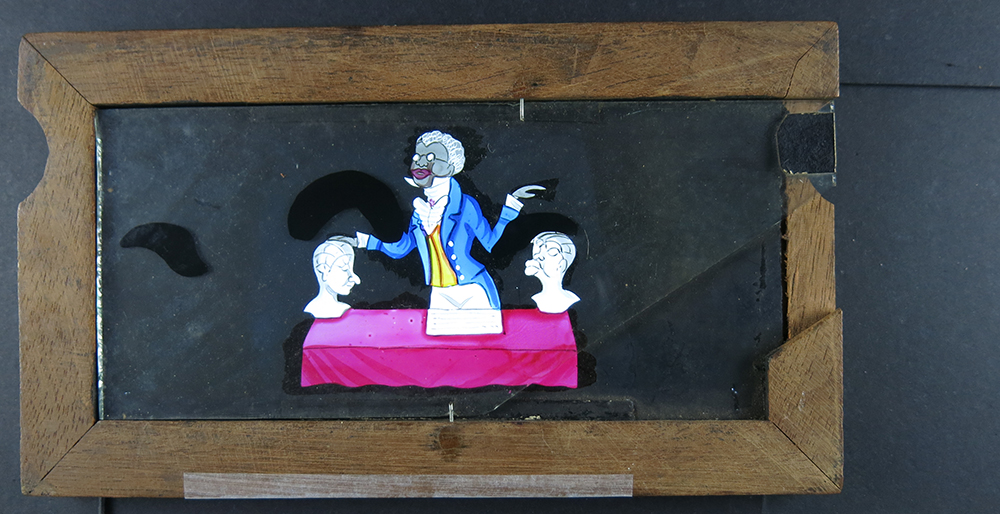
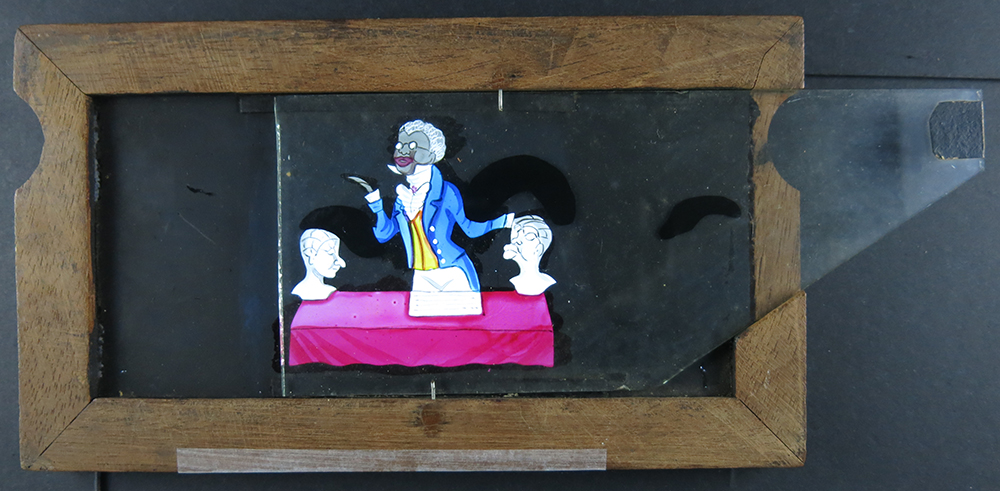
By far the most popular magic lantern slide of the nineteenth century was ‘Man Eating Rats’. Lanternists would even specifically promise it in their newspaper advertisements, so audiences knew they could go along and enjoy themselves making the requisite snoring and chomping and lip-smacking noises. I’ve had a copy of the slide for a while. But while the circulating rackwork rats worked perfectly, the sleeping man’s gluttonously bearded jaw was missing. Fortunately the ANU School of Art has a wealth of skill and knowledge and Waratah Lahy was able to paint me a  beautiful new jaw and beard (on a replacement piece of polycarbonate) which works perfectly. I’ll be showing it this Friday evening at the National Portrait Gallery in Canberra. I’ve also just brought a slipping slide of a phrenologist alternately examining a head of a ‘low’ type and a head of a ‘high’ type. Once again Australian National University historical expertise, through my colleague Alexandra Roginski, was able to provide me with actual phrenological readings from the period. So we’ll be performing this slide as well. There’ll be heaps of other slides, including The Gin Fiend.

'Man Eating Rats', hand painted and copperplate printed rackwork and slipping slide, c1890s.

‘Man Eating Rats’, hand painted and copperplate printed rackwork and slipping slide, c1890s.

'Phrenologist', hand painted and copperplate printed slipping slide, c1890s

‘Phrenologist’, hand painted and copperplate printed slipping slide, c1890s

'Phrenologist', hand painted and copperplate printed slipping slide, c1890s

‘Phrenologist’, hand painted and copperplate printed slipping slide, c1890s

History of Photography, The

The estimable Belinda Hungerford is doing a fabulous job researching and organising the archives of the Australian Centre for Photography. Her research led me to find, in the back of a cupboard, copies of a small booklet I produced with my students in 1990 (!). It was to accompany a show we put on at the ACP. Some students from back then are still doing important work in the field, I’m gratified to note. Reading through the anecdotes we collected back then it’s interesting that in that pre-digital period the minilab, now a lost site of visual profligacy and collective concatenation, served a not-dissimilar lubricious function to the ‘on-line’ environment now. If you want a copy of our booklet I’ll be glad to send you one, the price hasn’t changed in 25 years.

Australian Research Council funding for Heritage in the limelight: the magic lantern in Australia and the world

The ARC has funded a three year Discovery Project I will lead. The project aims to discover and analyse the large number of glass magic lantern slides that remain under-used in our public collections. International scholarship has recently begun to show that lantern slide shows were a ubiquitous, globalised and formative cultural experience. The project aims to explore the international reach and diversity of this globalised modernist apparatus from the Australian perspective. It plans to understand how diverse audiences affectively experienced these powerful forms of early media, and to develop ways for today’s Australians to re-experience their magic, invigorating and expanding our cultural heritage.

The team is Dr Martyn Jolly and Associate Professor Martin Thomas Australian National University; Professor Jane Lydon, University of Western Australia; Professor Nicolas Peterson and Professor Paul Pickering, Australian National University; Associate Professor Joe Kember, University of Exeter, UK.

With scholars like that we are guaranteed to find amazing material around Australia, and do wonderful things with it, in terms of identification, critical analysis and re-presentation. It’s also great that we will be working  with the European project A Million Pictures: Magic Lantern Slide Heritage as Artefacts in the Common European History of Learning. And I’m also looking forward to working even more with my friends from the lantern slide fraternity around Australia and the world. I can’t wait. I’m also really looking forward to picking up steam in my other ARC Discovery Project led by Dr Daniel Palmer, Monash University,’ Photography Curating in the Age of Photosharing’.

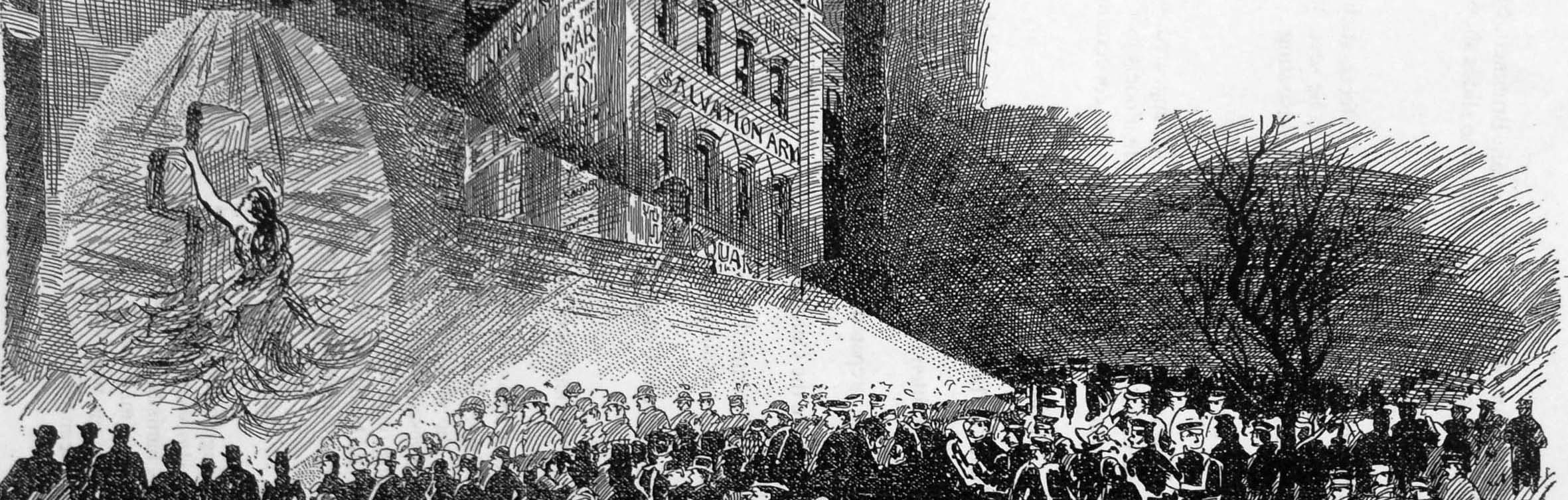
'In the Hurly Burly', detail from Salvation Army Melbourne War Cry, 1894

‘In the Hurly Burly’, detail from Salvation Army Melbourne War Cry, 1894

.


Holy City and Jack the Ripper

Holy City was the million-seller song of 1892. A little while ago, accompanied by a singer and pianist, I projected  my set of magic lantern slides, complete with double exposures and hand colouring, which were made to illustrate the song. Imagine my surprise this weekend when I read that its composer, the singer Michael Maybrick, has just been fingered as Jack the Ripper by the latest contribution to Ripperology, the 800 page They All Love Jack: Busting the Ripper (it’s all the fault of the Masons, apparently). If the book’s author, Bruce Robinson, is right, Maybrick had given up ripping a few years before he penned Holy City. I had always been fascinated by the song because of the way it took the trope of sublime religious vision, and reduced it to a nineteenth century opiated dream of travel. I had always been fascinated by my slides because they transcode the idea of the hallucinatory travelogue, as the dreamer takes a metaphysical Cook’s Tour to Heaven,  to the visual technology of the double exposure and the dissolve — presaging the transitive media of the twentieth century. But now it may also be an act of expiation by its author!

London Road film

It was wonderful to see  the film London Road the other day at the movies. It’s musical shot in the dourest of colours — even the flowers that finally bloomed at the end, after the neighbourhood serial killer had been banged up to rights, seemed to have the colours on their petals rationed as though it was still World War Two. The film was the adaption of a stage musical based on recordings of actual interviews with actual English residents in 2006 (which we finally heard over the end credits). The librettists had lovingly repeated and chorused each captured speech inflection, each glottal stop, each rising ‘yeah’ at the end of the sentence. It was a film that could only have been made in the UK.  It made me think of Nick Park’s claymation Creature Comforts, then further back through all the angry kitchen sink dramas of the fifties, then back through the Mass Observation Movement and finally to the GPO Film Unit of the 30s and 40s, with Humphrey Jennings’ wonderful stiff-upper-lip vox pops with stout fire wardens and  unflappable matrons. The title even echoes Jennings’ blitz masterpiece London Can Take It!. I came over all patriotic and I’m Australian!

London Road film

London Road film

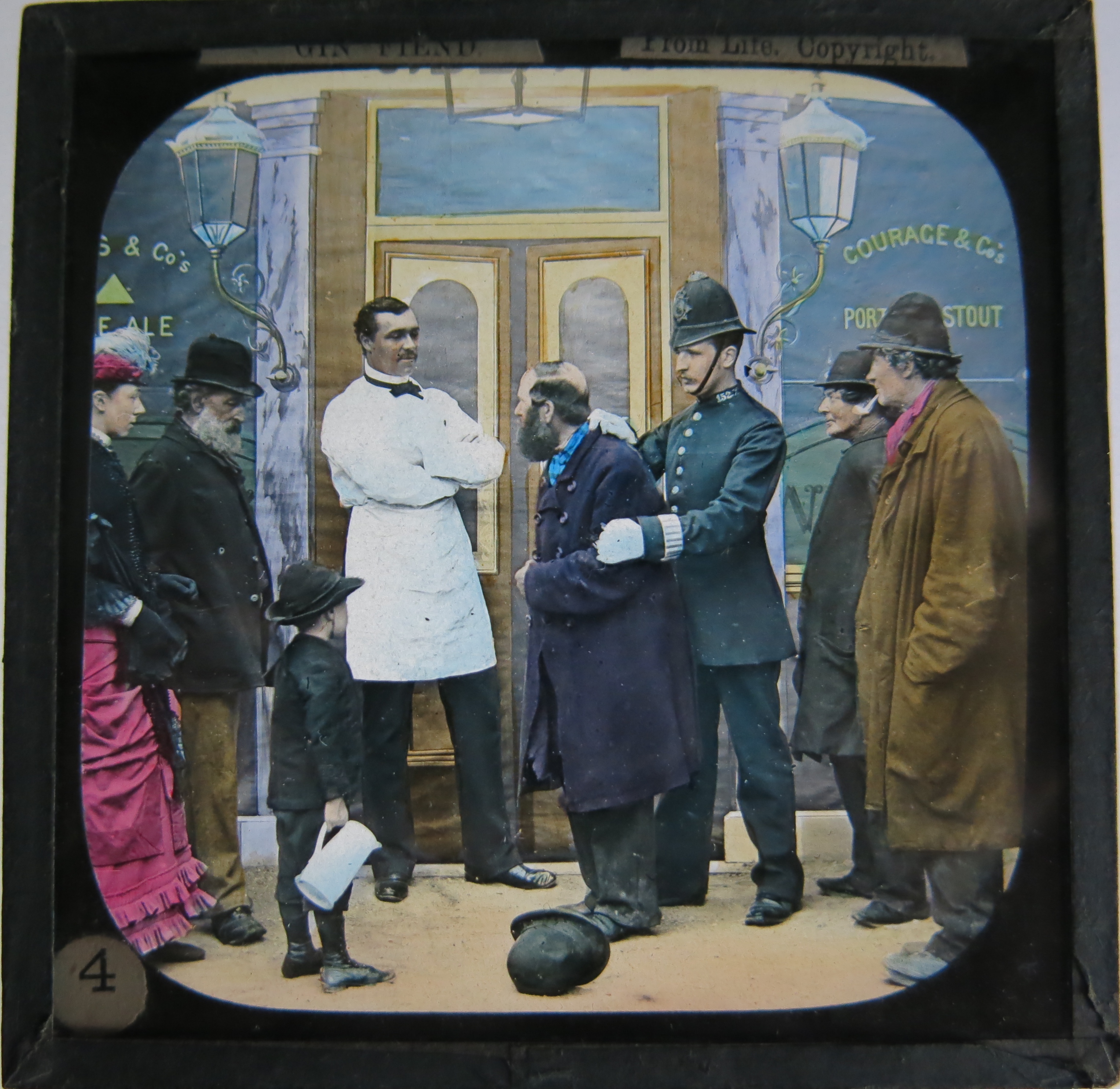
The Gin-Fiend

I’ve just brought these magic lantern slides manufactured by York & Son, UK, just before1888 to a temperance text by Charles Mackay. I’m trying to think why the faces might be obscured in slides two and three, the most beautiful and dramatic slides of the set.

The Gin Fiend slide 1

The Gin Fiend slide 1

The Gin-Fiend cast his eyes abroad

And looked o’er all the land,

And number’d his myriad worshippers

With his bird-like, long right hand

He took his place in the teeming streets,

And watched the people go,

Around and about, with a buzz and a shout,

For ever to and fro; —

 ”And it’s hip!” said the Gin-Fiend, “hip, hurra!

For the multitudes I see,

Who offer themselves in sacrifice

And die for love of me!”

The Gin Fiend Slide 2

The Gin Fiend Slide 2

There stood a woman on a bridge;

She was old but not with years;

Old with excess, and passion, and pain; —

And she wept remorseful tears

As she gave to her babe her milkless breast;

Then, goaded by its cry,

Made a desperate leap in the river deep

In the sight of the passer-by!

 ”And it’s hip!” said the Gin-Fiend, “hip, hurra!

She sinks but let her be —

In life or death, whatever she did

Was all for the love of me.”

The Gin Fiend slide 2

The Gin Fiend slide 3

There watched another by the hearth,

With sullen face and thin:

She uttered words of scorn and hate

To one that staggered in.

Long had she watched, and when he came,

His thoughts were bent on blood.

He could not brook her taunting look,

And he slew her where she stood.

 ”And it’s hip!” said the Gin-Fiend, “hip! hurra!

My right good friend is he;

He hath slain his wife — he hath given his life —

And all for the love of me.”

The Gin Fiend slide 4

The Gin Fiend slide 4

And every day, in the crowded way,

He takes his fearful stand,

And numbers his myriad worshippers

With his bird-like, long right hand;

And every day the weak and strong,

Widows, and maids, and wives,

Blood warm, blood cold, young men and old,

Offer the Fiend their lives

 ”And it’s hip!” he says, “hip! hip! hurra!

For the multitudes I see,

That sell their souls for the burning drink,

And die for the love of me.”


Camera Obscuras and Brisbane at Cloud Land show

For Robyn Stacey’s upcoming show Cloud Land at the Museum of Brisbane I have written an essay about the history of camera obscuras, Brisbane and Robyn. It was great to get the opportunity to spend a little more Trove-time looking into Brisbane’s own Whites Hill Camera Obscura, to the remains of which which I had previously made a pilgrimage. Thanks to the research of the Museum of Brisbane team we were able to find lovely, high resolution images of Brisbane’s one and only camera obscura:

From the tourist guide 'The Pocket Brisbane', 1913

From the tourist guide ‘The Pocket Brisbane’, 1913

Whites Hill Camera Obscura, c1924

Whites Hill Camera Obscura, c1924

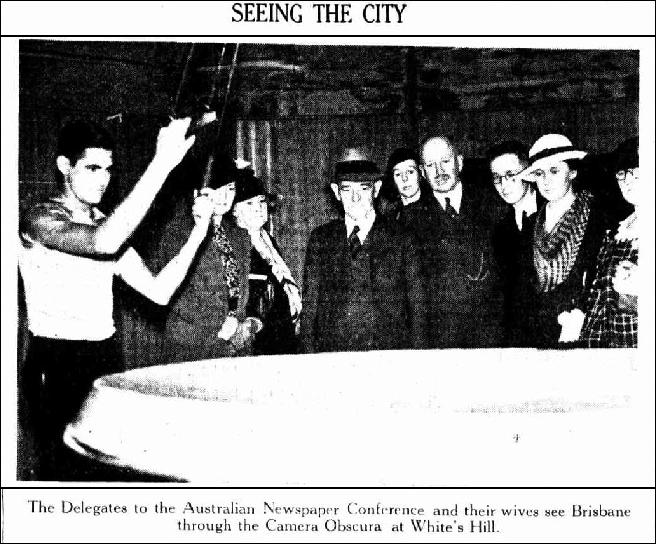
‘Seeing the City, The Delegates to the Australian Newspaper Conference and their wives see Brisbane through the Camera Obscura at White’s Hill’, The Telegraph, 1 June 1935 p13.

‘Seeing the City, The Delegates to the Australian Newspaper Conference and their wives see Brisbane through the Camera Obscura at White’s Hill’, The Telegraph, 1 June 1935 p13.

‘Children from the South Brisbane Intermediate School Rambling Club view the surroundings through the camera obscura at White’s Hill’, The Telegraph, 18 July 1936, p30

‘Children from the South Brisbane Intermediate School Rambling Club view the surroundings through the camera obscura at White’s Hill’, The Telegraph, 18 July 1936, p30

You’ll have to buy the Cloud Land catalogue to read about the history of Bob White, his camera obscura, and his telescopes — and their small but significant role in the psychogeography of Brisbane.  Some things still intrigue me. Why, for instance, in the Tele shots (which I think was the newspaper you read on the tram home from work) is the man operating the camera obscura only wearing a singlet, even though it is June, and possibly quite chilly. Is it some insolent semiotics directed to the well dressed southerners who look gingerly into the image? A year later, in July, the same man is dressed snugly and neatly for the visiting ramblers, who peer appreciatively into the bowl shaped image, which is duly blasted away by the flash of the Tele photographer’s Speed Graphic.

As a child I think I was dimly aware of the the long-ago existence of the hilltop machine. We lived not far from Whites Hill, but it was beyond the reach of our bikes. Although my father did occasionally drive us to the Whites Hill dump at the foot of the hill we never went up — but perhaps he mentioned the long-demolished camera obscura to me on the drive out, he was certainly the right age to have visited it as a kid. (Once, I remember, we  brought a load of broken-up concrete pathway to the Whites Hill dump, as we over-enthusiastically under-armed the chunks from the car boot my father accidentally whacked me on the shoulder with a flat piece, he was mortified, but after the initial shock, I found myself remarkably unharmed.)  The dump, chockers with rubbish culled from a thousand sixties backyards, has been smoothed over for playing fields, and is now barely a memory, less so, even, than the camera obscura.

Two suns at Tianjin

Thanks to my Hong Kong friends for pointing this out to me. They joke that when the Chinese leadership visited the site of Tianjin’s ‘Big Bang’, they commanded two suns to appear in the sky (check out the arm shadows). However Reuters still seems to be using the image without comment.

The image as it appears on Hong Kong's TVmost site.

The image as it appears on Hong Kong’s TVmost site.

TVmost's comment

TVmost’s comment

The image supplied by Reuters and used without comment by the South China Morning Post.

The image supplied by Reuters and used without comment by the South China Morning Post.