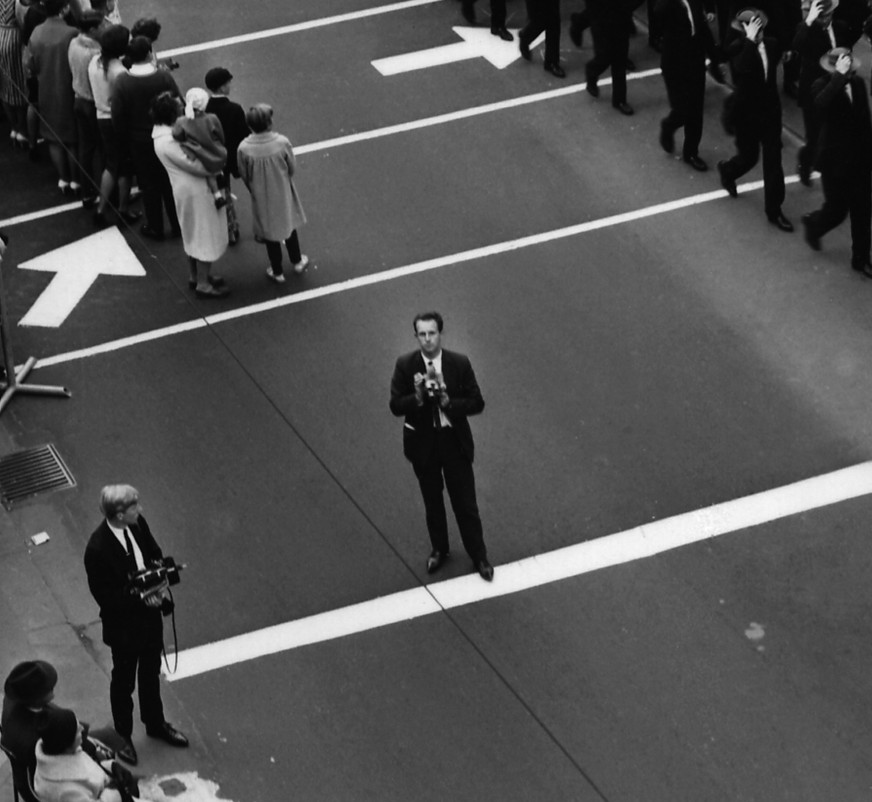
It was great seeing Stelarc, with his third ear, at the ANU School of Art’s Driving Forces conference. I’ve always greatly admired him of course. But I finally got to ask him about, and discuss with him afterwards, what I have always regarded as the ‘showmanship’ aspect of his practice. To me he’s a showman. I do not use this term pejoratively, and to me it does not diminish the fact that what has fundamentally driven his practice for decades is him putting the materiality his own body at stake in literally embodying his ideas. Nonetheless, for me there is an additional dimension of spectacle, performance and display (even down to his love of alliterative titles) which I still think is ‘showmanship’ in a positive sense. He was generous with me of course, but he didn’t buy it. But I was thinking back to the nineteenth century where, at places like the Royal Polytechnic Institution, or through famous and charismatic figures such as Professor Henry Pepper (who sojourned in Australia for a decade or two), or through the Victorian conversazioni, various technologically imagined futures were demonstrated through actual experiments conducted as entertainments. It would be great if this historical depth could begin to figure somewhere in Australia’s art/science discourse.
Category Archives: Blog
Still catching my breath after experiencing the tour de force animation in The Wind Rises
I’m still catching my breath after experiencing the tour de force animation in The Wind Rises, Hayao Miyazaki’s own Doctor Zhivago. He loves cameras and film: lovingly hand-animating moving parallax perspective, the carefully delineated iris hexagons in the carefully painted lens flare, the beautiful bokeh, the shutter-blur on railway-bridge pylons as they flash past, the defractions of teardrops, the distortions of pre-war glass-panes, and the sheen travelling across aluminium. But he loves paint equally: our heroine palette-knifes the great animator’s own colours into her fateful canvas, to be eventually washed away by the rain, more driving rain become the manga shorthand of parallel lines for motion, in an aerial view a winding train becomes a charcoal line that momentarily drifts off the tracks, and the faces of the quake victims morph into expressionistic blobs of paint. Although I think it’s somewhat disingenuous for Miyazaki to compare, via the Italian dude philosophising on the plane wing, Imperial Japan’s brutal ‘Co-Prosperity Zone’ and Mitsubishi’s Zero fighter program with the Pharaohs and their pyramids, for an end-of-career movie this one is amazing.

University of Queensland Art Museum apocalyptic opening speech
It was great hanging out with Campbell Gray, Gordon Craig and Michelle Helmrich at the UQAM, as well as s well as Maurice and Camilla from the QCP, and meeting the dealers for James Casebere and Yao Lu at the No Place, opening. The only bead I could get on their work and the work of Lori Nix and Giacoma Costa for my opening speech, was ‘apocalypse’, the text is below.

No Place show at UQAM
No Place
‘Hasn’t the weather been strange lately, could it be a warning?’ Perhaps you found yourself saying this, or something like this, to one of your friends recently. It sounds so contemporary, so much part of our current anxieties, but in fact it is the strap-line from the poster for a 1977 Australian film by Peter Weir called The Last Wave. The film ends with a huge tsunami hitting modern Sydney, as foretold earlier in the film by local aborigines with their ancient wisdom, and ignored by whites with their hubristic civilization. I’m starting with films of apocalypses because that is the only point of entry I can find into this intriguing show. I’m afraid that Gordon Craig’s title for his show, No Place, just doesn’t do it for me, nor does the idea of ‘home’which he floats in the catalogue. And ideas of dystopias and utopias, the ideas I first started with in an attempt to wrap my head around this difficult show, also didn’t get me very far. But I think the idea of apocalypse does give me a point of entry, because apocalypses are about contradictions, and I think that this is also a show of contradictions.
Peter Weir’s movie is only one of a long stream of apocalyptic movies, and it comes from the same period of the disaster movies that have influenced some of the artists here, movies like The Poseidon Adventure 1972 (from which I still bear the scars) and others like Towering Inferno and Earthquake from 1974. Before the wave of seventies disaster movies we had nuclear apocalypse movies like On the Beach 1959 or Doctor Strangelove 1964; and now there are a new crop of disaster movies, many featuring zombies, such as Danny Boyle’s 28 Days Later, 2002, where this generation’s anxieties are played out. I think apocalypses must be hard wired into us as humans. They are certainly a fundamental part of all the world’s major religions, and vivid apocalyptic scenarios can be traced back to the millenarian cults of the Dark Ages. I grew up in Brisbane in the shadow of another potential apocalypse — all-out nuclear annihilation, and now in Canberra my children cheerfully tell me that they will be dead before they reach my age because I’ve personally brought on climate change for them and, as a result, the sea levels will rise and the crops will fail for their generation.
And this is the thing about apocalypses, they unite the micro with the macro, the seemingly inconsequential with the cataclysmic, and the personal with the epochal. In the Dark Ages, or in certain parts of the South in the United States, if we didn’t individually pray to Heaven we’ll be left behind at the last trump. In the sixties, if we didn’t adequately prepare, we would be left as a thermonuclear shadow on the ground. And now, if we don’t each reduce our carbon footprints, sea levels will rise. And this is where apocalyptic scenarios come in, my personal carbon footprint will raise sea levels less than a micron, but collectively we are all in trouble.
Apocalyptic scenarios are personal: they are about our individual responsibilities and our personal failures, but they are our failures scaled up, from the human to the cosmic. And this is why I think a lot of work in this show is apocalyptic: it does not simply recreate scenarios that might be familiar to us from science fiction movies, but the activity of the artist’s labour itself, working with an exacto knife, fome core, polymer clay and glue, day after day, to create intense miniature worlds, which are then reproduced at massive scale, I think taps into a deep redemptive impulse. It takes Lori Nix seven months to build one of her dioramas, at about a metre across, of cities drowned by time; and she then photographs them, from the precise angle for which they were built, on an 8 x 10 view camera — the highest-resolution of recording there is. This shift from the hand-crafted table-top world do the high-resolution print creates a strangely uncanny image — one reminiscent of dreams, of the aftershock of the psychic impact on us of movies we were really too young to see at the time — but it is also a measure of the distance that needs to be bridged between the personal and the epochal.
There is labour in the digital too. One just has to stay to the end of the long roll of credits at the end of any contemporary science fiction film to realize that Hollywood’s outsourced CGI and VFX labs are the sweatshops of the post-industrial age, building cathedrals of illusion pixel by pixel, rather and stone by stone. The digital artists in this exhibition have also sweated laboriously to maneuver pixels into place with their Wacom Tablets. Yao Lu’s collages, of sublimely monumental piles of rubbish in China, use revered and ancient compositional references which project China’s mountains of rubbish, to which a blind eye can still be turned, into the future where they will — apocalyptically — come to define ‘Chineseness’ itself.
Giacomo Costa’s digital illusions unite urban architecture with geology and climate in an extended epochal timeframe where the human is so ephemeral it cannot even register. But their main impact on us as images comes, again, from the contradictions in scale: the microscopic detail of his vectoral models and texture maps, against the breadth of his vistas.
So there are contradictions within the images that I think are really important. The contradictions are essentially those which the very oxymoronic phrase ‘photographic fictions’ sets up. But these contradictions are also an essential truth: the Earth indeed will drown if we don’t change our ways. We will steal the future from our own children unless we can imagine — fictionalize — future scenarios scary enough to make us change, and compelling enough to connect or own micro lives with the macro fate of humanity.
Not only are there contradictions within the images, but Gordon Craig has also set up a contradiction within the show. James Casebere has been doing table-top work since the seventies, when Thomas Demand was still a boy in short pants, and his work has always been about the American mythos, often with a touch of postmodern irony. But here I think the irony is getting more pointed. At first glance the cardboard houses of Dutchess County have a Tim Burtonesque quirkiness, like the opening shots to Beetlejuice or Edward Scissorhands. These houses, with their cheap-ass, hokey and homey Americana architecture, probably hold all the normal suburban secrets, but nothing too challenging — at first glance, that is. Casebere’s table-top fiction was inspired by an actual scene which he saw from a freeway where, he says, he: ‘discovered the spread of cookie-cutter McMansion subdivisions, all mixed up with the unplanned ad-hoc triumph of vernacular taste, and a carbon footprint spun out of control.’ The Global Financial Crisis, with its Sub-Prime Mortgage fallout for Americans, had just hit; but rather than just photographing an historical crisis, or an aesthetic crisis in taste, Casebere had also presaged on apocalyptic crisis. It is the everydayness of this scene, with its ‘carbon footprint spun out of control’, that we must continue to imagine and reimagine, fictionlise and document, in order to keep all of its implications for our future in mind.
Martyn Jolly
Opening speech at UQ Art Museum
Trying to think of something to say in my speech at the opening of No Place at the University of Queensland Art Museum next Friday. What to say about u/distopian constructed place tableaus from two American, one Chinese, and one Italian photographer. Drop by if you are in Brisbane.
Experimental lantern slide projection with Professor Nic Peterson, Martin Thomas, David and Judith McDougal, Jenny Gall and Diedre Feeney
A good couple of hours were spent at the ANU experimentally projecting magic lantern slides from the collections of Professor Nic Peterson, Martin Thomas and David and Judith McDougall, as well as my own, on my two vintage lanterns. Nic’s handcoloured mission slides from the 20s (I think that was the dates) were especially interesting, the handcolouring adding to their poignancy. Nic also had the back story on what was going on at the missions. I need to work on my skills as a lanternist, but we agreed we had discovered a lot here to develop further later in the year.

Mission slides projected through vintage magic lantern

With Bearcage, Lee Grant and Yu Haibo

Is Rob Moody Australia’s greatest archive artist, greater even than the great Patrick Pound?
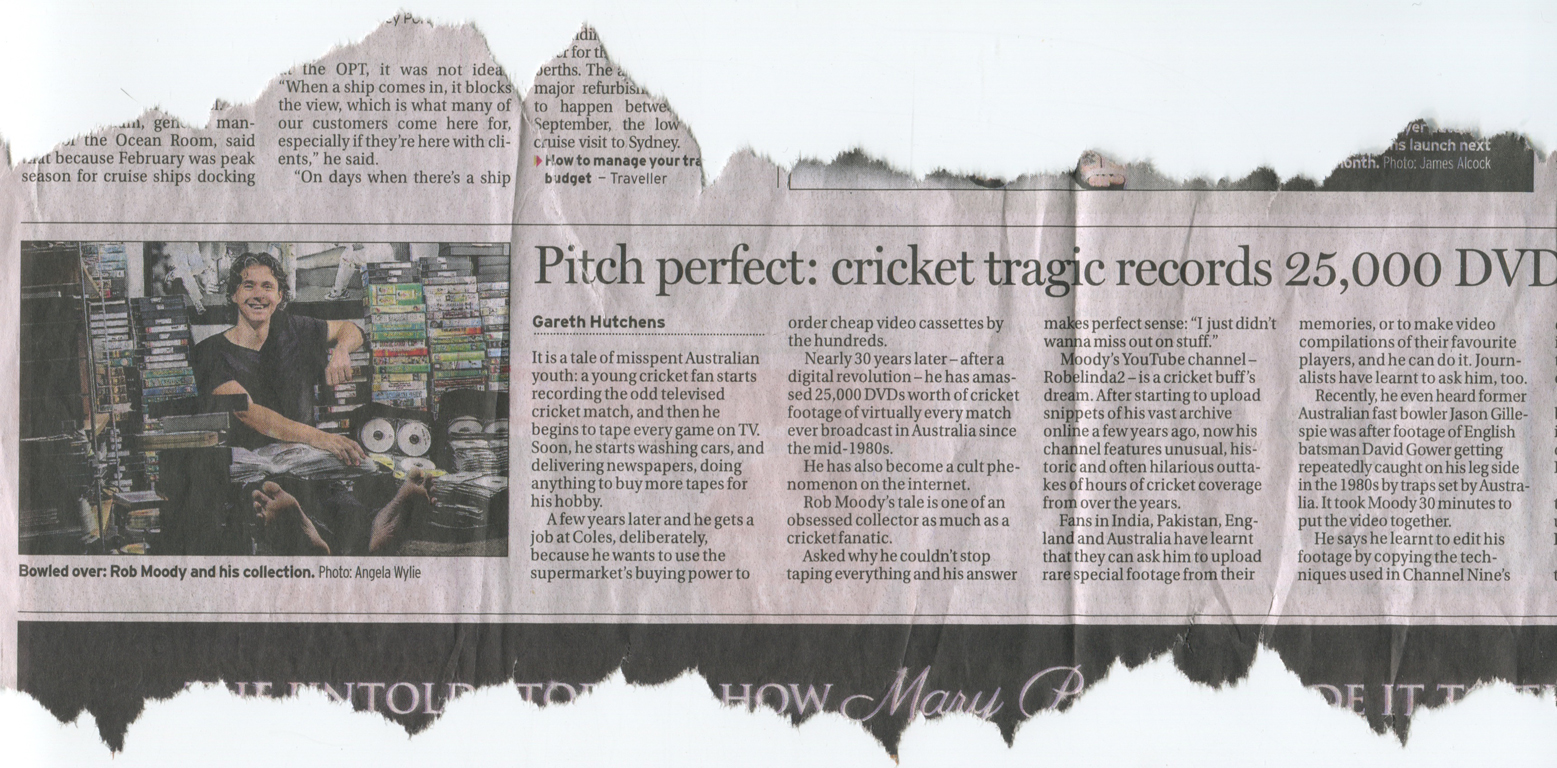
Rob Moody article 1

Rob Moody article 2
Pitch perfect: cricket tragic records 25,000 DVDs worth of game time
Author: Gareth Hutchens
Date: Sydney Morning Herald 18/01/2014 p10.
It is a tale of misspent Australian youth: a young cricket fan starts recording the odd televised cricket match, and then he begins to tape every game on TV. Soon, he starts washing cars, and delivering newspapers, doing anything to buy more tapes for his hobby.
A few years later and he gets a job at Coles, deliberately, because he wants to use the supermarket’s buying power to order cheap video cassettes by the hundreds.
Nearly 30 years later – after a digital revolution – he has amassed 25,000 DVDs worth of cricket footage of virtually every match ever broadcast in Australia since the mid-1980s.
He has also become a cult phenomenon on the internet.
Rob Moody’s tale is one of an obsessed collector as much as a cricket fanatic.
Asked why he couldn’t stop taping everything and his answer makes perfect sense: “I just didn’t wanna miss out on stuff.”
Moody’s YouTube channel – Robelinda2 – is a cricket buff’s dream. After starting to upload snippets of his vast archive online a few years ago, now his channel features unusual, historic and often hilarious outtakes of hours of cricket coverage from over the years.
Fans in India, Pakistan, England and Australia have learnt that they can ask him to upload rare special footage from their memories, or to make video compilations of their favourite players, and he can do it. Journalists have learnt to ask him, too.
Recently, he even heard former Australian fast bowler Jason Gillespie was after footage of English batsman David Gower getting repeatedly caught on his leg side in the 1980s by traps set by Australia. It took Moody 30 minutes to put the video together.
He says he learnt to edit his footage by copying the techniques used in Channel Nine’s cricket coverage. And his favourite thing to do with the footage is to make compilations of different players or incidents.
He has exposed Australian batsman Shane Watson’s defective technique in a video that compiles every one of his painful LBW test dismissals.
Another video features every test match run-out of the ungainly Pakistani batsman Inzamam-ul-Haq.
Over the years Moody has had to transfer his valuable footage from VHS to DVD to hard-drive, to save it from deteriorating.
He says he still loves the sport, though he can’t watch too many games while his two children, aged 6 and 4, are awake.
What does his wife think of his collection?
“She’s fine,” he says. “It looked physically a lot worse when we first got together because it was all on video tapes, thousands of video tapes.
“It’s not all over the house like it used to be.”
Opening of Still Fragments Landscapes at Belconnen Arts Centre
It was fun opening Louise Curham and Jo Law’s exhibition Still Fragments Landscapes at Belconnen Arts Centre: hand processed Super 8 film, at three frames a second, digitally composited with rotoscoped, hand-drawn and stop-frame stitched elements, all presented on small framed LED screens as video art you could live with. Nice.
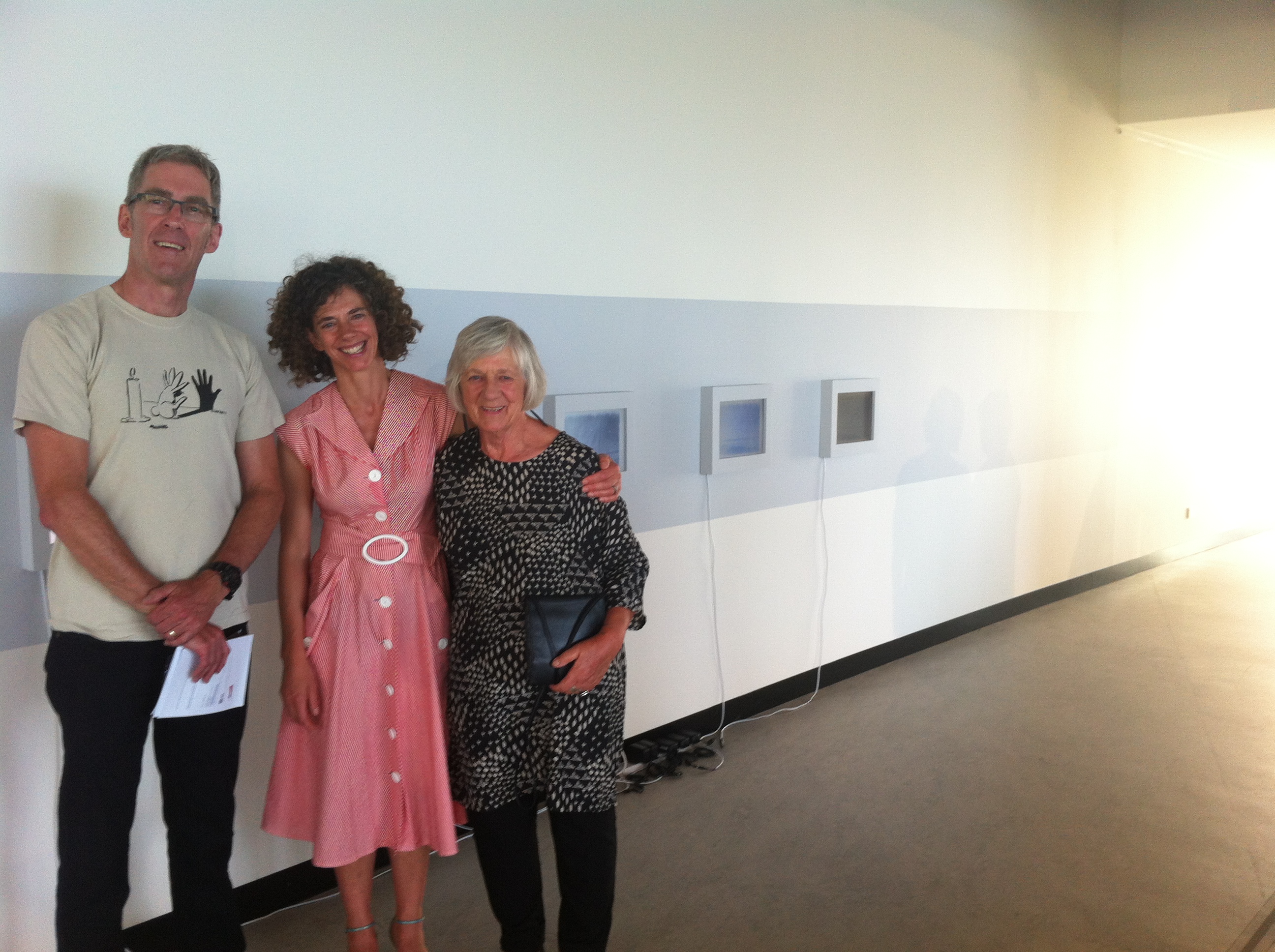
John Macdonald, Louise Curham, and her mother Val at the opening
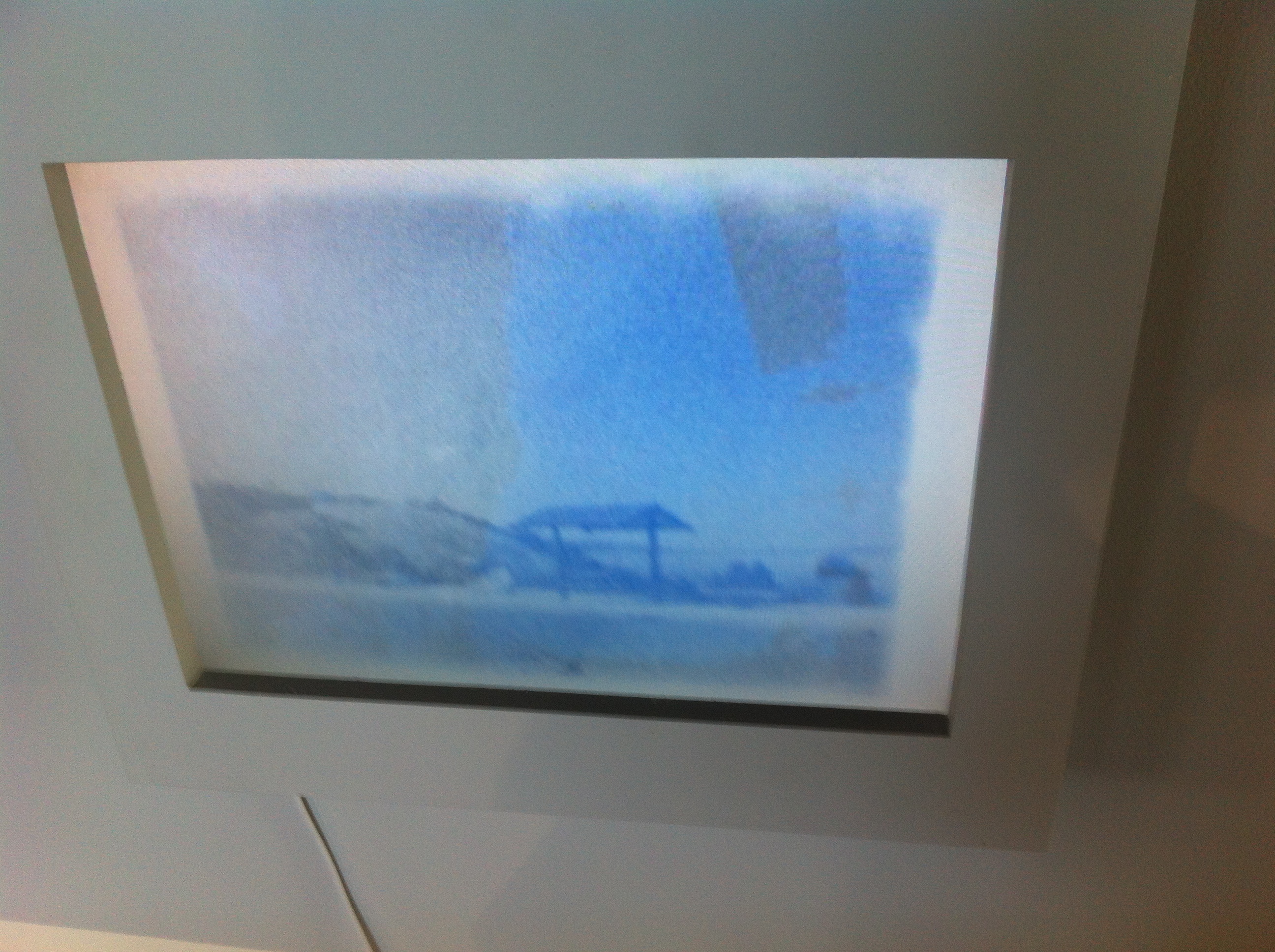
My magic lantern slide collection
Now I have got my two lanterns working with LED lights, I spent the weekend beginning to catalogue the slides I have recently acquired. It turns out I have hand-painted slides of the Hymn Rock of Ages, very similar to the set which the Salvation Army used in one of Australia’s first outdoor projection in Melbourne in1894; as well as many complete sets of Life Model and Song Slides, such as were frequently used in Australian missions and churches. I’m now thinking of where to go next with my research, I’m currently looking at the reaction of nineteenth century Australian audiences to the lantern through newspaper searches, but there are so many other exciting things to do:
- Commission contemporary artists to make contemporary lantern slides — paintings on glass or anything that can be sandwiched between 82 x 82mm glass!
- Recreate shows using the Song Slide sets and the mp3 transcriptions of the Edison wax cylinders and Columbia records which the Library of Congress have made available on-line
- Recreate shows using the Song Slide sets and Life Model sets with sheet music available from Trove and the recitations available online with performers interested in the genre of melodrama and sentiment
- Build a rig that will allow me to ‘wear’ the smaller lantern as part of a performance (which was a technique developed by the London Polytechnic)
- Collaborate with contemporary performers and musicians
Any ideas?
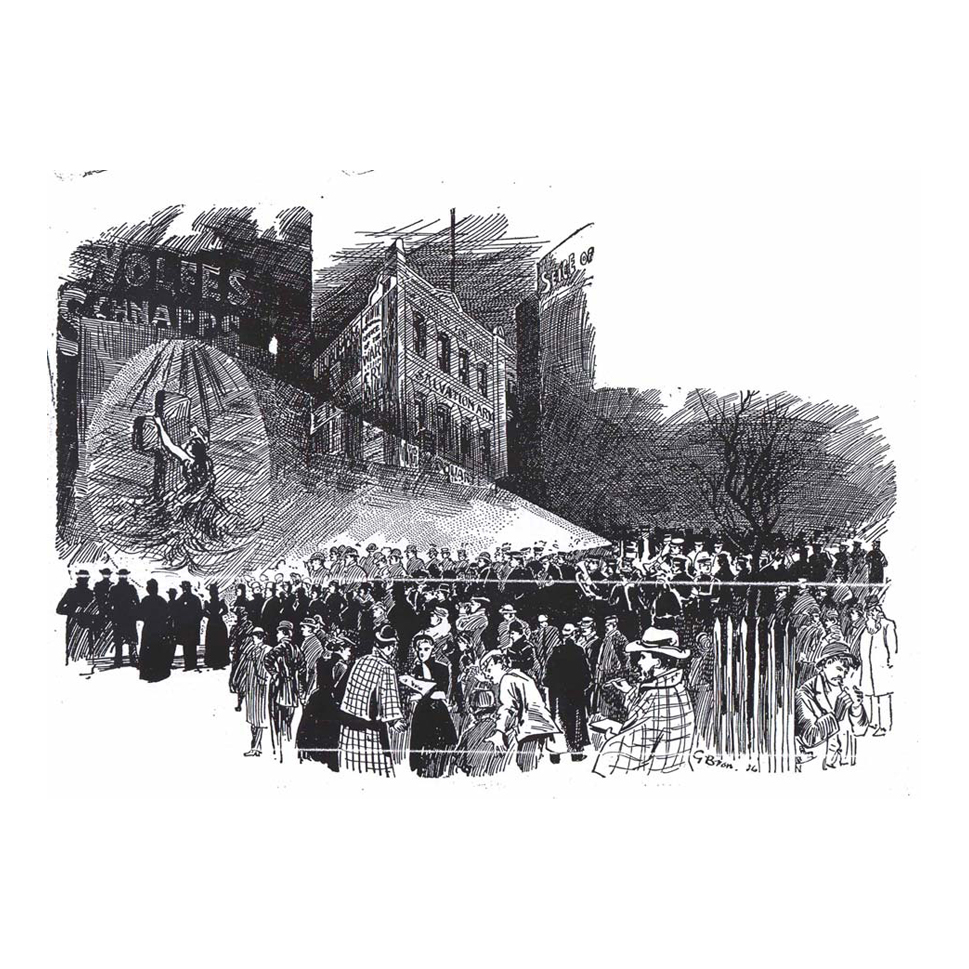
Outdoor projection of Rock of Ages, Melbourne 1894

My Rock of Ages Slides, similar to the ones the salvation Army projected outdoors in 1894 Melbourne

My complete set of ‘Jane Conquest’ slides, complete with angel ‘effect’ slides, similar to the one projected throughout Australia in the 1890s.

- Jane Conquest slide show illustrated in Salvation A

I Heart TV Launch at M16
The first opening of 2014 (first of many), but it was a pleasure to be able to give the opening talk at Sam Townsende and crew’s I Heart TV at M16. An intelligent show that got coverage in the Canberra Times. Great to catch up with old student friends who are still smart. Also looking forward to launching Louise Curnham’s and Jo Law’s Stills Fragments Landscapes at Belco Art Centre next week.

Clinton, Tess, Sam, Aki, Erica, Belle — the artists

Me raving
 Martyn Jolly