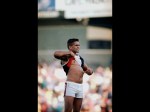
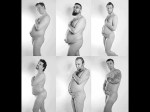
The hashtag #standupstripdown has been invented to be used by people like Heather Whitten who want to post family photographs with naked children. In the latest of a string of such incidents her image of her naked husband cradling her sick and naked son in a shower has been taken down several times by Facebook following complaints by people disgusted by the potentially paedophilic readings the photograph could carry. The disgusted complainers who are having such a lamentable chilling effect on our visual culture misunderstand both semiotics and paedophilia. Even if it unpleasant to imagine the occasional paedo using such images for sexual gratification, the psychological effect on our whole society of NOT seeing images of such rich aspects of life, love and bodies is far worse. Others complain that the children in such photographs cannot give their consent and may be shamed or embarrassed when they grow up. But image making and image sharing in our culture cannot be reduced to a infinite series of micro-contracts over ‘self image’ between two quasi-legal parties. Such a legalistic conception of self image as an owned ‘property’ also reduces the complexity and richness of our collective visual culture. I’ve previously written about this so I don’t know why people aren’t taking any notice of me. Perhaps I didn’t think of inventing a hashtag.
In Bangkok triangulating Francis Chit and being reminded of Charles Bayliss
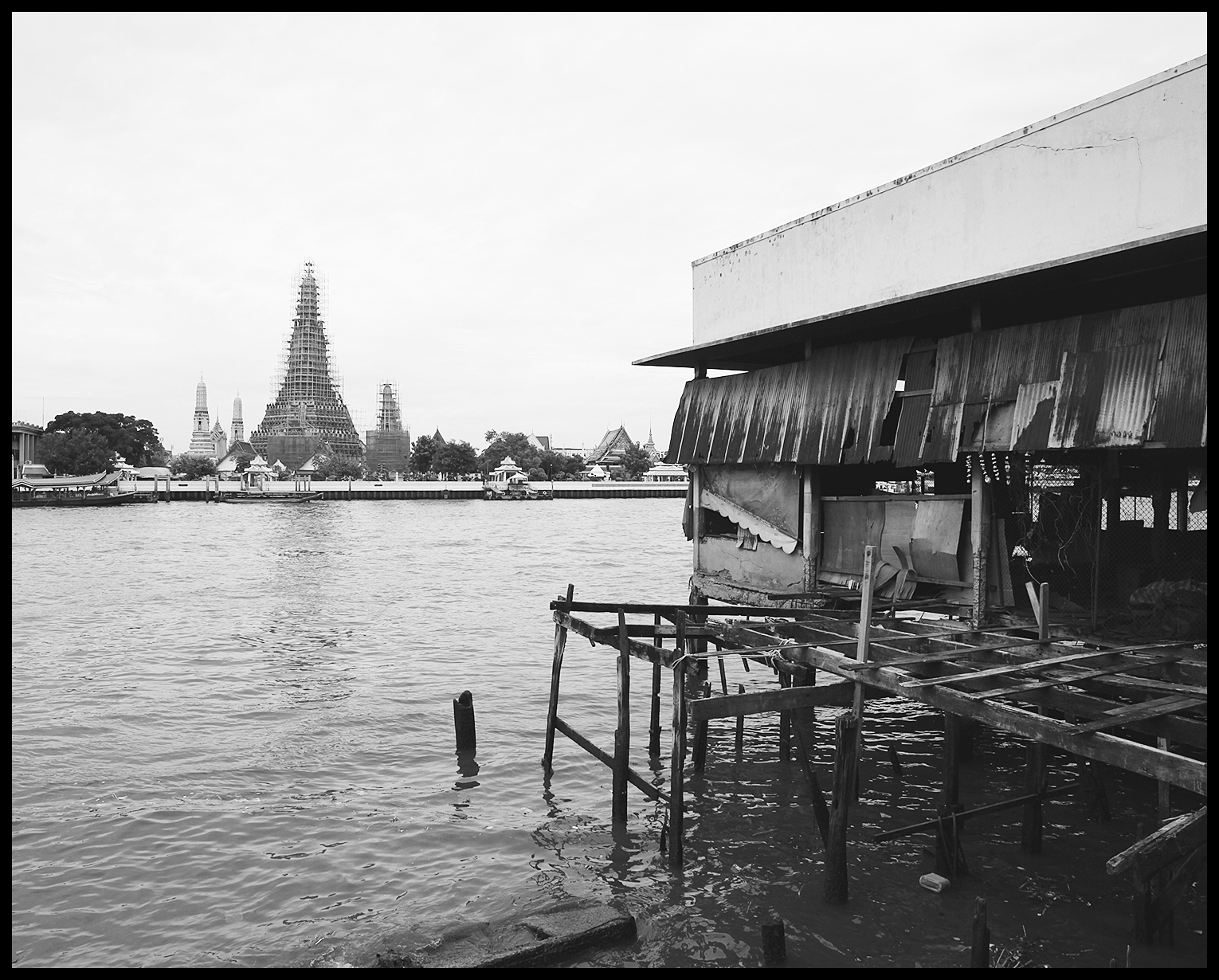
When we were recently in Bangkok we had a lovely afternoon with the super gracious Gun Susangkarakan who we had met when I was giving some seminars at Chiang Mai University Faculty of Fine Arts Department of Media Arts. Gun is an ace temple photographer (hard-core old-school, 8×10 selenium-toned contact prints). He took us to Wat Arun (Temple of Dawn).
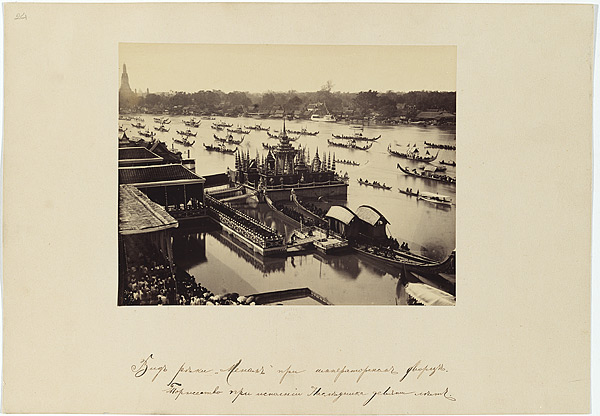
You can also just glimpse this temple in the left hand corner of Francis Chit’s fabulous 1886 shot of Prince Vajirunhis being escorted to the Grand Palace for his investiture as crown prince, which is now in the National Gallery of Australia, and featured in Gael Newton’s 2008 show Picture Paradise.

Francis Chit, ‘Prince Vajirunhis escorted to the Grand Palace for his investiture as crown prince. ‘Bangkok 14 January 1886. National Gallery of Australia
Chit had previously shot the Wat Arun from across the river in 1865.
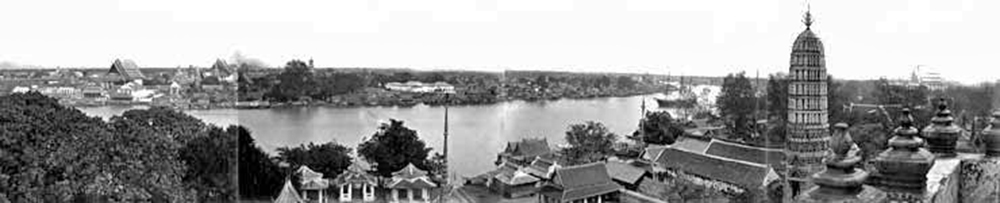
And he had climbed its stair to use it as a platform for a four-frame river panorama in 1863/64, when the river was a rice export port.
I was reminded of the five-frame Sydney Harbour panorama Charles Bayliss made from the roof of that ‘temple of commerce’, The Sydney International Exhibition Building, in about 1880, before it burnt down. Both have the same ‘aspirational’ loftiness, with architectural details from their improvised platforms projecting into the frames
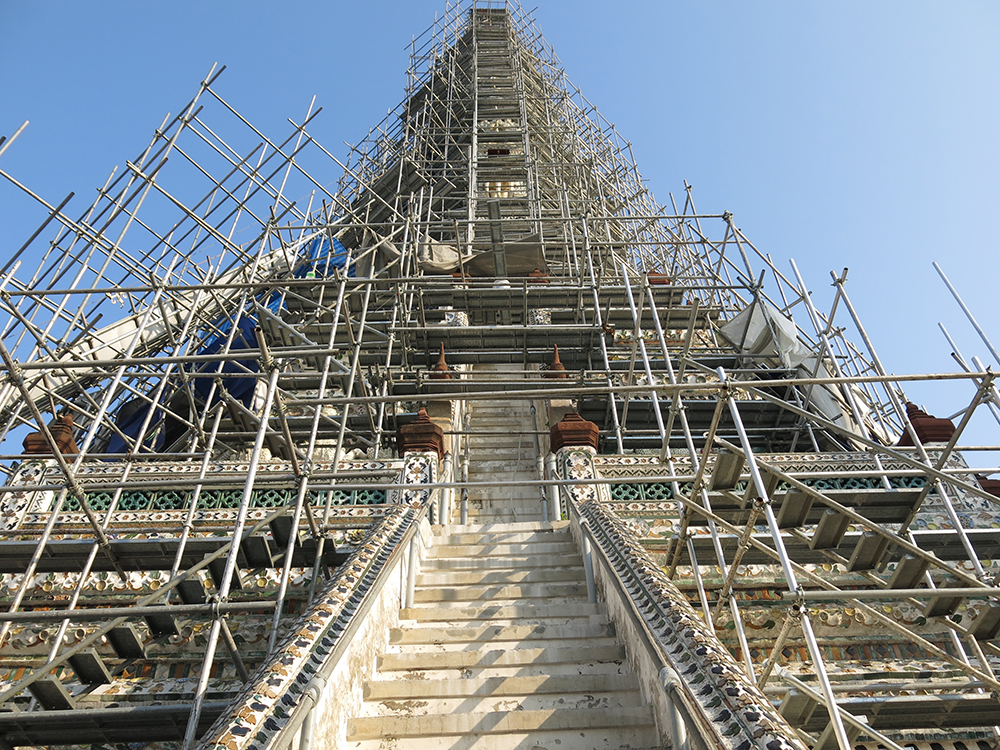
Fortunately Wat Arun is now being restored and is covered with a fine cross-hatching of scaffolding.
But the question remains, from where in the Grand Palace precinct did Chit shoot the investiture flotilla? Nineteenth century photographers around the world craved elevation and were always intrepid in gaining it. Did Chit get a special tower made, or was there a tower already there as part of the port infrastructure?
My review of ‘The Photograph and Australia’
In The Australian & New Zealand Journal of Art, Vol 15, No 2, 2015
The Photograph and Australia, curated by Judy Annear, Art Gallery of New South Wales 21 March — 8 June, 2015; Queensland Art Gallery 4 July — 11 October, 2015
There haven’t been enough books or exhibitions about photography and Australia, given that the medium is so popular and so fundamental to our visual culture, and given that it has left such rich resources in our museums, libraries and archives.[1] There was Jack Cato’s anecdotal The Story of the Camera in Australia, first published in 1955 but still in print in 1977. Then in 1988 the confluence of the bicentenary and the one hundred and fiftieth anniversary of the invention of the medium led to two further books to succeed Cato’s: Gael Newton’s Shades of Light: Photography and Australia, accompanied by a National Gallery of Australia exhibition, which linked Australian photography to international aesthetic narratives such as modernism; and Anne-Marie Willis’s Picturing Australia, which took a socio-critical approach to photography as a medium of power. Next came some institutional collection showcases, which used the idea of ‘Australia’ as a framing device.[2] Then, in 2007, Helen Ennis’s Photography and Australia used the medium, which she regarded as having ‘no singular or monolithic form’, to reflect on key themes in Australian society such as indigenous/settler interactions, the land, modernity, and our relationship to the rest of the world.
Now we have the Art Gallery of New South Wales’ The Photograph and Australia, like Shades of Light both a book and an exhibition. Unlike its predecessors it does not deal with Australian photography as an industry, or an aesthetic project, or a source of social power, or a national conversation. Instead, it deals with Australian photographs as ‘a phenomenon rather than simply a form’[3]. It puts the ontology of the photograph, its special status as a ‘message without a code’, at the heart of its methodology. It embraces the multiplicity and ambiguity of the roles and meanings diverse photographs have had in Australia. The starting point for the project was the direct aesthetic, emotional and intellectual engagement of Judy Annear, the Curator of Photography at the AGNSW, with the thousands upon thousands of individual photographs she trawled through in museums, libraries, archives, and dealers. Although the exhibition will be seen at two art galleries, the AGNSW and the Queensland Art Gallery, the visual power of the show was not primarily derived from state and national art gallery collections, which have been defined by the careful choices made by their curators since they first began to collect photography forty or so years ago. Rather, the exhibition was driven by the resonance Annear found with unexpected finds from relatively ‘uncurated’ archives and libraries — diverse institutions that have been acquiring more photographs for much longer than galleries. The show’s fascination is driven by the sheer eccentricity of some of these finds which Annear has winkled out of the archival recesses, such as Thomas Hinton’s kinky federation patriotism in four cabinet card dioramas featuring Australian heraldry and him wearing a loincloth, or Henry Tillbrook’s environmental self portraiture, or even CEW Bean’s hand-scrawled trigonometric annotations across one of his views of the Gallipoli Peninsula.
The book (assiduously researched by Annear and her team, and complete with biographies, checklists, timelines and glossaries as well as contributed essays) is divided into five chapters, from ‘Time’ to ‘Transmission’. The exhibition hang at the AGNSW explored four themes — settler and Indigenous relations, exploration, portraiture, and transmission — through nine rooms, from ‘Self and image’, through ‘Critique’, to ‘Transmission’ (again). But nonetheless, from the point of view of the visitor, the exhibition tended to remain a series of separate encounters with different photographs. It was up to the viewer to discover and interpret their own finds. There was no conventional authorial, aesthetic or technical hierarchy within the exhibition. An image which had faded to being little more than a sepia smudge, such as Richard Daintree’s circa 1860 image of his son Alfred asleep in a cot, was nonetheless included in the show because it remained a powerful ‘phenomena’ of paternal love, and anticipated the family snap of the twentieth century. There were other Daintrees in the show, for instance his promotional images of Queensland which had been printed and thickly covered with oil paint in London, but there was no way of reconciling these entirely different images by the one person, one supremely private the other explicitly public, into anything like an artistic oeuvre. That was not what this show was about.
Something of the sense of the raw unmediated archive carries over into the installation itself, the overwhelming impression for the viewer as they strained to peer into photograph after photograph after photograph was quantity, there has simply never been a show in Australia with so many photographs in it. Of course the point is that photography has always been a medium of quantity, that is part of the phenomenon, but still Annear brooks her viewers no quarter. She commands her visitors to look equally at every photograph, from the postage stamp sized heads in a tintype album or commemorative photomosaic to the tiny detail caught in the corner of a Melvin Vaniman platinum-print panorama. After finally exiting the exhibition — and if they have seen it all they must inevitably have sore eyes and the beginnings of a headache — perhaps Annear’s ideal viewer will nonetheless feel the same sense of satisfaction that a historical researcher is familiar with feeling after a hard day’s slog in the archive: that although they feel that they are not much closer to understanding their topic they have nonetheless engaged with the brut stuff of history.
There are no reproductions or enlargements in the show. The experience of the exhibition was concentrated on photographs as physical things — daguerreotypes in cases, albumen prints in albums, mammoth collodion negatives on light boxes, and cartes de visite by the hundred. If this turn to the materiality of the photograph was welcome, and very much in keeping with recent scholarship in photography, what remains for future exhibitions to properly address is that photography was a retinal phenomenon, as well as a physical one. As I looked through the top of a glass case down to William Hetzer’s stereographs of Sydney from the late 1850s (alongside their cute little original storage box), how I longed to see them in a stereoscope, so the new buildings of Sydney would pop up in relief along the receding length of Macquarie Street as he intended. Other museums are able to contrive safe stereo viewers for stereographs, why not the AGNSW?
Nonetheless some pockets of the exhibition represented a profound privilege for the viewer. Literally thousands of daguerreotypes were taken in Australia, but 99% have disappeared. Only a handful of them remain identifiable, and most of those seemed to be in this exhibition. There were a whole family of George Goodman daguerreotypes, four Douglas Kilburn groups of aboriginal people reunited at last from the National Galleries of Victoria and Australia, a JW Newland daguerreotype from 1848 of a twinkle-eyed Sydney publican in an extremely loud check suit looking like he was just about to step into a Dickens novel, and many other delights. As we bent over the glass cases in the gloom trying to get a visual purchase on the slippery, silvery images below us, we were subjected to one of Annear’s curatorial flourishes. Ricky Maynard’s series Portrait of a Distant Land, 2005, and Tracey Moffat’s Beauties, 1994, invigilated us from up high on the walls, from the same place where ancestral portraits might be hung in a great hall.
In a similar inversion Annear used the work of other contemporary photographers to pivot the historical photographs into the present. In some rooms this strategy was effective. For instance Anne Ferran’s Lost to Worlds series of 2008 — almost abstract images of grass mounds on the site of an old convict female factory — worked very well on the end wall of the room called ‘Picturing the Colony’. They added an extra dimension of time elapsation to John Watt Beattie’s creepy images of Port Arthur and Charles Woolley’s melancholic images of the ‘last’ Tasmanian aborigines. However other contemporary photographers found themselves with nothing to say to the historic photographs around them. Rosemary Laing’s giant image of an upside-down house-frame, Eddie, 2010, certainly added a dramatic sense of scale to the ‘Critique’ room, but it was too caught up in its own conceptual manoeuvres to be able to dialogue with the other images. However in the next room, called ‘Technology and time’, the the mortal time of Sue Ford’s epic autobiography Self Portrait with Camera, 2008, resonated across the room with the cosmic time of James Short and Joseph Turner’s late nineteenth century astronomical photographs.
One theme that strongly ran through the show were the many images that complicated the standard picture of white/black relations we have received. Historians such as Jane Lydon (who has an essay in the book) and curators like Helen Ennis and Michael Aird (who also has an essay in the book) have already begun the task of taking the photography of aboriginal people beyond the victim/oppressor paradigm. This show continues that project with its many wonderfully complex images of the entanglement of black and white lives, such as those by the amateur John Hunter Kerr, made in some kind of collaboration with aboriginal people on his Victorian property, or the intimate mixture of races in the carefully posed mission portrait-groups by the anthropologist Walter Baldwin Spencer and the photographer Walter William Thwaites.
The Photograph and Australia is overwhelmingly about nineteenth century photography, radically displacing what have conventionally been seen, until now, to be the two key decades in defining the Australianness of Australian photography — the 1930s with it international modernism, and the 1970s with its national counter-culturalism. In an exhibition which eschews teleology these decades are still there, but crammed uncomfortably into the weakest room in the exhibition, the room called ‘Critique’, where the icons of Australian photography such as Carol Jerrems’s Vale Street and Max Dupain’s Sunbaker are given a curatorial détournement. For instance Cazneaux’s heroic The Spirit of Endurance tree, 1937, is clustered with two other small Cazneaux snaps of soil erosion.
Cartes de visite, those ubiquitous photographs glued onto visiting cards, which are usually quickly dealt with en masse by most photo histories, were the artefacts that ran through the veins of this show from beginning to end. Small, cheap, ubiquitous and easily transmitted, when they were first taken each carte de visite would have delivered a specific packet of emotional punch for their original sitter and original recipient, but now most cartes are cast adrift in history, nameless and ambiguous. However the carte, this exhibition implies, most presciently anticipates contemporary uses of photography in social media, while containing riches of historical ambiguity pressurized into each tiny frame. Even the show’s magical publicity image of an antipodean Alice reflected in a looking glass of water in Middle Harbour turns out to be just a tiny carte when we finally encounter it at the very end of the exhibition.
Cartes de visite returned in bulk in this final room, titled ‘Transmission’. Two hundred and twenty-seven of them are installed on a grid on wall, while on other walls kitsch postcards and photobooks intimate the coming of mass media. In the middle of the room is a computer installation and online work Compound Lens Project by contemporary artists Patrick Pound and Rowan McNaught. This installation has the herculean task of swinging the whole massive exhibition behind it and orienting it to the twenty-first century where photography is, of course, digital, virtual, exponential, archival, online, and tagged. Their cross platform installation might work very well in another context where viewers have the inclination to pay the necessary attention to its algorithmic searching, selection, and graphic filtering of online photographs, particularly when the conceptual and visual connections between these iterative processes are not immediately evident, but in this context there was not enough visual plenitude on offer to engage with visitors whose eyes and brains were already wearying.
Annear would be the first to say that this is not a definitive exhibition. Although carried out with intelligence, ambition, passion, an acute eye, and considerable curatorial flair, her vast exhibition nonetheless is but one scratch of the surface. However it proves just how much remains unscratched. There must be more books and exhibitions about photography and Australia in the future.
Disclaimer: The reviewer contributed an essay to the book, and discussed aspects of the exhibition with Judy Annear during her research phase.
[1] For more on the historiography of Australian photography see: ‘Agency and Authorship in Australian Photo Histories’, Catherine De Lorenzo, in Photography, History, Difference, edited by Tanya Sheehan and ‘Other Histories: Photography and Australia’, Helen Ennis, Journal of Art Historiography 4 (2011).
[2] At Home in Australia, Peter Conrad, National Gallery of Australia and Thames & Hudson, 2003. An Eye for Photography: The Camera in Australia, Alan Davies, Carlton, Miegunyah Press and State Library of New South Wales, 2004. Intersections: Photography, History and the National Library of Australia, Helen Ennis, National Library of Australia, 2004
[3] ‘Introduction’, The Photograph and Australia, Judy Annear, Art Gallery of New South Wales, 2015, p13.
Counter morphologies of the male body in Australian photography
‘Sorely Tried Men: The male body in Australian photography’
paper delivered at the Art Gallery of New South Wales photography symposium, 27 July, 2013.
Powerpoint accompaniment:
Counter morphologies of the male body
Powerpoint gallery:
I love ANZAC biscuits. I usually make my own, but when I was in Woden Woolies last April I couldn’t resist buying this tin of ‘limited edition’ pre-made biscuits. The tin would be so handy, I thought, I could put my own biscuits in there; and it was so handsome, adorned with a photograph of a tower of soldiers, stripped to the waist and embossed into the lid. It’s a long journey from the Borneo of 1945 to the shelves of Woolies in 2013, but these men had taken it, and I couldn’t help thinking it was the nature of their bodies which had sent this photograph on its way.
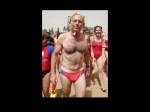
Almost seventy years later, the male body remains central to our culture: from the affectless cyborg of the blue-tied corporate type, to our future Prime Minister in red speedos, to the blurred body of the drunken footballer caught on CCTV. But it has long been argued by historians of Australia’s visual culture that it is the modernist male body, epitomized by the ANZAC Soldier on my biscuit tin lid, against which all these variants are now defined.
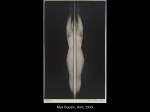
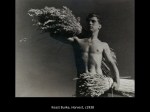
The interwar period, from the 1920s to the 1940s was crucial in creating the template of the nationalistic Australian body, both male and female. The best analysis of the construction of the male body in photography during this time is Isobel Crombie’s wide-ranging analysis of Max Dupain’s photography in her important book Body Culture. In this period the national body of Australia as a whole and the individual bodies of each Australian were seen as one. Australia, it was claimed, was becoming not only a sovereign nation within the British Empire, but also a distinct race. The race was Anglo-Saxon, and was defining itself by both looking into the past, and into the future. The emergent Australian type could be recognized when it seemed to conform to either ancient classical ideals, the Apollonian upright ‘noble’ figure, or modern streamlined forms, made pneumatic with sexual energy. During this period metaphors of health, vitalism, purity and fitness, along with their opposites — contagion, vitiation, pollution and degeneracy — constructed the body at three interpenetrating levels, the physical level of individual bodies, the national level of the Australian race, and the spiritual level of human connectedness with larger life forces.
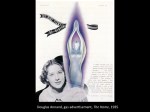
At the background of all these metaphors were strong currents of social Darwinism, which threw up two specific sciences: eugenics, the deliberate selection for breeding of the fittest and purest part of the population in order to aid the evolutionary advancement of the race; and anthropometrics, the diagnostic measurement of the human body. Because their simultaneous popularity with the Nazi regime in Germany made them suddenly and deeply unfashionable with the onset of World War Two and the Holocaust, it is easy to forget how pervasively popular and mainstream these sciences were in the interwar period. But popular they were: for example suburban surf carnivals mimicked militaristic displays of standardized ideal racial types, and in1926 the corsetry company Berlei in collaboration with physiologists from the University of Sydney undertook an anthropometric study of 6,000 Australian women, some of whom were measured at a special tent erected at Bondi Beach. Termed the National Census of Women’s Measurements it analysed twenty-three different measurements from each woman, which led to the development of the Berlei ‘five Australian figure type’ classification scheme and the ‘figure type indicator’ which was sent out to retailers who would take the customer’s exact measurements and then use them to classify the woman’s figure type for corset selection. As Sue Best has pointed out, the average type was not a statistical average at all, but was a physiologically arbitrary ideal which most Australian women would necessarily fail to live up to.
In the interwar period bodies were things to be sculpted — carved by the ocean, or re-moulded by new corsetry technologies. Bodies were generally seen as moving along one main vertical axis, from degeneracy to regeneracy. The type of body at the top of this axis, the Apollonian body, was most often what was pictured. There are far fewer pictorial examples of the bottom, degenerate end. Crombie illustrates two in her book. She reproduces two 1939 images by Dr Julian Smith from his Pictorialist ‘character studies’: The Blonde, by implication an Aryan type at the top of the racial axis, and ‘Leaf Music’, where the hapless sitter has had his hair styled and has been lit and posed by Smith to imply that he is at the bottom of the axis. The other illustration of degeneracy is A. O. Neville’s well-known and chilling illustration Three Generations, where a happy family portrait is turned into a eugenically genocidal prophecy for Australia.
So far so familiar. I don’t think anything I have said so far would be news to any one here. So I want to spend some time adding some small tangents to this vertical Apollonian axis, specifically in relation to the male body. The force of the ideal male body is upward and outward, a vertical pressure of racial vitality funneled by a tight column of torso muscle and tightly sheathed in a smooth membrane of tanned skin. At its most extreme it is a pneumatic phallus. But even during WW11, just a few years after the classic Modernist photographs of the 1930s, this norm was given surprising new meanings which showed how wobbly the Apollonian axis was.
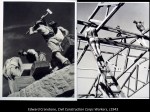
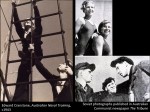
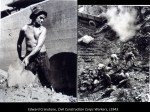
From 1942 the Civil Construction Core conscripted men between the ages of 35 and 55, who were otherwise ineligible for military service, to work on large building projects in northern and interior Australia. However they quickly began to attract adverse publicity. There was industrial unrest on many projects with workers accusing the management of inefficiency and rorting, and management accusing the workers of unpatriotic union activity. Against this background the Department of Information sent the photographer Edward Cranstone to all the CCC projects. His photographs were published in everything from the communist newspaper the Tribune to the Women’s Weekly, and were eventually formed into a large exhibition, which also included paintings of CCC workers by Dobell and other artists, that toured capital cities in 1944.
As a member of the Communist Party of Australia Cranstone was exposed to a rich source of propagandistic imagery. Soviet socialist photographs were regularly published in the Tribune, and their influence can be clearly seen in Cranstone’s Modernist visual rhetoric — his use of upward looking camera angles, strong diagonal compositions, bright sunlit forms and heroic poses. As one article reviewing the exhibition stated:
The Australian worker—bareheaded, steady-eyed, stripped to the waist—is the dusty, sweating keynote to a display [….] It would be surprising if most people did not take away a warm impression of that typical Australian, stripped to the waist, working on untouched land, levelling it, digging into it or building up from it. In a real immediate way, the show tells the story of how Australia—the country itself— has gone to war.
Cranstone’s men are heroic soldier/worker/pioneer hybrids. The battle they fight is in the industrial workplace and on the colonial frontier. Cranstone has to strive very hard to fit his workers, which were by definition not Australia’s finest, into the Apollonian type. In some images skin is pumped out by muscle, sheened by sweat, and ribboned by shadow as the men vigorously swing crowbars and work machinery, however in other images the visual rhetoric seems too extreme for the men’s actual bodies to live up to.
This may have been what led some commentators to react against their overt visual rhetoric and mechano-machismo, which had been clearly imported from elsewhere and applied externally to their subjects. In Canberra the exhibition was displayed hidden away in the basement of Parliament House rather than in the usual exhibition space of Kings Hall. The Speaker of the House, complaining about the Modernist paintings of William Dobell with their thick fleshy strings of paint, claimed that the show ‘was a grave reflection on the manhood of Australia generally, and particularly the fine types who have discharged essential duties during a critical period in Australia’s history.’ He added, in reference to Cranstone’s brand of photographic Modernism, that a ‘photograph allegedly taken in a quarry made me feel that I was in Dartmoor [Gaol].’ In using an internationalist visual rhetoric to rehabilitate the Australian worker Cranstone had stretched the Apollonian model to breaking point.
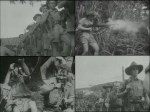
Damien Parer was also employed by the DoI, but as a war cameraman. The footage he shot in New Guinea was supplied to newsreel companies to be cut into their weekly newsreels. Parer’s most famous newsreel, Cinesound’s Kokoda Frontline, was essentially a collaboration between himself and the head of Cinesound Ken Hall. Damien Parer appeared as the ‘star’ to introduce the newsreel. After some titles telling us that Parer has already been responsible for some of the ‘classic footage’ of the War and that he is a reliable witness, Kokoda Frontline opens on Parer, in his uniform, in an empty domestic room, leaning casually against a table. The camera slowly moves in on his handsome face as he speaks directly to the camera, attempting to explain to his audience how close the war is:
I’ve seen the war, and I know what your husbands, your sweethearts and brothers are going through.
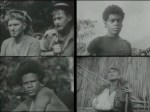
After this introduction the film cuts to some spectacular combat footage, but most important to the film are the intimate close-ups of the soldiers in retreat down the Kokoda Track with which the film ends. The soldiers either pass in slow procession past the camera, or compose themselves into tableaus as they have their bandages tenderly applied by their mates, or their cigarettes lit. Cut into these sequences are extended close-up shots of the faces of native bearers and Australian soldiers which act as still portraits of various emotions. The hortatory voice over commentary during these scenes contrasts with Parer’s tender pain, but it re-emphasises the theme he established:
This is war, the real thing. The utter weariness of sorely tried men is evident in their faces. […]Half the distance from Sydney to Melbourne men are sweating, suffering, dying in that jungle so that it cannot happen here. Are they getting all the support they deserve, from the mines, from the factories, from the ordinary civilian? […]
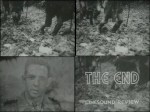
In the final seconds Parer’s soft face of concern returns, angelically superimposed over shots of the feet of the soldiers pushing down through mud. He repeats, but now in ghostly tones:
I’ve seen the war, and I know what your husbands, your sweethearts and brothers are going through.
The soldiers in Parer’s films are very different to Cranstone’s workers. The frontline on which they fight is not the domesticated colonial frontier of the purifying, astringent desert, but the dark uncannily wet tunnels of a jungle beyond the borders of Australia. The men are not assertively doing, but passively suffering. Parer’s soldiers are sick, bleeding and blinded. They rely on the tenderness of comrades or natives to survive. Their feet slip through mud as they lean on sticks or each other. They are not symbolic nationalist cyphers like Cranstone’s men, they are individuals, suffering psychological, as well as physical privations on our personal behalf. Parer was a devout Catholic and many have seen spiritual and religious connotations in his work. Many historians have linked Paper’s Catholicism to the composition of one of the final shots of Salvation Army Major Albert Moore lighting a cigarette for a wounded soldier, which is similar to a medieval or renaissance Deposition of Christ painting. The religious analogy is strengthened by the fact that the soldier is naked, covered from the waist down by an army blanket
Through their suffering these men will lead us to redemption. We, the audience of Parer’s newsreels, are feminised: we are wives, mothers or sisters who weakly complain at home and don’t acknowledge the danger from overseas. We see with our own eyes that our delusion and triviality has personally dispirited Parer, when he arrived back he was ‘full of beans’ with ‘the spirit of the troops’ but now he has experienced our complacency, he is worried and upset, his voice drops, and his face tightens.
There is abjection here too, not the auto-phallicisation of man and machine as in the CCC, but a polymorphous blending of mate into mate and man into mud. Australians would have easily recognised this abjection as already part of the ANZAC myth, Australian men similarly suffered together on the beaches of Gallipoli or in the trenches of France.
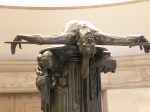
Parer’s trinity of ‘mother, wives and sisters’ are always present whenever the sacrifice of soldiers is evoked been evoked. For instance the sculptural centrepiece for the memorial which Sydney had built for its WW1 ANZACs was Rayner Hoff’s Sacrifice 1934, in which a symbolic Australian mother, wife and sister hold aloft a lithe, cleansed and perfect male body crucified on a sword, successfully borne up out of the miasma of battle and into a transcendent erotic masculinity. However in Kokoda Frontline Parer is sadly compelled to inform the women of WW11 Australia that, unlike these women, they have abandoned their soldiers to an abject eroticism.
The newsreel’s powerful message is that, in the darkest hour of the War, while their women are still enthralled by false images and trivial concerns, it is up to desperately abjected soldiers, redeemed by the spiritually defined eroticism of mateship, to defend Australia. In contrast to Parer’s psychologically specific homo-eroticism, Cranstone’s internationally symbolic, stylised auto-eroticism attempted, not always successfully, to redeem the home front labours of another potentially unstable category of Australian male — the worker.
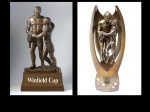
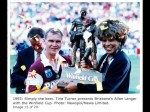
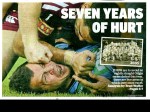
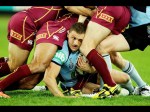
Whilst these two types of male body were produced at a particular extraordinary juncture of Australian history and culture I cannot resist the temptation to extrapolate them into later manifestations. The obvious place to look is not the battlefield but the sporting field. In 1963 the Fairfax photographer John O’Gready photographed two captains coming off the field after the Rugby League Grand Final. The coating of mud turned the footballers into bronze statues, while also referring to the battlefield mud of World Wars One and Two, where sublime mateship was forged in abjecting slime. In 1982 the cigarette company Winfield used the photograph for their Grand Final trophy. The enveloping of the Apollonian body within the abject still pervades contemporary sports photography. Many photographs, particularly around the State of Origin games, reprise the abjecting mud and eroticizing intimacy of war, as well as extreme pneumatic auto-phallicization.
If, back in the interwar period, the abject and the rhetorical complicated the simple Apollonian narrative of the supposed Australian race, revealing it as nothing more than a portable nationalistic rhetoric, in the case of Cranstone; or one which could be quickly supplanted by other models of masculinity in extremis — the abject and feminized, in the case of Parer, where there other forces also at work? The Berlei corsetry company had identified five different types of Australian female bodies, were there other types of male body? Two comedians dominated the Australian vaudeville scene in the interwar period. One, Roy Rene, was a slump-shouldered Semitic type in heavy make-up who slyly simpered lewd double-entendres. The other, George Wallace, played a naively optimistic, child-like, working class, everyman character. Wallace had a low-slung body, short legs, and a stomach hanging over his belt, which was a direct contradiction to the upward torso-led thrust of the Apollonian body.
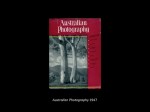
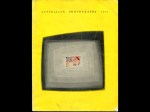
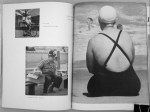
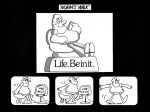
Wallace’s low centre of gravity was perhaps a nascent beer-gut, and the beer grew to become more important in Australian culture as the decades progressed. In the compilation Australian Photography of 1947 virtually all of the bodies are Apollonian, however ten years later, in Australian Photography of 1957, there is a whole double paged spread devoted to humorous or pathetic images of fat people. In another ten years, in the extremely important book Southern Exposure, by David Beal and Donald Horne, the beer gut makes it to the front cover, as a national trope of self indulgence, which is contrasted with an image of interior aridity on the back cover. By then the beer gut had become a perverse image of Australianness, for instance in a 1961 a Tanner cartoon connected it to conservative older generations standing in the way of women’s progress, an opposition homage in 1993 in a Nicholson cartoon where the beer gut was directly contrasted to the proudly black Apollonian body of the indigenous footballer Nicky Winmar. In a further ten years after Southern Exposure the beer gut, which had been used by the young firebrands Horne and Beal to indict Australia, had been adopted by the Australian Government in their national fitness campaign Life Be In It, attached to the archetypally unfit, but loveable Australian — Norm. Lately, however there have been signs of a the beer gut coming in a complete cycle, with men reclaiming their beer guts as an ironic part of a new metropolitan, feminized, masculinity.
In conclusion it is clear that the Apollonian axis, identified by so many historians, is still the dominant one, but it is not the only one, the male body is more complex that that, and has taken up many different morphologies throughout its history from the high points of Modernity, until now.
H.P. Brown,(Commissioner) Inquiry under the National Security Regulations into certain allegations concerning the administration of the Allied Works Council 5 March 1943.
K.K. ‘Australia Portrayed Stripped to the Waist’ Melbourne Herald 3 August 1944, p5.
Massey Stanley ‘Art Critic’ Sunday Telegraph 24 September 1944, p10.
Neil McDonald War Cameraman: The Story of Damien Parer, Lothian 1994, pp157-158.
Leigh Astbury ‘Death and eroticism in the ANZAC Legend’ Art and Australia Spring 1992 Vol 30 No 1, pp68-73.
Breasts
In the last week Facebook has banned the aged breasts in the background a photograph from 1999 posted by Ella Dreyfus, and the indigenous breasts from a traditional Aboriginal ceremony posted by Celeste Liddle. Both bans are of course absurd and offensive. But Facebook’s explanations are revealing. On the one hand it claims that ‘diversity is central to Facebook’s mission of creating a more open and connected world’, but on the other hand, it explains: ‘The reason we restrict the display of nudity is because some audiences within our global community may be sensitive to this type of content – particularly because of cultural background or age. In order to treat people fairly and respond to reports quickly, it is essential that we have policies in place that our global teams can apply uniformly and easily when reviewing content. As a result, our policies can sometimes be more blunt than we would like, and restrict content shared for legitimate purposes.’ Facebook’s mission is actually to circulate messages and images to as many consumers as possible, as rapidly as possible, so they can view ads. It may fantasise that it is something like a Habermasian public sphere, but on Facebook discursive relations are always subsumed in market relations. The connected world is a global market. (Plus, as Clementine Ford points out, Facebook HQ is still permeated by frat boy culture). Unfortunately, because of the ruthless efficiency of its image distribution model, for many artists and activists it remains indispensable.
Won’t You Buy My Pretty Flowers?
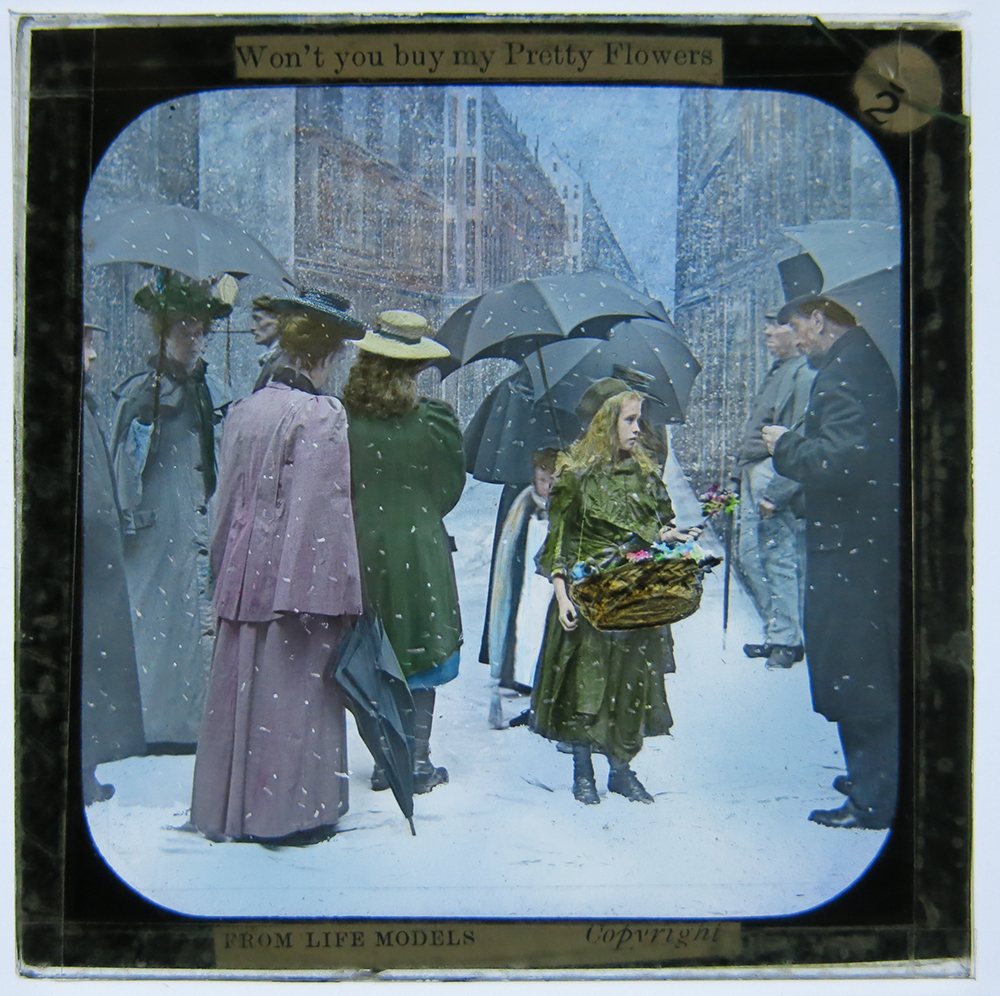
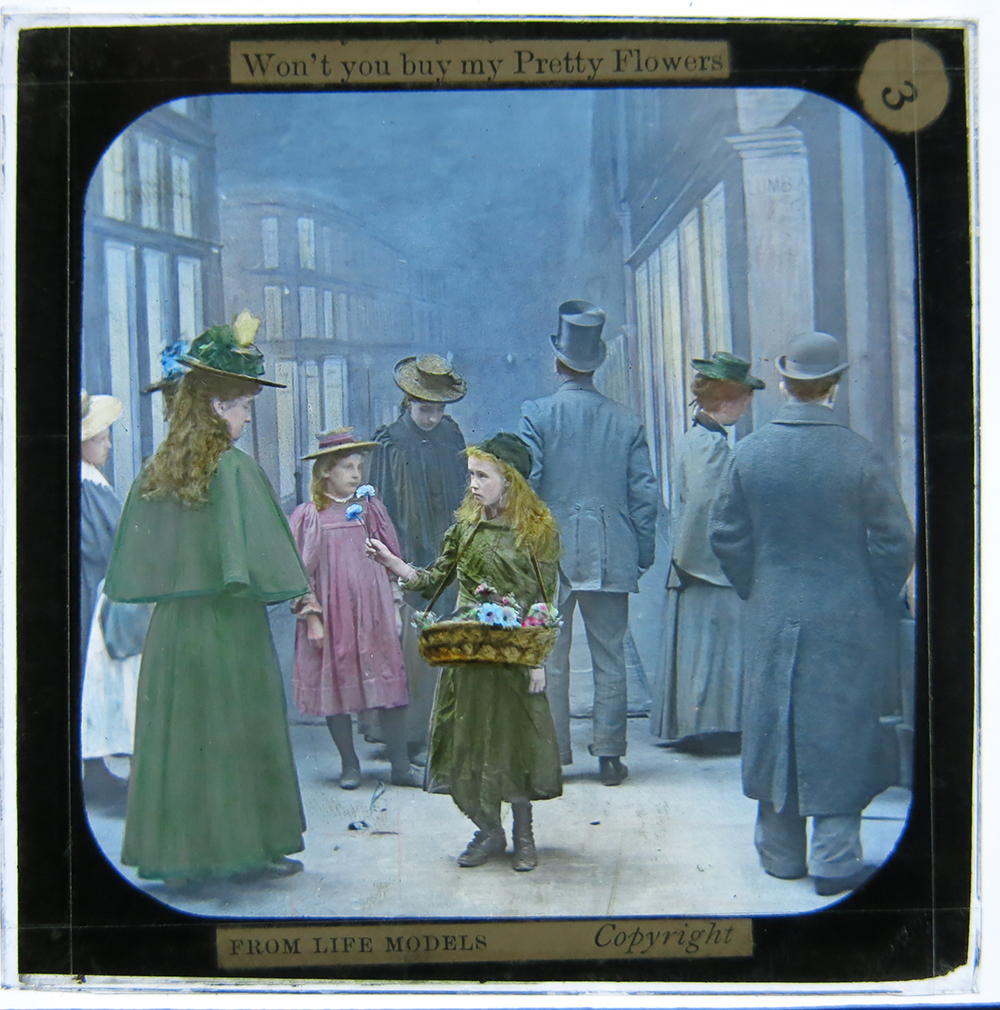
Here is a new set of life model magic lantern slides I have just acquired. I love the twin perspectival vanishing points of the first painted backdrop, the photogrammed snow flurries in slide two, and the weirdly frozen Beckettian choreography of the passers-by in the final slide. They were made by Bamforth and Co after 1897 in the UK. The song originates from the US in 1877 and is by George W Persley, Arthur W French, George Clare. (Although interestingly it was re-published in 1887 under the names of the American stage actress Miss Jennie Calef and producer H. P. Danks, after they had used it in their play “Little Muffets” — a clear case of IP theft and copyright infringement.) Later Bamforth and Co. recycled the original shots as postcards with the choruses as printed captions. I’m looking forward to one day projecting these slides, perhaps life size and outside in an urban setting, accompanied by a singer, as part of our project Heritage in the Limelight: The Magic Lantern in Australia and the World.
Underneath the gas light’s glitter,
Stands a fragile little girl;
Heedless of the night winds bitter,
As they round about her whirl.
While the thousands pass unheeding
In the evening’s waning hours;
Still she cries with tearful pleading,
Won’t you buy my pretty flowers?
Refrain.
There are many sad and weary
In this pleasant world of ours,
Crying in the night winds bitter.
Won’t you buy my pretty flowers?
Ever coming, ever going,
Men and women hurry by.
Heedless of the tear drops gleaming.
In her sad and wistful eyes.
While she stands there sadly sighing,
In the cold and dreary hours,
Listen to her sweet voice crying,
Won’t you buy my pretty flowers?
Refrain.
There are many sad and weary
In this pleasant world of ours,
Crying in the night winds bitter.
Won’t you buy my pretty flowers?
Not a loving word to cheer her.
From the passers by is heard;
Not a friend to linger near her,
With a heart by pity stirred.
On they rush the selfish thousands,
Seeking pleasure’s pleasant bowers;
None to hear with sad compassion,
Won’t you buy my pretty flowers?
Refrain.
There are many sad and weary
In this pleasant world of ours,
Crying in the night winds bitter.
Won’t you buy my pretty flowers?
Networking the Tradition: Curating Photography in Australia
Photofile
Vol. 95, Spring/Summer, pp48-55.
(with Daniel Palmer)
Australia’s big galleries and libraries have been seriously buying and curating photographs for over forty years now, during a period when the medium itself has undergone profound transformations. It’s time now to take an overview of the interaction between the institutional imperatives of our state and national collecting institutions and the changes in photography as a medium.
Although the institutional curating of photography did not begin in earnest until the 1970s, in the five or so decades before then the powerful idea of collecting photographs was intermittently discussed, at various levels of institutional authority, and with various degrees of vigour. For instance, at the end of the First World War, the amateur photographic magazine the Australasian Photo Review called for a ‘national collection of Australian photographic records’. The Mitchell Library was one of several institutions who responded positively to this idea, even suggesting a list of twelve different categories of photographs which amateurs could take for a future repository. However the librarians did not follow through on their initial positive noises and collections failed to materialise.
Thirty years later, at the end of the Second World War, the idea of a national collection was raised again. Laurence le Guay, the editor of the new magazine Contemporary Photography, devoted an entire issue to new sharp bromide enlargements Harold Cazneaux made from his Pictorialist negatives of Old Sydney, and declared that they ‘would be a valuable acquisition for the Mitchell Library or Australian Historical Societies.’ However, once more the library failed to follow through, and Cazneaux’s photographs remained uncollected.
Nevertheless, the interest in photography as an Australian tradition and the persuasiveness of the idea of significant public collections of historic photographs continued to build. By the 1960s both libraries and state galleries were beginning to make serious policy commitments to collecting photographs. The aims were to both collect photographs as documents of Australian life, and to record the importance of photography as a visual medium. For instance, the National Librarian of Australia, Harold White, began to work with Keast Burke who in 1956 had proposed a two tier national collection: one part to be purely about the information which photographs contained, and assembled by microfilming records and copying images in the library’s own darkrooms; the other part to be about the medium itself, made up of ‘artistic salon photographs’ and historic cameras.
The National Gallery of Victoria, under Director Eric Westbrook, became the first state gallery to collect photography. Despite forthright opposition from some members (one of whom referred to photography as “cheat’s way of doing a painting”), the Trustees approve the establishment of Department of Photography in 1967.[ii] The first work to enter the collection – David Moore’s documentary photograph Surry Hills Street (1948) – was acquired through a grant from Kodak. In the same year the NGV imported The Photographer’s Eye, a touring exhibition from New York’s Museum of Modern Art, which had been the first art museum to establish a Department of Photography in 1940.[iii] The exhibition was curated by MoMA’s John Szarkowski, undoubtedly the most influential photography curator of the second half of the twentieth century, as a statement of his formalist position on photographic aesthetics. Its title was adapted for a local version, The Perceptive Eye (1969–1970).
By 1973 the yet-to-be-opened National Gallery of Australia had purchased its first photograph, an artistic confection by Mark Strizic (Jolimont Railway Yards, 1970) that looked more like a print than a photograph. Two years later the AGNSW was laying the foundation for its collection with the acquisition, exhibition and book on the early twentieth century photographs of Harold Cazneaux, collected by them as fine-art Pictorialist prints, rather than as the sharp bromide enlargements that had been published by Contemporary Photography in 1948.
In this period the dual nature of the photograph as both a carrier of historical and social information, and an aesthetic art object and exemplar of a tradition, which had co-existed within the formulations of the previous decades, was finally separated between libraries and galleries. Library collecting focused on the photograph as a document of Australian life. For example in 1971 the National Library of Australia clarified its collection policy: it would only collect photographs as examples of photographic art and technique from the period up to 1960, leaving post-1960s ‘art for art’s sake’ photography to the new state and federal gallery photography departments.[iv]
The stage was set for the much-vaunted ‘Photo Boom’ of the 1970s, when, as Helen Ennis has pointed out, the baby boomer generation turned to photography for its contemporaneity in the context of a counter-cultural energy.[v] Galleries and libraries found themselves embedded in the newly constructed infrastructure of the Whitlam era: the newly established Australia Council, rapidly expanding tertiary courses in photography, new magazines and commercial galleries, and the establishment of the Australian Centre for Photography in Sydney in 1974.
In this context the need to define photography as both a tradition and a new language became more urgent. Such initiatives were largely driven by photographers themselves, whose leading figures made themselves aware of what was happening internationally. Thus Athol Shmith, a key member of the NGV Advisory Committee set up in the late 1960s, corresponded and travelled regularly to Europe. David Moore, one of the key figures in the establishment of the ACP, was familiar with plans for the International Centre for Photography in New York. The first director of the ACP, Graham Howe, was brought back from a stint at the London Photographers’ Gallery. Developments were typically framed around a broadly didactic mission: that photography is central to visual culture but ‘the public needs educating’ in the art of photographic seeing. In addition, the longed-for acknowledgement from overseas materialised in the form of John Szarkowski himself, who was invited on a ‘papal’ tour by the ACP in 1974. Szarkowski gave six public lectures titled “Towards a Photographic Tradition’ (recently recounted in Photofile Vol 93). The purpose of the national tour, as Howe put it at the time, “was to liberate photography from the world of technique and commerce and to suggest that it could also be of absorbing artistic and intellectual interest.”[vi]
Although Szarkowski’s approach was put under sustained stress during the period of postmodernism – especially by feminist critics – his ‘formalist’ approach to the medium continued to dominate the way that photography was understood in the art museum for the ensuing decades. Even as the discourse emerged of an Australian tradition with, for instance, the NGV’s investment in Australian documentary photographers in the late sixties, this became embedded in a model of Euro-American modernism. As Ennis put it, “The argument for ‘photography as art’ was based on the critical position of Modernism. Photography was considered to be a medium with its own intrinsic characteristics”.[vii] At the AGNSW Gael Newton deployed a clear art historical teleology, with the acquisition of Pictorialist photography by Harold Cazneaux and other members of the Sydney Camera Circle forming the foundation for the collection. Pictorialism was important to Newton because it was a: ‘conscious movement, aimed at using the camera more creatively’[viii] Her exhibitions of Harold Cazneaux and Australian Pictorial Photography in 1975 closely followed by a monograph on Max Dupain in 1980, seen as the modernist successor to the Pictorialists. However, the galleries also engaged with the contemporary art photography of the graduates from the new art schools, as well as emerging postmodern ideas. For instance the title of the Art Gallery of New South Wales’ 1981 exhibition Reconstructed Vision defined this new style of work against, but within the overall trajectory of, the newly established historical traditions.
In Melbourne a slightly different but equivalent art historical strategy was taking place within the institution of the NGV. This included the mass importation of canonical images from overseas. For instance, shortly after her appointment, the NGV’s inaugural curator (and first ever curator of photography in Australia), Jennie Boddington, ordered Farm Security Administration re-prints from the Library of Congress’s reproduction service. However at the same time the NGV also held solo exhibitions by the young, art school-trained artists Carol Jerrems in 1973 and Bill Henson in 1975.[ix]
While galleries were using art historical strategies to embed photography within their structures, libraries were also confirming their commitment to photography, but as a non aesthetic-object based, content-driven, curatorial strategy. The contemporary cultural relevance of the subjectivist photo boom of the seventies, combined with Modernist and Postmodernist teleologies, drove the aesthetic strategies of galleries, but the nationalistic socially cohesive agendas of events like the 1988 Bicentenary drove the content-based strategies of library photo collecting. In a forerunner to today’s participatory online photographic projects, in 1983 Euan McGillivray and Matthew Nickson proposed a snapshot collecting project, Australia as Australians Saw It, which would copy photographs in the possession of individuals, then index them and make them accessible through the latest technology. During the Bicentenary year Alan Davies, curator at the State Library of New South Wales, travelled to twenty-three country towns and copied about seven thousand vernacular photographs from 576 individuals. Under the title At Work and Play, they were made accessible by a videodisc keyword search (a forerunner to today’s digital database).
Fast forward to the present. Over the intervening 40 years, since the establishment of various departments and the ACP, the boundaries of photography have expanded. However, galleries have largely kept to the historical trajectories inaugurated in the 1970s. In the 1980s, photographic reproductive processes became central to postmodern art, which had the flow-on effect of boosting photography’s place in the art museum (Tracey Moffatt, Bill Henson, Anne Zahalka, etc.). But postmodernism did not fundamentally alter the increasing focus of departments of photography on ‘art photography’. Indeed, as many writers have observed, the wholesale acceptance of photography as art by the institutions and market occurred precisely at the moment of the critique of art photography, as it had been defined within the ‘formalist’ tradition, by artists and postmodern critics.
Photography’s potential as a protean medium to disturb or at least promote a dialogue between institutional disciplines and ordering systems has only rarely been explored by curators. Perhaps the most notable is the disruptive placement of contemporary Indigenous work, like Brook Andrew’s Sexy and Dangerous (1996) – which appropriates an image by the Charles Kerry photography studio – within galleries of nineteenth-century colonial painting at the NGV. Into the 1990s and 2000s, departments of photography essentially continued a monographic and consolidation phase, aided by the international prominence of large-scale colour photography as art, such as the Düsseldorf School (including photographers such as Andreas Gursky), or what Julian Stallabrass dubs “museum photography”.[x]. Meanwhile, we have seen the ongoing integration of photography as part of interdisciplinary art practice which may also include sculpture, performance or installation (sometimes dubbed the ‘post-medium condition’). Simultaneously, we have witnessed the rise of digital photography, which has produced a whole new generation of photographers using online photosharing services like Flickr and Instagram, whose effects are much more widely felt outside the museum. In response to these complex historical changes libraries have invested institutional effort into digitizing their image collections and making them available online, while art museums have embraced photography’s status as an object to be experienced in the flesh, hung in exhibition galleries.
If the primary aim of photography curating in the 1970s was to establish photography as art, this has clearly been achieved. Photography is ubiquitous within contemporary art, but not as an autonomous tradition – rather as a mode integrated within wider practices. And if the now forty-year old institutional structures are still largely with us, if museums continue to have departments, curators and galleries of photography, this is largely for the history of photography, for the knowledge of specific collections and conservation techniques. However, even if photography is now deeply embedded in the art museum, its precise role is still up for grabs. For instance, in 2013 the dedicated photography gallery at the NGV International was given up without any controversy (along with prints and drawings). In the early 1970s, photography enthusiasts had fought for a dedicated area, even just a corridor outside the Department of Prints and Drawings in 1972.[xi]Recently, in a delicious irony, the former photography space was occupied by Patrick Pound’s installation The Gallery of Air (2013) – which the wall label described as a poetic “site specific installation comprising 91 works from the collection of the NGV and 286 works from the collection of the artist” organized around the idea of air. Pound’s work included a wide variety of media in its playful exploration of collecting (both personal and institutional), but its inspiration lay in photography’s role as an ordering system. Various inclusions (such as Man With a Tie) were included in a previous work of found photographs, Portrait of the Wind (2010).
Clearly, museum departments can no longer work in isolation. However, what the mere integration of photography into the newly contemporary art museum all too easily elides is that photography’s place there has always been unstable, its ambiguous status as object and information continually threatening the grounds of the art museum’s hierarchies and collection policies. This instability manifests itself in different ways in different periods, but as we have already hinted at, one of the underlying themes in photography in the museum is the constant exclusion of the vernacular and of reproducibility itself. As Douglas Crimp argued in the late 1970s, the inclusion of photography within the canon of modernist art practice, by its own logic, excludes photography as reproduction.[xii] We have seen this in Australia in relation to the location of photography between the library and the art museum, in terms of a split between information and aesthetics, a documentary database versus an aesthetic object. Photography’s recent insertion into digital networks reveals these tensions yet again, in a new guise. Within a modernist logic, the networked digital image, circulating as reproducible information, is guaranteed to be excluded. The potential for different kinds of photography in the art museum goes largely unnoticed.
It could be argued that similar issues are faced by other Departments such as Painting, in the ‘post-medium’ age. And indeed that the sway of the MoMA Photography Department could be compared to the influence of the massively influential travelling show Two Decade of American Painting in 1967. However, we argue that the protean and unstable nature of the medium of photography makes its placement more problematic. As a result, within the rapidly growing discourse of curating contemporary art, we argue that more attention needs to be paid to the specific situation of photography and the history of photography exhibitions. This is not to regress into conventional medium specificity. It is simply to acknowledge that photography’s multiple, democratic and ambiguous presence as image and object within our culture complicates its place in the art gallery. Photography as a creative art has a more or less integrated tradition that we can and should continue to value because it drives further developments. But we should simultaneously recognize that this tradition is based on a series of exclusions, and addressing these exclusion can also energize the medium. As Peter Galassi once put it, the tradition is both indispensable and inadequate.
In identifying the future potential of photography in the art gallery, perhaps we can learn from the popularity of ‘metaphotographers’ such as Patrick Pound, working with the (always incomplete) archive.. Furthermore, if curators are engaged in creating innovative contexts for public engagement, networked photography opens up new possibilities for this to happen. We are not arguing that the art gallery ought to emulate the hyper-linked experience of the Internet, or the swipe-based logic of mobile media. However, we are proposing that authoritarian presentations of a connoisseurial canon need to become part of a larger project: exploring photography’s protean nature as a medium and its potential to complicate spectatorship and activate audiences in new ways.
Daniel Palmer & Martyn Jolly
[i] This essay derives from early research into the various forces currently influencing photography curating in Australian art galleries, funded in the first instance by an Australian Council grant.
[ii] Isobel Crombie and Susan van Wyk, 2nd sight: Australian photography in the National Gallery of Victoria (Melbourne: National Gallery of Victoria, 2002), 7.
[iii] Founded in 1929, MoMA presented its first photography exhibition in 1937 (the major Beaumont Newhall exhibition on the history of photography in 1938–1937). MoMA held their first one-person exhibition, by Walker Evans, in 1938, and established their Department of Photography in 1940, then the only one in any art museum.
[iv] Helen Ennis, ‘Integral to the Vision: A National Photographic Collection’ in Peter Cochrane (ed.), Remarkable Occurrences: The National Library’s First 100 Years (Canberra: National Library of Australia, 2010), 210
[v] See Helen Ennis, ‘Contemporary Photographic Practices’ in Gael Newton, Shades of Light: Photography and Australia 1839–1988 (Canberra : Australian National Gallery, 1988), 134.
[vi] Graham Howe, ‘The Szarkowski Lectures, Art & Australia, July–September , 1974, 89.
[vii] Ennis, ‘Contemporary Photographic Practices’, 136.
[viii] Gael Newton, Silver and Grey: Fifty Years of Australian Photography 1900-1950 (Sydney: Angus and Robertson, 1980), np
[ix] In Canberra the National Gallery not only purchased photographs from young art-school trained Australian photographers through the largesse of the Phillip Morris Arts Grant, but also, in 1980, before it even opened, gained Ministerial approval to spend $150,000 for the Ansel Adams Museum Set from an American gallery.
[x] Julian Stallabrass, ‘Museum Photography and Museum Prose’, New Left Review, no. 65, September-October 2010, 93–125.
[xi] Crombie and van Wyk, 2nd sight, 10
[xii] Douglas Crimp, ‘The Museum’s Old/The Library’s New Subject’ in Richard Bolton, ed., The Contest of Meaning: Critical Histories of Photography (Cambridge MA: MIT Press, 1989), pp. 3-13. See also Andrew Dewdney, ‘Curating the Photographic Image in Networked Culture’ in Martin Lister, ed., The Photographic Image in Digital Culture, Second edition (London: Routledge, 2013), 95–112.
The difficulties of producing a nineteenth century spirit photograph revealed with the help of Craig Tuffin and Lisa Clunie!
Last year I was enjoying watching the participants of the Alchemists Workshop make tintypes and salt prints at the ANU School of Art, which they were doing after having their minds blown by the early photography collection of the National Gallery of Australia. The highly knowledgable and highly generous Craig Tuffin, and the intelligent and light hearted Lisa Clunie, agreed to help me in riffing off a carte de visite of the Melbourne spiritualist Dr Walter Lindsey Richardson and a kneeling spirit, taken by the spirit photographer Frederick Hudson in London in 1873-4, and now in the collection of the National Gallery of Australia. I have previously written about this very important carte de visite, and its reception back in Australia. And I kind of thought I sort of knew how Hudson had made it. But it is only when you are confronted with the task of creating a similar image, under similar conditions and using wet collodion emulsion, as Hudson did (although he used collodion on glass, not metal as we did) that you realize the complexity of detail and organisation which Hudson needed to command. If the exposure was made on one wet plate, and if Richardson was to remain unaware of the presence of the human model for the incarnate spirit, then, while Richardson was detained, perhaps with chatter from an accomplice, in the small waiting room of Hudson’s suburban backyard glasshouse studio, the spirit must have been exposed, but against some kind of moveable black screen. Then both spirit and screen must have been removed out of sight before Richardson was invited to enter the glasshouse. The alternative is a negative sandwich, but to me the similar sharpness of both Richardson and the spirit does not suggest a sandwich.
Man to Eat Rats once more
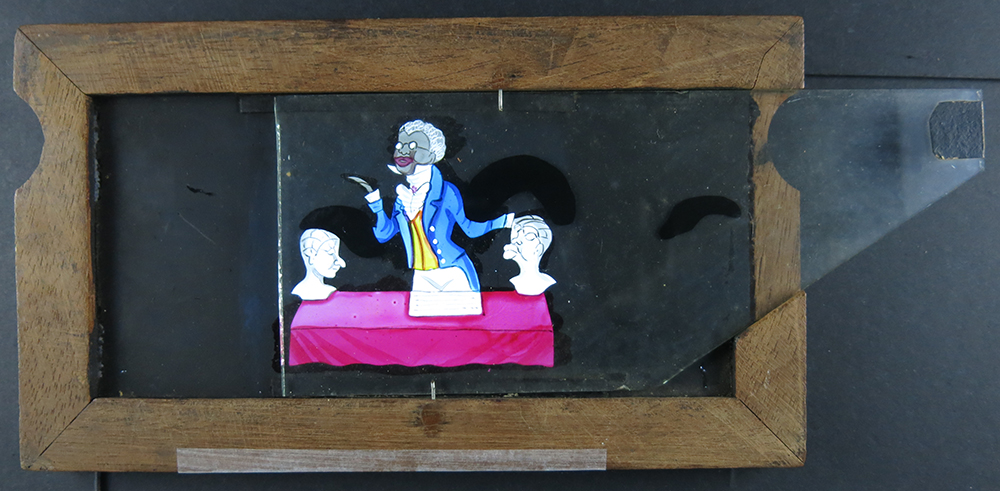
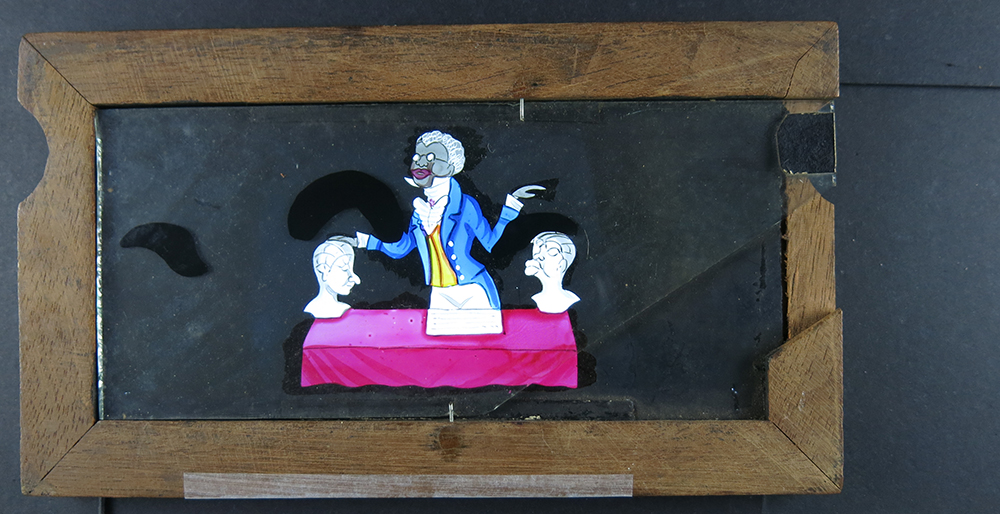
By far the most popular magic lantern slide of the nineteenth century was ‘Man Eating Rats’. Lanternists would even specifically promise it in their newspaper advertisements, so audiences knew they could go along and enjoy themselves making the requisite snoring and chomping and lip-smacking noises. I’ve had a copy of the slide for a while. But while the circulating rackwork rats worked perfectly, the sleeping man’s gluttonously bearded jaw was missing. Fortunately the ANU School of Art has a wealth of skill and knowledge and Waratah Lahy was able to paint me a beautiful new jaw and beard (on a replacement piece of polycarbonate) which works perfectly. I’ll be showing it this Friday evening at the National Portrait Gallery in Canberra. I’ve also just brought a slipping slide of a phrenologist alternately examining a head of a ‘low’ type and a head of a ‘high’ type. Once again Australian National University historical expertise, through my colleague Alexandra Roginski, was able to provide me with actual phrenological readings from the period. So we’ll be performing this slide as well. There’ll be heaps of other slides, including The Gin Fiend.
History of Photography, The
The estimable Belinda Hungerford is doing a fabulous job researching and organising the archives of the Australian Centre for Photography. Her research led me to find, in the back of a cupboard, copies of a small booklet I produced with my students in 1990 (!). It was to accompany a show we put on at the ACP. Some students from back then are still doing important work in the field, I’m gratified to note. Reading through the anecdotes we collected back then it’s interesting that in that pre-digital period the minilab, now a lost site of visual profligacy and collective concatenation, served a not-dissimilar lubricious function to the ‘on-line’ environment now. If you want a copy of our booklet I’ll be glad to send you one, the price hasn’t changed in 25 years.