Hopeless Romantics

Faces of the Living Dead on silk at ANU School of Art Foyer

Faces of the Living Dead on silk at ANU School of Art Foyer

Faces of the Living Dead on Silk

Faces of the Living Dead on Silk

Faces of the Living Dead on Silk

Faces of the Living Dead on Silk

Ursula Frederick asked me to be in a show to accompany an ANU conference on love. I resurrected some of my Ada Deane spirit photographs which I had printed on silk some years ago, and draped then onto model hands I brought from Lincraft. This is what I wrote for the catalogeue:

 The 1920s was a big decade for love, loss and yearning, as a host of loved ones were lost to cataclysmic events like the First World War and the flu epidemic. The 1920s was also a big decade for new media, as amateur photography became pervasive and electronic media like the radio connected people across vast distances. In this climate gnawing absences could often become ghostly presences in certain over active imaginations, and Spiritualism was in heyday.

In the 1920s the char-woman and pedigree dog breeder Ada Emma Deane conducted photographic séances at London’s Society for Psychical Research. People yearning to reconnect with their lost loved ones once more would send in a box of photographic plates which she would magnetize to the psychic spectrum by placing the box beneath her blouse against her chest. When they arrived for the séance the plates would be further sensitized as they placed their hands on the box, and she placed her hands on their’s. They would then sit on a wicker-work settee and, as Ada fussed around with her rickety old camera, think of the face they longed to see once more. Later, in the alchemical cave of Ada’s darkroom they would slip the plate into the developer and watch as their face appeared in the glass, to be followed shortly by another face, an ‘extra’ returned from beyond the grave.

I’ve had a long-standing interest in spirit photographs, which I see as simply an extreme amplification of the way all of us use portrait photographs of our loved ones. I’ve mainly written about them, but occasionally I have experimented with them too, trying to get right into the slippery, mucousy, labile, placental, ectoplasmic, ephemeral secretions of the photograph.  These details from Ada’s spirit photographs are printed on expensive wedding dress silk which I brought from a shop in Sydney. It’s designed to shimmer as it flows around the body of the bride.

Ursula has a great catalogue too.

Shaping Canberra, 2013

The Citizens of Canberra in Shaping Canberra, ANU School of Art Gallery 2013

The Citizens of Canberra in Shaping Canberra, ANU School of Art Gallery 2013

The Citizens of Canberra in Shaping Canberra, ANU School of Art Gallery 2013

The Citizens of Canberra in Shaping Canberra, ANU School of Art Gallery 2013

The Citizens of Canberra in Shaping Canberra, ANU School of Art Gallery 2013

The Citizens of Canberra in Shaping Canberra, ANU School of Art Gallery 2013

This year it’s been great to be invited to be in shows: by Cathy Laudenbauch and Patsy Payne for a show at the Front in Canberra called Undertone, and by Mary Hutchinson and Ruth Hingston for a show called Shaping Canberra at the ANU School of Art Gallery. The Shaping Canberra show went along with a conference also called Shaping Canberra, at which I gave a paper called Art from Archives, the paper’s in the writing part of this blog, at the end I talk about the work I did for the show thus:

“I’ll finish by talking a little bit about a small installation I have in the show which is opening tonight. In my head I divide the history of Canberra into two periods. There is the utopian period from its foundation to self-government, where Canberra was used by the Commonwealth Government as a model of an ideal Australian polity, and a kind of ideal template for a future Australian city. During this utopian period, which in my imagination peaks in the 1960s,  Canberra was tolerated as a noble experiment by most Australians. Then there is the distopian period from self-government till now, where Canberra is regarded by Australians and governments alike as parasitical, perverse, pretentious, indulgent and ‘out of touch’. In both these Canberras there are no actual people. In the distopian Canberra of today the people who live here are despised as a vitiated, degenerated, foppish sub-category of the real Australian. They are people of literally no account. As Clive Palmer said last week: ‘In Canberra they have the best roads, but nobody to drive on them’. However the utopian Canberra was also devoid of actual people, the few people that appear in the photographs are national cyphers, actors in a political fantasy, like the schematic figures that occur in architectural drawings.

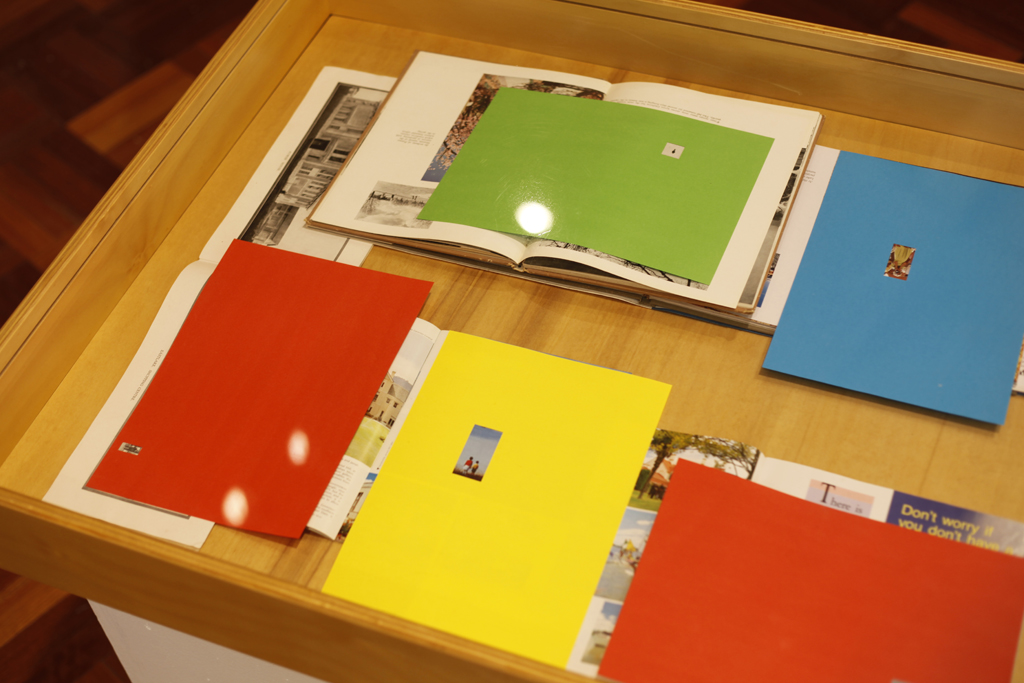
 So I’ve collected tourist brochures and NCDC publications from the utopian period of Canberra, making my own archive. Using an ‘Office Works’ aesthetic I have covered up the generic photographs with coloured sheets of A4 paper, obscuring the various civic vistas of national potentiality but revealing hapless pedestrians or passers by accidentally caught in the photographer’s camera, thereby pulling them out of their unwitting role as national cyphers, an perhaps returning to them their individuality as people.

 My work is cool and ironic, it is a million miles from the fervent spiritual juju of indigenous artists. It is affectionate, rather than interrogative. But nonetheless I think that on some level we are all engaged with the same occultish power of the archive.”

If you were at the conference you can read the other papers at:

http://hrc.anu.edu.au/confidential-papers

Magic Lanterns

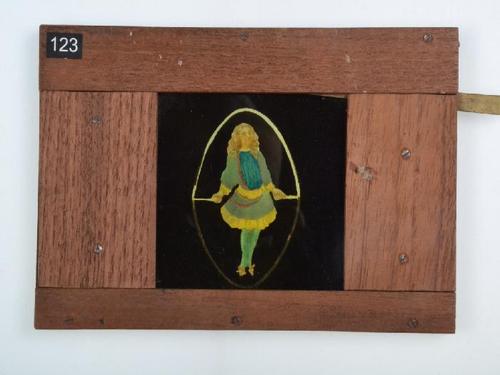
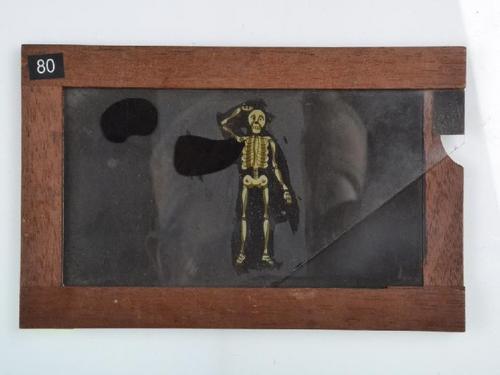
I’ve purchased two magic lanterns and some nineteenth century slipping slides, lever slides and chromatropes, as well as a large collection of nineteenth century life model slides, from an auction. I’ve got the two lanterns working with LED floodlights that produce no heat or UV light. I’m having a fantastic time playing with these wonderful things. But as practice-led research I have discovered that it is extraordinarily difficult to change and focus the slides,  and manipulate and animate  the slides smoothly. Lanternists in the nineteenth century would have needed to do that as well as keep their patter going in a large hall without amplification, regulate the gas supply to their limelight, and control often unruly audiences. I’m looking forward to spending some time with Trove because I want to read the newspaper reviews of these performances, when Australian audiences were training themselves to sit together in the dark. Below is some of the equipment I’m working with, and a link to a seminar I organised last year.

The Projected Image Heritage of Australia and New Zealand

My 'iron duke' lecture hall lantern

My ‘iron duke’ lecture hall lantern

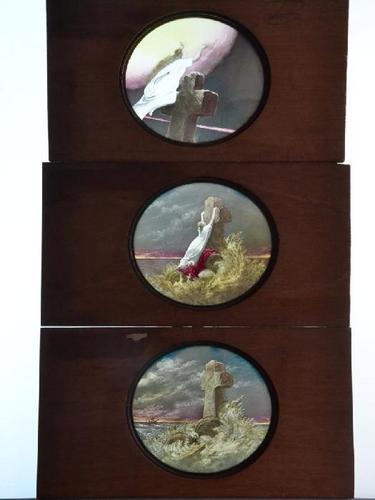
Rock of Ages hymn slides, as projected outdoors by the Salvation Army in 1894 in Melbourne

Rock of Ages hymn slides, as projected outdoors by the Salvation Army in 1894 in Melbourne

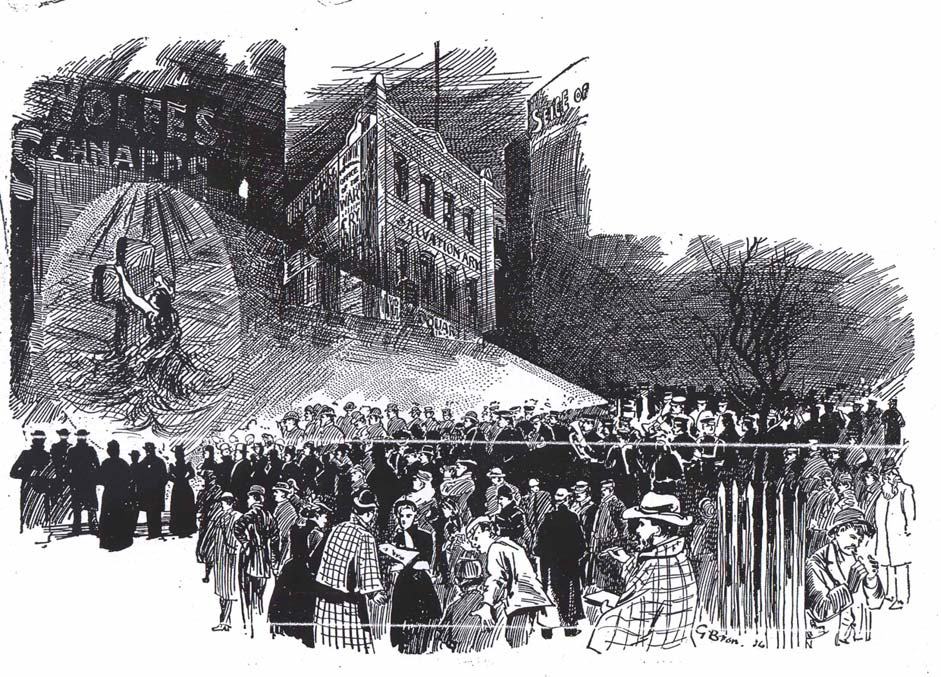
Salvation Army outdoor projection of Rock of Ages hymn slide on the side of a hotel, Melbourne 1894

Salvation Army outdoor projection of Rock of Ages hymn slide on the side of a hotel, Melbourne 1894

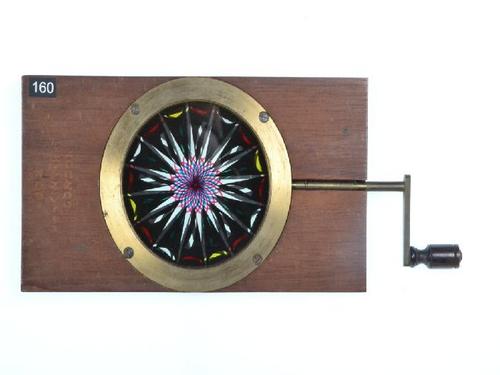
A chromatrope

A chromatrope

A chromatrope

A chromatrope

A slipping slide, moving the glass slightly produces a moire patterns from the scratched paint

A slipping slide, moving the glass slightly produces a moire patterns from the scratched paint

Skipping girl slide

Skipping girl slide

The skeleton removes its head

The skeleton removes its head

My 'parlour' lantern

My ‘parlour’ lantern

Edward Cranstone, Photographer

EDWARD CRANSTONE, PHOTOGRAPHER

Photofile, c1984

Recently the Australian National Gallery benefited from a gift by the photographer Edward Cranstone of seven spiral bound albums containing approximately 350 of his photographs from the Depression and Second World War years.

The albums contain three main groups of work: freelance photography from the late 1930s; photographs taken for the Department of Information between 1939 and 1941; and documentation of the work of the Allied Works Council in building strategic roads, aerodromes, etc. in Australia’s interior between 1942 and 1944.

The Second World War saw a flowering of documen­tary photography in Australia, with photographers like Max Dupain, Frank Hurley, Damien Parer, George Silk, Laurie Le Guay and Edward Cranstone all extensively documenting various aspect of the War. Little of this material has yet been seen in its entirety, and none of it has received the attention in deserves. In the case of Edward Cranstone a body of excellent photography and a fascinating document from war-time Australia’s visual culture is only now coming to light.

Born in 1903, Cranstone took up photography seriously at the onset of the Depression to supplement his income as a jazz drummer.’ Around 1935. to learn more about photographic technique, he approached the famous pioneering Melbourne Pictorialist John Kauffmann, who at the time, perhaps himself in straitened circumstances, was offering lessons. These lessons came for a fee Cranstone could not possibly afford, however a com­promise was soon reached whereby Cranstone worked un­paid in Kauffmann’s studio, and Kauffmann taught Cranstone photography. The relationship suited both par­ties: Kauffmann was still primarily involved in making art photographs, mainly close-up flower studies and views of picturesque Melbourne. The relationship, which lasted a year, is remembered as a very profitable one by Cranstone. Kauffmann lectured him about composition and lighting, took him to exhibitions, lent him books and showed him Pictorialist techniques.

Cranstone was soon freelancing, concentrating on portraiture. When Kauffmann retired in 1938, he sold his studio to one of his pay ing pupils who took Cranstone on as an assistant at a pound a week. Thereupon Cranstone’s work appeared under the studio owner’s name in a rented showcase in Collins Street, where Melbourne’s most prestigious photographic studios were located. At this time Cranstone also began a long association with Edna Walling, the avant-garde landscape gardener well known for her informal, naturally Australian gardens which Cranstone was to photograph for the rest of her career.

Later, towards the end of the war, Cranstone was to join the social circle that gathered around Danila Vassilieff, the flamboyant Russian painter who was a significant influence and inspiration to the expressionistic and politically left wing Melbourne painters of the 1940s. Cranstone’s closest photographic confederates at this time were Geoffrey Powell, Axel Poignant and Damien Parer. Although all were documentary photographers, approached their photography from significantly dif­ferent directions. Powell, politically active on the Left, pro­duced his photography within a particular political and social ideology. Poignant, on the other hand, developed a humanistic and pantheistic basis to his imagery. Damien Parer, who Cranstone first met at Kauffmann’s studio, photographed and filmed within ideas of clear, unen­cumbered reportage.

The polyphony of voices that Cranstone listened to and appreciated at this time reflected the unresolved and dissonant nature of the photographic discourse of the 1930s and ’40s. Pictorialism, which located photography within a traditional art discourse, was still a vital force; however it was increasingly being opposed by Modernist photography, the spare, reduced, flattened forms of which became the parlance for the fashion and magazine in­dustries both overseas and in Australia during the 1930s. The possibilities of a revitalized documentary photo­graphy, actively engaging in the world, were also being discussed at this time. Examples reached Australia mainly through such magazines as Life and Picture Post, for which photographers like Henri Cartier-Bresson and Bill Brandt worked.

Cranstone’s own photography from the ’30s echoes this commotion. His photographs range from extreme close-ups of Rolex watches to views of pastoral Australia elegantly seen through framing gum trees. Bird’s-eye views of bathers at the beach and documentary snapshots of life on Melbourne’s busy streets also feature. His most successful photographs from this period, however, are portraits. Waiting for the skipper, for in­stance, is a sophisticated Modernist image, being broken into strong verticals and horizontals by the yacht’s mast and the horizon line. As is characteristic of many of Cran­stone’s images, the space behind the figures is flattened into a single planar backdrop which emphasises the primary forms of the figures and mast.

In 1937, Cranstone joined the Department of Commerce, which with the beginning of the Second World War in 1939 became the Department of Information. As head photographer, Cranstone recruited two other photo­graphers to cover the War overseas, Damien Parer, who later became well known for his newsreel coverage of the War in New Guinea, and George Silk, who went on to photograph for Life magazine. Frank Hurley later took charge of these photographers in the Middle East.

For the first two years of the War, Cranstone photo­graphed in Australia, documenting the manufacture of munitions and Australia’s own ill-fated warplane, the Wirraway, as well as military training and embarkations. These two years saw the rapid development of Cranstone’s photography into very precisely evocative im­ages of strength and heroism constructed around strong diagonal compositons and severe upward looking camera angles. For instance, in one image a Wirraway sits on a tar­mac silhouetted against a backdrop of brooding storm clouds, its body and wing thrusting up and out of the photograph. In Making of an Anzac. originally taken for, but never published in, American Vogue, all the signs of ‘Australianness’ are present: the jaunty stance, the cocky look, the casually held cigarette, the gum-tree and the far horizon. But the extreme camera angle pushes the horizon line down so that the soldier almost floats above it against a clear sky; similarly, the gum tree becomes a dislocated com­positional element. This exaggerated viewpoint draws at­tention to the ‘gaze’ of the camera and gives an almost iconic force to the figure of the soldier, making him signify “Australian soldiery”.

Two of the best images from this period similarly give the figure iconic status. Both employ an upward looking camera, flattened space, and a backdrop of clear sky. In Naval training, (semaphore) elements of the ship frame the figures, and in their upward movement complement their actions. In Naval training, (foursailors) the figures casually disport themselves across the image, all emphasis is placed on their clear, angelic expressions as they gaze into space, connoting youth, strength and purity. In Munitions manufacture gleaming bomb shells are photographed so that as they are stacked in a spatially receding row they simultaneously fill the picture plane in an aggressive diagonal movement. All of Cranstone’s photography from this period has remarkable internal consistency; and is also consistent with much other imagery that had been produced in Europe, particularly Germany and the Soviet Union, dur­ing the 1920s and 30s.

The deployment of this particular, explicit form of ‘photographic seeing’ that characterises Cranstone’s im­agery had been an issue in Europe for thirty years. The story of its development, progress, and various permuta­tions is an extremely complex one. Briefly, its origins can be traced to the ideas of ‘ostranenie’, or ‘making strange’, developed by the pre-revolutionary Russian Futurists, which were subsequently taken up in the Soviet Union by such photographers as Alexander Rodchenko. These ideas also found voice in Germany, (with photographers like Laszlo Moholy-Nagy), where through the Bauhaus and New Objectiviey movements they eventually merged with the general Modernist canon, which by the 1930s had become thoroughly integrated into the cultural hegemony of the West.

Originally, this radical formalism was seen as being in­herently revolutionary, in fact an optical analogue of political revolution. However, this form of ‘photographic seeing’ began to come under attack in Europe in the 1920s and ’30s. The Russian Society for Proletarian Photojourn­alism and the German Worker Photographer movement accused it of being merely bourgeois formalism inaccess­ible to workers. However, some of its elements can still be found in the official propaganda imagery of both Stalinist Russia and Nazi Germany right up to the Second World War. These elements, (most notably the upward-looking camera angle, strong rising forms, and clear, direct lighting), became part of the rhetoric of the heroisation and iconisation of the worker, soldier and machine. At this particular historical instant, revolutionary formalism permutated into na­tionalistic formalism.

Cranstone’s specific access to this imagery is difficult to determine. Some sources, however, are clear. Through­out the War, Cranstone saw and was very impressed by the films of the Soviet Revolutionary director, Sergei Eisenstein, which were shown in Melbourne by the Australia-Soviet Friendship League, an organization of the Com­munist Party of Australia. He was particularly impressed by such films as “Ten days that shook the world” and “Bat­tleship Potemkin “. He may also have had access to official Soviet propaganda imagery, some of which was published in The Tribune during 1-9-39 and 1940, and which bears a close resemblance to his own work. From 1944, Cranstone himself contributed photographs to the Tribune. In any case his imagery has much in common, both conceptually and structurally, with the most sophisticated European propaganda photography of the 1920s and ’30s.

Early in 1942, Cranstone was transferred to the posi­tion of official photographer for the public relations depart­ment of the Allied Works Council (A.W.C.). The A.W.C. was formed as a result of General Macarthur’s discussions with Australia’s Prime Minister John Curtin, held in an ef­fort to expand Australia’s till then somewhat tardy war ef­fort.’ The A.W.C. was modelled on the Soviet Stakhanovites, the Nazi Todt Organization and the U.S. Civil Construction Corps. Under the leadership of the retired politician E.G. Theodore it called up men from the ages of 35 to 55. usually excluded from military service, to form the Australian Civil Construction Corps (C.C.C.). After call-up. men were sent to distant camps in Australia’s interior to begin work on strategic aerodromes, roads, etc. Conditions were harsh, and the conscripted men often in­itially unwilling. In addition there was considerable, and continuing, suspicion of the A.W.C.’s management: E.G. Theodore, who had a chequered past in politics and business, employed as his Director of Personnel a close business associate Frank Packer, the newspaper owner.3

The Unions involved frequently campaigned against what they saw as mismanagement, wastage and favouritism within the A.W.C. Disputes and stoppages were common. The A.W.C. management, in turn, accused the Unions and workers of hindering the war effort. In March 1943 a Commission of Inquiry was held under the National Security Regulations into “Certain Allegations Concerning   the   Administration    of   the   A.W.C.”* Although the Commission found no basis for the allega tions, the inquiry itself is indicative of considerable discon­tent.

A memo from Packer’s department in 1942 stated, “You should realise first that these men are human, and in many instances the circumstances of their call-up creates a certain quite natural feeling of resentment. Brusque, discourteous and overbearing methods in dealing with them only tend to aggravate this feeling. The result is a deep seated discontent which colours their whole future outlook and can cause an immense amount of trouble for officers of the C.C.C. who have to exercise authority over them.”5

All of this added up to a serious P. R. problem for the A. W.C. both internally and externally, and it was into this situation that Cranstone was transferred. Cranstone moved into premises in Collins Street with a small darkroom and an assistant, Vera Hodgson (whom he later married), to process the films, print the negatives and file the photographs. Cranstone was able to move quite freely around Australia with the full support of the A. W.C. He always travelled with the public relations officer, Frank Clancy, who planned the team’s itinerary and wrote the captions for the photographs. In the far north they travel­led very lightly, with only one Rolliflex, a few filters and film kept dry in bags of tea.

Cranstone exposed almost 2,000 negatives for the A.W.C, and approximately 7,000 prints a year were distributed from the department, both in Australia and overseas. At the end of the war it was estimated that ap- proximately 6,000 inches of Australian newspaper space were occupied by Cranstone’s photography per year.6

The most successful publicity project, however, was a travelling exhibition which toured to Brisbane, Sydney, Melbourne and Canberra in 1944. It comprised up to 500 of Cranstone’s photographs, some enlarged to 1.5 x 2.0 metres, with accompanying texts. Paintings by William Dobell and Herbert McClintock were also exhibited. The exhibition was enthusiastically received by the press and seen by approximately 80,000 people.

Cranstone’s photography can therefore be seen to have played a vital role in an extensive and well-orchestrated public relations campaign. The thrust of the campaign is summed up in another memo emanating from Packer’s department. “In so far as it is possible to do so you must, at all times, strive to impress on the men that they are not mere drudges performing a dull and routine task, but Australians, carrying out work of the first importance, without which the nation’s ability to defend itself adequately, or to launch an offensive, will be hamstrung. Everything possible should be done to make the men see themselves as civilian shock troops standing immediately behind the fighting services.”7

These themes of the “army behind the army”8 and “white collar shock troops”‘ are taken up in Cranstone’s photography of the C.C.C. workers and their projects. His imagery exhibits strong affinities with images of the pro­letariat worker used in Europe and the U.S.S.R. between the wars. It redeploys this imagery from a revolutionary, class-conscious context into the context of Australia’s na­tionalistic war-effort. In C.C.C. worker, a diagonal composition and up­ward looking camera angle are again used. Strips of shadow twisting across the worker’s bare torso emphasise his strength and physicality as he pushes a spanner forward and out of the picture plane. This action links, composi-tionally and connotatively, his right hand, as it easily grasps the tool, to his face, as it looks up into the distance. All this iconises the worker — his strength, his skill and his commitment to his task.

Cranstone also photographed the machinery and con­struction work of the C.C.C. In C.C.C. Construction the workers are supported, both physically and compositional-ly, by the beams of a building firmly criss-crossing between the edges of the photograph. In another image of a worker with a drill the worker almost becomes part of the machine, connoting a symbiotic relationship between workers and their tools (front cover). Cranstone’s photography can therefore be seen to have operated along two axes. In his highly codified treat­ment of the specifics of the A.W.C.’s activities he con­structed nationalistic metaphors for strength and commit­ment that could then be metonymically deployed within the documentary narrative structures of contemporary newspaper reports on the A.W.C. as well as the travelling exhibition. Or, to use a different terminology, Cranstone’s photographs were deployed syntagmatically as documents of the strategic works of the A.W.C. and paradigmatically as evocations of a nationalistically committed Australian worker. This paradigm excluded the worker as a classed, aged or self-aware individual.'”

As a reviewer of the exhibition for the Melbourne Herald wrote, “it would be surprising if most people did not take away a warm impression of that typical Australian, stripped to the waist, working on untouched land, levelling it, digging into it or building up from it. In a real immediate way, the show tells the story of how Australia — the coun­try itself — has gone to war.””

After the war Cranstone became a cinematographer for the Commonwealth Film Unit, now Film Australia, until his retirement in 1966. Immediately following the war he continued some politically conscious documentary photography in the slums of Sydney for a short time. However he eventually gave up serious photography.

He regards his photography for the A.W.C. as his most important work, and it remains an impressive body of imagery even today. As he wrote at the end of the spiral bound albums that are the only remaining record of the ex­hibition: “Exhibitied in the capital cities of Australia, they have been able to change completely the attitude of the public towards the C.C.C. This attitude, created entirely by the repeated attacks of the newspapers, persisted right up to the time the exhibition was first shown. This demonstrates very plainly that documentary photography can be a real factor because of its ability to bare the truth.”13

1. I would like to thank Edward and Vera Cranstone for the time they have spent with me. Most of the following biographical information is obtained from an interview recorded with them in March 1983 and an autobiographical manuscript supplied by Edward Cranstone. See also Edward Cranstone, “Documentary Assignment”, Contemporary Photography, vol. 1, no. 2, 1947.

2. Lloyd Ross. John Curtin — a biography. Macmillan. 1977. p.288 See also J.A. Morley, “The Allied Works Council”. Rydge’s Magazine. November 1942.

3. Irwin Young. Theodore — his Life and Times. Alpha Books.! 971. pp.

4. H.P. Brown (Commissioner). Inquiry under the National Security Regulations into the Administration of the Allied Works Council. 5 March 1942. National Library of Australia.

5. W. Steward Howard Manner of dealing with recruits. A.W.C. Person nel Department Circular No. 1. Australian Archives. Brighton, Victoria, ac cession no. M.P. 72, series 1-18.

6. F. Clancy. A Report upon the Photographic Activities of the Allied Works Council 15/12/42 — 30/6/45. Department of Works. Australian Ar chives, op. cit.

7. Quoted in ” “White Collar” Troops Carry On” The Sun 3/8/42.

8. “The civilian army behind the fighting army.” The Sydney Morning Herald 1/8/42.

9. The Sun op. cit.

10. See Roland Barthes. Elements of Semiology. Hill and Wang, 1968.

11. K..K. “Australia Portrayed Stripped to the Waist”. Herald. 3/8/44.

12. Edward Cranstone. Design for War. Vol. 3. Collection: Australian National Gallery.     MARTYN JOLLY

Martyn Jolly is Curatorial Assistant in the Depart­ment of Photography, Australia National Gallery.

Wonderful Pictures, 1994

Photographed, in colour and black and white, from the pages of Australiana picture books with a Linhof camera. First exhibited at the Centre for Creative Photography, Melbourne, then at the Museum of Contemporary Art in an exhibition called Sydney Photographed.

The Sports Pages, 2000

The Sports Pages, 2000

Framed and matted pages from newspapers. Each sports page was framed and matted in its entirety, with windows strategically cut to reveal crucial deatails of the sports photographs. Exhibited at the Museum of Contemporary Art, Sydney, in 2000 in an exhibition Sporting Life.

The Time Machine, 1988

The Time Machine

‘South Australia Rephotographed’, catalogue, 1988


“Nearly all civilized countries preserve their records with care, and in doing so they are working not only in accordance with scientific needs, but also in obedience to a deep-grained instinct.”

G.C. Henderson

Chairman of the Library and Archives Committee, Public

Library, Museum and Art Gallery of South Australia. 1920

ABOUT THE PHOTOGRAPH The American semiotician Charles Peirce described three modalities in which the sign stood for entities in the real world. The first, the symbol, was an arbitrary sign which functioned because of a conventional association between it and its referant. The second, the icon, referred to its object through resemblance. The third, the index, had a direct, causal connection with its object.

The photograph incorporates all three modalities of the sign, but in a dramatically ascending scale of potency. The much discussed representational power of the photograph lies in its symbolic nature, but more in its iconic nature, and more still in its indexical nature. The photograph’s optical and chemical causality, the fact that its referant adheres (to use Barthes’ term) distinguishes it from all other forms of visual record. It also grants it a privileged intimacy with the past.

A STORY OF THE PAST A dinosaur wanders through a pre-historic swamp. It places one of its huge feet in some soft mud and leaves both an iconic and indexical sign of its existence. A volcano explodes, covering the mud with lava, and fixing the footprint for ever. Time passes. A paleontologist excavates the fossilized footprint. He makes a plaster cast and places it in a museum. We come to visit the dinosaur exhibit. As we look at the footprint we shudder slightly. We can almost feel the ground shake under us as the ghostly dinosaur lumbers past. We shake our heads in wonderment: “so long ago, so much time has passed, yet it seems so close”.

Now it is no longer pre-history, no longer the Pleistocene Period. Now it is History, history with a capital H, Australia’s Official Bicentennial History — the Sepia-Toned Period. A photographer wanders through South Australia with social habits and a perceptual apparatus almost as open to speculation

as the dinosaur’s. He places the legs of his tripod on the ground, they leave a faint impression. He takes a photograph. Eventually it finds its way into a museum. We visit. We feel a slight shudder: “so long ago, so much time, yet it seems so close”.

Then we dream: what if we went back to that spot, got down on our hands and knees, gently ran our fingers over the ground and, by some miracle, found those three faint impres­sions from the feet of the photographer’s tripod. And what if we put our camera there, and took another photograph of exactly the same scene, but one hundred years, and several historical and social cataclysms later?

What if we displayed both photographs side by side in a museum? What shudders we would feel! What glowing auras of proximate distance we would bathe in! What mysteries of history we would create!

THE SOUTH AUSTRALIA

REPHOTOGRAPHED PROJECT Despite the Project’s prosaic title and its pretentions to scientific validity, it is essentially this intoxicating dream which underlies South Australia Rephotographed.

By presenting two photographs of the same scene, but separated by approximately a century’s worth of time, the Project may well teach us something about South Australian History. On the level of the photographs’ symbolic modality we may perhaps learn the extent to which South Australia’s social customs have changed. On the level of the photographs’ iconic modality we may perhaps learn the extent to which the topography and architecture of South Australia has changed. However it will be on the level of the photographs’ indexical modality that our essential fascination with the Project will lie. This fascination will remain unutterable, outside the Project’s pedagogics. Our fascination is with time itself, rather than history. Our thrill comes from time travel, rather than the specifics of historical change.

Our Time Machine is obviously the camera. But the force which propels it is the interaction of two interdependent systems: the photograph and the archive. The photographs mark — symbolically, iconically and indexically — two points in the flow of time, and the archival repository allows us to connect them. The simultaneous proximity and distance of the twinned images react off each other, giving the ‘that has been’ of the photograph a double valency.

THE MEANING OF TIME In his essay Photography Between Labour and Capital2 Allan Sekula discusses the relationship between the photograph and the archive. Sekula describes an archive as a ‘clearing house of meaning’, where any original function an image may have had is supplanted by its ‘semantic availability’. The image’s meaning is now up for grabs to anybody who cares to penetrate the ‘territory of images’ which constitutes the archive. This territory is a flat, featureless plain. It doesn’t matter whether the constituent photographs were initially personal snapshots, scientific documents, topographical views, or even artworks, they all end up with an ‘abstract visual equivalence’ within the archive. They are all, equally, only potential statements awaiting enunciation.

Within the archive, Sekula says, “the spectator is flung into a condition of imaginary temporal and geographical mobility. In this dislocated and disoriented state, the only coherence offered is that provided by the constantly shifting position of the camera, which provides the spectator with a kind of powerless omniscience. Thus the spectator comes to identify with the technical apparatus, with the authoritative institution of photography. In the face of this authority all forms of telling and remembering begin to fade. But the machine establishes its truth.”

As far as the retrieval systems of the Mortlock Library’s photographic archive allow us to determine, most of the historical images used in this Project (except those used by Ian North and Fiona Hall) were made by Samuel Sweet or Ernest Gall between the 1860s and the First World War. They are primarily views of Adelaide and its surrounds taken for sale through the photographers’ city studios. The clients for this view trade were mainly travellers collecting interesting and informative souvenirs of their visit, and settlers seeking visual descriptions of their new home to send back to friends and relatives in Europe.

South Australia was a product of the Systematic Colon­ization schemes of early nineteenth century Britain. These schemes involved the selling of regulated parcels of ‘wasteland’ to young, appropriately skilled colonists. The proceeds of these sales would in turn pay for the passage of further colonists. Thus an efficient pastoral yeomanry would be formed, avoiding the ad hocery of both convict transportation and the squatter system. The ideology informing this process was one of civilizing, Christianizing and colonizing the primitive vacancy

that was Australia. This was to be followed by the natural development and progress of the Colony in a British mould.

In this context the view trade’s function can be seen as basically propagandistic. The photographs may appear to be simple documents of Adelaide’s major new buildings; its handsome, well laid out thoroughfares; its busy port; and its picturesque, pastoral hinterlands. Their job, however, was to proselytize the Colony of South Australia back in Europe. They present South Australia as a potential space: empty, but ripe. The photographs were initially read within the rhetoric of the ‘New World’, one awakening from dormancy to activity, flowering from wilderness to a garden, growing from primi-tivism to civilization, and converting from paganism to Christianity: a world strange, but slowly and systematically transforming itself into a simulacrum of Europe. The archival images used in this project were originally invitations to participate in this transformation. They were forward looking, taken and sold to aid the teleological thrust of South Australia into prosperity, from the past to the future.

However, once embedded in the archives of the Mortlock library their forward thrust is halted. They become markers lodged in the past. Their meaning is placed on auction to the various users of the Library. Perhaps they become a nostalgic image for a picture postcard or a calendar, perhaps hard evidence for a thesis on architectural style, perhaps even part of the artistic vision of Samuel Sweet or Ernest Gall. Or, as in this case, they become a point of reference, one terminus of a joy-ride through time.

The spectator’s gaze travels on a photographic time-shuttle as it flicks from the archival to the contemporary image and back again, comparing this detail to that. The two terminuses share many characteristics. Each is, of course, of the same geographical location, and each depends on the other for its presence on the gallery wall. But more importantly, even though the origins and original meanings of the archival images lie outside the Project, they are now just as dependent on it as the contemporary, commissioned images for the potential readings they may make available to us.

However in this neat symmetry there is one wild card. The authors of the older images were undistinguished, even anonymous artisans. Simply two more names from the general category of ‘Nineteenth Century Photographer’. To maintain appropriate, scientifically neutral conditions for the Project, to

minimize the variables in the experiment, similarly artisanal photographers should have been chosen to carry out the rephotography. In fact six artist photographers were com­missioned, complete with all their fierce independence and restlessly individual styles. They were chosen because, like Samuel Sweet and Ernest Gall were in their time, they are the State’s foremost photographers. But their work is the product of an art discourse, rather than the commercial discourse in which Sweet and Gall were leaders. Artists and not, say, South Australia’s leading commercial or postcard and calendar photographers were chosen to participate, even though the latter are the true inheritors of the tradition of Sweet and Gall —the popular circulation of images of a picturesque and prosperous State.

This ambiguity of purpose within the Project reveals a more fundamental ambiguity within photography itself. Photography, as we all know, is a mechanical art, combining the discourses of ‘objective truth’ and ‘artistic vision’ in an uneasy alliance. It is precisely this alliance which has allowed South Australia Rephotographed to have a dollar each way, to invest in both the supposed impartiality of photographic truth and the privileged subjective impressions of the photographic artist. Within the seamless, symmetrical enclosure of the Project one redeems the other. The divergent discourses of historical fact and artistic truth are bonded together in an unassailable unit of mutual validation.

This monogamous pair-bonding asserts another neat symmetry for the two types of author involved in the Project —the artist and the artisan. Each becomes the privileged Voice of their time. Because an individualist personality is denied the anonymous artisan of the past their photographs attain a Positivist truth as historical artefacts. Like archeological relics they become passive ciphers standing in for a complete culture — mute, elliptical documents unproblematically containing, but not exceeding, all our assumptions about their historical period. However the present is not as complete, or as containable as the past. It automatically exceeds any single images attempts to contain it. Here the individualist, author­itative voice of the artist is privileged — blessed with perspicacity and acuity. Within the symmetrical terms of the Project these two privileged voices — the emblematic, artisanal voice of the past and the acute, artistic voice of the present —are married.

THE ARCHIVE OF ELAPSATIONS The Project is, in a sense, not so much an independent artistic or historiographic statement derived from an archive as a subset of that archive. The Mortlock Library has been extensively searched, and the historical images carefully selected by the Project’s director. However they were chosen solely on the basis of their amenability to rephotography. Images were chosen if they aesthetically appealed to contemporary photo-

graphic tastes, if it was physically possible to re-locate am. re-photograph them, and if this rephotography would evince the feeling of substantial historical change. The criteria for selection was primarily the efficiency with which the images would operate within the Project’s time-shuttle mechanism, rather than any specific social, cultural or historical arguments they might make. (Nor were the images selected to describe any particular photographer’s oeuvre, or any particularly photo­graphic style or concern, as has been the case in similar projects carried out in the United States.) They have simply been transferred from one totalizing system — the archive — to another — the South Australia Rephotographed Project.

However this subset of the larger archive is not an archive of images so much as an archive of ‘elapsations’ — the time-shuttle between twinned images. It is an archive not of clearly authored interpretations of reality, but of immutable, trans­cendent lines between moments of time — ‘now’ and ‘then’. As spectators we no longer read historical writings, but seem to experience History itself. The frictionless connection between two instants valorizes the Historical Moment as Truth. This new archive structures itself as a Positivist entity, dealing only in facts, denying variant readings, and placing absolute faith in the self-evidentiality of perceptual experience.

In the presence of this ‘archive of elapsations’ we feel something like the same dumb awe we feel before a dinosaur’s footprint. It is an awe that lies outside knowledge, created by the immediate presence of unconscionable oceans of time, and the aura of proximate distance.

But all ineffable experiences remain embedded in the social. They are produced within institutions such as the church, theatre, gallery or museum. Our audience with the dinosaur’s footprint comes courtesy of the intersection of the science of paleontology and the institution of the museum. The South Australia Rephotographed Project’s legitimating discourses are History and Art. Its supporting institutions are the gallery, Library archive and, more pervasively, the Australian Bicentennial Authority.

The Bicentenary was initially intended to celebrate a nationalistic, trans-class, trans-cultural unity, grounded in the supposedly a-historical verities of shared national ‘character’ and ‘experience’. Recently such celebrations have become the site of conflict, centred on Aboriginal Land Rights, but also including charges of cynical party-political opportunism.

The Official Bicentennial Celebration is essentially a process of erasure and conflation: the erasure of social and cultural difference and oppression, and the conflation of variant histories — British, Aboriginal and Immigrant — into a normative historical narrative. The anti-Bicentennial protests are essentially attempts at re-inscription and re-incision: the re-introduction of repressed historical events into the normative flow of the dominant historical narrative, the re-assertion of fundamental social and cultural differences, and the public proclamation of continuing inequalities and oppressions.

It is in this context that the true Janus-like character of the ‘archive of elapsations’ reveals itself. The historical images proudly looked forward, towards us, for their fulfilment in unified progress and stable prosperity. The contemporary images nervously look back, from uncertainty of identity and conflict of interest, into an unchangeable past where stability and meaning can perhaps be found within an original, historical truth. The twinned images stare each other in the face, what have they been allowed to see?

READING REPHOTOGRAPHY The structure of the Project tends to work for the processes of historical erasure and conflation. Although archival images of Aborigines were not deliberately excluded from the Project, none were found that were suitable for rephotography. However, once absent from the archival images they are excluded from the rephotographs. They remain absent from the Project’s history, but their absence is now a glaring one. It becomes a shadowy presence. Aborigines were at best quaint anachronisms to the view trade’s white clientele. They were the remnants of the pre-historic, potential space of Australia, the civilization and pastoralization of which the images recorded. Now their absence from the Project underlines their very survival of this genocidal history, as well as their prior ownership of ‘Terra Nullius’.

Two essential questions must be asked of all archival photographs: what meanings did they produce when they were originally published? What meanings can we produce from them now? Rephotography may redouble the indexical power of the photograph, and it may record superficial changes in the environment, but it is basically a historically passive activity. It does not, in itself, interrogate the original function of the archival images, nor does it seem to provide a fruitful enunciative context in which new readings may be produced. Because it places its faith in photographic self-evidentiality it is only through irony and disfunction that readings, outside the thrill of seeing time pass before our very eyes, can be made. However on closer examination these ironies and disfunctions fertilize the ‘archive of elapsations’, allowing unexpected readings to grow in the cracks between its temporal poles.

For instance one pervasive irony seems to confound our assumptions about the steady progress of history. Many of the contemporary photographs, particularly those of coastal and rural towns, have a leisurely nostalgic air to them, compared with the strenuous bustle of the archival images. This reversal of our normal conception of the respective ‘pace’ of the past and the present ironically underscores the decay of many South Australian industries.

The Project seems to record the replacement of commerce


with recreation as the prime picturable outdoor activity. Economic activity has now largely disappeared from the picturable — absorbed into computer circuitry, or hidden within unintelligible robotic functions; whilst recreation has come out from the parlour and away from the occasional picnic to almost totally define the space of the outdoors.

In the nineteenth century the outdoors was synonymous with economic production — farming, grazing, timber-getting, railway and steamer trade, mining, etc. The productive system mapped the outdoors. Roads, railways, sea-ways, ports and jetties all had primarily economic meanings within nineteenth century visual culture. Now the outdoors is synonymous with recreation — swimming, boating, sightseeing, bushwalking etc. Recreation maps the outdoors. Surf beaches, fishing jetties, marinas, highways and national parks all have primarily recreational meanings within contemporary visual culture.

The many new readings the project does make available are produced not so much when the contemporary photo­graphers dutifully follow the scientific guidelines of the Project, as when they deviate from them. Six artists may have been chosen for the Project in order to encode the two discourses of photography — objective truth and artistic vision — within its structure, but it is precisely their precocious artistry which saves the Project from a relentless scientism that would otherwise be stultifying.

Each artist has brought varying degrees of historical accuracy to their rephotography. Some, for instance Martin Smith and Alan Cruickshank, have been scrupulous in their detailed research, but have been thwarted at the last moment in their attempts to find that magical ‘exact same spot’. They have discovered the limits of even the photograph’s indexical power and have been reduced to the tentative nomination of a particular spot as ‘the spot’ within a range of relative uncertainty. (Very much in the manner of a physicist who is unable to locate the sub-atomic building blocks of matter with certainty, and can only theoretically predict their presence.) And, of course, in nominating, from a range of possible spots, the one spot which is to bear all the indexical magic of photographic time-travel, matters of personal taste — which reside in the photograph’s symbolic modality — must inevitably be crucial. Yet hitherto the whole complex of reasons why a particular view is chosen by a particular photographer at a particular historical and cultural juncture were excluded from the Project. Their re-appearance, even as a disfunction, opens up a space for the spectator to critically insert themself between the bonded images: why was that spot chosen and not another?

Another major disfunction occurs around the issue of the disposition of human figures within the various views. Unlike buildings or topographical features, passers-by have to be directed by the photographer to adopt certain positions within the overall scene.

The original photographers were making architectural and topographical views, they weren’t making sociological documents. People were subordinate to the scene, which was generally chosen to emphasise depth and scale. If onlookers were present at the time of the photograph’s execution they may have been included, but only as figures to further articulate the spectator’s sense of ‘view’: they were either indicators of scale, surrogate spectators, or perhaps evidence of a sober, industrious citizenry.

The scenes the artist photographers approached were predetermined by the archival images, but the directions they gave the inevitable onlookers were left up to their culturally and historically specific taste and judgement, and their interpretation of the ‘rules’ of the Project. Mark Kimber often directed onlookers to pose in exactly the same positions as the figures in the archival images. But, ironically, this obviously theatrical connection with the past reads as somehow fraudulent amidst so much indexical verisimilitude, thereby applying the brakes to the photographic time-shuttle.

Photographing passers-by as just that, passers-by, rankled with some photographers. The archival photograph’s dour descriptive views, arranged around the Claudian perspectival scemas favoured by nineteenth century photographers, were not to the taste of the contemporary artists who cut their teeth on the planar compositional strategies of twentieth century Modernism. To simply allow the figures to be caught where they stood would, for them, result in an image totally devoid of personal significance. Stephanie Valentin and Mark Kimber solved the problem by referring back to their personal photographic styles and introducing figures in the foreground of the scene, thus producing a kind of hybrid rephotograph/ sociological portrait. Both artists have been at pains to place markers of contemporaneity — ghetto-blasters, surf-mats, etc — in their rephotographs. Yet, once more, in an image charged with temporal flux such deliberate sociological declarations on the part of the artist photographers appear oddly gratuitous.

Two artists, Ian North and Fiona Hall, opted out of these irresolvable dilemmas by totally refusing the Project’s scientism and instead applying the ‘spirit’ of the project to their individual oeuvres.

Fiona Hall extended the interventions of Valentin and Kimber but couched her photographs entirely within the theatrical, creating tableaus based on early twentieth century snapshots. Her twinned images become humanist allegories, playing off the unchanging, casual ambience of ‘people at leisure’ against the radical changes to their dress and leisure time activities in the intervening years. She thereby asserts a behavioural commonality which transcends the historical particularity of social habits. A nationalistic commonality is further celebrated in another image where a family, replete with Anglo-Saxon members, is replaced by a family identically


replete with ‘multi-cultural’ members (including an Aboriginal boy). Basic familial norms are asserted over the cultural diversification of the Australian nation, which is now, allegorically, one big family.

Ian North’s combination of three South Australian landscapes, one each by Hans Heysen, Harold Cazneaux, and himself, are not concerned with topographical change through time. Rather they engage with the historical process through which a picturing system developed in the 1900s to 1930s becomes the most pervasively popular image of ‘South Australia’. The landscape paintings of Heysen, perhaps South Australia’s best known artist, and the Pictoralist photographs of Cazneaux, have become emblematic of South Australia’s ‘rugged north’. Ian North’s quasi-expressionist overlay of brush work visually links the three images. It also intervenes in the pictorial self-sufficiency of each landscape, flirting with the historical contingency of all picturing systems, even those which, by virtue of History, have acquired their own meta­phorical overlay.

The work produced by the six artists commissioned by South Australia Rephotographed has far exceeded the terms within which it was initially conceived. The sheer intoxication of time-travel remains, but in addition the archive of elapsations becomes a fertile terrain which, through irony and disfunction, is capable of producing many variant, even contradictory readings. The Project was inspired by photography’s privileged intimacy with the past, it attempted to contain history within time and the photograph within truth. It was bound to fail. But it is precisely within its failure, through the historical mobility and semiotic plurality of all photographs, that its success can be found.

Martyn Jolly

1.  G. C. Henderson. The Archives Department of South Australia.

(An appeal on behalf of the Board of Governors of the Public Library, Museum, and Art Gallery of South Australia to all who have in their possession original documents relating to the history of South Australia). Adelaide. 1920. Thanks to Margy Burn of the Mortlock Library for this reference.

2.  Allan Sekula. Photography Between Labour and Capital. In
Mining Photographs and other Picture 1948-1968. Nova Scotia
College of Art and Design.
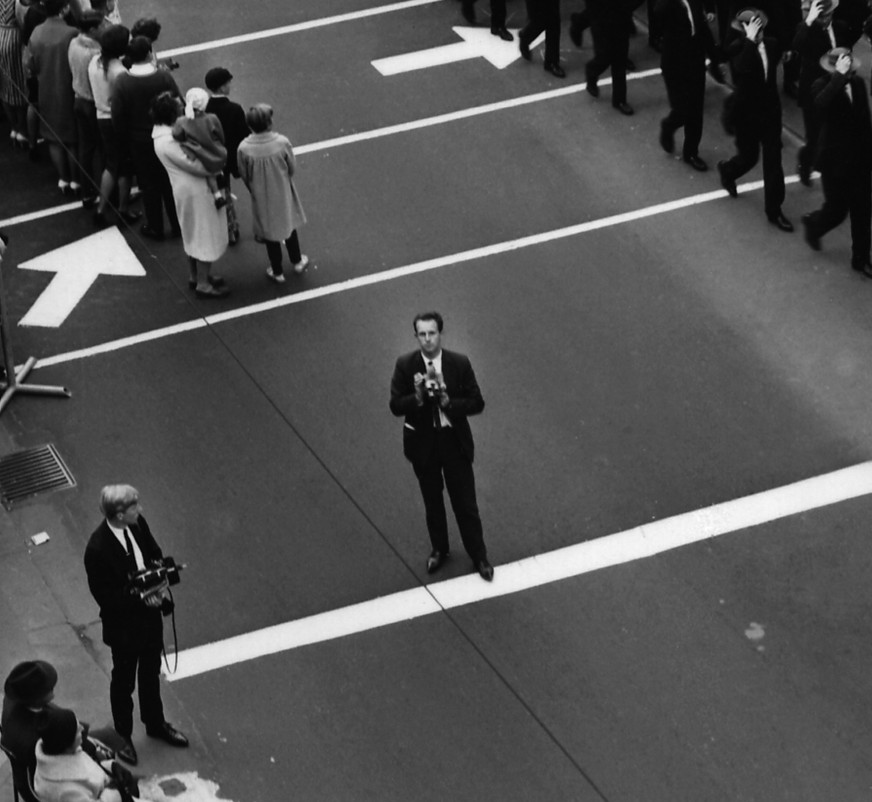
 

My City of Sydney, 1994

‘My City of Sydney’, 1994

Sydney Photographed catalogue, Museum of Contemporary Art, Sydney. pp 59-67

A SECOND-HAND COPY OF FRANK HURLEY’S PICTURE BOOK Sydney: A Camera Study is held in the library of the National Gallery of Australia.1 Between its pages are four pieces of toilet paper.  Presumably they were put there by Derek, who, going by his inscription on the fly leaf, originally gave the book, ‘with love to Mum and Dad and Shirley’ at Christmas 1948.  He has used the toilet paper as improvised tracing paper to add a personal overlay to the grand civic vistas in the book.

For instance we can orient a square of paper over the full colour photograph ‘The Spit, Middle Harbour’2 by the traced outlines of Clontarf, Middle Head and a sail boat. Once it is positioned we can locate Derek’s superimposed comments. An arrow points from the inscription ‘This is where Jim Miller has his block of land where we nearly built a duplex’ to a spot in Clontarf. Another inscription above Spit Road says: ‘I pass along this road everytime I go to White’s’. And another, in the top left hand corner reads: ‘Arthur -Marjorie’s brother lives just off the picture’. This is a wonderful example of somebody tactically re-using civic photography to record their own sense of space within its hegemonic view of an urban place. But it also points to a dialectic which perhaps affects all Sydney photographers who try to photograph their city: ‘Sydney’ is both a space in which some of us live, and a place in which a certain national iconography is staged.

After its publication in 1948, Sydney: A Camera Study was reprinted three times, completely revised in 1958, and eventually sold 50,000 copies.3 Countless similar books, primarily intended to be given by Australians to friends and family overseas, have been published since, but none have the authority of Hurley. A veteran propagandist of the Antarctic, New Guinea, and various theatres of the First and Second World Wars, Hurley defined our official visual culture for decades, with his operatic stagings and heroic deeds and monumental edifices. Hurley’s photographs are horribly oppressive, monumental things.  Each of his images is arranged like an over-designed stage set: foreground forms frame a receding plane which forces the eye back towards infinity.  Every building is on the square, every landscape is crowned with piles of creamy cloud, and every citizen is frozen looking purposively somewhere, either diligently down at their work if it is a factory shot, or deeply into space if it is a landscape.  Every single element of every single one of his photographs is relentlessly bound into an obsessive, almost paranoid national enactment. Every beach, every lifesaver, every street, every building, every factory, every mountain, every valley, every koala – they all serve Australian progress.

Hurley roamed throughout Australia in the 1950s and 1960s, producing a whole set of picture books in every State of the Commonwealth. However, because Sydney is Australia’s pre-eminent city, Hurley’s Sydney images and similar images by other photographers had a defining role to play within a more broadly nationalist iconography. Sydney is the stage on which Australian progress has been primarily displayed. Unlike say, Melbourne’s discursive micro-mythologies of various gnostic places within the metropolis – this or that separate street or locality – Sydney’s special places are all oriented within the nationalist stage directions of Our Harbour, Our Beaches and Our Monuments.

But Sydney still has no equivalent to the Eiffel Tower, which is both a universal symbol of Paris as well as offering a panoramic perspective on it. Sydney may have its complement of skyscrapers built by ‘corporate high-flyers’, but these towers tend to constitute merely an undifferentiated vertical skyline, a generic backdrop to the ‘real’ Sydney rather than its central motif. Despite the recent popularity of Centrepoint Tower’s viewing platform there has been no consistent physical point from which to view Sydney panoptically. However, it is still remarkably easy to conceptualise Sydney in the mintd’s eye from an aerial perspective, with a panoramic view of its places. Because Sydney not only a physical, topographic, sociogeographic site for living, but also a giant, virtual amphitheatre of national imagining, it is easy to imagine it from this ideal perspective with all of its diverse places conceptually ordered within its twin destinies as Austral birthplace and gateway.

In the imperial histories of most Australiana picture books Sydney is not the scandalous Fatal Shore of recent popular historical revisions, but a sacred birthplace, a kind of 18th-century geo-political manger. And in the imagination of these books, Sydney’s manifest destiny reaches back deep into its rock strata. As L Cotton, Professor of Geology and Physical Geography at The University of Sydney, wrote in ‘As It Was

the Beginning’, the first chapter of Sydney: A Camera Study: ‘According to a time scale now generally accepted by geologists, it was nearly 200,000,000 years ago when nature laid the foundations of our city.’4 Those rocks then sat and waited, ignoring the Aborigines, for the First Fleet to arrive. As C H Bertie, past president and Fellow, Royal Australian Historical Society wrote in his chapter, ‘A City and a Nation are Built’: ‘We have no record of the ejaculations of the men as they entered the heads and discovered the extent and beauty of Port Jackson, but Phillip adequately summed up their impressions when he wrote, some months later in a report to Lord Sydney “We got into Port Jackson early in the afternoon and had the satisfaction of finding the finest harbour in the world”.’5

This kind of history telling has been described by Paul Carter in the Road to Botany Bay as ‘diorama history’: a mythological history which invents a point of view, a panoramic eye before whose gaze the historical facts unfold.  History becomes a sublime working model which renders time clockwork and miniaturises space.6 Diorama history continues to affect our relationship to our city. As John Thompson wrote of Sydney in his poem accompaniment to Max Dupain’s 1966 book Soul of a City:

Much of your pride is new-fangled, yet histories hide in your bricks.

Archway, balcony, staircase, paths of the poor and the rich,

Fill with echoes and shadows, the brave rough ghosts of the earlies,

Wherever a Sydneysider may pause and lean and muse.

A double lifetime ago there were trees where the traffic rolls;

A lifetime ago it was only the fearless who sped so far…7 Australian progress has always relied upon, but also feared, mass mobilisations of people.  For most of this century that unthinkable migration coming down upon us on a broad front from the north was only conceptually containable when countered by another controlled migration funnelled in through Sydney Heads. As John Thompson put it:

O beautiful, affirmative city!

O brooch on the breast of a continent in the caress of the sea!

Hub of exchanges, ideas and antilogies, eldest and freshest

Of all the brash clan of young cities that shine in the clean dry South!8 In this imagining Sydney was, in Ross Gibson’s words, safely South of the West, not vulnerably South of the East.9

Of course government policy has now changed our cultural longitude, and migration has made Sydney much more polyglot than in Hurley’s day.  But the carnival of nations is still drawn into the cradling arms of Sydney’s imperial history.  For example, there is currently a dispute between the multicultural festival Carnivale and the anglo-centric Festival of Sydney over just this question.  Should Carnivale stay dispersed amongst the various ethnic condensations on the invisible plain of Sydney’s flat suburbs, and remain a ‘community’ event for its participants; or should it be brought into coherent view within the already inscribed, defined, predetermined ground of Sydney City and become a ‘internationally prestigious’ event to benefit all of Australia?

Sydney has not only retained the original moment of colonisation, it has also remained the first point of penetration, physically and conceptually, into the heart of the country itself. To the rest of the world Australia is undoubtedly the Bush rather than Sydney, but nonetheless today’s tourists need to touch down at Kingsford Smith before flying on to the desert, and more importantly can only reach the ancient wonder of Uluru through a prior conceptualisation of the modern wonder of the Opera House.

To live in Sydney is to act as an Australian for others overseas. As Hurley says in his introduction to Sydney: A Camera Study. ‘I hope that those who study this book will feel a glow of civic pride, and appreciate more fully the splendid work done by our public services and institutions that have contributed so much to the citizen’s well being, safety, and convenience. I hope too, that when the pages of Sydney: A Camera Study are turned by friends overseas, the contents will rouse in them an urge to come and join us in Sydney, or in some other of our cities or towns.’10 Derek’s traced overlays, intended to illustrate his new spatial world for Mum, Dad and Shirley, are a personal, epistolary adumbration of this colonial relationship.

Since then, of course, Australia has become increasingly reliant on touristic, rather than colonial population mobilisation. As Meaghan Morris wrote in ‘Panorama: The Live, The Dead and The Living’: ‘Where imperialism wanted settlers for security, tourism needs visitors for endorsement. One regime values permanence and accumulation, the other transience and turnover, one fears invasion, the other metaphorically solicits it. Threatened by the ‘foreign’, the ‘primitive’, and by ‘ghosts’, imperialist discourse tends towards closure: it paranoically defends the borders it creates. A touristic space must be liberal, and open: the foreign and the primitive are commodified and promoted, ghosts are special effects: the only ‘barrier’ officially admitted is strictly economic.’11

The Sydney amphitheatre is still a node within this touristic space. Its job now is to be not so much a crowded city, as a city where crowds are deployed and made visible, just as the outback’s job in both nationalist and touristic imagining is to be empty except for either ghostly or intrepid presences.  Melbourne is a crowded city, but not a city of crowds. Its apocalyptic evacuation in On the Beach seemed to be its natural role (at least according to Ava Gardner), however the panoramic image of a nuked and desert-like Sydney on an old Midnight Oil record cover was meant to rouse us to indignation.

The crowds of Sydney aren’t just currents of teeming citizens, they are self-conscious festivals. Sydney’s crowds are there to enact a purpose: the crowds at the Mardi Gras, the Bicentenary, the footy, the Sydney to Hobart Yacht Race, and the countdown to the announcement of the Olympic 2000 bid are all there to be seen to be there. Even when Sydney is exhorted to ‘let its hair down’ it does so in order to be admired by others.

The natural position for photographing this city seems to be up in the air, not only in a plane flying over the glinting harbour, but up with History itself, gazing over the shining events that make up the grand imperial narrative of Australia.  Countless images have pictured Sydney thus: ranged like stack seating around the Harbour, waiting for another First Fleet re-enactment or another Midget Sub attack. And countless other images -subversive collages or cheeky advertisements – have played with this repertoire, therefore reinforcing its primacy.

But of course if Sydney is a national diorama, for us who live here it is also a lived psychogeography.  Derek, in 1948, lived in the vista of Middle Harbour which he sent to his parents. He knew its contours, internal forces, and micro-histories intimately, and at the same time was proud of it as an abstract sign of his adopted country’s progress. Similarly we live, at one and the same time, in the abstract ‘Sydney’ and in our own locality, either on the North Shore, or in the Eastern Suburbs, the Western suburbs, or the Southern Suburbs. These sociomagnetic poles become the cardinal points of our: navigation: rich or poor, new or old money, working class or bourgeois, anglo or etr young or old, homely or trendy. Then there are the local ‘areas’, delicate atmosphe that ignore postcode boundaries. These are the sub-cultural enclaves: the residues outposts, the dying limbs and sprouting tendrils of any city. These differing urban densities and temperatures are the lacunae and folds of the city’s fabric which the panoramic view smooths away.

So the panoramic view of Sydney implies another, picturesque view, from down amongst it. It may be tempting to imagine that for every photographer ponderously positioning their camera on some eminent vantage-point in order to capture the monumental spectacle of Sydney, others have actively written their city of Sydney following personal paths within it. Many photographers appear to have inverted th unifying, prospective vision of Hurley’s dioramic photography of Sydney and sougf the fragmentary, the anecdotal, and the tangential.

There are several famous historical examples of this ‘other’ Sydney, for instance Harold Cazneaux’s middle-class dalliance with the besmirched, but pictorial, popp( the Rocks. Cazneaux lived on the North Shore, and in the 1900s photographed the children of the Rocks on his way to and from work in the city. In an article ‘In and i the City With a Hand Camera’ he described his techniques for hunting in these ne^ ‘picture grounds’ and warned his fellow amateur Pictorialists: ‘A trip down to the R | Area and Argyle Cut will convince any worker with pictorial imagination of what is I—I had, but photography is difficult in this neighbourhood. To be successful the work should have had some experience, as any nervousness of manner and lack of tact working here will only end by being ridiculed.  However go by all means and get broken in. Tact and expert manipulation of one’s camera is necessary if we wish to deal successfully with side street work in this locality.  Still the chances are that you may not like to return again.’12

Thirty-eight years later David Moore was out looking for American-style documentary poverty in Redfern on one of his weekends off from Max Dupain’s studio, with a Speed Graphic borrowed from Dupain. Suddenly he was yanked from the ‘cramped and sordid Redfern Lane’ and into the bedroom of Redfern Interior by a woman who mistook him for a newspaper photographer and demanded that he ‘take a picture and print it’.13

Although it may initially be tempting to see such photographic detours as the subjective, experiential reply to the demands of the panoptic, ideal Sydney, these photographers were not on a Situationist derive, or practising de Certeau’s ‘long poem of walking’.  If they were driven by any romantic desire it was the libidinous voyeurism of the flaneur. Their encounters were shot through with power, cliche, and stereotype, and were motivated by a pornographic desire to know the Other of civic place. Their reigning spatial metaphor is penetration, not drift. Thus they were always fully incorporated into Hurley’s imperial Sydney, analogous, in a way, to the discreet ads for ‘Naughty Sydney’s escort service’ at the back of the Tourist Guides left in hotel rooms.

Today Sydney has become as ‘overexposed’ as any other postmodern Western city. Our public life has shifted from the streets and plazas of our city to the screens and channels of our living rooms. Sydney’s famous crowds are now media, not civic events. In Meaghan Morris’s words, the media’s current demand ‘is for crowds, not population: people are needed to pass through a space (and be filmed or photographed), rather than inhabit it with communities.’14

The growth of the corporate towers that now form the backdrop in these images h meant that Sydney City has become evacuated of authentic ‘life’ (the town planner’s dreaded Doughnut Effect).  But although no longer ‘organically’ alive, Sydney City is i experientially dead. Those of us who may still, from time to time, walk in the cold an windy shadows of its office blocks, now find that its streets are being directly ‘theme a 1990s revision of Hurley’s dioramic national narrative.  For instance walkers occasionally come across a strategically placed sign-board, part of Westpac Bank’s Heritage Walk, which shows a photograph of the view from that exact spot a hundred years earlier.  If we wish we may go one step further and loll in a convict hammock at Hyde Park Barracks.  Soon, visitors to the Museum of Sydney, which has been incorporated into Governor Phillip Tower, will be able to interact with historical characters created by actors, scripts and computer technology. Visitors may even imagine them be phantoms rising directly from the soil of the archaeological site of first Govemment House, upon which the tower and the museum are built. Sydneysiders are no longer allowed to simply ‘pause and lean and muse’ on the ‘brave rough ghosts of the earlies’ as in John Thompson’s day. Now they must re-embody and re-enact, under controlled, sanitised conditions, the experience of those ghosts (now of both invaders, immigrants and Aborigines) as their civic duty to the commodified spectacle of Sydney.

Within the new historiographic logic of this theming, Sydney is now a compacted, archeological layering of contradictory historical moments, rather than simply the em stage for the perpetual unfolding of our imperial destiny. Yet it remains a mythic site the spectacle-culture of our nation.  Its potent vitality has been hollowed out into a shell a ruin. Sydney is now, more even than in Hurley’s heyday, an abstract space beyond contestation, waiting to be deployed within a primarily televisual spectacle of nationhood.  Reduced by cartoonist’s shorthand into the logo of a grafted Bridge/Opera House silhouette, or simply into an Opera House-shaped ribbon of exuberance for the Sydney 2000 Olympic bid, Sydney is now probably recognisable in a nano-second anywhere in the West.   Recent noisy conflict between the Federal, State and Local governments over the future of the Circular Quay precinct – the Cahill Expressway, the Customs House, East Circular Quay, even the Casino and the wharves – point to this intensifying national potency. The terms of the argument – universal aesthetic values,: amenability for promenading crowds, the need to have it all finished before ‘they’ arrive   in the year 2000 – all confirm Sydney City’s status as Australia’s televisual shop wine

It is this Sydney which is the site for current urban tactics. Some examples already present themselves. On Invasion Day 1988, Aboriginal protesters not only marched from Redfern to Hyde Park (tangentially, across the usual celebratory civic vectors, rather than, say, down George Street) but also invaded Mrs Macquarie’s Chair. What would have been a prime viewing balcony for proud white Australians became itself a stage for a protest which was televisually viewed by the world.

The televising of the Gay and Lesbian Mardi Gras seemed to be the inevitable culmination of its history of contesting the straight’s hegemony over a particular urban place. After winning the right to march up Oxford Street, successfully claiming it as a gay and lesbian place, the next space to dance into is our living rooms, and the next place to claim a right to is television. But by covering the event in exactly the same way as an ANZAC Day march, perhaps the ABC withheld from the Mardi Gras the ultimate right to transform its televisual place.

It is within an urban dialectic that Sydney photographers work. Are they citizens or civic actors? inhabitants of a space they know like the back of their hand? or extras in perpetual civic festival? Or are they both?

Notes

Frank Hurley,  Sydney: A Camera Study, Sydney, Angus & Robertson, Sydney, 1948

Frank Hurley,  Sydney: A Camera Study, p. 13

David P Millar, From Snowdrift to Shellflre, Sydney, 1984, p. 136

Frank Hurley,   Sydney: A Camera Study, p.10

Frank Hurley,  Sydney: A,Camera Study, p. 16

Paul Carter,  The Road to Botany Bay, London, Faber & Faber, 1987, pp. xix-xx

Oswald Ziegler, Max Dupain, John Thompson, Soul of a City, Sydney, Oswald Ziegler, 1966, unpaginated

Oswald Ziegler, Max Dupain, John Thompson, Soul of a City, unpaginated

Ross Gibson,  South of the West: Post Colonialization and the Narrative Construction of Australia, Indiana University Press, 1992

Frank Hurley,  Sydney: A Camera Study, p.7

Meaghan Morris, ‘Panorama: The Live, The Dead and The Living’, in Paul Foss (ed.) Island in the Stream, Sydney, Pluto Press, 1988, p. 182

Harold Cazneaux, ‘In and About the City with a Hand Camera’ in Australasian Photo Review, August and September 1910

David Moore,  David Moore: Australian Photographer, Sydney, Chapter & Verse, 1988, p.24

Meaghan Morris, ‘Panorama: The Live, The Dead and The Living’ p.182