PHOTODRAMAS – Both an exhibition of photographs and a telling of tales

Catalogue Essay for

PHOTODRAMAS,

Anne Zahalka, Ken Heyes, David James, Joy Stevens

Artspace, 16—23 March 1985


SCREEN GEMS

Firstly, the medium — the Cibachrome photograph. A beautiful, hard object, the sheer gloss of which often obliterates the image whilst dazzling the viewer. The viewer’s head must constantly move in an attempt to slip the gaze, almost surreptitiously, under the image’s emanation; whereupon flecks of silver can nearly be fancied embedded in the plasticized emulsion.

Truly a technology of restless desire — an object whose image tantalizes. Not an object of prolonged contemplation, where the viewer’s gaze can be comfortably absorbed into a palpable surface, or can come safely to rest on the tread of a brush-stroke. Rather an object from which the gaze skids — always nearly too quickly, always nearly out of control.

Cibachrome is a technology of loss, of almost but not quite. Like a film frame which is only projected momentarily we cannot focus on the image’s grain, cannot fully grasp its informational plenitude. All we seem to be allowed is the chance to prepare ourselves for the next, equally elusive, frame. These images are at once near and far. at stasis and in movement. They are Screen Gems, auratic and fugitive.


FILM STILLS WITHOUT A FILM

Secondly, the succession — the story. Not a series in the ‘Directorial Mode’ of the 1970s, not a relentless click-click-click leading to that inevitable punchline which invariably testifies to the directorial subjectivity of an artist. Nor a purposively muted ‘catalogue of events’. Rather, a procession of photographed tableaux with a diegetic reference, but not a narrative rationale. Images which are freed from the ruthless logic of temporal causality but which remain articulated within a metonymic succession.

Like film stills without a film they are nodes of dramatic over-determination left high and dry by a receding story line. These images take their cue from those other moments of film that are similarly marooned by cinematic narrative: those romantic moments on the ship’s deck against a back-projected moonlit sea; those dizzying car chases down Broadway where the back-projected pedestrians appear to sway drunkenly as they step from the kerb: those ‘significant’ close-ups on that vital clue; those attenuated ‘establishing shots’ before anything actually happens.

These Cibachromes are images which simultaneously ‘hold’ and ‘pull on’. They have metaphoric depth — they reach out to pull in the viewer’s powers of association — yet they also assume the viewer’s movement from one image to the next. They both burrow back into the gallery wall and point the way along it.

They are filmic without being cinematic. The standard cinematic suturing devices of ‘shot, reverse shot’, ‘point of view’, etc, are kept to a pragmatic minimum. The streamlined efficiency of the mechanics of traditional narrative is abandoned; each image is allowed, instead, the possibility of a ‘permutational unfolding’.

These successions are concatenations yet more still, since syntagmatic progressions are discounted each image is granted a multiplicity of paradigmatic levels on which to operate. These are not moments of connection between a before and an after, but moments of association within a configuration of befores, afters and nows.


TO SHOW AND TO SHOW TO SHOW

Thirdly, the image — the tableau. Not simply a photograph, since each image in enunciated by a scenario. Nor simply a montage, since there is no hope of a purely formal resolution to the image’s internal dynamics. Neither is there any surreal contradiction, nor any ostranenie. These are not dream images, nor images of formulaic play. No feats of imagination are required from the viewer, nor any self-satisfied grunts of privileged recognition — only work, reverie recharged as reading.

Each image is a semantic confine of diegetic elements — a careful assemblage of people, places, props, and other photographs into a plot, though not a plot closure. The awesome, rational, renaissance space of the camera is not attacked, nor embraced — merely assumed for the sake of argument.

These images proclaim their artifice, but have no point to make about it They both show and show to show for the viewer’s benefit, not their own. The viewer is faced with a referential emptiness in which a new reading must be made. The artifice of these images is a function of their considered construction from a lexicon of cultural redolences. The viewer’s reading of these images must be just as considered.

These tableaux are attempts to work with the visual culture without being subject to it, to manipulate cultural signs without simply being quotational or ironic. The viewer is left with the pleasure of working from one image to the next without consuming them. As part of this work reading may slow down, pause, reverse, or even speed up; whilst never losing sight of the ‘diegetic horizon’, nor ever simply following the logic of a story.


INHABIT FISSURES AND TRAVEL FAULTLINES

Finally, ‘Photodramas’ does not attack photography or film. It is not avant-garde, nor revolutionary. Rather it seeks to both loosen and rupture traditional cinematic and photographic modes of reading. The viewer is invited to inhabit the fissures and travel the faultlines of these ruptures, to read the stories without being their subject, to view the photographs without being the camera’s eye. In fact, to be the worst possible audience — interested but obstreperous.

Martyn Jolly

Sources

Roland Barthes. “The Third Meaning”, from Image Music Text Fontana, 1977

Alain Robbe-Gnllett. “Order and Disorder in Film and Fiction”, from Alpha, Trans, Chung, by Peter D’Agostino. NFS Press 1978.

KILLING TIME (What’s on our minds)

1985 Text for Mori Gallery exhibition Killing Time with Jeff Kleem, Jacky Redgate, Maureen Burns, Anne Zahalka, Ken Heyes, Juliee Pryor, Bruce Searle, Martyn Jolly, Mori Gallery January 1985

We no longer feel any joy in camera vision. We no longer delight In the eye. Photographers were once ever alert to the new, the revealing, the penetrating. Not any more. No more vertiginous camera angles, no more witty composltlons, no more frozen moments, no more timeless landscapes,

The photographer’s eye once strained to see as far as possible, penetrate as deeply as possible into the real. ‘The real’ was a complicated plot that only reluctantly revealed its secrets. It was a veil to be lifted, a chaos to be ordered, a depth to be plumbed. Not any more. Now our  photographer’s eyes are numbed. The stroboscopic ‘shocks of recognition’, provoked by ‘decisive moments’ in time, have reached the frequency of a tv’s pulsation. Everything now pereieved through the camera’s lens is an always already seen, known and read. Now we do see forever, for in photography we see everything always.

The photograph was once the function of a vertical thrust – a probing lens, a straining eye. Print clarity, lens resolution and artistic perception were all indices of this depth. Photography once seemed to be simply the collection of these photographs – a set of individual ‘seens’, a forest of camera extrusions. Now Its ubiquity has congealed into a field of contiguities. Each photograph is now merely one of all the photographs in the world – an image with edges but no boundaries. Each photograph shares in the same substance as every other photograph, each dips into the same pool of immediacy and veracity. The Integral history and historical location of each is subsumed into the immanent photographic presence. All the photographs in the world have congealed to form a global, gelatinous skin. Photography is now not so much a window on the world as an oily film which coats it.

Current photographic practice has ceased to be defined by the vertical thrust entailed In the act of taking a photograph. It Is no longer a series of Individualistic probes. Now it isdefined by the horizontal slide of the photograph’s infinite displacement and endless proliferation through reproduction. (A reproduction in which the mechanical and electronic exponentially multiply the photograph’s Inherent reproducibility.) Now we blindly feel our way across the global, mobius surface of photography with the expectation of revealing nothing new.

Yet photography qua photography persists. Its horizontallzation has not destroyed its priveleged relationslilp to the real  ‑ its optical andchemlcal -causality. Its almost carnal palpability. Only the particularity of the object, the eye and the Instant has been lost: individual photographs endlessly circulate beneath photography’s smooth skin; the photographer’s eye stares blankly ahead; the decisive moment expands to dissolve the instant.                                  –

We abandon vision In favour of the surface, penetration in favour of the survey. We Invite the quotatlonal, parodic and ironic to play across the photographic field. Photographs are rephotographed. Empty arcades are searched for the traces of previous photographers. The immaculate ‘reality’ that once-upon-a-time existed before the, cameras of famous photographers Is recreated and rephotographed in a cruel parody of ‘original vision’. Faces loom in a conflagration of masterpiece and blowup. Innocent, ‘sensitive’ emulsion is clinically spread to passively await its fate. The delicious pain of precious memories is nurtured in funereal swadling, or casually collected like holiday souvenirs. The two-dimensional and three-dimensional relentlessly fight it out. Texts and images gossip about each other behind their own backs. The game of portraiture is played out on an elaborate scale to once more gain our attention. Individual photographs supi-iliantly curl in their own transparent nests.

Martyn Jolly

“Who and What We Saw at the Antipodes” – who and what?

Unpublished manuscript for a talk on the album Who and What We Saw at the Antipodes, in the collection of the National Gallery of Australia. Written circa 1983. No citations. c1983

This album was assembled from photographs taken mainly in Australia between 1868 and 1870.  It was purchased by the Australian National Gallery and is one of a pair of albums.  The other, directly attributable to a Lady Fanny Jocelyn, is concerned with the domestic life of a British aristocratic family in the 1860s.

Viscountess Jocelyn was born Lady Frances Elizabeth Cowper around 1820, the younger daughter of Earl Cowper.  The invalid Earl died in 1837, and two years later her mother, Amelia Lamb, remarried the man with whom she had been having a well-publicised and glamorous love-affair for many years, Viscount Palmerston.  (There is speculation that her younger children, perhaps even Lady Fanny, were the daughters of Viscount Palmerston rather than the invalid Earl.) Viscount Palmerston was one of Queen Victoria’s closest advisers and a powerful force in British politics.  Lady Fanny herself was one of Queen Victoria’s ten bridesmaids and later a Lady-in-waiting.  In 1841 she married the dashing Viscount Jocelyn, who had recently returned from a six month expedition to the Chinese Opium War.  In her thirteen years of marriage, before her husband’s untimely death in 1854, she bore four children.

It was probably as a widow that Lady Fanny took up photography, which was becoming a very fashionable pass-time amongst the wealthy, educated and leisured classes.  Although women would have been discouraged from taking up the hobby, they were not absolutely precluded, particularly if they were wealthy and had fulfilled the Victorian obligations to their large families and their husband’s careers.  Other aristocratic women photographers of the period were Lady Clemintina Hawarden and the better known Julia Margaret Cameron (not strictly an aristocrat).

It was probably as a girl, that Lady Fanny acquired her watercolour skills, which would have been part of her education as a Lady.  A common pass-time for women of the period was the assemblage of elaborate albums and scrap-books containing poems, illustrations, sketches and drawings by themselves and others.  After the invention of photography, carte-de-visites of their friends, family and the famous were likewise assembled into elaborate, morocco-bound, brass-hasped, albums.  More rarely, the albums were embellished and decorated by hand, and more rarely still the purchased carte-de-visites were joined by photographs taken by the album’s owner.

The style, technique and predominant concerns of the two albums are closely related, and the album in the Gallery’s collection appears to have been owned by Lady Fanny Jocelyn. It may even have been assembled and decorated by her, but none of the photographs in our album were taken by her, quite simply because she is not recorded as being in Australia at the time.

In fact the exact identity of the person initially responsible for the Gallery’s album, and their connection with Lady Fanny Jocelyn, continues to evade my researches.  However by carefully analysing the album’s contents we are able to precisely locate their class, cultural and ideological position, which is just as useful for a deconstruction of the album.

The title page of the album shows Government House in Sydney and the vice-regal suite of the late 1860s.  They are most probably, from left to right:  Mr F.B. Toulmin, private secretary to the Governor; the Governor and his wife, the Earl and Countess of Belmore; and Mrs Beresford and Captain Beresford, aid-de-camp to the Governor.

The title is illuminated with ‘typically Australian” motifs: around the word ‘antipodes’ we see a grass-tree, a kangaroo, an aborigine, a boomerang, some parrots, a goanna, a ring-tailed possum and a snake.  This is the closest this album ever gets to showing non-European Australia, there are few photographs of such things elsewhere in the album, although they were freely available at the time.  The person who assembled the album, even though they stayed in Australia for three years, doesn’t appear to have encountered, or have been interested in encountering, any of these things first hand.  But nonetheless they remained acutely aware of their existence as signifiers of antipodality.  They were aware of the exotic charge the decorations gave to the word ‘antipodes’.  Other decorations in the album are similarly constructed within the paradigm of the ‘typically Australian’ but they exist, for the most part, only as decorations, as exotic embellishments to what remains, fundamentally, a stoically British existence in the colonies.  As will become clear, this is a profoundly insular and dissaffected album, one that shows Australia’s British masters’ poverty of experience of anything outside their own narrow society. Below the four carte-de-visites we have a photograph of Government House itself, showing the boathouse at the bottom and the masts of ships moored in Sydney Cove in the background.

The concurrence of the word ‘we’ with photographs of these five people, on the one page, would tend to suggest that one of them, or more, is the album’s originator.  To this question I shall return.  However it is immediately apparent that who ever the originator was, they were closely involved with the vice-regal family, as is demonstrated on another page which shows the Earl and Viscountess of Belmore and their four daughters dangling off a gum-tree branch.

The vice-regal suite arrived in Sydney on 7 January, 1868, after voyaging from England on the Sobraon.  The Earl of Belmore, on Eton and Oxford graduate, was only 32 when he took up his post, which he retained for four years before returning to Britain to attend to his estates and his career in British politics.  He and his wife are reported as making a very impressive vice-regal couple:  he being described as tall, and his wife as tall and dark.  Here she is pictured, at about the age of 25, with her first four daughters, she was to have six more daughters and three sons.  Her daughters are, from left to right:  Lady Therese, about 6; Lady Madelin, about 3; Lady Mary, about 1; and Lady Florence, about 4.

The Belmores, unlike many colonial governors, took a great deal of interest in the colony they governed, making sixteen arduous tours of its country areas.  On one tour of southern New South Wales and Victoria, undertaken in July 1868, the Countess was thrown bodily from her coach during an accident outside Goulburn.  But she was not hurt and continued on the tour, later removing her crinolines to descend a gold mine, the managers of which presented her with some nuggets when her attempts at panning proved unsuccessful.  However, despite her obvious devotion to her duties, she does not seem to have had much of a taste for Sydney’s social life, she is often recorded as not attending very important balls and picnics. One of the reasons for the Belmore’s return to England in 1872 was her failing health.  She obviously had an exhausting life in the colonies. On another page we have a photograph of Prince Alfred, the Duke of Edinburgh, flanked by his two equerries, Lord Newry and Elliot Yorke.  The photograhs were taken in Sydney in January 1868.

This was the occasion of the first Royal Tour of Australia, with Queen Victoria’s second son travelling to Adelaide, Melbourne, Sydney, Brisbane, Hobart and Launceston over six months, being shot at, and raising the patriotic emotions of colonial Australians to fever pitch.  The papers of the day are full of detailed accounts of the Prince’s every movement -his possum shooting parties, his visits to the theatre, etc. As well, they reproduced at tedious length all the speeches given in his honour, and all of his replies.

The Sydney Morning Herald even reported on the execution of this particular photograph.  It wrote: “The Duke of Edinburgh honoured Mr W. Bradley with a visit to his photographic establishment.  His Royal Highness afforded the artist on opportunity of taking seven very excellent likenesses”.  It goes on to describe the seven photographs, including this one, in which “His Royal Highness has assumed a slightly recumbent position near a sideboard.  His eyes are fixed upon an open book.  The face is what artists call three-quarter, and the expression more than that of any of the other photographs will remind some of the face of his Royal mother in her youthful days”.  The article concludes with “It is said that the Prince has expressed his approbation of the portraits.  Like others produced in this city, they are far before any which have been imported.  They will find a place, no doubt, in many albums, and tend to keep fresh in the remembrance of thousands the features of our Royal Sailor, and the festive days when his visit to this colony was commemorated”.  No doubt this portrait did feature in many albums, but few would have been privileged enough to have direct access to the Prince to have him sign this page himself.

Prince Alfred toured the colonies as Commander of the Royal Navy’s H.M.S.S. Galatea.  The Galatea arrived in Sydney Harbour from Melbourne on 21 January 1968.  The ceremonial welcome that had been planned for it, complete with flotillas of steamers in formation, welcome banners, and nine and seven gun salutes, was spoiled by a torrential and continual downpour of rain. The following day the Prince was welcomed to Sydney by a procession through Sydney’s streets, around Hyde Park and under no less than four triumphal arches.  That night, still in torrential rain, there was a display of fireworks and illuminated transparencies (large patriotic paintings, mounted in windows and on the fronts of buildings, lit from behind by gas lights). One of the most impressive displays was a fire-spitting winged dragon of over 30 metres that silently moved across the surface of the harbour.  It consisted of a steamer, entirely covered with detailed transparencies, trailing twenty-two smaller boats festooned with lanterns.  Men at the front of the steamer shot fireworks out of the dragon’s mouth and moved its jaws. Unfortunately, photography was not yet sufficiently technically advanced to record these events; although woodcuts made from sketches were included in the Illustrated Sydney News.

The album also contains two photographs of Clontarf, a popular picnic spot on Sydney’s Middle Harbour.  It was on this spot that, on 12 March, 1868, the Duke of Edinburgh was shot by a Fenian whilst attending a picnic to raise funds for a Sailors’ Home.  The would be assassin, James O’Farrell, fired into the Prince’s back from less than two metres, but the bullet’s republican progress was impeded by the several layers of rubber at the cross-over of the Royal Braces, so the Prince was not badly wounded.  Loyal Australians, however, were outraged, and over reacted in a way only colonists trying to prove their loyalty to the Empire can.  Some extremely Draconian legislation was enacted in New South Wales which, amongst other things, provided for up to two years imprisonment with hard labour for anyone “using language disrespectful to the Queen, or expressing sympathy with certain offenders”. Over a year later another picnic at Clontarf was not attended by Lady Belmore, the Governor’s wife, reportedly because she was too overcome with thoughts of the outrage she had witnessed there.

These images appear to have had wide circulation in Sydney. The top image most probably formed the basis of a chromolithograph by Thomas Picken, a resident of Sydney, which was published in “The Cruise of the Galatea” in 1868.  There was undoubtedly a high demand for pictures of the actual spot of such a dastardly attempt on the Prince’s life whilst he was in the very bosom of Sydney’s loyal economic and social elite. Picken was associated with the Royal Party through the watercolourist Oswald Brierly, who travelled on the Galatea as a guest of the Prince, and some of whose watercolours Picken had previously turned into chromolithographs.

The photograph of Mrs Susan Macleay, Miss Tiny and Miss Nelly Deas Thomson and Lord Newry (the Prince’s equerry) was taken in Sydney at Elizabeth Bay House, the home of William Macleay, probably during March or April 1868. The women in the photograph are three of the five daughters of Sir Edward Deas Thomson, a wealthy and powerful Sydney politician.  Susan Macleay, the woman standing on the left, was twenty-nine when this photograph was taken.  She had married William Macleay at the age of 18, but they had only been living at Elizabeth Bay House for three years.  William Macleay, besides pursuing the normal gentlemanly occupations of grazing and politics, was also, like his father-in-law, a keen naturalist,specializing in entomology.  Elizabeth Bay House was, at this time, a favourite meeting place for the colony’s leading scientists. Susan Macleay’s sisters were also frequent visitors to the House.  They lived close by, at “Barham” in Forbes Street Darlinghurst, only a mile or so through Kings Cross from Elizabeth Bay. “Barham” is now the Sydney Church of England Girls Grammar School.

Lord Newry seems to have stuck up a particularly close friendship with the Deas Thomson sisters during his stay in Sydney.  On the fourth of April 1868 he wrote to their mother, inviting her and her daughters on board the Prince’s ship that Sunday for Divine Service.  The relationship must have flowered because in August that year, safely back in England, he again wrote to the sisters thanking them for the birthday present they had sent him.  Unfortunately the letter does not mention what the present was.

Fancy dress was, of course, a favourite occupation of the Victorian leisured classes.  On Tuesday, 10 March, at the Prince of Wales Theatre, a public fancy dress ball was held in honour of the Duke of Edinburgh.  1,000 members of Sydney’s most fashionable society, from the Governor, Lord Belmore, down, attended.  The enthusiasm was so great that the next day a list of the costumes worn was published in the Sydney Morning Herald.  Tiny went as Evangeline, a French Canadian peasant character from a popular Longfellow poem; Nelly came as a Roman peasant; and Lord Newry came in the uniform of a volunteer.

The costumes in the photograph, however, seem to have a Middle Eastern or Mediterranean flavour, though of indeterminate country or class.  Viscount Newry’s monk costume, complete with false beard and bare feet.could perhaps relate sufficiently closely to those of the women to form some sort of ambiguous narrative, though nothing immediately suggests itself.  Any potential narrative is made more ambiguous by the pumpkin and grape vines, painted in watercolour, that surround the composition.  The grape vines may have been suggested by another of William Macleay’s gentlemanly pursuits -viticulture.

Lord Newry appears to have had a predilection for dressing-up and amateur dramatics.  On 2 March 1868 the Sydney Morning Herald reported that “There was a large and fashionable audience on Saturday evening [at the Prince of Wales Opera House] to witness the amateur performance given by Lord Newry and the officers of H.M.S. Charybidis in aid of the fund for the establishment of an Australian branch of the Royal Dramatic College.  The programme consisted of the comedietta “A Morning Call” and two farces “To Paris and Back for £5” and “Box and Cox”, the whole of which were played very creditably.

The band of the Galatea was present during the evening and played several pieces of popular music in an excellent manner”. However, this photograph does not appear to be related to either the fancy dress ball or the amateur performance.  It is probably just a tableau arranged and photographed for its own sake, perhaps illustrating a line of poetry.  The performance of tableaus was a popular pass-time throughout the nineteenth century.  It involved those with artistic pretentions dressing-up and disporting themselves in front of an audience for as long as they could remain still or keep from giggling. Tableaus were often viewed by the audience through a piece of dark gauze stretched inside a large gilt frame to give the impression of an old master painting, on which they were frequently based.  With the invention of photography a new impetus was given to the craze, the artistic efforts of the participants could now be immortalised and compared.

The background watercolour view in this composition is a topographically accurate portrayal of Sydney Pleads as seen from the front balcony of Elizabeth Bay House.  However, the photographic Dart of the composition is not of the morning room windows, the windows that actually frame this view, but is of some ground-floor windows towards the back of the house on the south-eastern side.  The photograph is actually taken outside the house, looking in to the butlery.  The doors and sandstone walls of the house have been cut out from the photograph to allow the painting of the background view, but the door architrave, wall-skirting and paving-stones have been retained and cleverly turned iside-out to act as ‘interior’ architectural features, perhaps to form a pseudo-verandah. This photographic conceit was necessary to obtain sufficient strong, even light for a good, sharp figure study.  A chair has been brought outside and covered with drapery to compositionally balance Lord Newry, and Tiny and Nelly have elegantly disported themselves over a grating leading to the cellars. The camera was located approximately one metre off the ground when this photograph was taken, this rather unusual camera position was chosen to ensure that the edges of the doorway remained parallel.

If this watercolour was done by Lady Fanny Jocelyn, it must have been painted in England, in which case of photograph of Sydney Heads taken from the front balcony of Elizabeth Bay House would have been needed.  Such a photograph is not in the album and has not been located elsewhere. (Tf, for that matter, the other floral decorations in the album were painted by Lady Fanny in England, actual specimens or other drawings would have, of course, been necessary; however this is not beyond the realms of possibility.)

Alternatively, the watercolour could have been provided by one of the Deas Thomson daughters themselves, their mother, Lady Anne Maria Deas Thomson, was known to paint in oils.

There is a further image of Mrs Susan Macleay later in the album, it was undoubtedly taken on the same occasion as the previous photograph.  Here she is posing as odalisque in a more obviously Ottomanesque setting.

It is interesting to note that the album, towards its end, contains carte-de-visites of ‘the real thing’, purchased in the Middle East on the return journey to Britain.  This interest in the natives of the Middle East contrasts with the disinterest shown in the natives of Australia, who were constructed within the paradigm of the ‘primitive’, rather than the ‘exotic’, and thus failed to appeal to refined tastes, even as parody.  Of course, Middle Eastern exotica was thoroughly inscribed within the iconography of nineteenth century art and literature . Another image from further on in the album is possibly also of the Deas Thomson sisters.  Here the watercolour background has been left uncompleted.  It may perhaps be of the sisters in their fancy dress ball costumes, because here they do seem to have a more peasanty flavour.

Lord Newry’s evening of amateur dramatics may possibly provide an explanation, in the absence of any other, for another page of the album which purports to show a Count Von Attems incarcerated in a convict’s cell by order of the Governor. Count Von Attems is probably a fictional name.  The Australian War Memorial suggests that the uniform may be Austrian, or it, too, may be fictional. The ship the Challenger was also photographed in Sydney Harbour.  It was the flag ship of the Royal Navy’s ‘Ships of War at the Sydney Station’ which usually numbered about five or so ships of various tonnages, classes and fire-power.  The album devotes many of its pages to these ships and the officers who came to Australia on them.  These officers formed a sort of portable social elite in which ever colony they happened to be stationed.  The photographs are carte-de-visites taken, most probably, by an enterprising Sydney photographer and sold to the general public.  The fact that there was a market for such photographs, in such a small city as Sydney,  is indicative of the adulation with which these embodiments of British power were treated in the Colony. The typographical details are cut from the navy List, an annual publication that recorded where every naval ship and officer was located within the Empire.

The commodore of the Challenger, as well as all the Royal Navy’s ships in Sydney, was Commodore Rowley Lambert who we see at the centre of this page surrounded by meticulously detailed watercolours of native Australian flora.  His wife, Mrs Lambert, is the person most under suspicion for originating the album.  The album has a strong naval flavour and Mrs Lambert was at many of the events the album records. She was also well acquainted with the vice-regal suite, and is often reported attending official functions with them.

Above and below Commodore Lambert are two gentlemen of Sydney. At the bottom we find Sir William Macleay, the entomologist of Elizabeth Bay House, who was a pillar of Sydney’s educated society. At the top of the page we find William Bede Dalley, described at the time as “short and thickset, with a jovial and often glowing countenance”.  He set trends in colonial dress, featuring colourful cravats and buttonholes.  He was renowned as the most scintillating conversationalist and after-dinner speaker in the Colony.  The son of Irish convict parents he quickly rose to prominence in politics and law.  He defended the bushranger Frank Gardiner and, at the time this photograph was taken, defended James O’Farrell, the would be assassin of the Duke of Edinburgh.

There is a very faint pencil inscription under three rare interior views in this album which reads “My drawing room, Phillip Street, Sydney”.  In 1870 two of our suspects for the origin of the album lived at Phillip Street.  Commodore and Mrs Lambert lived at number 46, and the Governor’s aid-de-camp, Captain Beresford and his wife lived across the street at number 45.  Phillip Street was obviously a preferred address, as well as being handy to Government House, Circular Quay and Farm Cove.

I think that the ‘my’ in the caption must refer to either Mrs Lambert or one of the Beresfords, most probably Mrs Lambert. The women whose small portrait appears above one of the photographs and who is also featured in the photographs themselves (holding her head to keep it still during an exposure of what must have been at least fifteen seconds) is Edith Helen Gladstone.  She was the younger sister of Countess Belmore and accompanied her on many vice-regal tours.  In 187 0, at the age of twenty, she married William Dumeresq, whose mother was cousin to William Macleay and whose father was a prominant public servant and landowner – one of the new generation of European immigrants who amassed huge fortunes in Australia by manipulating its governments.  For a bourgeois such as this the prospect of his son marrying into the British aristocracy must have been delicious indeed.

In one image Edith appears to be looking at a portfolio of photographs, or maybe chromolithographs.  Are they of the Blue Mountains?  Beside her a capacious handbag sits on a chair,most of the chairs are well covered, and there are fans and more photographs on the mantle piece.  Fern arrangements and books also decorate the room.

Interiors such as this would have been extremely difficult  photograph successfully because of the low light levels, and they are very rare.  We can, at this stage, only speculate as to who took them, most probably a local advanced amateur or willing professional was especially hired for the assignment.

Another photograph which may be by either a professional or an amateur is this rather charming scene of two women and a boy looking across Farm Cove to the Botanic Gardens from Mrs Macquarie’s Chair.  The italianate building on the left is Victoria Lodge, which still stands at the westerly gates to the Gardens.

The Flying Squadron consisted of six ships from the Royal Navy that circumnavigated the world between 1867 and 1870, doing little more than showing the Imperial flag.  They arrived in Sydney Harbour on 12 December and anchored in Farm Cove the following day, where we see them now.

The Commander of the Flying Squadron was Rear-Admiral G.T. Phipps Hornby, commander of the Squadron’s flagship, the Liverpool.  Another page contains a fine photograph of what is most probably the Liverpool. The Flying Squadron was a P.R. exercise that served the Empire in two main ways:  it gave its Naval Reserves some training, and it made its distant Colonies feel like loved and protected parts of the great British Empire.  As a Sydney journalist from the Empire gushed on the day of the Squadron’s arrival. “The arrival of the British Squadron, under Rear-Admiral Hornby is proof, if any were wanting, that England has a long arm and is able to protect her colonies if necessary. Probably not half of the twenty or thirty thousand people who saw the fleet coming in yesterday had ever witnessed anything so magnificent as those stately ships coming quietly through the water, with all their deadly armament, as it were, slumbering, but ready to pour out its terrific fire, if need were”. The ‘Sydney Morning Herald’ took a more pragmatic view.  “The visit of the Flying Squadron will divert the popular mind, in some measure, from political discussions, especially as the elections for the metropolis are past.  It may serve as a useful interruption in that kind of debate which tends toexasperate people against each other.”  This article is specifically referring to riots that occurred in Sydney, particularly the working class suburb of Balmam, in the lead up to the election.  The article ended with “the community may find satisfaction in the new evidence of British power”.

But the stately progress of the Squadron often bordered on farce.  Because it was largely manned by reserves it is unlikely that it could have protected anything, let alone Britain’s’ .flung colonies.  The six ships were constantly loosing each other at sea, or else running into each other at port.  During the voyage there were a total of 73 spars carried away, and 22 men died, four from falling from aloft. 16 men fell overboard of which only 10 were saved.  A total of 300 men deserted, a staggering 158 in Melbourne alone. However, details such as this didn’t mitigate the adulation of the colonists one bit, they remained totally besotted by these representatives of the British Empire.  There was another burst of sales of carte-de-visites of the Flying Squadron’s officers, as this page from the album testifies.

On leaving Sydney the Flying Squadron sailed to Hobart before continuing on to New Zealand.  They had on board with them Mrs Lambert and Captain Beresford, who they took as far as Tasmania.  A substantial portion of the album is devoted to the Flying Squadron’s Tasmanian visit, and other travels in Tasmania.

One page features Mr Charles Du Cane, Governor of Tasmania from 1869 to 1874.  On the right is his wife Georgina, who he married in 1863.  Between them is Mr Chichester, Du Cane’s private secretary.  Du Cane was a very popular Governor, mainly because he was fond of public appearances, he liked nothing better than giving speeches and opening things. Below is Mrs Du Cane’s boudoir in Government House, Tasmania, of which they were the first occupants.  Again we have a classic Victorian interior featuring, in common with the Sydney interiors, fern arrangements and portraits of friends and family, etc.  In addition are an inordinate number of figures and other representations of dogs – Mrs Du Cane was very fond of dogs.

On another page we have two views of Hobart, and one of a cricket match.  The Cricket match was played on 6 January, 1870 between the Southern Tasmanaian Cricket Association and the Flying Squadron, which had arrived from Sydney four days before.  The captain of the first team was Mr Du Cane himself, who was a keen cricketer; the captain of the second team was Rear-Admiral G.T. Phipps Hornby.  The day was described thus: “The weather was propitious, but rather windy.  A large number of spectators assembled both inside and outside the enclosure, and several carriages and equestrians on horseback.  In the pavilion were seated a goodly number of ladies and gentlemen. At the south-west end the governor’s tent was pitched, in which was a row of American arm chairs, in which sat His Excellency, the Hon. Mrs Du Cane, Mr CM. Chichester, A.D.C.; Mrs Lambert, Sir Valentine and Lady Fleming, Sir Francis Smith, Hon. T.D. Chapman, and other notabilities.  The fine band of Her Majesty’s ship “Endymion”, in a marquee, performed during the day.  A spacious refreshment booth for the cricketers and the public stood on the north-east side of the cricketers’ storehouse, erected and kept by Mr Courburn, of the Jolly Hatters, Melville Street, who had also in close proximity a booth for the dispensing of liquids”.

In the first innings of the Flying Squadron was, true to form, soundly beaten by the Association.  The loyal Tasmanians humbly excused their victory by claiming that the ship-bound Flying Squadron team had insufficient opportunity for batting and fielding practice. Obviously the photograph on the bottom of the page was not taken on the same occasion as the cricket match.  It would have been purchased from a photographer’s stock, perhaps to show how European Australia could look during the winter time.

On another page we have a photograph which was probably taken at a garden party held by Mrs Du Cane at Government House two days after the cricket match.  In the background is the Flying Squadron moored in the Derwent, Mrs Lambert looks at Mr Du Cane, Rear-Admiral G.T. Phipps Hornby leans on a chair over Mrs Du Cane who sits on the ground, finding herself incapable of holding her head still for the required exposure, Mr Chichester stands behind her.The garden party was described thus:

“the next afternoon (Saturday) being the last weekday, a general meeting took place to celebrate Mrs Du Cane’s garden party on the terrace of Government House, and there were gathered together all the youth, beauty and fashion for miles round, giving it an appearance of unusual animation, muslin and midshipmen being in great force.  Music, secluded paths, croquet, and other outdoor feminine amusements were largely patronized for some time, until a west wind, that had been inclined to be boisterous all the afternoon, began to blow the gauzy frocks about to such an extent as to imperil modesty … there was a general rush to the ball-room, where in the excitement of whirling to Flying tunes, and utterly regardless to the price of silk, the time was pleasantly wiled away till six o’clock, when there was a general break-up, to meet at the theatre afterwards, where the Squadron Amateurs appeared again, this time for the benefit of the Organ Fund”.

Another page contains two views of Melton Mowbray Hotel, near Jericho, on the road from Hobart to Launceston.  A Mr Blackwell. had turned the Hotel into a Hunting Lodge whose fame had spread across Australia and the world. Prince Alfred had lunched at the hotel on his way to Launceston two years before.

The next page features. Mona Vale, further up the road towards Launceston.  The house had been completed just two years at this time.  It was built by Robert Quayle Kermode, son of a wealthy land owner.  Prince Alfred stayed there on his way to and from Launceston.

We see Robert Kermode on the right, he was very ill at this time and was to die that year; on the left is his second wife Emily.  Mona Vale wa one of Australia’ s\grandest houses, set in extensive grounds with even an attempt ast landscape gardening in the eighteenth century manner:  the house overlooks an ornamental lake surrounded by willows.  The maintenance/of the house and grounds kept 100 people busy. These phonographs are cart-de-visites, indicating that they were probably taken by a local photographer for sale to the general public and tourists of Tasmania.  Kermode was proud of his house and would have been flattered by this popular attention.

At some stage during their visit to Australia either Mrs Lambert or Captain Beresford probably visited the Governor of Victoria.  There are two pages in the album devoted to the Victorian vice-regal suite. The Governor of Victoria was John Manners Sutton, who in 1869 became the Viscount Canterbury.  Like the Earl of Belmore he was an Eton and Cambridge graduate.  In 1839 he was unseated from the House of Commons for bribery, but this didn’t prevent him from receiving several Colonial Governmental appointments. He was an impoverished peer and relied on his salary to make ends meet.  He married his wife Georgina in 1838, and they are illustrated with three of their pudgy children, John, Mabel and Robert, along with the family dog.

There is another shot of the pair above Toorak, which was the Victorian Government House from 1854 to 1879.  The original site of Toorak covered 108 acres, and extended as far as the Yarra.  Considerable changes were made to the house after this photograph was taken, a balcony with a cast iron balustrade was added above the verandah, and a classical stone balustrade was added to the top of the tower.  Interestingly, the two gum trees standing in front of the house were cut down, and replaced by two much tidier and more European looking poplars. One of the gentlemen pictured on either side of the vice-regal couple is probably Lt. Rothwell, aid-de-camp to the Governor.

After describing for you who and what was seen at the antipodes the obvious question to ask, in conclusion, is how was it seen. Any deconstruction of the album must begin from the premise that it is an authored text.  The fact that the album follows a particular geographical route, orientates itself around a particular social elite, is extensively hand-worked, and shows strong interests and disinterests in certain themes, clearly indicates an author.  Further, we can safely say that the author was British with aristocratic associations who regarded themselves as merely sojourning in the exotic antipodes.

Finally, I think it is reasonable to assume that the author was a woman, simply because the practices of album assemblage and watercolour decoration were part of the nineteenth century construction of middle class femininity.  In addition, the person most implicated as the album’s originator is a woman -Mrs Lambert.

That being said, we can begin to see the whole album as being contrapuntally scored between the two themes of an antipodean ‘exotica’ and a specifically British ‘civilization’.  The first theme is carried primarily by the decorations, which are botanically accurate depictions of largely Australian flora: falling into the tradition of scientific naturalism within which Australia had first been perceived by Europeans on the scientific voyages of discovery that eventually led to the British invasion.  There are also, occasionally, photographs of antipodean exotica:  a stuffed Tasmanian devil, the Tasmanian bush, and a frontier station (complete with a carte-de-visite of its owner whose gentlemanly demeanour contrasts strongly with his brutally dishevelled piece of property).

The second theme, of British civilization, is carried exclusively by the photographs and the patterns of their placement on the album’s pages.  In this album British civilization is consciously separated from the ‘Australian’. Refuge is found in the replication of British familial, social and property structures as well as specifically British cultural practices.

The predominant social unit described in the album is the nuclear family, indeed it is the album’s recurring motif.  The portraits of family members are invariably laid out on the page to describe, in graphic terms, the filial relationships between them.   Often, by the inclusion of a photograph of the family house, property relations are directly inscribed within the family relations.  The depiction of these large Europeanized estates, safely encircled by their British owners, are further evidence of the clear distinction the album makes between ‘British civilization’ and ‘Australian antipodality’.

The comfortable interior photographs of rooms that were largely the domain of women – drawing rooms and boudoirs, were likewise intended as evidence of how tasteful life in Australia could be made to be.  The fern arrangements are the only immediately evident things that distinguish these interiors from European interiors.  The fern arrangements perform the same function for the interiors as the botanical decorations do for the album as a whole:  they provide an antipodean accent.

The rest of the album is largely made up of groups of carte-de-visite portraits grouped on the album’s pages.  These are rigorously arranged according to social circle.  We have Politicians of Sydney, Gentlemen of Sydney, Officers of the Ships of War at the Sydney Station, and Officers of the Flying Squadron.  In most of these pages the layout of the carte-de-visites establishes the relations of power and precedence within the group.  Usually the portraits rotate around a central, dominant figure.

Other pages, containing groups of largely unidentifiable women, tend to be arranged more rectilinearly, probably because the power relations between them were not as institutionalised.  The women are often integrated with children; and there are also pages devoted exclusively to children, often decorated with watercolours of botanical symbols of fecundity.

Finally, we have many pages devoted to naval ships moored in Sydney Harbour.  These potent symbols of British Imperial power were what initially brought the album’s author all the way out to the antipodes and were also what, after a brief sojourn safely ensconced in Sydney’s miniature replication of British social and political institutions, would return her home.

Martyn Jolly
Text of ‘anecdote’ presented at Art School Anecdote performance by Zoe Walker and Neil Bromwich

Aren’t art schools great? I think by law every art school should have a papier maché Statue of Liberty outside, with a plaque saying:

Give me your tired, your poor, 
Your huddled masses yearning to breathe free, 
The wretched refuse of your teeming shore. 
Send these, the homeless, tempest-tossed to me, 
I lift my lamp beside the golden door Continue reading

Has the digital revolution changed documentary photography?

‘Has the digital revolution changed documentary photography? ‘, State Library of New South Wales Magazine , May, 2013

Documentary photography is very popular at the moment. Despite the much vaunted torrent of digital images from the 24/7 news feeds, the myriad Youtube channels, or the thousands of photographs uploaded every minute to social media sites such as Flickr, Instagram or Facebook, people still have an appetite for the honed, considered, still image taken by a photographer who has devoted his or her life to the profession. New high-quality books, exhibitions, festivals, blogs, and the iPad editions of newspapers such as the Guardian, are all continuing to use the single ‘decisive moment’ of the documentary photograph, and continuing to attract viewers with it. Yet there are clear signs that the advent of digital photography has put the assumptions of the documentary genre under an enormous amount of pressure.

Digital photography has long since ceased to be new. The apocalyptic scenarios sketched out on its behalf in the late 1980s and early 1990s have proved to be simplistic, self-serving and wrong. Photography hasn’t imploded because, instead of light falling on emulsion to activate chemical reactions, light now falls on charged coupler devices to activate algorithmic reactions. People haven’t lost ‘faith’ in the photograph because photography was always more than just a particular technology, it was an historical convention, a social practice, an entrenched media industry, a personal relationship, and a psychological space. Shifting from film to memory cards and darkrooms to Photoshop wasn’t going to change that.

And, even though the statistics for the number of photo uploads are mind-boggling (for instance Flickr upload rates peaked at almost 2 million a day in mid 2011) we shouldn’t be carried away by the current on-line revolution in photography, either. Photography has always been a numbers game, and its numbers have always been relatively astronomical. For instance, way back in 1861, a little over twenty years after the invention of the medium, the enthusiastic booster of nineteenth century photography, Oliver Wendell Holmes, claimed that he had personally viewed 100,000 stereographs and had 1000 in his collection. By the twentieth century those staggering numbers were beginning to appear puny. In that century, it could be argued, the most important artefact for photography became the filing cabinet, not the camera, as massive archives around the world began to fill with photographs. For instance the filing cabinets in in the Film Preservation Facility of the stock photography agency Corbis, alone, hold eleven million pre-digital photographs. Seen in this light the current numbers of images available on-line are merely part of a trend, an exponential trend certainly, but a trend inherent to the medium nonetheless.

Some commentators talk about on-line photo sharing as though it is a new thing, as though people had never shared photographs before. But photography has always been a medium of interpersonal exchange, too. The very raison d’etre of the most popular portrait form of the nineteenth century, the carte-de-visite, was so that multiple copies could be shared within social circles The carte-de-visite albums of the period were the Facebook pages of their time. And even the millions of postcards, snapshots and albums of the twentieth century were always also specific messages between individuals, as well as a photographer’s image of the world. You only have to turn over any old postcard or discarded snapshot you might happen to pick up in a junkshop to find on the back a hand written message from one person to another, as short and enigmatic as a tweet.

The so-called ‘digital revolution’, therefore, has not fundamentally destroyed, but has only intensified the trends and qualities already fundamentally inherent in the medium. But, documentary photographers have felt these intensifications particularly acutely.

Documentary photographers want to change the world, that is one of the defining precepts of the genre. The folk heroes of documentary are those who have gone in under the radar or embedded themselves behind the lines and brought back images that have changed people’s perceptions of a war or other humanitarian crisis. The icons of the twentieth century, the classic photographs from the Second World War or the Vietnam War that have burned themselves into our collective historical consciousness, were all taken by committed documentary photographers working for governments or news organisations. But the icons of the past ten years, of the Iraq War or the Arab Spring, which have been similarly burned into our collective visual consciousness, were all taken by participants, not documentary photographers. The terrible photographs that ushered in the century, the torture photographs of 2003 and 2004 from Baghdad’s Abu Ghraib prison, were taken by the abusers themselves — the American Military Police. As Susan Sontag was the first to recognize: ‘A digital camera is a common possession among soldiers. Where once photographing war was the province of photojournalists, now soldiers themselves are all photographers — recording their war, their fun, their observations of what they find picturesque, their atrocities — and swapping images among themselves and emailing them around the globe.’ (Susan Sontag ‘Regarding the Torture of Others’, New York Times Magazine, 23 May, 2004 p27.) These images changed the world, certainly, but the people who took them had no agenda and no photographic ethic, other than boredom and a need to use the camera to feel part of a social group, albeit a perverse one.

In the nine short years since the global shock of the Abu Ghraib photographs, the commonest possession amongst all of us has become a mobile phone with a camera linked to the internet. Now we are all potential photographers almost all the time, and so the stream of revelations continues. The screams of alleged police brutality on our streets, the blood running down the faces of the victims of random terrorist attacks overseas, the surging of crowds at democracy demonstrations, and the drunken scuffles of the dissolute middle classes at night, all the phantasmagorical images of our social and political nightmares have first been uploaded to the internet from the mobile phones of participants, and then harvested from social media websites by mainstream new organisations. (The police themselves are now increasingly using the mobile phone cameras of the general public as a ubiquitous surveillance system, they often use the mobile phone and Facebook postings of participants to identify rioters.)

Yet even in these new circumstances, where the previously separate roles of photographer and subject, participant and observer, witness and victim are collapsing, there is still a role for the documentary photographer. Younger documentary photographers, such as the New Yorker Ben Lowy, are recognising the need to work in both modes, to provide a continual ‘feed’ of images as well as delivering considered, edited essays, in order to survive and remain relevant in this new economy of images.

On their way to being published and consumed by viewers, all digital documentary photographs pass through an environment were computer manipulation, to some degree, is inevitable. In this sense documentary photographs are a lot like contemporary movies, they both have some element of CG in them, even if the audience isn’t aware of it. For a long time we have realized that ‘external’ factors such as captioning, context, point of view, cropping, focal length and so on, dramatically altered the presumed meaning of news photographs, and we have learnt to ‘read’ photographs accordingly. However because they use a workflow that includes digital post-production, newspapers and mainstream media outlets have quickly moved to establish strict protocols that protect the ‘internal’ visual integrity, the documentary ‘truth’ and therefore the news value of their images, from CG infection. For instance in 2006, during the Israel-Lebanon conflict, sharp-eyed bloggers caught out the Reuters news agency who had published images by one of their stringers, Adnan Hajj. He had taken a shot of smoke rising above Beirut after an Israeli bombardment, but he had not been able to resist using the Photoshop ‘clone’ tool to, rather inexpertly, increase the amount of black smoke that appeared to be billowing from the buildings, before selling it on to Reuters. Once the alteration had been identified Reuters quickly dropped Hajj as a stringer, removed all of his 920 images from sale, and sacked one of their picture editors.

However other photographers are experimenting with embracing to possibilities of CG to not so much manipulate a truth, as to tell a story with multiple truths within one frame. For instance the Israeli gallery-based photographer Barry Frydlender still documents real scenes in Israel, but he composites multiple times, and multiple points of view, into the one complete image. These images have to be read differently by viewers, they are not a decisive moment, but rather decisive moments through which the viewer has to carefully navigate, assembling the complex meaning of the scene themselves.

These examples indicate the stresses traditional documentary photography is under, while at the same time it remains vibrant and obviously needed. One thing is certain: as photography continues it exponential change under the impact of the technological revolutions to come, the documentary impulse will continue to be at its very core.

Martyn Jolly

Children and Urban Space

‘Children and Urban Space’, Robert Rooney Seminar, Centre for Contemporary Photography, 24 April, 2013

Powerpoint slides:


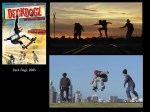
 In response to Robert Rooney’s extraordinary photographs I want to draw two very thin threads through the history of Australian photography and film.  I’m going to be looking at two separate filaments which have linked together the way children have been used to define or re-define urban space in Australia. The first is the figure of the street urchin, who has been seen as a combination of both the picturesque and the pathogenic. The second occurs in three films, Kid Stakes, 1927, BMX Bandits, 1983 and Deck Dogz, 2005, in which children or adolescents pursue trajectories at a tangent to the normative social geographies of Sydney.

Street Urchins and the Official Gaze

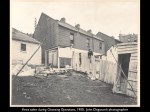
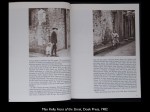
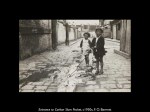
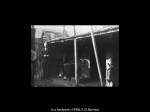
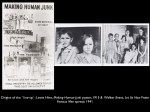
Children have been crucial motifs in the official photographs of urban space. They appear regularly in the photographs documenting the cleansing of The Rocks area following the outbreak of the Bubonic Plague in January 1900.

When these photographs were rediscovered in the 1970s the historian Max Kelly recognized that the photographer had also captured a new relationship between citizen and camera, in which the children had also become enmeshed.  He said:

Here people are as they were. There is no artifice. Some are caught unawares, some are apprehensive. Others are just as interested in the photographer as he is in them. Most have only rarely, if ever, had their photographs taken.

The presence of the small, kinetic children, often caught in fleeting movement or play, further activates the deep, wide-angle space of the photographs, while their social status as vulnerable innocents gives the political meaning of the slum clearance an extra symbolic validation.

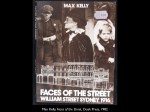
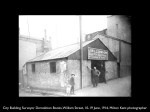
Children were deployed to a similar effect in the photographs methodically taken over a period of just one week, in 1916, to document all the buildings to be demolished for a widening of Sydney’s William Street. In his 1982 book Faces of the Street, Max Kelly entered this systematic space and enlarged sections from the evidentiary photos, performing a kind of retro street photography within the archive. Once excavated from the scene the child becomes a kind of readymade punctum in the overall scenarios of the official photographs.

This can also be seen in the Melbourne Housing Commission photographs of F. O. Barnett from the 1930s, where the presence of children overlays the spatial structuring of the labyrinthine, enclosed, segregated slum with a temporal dimension of social poverty. Here, children are social pathogens: will they stay poor like their parents, or will they erupt from the slums and threaten the rest of Melbourne?

However, the stern boot-steps of official photographers have always been shadowed by the soft pad of art photographers.

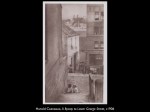
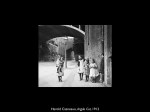
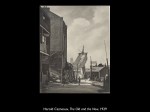
For instance in 1910 Harold Cazneaux wrote an article called In and about the City with a Hand Camera, a record of his own engagement with the streets which, he said, ‘have all the humour and pathos of life’. For Cazneaux he streets contained artistic lighting effects and picturesque subject matter waiting to be discovered by the intrepid Pictorialist. In particular they contained children who could be photographed in such a way as to hark back to the figure of the urchin when, for the nineteenth century viewer, there was an aesthetic and erotic frisson to be had in seeing innocence potentially threatened. But Cazneaux also admitted that the streets were resistant to his gaze. Without any official authority to back him up, a mute stand-off could quickly become outright hostility and demolish the Pictorialist’s personal old world fantasy. As he warned:

A trip down to the Rocks Area and Argyle Cut will convince any worker with Pictorial imagination of what is to be had, but photography is difficult in this neighborhood. To be successful the worker should have had some experience, as any nervousness of manner and lack of tact whilst working here would only end up by being ridiculed. However go by all means and get broken in. Tact and expert manipulation of one’s camera is necessary if you wish to deal successfully with side street work in this locality. Still, the chances are that you may not like to return again.

However Cazneaux did return again and again to the slums. In the late 1940s and 50s — because of a combination of the post war housing shortage, the rise of the Communist Party and Left politics in Australian art, and the ascendancy of the Documentary genre in photography —  ‘slum portraits’ had a popular resurgence.

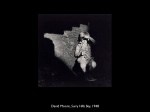
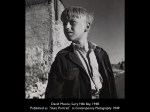
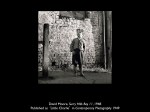
In 1948 Cazneaux turned the wee little pictorial gems which he had made back in the 1900s, into brand new bromide enlargements.. He also wrote a print criticism column for Contemporary Photography magazine to which aspiring photographer’s sent prints for critique. One of these was David Moore, an ambitious photographer working at Max Dupain’s studio who was assembling a portfolio to take to London to try to break into the picture magazine market. Moore had identified Sydney’s slums as a prime spot to get photographs that could be of interest to overseas picture editors. Like Cazneaux before him he travelled from his comfortable North Shore home to enter the slum in search of urchins. He titled one of his photographs ‘Little Charlie’, perhaps in reference to Charlie Chaplin’s character of The Tramp, and sent it in to Cazneaux, who was sympathetic to the young photographer’s editorial intentions.

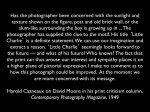
Has the photographer been concerned with the sunlight and texture shown on the figure, post and old brick wall, or the slum-like surrounding the boy is growing up in … The photographer has supplied the clue to the motif. His title ‘Little Charlie’ is a definite statement. We can use our imagination and extract a reason. ‘Little Charlie’ seemingly looks forward to the future — and what of his future? Who knows? The fact that the print can thus arouse our interest and sympathy places it on a higher plane of pictorial expression. I make no comment as to how this photograph could be improved.  At the moment we are more concerned with its message.

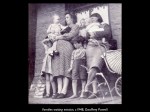
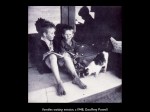
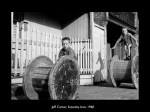
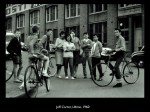
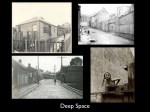
During this period many other photographers, such as Geoffrey Powell, Henry Talbot, Jeff Carter and Mark Strizic, also shot picturesque documentary urchins around the slums of Sydney. Many of these photographs — both the official ones and the artistic ones — have a very similar composition. They place the figures of the children precariously along the deep vertiginous angles of alleyways and walls, leading backwards and forwards through space. This visually amplifies the metaphorically precarious temporal status of the slum child, moving simultaneously backwards and forwards through the processes of social development and historical progress, as well as potentially across the barrier between the slum and the rest of the city. The ‘deep space’ shot dominates, but sometimes the ‘line-up against the wall ‘shot, which harks back to the graph–like display of poverty in Lewis Hine or Walker Evans, also occurs

It is probably too much of a stretch to tie this thread through to Carol Jerrems’ intensely personal engagement with the young skinheads she taught around Heidelberg in 1975. There are too many differences. She was not an outsider like the other photographers, rather she knew her subjects personally and she found them erotically compelling as individuals, rather than types. In filming the uncompleted film School’s Out she was a precarious guest in the communally enclosed spaces they had created for themselves on the banks of the Yarra. Looking at these extraordinary sequences now, not only does the intense eroticisation of the encounter come through, but also the sense that at any moment the rules that had been set to allow the encounter to happen in the first place, may suddenly be broken.

However Jerrems’ work does allow me to segue to the three films I want to finish with, which are also concerned with getting inside the spaces children create for themselves. Although basically generic kids movies, each film sets up a dominant panoramic view of the city, beneath which, or across which, a group of children move, following their own needs and desires, and evading the higher, clumsier and more inflexible demarcations of hapless adults.

Ludic Trajectories


Kid Stakes

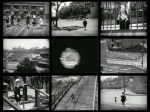
The popular children’s film Kid Stakes, made in 1927, contains an astonishing sequence that perfectly, elegantly and poetically, captures the spatial politics of Sydney in the 1920s. Based on a comic strip, the film centres on the slum kids of Woolloomooloo who play cricket and live their lives freely in front of the wharves and ships of Woolloomooloo Bay. Above them lies Potts Point, full of its posh mansions and restrictive mores. Suddenly, out of the rows of grand houses at the bottom of Victoria Street, emerges an upper class boy who yearns for the freedoms of the Woolloomooloo kids. Through the bars of his suburban prison he performs a panoramic sweep of the city across the bay. But this panorama is not a projection into the future, instead he is assaying a potential personal itinerary. He sees the kids playing, and the camera irises in. The Woolloomooloo steps dwarf him as he descends down them like a latter-day Dante, but the steps are leading him towards the salvation of the slums. Initially the slum kids taunt him, but when he proves he can fight he joins their gang and, his velvet clothes now torn, he becomes free. He is able to lead the kids back up the steps, past a sleeping policeman on guard between the two elevations, the two classes, of Sydney, and into the wilds of Potts Point for further adventures.

BMX Bandits

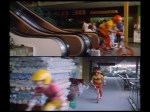
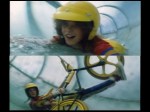
In BMX Bandits Nicole Kidman and her two friends are being chased by two bumbling baddies. The film is a ‘location film’ shot in Manly, but since it is trying to cash in on the BMX craze of the early 80s it is entirely an urban film — unusually for a beach film the kids never set foot on the sand, and never enter the surf. The baddies, who style themselves as American gangsters, drive a big American car and so are compelled to slew back and forth along the switchback roads of Manly’s hills, whilst the BMXers nimbly dart directly up and down the slopes, as well as through shopping centres and building sites. In one extraordinary sequence they transition between urban strata in a dizzying delirium as they slide down the fiberglass spirals of the Manly Waterworks, complete with their bikes.

Deck Dogz

The three nimble skateboarders in 2007’s Deck Dogz are also being chased by two lumbering and hapless baddies. But, rather than the unstructured romp of BMX Bandits, there is an attempt to embed their skateboarding thrills and spills in a Jospeh Cambellesque hero’s journey from the badlands of Sydney’s western suburbs to a beachside skate bowl where the Holy Grail of corporate sponsorship by a world famous skater awaits. But, as in Kid Stakes and BMX Bandits, panoramic horizon lines of the city also feature. These horizon lines are a spatial limit beneath which only children, equipped with either slum-bred insouciance, or BMX Bikes, or skateboards, can travel. In Deck Dogz the skateboarders travel down a stormwater drain, which morphs into the virtual space of a computer game to deposit them magically within the city of Sydney itself.

Martyn Jolly

The Australian National University’s Inkjet Research Facility

The Australian National University’s Inkjet Research Facility’, Imprint Magazine, March. Pp28-29

The ANU’s Inkjet Research Facility in the ANU School of Art was founded in 2003 with a remit to research the creative arts potential of inkjet printing on as wide a variety of different substrates as possible, and to integrate inkjet printing as closely as possible with other disciplines taught in the school such as photography, printmaking, drawing , textiles and painting.

The approach the Facility takes, of methodically and slowly applying hands on, studio based, iterative experimental processes to the technologies of inkjet printing, is very much in keeping with the ethos of the School of Art in which it is based. While the facility has nurtured many younger artists, many of the other artists who have experimented on our Océ Arizona, wide-format, flatbed, UV cured printer already had long experience in studio-based, hands-on techniques in other disciplines — particularly painting, printmaking, textiles and photography. They are already experts in working closely with the materials of their discipline in the ‘atelier’ of the studio or darkroom. To them the digitisation of image printing is just part of what has been a larger evolving and mutating environment in which they have continued to make their work.

Taking a low volume, experimental approach to equipment primarily designed for the high volume, highly standardised, requirements of an industry is not all that new, even if within traditions of art it has always the manual processes that have been valorised.  In the discourses of art photography and printmaking it is the craft and materiality of the traditional darkrooms or print studio that was usually celebrated.  The material processes of light falling on emulsion, or light projected through the finely-tuned magenta, yellow and cyan filters of colour enlargers were once the only way that photographic images were ‘bodied forth’ and their meanings created. Photographers thought in terms of cones of light causing chemical reactions across emulsion. Different emulsions and chemicals, they knew, reacted in different ways. Darkroom printers controlled those reactions directly through manually calibrating light filtrations and subtly changing chemical reactions.  Similarly prints and paintings were once chiefly made by the squeegeeing of ink through the fine mesh of a silk screen, or the pushing of paint into the weave of canvas. In these studio processes the intuitive control of the hand, twisting and pushing, inflecting and directing with micro-muscular movements, was what was valorised ‘ — by the market, the connoisseur and the historian.

However, just as art history was celebrating the individuated manual control which apparently reigned in artists’ darkrooms and studios over the centuries, the artists themselves always knew that at the same time they were dealing with automatic processes, often derived from industrially scaled reproductive technologies, such as lithography or screen printing, that had become superseded in the factory or commercial printery, but had survived in the atelier. They also knew that art history’s divided narratives of photography, printmaking and painting meant little to them when it came to the actual production of their images. Most art has always been ‘multimedia’ to some degree, combining various processes from photography, printmaking and painting, as well as, of course, collage, performance and construction.

This history continues. If you were forced to identify year one of the so-called ‘digital revolution’, you might nominate 1988. It was the year the first digital camera was invented, the Fuji DS-IP , which directly recorded images as a computer file onto a 16 MB card. It was the year the JPEG and MPEG compression standards were formulated. It was the year Thomas and John Knoll signed a licensing agreement with Adobe to distribute the software they were developing, which they had just christened ‘Photoshop’. And it was the year the Hewlett Packard Deskjet printer was released, the first consumer-priced printer to translate the bitmapped digital image into a matrix of microscopic jets of ink. Yet seen from the seen from the point of view of most of the artist who have worked in the Inkjet Research Facility, the year 1988 is not really so cataclysmic. It has simply introduced new technical procedures, and new material spaces into the artist’s working process — a process which has been going on for a long time.

For instance in 2009 the IRF hosted the ANU’s H. C. Coombs Creative Arts Fellow, the late Michael Callaghan. Well-known for his iconic screen-printed posters of the 1970s, Callaghan had a thirty-year career as a graphic designer, painter, sculptor, and printmaker. He brought all of this to bear as he worked closely with the IRF’s printer at the time T. J. Phillipson, who is now working in London at Cut Laser Cut. For a major exhibition which was first shown at the ANU School of Art Gallery, and then at the Damien Minton Gallery as The Torture Memo, Callaghan graphically collaged and layered the familiar media images and slogans of the recent Iraq War. The media images appeared in silhouette, the slogans in repeated patterns of both English and Arabic script. For one ambitious work, eventually called ‘What the US Government Did at Gitmo’, the patterns were printed onto marine ply which was then laser cut and assembled into a chair, such as a torture victim may have used. The chair was placed on a large mirror, itself printed with more script, which in turn reflected an image on the underside of the chair’s seat.

Other researchers didn’t exploit the Océ Arizona’s ability to print on a variety of substrates, as much as its ability to cover a lot of print area quickly, and at reasonably high quality. For instance, for his 2009 PhD examination David Wills produced one of his massive ‘Wunderwall’ installations. Titled ‘There Are Too Many Things in the Cupboard’, it comprised over 3000 separate images, each printed directly on 150 x 200mm fomecore, installed in a floor to ceiling grid almost twenty-seven metres wide.

So far there have been two exhibitions showcasing the Inkjet Research Facility’s work, each held in collaboration with colleagues from the University of South Australia’s School of Art, Architecture and Design. The most recent, Assisted Reproduction, curated by Dr Denise Ferris, was held at the ANU School of Art in October 2012.

It featured work by the painter Gary Smith, a graduate of the School’s painting workshop. For a series of large canvases of glowering industrial landscapes called ‘Refined’, he used a technique researched in the IRF with the aid of an ArtsACT grant.

In the catalogue Smith said:

‘My work over the past three years has explored how contemporary inkjet technologies and traditional glaze painting techniques can be layered and integrated to broaden the scope of painting. … I create multi-pass composite prints, that seek to utilize the inkjet facility as a painter would develop a picture rather than how a photographer would output a print.’

Elsewhere he explained in more detail:

‘The canvas is initially prepared with many layers of silver and pearlescent glazes. These act like a screen in a theatre and add luminosity to the final image. The image to be layered is then split into each of the colours, ie CMYK, and printed separately as a reduced percentage. Between each layer that is printed the whole canvas is glazed with acrylic. This acts to separate each color and to help break the image down. This process is repeated until the image reaches the required level of saturation. These can vary from work to work being 8 layers of printing and 8 layers of glazing to 24 layers of printing and 24 layers of glazing.’

This technique was also used in the collaborative painting Smith did with Frank Thirion. Called ‘The Faceless Men’ it was shortlisted for the 2012 Archibald Prize.

Another longstanding artist with a long association with the IRF is Annie Trevillian, who has been experimenting for several years with printing directly on textiles. For Assisted Reproduction she exhibited work from the site-specific installation ‘Remnants’, about the fugitive historical existence of the Indigenous and European men, women and children who once lived near some old house ruins left in the middle of the new Canberra suburbs of Gungahlin.  For the sixteen large format images use in the installation she wanted to print her motifs, which were derived from various aspects of the site including its artefacts, buildings, orchards, food, animals and machinery, onto a similarly fugitive, remnant material, so she chose a crisp  but lightweight polyester fabric called polyvoile.

In the catalogue Trevillian said:

‘Because of the transparency of the fabric the imagery was either hidden or obvious depending on the light and where you are standing. It definitely conveyed the idea that there was a history to the site whether hidden or known. A bit like prompting memories of people and places. I worked closely with Amy Macgregor from the IRF sampling colours. Stretching the fabric taut and securing it with masking tape pre printing was very reminiscent of stretching mesh for screen printing. I enjoy the fact that my skills from previous art making activities can be translated to different aspects of digital printing.’

Three other artists in the exhibition printed onto glass. PhD candidate Kevin Miller, for instance, often rescues old window glass or architectural glass panels complete with their patina of long use. Miller intensively works with the contrast levels in his digital image until the tones are so compressed, at either the extreme dark or light end ends of the scale, that their content is often at the very edge of perception, as though seen at the outer limits of peripheral vision.  Miller advice to his viewers, straining to interpret the images, is:

‘You could imagine someone peering at a computer screen, adjusting levels, testing contrast and examining the colour, there may even be some manipulation involved, but this is uncertain. Then you imagine the file being uploaded to the printer in a brightly lit space. In this case the smell is not of chemicals but something closer to acrylic paint and while standing there watching the image being revealed in layers on the glass you could believe that the sound of the back and forth movement of the printer head is strangely comforting to the artist.’

Two artists in the exhibition were inspired by the peculiar mystery of glass magic lantern slides. Nick Stranks, another Phd candidate at the School of Art, has been collecting used and old tools. He sees them as a form of physical biography of their original owners. Inspired by nineteenth century magic lantern slides he prints their image onto glass at one-to-one scale, so they then act as sculptural ‘shadows’ cast from the original tool.

Martyn Jolly has approached the magic lantern slide more directly. Following on from his historical research in the National Film and Sound Archive he has tried to figure out ways of reproducing the experience of experiencing a projected image in the nineteenth century. He printed a 150 year old magic lantern slide of a butterfly, from the NFSA’s collection onto plate glass 1.5 metre square, which was suspended and spot lit as though it was a slide projection.

But the most popular work in the Assisted Reproduction show was the witty series, ‘Cheese on Toast’, by current Inkjet Research Facility technician Amy Macgregor. Pursuing her fascination with ‘cheesey’ and ‘hammy’ TV shows and movie stars from the 1950s to the 1970s, she harvested some images of her favourites, including Doris Day and Rock Hudson, and printed them directly onto slices of white bread, carefully dried in a microwave. Not only does the UV cured ink, in it saturated Hollywood colours, soak into the surface of the white bread in a wonderfully delicious way, but the visual pun on ‘white bread’ heroes plays itself out as Doris, Rock, Cliff, Olivia, The Fonze and all the rest gaze out of the bread at us full of wholesome goodness.

What is fascinating about each of these artists is how adept they are at incorporating a range of technologies — their legacy from centuries of studio-based art making practices and decades of industrial image-producing technologies — within a ‘new’ digital environment. For them their research takes place in an historically unprecedented range of creative spaces which nest one into the other: the optical space of the camera, the physical space of the studio, the virtual space of the computer, and the mechanical space of the printer head as it methodically moves back and forth across a surface directly delivering colour and pigment at an impossibly microscopic level of resolution.

Martyn Jolly

Captions

Gary Smith

Tanks 2012

Acrylic and Pigment on Canvas

115 x 240 cm

Amy Macgregor

Doris on White (from the Cheese on Toast series), 2012

UV cured print on bread

10 x 10 cm

Nick Stranks

Mr Pratt (installation detail), 2012

glass, ink jet image, Steel

180 x 50 x 13 cm

Kevin Miller

Blood and Bone 1, 2 & 3, 2012

digital print on glass

(3 x) 90 x 90 cm

Michael Callaghan

What the US Government Did at Gitmo, 2009/2010

Digitally printed marne ply, stainless steel, digitally printed mirror, MDF and Timber, aluminium

Dimension variable

Courtesy Damien Minton Gallery

Michael Callaghan

What Detainee 063 Did at Gitmo, 2009/2010

Digital Print

111 x 140 cm

Courtesy Damien Minton Gallery

David Wills

‘There are too many things in the cupboard’ 2009

Installation of 3000 individual prints

ANU School of Art Gallery

Martyn Jolly

Reproduction of glass magic lantern slide of a moth C1860s

Collection, National Film and Sound Archive

Glass

150 x 150cm