University of Queensland Art Museum apocalyptic opening speech

It was great hanging out with Campbell Gray, Gordon Craig and Michelle Helmrich at the UQAM, as well as s well as Maurice and Camilla from the QCP, and meeting the dealers for James Casebere and Yao Lu at the No Place, opening. The only bead I could get on their work and the work of Lori Nix and Giacoma Costa for my opening speech, was ‘apocalypse’, the text is below.

No Place show at UQAM

No Place show at UQAM


No Place

‘Hasn’t the weather been strange lately, could it be a warning?’ Perhaps you found yourself saying this, or something like this, to one of your friends recently. It sounds so contemporary, so much part of our current anxieties, but in fact it is the strap-line from the poster for a 1977 Australian film by Peter Weir called The Last Wave. The film ends with a huge tsunami hitting modern Sydney, as foretold earlier in the film by local aborigines with their ancient wisdom, and ignored by whites with their hubristic civilization. I’m starting with films of apocalypses because that is the only point of entry I can find into this intriguing show. I’m afraid that Gordon Craig’s title for his show, No Place, just doesn’t do it for me, nor does the idea of ‘home’which he floats in the catalogue. And ideas of dystopias and utopias, the ideas I first started with in an attempt to wrap my head around this difficult show, also didn’t get me very far. But I think the idea of apocalypse does give me a point of entry, because apocalypses are about contradictions, and I think that this is also a show of contradictions.

Peter Weir’s movie is only one of a long stream of apocalyptic movies, and it comes from the same period of the disaster movies that have influenced some of the artists here, movies like The Poseidon  Adventure 1972 (from which I still bear the scars) and others like Towering Inferno and Earthquake from 1974. Before the wave of seventies disaster movies we had nuclear apocalypse movies like On the Beach 1959 or Doctor Strangelove 1964; and now there are a new crop of disaster movies, many featuring zombies, such as Danny Boyle’s 28 Days Later, 2002, where this generation’s anxieties are played out. I think apocalypses must be hard wired into us as humans. They are certainly a fundamental part of all the world’s major religions, and vivid apocalyptic scenarios can be traced back to the millenarian cults of the Dark Ages. I grew up in Brisbane in the shadow of another potential apocalypse — all-out nuclear annihilation, and now in Canberra my children cheerfully tell me that they will be dead before they reach my age because I’ve personally brought on climate change for them and, as a result, the sea levels will rise and the crops will fail for their generation.

And this is the thing about apocalypses, they unite the micro with the macro, the seemingly inconsequential with the cataclysmic, and the personal with the epochal.  In the Dark Ages, or in certain parts of the South in the United States, if we didn’t individually pray to Heaven we’ll be left behind at the last trump. In the sixties, if we didn’t adequately prepare, we would be left as a thermonuclear shadow on the ground. And now, if we don’t each reduce our carbon footprints, sea levels will rise. And this is where apocalyptic scenarios come in, my personal carbon footprint will raise sea levels less than a micron, but collectively we are all in trouble.

Apocalyptic scenarios are personal: they are about our individual responsibilities and our personal failures, but they are our failures scaled up, from the human to the cosmic. And this is why I think a lot of work in this show is apocalyptic: it does not simply recreate scenarios that might be familiar to us from science fiction movies, but the activity of the artist’s labour itself, working with an exacto knife, fome core, polymer clay and glue, day after day, to create intense miniature worlds, which are then reproduced at massive scale, I think taps into a deep redemptive impulse. It takes Lori Nix seven months to build one of her dioramas, at about a metre across, of cities drowned by time; and she then photographs them, from the precise angle for which they were built, on an 8 x 10 view camera — the highest-resolution of recording there is. This shift from the hand-crafted table-top world do the high-resolution print creates a strangely uncanny image — one reminiscent of dreams, of the aftershock of the psychic impact on us of movies we were really too young to see at the time  — but it is also a measure of the distance that needs to be bridged between the personal and the epochal.

There is labour in the digital too. One just has to stay to the end of the long roll of credits at the end of any contemporary science fiction film to realize that Hollywood’s outsourced CGI and VFX labs are the sweatshops of the post-industrial age, building cathedrals of illusion pixel by pixel, rather and stone by stone. The digital artists in this exhibition have also sweated laboriously to maneuver pixels into place with their Wacom Tablets. Yao Lu’s collages, of sublimely monumental piles of rubbish in China, use revered and ancient compositional references which project China’s mountains of rubbish, to which a blind eye can still be turned, into the future where they will — apocalyptically — come to define ‘Chineseness’ itself.

Giacomo Costa’s digital illusions unite urban architecture with geology and climate in an extended epochal timeframe where the human is so ephemeral it cannot even register. But their main impact on us as images comes, again, from the contradictions in scale: the microscopic detail of his vectoral models and texture maps, against the breadth of his vistas.

So there are contradictions within the images that I think are really important. The contradictions are essentially those which the very oxymoronic phrase ‘photographic fictions’ sets up. But these contradictions are also an essential truth: the Earth indeed will drown if we don’t change our ways. We will steal the future from our own children unless we can imagine — fictionalize — future scenarios scary enough to make us change, and compelling enough to connect or own micro lives with the macro fate of humanity.

Not only are there contradictions within the images, but Gordon Craig has also set up a contradiction within the show. James Casebere has been doing table-top work since the seventies, when Thomas Demand was still a boy in short pants, and his work has always been about the American mythos, often with a touch of postmodern irony. But here I think the irony is getting more pointed. At first glance the cardboard houses of Dutchess County have a Tim Burtonesque quirkiness, like the opening shots to Beetlejuice or Edward Scissorhands. These houses, with their cheap-ass, hokey and homey Americana architecture, probably hold all the normal suburban secrets, but nothing too challenging — at first glance, that is. Casebere’s table-top fiction was inspired by an actual scene which he saw from a freeway where, he says, he: ‘discovered the spread of cookie-cutter McMansion subdivisions, all mixed up with the unplanned ad-hoc triumph of vernacular taste, and a carbon footprint spun out of control.’ The Global Financial Crisis, with its Sub-Prime Mortgage fallout for Americans, had just hit; but rather than just photographing an historical crisis, or an aesthetic crisis in taste, Casebere had also presaged on apocalyptic crisis. It is the everydayness of this scene, with its ‘carbon footprint spun out of control’, that we must continue to imagine and reimagine, fictionlise and document, in order to keep all of its implications for our future in mind.

Martyn Jolly
 

My magic lantern slide collection

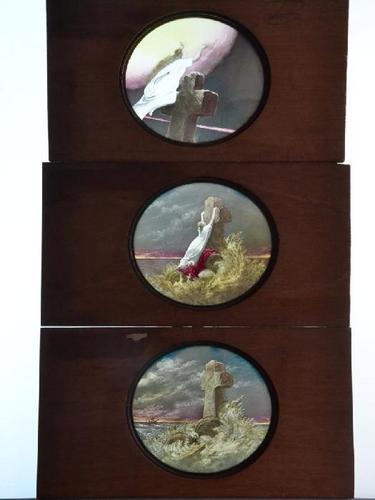
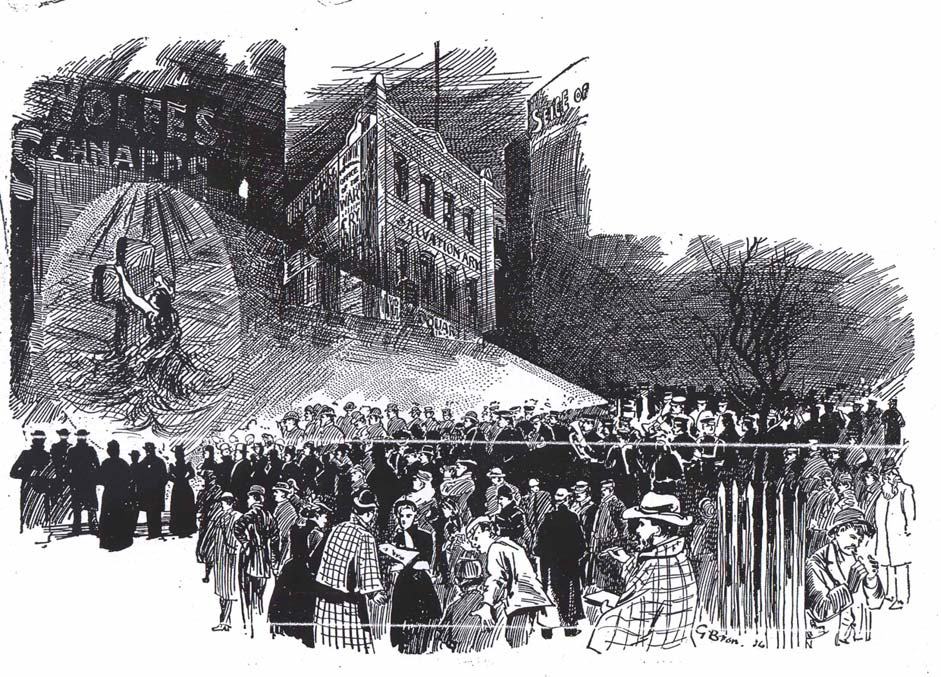
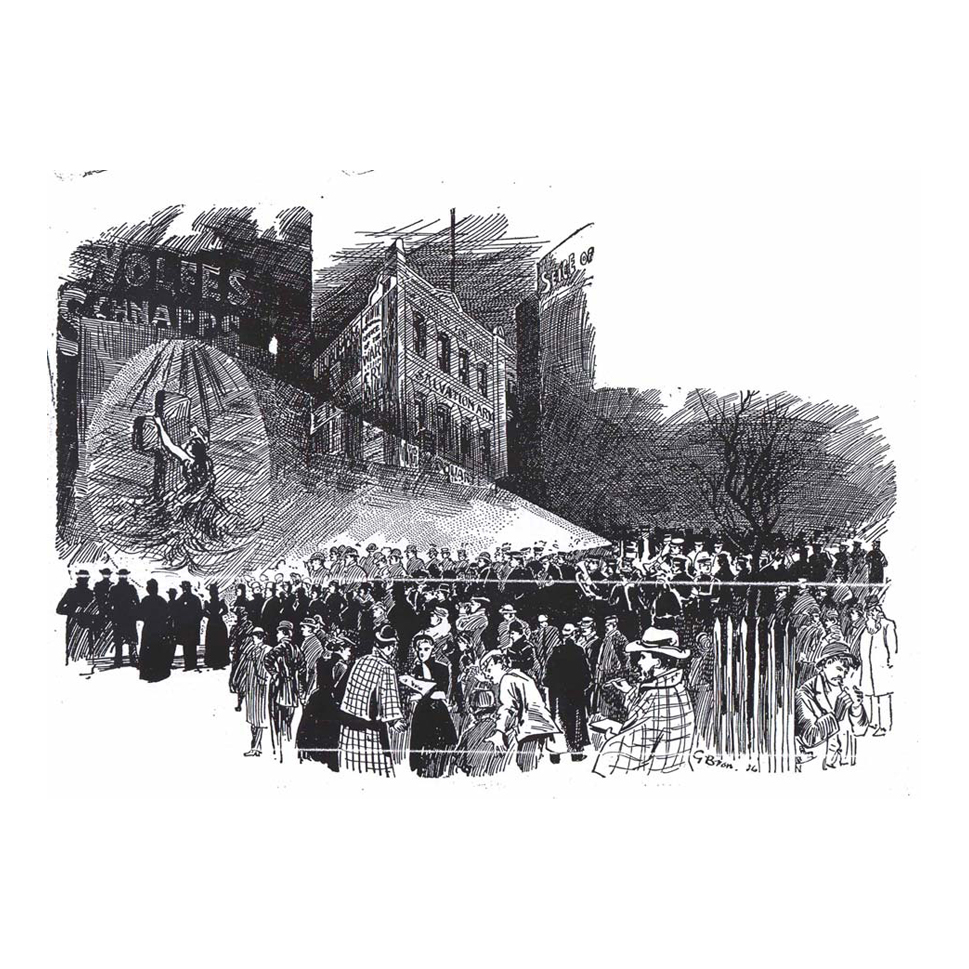
Now I have got my two lanterns working with LED lights, I spent the weekend beginning to catalogue the slides I have recently acquired. It turns out I have hand-painted slides of the Hymn Rock of Ages, very similar to the set which the Salvation Army used in one of Australia’s first outdoor projection in Melbourne in1894; as well as many complete sets of Life Model and Song Slides, such as were frequently used in Australian missions and churches. I’m now thinking of where to go next with my research, I’m currently looking at the reaction of nineteenth century Australian audiences to the lantern through newspaper searches, but there are so many other exciting things to do:

  • Commission contemporary artists to make contemporary lantern slides — paintings on glass or anything that can be sandwiched between 82 x 82mm glass!
  • Recreate shows using the Song Slide sets and the mp3 transcriptions of the Edison wax cylinders and Columbia records which the Library of Congress have made available on-line
  • Recreate shows using the Song Slide sets and Life Model sets with sheet music available from Trove and the recitations available online with performers interested in the genre of melodrama and sentiment
  • Build a rig that will allow me to ‘wear’ the smaller lantern as part of a performance (which was a technique developed by the London Polytechnic)
  • Collaborate with contemporary performers and musicians

Any ideas?

Outdoor projection of Rock of Ages, Melbourne 1894

Outdoor projection of Rock of Ages, Melbourne 1894

My Rock of Ages Slides, similar to the ones the salvation Army projected outdoors in 1894 Melbourne

My Rock of Ages Slides, similar to the ones the salvation Army projected outdoors in 1894 Melbourne

My complete set of 'Jane Conquest' slides, complete with angel 'effect' slides, similar to the one projected throughout Australia in the 1890s.

My complete set of ‘Jane Conquest’ slides, complete with angel ‘effect’ slides, similar to the one projected throughout Australia in the 1890s.

Jane Conquest slide show illustrated in Salvation A

Canberra Times article on the Canberra Museum and Art Gallery photography exhibition I’m in

New Canberra Museum and Gallery exhibition Lens Love explores the self, subject and environment

Sally Pryor

Canberra Times

November 30, 2013

CT article

Marzena Wasikowska’s Jess, Oskar, Kai and Mia.

It’s one of the most common complaints of modern life – the increasing tendency to photograph life when you should be living it instead. Snapping images of weddings and babies and parties and soon-to-be-devoured meals, as a way of affirming life’s existence when just being there isn’t enough. And why wouldn’t we, when cameras are constantly on hand, be moved to capture every single meaningful moment?

But when photography is more than just an impulsive social interaction, the process of living through images can be much more complicated. A new exhibition at Canberra Museum and Gallery shows how six local photographers have negotiated the porous boundaries between the self, the subject and the surrounding environment.

Gallery director Shane Breynard, who curated the show, says he set out from a cerebral standpoint – photographic film theory from the 1970s and ’80s that focuses on ”the gaze” as ”a concept for that period where the infant becomes aware of themselves”.

kml-na-lens-20131129183214699204-300x0

Lee Grant, from the series Belco pride.

”They get a shock that they’re an object in the world among other objects – they’re not just a flood of sensation. So I’ve had fun using that as a bit of a thread to select and group works together,” he says.

”Indeed, it’s something that is common among these photographers, that they all have a real sensitivity to the way today, in the modern world, we live half of our lives through an awareness of ourselves in images … we kind of live across time and in the relations of how we might be seen in an image.”

The six artists he chose have ta common anthropological vision of people and their place in the world as well as distinctive preoccupations.

kml-na-lens3-20131129183401202791-300x0

Denise Ferris’s The long hot summer.

Polish-born artist Marzena Wasikowska has three series of photographs in the show, and all relate to her family, including large-scale montages showing her three adult children, and their friends, spouses or children.

The images are immediately striking, and not just because of the instantly recognisable face of her middle daughter, actor Mia Wasikowska, but because of their careful, painterly composition. These are people who have grown up under their mother’s watchful, artistic eye, and their resulting lack of self-consciousness is palpable.

She also presents a study of a recent trip to Poland, her third since leaving her homeland at the age of 11, with images presented in grids that are made all the more poignant through their disconnectedness from each other.

kml-na-lens2-20131129183310507910-300x0

Detail from Martyn Jolly’s ACT Bushfire Memorial Images

Wasikowska’s husband, John Reid, also has works in the show, including his classic Fishman and Walking the Solar System series, both eccentric conceptual forays into the wilderness that immerse him as a subject at the mercy of the elements.

The youngest artist in the show, Lee Grant, is already known for her Belco Pride works – a series exploring her connection to the suburban Canberra of her childhood and adolescence. But her academic past as an anthropologist also shines through in the wary gaze of her subjects, from a group of teenage girls in a fast-food restaurant, to a well-dressed African family lined up in front of their house. Her Korea Project and Oriental Dinnerseries – Grant has a Korean mother – is also an examination of the refracted identity of Asians in Australia.

Head of the ANU school of art Denise Ferris presents works that are as inextricably bound up in the landscape as she is. From where she lives in the Perisher Valley, she has recorded the beauty and the fragility of the often harsh landscape of the mountains, in the midst of winter or the blaze of summer. Her images are sometimes populated with human figures, sometimes partially obscured by snow and thick clothing.

”This picks up on Lens Love, the title of the exhibition,” says Breynard. ”This is a place that Denise adores, and as she’s taking these photographs, there’s something there that she’s searching for and wants to grab and articulate. And it’s not just the landscape without people in it – there’s something about the connection and the way people use the landscape.”

Martyn Jolly has long been fascinated by archival images, and the effect created when he zeroes in on particular details, and removes the surrounding context. His series Faces of the Living Dead uses images from an archive at Cambridge University, images that are today known to be fakes – men and women caught up in the 1870s craze of ”communing” with dead relatives through photographs. The images, which include hazy presences floating around the faces of the grieving hopefuls, are cropped in for maximum and pathetic effect. Jolly also includes his series commissioned as part of the 2003 bushfire memorial – a reproduction of the columns of images he produced depicting the aftermath and recovery. He has used the same technique to crop the images close as a way of highlighting the drama and pathos.

Cathy Laudenbach is fascinated by how stories and experiences interact with particular places, leaving marks that aren’t always discernible to the naked eye.

In one series, The Beauty and the Terror, she has been inspired by the story of Daisy Bates, the Australian journalist who, in the early 1900s, retired to the Australian bush to devote herself to protecting Aboriginal people. Laudenbach includes no people in the images, but a presence is implied through shadows and objects.

”She’s divining, almost, a colonial inhabitation of this landscape,” says Breynard. ”There’s a sense in these photos of something that you can’t grasp – a story unfolding, or a mystery you can’t quite get, or a presence of a spirit.”

Like Jolly, she is also taken by notions of the supernatural, and in another series, The Familiars, she photographs rooms in which people have reported ghostly encounters.

”Today, it’s something characteristic of our time with our smartphones – we point at something and say, ‘That’s a good photo’, and we take it and file it away, and then we look at it again to connect with a time,” says Breynard. ”But these artists, I think, really slow down that time. There’s awkwardness in that, it’s their own searching … They slow you down, and they connect you with the mystery and ineffability of stuff you think you know.”

■ Lens Love, at Canberra Museum and Gallery, runs until February 23.

Read more: http://www.canberratimes.com.au/entertainment/new-canberra-museum-and-gallery-exhibition-lens-love-explores-the-self-subject-and-environment-20131129-2yh6m.html#ixzz2mD9WrG5n

Hopeless Romantics

Faces of the Living Dead on silk at ANU School of Art Foyer

Faces of the Living Dead on silk at ANU School of Art Foyer

Faces of the Living Dead on Silk

Faces of the Living Dead on Silk

Faces of the Living Dead on Silk

Faces of the Living Dead on Silk

Ursula Frederick asked me to be in a show to accompany an ANU conference on love. I resurrected some of my Ada Deane spirit photographs which I had printed on silk some years ago, and draped then onto model hands I brought from Lincraft. This is what I wrote for the catalogeue:

 The 1920s was a big decade for love, loss and yearning, as a host of loved ones were lost to cataclysmic events like the First World War and the flu epidemic. The 1920s was also a big decade for new media, as amateur photography became pervasive and electronic media like the radio connected people across vast distances. In this climate gnawing absences could often become ghostly presences in certain over active imaginations, and Spiritualism was in heyday.

In the 1920s the char-woman and pedigree dog breeder Ada Emma Deane conducted photographic séances at London’s Society for Psychical Research. People yearning to reconnect with their lost loved ones once more would send in a box of photographic plates which she would magnetize to the psychic spectrum by placing the box beneath her blouse against her chest. When they arrived for the séance the plates would be further sensitized as they placed their hands on the box, and she placed her hands on their’s. They would then sit on a wicker-work settee and, as Ada fussed around with her rickety old camera, think of the face they longed to see once more. Later, in the alchemical cave of Ada’s darkroom they would slip the plate into the developer and watch as their face appeared in the glass, to be followed shortly by another face, an ‘extra’ returned from beyond the grave.

I’ve had a long-standing interest in spirit photographs, which I see as simply an extreme amplification of the way all of us use portrait photographs of our loved ones. I’ve mainly written about them, but occasionally I have experimented with them too, trying to get right into the slippery, mucousy, labile, placental, ectoplasmic, ephemeral secretions of the photograph.  These details from Ada’s spirit photographs are printed on expensive wedding dress silk which I brought from a shop in Sydney. It’s designed to shimmer as it flows around the body of the bride.

Ursula has a great catalogue too.

Shaping Canberra, 2013

The Citizens of Canberra in Shaping Canberra, ANU School of Art Gallery 2013

The Citizens of Canberra in Shaping Canberra, ANU School of Art Gallery 2013

The Citizens of Canberra in Shaping Canberra, ANU School of Art Gallery 2013

The Citizens of Canberra in Shaping Canberra, ANU School of Art Gallery 2013

The Citizens of Canberra in Shaping Canberra, ANU School of Art Gallery 2013

The Citizens of Canberra in Shaping Canberra, ANU School of Art Gallery 2013

This year it’s been great to be invited to be in shows: by Cathy Laudenbauch and Patsy Payne for a show at the Front in Canberra called Undertone, and by Mary Hutchinson and Ruth Hingston for a show called Shaping Canberra at the ANU School of Art Gallery. The Shaping Canberra show went along with a conference also called Shaping Canberra, at which I gave a paper called Art from Archives, the paper’s in the writing part of this blog, at the end I talk about the work I did for the show thus:

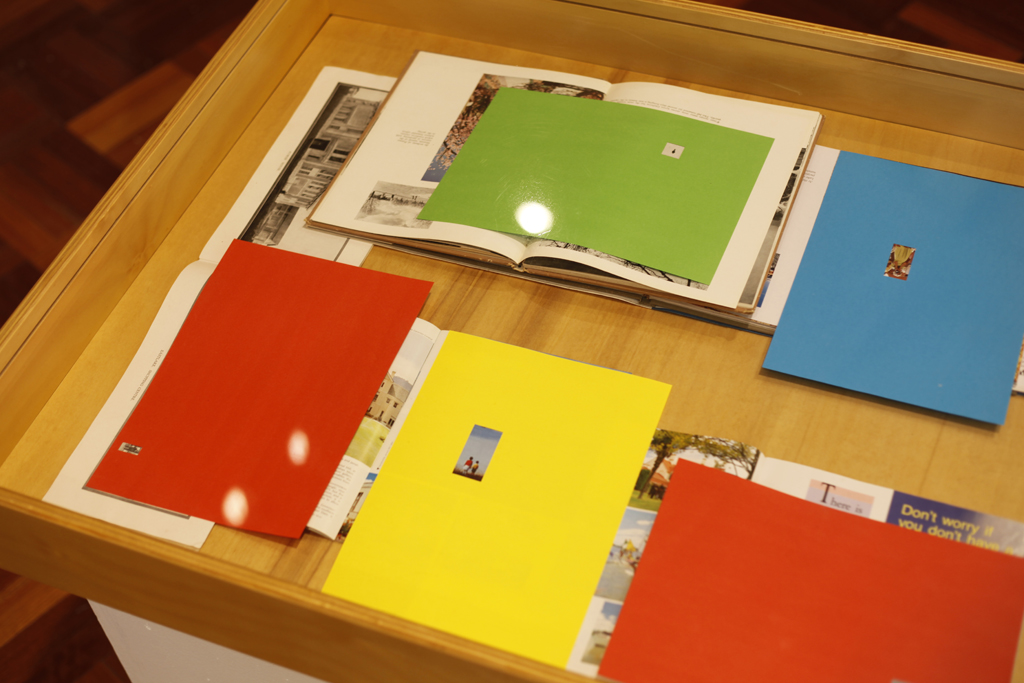
“I’ll finish by talking a little bit about a small installation I have in the show which is opening tonight. In my head I divide the history of Canberra into two periods. There is the utopian period from its foundation to self-government, where Canberra was used by the Commonwealth Government as a model of an ideal Australian polity, and a kind of ideal template for a future Australian city. During this utopian period, which in my imagination peaks in the 1960s,  Canberra was tolerated as a noble experiment by most Australians. Then there is the distopian period from self-government till now, where Canberra is regarded by Australians and governments alike as parasitical, perverse, pretentious, indulgent and ‘out of touch’. In both these Canberras there are no actual people. In the distopian Canberra of today the people who live here are despised as a vitiated, degenerated, foppish sub-category of the real Australian. They are people of literally no account. As Clive Palmer said last week: ‘In Canberra they have the best roads, but nobody to drive on them’. However the utopian Canberra was also devoid of actual people, the few people that appear in the photographs are national cyphers, actors in a political fantasy, like the schematic figures that occur in architectural drawings.

 So I’ve collected tourist brochures and NCDC publications from the utopian period of Canberra, making my own archive. Using an ‘Office Works’ aesthetic I have covered up the generic photographs with coloured sheets of A4 paper, obscuring the various civic vistas of national potentiality but revealing hapless pedestrians or passers by accidentally caught in the photographer’s camera, thereby pulling them out of their unwitting role as national cyphers, an perhaps returning to them their individuality as people.

 My work is cool and ironic, it is a million miles from the fervent spiritual juju of indigenous artists. It is affectionate, rather than interrogative. But nonetheless I think that on some level we are all engaged with the same occultish power of the archive.”

If you were at the conference you can read the other papers at:

http://hrc.anu.edu.au/confidential-papers

Magic Lanterns

I’ve purchased two magic lanterns and some nineteenth century slipping slides, lever slides and chromatropes, as well as a large collection of nineteenth century life model slides, from an auction. I’ve got the two lanterns working with LED floodlights that produce no heat or UV light. I’m having a fantastic time playing with these wonderful things. But as practice-led research I have discovered that it is extraordinarily difficult to change and focus the slides,  and manipulate and animate  the slides smoothly. Lanternists in the nineteenth century would have needed to do that as well as keep their patter going in a large hall without amplification, regulate the gas supply to their limelight, and control often unruly audiences. I’m looking forward to spending some time with Trove because I want to read the newspaper reviews of these performances, when Australian audiences were training themselves to sit together in the dark. Below is some of the equipment I’m working with, and a link to a seminar I organised last year.

The Projected Image Heritage of Australia and New Zealand

My 'iron duke' lecture hall lantern

My ‘iron duke’ lecture hall lantern

Rock of Ages hymn slides, as projected outdoors by the Salvation Army in 1894 in Melbourne

Rock of Ages hymn slides, as projected outdoors by the Salvation Army in 1894 in Melbourne

Salvation Army outdoor projection of Rock of Ages hymn slide on the side of a hotel, Melbourne 1894

Salvation Army outdoor projection of Rock of Ages hymn slide on the side of a hotel, Melbourne 1894

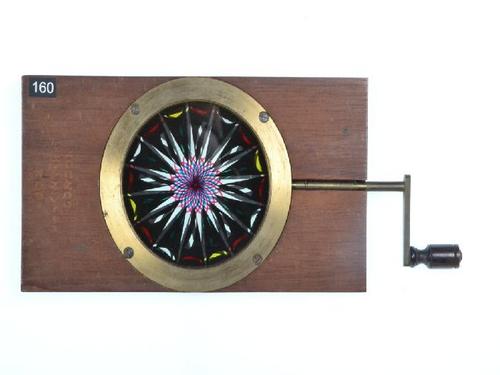
A chromatrope

A chromatrope

A chromatrope

A chromatrope

A slipping slide, moving the glass slightly produces a moire patterns from the scratched paint

A slipping slide, moving the glass slightly produces a moire patterns from the scratched paint

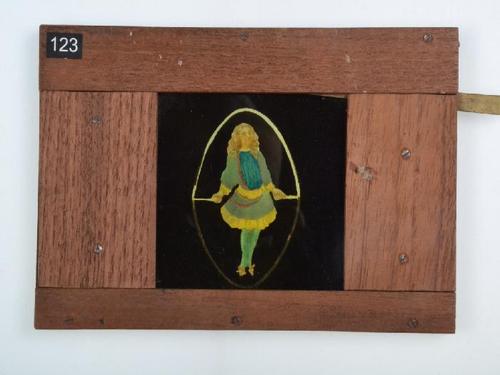
Skipping girl slide

Skipping girl slide

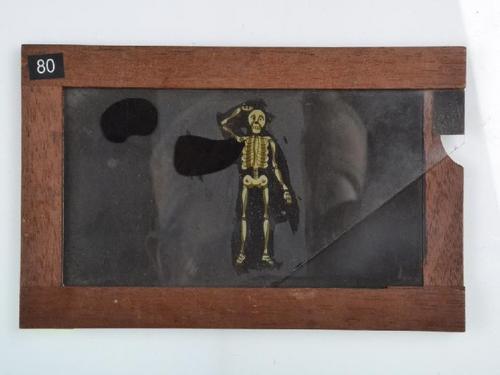
The skeleton removes its head

The skeleton removes its head

My 'parlour' lantern

My ‘parlour’ lantern

Wonderful Pictures, 1994

Photographed, in colour and black and white, from the pages of Australiana picture books with a Linhof camera. First exhibited at the Centre for Creative Photography, Melbourne, then at the Museum of Contemporary Art in an exhibition called Sydney Photographed.

The Sports Pages, 2000

The Sports Pages, 2000

Framed and matted pages from newspapers. Each sports page was framed and matted in its entirety, with windows strategically cut to reveal crucial deatails of the sports photographs. Exhibited at the Museum of Contemporary Art, Sydney, in 2000 in an exhibition Sporting Life.