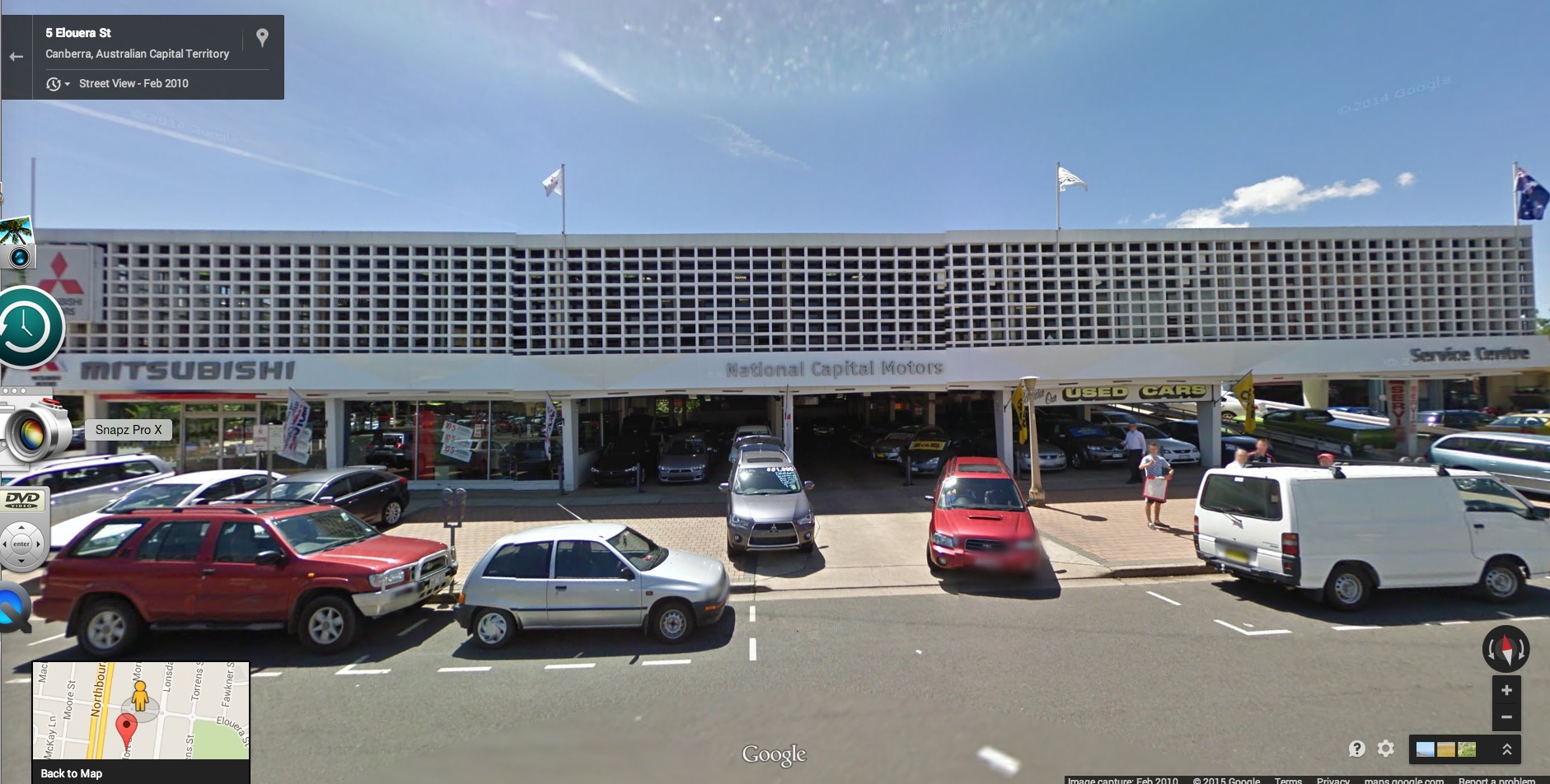
Paparazzi could be mistaken for terrorists and SHOT

So, the British Royal family has managed to avoid the real possibility of a slump, precipitated by Charles’s behaviour, back into a Georgian paradigm of mad kings and their mistresses. But the price of their successful reboot into Royal Family 2.0 has been that the new Royals must now be celebrities. Uber celebrities certainly, but celebrities nonetheless. And celebrities live or die by the camera. The work of the celebrity is to control the supply and demand for their photographs by a constant, daily labour of withholding, release and spin. This applies to every celebrity, from Lara Bingle (herself now rebooted as Lara Worthington) to Prince George. Perhaps Royal family 2.0 telegraphed their intention to rewrite the rulebook too obviously when they got, with too obvious a strategic calculation, Kate’s father and George’s grandfather to ineptly snap the first official photographs of the tot. Michael Middleton’s domestic photography, complete with bleached backgrounds and murky shadows, was meant to authentically read across to our own baby snaps, as though the Royals had somehow stumbled across a Jo Spence article in an old copy of TEN 8 magazine from the 1980s, or been given a Martin Parr book for Christmas. But, as every tabloid was forced to ask, were the first official photographs of George pleasingly cozy, or just bad?. Was their strategic calculation a miscalculation?

Then this week we see another egregious swing where, not the cozy power of domestic Britain, but the global power of terrorist-target Britain, is brought into play. A Kensington Palace encyclical warns off non-British paps. The commonwealth ones are thanked for following the script and waiting patiently for regular releases of new Prince George material, they way that grateful Apple users patiently wait for software upgrades. But the non-British paps are warned, in the words of The Mirror, that ‘they could be mistaken for terrorists, and SHOT” if they stalk George. So, in a Royal-created market where new images of George are the most prized on the planet, impoverished international paps are told to accept the steady corporate diet of regular updates on George’s progress, or place themselves in the same extra-judicial category as terrorists or refugees,

Clearly this Royal  reboot isn’t going to be all plain sailing, as the logic of celebrity culture and the global tabloid market for photographs clashes with the logic of state security. Could anyone at The Firm’s headquarters, Kensington Palace, have predicted these complications five years ago?

The Lights of London Town

I am continually failing at controlling my addiction to buying magic lantern slides on ebay. I have just received in the post two remaining life-model slides out of what had originally been a set of four made, Richard Crangle’s estimable Lucerna magic lantern web resource tells me, by York & Son in 1892 to illustrate the 1880 poem by the massively famous melodramatist and social reformer George R Sims.


The Lights of London Town


The way was long and weary,

But gallantly they strode,

A country lad and lassie,

Along the weary road.

The night was dark and stormy,

But blithe of heart were they,

For shining in the distance

The Lights of London lay.


O gleaming lamps of London,

That gem the City’s crown,

What fortunes lie within you,

O Lights of London town.


The years passed on and found them

Within the mighty fold,

The years had brought them trouble,

But brought them little gold.

Oft from their garret window,

On long still summer nights,

They’d seek the far-off country,

Beyond the London Lights.


O mocking lamps of London,

What weary eyes look down,

And mourn the day they saw you,

O lights of London town


With faces worn and weary,

That told of sorrow’s load,

One day a man and woman

Crept down a country road.

They sought their native village,

Heart broken from the fray;

Yet shining still behind them,

The Lights of London lay.


O cruel lamps of London,

If tears your light could drown,

Your victims’ eyes would weep them,

O lights of London Town.


George R. Sims 1880


I love the zoom-in from distant St Pauls, framed by trees in the first slide and barely visible except perhaps in projection, to close-up St Pauls (in exactly the same spot on the screen) framed by the garret window in the second slide. I love the way, in the second slide, the poverty-signifier of the bare walls visually constricts London down to the single schematic London logo. Sims used the same theme for his smash hit play The Lights of London, which was filmed twice in the twentieth century, most recently in 1923. Of course subsequently these something more, walk on the wild side thematics permeated popular culture. Although, perhaps nowadays the urban moths of pop songs, films and art are more likely to be single chancers, rather than eloping couples.

The Lights of London, slide 2 of 4.

The Lights of London, slide 2 of 4.

The Lights of London, slide 3 of 4.

The Lights of London, slide 3 of 4.

Google Photos app tags black couple as gorillas

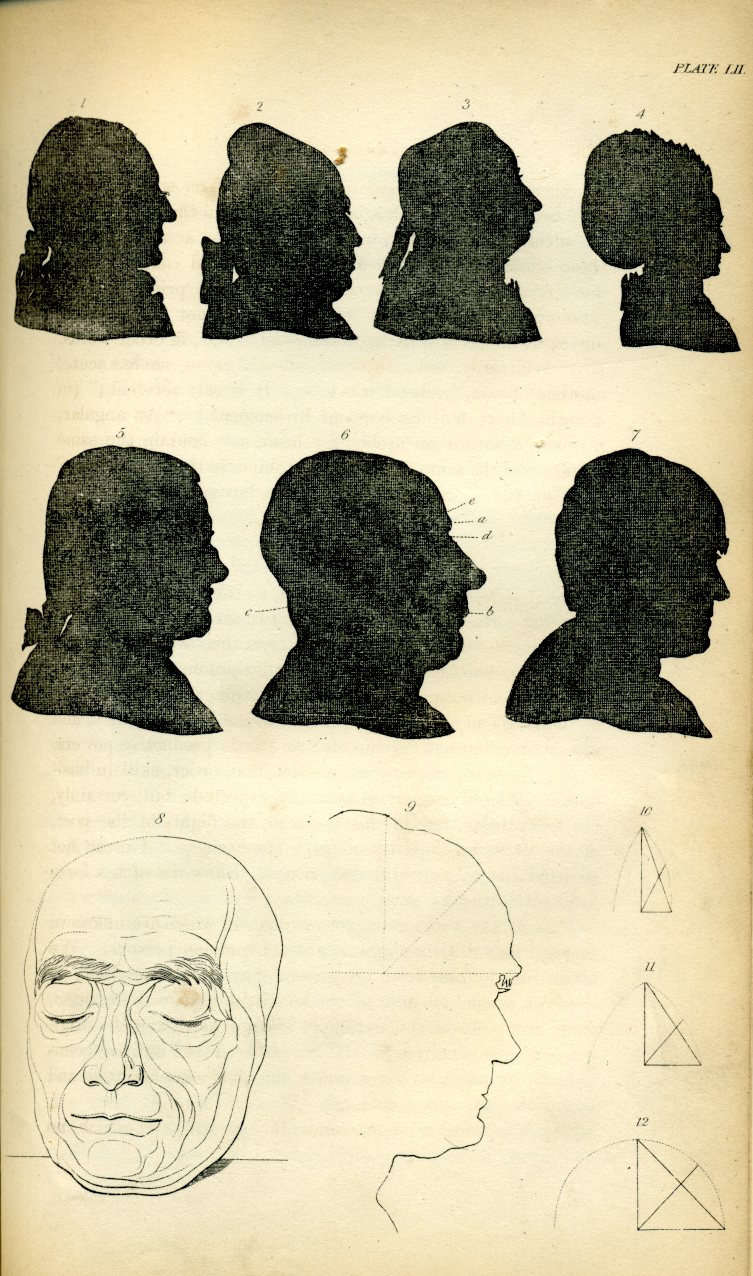
As discussed in my chapter ‘The Face in Digital Space‘ in the book The Culture of Photography in Public Space, the human face first entered abstract matrices of comparison in the late eighteenth century with the pioneering physiognomist Johann Kaspar Lavatar.  He placed the face in a psychological hierarchy using either zoological analogies or biometric algorithms. As a coda to my analysis is the recent news reports concerning Jacky Alcine, an early adopter of Google Photos, which automatically placed photos of him and his African-American friend in a folder called ‘Gorillas’. It is not possible for an algorithm to be in and of itself racist, but nonetheless Google scrambled to roll out a fix within two hours. However Google’s first fix led to yet more human faces to be categorised as gorillas, so it had to temporarily remove the word ‘gorilla’ as a category while they worked on more nuanced face recognition algorithms. These accidents point to how ‘live’ and ‘hot’ pseudo-Darwinian narratives still are in popular race discourse, such that Google quickly confessed to  being ‘appalled’ by the unintended result of their algorithmic facial analysis. It also points to how easily automatic tagging and profiling systems can overreach themselves in the newly fluid context of face recognition. The face is never neutral, therefore mathematical error quickly transcodes and multiplies itself into linguistic disaster.

Google Photos' algorithmic tagging of Jacky Alcine and friend.

Google Photos’ algorithmic tagging of Jacky Alcine and friend.

Johannes Kaspar Lavater, 'Essays in Physiognomy', plate 52.

Johannes Kaspar Lavater, ‘Essays in Physiognomy’, plate 52.

Johannes Kaspar Lavater, 'Essays in Physiognomy', plate 29.

Johannes Kaspar Lavater, ‘Essays in Physiognomy’, plate 29.

Ghost of Gallipoli formed on Wall at Australian War Memorial

I’m Canberra’s ‘ghost guy’, so when staff from the Faculty of Art and Design at the University of Canberra wanted somebody to open their exhibition Traces and Hauntings at Belconnen Arts Centre who were they going to call? I was delighted to, of course. When thinking about which angle on their work I could take I was pleased to come across this photograph in the Sun Herald (02/08/2015).  The shot was taken by Phillip Gordon of Newcastle, who observed and photographed figures with rifles and their kit by their sides who appeared on the Memorial wall in light rain. Spookily, the person Mr Gordon had come to pay his respects to, Bert Keepence, who had been killed at Lone Pine 100 years before almost to the week, had worked for the Water Board! A spokesperson for the War Memorial said it was just water stains on the sandstone, but as Mr Gordon said, “It blew me away for a bit”. Magical images persist, and are still reported on in our newspapers.

Ghosts of Gallipoli formed on the wall of the Australian War memorial, Sun Herald, 2 August 2015

Ghosts of Gallipoli formed on the wall of the Australian War Memorial, Sun Herald, 2 August 2015

Iconoclasm at the National Portrait Gallery

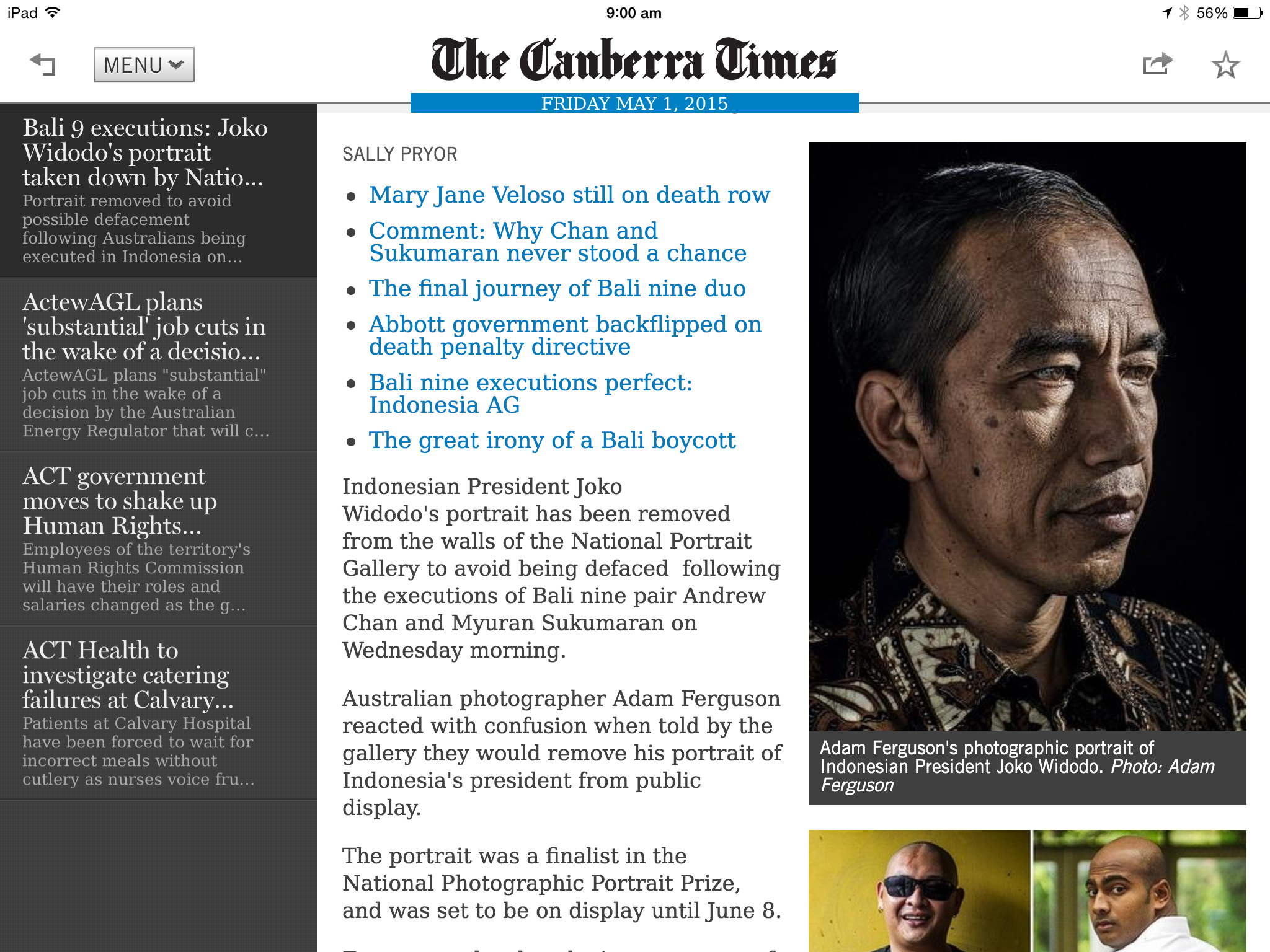
Why are the medieval forces of iconoclasm gaining strength in a visual environment which is reportedly becoming increasingly virtual and digital? After the spate of Rolfoclasm, previously reported on twice in this blog, comes Angus Trumble’s decision to remove Widodo’s portrait from the National Portrait Prize even though they don’t own it, and against the wishes of the person who does (and has already paid the gallery the competition entry fee and freight charges for the privilege of being considered for the prize) — Adam Ferguson. Part of Trumble’s reason was to protect it from rogue iconoclasm; and yes, Diane Arbuses were once spat on in New York, and Andreas Serrano’s Piss Christ was once attacked with an axe in Melbourne, but even if the worst happened Ferguson need only press the Start button on his printer once more to get his print back. However part of Trumble’s reason also appears to be to indulge in a bit of iconoclasm of his own, to align the Canberra gallery, and the honorific power of its walls, with the general anti-Wididodo mood of the nation and its politicians. But Trumble’s remarkable action does make us look at Ferguson’s picture again, with its heavy-handed use of photoshop to give Widodo’s face a Yousuf Karshian makeover of Statesman like gravitas. Trumble should have let Ferguson’s portrait remain on the wall, and let its overblown digital-Pictorialism provide the irony.

Canberra Times, 1 May, 2015

Canberra Times, 1 May, 2015

IMG_1380

Should art museums think of themselves as ‘collections’ or ‘archives’?

Should art museums think of themselves as ‘collections’ or ‘archives’?
Martyn Jolly
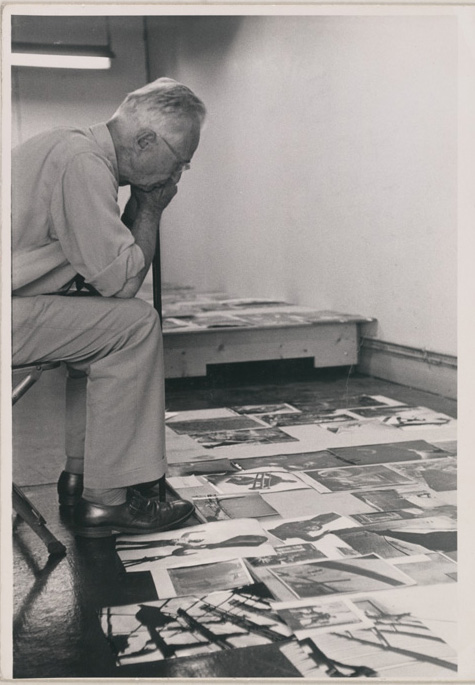
Photography has always been a numbers game, and the bigger the number the better. In the context where words like ‘exponential’ or ‘ballooning’ barely begin to describe the current state of the medium, is the notion of a photographic ‘collection’ relevant any more?

I’m talking along with Robyn Stacey

Art Gallery of New South wales, this Sunday 10.30am.

Edward Steichen at work in the Family of Man

Edward Steichen at work on the Family of Man

Rolfoclasm Continues

The Variety Club mural before the Rolfoclasm

The Variety Club mural before the Rolfoclasm

Rolfoclasm continues. Not only has he now been stripped of his Australian Honours, but he’s been painted out of the Variety mural at Victoria Markets and replaced with Stuart Wagstaff! But, hang on a minute, wasn’t Wagstaff the face of Benson and Hedges for decades? Didn’t the 116 ciggie ads — ‘when only the best will do’ —  which he knowingly made right up until the day cigarette advertising was finally banned in 1976 (then remaining on the B & H payroll until 1993) lead to the deaths of thousands of innocent Aussies? This shows the moral ambiguities which await any ‘clast when they self righteously take upon themselves the power of ‘clasm.

My Enlighten Canberra Projection

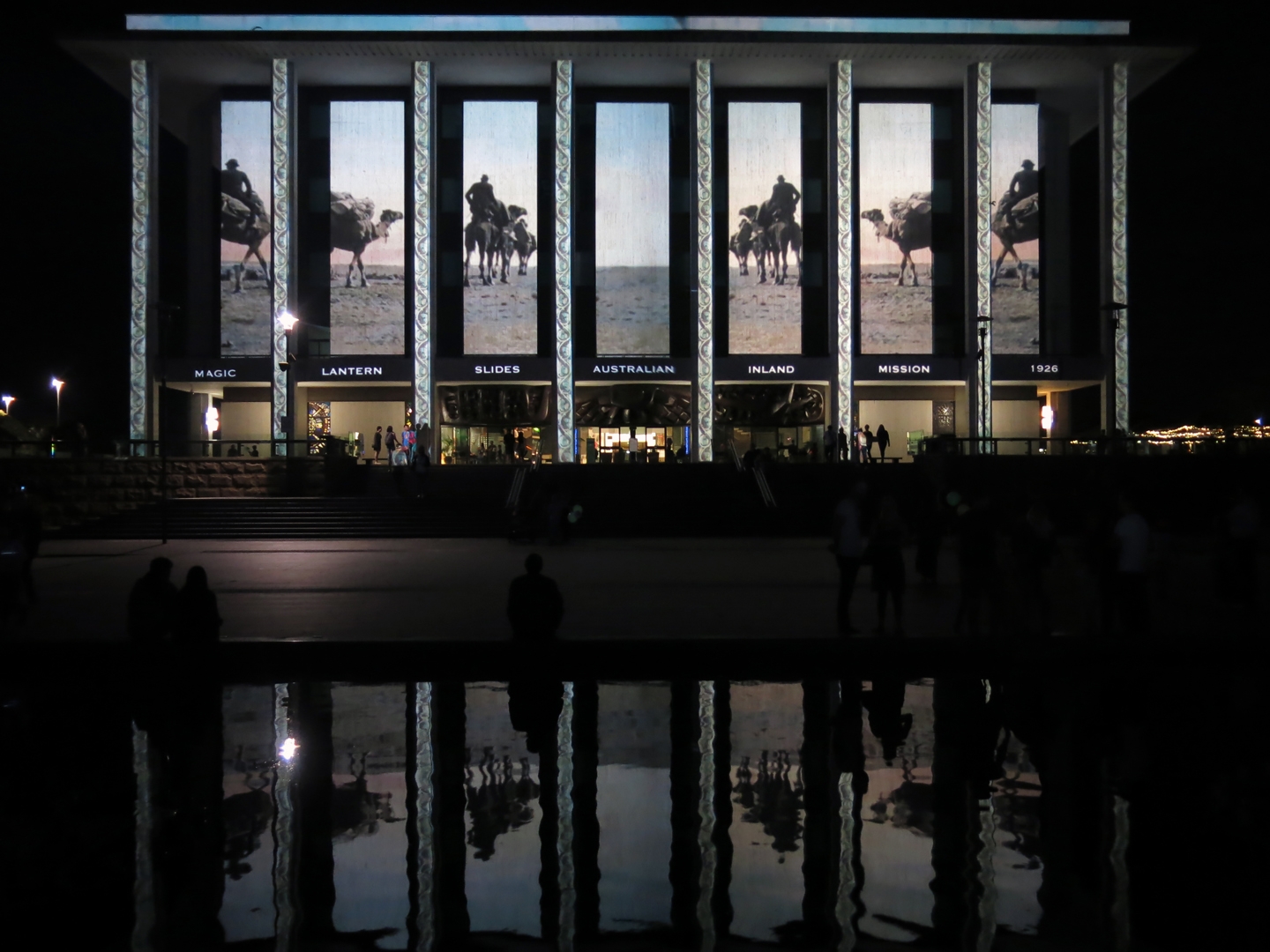
Martyn Jolly NLA projection for Enlighten Canberra

Martyn Jolly NLA projection for Enlighten Canberra

My ANU colleagues Lucien Leon, Kit Devine, Marcia Lochhead, Zoe Tulip, and myself, each designed an Enlighten Canberra projection for the National Library of Australia. Mine was derived from one of the hundreds of beautiful hand tinted magic lantern slides in the Library.

The explanatory text: The Reverend John Flynn was Superintendent of the Australian Inland Mission for almost forty years from 1912. A keen photographer, Flynn used magic lantern slides in the lectures he gave to publicise the work of the mission in providing medical, nursing and pastoral services to the people of the inland. The Library now holds a large collection of these beautifully hand-tinted images. The one used for this projection was taken in 1926 by a ‘Miss Colley’ and documents the Oodnadatta to Alice Springs Mail. Presumably it was used by Flynn to illustrate the vast distances  of the inland.

Braddon, Bloody Braddon

From the program to the

You Are Here Festival

March 18-22 2015

National Capital Motors from Google Street View

National Capital Motors from Google Street View

Braddon

The world snorted with derision when, for the second year in a row, the OECD nominated Canberra as the world’s best city. Critics pointed out that, although it had come out with the biggest numbers in the OECD’s nine ‘wellbeing indicators’, which included education, jobs, incomes and environment, this did not make for a great city. In fact, they chortled, Canberra is a terrible city. In The Guardian’s words: ‘Canberra is a deathly place.  It is a city conceived as a monument to the roundabout and the retail park, a bleak and relentless landscape of axial boulevards and manicured verges, dotted with puffed-up state buildings and gigantic shopping sheds. It is what a city looks like when it is left to politicians to plan.’ None of that is wrong (the ‘gigantic shopping sheds’ bit is particularly right). But it is very much an attenuated view from lofty London that begs many questions for those of us who are actually making a go of living here. For instance, maybe its monumental conception — Griffin’s grand design for utopian civic virtues — gives our city its brittly surreal, hyperreally heterotopic character for which many of us have developed a cool, wry affection. And maybe some of us like the regular irruptions into our day-to-day travels of raw bush and depthless sky, afforded by the skeletal nature of the relentless axial boulevards. And those axes have also begun to shelter at their fulcrums some fragile urban micro-climates which have slowly been developing over the years.

Since the 1960s, coincidentally Canberra’s heyday, urban discourse has shifted from the macro of the master plan to the micro of the precinct —the local area dense with textures, memories and experiences. Since the 1960s, across the world and without exception, many neighbourhoods of poverty or industry have been remade as waves of gentrification have swept over them. Artists have been the shock troops, reinforced by designers and architects, and followed by developers and trendies in a pattern as familiar and repeated as the tides. For fifty years urbanists have become adept at sniffing out the fluctuating nuances of the ‘local’ as waves of gentrification sweep back and forth. Antonioni’s 1966 masterpiece Blow Up, set in swinging London, is not only a film about the limits of knowledge in photography, it is also a film about the ever-transforming psycho-geographies of the postwar city. In his restless need to have everything he sees, the photographer visits a quiet nondescript London street to see a rundown junk shop he wants to buy. As soon as he notices two gay men incongruously walking a poodle there he knows, and the audience knows, that the local area’s character is already changing, and he must snap up the shop quickly. In Blow Up nothing is stable and nothing, not even the city, can ever completely becomes as it seems, before it must become something else. This is now the state for every city in the world, even Canberra.

For instance, ranged around the urban doughnut-hole of Civic are separated sites of local regeneration such as New Acton, Childers Street and Braddon. Of these perhaps only the transformation which Braddon is currently undergoing is intimately and intricately embedded in its past, however brief and prosaic that past may be. Braddon is basically only three parallel streets, and its car yards, hardware stores, panel beaters, takeaways and camping shops are only gradually giving way to coffee shops, restaurants, boutiques, bike shops and apartments. On their brief visit to Canberra the New York Times was kinder than The Guardian, identifying Braddon as Canberra’s ‘decidedly hipster underbelly’.

Pioneers such as the Helen Maxwell Gallery, once upstairs on Mort Street, predicted this urban renaissance many years ago, but couldn’t survive long enough to benefit from it; and some of the temporary pop-ups (who for a few months kept real estate spots warm before the temporary fencing went up around them) such as The Chop Shop, which was briefly located down an alley in Lonsdale Street, recognized past usages in their names. This rich and dense texture was just what sophisticated urbanists want, and is certainly what Canberra needs, probably more so than all the other ‘normal’ cities on the planet, so who am I to quibble?

Only to wish that because Canberra is different, there is the utmost delicacy as Braddon continues its inexorable makeover. Of course delicate urban renewal is what everyone wants, not least the developers themselves who love underbellies just like the rest of us, and for whom creative grunge has an intangible commercial value if handled correctly. But when it comes to the bottom line of the balance sheet, where income has to be plotted against expenditure down to the last percentile point over each individual square metre, the delicate presence of the past, or the tenuous tenancy of the under resourced, sometimes still lose out.

For instance Braddon has always been a car precinct (just as Canberra has always been a car city). From 1920 it was the site of Canberra Garage Limited, servicing the city’s fleet; and up until just a few years ago rev heads would spend their Saturday nights cruising up and down past the car yards, doing the circuit by languidly swinging round the roundabouts at Lonsdale and Torrens Streets; every now again pulling into the Caltex near the Mandalay at Girrawheen Street to pop their hoods for the admiring gazes of their mates; sometimes even attempting a burnout at the top of Lonsdale Street. If they ever ventured back to Braddon now the only circling they would be doing would be looking for a park.

One of the handsomest facades in Braddon was the delicate, white, open brickwork curtain that surrounded National Capital Motors on the corner of Mort and Elouera streets (perhaps the original site of Canberra Garage Limited?). But that piece of delightful architectural texture was flicked over like a house of cards to be replaced by a building of depressing, generic nastiness, with less architectural charm than the Centrelink office around the corner. All of the acres of recycled, undressed timber cladding, Dynabolted to the newly poured concrete walls of Braddon, can’t replace the authenticity of that lost texture. The only ghost I can find now of the facade is on Google Street View. The Google car had driven by National Capital Motors in 2010 and, thankfully, hasn’t been back to Braddon since. When it eventually does come back it will find quite a bit changed, but will implacably wipe away all the old ghosts with one sweep of its robotic camera.

In the meantime the de-Fyshwicking of Braddon continues, and for the pedestrian the mingling smells of gasoline and grease are regularly displaced by doughy, oily, blasts of hot air from each successive bistro kitchen’s exhaust. The pop-ups have popped off, and replacement aluminum and glass apartments have been cad-cammed into instantaneous existence. Street shop fronts have become enclosed retail experiences, and the artists left walking outside on the streets of Canberra’s erstwhile underbelly are beginning to feel the backs of their necks prickling as they are distantly surveilled by the area’s new residents from their be-Webered fifth-floor balconies.

These changes to Braddon are not just inevitable, they will probably end up being, on balance, ultimately good for Canberra too. They are nearly identical to the changes in a thousand similar inner city neighbourhoods around the world. But only nearly identical, not completely identical, because Canberra is different, Canberra, as we are frequently reminded by the rest of the world, is a special case. This makes any more than an absolutely necessary lack of delicacy in the ongoing gentrification of Braddon especially tragic, not that there will be of course.

Martyn Jolly (Thanks to Erin Hinton and Ursula Frederick for the tip-offs)

Oliver Wainwright, ‘50 years of gentrification: will all our cities turn into ‘deathly’ Canberra?’, The Guardian, 13 December, 2014

Emma Pearse, ‘36 Hours in Canberra, Australia’, New York Times, 5 June 2014

National Capital Motors from Google Street View
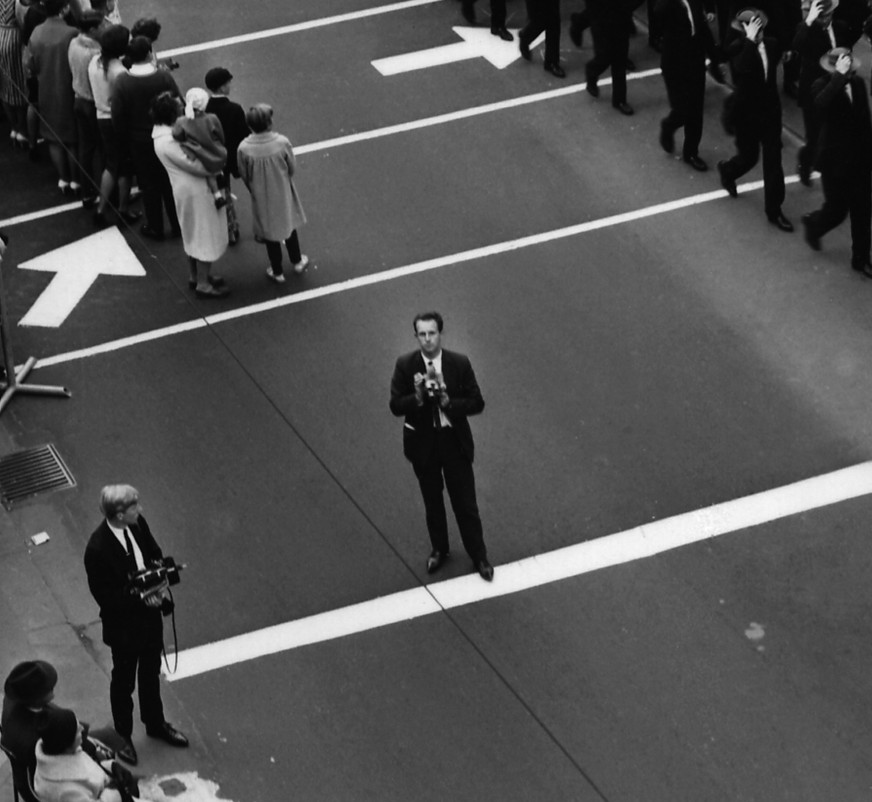
National Capital Motors from Google Street View

Thinking the Photobook Forum — Photobook Melbourne

I’m taking part in the forum Thinking the Photobook, as part of Photobook Melbourne. It’s on at ‘The Baron Said’, 83 Kerr Street Fitzroy, 5.30pm Sunday 15 February. What will I be talking about?

Question: How many Australian photobooks are in Parr and Badger’s massive, and massively selling, three volume encyclopaedia of almost 1000 photobooks?

Answer: Two only that I can find (Sleeth and Parke)

Question: Why are there so few?

Answer: Good question.

Beforehand Lee Grant is launching her new China book at the CCP, just up the road, at 3pm.