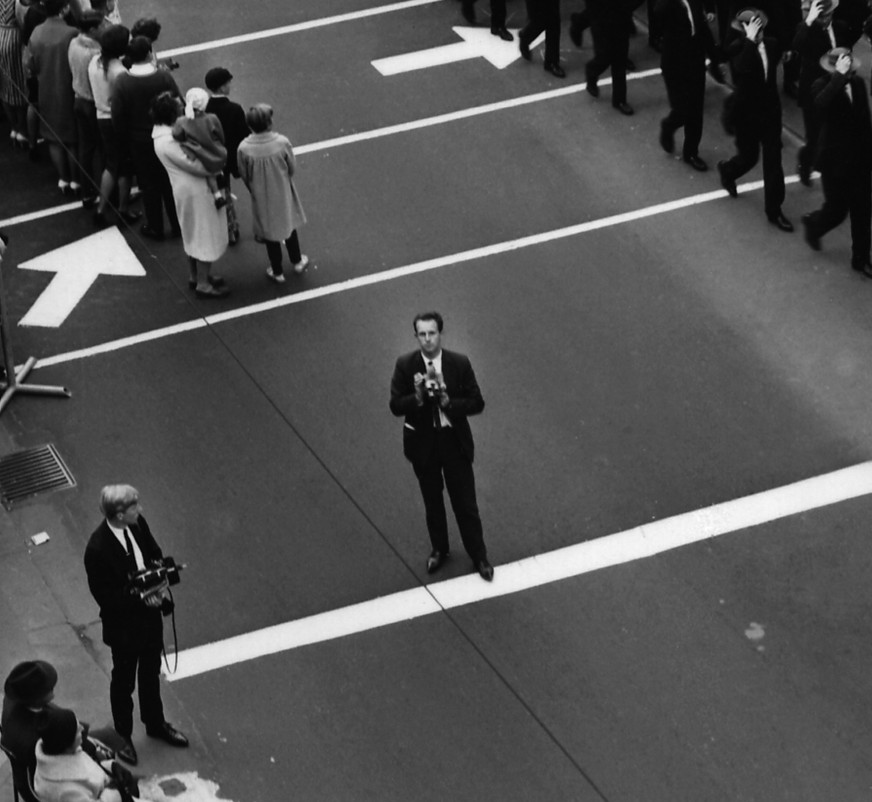
‘Spectres from the Archive’, MESH 18, Experimenta Media Arts, Melbourne, 2005

Spectres from the Archive

The dead have been making themselves visible to the living for millennia. In Purgatory, Dante asked Virgil how it was that he was able to see the souls of the dead with whom he was speaking, while their bodies had been left behind in the grave. Virgil beckoned a spirit who replied that, just as the colours of reflected rays filled rain-filled air, so the un-resurrected soul virtually impressed its form upon the air.[1] Similarly, the ghost of Hamlet’s father was as invulnerable to blows from a weapon as the air. It was a mere image which faded at cock-crow. But, for the last several centuries, these diaphanous, insubstantial condensations of light and air have been acquiring a technological, rather than a natural, phenomenology.

In the years following the French Revolution Etienne-Gaspard Robertson terrified crowds with the first phantasmagoria show, which he staged in a convent that had been abandoned by its nuns during The Terror. He made his magic-lantern projections, of paintings of gory figures such as The Bleeding Nun, appear to be phantasmic entities by blacking out their glass backgrounds and projecting them onto stretched gauzes, waxed screens, and billows of smoke. By placing the magic-lantern on wheels, which was dollied backwards by an operator, he gave these luminous, translucent apparitions the power to suddenly loom out over the audience. At an 1825 London phantasmagoria show the impact of this effect on the audience was electric. According to an eyewitness the hysterical screams of a few ladies in the first seats of the pit induced a cry of ‘lights’ from their immediate friends, but the operator made the phantom, The Red Woman of Berlin, appear to dash forward again. The confusion that followed was alarming even to the stoutest: “the indiscriminate rush to the doors was prevented only by the deplorable state of most of the ladies; the stage was scaled by an adventurous few, the Red Woman’s sanctuary violated, the unlucky operator’s cavern of death profaned, and some of his machinery overturned, before light restored order and something like an harmonious understanding with the cause of alarm”.[2]

In the eighteenth century the host of supernatural beings — such as ghosts, devils and angles — who had long inhabited the outside world alongside humans, were finally internalised under the illumination of Reason as mere inner-projections of consciousness — fantasies of the mind or pathologies of the brain. During this period, in Terry Castle’s phrase,  “Ghosts and spectres retain their ambiguous grip on the human imagination; they simply migrate into the space of the mind”.[3] But, as she goes on to explain, technologies such as the phantasmagoria allowed these images of consciousness to project themselves outside the mind once more, into the space of shared human experience. They were destined to return from the brain to re-spectralize visual culture.

The eighteenth century also changed the way in which death was experienced. No longer an ever-present communal experience, the effect of someone’s death became focussed onto a few individuals — their family — just as the various processes of death and mourning became privatised and quarantined within the institutions of the home, the hospital, and the necropolis.[4] One response to this was the rise in the nineteenth century of an extraordinary cult of the dead  — Spiritualism — which gripped the popular imagination well into the twentieth century. Spiritualism was the belief that the dead lived, and that they could communicate. Spiritualism was a quintessentially modernist phenomenon, and Spiritualists, as well as the spirits themselves, used all emerging technologies to demonstrate the truth of survival.[5]

The early years of Spiritualist communication were conducted under the metaphoric reign of the telegraph. In 1848 the world’s first modern Spiritualist medium, a young girl called Kate Fox, achieved world-wide fame by developing a simplified morse-code of raps to communicate with the spirits who haunted her small house in upstate New York. Twenty years later portraits of spirits began to appear on the carte-de-visite plates of the world’s first medium photographer, William Mumler. Spirit photographs were a personal phantasmagoria. Just as Robertson’s phantoms were lantern-slides projected onto screens, spirit photographs were actually prepared images double-exposed onto the negative. But the spirit photographer’s clients sat for their portrait filled with the belief that they might once more see the countenance of a loved one; they concentrated on the loved one’s memory during the period of the exposure; and they often joined the photographer in the alchemical cave of the darkroom to see their own face appear on the negative, to be shortly joined by another face welling up from the emulsion — a spirit who they usually recognised as a loved one returning to them from the oblivion of death. For these clients the spirit photograph was not just a spectacle, it was an almost physical experience of the truth of spirit return.

Public interest in spirit photography reached its highest pitch in the period just after World War One, when the unprecedented death toll of the war, combined with the effect of an influenza pandemic, caused a public craze for Spiritualism.[6] On Armistice Day in 1922 the London spirit photographer Mrs Ada Deane stood above the crowd at Whitehall and opened her lens for the entire duration of the Two Minutes Silence. When the plate was developed it showed a ‘river of faces’, an ‘aerial procession of men’, who appeared to float dimly above the crowd.[7]

When the ardent Spiritualist convert, Sir Arthur Conan Doyle, lectured to a packed house at Carnegie Hall the following year, he flashed this image up on the lantern-slide screen. There was a moment of silence and then gasps rose and spread over the audience, and the voices and sobs of women could be heard. A woman in the audience screamed out through the darkness, “Don’t you see them? Don’t you see their faces?” before falling into a trance.[8] The following day the New York Times described the image on the screen: “Over the heads of the crowd in the picture floated countless heads of men with strained grim expressions. Some were faint, some were blurs, some were marked out distinctly on the plate so that they might have been recognised by those who knew them. There was nothing else, just these heads, without even necks or shoulders, and all that could be seen distinctly were the fixed, stern, look of men who might have been killed in battle.”[9]

The Spiritualist understanding of photography was underwritten by a keen, and highly imaginative, conception of two substances: ether and ectoplasm. Since Morse’s first telegraphing of the words “what hath God wrought” in 1844, and Kate Fox’s first telegraphing to the spirits four years later, the air had steadily thickened as it was filled by more and more of the electromagnetic spectrum: from the electrical ionisation of residual gas in a cathode-ray tube (discovered by Sir William Crookes, who also photographed the full body materialization of a spirit Katie King by electric light); to x-rays (developed in part by Sir Oliver Lodge, who communicated with his dead son, Raymond, for many years after he fell in World War One);  to radio-waves; to television transmission. From the late nineteenth century until the period when Einstein’s theories made it redundant, most physicists agreed that some intangible interstitial substance, which they called ether, must be necessary as the medium to carry and support X-rays, radio waves, and perhaps even telepathic waves, from the point of transmission to point of reception. Since sounds, messages and images could be sent through thin air and solid objects, why not portraits from the other side?[10]

If ether allowed Spiritualist beliefs to be made manifest through electrical science, ectoplasm allowed them to be made manifest through the body. For about thirty years after the turn of the century various, mainly female, mediums extruded this mysterious, mucoid, placental substance from their bodily orifices, whilst groaning as though they were giving birth. Sometimes this all-purpose, proto-plasmic, inter-dimensional stuff seemed able to grow itself into the embryonic forms of spiritual beings, at other times it acted as a membranous emulsion which took their two dimensional photographic imprint. For instance on 1 May 1932 a psychic investigator from Winnipeg, Dr T. G. Hamilton, photographed a teleplasmic image of the spirit of Doyle (who had ‘crossed over’ the year before) impressed into the ectoplasm that came from mouth and nostrils of a medium.[11]

Just as spirit photographs were in reality various forms of double exposure, such teleplasms were in reality small photographs and muslin swallowed by the medium and then regurgitated in the darkness to be briefly caught by the investigator’s flash during the intense psychodrama of the séance. Nonetheless, for the Spiritualists they confirmed an associative chain that poetically and technically extended all the way from ectoplasm to photographic emulsion — creamy, hyper-sensitive to light, and bathed in chemicals.[12]

The Spiritualists placed photography at the centre of their cult of the dead. And modernity’s cultural theorists placed death at the centre of their response to photography. Photography was compared to embalming, resurrection, and spectralization. The horrible, uncanny image of the corpse, with its mute intimation of our own mortality, haunted every photograph. For instance to Siegfried Kracauer, writing in the 1920s, a photograph was good at preserving the image of the external cast-off remnants of people, such as their clothes, but could not capture their real being. The photograph: “dissolves into the sum of its details, like a corpse, yet stands tall as if full of life.”[13] The blind production and consumption of thousands upon thousands of these photographs was the emergent mass-media’s attempt to substitute itself for the acceptance of death implicit in personal, organic memory: “What the photographs by their sheer accumulation attempt to banish is the recollection of death, which is part and parcel of every memory image. In the illustrated magazines the world has become a photographable present, and the photographed present has been entirely eternalised.”[14]

To a subsequent critic, Andre Bazin, our embrace of the photograph was also a pathetic attempt to beat death. The sepia phantoms in old family albums were, “no longer traditional family portraits, but rather the disturbing presence of lives halted at a set moment in their duration … by the power of an impassive mechanical process: for photography does not create eternity, as art does, it embalms time, rescuing it simply from its proper corruption.”[15]

In Roland Barthes’ Camera Lucida, his almost necrophilic meditation on photography written while in the grim grip of grief for his mother, the photograph’s indexicality, the fact that it was a direct imprint from the real, made it a phenomenological tautology, where both sign and referent, “are glued together, limb by limb, like the condemned man and the corpse in certain tortures.”[16] In posing for a portrait photograph, he says, “I am neither subject nor object but a subject who feels he is becoming an object: I then experience a micro-version of death … : I am truly becoming a spectre.”[17] Later he reduces this essence of the portrait photograph down even further. It is not only an exact process of optical transcription, it is also an exquisitely attenuated chemical transfer, an effluvial emanation of another body—“an ectoplasm of ‘what-has-been’: neither image nor reality, a new being really.”[18]

Although wildly extrapolating upon the intimate connection between photography and death, the Spiritualist use of photography ran counter to the dominant perception of the photograph as irrevocably about pastness, about the instantaneous historicisation and memorialisation of time. Spirit photographs cheerfully included multiple times, and multiple time vectors. Spirit photographs were collected and used by Spiritualists very much like the millions of other personal snapshots that were being kept in albums and cradled in hands. But for them they did not represent the exquisite attenuation of the “that has been” of a moment from the past disappearing further down the time tunnel as it was gazed at in the present, nor the frozen image’s inevitable prediction of our own mortality. Rather, they were material witnesses to the possibility of endless emergences, returns and simultaneities.

The images were performative. They worked best when their sitters had seen them well-up from the depths of the emulsion in the medium’s developing tray, or seen them suddenly flashed on the screen in a lantern-slide lecture. Their power lay not in their reportage of a pro-filmic real elsewhere in time and space, but in their audience’s affective response to them in the audience’s own time and place. They solicited a tacit suspension of disbelief from their audience, at the same time as they brazenly inveigled a tacit belief in special effects. Spirit photographs used the currency of the audience’s thirst for belief to trade-up on the special effects they borrowed from cinema and stage magic —which had also descended from the phantasmagoria. They shamelessly exploited the wounded psychology of their audience to confirm their truth, not by their mute indexical reference to the real, but through the audience’s own indexical enactment of their traumatic affect. Their truth was not an anterior truth, but a manifest truth that was indexed by the audience as they cried out at the shock of recognition for their departed loved ones.

In mainstream thought about photography the two signal characteristics which defined photography and photography alone, physical indexicality and temporal ambiguity, were in their turn produced by two technical operations: the lens projecting an image of an anterior scene into the camera, and the blade of the shutter slicing that cone of light into instants. But the Spiritualist theory of photography discounted that technical assemblage, along with the ‘decisive moments’ it produced. It shifted the locus of photography back to the stretched sensitive membrane of the photographic emulsion, and dilated the frozen instant of the snapshot over the full duration of the séance.

Many contemporary artists are rediscovering the richly imaginative world the Spiritualists created for themselves. Others are strategically deploying the same technical effects once surreptitiously used by spirit photographers. These contemporary invocations are no longer directly underpinned by Spiritualist faith, but they do reinhabit and reinvent the metaphysical, performative and iconographic legacy of the Spiritualists. For these artists, as much as for the Spiritualists themselves, images, bodies, beliefs and memories swirl around and collide in intoxicating obsession. And technologies of image storage, retrieval, transmission and reproduction are simultaneously the imaginative tropes, and the technical means, for communicating with the beyond. For the Spiritualists the beyond was a parallel ‘other side’ to our mundane existence, for some contemporary artists it is quite simply the past.[19]

For instance the New York based artist Zoe Beloff folds famous episodes from the history of Spiritualism back into her use of new interactive technologies. Examples are the interactive CD-Rom, Beyond, 1997; the stereoscopic film based on the extraordinary ‘auto-mythology’ of the nineteenth-century medium Madame D’Esperance, Shadowland or Light From the Other Side, 2000; and the installation of stereoscopic projections based on the first séances of Spiritualism’s most famous ectoplasmic medium, Ideoplastic Materializations of Eva C., 2004. Some of Beloff’s works resurrect dead-end technologies and apparatuses, such as a 1950s stereoscopic home-movie camera to, for instance, directly link contemporary notions of virtuality to nineteenth century stage illusions, such as ‘Pepper’s Ghost’, where a live performer behind a sheet of glass interacted with a virtual phantasm reflected in it. She deploys the occult to re-introduce desire, wonder, fear and belief into what most media histories would have us think was just the bland march of ever-increasing technological sophistication. Like many of us, and like all of the people to first see a photograph or hear a sound recording, Beloff is still fascinated by the fact that the dead live on, re-embodied in technology. She remains interested in conjuring them up and interfacing between past and present like a Spiritualist medium.[20]

For his installation The Influence Machine, 2000, the New York video artist Tony Oursler projected giant ghost-heads of the pioneer ‘mediums’ of the ether, such as Robertson, John Logie Baird and Kate Fox, onto trees and billows of smoke in the heart of the world’s two biggest media districts, London’s Soho Square and New York’s Madison Square Park. These disembodied heads uttered disjointed phrases of dislocation and fragmentation, while elsewhere a fist banged out raps, and ghostly texts ticker-taped up tree trunks. In his Timestream, an extended timeline of the development of ‘mimetic technologies’, Oursler drew an occult trajectory through the more conventional history of media ‘development’, and identified that the dead no longer reside on an inaccessible ‘other side’, but survive in media repositories. To him: “Television archives store millions of images of the dead, which wait to be broadcast … to the living … at this point, the dead come back to life to have an influence … on the living Television is, then, truly the spirit world of our age. It preserves images of the dead which then continue to haunt us.”[21]

The most famous spectre of the nineteenth century was the spectre of communism which, in the very first phrase of the Communist Manifesto, Marx declared to be haunting Europe. But this, unlike almost every other spectre, was not a grim revenant returning from the past, but a bright harbinger of the future when capitalism would inevitably collapse under its internal contradictions ushering in the golden age of communism. But now communism is dead and buried, and when its spectre is raised it is not to haunt us, but to be a parable affirming the supposed ‘naturalness’ of capitalism.[22]

This circular irony formed the background to Stan Douglas’s installation Suspiria from Documenta 11 of 2003. The spectral temper of the imagery was achieved by overlapping a video signal with the over-saturated Technicolor palette of the 1977 cult horror film Suspiria. The piece deconstructed Grimm’s 250 fairy tales into a data-base of narrative elements, often centring on characters vainly seeking short cuts to wealth and happiness by extracting payments and debts. These fragments were videoed using actors wearing clothes and make-up in the primary colours. The chromatic channel of the video signal was separated and randomly superimposed, like an early-model colour TV with ghosting reception, over a switching series of live surveillance video-feeds from a stony subterranean labyrinth. These fleeting evanescent apparitions endlessly chased each other round and round the blank corridors.[23]

As well as the phantasmagoric apparatuses of projection and superimposition, with their long histories in mainstream entertainment as well as the occult, artists such as Douglas or Oursler have begun to deploy another newly occulted apparatus — the data-base.  For instance, Life after Wartime, presented at the Sydney Opera House in 2003, was an interactive, ‘performance’ of an archive of crime scene photographs which had been assembled by Sydney’s police-force in the decades following the Second World War. Kate Richards and Ross Gibson sat at laptops and midi keyboards and brought up strings of images which, combined with evocative haikus, were projected onto two large screens. Beneath the screens The Necks, a jazz trio well known for their ominous movie music, improvised a live soundtrack of brooding ambience. Although not directly picturing spectres, the texts and images did generate open-ended non-specific narratives around a set of semi-fictionalised characters and locations in the ‘port city’ of Sydney. These characters became invisible presences occupying the creepy emptiness of the crime scenes. The element of automation in the way the story engine generated the loose narratives preserved the integrity, the artefactuality, of the original archive. Ross Gibson wrote:

Whenever I work with historical fragments, I try to develop an aesthetic response appropriate to the form and mood of the source material. This is one way to know what the evidence is trying to tell the future. I must not impose some pre-determined genre on these fragments. I need to remember that the evidence was created by people and systems of reality independent of myself. The archive holds knowledge in excess of my own predispositions. This is why I was attracted to the material in the first instance — because it appeared peculiar, had secrets to divulge and promised to take me somewhere past my own limitations. Stepping off from this intuition, I have to trust that the archive has occulted in it a logic, a coherent pattern which can be ghosted up from its disparate details so that I can gain a new, systematic understanding of the culture that has left behind such spooky detritus. In this respect I am looking to be a medium for the archive. I want to ‘séance up’ the spirit of the evidence … [24]

In seeking to be a voodoo spiritualist ‘medium’ for the archive, the work was not trying to quote from it, or mine it for retro tidbits ripe for appropriation, so much as to make contact with it as an autonomous netherworld of images. This sense of the autonomy of other times preserved in the archive also informs the work of the Sydney photographer Anne Ferran. In 1997 she made a ‘metaphorical x-ray’ of a nineteenth-century historic house. She carefully removed items of the colonial family’s clothing from its drawers and cupboards and, in a darkened room, laid them gently onto photographic paper before exposing it to light. In the photograms the luminous baby dresses and night-gowns floated ethereally against numinous blackness. To Ferran the photogram process made them look, “three-dimensional, life-like, as if it has breathed air into them in the shape of a body. … With no context to secure these images, it’s left up to an audience to deal with visual effects that seem to have arisen of their own accord, that are visually striking but in an odd, hermetic way.”[25]

In contrast to this diaphanous ineffability, Rafael Goldchain’s Familial Ground, 2001, was an autobiographical installation in which the artist physically entered the archive of the family album, seeking to know and apprehend the dead. He re-enacted family photographs of his ancestors, building on his initial genetic resemblance to them by using theatrical make-up, costuming, and digital alteration, weaving the replicated codes of portraiture through their shared DNA.  He saw these performances, along with the uncannily doubled portraits they produced, as acts of mourning, remembrance, inheritance and legacy for his Eastern European Jewish heritage, which had been sundered by the Holocaust. The portraits supplemented public acts of Holocaust mourning with a private genealogical communion with the spectres of his ancestors who still inhabited his family’s albums. The dead became a foundation for his identity, which he could pass on to his son. They took on his visage as they emerged into visibility, reminding him of the unavoidable and necessary work of inheritance.[26]

The Native American artist Carl Beam also builds his contemporary identity on the basis of a special connection he feels to old photographs. He uses liquid photo-emulsion, photocopy transfer and collage to layer together historic photographs — such as romanticised portraits of Sitting Bull — and personal photographs —such as family snaps — into ghostly palimpsests. The collages directly call on spectres from the past to authorise his personal, bricolaged spiritual symbology. They allow him to time travel and re-build a foundation for his identity out of fragments from the past.

In 1980 Australia’s most eminent art historian Bernard Smith gave a series of lectures under the title The Spectre of Truganini. In the nineteenth century Truganini had become a much-photographed colonial celebrity as the ‘last’ of the ‘full-blood’ Tasmanian Aborigines. Smith’s argument was that, despite white Australia’s attempt to blot out and forget the history of its own brutal displacement of Australia’s indigenous population, the repressed would continue to return and haunt contemporary Australia until proper amends were made.[27]

As indigenous activism grew in intensity and sophistication during the 1980s and 1990s, anthropological portraits, such as those of Truganini, began to be conceived of as not only the theoretical paradigm for colonial attempts at genocide, but also as acts of violence in themselves, technically akin to, and instrumentally part of, that very process of attempted genocide. They began to be used by young indigenous artists to ‘occult up’ their ancestors. Their re-use attempted to capture a feeling of active dialogue with the past, a two way corridor through time, or a sense of New Age channelling.

The anthropological photographs used by urban indigenous photographers are not monuments, like the statues or photographs of white pioneers might aspire to be, because they do not commemorate a historical closure on the past. In a way they are anti-monuments, images of unquiet ghosts who refuse to rest in their graves. In a Barthesian meditation on nineteenth-century anthropological photographs the indigenous photographer Brenda L. Croft, who uses Photoshop to float imprecatory words of loss within images of her ancestors, retroactively invested the agency of political resistance in the portraits. “Images like these have haunted me since I was a small child and … [and] were instrumental in guiding me to use the tools of photography in my work. … The haunted faces of our ancestors challenge and remind us to commemorate them and acknowledge their existence, to help lay them, finally, to rest.”[28]

However, rather than laying their ancestors to rest, some indigenous artists have photographically raised them from the dead to enrol them in various campaigns of resistance. For instance one of the first Australian indigenous photographers to receive international attention was Leah King-Smith. Her exhibition Patterns of Connection, 1992, travelled throughout Australia as well as internationally. For her large deeply-coloured photo-compositions anthropological photographs were copied and liberated from the archives of the State Library of Victoria to be superimposed as spectral presences on top of hand-coloured landscapes. This process allowed Aboriginal people to flow back into their land, into a virtual space reclaimed for them by the photographer. In the words of the exhibition’s catalogue: “From the flaring of velvety colours and forms, translucent ghosts appear within a numinous world.”[29]

Writers at the time commented on the way her photographs seemed to remobilise their subjects. The original portraits ‘contained’ their subjects as objects, which could be held in the hand, collected, stored and viewed at will. Their placement of the figure well back from the picture plane within a fabricated environment created a visual gulf between viewer and object. But King-Smith reversed that order. Her large colour-saturated images ‘impressed’ the viewer: “The figures are brought right to the picture plane, seemingly extending beyond the frame and checking our gaze with theirs”.[30]

Leah King-Smith comes closest to holding spiritualist beliefs of her own. She concluded her artist’s statement by asking that, “people activate their inner sight to view Aboriginal people.”[31] Her work animistically gave the museum photographs she re-used a spiritualist function. Many of her fellow indigenous artists criticised her for being too generalist, for not knowing the stories of the people whose photographs she used, and not asking the permission of the traditional owners of the land she makes them haunt. But the critic Anne Marsh described this as a “strategic essentialism”. “There is little doubt, in my mind, that Leah King-Smith is a kind of New Age evangelist and many serious critics will dismiss her work on these grounds. … But I am interested in why the images are so popular and how they tap into a kind of cultural imaginary [in order] to conjure the ineffable. …  Leah King-Smith’s figures resonate with a constructed aura: [they are] given an enhanced ethereal quality through the use of mirrors and projections. The ‘mirror with a memory’ comes alive as these ancestral ghosts … seem to drift through the landscape as a seamless version of nineteenth century spirit photography.”[32]

While not buying into such direct visual spirituality, other indigenous artists have also attempted to use the power of the old photograph make the contemporary viewer the subject of a defiant, politically updated gaze returned from the past. In a series of works from the late 1990s Brook Andrew invested his nineteenth century subjects, copied from various state archives, with a libidinous body image inscribed within the terms of contemporary queer masculinity, and emblazoned them with defiant Barbara Krugeresque slogans such as Sexy and Dangerous, 1996, I Split Your Gaze, 1997 and Ngajuu Ngaay Nginduugirr [I See You], 1998.

Andrew uses the auratic power of the original Aboriginal subjects to simply re-project the historically objectifying gaze straight back to the present, to be immediately re-inscribed in a contemporary politico-sexual discourse. However other strategic re-occupations of the archive show more respect for the dead, and seek only to still the frenetic shuttle of appropriative gazes between us and them. For instance in Fiona Foley’s re-enactments of the colonial photographs of her Badtjala ancestors, Native Blood, 1994, the gaze is stopped dead in its tracks by Foley’s own obdurate, physical body. To the post-colonial theorist Olu Oguibe: “In Foley’s photographs the Other makes herself available, exposes herself, invites our gaze if only to re-enact the original gaze, the original violence perpetrated on her. She does not disrupt this gaze nor does she return it. She recognises that it is impossible to return the invasive gaze … Instead Foley forces the gaze to blink, exposes it to itself.”[33]

But the ghosts of murdered and displaced Aborigines aren’t the only spectres to haunt Australia. White Australia also has a strong thread of spectral imagery running through its public memory for the ANZAC digger soldiers, who fell and were buried in their thousands in foreign graves during all of the twentieth century’s major wars. Following World War One an official cult of the memory developed around the absent bodies of the dead, involving painting, photography, elaborate annual dawn rituals, and a statue erected in each and every town.

Like indigenous ghosts, Anzac ghosts also solicit the fickle memory of a too self-absorbed, too quickly forgetful later generation. Since 1999 the photographer Darren Siwes, of indigenous and Dutch heritage, has performed a series of spectral photographs in Australia and the UK. By ghosting himself standing implacably in front of various buildings, he refers to an indigenous haunting, certainly; but because he is ghosted standing to attention whilst wearing a generic suit, he also evokes the feeling of being surveilled by a generalised, accusatory masculinity — exactly the same feeling that a memorial ANZAC statue gives.

Siwes’ photographs are mannered, stiff and visually dull, but they have proved to be extraordinarily popular with curators in Australia and internationally. One reason for his widespread success may be that the spectre he creates is entirely generic — a truculent black man in a suit — and therefore open to any number of guilt-driven associations from the viewer. Similarly, many of the other indigenous artists who have used photographs to haunt the present have produced works which are visually stilted or overwrought.  But they too have been widely successful, not because of their inherent visual qualities, but because of the powerful ethical and political question which the very idea of a spectre is still able to supplicate, or exhort, from viewers who themselves are caught-up in a fraught relationship between the present and the past, current government policy and historical dispossession. That question is: what claims do victims from past generations have on us to redeem them?[34]

As photographic archives grow in size, accessibility and malleability they will increasingly become our psychic underworld, from which spectres of the past are conjured. Like Dante’s purgatory they will order virtual images of the dead in layers and levels, waiting to interrogate the living, or to be interrogated by them. Through photography the dead can be invoked to perform as revenants. They will be used to warn, cajole, inveigle, polemicise and seduce. But as always it is we, the living, who will do the work of interpretation, or perform the act of response. Like the viewers of Robertson’s phantasmagoria we think we know that these spectres are mere illusions, the products of mechanical tricks and optical effects. But just as surely we also know that the images we are seeing were once people who actually lived, and that the technologies through which they are appearing to us now will also uncannily project our own substance through time and space in the future, when we ourselves are dead. This knowledge gives photographic spectres more than just rhetorical effect. They can pierce through historical quotation with a sudden temporal and physical presence. Yet at the same time they remain nothing more than the provisional technical animation of flat, docile images. In the end, they are as invulnerable to our attempts to hold onto them as the air.

Martyn Jolly

“Sir Arthur Conan Doyle at Carnegie Hall”, Harbinger of Light, (1923)

P. Ariés, The Hour of Our Death (New York: Alfred A. Knopf 1981)

U. Baer, “Revision, Animation, Rescue”, Spectral Evidence : The Photography of Trauma, (Cambridge, Mass.: MIT Press 2002)

R. Barthes, Camera Lucida (London: Jonathan Cape 1982)

A. Bazin, “The Ontology of the Photographic Image”, What is Cinema, (Berkeley and Los Angeles: University of California Press 1967)

W. Benjamin, “Theses on the Philosophy of History”, Illuminations, (Glasgow: Fontana/Glasgow 1973)

E. Cadava, Words of Light: Theses on the Photography of History (Princeton: Princeton University Press 1997)

T. Castle, “Phantasmagoria and the Metaphorics of Modern Reverie”, The Female Thermometer: Eightenth-Century Culture and the Invention of the Uncanny, (Oxford: Oxford University Press 1995)

T. Castle, “The Spectralization of the Other in The Mysteries of Udolpho“, The Female Thermometer: Eightenth-Century Culture and the Invention of the Uncanny, (Oxford: Oxford University Press 1995)

B. L. Croft, “Laying ghosts to rest”, Portraits of Oceania, (Sydney: Art Gallery of New South Wales 1997)

J. Derrida, Specters of Marx : the state of the debt, the work of mourning, and the New international (New York: Routledge 1994)

S. Douglas, “Suspiria”, Documenta 11_Platform 5: Exhibition Catalogue, 2002)

A. Ferran, “Longer Than Life”, Australian and New Zealand Journal of Art, 1, 1, (2000)

A. Ferris, “Diembodied Spirits: Spirit Photgraphy and Rachel Whiteread’s Ghost“, Art Journal, 62, 3, (2003)

A. Ferris, “The Disembodied Spirit”, The Disembodied Spirit, (Brunswick, Maine: Bowdoin College 2003)

K. Gelder and J. M.Jacobs, Uncanny Australia: Sacredness and Identity in a Postcolonial Nation Melbourne University Press 1998)

R. Gibson, “Negative Truth: A new approach to photographic storytelling”, Photofile, 58, (1999)

T. Gunning, “Phantom Images and Modern Manifestations: Spirit Photography, Magic Theatre, Trick Films, and Photography’s Uncanny”, Fugitive Images: From Photography to Video, (Bloomington: Indiana University Press 1995)

T. Gunning, “Haunting Images: Ghosts, Photography and the Modern Body”, The Disembodied Spirit, (Brunswick, Maine: Bowdoin College 2003)

T. G. Hamilton, Intention and Survival (Toronto: MacMillan 1942)

F. Jameson, “Marx’s Purloined Letter”, New Left Review, 209, January/February, (1995)

M. Jolly, Faces of the Living Dead: The Belief in Spirit Photography (London: British Library in press)

K. Jones, Conan Doyle and the Spirits: the spiritualist career of Sir Arthur Conan Doyle Aquarian Press 1989)

L. Kaplan, “Where the Paranoid Meets the Paranormal: Speculations on Spirit Photography”, Art Journal, 62, 3, (2003)

L. King-Smith, “Statement”, Patterns of Connection, (Melbourne: Victorian Centre for Photography 1992)

S. Kracauer, “Photography”, The Mass Ornament: Weimar Essays, (Cambridge: Harvard University Press 1995)

R. Luckhurst, The invention of telepathy, 1870-1901 (Oxford ; New York: Oxford University Press 2002)

A. Marsh, “Leah King-Smith and the Nineteenth Century Archive”, History of Photography, 23, 2, (1999)

O. Oguibe, “Medium and Memory in the Art of Fiona Foley”, Third Text, Winter, (1995-96)

J. Phipps, “Elegy, Meditation and Retribution”, Patterns Of Connection, (Melbourne: Victorian Centre for Photography 1992)

P. Read, Haunted Earth (Sydney: University of New South Wales Press 2003)

L. R. Rinder, Whitney Biennial 2002, (New York: Whitney Museum of American Art 2002)

K. Schoonover, “Ectoplasm, Evanescence, and Photography”, Art Journal, 62, 3, (2003)

J. Sconce, Haunted Media: Electronic Presence from Telegraphy to Television (Durham, NC: Duke University Press 2000)

B. Smith, The Spectre of Truganini: 1980 Boyer Lectures (Sydney: Australian Broadcasting Commission 1980)

M. Warner, “‘Ourself Behind Ourself — Concealed’: Ethereal whispers from the dark side”, Tony Oursler the Influence Machine, (London: Artangel 2001)

M. Warner, ‘Ourself Behind Ourself — Concealed?’: Ethereal whispers from the dark side, Tony Oursler web site 2001)

M. Warner, “Ethereal Body: The Quest for Ectoplasm”, Cabinet, 12 (2003)

M. Wertheim, The Pearly Gates of Cyberspace: A History of Space from Dante to the Internet (Sydney: Doubleday 1999)

C. Williamson, “Leah King-Smith: Patterns of Connection”, Colonial Post Colonial, (Melbourne: Museum of Modern Art at Heide 1996)

J. Winter, Sites of memory, sites of mourning: The Great War in European cultural history (Cambridge: Cambridge University Press 1995)


[1] Purgatory, 25, 11. 94-101, cited in, Marina Warner, ‘Ourself Behind Ourself — Concealed?’: Ethereal whispers from the dark side,  np. For a discussion of Dante’s heaven hell and purgatory in relation to cyberspace see, Margaret Wertheim, The Pearly Gates of Cyberspace: A History of Space from Dante to the Internet, 44-75.

[2] Marina Warner, “‘Ourself Behind Ourself — Concealed’: Ethereal whispers from the dark side”, 75. For more on the phantasmagoria see Terry Castle, “Phantasmagoria and the Metaphorics of Modern Reverie”,

[3] Terry Castle, “The Spectralization of the Other in The Mysteries of Udolpho“, 135.

[4] P Ariés, The Hour of Our Death,  cited in Castle.

[5] For Spiritualism and photography see, Martyn Jolly, Faces of the Living Dead: The Belief in Spirit Photography,  and Tom Gunning, “Phantom Images and Modern Manifestations: Spirit Photography, Magic Theatre, Trick Films, and Photography’s Uncanny”, andTom Gunning, “Haunting Images: Ghosts, Photography and the Modern Body”, ;Louis Kaplan, “Where the Paranoid Meets the Paranormal: Speculations on Spirit Photography”,

[6] For post war memory and Spiritualism see Jay Winter, Sites of memory, sites of mourning: The Great War in European cultural history,

[7] Martyn Jolly, Faces of the Living Dead: The Belief in Spirit Photography,

[8] Kelvin Jones, Conan Doyle and the Spirits: the spiritualist career of Sir Arthur Conan Doyle, 193.

[9] “Sir Arthur Conan Doyle at Carnegie Hall”, np.

[10] For more on the electromagnetic occult see: Roger Luckhurst, The invention of telepathy, 1870-1901,  and Jeffrey Sconce, Haunted Media: Electronic Presence from Telegraphy to Television,  Artists who have been inspired by the electroacoustic occult include Susan Hiller, Scanner, Mike Kelley, Joyce Hinterding, David Haines, Chris Kubick and Anne Walsh.

[11] T. Glen Hamilton, Intention and Survival, plates 25 & 27.

[12] For more on ectoplasm see, Karl Schoonover, “Ectoplasm, Evanescence, and Photography”, and Marina Warner, “Ethereal Body: The Quest for Ectoplasm”,

[13] Siegfried Kracauer, “Photography”, 55.

[14] Kracauer, 59. For a discussion of Walter Benjamin’s thought on death in relation to photography see Eduardo Cadava, Words of Light: Theses on the Photography of History, 7-13.

[15] André Bazin, “The Ontology of the Photographic Image”, 242.

[16] Roland Barthes, Camera Lucida, 5-6.

[17] Barthes, 14.

[18] Barthes, 87.

[19] For a recent explorations of this connection see, Alison Ferris, “The Disembodied Spirit”, and Alison Ferris, “Diembodied Spirits: Spirit Photgraphy and Rachel Whiteread’s Ghost“,

[20] See http://www.zoebeloff.com, and Lawqrence R. Rinder, Whitney Biennial 2002,

[21] Marina Warner, “‘Ourself Behind Ourself — Concealed’: Ethereal whispers from the dark side”, 72.

[22] For Marx’s spectralization see Jacques Derrida, Specters of Marx : the state of the debt, the work of mourning, and the New international,  and Fredertic Jameson, “Marx’s Purloined Letter”,

[23] Stan Douglas, “Suspiria”, 557.

[24] Ross Gibson, “Negative Truth: A new approach to photographic storytelling”, 30.

[25] Anne Ferran, “Longer Than Life”, 166,167-170.

[27] Bernard Smith, The Spectre of Truganini: 1980 Boyer Lectures, . For subsequent work on Australia’s indigenous haunting see Ken Gelder and Jane M.Jacobs, Uncanny Australia: Sacredness and Identity in a Postcolonial Nation,  and Peter Read, Haunted Earth, .

[28] Brenda L. Croft, “Laying ghosts to rest”, 9, 14.

[29] Jennifer Phipps, “Elegy, Meditation and Retribution”, np.

[30] Clare Williamson, “Leah King-Smith: Patterns of Connection”, 46.

[31] Leah King-Smith, “Statement”, np.

[32] Anne Marsh, “Leah King-Smith and the Nineteenth Century Archive”, 117.

[33] Olu Oguibe, “Medium and Memory in the Art of Fiona Foley”,  58-59.

[34] “There is a secret agreement between past generations and the present one. Our coming was expected on earth. Like every generation that preceded us, we have been endowed with a weak Messianic power, a power to which the past has a claim. That claim cannot be settled cheaply.” Walter Benjamin, “Theses on the Philosophy of History”, 256. For an extensive response to this epigram in the context a photographic archive from the Holocaust see Ulrich Baer, “Revision, Animation, Rescue”,

Shock Photographs, Monumental Photographs and Haptic Photographs

‘Shock Photographs, Monumental Photographs and Haptic Photographs’, The ANU National Institutes Public Lecture Series, 2003, National Museum of Australia

Introduction

As I stared more, at images of people in business suits, on picnics, in a taxi, I became frightened. I looked at the people sitting across from me in the subway car for reassurance, but they too began to seem unreal, as if they were also figments of someone’s imagination. It became difficult to choose who or what was ‘real’, and why people could exist but people looking just like them in photographs never did. I became very anxious, nervous, not wanting to depend upon my sight, questioning it. It was as if I were in a waking dream with no escape, feeling dislocated, unable to turn elsewhere, even to close my eyes, because I knew when I opened them there would be nowhere to look and be reassured—Fred Ritchin. 1990.[1]

This attack of ontological paranoia occurred to a New York Times Magazine picture editor called Fred Ritchin in 1990 after seeing his first digitally altered photograph. In his book In Our Own Image: The coming revolution in photography he goes on to worry, after this alarming introduction, that the seamless and undetectable computer manipulation of the photograph would erode a viewer’s faith in the inherent veracity of photography, and compromise the bond of trust photojournalists had historically built up with their audience.

Of course Ritchin’s apocalyptic vision of thirteen years ago now seems silly and hubristic. The digitisation of photojournalism hasn’t led to the deliquescence of reality itself. In fact, rather than dissolving as a distinct medium into generalised streams of digital data, as was commonly predicted a decade ago, photography now seems as distinct a medium as ever. And, I intend to argue, at least in some of its forms the photograph as an object now seems more solid, more substantial than it has been for over a hundred years.

Certainly, within the mass media at least, photography has left its media specificity long behind. We now learn about the world from live satellite video-feeds, rather than wired press photos. Even in our newspapers, most of our most exciting newsworthy images are frame grabs from video, rather than shots taken as stills. All photojournalism is now  nothing more than a temporary freeze-frame, a blip in the continuous flow of mutable data. But, on the other hand, rather than this leading to a loss of faith in photography as a whole, which Ritchin predicted, there seems to have been an increased faith in some photographs, and as well an increase in their specific gravity and artefactual density.

Many of photography’s great theorists, such as Walter Benjamin, held a special regard for the photographs from the first few years of it invention. The long exposure times of the early photographs of the 1840s, combined with the still relative rarity and specialness of the act itself gave them, for Benjamin writing in 1931 at the beginning of the age of the photographic duplication and dissemination, a special solidity which the later invention of the mass-reproduced snapshot destroyed. In his A Small History of Photography Benjamin wrote:

The first people to be reproduced entered the visual space of photography with their innocence intact … photography had not yet become a journalistic tool … The human countenance had a silence about it in which the gaze rested. In short, the portraiture of this period owes its effect to the absence of contact between actuality and photography. … The procedure itself caused the subject to focus his life in the moment rather than hurrying on past it; during the considerable period of the exposure, the subject as it were grew into the picture, with the sharpest contrast to appearances in the snapshot. … Everything about these early pictures was built to last.[2]

My argument in this talk will be that, with our current journalistic tools now no longer being still cameras as much as live video-crosses, and with actuality hurrying on past us now in the form of a tide of digital media rather than a avalanche of snapshots, some photographs are re-aspiring to the solidity and the density that Benjamin imagined he saw in the medium’s incunabula, it originary prelapsarian objects.

I’m going to do a skimming survey of the current state, not of photography as a medium, but of photographs as distinct things. I’m going to make large and abrupt leaps from one small group of photographs to another, to try to identify and explain why some of those photographs have a higher specific gravity than was formally the norm.

Photojournalism

Lets start with the digital mass media. The biggest media event this year has of course been the Second Gulf War, the US invasion of Iraq. The coverage bore all the usual hallmarks of postmodern, hyperreal media coverage: it was scheduled into network programming with a precise beginning and end that bore little relationship to the actual status of military operations on the ground; the coverage was treated as a special form of entertainment programming with its own titles, logos and correspondent/stars; journalists weren’t figured as reporters independently covering the action, but returned to the status they had in the first and second world wars of being an integral part of the army structure and therefore also of the army’s logic of military success and public morale; and images were used, as they had been in the first gulf war, ballistically, transmitted into each belligerent’s media space to inflict maximum propaganda and morale damage; and so on.

From where I was sitting there seemed to be a split in the coverage: the moving image TV coverage tended, in terms of its formal characteristics, towards the rawness of unmediated surveillance-camera footage, while still relying on an authoritative exegesis from the well established figure of the grisled war-correspondent. The still photographs in the broadsheet press and the news magazines went in the opposite direction. They were perfectly exposed, perfectly composed, and shot in the same carefully colour-graded palette of many recent war movies. They were generic objects: not grabbed action snapshots so much as finely crafted photo-art objects that quoted the glorious history of twentieth century combat photography — a history seemingly accessed not directly, but through the Hollywood war-movie translation of that body of imagery. There was something about their skillfullness and visual completeness that reminded me of updated academic history painting. These images looked made for the white mat and wooden frame of the gallery wall rather than the newspaper page. They were displayed on the front pages of our bellicose papers not as reportage, or even as spectacles of the new, but as easily recognisable, familiar looking trophies, affective images of our commitment to the coalition of the willing.

Only in a few instances did images break through this generic blanket. When a BBC video cameraman became collateral damage, the footage his camera continued to capture as he lay wounded was broadcast, and still frames were extracted from it and frequently reproduced — particularly one showing a drop of blood on the camera filter. But this seeming irruption of the viscera of reality into the world of the image was, for me, disappointing. It too, seemed generic. The cameras of other cameramen, for instance the Australian Neil Davies, had also kept on automatically filming as they died. The drop of blood seemed too arch after the Blair Witch Project, too much like the ultimate special effect.

Roland Barthes, in his famous article, Shock Photographs, complained that in too many photographs designed to shock the photographer made the mistake of substituting his own feelings into the image, reacting on the viewer’s behalf and thereby divesting the viewer of everything but the “simple right of intellectual acquiescence.” [3]   Now it might be ungrateful of me, but I feel the same about the poor BBC photographer’s sacrifice: ‘no thanks, ho hum, seen it all before.’ His blood on the camera lens immediately and inevitably became semiotic, quotational.

But one photograph did shock me during this period. It wasn’t taken in the official or ‘formal’ war itself (to use the felicitous Whitehouse phrase), but in the informal media warm-up, the ‘Countdown to War’. I opened my paper to find a double page spread. On the left-hand page were the usual generic, perfectly composed photographs I have already described: crazy arabs shouting slogans, and pious Americans getting a quick pre-battle baptism. But on the right-hand page was the image of an Israeli bulldozer which had just run over and killed a young protester as it was going about its business of demolishing Palestinian houses in a refugee camp. Here, to once again quote Barthes from Shock Photographs, was a photograph in which “the fact, surprised, explodes in all its stubbornness, its literality, the very obviousness of its obtuse nature.” This is an image which, again to quote Barthes, seemed “alien, almost calm, inferior to [its] legend.” [4]

The photograph is uncomposed, the bulldozer sits obdurately at the centre of the frame, its blade a dull blank face. But why I think this photograph is for me a shock photograph is because of the surface of the image — there is something like snow or rain across the face of the photograph. It can’t be snow, and it’s highly unlikely to be rain either since the picture taken moments before, also by an unnamed photographer, is in bright sunlight. It’s some kind of visual noise. Is this an old-fashioned film-based photograph, perhaps shot on a cheap disposable camera, which has been scanned for the picture agency which distributed it, Associated Press? Or is this an image snapped on an amateur digital camera at too low a resolution, or a video frame grab, or a jpeg thumbnail pulled down off the web and interpolated, unsharp-masked and anti-aliased up to size but beyond the capacity of the original file? Whatever it is, its surface indeterminacy paradoxically means that for me it is more than just a mere image, it is a document — an object or artefact from a singular point in space and time, with a physical weight or visual heft all its own, a picture with its origins outside the digital data-flows of the media.

Photograms

I’m going to use my fascination with the surface of this image, which is indeterminate, but nonetheless physical and palpable and dense, to make a huge leap in my survey of the current state of the photograph to the narrow, small little world of art photography. The world I live in.  And one can’t help noticing that within art photography there has been a return to surface, and more specifically to emulsion. For instance the National Gallery of Victoria held an exhibition earlier this year called First Impressions, which featured the work of twelve Australian artists who work in the medium of the photogram. One of the stars of that show was Anne Ferran. You all know her work. She completed a residency here at the Museum last year and she began working with the photogram as a medium in 1995 during a collaboration with the ANU School of art’s Anne Brennan at the Hyde Park Barracks.

Although I am going to be using the current photogram craze in Australia to illustrate qualities I think are present in some other photographs, in fact the photogram is a very different thing to the photograph. The photogram is not like an ordinary photo, it doesn’t consist of the snapping of an anterior scene, its technical assemblage is not one of a shutter-blade vertically slicing through a cone of light projected by a lens, and thereby excising an instant from time and space. It is rather a residue of an event — the optical and chemical event of an object touching photo-paper. The photogram has a different relationship to time and history than the photograph, it doesn’t grant the present information, knowledge, detail or anecdote about the past; rather it is a generalised presence of the past still physically present within the now. Crucially, the photogram isn’t a record of a separate object as a photograph is, it doesn’t even look much like the object that produced it, rather it is a record of a tactile event, and the event of object and shadow meeting on a sensitive surface persists in its record. The photogram is a physical performance which is perpetually taking place in the image.

Other photogram artists represented in the NGV show were Ruth Maddison, who was represented with her photogram self-portrait, and Simone Douglas, where again we get the sense that we are seeing an ongoing performance of light and chemistry rather than a record of someone’s physiognomy as it looked at a particular time.

In the catalogue to the show the curator of the exhibition Isobel Crombie, quotes Helen Ennis, from the School of Art’s  Theory Workshop, from a forward for a special issue of Photofile called ‘Traces’, which she edited on a similar theme. Isobel Crombie writes:

One notable feature of contemporary photograms is the fluid concept of time they embody. A dynamic understanding of what is past and what is present in these works questions our Western notions of linear time. Indeed what we find in Photograms is that the past has often become congruent with the present. As the photography writer Helen Ennis has noted recently: ‘No longer constructed in terms of a rupture between past and present or even fade-outs between the two, time is reconfigured as a continuum. And so, it becomes conceivable that objects, events and experiences from the past have a ‘living presence’.[5]

Contemporary Indigenous Photography

Something of the qualities of ‘living presence’, ‘tactility’, and ‘performance’ which attracts artists to the photogram, also attracts other artists to ‘perform’ images across or within a photographic surface — not a photographic surface conceived of as a slice of an optical pyramid excised from time and dislocated from space, but as a stretched membrane, a semi-conducting diaphragm.

Again, this shift allows the artist to figure time, history and memory very differently. Many contemporary indigenous artists have take part in this shift. Much recent indigenous photography has attempted to call the past forward to bear witness to the present. For instance Leah King-Smith, in an immensely popular exhibition Patterns of Connection from 1992 ‘performs’ two images together onto a single gelatinous surface: archival images of her ancestors which she has liberated from their imprisonment in the State Library of Victoria, and landscapes of her own land. This is an attempt to magically conjure the still living presence of her ancestors into the now. They fantasise that the Library portraits are not just historical images—dead, gone and in the past—but ghosts, still revenant and with agency in the present. As Clare Williamson has described it:

The figures are brought right to the picture plane, seemingly extending beyond the frame and checking our gaze with theirs.[6]

This is obviously a crucial move to make within the context of recent debates in Australia over reconciliation, the debate which raged in the mid 1990s between bleeding-heart black-armband history and bottom-line white-blindfold history about our responsibility to the past. As the indigenous curator Brenda Croft has written:

The haunted faces of our ancestors challenge and remind us to commemorate them and acknowledge their existence, to help lay them, finally, to rest. [7]

Brook Andrew invests the bodies of his nineteenth century subjects—who he releases from the closet of the past by copying their images from the archive of the nineteenth century postcard photographer Charles Kerry—not only with a libidinous body image re-inscribed within the terms of a contemporary ‘queer’ masculinity, but also with defiant Barbara Krugeresque slogans such as Sexy and Dangerous, 1996, I Split Your Gaze, 1997 and Ngajuu Ngaay Nginduugirr, [I see you], 1998. These works attempt to reverse the relationship of subject and object in the nineteenth century colonial portrait around the axis of the trajectory of the gaze, and to make the contemporary viewer the subject of a defiant, politically updated gaze returned from history itself. The image is turned into a reflective surface which bounces the historical objectifying gaze straight back to the present moment to be immediately re-inscribed in a contemporary politico-sexual discourse.

Darren Siwes has more recently brought this idea of haunting to the fore in his performance photographs. Again, these images aren’t snapshots, but extended exposures where the photographer has exited the scene halfway during the exposure to perform himself as a spectral masculine presence laminated into contemporary Australia.

Monumental Photographs

Something about the way Siwes is standing to truculently surveille a contemporary Australia that seems too self absorbed to recognise him reminds me of all the Anzac memorial statues that similarly haunt Australia with their almost forgotten presence. And this allows me to make another leap to a set of photographs which have also been turned, literally, to stone.

To most theorists of photography the photograph could never be monumental. It was constructed out of time itself, and so can never transcend time. For instance in 1982 Barthes wrote:

Not only does [the photograph] commonly have the fate of paper (perishable), but even if it is attached to more lasting supports, it is still mortal: like a living organism, it is born on the level of the sprouting silver grains, it flourishes a moment then ages … attacked by light, by humidity, it fades, weakens, vanishes; there is nothing left to do but throw it away. Earlier societies managed so that memory, the substitute for life, was eternal and that at least the thing which spoke death should be immortal: this was the monument. But by making the (mortal) Photograph into the general and somehow natural witness of ‘what has been’, modern society has renounced the monument. A paradox; the same century invented History and Photography. But history is a memory fabricated according to positive formulas, a pure intellectual discourse which abolishes mythic Time; and the photograph is a certain but fugitive testimony; so that everything, today, prepares our race for this impotence: to be no longer able to conceive duration, affectively or symbolically.[8]

But photographs are being eternalised today, to stand as affective, public monuments to duration. Photographs have long stood on mantelpieces in improvised household shrines to remembered dead and acknowledged ancestors, but now historic photographs also have the unprecedented privilege of being the centrepieces of virtually every official commemoration. In these public ceremonies official photographs are performing the same role for the nation, city or town, as the faded snapshot or sepia studio portrait does for the family.

For most of this century the photograph, as a form of media reportage, has traded on the fact that it was able to pluck a fleeting instant out of the rush of time. But in the case of the Kodachrome slide taken by the Australian army PR photographer Sergeant Mike Coleridge of B Company RAR, which was cropped, enlarged to cinematic size, and etched into granite for the Vietnam War Memorial, the evanescent instant captured by the army public relations photographer has been literally turned to eternal stone. Within this commemorative context the shutter blade’s slice of time acquires not only an architectonic presence, but becomes the locus for the same contemplative temporal dilation as a roll call of the dead, or a minute’s silence.

Monumental photographs perform the bodies of their viewers. They either tower over them and physically interpellate them in their nationalist ideological subjectivity, or they compel them to proceed past, or through them, in a spatialised memory/history experience.

Monumental photographs are hybrid objects, between the obduracy of the mute architectural obelisk, and the evanescence of the virtual photographic image. Transformations of scale and material are important to contemporary monumental photographs. They are transmuted into a historically eternalised set of elemental minerals: stone, glass and metal. This takes the organic, perishable, gelatinous emulsive flesh of the photograph and smelts it into the marmoreal, the vitreous, and the metallurgical. Both private memory and public history are equally grist to these civic memory mills—private snapshots are recuperated as avidly as archival record photographs. For instance joining the Vietnam memorial along Anzac Parade are private snapshots which are slumped into glass sheets in the nurses memorial, and a cinematic montage, a cavalcade of archival images full of wipes and dissolves, which is transmuted into a frieze in Robert Boynes’ Air Force memorial.

Haptic Photographs

From the beginning photographs have been used as public talismans of private memory. In the nineteenth century post mortem daguerreotypes were sometimes re-photographed, being cradled by grieving relatives. But lately this private performance has become a public one. Perhaps the aetiology of this public performance of the photograph as a talismanic witness to absence goes back to the Argentinean Grandmothers of May Square, who from 1976 stood in silent vigil with photographs of the Disappeared. In Australia I first noticed the practice with members of the Stolen Generations in the mid 1990s. But over the last couple of years what was initially an occasional semi-private ritual performed in the photographer’s studio, and then a brave public declaration, has become a bit of media stunt, performed at the behest of newspaper and magazine photographers again and again by anybody with a loss to declare. They are now routine public statements, ritualised declarations of loss or trauma. They are mute testimonies, where the intractable visual evidence of the photograph voices the silence of the witness.

Sometimes, as in the case of Australian Aborigines from the Stolen Generation, it is archival, government photographs which are held, re-personalising the public record and performing a grim parody of the anthropological photograph. Sometimes it is already published journalistic images which are cradled, connecting individual and public memory, direct and mediated experience.

The effectiveness of these media images depends on two gestures, two aspects of the way the private photograph is literally ‘performed’ in the public: the quality of touch between the sitter and the photograph they hold; and the expression on their face. Is the photograph cradled, clutched, formally perched alongside, or primly pinched between thumb and forefinger? Is it defiantly held out to the camera, or half hidden beneath encircling arms? Or does the sitter look wistful, lost in internal reverie, or defiant? Despite the clichéd reiteration of these types of images in our press the combination of gesture and expression still frequently produces an effective and moving image, which connects with our anxieties about the instability of contemporary memory and history. The indexical verity of the photographic image which they hold anchors the sitter in history and legitimates their memories. The photographic surface of the haptic photograph becomes a membrane which seals together two images from two times, the past and the present.

Touch, thingness and performance

I’m not the first person to identify the themes in photography that I have been trying to draw out here. A few years ago the photographic theorist Geoffrey Batchen gave a lecture in the Art School’s Art Forum program on vernacular photography, in which he identified the quality of touch as a key aspect of the popular relationship to photography which had been excluded, up until then, from its formal history. And a few months ago the visual anthropologist Elizabeth Edwards gave a talk at the National Library of Australia in which she identified the ‘thingness’ of photographs, their quality as objects and the marks of their use which they bear, as crucial to our full understanding of their meaning and power. As I hope by now is clear, ‘touch’ and ‘thingness’ are crucial to the increase in the specific gravity of some photographs which I have tried to describe here. But I think a third aspect is still waiting for full attention, and that is performance. As can be seen time and time again in the haptic photograph, photographs are also performed into meaning.

Touch and thingness belong firmly to the paradigm of the analogical photograph — a paper print chemically produced from an instantaneous snapshot. Those concepts do not easily map across to the digital paradigm, where, inherently, there is no ‘thing’ to touch. Yet clearly digital photographs will and do perform some of the same ritual functions as analogical photographs. Unlike touch and thingness, I think the concept of performance does map across to the digital. Think of the way you perform images in your computer, the family images you turn into your desktop background, and the downloaded net-porn you nest several folders down in an obscure corner of your hard disk. The net is full of e-mailed jpegs destined to be glanced at and either saved or deleted. The web is full of on-line albums and photo memorials. Notable on-line memorials include the archive of images of those killed on the Cambodian killing fields, and the Argentinean Wall of Memory commemorating the disappeared in Argentina.

A more hokey example of the on-line memorial was sponsored by Kodak and AOL to commemorate September the 11th. Called the Tribute to American Spirit Photoquilt, this corporate exercise deliberately drew on a previously sanctified form of American folk memory — the quilt — to produce, within the user’s computer, the effect of a monumental surface which seemed to stretch epically beyond the edges of the computer screen. The viewer could track across and zoom into this mosaic-like surface, or enter search-terms into a data-base. All the shibboleths of the corporately defined web are therefore combined: screen-space and data-space are conflated, and an on-line community consensus — in this case of grief and shock — seems to be instantaneously produced and confirmed.

Conclusion

I began this talk with two literary images. The first was the fantasised threat, thirteen years ago, of the end of the world as we know it brought about by the end of photography as we knew it. The second was Benjamin’s feeling of 1931 that there was an ontological split between the prelapsarian photo-documents of the 1840s and the mechanically reproducing images of the 1930s. I want to end with a third image drawn from the greatest book ever written about photography, Camera Lucida, by Roland Barthes. Written whilst he was in the grim grip of grief for his mother the book is driven by Barthes’ obsession with a small group of dog-eared snapshots from his family’s past. In re-experiencing his mother’s death through these photographs Barthes tries to consolidate the intractable truth of his grief around his own few hidden photographs, and to jealously shelter these photographs, as precious, private artefacts, from the rest of photography and the media, what he calls the brash world of images.

I experience the photograph and the world in which it participates according to two regions: on the one side the Images, on the other my photographs; on the one side unconcern, shifting, noise, the inessential (even if I am abusively deafened by it), on the other the burning, the wounded.[9]

It seems to me that now, after unexpectedly surviving its own death, photography is automatically splitting along similar lines to those drawn by Benjamin and Barthes. Some photographs are now no longer about shutter blades irrevocably slicing up cones of light into decisive slivers of time and space, they are about image surfaces, dispersed fields of reflection or transmission, stretched membranes barely separating two worlds. These scarified skins allow us to transfer touch across time and space. Some photographs are no longer documentary images of elsewhere, but voodoo objects which co-occupy our lives with us. They are arenas in which, and talismans with which, we perform daily rituals, testimony and witness to memory and loss.

Martyn Jolly

August 2003


[1]  F. Ritchin, In Our Own Image: The Coming Revolution in Photography, New York, Aperture Foundation, 1990.

[2] W. Benjamin, ‘A Small History of Photography’, One Way Street and Other Writings, London, NLB, 1931, pp 244-245.

[3] Roland Barthes, ‘Shock Photographs’, The Eiffel Tower and Other Mythologies, Hill and Wang, 1979, p71.

[4] P73.

[5] Isobel Crombie, First Impressions: Contemporary Australian Phootgrams, National Gallery of Victoria, 2003.

[6]  Clare Williamson, ‘Leah King-Smith: Patterns of Connection’, Colonial Post Colonial, Melbourne, Museum of Modern Art at Heide, 1996, p46.

[7]  Brenda L. Croft, ‘Laying ghosts to rest’, Portraits of Oceania, Judy Annear, Sydney, Art Gallery of New South Wales, 1997, p9 &  14.

[8] R. Barthes, Camera Lucida, 1982, p93.

[9] p98.

Warming up the cold hard evidence: Place and identity, memory and history—and all those old photographs

‘Warming up the cold hard evidence: Place and identity, memory and history—and all those old photographs’, Exploring Culture and community for the 21st Century, Global Arts Link opening publication, Ipswich, 1999.

Places are built on shared histories. Identities are constructed from collective memories. Our sense of a collective past lays the foundation for our sense of location in the present. Increasingly, historic photographs (or films) are being called upon to provide the factual evidence for this shared past. Images have long been central to news reportage, but now they are essential to any retelling of history. Images have long been key repositories of personal memories; but now, through the mass media, in museum displays, and as part of public celebrations, they are becoming fundamental to collective memory as well.

The photographic image has contradictory qualities when it comes to its uncanny ability to document history and evoke memory. The historic photograph is intimately and completely of the past in a way no other written record or collected artefact can be. It is a direct optical and chemical impression of an actual scene from the past. Yet, in its ability to substitute its frozen tableau for the past, the photograph also raises the suspicion that it is casting us adrift from a full, rich experience of living memory and authentic history.

As a result of our technological development the past is all around us as never before—but only as an image. No longer do we experience the past in the form of spontaneous rituals, shared habits, or inter-generational knowledges passed down hand-to-hand and mouth-to-mouth.  Now we see the past as a myriad dislocated fragments: retro-styled images used to sell products or political parties, iconic media images perpetually reprinted or rebroadcast on every historic anniversary, huge on-line image data-bases with instantaneous touch-screen accessibility, old film clips shown as part of the manufactured nostalgia of ‘Where Are They Now’ TV shows, and so on. In the process of this massive eruption of the past into the present, images are swept away from their initial contexts, fictional and documentary sources are interchanged, films are re-sequenced, photographs are re-juxtaposed, and historic moments are morphed together into a lubricous phantasmagoria of yesterdays.

But ironically, just as photography and film have destroyed the orderly progression of time and our sense of embeddedness in tradition and history, so we are forced to rely on them more and more to return to us some sense of a stable place in history and collective memory. The last few decades have witnessed a memory boom like never before—from family genealogists searching through library microfiche for that elusive record of a distant ancestor, to cool retro-hipsters rummaging through market stalls for that perfect object from their favourite decade. Both are impelled by a sense of loss, a desire to not so much know their history, as to feel a palpable connection with the past, to set foot once more on a solid shore after the temporal turbulence of the present. To these amateur mnemonists the past is entirely about the present, it is a demonstrable alternative to it, a fantasy means of escape from it, and, most importantly, the place for perhaps meeting somebody, somewhere else in time, who is reaching out towards them.

In all of these processes the photographic image is fundamental. Historic photographs are performing more vital functions for collective identity than ever before. For instance personal photographs have long stood on mantelpieces in improvised household shrines to remembered dead and acknowledged ancestors, but now historic photographs also have the unprecedented privilege of being the centrepieces of virtually every official commemoration. In these public ceremonies official photographs are performing the same role for the nation, city or town, as the faded snapshot or sepia studio portrait does for the family.

In some instances they have even become literally monumentalised. Photographs have been etched into stone in Australian war monuments such as the Vietnam War Memorial, 1992, on Anzac Parade, Canberra; the Kokoda Memorial, 1996, in Concord, Sydney; and the Monash Memorial, 1998, in France. For most of this century the photograph, as a form of media reportage, has traded on the fact that it was able to pluck a fleeting instant out of the rush of time. But in the case of the Kodachrome slide which was cropped, enlarged to cinematic size, and etched into granite for the Vietnam War Memorial, the evanescent instant captured by the army public relations photographer has been literally turned into eternal stone. Within this commemorative context the shutter blade’s slice of time acquires not only an architectonic presence, but becomes the locus for the same contemplative temporal dilation as a roll call of the dead, or a minute’s silence.

Certain film and TV images also aggregate into lithic media presences through ritual repetition: every ANZAC day we are shown the same few seconds of weary feet pushing down through the mud of the Kokoda Track, or the same lone bugler against the sunrise. Repetition becomes the key factor in this commemorative use of images. Media images which are not repeated are not remembered. When media memory has substituted for our organic memory we cede over our ability to remember. Because images package up experiences of the past, they can just as easily be used to dispose of it as to retain it. (Remember how you were glued to the telly during the Gulf War? How much of it can you remember now?) Every photographic image is therefore a function of an archive, an archive in which photographs are much more likely to lie dormant and forgotten, as to be retrieved to reintroduce the past to the present.

Even counter-hegemonic memory relies on the evidential substrata of the photographic archive. Aboriginal Australians have long cherished a collective memory resistant to white forgetting. Their long term memories of invasion, dispossession and social destruction have evaded, over a period of generations, the deliberate attempts at extermination by both history and public memory. Their memories have so far survived organically: through individual transference hand-to-hand and mouth-to-mouth, and through stories, songs, and art. Recently photographic archives have also become crucial to Aboriginal counter memory. Photographs are being used to allow individuals to forensically retrace lost family. They are being used collectively to recreate and share a sense of larger blood ties. In this process anonymous ‘historic’ photographs of Aborigines, which were once part of the very process of colonial dispossession and which, like their subjects, were dispersed to various public collections, are being gathered, radically re-inflected, and imbued with the warmth of memory.

Many contemporary Aboriginal photographers have initiated a one-on-one dialogue with these mute survivors from the past. They have attempted to evade the colonial scrutiny of the original photographers, and the enforced pantomime of the subjects, to discover something that has long lain dormant in the image. By focussing on the returned gazes of their lost ancestors contemporary Aborigines are recognising a defiant challenge returned across the generations.

Many aboriginal artists directly incorporate historic photographs into their work. For instance in the exhibition Patterns of Connection 1990-91 Leah King-Smith used superimposition to liberate Aboriginal ancestors from the nineteenth century photographic collection of the State Library of Victoria and return them as ghostly presences to contemporary images of her own country; while in Native Blood 1994 Fiona Foley took upon her own living body the subjugated poses of her Badtjala people as photographed in the nineteenth century and collected by the Queensland Museum.

Whether one is consolidating an established sense of place and identity, or re-establishing such a sense after a history of dispossession or dislocation, the silent tableau of the photograph, itself cast adrift in time, is being desperately re-animated with the most important thing of all: our memories.

Martyn Jolly

Reusing historic photographs in contemporary Australian photography

‘Reusing Historic Photographs in Contemporary Australian Photography’, The Power to Move, exhibition forum, Queensland Art Gallery, February, 1996 

One of the most famous and evocative images from photography’s history is Nadar’s photograph of neatly stacked bones and skulls in the Paris catacombs. It might seem a strange image with which to begin a talk on contemporary Australian photography, but I’ve had this photograph in my mind recently as a kind of visual metaphor for the present state of photography. Taken a few decades after photography’s invention, the image is still compelling because it comes from photography’s prelapsarian period—when the medium seemed new born amidst an Edenic profusion of fresh new things to see, and photographers relished the innocent discovery and capture all the wonders of the visible. (Nadar was able to photograph underground for the first time because of his daring use of portable electric lights and posed mannequins.) But for me this image has now come to represent the medium’s state at the end of its history, when the huge subterranean presence of the subsequently accumulated Total Photographic Archive seems to be defining photography’s current lugubriously retrospective mood.

Certainly this ‘presence of our past’ within photography is well established in Australian visual culture. Examples are numerous. For instance there is the deliberate reuse, parodic or otherwise, of well known classics of Australian photography, such as Max Dupain’s Sunbaker. And his Meat Queue has recently been computer collaged to advertise jeans in a fashion magazine. There is the creation of non-specific, but nonetheless precisley authentic photographic atmospheres from the past, produced for numerous fashion, real estate, or breakfast cereal ads. And photographs are now regularly used in Australia when the highest spiritual values of the nation need to be ritually embodied, as in the Vietnam War Memorial, the 1995 Australia Remembers Celebrations, and the Winfield Cup.

These tactics for evoking the past which occur in our broad visual culture are reflected in miniature in the visual strategies of that small part of it called art photography. Over the past fifteen years or so many Australian photographers have reused historic photographs in their work. This reuse ranges from cheeky quotational parodies to historical excavations at the implacable centre of the image. I also include in this tendency the recreation of past visual styles to give an authentic mnemonic charge to contemporary image making.

For example Anne Zahalka’s appropriational work from the mid to late 1980s takes a straight Postmodern pastiche approach, where the authority of the original is deliberately deflated in order to be inserted into a semiotic process of citation and comment. When we look at her works we apply them in our minds back to the originals. They are glosses on the received visual texts of the past—gently critiquing their patriarchal or ethnocentric assumptions, or through humorous juxtaposition asking us if these well worn Australian classics might not need to be updated in the light of subsequent history.

I want to characterise this as a ‘reading’ process, where through either a process of cut and paste collage, or recreated dress-up tableaus, images are metonymically and metaphorically juxtaposed in order to be compared and judged by a complicit and knowing audience.

The 1979 collages of Peter Lyssiotis, Industrial Woman, also require a similar ‘reading’ process of visual semiotics. While Zahalka targets particular famous images or easily recognised periods and genres, the images Lyssiotis collages tend to be anonymous—drawn, I would guess, from the thousands of photographs produced every month for annual reports, publicity brochures, magazines and so forth. Only occasionally, and perhaps accidentally, are the images recognisable. Both artists, however, rely on a pre-existent photographic archive: in Zahalka’s case the valorised museum collection, and in Lyssiotis’s case a kind of virtual archive of ubiquitous mass imagery. The images Lyssiotis uses are not nagged into a state of autocritique, as in Zahalka’s work; instead, through the collaged juxtaposition, and through our prior knowledge of the conventional political blandishments which the image fragments would have originally signified, we read a critique of the current state of Australian politics. The nefarious nature of photographs is assumed, and through semiotic reconfiguration the true state of things which they once masked is revealed.

For my purposes I would like to characterise both these processes of reading as ‘horizontal’, because the viewer makes meaning by scanning across the photograph’s content—the past is cited, removed from its original context, and inserted into a new visual text.

In contrast we have another set of images, mainly from the later 1980s and into the 1990s, which I think have a stronger ‘vertical’ axis. By which I mean that we seem to look down into the depths of the image. Leah King-Smith, for instance, also went to the archive to find images, not to chastise them for their political errors, but to liberate them. There is a painful and inconsolable paradox at the heart of her project. Thousands of photographs were taken of Aboriginal people during the nineteenth century—putatively in the name of positivist anthropological taxonomy, but also as part of a process of colonisation, displacement and genocide. As a Koori artist in residence at the State Library of Victoria King-Smith rephotographed some of these images, thereby removing the Aborigines from their scientific classifications, and then montaged them over fish-eye shots of the land they once inhabited. They return as frozen ghosts to haunt a land which has irrevocably changed beneath them. So, even though the prison wall of the archive may have been burst assunder, there has been no real liberation, all that is found are ephemeral spectres. Although the Aborigines in the photographs still have strong individual facial expressions, evidence of a former personality (and perhaps of silent resistance  to the camera), in King-Smith’s work they remain doomed. They look up at us through the depths of history, silent and drowned. The only function of these images is mourning. There is nothing to be read, nothing to be said.

The superimposition, hand colouring and fish eye effects give a sense of spatial depth to the images—a vertical dimension back into the ineffable depths of time, history and photography, which in this work all collapse into one another.

Although not as deeply pitched as Leah King-Smith, Jeff Gibson’s Skin Deep, Amoré and Delusions of Grandeur series have a similar elegiac mood. Gibson found and rephotgraphed images of 1950s matinee idol pin-ups, which were once the Platonic models of the ideal form of masculine beauty and the objects of socially sanctioned female sexual desire. He shows them as subject to the corrosive forces of time. But this temporal corrosion has not romantically patinated them: because their potency was always only skin deep anyway, it has eaten away at their essence. Gibson’s elegy for a redundant masculine ideal is suffused with irony: the original images were produced for the female spectatorial gaze, and within the libidinal visual economy of the 1950s the requisite thick make-up, glamour lighting and passive poses entailed a kind of ‘feminisation’ of the male. They were therefore always problematic within Australian masculinity. Gibson’s own relationship to them as a man from at least one generation later is doublely problematic: they loom too large in the visual archive of masculinity for him to simply dismiss them as his gender’s kitsch, but neither are they really viable (except in a suffocatingly nostalgic way) as a historical referent for contemporary men. But that irony aside, his faces have a similar mutely morbid quality to Leah King-Smith, and Gibson similarly uses a process of montaged superimposition which gives a vertical depth to the image.

If the semiotic metonymy and metaphor of collage describes the citational uses of historic photographs in the work of artists like Anne Zahalka or Peter Lyssiotis, perhaps a suitable metaphor for the reuse of archival photographs with all their mnemonic powers intact, which occurs in the work of Leah King-Smith or Jeff Gibson, may be stratigraphy—the archaeological examination of layers of rock. The crucial difference is that the photographs reused by the latter artists remain embedded in history and memory, they are not levered out to be processed, reordered and redeployed in the present.

All of these photographers recognise that photgraphy is generating a new ‘power to move’. The most powerful quality of the medium has always been its notorious verisimiltude—its intoxicating intimacy with fragments of the real and with particular moments of time. But now, after one hundred and fifty years of the accumulation of these billions of isolated physical and temporal fragments, photography is producing an intoxicating intimacy with communal history and popular memory. Roland Barthes, in the book Camera Lucida, described the essence of photography as an equisite, individual moment of personal remembrance, such as he experienced when he held in his hand a snapshot of his dead mother taken of her as a child. Those individuated moments have become collectivised. The private spaces of photographs have joined together through communal use to become shared, almost public spaces. The pricks and pangs of the photographic image have almost become environmental.

This communal power is exploited by Tracey Moffatt. Her work sets melodramatic misé en scenes within pungent atmospheres which seem to rise up and envelop us like a repressed memory. Scarred for Life evokes the printing quality and layout of picture magazines like Life or Post, but they also have a kind of Kodak Instamatic flavour to them. Something More evokes the saturated colours of cheap books, cheap movies or cheap bedroom wall posters. These atmospheres give us a shiver of the uncanny—they are simultaneously from the past and in the present. They are hyper-real and strange, but yet somehow still intimately of us. What charges Moffatt’s melodrama with authentic psychological trauma is the strong mnemonic force of her various photographic styles.

But there seems to be more at stake here than in the knowing stylistic citations of, say, Robyn Stacey, where the artist remains a distanced virtuoso, coolly orchestrating her battery of special effects. Moffatt’s tactic, which certainly in the end is just as knowing, is to allow herself to be enveloped, and to succumb with an almost masochistic delight to the collective memories she unleashes. All of this defies language and takes the viewer beyond the image itself, beyond its mere historical referentiality, and into associated mnemonic, phenomenological and psychological states. The function of these images seems to be to destabilise us, to cast us adrift across the chromogenic currents of personal association.

It is tempting to see these different uses of historic photographs, from horizontal semiotic juxtaposition to vertical stratigraphic layering, as part of a shift in Australian art generally. You could say that they are indicative of the general ‘flight from the sign’ that characterises the shift from the eighties to the nineties—from the classic postmodern concern with textuality to the more recent interest in material and spatial qualities and associations. But I would like to draw an even longer bow, I think that we can also perhaps see here the symptoms of a kind of epochal event within the medium of photography as a whole. Unlike the medium in which Nadar was a pioneer, which was orientated to the future, and scientifically and phenomenologically explorative, photography now is fundamentally retrospective. The medium’s residue, its huge archive, now casts its shadow over every new photograph taken. There are no new prospects for photography, just various new forms of retrospective curatorship.

I think this curatorship may become an important part of the next phase of art photography. We can see it happening in the work of some of the artists in this exhibtion which I have discussed. We can see it in the slew of new coffee table books published very year, such as the Joel Peter Witkin selected Masterpieces of Medical Photography, which excavate and aesthetically valorise ever more arcane pockets of the Total Photographic Archive. We can see it in the ever more sophisticated mannerism of many photographers (and filmmakers) who tweak, embellish and distil past styles. We see it in the work of many photographers (and painters such as Gordon Bennett) who are only able to think the past through the photographic misé en scene—who have no other way of accessing, evoking and imaging pastness itself except through photography. A Kodak slogan from a few years ago, used to market a new, high tech product, seems to capture the current mood of photography pefectly—’the future of memories’.

Martyn Jolly

Photography’s past and its future

‘Photography’s past and its future’, Like Life or Life Like forum, Art Gallery of New South Wales, May, 1996 

One of the most famous and evocative images from photography’s history is Nadar’s photograph of neatly stacked bones and skulls in the Paris catacombs. I’ve had this photograph on my mind recently as a kind of visual metaphor for the present state of photography. Taken in the 1860s, the image is still compelling because it comes from photography’s prelapsarian period—when the medium seemed new born amidst an Edenic profusion of fresh new things to see, and photographers relished the innocent discovery and capture of all the wonders of the visible. (Nadar was able to photograph underground for the first time because of his daring use of portable electric lights and posed mannequins.) But for me this image has now come to represent the medium’s state at the end of its history. Since Nadar’s photograph was taken an incalculable number of photographs have become accumulated in millions of archives around the world—ranging from museum collections and government records to private photo albums. The huge subterranean presence of what I call the Total Photographic Archive seems to be defining photography’s current lugubriously retrospective mood.

Certainly this ‘presence of our past’ within photography is well established in Australian visual culture. Examples are numerous. For instance there is the deliberate reuse, parodic or otherwise, of well-known classics of Australian photography, such as Max Dupain’s Sunbaker and Meat Queue. There is the creation of non-specific, but nonetheless precisely authentic photographic atmospheres from the past, produced for numerous fashion, real estate, or breakfast cereal ads. And photographs are now regularly used in Australia when the highest spiritual values of the nation need to be ritually embodied, as in the Vietnam War Memorial, the 1995 Australia Remembers Celebrations, and the Winfield Cup.

These tactics for evoking the past which occur in our broad visual culture are reflected in miniature in the visual strategies of that small part of it called art photography. Over the past fifteen years or so many Australian photographers have reused historic photographs in their work. However lately this reuse has tended to change in its character. In the eighties photographers such as Anne Zahalka raided the archive to appropriate and pastiche well known cultural icons. The authority of the original was deliberately deflated in order to be inserted into a semiotic process of citation and comment. These images were glosses on the received visual texts of the past, gently critiquing their patriarchal or ethnocentric assumptions, or through humorous juxtaposition asking us if those well worn Australian classics might not have needed to be updated in the light of subsequent history. This was a process of historical ‘reading’, where through either cut and paste collage, or recreated dress-up tableaus, images were metonymically and metaphorically juxtaposed in order to be compared and judged by a complicit and knowing audience.

In the 1990s, however, references to the past in Australian art photography are less likely to be cheeky quotational parodies and more likely to be historical excavations into the implacable depths of the image. For instance Leah King-Smith also went to the archive to find images, not to chastise them for their political errors, but to liberate them. There is a painful and inconsolable paradox at the heart of her project. Thousands of photographs were taken of Aboriginal people during the nineteenth century—putatively in the name of positivist anthropological taxonomy, but also as part of a process of colonisation, displacement and genocide. As a Koori artist in residence at the State Library of Victoria, King-Smith rephotographed some of these images, thereby removing the Aborigines from their scientific classifications, and then montaged them over fish-eye shots of the land they once inhabited. They return as frozen ghosts to haunt a land which has irrevocably changed beneath them. Even though the prison wall of the archive may have been burst asunder, there has been no real liberation, all that is found are ephemeral spectres. Although the Aborigines in the photographs still have strong individual facial expressions, evidence of a former personality (and perhaps of silent resistance  to the camera), in King-Smith’s work they remain doomed. They look up at us through the depths of history, silent and drowned. The only function of these images is mourning. There is nothing to be read, nothing to be said. The superimposition, hand colouring and fish eye effects give a sense of spatial depth to the images—a vertical dimension back into the ineffable depths of time, history and photography, which in this work all merge into one another.

If the semiotic metonymy and metaphor of collage describes the citational uses of historic photographs in the work of artists in the 1980s, perhaps a suitable metaphor for the reuse of archival photographs with all their temporal associations intact, which occurs in the work of artists in the 1990s such as Leah King-Smith, may be stratigraphy—the archaeological examination of layers of rock. In contrast to a horizontal citational reading of the past, here we have a vertical stratigraphic excavation of the image. The crucial difference is that the photographs reused by the latter artists remain embedded in history and memory, they are not levered out to be processed, reordered and redeployed in the present.

The residual mnemonic power of photographs is exploited by Tracey Moffatt. Her work sets melodramatic misé en scenes within pungent atmospheres which seem to rise up and envelop us like a repressed memory. Something More evokes the saturated colours of cheap books, cheap movies or cheap bedroom wall posters. The colour off-set pages of Scarred for Life evoke the printing quality and layout of picture magazines like Life, but they also have a kind of Kodak Instamatic flavour to them. The strong mnemonic force of her various photographic styles charges Moffatt’s melodramas with authentic psychological trauma. There seems to be more at stake here than in the knowing stylistic citations of, say, Robyn Stacey, where the artist remains a distanced virtuoso, coolly orchestrating her battery of special effects. Moffatt’s tactic, which certainly in the end is just as knowing, is to allow herself to be enveloped, and to succumb with an almost masochistic delight to the collective memories she unleashes. All of this takes the viewer beyond the image itself, beyond its mere historical referentiality, and into associated mnemonic, phenomenological and psychological states. These images cast us adrift across the chromogenic currents of personal association.

It is a familiar complaint about the twentieth century that the past has become increasingly ruptured from the present. Under the reign of Modernity’s technological progress we experience the past less as a supporting, nurturing tradition which is perpetually engendering the present, and more as a commodified series of retinal scenarios which we access retrospectively from a distance. For us now History is a series of stories with causes and outcomes, told within dramatic structures with the aid of pictures. History is technologically produced in the present—encoded for us into books, novels, films, TV shows, re-enactments, historical restorations, and anniversaries—in order to serve the present’s social objectives. This change in history from the environmental to the scenographic has produced a similar change in our collective memory. It is no longer passed hand to hand and mouth to mouth, within a unifying sense of time and place. It too has become retinal and commodified, embodied in photographs, songs, slogans, and fragments of film and TV footage. These images don’t constitute a complete mnemonic environment (as myth and ritual do in tribal societies), but instead prompt individual memories which are then collectivised into popular memory.

Photography therefore has a special relationship with both history and memory. Photographs allow us a ‘window’ on the past, and are therefore the principal showcases of technologically transmitted history. But at the same time photographs act as sharp mnemonic probes into the soft, cerebral matter of personal memory. Sometimes the two functions of the photograph collide, as in the filmed image of the “Dancing Man”, used as an iconic centrepiece to the historical celebrations of the end of WW11, which brought forward separate, mutually exclusive, personal memories from at least four different men, each of whom was absolutely convinced that he was the one and only true “Dancing Man”

The most powerful aspect of photography’s intoxicating verisimilitude is its semiotic indexicality— its optical and chemical adherance to fragments of the real moments of time. But now, after one hundred and fifty years of the accumulation of these billions of isolated physical and temporal fragments, photography is producing an intoxicating intimacy with communal history and popular memory. Now those individuated moments have become collectivised. The private spaces of photographs have joined together through communal use to become almost a social landscape, such that we can now, for instance, almost talk of the one ‘national’ box brownie shot taken in the suburban backyard with the paling fence in the background. The pricks and pangs of the photographic image have become shared, tradeable commodities. Photographs are increasingly becoming negotiable processes for re-establishing broken connections with our forebears, for re-affirming the continuity of fragmented temporalities, and for giving us a reassuring sense of long duration beyond what is an increasingly isolated sense of ‘now’.

For example Fiona Foley uses historic photographs and the genetic continuity and materiality of her own body to re-establish ancestral connections with her dispossessed People of Fraser Island. She poses in the pose to which one of her ancestors was subjected over a century earlier. But she does not simply mourn, or glibly heroicise herself by defiantly returning our gaze. Rather she re-enacts the exchange of gazes which once took place in a nineteenth century photographic studio. By reincarnating the libidinal visual economy of nineteenth century anthropological photography in a twentieth century art gallery she keeps the processes of memory and history alive. One critic has identified here a different kind of response to the end of the millennium: a “custodial aesthetics rather than the prevailing pseudo-existentialist obsession with death and nothingness” (Olu Oguibe, Medium and Memory in the Art of Fiona Foley, Third Text, Winter 1995-96, p60)

Perhaps we are all a bit like that replicant in Blade Runner who, tragically doomed to live in an eternal present with no future and no past, comes to rely on a few photographs to verify her artificial memory implant. Photographs have become our prosthesis memories, simulacra of our past. But now these various memory prosthetics are becoming collectivised and communally transacted. We can see inklings of this in projects such as the Library of Congress’s National Digital Library Program accessed through their Web page American Memory Collection where photographs and other records are available on line, an idea being emulated on a smaller scale by our own Australian Archives.

The past for us is becoming a consensual memory hallucination created by a collectively and simultaneously jacking in to the Total Photographic Archive. I have deliberately recast William Gibson’s famous formulation of cyberspace because if photography is now increasingly identified with the past, the question is raised, what will its role be in the future?

Since I have invoked Blade Runner and Neuromancer, please bear with me while I indulge in a millenarian fantasy of my own. Try to imagine the past. It is relatively easy—the past is made up of photographs and films, real and fictional. Now try to imagine the future. That is much harder. For me, no conventional images readily come to mind, although I suspect that if the same question had been asked in the 1950s it would be easy to imagine, and believe in, conventional SF imagery of a techno-utopia, or alternatively a techno-distopia—depending on taste. Now, however, the futuristic is just another retro style. The past remains photographic or filmic: it is scenographic, perspectival, and prosceniumed. The future, however, has become liquescent: it is fractaled, phenomenological, and vertiginous. (Perhaps some of the hostility to the Museum of Sydney is that it has refused the conventional stability of the photographic or filmic tableau in its displays about the past, and instead has deliberately created a hysterical polyphony of ghosts and virtual presences—a style generally reserved these days for imagining the future.)

In the future there will be no ground on which to plant your feet, and no walls to put your back against. Even the indexical image will be perpetually morphing and fracturing, opening up spatially to admit us into its VRML interior, or denoting something quite different than the photograph’s conventional anterior reality, as in the digitally composite Time cover “The Face of America”, where a national census is both statistically and indexically denoted.

But of course there will still be conventional photographs in the future. Without doubt the private function of the photograph as personal memento will continue. And newspapers are busily trying to establish protocols to contain and stabilise the new liquidity of the image. When they are caught egregiously darkening the only lightly negroid skin of O. J. Simpson, or giving demonic eyes to Martin Bryant, they immediately apologise and dissemble profusely. So it is possible to imagine a time when the photograph, as we conventionally think of it, becomes just one category within a larger set of liquescent, though still indexical, images. It will be protected and valorised, carefully quarantined against digital infection by strict contextual protocols. Rather than being the current representational norm against which visual deviance is measured, it will become a ‘limit case’, with special functions and powers.

Like all millenarian fantasies mine is probably wildly overstated. Certainly photography has always been potentially liquescent right from the start, think for example of the huge enthusiasm for ‘spirit photography’ in the late nineteenth century, or the avant-garde experiments with collage, ostranenie, and visual immersion amongst the Russian Constructivists. But, at the very least, my millenial fantasy of a photography caught between a residual past and a phantasmagoric future casts a useful light on contemporary photographic phenomena. For instance the State Library of NSW’s current exhibition, Photo Documentary: Recent images of everyday life, has a strong sense of its greater eventual importance to an imagined future audience rather than its present day one. The catalogue introduction states: “few personal photographs have significance to anyone other than their owner. But some photographs are much more important. These are documentary photographs which are more public images, showing us aspects of society or our environment that need to be recorded for the future. In addition to the […] ability of the photograph to simply record, they strive to reveal images of enduring interest from everyday life and ordinary spectacle.” The audience is encouraged to project itself into the future and to look back on the present with a historian’s eye. For instance the caption to a Peter Elliston photograph performs a extraordinarily complex hermeneutic forensics on the image (similar to the forensic enhancement and narrativization of a photograph performed by Harrison Ford in Blade Runner) deducing in fetishistic detail the time, date and personal relationships in the image.

It is significant I think that the artists I have mentioned so far, who excavate the implacable heart of the photograph, combine it with another term: the land once inhabited by a dispossessed people as in Leah King Smith, the body of the historical subject genetically persisting, as in Fiona Foley, or pungent memories of adolescent trauma as in Tracey Moffatt. (Nor is it any accident, of course, that they are all Aboriginal. Memory is a much more acutely political and emotional term when history weighs heavily.) I think we have here an indication that in its new protected and cosseted state the photograph will become increasingly a custodial keeping place for a sense of ordered time. I predict that it will grow in ontological status more towards the nameless materiality of the body, land, and organic memory, and away from aesthetics, citational intertextuality and semiotic connotation. There will truly be a corpus of photographs, no longer a conventional document archive to be read, but a monumental virtual catacomb to be exhumed.

Unlike the medium in which Nadar was a pioneer, which was orientated to the future and scientifically and phenomenologically explorative, photography now is fundamentally retrospective, interiorising and densely accretive. There are no new prospects for photography as a medium, just various new forms of retrospective curatorship. We can see evidence of this in the slew of new coffee table books published very year, such as the Joel Peter Witkin selected Masterpieces of Medical Photography, which excavate and aesthetically valorise ever more arcane pockets of the Total Photographic Archive. We can see it in the ever more sophisticated mannerism of many photographers (and filmmakers) who tweak, embellish and distil past styles. We see it in the work of many photographers such as Fiona MacDonald, Alan Cruikshank, Destiny Deacon, John F. Williams and Elizabeth Gertsakis and artists such as Gordon Bennett and Narelle Jubelin who think the past through the photographic misé en scene—who use the photograph to be pastness itself.

A Kodak slogan from a few years ago, used to market their Photo-CD seems to capture the current mood of photography perfectly—’the future of memories’.

Martyn Jolly

May 1996

The Returned: Memory and History in Classic Australian Photographs

Media International Australia,  No. 78, November, 1995

In early 1992 the State Library of New South Wales mounted Sydney Exposures: Through the Eyes of Sam Hood & His Studio. The exhibition was the result of its curator, Alan Davies’, almost superhuman labour of cataloguing the 33,000 photographs left to the Library by the studio. The Library’s publicity department chose one of those, The boys on the beach, Bondi, 10 October 1932, to spearhead its publicity campaign. An article in the Sydney Morning Herald preview to the show related how Alan Davies was able to date the photograph to the day by looking with a magnifying glass at a crumpled newspaper lying in the sand in a corner of the photograph, and then going through the Library’s microfilm copies of that newspaper until he found the edition with that front page.(Summer Agenda, Sydney Morning Herald, 3 January 1992, 8)

A few days later, in an article headed ‘Bondi beach boys regroup on a wave of nostalgia’ the paper tells how a Mr Finn had seen himself in the photograph when it was reproduced in the SMH. He first rang up the paper, then three of his mates who were also in the photograph. They all visited the exhibition and were photographed in front of the image.

[…] “I didn’t think my past would ever catch up with me” retired solicitor John Hickey joked.
[…] Mr Hickey’s past has caught up with, and overtaken, him.
The image chosen by the State Library to promote its new exhibition is one called The Boys on the Beach. It appears on posters, handbills, and on the back on many State Transit Buses.
Sam Hood, […] snapped this group of 14 bronzed Aussies […] on Bondi Beach. He recorded it simply as ‘Beach Scene’, […].
[…] Looking straight at the camera, third from left, is John Hickey, who, like the other surviving members of the group, is in his 70s. (Three are dead.)
Four of the beach boys were reunited last week for a tour of Sydney Exposures: Mr Hickey, retired pharmacist Greg Williams (fourth from the right) retired publican Tom Moody (the group’s only blond) and CJ. Finn, who has “Done a bit of everything: (far right).
[…] Oddly enough, none of the four can remember the photographic session which produced this quintessential Sydney image.
They do, however, vividly remember those endless, carefree summers on Bondi Beach.
[…] They were there on February 6, 1938, the notorious Black Sunday, when nearly 200 people were swept off a sandbank at Bondi, and five drowned. “People were being pulled [out of the water] by the hair,” Mr Finn recalled.
Studying the Library’s huge blowups of the photograph, they identified most of the participants, […].
However the group disputes Mr Davies’s dating of the photograph, suggesting that it was probably taken in 1937, when they were 15 to 16 years old.”(Sydney Morning Herald, 18 January 1992, 22)

Oddly enough, none of the four can remember the photographic session which produced this quintessential Sydney image because they weren’t there. The photograph was taken in 1932 and it is not of them. Alan Davies was away on leave at the time, and was unable to defend his forensic method of dating the photograph, which had used the full scientific arsenal of the Library’s archival systems, against the organic, corporeal testimony of the men’s memories. Eventually a total of forty-eight people came forward claiming to be in the photograph, and Alan Davies has now, through proper curatorial verification, been able to positively identify each of the fourteen participants.

Mr Finn and his mates had hallucinated themselves into this quintessential image. The completeness and extent of their hallucination is extraordinary, identifying ‘most’ of the participants in the photograph. The SMH, also, was an active participant in this consensual hallucination, asking its readers, in the face of the evidence of the photograph itself, to believe that the young men in the photograph are only 15 or 16 years old.

What historic and mnemonic processes are at work to cause this mass hallucination? What is it about photography itself which has recently generated the slew of similar stories both in Australia and overseas, all of which involve the unlikely ‘return’ of participants out of classic historical photographs? I have collected ten of these stories from Australia alone.

A classic photograph has a lot in common with a classic painting. They both circulate endlessly throughout our visual culture: on stamps, postcards or T-shirts. They are both displayed as important works of art, or parodied by cheeky young artists and advertisers. They are both associated with art, skill and genius, which is seen to have somehow condensed and embodied a mythic aspect of nation, race or history.

But there are also important differences between a classic painting and a classic photograph. As they grow more famous both the classic painting and the classic photograph grow in power as public testaments. In the classic painting this testamentary power resides more and more in the very painting itself: the fibres of the canvas, the facture of the paint, and the patina of the grime grow in density as history impacts into them and compacts them down. Their aura as artefacts grows. However in a classic photograph the power of the photograph as auratic object increases only slightly (photographs are still no where near getting the same price at auction as paintings) but the power and focus of its referentiality becomes more acute as it becomes more famous. A classic photograph is able to suddenly swoop us down into a direct, personal experience of history, whereas a classic painting never can.

A good example of this occurred on a front page of the Weekend Australian in 1989 where two photographs appear under the heading ‘Snapshot of a Suburb’s Soul Revisited’. The larger photograph was of a woman standing in front of a terrace house with a tower block of flats behind, the smaller was David Moore’s classic Redfern Interior. The caption reads ‘Mrs Dawes Yesterday […] and, below, in bed with her child in the classic 1949 David Moore photograph’.

It is 1949 and a young mother lies in bed cradling her newborn, her husband’s belt hangs in reach “in case the kids muck up” and a hand-made hessian basinet stands alongside.
An old and worried woman stares intently into the future as she leans on the base of a rickety wooden bed while a mop-haired toddler sits at her feet clutching a doll.
The old woman was one of Redfern’s most familiar faces, Mrs Annie Plumber, and the blonde poppet with a dirty face was her grand daughter, Carol Stanley.
The young mother captured forever on film is Mrs Eileen Dawes and her story is a living sculpture of Australian suburban life.
She was born in Redfern—once Sydney’s quintessential Australian Suburb, now famous for its Aboriginal ghetto—in 1915, just weeks before Gallipoli forged the ideal of Australian nationhood.
She was a mother when crime queens Tilley Devine and Kate Leigh fought for influence in Sydney’s underworld.
In the austere post war environment of derelict inner city tenements and rutted narrow lanes, Eileen Dawes gave birth to a baby—one of 16 pregnancies—and  a stranger entered her life.
The stranger was an anonymous photographer brought to the crowded terrace to capture a classic scene of Australian life.
Forty years later Mrs Dawes was to learn that the visitor was a man named David Moore, now one of Australia’s best known photographers, and that her picture had become famous.
[…] Regularly republished in books and magazines the photograph Redfern Interior 1949, has hung on the walls of the world’s great art galleries and the scene has come to epitomise an Australia that is forever lost.
Months of searching for the photograph’s unknown subjects took The Weekend Australian back to within metres of where it had originally been shot so many years ago.
Hours spent scouring yellowing minutes and eviction notices from the now defunct Redfern Council, days of door knocking and false leads were eventually rewarded when Annie Plumber’s daughter, Celie, identified her mother.
[…] This week we went back to Redfern and back to Eileen Dawes, now 74. And the story of her life since the day this picture was taken is a tale of a battler who made it.
Mrs Dawes—nanna to 31 grandchildren and great nan to 16—said: “I remember the photo being taken. I had just had the baby and my neighbour came in and said there was a man who wanted to take my photo.
“I had nothing to lose, but when my Billy came home he went bloody crook for having a man in the bedroom.
“Poor old Mrs Plumber was there too, she had a hard life you know. But then, they were hard times.
“She was a great friend of my mother and her husband, Bert, used to sell rabbits during the depression.”
[…] It is many years since Eileen Butler walked up the cobbled back lane to marry William Dawes at St Pauls Church of England on January 18, 1933, and memories are blurred.
All the Dawes children have left, as has Carol Stanley, the child at the foot of the bed.
Now Mrs Townsend, Carol, 43, is married to a railway worker, has children of her own, and lives in Dapto on the NSW south coast. (Weekend Australian, 17 June 1989, 1)

This, like all of the other ‘returned’ articles, is rich with historiographic intertextuality. A massive historical span is measured in the trajectory from Gallipoli to a contemporary ‘aboriginal ghetto’. The incipient reference to the Nativity present in the original photograph is picked up by the journalist who enlists the photographer himself to play the part of the Three Wise Men as a ‘stranger’ who was ‘brought to her terrace’ and ‘entered her life’. Her nationalistic maternity is played off against the alternative, larrikin femininity of underworld crime queens. Labyrinthine slums are evoked by Dickensian cobbled back lanes, rutted narrow lanes, and tenements.

But what is of interest to me, more than the journalistic poetics, is the elaborate lengths to which the article goes to establish the simultaneous obscure privacy and public iconicity of the participants. Mrs Dawes is only found after an elaborate search by the Weekend Australian. She would have been lost to us entirely except for the chance recognition of a random door knock. She remained ignorant of her fame, and went on to personally spin a web of contingent anecdote around herself—tediously elaborated in the article with names, ages, and dates—whilst at the same time her image was congealing into an icon on the walls of the world’s greatest galleries. Yet the two processes seem related, and to affirm and reinforce each other. Although the classic photograph cannot accrete to itself the artefactual aura of the painting, in this case it has been able to discursively generate an aura around its participants. Their memories and bodies measured and recorded an epic time span as they slowly turned into living sculptures whilst their image was elsewhere, simultaneously turning into an icon.

But this mutual exchange between photograph and participant is not always stable. As it drifts further away from the moment when it was taken a classic photograph’s symbolic and iconic reference to an entire national collectivity becomes broader and more inclusive. However at the same time its testamentary and contingent reference to a local moment becomes narrower and more particular. The resultant tension between the classic photograph’s personally mnemonic power and its historically iconic power often leads to a scandal within our complacent assumptions about photography’s historical truth. For instance a few days after the death of Max Dupain in 1992 the Sydney Morning Herald carried a front page article, ‘Exposed: Max’s bronzed Aussie Sunbaker was a lilywhite Pom’, in which Australia’s top corporeal icon is revealed to have been not only palely English, but cultured as well.

It was taken on some empty south coast beach, where a group of friends was camping one summer weekend.
One, glistening from the surf, flung himself on the sand, pillowed his head on a forearm and slept in the sun.
Another of the group, the 26-year-old Max Dupain, photographed him as he lay, and the ensuing image Sunbaker 1937  became an Australian icon.
[…] It was an early example of the photographer’s gift for what friend and colleague David Moore once described as his “rigorous discipline of selection [which] honed the statements to a precise edge”
Its universality and power as icon bestowed anonymity on the Sunbaker —until this week, that is, when the death of Max Dupain 55 summers later brought what is possibly his most widely-known image to the fore.
On 2GB’s breakfast program on Thursday the question was asked: Who was the Sunbaker? A neighbour of John Salvage phoned him at work. “They’re asking about your father,” she said. Yesterday, after an interview at the station, John Salvage repeated the unlikely truth. The classic Australian image was indeed of his father—an English migrant, Harold Cyril Salvage by name. So English was he, his son recalls, that “until the day he died [in 1990], he remained an Englishman. He had a beautiful English accent which used to amaze my friends; but all the ladies used to love him. He had a great love of the arts and of classical music—he was very cultured.”
[…] It was on one of those idyllic prewar weekends that the photographs […] were taken.
[…] The war put paid to the close knit activities of the group. After war’s end, their ways struck out at different tangents, though they remained in contact all their lives.
Harold Salvage went on to become an architectural engineer with the Department of Works, […].
Max Dupain, however, stayed with photography, shaping his images, capturing the fall of light, perfecting his passion for form and the moment.
But more than one million negatives later, Sunbaker remains a quintessential Dupain photograph. (Sydney Morning Herald, 1 August 1992, 1)

The compulsion to spend several days of one’s time searching yellowing council files for Redfern Interior, or to ask ‘who was the Sunbaker’, seems intimately associated with the nature of photography itself. Asking similar questions of classic paintings, like ‘who was Shearing the Rams?’ or ‘is the Victory Girl a grandma now?’ doesn’t have the same imperative. Obviously the ontological nature of the photograph, its celebrated optical and chemical causality, allowed 2GB to ask the question. It is only a classic of Australian photography that can be commemorative on both an iconic and an evidential, a connotational and a denotational, a semiotic and a material, level. But even if photography allows such questions, why do they appear to be compelled? What is it about history and memory which demands those questions of the photograph?

Throughout Modernity, history and memory have increasingly come to be defined in dialectically oppositional terms to each other. For instance in ‘The Storyteller’ Walter Benjamin complained about the loss of traditional, ‘organic’ memory within Modernity. To Benjamin the experience of past and distant events which was once passed collectively, “mouth to mouth”, was being transformed by the technological dissemination of information. This was replacing the epic story with the commodified novel, experience and wisdom were being replaced by information and reportage, collective memory was losing way to explanatory history.(Benjamin 1973, 83-109)

On one level these newspaper stories take simple delight in reasserting the popularly mnemonic in the face of the institutionally historic. This leads to the tongue in cheek, but nonetheless triumphal, ‘exposing’ of a mnemonic scandal within historic iconicity. Mostly, however, both photographer and subject are presented as unwitting innocents equally caught up in the whirl of the past. For instance in a 1993 the SMH, under the heading ‘A ‘sticky beak’ seeks out the man who shot her in Corfu St’, three photographs appear: one of Henry Talbot’s Woolloomooloo Girl, taken in the 1950s, and two of its subject, Miss Janet Barlow, with the photographer forty years later.

Janet Barlow’s face has aged, but there is still that direct gaze which caught the eye of the photographer Henry Talbot 40 years ago and became a classic Australian image.
The photograph, Woolloomooloo Girl, can be found in the National and NSW Galleries: a snapshot of a young girl, aged 9 or 10, leaning over a fence on Corfu Street and staring down at the camera unabashed.
[…] The photograph became Talbot’s best known and one of his most cherished, although he never knew the girl’s name.
That is, until this week when, after 40 years, Janet Barlow and Henry Talbot came back to Corfu Street.
Their meeting was prompted after Miss Barlow’s niece received a birthday card with the Talbot photograph on it and recognised her aunt as the Woolloomooloo girl. […]
[I]t took only a search of the phone books by Miss Barlow before photographer and subject agreed to return to the scene.
Soon they were recalling how that photograph happened.
[…] “we went walking, looking for good photographs” […] “I saw the girl lean over the fence, thought that would make a nice picture and snap snap…”
For Miss Barlow, a neo-natal nurse from Russell Lea who turns 50 this year, the memory is even clearer.
“It would have been a Sunday because we washed our hair Sundays after we went down to the Domain to hear the soap box speakers,” she said. “I was getting my hair washed and I heard someone was taking pictures and just stuck my head up [over the fence].”
“It was just a sticky beak and I was the biggest sticky beak around.”
[…] Mr Talbot always thought the Woolloomooloo Girl was a photograph from 1956, but Miss Barlow said her family left Corfu Street in 1954 when she was 11, putting the photograph at ‘52 or ‘53. Either way, the photo, like their memories, essentially is timeless.(Sydney Morning Herald, 28 August 1993, 3).

The memories of photographer and subject are not commensurate, but any possible scandal is averted by them both accepting equally serendipitous roles in what are presented as the larger workings of time, history and the medium. Their lives briefly came together with the lightest of touches and then parted, only to meet again as if by fate when the infinitely complex historic and mnemonic interactions of the mass distribution of birthday cards and the sharp eyes of nieces inevitably intermeshed. They now willingly submit their memories to the “timeless” hegemony of history.

An important element in all of these stories is the crucial role of a media institution, either a radio station or a newspaper or magazine, as a mediator between memory and history. The media’s panopticism, its ubiquitous presence across time and space, is what completes the circuit and allows individuals to ‘return’ to the realm of lived memory from their iconic imprisonment in history. The front page newsworthiness of such transubstantiations lies as much in the newspaper’s celebration of its own power and custodianship over memory and history, as in the event of the coincidence itself. The SMH  obviously has a stake in implicating itself into the very substance of this memory/history fortuity. Although these stories could be seen as mere puff pieces, through them and similar faits divers (which in fact take up a large proportion of the paper) it may well be constructing itself as an ancient, capillary, historical and mnemonic presence in all our lives.

One plausible explanation of these stories is that the press is preparing its readers for a crisis in faith in its photographs brought on by computer digitalisation. In a future where the photograph, previously regarded as ontologically ‘truthful’, is realised as a infinitely mutable file of mathematical data, the newspaper’s curatorial process of archiving and publishing will become more important to a photograph’s ultimate authority than its diminished denotational power. Each of the stories emphasises the discursive nature of the classic photograph: analysing the nature of the photographer’s genius, performing sophisticated semiotic readings of its connotational procedures, and charting its role in our visual culture. These stories could therefore be encouraging us to invest faith not in the ultimate ontological authority of the photographic image, but in the ubiquitous systems of recuperation and transmittal represented by a new kind of social contract between the newspaper’s archive and its readership. For instance after the recent Papal tour the SMH, in an ad headed ‘Were you photographed with the Pope?’, invited its readers to come in to the Fairfax Photo Library and view the photographs taken by its journalists on the off chance that they had captured an accidental souvenir. Their photo libraries are one authoritive advantage the press still maintains over TV. TV uses ephemeral video tape, its news programming valorises instantaneity and brutal denotational effect, and the rest of its scheduling displays a notorious disregard for the orderly progression of time and the temporal particularity of events. To TV, the past can only be recalled in generalised, experiential, and imagistic terms.

In the article “Between Memory and History: Les Lieux de Mémoire” the French historian Pierre Nora elaborates on Benjamin’s originally ambivalent complaint by claiming that as a result of modernity there is now an unprecedented rupture of the present from the past. Modernity is obsessed with memory, but in a commodified, localised form. Because of the media we now ‘know’ more about recent and current events. But this has replaced a memory entwined in the intimacy of a collective heritage with an ephemeral, filmic knowledge. Memory which was once organic, natural and ubiquitous, must now be preserved in lieux de mémoire  which are “sites of memory, because there are no longer milieux de mémoire, real environments of memory.”(Nora 1989, 7) Because there is no longer natural, spontaneous memory, we must deliberately create archives, maintain anniversaries, organise celebrations, and pronounce eulogies. Since our connectivity to the past can no longer be experienced from the inside it has to be experienced from the outside, via its outward signs. Memory is absorbed and reconstituted in the archive which becomes a prosthesis-memory. Because this new historical memory is no longer a collective practice we tend to interiorise and individuate it. Everyone goes in search of their own memory, or that of their ethnic, class, or professional group—hence the recent boom in genealogy. The past becomes a skein of jealously maintained genealogies rather than a nurturing environment in which we all live. Memory also tends to become retinal, televisual, cinematic and narrativised because this is how we understand the present. In present day Australia the conjunction of the genealogical and the retinal is attaining its epiphany when nieces recognise aunts and sons recognise fathers in classic photographs.

Although not always seen in the apocalyptic terms of Nora, the memory history dialectic has been a key talking point within recent historiography. (Hamilton 1994, 9-32) Oral historians are well aware that history affects and changes memory, bending and mutating it to fit in with itself. Researchers into the experiences of Australian women on the Home Front during WW11 are confidently told by their subjects that they will learn every thing they need to know from watching The Sullivans. (Darian-Smith 1994, 137-157) Alistair Thomson’s book Anzac Memories: Living with the Legend chronicles the often traumatic reorganisation of memory under the rule of mythic history.

[T]he apparently private process of composing safe memories is in fact very public. Our memories are risky and painful if they do not fit the public myths, so we try to compose our memories to ensure they do fit with what is publicly acceptable. Just as we seek the affirmation of our personal identities within the publics in which we live, we also seek affirmation of our memories. […] [O]ur memories need the sustenance of public recognition, and are composed so that they will be recognised and affirmed.(Thomson 1994, 11).

At the same time, of course, popular memory does constitute a relatively autonomous form of history; and history itself is constantly maintaining and refreshing itself with strategic injections of memory. However, even if there is a cross infection of memory and history, it is still useful to think of individual memory and institutional history as fundamentally mutually opposed terms. In this light these stories can be seen as attempts by newspapers to establish themselves as Lieux de mémoire, as mediators between the combative forces of history and memory.

The other sites where such a mediation is required are in public processes of national commemoration and monumentalisation. The task of monuments and commemorative ceremonies is precisely to reconcile personal memory with public history. The builders of monuments, like newspaper journalists, also see benefits in searching for nuggets of memory in the mullock of history. In 1990 a small article appeared in the Sydney Morning Herald headed ‘Search for image to typify Vietnam War’:

In an attic or in a garage, among cherished papers or letters, could be the photograph that captures in one frozen image the essence of Australia’s involvement in the Vietnam War. A search is under way to find it and use it as the central figure of the new Australian Vietnam Forces National Memorial in Canberra. The photograph should evoke Australians in Vietnam, just as cameraman Damien Parer’s image of a wounded digger with bandaged eyes, leaning on his mate and crossing a New Guinea river, caught Australians in World War Two.[…] “It will be a tall order but I believe that between what is available in Canberra[…] and what is stored, probably in someone’s keepsakes, we will find something.” The committee is looking at photographs from the Australian War Memorial but is hoping that veterans, their families or other members of the public will submit photographs never before seen. “It could be a picture taken by a soldier hurt and killed in combat that only the parents or loved ones have that fits the bill.(Sydney Morning Herald,18 July 1990).

As it turned out, the mnemonic forces ritually invoked by this article didn’t work, no quintessential photograph manifested itself in a shoe box, or an attic, or a garage. The committee had to sift thorough an official collection to find the photograph they eventually used—a Kodachrome slide taken by an official photographer which had been part of the displays in the Memorial itself at least since the early 1980s.

Photographs are not only playing an increasing role in physical monuments and memorials, they are also becoming the set pieces in rituals and festivals of remembrance and commemoration. A SMH article, headed ‘Time to embrace a great moment of love over death’, about the photograph chosen to be the logo for the ‘Australia Remembers’ celebrations commemorating the 50th anniversary of the end of World War 11, had all of the elements discussed above.(Sydney Morning Herald , 31 December, 3.) But now, rather than being a newsworthy ‘scandal’ discovered within history, contingent memories were explicitly invoked in order to be institutionally re-colonised by history. In The Women’s Weekly of April 1995 another ‘found!’ article appeared, in this case also linked to the 50th anniversary celebrations of the end of WW11

Found! The dancing man. After a fleeting but unforgettable encounter on the day World War 11 ended, Freda Osborne and mystery man Ern Hill have been re-united at last.
[…] Ern, 67 […] was the young man pictured doffing his hat and whirling past two bemused young women, one of whom was Freda, and two soldiers.
That image of the “dancing man”, more than any other, symbolised the outpouring of joy which gripped Australia on August 15, 1945.
But although footage of the young man’s uninhibited display has been shown hundreds of times, his identity was unknown until The Women’s Weekly reproduced the picture as part of its “Australia Remembers” tribute to World War 11 last month.
[…] The Department of Veteran’s Affairs wanted to find the “dancing man” to help promote  the “Australia Remembers” celebrations […] It asked various service organisations for help, but without success. It was even thought that the “dancing man” could be dead.
[…] When Sydneysider Sue Butterfield saw the photograph she instantly recognised her father, Ern Hill, as the famous “dancing man”. Ern, now retired, reluctantly agreed that indeed he was the man in the picture.
[…] In last month’s issue, Freda Osborne told how she was with her friend Clarrie, when the “dancing man” twirled past. Then, when The Women’s Weekly told Freda that the “dancing man” had been found, she said she would “just love” to meet him.
[…] She told him that, as he whirled past her that afternoon, he shouted: “Come on luv, the War’s over so let’s dance.” Then she said Ern asked for a kiss. She remember laughing and telling him he was “a cheeky devil”.
“Strewth, I don’t remember the kiss bit,” Ern said. “But anything could have happened that day. Even though I hadn’t had a drink, we were all pretty much out of it.” […](Australian Women’s Weekly, April 1995, 18-19)

Again we have the triumphal, but somehow inevitable rescue of sticky mnemonic contingency from sublime historical symbolism. And again we have The Women’s Weekly, surely a much greater institution in any case, succeeding where the Department of Veterans’ Affairs had failed. Subsequently this article produced its own scandal when two other claimants—Patrick Blackall, who has taken out a statutory declaration saying “I’m the genuine dancing man”, and Mr Frank McAlary QC—came forward to challenge Ern’s right to his iconic memory. (Sydney Morning Herald, 29 July 1995, 3)

In all these accounts we have the strange figure of the return of the lost identity from some kind of incarceration in history, as though they were POWs finally released from History. These released Prisoners of History stumble out in a confused, jostling rush. They bring with them not only extra news and further poignant details from their memories—which may occasionally contradict, but generally reinforce our historical knowledge—they also bring the material testimony of their own selves, their weathered bodies and tangled pasts. But, just as glorious, contingent, unmotivated memory is liberated from history it is re-imprisoned to serve history once more. Just as memory fades under the retinal rule of modern history it is recuperated to be used once more to cast a final, auratic glow back onto that which is extinguishing it.

Benjamin, Walter 1973, ‘The Storyteller: Reflections on the Works of Nikolai Leskov’, in Illuminations, Fontana, 83-109.

Darian-Smith, Kate 1994, ‘War Stories: Remembering the Australian Home Front During the Second World War’, in Memory and History in Twentieth Century Australia, ed. Kate Darian-Smith and Paula Hamilton, Oxford University Press, Melbourne, 137-157.

Hamilton, Paula 1994, ‘The Knife Edge, Debates about Memory and History’, in Memory and History in Twentieth Century Australia, 9-32.

Nora, Pierre 1989, ‘Between Memory and History: Les Lieux de Mémoire’, Representations, 26, Spring, 7.

Thomson, Alistair 1994, Anzac Memories: Living with the Legend , Oxford University Press, Melbourne, 11.

Spectres from the Archive

‘Spectres from the Archive’, chapter in Image and Imagination: Le Mois de la Photo, edited by Martha Langford, McGill-Queens University Press, Montreal, pp 173 -184. ISBN 0-7735-2969-1

The dead have been making themselves visible to the living for millennia. In Purgatory, Dante asked Virgil how it was that he was able to see the souls of the dead with whom he was speaking, while their bodies had been left behind in the grave. Virgil beckoned a spirit, who replied that, just as the colours of reflected rays filled rain-filled air, so the unresurrected soul virtually impressed its form upon the air.[1] Similarly, the ghost of Hamlet’s father was as invulnerable to blows from a weapon as the air. It was a mere image, which faded at cock-crow. But, for the last several centuries, these diaphanous, insubstantial condensations of light and air have been acquiring a technological, rather than a natural, phenomenology. And now contemporary artists are deploying those spectres as a means to directly address the present from the past.

In the years following the French Revolution, Étienne-Gaspard Robertson terrified crowds with the first phantasmagoria show, which he staged in a convent that had been abandoned by its nuns during the Terror. He made his magic-lantern projections of paintings of gory figures such as The Bleeding Nun appear to be phantasmic entities by blacking out their glass backgrounds and projecting them onto stretched gauzes, waxed screens, and billows of smoke. By placing the magic lantern on wheels, which was dollied backwards by an operator, he gave these luminous, translucent apparitions the power, suddenly, to loom out over the audience. At an 1825 London phantasmagoria show, the impact on the audience of this effect was electric. According to an eyewitness, the hysterical screams of a few ladies in the first seats of the pit induced a cry of “lights” from their immediate friends. When the operator made the phantom, The Red Woman of Berlin, appear to dash forward again, the “confusion was instantly at a height which was alarming to the stoutest; the indiscriminate rush to the doors was prevented only by the deplorable state of most of the ladies; the stage was scaled by an adventurous few, the Red Woman’s sanctuary violated, the unlucky operator’s cavern of death profaned, and some of his machinery overturned, before light restored order and something like an harmonious understanding with the cause of alarm.”[2]

In the eighteenth century the host of supernatural beings, such as ghosts, devils, and angels, that had long inhabited the outside world alongside humans were finally internalized under the illumination of Reason as mere inner-projections of consciousness – fantasies of the mind or pathologies of the brain. During this period, in Terry Castle’s phrase, “ghosts and spectres retain their ambiguous grip on the human imagination; they simply migrate into the space of the mind.”[3] But, as she goes on to explain, technologies such as the phantasmagoria allowed these images of consciousness to project themselves outside the mind once more, into the space of shared human experience. They were destined to return from the brain to respectralize visual culture.

The eighteenth century also changed the way in which death was experienced. No longer an ever-present communal experience, the effect of someone’s death became focused onto a few individuals – the family – just as the various processes of death and mourning became privatized and quarantined within the institutions of the home, the hospital, and the necropolis.[4] One response to this change was the rise in the nineteenth century of an extraordinary cult of the dead – Spiritualism – which gripped the popular imagination well into the twentieth century. Spiritualism was the belief that the dead lived and that they could communicate. It  was a quintessentially modernist phenomenon, and Spiritualists, as well as the spirits themselves, used all emerging technologies to demonstrate the truth of survival.[5]

The early years of Spiritualist communication were conducted under the metaphoric reign of the telegraph. In 1848 the world’s first modern Spiritualist medium, a young girl called Kate Fox, achieved worldwide fame by developing a simplified Morse code of raps to communicate with the spirits who haunted her small house in upstate New York. Twenty years later, portraits of spirits began to appear on the carte-de-visite plates of the world’s first medium photographer, William Mumler. Spirit photographs were a personal phantasmagoria. Just as Robertson’s phantoms were lantern slides projected onto screens, spirit photographs were actually prepared images double-exposed onto the negative. But the spirit photographer’s clients sat for their portrait filled with the belief that they might once more see the countenance of a loved one; they concentrated on the loved one’s memory during the period of the exposure; and they often joined the photographer in the alchemical cave of the darkroom to witness their own face appear on the negative, to be shortly joined by another face welling up from the emulsion – a spirit whom they usually recognized as a loved one returning to them from the oblivion of death. For these clients, the spirit photograph was not just a spectacle; it was an almost physical experience of the truth of spirit return.

Public interest in spirit photography reached its highest pitch in the period just after the First World War, when the unprecedented death toll of the war, combined with the effect of an influenza pandemic, caused a public craze for Spiritualism.[6] On Armistice Day in 1922 the London spirit photographer Mrs Ada Deane stood above the crowd at Whitehall and opened her lens for the entire duration of the Two Minutes Silence. When the plate was developed it showed a “river of faces,” an “aerial procession of men,” who appeared to float dimly above the crowd.[7]

When the ardent Spiritualist convert Sir Arthur Conan Doyle lectured to a packed house at Carnegie Hall the following year, he flashed this image up on the lantern-slide screen. There was a moment of silence, then gasps rose and spread over the audience, and the voices and sobs of women could be heard. A woman in the audience screamed out through the darkness, “Don’t you see them? Don’t you see their faces?” before falling into a trance.[8] The next day the New York Times described the image on the screen: “Over the heads of the crowd in the picture floated countless heads of men with strained grim expressions. Some were faint, some were blurs, some were marked out distinctly on the plate so that they might have been recognised by those who knew them. There was nothing else, just these heads, without even necks or shoulders, and all that could be seen distinctly were the fixed, stern, look of men who might have been killed in battle.”[9]

The Spiritualist understanding of photography was underwritten by a keen and highly imaginative conception of two substances: ether and ectoplasm. Since Morse’s first telegraphing of the words “What hath God wrought?” in 1844, and Kate Fox’s first telegraphing to the spirits four years later, the air had steadily thickened as it was filled by more and more of the electromagnetic spectrum: from the electrical ionization of residual gas in a cathode-ray tube (discovered by Sir William Crookes, who also photographed the full body materialization of a spirit Katie King by electric light), to x-rays (developed in part by Sir Oliver Lodge, who communicated with his dead son, Raymond, for many years after he fell in the First World War),  to radio waves, to television transmission. From the late nineteenth century until the period when Einstein’s theories made it redundant, most physicists agreed that some intangible interstitial substance, which they called ether, must be necessary as the medium to carry and support X-rays, radio waves, and perhaps even telepathic waves, from the point of transmission to point of reception. Since sounds, messages, and images could be sent through thin air and solid objects, why not portraits from the other side?[10]

If ether allowed Spiritualist beliefs to be made manifest through electrical science, ectoplasm allowed them to be made manifest through the body. For about thirty years after the turn of the century, various mediums, most of them women, extruded this mysterious, mucoid, placental substance from their bodily orifices while groaning, as though they were giving birth. Ectoplasm continued the long association between Spiritualist receptivity and the feminine – mediums were supposedly passive and unintellectual, but sensitive and attuned at a more elemental level.

Sometimes this all-purpose, proto-plasmic, interdimensional stuff seemed to be able to grow itself into the embryonic forms of spiritual beings, while at other times it acted as a membranous emulsion that took their two-dimensional photographic imprint. For instance, on 1 May 1932 a psychic investigator from Winnipeg, Dr T.G. Hamilton, photographed a teleplasmic image of the spirit of Doyle (who had “crossed over” the year before) impressed into the ectoplasm that came from the mouth and nostrils of a medium.[11]

Just as spirit photographs were, in fact, various forms of double exposure, teleplasms were small photographs and muslin swallowed by the medium and then regurgitated in the darkness – to be caught, briefly, by the investigator’s flash during the intense psychodrama of the séance. Nonetheless, for the Spiritualists, they confirmed an associative chain that poetically and technically extended all the way from ectoplasm to photographic emulsion – creamy, hyper sensitive to light, and bathed in chemicals.[12]

While the Spiritualists were placing photography at the centre of their cult of the dead, modernity’s cultural theorists were placing death at the centre of their response to photography. They compared photography to embalming, resurrection, and spectralization. For them, the horrible, uncanny image of the corpse, with its mute intimation of our own mortality, haunted every photograph. To Siegfried Kracauer, writing in the 1920s, a photograph was good at preserving the image of the external castoff remnants of people, such as their clothes, but could not capture their real being. The photograph “dissolves into the sum of its details, like a corpse, yet stands tall as if full of life.”[13] The blind production and consumption of thousands upon thousands of these photographs was the emergent mass media’s attempt to substitute itself for the acceptance of death, which was implicit in personal, organic memory: “What the photographs by their sheer accumulation attempt to banish is the recollection of death, which is part and parcel of every memory image. In the illustrated magazines the world has become a photographable present, and the photographed present has been entirely eternalised.”[14]

To a subsequent critic, André Bazin, our embrace of the photograph was also a pathetic attempt to beat death. The sepia phantoms in old family albums were “no longer traditional family portraits, but rather the disturbing presence of lives halted at a set moment in their duration … by the power of an impassive mechanical process: for photography does not create eternity, as art does, it embalms time, rescuing it simply from its proper corruption.”[15]

In Roland Barthes’s Camera Lucida, his almost necrophilic meditation on photography, written while in the grim grip of grief for his mother, the photograph’s indexicality, the fact that it was a direct imprint from the real, made it a phenomenological tautology, where both sign and referent “are glued together, limb by limb, like the condemned man and the corpse in certain tortures.”[16] In posing for a portrait photograph, he says, “I am neither subject nor object but a subject who feels he is becoming an object: I then experience a micro-version of death … I am truly becoming a spectre.”[17] Later he reduces the essence of the portrait photograph down even further. It is not only an exact process of optical transcription but an exquisitely attenuated chemical transfer, an effluvial emanation of another body – “an ectoplasm of ‘what-had-been’: neither image nor reality, a new being, really.”[18]

Although also wildly extrapolating upon the intimate connection between photography and death, the Spiritualist use of photography ran counter to this conception of the photograph as irrevocably about pastness, about the instantaneous historicization and memorialization of time. Spirit photographs cheerfully included multiple times and multiple time vectors. Spirit photographs were collected and used by Spiritualists very much as the millions of other personal snapshots were kept in albums and cradled in hands. But for them these photographs did not represent the exquisite attenuation of the ‘that has been’ of a moment from the past, disappearing further down the time tunnel as it was gazed at in the present, or the frozen image’s inevitable prediction of our own mortality. Rather, they were material witnesses to the possibility of endless emergences, returns, and simultaneities.

The images were performative. They worked best when their sitters saw them well up from the depths of the emulsion in the medium’s developing tray, or suddenly flash on the screen in a lantern-slide lecture. Their power lay not in their reportage of a pro-filmic real elsewhere in time and space, but in their audience’s affective response to them in the present time and place. They solicited a tacit suspension of disbelief from their audience, at the same time as they brazenly inveigled a tacit belief in special effects. Spirit photographs used the currency of the audience’s thirst for belief to trade up on the special effects they borrowed from cinema and stage magic – which had also descended from the phantasmagoria. They shamelessly exploited the wounded psychology of their audience to confirm their truth, not by their mute indexical reference to the real, but through the audience’s own indexical enactment of their traumatic affect. Their truth was not an anterior truth, but a manifest truth that was indexed by members of the audience as they cried out at the shock of recognition for their departed loved ones.

In mainstream thought about photography, the two signal characteristics that  defined photography and photography alone, physical indexicality and temporal ambiguity, were, in their turn, produced by two technical operations: the lens projecting an image of an anterior scene into the camera, and the blade of the shutter slicing that cone of light into instants. But the Spiritualist theory of photography discounted that technical assemblage, along with the “decisive moments” it produced. It shifted the locus of photography back to the stretched sensitive membrane of the photographic emulsion, and it dilated the frozen instant of the snapshot over the full duration of the séance.

Many contemporary artists are rediscovering the richly imaginative world the Spiritualists created for themselves. Others are strategically deploying the same technical effects once surreptitiously used by spirit photographers. These contemporary invocations are no longer directly underpinned by Spiritualist faith, but they reinhabit and reinvent the metaphysical, performative, and iconographic legacy of the Spiritualists. For these artists, as much as for the Spiritualists themselves, images, bodies, beliefs, and memories swirl around and collide in intoxicating obsession. And technologies of image storage, retrieval, transmission, and reproduction are simultaneously the imaginative tropes, and the technical means, for communicating with the beyond. For the Spiritualists, the beyond was a parallel “other side” to our mundane existence. For some contemporary artists, it is quite simply the past.[19]

The New York-based artist Zoë Beloff, for example, folds famous episodes from the history of Spiritualism back into her use of new interactive technologies. Examples are the interactive CD-Rom, Beyond (1997); the stereoscopic film based on the extraordinary “auto-mythology” of the nineteenth-century medium Madame D’Esperance, Shadowland or Light from the Other Side (2000); and the installation of stereoscopic projections based on the first séances of Spiritualism’s most famous ectoplasmic medium, Ideoplastic Materializations of Eva C. (2004). Some of Beloff’s works resurrect dead-end technologies and apparatuses, such as a 1950s stereoscopic home-movie camera, to link contemporary notions of virtuality directly to nineteenth-century stage illusions, such as “Pepper’s Ghost,” where a live performer behind a sheet of glass interacted with a virtual phantasm reflected in it. She deploys the occult to reintroduce desire, wonder, fear, and belief into what most media histories would have us think was just the bland march of ever-increasing technological sophistication. Like many of us, and like all the people to first see a photograph or hear a sound recording, Beloff is still fascinated by the fact that the dead live on, re-embodied in technology. She remains interested in conjuring them up and interfacing between past and present like a Spiritualist medium.[20]

For his installation The Influence Machine (2000), the New York video artist Tony Oursler projected giant ghost heads of the pioneer “mediums” of the ether, such as Robertson, John Logie Baird, and Kate Fox, onto trees and billows of smoke in the heart of the world’s two biggest media districts, London’s Soho Square and New York’s Madison Square Park. These disembodied heads uttered disjointed phrases of dislocation and fragmentation, while, elsewhere, a fist banged out raps, and ghostly texts ticker-taped up tree trunks. In his Timestream, an extended timeline of the development of “mimetic technologies,” Oursler drew an occult trajectory through the more conventional history of media “development,” and he identified that the dead no longer reside on an inaccessible “other side” but survive in media repositories. To him, “television archives store millions of images of the dead, which wait to be broadcast … to the living … at this point, the dead come back to life to have an influence … on the living. Television is, then, truly the spirit world of our age. It preserves images of the dead which then continue to haunt us.”[21]

The most famous spectre of the nineteenth century was the spectre of Communism, which, in the very first phrase of the Communist Manifesto, Marx declared to be haunting Europe. But this, unlike almost every other spectre, was not a grim revenant returning from the past but a bright harbinger of the future, when capitalism would inevitably collapse under its internal contradictions, ushering in the golden age of Communism. But now Communism is dead and buried, and when its spectre is raised it is not to haunt us, but to be a parable affirming the supposed “naturalness” of capitalism.[22]

This circular irony formed the background to Stan Douglas’s installation Suspiria from Documenta 11 of 2003. The spectral temper of the imagery was achieved by overlapping a video signal with the oversaturated Technicolor palette of the 1977 cult horror film Suspiria. The piece deconstructed Grimm’s 250 fairy tales into a database of narrative elements, often centring on characters vainly seeking shortcuts to wealth and happiness by extracting payments and debts. These fragments were videoed using actors wearing clothes and make-up in the primary colours. The chromatic channel of the video signal was separated and randomly superimposed, like an early model colour TV with ghosting reception, over a switching series of live surveillance video-feeds from a stony subterranean labyrinth. These fleeting evanescent apparitions endlessly chased each other round and round the blank corridors.[23]

In addition to the phantasmagoric apparatuses of projection and superimposition, with their long histories in mainstream entertainment as well as the occult, artists such as Douglas or Oursler have begun to deploy another newly occulted apparatus – the database. For instance, Life after Wartime, presented at the Sydney Opera House in 2003, was an interactive  performance of an archive of crime-scene photographs that had been assembled by Sydney’s police force in the decades following the Second World War. Kate Richards and Ross Gibson sat at laptops and midi keyboards and brought up strings of images which, combined with evocative haikus, were projected onto two large screens. Beneath the screens, The Necks, a jazz trio well known for its ominous movie music, improvised a live soundtrack of brooding ambience. Although not directly picturing spectres, the texts and images generated open-ended non-specific narratives around a set of semi-fictionalized characters and locations in the “port city” of Sydney. These characters became invisible presences occupying the creepy emptiness of the crime scenes. The element of automation, in the way the story engine generated the loose narratives, preserved the integrity, the artifactuality, of the original archive. Ross Gibson wrote:

Whenever I work with historical fragments, I try to develop an aesthetic response appropriate to the form and mood of the source material. This is one way to know what the evidence is trying to tell the future. I must not impose some pre-determined genre on these fragments. I need to remember that the evidence was created by people and systems of reality independent of myself. The archive holds knowledge in excess of my own predispositions. This is why I was attracted to the material in the first instance – because it appeared peculiar, had secrets to divulge and promised to take me somewhere past my own limitations. Stepping off from this intuition, I have to trust that the archive has occulted in it a logic, a coherent pattern which can be ghosted up from its disparate details so that I can gain a new, systematic understanding of the culture that has left behind such spooky detritus. In this respect I am looking to be a medium for the archive. I want to “séance up” the spirit of the evidence. [24]

In seeking to be a voodoo spiritualist “medium” for the archive, the work was not trying to quote from it, or mine it for retro tidbits ripe for appropriation, so much as to make contact with it as an autonomous netherworld of images. This sense of the autonomy of other times preserved in the archive also informs the work of the Sydney photographer Anne Ferran. In 1997 she made a “metaphorical x-ray” of a nineteenth-century historic house. She carefully removed items of the colonial family’s clothing from its drawers and cupboards and, in a darkened room, laid them gently onto photographic paper before exposing it to light. In the photograms the luminous baby dresses and night-gowns floated ethereally against numinous blackness. To Ferran, the photogram process made them look “three-dimensional, life-like, as if it has breathed air into them in the shape of a body … With no context to secure these images, it’s left up to an audience to deal with visual effects that seem to have arisen of their own accord, that are visually striking but in an odd, hermetic way.”[25]

In contrast to this diaphanous ineffability, Rafael Goldchain’s Familial Ground (2001) was an autobiographical installation in which the artist physically entered the archive of the family album, seeking to know and apprehend the dead. He re-enacted family photographs of his ancestors, building on his initial genetic resemblance to them by using theatrical make-up, costuming, and digital alteration, weaving the replicated codes of portraiture through their shared DNA. He saw these performances, along with the uncannily doubled portraits they produced, as acts of mourning, remembrance, inheritance, and legacy for his Eastern European Jewish heritage, which had been sundered by the Holocaust. The portraits supplemented public acts of Holocaust mourning with a private genealogical communion with the spectres of his ancestors who still inhabited his family’s albums. The dead became a foundation for his identity, which he could pass on to his son. They took on his visage as they emerged into visibility, reminding him of the unavoidable and necessary work of inheritance.[26]

The Canadian First Nations artist Carl Beam also builds his contemporary identity on the basis of a special connection he feels to old photographs. He uses liquid photo-emulsion, photocopy transfer, and collage to layer together historic photographs, such as romanticized portraits of Sitting Bull, and personal photographs, such as family snaps, into ghostly palimpsests. The collages directly call on spectres from the past to authorize his personal, bricolaged, spiritual symbology. They allow him to time travel and to rebuild a foundation for his identity out of fragments from the past.

In 1980, Australia’s most eminent art historian, Bernard Smith, gave a series of lectures under the title “The Spectre of Truganini.” In the nineteenth century, Truganini had become a much-photographed colonial celebrity as the “last” of the “full-blood” Tasmanian Aborigines. Smith’s argument was that, despite white Australia’s attempt to blot out and forget the history of its own brutal displacement of Australia’s indigenous population, the repressed would continue to return and haunt contemporary Australia until proper amends were made.[27]

As indigenous activism grew in intensity and sophistication during the 1980s and 1990s, anthropological portraits, such as those of Truganini, began to be conceived of not only as the theoretical paradigm for colonial attempts at genocide but also as acts of violence in themselves, technically akin to, and instrumentally part of, that very process of attempted genocide. They began to be used by young indigenous artists to “occult up” their ancestors. Their reuse attempted to capture a feeling of active dialogue with the past, a two-way corridor through time, or a sense of New Age channelling.

The anthropological photographs used by urban indigenous photographers are not monuments, as the statues or photographs of white pioneers might aspire to be, because they do not commemorate a historical closure on the past. In a way they are anti-monuments, images of unquiet ghosts who refuse to rest in their graves. In a Barthesian-inspired meditation on nineteenth-century anthropological photographs, the indigenous photographer Brenda L. Croft, who uses Photoshop to float imprecatory words of loss within images of her ancestors, retroactively invested the agency of political resistance in the portraits. “Images like these have haunted me since I was a small child … [and] were instrumental in guiding me to use the tools of photography in my work … The haunted faces of our ancestors challenge and remind us to commemorate them and acknowledge their existence, to help lay them, finally, to rest.”[28]

However, rather than laying their ancestors to rest, some indigenous artists have photographically raised them from the dead to enrol them in various campaigns of resistance. One of the first Australian indigenous photographers to receive international attention was Leah King-Smith. Her 1992 exhibition “Patterns of Connection” travelled throughout Australia as well as internationally. For her large, deeply coloured photo compositions, anthropological photographs were copied and liberated from the archives of the State Library of Victoria and superimposed as spectral presences on top of hand-coloured landscapes. This process allowed Aboriginal people to flow back into their land, into a virtual space reclaimed for them by the photographer. In the words of the exhibition’s catalogue: “From the flaring of velvety colours and forms, translucent ghosts appear within a numinous world.”[29]

Writers at the time commented on the way her photographs seemed to remobilize their subjects. The original portraits “contained” their subjects as objects, which could be held in the hand, collected, stored, and viewed at will. Their placement of the figure well back from the picture plane within the fabricated environment of a photographer’s studio created a visual gulf between viewer and object. But King-Smith reversed that order. Her large, colour-saturated images “impressed” the viewer: “The figures are brought right to the picture plane, seemingly extending beyond the frame and checking our gaze with theirs.”[30]

King-Smith comes closest to holding spiritualist beliefs of her own. She concluded her artist’s statement by asking that “people activate their inner sight to view Aboriginal people.”[31] Her work animistically gave the museum photographs she reused a spiritualist function. Some of her fellow indigenous artists thought the work too generalist. It lacked specific knowledge of the stories of the people whose photographs were reused, and it didn’t have explicit permission from the traditional owners of the land they were made to haunt. But the critic Anne Marsh described that as a “strategic essentialism.” “There is little doubt, in my mind, that Leah King-Smith is a kind of New Age evangelist and many serious critics will dismiss her work on these grounds,” she wrote. “… But I am interested in why the images are so popular and how they tap into a kind of cultural imaginary [in order] to conjure the ineffable … Leah King-Smith’s figures resonate with a constructed aura: [they are] given an enhanced ethereal quality through the use of mirrors and projections. The ‘mirror with a memory’ comes alive as these ancestral ghosts … seem to drift through the landscape as a seamless version of nineteenth century spirit photography.”[32]

While not buying into such direct visual spirituality, other indigenous artists have also attempted to use the power of the old photograph to make the contemporary viewer the subject of a defiant, politically updated gaze returned from the past. In a series of works from the late 1990s, Brook Andrew invested his nineteenth-century subjects, copied from various state archives, with a libidinous body image inscribed within the terms of contemporary queer masculinity and emblazoned them with defiant Barbara Krugeresque slogans such as Sexy and Dangerous (1996), I Split Your Gaze (1997), and Ngajuu Ngaay Nginduugirr [I See You] (1998).


Andrew exploits the auratic power of the original Aboriginal subjects simply to re-project the historically objectifying gaze straight back to the present, to be immediately reinscribed in a contemporary politico-sexual discourse. However, other strategic reoccupations of the archive show more respect for the dead and seek only to still the frenetic shuttle of appropriative gazes between us and them. In Fiona Foley’s re-enactments of the colonial photographs of her Badtjala ancestors, Native Blood (1994), the gaze is stopped dead in its tracks by Foley’s own obdurate, physical body. To the post-colonial theorist Olu Oguibe: “In Foley’s photographs the Other makes herself available, exposes herself, invites our gaze if only to re-enact the original gaze, the original violence perpetrated on her. She does not disrupt this gaze nor does she return it. She recognises that it is impossible to return the invasive gaze … Instead Foley forces the gaze to blink, exposes it to itself.”[33]

But the ghosts of murdered and displaced Aborigines aren’t the only spectres to haunt Australia. White Australia also has a strong thread of spectral imagery running through its public memory for the ANZAC digger soldiers who fell and were buried in their thousands in foreign graves during all of the twentieth century’s major wars. Following the First World War, an official cult of the memory developed around the absent bodies of the dead, involving painting, photography, elaborate annual dawn rituals, and a statue erected in every town.

Like indigenous ghosts, Anzac ghosts also solicit the fickle memory of a too self-absorbed, too quickly forgetful later generation. Since 1999 the photographer Darren Siwes, of indigenous and Dutch heritage, has performed a series of spectral photographs in Australia and the United Kingdom. By ghosting himself standing implacably in front of various buildings, he refers to an indigenous haunting, certainly; but because he is ghosted standing to attention while wearing a generic suit, he also evokes the feeling of being surveilled by a generalized, accusatory masculinity – exactly the same feeling that a memorial ANZAC statue gives.

Siwes’s photographs are mannered, stiff, and visually dull, but they have proved to be extraordinarily popular with curators in Australia and internationally. One reason for his widespread success may be that the spectre he creates is entirely generic – a truculent black man in a suit – and therefore open to any number of guilt-driven associations from the viewer. Similarly, many of the other indigenous artists who have used photographs to haunt the present have produced works that are visually stilted or overwrought. But they, too, have been widely successful, not because of their inherent visual qualities but because of the powerful ethical and political question that the idea of a spectre is able to supplicate, or exhort, from viewers who themselves are caught up in a fraught relationship between the present and the past, current government policy and historical dispossession. That question is straightforward: What claims do victims from past generations have on present generations to redeem them?[34]

As photographic archives grow in size, accessibility, and malleability, they will increasingly become our psychic underworld from which spectres of the past are conjured. Like Dante’s purgatory, they will order virtual images of the dead in layers and levels, waiting to interrogate the living or be interrogated by them. Through photography, the dead can be invoked to perform as revenants. They will be increasingly used to warn, cajole, inveigle, polemicize, and seduce. But, as always, it is we, the living, who will do the work of interpretation or perform the act of response. Like the viewers of Robertson’s phantasmagoria, we think we know that these spectres are mere illusions, the products of mechanical tricks and optical effects. But we also know that the images we are seeing were once people who actually lived, and that the technologies through which they are appearing to us now will uncannily project our own substance through time and space in the future, when we ourselves are dead. This knowledge gives photographic spectres more than just rhetorical effect. They can pierce through historical quotation with a sudden temporal and physical presence. Yet, at the same time, they remain nothing more than the provisional technical animation of flat, docile images. In the end, they are as invulnerable to our attempts to hold onto them as the air.

Martyn Jolly


[1] Purgatory, 25, 11, 94-101, cited in Warner, “’Ourself Behind Ourself — concealed”…’. For a discussion of Dante’s Heaven, Hell, and Purgatory in relation to cyberspace, see M. Wertheim, The Pearly Gates of Cyberspace: A History of Space from Dante to the Internet, (Sydney: Doubleday, 1999), 44-75.

[2] M. Warner, ”Ourself Behind Ourself — Concealed’: Ethereal whispers from the dark side’, in Tony Oursler the Influence Machine, ed. by (London: Artangel, 2001), 75. For more on the phantasmagoria, see T. Castle, ‘Phantasmagoria and the Metaphorics of Modern Reverie’, in The Female Thermometer: Eightenth-Century Culture and the Invention of the Uncanny, ed. by (Oxford: Oxford University Press, 1995).

[3] T. Castle, ‘The Spectralization of the Other in The Mysteries of Udolpho‘, in The Female Thermometer: Eightenth-Century Culture and the Invention of the Uncanny, ed. by (Oxford: Oxford University Press, 1995), 135.

[4] P. Ariés, The Hour of Our Death, (New York: Alfred A. Knopf, 1981), cited ibid.

[5] For Spiritualism and photography, see M. Jolly, Faces of the Living Dead: The Belief in Spirit Photography, (London: British Library, in press), and T. Gunning, ‘Phantom Images and Modern Manifestations: Spirit Photography, Magic Theatre, Trick Films, and Photography’s Uncanny’, in Fugitive Images: From Photography to Video, ed. by P. Petro (Bloomington: Indiana University Press, 1995) and T. Gunning, ‘Haunting Images: Ghosts, Photography and the Modern Body’, in The Disembodied Spirit, ed. by A. Ferris (Brunswick, Maine: Bowdoin College, 2003)

[6] For postwar memory and Spiritualism, see J. Winter, Sites of memory, sites of mourning: The Great War in European cultural history, (Cambridge: Cambridge University Press, 1995).

[7] Jolly.

[8] K. Jones, Conan Doyle and the Spirits: the spiritualist career of Sir Arthur Conan Doyle, Aquarian Press, 1989), 193.

[9] ‘Sir Arthur Conan Doyle at Carnegie Hall’, Harbinger of Light, July (1923), ,np..

[10] For more on the electromagnetic occult, see R. Luckhurst, The invention of telepathy, 1870-1901, (Oxford ; New York: Oxford University Press, 2002), and J. Sconce, Haunted Media: Electronic Presence from Telegraphy to Television, (Durham, NC: Duke University Press, 2000). Artists who have been inspired by the electro-acoustic occult include Susan Hiller, Scanner (Robin Rimbaud), Mike Kelley, Joyce Hinterding, David Haines, Chris Kubick, and Anne Walsh.

[11] T. G. Hamilton, Intention and Survival, (Toronto: MacMillan, 1942), plates 25 and 27.

[12] For more on ectoplasm, see K. Schoonover, ‘Ectoplasm, Evanescence, and Photography’, Art Journal, 62, (Fall), 3and M. Warner, ‘Ethereal Body: The Quest for Ectoplasm’, Cabinet, Fall 2003 – Winter 2004 (2003).

[13] S. Kracauer, ‘Photography’, in The Mass Ornament: Weimar Essays, ed. by T. Levin (Cambridge: Harvard University Press, 1995), 55.

[14] Ibid., 59. For a discussion of Walter Benjamin’s thought on death in relation to photography, see E. Cadava, Words of Light: Theses on the Photography of History, (Princeton: Princeton University Press, 1997), 7-13.

[15] A. Bazin, ‘The Ontology of the Photographic Image’, in What is Cinema, ed. by (Berkeley and Los Angeles: University of California Press, 1967), 242.

[16] R. Barthes, Camera Lucida, (London: Jonathan Cape, 1982), 5-6.

[17]  Ibid, 14.

[18] Ibid, 87.

[19] For a recent exhibition exploring this connection, see A. Ferris, ‘The Disembodied Spirit’, in The Disembodied Spirit, ed. by A. Ferris (Brunswick, Maine: Bowdoin College, 2003).

[20] See http://www.zoebeloff.com, and Whitney Biennial 2002, ed. by L. R. Rinder, (New York: Whitney Museum of American Art, 2002).

[21] Warner, ”Ourself Behind Ourself — Concealed’: Ethereal whispers from the dark side’, in ed. by , 72.

[22] For Marx’s spectralization, see J. Derrida, Specters of Marx : the state of the debt, the work of mourning, and the New international, (New York: Routledge, 1994), and F. Jameson, ‘Marx’s Purloined Letter’, New Left Review, 209, January/February.

[23] S. Douglas, ‘Suspiria’, in Documenta 11_Platform 5: Exhibition Catalogue, ed. by 2002), 557.

[24] R. Gibson, ‘Negative Truth: A new approach to photographic storytelling’, Photofile, (1999), 30.

[25] A. Ferran, ‘Longer Than Life’, Australian and new Zealand Journal of Art, 1, 1, 166, 167-70.

[27] B. Smith, The Spectre of Truganini: 1980 Boyer Lectures, (Sydney: Australian Broadcasting Commission, 1980). For subsequent work on Australia’s indigenous haunting, see K. Gelder and J. M.Jacobs, Uncanny Australia: Sacredness and Identity in a Postcolonial Nation, Melbourne University Press, 1998), and P. Read, Haunted Earth, (Sydney: University of New South Wales Press, 2003).

[28] B. L. Croft, ‘Laying ghosts to rest’, in Portraits of Oceania, ed. by J. Annear (Sydney: Art Gallery of New South Wales, 1997), 9, 14.

[29] J. Phipps, ‘Elegy, Meditation and Retribution’, in Patterns Of Connection, ed. by (Melbourne: Victorian Centre for Photography, 1992), np.

[30] C. Williamson, ‘Leah King-Smith: Patterns of Connection’, in Colonial Post Colonial, ed. by (Melbourne: Museum of Modern Art at Heide, 1996), 46.

[31] L. King-Smith, ‘Statement’, in Patterns of Connection, ed. by (Melbourne: Victorian Centre for Photography, 1992), np.

[32] A. Marsh, ‘Leah King-Smith and the Nineteenth Century Archive’, History of Photography, 23, 2, 117.

[33] O. Oguibe, ‘Medium and Memory in the Art of Fiona Foley’, Third Text, Winter, 58-9.

[34] “The past carries with it a temporal index by which it is referred to redemption. There is a secret agreement between past generations and the present one. Our coming was expected on earth. Like every generation that precedes us, we have been endowed with a weak Messianic power, a power to which the past has a claim. That claim cannot be settled cheaply.” W. Benjamin, ‘Theses on the Philosophy of History’, in Illuminations, ed. by H. Arendt (Glasgow: Fontana/Glasgow, 1973), 256. For another extensive response to this epigram in the context a photographic archive from the Holocaust, see U. Baer, ‘Revision, Animation, Rescue’, in Spectral Evidence : The Photography of Trauma, ed. by (Cambridge, Mass.: MIT Press, 2002).

National Gallery of Victoria talk during ‘Good Looking’, exhibition curated by Kate Rhodes

When I was thinking about what to say tonight I thought I would start with the distinctive aspect of this exhibition — how stylistically and historically diverse the photographs are. The curator has had the entire collection of the NGV to dive into at will to extract and re-combine photographs under her broad overarching theme of narrative fiction. She’s able to do this virtuoso piece of orchestration with a fair amount of confidence that because of the nature of the medium the images, although diverse, will kind of hang together in their new semantic configuration because they all, ultimately, have some grounding in reality. For the purposes of tonight, let’s call the NGV collection an archive, although it’s a very particular kind of archive having been carefully curated, selected and vetted to suit the purposes of an art museum.

Of course archives are absolutely fundamental to photography. I think it was Rosalind Krauss who, in the 1980s, said that the central artefact to photography wasn’t the camera but the filing cabinet. (If she was writing today she might add a third artefact, the scanner) The logic of the archive drives the work of creative photographers. We often remind me of bureaucrats, giving ourselves assignments to produce what we like to call ‘bodies of work’ — twelve identical photographs of this, 24 identical photographs of that — which we administer into an archive hung in a row along the wall or stored in a solander box. The public coming to contemporary photography exhibitions becomes like an archivist, comparing the different iterations of the same image, and finding pleasure in contrasting the individualities of each photograph to the generalities and commonalities running through the whole series, which were laid down by the photographer’s initial archival ‘self-assignment’.

Archives also follow the same fundamental law of photography as the individual photograph, that is that the older it is the more interesting it is. Even the most banal photographs taken for the most prosaic purposes become mysterious and evocative when there origins get lost in time. Photographers and curators have used this capacity to construct their own new archives. For instance Thomas Walther, the well-known international collector of avant-garde photography, also assembled a collection of anonymous vernacular photographs from flea markets, these snaps formally look like avant-garde photographs but they have the added dimension of the absence of the photographer’s original motivation, which the viewer can now fill with their own speculation. This collection, now re-authorised by the authority of the connoisseur’s eye, was exhibited as Other Pictures at the MCA in 2002. We might think of Patrick Pound’s installation The Memory Room at the CCP in 2002 as another example of an artist using the mystery of the cast adrift photograph.

But this effect of the evocative mystery of the historically dislocated photograph is exponentially increased when an entire archive is cast adrift across time. In an archive the original motivation to lay down the images in an ordered form is obviously stronger and more defined than the ephemeral evanescent impulse to simply click a shutter, so the archive becomes more mysterious when, through the passage of time, we lose touch with that original motivation. For instance the photographer Rozalind Drummond found an archive of WW11 photographs in an East Berlin junk shop. The lost family connections between the photographs, and the silenced exchange of affiliative looks between the images, amplifies the power of the whole archive beyond any of the single photographs. Like virtually photographer I know Rozalind brought this collection because she thought it was important, it had to be rescues. But now she doesn’t quite know what to do with it. Everything we as artists can think of to do to these archives eventually just seems to be somehow redundant.

Archives also allow photographs to have access to another dimension which is usually denied to the individual photograph — the monumental. A single image which is blown up to monumental size is very often just that — over blown. The decisive moment still retains it’s temporal contingency, its urgency, no matter what scale it is. It never seems to be able to get out of the flow of history. But if an archive of individual moments is spatialized into a grid, photography can become monumentalised. For instance in her recent Adelaide Biennale anti-war protest piece Not in My Name, Silvia Velez downloaded thousands of images from the internet of the futile protests around the world against the inevitable George Bush invasion of Iraq. After abstracting them and printing them on Post-it notes, the most ephemeral of ‘reminders’, she monumentalised them on a wall, mimicking the inscriptions of martyr’s names on so many marble monuments.

The classic essays on the archive in photography is Alan Sekula’s “Reading an Archive” from 1983. In that he refers to an archive as a ‘clearing house of meaning’. Photographs are made available to be separated from the specificity of their original use when they are deposited in an archive. When they are plucked from an archive and re-used and re-contextualised they are given different meanings. This is how historians, book editors and curators use archives. A semantics is given to the archival images which they didn’t have when they lay dormant and ordered in their original grid. This is what Kate has done in curating this show, out of the dormant taxonomy of the art-historical archive — the artist’s name, or their period (19th century views, 1990s art photograph, etc) — a new semantic enunciation is made: narrative fictions.

For a long time, as well as historians and curators, artists have been fascinated by archives and have used them as ‘clearing houses of meaning’. In Europe one immediately thinks of Gerhard Richter or Christian Boltanski, where specific archives get re-configured as intimations of mortality and the ineluctable processes of time and history. Closer to home, artists like Elizabeth Gertsakis have for a long time been re-narrativising archives, both personal and public, to make statements, amongst other things, about identity.

But without wanting to make too big a deal out of it, I think there has been a slight turn recently in this re-use of archives. I think that not only has there has been a general increase in interest in archives from artists. And I think that there has been turn away from seeing the archive as a clearing house of meaning, a resource from which new enunciations can be made, towards wantinh keeping the archive’s mysterious integrity intact, as discreet and ineffable.

Some people might have gone to Ross Gibson’s performance of Life after Wartime  at ACMI Sunday before last. This piece concerns itself with an archive of post war Sydney police images Ross has been working on for six years. I’m not sure what he did in Melbourne, but in the performance I saw at the Sydney Opera House he and his collaborator Kate Richards sat at midi-keyboards at laptops. But instead of being connected to audio samples the keys were connected to strings of images. The images they brought from the archive were combined with haikus by Ross, and this was accompanied by a live soundtrack by the Necks, who are known for their ominous soundtracks to movies such as The Boys. The texts and images generate open-ended non-specific narratives around a couple of characters and locations in a ‘port city’.

Now this idea of ‘playing’ the archive as if it was some giant pipe-organ might not seem to be too different from a curator who plays the tune of ‘narrative fiction’ on the pipe organ of the NGV collection. But there was an element of automation in the way the ‘story engine’ generates the loose narrative, and certainly Ross is keen on preserving the integrity, the artefactuality of the original archive.

Whenever I work with historical fragments, I try to develop an aesthetic response appropriate to the form and mood of the source material. This is one way to know what the evidence is trying to tell the future. I must not impose some pre-determined genre on these fragments. I need to remember that the evidence was created by people and systems of reality independent of myself. The archive holds knowledge in excess of my own predispositions. This is why I was attracted to the material in the first instance — because it appeared peculiar, had secrets to divulge and promised to take me somewhere past my own limitations. Stepping off from this intuition, I have to trust that the archive has occulted in it a logic, a coherent pattern which can be ghosted up from its disparate details so that I can gain a new, systematic understanding of the culture that has left behind such spooky detritus. In this respect I am looking to be a medium for the archive. I want to ‘séance up’ the spirit of the evidence….” ‘Negative Truth: A new approach to photographic storytelling’, Photofile 58, December 1999

One could argue that, contrary to his claim, Ross has imposed “some pre-determined genre” on the fragments, that of the psychological detective story. But nonetheless, in seeking to be a voodoo spiritualist ‘medium’ for the archive Ross is trying to make contact with it as a whole.That is the distinction I want to make here. Artists are beginning to work with archives on their own terms rather than to make their own enunciations from them.

(As an aside, it is interesting to compare this work with the two opening ACMI exhibitions Ross curated, Remembrance and the Moving Image. These exhibitions, you will remember, were filled with slowed down, granular, archival film footage. But, as always, the forward thrust of film footage, even when turned against itself into an entropic downward spiral, still doesn’t approach the mute enigma, and the feeling of narrative potential, which the still archival image gives.)

Another example of this turn to a concern with communing with the personality of an archive as a whole is a recent series by the Sydney photographer Anne Ferran who shows in Melbourne at Sutton. The series 1-38 comprises 38 images which are details from each of 38 photographs which were taken of female psychiatric patients in 1948. Looking at Ferran’s earlier work we can see why she would be fascinated by this archive, everything about it is lost, the name of the original photographer, the purpose of the photographs, the names of the women, and their disease. The fragments, which are of the hands and torso of the women, are impassively displayed in a strip around the wall. So the structure, personality or mood of the original archive is preserved. Her cropping simply amplifies the inchoate choreography of distress which the inmates exhibited.

The greatest archive we have is our own negative-files. Sometimes the processes of history can turn a few sheets of negatives into an acute and self-contained archive with it’s own ‘mood, logic or occult spirit’, to use Ross Gibson’s words. The Canberra photographer Denise Ferris lived in South Africa for a short while in 1979 and 1980, because of a doomed love affair. Whilst there, she photographed in a poor part of Cape Town called District Six. District Six was bulldozed just before the end of Apartheid. All the remains now is a museum, and the fading memories of those who used to live there. Asked to return to South Africa recently for an exhibition, Denise looked at her District Six negatives for the first time in almost a quarter of a century. Left high and dry by the onward current of her own life, each negative seemed as important as the other. As in Anne Ferran’s work, 1-38, what basis did she have to discriminate between them? She printed them all up onto thin sheets of paper and hung them like falling leaves in two ovoid shapes. The shapes were repeated by the thin strips of prints she made from her original notes on the edge of the negative sheets. People from District Six welcomed the exhibition enthusiastically, and the museum will collect a set. But the archive remains as remote from Denise as ever, she met none of her original subjects while she was there.

Peter Robertson’s two recent exhibitions, Sharpies and Beyond Xanadu also record this uncanny process of what was at one point simply a personal collection becoming, through a process of return and re-nomination, an historical archive. By simply reprinting and renominating some of the photographs in his own photo albums, as well as the photo albums of his friends, under the rubric ‘Sharpies’, or by exhibiting his fashion model tear-sheets and model tests, he alloys together different authorities and moods in the archive: autobiography, nostalgia and urban anthropolgy.

A similar example comes from Brenda L Croft. In the series Man About Town she  simply reproduced every Kodachrome slide in the yellow box she found amongst her father’s possessions after he died. Croft did not insert herself into the photographs, she did not make them into ‘art’. It allows them to maintain their ineffable distance from us in the present. There is plenty of space left for us to fantasise and speculate about his life in the 1950s when he was a young single man, before he met the artist’s mother, before he knew that he had a twin sister, and before he found his mother from whom he had been taken as a baby.

I’ve been interested in archives for virtually all my career. Recently I’ve also been interested in spirit photographs (not taking them, but researching them). I was amongst the collection of the Society for Psychical Research in the Cambridge University Library researching the 1920s spirit photographer Ada Deane when three large albums came up with 3000 spirit photographs. I had the same reaction I think many people have when they come across a lost archive: I’ve just got to get this out. What to do. I guess I steered a course between the two tendencies I have tried to identify this evening. I wanted to preserve the archive’s integrity, to ‘séance up’ it’s heart and soul, but I also wanted to make art. So I homed in on details of expression and body language.

In a previous body of work, Nineteen Sixty-Three: News and Information, 1997, I used a flatbed scanner to digitally excoriate the original image to produce a high resolution computer file, which was then cropped, enlarged, enhanced and printed. Working in the Australian Archives I made my way through 3000 propaganda photographs taken by the Australian News and Information Bureau during 1963. The metaphor I had in my mind was an excavation of the original mise en scene for photographic details to be isolated like archaeological artefacts. In both cases I gravitated not towards the main subject of the image, but towards its background or its incidental detail. I avoided faces and the centripetal force of the eyes, and instead drifted towards body language—the tensing of muscles or wricking of limbs; and the wearing of clothes—the gaping of lapels, hitching of cuffs and rucking of crotches. I was also interested in textures and material surfaces, as well as the re-vectorisation of the photograph’s original spatial composition that re-cropping allowed.