The Truth About Digital Photography

From the ANU Reporter Vol. 46 No. 2, May 2015

In the world Trending #2

There have been two different phases in the relatively short history of digital photography.

First was the apocalyptic phase, when there were dire warnings of ‘the end of photography’. The coming ‘revolution’, it was claimed, would fundamentally reconfigure the photographic ‘eye’.

We would be cast adrift from the firm shores of analogue photography, where chemical emulsion reliably reacted to the light reflected from real-world scenes, and left to float on a digital sea where pictures, now just data, could be changed at will.

Like many apocalypses, this one didn’t come. Although iconic names such as Kodak were swept away into history, the practice of photography itself went from strength to strength.

Cameras got cheaper and smaller and people took more and more photos to post on social media. Far from being bankrupted, the newly ubiquitous medium gained more impact than ever.

What those Chicken Littles didn’t realise is that photography is much more than just a technology, it is a social practice, a personal habit, a psychological need, an accumulated history of looking and, increasingly, a global network of exchange.

Photographic truth is supported by social protocols, and it is the multiple micro-recalibrations of these that we are currently experiencing in the second phase of digital photography. News organisations still protect direct photon to pixel mapping.

When Adnan Hajj, a hapless stringer for Reuters, was caught out by sharp-eyed bloggers using Photoshop’s clone tool to increase the amount of smoke rising from Beirut after a 2006 Israel bombing raid, he was summarily dropped. All 920 of his images were immediately removed from the Reuters site and a picture editor was sacked.

However, while minor excisions and additions to the image are strictly policed, enhancements or modifications to the connotational ‘feel’ of the reportage image as a whole are still allowed by press photography protocols.

In 2010, Stepan Rudik was stripped of his World Press Photo award.  He had radically cropped thephotograph he submitted, Street Fighting, Kiev, Ukraine, and  applied a heavy Photoshop filter to it. But that wasn’t why he was stripped of the award, it was because he had digitally removed a tiny pinch of pixels representing the intrusive foot of an irrelevant figure in the background of the image.

This year, 20 per cent of World Press Photo entries were disqualified for similar digital cutting and pasting and controversies like these, big and small, continue to erupt across the Internet.

But if we take a sideways step into celebrity photography, we find not only a tolerance for digital enhancement, but an expectation of it.

We are all now so completely habituated to seeing the flawless, poreless, skin of our celebrities stretched over their cheekbones that we barely give the routine post-production enhancement of the glossy images we consume a second thought. Indeed we now expect it as a kind of fantasy ‘truth’.

When 224 un-retouched photographs from a Beyoncé advertising shoot were released on a fan site earlier this year, before the texture of her tiny acne scars, moles and wrinkles had been digitally smoothed away, her fans “freaked out”, and were left “shocked and lost”.

The site was forced to remove the photographs of what they maintained was just Beyoncé as a “naturally beautiful” “regular woman” because “some of the things we have seen posted were just horrible, and we don’t want any part of it”.

But, before we laugh too quickly at the betrayal Beyoncé’s deluded fans felt, we must realise that reportage photos are also routinely undergoing similar makeovers.

In 2013, another controversy engulfed the World Press Photo Award when winner Paul Hansen’s Gaza Burial was accused of digital manipulation. It was eventually revealed that it was the product of the superimposition of three separately modulated versions of the one file, which gave the final digital composite a cinematic feel as though the director of photography on a big Hollywood movie had lit it with movie lights. Nonetheless it retained the prize because, although it had been enhanced, no pixels had been removed or added.

The meaning of the words ‘photographic manipulation’ is shifting before our eyes and growing in complexity. Today’s digital cameras don’t take pictures, they record data.

In this new imaging logic, the journey from scene to image is a continuity where image manipulation can feedback into a scene’s ‘truth’.

Add to this the exponential proliferation of images online, the acceleration of their transmission, and their accumulation into vast data-bases and we are set for yet more fascinating recalibrations in photographic truth.

An Australian Spiritualist’s personal carte-de-visite album

my chapter from:

Shifting Focus: Colonial Australian Photography 1850 – 1920

Edited by Anne Maxwell and Josephine Croci

Australian Scholarly Publishing

Melbourne 2015

At first glance it’s an unassuming album, barely twelve by fifteen centimetres in size and about six centimetres thick. The anonymous owner purchased the blank album for three shillings in Melbourne in the early 1880s. The thirty-six carte-de-visite portraits that she slipped into it were taken in Australia and overseas from the late 1850s onwards.

So far there is not much to distinguish this album, which is in the collection of the National Gallery of Australia, from the hundreds of other carte-de-visite albums that were assembled in the latter part of the nineteenth century. Such albums visually located their owners within widening concentric circles of immediate family, social groups and political classes. They were oral, as well as visual, documents because their owners narrated them as they were shown to family and friends in the parlour. But, although they were domestic objects, the images they contained opened out onto the whole world.

In most nineteenth century albums portraits of intimate friends rubbed shoulders with portraits of famous personages, but in this album these images also rubbed shoulders with portraits of spirits. The album documents one person’s passion for the religion of Modern Spiritualism. Its owner was probably a member of the Victorian Association of Spiritualists, and her album uses cartes-de-visite to map the spiritual, social and political world the Victorian Spiritualists created for themselves.

Looking through this album now we are missing the owner’s all-important narration, but it is possible to recover some of the knowledge she would have recalled about each subject as she slid their photograph into its pocket. The portraits were inserted into the album in no particular order and most are, in themselves, visually unremarkable. However analysing the album as a complete object is still worthwhile, because, when we know some of the things the album’s original owner knew about each portrait, the disparate images begin to network together into a complex world-view made up of succeeding spheres of the local, the famous, and the disincarnate. Biographical information can be found for all but one of the portraits in the album. Of these only a couple are Melbourne locals. Of the rest, approximately a third are of Spiritualist mediums and lecturers who visited Melbourne on their round-the-world tours, another third are international luminaries of Modern Spiritualism, and a final third are of well known spirits returned from the dead. A description of even a small representative sample of the these four groups gives an indication of the extent of the album’s reach, all the way from Melbourne, to Britain, to the United States, and on to the Beyond.

The Network of Portraits

The album contains a couple of portraits of Melbourne spiritualists who its owner probably would have known personally. Perhaps she even obtained their portraits in exchange for her own. Most significant is a portrait of William H. Terry by the Melbourne photographers Stewart & Co. Terry was Melbourne’s most prominent Spiritualist. A vegetarian teetotaller, Terry was a spiritual healer, diagnosing ailments through what he called a ‘spiritual telegraph’ with the Beyond. Throughout the 1870s, popular interest in Spiritualism and séances continued to grow so that by 1878 a reporter for the Melbourne Age was confessing:

Though I do not profess to being a Spiritualist, I own to having been infected with the fashionable itch for witnessing ‘physical manifestations’ as they are called, and accordingly I have attended several séances with more or less gratification[1]

By 1881, at about the time this album was being compiled, the membership of the VAS had climbed 853 members, at a time when Melbourne’s population was barely 300,000.[2]

The VAS sponsored the visits of many prominent international spiritualists to Melbourne, and their cartes-d-visite were placed into the album. The glamorously bearded American lecturer, Dr J. M. Peebles, who came to Melbourne in 1872 and again in 1878, visited the same Melbourne photographer as Terry, Stewart & Co, to have his portrait made. He lectured to standing-room-only crowds of up to 3000 people every Sunday for three months about progressive vegetarian diet reform.[3]

One of the most high-profile mediums to visit Australia was J. J. Morse. Supposedly an uneducated barman, he suddenly became full of erudition when entranced. He also appeared to be able to withstand fire and physically elongate his body. [4] His carte in the album was taken by the photographer James Bowman of Glasgow. The album also features a Bowman portrait of Morse’s spirit guide, Tien Sien Tie. (Figure 1) Supposedly a Chinese philosopher who had lived on Earth in the reign of the Emperor Kea-Tsing, Tien Sien Tie first ‘controlled’ Morse in 1869. The spirit portrait is in fact a photographic copy made by Bowman of a trance drawing produced by the Glasgow medium David Duguid. Duguid would take a plain card and breathe on it and rub it between his hands in order to ‘magnetize’ it. He would then place it in a sealed envelope in the centre of the séance table, while the sitters placed their hands on the envelope and sang hymns in order to protect the fine mechanisms of the spirits from outside influences as they worked. When the envelope was eventually opened a spirit drawing was found on it.[5] Duguid’s trance drawing is a stilted piece of proto ‘photo-realism’, however it was adapted to being turned into a carte-de-visite, allowing the spirit to take his place amongst the other personages in the album.

James Bowman (Glasgow), J J Morse’s Controlling Spirit Tien Sien Tie, c1874, carte-de-visite in album page, National Gallery of Australia, Canberra.

James Bowman (Glasgow), J J Morse’s Controlling Spirit Tien Sien Tie, c1874, carte-de-visite in album page, National Gallery of Australia, Canberra.

Conventional cartes-de-visite of many of the senior figures of the international movement, who never visited Australia, were also placed in the album. For instance it contains a thoroughly unremarkable portrait of Modern Spiritualism’s first and most famous medium, Kate Fox, who as a young girl in 1848 had first established a code of raps for communicating with a spirit that haunted her house in upstate New York, thus sparking the growing craze for Spiritualism which spread across the world.

These cardinal figures are supported in the album by a range of lesser known writers, proselytisers and investigators for the movement. However without doubt, the highlights of the album are the spirits themselves. The world’s first spirit photographer was William Mumler of Boston, and his photographs were circulated widely throughout the global Spiritualist community as visual testimony to Spiritualist truths. Perhaps the most famous testimony came from Moses A. Dow. The faded, desiccated spirit we see slipped into the Melbourne album today gives the contemporary viewer little indication of the intense emotions and complex interactions that surrounded the photograph. Dow had taken a talented young woman, Mabel Warren, under his wing and eventually came to regard her as a dearly beloved daughter. She was suddenly taken ill and quietly passed into spirit land, leaving Dow grief stricken. The spirit stayed in touch with Dow through several different Boston mediums before announcing that she wished to give Dow her spirit picture via Mumler’s photographic mediumship. Dow described the result of Mumler’s photographic séance with him:

Her right hand passes over my left arm and clasps my hand. Her left hand is seen on my left shoulder, and between the thumb and forefinger of this hand is held an opening rose bud, the exact counterpoint of the one I placed there while she lay in the casket at her funeral.[6]

For three shillings sixpence for a packet of three, spiritualists living in Britain and Australia were able to order copies of these photographic proofs that the dead lived from Spiritualist magazines, such as Boston’s Banner of Light, and London’s Spiritual Magazine. However in this album all traces of that rose bud have finally leached out of the photograph.

The other key photographer in Spiritualism was the London photographer Frederick Hudson. His 1872 group portrait of two mortals and a spirit is inserted into the album’s first page. (Figure 2) The medium Charles Williams, who is seated, could supposedly produce fully materialized spirits while he sat tied up and entranced in a curtained-off cabinet. He benefited from the patronage of Samuel Guppy who is photographed standing beside him. The wealthy Guppy had married the medium Agnes Nichols in1867and they became London Spiritualism’s ‘first couple’. In this portrait the top half of a shrouded spirit appears to be materializing in front of the two men, assertively looking towards the viewer and raising his hand in a biblical gesture.

Frederick Hudson, Samuel Guppy (left), the medium Charles Williams, and a spirit, c1872, carte-de-visite in album page, National Gallery of Australia, Canberra.

Frederick Hudson, Samuel Guppy (left), the medium Charles Williams, and a spirit, c1872, carte-de-visite in album page, National Gallery of Australia, Canberra.

Some Spirits were known by name. The best-known spirit of the day was John King, who spoke in direct voice through a floating trumpet and said he was Henry Owen Morgan, the buccaneer. Many mediums claimed to be able to materialize him, including Charles Williams, and with his trademark turban King frequently appeared at séances in London. He even posed behind some studio scenery in substantial form (though with suspiciously similar facial features to Charles Williams himself) for his carte-de-visite, which is in this album. (Figure 3)

Unknown, The spirit John King, c1870s, carte-de-visite in album page, National Gallery of Australia, Canberra.

Unknown, The spirit John King, c1870s, carte-de-visite in album page, National Gallery of Australia, Canberra.

Hudson’s fame quickly grew amongst Spiritualists and he began to accept many clients into his studio, producing draped spirits on the plates for them as well. However his most important collaborator was Miss Georgiana Houghton, an accomplished upper class women who in 1859 found her true passion in Spiritualism and ebulliently developed her own amateur mediumship.

She had read the first reports of William Mumler’s spirit photographs in the Spiritual Magazine of December 1862. She at once believed, and purchased one of the packets of Mumler photographs that the magazine offered to its readers. Ten years later the Guppys introduced her to Frederick Hudson. She recounted her subsequent four years of experimentation with him in a book illustrated with fifty-four miniaturised cartes-de-visite called Chronicles of the Photographs of Spiritual Beings and Phenomena Invisible to the Material Eye. In the preface to the book Houghton granted her photographs a privileged role in proving Spiritualism’s truths:

I send them forth in full assurance that they carry a weight of evidence as to the substantiality of spirit being far transcending any other forms of mediumship.[7]

Houghton travelled across London every Thursday to Hudson’s backyard glasshouse studio, meeting Mrs Guppy for a regular appointment at which Hudson would coat, sensitise and expose three plates of her. Hudson wholesaled his photographs of Houghton back to her, and she retailed them to her Spiritualist correspondents around the world, thus increasing his clientele as well as making enough profit for Houghton to cover her own costs. Miss Houghton and Mrs Guppy took turns to be photographed after mesmerizing the other in a ‘cabinet’ — a curtained-off part of a room which supposedly collected and concentrated the psychic energy of entranced mediums. The mesmerized women acted as batteries of stored-up spirit-power which could be drawn upon by the spirits to supplement their own spirit-power as they materalised themselves. To Houghton the draped figures could not possibly be Hudson’s collaborators dressed-up, they were too flat and unfilled-out. Their draped appearance was the result of the spirits using the women’s spiritual power with wise economy. Spirits told the lady experimenters to preserve their magnetism by wearing clothes that they had had about their person for a considerable time, and to avoid wearing clothes that had just been laundered. Houghton went a step further, using one of her black satin petticoats to construct her own dark-cloth for Hudson to cover and uncover the lens of his camera.

For Houghton, what was most genuine about the shrouded figures in her photographs was the simple, unassuming modesty of their attitudes (poses we would now see as stilted eschatological theatrics). In contrast, she noted, living people usually wanted their portraits taken in order to exhibit their ego, and photographers were paid to make the most of any good feature. For her, the hundreds of cartes-de-visite displayed in shop windows, where the sitters were full of self-consciousness and had an air of self-gratification, contrasted badly with the air of peaceful repose of the spirits that she saw in Hudson’s photographs.

In a photograph taken in May 1872 a spirit appeared whom she recognised as her Aunt Helen who had died thirty years before of heart disease brought on by grief at the loss of her husband. Aunt Helen had left half her fortune to Houghton who had gratefully spent it all on her Spiritualist enthusiasms. She appeared now standing right behind Houghton to indicate that she continuing to support her from beyond the grave. The Melbourne compiler of this album purchased this double portrait for her album. (Figure 4)

Frederick Hudson, Miss Houghton and spirit of her aunt, c1872, carte-de-visite, National Gallery of Australia, Canberra.

Frederick Hudson, Miss Houghton and spirit of her aunt, c1872, carte-de-visite, National Gallery of Australia, Canberra.

A key Hudson portrait from the album is of Dr Walter Lindesay Richardson, father of the future famous Australian author Henry Handel Richardson who based her book The Fortunes of Richard Mahony on him. Richardson was a successful doctor in Ballarat and became the first president of the Victorian Association of Spiritualists, while also holding other eminent posts in colonial society such as on the Senate of Melbourne University. He was so successful in business he was able to return to Britain for a tour of the Continent with his family in 1873 and 1874. Whilst there, he wowed British Spiritualists with an address that connected progressive Spiritualism to the manifest destiny of the colonies. He said:

I come from a far country where […] the Teuton and the Celt and the Anglo-Saxon are founding a new republic and […] the great wave of modern Spiritualism is spreading over the length and breadth of the land. It is sapping the foundations of ecclesiastical Christianity; it is splitting asunder corporations based on self-interest and human greed […] It is, amid much ridicule and denunciation, proclaiming the brotherhood of the human race and the absolute and unconditional freedom of each immortal soul.[8]

When in London Richardson also attended séances with London’s leading mediums including Charles Williams, Mrs Guppy and Miss Houghton. He witnessed the materialization of London’s most celebrated spirits as well, including John King. In early 1874 he visited Frederick Hudson, as so many others were doing. After cleaning the plates himself and followed every stage of the process through to development, he received spirits on three out of the four plates, sending prints back to William H. Terry in Melbourne. The most remarkable of the three successes is in the album. (Figure 5) Terry, writing in his magazine the Harbinger of Light, tried to wrap his head around exactly what he was seeing:

Frederick Hudson, Dr Richardson and spirit of his sister, 1873-74, carte-de-visite in album page, National Gallery of Australia, Canberra.

Frederick Hudson, Dr Richardson and spirit of his sister, 1873-74, carte-de-visite in album page, National Gallery of Australia, Canberra.

…a Gothic chair is standing before the sitter with its back in close proximity to his knees; a female figure which is kneeling in front of him seems to permeate the chair, portions of the chair being visible through the form, as though the matter of the chair offered no obstruction to the more refined material of the Spirit form.[9]

So, Terry reasoned, this form must be a transition stage to full materialization…..

As far as we understand it, the Materialized Spirit form which appears on these occasions, is a condensation of sublimated matter, brought about by a scientific process known to Spirits who have studied Chemistry. The power used is Electricity, brought to bear through the magnetic emanations of the Medium, and but few Media (sic) have the necessary emanation to enable the spirits to complete the process.[10]

Richardson also sat in on several séances with the leading matron of London Spiritualism, Mrs MacDougall Gregory, who was also the widow of his old Chemistry professor. Hudson’s carte-de-visite of Mrs Gregory is also in the album. (Figure 6) The shrouded spirit who has joined her, identified in the caption as the sister of her departed husband, has eschewed the self-conscious formal poses of the standard carte-de-visite, and instead sits comfortably cross-legged on the floor beside her, imitating the sitting conventions of the American Indians and Orientals who were often Spirit Controls for British mediums.

Frederick Hudson, Professor Gregory’s wife and spirit of his sister, c1873, carte-de-visite, National Gallery of Australia, Canberra.

Frederick Hudson, Professor Gregory’s wife and spirit of his sister, c1873, carte-de-visite, National Gallery of Australia, Canberra.

Spiritualism and Nineteenth Century Science

For us, merely knowing bare facts such as these about the subjects of the portraits may have only succeeded in filling the album with bewildering chatter from the procession of grifters, hucksters, naifs and idealists who crowd its pages. But, if we could hear how its owner would have narrated it in the 1880s, this silent collection of now-faded cartes-de-visite would become full of the urgent discourse, the very presence, of all of the key protagonists in the Spiritualists’ world. These personages formed themselves into series of conceptual concentric circles around her: local campaigners such as Terry and Richardson; celebrity proselytizers and mediums who had visited and performed in Melbourne such as Morse; famous mediums and writers from overseas who she had only read of or heard about; and finally, in the outer circle, the spirits themselves, such as Charles Williams’ tall and turbaned John King or Georgiana Houghton’s stalwart Aunt Helen.

This structure of progressive elevation and etherealization was also how, in a cross-pollination of their Swedenborgian and Copernican cosmologies with progressive ideas of political progress and social evolution, the Spiritualists conceived of this life and the afterlife — as a series of concentric spheres through which mortals and spirits gained more knowledge as they continued their ascent towards God.

Not only were developments in politics and social philosophy shaping the movement’s progressive social agenda, but developments in science were also structuring its metaphysical imagination. Nineteenth century advances in evolutionary biology, geology, physics and chemistry, which emphasised that matter and being changed incrementally over time, were crucial to Spiritualism. The new technologies arising from these sciences not only provided tangible evidence that science was progressing and opening up hitherto unknown worlds of knowledge, which the Spiritualists were confident already contained confirmed examples of spirit communication, but they also provided enabling metaphors and analogies which were joyfully inhabited and extrapolated upon by the Spiritualist imagination — an imagination which had the capacity to stretch far beyond the breaking point of incredulity other people had.

The reigning metaphors were electricity and the telegraph, the wonders of the age, which allowed communication over vast distances. For instance in the 1850s two separate magazines called themselves The Spiritual Telegraph. Spiritualism was therefore a theory of communication as much as it was a conventional religion. It was not a faith in a deferred redemption, but an active belief in the current opportunities provided by supposed communication with those who already had higher knowledge — the spirits.

Mediated Intimacy

If Spiritualism was a theory of technological communication, can contemporary theories of the media cast any light on the activity of this anonymous compiler of carte-de-visites? In his 1995 book The Media and Modernity: A Social Theory of Media, John Thompson argues that, because of today’s new technologies such as TV and the internet, our social relationships and sense of ourselves are increasingly characterised by what he calls ‘mediated intimacy’, an intimacy exemplified by the real sense of closeness many fans feel with the stars they idolize. He says:

It is this new form of mediated, non-reciprocal intimacy, stretched across time and space, which underlies, for example, the relationship between fan and star. It can be exhilarating, precisely because it is freed from the reciprocal obligations characteristic of face-to-face interaction. But it can also become a form of dependence in which individuals come to rely on others whose very absence and inaccessibility turn them into an object of veneration.[11]

Fans create their own customised worlds by taking up, transforming and incorporating media products into a structured symbolic universe inhabited only by themselves. Because of media technologies, Thompson says, we are all living in a mediated world in which we are increasingly unconstrained by our location or our time, but only at the cost of the displacement of immediate ‘lived’ experience:

If we compare our lives today with the lives of individuals who lived two or three centuries ago, it seems clear that the structure of experience has changed in significant ways. […] While lived experience remains fundamental, it is increasingly supplemented by, and in some respects displaced by, mediated experience, which assumes a greater and greater role in the project of self-formation.[12]

Perhaps we can see the owner of this album, who lived a mere one hundred and thirty years or so ago, as a pioneer of both the pleasures, and the pitfalls, of this use of mediated experience for a project of self formation. She probably never left Melbourne, but through the global interchange of cartes-de-visite, and through the global reach of Spiritualist networks, she assembled a coherent world for herself out of fragments of photographically mediated experience.

She probably did this by sending money overseas to spiritualist magazines, as well as to individuals like James Bowman from Glasgow, and Georgiana Houghton from London. In addition she brought cartes-de-visite off visitors to Melbourne, and probably exchanged her own image for cartes-de-visite of her fellow Melbourne Spiritualists. They all come together in her little parlour album — from Melbourne, from London, and from Boston — all assembled in the ready-made pockets of her album.

These cartes-de-visite constructed an entire world, with the compiler’s firm place at the centre of it implied, but never stated. Some of the images were drawn from lived experience in the colony of Victoria, and some were drawn from the higher planes of the spirit world, where celebrity spirits such as John King perpetually hovered, intimately near, but yet always out of reach — very much like a contemporary fan’s relationship to their favourite celebrity. As media objects they were all flattened, delocalised and mobilised by the globalised conventions of the various photographic studios around the world, which produced cartes-de-visite in a standardised format, in standardised glass-house studios, with standardised photographic conventions. (The Glasgow photographer Bowman even transduced trance drawing of supposed spirits into conventional cartes-de-visite.) They were all brought together into the compacted space of the album, where they were available for instant retrieval and sharing. In many respects they are like a page on a contemporary social networking site such as Facebook. In these virtual spaces close intimates, social acquaintances and favourite celebrities are all similarly flattened into ‘friends’, which orbit around the empty centre of us, constructing what we now call our ‘profile’ through our connections, rather than our innate selves.

Conclusion

Thompson warns us that there are both strengths and dangers in mediated intimacy, both pleasures and pitfalls. Did our compiler experience any of these pitfalls? Was this album, and the extraordinarily intimate, yet mediated, world it constructed simply the product of a passing enthusiasm? Did the owner, perhaps with too much money and time on her hands, simply jump on the bandwagon at the height of the fad, collecting cartes-de-visite indiscriminately before eventually getting bored with Spiritualism’s breathless rhetoric of progress and revelation, or perhaps disillusioned with its charlatans? Did the interpenetrating spheres she built up in her album all suddenly collapse in on her like a house of cards? Or, did she remain one of the social, spiritual and technological pioneers of Australia, expanding on the conventions of the portrait album to describe both the palpable and the evanescent world she lived in. Did she seriously manage to incorporate the worlds she constructed in her album, although they were ultimately built only within her imagination, into a sustained, and sustaining, personal commitment to her new religion?

We will never know.

Martyn Jolly

[1] Emma Hardinge Britten, Nineteenth Century Miracles: or Spirits and their work in every country of the earth: A complete historical compendium of the great movement known as ‘Modern Spiritualism’ (New York: William Britten, 1884), 238.

[2] Alfred J. Gabay, Messages from Beyond, Spiritualism and Spiritualists in Melbourne’s Golden Age, 1870-1890, ( Melbourne: Melbourne University Press, 2001), 70.

[3] Ibid, 83-86

[4] Nandor Fodor, Encyclopaedia of Psychic Science, (London: Arthurs Press, 1933), 246.

[5] ibid, 97.

[6] Martyn Jolly, Faces of the Living Dead: The Belief in Spirit Photography, (Melbourne: Miegunyah Press, 2006), 19.

[7] Georgiana Houghton, Chronicles of the Photographs of Spiritual Beings and Phenomena Invisible to the Material Eye, Interblended with Personal Narrative, (London: E. W. Allen, 1882), np.

[8] Dorothy Green, ‘Walter Lindesay Richardson: the Man, the Portrait and the Artist’, Meanjin Quarterly 29.2 (March 1970): 5.

[9] William H. Terry, Harbinger of Light, 1 July 1874, 651.

[10] ibid, 651.

[11] John Thompson, The Media and Modernity: A Social Theory of Media, (Cambridge: Polity Press, 1995), 208.

[12] ibid, 233.

Of Strange Glasses: Camera Obscuras, Brisbane, and Robyn Stacey

(Catalogue essay for Cloud Land, Museum of Brisbane, 18 September 2015 — 3 April  2016)

Stick your hand in your pocket and hoik out your mobile phone. Flip it over and find the camera lens, it’ll be about the width of a grain of rice. Behind the lens is a sensor about the size of a baby’s fingernail, and between the lens and sensor is the only void in your phone that the manufacturer hasn’t crammed with electronics. It is a chamber, dark except for the tiny pyramid of image which the lens projects. That ‘chamber dark’ is a camera obscura. Now only a few millimetres high, the camera obscura was once the size of a room.  Of course your phone’s camera obscura is really a tiny photographic camera. When you tap the button the phone saves an image file from the stream of data produced by the sensor, while skeuomorphically playing you the comforting sound effect of an old-fashioned photographic shutter. But photographic cameras are only 176 years old, while camera obscuras are at least half a millennium old and may be even older.

Five hundred years ago Leonardo da Vinci already understood quite well what was going on when he asserted that:

[E]very [light] ray passing through air of equal density travels in a straight line from its cause to the object or place where it strikes. The air is full of an infinity of straight and radiating lines intersected and interwoven with one another without one occupying the place of another. They represent to whatever object the true form of their cause. The body of the atmosphere is full of infinite radiating pyramids produced by the objects existing in it.[1]

But how could the ‘infinity of radiating pyramids’ produced by everything in every direction be organised into a coherent image? The answer was the camera obscura. Inside a darkened room a tiny pinhole could squeeze down the ‘infinity of straight and radiating lines’ to individual pencil beams, each one drawing only a small separate sample of the scene onto the opposite wall.

Opticians then discovered that if glass discs were ground into the shape of lentils (hence the word lens) and placed in enlarged pinholes, more light rays could be admitted into the dark chamber and bent by the different density of the glass to form an upside-down and back-to-front image. In 1589 Giambattista della Porta celebrated the wonder of seeing an image separate itself from its object for the first time, and the uncanny effect of the inversion of the image as it was projected into the room. In the seventeenth book of his magnum opus Natural Magic, titled ‘Of Strange Glasses’, he begins by describing a pinhole camera obscura, where the hole in the wall is the width of a little finger:

So shall you see all that is done without in the sun, and those that walk in the streets, like to Antipodes, and what is right will be left, and all things changed, and the farther [the images] are from the hole the greater they will appear. … If you put a small centicular crystal glass in the hole, you shall presently see all things clearer, the countenances of men walking, the colours, garments, and all things as if you stood hard by, you shall see them with so much pleasure, that those that see it can never enough admire it.[2]

della Porta went on to describe, 250 years before the invention of photography, how the combination of different types of lenses could increase the angle of view, to the point where the viewer inside the room would rejoice to see projected onto a piece of paper “an epitome of the whole world”. As well, he reported, concave mirrors could be used to re-invert the image to being upright, while redirecting it to another part of the room. It didn’t take della Porta long to realise the potential of this kind of optical set-up. He launched himself into an extravagant flight of fantasy where he imagined some ‘ingenious person’ staging elaborate scenes of “hunting, battles of enemies, and other delusions” on a spacious, sunlit plain outside the camera obscura. Inside the camera obscura, viewers, unaware of the elaborate tableaus being staged for their benefit outside, would only see the moving images of these scenes:

they cannot tell whether they be true or delusions: swords drawn will glitter in at the hole, that they will make people almost afraid. I have often showed this kind of spectacle to my friends, who much admired it, and took pleasure to see such deceit; and I could hardly by natural reasons, and reasons from the optics, remove them from their opinion, when I had [revealed] the secret’.[3]

The idea of two pyramids of light, from object to image, with their apexes meeting at a lens, had already become one of the dominant tropes of the Enlightenment but, for della Porta and others, fantasy and delusion were never far away from natural truth and its optical laws. This was especially strange because, as della Porta well knew, the camera obscura also demonstrated how the eye worked: the image is let into the eye by a pupil, just as it is let into the camera obscura by a lens; and the back of the eye receives the image, just as the rear wall does in a camera obscura.

In 1619 Christopher Scheiner performed an experiment where human perception and the camera obscura were collapsed one into the other. He suggested entering a darkened room and boring a hole in the wall, and into that hole placing the eye of a recently dead man, or if a recently dead man was unavailable, a dead ox. The dead eye must still be plump with all its aqueous and vitreous humors, and it must be inserted into the hole so that it is looking out from the dark into the light. Then he suggested taking a sharp knife and scraping away at the flesh behind the retina, then placing thin paper or an eggshell over the spot. There, in the dark of the room, if you peered closely enough, you would see a tiny image of the outside world projected onto the inside of the eyeball.

What this experiment couldn’t demonstrate, however, was how this upside and inverted image was combined with its neighbour from the other eye, rectified, and turned into human vision incorporated within the mind of the perceiver. The philosopher Rene Descartes featured Scheiner’s experiment in his Optics of 1637. He illustrated the camera obscura set-up schematically, but he rendered the optical structure of the eyeball with surgical detail. However, in the book’s illustration the retina is being observed by a classical bust hovering in the dark with robes and a patrician beard. Who is this man? Of course he is the experimenter in the camera obscura, but if this is also a model of how human vision works, the illustration is also of our own heads, and he is a homunculus of us, or our perception, or our knowledge, or our spirit, or our soul.

Illustration from 'Optics', Rene Descartes, 1637

Illustration from ‘Optics’, Rene Descartes, 1637

What worried philosophers and scientists such as Descartes, Johannes Kepler, John Locke and Isaac Newton was: what was the nature of that homunculus who took the various light beams which had irrupted into the eye and struck the retina, and eventually delivered them as ‘the world’ to the person? Was vision just inert vitreous optics screening pictures in front of the tribunal of perception in our brains, or was the human spirit, or soul, necessary as well, to tie us into the world we subjectively experience? Where was our faculty of perception located, just behind our eyes where the robed bust hovered, or somewhere else in our spirit? Where did we end and our world begin?

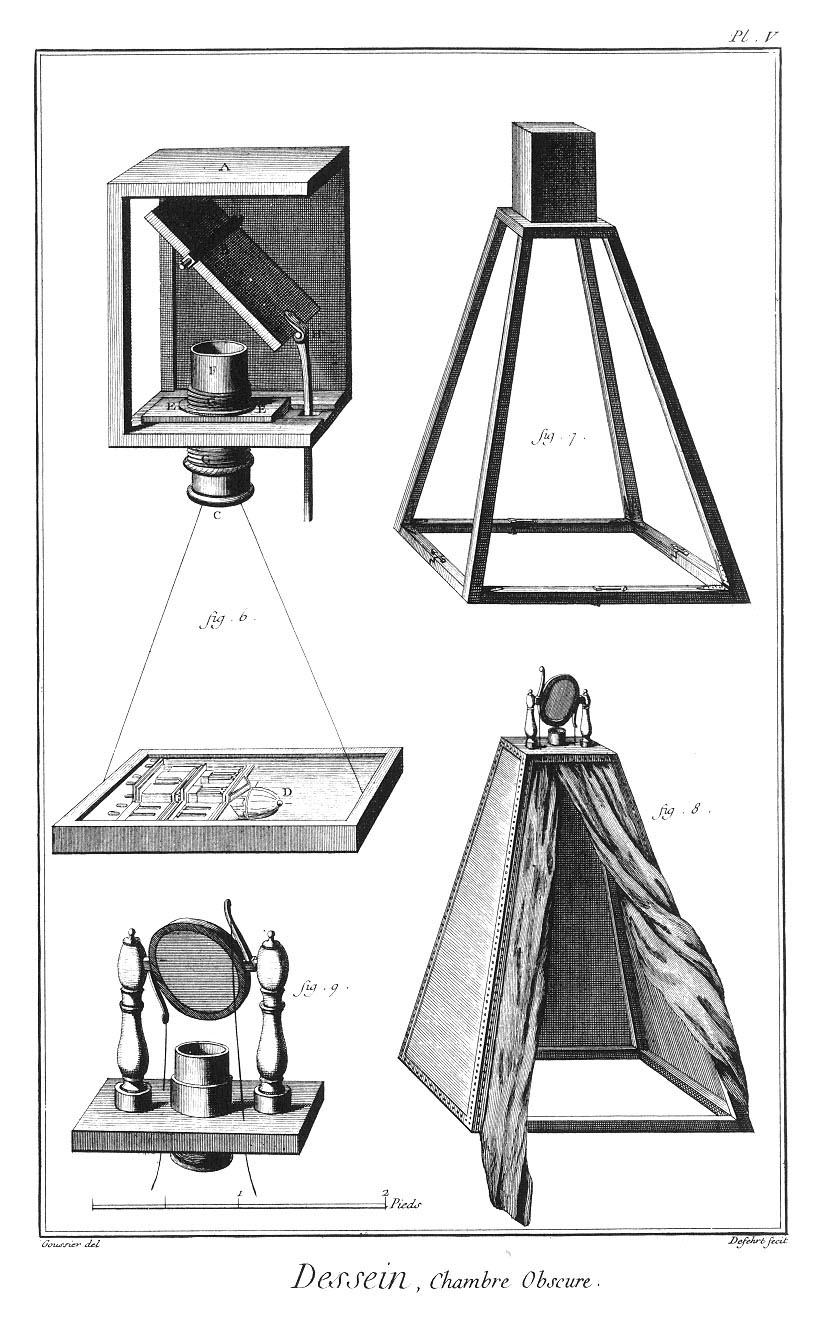
Whilst camera obscuras were performing duties as philosophical and scientific analogies, they were also being developed as machines. They were shrinking from the size of rooms to the size of scientific instruments. Diderot’s Encyclopedia from the mid18th century illustrates several handy desktop models in the section devoted to drawing. In these camera obscuras the world is miniaturised by the lens, and the artist looks attentively down at the world re-inverted by mirrors and projected onto a ground glass screen or drawing paper. Some camera obscuras were boxes of wood where a reflex mirror reflected the image up onto the underside of the artist’s drawing paper, which was protected from being washed out by ambient light with a hood. Others were like pyramidic tents into which the draftsman stuck his head and hand, where a periscope projected the image down onto paper. These camera obscuras removed their users from the flux of world, and laid out images for their rational eyes to observe and draw.

Plate 4, Drawing, Camera Obscura, Encyclopedia, Denis Diderot, 1751-1772

Plate 4, Drawing, Camera Obscura, Encyclopedia, Denis Diderot, 1751-1772

Plate 5, Drawing, Camera Obscura, Encyclopedia, Denis Diderot, 1751-1772

Plate 5, Drawing, Camera Obscura, Encyclopedia, Denis Diderot, 1751-1772

But even though the camera obscura was adopted as an instrument of rational sight in the 18th century, the problem of our vision’s simultaneous enmeshment in and removal from the world, which the camera obscura spectacularly instantiated, wouldn’t go away. In 1846 Karl Marx even took the camera obscura analogy and radically expanded it out to be a metaphor for ideology as well.

If in all ideology men and their circumstances appear upside down as in a camera obscura, this phenomenon arises just as much from their historical life-process as the inversion of objects on the retina does from their physical life processes.[4]

To Marx, we could not trust what we see in society because it had already been inverted by the ideology into which we had been born. We don’t recognise the inversion of ideology because we have been formed by it as historical subjects, just as we don’t recognise that our eyes invert our vision, because we are formed by it as cognitive subjects.

While Marx was using the camera obscura as a handy metaphor in his revolutionary thought, actual camera obscuras were being enjoyed by the proletariat. In Australia they were becoming popular attractions, rather than scientific instruments. From the 1850s camera obscuras, probably built into carts, were being advertised as feature attractions in Australian traveling fairs and exhibitions. Intrepid entrepreneurs began to build permanent camera obscuras, out of either stone or wood, at prominent vantage points in Adelaide, Sydney, Wollongong and Brisbane. The ones in Adelaide, Sydney and Wollongong didn’t last long, but the one in Brisbane lasted almost 50 years.

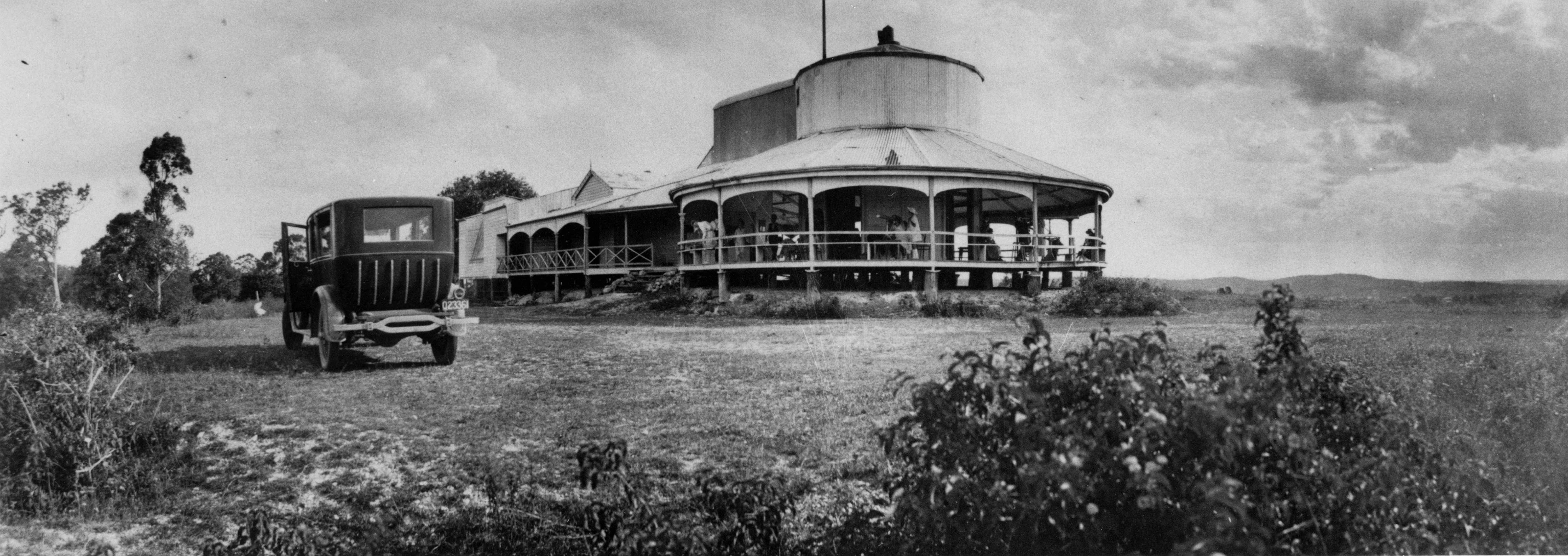
After Robert and Eliza White opened a kiosk and sly grog outlet on the top of the hill (now Whites Hill) in their property on the outskirts of Brisbane, they decided to invest 200 pounds in importing two telescopes and a camera obscura from England.[5] The camera obscura apparatus, “consisting of a lens which reflects panoramic views on a saucer shaped concrete bowl, with a plaster of paris surface”, was built into a tower above their octagonal dining room, and from 1891 the attraction garnered a steady trickle of visitors, many of whom were happy to take the half-hour walk from the Coorparoo tram terminus.[6]

Camera Obscura, Catalogue, William Y. McAllister, New York, c1890

Camera Obscura, Catalogue, William Y. McAllister, New York, c1890

Like many others around the world, the Whites Hill camera obscura provided visitors with an uncanny experience. As they looked into the pool of image they felt a bit like the homunculus in Descartes’ Optics, as if they were losing certainty as to where they were, what size they were, or where their body ended and the rest of the world began. Bob White twisted one handle to rotate the periscope around, sweeping Brisbane and Moreton Bay across the circular viewing table, while also pulling another handle to shift the angle of the reflex mirror, swinging the centre of view from foreground to distance. The Queenslander enthused:

Above is the tower, which is a camera obscura. Like an impressive old-necromancer the host operates the strings controlling the finder, and amazingly lovely scenes flit across the large horizontal, white disc placed in the centre of the room. Forest scenery is succeeded by water scapes, and the mouth of the Brisbane River appears. A slight tug at the cord and the bay slips into view. Then one picks up several islands. Another movement of the finder, and stately mountain peaks limn themselves on the white disc. In the foreground, just where one was going to rest his hand, trees quiver in a breeze which has been shut out from the tower. There are skies, too, where luminous clouds move across wonderful pools of blue. Another twist of the cord, and the finder discovers a mighty city with its suburbs rambling over countless hills. Above these are lovely cumulus clouds; and in the foreground a path strangely familiar. Then one remembers suddenly that he passed along it when climbing the ascent to the house. One feels glad that this the twentieth, not the seventeenth century, and that the grave old magician near by is not likely to be burned as a wizard![7]

Whites Hill, from 'The Pocket Brisbane', 1913

Whites Hill, from ‘The Pocket Brisbane’, 1913

View of the Observatory restaurant at Camp Hill Brisbane, 1924

View of the Observatory restaurant at Camp Hill Brisbane, 1924

In similar camera obscuras elsewhere in the world operators encouraged their lofty customers to adopt an almost god-like attitude to the scenes they witnessed. In the 150-year-old Edinburgh camera obscura visitors are still invited to hold slips of paper on the table, so the Lilliputian figures walking below appear to walk across the paper, unaware that they have been ‘captured’.

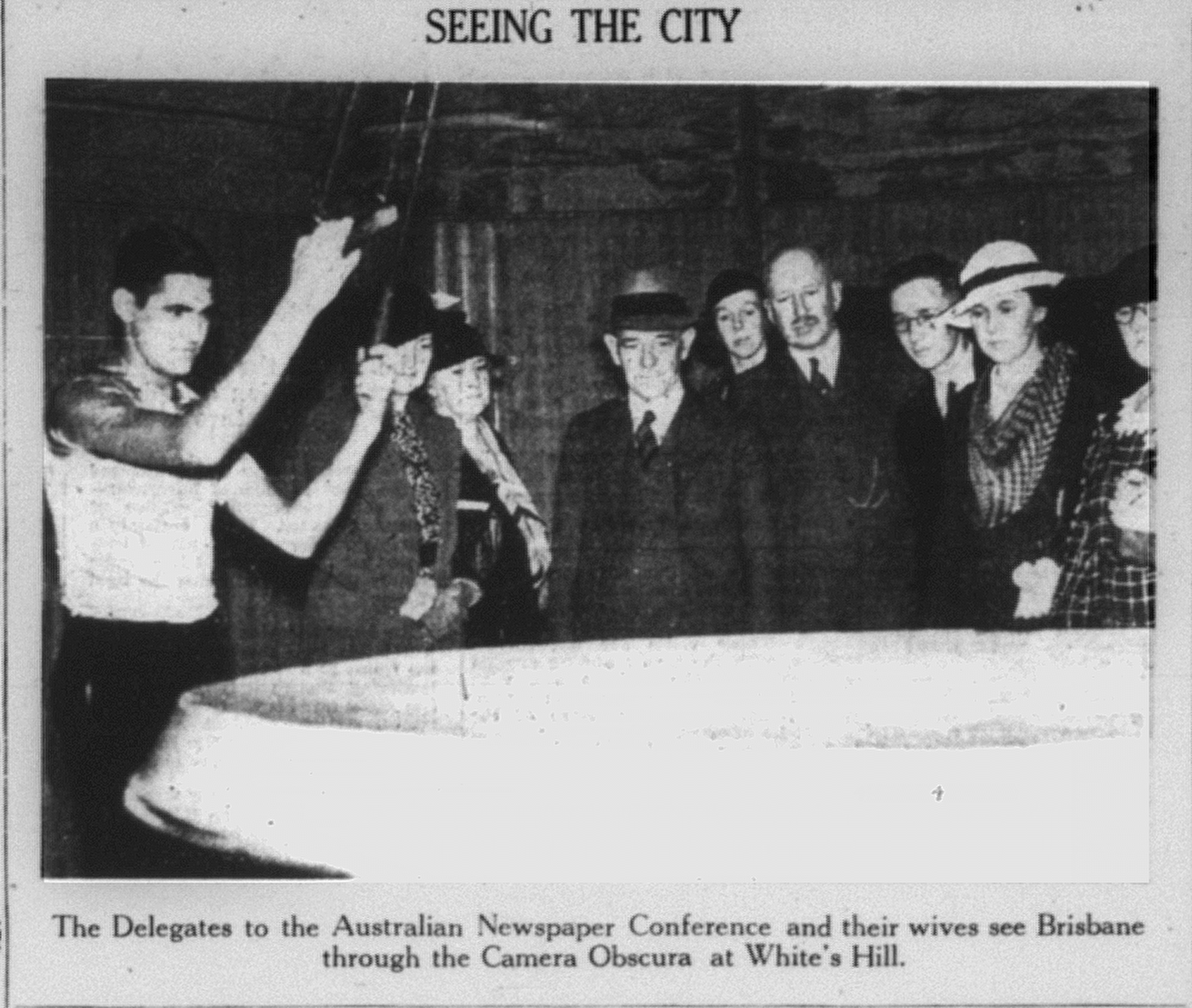
In 1928, following the death of Bob White, the Greater Brisbane Council resumed White’s Hill and sublet the kiosk and its camera obscura. But, even though the Lady Mayoress did her bit by holding tea parties there, the attraction did not thrive. In 1935 the delegates to the Australian Newspaper Conference and their wives visited, but the new lessee didn’t even bother to put on a shirt for the southerners. As he swiveled the periscope and tilted the mirror the delegates looked on truculently.[8] A year later, and the same operator was slightly better dressed for the children of the South Brisbane Intermediate School Rambling Club, who seemed slightly more impressed as they leant into the bowl, immersing themselves in the coloured concave image which the Telegraph photographer’s flash was about to blast away.[9] But, within a few years, continually hampered by the difficulty of public transport access and poor publicity, the kiosk had been abandoned. By the Second World War the American army had commandeered the land for its geographical eminence as an observation post and training ground. After the War the Whites Hill camera obscura was left to the vandals.[10]

‘Seeing the City, The Delegates to the Australian Newspaper Conference and their wives see Brisbane through the Camera Obscura at White’s Hill’, The Telegraph, 1 June 1935 p13.

‘Seeing the City, The Delegates to the Australian Newspaper Conference and their wives see Brisbane through the Camera Obscura at White’s Hill’, The Telegraph, 1 June 1935 p13.

‘Children from the South Brisbane Intermediate School Rambling Club view the surroundings through the camera obscura at White’s Hill’, The Telegraph, 18 July 1936, p30.

‘Children from the South Brisbane Intermediate School Rambling Club view the surroundings through the camera obscura at White’s Hill’, The Telegraph, 18 July 1936, p30.

In one sense these camera obscuras (Queensland hosted another one during the 1960s at Picnic Point in Toowoomba) are a subset of the panoramic mode of photography. Wickham Terrace was the most popular place in Brisbane from which cameras could click through 360 degrees, surveying the achievements of the city as it progressed with the straightening of streets, the building of bridges and the construction of buildings. But panoramas have just one temporal dimension, they are about measuring how far we have come, or how far we have yet to go. They have just one point of view, a stable one at the centre of the circle (usually, in Brisbane’s case, near the Windmill) acting like a scopic surveyor’s peg from which distances to landmarks in both history and geography can be measured. They have none of the hallucinatory, groundless shifts of the camera obscura attraction.

But that is the tradition that Robyn Stacey’s city photography belongs to: magical experiential pockets tucked into the seamless panoptic sweep, delusion within vision, memory within history, and the psychic within the civic. Brisbane, with “its suburbs rambling over countless hills” as The Queenslander put it, is particularly good at evading the panoptic view. The river and the hills fold in on themselves, but these folds have always been riven with shifting and unseen boundaries, divisions, segregations and curfews defined around race, class and gender. However, the biggest permanent division was between high and low. During the time of Robert White’s camera obscura, which was only 120 metres above sea level, any eminence amongst the hills, even of a few metres in altitude, was enough to cement social division: the rich built their villas along the ridges, straining to catch any breeze off the Bay, while the poor built their bungalows in the gullies, waiting to be flooded. During the Second World War, the time of greatest segregation, the American army observation post that replaced the Whites Hill camera obscura was only one node in a vast, South-East-Queensland-wide network of observation points, searchlight units and anti-aircraft gun-batteries that took over every hilltop, anxiously watching the sky.

After the War the rambling topography of Brisbane, with its hidden pockets of local intensity, was written over by progress. The ‘mighty city’, which The Queenslander had seen, must have been no more than a horizontal smudge in Bob White’s camera obscura, but it nonetheless began to sprout. In 1960 the Torbreck home unit tower claimed Highgate Hill for modernity; shortly after television towers, one for each of the four channels on the TV set in our living rooms, ranged themselves along the ridge of Mount Coot-tha; in the 1970s office buildings were erected in the CBD, dwarfing the previous eminence of the City Hall from which reputedly you could once have scanned from Stradbroke Island to Mount Tibrogargan; and in 1982 the Deen Brothers demolished Cloudland Ballroom to make way for crappy apartments.

This urban thicketing is recorded by some of Stacey’s images: the relentless grids of high-rise buildings completely wallpaper Ronald van Weezel’s room at the Hilton; and they spear to death the dreamy clouds and nostalgic photographic views of old Brisbane laid across the bed in room 1706 of Quay West; while all the young occupants of Willara House can look out to from her window is a fractured wall of brick and concrete. Sometimes, however, Stacey is able to carefully pick out her views between the towers and recall the underlying geographies of Brisbane. For instance, the image of the Story Bridge from All Hallows School (which was established in a doctor’s mansion built on another key site of geographical eminence, Duncan’s Hill at the top of Fortitude Valley, purchased by the Catholic Church in 1863) is like a giant picture postcard someone has put back upside down in the postcard rack. In a similarly spectacular inversion Stacey implodes the panoptic Benthamite architecture of another famous landmark, Boggo Road Gaol, to create an internal horizon of brick, fringed by the tops of the trees and blocks of flats of Dutton Park peeping over the wall. The City Botanic Gardens, which was originally a convict farm lying at the heart of Brisbane’s colonial layout, has been inverted and turned into a curtain of richly brocaded green. The curtain rises to reveal Maroochy Barambah, the song woman of the Turrbal people, the original owners of the land, who strikes a pose against a blue backdrop of sky. The Turrbal people unsuccessfully claimed Native Title over areas of Brisbane, but Maroochy’s defiant stand in a room of the Royal on the Park Hotel still attempts to topsy-turvy the hotel’s claim that it ‘provides a view like no other and offers guests a tranquil retreat in the heart of the Brisbane CBD’.

.Robyn Stacey has asked other transient occupants to perform as themselves in her room camera obscuras: Tyrone waits in the Children’s Court; while Jade in Room 1817 or Lesley in room 2212 of the Sofitel, or Mess in room 2418 of the Marriott, wait in their hotels. They remind me of the homunculus in Descartes’ Optics, they seem like they are sitting inside their own heads, immersed in a ‘through the looking glass’ dream of Brisbane. Or perhaps Stacey’s uncanny photography has temporarily released Brisbane from the thrall of its ‘historical life-processes’, as Marx would have put it, so it appears to these visitors as it really is. For instance Carlos, an occupant of a room at the Hotel Tower Mill, leans forward against a wall, with his eyes closed in intense inner communion. Projected onto the wall of the room once, and then reflected in a wardrobe mirror again, is the Windmill across the road, haloed in a nebula of jacaranda blossom. The Windmill is the oldest, and for many years was the highest, building in Brisbane, from which the Hotel Tower Mill takes its name and its architectural shape. The Windmill was the spot near which many of Brisbane’s proud photographic panoramas were taken; the building on top of which a time ball once dropped every day at 1pm, keeping Brisbane synchronised before clocks; and the building from which test radio and television transmissions were first made in the 1920s. But folded into this panoramic history darker functions and submerged lacunae lurk. Built on a ridge to catch the breeze in the late 1820s the sails of the Windmill never worked properly, perhaps they were put on the wrong way. So convicts were put to work until they dropped at a treadmill, grinding their grain and receiving their punishment simultaneously. Reputedly, the sails did become eventually useful as an improvised gibbet for two Aboriginal men, wrongly accused of murder who, in 1841, were unceremoniously pushed off the balcony of the Windmill, amid the howls of the other Aboriginal people of Brisbane, to dangle in a public execution. Now quaintly down at heel, the Hotel Tower Mill, in which Carlos dreams, was once seriously posh. It was the accommodation chosen for the all-white Springbok Rugby Union team from apartheid South Africa when they were invited to Brisbane in 1971. Police violently pushed the anti-apartheid protestors, who had gathered next to the Windmill across the road from the motel, down the steep slope of Wickham Park, bashing them as they tried to escape. Does the camera obscura re-project these distant memories, which the Windmill has attracted to itself like an historical lightening rod, into Carlos’s head?

Carlos isn’t saying. After taking part in Stacey’s experiment he’s checked out and gone back to where he came from. But as we look at her images of the outside in and the upside down, we too are invited to observe how a whole big, brash city may magically find itself silently floating upside down inside a single room; and how the past may still be felt, delicately tucked up into the present.

Another, more elemental, vision underpinned the laws of optics before they were rectified, framed and interpreted by photographic cameras and cultural conventions. Stacey shows us that, even in these days of the camera phone, da Vinci’s mind blowing revelation of infinite radiating pyramids filling the atmosphere is still capable of shaking us out of our habits and allowing us to experience the city we have built for ourselves in fresh and uncanny ways.

[1] Leonardo Da Vinci, Notebooks, Oxford University Press, 2008, p115

[2] Giambattista della Porta, ‘Of Strange Glasses’, Natural Magic (English translation), Thomas Young, 1658, pp363-364

[3] ibid, pp364-365

[4] Karl Marx, A Critique of The German Ideology, 1846, np

[5] ‘Passing of a Pioneer, Mr John White, of White’s Hill, Glimpses of early Brisbane, The Telegraph, 25 February 1927, p9)

[6] ‘Excursionist, Trips Around Brisbane, The Australasian, 20 February 1892, p44; The Brisbane Courier, 31 July 1929 p14.

[7] ‘Illustrations, Sixty Years Married, The Whites of White’s Hill’, The Queenslander, 24 January 1925, p40

[8] The Telegraph, 1 June 1935, p13

[9] The Telegraph, 18 July 1936, p30

[10] Judy Rechner, Where Have All The Creeks Gone: Camp Hill Heritage Drive Tour, Brisbane East Branch, National Trust of Queensland, 2001.

The Face in Digital Space

Published in ‘The Culture of Photography in Public Space’, edited by Anne Marsh, Melissa Miles and Daniel Palmer, Intellect, Bristol, 2015

GALLERY OF ILLUSTRATIONS

That configuration of eyes, nose and mouth stuck to the front of our heads, which we call the face, not only connects the outer sociological self to the inner psychological self— the old ‘window on the soul’ idea — but it also connects one person to another in a relationship. For the philosopher Emmanuel Levinas the face was the place of authentic encounter between self and other: ‘The face opens the primordial discourse whose first word is obligation’. (Levinas 1979: 210) According to Levinas, when two faces face each other, each demands something from the other, even if it is only recognition. It is the power of ideas such as this that still underpin controversies around the role of the face in public places of social interaction. For instance, the debates around recent attempts by various European governments to ban the burqa and the niqab in public, place the face at the very centre of contemporary definitions of personal autonomy and public citizenship. (Chesler 2010)

In order to perform this social function of human interaction the face has to be abstracted away from the body so that it can enter into a system of semiotic exchange. Deleuze and Guattari called this ‘faciality’, a process that over-codes the organism of the body with other strata of signification and subjectification. (1988) To them, the face is an abstract machine of ‘black holes in a white wall’ — a technology increasingly becoming enmeshed with other technologies.

Facial history

But in many ways this process of abstraction and ‘over-coding’ begins much earlier, with John Caspar Lavatar’s popular Essays in Physiognomy from the 1770s. Lavater defined his new science of physiognomy as the ‘the science … of the correspondence between the external and the internal man, the visible superficies and the invisible contents.’ (Lavater 1885: 11) He established that correspondence by either visual analogy, where a bovine-looking person must exhibit dull, bovine personal characteristics; or by biometric algorithms, where the slope of a brow, for instance, indexed cranial capacity and thus intelligence. A brow at a high angle above the nose was the mathematical index of a large brain, but also the visual equivalent of Roman nobility. A brow at a low angle indicated a small brain, and was also literally simian. Lavater’s analogical mapping and algorithmic vectorization allowed him to compare and classify faces, but they also removed the face from the ranks of the purely human, and placed it into an abstracted morphing space which was also shared by animals. Plate 80 of his Essays in Physiognomy demonstrates this with startling clarity as Lavater’s illustrator morphs a drawing of a frog’s face through twelve separate frames. In the first frame the angles of the isosceles triangle between the frog’s eyes and its lips is, Lavater tells us, just 25 degrees. Frame by frame the frog’s eyes slowly become more almond shaped and the whole face lengthens until, by the final frame, we find ourselves looking into the face of an androgynous human. The angle between the eyes and lips of this face has now increased to 56 degrees, a facial angle shared, according to Lavater, by Aristotle, Pitt, Frederick the Great, and Apollo.(497)

Eighty years later Charles Darwin completed the project of placing the human face within the realm of animals with his development of the theory of evolution. In his wildly popular follow-up book of 1872, The Expression of the Emotions in Man and Animals, he homed in on the mechanics of the face and established that human facial expression was an instinctual animal behaviour, rather than a social language. (Darwin1 872) He demonstrated the automatic, biological mechanics of expression by artificially decoupling the external hydraulics of the facial muscles from their usual inner, instinctual motivations. For instance, for plate seven he obtained from the French scientist Dr Duchene a photograph of the facial muscles of an intellectually impaired man being twitched into the expression of ‘horror and agony’ by the external application of the terminals of a galvanic battery. He then juxtaposed this with a photograph he had commissioned of the photographer Oscar Rejlander acting out exactly the same expression. By photographically proving that muscles could be manipulating by two entirely separate methods — electricity and pantomime — to produce exactly the same expression. In this plate Darwin demonstrated that the face lay on top of the self, the face alone, without the self, could enter the plane of abstracted analysis and comparison.

Lavater’s physiognomic analogs and algorithms, and Darwin’s muscular decoupling, had the effect of conceptually delaminating the face from the body. But it was photography that then circulated that face within society. The greatest celebrity of Victorian England was the royal courtesan, partygoer, actress, beauty, and endorser of Pears Soap, Lillie Langtry. Through photography her face left the realm of her body and entered other media spaces. In Victorian England the most lubricious place where newly mobilised images bumped up against each other was the stationer’s shop window, and Lillie’s photographs were right in the middle of every window, disturbing the pre-existing social order. A writer at the time commented on:

… that democratic disregard of rank which prevails in our National Portrait Gallery of the present day — the stationer’s shop window — where such discordant elements of the social fabric as Lord Napier and Lillie Langtry … rub shoulders jarringly. (Ewing 2008: 22)

 Langtry was also the very first person in the world to find herself in a photographic feedback loop, that is, to feel the effects of her photographed face, as it circulated though Victorian visual culture, reflecting back on to her actual body. In her autobiography, The Days I Knew, she recalled:

Photography was now making great strides, and pictures of well-known people had begun to be exhibited for sale. The photographers, one and all, besought me to sit. Presently, my portraits were in every shop-window, with trying results, for they made the public so familiar with my features that wherever I went — to theatres, picture galleries, shops — I was actually mobbed. Thus the photographs gave fresh stimulus to a condition which I had unconsciously created. One night, at a large reception at Lady Jersey’s, many of the guests stood on chairs to obtain a better view of me, and I could not help but hear their audible comments on my appearance as I passed down the drawing-room. Itinerant vendors sold cards about the streets with my portrait ingeniously concealed, shouting ‘The Jersey Lily, the puzzle is to find her’. (Langtry 1925: 40)


Facial velocity

In the subsequent 130 years, of course, the velocity of that photographic circulation has only increased in speed and brutality. And now it is not just the mega-famous who find themselves caught up in photographic feedback loops. Erno Nussenzweig has become the chief exemplar of the ever-present possibility that any one of us can suddently become an accidental celebrity. One day in 1999 this elderly, bearded, orthodox Jewish man innocently emerged onto the sidewalk from a subway at Times Square. It wasn’t until five years later that he discovered that at that decisive moment he had been photographed by Philip-Lorca diCorcia who had set up a bank of flashlights on scaffolding to capture random passers by as they came into his camera’s plane of focus. diCorcia had exhibited the portrait at the prestigious Pace/McGill Gallery, published it in a book called Heads, sold out its edition of ten prints at between twenty and thirty thousand dollars each, and had eventually won London’s prestigious Citibank Prize with it. Nussenzweig sued for 1.6 million dollars claiming the photographer had used his face for purposes of trade, as well as violated his religious beliefs. His lawyer, Jay Golding, put his case best succinctly to the New York Post who in their report ‘What’s a picture worth — he wants 1.6 Mil’ quoted him as saying: ‘It’s a beautiful picture. But why should this guy make money off of your face?’. (Hafetz 2005: 23) diCorcia’s lawyer, however, was able to convince the judge that the photographs were taken primarily for the purpose of artistic expression, not commerce, and were therefore protected by the First Amendment.

Or consider the case of Neda Soltan. In 2009 she was videoed by the mobile phones of three separate pro-democracy demonstrators in Iran as she lay dying from a government-sniper’s bullet. After the videos went viral on the internet her face was even turned into a mask and worn by pro-democracy demonstrators at a protest in Paris. (Wikipedia ‘Death of Neda Agha-Soltan’ 2013) Meanwhile, in the hours after her death, some eager journalists mistakenly harvested a photograph of another Iranian woman with a similar name, Neda Soltani, from her Facebook page. It was this face that was used in many improvised shrines to the other, assassinated Neda. Iranian authorities then began to harass Soltani in order to get her to cooperate with them in claiming hat the original murder had been a set-up by the western media. After twelve days of harassment the other Neda was forced to flee Iran and seek refuge in Germany, from where she wrote a book about her experience, My Stolen Face. (Soltani 2012)

Or put yourself in the shoes of Nicole McCabe, an Australian citizen living in Jerusalem and pregnant with her first child. She also had her photograph harvested from Facebook. In 2010 the Israeli Government had stolen McCabe’s identity for a Mossad agent to use in order to assassinate a Hamas official. When the story broke and the passports the Israeli’s had forged were circulated in the media, complete with their actual passport numbers, Nicole McCabe decided she did not want to talk to Australian journalists, or be photographed by them. But after having the door slammed on them by McCabe’s angry husband, the journalists simply sourced photographs of her from Facebook, where friends had posted her wedding photographs. Nicole said she felt:

‘sick, angry, embarrassed and upset … even if Facebook is public, they have no right to take what they want without asking. I was more determined than ever not to let anyone take a photo of me.’ (Media Watch 2010)

 Or consider the fate of the footballer Sonny Bill Williams. In 2007 he embarked on an afternoon drinking session at the Clovelly Hotel with his team-mates and a group of football groupies that included celebrity iron woman Candice Falzon. Later that night one Clovelly local got a message on his phone. The local reported: “It said Candice Falzon had followed Sonny Bill into the toilets upstairs at the pub and everyone knew about it. The next message I got was an … um … action shot.” The shot, taken by putting a mobile phone under the toilet door as William and Falzon had sex, was soon being widely circulated amongst the mobile phones of Clovelly, and when it was eventually published on The Daily Telegraph’s website, it attracted a record number of hits. Williams reportedly had to spend all the following morning buying up copies of newspapers in his area in a futile attempt to stop his girlfriend learning of his toilet tryst. Although the person who took the photograph could have been liable for two years jail under the summary offences act for taking lewd photographs in toilets and change rooms, the newspaper itself could not be successfully prosecuted for posting the photograph once it was taken. (The Daily Telegraph 2007)

Incidents such as this show that faces don’t just have features, they also have velocities. The more famous you are the more recognizable you are to more people, but also the faster your face is circulated in the media. Even if you aren’t famous, a lightning bolt of sudden celebrity can dramatically, thought temporarily, catapult your face into a higher strata of recognizability, which propels exchange at a faster velocity.

While some have felt themselves suddenly swept up into these currents of facial velocity, others have attempted, with mixed success, to ride those turbulent currents to even greater fame. Consider the career of Lara Bingle. Once an ordinary bikini model, her celebrity stocks rose in 2006 when she was chosen for a tourism campaign. The men’s magazine Zoo Weekly then published revealing photographs of her that had been taken eleven months earlier, before she was chosen to be the wholesome face of Australia, on which they superimposed sexually suggestive speech bubbles. She sued the magazine for defamation. She won the case when the judge accepted that the magazine was smutty and had implied that she had willingly consented to pose for the sexual titillation of its readers. (Sydney Morning Herald 2006a, 2006b) However by the end of 2006 the tourism campaign had flopped, and Bingle was having an illicit affair with the married footballer Brendan Fevola. But by 2008 her stocks had risen again, she was engaged to the cricketer Michael Clark, and they were one of Sydney’s foremost celebrity couples, even endorsing an energy drink. By early 2010 she had even signed up with celebrity agent Mark Marxson. But then Woman’s Day published a mobile-phone photograph her ex-lover Brendan Fevola had taken of her in the shower back in 2006, which his football mates had been circulating between their mobile phones for some time. Her engagement with Michael Clark broke down and the energy drink company dropped them. Mark Marxson threatened to ‘strike a blow for women’s rights’ by getting her to sue Fevola, but she did not have a case because, unlike in the Zoo Weekly case, no specific laws of defamation were broken. (Byrne 2010) Bingle’s stocks in the celebrity marketplace plummeted but, after a period of careful career management including charity work, family-friendly television appearances, and the avoidance of footballers, they begun to rise again. They rose so far that by 2012 she successfully negotiated with a TV production company to become the subject of a ‘reality’ TV series Being Lara Bingle on a commercial television network. Conveniently, just before the premiere was about to air, another controversy erupted when she was supposedly photographed surreptitiously by the famous paparazzi Darryn Lyons (who was in fact a business partner of Bingle’s) standing nude near the window of the Bondi flat that had been rented for the show. This confected ‘invasion of privacy’ allowed her to tell breakfast radio that: “There should be a law against someone shooting inside your house …. it’s just not right”, thus garnering pre-publicity for the series, and conveniently forming the content of the first episode. That first TV episode rated highly, however subsequent episodes in the series steadily lost viewers, to the point where Bingle’s career languished once more. (O’Brien 2012) Bingle then climbed back in the celebrity news cycle after she began to date the Avatar actor Sam Worthington, reportedly introducing him to the use of social media platforms such as Instagram. In February 2014 the couple suddenly hit the celebrity gossip headlines when Worthington was arrested in New York for allegedly assaulting a photographer who had allegedly kicked Bingle in the shin. (Clun 2014)

The camera has ruled Lara Bingle’s career as celebrity, someone defined by our desire to look at her. But this has been the case ever since Lillie Langtry. However the roller coaster ride of Bingle’s value as a bankable celebrity has also been ruled by the sudden eruptions or irruptions, whether planned or not, ‘authorised’ or not, of particular recognisable photographs which re-attach the ‘face’ of Bingle to the ‘brand’ of Bingle in different ways. The speed of their circulation through both social media and the mainstream media, create the volatility of the market for her images. Celebrities are sometimes even forced to engage in this market directly. For example, in 2013 the TV and radio presenter Chrissie Swan, who had acquired her celebrity status dispensing homespun wisdom to ordinary women, was photographed smoking whilst she was pregnant, something she herself had campaigned against. So that they could never be published, she engaged in a bidding war with two magazines for the photographs, eventually pulling out after offering $53,000, two thousand dollars less than the winning bid by Womens Day. (news.com.au 2013)

Facial vecotorisation

These examples indicate the high speed of facial velocity. But what of facial vectorisation? The terrain of the face continues to be the site of scientific research that updates Lavater’s and Darwin’s pioneering efforts and re-affirms the face’s muscular mechanics as central to our humanity — although now not by indexing some immutable inner person as Lavater had supposed, but through their intrinsic role within language comprehension. Contemporary cognitive psychologists such as professor Rolf Zwan, from Erasmus University Rotterdam, are researching the ways that facial muscle-movement directly feedbacks to the brain. For example experiments have shown that if you are smiling you can read sentences about emotions quicker than if you are frowning; and if you have had Botox you have more difficulty interpreting photographic portraits of emotions because in conversation your facial muscles subtly enter into a feedback loop of micro-mimicry with your interlocutor, which Botox decouples. (Lingua Franca 2011; White 2011; Zwaan 2013) Other experiments suggest that if you are in the presence of the representation of a face your moral standards are higher. (Bourrat, Baumard, McKay 2011; Smith 2011)


While these examples of cognitive research indicate that the face as a concept remains central to discourses of the human, individual faces are also increasingly caught up in ever-finer meshes of delamination, vectorisation, and mobilization. For instance plastic surgery is moving down the social scale from being the prerogative of the famous and the fatuous, to being a commonplace conventional practice for all of us. ‘Extreme makeovers’ are increasingly re-mapping everyday faces, and recalibrating with the scalpel the vectoral angles between eyes, noses and chins in order to ratchet their owners up in scales of beauty.

If the facial structure itself can be morphed through surgery, in other instances the facial pixel maps representing the person can be manipulated. The regular Photoshoping of celebrity portraits in our magazines simply replicates in two dimensions the effects of the cosmetic surgeon’s scalpel, and the amount of pixelated deviation away from the ‘truth’ can even be algorithmically calculated and given a value. (Fahid, Kee 2011) Photoshop can also be used to disguise faces. Consider the case of Christopher Paul Neil who liked to post pictures of himself sexually abusing Vietnamese and Cambodian children on paedophile websites. He applied a swirl filter to his face to disguise his identity, but German police simply applied the same filter in reverse and unswirled the pattern and reveal his face. Interpol then posted the image on their website where he was recognised by five different people and identified. After his face was picked up by a surveillance camera at Bangkok Airport he was eventually arrested in October 2007. (Daily Mail 2007; Wikipedia ‘Christopher Paul Neil’ 2013)

Neil was recognised by a human being, but the technological possibility exists that eventually his face could have been recognised by a machine. Facial recognition software applies algorithms to the same sets of vectors between eyes, nose and mouth that Lavater originally identified. Australia is at the forefront of facial recognition research. We have not only already introduced ‘smart gates’ at our airports to match our facial algorithms with a database, but National ICT Australia (NICTA) received 1.5 million dollars from the Cabinet to research what it describes as the ‘holy grail’ of surveillance: ‘real-time face-in-the-crowd recognition technology’. Concurrent with these Australian research projects, international protocols are also being developed. For instance the US Department of Commerce’s National Institute of Standards and Technology hosted the Face Recognition Grand Challenge open to entrants from industry, universities and research institutes. This means, according to NICTA, that:

The surveillance industry is currently undergoing the same revolutionary changes that shook up the computer industry when internet use took off in the 1990s. Instead of each supplier providing a unique product, the sector will soon be dominated by standards and interoperability. Surveillance will eventually merge into a virtually seamless multimedia network embracing social media, location services, mobile devices, maps, and 3D models. (Advanced Surveillance Project 2013; (Bigdeli, LovellMau, 201abc)

However even though technology is yet to actually deliver on its promises, the idea of facial recognition and facial manipulation has already become commonplace in the media, and almost domesticated. For several years it has been something we can all indulge in as a kind of game. A whole class of smart phone apps are based on face recognition software. We can also apply face recognition algorithms to the vast reservoirs of faces on the internet, or on Facebook, or in our iPhoto libraries, in order to locate friends we are looking for even when the metadata tags aren’t available; or to look for celebrities; or to calculate how much we look like a celebrity; or to calculate which of our children most looks like us. Many new cameras also have face recognition software built in which recognises, automatically focuses on, and tags, particular people even before the shutter is clicked.

In a way of thinking about the face that is very similar to Lavater’s and Darwin’s, the frontier of contemporary 3D computer animation is the mapping of actual micro-muscular movements onto animated wire-frames. The most famous example of this so far has occurred in the movie Avatar, 2009, where actors, including Sam Worthington, wore head-rigs which filmed the movement of motion-tracking markers on their faces. This digital information was then ‘peeled’ off the actor’s face and re-applied to a 3D animation wire-frame model. The use of the same rigs on the actor Andy Serkis for the movie Rise of the Planet of the Apes, 2011, finally placed the human face and its expressions in the realm as animals, as imagined by Lavater 230 years ago. Significantly, this technology has also become domesticated in on-line games such as Macdonald’s website Avartize Yourself. Other games take forensic ‘age progression’ software used by missing-persons bureaus, and turn them into games such as the iPhone app Hourface.

Facial Privatisation

Why is it worthwhile looking so closely at tabloid trash and trivial on-line games? Because they, as much as high-end cutting-edge research, are the symptoms of two new tendencies in the valency of the face. Firstly, we are all becoming celebrities, at least potentially. The velocity of our own faces can suddenly speed up when we least expect it. Secondly, our faces are all part of what NICTA calls a ‘virtually seamless multimedia environment’. This is not just analogical space, the bit-mapping and point-by-point comparison of appearances, but algorithmic space, where faces are vectorised and turned into equations that can instantly interact with a myriad of other equations. The pervasiveness of celebrity culture, combined with the explosion of algorithmic biometrics within merging media and data spaces, has had a profound effect upon the ways in which every one of us regards our own face. The face is congealing as a bastion from which to advance privacy rights and proclaim property rights.

 There has been a consistent and inexorable drift in legal opinion in Australia towards a tort of privacy — which we currently do not have — that is ultimately focussed on protecting the human face. Back in 2001 Justice John Dowd was able to confidently claim that a person ‘does not have a right not to be photographed’. But by 2003 Justice Michael Kirby was commenting that extending the law in Australia to protect the ‘honour, reputation and personal privacy of individuals’ would be consistent with international developments in human rights law. (Nemeth 2012)

 By 2008 Professor David Weisbot, president of the Australian Law Reform Commission, was saying that during their inquiry into privacy law, the ALRC had:

consistently heard strong support for the enactment of a statutory cause of action for serious invasion of privacy. While the debate overseas has focussed on the activities of paparazzi photographers, interestingly, most of the concerns expressed to the ALRC related more to the private sphere than the mainstream media — and to the protection of ordinary citizens rather than celebrities. People are extremely concerned about new technology and the ease with which their private personal images may be captured and disseminated. (Australian Law Reform Commission 2008)

 In their recommendations the ALRC called for: ‘a private cause of action where an individual has suffered a serious invasion of privacy, in circumstances in which the person had a reasonable expectation of privacy’. (2008) And in 2011 the NSW Law Reform Commission agreed, releasing draft laws that stated that an invasion of privacy should exist where a person ‘has a reasonable expectation of privacy’, which could potentially even include a public place. (New South Wales Law Reform Commission 2010; Marr 2009))

So, why this paradox? Why, when our personal information is flowing more freely than ever before, when 80% of people want CCTV cameras in their public spaces, and when the vast majority of Facebook users are happy to use its default settings where there is little or no privacy at all, why are we getting increasingly paranoid about our faces? I think it is because the face is caught up in a wider transformation. It is swimming against the tide that is pulling the private into the public because it is part of a stronger current, from signification to possession. Those of us feeling the effects of both celebrity culture and algorithmic data-media are regarding privacy less as a singular inherent right, and more as a fungible personal commodity which can be exchanged in a market place. For instance Nicole McCabe knew her participation in Facebook was not free, she knew she had ‘sold’ it some of her privacy in order to enjoy its benefits, but suddenly and unexpectedly she came to realize that perhaps she had ‘traded off’ too much of her privacy. This mercantile logic is also beginning to pervade other environments of facial interaction, such as public places. Within the politics of the face the receding sense of the private, in the sense of the ‘the discreet’, is being overtaken by an encroaching sense of the privatised, in the sense of ‘the owned’. We all increasingly agree implicitly with Nussenzweig’s lawyer: ‘why should this guy make money off of your face?’.

The abstraction, delamination and mobilization of the face has led to its reification. The face is closing down on the sense of openly mutual obligation that, in Levinas’s terms, once arose when one face faced another, and is replacing it with a sense of commercial enclosure. This reification is intensified by the way that all faces, even our own, can be peeled away from our bodies to enter new virtual and algorithmic spaces. Celebrities are merely at the vanguard of this transformation. Celebrities believe they are their own commodity. They believe that their face is the result of their labour and their talent. It is their capital, their brand, their corporate logo. The velocity with which their face travels through the neworks of the media is what determines their value as a celebrity. They believe they therefore have a proprietary right in it. In America their faces are even protected by a common law ‘right of publicity’ which grants them, in the words of one key judgement, ‘the exclusive right to control the commercial value and exploitation of [their] name, picture, likeness or personality.’ (Wikipedia, ‘Personality Rights’ 2013) And, just like them, we ordinary people also feel that our own faces are also becoming more monologic, less a window or an interface, and more a logo for ‘Brand Me’. That configuration of eyes, nose and mouth stuck to the front of our heads, which we call the face, is now not so much a portal to the inner self, or a species of physiognomic autobiography, or an interface to our fellow citizens, as much as a rebus of identity, or perhaps a corporate logo for the persona. It is clear that laws of privacy, photography and reproduction will eventually be changed to confirm for everybody what has already happened in facial valency to a select few. They will come to protect not only the integrity of the personal autonomy and public citzenship of the individaul as accessed through the face, but also the value of the face itself — as an individual’s property

 GALLERY OF ILLUSTRATIONS

Bibliography:

Advanced Surveillance Project (2013), NICTA, http://nicta.com.au/research/projects/safe_as. Accessed 31 January 2013,

Australian Law Reform Commission (2008), ‘For Your Information: Australian Privacy Law and Practice (ALRC Report 108)’, http://www.alrc.gov.au/publications/report-108. Accessed 31 January 2013.

Bigdeli, A. & Lovell, B. & Mau, S. (2011a), ‘You, yes you: welcome to the world of advanced surveillance”, The Conversation, 23 May, http://theconversation.edu.au/. Accessed 31 January 2013.

Bigdeli, A. & Lovell, B. & Mau, S (2011b), ‘Something to watch over me: policing our national bordersThe Conversation, 26 May, . http://theconversation.edu.au/>

Bigdeli, A & Lovell, B & Mau, S 2011c ‘All-seeing eye: the future of surveillance and social media’ The Conversation, 27 May, Accessed 31 January 2013, http://theconversation.edu.au/. Accessed 31 January 2013.

Bourrat, P. & Baumard, N. & McKay R. (2011) ‘Surveillance Cues Enhance Moral Condemnation’, Evolutionary Psychology,  9(2) pp.193-199.

Byrne, L. (2010), ‘Lara Bingle to sue Brendan Fevola over nude photo’, Herald Sun, 2 March, http://www.heraldsun.com.au/news/victoria/lara-bingle-to-sue-brendan-fevola-over-nude-photo/story-e6frf7l6-1225835852364. Accessed 31 January 2013.

Chesler, P. (2010), ‘Ban the Burqa? The Argument in Favor’, The Middle East Quarterly, Fall, pp34-45.

Clun, R. (2014), ‘Sam Worthington arrested in New York for assaulting photographer who allegedly kicked Lara Bingle’, The Sydney Morning Herald, 24 February, http://www.smh.com.au/lifestyle/celebrity/sam-worthington-arrested-in-new-york-for-assaulting-photographer-who-allegedly-kicked-lara-bingle-20140224-33c4f.html. Accessed 28 February 2014.

Daily Mail (2007), ‘Police name internet paedophile caught out in digitally altered images’, 16 October, http://www.dailymail.co.uk/news/article-486334/Police-internet-paedophile-caught-digitally-altered-images.html. Accessed January 31 2013.

Darwin, C. (1872), The Expression of Emotion in Man and Animals, J. Murray London.

Deleuze, G. & Guattari, F. (1988), ‘Year Zero: Faciality’, A Thousand Plateaus: Capitalism and Schizophrenia, , trans Massumi, B, Athlone Press, London.

Ewing, W. A. (2008), Face: the new photographic portrait, Thames & Hudson, London.

Fahid, H. & Kee, E. (2011), ‘A perceptual metric for photo retouching’, Proceedings of the National Academy of Sciences of the Unites States of America, 28 November, PNAS 108 (50), pp. 19907-19912.

Hafetz, D. (2005) ‘What’s a picture worth — he wants 1.6 Mil’, New York Post, 26 June, p23.

Langtry, L. (1925) The Days I Knew, George H Doran Company, New York.

Lavater, C. (1885) Essays on physiognomy, also one hundred physiognomical rules, taken from a posthumous work by J.G. Lavater, and a memoir of the author, 17th ed, trans Holcroft, T., Ward Lock, London.

Law Reform Commission of New South Wales (2010), ‘Report 127 – Protecting Privacy in New South Wales’, http://www.lawreform.lawlink.nsw.gov.au/agdbasev7wr/lrc/documents/pdf/r127_final_revised.pdf. Accessed 31 January 2013. <http://www.lawlink.nsw.gov.au/lawlink/lrc/ll_lrc.nsf/pages/LRC_r127toc>

Levinas, E. 1979, Totality and Infinity: An Essay on Exteriority, trans Alphonso (Lingis, M. Nijhoff Publishers The Hague, Boston.

Lingua Franca (2011), ‘Embodied Cognition, interview with Professor Rolf Zwaan’, ABC Radio National Broadcast 10 September, http://www.abc.net.au/radionational/programs/linguafranca/embodied-cognition/2939354. Accessed 31 January 2013.

Marr, D. (2009), ‘Pesky Press Annoying You? Now You Can just Sue Them’, The National Times, Sydney Morning Herald, 15 August 2009, http://www.smh.com.au/opinion/pesky-press-annoying-you-now-you-can-just-sue-them-20090814-el51.html. Accessed 31 January 2013.

Media Watch (2010), ‘Identity Fully Revealed’, Episode 05, 8 March, http://www.abc.net.au/mediawatch/transcripts/s2839839.htm. Accessed 31 January 2013.

Nemeth, A. (2012), NSW Photo Rights: Street Photography Legal Issues, 4020, http://4020.net/words/photorights.php. Accessed 31 January 2013.

news.com.au (2013), ‘Tearful Chrissie Swan admits she hasn’t been able to quit smoking while pregnant’, http://www.news.com.au/entertainment/celebrity/mix-fm-presenter-chrissie-swan-admits-to-smoking-cigarettes-while-pregnant/story-e6frfmqi-1226572082685. Accessed 10 February 2013.

O’Brien, S. (2012), ‘Lara Bingle’s nude paparazzi snaps a privacy invasion’, Herald Sun, 2 May, http://www.heraldsun.com.au/opinion/lara-bingles-nude-paparazzi-snaps-a-privacy-invasion/story-fn56aaiq-1226344709298. Accessed 31 January 2013.

Smith, D. (2011), ‘Why one look will put the fear of god into you’ June 11, Sydney Morning Herald, http://www.smh.com.au/national/why-one-look-will-put-the-fear-of-god-into-you-20110610-1fx30.html. Accessed 31 January 2013 <

Soltani, N. (2012), My Stolen Face: The Story of a Dramatic Mistake, Random House, Kailash.

Sydney Morning Herald , 2006, ‘Bingle bites back — sues men’s mag’, Stay in Touch, , 11 May, http://www.smh.com.au/news/stay-in-touch/bingle-bites-back–sues-mens mag/2006/05/10/1146940612505.html. Accessed 31 January 2013.

Sydney Morning Herald 2006, ‘Judge Backs Bingle on Zoo Smut’, 8 December, http://www.smh.com.au/articles/2006/12/08/1165081128065.html?from=rss. Accessed 31 January 2013.

The Daily Telegraph (2007), ‘Sonny Bill, Candice toilet Joke’, Sydney Confidential, 14 April, http://www.dailytelegraph.com.au/news/sonny-bill-candice-toilet-joke/story-e6frewt0-1111113317469. Accessed 31 January 2013.

White, S. (2011), ‘Pardon the Expression’, Spectrum, Sydney Morning Herald, 6-7 August, p. 23.

Wikipedia 2013, ‘Christopher Paul Neil’, http://en.wikipedia.org/wiki/Christopher_Paul_Neil. Accessed 31 January 2013.

Wikipedia 2013, ‘Death of Neda Agha-Soltan’, entry, http://en.wikipedia.org/wiki/Death_of_Neda_Agha-Soltan. Accessed 31 January 2013,

Wikipedia 2013, ‘Personality Rights’, http://en.wikipedia.org/wiki/Personality_rights. Accessed 31 January 2013.

Zwaan, R 2013 Brain & Cognition, Erasmus University Rotterdam, <http://www.brain-cognition.eu/, Accessed 31 January 2013.
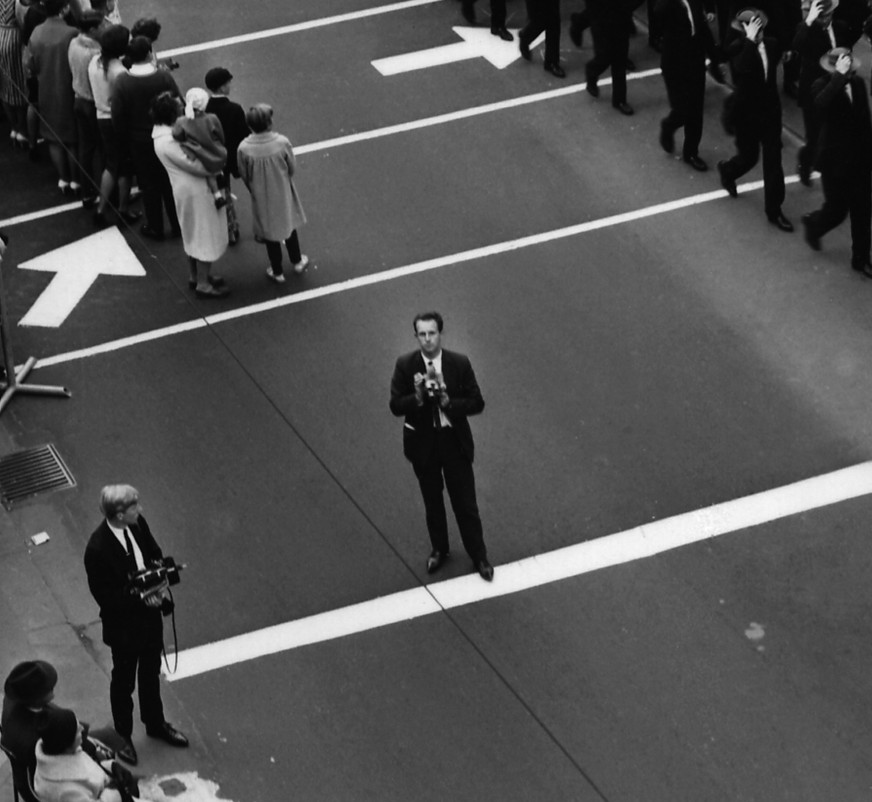
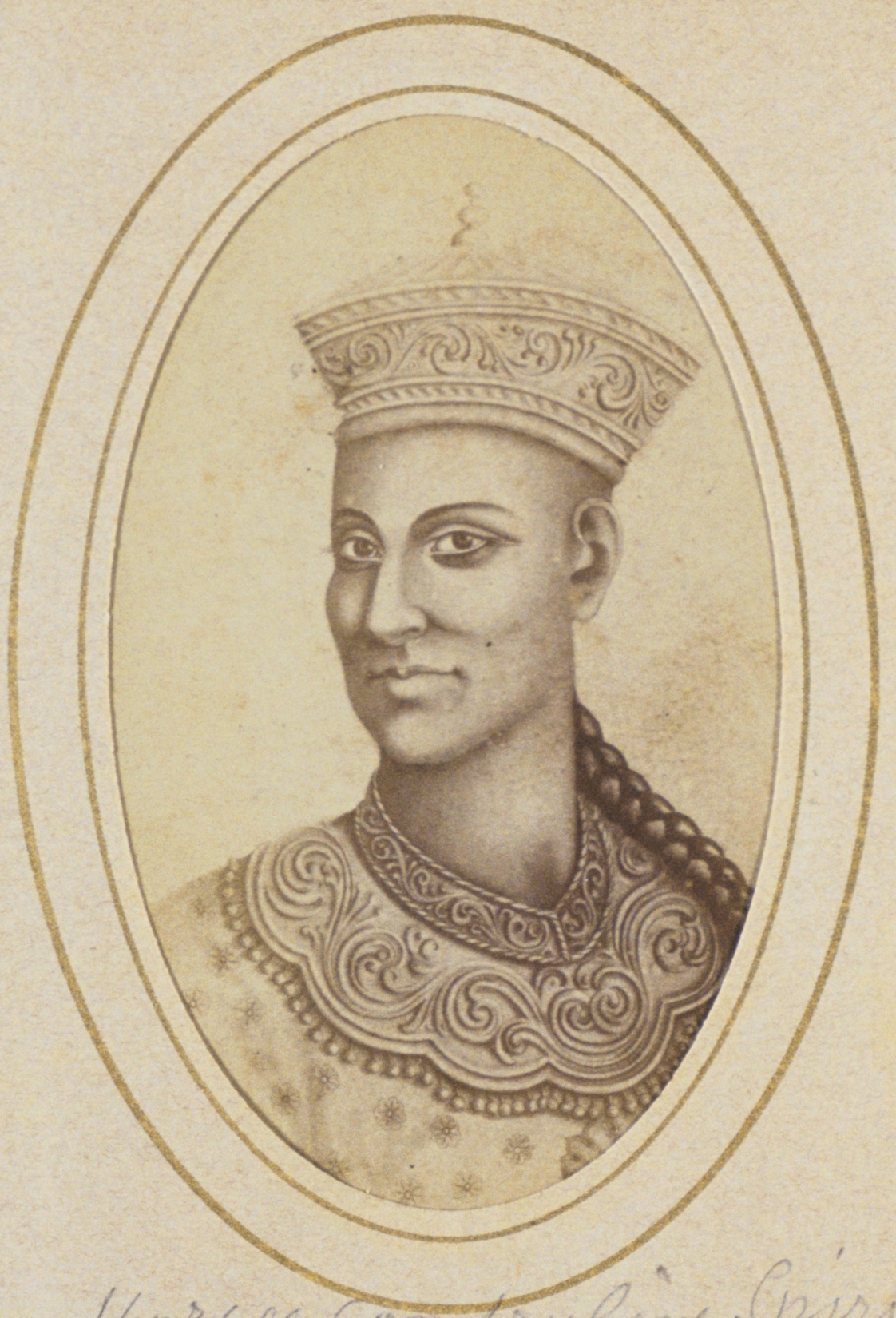
Delicious Moments: The Photograph Album in Nineteenth Century Australia


Published in The Photograph and Australia, edited by Judy Annear, Art Gallery of New South Wales, 2015

Photographs were never just images, they were always also things: objects to be touched or held, given or received, hidden or revealed, kept or destroyed. Photographic historians are paying increasing attention to objects such as photographic albums, and as they do so new insights into the way people once loved, shared and remembered are opening up to us.[1] But, as we look afresh at these old albums, connections with the way we use photographs today are also emerging, even though photographs are no longer the things they once were.

On 18 October 1860 a Sydney merchant announced: ‘We have received per mail a few photographic portraits of The Queen, the Prince Consort, and all members of the Royal Family. They have been taken from the life by Mr Mayall of Regent Street and are highly interesting from their truthfulness and unexaggerated appearance’.[2] The royal portraits were in the new carte-de-visite format – full-length portraits photographed in sets of eight by special multi-lens cameras and glued onto small mass-produced visiting cards. By early 1862 Sydney stationers were advertising another new commodity, the carte-de-visite album.[3] These albums had thick, decorated pages with pre-cut slots to hold cartes de visite. By July that year the Sydney photographers Freeman Brothers were announcing that they had ‘arranged a series of variable and appropriate backgrounds, so as to produce increased effect and add interest to the pictures […] in order to meet the increasing demand for these elegant varieties of the photographic art’.[4] The global carte-de-visite craze had hit Australia – the product of the coming together of an international postal service, a modular album, and a standardised photographic format. A popular poem that was placed on the first page of many Australian albums instructed the reader on how to use this new object:

Yes, this is my album

But learn ere you look:

That all are expected

To add to my book.

You are welcome to quiz it

The penalty is,

That you add your own portrait

For others to quiz[5]


The album was therefore a site of mutual obligation and reciprocal exchange. Mayall’s portraits, which reportedly sold in their hundreds of thousands around the empire, set up the royal family as the template for all the other families in the colony, while carte-de-visite albums became a physical manifestation of one’s place in a rigid social system. As she tucked images of the famed, such as those of the royal family with their ‘truthfulness and unexaggerated appearance’, into the same intimate pockets as the portraits of people she knew, each album’s owner stitched herself tightly into her immediate family as well as concentric social circles extending all the way up to the stratospheric reaches of royalty. The Sydney Morning Herald quoted one satirist who poked fun at the ‘claims to gentility’ the carte-de-visite album had unleashed; but his social vignette also points to how tactile the albums were, how startlingly immediate the portraits were, and how the combination of portraits was animated by a compiler’s narration:

 You place it in your friend’s hands, saying, ‘This only contains my special favorites, mind’, and there is her ladyship staring them in the face the next moment. ‘Who is this sweet person?’ says the visitor. ‘Oh that is dear Lady Puddicombe’, you reply carelessly. Delicious moment![6]

 There was much that was formulaic about the carte-de-visite’s iconography. The ‘series of variable and appropriate backgrounds’ Freeman Brothers arranged for their clients would have been necessarily limited, and the repertoire of poses, derived from paintings, equally formulaic.[7] But cartes de visite allowed the middle classes to ‘perform’ themselves as they wanted to be seen, then socially articulate themselves within the juxtapositions of the album, and finally even to see themselves ensconced in global networks. These were all powerful forces so, not surprisingly, albums themselves began to appear as talismanic objects within carte-de-visite portraits. Townsend Duryea, for instance, photographed a young Moonta woman gazing wistfully off into the distance; we don’t know whom she is thinking of, but we are certain their portrait is in the album which sits open in front of her (p xx).

Not all nineteenth-century albums followed the modular conventions of the pre-made carte-de-visite album; some were surprising informal. Around Christmas-time 1858 Louisa Elizabeth How, the wife of a wealthy merchant, briefly took up photography.[8] Her photographs of visitors to her harbourside home provide an insight into the day-to-day social life of friends in a domestic space. The settlers John Glen and Charles Morrison lounge with stereoscopes and stereo cards – an earlier photography craze – while William Landsborough, just returned from opening up new land for pastoral claims in southern Queensland, sits stiff-leggedly. His young Aboriginal companion ‘Tiger’ has obviously been told by How to wedge his elbow on the back of Landsborough’s chair in a fraternal gesture. He loosely holds his doffed cap in one hand, but hovers his other hand just above the explorer’s shoulder, barely touching it with his stiff fingers.

Albums such as How’s, which take us so closely into the bodily interrelationships of colonial Australians, are extremely rare. More common are the large, elaborately hand-painted, collaged scrapbook albums that became popular among middle- and upper-class women in the late 1860s.[9] Mrs Lambert, the compiler of one of these albums, Who and what we saw at the Antipodes, not only records the social circles of Sydney’s colonial elite, but also their houses and drawing rooms. For one photograph she flung open the curtains to her own drawing room at 46 Phillip Street. Though the streaming sun reduced the exposure time, Edith Gladstone, the young sister of Countess Belmore, the Governor’s wife, still has to hold her head to keep it from moving while she is photographed reading at a desk. There is an air of casual immediacy to the image, and a domestic informality is revealed as our eye wanders through the clutter of novels, albums and knick-knacks.[10]

Another album, from the Lethbridge family of Queensland pastoralists, contains a lovely, and remarkably modern-looking, portrait of a fresh-faced young girl leaning back in her chair and looking frankly into the camera with her fingers laced behind her head. Somebody, at a later date, has added the necessary metadata in pencil: ‘Effie Dalrymple, sister to Florence Lethbridge’. Thanks to those worker-bees of history, the family genealogists, and the digitisation of photographic collections, it only takes Google 0.45 seconds to find me another image of Effie, this one taken in 1900 after she had been married for twenty years and borne four children to the Mayor of Mackay, David Dalrymple. In the image that Google delivers, her face is now set hard and her hair tightly drawn back.

To jump from a nineteenth-century portrait album to the internet is now an automatic leap. And plenty of people have noticed the structural similarities between carte-de-visite albums and Facebook.[11] This comment from 1862 about the process of being turned into a carte de visite seems remarkably familiar today:


you have the opportunity of distributing yourself among your friends, and letting them see you in your favorite attitude, and with your favorite expression. And then you get into those wonderful books which everybody possesses, and strangers see you there in good society, and ask who that very striking looking person is?[12]

Slide04

Slide02 Slide06 Slide05

Nineteenth-century albums mediated between the private and the public, allowing people to invent themselves and to feel connected with each other over vast distances of space and time, networked into global, virtual communities. Just like online photo-sharing today.


[1] See, for example: Geoffrey Batchen, Forget me not: photography and remembrance, Van Gogh Museum, Amsterdam, 2004; Martha Langford, Suspended conversations: the afterlife of memory in photographic albums, McGill-Queen’s University Press, Montreal, 2001; Elizabeth Edwards, ‘Photographs as objects of memory’, in Marius Kwint, Christopher Breward & Jeremy Aynsley (eds), Material memories, Berg, Oxford, 1999, pp 221–36; Deborah Chambers, ‘Family as place: family photograph albums and the domestication of public and private space’, in Joan Schwartz & James Ryan (eds) Picturing place: photography and the geographical imagination, IB Tauris, London, 2003, pp 96–114; and Verna Posever Curtis, The album in the age of photography, Aperture/Library of Congress, New York, NY & Washington, DC, 2011.

[2] Sydney Morning Herald, 18 October 1860, p 8. For more on carte-de-visite albums in the 1860s see Warwick Reeder, ‘The stereograph and the album portrait in colonial Sydney 1859–62’, History of Photography, vol 23, no 2, summer 1999, pp 181–91.

[3] Sydney Morning Herald, 15 March 1862, p 2; Sydney Morning Herald, 26 Apr 1862, p 7.

[4] Sydney Morning Herald, 2 July 1862, p 2.

[5] A carte-de-visite copy of this poem appears in an album in the papers of Isobel Mackenzie, State Library of New South Wales, MLMSS 2996/SPG/1; another is in the State Library of Tasmania, TL.P 779.POR. The poem is also cited in Reeder 1999, p 182; Deborah Chambers 2003, p 99; and Risto Sarvas & David M Frohlich, From snapshots to social media: the changing picture of domestic photography, Springer, London, 2011, p 41.

[6] Sydney Morning Herald, 27 Oct 1862, p 8.

[7] For more on carte-de-visite conventions see Geoffrey Batchen, ‘Dreams of ordinary life’, Photography: theoretical snapshots, Routledge, London, 2009, pp 80–97.

[8] Isobel Crombie, ‘Louisa Elizabeth How: pioneer photographer’, Australian Business Collectors Annual, 1984; and Joan Kerr (ed), Dictionary of Australian artists: painters, sketchers, photographers, engravers to 1870, Oxford University Press, Melbourne, 1992, pp 375–76.

[9] For international examples of these albums see Elizabeth Siegel, Playing with pictures: the art of Victorian photocollage, The Art Institute of Chicago, Chicago, IL, 2010.

[10] Martyn Jolly, ‘“Who and what we saw at the Antipodes”: who and what?’, martynjolly.com/writing/nineteen-century-albums/, accessed 30 June 2014.

[11] See Martyn Jolly, ‘A nineteenth-century Melbourne spiritualist’s carte de visite album’, in Anne Maxwell (ed) Migration and exchange, Australian Scholarly Publishing, Melbourne, 2014 (forthcoming); Esther Milne, ‘Magic bits of pasteboard: texting in the nineteenth century’, M/C Journal, vol 7, no 1, Jan 2004, media-culture.org.au/0401/02-milne.php, accessed 30 June 2014; Simone Natale, ‘Photography and communication media in the nineteenth century’, History of Photography, vol 36, no 4, Nov 2012, pp 451–56; and Risto Sarvas & David M Frohlich 2011, pp 35-42.

[12] Sydney Morning Herald, 27 Oct 1862, p 8.

Should art museums think of themselves as ‘collections’ or ‘archives’?

Lecture at Art Gallery of New South Wales, in association with the exhibition The Photograph and Australia, 29 March 2015

(The research for this lecture was done in association with Dr Daniel Palmer as part of our ARC Discovery Project Photography Curating in the Age of Photosharing)

the powerpoint is below

INTRODUCTION

When the Art Gallery of New South Wales asked me to write an essay on nineteenth century photograph albums for the catalogue to the exhibition The Photograph and Australia they emailed me some jpegs of the albums they would be exhibiting. One jpeg was from an album in the State Library of Queensland that had been compiled by the Lethbridge family of pastoralists. It showed a charming fresh faced girl and I could see immediately why the curator, Judy Annear, had been attracted to it. The photograph’s informality, and the girl’s easy manner was quite anachronous in the context of the other photographs of the period, which I guess was around the early 1870s. A member of the Lethbridge family member had evidently come along later and written in pencil on the album page: ‘Effie Dalrymple, sister of Florence Lethbridge (nee McLean)’. Of course I did what every highly skilled and highly trained photographic researcher with thirty years experience in the field does with such precious metadata, I typed it into Google and hit return. In 0.49 seconds the results came back, I clicked on ‘images’, and in another fraction of a second I was looking at Effie again, this time in 1900. In less than a second she had aged thirty years and all of the fresh bloom of youth had drained from her face which was now pinched and tightly pulled back by her hair. The second photograph Google found for me also came from the State Library of Queensland, but it came via a circuitous root, my first hit was to a computer-student’s blog. He had used the SLQ’s on line image database for a class exercise in data management. It is only through his blog that I got to the SLQ digital record. A few more searches took me to some genealogical sites, and the site of the Mackay Historical Society, and within minutes and I knew what had happened to the lovely girl in the photograph: in 1880 she had married the Mayor of Mackay who went on to become a widely disliked right wing politician in Queensland, and had had four children by him.

My little story exemplifies two things photography does best. First it deals with aging and mortality. Photography can show us with a shock how bodies and faces age and die. By freezing time it makes the passing of time more tragic, especially when you spend that time married to a right wing Queensland politician. The second thing my story shows is that photography is a networked medium. Photographs by themselves don’t mean as much as photographs in relation to other photographs. And photographs are slippery things, they do not want to stay in one format, as objects secured in albums for instance, they want to be copied and duplicated. With the digital revolution photographs are now everywhere, they are digitized into ‘digital assets’ and available in Digital Asset Management Systems, along with other digital assets such as sound files or text files, which are accessible through various Content Management Systems. Individual end users like you and me and the student blogger though which I found Effie again are connecting and threading those databases together as we blog and tweet photographs.

At the preview to The Photograph and Australia the director of the AGNSW Dr Michael Brand proudly announced that the Art Gallery of New South Wales photography collection now numbered 5000 objects. My first thought was: ‘what, only 5000? Is that anywhere near enough? I’ve got more than that on my iPhone in my pocket, and some of them aren’t too bad either.’ Of course what was implied in Dr Brand’s boast was that these were carefully selected photographs, it was a curated collection, assembled by a succession of experts who had developed collection plans, strategic directions, and curatorial policies, which interlinked with the plans, directions and policies of the Art Gallery as a whole. These strategies are even outlined in the 2007 book Guide to the Photography Collection.


ART GALLERY COLLECTION

There are several things to say about the AGNSW’s collection, as well as the photography collections in other art galleries. This is a collection of photographs as art, and that therefore means it is a collection of photographs as art objects. Since the beginnings of art photography the photo object, as opposed to the photo-image, has been primary. We only need to go back the Alfred Stieglitz’s 291 Gallery in 1906 to see the paradigmatic display of photo-objects, each isolated in its elegant amplitude of olive and grey, burlap and hessian. It was clearly to this heightened aesthetic attention to the photograph as object that Harold Cazneaux aspired three years later in his 1909 one man show, although his hang still has the feeling of a cluttered Edwardian parlour, rather than an elegant New York Gallery. Nonetheless the foundation curator of the AGNSW collection, Gael newton chose Harold Cazneux and his Pictorialist friends in the Sydney Camera Circle to be the firm foundation stones of the collection because, in her words Pictorialism was ‘a conscious art movement, aimed at using the camera more creatively.’

The main artefact of this approach to curating is the print. And amongst prints the most highly valued are vintage prints, those made by the photographer close to the date the image was taken. The idea of the vintage print, which still rules the market, contains all of the fetishizations of art objects: a single point of origin in time, a singular artistic vision, and the artist’s crafting hand. Even when there is no artist, the power of the vintage print still remains. For instance on online photo dealer recently offered for sale a set of press prints which had been released to the press by NASA in 1966. The images were made robotically by the Lunar Orbiter 1 as it circled the moon, and radioed data back to earth to be read out in strips onto 35 mm film like a fax achine. The site offers them as ‘vintage silver prints’ in very good condition, not mounted. Their slight yellowing adds to their aura as precious relics from the space age, and these press prints would be worth less, I think if they were still crisp and white.

Around this idea of the vintage print other scopic machineries are built. One is the passé partout (pas par too) mat board, which the Pictorialists loved, which isolates the single image from visual contamination. Another piece of museal engineering is the solandar box where the few lucky prints selected to be collected will be preserved until the end of time. When I was a young curator I was frequently reminded that the initial cost of buying a print was minimal, it was the ongoing cost as that print had to be accessioned, catalogued, tracked, conserved and stored in controlled conditions for ever and ever which was the real cost.

If the matt board and the solandar box are the museal engineering for art photography, the curators are the engineers. Here we see Ralph Eugene, Alfred Stieglitz, Heinrich Kuhn and Edward Steichen gazing intently at a print, I like to imagine that Kuhn is looking so surprised because the print is beginning to smoke under the intensity of their gazes, like we used to burn paper with our magnifying glasses when we were children. After his Pictorialist phase Steichen became a visual engineer of propaganda shows, and he was photographed in action with the Family of Man, building visual architectures out of prints.

This concern with the photograph as object is of course a natural fit for an art gallery. When most art gallery collections were being founded in the 1970s it fitted in with the collection logic all of their other objects — prints, paintings, sculptures, decorative art and so on which had previously been collected in the season before. Only since the 1990s, with the growth in video art, computer art and multimedia art has another potentially ‘virtual’ or non-object based collecting category entered the art gallery. But the idea of a curated collection of photographs is still a natural fit to an art gallery. The collection to which Dr Brand referred, then, is very different to an archive. While an archive is potentially infinitely expandable and is only restricted by contingencies such as storage space, the collection is deliberately shaped. Representative selections are handpicked from representative photographers, so that the collection itself in its very structure forms a picture of photography, or as the curators would hasten to add I’m sure, one picture amongst many other possible pictures.

Curators are continually rewriting their policies in order to re-draw the picture they want to make of the photograph and Australia. For instance Gael Newton began the AGNSW collection in the 1970s with an emphasis on Pictorialism, while before she retired from the National Gallery of Australia last year she shifted the collecting emphasis of that collection to the Asia and the Pacific, in order to re-draw the picture it was making of photography relevant to Australians in the twenty-first century. While there can never be too many images in an archive, here can be too much in a curated collection which needs to be restricted in number so it can be shaped. Notions of quality come into play.

LIBRARY ARCHIVE

In a curated collection an image of ‘poor quality’, from a set of say twenty prints brought from a photographer, will reduce the effectiveness of the entire set; however in an archive where there might be hundreds or thousands of photographs, so one more or less good or bad image doesn’t matter. For instance while the National Library of Australia has catalogued 10,987 Wolfgang Sievers photographs and put them on line. The AGNSW has just 22. The 22 the AGNSW owns are a fine selection, covering his career from his early days in Germany to his later big scale corporate work, as well as some early colour. The selection of 22 tells us what has been accepted by scholars as Sievers’ main story as a creative artist, the relationship between the noble worker and his industrial tools. The NLA on the other hand acquired the lot when Sievers died a few years ago, and has almost completed the mammoth task of putting them online, with only a couple of thousand to go. It would take a lot of work to get the shape of Sievers as a creative photographer from the NLA’s vast archive, but it is a resource within which we can find evidence Australian industry, architecture and advertising.

THE AUSTRALIA HISTORY OF THE DISTINCTION BETWEEN COLLECTION AND ARCHIVE

So that might seem to be one distinction between gallery and library, collection and archive — one tells us about the creative individual, the other is a resource through which their photographs can tell us about our society and history. This distinction has been characterized by other scholars as that between ‘canon’ and ‘archive’. Another distinction might be between curation and retrieval: in a gallery collection photographs have already been selected to tell a story, and other experts will, from time to time, sequence them into exhibitions; in the archive meanings await retrieval through user searches.

But this distinction between canonical collection and archive and is not clear-cut, and in fact they have been institutionally entangled for the last 100 years. For instance, at the end of the First World War, perhaps in the throes of the same nationalistic fervour we are feeling one hundred years later, the amateur photographic magazine the Australasian Photo Review called for a ‘national collection of Australian photographic records’. The Mitchell Library was one of several institutions who responded positively to this idea, even suggesting a list of twelve different categories of photographs which amateurs could take for a future repository. The photographs included:

  1. The topography of districts, such as panoramic views, extended landscapes etc., showing general features of districts
  2. Street views and principal thoroughfares, artistic by-ways, etc., not only cities and town, but even of small country centres.
  3. Celebrations, pageants, festivities, great functions, etc, no matter whether they are political, civic, social or religious
  4. Celebrities and even oddities (including public men, politicians, authors, artists, actors, leaders of industry, agitators and reformers, town characters, etc.)
  5. Trade and industry, commerce and transport, depicting the various operations connected therewith
  6. Public buildings, statues, monuments, churches — old and new, architectural curiosities and follies, etc.
  7. Public parks and gardens and memorial avenues.
  8. Prize stock, famous horses, cattle, sheep, dogs, etc.
  9. Sport and pastimes, such as racehorses and their jockeys, racing yachts and their crews, famous cricketers and footballers, sculliers, etc.
  10. Nature studies, such as growing trees and flowering plants in situ, birds nests in natural position, animals at play, etc.
  11. Aboriginals, showing their physical features, corroborees, habits and customs, sports and pastimes
  12. Any other phase of life, scientific photographs, collections of views illustrative of tours in Australasia and the Pacific

It is interesting that The Photograph and Australia conforms almost perfectly to this hundred year old template.

Thirty years later, at the end of the Second World War, the idea of a national collection was raised again. Laurence le Guay, the editor of the new magazine Contemporary Photography, devoted an entire issue to new sharp bromide enlargements Harold Cazneaux made from his Pictorialist negatives of Old Sydney, and declared that they ‘would be a valuable acquisition for the Mitchell Library or Australian Historical Societies.’ However, once more the library failed to follow through, and Cazneaux’s photographs remained uncollected.

Nevertheless, the interest in photography as an Australian tradition and the persuasiveness of the idea of significant public collections of historic photographs continued to build. By the 1960s both libraries and state art galleries were beginning to make serious policy commitments to collecting photographs. The aims were to both collect photographs as documents of Australian life, and to record the importance of photography as a visual medium. For instance, the National Librarian of Australia, Harold White, began to work with Keast Burke who in 1956 had proposed a two tier national collection: one part to be purely about the information which photographs contained, and assembled by microfilming records and copying images in the library’s own darkrooms; the other part to be about the medium itself, made up of ‘artistic salon photographs’ and historic cameras.

The National Gallery of Victoria became the first state gallery to collect photography. The first work to enter the collection – David Moore’s documentary photograph Surry Hills Street (1948) – was acquired through a grant from Kodak. In the same year the NGV imported The Photographer’s Eye, a touring exhibition from New York’s Museum of Modern Art, which had been the first art museum to establish a Department of Photography in 1940. The exhibition was curated by MoMA’s John Szarkowski, undoubtedly the most influential photography curator of the second half of the twentieth century, and a curator in the lineage of Stieglitz and Steichen. The Photographer’s Eye was a statement of his formalist position on photographic aesthetics. Its title was adapted for a local version, The Perceptive Eye (1969–1970).

By 1973 the yet-to-be-opened National Gallery of Australia had purchased its first photograph, an artistic confection by Mark Strizic (Jolimont Railway Yards, 1970) that looked more like a print than a photograph. Two years later the AGNSW was laying the foundation for its collection with the acquisition, exhibition and book on the early twentieth century photographs of Harold Cazneaux, collected by them as fine-art Pictorialist prints, rather than as the sharp bromide enlargements that had been published by Contemporary Photography in 1948. However at the same time the National Library of Australia was also collecting Cazneux prints in accordance with its policies to collect exemplars of the medium, and documents of history. In the end the AGNSW ended up with 203 carefully selected Cazneaux’s, while the NLA ended up with 1414.

It was only after this period, in the late 1970s, that the dual nature of the photograph as both a carrier of historical and social information, and an aesthetic art object and exemplar of an individual’s creativity, which had co-existed over the previous decades, was finally separated between libraries and galleries. Both galleries and libraries found themselves embedded in the newly constructed infrastructure of the Whitlam era: the newly established Australia Council, rapidly expanding tertiary courses in photography, new magazines and commercial galleries, and the establishment of the Australian Centre for Photography in Sydney in 1974.

In this historical context the photographer as creative artist, and the photograph as art object gained brief cultural ascendancy. The longed-for acknowledgement from overseas materialised in the form of John Szarkowski himself, who was invited on a ‘papal’ tour by the ACP in 1974. Szarkowski gave six public lectures titled “Towards a Photographic Tradition’ .The purpose of the national tour, as Howe put it at the time, “was to liberate photography from the world of technique and commerce and to suggest that it could also be of absorbing artistic and intellectual interest.”

Photography was considered to be a medium with its own intrinsic characteristics”. At the AGNSW Gael Newton deployed a clear art historical teleology, she built on the Pictorialist foundation with a monograph on Max Dupain in 1980, seen as the modernist successor to the Pictorialists. However, galleries also engaged with the contemporary art photography of the graduates from the new art schools, as well as emerging postmodern ideas. For instance the title of the Art Gallery of New South Wales’ 1981 exhibition Reconstructed Vision defined this new style of work against, but within the overall trajectory of, the newly established historical traditions.

While the gallery use art historical strategies to embed photography within their structures was certainly in the cultural ascendancy at this time, nonetheless libraries were also confirming their commitment to photography, but as a non aesthetic-object based, content-driven, curatorial strategy. The contemporary cultural relevance of the subjectivist photo boom of the seventies, combined with Modernist and Postmodernist teleologies, drove the aesthetic strategies of galleries, but the nationalistic socially cohesive agendas of events like the 1988 Bicentenary drove the content-based strategies of library photo collecting. At the same time as curators in galleries were building such art historical teleologies, library curators like Alan Davies at the State Library of New South Wales were taking a more encyclopedic approach producing comprehensive surveys such as 1986’s The Mechanical Eye in Australia. At the same time as gallery curators were seeing ‘creative’ photography finally getting the recognition it deserved from a reluctant art establishment still fixated on painters like Brett Whitley, vision of vast searchable databases began to open up for librarians. In a forerunner to today’s participatory online photographic projects, in 1983 Euan McGillivray and Matthew Nickson proposed a snapshot collecting project, Australia as Australians Saw It, which would copy photographs in the possession of individuals, then index them and make them accessible through the latest technology, which at that time was microfiche. Their idea never got off the ground. But, two years after the publication of The Mechanical Eye in Australia, during the bicentenary, Alan Davies, curator at the State Library of New South Wales, travelled to twenty-three country towns and copied about seven thousand vernacular photographs from 576 individuals. Under the title At Work and Play, they were made accessible by a videodisc keyword search (a forerunner to today’s digital database and tagging methodology).

CRIMP

The contest between the logic of the gallery and the library in the 1970s and 1980s was a global phenomenon, and part of poststructuralist, Marxist theoretical discourse. This situation was dramatized in the US by the critic Douglas Crimp in 1979 who saw the institutional aesthetization of photography as a contraction of its power as a medium. In The Museum’s Old, the Library’s New Subject he wrote:

Photography will hereafter be found in departments of photography or divisions of art and photography. Thus ghettoized, it will no longer primarily be useful within other discursive practices; it will no longer serve the purposes of information, documentation, evidence, illustration, reportage. The formerly plural field of photography will henceforth be reduced to the single, all-encompassing aesthetic. Just as, when paintings and sculptures were wrested from the churches and palaces of Europe and consigned to museums in the late eigh­teenth and early nineteenth centuries, they acquired a newfound autonomy, relieved of their earlier functions, so now photography acquires its autonomy as it too enters the museum. But we must recognize that in order for this new aesthetic understanding to occur, other ways of understanding photography must be dismantled and destroyed. Books about Egypt will literally be torn apart so that photographs by Francis Frith may be framed and placed on the walls of museums. Once there, photographs will never look the same. Whereas we may formerly have looked at Cartier-Bresson’s photographs for the information they conveyed about the revolution in China or the Civil War in Spain, we will now look at them for what they tell us about the artist’s style of expression.

THE CURRENT DISTINCTION BETWEEN COLLECTION AND ARCHIVE

Fast forward to the present in Australia. Over the intervening 40 years, since the establishment of various departments and the ACP, the boundaries of photography have expanded. However, galleries have largely kept to the historical trajectories inaugurated in the 1970s. In the 1980s, photographic reproductive processes became central to postmodern art, which had the flow-on effect of boosting photography’s place in the art museum. But postmodernism did not fundamentally alter the increasing focus of departments of photography on artefacts of ‘art photography’.

Into the 1990s and 2000s, and until perhaps the AGNSW’s The Photograph and Australia show, departments of photography essentially continued a monographic and consolidation phase, aided by the international prominence of large-scale colour photography as art, such as the Düsseldorf School. Simultaneously, we have witnessed the digital revolution, which has produced a whole new generation of photographers using online photosharing services like Flickr and Instagram, whose effects until now have been felt much more widely felt outside the gallery. In response to the digital revolution libraries and social history museums have invested institutional effort into digitizing their image collections and making them available online. They have brought software from international companies that give them sophisticated Digital Asset Management Systems for organizing images and other data in the same digital space, and they have brought Content Management Systems for delivering that information to users in different ways. In the digital space of social history museums and libraries the logic of ‘asset management’ and ‘content delivery’ is merging. For instance the popular Emu Digital Asset Management System advertises a ‘narrative’ module which automatically connects together diverse digitized objects within the catalogue itself, but across normal taxonomic categories, for instantaneous publishing on line, or to be available for public searches. This is in contrast to traditional gallery spaces where storerooms, catalogues, and exhibition spaces are maintained as separate entities. Likewise the Android labels on objects in museums are multimedia rich, and can be updated instantaneously from a curator’s desktop through the institution’s Content Management System. This is in contrast to the art gallery’s commitment to the status as an object to be experienced in the flesh, hung in static exhibition installations.

The Melbourne scholar Scott McQuire has compared the ‘vault’ approach to what he calls an ‘operational archive’, in the vault approach the collection is kept in a specific space, from which its objects are occasional produced; the ‘operational archive’ on the other hand is continually active as data is transferred in and out. In this distinction there is a shift from cataloguing, where a discrete process of description and accessioning adds static information such as title, date, subject, to active ‘tagging’ where users continue to add tags to the image. This shift might also be between a curated exhibition, where a set of pictures is chosen and sequenced, to an active search, where an archive is sampled using a keyword. A further distinction might be between a spatialized ‘display’ of photographs, and a temporalized ‘stream’ of photographs in, say, an Instagram feed.

FUTURES

If the primary aim of photography curating in the 1970s was to establish photography as art, this has clearly been achieved. Photography is ubiquitous within contemporary art, but ironically now not as an autonomous tradition – rather as a mode integrated within wider practices. But if the now forty-year old institutional structures are still largely with us, if museums continue to have departments, curators and galleries of photography, this is still largely for the autonomous and separate history of photography, for the knowledge of specific collections and conservation techniques, rather than for its networked ubiquity with our art and culture. So even if photography is now safely and deeply embedded in the art museum, its precise role is still up for grabs.

Clearly, museum departments can no longer work in isolation. However, what the mere integration of photography into the newly contemporary art museum all too easily elides is that photography’s place there has always been unstable, its ambiguous status as object and information continually threatening the grounds of the art museum’s hierarchies and collection policies.

We have seen this in Australia in relation to the location of photography between the library and the art museum, in terms of a split between information and aesthetics, a documentary database versus an aesthetic object. Photography’s recent insertion into digital networks reveals these tensions yet again, but with even more complexity. Within the modernist logic which originally auspiced photography in the art gallery, the networked digital image, circulating as reproducible information, is guaranteed to be excluded. If gallery photography departments continue to adhere to the logic which gave birth to them the potential for different kinds of photography in the art gallery could go largely unnoticed. But there may be the potential for art galleries to judiciously incorporate some aspects of the archival image mode, retain their integrity, and enhance their relevance to contemporary culture.

In identifying the future potential of photography in the art gallery, perhaps we can learn from artists. For instance The Photograph and Australia has deliberately placed Patrick Pound’s computer programming work, which is about the continual digital slippage of photographs, next to a bank of cartes de visite and postcards. Furthermore, if curators are engaged in creating innovative contexts for public engagement, networked photography opens up new possibilities for this to happen. I am not arguing that the art gallery ought to emulate the hyper-linked experience of the internet, or the swipe-based logic of mobile media. However, I am proposing that authoritarian presentations of a connoisseurial canon need to become part of a larger project: exploring photography’s protean nature as a medium and its potential to complicate spectatorship and activate audiences in new ways.

HISTORY IN PICS

It is clear that the cat is already out of the bag, and that previously separate spaces and categories have already collapsed for art galleries as they have for libraries and museum. For instance something that drive curators in both galleries and libraries absolutely crazy is twitter feeds such as @historyinpics, which is run by two teenagers, a 17 year old from Victoria and a 19 year old from Hawaii. The experts say that this Twitter stream is a genuine phenomenon. Last year it had twice as many followers as the Library of Congress, and reportedly earned the teenagers $50,000 a month, last week it had 2.38 million followers, of which, apparently, only 5% are bots. Every day a new photo which has been scraped from an online archive is tweeted, and though there is preponderance of Hollywood movie stars the feed is addictive, and it is now how many people understand historic photographs. But these photographs are entirely cast adrift, without authors or attribution or location. The site infringes copyright, frequently posts fake photographs, and rarely credits the photographer. It may be history candy, but it give its followers no sense of history.

GOOGLE INSTITUTE

The Google institute is a way that institutions can wrest back this powerful internet space from the ignorant teenagers who currently rule it. It allow them to put parts of their collections online, and it allows users to ‘curate’ their own sequences. For instance the AGNSW’s ‘Posts from the Past’ is an online slide show of 22 cartes de visite from the exhibition The Photograph and Australia with some captioning, and some ability for the user to re-arrange and compare the photographs. However this is essentially still a very short slide show, a short extract from a larger installation, and it still has the sense of a finite experience served up to the user

HISTORY PIN

Similarly HistoryPin is used by institutions to pin images from their collections onto Google maps.

COLLECTION FISHING

The hashtag #collectionfishing is also used by archivists to try to get their collections out to the public.

AUSTRALIAN WAR MEMORIAL

Some more interesting examples of how curators in social history museums are using the opportunities afforded by Digital Asset Management Systems and Content Management Systems can be found in the new World War One Galleries of the Australian War Memorial. The gallleries cost over thirty million dollars to prepare, but from my point of view the results are problematic. The spaces are congested with technology, and the visitor’s head is filled with audio soundtracks featuring ‘war’ sound effects and children singing plaintive songs. Any personal affective response which the viewer may have to the auratic power of the artefactual material is pre-empted and crowded out by the emotional manipulation of the galleries themselves which think and feel for us — and think and feel a very restrictive, jingoistic version of the ANZAC myth as formative to our national identity. Nonetheless there are some interesting aspects to the installation which indicate future directions for development. One aspect is to do with quantity, the other is to do with scale.

A large quantity of photographs are included in The Life at Anzac display which was developed to showcase the Memorial’s collection of amateur photographs taken by the soldiers at Gallipoli, and to introduce visitors to the realities of soldier life at Gallipoli – beyond the narrative of the landing and battles at Lone Pine and the Nek which are frequently reproduced in the media. The Memorial’s curators wanted to minimise the curatorial voice and draw directly from the records of soldiers to interpret their experience at Gallipoli. The 372 photographs selected for use in the display were uploaded to the Collection Management System. Twenty-two tags were developed based on what the photographs and diaries illustrate – what the soldiers have chosen to capture and tell us about their experiences. For example: living amongst the dead, lost friends, dugouts, behind the lines, weather — storm, heat, snow — faces, general views, medical, religion. From this set of twenty-two, one to three tags were assigned to each photograph, so that multiple subjects could be explored in each photograph. The Memorial curators told me that they didn’t have to force any of the tags onto the images, most images ‘spoke’ to them pretty clearly, they said.  Each column in the display relates to a tag, some tags cover multiple columns because of the quantity of images. 153 quotes from soldier diaries were also entered on to the CMS and assigned tags. These appear at random when a visitor pulls up a photograph. The Memorial has the ability to change the display remotely through the CMS, adding new content (images, tags & quotes), theming the selection to a particular event or visit, or changing the selection entirely. The photographs selected represent a very small proportion of what the Memorial holds and it hopes to include more as resources/allow. The users interaction is subtle which was important given the limitations of the physical space. The ‘falling rain’ or cascade appearance was chosen to give the impression of an infinite collection and introduce some movement and graphic energy.

The other aspect is scale, this is seen in a slide show produced from a high-resolution scans of the glass plate negatives made by Frank Hurley and Hubert Wilkins, these are projected from a bank of 49 separate data projectors, so the projection is not pixelated and is at the level of the film grain. However unfortunately the visual power of this technology is compromised by its positioning.

While not suggesting that art galleries do anything like these kind of social history displays, which are very ideologically directed in their affective power, perhaps there may be some clues for art museum to develop new ways to approach contemporary photographic practice.

Interestingly, although the Australian War Memorial World War One galleries rely so much on digital images, they still need to evoke the artefactual, auratic quality of snapshots, however these need to be simulated in inkjet prints.

LEE GRANT

The digital revolution is affecting the practice of art photographers. Many artists do not work in a single visual space any more, producing prints for books or exhibition, say. They work across platforms. For instance the photographer Lee Grant carefully edited 65 photographs into the book Belco Pride, about the Canberra suburb of Belconnen. But she has 200 photographs of Belconnen that she considers to be part of the set. Many other photographers work in this way, so there could be a curated selection of say 65 photographs, or there could be various iterations of the archive produced by users.

Many other photographers produce a continual stream of Instagram posts, which are as integral to their practice as their officially published work.

Other artists return to particular topics or subjects over an extended period of time revisiting them and changing them.

CONCLUSION

This implies that there could be the potential for curators to not only purchase a selection of prints from a photographer, but to ‘contract’ with a photographer to maintain an interface to their ‘operational archive’ to use Scott McQuire’s term, as it grows and mutates. There could be the potential to not replace the power and the beauty of the unique object, but to augment it with other ways of creatively experiencing the photograph as a networked image, as well as a crafted print.

Martyn Jolly

Rolfoclasm Continues

The Variety Club mural before the Rolfoclasm

The Variety Club mural before the Rolfoclasm

Rolfoclasm continues. Not only has he now been stripped of his Australian Honours, but he’s been painted out of the Variety mural at Victoria Markets and replaced with Stuart Wagstaff! But, hang on a minute, wasn’t Wagstaff the face of Benson and Hedges for decades? Didn’t the 116 ciggie ads — ‘when only the best will do’ —  which he knowingly made right up until the day cigarette advertising was finally banned in 1976 (then remaining on the B & H payroll until 1993) lead to the deaths of thousands of innocent Aussies? This shows the moral ambiguities which await any ‘clast when they self righteously take upon themselves the power of ‘clasm.

Braddon, Bloody Braddon

From the program to the

You Are Here Festival

March 18-22 2015

National Capital Motors from Google Street View

National Capital Motors from Google Street View

Braddon

The world snorted with derision when, for the second year in a row, the OECD nominated Canberra as the world’s best city. Critics pointed out that, although it had come out with the biggest numbers in the OECD’s nine ‘wellbeing indicators’, which included education, jobs, incomes and environment, this did not make for a great city. In fact, they chortled, Canberra is a terrible city. In The Guardian’s words: ‘Canberra is a deathly place.  It is a city conceived as a monument to the roundabout and the retail park, a bleak and relentless landscape of axial boulevards and manicured verges, dotted with puffed-up state buildings and gigantic shopping sheds. It is what a city looks like when it is left to politicians to plan.’ None of that is wrong (the ‘gigantic shopping sheds’ bit is particularly right). But it is very much an attenuated view from lofty London that begs many questions for those of us who are actually making a go of living here. For instance, maybe its monumental conception — Griffin’s grand design for utopian civic virtues — gives our city its brittly surreal, hyperreally heterotopic character for which many of us have developed a cool, wry affection. And maybe some of us like the regular irruptions into our day-to-day travels of raw bush and depthless sky, afforded by the skeletal nature of the relentless axial boulevards. And those axes have also begun to shelter at their fulcrums some fragile urban micro-climates which have slowly been developing over the years.

Since the 1960s, coincidentally Canberra’s heyday, urban discourse has shifted from the macro of the master plan to the micro of the precinct —the local area dense with textures, memories and experiences. Since the 1960s, across the world and without exception, many neighbourhoods of poverty or industry have been remade as waves of gentrification have swept over them. Artists have been the shock troops, reinforced by designers and architects, and followed by developers and trendies in a pattern as familiar and repeated as the tides. For fifty years urbanists have become adept at sniffing out the fluctuating nuances of the ‘local’ as waves of gentrification sweep back and forth. Antonioni’s 1966 masterpiece Blow Up, set in swinging London, is not only a film about the limits of knowledge in photography, it is also a film about the ever-transforming psycho-geographies of the postwar city. In his restless need to have everything he sees, the photographer visits a quiet nondescript London street to see a rundown junk shop he wants to buy. As soon as he notices two gay men incongruously walking a poodle there he knows, and the audience knows, that the local area’s character is already changing, and he must snap up the shop quickly. In Blow Up nothing is stable and nothing, not even the city, can ever completely becomes as it seems, before it must become something else. This is now the state for every city in the world, even Canberra.

For instance, ranged around the urban doughnut-hole of Civic are separated sites of local regeneration such as New Acton, Childers Street and Braddon. Of these perhaps only the transformation which Braddon is currently undergoing is intimately and intricately embedded in its past, however brief and prosaic that past may be. Braddon is basically only three parallel streets, and its car yards, hardware stores, panel beaters, takeaways and camping shops are only gradually giving way to coffee shops, restaurants, boutiques, bike shops and apartments. On their brief visit to Canberra the New York Times was kinder than The Guardian, identifying Braddon as Canberra’s ‘decidedly hipster underbelly’.

Pioneers such as the Helen Maxwell Gallery, once upstairs on Mort Street, predicted this urban renaissance many years ago, but couldn’t survive long enough to benefit from it; and some of the temporary pop-ups (who for a few months kept real estate spots warm before the temporary fencing went up around them) such as The Chop Shop, which was briefly located down an alley in Lonsdale Street, recognized past usages in their names. This rich and dense texture was just what sophisticated urbanists want, and is certainly what Canberra needs, probably more so than all the other ‘normal’ cities on the planet, so who am I to quibble?

Only to wish that because Canberra is different, there is the utmost delicacy as Braddon continues its inexorable makeover. Of course delicate urban renewal is what everyone wants, not least the developers themselves who love underbellies just like the rest of us, and for whom creative grunge has an intangible commercial value if handled correctly. But when it comes to the bottom line of the balance sheet, where income has to be plotted against expenditure down to the last percentile point over each individual square metre, the delicate presence of the past, or the tenuous tenancy of the under resourced, sometimes still lose out.

For instance Braddon has always been a car precinct (just as Canberra has always been a car city). From 1920 it was the site of Canberra Garage Limited, servicing the city’s fleet; and up until just a few years ago rev heads would spend their Saturday nights cruising up and down past the car yards, doing the circuit by languidly swinging round the roundabouts at Lonsdale and Torrens Streets; every now again pulling into the Caltex near the Mandalay at Girrawheen Street to pop their hoods for the admiring gazes of their mates; sometimes even attempting a burnout at the top of Lonsdale Street. If they ever ventured back to Braddon now the only circling they would be doing would be looking for a park.

One of the handsomest facades in Braddon was the delicate, white, open brickwork curtain that surrounded National Capital Motors on the corner of Mort and Elouera streets (perhaps the original site of Canberra Garage Limited?). But that piece of delightful architectural texture was flicked over like a house of cards to be replaced by a building of depressing, generic nastiness, with less architectural charm than the Centrelink office around the corner. All of the acres of recycled, undressed timber cladding, Dynabolted to the newly poured concrete walls of Braddon, can’t replace the authenticity of that lost texture. The only ghost I can find now of the facade is on Google Street View. The Google car had driven by National Capital Motors in 2010 and, thankfully, hasn’t been back to Braddon since. When it eventually does come back it will find quite a bit changed, but will implacably wipe away all the old ghosts with one sweep of its robotic camera.

In the meantime the de-Fyshwicking of Braddon continues, and for the pedestrian the mingling smells of gasoline and grease are regularly displaced by doughy, oily, blasts of hot air from each successive bistro kitchen’s exhaust. The pop-ups have popped off, and replacement aluminum and glass apartments have been cad-cammed into instantaneous existence. Street shop fronts have become enclosed retail experiences, and the artists left walking outside on the streets of Canberra’s erstwhile underbelly are beginning to feel the backs of their necks prickling as they are distantly surveilled by the area’s new residents from their be-Webered fifth-floor balconies.

These changes to Braddon are not just inevitable, they will probably end up being, on balance, ultimately good for Canberra too. They are nearly identical to the changes in a thousand similar inner city neighbourhoods around the world. But only nearly identical, not completely identical, because Canberra is different, Canberra, as we are frequently reminded by the rest of the world, is a special case. This makes any more than an absolutely necessary lack of delicacy in the ongoing gentrification of Braddon especially tragic, not that there will be of course.

Martyn Jolly (Thanks to Erin Hinton and Ursula Frederick for the tip-offs)

Oliver Wainwright, ‘50 years of gentrification: will all our cities turn into ‘deathly’ Canberra?’, The Guardian, 13 December, 2014

Emma Pearse, ‘36 Hours in Canberra, Australia’, New York Times, 5 June 2014

National Capital Motors from Google Street View

National Capital Motors from Google Street View

Rowan Conroy, John Ruskin, climate change, photography

Storm Clouds of the Twenty-First Century, my essay for:

Rowan Conroy: Natura Naturans

Barometer Gallery, 13 Gurner Steet Paddington

27th September – 11th October  2014

Storm Clouds of the Twenty-First Century

I’m sure Rowan Conroy wasn’t the only person photographing the sky from the bottom of Glebe Point Road that Thursday afternoon of 17 October 2013. As the dense smoke from the fires raging in the Blue Mountains rolled back over Sydney, I’d bet that plenty of people were using their cameras or iPhones to photograph the blotting out of the sun. Stranger may have even talked to stranger about the phenomenon, perhaps muttering under their breath words such as ‘awesome’, ‘apocalyptic’, ‘sublime’ or ‘portentous’. In a human gesture that goes back to the time of Stonehenge they all, including Conroy, looked deeply, and anxiously, into the sky. There was a sign there, the sky was telling us — the human race — something, but what? The sky portended doom, certainly, but what kind of doom exactly — was it nothing more than the business-as-usual doom of a cruelly cyclical mother nature, simply enacting the familiar Australian narrative of drought and flooding rains; or was there an additional doom, where climate change had already permanently pushed the weather into new realms of extremity.
 

Conroy’s carefully printed photographs are probably more terribly beautiful than the souvenir snaps other people took that afternoon. In some of his images, pewter-coloured puffs of smoke in the foreground chromatically shift the flame-tinged smoke in the background from copper to gold, giving the image a scaleless virtuality, like you see when you stare into the coals of a campfire for too long. In other shots, taken looking up towards the sun, we get the vertiginous feeling that we are a medieval sinner staring down into the bowels of hell. Still others stack up horizontal banks of cloud like an aerial geology that compresses the ragged remnants of dusky blue beneath. But each of the different terrible beauties of these photographs poses the same question — a question that worries many people: what is happening to our world?


Another worrier who looked into the skies was the nineteenth century art critic John Ruskin. To Ruskin nature was the origin of beauty on every level: aesthetic, moral and spiritual. But, in the early part of his career Ruskin warned his readers against a poetical conceit he called the ‘pathetic fallacy’, where weak people who are ‘over-clouded or over-dazzled’ by passionate emotion falsely attributed human feeling to nature itself. However to Ruskin this mistaken projection onto nature, where a flower is not a flower but a ‘a star, or a sun, or a fairy’s shield, or a forsaken maiden’, was still higher than the dull perception of an unfeeling person for whom the flower could never be anything but an unloved, symbolically inert organism. But, on a level higher than both these states, Ruskin placed the perception of one who was able to see the natural fact of the flower simultaneously intertwined with the spiritual associations and human feelings it evoked. Conroy does not succumb to the pathetic fallacy, his clouds are more than empty symbols of a fantasy apocalypse, they are also observed meteorological records, but records demanding a human response: this day happened, and it told us something.


About thirty years after writing on the pathetic fallacy, and towards the end of his life as he began to suffer bouts of mental illness, Ruskin wrote about the skies he had been observing and painting for decades. In the lecture The Storm-Cloud of the Nineteenth Century he claimed to have observed a new meteorological phenomenon that had arisen in the early 1870s. He called it the ‘plague wind’: a ‘dry black veil which no ray of sunshine can pierce’, looking as though ‘it were made of dead men’s souls’. When it blew, it blew tremulously, and made the leaves of trees shudder with a fitful distress. Its clouds, made of ‘sulphurous chimney-pot vomit’, were ‘thin, scraggy, filthy, mangy [and] miserable’; they did not redden the sun, but instead blanched it. In the scientific record of England’s climate there is scant actual evidence for the phenomena Ruskin observed (although temperatures in those decades were slightly lower than usual and rainfall slightly higher). But Ruskin’s observations weren’t scientific, they had succumbed to something like the pathetic fallacy he had previously condemned. His lecture, though based in close and highly-tuned personal observation, does more than just record the effect of industrial pollution on the environment, it also claims to see the moral and spiritual decay of England actually written in the sky.


Ruskin’s lecture was slightly mad, certainly, but it is a compelling, and relevant, read even today. In the last paragraph Ruskin says: ‘What is best to be done, do you ask me? The answer is plain. Whether you can affect the signs of the sky or not, you can the signs of the times. Whether you can bring the sun back or not, you can assuredly bring back your own cheerfulness, and your own honesty.’


Standing at the beginning of the climatic revolution of the twentieth-first century, rather than in the middle of the industrial revolution of nineteenth, perhaps ‘cheerfulness’ is no longer the best word to describe the ongoing communal resilience that will be required of us, but ‘honesty’ certainly is the best word to describe the change needed in our public discourse. To respond appropriately, and scientifically, to the threat of climate change we may need to embrace something like the revelatory vision of Ruskin. Conroy has.


Martyn Jolly


John Ruskin, ‘Of The Pathetic Fallacy’, Modern Painters, Volume 3, Part 4, 1856

John Ruskin, The Storm-Cloud of the Nineteenth Century, 1884

Brian J Day, ‘The Moral Intuition of Ruskin’s ‘Storm-Cloud’’, SEL Studies in English Literature 1500-1900, Volume 45, Number 4, Autumn 2005, pp917-933


Rowan Conroy, 'Natura Naturans', 2014

Rowan Conroy, ‘Natura Naturans’, 2014

Rowan Conroy, 'Natura Naturans', 2014

Rowan Conroy, ‘Natura Naturans’, 2014

Rowan Conroy, 'Natura Naturans', 2014

Rowan Conroy, ‘Natura Naturans’, 2014

Rowan Conroy, 'Natura Naturans', 2014

Rowan Conroy, ‘Natura Naturans’, 2014

Rowan Conroy, 'Natura Naturans', 2014

Rowan Conroy, ‘Natura Naturans’, 2014

Rowan Conroy, 'Natura Naturans', 2014

Rowan Conroy, ‘Natura Naturans’, 2014

Rowan Conroy, 'Natura Naturans', 2014

Rowan Conroy, ‘Natura Naturans’, 2014

Rowan Conroy, 'Natura Naturans', 2014

Rowan Conroy, ‘Natura Naturans’, 2014

Rowan Conroy, 'Natura Naturans', 2014

Rowan Conroy, ‘Natura Naturans’, 2014

Rowan Conroy, 'Natura Naturans', 2014

Rowan Conroy, ‘Natura Naturans’, 2014

Rowan Conroy, 'Natura Naturans', 2014

Rowan Conroy, ‘Natura Naturans’, 2014

Rowan Conroy, 'Natura Naturans', 2014

Rowan Conroy, ‘Natura Naturans’, 2014

Rowan Conroy, 'Natura Naturans', 2014

Rowan Conroy, ‘Natura Naturans’, 2014

Rowan Conroy, 'Natura Naturans', 2014

Rowan Conroy, ‘Natura Naturans’, 2014

Rowan Conroy, 'Natura Naturans', 2014

Rowan Conroy, ‘Natura Naturans’, 2014

Rowan Conroy, 'Natura Naturans', 2014

Rowan Conroy, ‘Natura Naturans’, 2014

Rowan Conroy, 'Natura Naturans', 2014

Rowan Conroy, ‘Natura Naturans’, 2014

International Spotlight as National Mirror: Robert B Goodman’s Trajectory Through The Pacific and Australia

Powerpoint presentation at Broken Images: American Photography in the Asia Pacific, 1850-1950, Queensland Art Gallery, 3 July 2014


INTRODUCTION

Robert B Goodman plunged through Australian photography like a comet — arriving in 1962 and departing in 1967 — and nothing was ever the same again. He inspired Australian photographers and designers, helped one of them get their first international gig, and expanded the horizons of all of them. He ‘raised the bar’, and ‘set new benchmarks’ in book production. He was a new model of photographer on the Australian scene: a wheeler and dealer, a mover and shaker, an inveterate publicist who saw photography not in terms of ‘art’, ‘documentary’, ‘advertising’ or ‘industrial’— the previous compass points between which Australian photography had languidly drifted for decades — but in terms of corporate publicity, marketing campaigns, sponsors, deals, promotions and pre-sales. He was a Yank in cohoots with mining companies, banks and tourist agencies; he was handsome and articulate, smooth talking, perpetually typing letters, always ready for the next meeting; he had an air that he could be anywhere in the world, really, but he was choosing, just at the moment, to be in Australia, because Australia was important, just at the moment. At the same time he was able to back up his talk — Goodman could efficiently and repeatedly nail high quality National Geographic style shots of anything: portraits, landscapes, industrial, street scenes, sport. Being a National Geographic photographer he understood 35mm film, and was completely at home with colour, at a time when most Australian photographers were still shooting on black and white, medium format film. And some Australian photographers were secretly jealous of him, so they set about publishing their own replies to his magnum opus, which they reviled as it kept selling month after month after month, from 1966 all the way through to 1970.


NATIONAL GEOGRAPHIC

Goodman was born in Cincinnati and studied photography in Ohio, but was attracted to the romance of Hawaii and moved there in 1959 at the age of 21. His big break came when a National Geographic writer got him to photograph close to the mouth of an erupting volcano. His daredevil shots, published in March 1960, lead to them employing him. Although he travelled globally for the Geographic, he concentrated on the Pacific region. He contributed a substantial number of shots of New Zealand for an article primarily attributed to Brian Brake for National Geographic’s April 1962 edition, and by the October edition he had his own by-line for an article on Western Samoa. That year he was assigned to Australia for five months to work on a major article about the nation. In standard National Geographic style, and consistent with the previous New Zealand and Samoan articles, the layout for the Australian article played up the contrast between city and country, ancient and modern, aboriginal and western.


Whilst in Australia, Goodman met the Australian documentary photographer Jeff Carter. Carter remembered their meeting in the following vivid terms:


I was photographing Sydney’s Kings Cross, in particular the trendy, newly completed Rex Hotel in Macleay Street. … In order to get a dramatic low angle I crouched in the gutter opposite the entrance steps, honing in on a dapper male wearing an eye catching candy stripe suit exiting the building. After firing off a volley of rapid-fire exposures, I became aware the gentleman had halted directly in front of me. As I rose to my feet he addressed me in a strong American accent, ‘Say, you look like you can handle a camera. I’m Robert Goodman of the National Geographic magazine. Just arrived today. I’m here to contact some Aussie photographers, the names of David Moore, David Potts and Jeff Carter. You wouldn’t happen to know any of them?’


Carter’s and Moore’s subsequent National Geographic commission was published in 1966 and had a big impact on Carter’s career, he not only cleared $3200 from it, but he was left with an invaluable archive of three thousand colour slides to draw upon for years to come. David Moore already had international opportunities as a stringer for the Black Star agency, and was about to shoot a slim volume on Australia and New Zealand for Time Life World Library encyclopaedia; nonetheless his National Geographic article of 1967 enlarged his archive and his reputation.


Whilst on assignment in Australia Goodman conceived the idea of producing a high production-value coffee table photobook about Australia for a global market. The way Goodman told the story captures some of his charismatic style:

I was lying in my bedroom one afternoon at the Stuart Arms Hotel in Alice Springs, when it suddenly hit me that for all my travelling around I really knew nothing about Australia. I knew that to capture it in its entirety, its actuality, I needed more than just five months. For three days I stayed in that room trying to come to a decision. Here I was with a good job on the Geographic – I had only just joined them – a job any photographer would envy. Should I throw it up for what was only a hazy dream? How could I do it? Could I do it? I didn’t know, but the idea was there, and it grew stronger and stronger. You see, I didn’t think Australia was being publicised properly. … And, I reasoned, a stranger looking at the country and its people could possibly have clearer eyes than those who live here and perhaps cannot see the forest for the trees. So, there I was. I wanted to do a book on Australia.

After completing a National Geographic assignment on Jacques Cousteau in the Red Sea he resigned from the company and returned to Sydney to begin to raise money for the venture. He was an extraordinarily energetic entrepreneur and eventually, after a year, had gained the support of twelve leading travel, mining, banking and manufacturing companies who he persuaded of the benefit of having a book to promote Australia in general, and their industry in particular. They made $150,000 available over three years to finance the book, in return for ten thousand copies to be used as promotional gifts.


THE AUSTRALIANS

Goodman shot the book during 1963 and 1964, including a six-week caravan trip with his wife and young son. Sidney Nolan introduced him to the novelist George Johnston, who had just returned from living in Greece, and whose just-published sentimental autobiographical novel My Brother Jack was receiving critical and popular acclaim. He agreed to write the text. Goodman said:

George’s text for the book is the most moving I have ever read. His simple prose, every page verbally keyed to the pictures, is magnificent. I couldn’t have written any of it. I’m an American, and no matter how long I stay here I will always be one. But George is fifth-generation Aussie, and he talks of his country, its people, its future and past, and makes it all meaningful to his own people. Anyway, when we got lined up, I simply went out and took pictures —30,000 of them altogether — and as I took them George and I would go through them together.

Although many other Australian photobooks at this period were making use of the new Asian printers in Hong Kong, Japan and Singapore, Goodman ensured quality control by seeking out the Adelaide independent publisher Rigby and the Adelaide printery Griffin Press. He said:

I must have been as bold as brass then. There I was on four bob a day, talking to top-line printers, ink manufacturers, book-binders, telling them about my huge project, saying I would consider using them! It paid off, though. I really got the cream of the profession working for me.


The London trained modernist designer Harry Williamson designed the book. Goodman even returned to the Kodachrome rolls he had shot on his first trip to Australia, and Williamson flipped them and re-cropped them. Williamson established a unifying design grid based on the shape of Goodman’s 35mm slides which, compared to other books and magazines of the period, cleaned up and de-cluttered each spread while establishing a continuity throughout the book. Williamson also worked closely with the New York based, former Newsweek editor, Jonathan Rinehart who Goodman had hired to help him edit the text and image together so that, in his words, ‘the book, in its final expression would be neither picture nor word book, but rather a beautifully intertwined volume with a unity all of its own.’


Goodman had already made important media connections during his earlier visit, particularly with the middle-class travel magazine Walkabout who, a year out from the book’s publication, began to build anticipation for it by covering his travels around Australia with his wife as a photo story in its own right. In the lead up to the release date the publishers took out a series of ads in the booksellers’ trade journal Ideas.


When it finally hit the shops in September 1966 the book was supported by an unprecedented publicity blitz, with articles and mentions in almost every magazine and newspaper. The coverage was tailored to each magazine, the Women’s Weekly highlighted the support of his wife and young son, while Australian Photography showed a display of all the Nikon camera gear he had used. The book became a favourite corporate and government gift — the Queen and President Johnson received theirs bound in merino skin. Enlargements and transparencies from the book also became the centrepiece of the modernist architecture for Australia’s Expo ’67 pavilion.


The book used sequencing to comment on Australian identity in the 1960s. For instance, as we turn from a vertical colour shot of distant backlit figures walking down a Sydney street beneath a Union Jack, to the next page, we are suddenly confronted with a double-page full-bleed spread containing a black and white close-up shot of three southern-European faces looking ahead with keen, lip-biting trepidation — ‘Immigrant Arrivals, Sydney Harbour’, the caption tells us. This spread describes the demographic change happening in Australia with a startling telephoto intimacy unprecedented in previous Australiana books. (The image was copied about a year later by David Moore on his assignment for National Geographic, but Moore’s version Migrants Arriving in Sydney 1966, eventually became a national icon.) Williamson also used colour with confidence. For instance the series of vertical slices arrayed across two pages conducts a kind of kind of typological census, in pink, yellow and red, of three generations of Australian womanhood at the Melbourne Cup.


The flavour of The Australians was determined by its international context. The fact that Goodman was a visiting American was articulated by the publicity as an advantage — as an unprejudiced but internationally knowledgeable outsider only he could see us as we really were. The book’s chapters followed a trajectory very familiar from lots of other Australiana photobooks — from the ‘Land’ to the ‘People’ to ‘Industry’, to ‘Arts’, to ‘Sport’ and finally to ‘Anzac’ — but they were given personal colour by a series of short written vignettes mixing Johnston’s nostalgic recollections with anecdotes and social speculation.


Reviews confirmed that The Australians had set a benchmark because of the physical quality of the book and because it broadened the themes and issues which could be encompassed by an Australiana photobook. The Australian newspaper, picked up on the book’s fundamentally optimistic and nationalistically flattering message. Although the faces in the book had ‘the sun cracked texture of parched land’, nonetheless they ‘did us proud’ in a way ‘that may seem oddly old fashioned in these days of national self analysis and criticism’.


The book not only flattered Australians, it also flattered the mining, travel and finance companies who had backed it. Its unprecedented financial success encouraged other photographers to move into the market it had opened up, but it also goaded them into replying to its corporate jingoism. The most trenchant reply came the next year from Southern Exposure, a book with a text by Donald Horne, whose ironically titled The Lucky Country had been a talking point since its publication three years before, and photographs by David Beal, whose black and white images, rather than having the chromatic chutzpah of the classic National Geographic shot, had heavy doses of the gritty documentary acerbity of Bill Brandt and Robert Frank. The dust jacket blurb is clearly directed at a reader who is already thoroughly familiar with the success of of The Australians:


Southern Exposure is the most original picture book on Australia yet to be published. It marks a departure from the stereotyped, quasi-official, ‘coffee table’ productions which portray in verbal and visual clichés an idealised picture of Australia. […] ‘We are trying to get down in pictures and words the Australia we see.


The cover images are almost satirical. A beer-gutted Australian worker holds a shovel but incongruously licks an ice cream – almost a visual encapsulation of the argument of The Lucky Country – while on the back cover the ‘real’ Australia remains cracked and parched. The faces in Goodman’s The Australians were frontal and open with level gazes, whereas the faces in Beal’s Southern Exposure are belligerent or turned away. Their gobs are plugged with bottles, cans or cigarettes. Turning the pages doesn’t produce dramatic revelations, as in The Australians, but sardonic puns. For instance, a visiting English actress’s bejeweled décolletage at an opening night transmutes with the turn of the page into an empty beer glass shoved down a female pub drinker’s blouse. Other images, such as bleached animal skeletons, a major visual trope of postwar Australian iconography in painting and photography, seem to be out to trump Goodman’s more glamourised depictions. Compared to the ragged imprecation of Beal’s desiccated kangaroo in Southern Exposure, Goodman’s ‘Dead Ram, Witchelina Station, South Australia’ in The Australians begins to look almost choreographed. Rather than looking weary but quaintly proud as in Goodman, Beal’s returned Anzac soldiers just look smug and slovenly.


Southern Exposure raised the hackles of Walkabout, the travel journal that had doyens from the travel industry on its board which had directly supported Goodman’s The Australians. They complained:


The spate of picture books seems to be running into side-channels, not without stirring up mud. Southern Exposure is an example. […] This new genre of picture-book, solidly established last year by The Australians, was given an impeccable and sophisticated pattern by George Johnston’s text and Bob Goodman’s pictures. A welling, wholesome sanguineness swept through it. Australian frailties were admitted with grace, but Johnston’s pride in and Goodman’s American admiration for a people who had tamed but had been simultaneously moulded by a fiercely raw nature, and from scruffy beginnings had built a nation with no small part in the world’s affairs, arts, sciences and sports, seeped through unashamedly. Achievement was the keynote. [But] In [Southern Exposure], people will read what is tantamount to a lecture to Australians themselves from a superior posture of niggling, radical intellectualism.


Elsewhere I have argued that Beal and Horne’s reply to The Australians was followed by important books by Jeff Carter, and Rennie Ellis and Wesley Stacey, which were also not only published in the wake of, but defined against, The Australians. To quote Harry Williamson in a recent email to me: ‘David Beal, Jeff Carter, Wes (Stacey) and Rennie (Ellis) bring a gritty extension to what Bob Goodman started, and although in some ways he made it possible to get those books out and published, it was never something he would have intended to achieve himself.’


BACK TO HAWAII

After the success of The Australians the trio of Harry Williamson, Jonathan Rinehart from New York, and Goodman stayed together and discussed other potential countries where businesses would want to invest money on publicising themselves and their country, such as South Africa, Mexico and Israel. However Goodman returned to his spiritual home Hawaii and the three worked on the book The Hawaiians, which came out in 1970. It closely followed the template set by The Australians: the cover also featured a frontal open face, the layout followed the same 35 mm shape across the double page spreads, there was a special deluxe edition, and presumably free copies for the thirty-four corporate sponsors.


Rather than using a small independent publishing company, in Hawaii where he intended to live, Goodman set up his own company, Island Heritage. He offered Williamson a position in the company but Williamson decided to stay in Australia. Back in Hawaii Goodman eventually became more interested in book publishing than photography per se. With his friend Robert Spicer he produced a series of children’s books based on traditional folk tales in Hawaii. He became part of the renaissance of Hawaiian culture through his publishing association with the Hawaiian artist Herb Kane. After working on an early Macintosh computer to design a 1986 book about the Hawaiian whaling industry Whalesong, he became an advocate for desktop computer publishing.


CONCLUSION

Goodman wasn’t the only photographer to publicise Australia to an international market. The world famous photographer E O Hoppe toured here in the late 1920s to add to his series of books on Britain, Germany and America with one on Australia. Called The Fifth Continent, it also mixed national typologies with landscapes; and from 1958 David Moore attempted to carve out Australia, S E Asia and the Pacific as his patch through The Black Star agency. And then of course there is Frank Hurley, who was similarly self-promotional, and who died in 1962, the year Goodman first arrived in Australia. However although Hurley exhibited his exploration films internationally, his Australiana books were aimed at modest domestic audience and had none of the social identity dimensions of Hoppe, Moore or Goodman. Ten years after Goodman left Australia another American National Geographic photographer came to our distant shores. Just like Goodman had before him, at some stage after photographing Robyn Davidson’s camel Journey for National Geographic in 1977, Rick Smolan (played by Adam Driver in the movie Tracks) conceived of his A Day in the Life of Australia book, where ‘one hundred of the world’s top photojournalists photographed Australia over twenty-four hours during 6 March 1981’. This was a similar to the business model Goodman had developed — both in its audacity, and in its invitation for the world to come and ‘show us to ourselves’. Goodman’s series only reached two countries, but Smolan’s A Day In The Life of … series extended from its beginning in Australia, to Hawaii (like Goodman) then to Canada, Japan, America, California, Spain and the Soviet Union.


Despite their differences all of these photographers deployed the same sets of elements: their own special personalities as galvanizing global photographers, their individual attempts to create new markets for photography, the compelling power of an international gaze trained upon Australia, which reflected back to a domestic audience tropes of Australian identity, such as national typologies or nationalistic landscapes, with increased intensity. In the case of all these photographers the international spotlight became a national mirror.


The memory of Goodman’s galvanizing effect on Australian photography has now been almost completely forgotten. For instance I myself remember, in 1981 as a Marxist, Foucaldian, Barthesian art student, attending a PR event about the production of Smolan’s A Day in the Life of Australia. As a postmodern cadet I was there to condemn and sneer at its clichéd depiction of Australia, but I still remember one bearded old photographer, I don’t remember who, saying that until A Day in the Life of Australia we had had no better picture book to send overseas than Goodman’s The Australians, which was at the time fifteen years old. ‘What was this book?’ I remember wondering at the time, ‘who was this Goodman? I had never heard of him.’ ‘Since I hadn’t heard of him, he certainly couldn’t be important’, I thought to myself at the age of twenty-two. But clearly Goodman’s trajectory through Australia had reverberated for at least fifteen years, and now I think it is time it is recognised again.


Martyn Jolly